Archive for the ‘Golan’ category

Secret Israel-Jordanian-Syrian border talks begin

November 21, 2016

Secret Israel-Jordanian-Syrian border talks begin, DEBKAfile, November 21, 2016

fawwar-camp480

Israel, Jordan and Syria have embarked on secret discussions for the stabilization of their borders in southern Syria by restoring the status quo ante that reigned on the Golan prior to the outbreak of the Syrian civil war in 2011.

This is reported exclusively by DEBKAfile from intelligence, Washington and Moscow sources.

The incoming Trump administration in Washington and Russian President Vladimir Putin are in the picture; so is the United Arab Emirates ruler, Sheikh Mohamed Bin Zayed Al Nahyan.

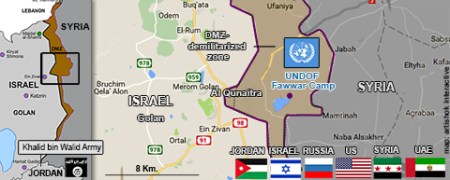
Although still at a preliminary stage, the talks have produced their first tangible result: A vanguard of the United Nations Disengagement Observer Force (UNDOF) has arrived on the Syrian side of the Golan. It has taken up position at its former Fawwar Camp base 4km east of Quneitra, which it evacuated during the Syrian fighting. The main body of the force, around 1,000 UN soldiers and 70 observers, is expected soon, to take up the task of reconstituting the former demilitarized zone that separated Israel and Syria under the 1974 armistice agreement.

This DMZ runs 80km along the Hermon range up to the Lebanese border in the north and down to the Israel-Syrian-Jordanian triangle in southern Syria up to the Jordanian border. In the 25km long Golan strip, between half a kilometer and 10 deep, the IDF and Syrian army were originally limited as to the number of soldiers and types of weaponry they are allowed to maintain. The strip will revert to Syrian civil administration under UNDOF control, and the Israeli-Syrian border crossing point will be reopened in the Quneitra area under the joint supervision of UN, Israeli and Syrian officers.

The military arrangements are still in discussion and changes may be introduced to this format.

The main obstacle to the return of pre-Syrian war conditions to this sensitive border region is the presence of radical Syrian rebel forces in southern Syria, mainly the Khalid bin Walid Army, whose leaders have sworn allegiance to Islamic State commander Abu Bakr al-Baghdadi.

These forces will face the option of accepting the authority of the Syrian army or fighting a win-or-die battle.

Israel has an additional, compelling interest in restoring the disengagement zone with Syria in that it leaves no room for the grab for a military presence opposite Israeli Golan and Galilee that was made in recent months by Iran and its Lebanese proxy, Hizballah, for the purpose of opening a new front for terrorist attacks against Israel – as DEBKAfile was first to reveal. .

An indirect clue to the secret diplomatic talks ongoing came from the Syrian ruler Bashar Assad in an interview he gave on Nov. 16 to a Portuguese radio station, when he said: “If –if – he [Trump] fights the terrorists, it is clear that we will be a natural ally, together with the Russians, Iranians and many other countries who want to defeat the terrorists.”

The parties with varying degrees of involvement in the restoration of the UN-controlled DMZ on the Golan border are, therefore, the incoming Trump administration, Moscow, Damascus, Amman, Abu Dhabi and Jerusalem. Russia, Jordan and the Emirates have gained relevance for the first time as a result of changes in the strategic balance engendered by the Syrian war.

Rockets on Golan, Pentagon flouts Obama, no truce

September 18, 2016

Rockets on Golan, Pentagon flouts Obama, no truce, DEBKAfile, September 17, 2016


syria_golankipat

The Pentagon and US army are not following the orders of their Commander-in-Chief Barack Obama in the execution of the military cooperation accord in Syria concluded by US Secretary of State John Kerry and Russian Foreign Minister Sergei Lavrov in Geneva on Sept. 12.

Five days after the truce they agreed would go into effect Monday, fighting was still raging Saturday, Sept. 17.

DEBKAfile was the only Western publication to foresee this eventuality in an article published on July 18.

It was already evident then that any military cooperation agreement between the two powers would be contingent on America exposing its intelligence-gathering methods to Russia – not just in Syria but worldwide.

As our military sources predicted, this new intelligence sharing arrangement would necessarily extend to the Syrian Air Force as a third partner.

In advance of the deal, Moscow deployed its aircraft carrier, the Admiral Kutzenov, post haste to Syrian waters, to make sure that the Joint Implementation Center set up by the Kerry-Lavrov deal for intelligence-sharing would also apply to the warplanes and cruise missiles on the carrier’s decks and its escort of missile cruisers.

This deal was perceived in Moscow as an opportunity to study the combat methods and tactics practiced by the US Navy and Air force in real battlefield conditions.

But this eventuality was far from the intentions of US security and intelligence chiefs at a time of deepening adversity between Washington and Moscow.

The remarks of State Department spokesman Mark Toner on Thursday, Sept. 5 hinted at these conflicting perceptions: “I don’t think anyone in the US government is necessarily taking at face value Russia’s – or certainly not the Syrian regime’s – commitment to this arrangement.” He went on to say: “What really matters here is that the president of the United States supports this agreement, and our system of government works in such a way that everyone follows what the president says.”

Is that really so?

The fact that Kerry’s spokesman found it necessary to emphasize that “everyone follows what the president says,” strongly indicated that not everyone in Washington was in fact obeying the president.

Such disobedience is almost unheard of and would never be admitted publicly. In this case, it is being kept carefully under wraps.

Defense Secretary Ashton Carter and Chairman of the US Chiefs of Staff Gen. Joseph F. Dunford will never on any account admit that, in the execution of military collaboration with Russia in the Syrian conflict, they are not exactly carrying out the president’s precise instructions.

syrianceasefire480

But Washington sources report that Defense Secretary Carter maintains that he can’t act against a law enacted by Congress. He was referring to the law that prohibits all military-to-military relations with Russia as a result of Moscow’s annexation of the Crimea region of Ukraine.

According to DEBKAfile’s military sources, they are simply dragging their feet in ground operations. This is driving Vladimir Putin and his generals into fits of rage.

Friday, Sept 16, Lavrov accused the US of “stalling on its promise to separate moderate rebel groups in Syria from terrorists,” adding, “US progress in delivering on the promise is slow.”

Saturday, Putin himself burst out that the rebels were “regrouping under the ceasefire.” He put the blame on those “rebels” for the failure of the agreed truce to take effect after five days.

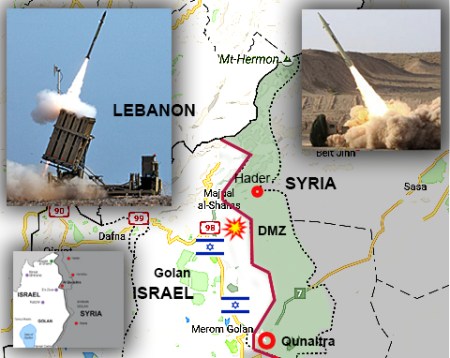
Our military and intelligence sources see a connection between Putin’s angry outburst and the rising tensions on the Syrian-Israeli border in the past week, culminating in the two Syrian rockets that were shot down Saturday over the Golan by Israel’s Iron Dome batteries.

For some time, the Russians and Syrians have made no bones about their objection to Israel’s policy of supporting a motley assortment of Syrian rebel groups in southern Syria close to its border. Among these groups is Al Qaeda’s Syrian arm Jabhat Al-Nusra (the Nusra Front) that has renamed itself Jahat Fath Al-Sham.

Whatever Assad, Iran or Hizballah may accept or reject, President Putin utterly refuses to tolerate Israel allowing the Nusra Front to control parts of this border sector.

Therefore, the rockets and missiles apparently “straying” across the border onto the Golan may well multiply in the coming days.

Yet another complication raised its head over the weekend when the US-backed rebel militia, the Free Syrian Army, vented its fury over the Kerry-Lavrov truce deal by driving away American Special Operations troops helping them in the battle for Al-Rai and abusing them as “infidels.”

The US blames the Russian leader for failing to force Bashar Assad to hold his fire and to let emergency supplies reach the beleaguered population in Aleppo, thereby undermining their ceasefire accord.

But it is becoming evident that the brutal standoff in Syria will be sustained until Putin is satisfied that the US is cooperating with Russian forces in Syria and the Mediterranean region in all spheres.

Before he decides to lean hard on Assad to cease hostilities, he will want to see the White House twisting the arms of the Pentagon and US forces to play ball in the most sensitive spheres.

Hizballah units regroup on Israel’s Golan border

September 7, 2016

Hizballah units regroup on Israel’s Golan border, DEBKAfile, September 7, 2016

qunetrafront

DEBKAfile’s military sources note that the Iranian media attached photos of Israel’s security force opposite Quneitra to their reporting on the new move, thereby framing the target of the Syrian-Iranian-Backed Hizballah build-

***********************

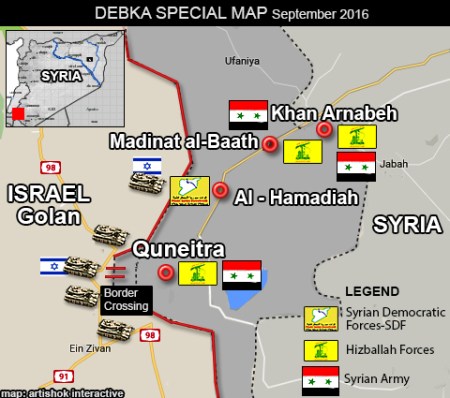
A large Hizballah force, backed by the Syrian army and pro-Iranian Shiite militias, is building up outside Quneitra, just 2km from Israel’s Golan border. The Lebanese Shiite fighters, under the command of Iranian Revolutionary Guards (IRGC) officers, are streaming into southern Syria, armed with tanks and artillery.

Monday night, Sept. 5, Iranian state-controlled media shed light on this movement, reporting that the combined force had “completed preparations necessary for an extensive operation in southern Syria,” adding, “Hizballah aims to put an end to the presence of armed men in the area close to the border.”

The nature of the “armed men” was not specified, but the goal of the new operation was clear: after evicting the assorted anti-Assad groups, including the Islamic State, holding territory “close to the border,” Hizballah and its backers planned to regroup on the Syrian-Israeli boundary.

This would position Iran and its Hizballah surrogate ready to realize their six-year old design, which is to open a second warfront against Israel.

Western and Mid East sources have toldl DEBKAfile that the triple army is in high spirits after last week’s successful operation in Aleppo. By snatching back parts of the city they lost in mid-August, the Syrian army and its allies managed to cut off the rebels’ supply lines from Turkey.

It was then that some Hizballah units were detached from the Aleppo arena and redirected to the Quneitra front in southern Syria to face the Israeli border.

israeliborder480

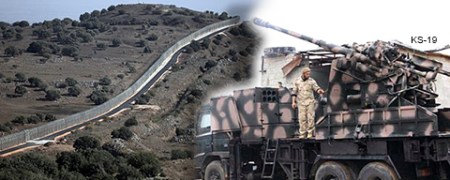
Those sources report that the incoming troops were sighted this week when they arrived at Madinat al-Baath and Khan Amabeh, the main Syrian army bases on the Syrian Golan. They came with tanks and heavy artillery. Seen for the first time in the Quentra sector were heavy, self-propelled KS-19 artillery batteries, which are Russian anti-air guns adapted to ground warfare. They have a range of 21km and a firing capacity of 15 shells per minute.

The newly-arrived Hizballah force appears to have set the capture of Syrian rebel-held al-Hamdiniyah 2km from the Israeli border, as its first objective.

DEBKAfile’s military sources note that the Iranian media attached photos of Israel’s security force opposite Quneitra to their reporting on the new move, thereby framing the target of the Syrian-Iranian-Backed Hizballah build-up.

This fast-approaching development poses two tough questions:

1. Will Israel lie down for the avowedly hostile Hizballah and Iran to occupy territory along its eastern border?Israel officials have repeatedly emphasized that these forces would not be allowed to take up positions on the Golan border, a message Russia most certainly passed on to Damascus.

If Hizballah and its allies go through with their planned offensive, Israel will have to consider serious military action to prevent them from reaching the border fence, i.e., an operation on a scale quite different from the small-shot IDF reprisals for rockets or shells straying across into the Golan from fighting on the other side.

2. Will the advancing Iranian-led force have Syrian air cover? If it does, the Israeli Air Force will also be involved in aerial combat over the Golan.

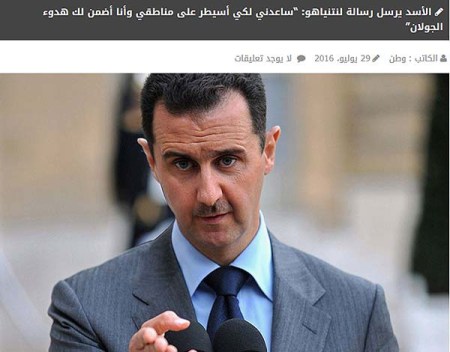
Assad to Netanyahu: Help Me Keep my Seat and I Guarantee You a Calm Golan

July 30, 2016

Assad to Netanyahu: Help Me Keep my Seat and I Guarantee You a Calm Golan, JNi.Medi via Jewish Press, July 30, 2016

(But what about Iran? — DM)

assad to Israel“Assad sends a message to Netanyahu: ‘Help me to control my region and I guarantee you a calm Golan.'”

A Kuwaiti news website on Friday cited a source saying Israeli Prime Minister Benjamin Netanyahu has received a message from Syrian President Bashar al-Assad, in which Assad vowed to keep the Golan as a demilitarized zone, and the rest of Syria committed to a cease-fire with Israel, if Netanyahu commits to not engaging Israel in an effort to topple Assad.

The source commented that Assad was saying to Netanyahu, in effect: “Help me to control my region and I guarantee calm for Israel in the Golan Heights.”

Commenting on rumors that former US ambassador to Israel Martin Indyk is slated to be President Hillary Clinton’s special envoy on the peace process between Israel and its neighbors, the source told the news website that Israel is very concerned over a report that was prepared by Indyk for President Bill Clinton about the Golan Heights. Israel is anxious to point US attention to the fact that the situation on south Syria and south Lebanon has been altered by the five-year civil war, and American notions about returning the Golan to Syria are absurd under these circumstances. Assad apparently wishes to take advantage of an opportunity to strike a deal with the Israelis to secure their neutrality in the war.

Meanwhile, Politico.eu reported Saturday that Saudi Arabia’s Foreign Minister Adel Al-Jubeir said his country is offering Russia access to the Gulf Cooperation Council Market and regional investment funds in return for pulling its support for the Assad regime.

“We are ready to give Russia a stake in the Middle East that will make Russia a force stronger than the Soviet Union, greater than China’s,” the Saudi minister said, adding, “It would be reasonable for Russia to say, that’s where our relations will advance our interests, not with Assad. We don’t disagree on the end game in Syria but on how to get there. Assad’s days are numbered,” he urged, “so make a deal while you can.”

Has the IDF hit the Basij forces commander General Naghdi?

July 30, 2016

Has the IDF hit the Basij forces commander General Naghdi? DEBKAfile, July 30, 2016

EinZivan2 (1)

Gen. Naghdi’s visit to Quneitra undoubtedly presaged some decisions in Tehran with regard to direct Hizballah-Syrian-Iranian action against Israel.

The Iranian, Syrian and Hizballah agencies accuse Israel of the attack because the say it was executed by two Nimrod anti-tank long-range missiles, manufactured by the Israeli Aerospace Industry, for use by the IDF against armored vehicles, ships, bunkers and troop concentrations.

*****************

Iranian, Syrian and Hizballah sources are intimating that the “Syrian officer” injured on July 26 in Quneitra by Israel’s double Nimrod’ missile shot was none other than Revolutionary Guards Gen. Muhammad Resa Naghdi, head of the paramilitary Organization for the Mobilization of the Oppressed, also known as the Basij, which falls under the Islamic Revolutionary Guard Corps (IRGC). The victim was earlier described officially as a Syrian officer.

If he was indeed hurt or killed by an Israeli rocket, Naghdi would become the highest-ranking IRGC general ever hit by the IDF.

On July 27, the semi-official Fars news agency reported that a top Iranian general recently visited the Israeli-Syrian border to tour Quneitra and the Golan demarcation lines between Syria and Israel – the first time the Tehran government had publicized a visit by a senior regime official to the area.

It may be presumed, DEBKAfile’s intelligence sources say, that someone at the IDF lookout posts spotted and reported on Gen. Naghdi’s arrival with an entourage in Quneitra on July 26 and saw him inspecting through binoculars the IDF defense positions. He was then quickly identified.

Any decision to go after a high-ranking Iranian would not have been left to local IDF commanders or even OC Northern Command Maj. Gen. Aviv Kohavi, but passed straight to Prime Minister Binyamin Netanyahu, Defense Minister Avigdor Lieberman and Chief of Staff Lt. Gen. Gady Eisenkot – especially in this case.

General Naghdi is not just another Iranian general. He heads the more than a million-strong Basij militia, which is a pillar of the ayatollahs regime in Tehran, and the backbone of the Iranian internal security forces which maintain the regime’s total control in every corner of the Islamic Republic.

Gen. Naghdi’s visit to Quneitra undoubtedly presaged some decisions in Tehran with regard to direct Hizballah-Syrian-Iranian action against Israel.

The IDF is holding its silence on reports of his injury, declining as usual to comment on reports by foreign publications.

The Iranian, Syrian and Hizballah agencies accuse Israel of the attack because the say it was executed by two Nimrod anti-tank long-range missiles, manufactured by the Israeli Aerospace Industry, for use by the IDF against armored vehicles, ships, bunkers and troop concentrations..

The missile has a semi-active laser guidance system, and is able to operate day and night. Its flight path can be below the clouds, while its operators far behind use a laser to guide it to target.

The launcher platform, with four missiles, can be installed on a Jeep, weapon-bearing vehicle, Abir, or armored vehicles. In addition, it is possible to send it from CH-53 ‘Yasur’ helicopter.

Israel has acted in the past against the establishment of an Iranian and/or Hizballah military presence on its Golan doorstep. On Jan. 19, 2015, an IDF air strike killed the Iranian Brig. Gen, Mohammad Ali Allahdadi and six Hizballah officers while they were on a tour of inspection near Quneitra.

Thursday, July 28, DEBKAfile ran an exclusive report on rising Israel-Russia tensions centering on southern Syria and the Golan.

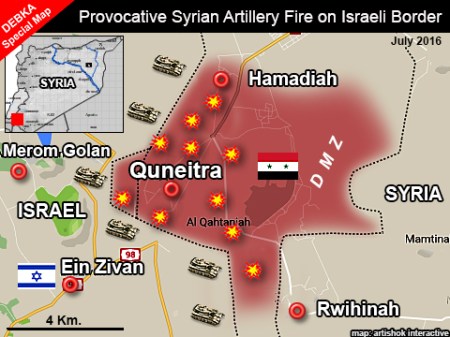
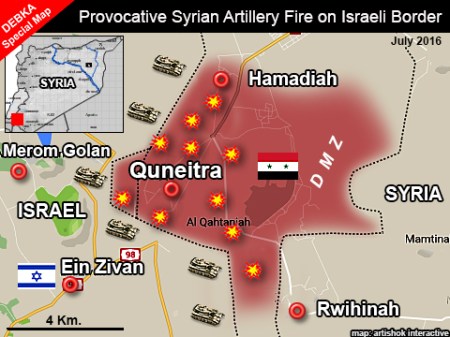
For four days since July 25, the Syrian army has been continuously firing artillery batteries – moved close to Israel’s defense lines on the Golan border – in a manner that comes dangerously close to provoking an Israeli response. This carefully orchestrated Syrian campaign goes on around the clock.

It is the first time in the six years of the Syrian war that Bashar Assad has ventured to come near to provoking Israel. But now he appears to be emboldened by his Russian ally.

The IDF is holding its fire for the moment. But Israeli military and government leaders know that the time is near for the IDF to be forced to hit back, especially since it is becoming evident that the Syrian army’s steps ae backed by Russia.

DEBKAfile’s military sources provide details of the Syrian steps:

  • The Syrian army’s 90th and 121nd battalions have been firing their artillery batteries non-stop across a 10km band along the Golan border from Hamadia, north of Quneitra, up to a point facing the Israeli village of Eyn Zivan. (See attacked map).
    This means that the Syrian army has seized the center of buffer zone between Israel and Syria and made it a firing zone.
  • This artillery fire fans out across a radius that comes a few meters short of the Israeli border and the IDF troops stationed there. It then recedes to a distance of 500 to 600 meters and sweeps across the outposts and bases of the Syrian rebel forces believed to be in touch with Israel or in receipt of Israeli medical aid.
  • The new Syrian attack appears to hold a message for Jerusalem: For six years, you supported the rebels against the Assad regime in southern Syria. That’s now over. If you continue, you will come face to face with Syrian fire.
  • Damascus is also cautioning those rebels:  For years, you fought us with Israel at your backs. But no longer. Watch us bring you under direct artillery fire, while the IDF sits on its hands.
  • On July 26, Russian media published an article revealing that Russia had delivered to the Syrian Air Force, advanced SU-24M2 front-line bombers, which is designed for attack on frontlines of battle. Israeli officials were unpleasantly taken aback by the news. Up until now, the Russians and Syrians refrained from deploying air strength in South Syria near the Israeli border. Now the Syrian air force has the means to do so.
  • DEBKAfile military sources report that the SU-24M2, following recent upgrades and modifications in Russian factories, is now capable of dropping smart bombs – ballistic bombs with a guidance system on their tails that enable them to hit targets with precision.This guidance system does not rely on US GPS satellites but rather the equivalent Russian GLONASS system which is linked to a network of 21 Russian satellites and partially encrypted for military usages.
    In addition, the SU-24M2 is equipped with a system that projects the information the pilot needs (flight details and battle details) on the plane’s windshield (head-up display) and on the pilot’s visor.
  • The Russians delivered to the Syrians two of these sophisticated airplanes this week, out of 10 that they will supply soon.

The IDF has concluded that it is only a matter of time before these planes appear in Southern Syria and so generate a new and highly combustible situation on Israel’s northern and northeastern borders.

The Russians are colluding with Damascus to inform Israel that it will no longer be allowed by either to continue backing the rebel forces in southern Syria or sustain the buffer zone which they man.

Israel may pay dear if Prime Minister Binyamin Netanyahu, Defense Minister Avigdor Lieberman, and Chief of Staff Lt. Gen. Gadi Eisenkot decide to continue to abstain from hitting back at the Syrian fire which is aimed every few hours at the vicinity of IDF posts or the impending arrival of Russian bombers. The price in store would be the weakening of the IDF’s hold on the Golan border.

Syrian-Russian Provocations Could Spark Golan Clash

July 28, 2016

Syrian-Russian Provocations Could Spark Golan Clash, DEBKAfile, July 28, 2016

EinZivan2

For four days since July 25, the Syrian army has been continuously firing artillery batteries – moved close to Israel’s defense lines on the Golan border – in a manner that comes dangerously close to provoking an Israeli response. This carefully orchestrated Syrian campaign goes on around the clock.

It is the first time in the six years of the Syrian war that Bashar Assad has ventured to come near to provoking Israel. But now he appears to be emboldened by his Russian ally.

The IDF is holding its fire for the moment. But Israeli military and government leaders know that the time is near for the IDF to be forced to hit back, especially since it is becoming evident that the Syrian army’s steps ae backed by Russia.

DEBKAfile’s military sources provide details of the Syrian steps:

  • The Syrian army’s 90th and 121nd battalions have been firing their artillery batteries non-stop across a 10km band along the Golan border from Hamadia, north of Quneitra, up to a point facing the Israeli village of Eyn Zivan. (See attacked map).
    This means that the Syrian army has seized the center of buffer zone between Israel and Syria and made it a firing zone.
  • This artillery fire fans out across a radius that comes a few meters short of the Israeli border and the IDF troops stationed there. It then recedes to a distance of 500 to 600 meters and sweeps across the outposts and bases of the Syrian rebel forces believed to be in touch with Israel or in receipt of Israeli medical aid.
  • The new Syrian attack appears to hold a message for Jerusalem: For six years, you supported the rebels against the Assad regime in southern Syria. That’s now over. If you continue, you will come face to face with Syrian fire.
  • Damascus is also cautioning those rebels:  For years, you fought us with Israel at your backs. But no longer. Watch us bring you under direct artillery fire, while the IDF sits on its hands.
  • On July 26, Russian media published an article revealing that Russia had delivered to the Syrian Air Force, advanced SU-24M2 front-line bombers, which is designed for attack on frontlines of battle. Israeli officials were unpleasantly taken aback by the news. Up until now, the Russians and Syrians refrained from deploying air strength in South Syria near the Israeli border. Now the Syrian air force has the means to do so.
  • DEBKAfile military sources report that the SU-24M2, following recent upgrades and modifications in Russian factories, is now capable of dropping smart bombs – ballistic bombs with a guidance system on their tails that enable them to hit targets with precision.This guidance system does not rely on US GPS satellites but rather the equivalent Russian GLONASS system which is linked to a network of 21 Russian satellites and partially encrypted for military usages.
    In addition, the SU-24M2 is equipped with a system that projects the information the pilot needs (flight details and battle details) on the plane’s windshield (head-up display) and on the pilot’s visor.
  • The Russians delivered to the Syrians two of these sophisticated airplanes this week, out of 10 that they will supply soon.

The IDF has concluded that it is only a matter of time before these planes appear in Southern Syria and so generate a new and highly combustible situation on Israel’s northern and northeastern borders.

The Russians are colluding with Damascus to inform Israel that it will no longer be allowed by either to continue backing the rebel forces in southern Syria or sustain the buffer zone which they man.

Israel may pay dear if Prime Minister Binyamin Netanyahu, Defense Minister Avigdor Lieberman, and Chief of Staff Lt. Gen. Gadi Eisenkot decide to continue to abstain from hitting back at the Syrian fire which is aimed every few hours at the vicinity of IDF posts or the impending arrival of Russian bombers. The price in store would be the weakening of the IDF’s hold on the Golan border.

IDF bulldozers with tanks enter Golan DMZ

July 13, 2016

IDF bulldozers with tanks enter Golan DMZ, DEBKAfile, July 13, 2016

GolanIsrael_Zone

Israeli military bulldozers backed by tanks have crossed into the demilitarized zone dividing the Israeli and Syrian Golan borders. They are building a line of fortifications and anti-tank trenches 300-500 meters inside the DMZ.

This is the first time in the six-year Syrian war that the IDF has openly operated on the Syrian side of the border. The force has not so far run into opposition- or indeed any word of protest – or even mention – by Assad regime officials in Damascus.

The sole reference to Israeli military movements in the DMZ has come from a small Syrian rebel group which described them.

DEBKAfile’s military sources report that the IDF operation was still going forward Wednesday, July 12, on a patch of terrain facing the Israeli Golan village of Ein Zivan, on the one hand, and the Syrian town of Quneitra, on the other.

The enclave splitting the Golan between Syria and Israel is defined in the 1974 armistice agreements as a demilitarized zone under the military control of the UN Disengagement Observer Force (UNDOF) and Syrian civilian administration. It is bounded by two strips of land around 10km deep where each side is permitted to maintain diluted military strength. No ground-to-air missiles may be deployed inside a 25km radius from the DMZ.

It was agreed that Syrian nationals forced by the October 1973 war and its aftermath to leave their homes would be able to return. Ruined Quneitra was later handed back to Syria against a commitment by its government to repopulate the town and ban terrorist activity and infiltrations of Israel from the Golan sector.

Both commitments were given orally to the US government.

However, the Syrian war as it unfolded in the last two years turned the deal on its head. The UN observers abandoned their posts, leaving behind a void that was partly filled by Syrian troops and a motley assortment of rebel groups.

But the DMZ was left mostly unoccupied as both Israel and Syria tried to preserve at least the semblance of the deal intact. However, Assad’s allies Iran and Hizballah have repeatedly attempted to plant a forward military and terrorist presence opposite Israel’s Golan defense lines – with avowed hostile intent.

The silence from Damascus on Israel’s military steps on the Golan may be no more than a respite as the Syrian ruler waits for Tehran’s endorsement of joint Syrian-Iranian-Hizballah counteraction.

Our sources add that IDF military steps on the ground were accompanied by unusual Israeli Air Force movements over Syria and Lebanon, and elevated preparedness on the 10th anniversary this week of the Lebanon war fought between Hizballah and Israel.

It was noted that Hizballah refrained from celebrating the occasion and omitted its customary boasts of a “great victory” – thereby intensifying the sense in Israeli military circles that Iran’s Lebanese proxy may be cooking up a surprise operation.

Iranians and Walid suicide units on Golan border

July 8, 2016

Iranians & Walid suicide units on Golan border, DEBKAfile, July 8, 2016

GolanIsrael_military

A flurry of false Hizballah claims amid rising military tension this week was designed to cover up a direct Israeli hit of the Iranian Revolutionary Guards HQ in South Syria, DEBKAfile military and intelligence sources disclose.

Whereas Hizballah reported on July 5 that Israeli helicopters had attacked Syrian army positions near the Golan town of Quneitra, in fact, one of the two Israeli “Tamuz” IDF rockets fired on July 4, in response to stray cross-border Syrian army mortar shells, struck the Syrian Ministry of Finance building near Quneitra, which housed Iranian Guards and Hizballah regional headquarters. An unknown number of Iranian officers were killed as a result.

On July 6, Hizballah sources reported a high level of tension at its east Lebanese outposts in Hasbaya, al-Qarqoub and Mount Hermon, indicating possible preparations to retaliate for the Iranian casualties.

The mortar shells that occasionally stray into Israel are aimed by the Syrian forces in Quneitra at Syrian rebel engineering units, which are digging an anti-tank trench on the town’s southern edge to prevent Syrian tanks from mounting an all-out assault against them (See attached map).

These skirmishes are put in the shade by the dangerous gains by Islamist terrorists in southern Syria.

Both ISIS and al-Qaeda’s Nusra Front have overrun the entire Syrian strip bordering on Israel and Jordan – a distance of 106km from Daraa up to the Druze villages of Mount Hermon.

The Islamists have seized control of this strategic borderland by taking advantage of the fighting between Syrian army and Syrian rebel forces in southern Syria.

Israel and Jordan were also remiss. The IDF and the Jordanian Army were so busy trying to prevent the Syrian army, the Iranian Revolutionary Guards and Hizballah from encroaching on their northern defense lines in northern Jordan and the Golan that they failed to notice the Islamic terrorists creeping up on their borders.

The terrorist presence which Israel finds most alarming is that of the “Khaled Bin Al-Walid Army” – a militia linked to both ISIS and al-Qaeda, which now controls a 36km band bordering on central and southern Golan from south Quneitra to the Jordan-Israel-Syria tri-border area – opposite Hamat Gader and Shaar HaGolan (See map).

The Khaled Bin Al-Walid Army was spawned by a union between the Islamist Liwa Shouada Yarmouk and Mouthana Islamic Movement militias. Its commander is Abu Abdullah al-Madani,  a Palestinian from Damascus, who is one of al-Qaeda’s veteran fighters. Close to Osama Bin-Laden, he fought with hhimagainst the Americans when they invaded Afghanistan 15 years ago. Ten years ago, he moved to Iraq, still fighting Americans, now alongside the al-Qaeda commander Abu Musab al-Zarqawi.

When al-Qaeda was defeated in Iraq, al-Madani moved to Syria.

DEBKAfile counter terror sources report that this veteran of Islamist terrorism, who is believed to be in touch wit Bin Laden’s successor Ayman al Zawahri, is active in three areas:

1. He is purchasing and stockpiling chemical weapons – a high priced commodity frequently traded among various Syrian rebel organizations.

2. Abu Abdullah al-Madani is recruiting from his militia suicide units for which he is personally training for operations inside Israel. DEBKAfile sources say that his plan is being taken very seriously by Israel security chiefs.

3. He is maintaining operational ties with Al Nusra commanders in the border region, possibly seeking access to the Israeli border through their turf for his chemical weapons and suicide units.

More airports under ISIS threat after Istanbul

June 29, 2016

More airports under ISIS threat after Istanbul, DEBKAfile, June 29, 2016

istanbul-dead

The US, Europe and the Middle East are again refusing to connect the dots of the terrorist threat, recalling the denial that marked the peak period of Al Qaeda’s atrocities in the early 2000’s.

When the US Defense Secretary Ashton Carter trumpeted the Fallujah victory over the Islamic State on June 27, he neglected to disclose that the real victors were Iranians – not Iraqis. The next day, an ISIS suicide attack on Istanbul’s Ataturk airport overshadowed that success, killing at least 41 people including 13 foreign nationald and injuring more than 230.

As the Obama administration labored to conceal from the public in the West its strategy of using Shiite forces to hammer ISIS in Iraq and parts of Syria, the Sunni terrorists retaliated in Istanbul – and not just there.

Seven ISIS suicide bombers, some on motorcycles, exploded on Monday, June 27, in a Christian village in the Lebanon Valley near Baʿalbek. A week earlier, an ISIS suicide bomber blew himself up at the gates of a large Jordanian military base on the Syrian border.

The connection between the ISIS arenas and cause and event is there for anyone who wants to see it.

ISIS has a ready store of suicide bombers who are willing to blow themselves up, not just because they are ‘extreme fanatics’ or “thugs” as President Obama insists on defining them, but because they believe they are fighting a religious war: Sunnis against Shiites, Sunnis against Christians and Sunnis against Jews.

On this point, Obama is in denial.

Turkey’s Sunni President Tayyip Erdogan was swiftly punished for concluding a political-military-intelligence agreement with the Jewish state. That same day, three suicide bombers, probably waiting for months at a safe house near the Istanbul airport, were ordered from ISIS Syrian headquarters in Raqqa, to go into action.

Neither the dense US intelligence net in the region, nor Turkish and Israeli intelligence managed to intercept the order.

DEBKAfile intelligence sources point out that the highly secure Ataturk airport, the third largest in Europe, is not the only one on the continent at which ISIS suicide units are lurking ready to strike.

American-European intelligence input points to their presence near at least two or three other airports in Europe. The problem is that the intel is very general, pointing to intent, with no specifics on countries or airports.

The public in the West and Middle-East are not told either about the ‘small’ victories scored by ISIS on the battle field. For instance, ISIS forces managed to block the Syrian-Hizballah advance towards the highway leading from Palmyra to Raqqa, inflicting heavy losses despite Russian air cover.

In Israel, where security awareness is usually high, no one was told about the successful ISIS engagement at the Syria-Jordan-Israel border junction bordering on the Israeli Golan against US-trained and armed Syrian rebels, who fought under artillery cover from Jordan.

In other words, ISIS has established itself on the Israeli border, a few kilometers away from the Sea of Galilee and Tiberius.

The Islamic State is fully geared to respond to such losses as Fallujah by going for strategic gains on the ground and inflicting horrible retribution on its victims by remotely activating sleeper cells of suicide killers.

Rather than being degraded, as Obama claims, ISIS is fully equipped to target its victims across several continents.

On Tuesday Istanbul airport was its chosen target. Now, we must wait and see who is next.

Iran’s Chess Board

June 3, 2016

Iran’s Chess Board, Front Page MagazineCaroline Glick, June 3, 2016

official_photo_of_hassan_rouhani_7th_president_of_iran_august_2013

Even if Obama’s successor disavows his actions, by the time Obama leaves office, America’s options will be more limited than ever before. Without war, his successor will likely be unable to stem Iran’s rise on the ruins of the Arab state system.

********************

Reprinted from jpost.com.

Strategic thinking has always been Israel’s Achilles’ heel. As a small state bereft of regional ambitions, so long as regional realities remained more or less static, Israel had little reason to be concerned about the great game of the Middle East.

But the ground is shifting in the lands around us. The Arab state system, which ensured the strategic status quo for decades, has collapsed.

So for the first time in four generations, strategy is again the dominant force shaping events that will impact Israel for generations to come.

To understand why, consider two events of the past week.

Early this week it was reported that after a two-year hiatus, Iran is restoring its financial support for Islamic Jihad. Iran will give the group, which is largely a creation of the Iranian Revolutionary Guard Corps, $70 million.

On Wednesday Iranian media were the first to report on the arrest of a “reporter” for Iran’s Al-Alam news service. Bassam Safadi was arrested by Israel police in his home in Majdal Shams, the Druse village closest to the border with Syria on the Golan Heights. Safadi is suspected of inciting terrorism.

That is, he is suspected of being an Iranian agent.

There is nothing new about Iranian efforts to raise and run fronts against Israel within its territory and along its borders. Iran poses a strategic threat to Israel through its Hezbollah surrogate in Lebanon, which now reportedly controls the Lebanese Armed Forces.

In Gaza, Iran controls a vast assortment of terrorist groups, including Hamas.

In Judea and Samaria, seemingly on a weekly basis we hear about another Iranian cell whose members were arrested by the Shin Bet or the IDF.

But while we are well aware of the efforts Iran is making along our borders and even within them to threaten Israel, we have not connected these efforts to Iran’s actions in Iraq and Syria. Only when we connect Iran’s actions here with its actions in those theaters do we understand what is now happening, and how it will influence Israel’s long-term strategic environment.

The big question today is what will replace the Arab state system.

Syria, Iraq, Lebanon, Yemen and Libya no longer exist. On their detritus we see the fight whose results will likely determine the fates of the surviving Arab states, as well as of much of Europe and the rest of the world.

Israel’s strategic environment will be determined in great part by the results of Iran’s actions in Iraq and Syria. While Israel can do little to affect the shape of events in these areas, it must understand what they mean for us. Only by doing so, will we be able to develop the tools to secure our future in this new strategic arena.

Until 2003, Saddam Hussein was the chief obstacle to Iran’s rise as the regional hegemon.

US forces in Iraq replaced Hussein until they left the country in 2011. In the meantime, by installing a Shi’ite government in Baghdad, the US set the conditions for the rise of Islamic State in the Sunni heartland of Anbar province on the one hand, and for Iran’s control over Iraq’s Shi’ite-controlled government and armed forces on the other.

Today, ISIS is the only thing checking Iran’s westward advance. Ironically, the monstrous group also facilitates it. ISIS is so demonic that for Americans and other Westerners, empowering Iranian-controlled forces that fight ISIS seems a small price to pay to rid the world of the fanatical scourge.

As former US naval intelligence analyst J.E. Dyer explained this week in an alarming analysis of Iran’s recent moves in Iraq published on the Liberty Unyielding website, once Iranian- controlled forces defeat ISIS in Anbar province, they will be well placed to threaten Jordan and Israel from the east. This is particularly the case given that ISIS is serving inadvertently as an advance guard for Iran.

In Syria, Iran already controls wide swaths of the country directly and through its surrogates, the Syrian army, Hezbollah and Shi’ite militias it has fielded in the country.

Since the start of the war in Syria, Israel has repeatedly taken action to block those forces from gaining and holding control over the border zone on the Golan Heights.

Prime Minister Benjamin Netanyahu’s surprising recent announcement that Israel will never relinquish control over the Golan came in response to his concern that in exchange for a cease-fire in Syria, the US would place that control on the international diplomatic chopping block.

A week and a half ago, Iran began its move on Anbar province.

On May 22, Iraqi forces trained by the US military led Iraq’s offensive to wrest control over Fallujah and Mosul from ISIS, which has controlled the Sunni cities since 2014. Despite the fact that the lead forces are US-trained, the main forces involved in the offensive are trained, equipped and directed by Iran.

As Iraqi forces surrounded Fallujah in the weeks before the offensive began, Qassem Soleimani, the commander of the Revolutionary Guards’ Quds forces, paid a public visit to the troops to demonstrate Iran’s dominant role.

The battle for Fallujah is a clear indication that Iran, rather than the US, is calling the shots in Iraq. According to media reports, the Pentagon wanted and expected for the forces to be concentrated in Mosul. But at the last minute, due to Soleimani’s intervention, the Iraqi government decided to make Fallujah the offensive’s center of gravity.

The Americans had no choice but to go along with the Iranian plan because, as Dyer noted, Iran is increasingly outflanking the US in Iraq. If things follow their current course, in the near future, Iran is liable to be in a position to force the US to choose between going to war or ceasing all air operations in Iraq.

On May 7, Asharq al-Awsat reported that the Revolutionary Guards is building a missile base in Suleimaniyah province, in Iraqi Kurdistan.

A senior IRGC general has made repeated visits to the area in recent weeks, signaling that the regime views this as an important project. The report further stated that Iran is renewing tunnel networks in the region, built during the 1980-88 Iran-Iraq War.

Dyer warned that depending on the type of missiles Iran deploys – or has deployed – to the base, it may threaten all US air operations in Iraq. And the US has no easy means to block Iran’s actions.

To date, commentators have more or less agreed that US operations in Iraq and Syria make no sense. They are significant enough to endanger US forces, but they aren’t significant enough to determine the outcome of the war in either territory.

But there may be logic to this seemingly irrational deployment that is concealed from view. A close reading of David Samuels’s profile of President Barack Obama’s Deputy National Security Adviser Ben Rhodes published last month in The New York Times, points to such a conclusion.

Samuels described Rhodes as second only to Obama in his influence over US foreign and defense policy. Rhodes boasted to Samuels that Obama’s moves toward Iran were determined by a strategic course he embraced before he entered office.

A fiction writer by training, Rhodes’s first “national security” job was as the chief note taker for the Iraq Study Group.

Then-president George W. Bush appointed the group, jointly chaired by former secretary of state James Baker and former congressman Lee Hamilton, in 2006, to advise him on how to extricate the US from the war in Iraq.

In late 2006, the ISG published its recommendations.

Among other things, the ISG recommended withdrawing US forces from Iraq as quickly as possible. The retreat was to be enacted in cooperation with Iran and Syria – the principle sponsors of the insurgency.

The ISG argued that if given the proper incentives, Syria and Iran would fight al-Qaida in Iraq in place of the US. For such action, the ISG recommended that the US end its attempts to curb Iran’s nuclear program.

Responsibility for handling the threat, the ISG recommended, should be transferred to the US Security Council.

So, too, the ISG recommended that Bush pressure Israel to withdraw from the Golan Heights, Jerusalem and Judea and Samaria in the framework of a “peace process.”

Such action too would serve to convince Iran and Syria that they could trust the US and agree to serve as its heirs in Iraq.

Bush of course, rejected the ISG’s recommendations.

He decided instead to sue for victory in Iraq. Bush announced the surge in US forces shortly after the ISG published its report.

But now we see, that through Rhodes the Iraq Study Group’s recommendation became the blueprint for a new US strategy of retreat and Iranian ascendance in Iraq and throughout the Middle East.

The chief components of that strategy have already been implemented. The US withdrawal from Iraq in 2011 left Iran as the new power broker in the country. The nuclear pact with Iran facilitated Iran’s transformation into the regional hegemon.

Against this strategic shift, the US’s minimalist campaigns in Iraq and Syria against ISIS make sense.

The US forces aren’t there to defeat ISIS, but to conceal Iran’s rise.

When ISIS is defeated in Anbar and in Raqqa in Syria, its forces are liable to turn west, to Jordan.

The US is currently helping Jordan to complete a border fence along its border with Iraq. But then ISIS is already active in Jordan.

And if events in Iraq and Syria are any guide, where ISIS leads, Iran will follow.

Iran’s strategic game, as well as America’s, requires Israel to become a strategic player.

We must recognize that what is happening in Iraq is connected to what is happening here.

We need to understand the implications of the working alliance Obama has built with Iran.

Even if Obama’s successor disavows his actions, by the time Obama leaves office, America’s options will be more limited than ever before. Without war, his successor will likely be unable to stem Iran’s rise on the ruins of the Arab state system.

In this new strategic environment, Israel must stop viewing Gaza, Judea and Samaria, the Golan Heights and Lebanon as standalone battlefields. We must not be taken in by “regional peace plans” that would curtail our maneuver room. And we must bear in mind these new conditions as we negotiate a new US military assistance package.

The name of the game today is chess. The entire Middle East is one great board. When a pawn moves in Gaza, it affects the queen in Tehran.

And when a knight moves in Fallujah, it threatens the queen in Jerusalem.