PM Netanyahu’s Remarks to the Washington Institute for Near East Policy, via You Tube, May 2, 2015
Archive for the ‘Gaza’ category
IDF strikes Gaza in response to rocket fire
April 24, 2015IDF strikes Gaza in response to rocket fire
By Yoav Zitun 04.24.15, 00:26 Via YNet News

(‘Not Hamas, merely rebellious elements in the strip’. I was once one of many rebellious elements in school, but I don’t remember any of us firing any rockets. – LS)
In retaliation for first rocket attack of 2015, Israeli military attacks Hamas position in Beit Hanoun.
After four months of quiet, a rocket was fired on Thursday evening from Gaza towards communities in southern Israel. The rocket exploded in an open field in the Sha’ar Ha Negev Regional Council. There were no injuries or damages reported.
Close to midnight on Thursday, the IDF tanks attacked a Hamas position in the northern Gaza Strip in retaliation for the rocket that landed in southern Israel a few hours earlier.
The IDF said in a statement that it “will not condone any effort to harm the security of the people of Israel.”
Palestinian sources reported that the artillery shelling hit an open area near Beit Hanoun, the site of the rocket which was launched on Israel.
According to an initial IDF investigation, Hamas was not involved in the rocket fire, which was likely initiated by rebellious elements in the Strip. Due to the rocket fire, Israel will not allow passage for Gazan worshippers to the Temple Mount in Jerusalem.
The IDF sources believed that like in previous incidents since the end of Operation Protective Edge in August, the rocket fire was a one-time incident which does not signal an escalation. Hamas has shown restraint in recent months and actively worked to prevent elements within the Strip from approaching the barrier with Israel.
In recent days Hamas has executed a wave of arrests of Salafists in the Strip, following a series of explosions across Gaza. Hamas’ security forces have searched relentlessly for those responsible but the identity of the mastermind behind the attacks remains unclear.
According to Salafi sources, 13 of their members were arrested, and it is possible the rocket fire on Israel tonight was intended to embarrass Hamas over the arrests.
Alon Shuster, the head of the regional council, told Ynet: “This is an aberration and its consequences are unclear. There is no panic among the residents, even among those who heard the explosion. This is the reality you deal with when you live in a hotspot which is not handled and occasionally explodes.”
IDF Strikes in Gaza Following Rocket Attack
April 24, 2015IDF Strikes in Gaza Following Rocket Attack, Israel National News, Elad Benari and Kobi Finkler, April 24, 2015
 Israeli airstrike in Gaza Reuters
The IDF on Thursday night, shortly before midnight, launched an airstrike which targeted a “terrorist infrastructure” in northern Gaza, the IDF Spokesperson’s Unit said in a statement.
According to the statement, the airstrike was in retaliation for an earlier rocket attack by Gaza terrorists on southern Israel.
In addition, said the IDF, the entry of worshipers from Gaza into Israel will be prevented on Friday.
“The IDF will not permit any attempt to harm the security of the citizens of Israel,” the statement said.
The IDF confirmed earlier that at least one terrorist rocket had been fired from Gaza at southern Israel.
There were no reports of physical injuries or damage. The remains of one rocket were located in an open area in the Sha’ar Hanegev region.
The last time a Color Red siren was heard in the Gaza Belt region was in late December – four months ago. In response, IAF jets attacked Hamastraining grounds in Khan Yunis, in southern Gaza.
Hizballah copycats Hamas’ terror tunnels for Lebanese-Galilee border. No IDF solutions yet
April 21, 2015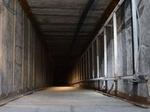 A Hamas terror tunnel – a model for Hizballah
Anxiety about the new terror tunnels they sense Hamas is excavating under their feet is no longer confined to Israelis living in proximity to the Gaza Strip, or the soldiers serving there. Israel’s northern borderland dwellers, who can see Hizballah’s yellow flags in from their balconies, have the same concerns. Their reports of mysterious underground explosions are confirmed by thousands of Israeli troops conducting field exercises in the neighborhood. The soldiers attest to heavy earthmoving equipment, explosions, burrowing, and shaking ground on the Lebanese side of the border, giving the area the appearance of a huge subterranean building site.
The Lebanese Shiite Hizballah group, Iran’s Lebanese surrogate, has clearly taken a leaf out of its Palestinian ally, Hamas’ book, for a fully mobilized terror tunnel project against northern Israel. Its manpower, including engineering units, is working under the guidance of Iranian Revolutionary Guards officers to sink a large network of tunnels leading under the border into Galilee. They are working efficiently and at top speed with the aid of modern Western-made earthmoving equipment and foreign professionals paid top dollar to manage the project.
Israel seems to be curiously passive in the face of its enemy’s ambitious enterprise. Only last week, the Defense Ministry’s Political Coordinator Amos Gilad denied any knowledge of terrorist tunnels reaching Israel from Lebanon.
However, Brig. Gen. Moni Katz, commander of the IDF’s Division 91, which is responsible for security of the Galilee region, told a different story: “To me it is obvious that the other side is busy digging tunnels. I don’t need intelligence to tell me this. Intuition is enough. There is no denying that this is what they are up to. Can I say they have completed a tunnel?” The general went on to reply: “I must assume they have. I can’t prove it or say for sure a tunnel has crossed into our territory. But my basic premise is that this is so and it is up to us to make plans to fit this case.”
Putting those plans into practice – which would necessitate destroying the tunnels either before they were built or at their entry-points – faces four major difficulties:
1. Close surveillance and first-class intelligence are required to keep track of hostile tunnel projects starting from the planning stage, the recruitment of manpower, the acquisition of engineering technology and equipment and registering the quantity of earth displaced and removed from the underground burrow.
2. The digging process, which sound sensors should have no difficulty in detecting, is a relatively short and irregular process which can just as easily be camouflaged by surface activities.
3. Locating a finished tunnel at the stage when it is still unused and relatively quiet calls for pinning down a number of variables, such as the type of soil, the depth, length, breadth and lining material used in building the tunnel, humidity, weather conditions on the surface as well as its environment, whether urban or rural.
4. Locating such a tunnel – even when it is already in operational use by an enemy – poses another set of difficulties. In combat conditions, electronic listening devices would be drowned out by the fire and explosions of battle and, in the confusion of war, enemy troops would be hard to intercept as they moved in and out the tunnels.
A glance at the map shows that the danger of tunnel warfare should also be taken into account on Israel’s eastern front – where it would just as hard to detect as in the north and the southwest: The Arab populations inhabiting the West Bank and the Israeli side of the border – only hundreds of meters apart – are similar enough to keep counter-terrorism authorities on a high level of alert for the construction of tunnel links between the two territories.
Perhaps a succession of military chiefs should be held accountable for letting the tunnel terror peril develop to its current proportions. But it must also be said that no silver bullet has so far been invented to counter this primitive vehicle of terror, including the methods tried till now, such as buried microphones, optical fibers sensitive to seismic tremors, deep trenches along the border and an assortment of off-beat inventions.
In the view of our military analysts, any solutions would have to vary from sector to sector, adapted to the military and topographical features in each case and an intelligence assessment of the level of risk involved in counteraction. This effort would have to be directed by an interdepartmental, interagency administration directly answerable to the prime minister or defense minister.
Arab world: Egypt’s dangerous stalemate
April 17, 2015Arab world: Egypt’s dangerous stalemate, Jerusalem Post, Zvi Mazel, April 17, 2015
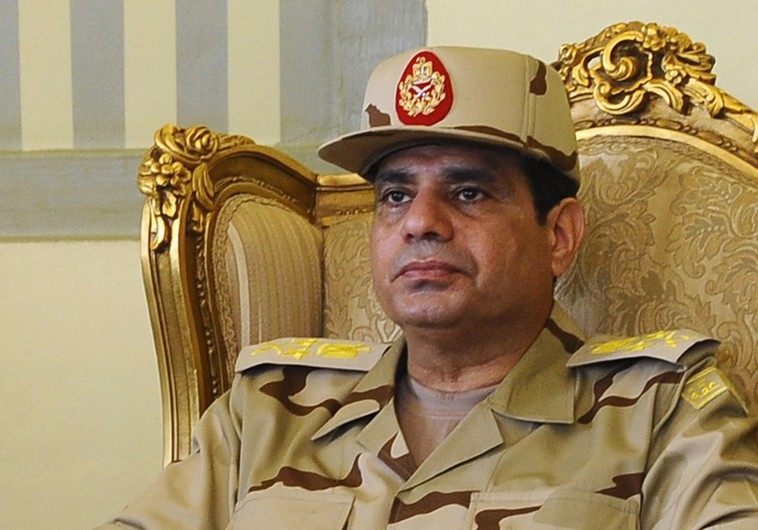 Abdul Fattah Sisi. (photo credit:REUTERS)
Vainly did the Egyptian president try to convince the US-led coalition against Islamic State to extend its activities to the whole Middle East. But US President Barack Obama is unwilling to acknowledge that there is a regional and international dimension to the movement.
*****************
Egyptian President Abdel Fattah al-Sisi is fighting for his country’s survival – and his own.
Islamic terrorism is not abating, hampering vital efforts to bring a better life to the people through a revitalized economy and political stability. Sisi knows he has to show results soon to prevent Egypt from slipping back into anarchy and chaos.
Despite the army’s all-out effort to defeat Islamist insurgency in Sinai, there is no end in sight. F-16 fighter planes and Apache helicopters have joined the campaign, security forces have killed or wounded hundreds of terrorists, destroying their haunts and their training groups – but more keep coming.
Ansar Bayt al-Maqdis gunmen, who have pledged allegiance to Islamic State, continue making daring raids against police stations and other security targets, leading to loss of life and heavy damage.
In one instance on April 14, the commander of the central police station of El-Arish was wounded in a raid; the assailants were able to escape.
For all intents and purposes the situation has reached a stalemate, though the army has managed to contain the terrorists in the northern part of the Sinai Peninsula, preventing them from extending their activities to the south and to the Suez Canal – where they could have inflicted untold damage to economic and security infrastructure, and severely undermined public morale.
However, there are still sporadic terrorist attacks in Cairo and other parts of the country.
Bombs explode, killing and maiming; power lines are blasted. A number of terrorist groups are involved, from Ansar Bayt al-Maqdis and the so-called Soldiers of Egypt to the ever-present Muslim Brotherhood; many of their members have been arrested, their leaders sentenced to death – though no one has been executed yet – but they keep on demonstrating against the regime (though in diminishing numbers).
In Yemen, Iranian-backed Houthi tribes are poised to take over the strategic Red Sea straits, threatening free passage to the Suez Canal – a reminder, if one was needed, of the fact that Islamic terrorism knows no border.
Vainly did the Egyptian president try to convince the US-led coalition against Islamic State to extend its activities to the whole Middle East. But US President Barack Obama is unwilling to acknowledge that there is a regional and international dimension to the movement.
The fact remains that Islamic State dispatches terrorists and weapons to Ansar Bayt al-Maqdis in the Sinai Peninsula from Libya, where there is an unlimited supply of both. No matter how many guerrillas are intercepted or killed by the Egyptian army, more are coming through the vast mountainous and desert region, along the 1,200-km border between the two countries.
Then there is Gaza, where terrorists can find refuge, regroup and train, and where new weapons can be tested.
Cairo is desperately trying to cut off the peninsula from the Strip. The Rafah crossing is closed most of the time, and when it opens it is under the strict supervision of Egyptian authorities. More than 2,000 contraband tunnels have been destroyed and a 1-km.-deep sanitized zone has been installed; thousands of families have been uprooted.
They have been compensated but resentment is high, and the move has prompted widespread condemnation by human rights associations.
Against this backdrop, the regime is weighing extending the zone to 5 km. and making the digging of contraband tunnels punishable by life imprisonment. A court in Cairo has forbidden Hamas activities in Egypt, and another has declared Hamas a terrorist organization; however, the central government is appealing that decision for the sake of its ongoing dialogue with Gaza’s leaders on the Palestinian issue.
The Iranian-Houthi threat has led Sisi to call for the creation of a rapid-response Arab unit, as Saudi Arabia has rallied neighboring states to form a coalition against the rebels in Yemen – who are threatening its border in the south, and were about to take control of the strategic port of Aden.
Though the creation of a united Arab unit was decided at a summit in Sharm e-Sheikh last month, implementation will not be easy. A number of states such as Lebanon and Iraq have warned they would not allow any infringement to their sovereignty; some Gulf states and Jordan have been more forthcoming, and meetings between army commanders are scheduled.
The problem is that these countries are not keen to risk their troops in a ground operation in neighboring states. Armies are the traditional bulwark of Arab regimes; a failed intervention outside their borders could cause their downfall. Nevertheless, since the West is largely indifferent to what is happening, Sisi and his Gulf allies have no choice but to unite against the common threat of Islamic terrorism, be it Sunni or Shi’ite.
On the home front, Sisi has launched a series of impressive projects – a new canal parallel to the old one to enable simultaneous crossing in both directions, thereby doubling receipts; an industrial, commercial and tourist zone between the two canals; 3,000 km of modern roads. Perhaps his most ambitious project is the creation of a new administrative capital city east of Cairo, at an estimated cost of $45 billion. Arab states have rallied to his side, pledging billions of dollars at a special economic summit last month; international groups have indicated their interest in some of the projects – a significant victory for the embattled president.
But Egypt’s endemic problems – population explosion, illiteracy leading to widespread unemployment and enduring poverty, as well as corruption on an epic scale – are not making Sisi’s task easier.
He is also calling to reform Islam by purging it of its extremist discourse, and has already instructed the Education Ministry to eliminate extremist content such as the call to jihad and attacks on other religions.
Meanwhile, the political situation is still unclear and elections are repeatedly postponed, allegedly because of ambiguities in the election law.
The fact is that the president has not been able to secure a large enough block to ensure his electoral victory, while the Muslim Brotherhood – though banned – and other Islamic parties can still muster a sizable vote.
Can Sisi win all his battles? How long will the Egyptian people wait for some much-needed economic results? Egypt is going it alone, still waiting for the West to understand that Cairo remains its best ally against the rising tide of terrorism now lapping at its shores.
Report: Hamas Using Heavy Machinery to Re-Dig Terror Tunnels
April 15, 2015Report: Hamas Using Heavy Machinery to Re-Dig Terror Tunnels, Israel National News, Tova Dvorin, April 15, 2015
(From whom are they getting the heavy machinery, how is it being transported and from where to where? — DM)
Less than one year after Operation Protective Edge in Gaza fizzled out, Hamas is already building new terror tunnels under Israel.
But while the evidence that terror activity has resumed has been lingering for months, sources now say that the terror group has taken the digging to the next level.
Hamas has switched from manual slave labor to machinery to dig terror tunnels under Israel, Palestinian Arab sources revealed to Walla! News Wednesday.
The group is using a Bagger 288, a German-produced mining machine known as a bucket-wheel excavator.
A damning letter emerged from Gaza in August 2014 from a Palestinian Arab who was forced to dig terror tunnels after he accepted a cryptic joboffer from Hamas; the group plucked him from his home in a truck and forced him down into a tunnel. At least 160 Palestinian Arab children have also died digging terror tunnels, the same report revealed.
Unlike workers working by hand, however, the Bagger can dig far faster and burrow into smaller spaces, the sources revealed.
In addition, bulldozers can clearly be seen from the Israeli side of the border doing at least part of the digging and cleanup; Hamas is using a mixture of cement (when available) and wooden boards for the construction.
Senior security sources confirmed the report, adding that Hamas’s true aim is to dig the tunnels at high speed and that they are focusing on producing short-range rockets and mortars – which are more difficult for the Iron Dome Missile Defense System to shoot down.
Iran sends Hamas massive aid to rebuild tunnels – report
April 5, 2015Iran sends Hamas massive aid to rebuild tunnels – report, DEBKAfile, April 5, 2015
Iran has transferred tens of millions of dollars to Hamas’s military wing in Gaza to help it rebuild the tunnels destroyed in last summer’s conflict with Israel, the Sunday Telegraph reports. In an intense effort to restore the Palestinian extremists’ military capabilities, Iran is also funding new missile supplies to replenish the stocks used up in bombing Israeli towns and villages. Hamas capabilities were seriously degraded by Israel’s Operation Protective Edge last summer which ended in a ceasefire.
Report: Israeli Jet Struck Weapons Depots in Libya
April 4, 2015Report: Israeli Jet Struck Weapons Depots in Libya, Israel National News, Gil Ronen, April 4, 2015
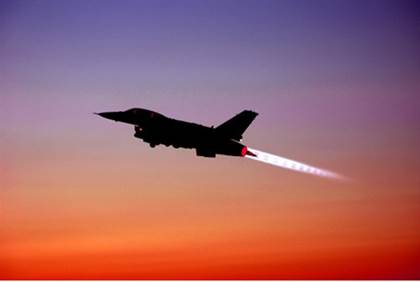 IAF F-16 IAF Website
Al Watan added that Egypt allowed the Israeli jet to pass through its airspace en route to southern Libya.
********************
Arab news sources reported at week’s end that an unidentified jet believed to be Israeli destroyed warehouses in southern Libya that held weapons bought by Iran for Hamas.
According to the reports in Al Watan and other news outlets, the warehouses were completely destroyed. The weapons that were inside them had allegedly been purchased by Iran, by means of weapons dealers in Sudan and Chad, and were supposed to be smuggled to Hamas through Egypt, by means of the smuggling tunnels between Sinai ands Gaza.
The destruction of the weapons stores in southern Libya was carried out in coordination with the Egyptian security and intelligence apparatuses, the reports claimed.
Al Watan added that Egypt allowed the Israeli jet to pass through its airspace en route to southern Libya.
Khamenei sends Iranian navy to Bab el-Mandeb Straits. Iran arms store for Hamas bombed in Libya
March 31, 2015Khamenei sends Iranian navy to Bab el-Mandeb Straits. Iran arms store for Hamas bombed in Libya, DEBKAfile, March 31, 2015

Control of the Red Sea Bab el-Mandeb Straits passed Tuesday, March 31 to pro-Iranian Yemeni forces when the Yemeni Army’s 117th Brigade loyal to the former Yemeni President Ali Saleh handed positions guarding the waterway to two Houthi commando battalions trained by Iranian Revolutionary Guards. This is revealed by DEBKAfile’s military and intelligence sources.
In another development Tuesday involving Iran’s spreading tentacles, DEBKAfile’s military sources reveal that unidentified aircraft bombed Burak, a small military base in the Fezzan province of southwestern Libya, which serves Iran as a transit store for arms purchased in Sudan for the Palestinian Hamas.
The weapons, which recently reached the Libyan base through Chad, were destroyed. They were scheduled to be smuggled through Egypt and Sinai and onto Gaza. Western military sources attributed responsibility for the bombardment to the Egyptian or Israeli air forces. Both Israel and Egypt have declined to comment on the report.
To strengthen Iran’s grip on the key Red Sea gateway, Iran’s supreme leader Ayatollah Ali Khamenei has ordered two naval task forces to sail to the Red Sea. They are to fend off a Saudi-Egyptian offensive to dislodge the Houthi battalions now holding a point linking the Red Sea and the Indian Ocean and Persian Gulf.
The naval task forces are being sent to draw a sea shield around the Houthi forces to defend them against Saudi-Egyptian assaults. This maneuver was orchestrated by the Al Qods Brigades chief Gen. Qassem Soleimani.
Our sources report that the 33rd task force set out on its mission Tuesday night from the Gulf port of Bandar Abbas.
Abbas Calls on Arab States to Attack Hamas
March 28, 2015Abbas Calls on Arab States to Attack Hamas, Israel National News, Ari Yashar, March 28, 2015
(Unlikely, but what would Obama say? — DM)
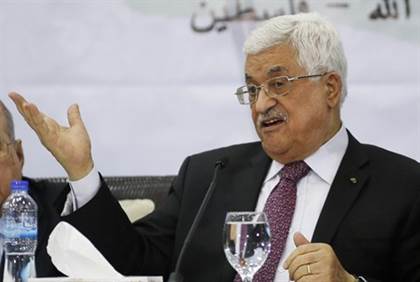 Mahmoud Abbas Reuters
Abbas urges ‘same policy’ of Yemen airstrikes to be used by Arab League in ‘Palestine,’ after his adviser calls for ‘iron’ blow to Hamas.
Palestinian Authority (PA) Chairman Mahmoud Abbas used the platform of the Arab League summit in Sharm el-Shekh, Egypt, this Saturday to attack his “unity partner” Hamas, making a subtle call for the Arab states to take military action against the Gaza-based Muslim Brotherhood offshoot.
Speaking at the 26th summit in the southern Sinai peninsula, Abbas made reference to the campaign of airstrikes launched last Thursday by Saudi Arabia and other Arab countries against Iran-backed Shi’ite Houthi rebelsin Yemen – the Houthis have overthrown the government while rapidly expanding their control.
“I hope that the Arab countries will take the same policy they employed in Yemen for all Arab countries suffering from internal conflict – like Palestine, Syria, Libya and Iraq,” Abbas said according to Yedioth Aharonot, in an open jab at Hamas in Gaza.
Making Abbas’s comments calling for military intervention in “Palestine” all the more pointed is the fact that just two days earlier, Abbas’s adviser on Religious and Islamic Affairs Mahmoud Al-Habbash, who also serves as PA Supreme Sharia (Islamic law) Judge, made similar remarks.
Al-Habbash urged the Arab countries to take action and strike Hamas with an “iron fist,” in an open call for military intervention.
Hamas and the PA signed a unity deal last April, which has done little to damper the enmity raging between the rivals ever since Hamas violently seized control of Gaza in 2007 – the most obvious example of the how the deal has not changed tensions was when Hamas tried to stage a coup against the PA in Judea and Samaria last year.
Responding to Al-Habbash, Hamas said the comment is “a dangerous and not nationalist call.”
Abbas’s call for Arab intervention comes after Arab foreign ministers meeting in Egypt last Thursday declared the establishment of a joint Arab military force, reportedly meant to rapidly respond to security threats to Arab nations.
Arab League secretary-general Nabil al-Arabi was assigned with coordinating the details with the chiefs of staff of the various Arab armies within one month, so as to work out the logistics of establishing the new force.




 anneinpt
 artaxes
 danmillerinpanama
 davidking1530
 Peter Hofman
 Joseph Wouk
 Peter
Peter Louisiana Steve
 WarSclerotic
Recent Comments