Archive for the ‘Free Syrian Army’ category

Inside the CIA’s Syrian Rebels Vetting Machine

November 11, 2014

Inside the CIA’s Syrian Rebels Vetting Machine, Newsweek, November 10, 2014

(The Obama administration’s vetting of “moderate” terrorists is consistent with its vetting of Iranian nuke intentions and progress. Both would be funny were the consequences not so dangerous. — DM)

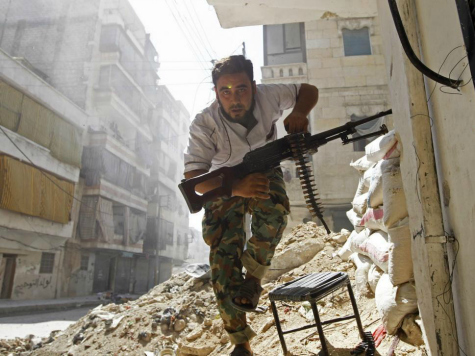
syrian-rebels-fsaA Free Syrian Army fighter in Aleppo. Hosam Katan/Reuters

Nothing has come in for more mockery during the Obama administration’s halting steps into the Syrian civil war than its employment of “moderate” to describe the kind of rebels it is willing to back. In one of the more widely cited japes, The New Yorker’s resident humorist, Andy Borowitz, presented a “Moderate Syrian Application Form,” in which applicants were asked to describe themselves as either “A) Moderate, B) Very moderate, C) Crazy moderate or D) Other.

After Senator John McCain unwittingly posed with Syrians “on our side” who turned out to be kidnappers, Jon Stewart cracked, “Not everyone is going to be wearing their ‘HELLO I’M A TERRORIST’ name badge.”

Behind the jokes, however, is the deadly serious responsibility of the CIA and Defense Department to vet Syrians before they receive covert American training, aid and arms. But according to U.S. counterterrorism veterans, a system that worked pretty well during four decades of the Cold War has been no match for the linguistic, cultural, tribal and political complexities of the Middle East, especially now in Syria. “We’re completely out of our league,” one former CIA vetting expert declared on condition of anonymity, reflecting the consensus of intelligence professionals with firsthand knowledge of the Syrian situation. “To be really honest, very few people know how to vet well. It’s a very specialized skill. It’s extremely difficult to do well” in the best of circumstances, the former operative said. And in Syria it has proved impossible.

Daunted by the task of fielding a 5,000-strong force virtually overnight, the Defense Department and CIA field operatives, known as case officers, have largely fallen back on the system used in Afghanistan, first during the covert campaign to rout the Soviet Red Army in the 1980s and then again after the 2001 U.S. invasion to expel Al-Qaeda: Pick a tribal leader who in turn recruits a fighting force. But these warlords have had their own agendas, including drug-running, and shifting alliances, sometimes collaborating with terrorist enemies of the United States, sometimes not.

“Vetting is a word we throw a lot around a lot, but actually very few people know what it really means,” said the former CIA operative, who had several postings in the Middle East for a decade after the 9/11 attacks. “It’s not like you’ve got a booth set up at a camp somewhere. What normally happens is that a case officer will identify a source who is a leader in one of the Free Syrian Army groups. And he’ll say, ‘Hey…can you come up with 200 [guys] you can trust?’ And of course they say yes—they always say yes. So Ahmed brings you a list and the details you need to do the traces,” the CIA’s word for background checks. “So you’re taking that guy’s word on the people he’s recruited. So we rely on a source whom we’ve done traces on to do the recruiting. Does that make sense?”

No, says former CIA operative Patrick Skinner, who still travels the region for the Soufan Group, a private intelligence organization headed by FBI, CIA and MI6 veterans. “Syria is a vetting nightmare,” he told Newsweek, “with no way to discern the loyalties of not only those being vetted but also of those bringing the people to our attention.”

A particularly vivid example was provided recently by Peter Theo Curtis, an American held hostage in Syria for two years. A U.S.-backed Free Syrian Army (FSA) unit that briefly held him hostage casually revealed how it collaborated with Al-Qaeda’s al-Nusra Front, even after being “vetted” and trained by the CIA in Jordan, he wrote in The New York Times Magazine.

“About this business of fighting Jabhat al-Nusra?” Curtis said he asked his FSA captors.

“Oh, that,” one said. “We lied to the Americans about that.”

Concerns about the CIA’s vetting system arose long before the Syrian civil war erupted in 2011, several CIA veterans told Newsweek. In Baghdad, one said, agency operatives had such thin faith in the system that they often had sweaty palms as they awaited a meeting with a newly recruited Iraqi spy—even though he had been cleared by CIA vetters—because they knew he might show up with a suicide vest under his jacket. That happened in Afghanistan on December 30, 2009, when a Jordanian physician recruited by the CIA on his claim to have access to Osama bin Laden turned out to be working for Al-Qaeda. He blew himself up at a CIA base, taking out seven agency operatives as well.

That double agent had been served up by Jordan’s General Intelligence Directorate, a longtime partner of the CIA in clandestine operations. Relying on close liaisons to vet spies might’ve worked well enough during the Cold War, when the CIA’s name files were meticulously updated by its small corps of Ivy-educated spies, but in the swirling chaos of the post-9/11 Middle East or South Asia, where Arabic (or Urdu, Farsi or Pashtun) names can be transliterated to English and back in endless varieties and where political allegiances are as blurry as the centuries-old colonial boundaries drawn up by bureaucrats in London and Paris, the CIA’s vetters are just not up to the task, say spy agency veterans with long experience in the region.

“For two years I managed a lot of those folks,” said one person not authorized to discuss the inner workings of the system. “A lot of them are contractors just coming out of college and don’t have a lot of experience under their belts—not in the Middle East, or the region or in Arabic.”

(The CIA declined comment on the vetting process. Navy commander Elissa Smith, speaking for the Defense Department, said in a statement that “the U.S. military has decades of experience screening foreign military forces for training. We also know the Syrian opposition better now than we did two years ago. While we cannot disclose the details of our sources and methods, we will screen thoroughly and conduct continuous monitoring.”)

American embassies around the world are open to just about anybody who wants to sign up for the FSA. “They fill out a form. You get their four-part name, their date of birth, and then their tribe and where they’re from and all that,” the former operative explained. “Their work history, if there is any. Then you take that and run your traces through all your databases—your HUMINT and SIGINT [agency acronyms for information from human spies and National Security Agency intercepts, called signals intelligence]. And then you take certain aspects of that information, and you sanitize it, and you send it by cable to your station in whatever country, and you ask for their traces on this individual, to see if anything comes up.

“The problem with that process,” the former operative continued, “is when you have a person sitting at a computer who doesn’t know how to standardize Arabic names.… They may translate it correctly, but the person typing it in may or may not know how to look for it with all the name variances that might already be in the system.”

When it came time to start vetting Syrian rebels, the CIA faced even more hurdles. When the Obama administration shuttered the American Embassy in Damascus in 2011, just as the civil war was exploding, the covert CIA station inside the building there was rolled up, too. The agency had to “make do,” as one former operative put it.

“The main problem with plans that arm and train the ‘moderates’—who ominously are moderate only in their fighting abilities,” said Skinner, “is that it assumes perfect knowledge, or ‘good enough’ knowledge, about the people being armed. When in fact there is nothing close to that.… The background info on these fighters is next to nothing and misleading, especially in Syria, where we don’t have a liaison relationship, and so the vast majority of even check-the-box vetting is by third parties [who are] out-of-the-country players with a stake in the game.

“As in Afghanistan, we can get scammed and misled at every stage with tragic results,” Skinner added. “One can’t simply build a loyal effective army thirdhand. It’s like running a want-ad that says, ‘Only Moderates Show Up for Free Weapons and Paid Training,’ and believing that is effective screening.”

“It’s one thing if you’re talking about a few dozen, or even a few hundred, individuals to run name checks or traces on,” agrees Martin Reardon, a former high-ranking FBI counterterrorism official. “But the first group of [Syrian] rebels to be trained [by the U.S.] is supposed to number upwards of 5,000. Assuming the administration can identify that many ‘moderate’ rebels to begin with, it would be virtually impossible to accomplish even minimal background checks with any degree of reliability.”

Another troubling lesson from the wars in Afghanistan, Iraq and now Syria is that today’s moderate can become tomorrow’s extremist. “Just because that guy may be moderate today—who may really and truly be a moderate and despise Al-Qaeda or whatever—what if that guy is seen walking into the Green Zone by his friend so-and-so at the checkpoint?” the former CIA vetting expert said. “And everybody knows those guys coming into the Green Zone are there to see the CIA, or at least that’s the assumption. So they grab his father, his son or his brother, and they take him captive. What’s to stop them from forcing him to strap a bomb to his body and walking back into the next meeting with an [improvised explosive device] on his chest?”

Or this: “What if you’re in Afghanistan and maybe you’re friends [with a contact], but tomorrow you drop a bomb on his cousin? You think he’s going to be your friend tomorrow? These things can change overnight. So this vetting idea—‘once vetted, things are all right, we’re good to go’—is crazy.”

Given such accounts, the odds of keeping loyal troops seems like panning for gold—or worse, an exercise in self-delusion. But the former CIA operative, who served in a variety of Middle Eastern posts as well as headquarters, said Obama administration officials aren’t fibbing about their faith in the system. They just may not realize it’s shot through with holes. “Most of them think they’re doing it pretty good, but they’re also not our best and brightest in terms of knowing how to vet,” this person said. “So I don’t think it’s a charade, I think it’s misguided. They don’t know how poor it actually is.”

So what? responds former senior CIA operations officer Charles Faddis, who led a covert team into Kurdistan in advance of the 2003 U.S. invasion of Iraq. He says it’s time to act, no matter how shaky the foundations of the CIA’s Syrian army. “You can’t run covert action without getting your hands dirty. We can’t sit on the sidelines and have discreet, antiseptic contacts with these guys and accomplish anything,” Faddis said. “If we’re going to do this, we need to wade in.”

Caution be damned. Hold our noses and pass the ammunition.

“We need to have people on the ground. We need to give them serious money and weaponry,” Faddis said. “Unless we do that, we are never really going to have any control over what’s going on, or any real idea who we should be in bed with.”

Military Upset with White House ‘Micromanagement’ of ISIS War

October 31, 2014

Military Upset with White House ‘Micromanagement’ of ISIS War, Daily BeastJosh RoginEli Lake, October 31, 2014

(The impatient (non-Islamic) Islamic State seems unwilling to play “dither along with us” with the Obama Administration while awaiting news that the You Tube video which caused the entire mess has been taken down and its creator suitably punished. Please see also U.S. strategy against Islamic State hits major hurdles. — DM)

1414748715741.cached

[M]ilitary officers and civilian Pentagon leaders tell The Daily Beast, is the ISIS war’s decision-making process, run by National Security Advisor Susan Rice. It’s been manic and obsessed with the tiniest of details. Officials talk of sudden and frequent meetings of the National Security Council and the so-called “Principals Committee” of top defense, intelligence, and foreign policy officials (an NSC and three PCs in one week this month); a barrage of questions from the NSC to the agencies that create mountains of paperwork for overworked staffers; and NSC insistence on deciding minor issues even at the operational level.

“We are getting a lot of micromanagement from the White House. Basic decisions that should take hours are taking days sometimes,” one senior defense official told The Daily Beast.

*****************

The Pentagon brass placed in charge of implementing Obama’s war against ISIS are getting fed up with the short leash the White House put them on.

Top military leaders in the Pentagon and in the field are growing increasingly frustrated by the tight constraints the White House has placed on the plans to fight ISIS and train a new Syrian rebel army.

As the American-led battle against ISIS stretches into its fourth month, the generals and Pentagon officials leading the air campaign and preparing to train Syrian rebels are working under strict White House orders to keep the war contained within policy limits. The National Security Council has given precise instructions on which rebels can be engaged, who can be trained, and what exactly those fighters will do when they return to Syria. Most of the rebels to be trained by the U.S. will never be sent to fight against ISIS.

Making matters worse, military officers and civilian Pentagon leaders tell The Daily Beast, is the ISIS war’s decision-making process, run by National Security Advisor Susan Rice. It’s been manic and obsessed with the tiniest of details. Officials talk of sudden and frequent meetings of the National Security Council and the so-called “Principals Committee” of top defense, intelligence, and foreign policy officials (an NSC and three PCs in one week this month); a barrage of questions from the NSC to the agencies that create mountains of paperwork for overworked staffers; and NSC insistence on deciding minor issues even at the operational level.

“We are getting a lot of micromanagement from the White House. Basic decisions that should take hours are taking days sometimes,” one senior defense official told The Daily Beast.

Other gripes among the top Pentagon and military brass are about the White House’s decision not to work with what’s left of the existing Syrian moderate opposition on the ground, which prevents intelligence sharing on fighting ISIS and prevents the military from using trained fighters to build the new rebel army that the President has said is needed to push Assad into a political negotiation to end the conflict.

The New York Times reported Wednesday that Defense Secretary Chuck Hagel himself is among the critics of Obama’s strategy in Syria. Hagel wrote a memo last week to National Security Advisor Susan Rice warning that Obama’s Syria strategy was unclear about U.S. intentions with respect to Syrian President Bashar al Assad, undermining the plan.

Hagel stood by the memo Thursday. “We owe the president and we owe the National Security Council our best thinking on this. And it has to be honest and it has to be direct,” he told reporters.

But the top uniformed military leaders in charge of the operation are also struggling to work around the White House policy constraints and micromanagement, including Joint Chiefs Chairman Gen. Martin Dempsey, Gen. Lloyd Austin, commander of CENTCOM, and Gen. Michael Nagata, the SOCOM lead official in charge of the Syrian train and equip program, according to multiple officials and persons briefed by those generals.

Nagata has been tasked to build a new rebel army from scratch but is not permitted to work with existing brigades, meaning he must find and vet new soldiers, mostly sourcing from Syrian refugee camps in Turkey, Jordan, and Lebanon. What’s more, the size of the program will produce only 5,000 fighters a year after the training begin, most of whom who will serve as “local defense forces” and not actually go after ISIS, according to two officials briefed on the plan. Of those forces, 500 would be given additional training in “counterterrorism.” That’s a small attack force to face an ISIS military that is estimated to have tens of thousands of fighters.

Dempsey told reporters Thursday that the recruiting and vetting of soldiers for the new Syrian rebel army has not yet begun, although sites for the training camps have been chosen.

“At this point we still don’t know how long it’s going to take to send in the trained guys,” a senior Defense official said. “The situation is changing so much on the ground it’s hard to plan it out.”

Dempsey has twice made public statements that seemed to reveal his dissatisfaction with the White House policy. Last month, he said it would take 12,000 to 15,000 ground troops to effectively go after ISIS in Iraq and Syria. Earlier this month, he suggested that U.S. ground troops might be necessary to fight ISIS in the future, a comment he later walked back.

Many military officials, including at CENTCOM’s headquarters in Tampa and their air base in Qatar (where the ISIS air campaign is run) are barred from even communicating with Syrian opposition representatives unless those rebels are on a White House / State Department approved list. Many Syrian opposition leaders complain that Free Syrian Army brigades fighting ISIS now are offering help in making the ISIS strikes effective, but are getting no response from the administration.

The international coalition against ISIS, led on the U.S. side by retired Gen. John Allen and State Department official Brett McGurk, is working with Sunni tribes in Iraq to coordinate against ISIS. But they are not working with the corresponding tribes on the Syrian side of the mostly non-existent Iraq-Syria border. ISIS has slaughtered hundreds of these tribesmen in Eastern Syria who refused to yield to the group’s demands.

Meanwhile, the Free Syrian Army, largely written off by the White House, has been suffering heavy losses to ISIS as well as to the al-Qaeda affiliated al Nusrah Front, which has opened up a third fighting front against the FSA in cities like Idlib. FSA brigades that have been vetted by the U.S. government, including the Syrian Revolutionaries Front and Harakat Hazm, have seen their non-aggression pact with al Nusrah disappear.

“Al Qaeda has captured a number of villages from the FSA in Idlib and the fighting continues to be intense. The FSA needs urgent Coalition support in this fight because if Al Qaeda captures Jabal al-Zawiyeh in Idlib, extremists will be positioned to cut off a critical line of supply from the Turkish border,” said Oubai Shahbandar, advisor to the Syrian National Coalition. “So the question is: Will Coalition airstrikes help the FSA fight al Qaeda or will they allow Al Qaeda to overrun moderate forces?”

NSC Spokeswoman Bernadette Meehan declined to comment on the criticisms coming from the Pentagon and military about the White House’s approach to ISIS and training the Syrian rebels. But on Wednesday, Deputy National Security Advisor Tony Blinken, who is rumored to be Obama’s choice to replace Bill Burns as Deputy Secretary of State, defended the White House strategy but said that FSA is just not a viable partner.

“For more than two years working with and supporting the moderate opposition, we’ve made some gains in making it more effective and trying to position it as a counterweight to Assad.  Now we’re intensifying that support,” he said at the Carnegie Endowment for International Peace. “The coalition can do real damage to ISIL through the air. But without forces on the ground to hold territory from which ISIL has been removed, we will not be able to shrink and eventually eliminate the safe haven.”

Secretary of State John Kerry said Thursday that there is no military solution to the Syria crisis and said the U.S. is reaching out to countries like Russian and Iran to seek a new political negotiation. Syrian National Coalition President Hadi al Bahra told The Daily Beast last month that there is no genuine interest in the West for a new political process, which he described as being “in a coma.”

“There have been so many things said on Syria that were not delivered, nobody thinks the President really wants to do anything on Syria. Even currently serving officials realize that you cannot bomb your way out of this and you need to have a plan for a political solution, but we don’t have it,” said Andrew Tabler, senior fellow at the Washington Institute for Near East Policy. “There’s needs to be a fully thought out strategy with a political dimension that involves the opposition. If you don’t do that, you can’t solve this problem.”

U.S. strategy against Islamic State hits major hurdles

October 31, 2014

U.S. strategy against Islamic State hits major hurdles, LA Times, 

(Happy Halloween from the Obama Administration. — DM)

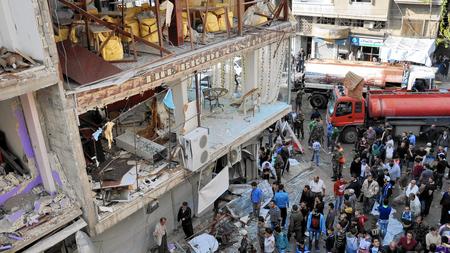
la-epa-epaselect-syria-homs-car-bomb-jpg-20141030Syrian police and residents inspect the site of a car bombing in Homs on Oct. 29. The U.S. plan to raise a rebel army in Syria to fight Islamic State has run into steep political and military obstacles. (European Pressphoto Agency)

The Obama administration’s plan to raise a 15,000-strong rebel army in Syria has run into steep political and military obstacles, raising doubts about a key element of the White House strategy for defeating Islamic State militants in the midst of a civil war.

Pentagon concerns have grown so sharp that Defense Secretary Chuck Hagel sent a two-page memo to the White House last week warning that the overall plan could collapse because U.S. intentions toward Syrian President Bashar Assad are unclear, according to a senior defense official who read the memo but was not authorized to speak publicly.

President Obama has called on Assad to step down, but he has not authorized using military force, including the proposed proxy army, to remove the Syrian leader.

At a news conference Thursday, Hagel declined to discuss his memo to national security advisor Susan Rice, but he acknowledged that Assad has inadvertently benefited from more than five weeks of U.S.-led airstrikes against the Islamic State, one of the most powerful antigovernment forces in Syria’s bitter conflict.

Secretary of State John F. Kerry sought to paper over the problem Thursday, telling a forum in Washington that the proposed proxy army “can have an impact on Assad’s decision-making so we can get back to a table where we could negotiate a political outcome, because we all know there is no military resolution of Syria.”

Rebel leaders in Syria say they would reject joining a U.S.-backed force that is not aimed at defeating Assad, their main enemy.

Senior U.S. military officers also privately warn that the so-called Syrian moderates that U.S. planners hope to recruit — opposition fighters without ties to the Islamic radicals — have been degraded by other factions and forces, including Assad’s army, during the war.

It will take years to train and field a new force capable of launching an offensive against the heavily armed and well-funded Islamic State fighters, who appear well-entrenched in northern Syria, the officers say.

“We’re not going to be able to build that kind of credible force in enough time to make a difference,” said a senior U.S. officer who is involved in military operations against the militants and who asked for anonymity because he was not authorized to speak publicly. “We’ve watched the moderate opposition dwindle and dwindle and now there’s very little left.”

The Pentagon plan calls for putting 5,000 rebel fighters into Syria in a year, and 15,000 over the next three years.

It is the least developed and most controversial part of the multi-pronged U.S. strategy, which also includes near-daily airstrikes in Iraq and Syria, deployment of U.S. military advisors and other support to assist Iraqi government and Kurdish forces, along with attempts to choke off the militants’ financing from oil sales and foreign donors.

When officers involved in high-level Pentagon deliberations in the summer raised concerns about building a rebel army from scratch, they were overruled by senior commanders, who warned that airstrikes alone would not defeat the militants, one of the officers said.

But Pentagon unease has intensified in recent weeks as Jordan and Turkey, two allies that the Obama administration is counting on to help train the proposed proxy force, made it clear that they are lukewarm to the plan, two U.S. officials said.

Washington and its allies are chiefly split over whether the proposed force should focus on reclaiming Syrian territory now held by the Islamic State militants, which is the U.S. priority, or should also battle troops loyal to Assad, the allies’ main concern.

Turkey said this month that it would train a portion of the Syrian force, joining Saudi Arabia in training on its territory. U.S. officials don’t expect to assemble the first group of “moderate” rebels, drawing them from inside Syria or from crowded refugee camps in nearby countries, until early next year at the earliest.

But Turkish officials have signaled that the rebels it trains would concentrate on battling Assad’s forces, not Islamic State, once they return to Syria.

Jordan has not joined the training effort, although it hosts a separate, smaller, CIA-run operation for Syrian insurgents.

U.S. officials say greater involvement by Turkey and Jordan would allow them to increase the number who can be trained, and provide easier conduits for support and resupply when they return to Syria.

The dispute reflects the complex calibrations now in play as the Islamic State militants shake long-established political and military fault lines in the Middle East.

Most dramatically, perhaps, U.S. forces are now in at least tacit alignment with traditional enemies such as Iran and Hezbollah, the Lebanon-based militant and political group, against a common threat.

Syrian rebel leaders and Arab allies complain that the U.S.-led airstrikes have helped Assad by weakening one of his most powerful foes and enabling his army to step up attacks on other rebel factions.

A spokesman for the Free Syrian Army, an umbrella organization claiming to represent largely autonomous rebels in Syria, said fighters were incensed by the U.S. insistence on focusing entirely on Islamic State.

“They have forgotten that tens of thousands of civilians are suffering because of the regime,” said the spokesman, who did not want his name published because it could endanger his family. “Our main cause is the regime, and that will remain our main cause.”

A rebel commander, a defector from the Syrian army who also asked for anonymity, agreed. The U.S. plan “doesn’t work for us,” he said.

“They are concerned with ISIS … but we are concerned with the regime more than ISIS,” he said, using one of several acronyms for Islamic State.

U.S. Central Command, which is overseeing the effort to build a Syrian force, says questions about its direction will be resolved once the fledgling program is underway.

“We are early on in this and there’s much to be figured out,” said Maj. Curtis J. Kellogg, a spokesman for Central Command.

Frederic C. Hof, a former special advisor to President Obama for Syria, said the U.S. plan “is going to be a tough sell” in Syria.

“You can always get people by providing weapons, ammo and pay, but your appeal to a large number of Syrians will increase dramatically if it is a force whose goal is eventually to govern all of Syria,” not just beat one faction, he added.

The caution reflects, in part, a U.S. desire to reassure Iran, one of Assad’s closest backers, that it is not seeking to oust him by force. If the U.S. backtracked on that promise, Iran might step up military support for Assad.

Tehran also could respond by using local Shiite militias to attack U.S. personnel or facilities in Iraq. The Iranian-backed Shiite militias in Iraq have coordinated their attacks on Islamic State with the U.S.-backed government in Baghdad.

“If we really focus on Assad, the Iranian piece of this coalition [against Islamic State] will fracture, and we will have Shia militants trying to target us,” said the senior U.S. military officer.

The U.S. experience with proxy military forces is laced with disappointment.

The Kennedy administration backed a failed invasion of the Bay of Pigs in Cuba in 1961 after training a counterrevolutionary brigade. In the 1980s, the Reagan administration bankrolled the Contras in Nicaragua, who were unsuccessful against the Sandinistas’ socialist revolution.

“We’ve helped arm insurgencies before,” Bruce Riedel, a former CIA analyst who now is a senior fellow at the Brookings Institution. “Nearly all of them have been complete failures or marginal to the final outcome. But there was one spectacular success.”

The CIA, working with Pakistan and Saudi Arabia, covertly poured $4 billion into arming a rebel force in Afghanistan from 1979 to 1989, helping them drive out Soviet forces. Riedel, who wrote a book about the undertaking, said the CIA operation hastened the fall of the Soviet Union and the end of the Cold War.

The Syrian rebel forces, with their fractured leadership and rival sponsors, bear similarities to the competing Afghan mujahedin factions during that war, Riedel said. If the U.S. can secure tight-knit partnerships with neighboring countries on training the rebels, it could also see success against Islamic State.

“There’s no reason we can’t do it again,” he said. “But it doesn’t happen overnight.”

Time Is Running Out for Obama on Syria

October 30, 2014

Time Is Running Out for Obama on Syria, Daily BeastJamie Dettmer, October 30, 2014

The idea that U.S.-backed Syrian rebels defeat ISIS and force Assad to the negotiating table has absolutely nothing to do with what’s happening on the ground.

Only two days ago, President Barack Obama’s envoy to the Syrian rebels, retired Marine Gen. John Allen, explained confidently that the U.S. would help to train and equip Western-backed fighters to become a credible force that would compel the Assad regime to negotiate a political deal and end the four-year-long civil war.Yeah. Right. The Obama administration’s plans have little or nothing to do with what is unfolding all too rapidly on the ground: Rebel brigades are demoralized, disintegrating, and fighting among themselves.The Americans and their allies are carrying out a desultory air campaign in Syria that appears focused on support for the Kurds. Meanwhile, President Bashar al-Assad’s forces maintain a withering air offensive of their own on rebels and civilians alike in northern Syria.

Last week in a 36-hour period, Assad’s air force launched 210 airstrikes, according to generally reliable opposition activists. That’s more than the entire American-led coalition has mounted in both Iraq and Syria since Sept. 22.

Brigades of secular fighters and relatively moderate Islamists are nearly encircled and their supply lines are threatened in the country’s second largest city, Aleppo. Assad’s forces in the northern Syrian city of Idlib, meanwhile, are moving from defense to offense. On Monday, they recaptured the governor’s mansion and police headquarters.

The rebels are squabbling among themselves as suspicions rage about American designs and intentions.

Clashes erupted this week between Islamist brigades aligned with the Syrian Revolutionaries Front and the al Qaeda affiliate Jabhat al-Nusra after the jihadists seized seven towns and villages in the Idlib countryside they previously controlled. And while U.S. officials may not shed a tear over the infighting between Islamists and jihadists—they have long urged rebel factions to distance themselves from the al Qaeda group—the infighting raises the risks that al Nusra may develop a rapprochement with rival ISIS militants, making it harder to “degrade and ultimately defeat” that group as Obama says he intends to do.

Al Nusra and ISIS, both spinoffs of al Qaeda, have been at war with each other since al Qaeda’s top leadership disavowed ISIS early this year. But there have been a series of meetings between al Nusra commanders and the leaders of other rebel groups to iron out differences, according to Abdul Rahman, a commander in the 3,000-strong Jaysh al-Mujahedeen or Army of Mujahedeen, an Islamist-leaning brigade that emerged from the villages and towns of the Aleppo countryside. “Al Nusra is particularly suspicious of the rebel brigades favored by the Americans who are getting weapons from Washington,” he says.

That includes the mainly secular Harakat Hazm (The Steadfast Movement), which has received TOW anti-tank missiles from the Obama administration. According to a senior State Department official, who spoke to The Daily Beast on condition of anonymity, it is the FSA-aligned militia most trusted by Washington.

Infighting has been a persistent problem in the FSA. In 2012 and 2013, jihadist groups emerged in northern Syria not least because their discipline attracted defections from both FSA and Islamist brigades.

In the absence of any over-arching rebel military leadership, there is no one to referee disputes before they get out of hand. The Supreme Military Command (SMC), which on paper is meant to oversee the FSA-aligned militias, is anything but supreme and rebel commanders on the ground ignore its orders.

Despite strenuous efforts by Washington and the Gulf States to try to boost the authority of the SMC, nothing has worked, much to the frustration of U.S. officials tasked with funneling aid and arms to more than 16 FSA-aligned brigades.

“We ignore the SMC,” a senior State Department official told The Daily Beast. “We would like to see a stronger SMC and a proper command structure. One that can act as a middleman on supplies so we don’t have to deal with commanders directly, which would help us to avoid being drawn into arguments.” But no such entity exists, so U.S. officials are inundated by grievances from rebel commanders, who complain this or that militia is getting more than they are.

The absence of command and control means there is only haphazard combat coordination on the ground. “There are hard-pressed commanders who are desperately in need of support and reinforcements and they can’t wait, but they don’t get help,” says the exasperated State Department official. “It’s the rebels’ job to fix this and to come to each other’s assistance promptly.”

While conceding their failure over the four-year-long civil war to fashion a coherent force, rebel commanders counter that U.S. neglect and Washington’s refusal to arm them with advanced weaponry deprived them of the leverage to discipline fighters and to keep them loyal and to halt defections to jihadist groups.

“Look,” said a commander with the Syrian Revolutionaries Front, “we don’t have shoulder-launched ground-to-air missiles, but the Islamic State does, thanks to the Iraqi army leaving them to be looted by the jihadists.”

Either way—rebel squabbling or U.S. neglect—the rebels the Obama administration wants to build up to be credible enough to force the Assad regime to the negotiating table look less convincing with each passing day.

What do Kobani airdrops mean for regional politics?

October 21, 2014

What do Kobani airdrops mean for regional politics? Al-MonitorAmberin Zaman, October 20, 2014

Smoke and flames rise over Syrian town of Kobani after an airstrikeSmoke and flames rise over the Syrian town of Kobani after an airstrike, as seen from the Mursitpinar crossing on the Turkish-Syrian border in the southeastern town of Suruc, Oct. 20, 2014. The United States told Turkey that a US military airdrop of arms to Syrian Kurds battling the Islamic State in Kobani was a response to a crisis situation and did not represent a change in US policy. (photo by REUTERS/Kai Pfaffenbach

The US will use its new leverage over the PYD to push the Kurds to engage with factions opposed to Syrian President Bashar al-Assad, particularly the Free Syrian Army. The YPG’s existing battleground alliance with various rebel factions will, therefore, probably expand.

****************

On Oct. 19, the US Central Command (CENTCOM) announced that it had conducted multiple airdrops near the Syrian Kurdish town of Kobani, which has remained under siege by Islamic State (IS) fighters for more than a month. CENTCOM said US C-13 cargo planes had made multiple drops of arms, ammunition, and medical supplies provided by Kurdish authorities in Iraq. The move is set to have a profound effect on regional balances between Turkey, the Kurds and the United States that will likely reverberate in Tehran and in Damascus as well.

For several weeks now, the US and its allies have been bombing IS positions around Kobani. But the delivery of weapons takes the de facto alliance between the Syrian Kurds and the United States to a new level.

Turkey, which borders Kobani, is best positioned to help the Syrian Kurds. But the country’s ruling Justice and Development (AKP) party has spurned repeated Syrian Kurdish demands to allow weapons and fighters to cross through Turkey into the Syrian Kurdish enclave. On Oct. 18, Turkish President Recep Tayyip Erdogan said that the Syrian Kurdish Democratic Union Party (PYD), whose armed wing the People’s Protection Units (YPG) is battling IS in Kobani, were “the same as the PKK. “It’s a terrorist organization. It would be very, very wrong to expect us to openly say ‘yes’ to our NATO ally America to give this kind of [armed] support [to the PYD],” Erdogan declared.

Erdogan was referring to the PYD’s close links to the Kurdistan Workers Party (PKK), which has been fighting on and off for self-rule inside Turkey since 1984. The PKK is on the State Department’s list of terrorist organizations, and until last month successive US administrations refused to have any contact either with the PKK or the PYD. But the PKK and the YPG’s effectiveness against IS both in Iraq and Syria has triggered a paradigm shift in US strategic thinking. The US and the Syrian Kurds are now allies in the war against IS.

US Secretary of State John Kerry told reporters in Jakarta, Indonesia that while the Obama administration understood Turkey’s concerns, it would have been “irresponsible” and “morally difficult” not to support the Syrian Kurds in their fight against IS.

Kerry said IS had chosen to “make this a ground battle, attacking a small group of people there who, while they are an offshoot group of the folks that our friends the Turks oppose, they are valiantly fighting ISIL and we cannot take our eye off the prize here.” Kerry stressed, however, that it was “a momentary effort” and that the US had “made it very clear” to Turkey that it “is not a shift in the policy of the United States.”

Kerry’s words came hours after US President Barack Obama spoke over the telephone with Erdogan about Kobani. News emerged soon after that Turkey would be allowing Iraqi Kurdish peshmerga fighters to cross through Turkey into Kobani carrying fresh weapons for the YPG. How in the space of 48 hours did Turkey go from calling the PYD terrorists to opening an arms corridor for them?

As analysts ponder these dizzying changes, here a few immediate factors to consider:

      1. Turkey could have led the effort to support anti-IS forces in Kobani by letting arms and fighters through its borders weeks ago. This would have bolstered the peace process between Turkey and its own Kurds, while averting the public relations disaster caused by images of Turkish tanks and soldiers looking on as the Syrian Kurds battled IS in Kobani, thereby reinforcing claims that “Turkey supports IS.

      2. The fact that Turkey was forced into opening a corridor to Kobani only after the US informed Ankara that it would go ahead with the airdrops anyway only increases doubts about Turkey’s commitment to working with its Western partners. It also plays into the hands of Erdogan’s domestic rivals, who will now say he is America’s poodle and that the US is using the PKK to tame Turkey.

      3. One big question is whether the recent days’ events mean that the PYD will move away from the PKK. The likely answer is that the PKK will seek to move closer to the US. The PKK has already established a channel of communication with the US via the PYD in Syria, and is also fighting alongside US-supported Kurdish peshmerga forces in Iraq. Any attempt to drive a wedge between the PYD and the PKK is doomed to fail. Abdullah Ocalan, the imprisoned founder and leader of their PKK, commands the loyalty of Syrian and Turkish Kurds alike.

      4. Any US-PKK dialogue would make the PKK less likely to resume violence against the Turkish army, as this would tarnish its burgeoning legitimacy. Turkey could yet turn the situation to its advantage and make goodwill gestures to the Syrian Kurds. These could include opening the sealed border with the PYD-controlled town of Serkaniye (Ras al Ain). The fact that US drones flew drone reconnaissance missions over Kobani out of the Incirlik air base has gone largely unnoticed in the media. So Turkey actually has helped, but chose not to advertise this.

      5. The Kurds adeptly used the media and global public opinion — which depicted them as the region’s secular, pro-Western force, a space formerly occupied by Turkey — to draw the US into the battle for Kobani. The battle for Kobani then became a symbol of the contest between IS and the coalition, one that the US could no longer afford to lose. Moreover, the concentration of IS forces around Kobani allowed the US to inflict heavy losses on IS fighters.

      6. Iraqi Kurdish President Massoud Barzani is probably unhappy about US engagement with the PYD/PKK, which he views as rivals. But, unlike Turkey, he has turned the situation to his own advantage by projecting himself as a benevolent leader who has aided fellow Kurds in their time of need.

      7. The US will use its new leverage over the PYD to push the Kurds to engage with factions opposed to Syrian President Bashar al-Assad, particularly the Free Syrian Army. The YPG’s existing battleground alliance with various rebel factions will, therefore, probably expand.

      8. Is the de facto non-aggression pact between the Syrian regime and the Kurds coming unstuck? It’s too early to say, because the US insists that its military intervention in Syria is limited to countering IS. The Kurds are likely to continue to hedge their bets for as long as they can.

      9. And what of the PYD’s other primary benefactor, Iran? Will its friendship with the Americans anger the clerics? Much will depend on whether the US and Iran can reach a deal over Iran’s nuclear program. Should the talks fail, the PKK may become an instrument of US policy to be used against Iran.

      10. Any alliance in the Middle East should never be taken for granted.


It’s official: U.S. will build new Syrian rebel force to battle Islamic State

October 16, 2014

It’s official: U.S. will build new Syrian rebel force to battle Islamic State, McClatchy DC, Hannah Allam, October 15, 2014

(Phase Two of “Operation We Got It Wrong Again.” Will Kurds or newbies be supplied, equipped and trained? By whom will the “moderates” be vetted and trained? By now focusing on the Syrian political opposition, will we be distancing ourselves from Assad’s supporter Iran?– DM)

Airstrike KobaniSmoke rises following an airstrike by US-led coalition aircraft in Kobani, Syria, during fighting between Syrian Kurds and the militants of Islamic State group, Oct. 9, 2014. (AP Photo/Lefteris Pitarakis)

This time, Allen said, the United States and its allies will work to strengthen the political opposition and make sure it’s tied to “a credible field force” that will have undergone an intense vetting process.

******************

— John Allen, the retired Marine general in charge of coordinating the U.S.-led coalition’s response to the Islamic State, confirmed Wednesday what Syrian rebel commanders have complained about for months – that the United States is ditching the old Free Syrian Army and building its own local ground force to use primarily in the fight against the Islamist extremists.

“At this point, there is not formal coordination with the FSA,” Allen told reporters at the State Department.

That was perhaps the bluntest answer yet to the question of how existing Syrian rebel forces might fit into the U.S. strategy to fight the Islamic State. Allen said the United States’ intent is to start from scratch in creating a home-grown, moderate counterweight to the Islamic State.

For most of the three years of the Syrian conflict, the U.S. ground game hinged on rebel militias that are loosely affiliated under the banner of the Free Syrian Army, or FSA. Their problems were no secret: a lack of cohesion, uneven fighting skills and frequent battlefield coordination with the al Qaida loyalists of the Nusra Front.

This time, Allen said, the United States and its allies will work to strengthen the political opposition and make sure it’s tied to “a credible field force” that will have undergone an intense vetting process.

“It’s not going to happen immediately,” Allen said. “We’re working to establish the training sites now, and we’ll ultimately go through a vetting process and beginning to bring the trainers and the fighters in to begin to build that force out.”

The Syrian arena is important, Allen said, but to the U.S., “the emergency in Iraq right now is foremost in our thinking.” There will be a simultaneous training-and-equipping campaign for Iraq, where the U.S.-trained military collapsed during the Islamic State’s summer offensive.

Allen said the new training program is “for those elements of the Iraqi national security forces that will have to be refurbished and then put back into the field,” with the ultimate goal of reclaiming Iraqi territories seized by the Islamic State.

Allen sounded confident that the United States and its allies could juggle two massive training efforts even as the Islamic State has shown itself to be resilient under weeks of coalition airstrikes.

“We have the capacity to do both, and there is significant coalition interest in participating in both,” Allen said of the twin force-building efforts in Iraq and Syria.

But, as he stressed repeatedly in his remarks, “it’s going to take a while.”

Ahmad Tomeh, who was just re-elected prime minister of the Syrian opposition’s interim government, told McClatchy that Allen met six leaders of the political opposition during his trip to Istanbul last week, but had no talks with any of the ground commanders, including the vetted, trained commanders the U.S. has been supporting. They asked for increased help, Tomeh said, but got no commitment.

Special Report: How Syria policy stalled under the ‘analyst in chief’

October 9, 2014

Special Report: How Syria policy stalled under the ‘analyst in chief, Reuters, David Rohde and Warren Strobel, October 9, 2014

(Fireman: “Chief! The firehouse is on fire. Can we hose it down” Fire Chief: “Let’s analyze this. First we need to requisition a new fire hose. The old one has holes at both ends.” Fireman: “But it needs them. Water goes in one end and out the other.” Fire Chief. “So get one closed at both ends. It will work better. Trust me on this. Wait a minute. We need to decide what color hose to requisition. We’ll need a committee for that.” Et tu, Reuters?– DM)

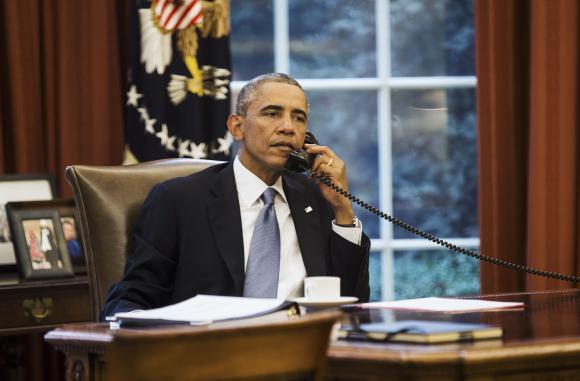
U.S. President Obama speaks on the phone with Saudi Arabia's King Abdullah from the Oval Office of the White House in WashingtonPresident Obama speaks on the phone from the Oval Office, September 10, 2014. CREDIT: REUTERS/KEVIN LAMARQUE

Decisions small as well as large are made at the White House, often with scant influence from the Pentagon and State Department and their much larger teams of analysts and advisers. Senior Cabinet officials spend long hours in meetings debating tactics, not long-term strategy, the officials said.

**********************

Throughout 2012, as signs mounted that militants in Syria were growing stronger, the debate in the White House followed a pattern. In meeting after meeting, as officials from agencies outside the executive residence advocated arming pro-Western rebels or other forms of action, President Barack Obama’s closest White House aides bluntly delivered the president’s verdict: no.

“It became clear from the people very close to the president that he had deep, deep reservations about intervening in Syria,” said Julianne Smith, who served as deputy national security advisor to Vice President Joe Biden. “And the likelihood of altering those views was low, very low.”

This summer, events overwhelmed the status quo. In June, the radical group Islamic State, after seizing wide swaths of Syria, conquered Iraq’s second largest city and threatened Baghdad as the Iraqi army collapsed. The insurgents beheaded two American journalists, increasing U.S. public support for military action. Finally, U.S. intelligence agencies detected foreign jihadists who they believe had moved to Syria to plot attacks against the United States and Europe.

The radicals had undermined the administration’s argument it had successfully ended the war in Iraq and were threatening Obama’s record of defending the homeland. The jihadists, said Smith, “turned the debate on its head.”

On September 18, Obama reversed his three-and-a-half-year opposition to military action in Syria and ordered open-ended airstrikes against militants. It wasn’t his first U-turn on Syria. In August 2012, Obama had warned President Bashar Assad that using chemical weapons was a “red line” Syria dare not cross; when evidence emerged that Damascus had gassed the rebels and civilians, Obama opted not to respond with force.

The bombing campaign, which could last for years, is a major course correction for a president with a famously cautious foreign policy.

Obama’s handling of Syria – the early about-face, the repetitive debates, the turnabout in September – is emblematic, say current and former top U.S. officials, of his highly centralized, deliberative and often reactive foreign policy.

They say Obama and his inner circle made three fundamental mistakes. The withdrawal of all American troops from neighboring Iraq and the lack of a major effort to arm Syria’s moderate rebels, they say, gave Islamic State leeway to spread. Internal debates focused on the costs of U.S. intervention in Syria, while downplaying the risks of not intervening. And the White House underestimated the damage to U.S. credibility caused by Obama’s making public threats to Assad and then failing to enforce them.

“REAL CHOKEPOINT”

This week, former Defense Secretary and CIA director Leon Panetta joined Hillary Clinton and a growing list of former cabinet members and aides who said Obama made major mistakes in the Middle East. Panetta singled out the U.S. troop withdrawal from Iraq.

“It was clear to me – and many others,” Panetta wrote in his memoir, “Worthy Battles,” “that withdrawing all our forces would endanger the fragile stability then barely holding Iraq together.”

Such arguments were rejected at the time inside the White House, where the foreign policy machine has grown dramatically in power under Obama and cabinet members and their departments have felt marginalized.

The National Security Council staff, which coordinates U.S. defense, diplomatic and intelligence policy from inside the White House, has nearly doubled in size on his watch. It has gone from about 50 under George H.W. Bush to 100 under Bill Clinton, 200 under George W. Bush and about 370 under Obama.

Decisions small as well as large are made at the White House, often with scant influence from the Pentagon and State Department and their much larger teams of analysts and advisers. Senior Cabinet officials spend long hours in meetings debating tactics, not long-term strategy, the officials said.

Robert S. Ford, the former U.S. ambassador to Damascus, recalled long meetings to debate small issues, such as which Syrian opposition members he could meet with and whether it was okay to give cell phones, media training and management classes to a local Syrian government council controlled by the opposition.

Sometimes, this more centralized White House system becomes overwhelmed.

“There’s a real choke point,” said Michele Flournoy, who served as the Under Secretary of Defense for Policy, the No. 3 Pentagon civilian, in Obama’s first term. “There’s only so much bandwidth and there’s only so much they can handle at one time. So, things start to slow down.”

Flournoy and other former officials who criticize the administration’s approach concede that the most important decisions – using military force – must ultimately be the president’s call. They argue, though, that intensified White House control has resulted in the United States being behind the curve, whether in trying to counter Russian propaganda about the Ukraine crisis or battle online recruitment by jihadists.

Syria, where the estimated death toll has topped 190,000, is cited as a prime example.

By the fall of 2012, covertly arming Syria’s rebels had been accepted by Obama’s top three national security Cabinet members – Clinton, Panetta and CIA chief David Petraeus – as the best way to slow radicalism in Syria. The president and his inner circle first rejected the advice, then mounted a small scale program to arm the rebels, and now, two years later, after Islamic State has seized swaths of Syria and Iraq, embrace the approach.

Obama’s aides say tight White House coordination is a must in an era when the United States faces threats like terrorism, which requires harnessing the capabilities of the Pentagon, the U.S. intelligence community, the State Department and other agencies. It’s the president’s duty to take ultimate responsibility for matters of war and peace, they say.

“Other than, of course, the men and women in uniform” and other officials deployed abroad, said Ben Rhodes, a White House deputy national security adviser, “only the president of the United States is assuming the risk of the cost of action.”

WHITE HOUSE CONTROL

This account of Obama’s national security decision-making is based on interviews with more than 30 current and former U.S. government officials, who have served both Democratic and Republican administrations going back to President Richard Nixon.

In some ways, Obama’s closer control and the frequent marginalization of the State and Defense departments continues a trend begun under Bill Clinton and George W. Bush.

But under Obama, the centralization has gone further. It was the White House, not the Pentagon, that decided to send two additional Special Operations troops to Yemen. The White House, not the State Department, now oversees many details of U.S. embassy security – a reaction to Republican attacks over the lethal 2012 assault on the U.S. consulate in Benghazi, Libya. A decision to extend $10 million in nonlethal aid to Ukraine also required White House vetting and approval.

On weightier issues, major decisions sometimes catch senior Cabinet officers unawares. One former senior U.S. official said Obama’s 2011 decision to abandon difficult troop negotiations with Baghdad and remove the last U.S. soldiers from Iraq surprised the Pentagon and was known only by the president and a small circle of aides.

The president, initially perceived as one of the greatest communicators of his generation, is now viewed as having done a poor job of defining and defending his foreign policy, polls indicate. A majority of Americans – 54 % – disapprove of Obama’s foreign policy performance, according to Reuters/Ipsos polling, one of the lowest ratings of his presidency.

Rhodes, one of Obama’s longest-serving national security aides, says a series of complex world crises, not policy mistakes, has driven down the president’s approval numbers. More broadly, he says, Obama has been right to be deliberative in the wake of costly wars in Iraq and Afghanistan.

“What he’s always said is that if there’s a threat against us, we will act,” Rhodes said. “But when it comes to shaping events in cultures that are foreign to the United States we have to have some degree of realism.”

Obama has had notable national security successes. His record of protecting U.S. territory from attack remains largely unblemished. Current and former officials praise his policy on nuclear talks with Iran as clear and consistent. He is building a coalition against Islamic State that includes Arab nations participating in airstrikes with the United States, Britain,France and others.

And while past presidents faced grave dangers, most notably the possibility of Cold War Armageddon, for Obama the world is very different. The decisions he must make on using U.S. military force have multiplied. This reality, supporters say, is overlooked by detractors.

Obama has launched a humanitarian military intervention in Libya; overseen counter-terrorism operations in Pakistan, Libya, Somalia, Yemen, Iraq, Afghanistan and elsewhere; moved to end his predecessor’s wars in Iraq and Afghanistan;  wrestled with lethal threats to U.S. hostages and diplomatic posts; and sent the American military to West Africa to help tackle the Ebola virus and search for kidnapped Nigerian schoolgirls.

“ANALYST IN CHIEF”

Current and former officials say the globalized world of Twitter and 24-7 news creates an expectation at home and abroad that the United States will quickly take a position on any foreign policy issue. The demand for instant American positions – and American leadership – can be overwhelming.

“One of the biggest problems in Washington,” said retired General James Jones, who was Obama’s national security advisor from 2009 to 2010, “is to find the time to think strategically, not tactically. You’d wake up and there would be a new crisis and you’d be scrambling to deal with them.”

Six years of grinding partisan warfare over foreign policy (and much else) have left Obama increasingly fatalistic about his critics.

While on vacation in Martha’s Vineyard in late August, he was widely criticized for golfing after making a condolence call to the family of murdered American journalist James Foley. Minutes after declaring Foley’s murderer – Islamic State – a “cancer” that had “no place in the 21st century,” Obama teed off with a campaign contributor, an old friend and a former NBA star.

Obama later told aides the criticism was inevitable. No matter what I do, he said, my enemies will attack me.

Far from being disengaged or indecisive on foreign affairs, as he is sometimes portrayed, Obama drives decision-making, say current and former officials.

Obama prepares thoroughly for meetings, has an encyclopedic memory and methodically dissects problems, former officials who have been with him in meetings say. The former law professor dominates foreign policy sessions, from small Oval Office gatherings to formal National Security Council meetings he chairs. Obama promoted open NSC debate, asked for dissenting opinions from cabinet members and called on junior officials who traditionally don’t speak at such meetings, they said.

Some aides complained that alternative views on some subjects, such as Syria, had little impact on the thinking of the president and his inner circle. Despite the open debate, meetings involving even Cabinet secretaries were little more than “formal formalities,” with decisions made by Obama and a handful of White House aides, one former senior U.S. official said.

Obama “considers himself to be analyst in chief, in addition to Commander in Chief,” on certain issues, according to Fred Hof, a former State Department envoy on Syria. “He comes to a lot of the very fundamental judgments on his own, based on his own instincts, based on his own knowledge, based on his own biases, if you will.”

The president’s supporters say his approach is based on principle, not bias. He ran on a platform of winding down the Iraq War and made his views crystal-clear on military action in the Middle East. Obama believed that the human and financial costs of large-scale interventions weren’t worth the limited outcomes they produced. He held that U.S. force could not change the internal dynamics of countries in the region.

THE SYRIA DEBATE

In August 2011, Obama issued a 620-word statement on Syria that his aides hoped would put him on the right side of history. After weeks of pressure from Congress, Syrian-Americans and allies in the Middle East and Europe, he called for Assad to “step aside.”

“It is time for the Syrian people to determine their own destiny,” Obama said.

Ford, ambassador to Syria from 2011 to 2014, said he supported the statement, but now regrets it because Washington didn’t back up the words with action. He said the Syria case reflects a pattern in the administration of issuing public statements without developing a clear policy.

When Assad refused to relinquish power, it became clear that the administration and its allies lacked a plan – or the political will – to forcibly remove him. American and European credibility in the region suffered.

Taking the removal of Assad into their own hands, Turkey and other Arab states overtly backed – or turned a blind eye to – the emergence of jihadist groups in Syria. American officials warned the countries that it would be impossible to control the militants, according to former U.S. officials. The Turks, according to one former official, replied that with Washington itself sitting on the sidelines, they had no choice but to back certain anti-Assad radicals.

As jihadists gained strength in the Syrian opposition in 2012, members of Obama’s first-term cabinet began to support covert U.S. action in Syria.

In the summer of 2012, three senior advisors outside the White House – Clinton, Panetta and Petraeus – proposed that the CIA train and equip the relatively moderate Syrian rebels operating as the Free Syrian Army.

At about that time, Ford said, the Free Syrian Army was warning – and U.S. officials confirmed independently – that militant groups were luring away fighters with cash. The more Western-friendly rebels had few funds to counter with.

In December 2012, Obama rejected the proposal.

Eight months later, in August 2013, U.S. intelligence concluded that Assad had used poison gas against rebels and civilians in a Damascus suburb, defying Obama’s public warning against chemical attacks. For a week, Obama appeared on the verge of launching airstrikes. After a walk with Chief of Staff and longtime aide Denis McDonough on the White House grounds, Obama changed course without consulting his national security Cabinet members and announced he would seek Congress’ approval, which never materialized. Instead, Washington and Moscow agreed on a deal to remove Syria’s chemical arms.

The missile strike reversal was widely cited by officials interviewed as the clearest example of Obama not engaging in a full Cabinet-level debate before making a strategic decision.

State Department officials warned for years that extremists would benefit from a power vacuum in Syria. “We were saying this area is going to be controlled by extremists and they’ll link up with Iraq,” said Ford. Obama made the wrong decision, Ford concludes. “It’s clear, in retrospect, that they needed more help then to counter the extremism.”

Another former official involved in Syria policy defended Obama. He said that in the early years of the Syrian conflict, with the long Iraq War fresh in their minds, Obama’s senior lieutenants struggled to find any vital national interest that would merit American intervention. Warnings of terrorism were discussed, this official said. But the White House responded that there were “more efficient and cheaper ways of dealing with the threat than intervening in Syria.”

Smith, the former NSC aide, said the Obama years hold a lesson.

“The instinct is to centralize decision-making with the hope of exerting more control,” she said. “But that often limits the U.S. government’s agility and effectiveness at a time when those two traits are most needed.”

Syrian Rebels Seize Russian Spy Station Near Israeli Border

October 7, 2014

Syrian Rebels Seize Russian Spy Station Near Israeli Border, Daily BeastJosh Rogin, October 7, 2014

Russian spy baseYouTube

The FSA found photos and lists of senior Russian intelligence and military officials who visited the facility, pictures of Russian personnel running the base, and maps showing the location of Israeli military units. Israeli news reports earlier this year said the Russian government had upgraded an advanced surveillance and intelligence gathering station in that area which could snoop on Israel, large parts of Jordan, and western Iraq, potentially to warn Iran in advance of an Israeli strike. Initial reports said documents from the facility suggested the Russian equipment was used to spy on Israel, Saudi Arabia and Jordan

***************

When the Free Syrian Army pushed Assad’s soldiers out of a town south of Damascus, the last thing they expected to find was a Russian spy post, a few miles from the Golan Heights.

Syrian rebels have overtaken a joint Russian-Syrian secret facility that they claim was a covert intelligence collection base. Opposition fighters say the post was used to snoop in on the communications of opposition groups — and perhaps even the nearby Israelis.Free Syrian Army officials, U.S. officials, and independent experts told The Daily Beast that the evidence of Russian involvement in the facility, just a few miles from Syria’s border with Israel, if verified, would show a level of Russian involvement in the Syrian civil war that was not previously known.

Free Syrian Army officials posted several videos on YouTube showing both the outside and the inside of the facility, which the FSA captured over the weekend during a battle near Al Harah, south of Damascus, next to the Golan Heights.

The videos and accompanying photos show insignias representing a branch of Syrian intelligence and the Russian Osnaz GRU radio electronic intelligence agency. The FSA found photos and lists of senior Russian intelligence and military officials who visited the facility, pictures of Russian personnel running the base, and maps showing the location of Israeli military units. Israeli news reports earlier this year said the Russian government had upgraded an advanced surveillance and intelligence gathering station in that area which could snoop on Israel, large parts of Jordan, and western Iraq, potentially to warn Iran in advance of an Israeli strike. Initial reports said documents from the facility suggested the Russian equipment was used to spy on Israel, Saudi Arabia and Jordan.

U.S. defense officials told The Daily Beast the photos of the Russian insignia first shared on blogs were legitimate. But that evidence, at the same time, may not necessarily mean the facility captured by the opposition was controlled by Russia’s military; it could just mean that Russians were working there, as advisors or partners to Syrian troops.

Mark Galeotti, an expert on Russia’s military and intelligence services at New York University said the term “Osnaz” on the insignia just meant a special unit of any kind. “It’s the kind of unit that the Russians would have had there because Syria is not the easiest area to operate in, they are an element of the radio-technical intelligence boys who do this.”

Firas Al Hawrani, the official spokesman for the FSA in southern Syria, told The Daily Beast Monday that FSA forces had seen about 15 Russian personnel operating in the Al Harah area before the FSA took the facility, but they left before the area fell out of regime control.

“The Russians who were at the Al Harah mountain, the regime took them to Damascus by plane two weeks ago,” he said.

Galeotti said these Russian advisers would specifically be working on intercepting radio communications of opposition figures. “They would be running an operation for detailed radio technical intelligence, we are not talking about intercepting telemetry and aircraft,” he said. “This is for eavesdropping on rebel radio communications. Cell communications are easier identified through other means. And this is also for identifying the presence of these units, which leads directly into targeting.”

Russia has been one of Syria’s most important allies for years. The port of Tartus is Russia’s only naval base on the Mediterranean, for example. And since the civil war in the country broke out in 2011, Russia has provided the country with advisers and billions of dollars’ worth of heavy military equipment. Galeotti said Syria’s security services are good as “traditional secret police skills,” such as interrogation and bugging telephones. The facility taken over by the Syrian opposition, however, suggests the Russians gave the regime “a whole new capability,” Galeotti said. “A lot of the Syrians are very clumsy. Some of the more precise attacks in the last year have suggested a new sophistication.”

Sen. John McCain told The Daily Beast Monday that the apparent Russian involvement in the base, which was also reportedly tasked with collecting signals intelligence and communications of rebel groups, showed of the depth of Moscow’s collusion with Damascus in the Syrian civil war.

“If what they’ve recovered is true and I have no reason to believe it’s not, it really is very indicative of the significant involvement of Russia in this conflict,” he said. “It shows significant coordination, establishment of a facility they could use for coordination and intelligence capabilities including intercepts. It’s a pretty sophisticated operation there that they’ve uncovered.”

Meanwhile, in Northern Syria, ISIS continued a major assault on the city of Kobani near the Turkish border as Kurdish and tribal forces tried to repel them. Dr. Najmaldin Karim, the governor of Kirkuk, was in Washington last week asking U.S. officials to expand the airstrikes in both Iraq and Syria and to increase aid to the Kurdish forces in both countries.

Not only is ISIS advancing in Northern Syria, they are digging in their positions in several Iraqi cities, including Mosul and Ramadi, Karim told The Daily Beast in an interview. Gen. John Allen, whom President Obama appointed to coordinate the international coalition against ISIS, said in Baghdad that the drive to free key cities like Mosul may take as long as a year.

“A lot of the front lines are basically frozen,” said Karim. “The worst thing would be for the United States, the region, and for Iraq, would be if the situation stays like this and festers. These guys have been there since June. If it goes further, it becomes a way of life. It will become like Somalia.”

With a strategy like this, does it even matter who the Free Syrian Army is?

October 1, 2014

With a strategy like this, does it even matter who the Free Syrian Army is? Breitbart, September 29, 2014

Syrian-militant-reuters

The US strategy as announced by President Obama in his speech to the nation on September 10, 2014, calls for the US to establish staging areas inside Saudi Arabia where 5,000 FSA fighters can spend 18 months training to become a more effective and well armed fighting force to better combat both the Syrian regime, again numbered at up to 175,000 men and forces of the ISIS terrorist army.

******************

Assume for a moment that the Free Syrian Army, the mysterious rebel alliance to which the United States is now allied in its broader campaign to degrade and destroy ISIS, is not the ill defined and ever-changing conglomeration of tribal factions; each committed to a Jihadist agenda in some degree and each with their own mysterious allegiances actively seeking the military overthrow of the Iranian backed regime of Bashir al-Assad.

Instead, assume that the FSA consists in fact of unimpeachably “vetted” limited government, Jeffersonian style democrats each of whom are are fully committed to the establishment of a US – styled constitutional republic in Syria, and thus utterly worthy of complete and total American support. Now that an air tight hypothetical premise has been built to justify bipartisan support for the FSA, try to imagine the Obama Administration authoring the policy most likely to condemn the FSA to certain defeat and US regional standing to rock bottom.

One need not imagine however, that the latter part of the fanciful scenario spelled out above is in any way fictional. As it currently has been articulated, this pretty much sums up US policy vis-a-vis the Free Syrian. As of this writing, Syria’s civil has been raging for 1294 days. During that span, more than 200,000 Syrians have been killed, many times that wounded and more than one third of the country’s 30 million people have been made homeless. The country’s map now resembles a pockmarked incomprehensible hodgepodge of regime and rebel redoubts and strongholds massed against each other.

The two main sides in Syria’s civil war–the regime and its prime opponents who collectively chooses to call itself the Syrian Coalition–have fought each other to a standoff in the past several months. The ISIS forces that occupy much of Syria’s east and north have largely avoided much military contact with regime forces, concentrating instead on consolidating its hold over the territory it controls, although ISIS forces did attack and overrun four Syrian military outposts in August, gleefully displaying the heads of Syrian soldiers its fighters had proudly cut off.

Using US supplied war material it stole from fleeing Iraqi forces it overran in June and July, ISIS has fortified its positions in Syria and is rapidly moving toward Aleppo, Syria’s largest city currently in rebel or FSA, hands. The so-called “Free Syrian rebels” now find themselves confronted with an overwhelming multi forced front. In Aleppo, they are surrounded. Its continued control of that city depends upon it being able to hold communications lines that grow more precarious by the day.

The Obama Administration and most western analysts estimate the size of the Free Syrian Army now caught in this deadly pincer at roughly 5,000 men. To the north and east, the 5,000 FSA fighters, if they can even be called a single force with unitary command, (There are at least three people at present who claim to lead the FSA).

They face a rapidly expanding and ever emboldened ISIS army of between 10,000 and 31,500. Surrounding the 5,000 FSA fighter to their south and west are the regular forces of the Syrian Army that number between 130,000 to 165,000 men.

The US strategy as announced by President Obama in his speech to the nation on September 10, 2014, calls for the US to establish staging areas inside Saudi Arabia where 5,000 FSA fighters can spend 18 months training to become a more effective and well armed fighting force to better combat both the Syrian regime, again numbered at up to 175,000 men and forces of the ISIS terrorist army.

How will these 5,000 fighters leave their current positions and get to Saudi Arabia? Who will assume control of the positions they currently hold once they abandon them for the Elysian fields of Saudi Arabia? Once “trained” and “equipped”, how, a year and a half from now, will these 5000 FSA fighters, currently outnumbered 50 to 1, be able to “reassume” their long  abandoned positions? Does the Administration and other supporters of its FSA assistance strategy expect ISIS and Assad forces to politely agree to hold their enemies coats while they excuse themselves for training in Saudi Arabia?

Has there ever in American military history been a more hair-brained, ill-conceived military mission more certain to fail? Again, putting aside entirely the many valid questions about precisely who we are the people we are planning to train and what their real objectives are, with a strategy like this, does it really even matter?