Archive for the ‘Egypt’ category

Yemen war: Saudis prevented Russian evacuations by air, bombed Moscow’s spy center in Aden

April 7, 2015

Yemen war: Saudis prevented Russian evacuations by air, bombed Moscow’s spy center in Aden, DEBKAfile, April 7, 2015
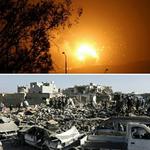
Russias_Yemen_consulate_damaged_in_Saudi-led_airstrikes_1.4.15Russia’s bombed out consulate in Aden

Saudi Arabia has gone head to head with Russia as Iran’s ally in Yemen.

Moscow claims to have evacuated hundreds of Russian nationals from Yemen by an air lift running out of Sanaa airport, but DEBKAfile’s exclusive intelligence and military sources reveal that not a single Russian plane has taken off from any Yemeni airport since March 27, when Saudi Arabia launched its military offensive against the pro-Iranian Houthi rebels.

The Saudiis warned Russia that they would not be responsible for the safety of any flights landing at a Yemeni airport or the passengers assembled there for evacuation, while their air force conducted strikes against the rebels. Having achieved control of Yemen’s skies in the early stages of their intervention, the Saudis declared its air space a no-fly zone.

This warning gained substance when, on April 1, Saudi F-15 warplanes bombed the Russian consulate in the second largest Yemeni city, Aden. A Russian witness said that not a single window was left in the building and all Russian citizens would have to leave the town.

According to DEBKAfile’s sources, the building was in fact completely demolished in order to dismantle Russia’s regional intelligence-gathering center which operated out of the consulate building and fed Iranian intelligence with data on military movements in the neighborhood.

It functioned according to the same system as Russian spy stations in Syria, which routinely keep their Iranian colleagues au fait with military activities, including Israeli army movements.

The intelligence gathered by the Aden facility was no doubt passed on by Iranian agents to the Houthi commanders, certainly after Al Qods Brigades chief Gen. Qassem Soleimani arrived in Sanaa to direct the rebel offensive after the Saudi offensive was launched.

In normal times, the Russian spy facility would have been responsible for surveillance over navigation through the Bab el-Mandeb Strait and the warships sailing between Red Sea, the Gulf of Aden and the Indian Ocean.

The next chapter of the Russian evacuation story unfolded on Thursday, April 2, the day after the consulate was razed: The Russians tried activating their connections in Cairo to obtain Saudi permission to land a plane in Sanaa, where hundreds of Russians had crowded to await passage to safety.

The Saudis relayed their refusal to Moscow through Cairo.

Then, on Friday, April 3, a flight landed at Moscow’s Chkalovsky Airport carrying Russian evacuees from Yemen, followed by a second flight which landed at an unnamed Russian military airport.

DEBKAfile’s sources report that neither of those planes were actually permitted to take off from Sanaa, but flew in from Cairo. After the Saudi ban on flights through Yemeni airports, Moscow had no choice but to rescue its nationals from the embattled country by sea aboard ships that carried them to Egypt.

 

Can and should Israel destroy Iran’s nuclear facilities?

April 5, 2015

Can and should Israel destroy Iran’s nuclear facilities? Dan Miller’s Blog, April 5, 2015

(The views expressed in this article are mine and do not necessarily reflect those of Warsclerotic or any of its other editors. — DM)

It has been suggested that Israel should seriously consider destroying Iranian nuclear facilities, but Israeli officials obviously haven’t said, and won’t say, if, how or when she might.

Iran fenced in

Speaking to Arutz Sheva Friday, Professor Efraim Inbar, who heads the Begin-Sadat Center for Strategic Studies, said the deal had realized Israel’s worst fears by leaving Iran’s nuclear program essentially intact.

The Islamic Republic’s nuclear program has been granted “legitimacy” by the agreement, which still allowed it to continue enriching uranium and to maintain a reactor capable of producing enriched plutonium, he said. “And that’s what worries Israel, that they (Iran) will be able within a short time frame to reach a nuclear bomb.”

“I hold the view that the only way to stop Iran in its journey to a nuclear bomb is through military means,” Inbar maintained, suggesting that “Israel needs to seriously consider striking a number of important nuclear facilities” to head off the threat.

On March 28, former U.S. Ambassador Bolton said that it should be done.

The P5+1 nuclear “deal,” proudly announced by President Obama on April 2nd, is a sham. There is no “deal,” and public announcements by Iran and Obama cast it in very different lights. According to Iran, all sanctions will be lifted immediately when an agreement is reached on or before June 30th. According to Obama, sanctions relief will be gradual and based on Iran’s compliance with invasive inspections and other conditions. Even National Public Radio (NPR) has pointed out differences. NPR observed that, according to Iran,

all sanctions relief – U.N., EU and U.S. – would be immediate. It was unequivocal. It stated that Iran under the deal was free to pursue industrial scale enrichment to fuel its own reactors – unequivocal. It stated that Iran was unhindered in its ability to conduct centrifuge R&D.

Iran has also emphasized that its intention to destroy Israel is non-negotiable, and the Obama Administration has rejected any efforts to make Iran recognize Israel’s right to exist, on the ground that

“This is an agreement that is only about the nuclear issue,” State Department spokeswoman Marie Harf told reporters on Friday night, according to Fox News. “This is an agreement that doesn’t deal with any other issues, nor should it.” [Emphasis added.]

Israeli Prime Minister Netanyahu has said that Israel’s right to exist is non-negotiable.

Iran is very unlikely to retreat from its perception of the “deal,” Obama is very likely to retreat in Iran’s favor, and Israel is very unlikely to retreat from its perceptions about Iran, the “deal” or Israel’s right to exist.

What should Israel do?

In Martin Archer’s novel Islamic War, which I reviewed here, Israel dispatched elderly, large and substantially refurbished remove controlled aircraft, full of high explosives, from Somalia to half dozen nuclear facilities operated by hostile nations. They flew circuitous routes at varying altitudes to avoid detection until it was too late to stop them. Over a period of weeks, they crashed into and destroyed their targets, amid speculation about who had done it and why. Israel was not suspected. Would that have been possible then? Now? I don’t know.

It has been reported that Saudi Arabia has given Israel clearance to use her airspace for an attack on Iran’s nuclear facilities.

Fox News reports that US Defense sources claim the Saudis are conducting tests on their air defense systems after giving Israel permission to to enter a narrow corridor to shorten the distance to attack Iran.

The testing would make sure that Saudi jets don’t get scrambled when Israel entered Saudi airspace. Once the IAF planes complete their mission and exit Saudi airspace, Saudi defenses would go back online again. [Emphasis added.]

Might Saudi Arabia, Egypt and perhaps other Gulf States go beyond not interfering with an Israeli attack to provide air support and other help? They seem to be as displeased with the “deal” as Israel is.

Assuming that Israel is not overly concerned about being identified as the attacker and is willing to act alone, she might:

Detonate one or more high-altitude atomic bombs to emit sufficient electromagnetic pulses (EMP) to fry all above-ground Iranian electronics. That would substantially disable Iranian above-ground command and control facilities as well as other communications, hence diminishing (but not eliminating) the possibility of counter-strikes by Iran and/or its proxies. Perhaps she has other, non-nuclear, means of generating EMPs; she hasn’t said.

Immediately thereafter, drop whatever suitable bombs she may have on all Iranian military and nuclear facilities. Does Israel have bunker-buster bombs? Probably not of U.S. manufacture, but that does not mean that she has not developed her own. It would be surprising if she had not.

Obama and other “leaders of the free world” would complain and the U.N. would emit fits of angry censures. However, that happens with great frequency in any event, and would be an insufficient reason for Israel to commit national suicide through inaction against Iran.

I am no “military expert” and would appreciate any comments on the suggestions I have made as well as any other suggestions anyone might care to offer.

Egypt sends large naval-marine force to Bab el-Mandeb

April 5, 2015

Egypt sends large naval-marine force to Bab el-Mandeb , DEBKAfile, April 5, 2015

(Please see also, Khamenei sends Iranian navy to Bab el-Mandeb Straits. Iran arms store for Hamas bombed in Libya. — DM)

DEBKAfile’s military sources report that Egypt Sunday transferred war ships and marine forces as reinforcements for securing the Bab el-Mandeb Strait against Iranian-backed Houthi control. Egypt now deploys six warships and at least 1,000 marines at the vital shipping gateway.

Egypt will defend its Gulf allies “if we have to,” said President Abdel-Fatteh Al-Sisi Saturday night after a meeting of the Supreme Council of the Armed Forces. He stresse that Bab Al-Mandab Strait was a national security issue for Egypt and Arab countries. Arab national security would only be protected by Arab countries, said the president.

Egypt has closely monitored the civil war in Yemen, especially since the Saudi-led Operation Decisive Storm began to end the Iranian-backed Houthi rebellion. The disruption of shipping in the Bab el-Mandeb Strait would directly affect traffic, including energy shipments, to and from the Gulf and Far East through Egypt’s Suez Canal.

Report: Israeli Jet Struck Weapons Depots in Libya

April 4, 2015

Report: Israeli Jet Struck Weapons Depots in Libya, Israel National News, Gil Ronen, April 4, 2015

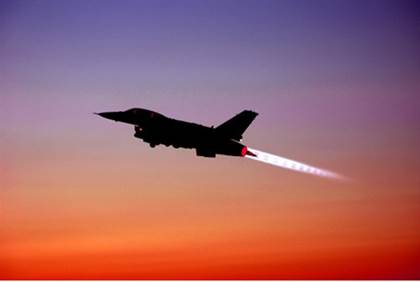
img373532IAF F-16 IAF Website

Al Watan added that Egypt allowed the Israeli jet to pass through its airspace en route to southern Libya.

********************

Arab news sources reported at week’s end that an unidentified jet believed to be Israeli destroyed warehouses in southern Libya that held weapons bought by Iran for Hamas.

According to the reports in Al Watan and other news outlets, the warehouses were completely destroyed. The weapons that were inside them had allegedly been purchased by Iran, by means of weapons dealers in Sudan and Chad, and were supposed to be smuggled to Hamas through Egypt, by means of the smuggling tunnels between Sinai ands Gaza.

The destruction of the weapons stores in southern Libya was carried out in coordination with the Egyptian security and intelligence apparatuses, the reports claimed.

Al Watan added that Egypt allowed the Israeli jet to pass through its airspace en route to southern Libya.

US releases military aid to Egypt, cites national security

March 31, 2015

US releases military aid to Egypt, cites national security, Associated Press via Fox News, March 31, 2015

President Barack Obama on Tuesday released military aid to Egypt that was suspended after the 2013 overthrow of the government, in an effort to boost Cairo’s ability to combat the extremist threat in the region.

The White House said Obama notified Egyptian President Abdel-Fattah el-Sissi in a phone call Tuesday that the U.S. would be sending 12 F-16 fighter jets, 20 missiles and up to 125 tank kits, while continuing to request $1.3 billion in military assistance for Egypt. The White House said that would make Egypt will remain the second-largest recipient of U.S. foreign military financing worldwide.

The funds were suspended 21 months ago when el-Sissi, then military chief, overthrew Egypt’s first democratically elected leader, Islamist President Mohammed Morsi. But Washington could not provide almost half of the annual aid package — along with assistance held up from previous years — until it certified advances by el-Sissi’s government on democracy, human rights and rule of law or issued a declaration that such aid is in the interests of U.S. national security.

The U.S. has been providing hundreds of millions in counterterrorism assistance to its ally, which didn’t stall as a result of the government overthrow. Egypt has been arguing it needs the money to face growing threats from extremists creeping over the border from lawless Libya or operating in the Sinai Peninsula, and the U.S. sees the funds as critical for stability in the volatile Middle East.

The aid comes as Egypt is trying to play a leading role in forming an Arab military alliance that can fight terrorism in the region.

The White House said it is not issuing a certification that Egypt has made progress toward democracy. Instead, the U.S. said it is maintaining that the aid is in the interest of U.S. national security.

The White House said in Obama’s call to el-Sissi, he “explained that these and other steps will help refine our military assistance relationship so that it is better positioned to address the shared challenges to U.S. and Egyptian interests in an unstable region, consistent with the longstanding strategic partnership between our two countries.”

The White House said Obama also reiterated U.S. concerns about Egypt’s continued imprisonment of activists and encouraged increased respect for freedom of speech and assembly.

Egypt seizes Bab el Mandeb ahead of Iran. Saudis bomb Iran-backed Yemeni Houthis. US launches air strikes over Tikrit

March 26, 2015

Egypt seizes Bab el Mandeb ahead of Iran. Saudis bomb Iran-backed Yemeni Houthis. US launches air strikes over Tikrit, DEBKAfile, March 26, 2015

Yemen3_1

The separate operations in Yemen and Iraq attested to the widening breach between the Sunni Arab camp and the Obama administration and the former’s resolve to thwart US strategy for buying a nuclear deal with Tehran by empowering Iran to attain the rank of leading Middle East power.

**********************

In a surprise step, Egyptian marine naval and marine forces Thursday morning, March 26, seized control of the strategic Bab El-Mandeb Straits to foil Tehran’s plans to grab this important energy shipping gateway between the Red Sea, the Gulf of Aden and the Suez Canal, DEBKAfile’s military sources report from the Gulf. Egypt disguised the raid as a counter-piracy operation. It rounded off the Saudi-led air strikes launched the same morning against Iran-backed Houthi rebels in Yemen. These operations signaled the start of a major Sunni Arab revolt against Iran’s approaching takeover of Yemen, through its Houthi proxy, and advances in other strategic positions in the Middle East, with Washington’s support.

Thursday morning too, the US launched the US launched its first air strikes against Islamic State positions in the Iraqi city of Tikrit, rallying to the aid of the Iranian-commanded Iraqi operation, which had failed to dislodge the jihadis in two weeks of fighting.

The separate operations in Yemen and Iraq attested to the widening breach between the Sunni Arab camp and the Obama administration and the former’s resolve to thwart US strategy for buying a nuclear deal with Tehran by empowering Iran to attain the rank of leading Middle East power.

DEBKAfile reported earlier Thursday morning:

Iran’s Revolutionary Guards (IRGC) are now leading war action in four Mid East arenas: Syria, Iraq, Yemen and Lebanon, while building Shiite “popular” armies deferring to Tehran in three: Syria, Iraq and Yemen.

The formal announcements coming from Riyadh and Washington attempted to gloss over the open breach. The Saudis Wednesday indicated that their military buildup on the Yemeni was “purely defensive,” while Washington subsequently declared support for the Saudi-Gulf-Egyptian air strikes after they began.

According to our Washington sources, President Obama decided Wednesday to accede to the Iraqi premier Haider al-Abadi’s request for air support to de-stall the Tikrit operation against ISIS. Iran’s Al Qods Brigades chief, Gen. Qassem Soleimani, who commanded the operation from the start has departed the scene.

Nothing has been said to indicate whether the Iranian forces, including Revolutionary Guards officers, remain in the area. It appears that the Obama administration prefers as little as possible to be mentioned about US-Iranian battlefield coordination in Iraq versus the Islamists, especially since it was not exactly a big success. At the same time, US air strikes launched to support ground forces are bound to be coordinated with their commanders, who in this case happen to be mostly Iranian. In the last two weeks of the Tikrit operation, liaison between the US and Iranian military in Iraq was routed through the office of the Iraqi Prime Minister in Baghdad.

Early Thursday, Riyadh reported that the Saudi Royal Air Force had taken out Houthi air defenses, destroyed numerous Houthi fighter planes and were imposing a wide no-fly zone over Yemen.

Egypt is providing political and military support for Saudi-GCC operation against Houthi fighters in Yemen, the Egyptian state news agency said Thursday. Egypt’s Foreign Ministry was quoted as saying this support could involve Egyptian air, naval and ground forces, if necessary.

DEBKAfile’s military sources add: The Saudis declared Yemeni air space a no-fly zone to achieve to goals: (1) To deny the Yemeni forces advancing on the key port city of Aden access to air cover which would undoubtedly have been forthcoming from mutinous elements of the Yemeni air force. Without it, the rebel advance would be severely hobbled, and, (2) to prevent Iranian warplanes from landing at Yemeni air bases with deliveries of military equipment and ammunition their Houthi proxies.

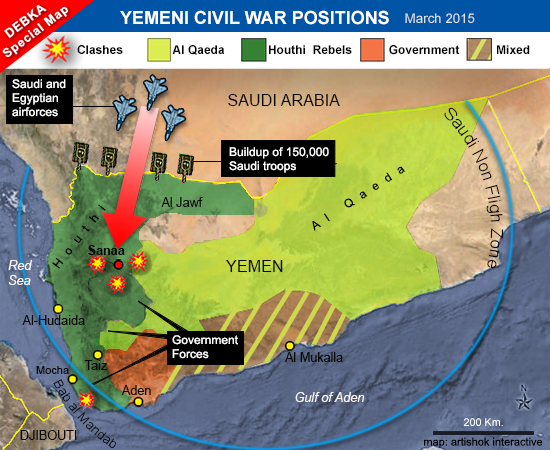
Gulf sources disclose that Saudi Arabia has placed 100 warplanes and 150,000 troops with heavy weapons at the disposal of the operation against Iran’s Yemeni proxy, the Zaydi Houthis, as well as pressing into service Pakistani, Moroccan and Jordanian military units. This force is a sign that Riyadh intends of following up its air action with a ground invasion across the border into Yemen to crush the revolt in its backyard.

Developing…

Book review: The Islamic War

March 16, 2015

The Islamic War: Book review, Dan Miller’s Blog, March 16, 2015

(The views expressed in this article are mine and do not necessarily reflect those of Warsclerotic or its other editors. — DM)

The Islamic War, Martin Archer, 2014

The novel begins with a terror attack on a residential area in Israel, resulting in multiple causalities. It may, or may not, have involved members of the Iranian Revolutionary Guard. Menachem Begin is the Israeli Prime Minister and Ariel Sharon is the Defense Minister. The story begins immediately after the (postponed?) end of the Iran – Iraq war in 1988.

A massive armor, infantry, artillery and air attack on Israeli positions in the Golan follows the terrorist attack. The Israelis are outnumbered and suffer many thousands of casualties.

Israel had anticipated a simultaneous attack via Jordan, so most Israeli tank, infantry and air resources are deployed there, rather than in the Golan, to conceal themselves and await the arrival of Iranian, Iraqi and Syrian forces. They come and are defeated, most killed or fleeing. The Israeli forces then move into Syria and have similar successes there as well.

As the story evolves, it becomes evident that Israel must have known that the Iran – Iraq war had been allowed to fester to permit Iran, Iraq and Syria to develop a well coordinated plan to dispose of Israel, in hopes that a surprise attack could be made as soon as the Iran – Iraq war ended. Other events also suggest that Israel had prior notice:

Nuclear facilities of several hostile nations explode mysteriously.

The Israeli Navy had managed to infiltrate Iranian oil ports — apparently before the attack on the Golan — without being noticed. Then, at a propitious moment near the end of the fighting elsewhere, they destroyed all oil tankers in, entering or leaving port, along with all Iranian oil storage facilities.

The Israel Navy, which had suffered no losses, then moved to Saudi Arabia to protect her oil ports and ships coming to buy her oil and leaving.

As these events unfold, Israel, Egypt, Jordan, Saudi Arabia and Turkey* are negotiating a united front against Iran, Iraq and Syria, much to the displeasure of the U.S. Secretary of State, who wants a cease fire and return to the status quo ante. Fortunately, the U.S. President favors Israel and her coalition and generally ignores his SecState.

I won’t spoil the story by relating what happens at the end, but it’s very good for Israel, Egypt, Jordan, Saudi Arabia, Turkey and the Kurds, and very bad for Iran, Iraq and Syria. The novel is well worth reading, perhaps twice.

_____________

*Historical note: Turkey in 1988 was reasonably secular and also in other ways quite different from now. Egypt under President Al-Sisi is, in some but not all respects, similar to Egypt in 1988 under President Mubarak. Beyond a good relationship with Israel, Al-Sisi is working to modernize and reform Islam by turning it away from the violent jihad which drives both the Islamic State (Sunni) and the Islamic Republic of Iran (Shiite). Egypt remains under fire from the Obama administration due to the “coup” which ousted President Morsi, who had made Egypt essentially an arm of the Muslim Brotherhood. Egypt now helps to protect Israel with her military presence in the Sinai to oppose Hamas and Muslim Brotherhood activities there. Saudi Arabia and Jordan, like most countries in the Middle East, look out for the interests of their rulers first and are quite concerned about both the Islamic State and Iran.

ISIS-Sinai Is packing large water tankers with explosives

March 14, 2015

ISIS-Sinai Is packing large water tankers with explosives, DEBKAfile, March 14, 2015

(Please see also, IDF braces for Islamic State attack on Israel-Egypt border. — DM>

Egyptian military sources report that the ISIS Sinai affiliate has been discovered rounding up a large fleet of water and fuel tankers and big lorries and packing them with explosives for large-scale terrorist attacks on Egyptian and Israeli targets. The group which calls it’s the Sinai Province of the Islamist Caliphate tried the method out on March 4, using an explosives-packed water tanker to storm an Egyptian military compound in the Kawthar district of the northern Sinai town of Sheikh Zuweid. On March 10, they seized another water tanker at al-Towil east of El Arish, and on March 11, in the same area, they captured two large trucks of the Egyptian electricity company and pushed the drivers out.
Thursday, March 13, Col. Arik Hen of the IDF’s 80th Division said the military was on the alert for a major coordinated ISIS attack on Eilat from Sinai and the sea.

Hamas’ revamped naval commandos could pose a problem for Israel

March 14, 2015

Hamas’ revamped naval commandos could pose a problem for Israel, Ynet News, Alex Fishman, March 14, 2015

Although all unit members were killed during last summer’s infiltration attempt at Zikkim, Hamas viewed this as a massive achievement and subsequently trained a new force whose role will be to carry out mass attacks on the Israeli home front.

Palestinian Islamist organization Hamas has completed the reconstruction of its naval commando force, consisting of dozens of trained divers, in order to hit strategic sites, Israeli and others’, in the Mediterranean Sea.

With the development of its underwater unit, Hamas aims to compensate for the failure of the offensive tunnels from the Gaza Strip, which it rules, which were supposed to reach into Israel. From just a handful, the force has grown into many dozens of fighters trained to strike the Israeli home front via abductions and killings.

Hamas’s operational approach sees the naval commandos as one long “tunnel”, extending from Gaza in Israel’s south to Rosh Hanikra in the north, through which it could hit any target along the entire Israeli coast. These could be strategic objectives such as power plants, coal terminals, gas rigs and so on. However, using Operation Protective Edge as a model, it seems that Hamas is training its commandos to create a continuous shockwave for Israeli society through the mass murder of civilians and soldiers.

Hamas diversHamas’ infiltration attempt at Zikim during Protective Edge (Photo: IDF)

The Israeli defense establishment sees the strengthening of Hamas’ underwater activity – through the establishment of a large and professional commando unit – as one of the main lessons Hamas took from last summer’s conflict.

The Hamas commandos’ successful penetration a kilometer deep within Israeli territory, near Kibbutz Zikkim, is one of the organization’s major achievements during the 50 days of fighting, as this was the only time when Hamas special unit members managed to infiltrate Israel. If not for Israeli intelligence, it is likely the commando unit would have been able to penetrate the community or a nearby IDF base and carry out the mass murder it wanted.

Earlier this week, Egyptian newspaper “Al-Akhbar” reported that the creation of the naval commando unit was intended to harm Egypt’s facilities in the Mediterranean. The Egyptians, who have signed a gas deal with Israel, are worried about damage to the Tethys Sea group’s installation, while accusing Hamas of conducting sea-based attacks on Egyptian naval forces.

In November 2014, an Egyptian patrol boat was attacked as it conducted an operation against smuggling from the Gaza Strip. The attack was carried out by three rubber boats in the Egyptian Delta, near the port of Damietta. The perpetrators seized control of the ship, killed 13 Egyptian soldiers and hoisted the Islamic State flag.

The Egyptians blamed Hamas for supporting and being party to attacks of this kind, and significantly changed the security measures on their ships. Even the commands to open fire have changed, and the Egyptians shoot to destroy Gazan fishing boats that approach them without prior coordination.

In light of the accusations, Hamas leader Mahmoud Zahar was quick to issue a denial in the Al-Quds newspaper, saying that Hamas was not planning to wave underwater warfare in the area.

It was until Operation Pillar of Defense in November 2012 that the Hamas naval force was viewed as amateurish. But since that operation, Hamas was been working on setting up a large professional unit – its people were sent abroad for training, most likely to Iran, and it procured military-grade diving equipment.

During last summer’s infiltration at Zikkim, Israel registered the use of military standard systems, which prevent bubbles from surfacing during a dive. Hamas also has a small underwater craft, known as a “scooter”, for individual divers, and has even published pictures of them for propaganda purposes. It appears that following the collapse of diving tourism in Sinai, the club owners were happy to sell some advanced diving equipment.

The training of the reinvigorated commando unit is largely reminiscent of the training for elite units in conventional armies, including the ability to withstand physical and mental pressure that is customary within professional naval commando units in the region.

The defense establishment and the IDF are preparing for an increased threat from this underwater force. It should be noted that during Protective Edge, this unit only sustained partial damage, and in any future conflict its infiltration efforts will be a force to be reckoned with for Israel.

IDF braces for Islamic State attack on Israel-Egypt border

March 13, 2015

IDF braces for Islamic State attack on Israel-Egypt border, Israel Hayom, Lilach Shoval and Daniel Siryoti, March 13, 2015

(Please see also IDF on alert for coordinated ISIS assault on Eilat or vicinity. — DM)
142623927595729064a_bSouthern Border Brigade Deputy Commander Col. Arik Hen | Photo credit: Yehuda Ben Itach


Ansar Bayt al-Maqdis released a video Thursday in which its operatives claim to have fired three rockets at the Eilat port last week. The group claimed it plans to fire up to 150 rockets daily at Egyptian security forces in Sinai and the Eilat port.

*********************

The Israel Defense Forces is said to be preparing for the possibility that one of the Sinai-based terrorist organizations affiliated with the Islamic State group will carry out a massive attack on the Israel-Egypt border.

It is believed that Ansar Bayt al-Maqdis, the largest Islamic State-affiliated jihadi group in Sinai, will attempt to target Egyptian security forces along Israel’s southern border using what has become its signature modus operandi — surprise attacks by dozens of terrorists on several targets simultaneously.

The military believes these terrorists will attempt to disguise themselves as smugglers, or perhaps even as Egyptian security forces, so they would be able to approach Israeli troops in the sector.

Earlier this week, Southern Border Brigade Deputy Commander Col. Arik Hen said the threat was a priority for the IDF, and that “it affects military readiness for various scenarios that may develop” near or on the border.

Meanwhile, the military is said to be outlining its defense of the Timna Airport, the new international airport currently under construction in southern Israel, which is expected to become operational in 2017.

As part of the planned defenses, a 30-kilometer fence is being designed to encompass the airport and adjacent area.

Ansar Bayt al-Maqdis released a video Thursday in which its operatives claim to have fired three rockets at the Eilat port last week. The group claimed it plans to fire up to 150 rockets daily at Egyptian security forces in Sinai and the Eilat port.