Judging by his approach to complex national and international issues, U.S. President Barack Obama is very frustrated. The frustration is natural for someone who made big promises, almost messianic ones, and is now leaving behind nothing more than a trail of shattered dreams. During his eight years in office, the United States has gone from being a leading superpower, a pillar of Western civilization, to a state that is hesitant, indecisive and alarmingly slow to respond. Its domestic economy is faltering, sowing uncertainty and insecurity among the large middle class.
Needless to say, the success enjoyed by Republican presidential candidate Donald Trump is an expression of a great number of Americans who grew up hearing about how their flag was raised on Japan’s Mount Suribachi on the island of Iwo Jima toward the end of World War II, and who are now watching with heartache as their beloved flag is being lowered to half-mast before being taken down altogether.
In an effort to gather up the pieces of his crumbling legacy, Obama set out on his final trip to the Middle East and Europe. America’s long-time allies feel betrayed. Their resentment is clear. Relationships between countries are not disposable. The Obama administration’s deference to Iran has had major implications on its ties with Saudi Arabia and the Gulf States. A divided Egypt is still paying the price for Obama’s support for the Muslim Brotherhood.
The state of Israel, which has led the struggle against a nuclear Iran for a long time, has by now come to terms with the fact that the United States was duped by the fake smiles of Iranian Foreign Minister Mohammad Javad Zarif and his friends in Tehran. Singing Passover songs in Hebrew won’t change the fact that Obama has not changed, after having sided entirely with the mendacious Palestinian narrative of victimhood.
Leaders in the Middle East cannot decide whether Obama is a naive president or one who is willing to sacrifice his fundamental values and his credibility just so he can leave behind what he sees as a positive sentence in the books of history — a sentence that will be erased with record speed.
Europe is also discouraged by the United States. Obama’s indecisiveness regarding the madness in Syria has allowed Russia to take significant steps in the Middle East and Europe. The failed efforts to confront the Syrian problem have contributed to the tsunami of migrants flooding Europe and all the resulting consequences for European society and its security. Add to this, of course, the financial crisis currently threatening to destroy the European Union, the seeds of which were sown in 1992 with the signing of the Maastricht Treaty in 1992.
It is against this backdrop that the British are expected to decide via referendum whether or not to remain a part of the European Union. During his recent visit to England, Obama spoke out strongly against Britain’s potential separation from the EU. This was a crude and disproportionate effort to meddle in another state’s affairs — an expression of his desire to evade blame for the collapse of the European Union. In his mind, British citizens are expected to forgo their opinions and best interests in favor of his legacy.
It is therefore unclear why Obama unleashed his fury at Prime Minister Benjamin Netanyahu when the latter made tireless efforts to convince Congress and the American public not be deceived by the dangerous nuclear deal. How much hypocrisy does it take to allow yourself to do things that you reprimand others for doing? Immanuel Kant saw this kind of behavior as a basic moral failure. Luckily for Britain’s citizens, Obama cannot veto their decision.
A candidate like Donald Trump should be impossible. A loud, unscripted, hard-edged reality show-style candidate with exceedingly flexible positions on many hot-button issues would be laughed out of contention for the Republican nomination in other years. A man whose serial gaffes and willingness to stick his thumb in the eye of the gatekeepers of good taste would be cooked before he stepped onto the debate stage. An utterly inexperienced politician, who describes our rights and privileges as particular to us as Americans rather than universal moral mandates, would be rejected by both parties at any other time in the modern era.
But in Trump’s case, these supposedly disqualifying positions and attributes have proven to be the basis for unexpected success. Why? In part, it is because he corrects massive ideological failures by the Right, which have enabled unmitigated cultural overreach by the Left, eliminating the social and cultural basis that permits a Western liberal order to exist.
For decades, the institutional Right has ceded American culture to the Left, in spite of many voices who pointed out ample areas where the Right could carve out a countercultural movement against leftist domination, or even co-opt some of modern culture for itself.
The cause of this is partially a denial of how swiftly the culture has moved Left, leaving the institutional Right under the false impression it is still fighting the culture war of the 90’s and early 2000s. The Right’s obsession with 90’s-era battles over sex, drugs, and rock and roll is more than just an anachronism: it represents a self-inflicted wound that ignored how the Left used the culture to repeatedly make the case for their vision of an ideal society. We now know the Left won that war, and in this context, Trump represents the first candidate for whom success could only come after a culture war apocalypse.
The Right of the ‘Young Fogies’
The culture wars permitted the Right to be taken over by what Jeffrey Hart—Richard Nixon speechwriter, sometime National Review editor, and all-around conservative giant—described as “young fogies.” Hart describes the phenomenon in an essay titled “The Intelligent Woman’s Guide to a Modern American Conservatism,” in which he envisions as a dialogue between himself and a younger woman of the era. Here is Hart’s warning:
A lot of my students are not sold on conservatism.[…] They think conservatives are preppies who are against sex. […] In some visible cases, the main content of ‘conservatism’ seems to be a refusal of experience. We have more than our share of young fogies. I could name some names, but what the hell. In my view, young fogie American conservatives…place an altogether disproportionate emphasis on sex and sex-related moral questions. […] Some conservatives appear to confuse Victorian morality with the Western tradition, and even with Christianity.
Hart wrote those words in 1982, when candidates like Ronald Reagan were still winning young voters. But the “young fogie-ism” Hart warned against was already becoming a significant portion of the Republican brand, one that extended through the anti-video game, anti-rap, anti-sex, anti-sideboob, anti-violence handwringing that became an integral part of the Republican persona over the next two decades.
Trump is many things, but a fogie he is not. On the surface, Trump’s gold-plated lifestyle is nothing like the old Hollywood-style glamour of the Reagan White House. But for an era where most Americans have moved far beyond the culture wars of the past, where reality stars are our new tastemakers and Kim Kardashian is an icon mothers encourage their daughters to emulate, he offers an aspirational vision of wealth and accomplishment that appeals to the same combination of glitz and celebrity.
The Left Turns the Market Against the Right
Obsessing over the lost culture wars of the past is an error for the Right. But the real problem is that even if the Right hasn’t moved on from its previous losses, the Left has moved on from its previous victories. They remain focused on advancing their vision and building on their victories, to the point of eradicating any opposition from the public square. As a result, the character of the Left has fundamentally changed in a way that today’s Right seems quite incapable of grasping.
Hannah Arendt once quipped that the fiercest revolutionary becomes a devoted conservative after the revolution. This is certainly true of the Left, which has, since its culture war victories, co-opted much of the dogma of earlier conservatives and poisoned it. The old Left cast itself as transgressors against mainstream morality. This Left enforces and controls mainstream morality. The old Left championed transgressive free speech. This Left despises it.
Most importantly, the old Left cast itself as outside of capitalism. This Left is thoroughly corporatist, and only occasionally pretends otherwise. As a result, conservatives have stood by, oblivious and helpless, as the Left began to turn all our best weapons—especially the free market—against us.
This brings us to a second point: the inadequacy of the institutional Right at anticipating and explaining free markets. Conservatives and libertarians have been warning of capitalism cannibalizing itself since at least 1942, when Austrian economist Joseph Schumpeter opened his book “Capitalism, Socialism, and Democracy” with disturbing news for his free market-sympathetic peers.
“I felt it my duty to take, and to inflict upon the reader, considerable trouble in order to lead up effectively to my paradoxical conclusion: capitalism is being killed by its achievements,” Schumpeter wrote. Much later on in the book, he observed even more cuttingly that “capitalism, inevitably and by virtue of the very logic its civilization creates, educates and subsidizes a vested interest in social unrest.”
Cultural Neutrality Is Not Possible
Schumpeter was right then, and he is distressingly right now. The cancer of leftism has spread through capitalism even further than it had in 1942. The general assumption of the American people in the aftermath of the financial crisis and the collapse and bailouts of Wall Street is that they were witnessing failures of capitalism, and the Right has done little to correct this impression.
Trump’s brazenness in admitting to past acts of cronyism is another aspect that would, for any other politician, spell his doom. Instead, it has fostered a greater degree of trust from his supporters. This is because Trump alone seems to understand that capitalism has weaknesses at all, having been a capitalist himself. The greatest of those is the fact that capitalism—and its defenders—assume it can operate from a position of cultural neutrality. It can’t.
In the latest season of “South Park,” the titular town is overrun with advertisements masquerading as human beings: soulless robots who use gentrification and political correctness (“mental gentrification,” the show wryly notes) to eliminate actual human beings from the area. This idea that a certain species of capitalism might actually drive political correctness is daring and interesting, and relatively unremarked upon by those on the Right today.
The Left Treats Race and Sex as Brands
One of the key tactics of advertisers is to make consumers feel their life is missing something without whatever product the advertiser is selling. If you look at ads that attempt to showcase the difference between, say, data packages from different cell phone carriers, you’ll often see the competition depicted as holding back their customers from the awesome data package they could have because of greed, technological incompetence, or some other abstraction that, of course, the advertised carrier doesn’t suffer from.
Once someone buys a product, you want them to feel allegiance to it, a degree of brand loyalty that can sometimes resemble political tribalism (see Apple). The aim is to make customers believe that someone who consumes that particular product belongs to a community of other buyers, who just happen to be a particularly desirable community to be a part of!
When you distill it down to its essence, the worst forms of modern leftist politics play on all of these same tactics, playing down the ramifications of policy agendas to speak to a much deeper and emotional desire to be a good person. Did you vote for Barack Obama because you wanted to feel good about yourself, but still feel life’s missing something? Vote for Bernie Sanders, and he’ll deliver on the promise to give you everything you need. Not getting the wage you could be getting? It’s the patriarchy, so switch carriers and join our feminist army for Hillary instead.
The Left treats race and sex as brands, operating with messaging and tactics that are more than just organizing techniques: they’re a brilliant technique to capture someone without the insight to see through the pitch. The Left has realized it can succeed by creating cultural turf wars among different demographics as a substitute for a policy agenda that speaks to their real needs.
The Political Equivalent of Gawker
In this, they break from the past in many respects. Bill Clinton himself revealed how significant this shift was when he challenged Black Lives Matter. Clinton was advancing a policy argument in defense of his approach to crime in the 1990s, in the face of protesters who would hear none of it. His arguments were based on the facts, where the BLM protesters’ signs were based on the equivalent of brand loyalty to a cultural movement. No matter how correct Clinton’s case was, it inevitably fell on deaf ears.
The point is that the post-culture war Left has not laid down their arms. Instead, they have become the political equivalent of Gawker: a divisive industry seeking cultural flashpoints to exploit and highlight, devoted to manufacturing mutual hate for their own benefit. They thrive on the click-war hate that pits groups against each other.
It is not enough that women face challenges within a post-feminist society—they must be told that half the country is participating in a war on their priorities. In an atomized culture, breaking down people to the elements of ethnicity, sex, and gender is the Left’s go-to method of redefining society according to their priorities.
This is a key point that cannot be ignored. Because of the modern Left’s sophisticated use of advertising techniques, they have done something with their hatemongering that the Left of the past could only dream of: they have made it profitable. In so doing, they have turned a capitalist tactic on the culture that sustains it, and thus, on itself.
The Right Needs a New Cultural Vision
The Right must fight back against that. Yes, free markets remain the best economic system ever created, and a necessary precondition for a free society, but not a sufficient one. Does this mean the state has to get involved? Not necessarily. Conservatives could use another weapon to limit the spread of this kind of poison, and that’s culture.
Unfortunately, what little of a cultural vision we possess on the Right is so dated as to be largely hokey and irrelevant to the experience of Americans today. Because this new Left has become the dominant culture, the Right is obliged to form a counterculture. But countercultures are no place for young fogies. Countercultures shoot sacred cows, scandalize “respectable” norms, and generally wreak havoc for the sake of breaking down the hypocrisy and weakness of the dominant culture. By and large, it’s still the young fogies who run the show, and expecting them to create a counterculture, let alone a counterculture that produces actual art, is ludicrous.
The Right doesn’t have to conjure up its own art from scratch. It can and occasionally has co-opted modern entertainment as well. After all, don’t films like Christopher Nolan’s “Batman” series make the most powerful statement about the tension between chaos and civilization since John Ford? Don’t Nietzschean fairy tales like “Breaking Bad,” “House of Cards,” or even “True Detective,” not to mention most video games, utterly brush aside the Left’s fantasies about Rousseauistic, universal human goodness? Well, yes—but once again, Hart’s warning looms large, and fogie-ism rears its head.
An excellent example of this is an article titled “A Counterproductive Alliance,” discusing the increasing friendliness to right-wing ideas among video game fans after the #Gamergate controversy. The gist of the article can be summed up as: “How will we maintain our air of moral superiority if people show up to CPAC in costumes instead ofblazers and bowties?” Never mind that #Gamergate and movements like it were the most successful backlash against political correctness: for some “conservatives,” sayingyes to potential allies was too much to bear if it meant hobnobbing with the sorts of people who’ve never read a Bible or owned a varsity jacket.
Beat Dominant Culture at Its Own Game
This leaves the Right in a vulnerable and very unenviable spot: the most anachronistic elements of right-wing politics have rendered us too unimaginative to create a counterculture of our own, and too snobbish to appropriate the elements of the dominant culture that could serve as building blocks.
What’s a conservative who wants to stop culture, and thus politics, from being dragged to the far Left do? Answer: He or she has to hope that some part of mainstream culture co-opts the Right. Pray, in other words, that some Prometheus comes along who’s willing to steal fire from his fellow cultural elites to give to the Right’s forgotten constituencies, even if it annoys their more refined leaders.
Perhaps, say, some titanic elite figure who knows leftist pop culture’s weaknesses from the inside, and is willing to lose his cozy insider status to go at it like a wrecking ball? You know, the sort of person with enough cultural cachet to turn an episode of “Saturday Night Life” into an hour-long infomercial for his political vision, rather than a source of endless sneering gags about Republicans? The kind of person who can get away with barking orders at MSNBC hosts? That kind of person?
Oh look, it’s Donald Trump. Trump, alone among the 2016 Republican candidates, has been willing to seize the banner of the Right in the current culture war, and plant it straight in the backs of his fallen leftist antagonists. Trump did this the way countercultural warriors are supposed to win fights: he beat the dominant culture at its own game by rejecting their assumptions about what was allowed.
Hoisted on Their Own Petards
Compared to Trump at his most mocking and satirical, Gawker is tame. Compared to Trump at his most daring and impetuous, even the most ruthless of Hollywood’s antiheroes look peevish. Compared to Trump’s seemingly oblivious moments of benevolence, Upworthy looks mawkish and saccharine. Trump has made destroying the young fogies on the Right and Left the greatest thing on TV.
If the leaders of the Right are scared of Trump because he will say anything; the Left is scared of Trump precisely because he will say anything. He does not play by the rules, and that makes him less predictable and more dangerous. What Ronald Reagan and Trump have in common is obvious: an incredible capacity to use the media to captivate the American people. One learned this in Hollywood, the other in reality TV, but both deployed this skill to great effect.
There is, of course, a big difference, as well: everyone knows Reagan cast himself as a sunny, heroic figure. Trump, on the other hand, is taking his cues from his time as a pro-wrestling heel personality, i.e., a comically larger-than-life villain. But there’s a neat thing about villains, or at least well-done ones: they get to show where people’s ideas of good and evil fall flat. Trump does this brilliantly to the Left. He has taken the humiliating mockery that the media has trained so effectively on “hicks,” Christians, and Republicans, and turned it round to expose the smug, mostly leftist Babbits and young fogies of the Acela Corridor as no less ridiculous.
That’s a good start for someone who wants to make America great again, rather than letting America succumb to its eventual, leftist-driven death by a thousand clicks.
Trust can be a double-edged sword when it is not founded on insight. In politics as in personal relations, one can trust the wrong person or distrust the right one — with unfortunate consequences. Political candidates almost universally craft their public image to play to the voter’s perception of their character — the “kissing babies” syndrome. They know that their audience is susceptible to emotional manipulation and so present themselves as deeply concerned with the public welfare, as scrupulously honest and, most importantly, as likeable and trustworthy.
But let the candidate refuse to play by the rules of the electoral game, to cast politically-correct caution to the wind, and to say directly what is on his mind without hedging or skirting contentious issues, and he will immediately be trashed as a moral pariah or an unsophisticated pleb. Establishment politicians will turn against him in an orgy of vilification and horror, and a partisan media will launch incessant volleys of contempt, vituperation and slander against both his character and his candidacy, dismissing him as a demagogue-in-the-making, a Republican version of Bernie Sanders, a social barbarian, a ruthless capitalist, and so on. In an access of unconscionable blindness, even so generally astute a commentator as Carolyn Glick has fallen for this canard, erroneously claiming that Trump offers no solutions to America’s problems, merely focuses on blaming others while channeling hate. The disreputable tactic of blaming Trump for the programmatic violence of the Left — a disingenuous maneuver of which even Marco Rubio and Ted Cruz (aka TrusTed) were not innocent — is another instance of such malfeasance.
Such is the fate of a candidate who has dared to speak truth to cowardice and to grapple with the hot button issues of the current social, cultural, and political scene: Muslim immigration and the problem of jihad, open borders and the massive influx of illegal aliens, trade imbalance, the deterioration of the manufacturing industry, galloping debt, the shrinking of the middle class and the plight of the American blue-collar worker. The message may not always be carefully articulated (to put it mildly), but it is the one message that addresses the critical dilemma in which the nation now finds itself. It is a message that is anathema to the gated elite, both political and intellectual, which is preoccupied with preserving its palatinate of power and privilege.
The primary strategy of the elite, as I contended in a recent article, is to promote public trust in its chosen candidates and, especially, corrosive distrust in those who have run afoul of its agenda. Cue the Donald. Republican politicians, conservative intellectuals and many common voters are willing to risk the dissolution of the party in ganging up on the one candidate who does not rely on corporate donations and the unsavory commitments that come with them, and who, for all his flaws (and who is without them?) has been willing to take a stand in defence of national security and restored solvency.
In effect, the electorate is influenced to trust the aristocracy of correct sentiment and presumably educated opinion and to distrust the swashbuckling outsider who has not been groomed by the keepers of the political estate and does not adhere to the standards of approved discourse. The individual voter is never encouraged to distrust both his vocal preceptors and his own endocrinal reactions, to engage in research, to reflect on the basis of evidence, and to acquire genuine insight in the process. That is, he is not schooled to think, to struggle for objectivity, since the press and the political establishment implicitly agree with ObamaCare architect Jonathan Gruber that the American public is terminally stupid. Whatever the level of public intelligence, the nomenklatura plainly is not to be trusted.
Whom, then, can one trust? Certainly not oneself — at least, not one’s initial reactions, whether pro or con. Self-distrust is a healthy position from which to begin one’s search for truth — or if undoubted truth is not available to the human mind, let us say credible verisimilitude. Nor is it a question of whom one personally likes or dislikes. The issue is larger than that. To base one’s voting decision on personal liking or disliking of the man or woman in question, on the assessment of a candidate’s perceived personality or public manifestation, on a gut reaction to the face, the voice, the manner and the language is at best problematic. It is like living in an Oculus Rift world.
Trust, as we have noted, can be deceptive. People trusted Obama, possibly the biggest mistake the American people have ever made, and a vote for Hillary or Bernie, diligently angling for voter trust, would only prolong and intensify the agony. In my country, people did not trust former Canadian prime minister Stephen Harper, who navigated ably in the treacherous waters of a stormy political and economic world; instead they placed their trust in Justin Trudeau, who in six short months has amassed a $29.4 billion deficit, imported thousands of unvetted “Syrian” refugees at public expense, and is set to raise an already prohibitive tax rate.
Advocating for voter responsibility is a scarcely tenable proposition, and yet it is the sine qua non for democratic survival. I cannot say with assurance that Trump is the best man for the presidency, but I can say with confidence that his potential qualifications for the job have been obscured by an unremitting campaign of calumny and misapprehension that seems almost demented. The Michelle Fields controversy is an excellent example of how the media and the pundits have inflated a tempest in a teacup to tsunami proportions. I was once quite emphatically shoved aside by a pair of bodyguards when I approached Robert Spencer as he was being led to the podium –my bad, not his or his bodyguards’. A speaker under threat has a right to a protected space.
Admittedly, there is no yellow brick road to the right choice. One can only work to be as well-informed as possible and to study the issues with close attention. And to distrust one’s own subjective — that is, immediate, visceral, idiosyncratic or ad hominem — reactions to the politician who lobbies for your unearned favor or challenges your congenial assumptions.
It is time for the GOP establishment to work with this new reality rather than wage war against it.
***********************
The scale of Donald Trump’s victory in New York turned him from frontrunner into presumptive Republican nominee.
The vehemently anti-Trump faction of the party will reject this conclusion.
The news media will dither and analysts will knit pick.
The pseudo-sophisticated will point to the cleverness of stealing delegates legally pledged to Trump.
It is all baloney.
Trump’s emphasis on the will of the voters will “trump” these arguments and analyses. When one candidate has won the lion’s share of the popular vote–and almost certainly Trump will have won more than his two rivals combined–the Republican base is not going to support overturning that outcome with insider cleverness at local, state or national conventions.
And even those efforts are likely to be moot since Trump seems poised to win the nomination outright.
Let’s start with New York.
As I write, the latest numbers are 89 delegates for Trump, 3 for John Kasich, and zero for Ted Cruz.
Let me repeat: the champion of the stop Trump movement just won ZERO delegates.
Ahh, the sophisticates say, but this is Trump’s home state. Of course he won all the delegates. If that is the standard, let’s look at the results in Cruz’s home state.
In the Texas primary on March 1, Cruz got 104 delegates, Trump got 48, Rubio got 3 and Kasich got none. In Cruz’s home state, Trump got nearly one third of the delegates in a four-person race.
One other really big state, Florida, has also had the chance to vote. And what happened there? On March 15, Trump won 99 delegates. Cruz, Rubio and Kasich combined won zero.
So in the three biggest states to have voted so far, the delegate count is Trump 236, Cruz 104, and Kasich 3. (California will vote on June 7 and the latest CBS poll shows Trump at 49 percent, Cruz 31 percent, Kasich 16 percent.)
Trump is far ahead in delegates in the three biggest states to have voted.
Of course, Trump’s core argument is not about delegates. It’s about the popular vote.
In Florida, New York, and Texas, Republicans have voted. Roughly 2.4 million voted for Trump, compared to 1.8 million for Cruz and 500,000 for Kasich. In these three biggest states, Trump has attracted more votes than Cruz and Kasich combined.
All evidence is that California will further widen that margin based on recent polling.
Trump is probably going to win all of New Jersey’s delegates (which is winner-take-all, with poll numbers resembling the results in New York). He’s probably going to win Pennsylvania, Connecticut, and Maryland as well (though by a narrower margin) and possibly Rhode Island.
It is likely that Kasich will come in second and Cruz will come in third in all of those states. That could strengthen Kasich enough for him to rival Cruz in California (further widening the “Never Trump” candidate’s gap behind Trump).
Cruz’s best shot to turn the race around may be Indiana. That state could be a legitimate battleground for all three candidates. (Kasich is the governor of Ohio right next door, so he also has a shot at Indiana.)
Cruz may win a few small western states. He may also cleverly keep poaching Trump’s delegates at state conventions in an effort to overturn the popular vote with insider maneuvering.
There are two problems with those strategies.
First, Trump is correct in asserting that a manipulated nomination defying the popular vote would be anathema to the Republican base. It would make Cleveland and the fall campaign chaotic and unmanageable.
Second, Trump is probably going to win the nomination on the first ballot.
Take a clear-eyed look at the numbers. After New York, Trump has 845 delegates. Cruz has 559, and Kasich has 147.
So Trump is 139 delegates ahead of the other two combined.
He is almost 300 delegates ahead of Cruz, his closest rival.
Every analysis of the next few weeks indicates Trump’s margin will widen and he will move steadily closer to 1237. Already, he is only 392 short before any undecided delegates, Rubio delegates, and the like are counted.
These are the numbers of a presumptive nominee, not a front runner. If this were any candidate but Donald Trump, the media would be saying his rivals’ efforts were hopeless and the establishment would be pressuring them to exit the race.
It is time for the GOP establishment to work with this new reality rather than wage war against it.
Something feels rotten when Democrats start talking about Israel. Even their words of support sound fishy.
Bernie says, “Yes, Israel has a right to defend itself.” Wow. How generous. Keep it going like that and better than Brando in “On the Waterfront,” you will remain a contender. You will be somebody. But then he keeps talking and ruins everything. “But I question the disproportionate response.”
That’s approximately a direct quote. I couldn’t keep up as these two kept going at it during the Thursday night main event on CNN.
Well somebody had to watch it, and I did. I did it for you, to spare you the gibberish. Yes this was some brawl between these two Democrat lightweights. Blitzer had to keep stepping in to keep them apart and the last time I saw anything like this was when Mike Tyson bit somebody’s ear off in the ring. (Evander Holyfield.)
The two contenders left standing for the Liberal side faced off over the banks, Wall Street, the economy, race relations, the minimum wage, gun control, but I can’t recall who was in favor of this or against that, because I do not believe a word of it anyway.
They’ll say anything to get elected and do unto us what Obama has been doing over the past nearly eight years – only double.
I do know that they love abortion, adore mass legal and illegal immigration, and have no problem with terrorists.
I took notes, but not fast enough to catch anything on foreign affairs, like say Iran, Iraq, Syria, North Korea or any of the other places that pose a danger to themselves and to the United States of America…not to mention Israel. My mistake. Israel is always mentioned. Israel always comes up.
The world has become a small place for Liberals. There’s us, and there’s Israel, and seldom in a good way. But hold on.
Hillary came back to say…I’m not sure what it was, but it sounded like she was taking Israel’s side, more or less.
Hillary, who takes advice from people like Sid Blumenthal and other anti-Israel hotshots, said Israel has a right to do anything to stop the bombing.
Or was that Trump? Yes it was Trump speaking someplace else. Go Trump!
But Hillary was not about to let Bernie get the upper hand on who’s the bigger fake Zionist.
She said, “Hamas uses human shields because Gaza is so densely populated. They have no choice.”
No, wait. That was January two years ago when Hillary excused Arab terrorism and placed the entire blame on the Jewish State.
Fast forward to Thursday night, and NOW she says quite the opposite, that Israel is on the spot against an enemy that uses every dirty trick in the book.
Or something like that, according to my notes. But clearly she was reaching for the Herzl Prize.
Which Hillary would we be getting if she gets herself to the White House heaven forbid? Bernie we know. Oh Bernie we know.
At a time when Israel needs a true and firm friend from the United States, both of these pretenders remain lukewarm, two-faced and hypocritical. Neither of them seems capable of getting it straight when it comes Israel, a condition that seems to afflict so many Liberals from the top all the way across.
So why not just back off?
Israel, which ranks as the world’s sixth happiest country, does not need all that attention, not your curses or even your blessings.
As Rashi has it terms of an insect for the hypocritical Balaam: “I don’t want your honey and I don’t want your sting.”
On Saturday, April 9, Colorado had an “election” without voters. Delegates were chosen on behalf of a presidential nominee, yet the people of Colorado were not able to cast their ballots to say which nominee they preferred.
A planned vote had been canceled. And one million Republicans in Colorado were sidelined.
In recent days, something all too predictable has happened: Politicians furiously defended the system. “These are the rules,” we were told over and over again. If the “rules” can be used to block Coloradans from voting on whether they want better trade deals, or stronger borders, or an end to special-interest vote-buying in Congress—well, that’s just the system and we should embrace it.
Let me ask America a question: How has the “system” been working out for you and your family?
I, for one, am not interested in defending a system that for decades has served the interest of political parties at the expense of the people. Members of the club—the consultants, the pollsters, the politicians, the pundits and the special interests—grow rich and powerful while the American people grow poorer and more isolated.
No one forced anyone to cancel the vote in Colorado. Political insiders made a choice to cancel it. And it was the wrong choice.
Responsible leaders should be shocked by the idea that party officials can simply cancel elections in America if they don’t like what the voters may decide.
The only antidote to decades of ruinous rule by a small handful of elites is a bold infusion of popular will. On every major issue affecting this country, the people are right and the governing elite are wrong. The elites are wrong on taxes, on the size of government, on trade, on immigration, on foreign policy.
Why should we trust the people who have made every wrong decision to substitute their will for America’s will in this presidential election?
Mr. Cruz has toured the country bragging about his voterless victory in Colorado. For a man who styles himself as a warrior against the establishment (you wouldn’t know it from his list of donors and endorsers), you’d think he would be demanding a vote for Coloradans. Instead, Mr. Cruz is celebrating their disenfranchisement.
Likewise, Mr. Cruz loudly boasts every time party insiders disenfranchise voters in a congressional district by appointing delegates who will vote the opposite of the expressed will of the people who live in that district.
That’s because Mr. Cruz has no democratic path to the nomination. He has been mathematically eliminated by the voters.
While I am self-funding, Mr. Cruz rakes in millions from special interests. Yet despite his financial advantage, Mr. Cruz has won only three primaries outside his home state and trails me by two million votes—a gap that will soon explode even wider. Mr. Cruz loses when people actually get to cast ballots. Voter disenfranchisement is not merely part of the Cruz strategy—it is the Cruz strategy.
The great irony of this campaign is that the “Washington cartel” that Mr. Cruz rails against is the very group he is relying upon in his voter-nullification scheme.
My campaign strategy is to win with the voters. Ted Cruz’s campaign strategy is to win despite them.
What we are seeing now is not a proper use of the rules, but a flagrant abuse of the rules. Delegates are supposed to reflect the decisions of voters, but the system is being rigged by party operatives with “double-agent” delegates who reject the decision of voters.
The American people can have no faith in such a system. It must be reformed.
Just as I have said that I will reform our unfair trade, immigration and economic policies that have also been rigged against Americans, so too will I work closely with the chairman of the Republican National Committee and top GOP officials to reform our election policies. Together, we will restore the faith—and the franchise—of the American people.
We must leave no doubt that voters, not donors, choose the nominee.
How have we gotten to the point where politicians defend a rigged delegate-selection process with more passion than they have ever defended America’s borders?
Perhaps it is because politicians care more about securing their private club than about securing their country.
My campaign will, of course, battle for every last delegate. We will work within the system that exists now, while fighting to have it reformed in the future. But we will do it the right way. My campaign will seek maximum transparency, maximum representation and maximum voter participation.
We will run a campaign based on empowering voters, not sidelining them.
Let us take inspiration from patriotic Colorado citizens who have banded together in protest. Let us make Colorado a rallying cry on behalf of all the forgotten people whose desperate pleas have for decades fallen on the deaf ears and closed eyes of our rulers in Washington, D.C.
The political insiders have had their way for a long time. Let 2016 be remembered as the year the American people finally got theirs.
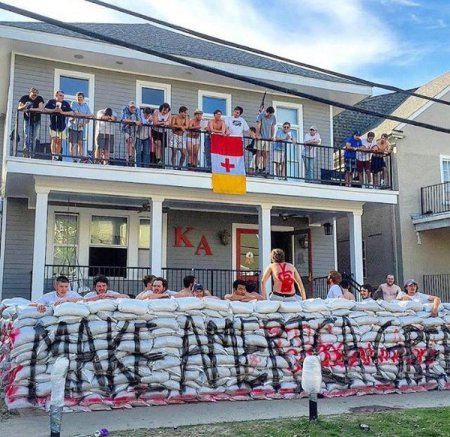
It appears that the building of a wall is the local chapter’s annual tradition before its “Old South” formal ball. This time the students added the language as either a joke or implied support but student groups denounced the language as “filled with connotations of hate and ignorance.” Even if this were serious support for Trump, that is not hate speech. It would be pure political speech — just as students are free to support Bernie Sanders, as many do.
On the video below, student appear to be tearing down the wall and tossing the sandbags into the street as frat members object that “this is private property.” Students like Ana De Santiago seemed to miss the point of violently preventing the speech of other students because you disagree with them. She insisted that “By writing Trump in large, red letters across the ‘wall,’ . . . KA changed what was a tradition of building a wall into a tradition of constructing a border, symbolizing separation and xenophobia.” Or they could simply be supporting Trump and his view of immigration reform. I doubt seriously that De Santiago would take kindly to the frat tearing down signs in support of her presidential candidate or immigration policies.
The hypocritical position of these students reflects the growing intolerance for free speech on our campuses. These students believe that they have a right, even an obligation, to silence students with opposing views.
University spokesman Mike Strecker said frat members used Trump’s name and slogan as satire. But it really does not matter. The University should be investigating the students who engaged in a violent act to stop the speech of other students . . . whether satire or serious. Moreover, the University seemed to blame the students for engaging in free speech, saying that while it encourages the “free exchange of ideas and opinions”, the local chapter’s actions “sparked a visceral reaction in the context of a very heated and divisive political season.” That does not appear very supportive of free speech to blame the victims of an attack on free speech. Students and faculty are allowed to “spark a visceral reaction in the context of a very heated and divisive political season.” Indeed, we should want passionate debate on the candidates and their ideas. It was the students tearing down the wall who were bringing violence and intolerance to the debate. They should be the focus of the ire of the university.
Recently, I’ve been corresponding with a friend on the ever-contentious subject of Donald Trump, a man whom my interlocutor finds objectionable on both political and personal grounds. Political positions can be discussed and debated even if they do not produce agreement or compromise, but a personal animadversion cannot be met with argument. My correspondent considers Trump an unreconstructed vulgarian, loud, ill-mannered and abrasive, all of which apparently render him unfit for office. He simply cannot vote for a man he dislikes.
Personal liking is one of the least reliable criteria for voting. The election of Barack Obama to the presidency is surely proof positive that affection for a political figure—the love affair with Obama was a national phenomenon—can result in unmitigated disaster. The same is true of personal dislike, which may often lead to the rejection of thebest, orleast worst, candidates for political office.
In Canada’s recent federal election, former PM Stephen Harper was vilified in the press and held in contempt by the majority of the electorate as a dangerous and unsavory character. He was rumoured to harbor a “secret agenda,” though nobody could say what it was. He was denounced as a brooding egotist and a control freak. He was viewed as unsympathetic to the marginalized and disadvantaged, stingy with entitlements, unimpressed by the claims of the arts community for ever greater government largesse, and generally hostile to Canada’s growing and increasingly clamorous Islamic community.
The fact that he steered the country safely through the market crash of 2008, signed lucrative international trade deals, kept taxes down, reduced the GST (Goods and Services Tax) and provided the country with a balanced budget plainly counted for nothing. His emendation of citizenship protocols in an effort to check the spread of culturally barbaric practices, chiefly associated with Islam, counted against him. At the end of the day, he was simply unlikeable, he was “Harperman,” and he had to go.
Instead, Canadians fell in love with Justin Trudeau, easily the most unqualified prime ministerial candidate since Confederation (there have been many duds, eccentrics and charlatans, but Trudeau is in a category of his own). He was young, personable, wavy-haired, utterly innocuous and adroit at spouting platitudes. Women found him attractive, millennials recognized one of their own, and he embraced all the feel-good big-spending fads and sophistries of welfare socialism. In short, people found him immensely likeable, the polar opposite of the straitlaced, parsimonious Harper.
The consequences were not long in coming. Trudeau has been in office for half a year, more than enough time to engineer the rapid deterioration of a once-prosperous and relatively secure nation. He has brought in 25,000 “Syrians” and is aiming for many thousands more, all living off the public dole and no doubted salted with aspiring jihadists. He intends to build mosques (which he calls “religious centers”) on military bases and is re-accrediting Muslim terror-affiliated organizations that Harper defunded. He inherited Harper’s balanced budget and in just a few short months was busy at work racking up a $29.4 billion deficit. Not to worry, since Trudeau is on record saying that budgets balance themselves. Magic is afoot. All one need do is continue believing in the Ministry of Silly Walks and the nation will stride ever forward.
(Here’s the silly walks video. I was unable to restrain myself. — DM)
According to a March 18, 2016 Ipsos poll, 66 per cent of Canadians approve of his performance. A boilerplate article by Jake Horowitz for Policy.Mic represents the general attitude of appreciation. In his meeting with Barack Obama, Horowitz writes, “it was Trudeau’s tone of optimism, and his embrace of a style of politics marked by positivity, inclusion and equality, that truly shined [sic] through. Practically everything about his values comes in stark contrast to what we’ve heard from Republican front-runner Donald Trump, who has dominated the 2016 election cycle with divisiveness, anger and fear-mongering.”
Often commentators will seek to buttress their personal liking or disliking on the basis of presumed intellectual substance. Despite his success in business, his knowledge of practical economics and international finance, and his instinctive recognition of what is needed in a country beset by astronomical deficits, trade imbalances and catastrophic immigration problems, Trump is frequently dismissed as an ignoramus. “Trump doesn’t read,” says David Goldman. “He brags about his own ignorance. Journalist Michael d’Antonio interviewed Trump at his New York home and told a German newspaper: ‘What I noticed immediately in my first visit was that there were no books… huge palace and not a single book.’”
On the other hand, we are told that Justin Trudeau reads. According to Jonathan Kay, formerly letters editor at The National Post and currently editor of The Walrus, who assisted Trudeau in writing the Canadian Prime Minister’s memoir Common Ground, “I can report that Trudeau is very much an un-boob. Several of our interviews took place in his home study, which is lined with thousands of books…We spoke at length about the Greek classics his father had foisted upon him as a child…and the policy-oriented fare he now reads as part of his life in politics…Trudeau probably reads more than any other politician I know.”
Kay never mentions that this intellectual giant failed to complete the two university degrees for which he had enrolled, earned his chops as a substitute instructor at the high school level, and inherited a formidable financial estate from his famous father, former Canadian PM Pierre Trudeau. He has done nothing with his life except preen and posture for the public—a “shiny pony,” as journalist Ezra Levant has dubbed him. Trump on the other hand received an inheritance and turned it into one of the world’s major fortunes. As New English Review editor Rebecca Bynum points out, “the businessman from Queens understands the American working people better than the Harvard man from Texas or the mailman’s son from Ohio. He speaks in plain English to describe the incompetence, and yes, the stupidity of those currently in power, who could not have harmed our country any more if they had had outright malicious intent.”
The Harper case was anomalous. He was an evidently accomplished man, trained in economics (unlike Trudeau, he completed his university program), a stalwart Canadian who wrote a book on our national sport, A Great Game: The Forgotten Leafs & the Rise of Professional Hockey, (unlike Trudeau’s memoir, there was no Kay-like ectoplasm to assist in its composition) and was deeply interested in the Franklin Expedition and the lore of the Canadian North. And he was a reader. Nevertheless, Canadian novelist Yann Martel mocked Harper in a series of letters collected into a book, 101 Letters to a Prime Minister, condescendingly lecturing Harper on what he should read, with the implication (sometimes explicit) that Harper saw nothing but the financial bottom line and was a man without imagination, heart or a vision for the country larger than trade deals and tax policy. (Martel is evidently a prehensile reader, having discovered an obscure novella by the Argentine writer Moacyr Scliar, Max and the Cats, which arguably formed the plagiarized occasion for his own Life of Pi. Not the man to instruct the PM.) In any event, under a relentless media barrage the public came to see Harper as a rigid martinet. In the 2015 election, he never had a chance.
Harper was regarded by the press and a plurality of Canadians pretty much as Trump is currently viewed by establishment Republicans, sanctimonious conservatives and a partisan media, for whom The Donald has become politically non grata, a “reptile” in Andrew Klavan’s distemperate rhetoric. Trump’s dilemma is that he has refused to be housebroken. He is certainly a flawed human being, but I have never known one who wasn’t.
So let us now compare. Trump has pledged to set the U.S. on a sound economic footing, prevent the flow of illegal migrants across the southwestern border, limit Islamic immigration into the country, and restore America’s diminished prestige and might on the international stage. But he is, we are told, a boor, a plebeian, a crass opportunist, a know-nothing who doesn’t read. “Donald Trump may not be perfect,” Bynum agrees, “but at least he will clean house.” All the more reason, it appears, for the virulence and disparagement with which he has been met. The bien pensants dislike him with a vehemence that does them little honor.
On the other hand, Trudeau, as we’ve seen, has plunged his country into deficit, has imported thousands of Muslims who will swell the welfare rolls and generate social unrest, as is inevitable wherever Muslims begin to multiply, withdrawn Canadian forces from the campaign against ISIS, and filled his cabinet with highly questionable personnel—women simply because they are women, such as the lamentably dense Chrystia Freeland, Minister of International Trade (who disgraced herself on the Bill Maher show), and doddering retreads like Immigration Minister John McCallum. But Trudeau is suave, telegenic, blandly inoffensive—and he reads. People like him with a passion that also does them little honor.
Would any sane person choose a Trudeau-type figure over a Harper or a Trump to lead their country into a problematic future? The larger issue is whether any reasonable person should predicate his voting preference on personal liking or disliking. Trudeau is intellectually vapid, has the wrong instincts, and is unlearnable. But he is liked. As for Trump, I am not suggesting that he would be a better choice than Cruz may be or Rubio may have been, though I suspect he might. He still has much to learn about the intricacies and priorities of governing and about looking “presidential.” What matters is that a candidate for political office is smart, has the right instincts, and is willing to learn. I believe Trump qualifies in these respects. Disliking him is beside the point.
Writing for The Federalist, Timm Amundson acknowledges that Trump can be rude, arrogant and reckless, and asks: “How can a principled, pragmatic, deliberate conservative be drawn to such a candidate?” And answers: “It is because I believe conservatism doesn’t stand a chance in this country without first delivering a very heavy dose of populism,” that is, “a platform built largely on the principle of economic nationalism…focus[ing] on three primary policy areas: trade, defense, and immigration.” This is Trump’s bailiwick.
To approve or disapprove of a candidate on the basis of his or her social and economic platform is wholly legitimate, is at least theoretically open to debate and constitutes a sensible basis for choice. If you believe, as Amundson does, that the core populist platform is the surest way “for America to begin rebuilding her neglected middle class and restoring her sovereignty,” then cast your ballot appropriately. The Overton Window is closing fast.







 anneinpt
 artaxes
 danmillerinpanama
 davidking1530
 Peter Hofman
 Joseph Wouk
 Peter
Peter Louisiana Steve
 WarSclerotic
Recent Comments