Archive for the ‘Department of Defense’ category

Airborne Girl’s Guide to Islam & Its Abuse of Women

February 18, 2015

Airborne Girl’s Guide to Islam & Its Abuse of Women, Blackfive, February 18, 2015

Right in time for President Obama’s extremist-riddled Countering Violent Extremism Summit comes an honest report on the horrific treatment of women in Islamic states. It starts with the abuse she suffered personally at the hands, and gun barrels, of our supposed allies the Saudis during the First Gulf War. But the real issue is the infiltration of this oppressive and backwards culture into free western society. For every “strong” woman telling the press how wearing a veil empowers her, there are dozens in the shadows being beaten, forced into arranged marriages and dying in “honor” killings.


Pentagon spokesman portrays Guantanamo recidivism as a good thing

February 12, 2015

Pentagon spokesman portrays Guantanamo recidivism as a good thing, Long War Journal, Bill Roggio, February 11, 2015

Rear Admiral Kirby is not trying to be satirical. Or is he?– DM)

Yesterday, Pentagon Press Secretary Rear Admiral John Kirby cast a positive light on jihadists from the Taliban and al Qaeda who have been released from Guantanamo and have returned to wage jihad. The topic came up in the discussion of an airstrike that killed Mullah Abdul Rauf Khadim, a senior Taliban commander who was detained at Guantanamo from 2001 to 2007, released to Afghan custody and freed in 2009, and returned to the Taliban shortly afterward to assume the role of a senior military commander up until his defection to the Islamic State earlier this year. Below is the exchange, from the Pentagon’s transcript:

Q: Why was he released?REAR ADM. KIRBY: Joe, I don’t have the records on this guy from — from Guantanamo Bay.

Yes, he was a detainee. He was released in 2007. He was released to Kabul.

The other thing that we’ve said — and this is another great example, because we had a long, you know, discussion not too long ago about the — the recidivism and particularly the issue of this — this one individual who reengaged there in Qatar, and we said that they return to the battlefield and to the fight at their own peril. Mr. Kadim is proof of that.

Kirby’s statement that Khadim’s death should be viewed as a positive is cold comfort to the hundreds of Afghans, Americans, and Coalition personnel who were killed while Khadim commanded forces in southern Afghanistan. The jihadist was able to operate for more than six years as a top level Taliban commander and has the blood of thousands on his hands.

Khadim and Mullah Zakir, another Guantanamo alum (who is still alive; he “resigned due to ill health,” according to the Taliban) were responsible for implementing the Taliban’s counter-surge strategy. While the the jihadist group failed to halt Coalition and Afghan forces’ gains in the south from 2009 to 2011 (gains which are now melting away), at least 875 Coalition members were killed during the fighting in Kandahar (273 killed) and Helmand (602 killed) during that time period, according to iCasualties (note, data on Coalition members killed by province after 2011 is not available on the iCasualties website). The number of Afghan security personnel and civilians killed in Kandahar and Helmand by the Taliban during that timeframe is not available, but is likely in the thousands.

Despite this, Kirby doubles down and says Guantanamo should be closed, which means even more jihadists will be freed.

Q: After seeing such example, like former Guantanamo detainee who was released and went back to the — to work with the Taliban, is the Pentagon still convinced that Guantanamo should be closed?REAR ADM. KIRBY: Yes. The Pentagon’s position is that the detainee facility should be closed. Secretary Hagel has made that clear on any number of occasions. There’s no change to that.


4-Star Admiral Slams Obama: Muslim Brotherhood Infiltrated All Of Our National Security Agencies

February 11, 2015

4-Star Admiral Slams Obama: Muslim Brotherhood Infiltrated All Of Our National Security Agencies, You Tube, January 28, 2015

During a press conference on how to combat radical Islamic extremism, Admiral James A. “Ace” Lyons (U.S. Navy, Ret.), former Commander-in-Chief, U.S. Pacific Fleet, stated that under the leadership of Barack Obama the Muslim Brotherhood have infiltrated all of the National Security Agencies of the United States. Furthermore, Lyons said that Obama is deliberately unilaterally disarming the military and spoke to the need for the new GOP controlled congress and Military leaders to stand up to the administration and uphold their oaths.


How Iran Is Making It Impossible for the US to Beat ISIS

February 1, 2015

How Iran Is Making It Impossible for the US to Beat ISIS, Daily Beast, Michael Weiss, Michael Pregent, February 1, 2015
1422791113178.cachedAhmed Saad/Reuters

Washington needs to quit pretending it can work with Iran to defeat the Islamic State. Tehran’s real objective is to defeat Washington.

It was August 2007, and General David Petraeus, the top commander of U.S. forces in Iraq, was angry.  In his weekly report to then-Defense Secretary Robert Gates, Petraeus wrote:  “I am considering telling the President that I believe Iran is, in fact, waging war on the U.S. in Iraq, with all of the U.S. public and governmental responses that could come from that revelation. … I do believe that Iran has gone beyond merely striving for influence in Iraq and could be creating proxies to actively fight us, thinking that they can keep us distracted while they try to build WMD and set up [the Mahdi Army] to act like Lebanese Hezbollah in Iraq.”

There was no question there and then on the ground in Iraq that Iran was a very dangerous enemy. There should not be any question about that now, either. And the failure of the Obama administration to come to grips with that reality is making the task of defeating the so-called Islamic State more difficult—indeed, more likely to be impossible—every day.

There are lessons to be learned from the experience of the last decade, and of the last fortnight, but what is far from clear is whether Washington, or the American public, is likely to accept them because they imply much greater American re-engagement in the theater of battle. As a result, what we’ve seen is behavior like the proverbial ostrich burying its head in the desert sand, pretending this disaster just isn’t happening. But at a minimum we should be clear about the basic facts. In Iraq and Syria, as we square off against ISIS, the enemy of our enemy is not our friend, he is our enemy, too.

In 2007, there were 180,000 American troops in Iraq. Under Petraeus’s oversight, U.S. Joint Special Operations Command (JSOC), the elite forces responsible for hunting terrorists around the world, was divided into two task forces. Task Force 16 went after al Qaeda in Iraq, the group that eventually would spawn ISIS, while Task Force 17 was dedicated to “countering Iranian influence,” chiefly by killing or capturing members of Iraq’s Shia militias—though in some cases, it even arrested operatives of Iran’s Revolutionary Guards Corps-Quds Force (IRGC-QF) who were arming and supervising those militias’ guerrilla warfare against coalition troops.

At one point, in the summer of 2007, Petraeus concluded that the Mahdi Army, headed by the Shiite demagogue Muqtada al-Sadr, posed a greater “hindrance to long-term security in Iraq” than al Qaeda did. As recounted in The Endgame, Michael Gordon and Bernard E. Trainor’s magisterial history of the Second Iraq War, two-thirds of all American casualties in Iraq in July 2007 were incurred by Shiite militias.  Weapons known as explosively formed penetrators, or EFPs, were especially effective against the U.S. forces. They were Iranian designed and constructed roadside bombs that, when detonated, became molten copper projectiles able to cut through the armor on tanks and other vehicles, maiming or killing the soldiers inside.

So it came as a surprise to many veterans of the war when Secretary of State John Kerry, asked in December what he made of the news that Iran was conducting airstrikes against ISIS in Iraq, suggested “the net effect is positive.” Similarly, Chairman of the U.S. Joint Chiefs of Staff Gen. Martin Dempsey—formerly the commander of the 1st Armored Division in Baghdad—told reporters last month, “As long as the Iraqi government remains committed to inclusivity of all the various groups inside the country, then I think Iranian influence will be positive.”

Whatever the Iraqi government says it is committed to, “inclusiveness” is not what’s happening on the ground.

Iran’s influence in Iraq since ISIS sacked Mosul last June has resulted in a wave of sectarian bloodletting and dispossession against the country’s Sunni minority population, usually at the hands of Iranian-backed Shia militia groups, but sometimes with the active collusion of the Iraq’s internal security forces. Indeed, just as news was breaking last week that ISIS’s five-month siege on the Syrian-Turkish border town Kobane finally had been broken, Reutersreported that in Iraq’s Diyala province at least 72 “unarmed Iraqis” —all Sunnis—were “taken from their homes by men in uniform; heads down and linked together, then led in small groups to a field, made to kneel, and selected to be shot one by one.”

Stories such as these out of Iraq have been frequent albeit under-publicized and reluctantly acknowledged (if at all) by Washington both before and after Operation Inherent Resolve got underway against ISIS.

For instance, 255 Sunni prisoners were executed by Shia militias and their confederates in the government’s internal security forces between June 9 and mid-July, according to Human Rights Watch. Eight of the victims were boys below the age of 18.  “Sunnis are a minority in Baghdad, but they’re the majority in our morgue,” a doctor working at Iraq’s Health Ministry, told HRW at the end of July. Three forensic pathologists found that most of the victims in Baghdad were shot clean through the head, their bodies often left casually where they were killed. “The numbers have only increased since Mosul,” one doctor said.

On August 22, 2014, the Musab Bin Omair mosque in Diyala—the same province where last week’s alleged executions occurred—was raided by officers of the security forces and militants of Asaib Ahl al-Haq (the League of the Righteous), which slaughtered 34 people, according to HRW.  Marie Harf, the U.S. State Department spokeswoman, said at the time: “This senseless attack underscores the urgent need for Iraqi leaders from across the political spectrum to take the necessary steps that will help unify the country against all violent extremist groups.”

Since then, however,  U.S. warplanes have provided indirect air support to Asaib Ahl al-Haq and Kataib Hezbollah, a U.S.-designated terrorist entity, both of which were at the vanguard of the troops that ended ISIS’s months-long siege of Amerli, a Shia Turkomen town of about 15,000, in November 2014.  These militias have also been seen and photographed or videoed operating U.S. Abrams tanks and armored vehicles intended for Iraq’s regular army, which means that there are now two terrorist organization, Sunni ISIS and Kataib Hezbollah, armed with heavy-duty American weapons of war.

The Hezbollah-ization of Iraq’s military and security forces has been overseen by the IRGC-QF, another U.S.-designated terrorist entity, which is headed by Maj. Gen. Qassem Suleimani, a man personally sanctioned by the Treasury Department for his role in propping up Bashar al Assad’s mass murderous regime in Syria.

Suleimani is the same Iranian operative Petraeus  once called “evil” because of his well-documented role orchestrating attacks on U.S. servicemen. The most notorious episode happened in Karbala in 2007—in a raid that was carried out by Asaib Ahl al-Haq and resulted in the death of five G.I.s  One of the founders of this militia and a main perpetrator of the attack, Qais al Khazali, was captured by coalition forces and subsequently released in a prisoner swap for a British hostage in 2009. Today, al Khazali moves freely around Iraq, dressed in battle fatigues, commanding Asaib militants.

Another one of Suleimani’s major proxies, the Badr Corps, is headed by Hadi al-Amiri, who happens to be Iraq’s current minister of transport, in which capacity he’s been accused by the U.S. government of helping to fly Iranian weapons and personnel into Syria. Not only was one of al-Amiri’s Badr henchmen, the group’s intelligence chief Abu Mustafa al-Sheibani, the man chiefly responsible for importing explosively formed projectiles into Iraq from Iran’s Mehran province during the occupation, but another of his subordinates, Mohammed Ghabban, is currently Iraq’s Interior Minister. This gives the Badr Corps purview over all of Iraq’s internal security forces, including its federal police—that is to say, the men in uniform who have allegedly acquiesced or connived in the Shia militias’ anti-Sunni pogroms.

Indeed, Iraq’s Interior Ministry gained notorious reputation in the last decade for being a clearinghouse for sectarian bloodletting. During the civil war in the mid-2000s, its agents, nominally aligned with U.S. troops, moonlighted as anti-Sunni death squads that functioned with the impunity of officialdom. The ministry also ran a series of torture-prisons in Baghdad, such as Site 4, where, according to a 2006 U.S. State Department cable, 1,400 detainees were held in “in squalid, cramped conditions,” with 41 of them bearing signs of physical abuse. Ministry interrogators, the cable noted, “had used threats and acts of anal rape to induce confessions and had forced juveniles to fellate them during interrogations.”

Needless to add, Badr has hardly mended its ways with the passage of time and the exit of U.S. troops from Iraq. Today, the militia has been accused of “kidnapping and summarily executing people…[and] expelling Sunnis from their homes, then looting and burning them, in some cases razing entire villages,” in thewords of Human Rights Watch’s Iraq research Erin Evers, who added for good measure that the current White House strategy in Iraq is “basically paving the way for these guys to take over the country even more than they already have.”

As if taunting the Obama administration’s, Suleimani has takento popping up, Zelig-like, in photographs all over Iraq, usually from a front-line position from which ISIS has just been expelled.  It is hard to overestimate the propaganda value such images now carry.

Consider this week’s blockbuster disclosure that the CIA and Israel’s Mossad collaborated in the 2008 assassination of one of Suleimani’s other high-value proxies, Hezbollah security chief Imad Mughniyeh. In close collaboration with Iran, Mughniyeh coordinated suicide attacks ranging from the 1983 U.S. Marine barracks bombings in Beirut to the blowing up of the AMIA Jewish center in Buenos Aires in 1994.  Mughniyeh also was linked to the kidnapping of several Europeans and Americans in Lebanon in the 1980s, including CIA Station Chief William Buckley, believed to have died in 1985 after months of torture by Iranian and Iranian-trained interrogators.

So it is not surprising that Langley wanted Mughniyeh dead. What is suprising is that according to the Washington Post the CIA and Mossad had “a chance to kill” the Iranian master-spy Suleimani as he strolled through Damascus with Mughniyeh in 2008, but passed it up because of potential collateral damage. No doubt U.S. satellite surveillance is currently tracking Suleimani’s plain-sight movements in Iraq and Syria, too.

Last month, an Israeli attack in the Syrian sector of the Golan Heights killed Mughniyeh’s son, Jihad, who was said to have been an “intimate” protégé of Suleimani.

While segments of the U.S. intelligence establishment and punditocracy believe Iran to be a credible or necessary force for counterterrorism, the fighters associated with Suleimani’s paramilitaries profess a different agenda entirely.

In October, ISIS was driven from Jurf al-Sakher, a town about 30 miles southwest of Baghdad. The operation was said to have been planned personally by Suleimani. It featured Quds Force agents and Lebanese Hezbollah militants embedded with some 7,000 troops form the Iraqi Security Forces.

Ahmed al Zamili, the head of the 650-strong Al Qara’a Regiment, one of the militias party to that fight, told the Wall Street Journal that he actually welcomed the invasion of Iraq by ISIS because this dire event would only hasten the return of the Hidden Imam, a religious prophecy which in Shia Islam precedes the founding of a worldwide Islamic state.  Al Zamili made it clear that his notion of counterinsurgency was holy war. Meanwhile, 70,000 Sunnis were driven from Jurf al-Sakher, which means “rocky bank” and has now been renamed Jurf al-Nasr (“victory bank”). The provincial council told them they would not be allowed to return for eight or ten months.

“Iran has used Iraq as a petri dish to grown new Shia jihadist groups and spread their ideology,” says Phillip Smyth, an expert on Shia militias. By Smyth’s count, there are more than 50 “highly ideological, anti-American, and rabidly sectarian” Shia militias operating in Iraq today, and recruiting more to their ranks, all with the acquiescence of the central government.

Some of Iraq’s Shia politicians have acknowledged the dismal reality that has attended Baghdad’s outsourcing of its security to “Khomeinists” — and the potential it carries for the kind of all-out sectarian bloodletting that nearly tore the country apart in the mid-2000s.

One unnamed  Shia politician told the Guardian newspaper last August that groups of Shia extremists “equal in their radicalization to the Sunni Qaeda” are being created. “By arming the community and creating all these regiments of militias, I am scared that my sect and community will burn,” he said.

More recently, Iraq’s Vice President for Reconciliation, Ayad Allawi, a secular Shia who once served as the interim prime minister, told the same broadsheet that pro-government forces have been ethnically cleansing Sunnis from Baghdad. This is a starker admission of the atrocities being committed by America’s silent partner than currently is on offer by the State Department or Pentagon, and many Sunnis now suspect Washington of full collaboration with Tehran, whatever the protestations to the contrary.

When Michael Pregent, one of the authors of this essay, briefed a team of U.S. military advisors headed to Iraq recently, he warned them that they are now operating in an environment in which Iranian and Shia-militia targeting choices take priority over the recommendations of U.S. advisors and intelligence officers.

The consequence of this tacit collaboration with the Quds Force and its assets is obvious: the United States will be portrayed by ISIS propagandists as a helpmeet in the indiscriminate murder and dispossession of Sunnis.

Kerry and Dempsey would do well to pay closer attention to Iran’s air war, too. According to one Kurdish Iraqi pilot interviewed by the Guardian, Suleimani’s command center in Iraq, the Rasheed Air Base south of Baghdad, is where “the Iranians make barrel bombs” and then use Antonov planes and Huey helicoptetrs to drop them in Sunni areas — thus replicating one of the nastiest tactics of Assad’s air force in Syria.

The Anbar Awakening critical to stabilizing Iraq in the middle of the last decade was made possible by the presence of U.S. ground forces who represented to the influential Sunni tribes an impartial bulwark against the draconian rule of al Qaeda in Iraq.

Many in the Obama administration express the hope that another such awakening can be fomented, given the current political and military dynamics in Iraq. But how? ISIS has cleverly exploited the sensitivities and fears of Iraq’s Sunni tribes, offering those it hasn’t rounded up and murdered the chance to “repent” and reconcile with the so-called “Calihpate.”

ISIS: Inside the Army of Terror, a new book by the co-author of this piece, documents the tragic situation of those Sunni tribesmen who have risen up against ISIS only to be slaughtered mercilessly, sometimes with the help of their fellow tribesmen, whom ISIS had already won over. The rest of the constituents of this bellwether Sunni demographic are thus given a choice between cutting a pragmatic deal with ISIS or embracing Shia death squads as their saviors and liberators. Most have, predictably, opted for the former.

“The American approach is to leave Iraq to the Iraqis,” Sami al-Askari, a former Iraqi MP and senior advisor to former Prime Minister Nouri al-Maliki, told Reuters last November. “The Iranians don’t say leave Iraq to the Iraqis. They say leave Iraq to us.”

For the White House, that ought to define the problem, not the solution.

Exclusive: ISIS Gaining Ground in Syria, Despite U.S. Strikes

January 15, 2015

Exclusive: ISIS Gaining Ground in Syria, Despite U.S. Strikes, The Daily Beast, January 15, 2015

1421322880562.cachedHosam Katan/Reuters

American jets are pounding Syria. But ISIS is taking key terrain—and putting more and more people under its black banners.

ISIS continues to gain substantial ground in Syria, despite nearly 800 airstrikes in the American-led campaign to break its grip there.At least one-third of the country’s territory is now under ISIS influence, with recent gains in rural areas that can serve as a conduit to major cities that the so-called Islamic State hopes to eventually claim as part of its caliphate. Meanwhile, the Islamic extremist group does not appear to have suffered any major ground losses since the strikes began. The result is a net ground gain for ISIS, according to information compiled by two groups with on-the-ground sources.In Syria, ISIS “has not any lost any key terrain,” Jennifer Cafarella, a fellow at the Washington, D.C.-based Institute for the Study of War who studies the Syrian conflict, explained to The Daily Beast.Even U.S. military officials privately conceded to The Daily Beast that ISIS has gained ground in some areas, even as the Pentagon claims its seized territory elsewhere, largely around the northern city of Kobani. That’s been the focus of the U.S.-led campaign, and ISIS has not been able to take the town, despite its best efforts.Other than that, they are short on specifics.

1421269431538.cachedClick to Enlarge (Coalition For a Democratic Syria)

“Yes, they have gained some ground. But we have stopped their momentum,” one Pentagon official told The Daily Beast.

A map developed by the Coalition for a Democratic Syria (CDS), a Syrian-American opposition umbrella group, shows that ISIS has nearly doubled the amount of territory it controls since airstrikes began last year.

“Assessing the map, ISIS has almost doubled its territorial control in Syria. But more importantly, the number of people who now live under ISIS control has also increased substantially,” CDS political adviser Mouaz Moustafa said.

With the fall of that much territory into ISIS hands, Syrians who once lived in ungoverned or rebel held areas are now under ISIS’s grip. Of course, in an irregular war like this one, control of people is far more important than control of territory. In that regard, too, things appear to be going in the wrong direction.

In the first two months following American airstrikes, about a million Syrians who had previously lived in areas controlled by moderates now lived in areas controlled by extremist groups al Nusra or ISIS, according to CDS, citing conversations with European diplomats who support the Syrian opposition.

The area of ISIS’s expansion includes large segments of the Homs Desert, which begins far south of the contested northern city of Aleppo. It stretches below the presumed capital of ISIS in Syria, Raqqa, and all the way to the Iraqi border. It is largely rural and not an area that ISIS has had to fight for. Rather the group took control of uncontested parts of the countryside while skirting key regime strongholds in the area, Cafarella said.

But that does not mean that land is not valuable to ISIS. That newly acquired terrain allows ISIS troops to target and threaten more valuable areas, Cafarella said.

Since the U.S. campaign began in August, “there are little buds of ISIS control in eastern Homs, al Qalamoun [which borders northern Lebanon], and southern Damascus that do appear to be growing because of that freedom of operation that can connect those western cells to key ISIS terrains in Raqqa and Deir ez Zour” in northern and eastern Syria.

Moustafa, the CDS political adviser, blamed ISIS territorial gains on a lack of “strategic coordination between coalition strikes and moderate forces inside Syria, meaning that the Free Syrian Army and aligned groups cannot use the strikes to retake territory.” Further, Moustafa told The Daily Beast, coalition strikes have given other extremist groups sympathy for ISIS.

One frustration of the Syrian opposition groups is that the bombing campaign has been focused at the heart of ISIS controlled territory, rather than at the front lines, where ISIS territorial gains could be pushed back.

“The coalition strikes seem similar to drone campaigns in Yemen or Pakistan, targeting only leadership. The front-line strength of ISIS has undoubtedly increased even as some of these targeted strikes take out mid-level individual leaders,” Moustafa said.

As of Sunday, the U.S. and its coalition partners had conducted 790 airstrikes in Syria, according to Pentagon statistics. In all, the U.S. has spent $1.2 billion on its campaign against ISIS in Iraq and Syria.

In its public comments, the U.S. military has said repeatedly the effort against ISIS is on the right track. However it often does this by conflating its war in Iraq and Syria. Ask a question about what is happening in Syria, and U.S. officials will stress that ISIS has not gained ground in Iraq. Ask if the U.S. effort is working in Syria, and the military often points to the fact that ISIS has failed to take control of Kobani.

During a Jan. 6 press briefing, for example, when a reporter asked “where ISIS’s relative strength is right now,” Navy Rear Adm. John Kirby replied by talking exclusively about the U.S. effort in Iraq, naming cities were the military believed ISIS’s momentum has been “halted.”

When the reporter pressed for an answer on what was happening in Syria, Kirby struggled, saying, “I couldn’t give you a—a specific point at which, you know, we believe, well geez, we’ve halted their momentum. It—it’s come slowly, in various stages. But I think it’s safe to say that over the last three to four weeks, we—we’ve been confident that that momentum has largely been blunted.”

On Friday, Kirby proclaimed that ISIS had lost 700 square kilometers since the campaign began—over half the size of New York City or about four times the size of the District of Columbia. But the Pentagon spokesman could not say what percentage that area marked of total ISIS-controlled land. Nor could he say if that loss was in Iraq, Syria, or combined in both nations. As Kirby asserted: “I’m frankly not sure how relevant that is. I mean, it’s—they have less ground now than they did before. They’re trying to defend what ground that they have. They’re not going on the offense much, and they’re really trying to preserve their own oxygen.”

1421269455425.cachedClick to Enlarge (Coalition For a Democratic Syria)

The American military has not been able to take full advantage of the difficulties ISIS is facing. A worldwide drop in oil prices threatens the recently declared state’s ability to raise revenue, while declining standards in public services, distribution of aid, and provision of electricity threaten to undercut the group’s support across the territories it controls. ISIS has also not been able to follow through on its military quest to challenge the Iraqi government all the way to Baghdad.

The U.S. military stressed it is waging an “Iraq first” war, that is focused on eliminating ISIS from that country first. There, the U.S. can turn to Iraqi troops on the ground to assess its efforts. But there is no equivalent resource on the ground in Syria. Perhaps because of that, the U.S. military has offered a far more detailed assessment of the air campaign in Iraq than the one in Syria.

The Combined Joint Task Force in charge of the American air campaign refused to answer a Daily Beast query about ISIS gains in Syria, even as it striking targets there. U.S. Central Command replied, “As a matter of policy we do not discuss intelligence issues.”

Information on the maps:

The maps provided by the Coalition for a Democratic Syria show the areas controlled by moderate Syrian rebels, the Syrian regime, ISIS, Syrian al Qaeda affiliate al Nusra, as well as territories contested by these groups. The maps were developed by a field team from the Coalition for a Democratic Syria (CDS), an umbrella group of Syrian American organizations. The maps were sourced through on-the-ground networks including civilian councils, humanitarian organizations, armed actors, and media monitoring of independent Syrian channels.

SecDef Nominee Says Iranian Nukes ‘Most Significant Strategic Threat’

December 10, 2014

SecDef Nominee Says Iranian Nukes ‘Most Significant Strategic Threat,’ Washington Free Beacon, December 10, 2014

(If Mr. Carter fails to change his views on Iran, or at least stop talking about them, how long will he last as Obama’s Secretary of Defense? — DM)

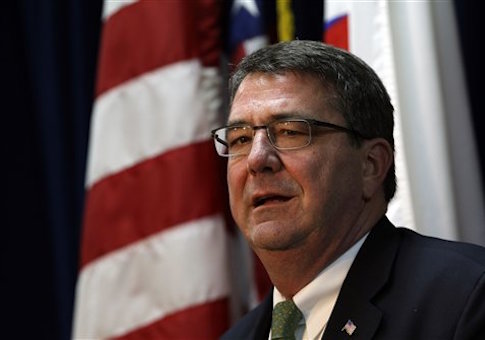
Ashton CarterAshton Carter / AP

President Barack Obama’s nominee for secretary of defense Ashton Carter has a very strong position on nuclear non-proliferation issues, the Tower reports.

Some of those positions stand in contrast with those of the Obama administration.

Politico on Tuesday described him as a “leading member of a clique of defense intellectuals long concerned with the possibility of a nuclear terrorist attack” and suggested he “could be more consequential when it comes to Obama’s plans for dealing with Iran’s nuclear program.”

Two months before President Obama’s 2008 election, Carter argued, in a paper coauthored with diplomatic heavyweights including former Special Middle East Coordinator Dennis Ross and Nonproliferation Policy Education Center Executive Director Henry Sokolski, that “Iran’s nuclear development may pose the most significant strategic threat to the United States during the next Administration.” The Times of Israel covered Carter’s nomination, noting that he was a “vocal proponent of stronger action to stymie nuclear proliferation.” Carter had visited the Jewish state in 2013, and was quoted as telling a group of Israeli soldiers that “protecting America means protecting Israel, and that’s why we’re here in the first place.”

The Jerusalem Post reported on Friday that as part of the Pentagon’s Defense Advisory Acquisition Group, Carter played an “instrumental” role in the transfer of F-35 fighter jets from the U.S. to Israel. Israel recently placed a preliminary order to purchase 25 more of the state of the art fighters. Speaking Friday to reporters at the State Department press briefing about U.S.-Israel ties, Deputy Spokesperson Marie Harf reaffirmed the closeness of the relationship, calling ties between the countries “incredibly close, essential” and “unshakable” and noting that it is “arguably the closest military-to-military relationship” the countries have ever had.

US military continues to claim al Qaeda is ‘restricted’ to ‘isolated areas of northeastern Afghanistan’

November 19, 2014

US military continues to claim al Qaeda is ‘restricted’ to ‘isolated areas of northeastern Afghanistan,’ Long War Journal, Bill Roggio, November 19, 2014

A recently issued report on the status of Afghanistan by the US Department of Defense has described al Qaeda as being primarily confined to “isolated areas of northeastern Afghanistan.” But information on Afghan military and intelligence operations against the global jihadist group contradicts the US military’s assessment.

The Defense Department released its “Report on Progress Toward Security and Stability in Afghanistan” in October. The report, which “covers progress in Afghanistan from April 1 to September 30, 2014,” contains only nine mentions of al Qaeda. Five of those mentions simply reference the mission to conduct “counterterrorism operations against remnants of core al Qaeda and its affiliates.”

The US military’s report states that “[s]ustained ISAF [International Security Assistance Force] and ANSF [Afghan National Security Forces] counterterrorism operations prevented al Qaeda’s use of Afghanistan as a platform from which to launch transnational terrorist attacks during this reporting period.”

Then the report goes on to describe al Qaeda as “isolated” in the northeastern part of the country, a reference to the remote mountainous provinces of Kunar and Nuristan.

“Counterterrorism operations restricted al Qaeda’s presence to isolated areas of northeastern Afghanistan and limited access to other parts of the country,” the report continues. “These efforts forced al Qaeda in Afghanistan to focus on survival, rather than on operations against the West. Al Qaeda’s relationship with local Afghan Taliban organizations remains intact and is an area of concern.”

Al Qaeda’s operations contradict US military claims

For years, the US military has claimed that al Qaeda is constrained to operating in northeastern Afghanistan, but ISAF’s own data on raids against the terrorist group and its allies has indicated otherwise. According to ISAF press releases announcing operations between early 2007 and June 2013, al Qaeda and its allies were targeted 338 different times, in 25 of 34 of Afghanistan’s provinces. Those raids took place in 110 of Afghanistan’s nearly 400 districts. [See LWJ report, ISAF raids against al Qaeda and allies in Afghanistan 2007-2013.]

Continuing this pattern, while the latest DoD report, which covers the period between April 1 and Oct. 30 of this year, claims that al Qaeda is restricted to northeastern Afghanistan, reported Afghan military and intelligence operations during the same time period indicate that al Qaeda remains active beyond Kunar and Nuristan.

The most high-profile operation against al Qaeda was conducted in Nangarhar province in October. Afghanistan’s National Directorate of Security reported that al Qaeda leader Abu Bara al Kuwaiti was killed in a US airstrike in Lal Mandi in Nangarhar’s Nazyan district. The airstrike took place at the home of Abdul Samad Khanjari, who was described as al Qaeda’s military commander for the province.

Abu Bara likely served in al Qaeda’s General Command. He was close to al Qaeda emir Ayman al Zawahiri, and had served as an aide to Atiyah Abd al Rahman, al Qaeda’s former general manager who was killed in a US drone strike in Pakistan in August 2011. Abu Bara wrote Atiyah’s eulogy, which was published in Vanguards of Khorasan, al Qaeda’s official magazine. US intelligence officials have told The Long War Journal that Abu Bara was the most senior al Qaeda leader killed in Afghanistan in years. [See LWJ report, Senior al Qaeda leader reported killed in US airstrike in eastern Afghanistan.]

Another senior al Qaeda leader known to operate in Afghanistan is Qari Bilal. In August, Afghan officials said that he commands more than 300 fighters in the northern province of Kunduz, where several districts are controlled or contested by the Taliban. Bilal is also a member of the Islamic Movement of Uzbekistan, an al Qaeda-linked group that has integrated its operations with the Taliban in northern Afghanistan.

Bilal escaped from a Pakistani jail in 2010, entered Afghanistan, and was subsequently captured by ISAF special operations forces in 2011. He was later freed by Afghan officials and rejoined the fight. [See LWJ report, Senior IMU leader captured by ISAF in 2011 now leads fight in northern Afghanistan.]

This month, Afghan officials announced the capture of Eqbal al Tajiki, a citizen of Tajikistan who served with al Qaeda’s network in Kunduz. Sediq Sediqi, the spokesman for the Interior Ministry, said that Eqbal “is an active member of the al Qaeda network” who was “transferred by his colleagues to northern parts of Afghanistan to carry out terrorist activities,” according to Afghan Channel One TV. Sediqi said Eqbal had “received terrorist training in North Waziristan for three years.”

Eqbal may have been a member of the Qari Salim Group, “a high-profile Al Qaeda affiliate” that is commanded by Qari Khaluddin, Pajhwok Afghan News noted in October. Khaluddin “had recently trained in Pakistan’s city of Quetta.” The group is said to have been plotting to attack a military base in Kunduz.

Another al Qaeda group known to be operating in Afghanistan is Junood al Fida. In early October, Junood al Fida released video that purported to show the group taking control of the district of Registan in the southern province of Kandahar.

Junood al Fida, which is comprised of Baluch jihadists, has sworn loyalty to the Taliban but also describes Qaeda emir Ayman al Zawahiri as “Our Shaykh al Habeeb” [beloved leader] and its “Ameeruna” [our chief]. The group’s propaganda routinely attacks the US. [See LWJ reports, Baloch jihadist group in southern Afghanistan announces death of commander and Jihadist group loyal to Taliban, al Qaeda claims to have captured Afghan district.]