(The views expressed in this article are mine and do not necessarily reflect those of Warsclerotic or any of its other editors. — DM)
Some consider North Korea to be the rogue nation most likely to use an electromagnetic pulse (EMP) to attack America; Iran is also seen as quite likely to do it. It matters little which succeeds.
Here is a lengthy 2013 video about an EMP attack, what would happen and why:
The possibilities and consequences of an EMP attack on America are too horrific to contemplate; the “legitimate news media” generally ignore them. We therefore tend to relegate them to the realm of remote “tin foil hat conspiracy theories” and to focus instead on more congenial stuff — the latest sex scandal, Hillary Clinton’s campaign van parking in a disabled-only space and other matters unlikely to impact America to an extent even approaching that of an EMP attack. Meanwhile, most of “our” Congress Critters, who should know better, focus on opinion polls, filling their campaign coffers and getting richer personally while neglecting our atrophying missile defense systems and other potential means of avoiding or recovering from an EMP attack.
Here is a 2013 video about the likelihood of an Iranian EMP attack on America that would paralyze the country for a very long time.
North Korea and the Islamic Republic of Iran have long cooperated in the development of nukes and means to deliver them. I wrote about their cooperation here, here, here and elsewhere. It now appears that Iran intends to use them for an EMP attack on America.
The issue of a nuclear EMP attack was raised in the final hours of this week’s elections in Israel when U.S. authority Peter Vincent Pry penned a column for Arutz Sheva warning of Iran’s threat to free nations.
“Iranian military documents describe such a scenario — including a recently translated Iranian military textbook that endorses nuclear EMP attack against the United States,” he wrote. [Emphasis added.]
Here is a March 7, 2015 video about the impact of the P5+1 “negotiations” on Iran getting (or keeping) nukes and the likelihood of an Iranian EMP attack on America:
In April of this year, John Bolton had this to say about the Iran – North Korea connection, how much we don’t know and the ongoing P5+1 “negotiations.”
Perhaps Israel can take out Iran’s nuke capabilities.
Here is a February 2015 video about what’s (not) being done to harden our domestic power grid:
As of February of this year, Govtrack US opined that the chances of passage of the SHIELD act were zero percent. Be that as it may, simply hardening the power grid would not solve communications or transport problems — most modern communications devices, as well as vehicles built after 1987, depend on computer chips and, when the chips are fried, will not function. Even if food and water could be processed, getting them to consumers in sufficient quantities to keep them alive would be an enormous if not impossible task.
Problems of a human nature would also arise and remaining alive would be difficult. If one’s family were about to starve, how many would try to steal food and water from those who still have even enough for a few days? How many roving gangs of armed criminals, quite willing to kill, would do the same? The police would likely have no communications ability and might well be otherwise occupied, tending to their own families. Military forces not confined to base would likely have the same problems and be doing the same.
That suggests another problem in restoring infrastructure seriously damaged or destroyed by the EMP attack. It would not only require the availability of transport, communications and undamaged equipment. It would also require the availability of personnel, not otherwise occupied in scrounging for food, water, medical supplies and other resources to care for their own families, while protecting them from those lacking such resources, as well as from armed gangs.
Now, the U.S. military is taking steps to protect itself by reopening a cold war bunker at Cheyenne Mountain, abandoned in 2006.
Cheyene Mt. Complex
The Pentagon last week [early April 2015] announced a $700 million contract with Raytheon Corporation to oversee the work for North American Aerospace Command (NORAD) and US Northern Command.
Admiral William Gortney, head of NORAD and Northern Command, said that ‘because of the very nature of the way that Cheyenne Mountain’s built, it’s EMP-hardened.’
. . . .
‘And so, there’s a lot of movement to put capability into Cheyenne Mountain and to be able to communicate in there,’ Gortney told reporters.
‘My primary concern was… are we going to have the space inside the mountain for everybody who wants to move in there, and I’m not at liberty to discuss who’s moving in there,‘ he said. [Emphasis added.]
The Cheyenne mountain bunker is a half-acre cavern carved into a mountain in the 1960s that was designed to withstand a Soviet nuclear attack. From inside the massive complex, airmen were poised to send warnings that could trigger the launch of nuclear missiles.
But in 2006, officials decided to move the headquarters of NORAD and US Northern Command from Cheyenne to Petersen Air Force base in Colorado Springs. The Cheyenne bunker was designated as an alternative command center if needed.
Now the Pentagon is looking at shifting communications gear to the Cheyenne bunker, officials said.
‘A lot of the back office communications is being moved there,’ said one defense official.
Officials said the military’s dependence on computer networks and digital communications makes it much more vulnerable to an electromagnetic pulse, which can occur naturally or result from a high-altitude nuclear explosion.
Under the 10-year contract, Raytheon is supposed to deliver ‘sustainment’ services to help the military perform ‘accurate, timely and unambiguous warning and attack assessment of air, missile and space threats’ at the Cheyenne and Petersen bases.
Raytheon’s contract also involves unspecified work at Vandenberg Air Force Base in California and Offutt Air Force Base in Nebraska.
When will the site be fully operational, for what and who will be allowed to go there?
Some other military bases are probably being hardened, at least to an extent that might (or might not) preserve their electrical grids. If it works, they may serve as refugee centers for adjacent civilian populations. However, the military installations would likely run out of food and potable water before very long and, with food and water processing centers no longer operational, there would be substantial difficulties in getting — as well as transporting — large quantities of food and water. Were the processing centers to become operational, transportaion difficulties would remain. Communications between the military installations and the outside world? Likely zilch, at least initially, because radios, telephones and other modern communications devices (as most now are) depend on computer chips and would be fried by an EMP attack. Some might eventually be restored at some military bases, but that is not likely to be the case with those not on those bases.
Conclusions
What would you do in the event of an EMP attack? In a major metropolitan area, you would probably be SOL very quickly. In a small town? Marginally but not much better off. An isolated small farm, close to a mountain spring and adequately stocked with food, medical supplies, firearms and ammunition, could provide reason to hope that you might eventually be able to grow or slaughter sufficient food and have access to enough potable water to survive; at least until roving armed gangs arrive and overpower you.
This video is about a massive world-wide pandemic. In the event of a pandemic, electricity, automobiles and communications would still function, at least for a while. Following an EMP attack, the consequences would likely be substantially worse and last far longer.
Here is a link to a novel about one family in a small city and its efforts to survive an EMP attack on America. It does a reasonable job of summarizing the potential consequences.
Iran sent a destroyer and another vessel to waters near Yemen last week but said it was part of a routine counter-piracy mission.
What’s unusual about the new deployment, which set out this week, is that the Iranians are not trying to conceal it, officials said. Instead, they appear to be trying to “communicate it” to the U.S. and its allies in the Gulf.
********************
U.S. military officials are concerned that Iran’s support for Houthi rebels in Yemen could spark a confrontation with Saudi Arabia and plunge the region into sectarian war.
Iran is sending an armada of seven to nine ships — some with weapons — toward Yemen in a potential attempt to resupply the Shia Houthi rebels, according to two U.S. defense officials.
Officials fear the move could lead to a showdown with the U.S. or other members of a Saudi-led coalition, which is enforcing a naval blockade of Yemen and is conducting its fourth week of airstrikes against the Houthis.
Iran sent a destroyer and another vessel to waters near Yemen last week but said it was part of a routine counter-piracy mission.
What’s unusual about the new deployment, which set out this week, is that the Iranians are not trying to conceal it, officials said. Instead, they appear to be trying to “communicate it” to the U.S. and its allies in the Gulf.
It is not clear what will happen as the convoy comes closer to Yemen. Saudi Arabia has deployed ships around Yemen to enforce the blockade, as has Egypt. An official said the ship convoy could try to land at a port in Aden, which the Houthis have taken over.
Although the U.S. is assisting with the Saudi-led air campaign, it is not participating in the naval blockade of Yemen, said U.S. Central Command spokesman Col. Pat Ryder.
However, the U.S. Navy is in the region and has already “consensually boarded” one Panamanian-flagged ship in the Red Sea on April 1 on the suspicion it was illegally carrying arms for the Houthis.
None were found, but the move raised alarm bells in Washington over an increasingly active U.S. military role in the conflict. The Pentagon indicated this week that more boardings could occur.
“We will continue to vigilantly defend freedom of navigation and to conduct consensual searches in an effort to ensure that drugs, human trafficking, weapons trafficking and other contraband are limited,” Army Col. Steve Warren said on Monday.
Officials fear a naval confrontation between Iran and Saudi Arabia could escalate what has become a proxy war between the two countries.
The U.S. has been supporting the airstrikes with intelligence and logistical support, and last week began refueling Saudi fighter jets. Administration officials say it is important to support Saudi Arabia.
Earlier this week, a senior State Department official said the U.S. would try to ensure that a United Nations Security Council arms embargo against Houthi leadership is enforced.
“We will be taking very careful look and examining very closely efforts to violate the embargo,” senior State Department official Gerald Feierstein told the House Foreign Affairs Committee.
The deepening of the conflict comes as the U.S. hopes to reach a deal with Iran to roll back its nuclear program in exchange for sanctions relief. Officials say U.S. support for the Saudi-led coalition has not affected the negotiations with Iran.
The conflict also threatens to complicate U.S.’s relations with Iraq. Iraqi Prime Minister Haider al-Abadi, an Iran ally, criticized Saudi Arabia for its airstrike campaign during a visit to Washington this week.
U.S. officials say they are unsure why Iran is making the brazen move. One theory they have floated is that the Saudi-led coalition has effectively blockaded any air routes into Yemen and there are no other ways to resupply the Houthis.
Another theory is that Iran is trying to distract the coalition from another ship it has tried hard to conceal that is currently docked at Oman — a potential land route for smuggling arms into Yemen.
Yet another theory is that Iran wants to force a confrontation with Saudi Arabia that it believes it will win, because Iran views the Saudi military as weak and suspects the U.S. lacks the willpower to support its Gulf ally.
Earlier this week, Iranian Supreme Leader Ali Khamenei on Twitter taunted Saudi Arabia, calling its military puny and smaller than Israel’s. He also said the air campaign was tantamount to genocide of innocent Yemeni civilians and that the U.S. would also fail in Yemen.
U.S. officials say they hope the airstrikes will force Houthis to the negotiating table in order to restore stability in Yemen, where America faces a terrorist threat from al Qaeda in the Arabian Peninsula (AQAP).
“We’re assisting the Saudis to protect their own territory and to conduct operations that are designed to lead ultimately to a political settlement to Yemen,” said Defense Secretary Ashton Carter on Thursday.
“That’s good for the people of Yemen, first and foremost. It’s good for Saudi Arabia that doesn’t need this on its southern border. And … it’s good for us, among other reasons, because of AQAP’s presence in Yemen. But for that to occur, it’ll require more than military action,” he added.
[T]ens of thousands are fleeing Ramadi, the largest city in Anbar province of some half a million — the city lies 100 miles from Baghdad. And ISIS has also launched an attack on the major oil refinery city of Baiji, just north of Tikrit. Could it be that ISIS conducted a very well planned and executed deception plan to make Iraqi Security Forces and their Iranian allies focus on Tikrit, while they focused their offensive operations elsewhere? If so, it’s a brilliant operational level ruse.
But there is an even more important question — how did ISIS do this without any detection? How did they reposition their force — in open desert — and no one saw it? This is a direct reflection of the intelligence failure of the so-called Obama coalition.
***********************
One of the best lessons I learned in my years of service in the military is a quote often share with y’all: “the enemy has a vote.”
You can try and sell the American people — and others — a politicized line such as “al-Qaida has been decimated and destroyed” or “we have reached the framework of a deal with Iran” or “ISIS is not Islamic,” but the bad guys are not affected by empty rhetoric.
And here we go again with the Obama administration and the conflagration against Islamic terrorism. We’ve been told that ISIS has stalled. Their recruiting is low and they’re demoralized – by the way, what is up with the Ohio man just arrested after returning from Syria and training with ISIS?
The Daily Beast, not exactly a conservative outlet, reports, “ISIS is reportedly marching on the key Iraqi city of Ramadi—upending the momentum the U.S.-led military coalition seemed to have just days ago, and threatening to shatter an already delicate recent power shift that both the U.S. and Iraq hoped to exploit.
“Until Wednesday’s reports about Ramadi both U.S. and Iraqi officials were examining what effects ISIS’s recent losses could have in future battles. The officials were even talking about where they would take down ISIS next. During his visit to Washington, Iraqi Prime Minister Haider al Abadi suggested in an interview Wednesday with reporters that his troops could move on both Anbar Province—where Ramadi in the local capital—and the oil-rich city of Baiji.
But that was before, according to residents, three cities near Ramadi fell into ISIS hands. Hours later, area security forces reportedly asked for more support from the central government to retain control of the city. Pentagon officials stopped short of saying the city was on the brink of falling. But they didn’t sound confident it would hold, either.
“The situation in Ramadi remains fluid and, as with earlier assessments, the security situation in the city is contested. The ISF [Iraqi Security Forces] continue to conduct clearing operations against ISIL-held areas in the city and in the surrounding areas of Al Anbar province,” U.S. Central Command spokesman Army Major Curt Kellogg said in a statement, using the government’s preferred acronym for ISIS. The coalition continues to coordinate with ISF forces and provide operational support as requested.”
The truth is, tens of thousands are fleeing Ramadi, the largest city in Anbar province of some half a million — the city lies 100 miles from Baghdad. And ISIS has also launched an attack on the major oil refinery city of Baiji, just north of Tikrit. Could it be that ISIS conducted a very well planned and executed deception plan to make Iraqi Security Forces and their Iranian allies focus on Tikrit, while they focused their offensive operations elsewhere? If so, it’s a brilliant operational level ruse.
But there is an even more important question — how did ISIS do this without any detection? How did they reposition their force — in open desert — and no one saw it? This is a direct reflection of the intelligence failure of the so-called Obama coalition.
However, let me digress for a moment and consider the effect this is having on those brave and courageous men and women who just a decade ago bled, sacrificed, lost limbs, and died in order to drive the enemy out of Ramadi.
Can you imagine what it is doing to them to hear this news — of course it appears that President Obama cares little. His campaign promise was more important than acknowledging the enemy has a vote. His defiance would not allow him to admit that he was wrong and that our men and women who DID serve with honor and distinction defeated the enemy, al-Qaida in Iraq. The emotional scars run deep, and sadly the person inflicting the damage and reopening wounds resides at 1600 Pennsylvania Avenue.
During a Senate Armed Services hearing Chairman John McCain, a former combat fighter pilot, asked an astonishing question — which those of us in the know, knew. How many total sorties have been flown since last August when we announced the air campaign against ISIS? The answer is approximately 12,000. How many of these sorties have dropped weapons (munitions)? The answer was 3,000. When queried, the new Secretary of Defense, Ash Carter, explained that the problem is that we don’t have G-FACs (Ground- Forward Air Controllers) on the ground. As well, it appears we don’t have intelligence gathering capability. ISIS is not being pushed back. They are on the offense, and how can that be happening?
Not only in Iraq, but in Yemen, where President Obama stated last September that this was a shining example of success. Al-Qaida in the Arabian Peninsula (AQAP) has taken over a vital airfield, port, and oil facility. And if you haven’t been paying attention, Americans are fleeing the country by whatever means they can find. Right now they are escaping on boats to Dijbouti. For those of you who aren’t aware, the U.S. Marine Corps always has a regional force afloat called a Marine Expeditionary Unit (Special Operations Capable) — MEU(SOC). One of their mission sets is called NEO – Non Combatant Evacuation Order — which is where they coordinate with the local embassy to extricate Americans from a hostile country. Remember, ARG/MEU (Amphibious Ready Group/Marine Expeditionary Unit) was sitting off the coast of Yemen, but the Obama administration ordered our embassy evacuated as the Marines destroyed their weapons and flew out on Oman Air.
I know, you’re saying, why should I care? You think I’m just complaining and running my mouth. I believe the same was said of one Winston Churchill whilst the people of England were embracing Neville Chamberlain. The point is that the enemy is being emboldened and domestic prosperity means nothing when planes fly into buildings. The redistribution of wealth will mean little when someone shouts “Allahu Akhbar” and guns down American troops in America. Income inequality will not be a pressing issue if another woman is beheaded at her workplace by an Islamist — and it’s just dismissed.
We are suffering from the sickness of soundbite mentality and as the Taliban says, “you may have watches but we have the time.”
We have an administration that is lying to us and refuses to confront a very threatening enemy. The last time such a maniacal threat was disregarded — well, millions lost their lives. I pray that a catastrophic event does not have to occur to wake us up — but it seems we are on that road. This is not about bravado, it is about making a stand to defeat Islamo-fascism and its spawn, terrorism and jihadism. And let us not forget that meanwhile Vladimir Putin lurks in the dark places and China slowly extends its regional hegemony.
(Don’t worry! Be Happy! Obama is in charge so everything will come up roses for sure.
Just ask Obama, the all-wise, all-knowing. He will set it right, as soon as Iran uses the nukes she deserves. — DM)
American warplanes have begun bombing the Islamic State-held Iraqi city of Tikrit in order to bail out the embattled, stalled ground campaign launched by Baghdad and Tehran two weeks ago. This operation, billed as “revenge” for the Islamic State (IS) massacre of 1,700 Shiite soldiers at Camp Speicher last June, was launched without any consultation with Washington and was meant to be over by now, three weeks after much triumphalism by the Iraqi government about how swiftly the terrorist redoubt in Saddam Hussein’s hometown was going to be retaken.
U.S. officials have variously estimated that either 23,000 or 30,000 “pro-government” forces were marshaled for the job, of which only slender minority were actual Iraqi soldiers. The rest consisted of a consortium of Shiite militia groups operating under the banner of Hashd al-Shaabi, or the Population Mobilization Units (PMU), which was assembled in answer to afatwahissued by Iraq’s revered Shiite cleric Ayatollah Ali Sistani in June 2014 following ISIS’s blitzkrieg through northern Iraq. To give you a sense of the force disparity, the PMUs are said to command 120,000 fighters, whereas the Iraqi Army has only got 48,000 troops.
Against this impressive array of paramilitaries, a mere 400 to 1,000 IS fighters have managed to hold their ground in Tikrit, driving major combat operations to a halt. This is because the Islamic State is resorting to exactly the kinds of lethal insurgency tactics which al Qaeda in Iraq (its earlier incarnation) used against the more professional and better-equipped U.S. forces. BuzzFeed’s Mike Giglio has ably documented the extent to which IS has relied upon improvised explosive devices, and just how sophisticated these have been. Even skilled explosive ordnance disposal teams — many guided by Iranian specialists — are being ripped apart by what one termed the “hidden enemy” in Tikrit.
Because IS controls hundreds of square miles of terrain in Iraq, it has an unknown number of bomb manufacturing plants, and because it knows the terrain so well, it’s been able to booby-trap houses and roads. Even Shiite prayer beads left lying on the ground are thought to be rigged to explosives. One Kurdish official told Giglio that the Kurdish Peshmerga fighters alone have “defused or detonated more than 6,000 IEDs along their 650-mile front with ISIS since the war began in August.”
The toll this has taken on the militias is extraordinary. Cemetery workers in Najaf told the Washington Postthat as many as 60 corpses are arriving per day. Former Defense Intelligence Agency officer Derek Harvey tweeted last week that an Iraqi Shiite source told him the number of militia war dead from the Tikrit offensive so far may be as high as 6,000. So the militias’ triumphalism, much of it no doubt manufactured by Iran’s propaganda machine, proved to be misplaced. Jeffrey White, another former DIA analyst now at the Washington Institute for Near East Policy, notes “there’s a failure of will on the part of the militias and government forces. They just didn’t have the sufficient desire and determination to take the fight forward given the casualties they’ve been sustaining.”
So now, the same Iraqi government which earlier dismissed the need for U.S. airpower had to put in an eleventh-hour request for it, lest an easy victory descend into embarrassing folly. But the past few months ought to have shown that even indirectly relying on Iranian agents to conduct a credible ground war against Sunni extremists was always a lousy idea for three reasons: those agents hate the United States and have threatened to attack its interest in Iraq; they’re guilty of IS-style atrocities themselves; and they’re lousy at fighting an entrenched jihadist insurgency.
Chairman of the Joint Chiefs Martin Dempsey told Congress on March 3: “What we are watching carefully is whether the militias — they call themselves the popular mobilization forces — whether when they recapture lost territory, whether they engage in acts of retribution and ethnic cleansing.” He needn’t watch any longer. They are engaging in exactly that.
The crimes of war
On March 10, the United Nations Office of the High Commissioner for Human Rights (OHCHR) released a comprehensive study of human rights violations committed by both IS and pro-Iraqi forces. The Islamic State, OHCHR concluded, has likely committed genocide against the Yazidis, a ethno-religious minority in Iraq, in a catalogue of war crimes and crimes against humanity that include gang-rape and sexual slavery. But OHCHR’s language is equally unambiguous in condemning the other side on the battlefield: “Throughout the summer of 2014,” the report noted, “[PMUs], other volunteers and [Shiite] militia moved from their southern heartlands towards [Islamic State]-controlled areas in central and northern Iraq. While their military campaign against the group gained ground, the militias seem to operate with total impunity, leaving a trail of death and destruction in their wake.” [Italics added.]
Sunni villages in Amerli and Suleiman Bek, in the Salah ad-Din province, have been looted or destroyed by militiamen operating on the specious assumption that all inhabitants once ruled by IS must be IS sympathizers or collaborators. Human Rights Watch has also lately discovered that the “liberation” of Amerli last October — another PMU/Iranian-led endeavor, only this one abetted by U.S. airstrikes in the early stages — was characterized by wide-scale abuses including the looting and burning of homes and business of Sunni residents of villages surrounding Amerli. The apparent aim was ethnic cleansing. Human Rights Watch concluded, from witness accounts, that “building destruction in at least 47 predominantly Sunni villages was methodical and driven by revenge and intended to alter the demographic composition of Iraq’s traditionally diverse provinces of Salah al-Din and Kirkuk.”
Sunnis weren’t the only demographic subjected to collective punishment. A 21-year-old Shiite Turkmen from the Yengija village was “burned with cigarettes and tied to a ceiling fan” by militants of Saraya Tala’a al-Khorasani, another Iran-backed militia. He told Human Rights Watch: “They kept saying, ‘You are ISIS,’ and I kept denying it. They were beating me randomly on my face, head, shoulders using water pipes and the butts of their weapons…. They went to have lunch and then came back and beat us for an hour and half. Later that night they asked me if I was Shia or Sunni. I told them I was Shia Turkoman and they ordered me to prove it by praying the Shia way…. They kept me for nine days.”
This account tracks with a mountain of social media-propagated video and photographic evidence showing that Iraq’s Shiite militias are behaving rather like the Islamic State — beheading and torturing people they assail as quislings, and then exhibiting these atrocities as a means of recruitment. More worrying, a six-month investigation by ABC News has found that U.S.-trained Iraqi Security Force personnel are also guilty of anti-Sunni pogroms, with officers from Iraq’s Special Forces shown in one video accusing an unarmed teenaged boy of being a shooter (a charge the boy denies) before opening fire on him.
Looking the other way
The Obama administration’s counterterrorism-driven policy for the Middle East, and a quietly pursued diplomatic reconciliation with Iran, has resulted in America’s diminishment of grave war crimes committed by Iran’s clients and proxies, and the problem is hardly just confined to Iraq. In Syria, for instance, the National Defense Force, a conglomerate of militias trained and equipped by Iran’s Revolutionary Guards Corps-Quds Force (IRGC) — a U.S.-designated terrorist entity — has been accused by the Syrian Network for Human Rights and the Euro-Mid Observer for Human Rights, of “[burning] at least 81 people to death, including 46 civilians; 18 children, 7 women, and 35 of the armed opposition fighters,” along with other pro-Assad forces. The State Department has offered condolences to Iran’s President Hasan Rouhani on the death of his mother; to date, it has not said a word about the immolation of these Syrians at the hands of a Quds Force-built guerrilla army.
All of which raises the question: Does the United States have a “common interest,” as Secretary of State John Kerry phrased it, with a regime in Tehran whose proxies are currently burning people alive in their houses, playing soccer with severed human heads, and ethnically cleansing and razing whole villages to the ground?
It really ought to surprise no one in the U.S. government that what amounts to an Iranian occupation of the Levant and Mesopotamia would lead to an increase in jihadist bloodletting. Dempsey has less of an excuse than most. A four-star general, he formerly commanded the First Armored Division in Baghdad, which in 2004 was the unit redirected, as it was about to go home, to fight the Shiite militias who had taken over Karbala and other southern cities, so he would have seen the precursor to the PMUs in action. Yet somehow managed to brief legislators that the Islamic Republic’s role in Iraq might yet prove “positive” — provided, that is, it didn’t lead to an uptick in sectarianism. This is like arguing that death wouldn’t be so bad if it didn’t result in being dead. It did not take much, however, for the scales to fall from Dempsey’s eyes. He took a helicopter tour of Baghdad last week and noticedthe “plethora of flags, only one of which happens to be the Iraqi flag,” The rest, he told reporters to evident dismay, belonged to Shiite militias. (He might have also added that posters of Ayatollah Ruhollah Khomeini and Ayatollah Ali Khamenei are now omnipresent in the Iraqi capital where ones of Saddam Hussein used to be.)
Everyone from Gen. David Petraeus to Kurdish intelligence chief Masrour Barzani is acknowledging the obvious: that Shiite militias pose more of a long-term threat to the stability of Iraq than does the Islamic State. Even Ayatollah Sistani has made noises lately about the rampant abuses committed by the “volunteers” he assembled through a religious edict.
While it is true that most Iraqis do not wish to live in a state of vassalage to Iran, it also true that most of the “units” in the PMUs are well-known subsidiaries of the Quds Force. “The indoctrination they’ve been getting is anti-American, Khomeinist ideology,” said Phillip Smyth, an expert on Shiite militias and author of a comprehensive survey of them put out by the Washington Institute for Near East Policy. “Sectarianism has been promoted whether we like it or not.”
According to Chris Harmer, a former U.S. Naval officer and now an analyst at the Institute for the Study of War, there really is no dressing up who the supposed “good guys” in Iraq now are. “They killed hundreds of Americans during the war,” Harmer said. “These are not ‘affiliated’ organizations — they are same guys, the same organizations. And can you find me anybody stupid enough to say that what Iran wants is a stable, unified, secular, non-sectarian Iraq?”
The enemies of our enemy are our enemy
Indeed, quite apart from having American blood on their hands and American interests furthest from their mind, Shiite militias — following Tehran’s favorite playbook — have also taken to conspiratorially blaming the United States for inventing and militarily supporting the Islamic State, while decrying any American anti-IS involvement in Iraq. Take, for instance, the Badr Corps, headed by Hadi al-Amiri, the commander of Hashd al-Shaabi, and a man infamous for “using a power drill to pierce the skulls of his adversaries,” or so the State Department found in a 2009 cable to Washington, which also alleged that al-Amiri “may have personally ordered attacks on up to 2,000 Sunnis.” (Despite this grim record, al-Amiri was invited to the Obama White House in 2011 when he was Iraq’s transportation minister.)
Lately al-Amiri taken to both boasting that Stuart Jones, the current U.S. ambassador to Iraq, personally offered him close air support, whilereprehending those Iraqis who “kiss the hands of the Americans and get nothing in return.” But when it comes to Tehran, he’s full of praise for the “unconditional” support his country has received. Now al-Amiri has found a more modest tongue. He told the Guardian’s Martin Chulov on March 26: “We did not ask for [U.S. airstrikes on Tikrit] and we have no direct contact with the Americans. From what I understand, Prime Minister Haidar al-Abadi made the request. However, we respect his decision.”
Kataeb Hezbollah may be the only Iraqi Shiite militia in Iraq to be designated a terrorist entity by the United States, but that hasn’t stopped it from driving around in Abrams tanks, Humvees, armored personnel carriers, MRAPs, and toting M4 and M16 rifles — all the accidental largesse of Uncle Sam, which has sent $1 billion in military equipment to Baghdad, but has no oversight as to which actors, foreign or domestic, ultimately receive what. An abundance of U.S. weapons hasn’t dissuaded Kataeb Hezbollah from openly inciting violence against the American-led coalition to destroy the Islamic State.
“Recently we had them accusing the United States of supplying [IS] via helicopters,” said Smyth. “Kataeb Hezbollah then came out with a bullshit article claiming that they shot down a British cargo plane carrying arms to [IS]. They also said they were going to move antiaircraft missile batteries in Anbar and north of Baghdad to counter U.S. airdrops to [IS]. Whenever they sense too much of a U.S. influence in Iraq, they start to threaten American soldiers.” Kataeb Hezbollah, it bears mentioning, is headed by Abu Mahdi al-Muhandis, an Iranian spy who is widely believed to have planned the bombings of both the U.S. and French embassies in Kuwait in the 1980s. There’s even a photograph of him holding up a Kuwaiti newspaper fingering him for this act of international terrorism. Kataeb Hezbollah has also been caught on video playing bongos with severed human heads.
Another prominent Shiite militia is Asaib Ahl al-Haq, or the League of the Righteous, which in 2007 set an ambush which killed 5 U.S. servicemen in Karbala. It, too, now also happily motors around Iraq in U.S. armored vehicles, some of them thought to have been stolen from the U.S. consulate in Basra. One unnamed U.S. official told Al Jazeera that Asaib was most recently responsible for burning down homes in Albu Ajil, a village near Tikrit in retaliation for massacres carried out by the Islamic State. It has also been implicated in the abduction and murder of Sheik Qassem Sweidan al-Janabi, one of the Sunni tribal leaders who worked cheek-by-jowl with U.S. forces in fighting al Qaeda in Iraq during the so-called Awakening period.
Remarkably, the demagogic Shiite cleric Muqtada al-Sadr, once the bane of U.S. forces in Baghdad, condemned al-Janabi’s murder — in language more severe than anything contrived by the U.S. State Department’s Marie Harf or Jennifer Psaki. “Did not I tell you that Iraq will suffer from the brazen militias?” al-Sadr was quoted as saying. “Did I tell you that the army must handle the reins?” Al-Sadr demanded that Shiite head-loppers be punished and actually backed up his rhetoric with action, suspending the participation of his own al-Salam Brigades and al-Yaom ak-Mawood military in ongoing operations. (He unsuspended these militias a week ago to help with the battle in Tikrit, but so far, because of the frozen nature of the ground campaign, none of the Sadrists have seen any real action.)
Assad’s friends in Iraq want to kill Americans
The Basij-ization of Iraq of was both inevitable, given the defunct and corrupted state of the U.S.-trained military, and Iran’s outsize influence in Baghdad even before ISIS conquered a third of the country. “When the Iraqi Army was destroyed last July, this was a gift to Iran to build up these militias,” Gen. Najim Jibouri, the former mayor and police chief of Tal Afar, a crucial Iraqi border town now held by the Islamic State, said in a recent interview. “A few days ago, Khaled al-Obaidi, Iraq’s minister of defense, went to Tikrit, but the militias wouldn’t allow him to enter. He had to stay in Samarra.”
All of which makes risible U.S. officials’ continued emphasis that there is no direct American coordination with Iran or its proxies. Gen. James Terry, the U.S. commander of the coalition, claims that the “ongoing Iraqi and coalition air strikes are setting the conditions for offensive action to be conducted by Iraqi forces currently surrounding Tikrit. Iraqi security forces supported by the coalition will continue to gain territory.”
One of the authors personally witnessed in Baghdad how the IRGC targets make their way into the U.S. targeting queue. Shiite militia commanders pass Quds Force-selected targets to Badr-affiliated Iraqi Security Force commanders on the ground (many of whom are, in fact, agents of the militias), who then pass them on as legitimate targets to Iraq’s Defense Ministry representatives in the Joint Operations Centers where U.S. advisors then put those targets into a queue for aerial sorties. This is the pattern of target development that U.S. forces tried to stop during the American occupation of Iraq — when there was actually a military strategy for countering Iranian influence in the country.
But this nefarious chain of putting intelligence into action — and making the United States do the dirty work — has been resurrected. Soleimani knows it, al-Muhandis knows it, al-Amiri and his Badr agents in the Iraq Security Forces know it — so, too, should the Pentagon, whatever claims to the contrary it puts out. Iranian intelligence operatives are now America’s eyes on the ground.
What does this mean for Tikrit? The Islamic State will no doubt be flushed from the city or bombed to death eventually, but it will be a tactical loss for IS, not a strategic one. They’ll still have Mosul and most of Anbar province. The Institute for the Study of War’s Chris Harmer notes that this will have a direct bearing on bigger fights ahead. “These militiamen will say, ‘This is how badly we got beat up in Tikrit, who wants to volunteer to storm that castle in Mosul?’”
Even if Iran’s proxies do end up massing on Mosul, they’ll remain the ultimate occupying force in post-Islamic State Tikrit. The Washington Post’s Loveday Morris tweeted on March 26 that Kataeb Hezbollah and Asaib Ahl al-Haq have now “suspended” their operations in the city, no doubt out of a desire to not appear to be coordinating with the hated United States. But once the Pentagon declares victory, the militias will no doubt try to hijack it and move right in to serve as the occupying force in Tikrit.
Despite reports on Thursday that three Shiite militias were “withdrawing” from operations in objection to U.S. airstrikes, now the news has come that they’ve called off their boycott, largely owing to another edict by Ayatollah Sistani. Even an alleged accidental hit by U.S. warplanes on Asaib Ahl al-Haq barely raised that militia’s pique, according to the New York Times. A Badr Corps representative also told the newspaper, “We haven’t retreated from our positions near Tikrit.” Still, others have indicated that they’re not going to let a good turn go unpunished and intend to strike at American soldiers in Iraq.
Akram al-Kabi, the leader of the Al Nujabaa Brigade, which has also fought with the Assad regime in Syria, has said: “We are staying in Tikrit, we are not leaving and we are going to target the American led coalition in Tikrit and their creation, ISIS.” Today, one of al-Kabi’s spokesmen reiterated thatthreat. Al-Kabi was once a deputy in Asaib Ahl al-Haq and was associatedwith that militia’s attacks against U.S. and British troops in 2008-2011, including an incident in which British contractors were abducted from the Iraqi Finance Ministry and later murdered. CENTCOM commander Gen. Lloyd Austin’s nevertheless briefed the Senate on Thursday with a straight face that “[c]urrently, there are no [Shiite] militia and as reported by the Iraqis today, no [PMU] in that area as well.” This is either propaganda or sheer ignorance about what is transpiring in Austin’s theatre of operations. The Guardian’s Chulov, who just returned from Tikrit, confirmed to one of the authors, in fact, that both al-Amiri and al-Muhandis were indeed in the center of the city on March 26.
Recrimination and resentment by these militias is no light matter. According to Politico, U.S. military planners are now worried that any decision to engage or isolate the Assad regime in Syria will encourage Iran or its cut-outs to attack the some 3,000 U.S. military trainers currently stationed in Iraq. It’s hard to tell where genuine concern bleeds into further excuse-making on the part of an Obama administration that has shown no intention of engaging or isolating the Assad regime, which is responsible for the vast majority of war dead and war crimes in Syria. Regardless, the result is the same: Washington is now behaving as if it needs Tehran’s permission to pursue its own anti-IS strategy, if it can even be called that.
You call this a plan?
“What strategy?” asks Chris Harmer. “We have only consequentially intervened in one part in Syria — Kobani. What’s the plan for countering [the Islamic State] there? Training 5,000 Syrian rebels per year. That is laughable when you consider the 200,000 dead from four years of attritional warfare, the four million refugees, and slow-motion destruction of the country. Five thousand doesn’t even get you into the ballgame. You have to have a significant portion of the population on your side. Moderate Syrians should be on our side. They’re saying the Americans are unreliable, they’re not on our side. This is why the moderate opposition has collapsed and the beneficiaries of that collapse have been al Qaeda, the Islamic State and Assad.”
The loss of confidence in the United States by moderate Sunnis in Syria is mirrored in Iraq. New polling data has confirmed that most Mosulawis, for instance, welcomed IS back into Iraq’s second city not out of ideological sympathy for the terror group, but out of deep-seated political grievances with the Iraqi government. Yet the Obama administration is doing next to nothing to redress these grievances. The Anbar tribal leader Sheikh Ahmed Abu Risha, whose charismatic brother was notoriously gunned down by al Qaeda just days after meeting with President George W. Bush in Baghdad in 2007, simply could not get a meeting with any significant official in White House during a 10-day tour of Washington last February. Vice President Joe Biden was good enough to drop in on a lesser confab, mainly to smile and pat them on the head and tell them to work constructively with the new government of Prime Minister Haider al-Abadi.
“Many of the people in Mosul will stand with [the Islamic State] if Shiite militias invade,” said Gen. Najim Jibouri. “Eighty percent of the population is does not like [IS], but if the militias are involved — 80 percent will stand very strong with [IS]. I told the Americans before, the image now is not like it was in 2003. Now the Sunni people want American forces. They will throw the flowers on them now, because the battle now is not between them and the United States and [IS], it’s between the Sunnis and Iran.” Yet far too many Sunnis still see the United States as aligned with Iran against them, Jibouri said.
Whether or not a nuclear agreement with Iran gets signed in Lausanne this weekend, whether or not Obama inaugurates a perestroika with Tehran as a result, the unshakable truth is that most of Iraq looks in the long term to remain a satrapy of the mullahs. This will only lead to further sectarian violence and civil war. “I met with almost two dozen national leaders in Iraq last week,” Ali Khedery, the longest consecutively serving U.S. diplomat in the Green Zone, told us. “I heard from Sunni, Shiite, Kurdish officials and virtually all of them told me that the real prime minster of the country is Qasem Soleimani and his deputy is Abu Mahdi al-Muhandis.”
Dimona nuclear reactor circa 1960sNational Security Archive/Flash 90
In a development that has largely been missed by mainstream media, the Pentagon early last month quietly declassified a Department of Defense top-secret document detailing Israel’s nuclear program, a highly covert topic that Israel has never formally announced to avoid a regional nuclear arms race, and which the US until now has respected by remaining silent.
But by publishing the declassified document from 1987, the US reportedly breached the silent agreement to keep quiet on Israel’s nuclear powers for the first time ever, detailing the nuclear program in great depth.
The timing of the revelation is highly suspect, given that it came as tensions spiraled out of control between Prime Minister Binyamin Netanyahu and US President Barack Obama ahead of Netanyahu’s March 3 address in Congress, in which he warned against the dangers of Iran’s nuclear program and how the deal being formed on that program leaves the Islamic regime with nuclear breakout capabilities.
Another highly suspicious aspect of the document is that while the Pentagon saw fit to declassify sections on Israel’s sensitive nuclear program, it kept sections on Italy, France, West Germany and other NATOcountries classified, with those sections blocked out in the document.
The 386-page report entitled “Critical Technological Assessment in Israel and NATO Nations” gives a detailed description of how Israel advanced its military technology and developed its nuclear infrastructure and research in the 1970s and 1980s.
Israel is “developing the kind of codes which will enable them to make hydrogen bombs. That is, codes which detail fission and fusion processes on a microscopic and macroscopic level,” reveals the report, stating that in the 1980s Israelis were reaching the ability to create bombs considered a thousand times more powerful than atom bombs.
The revelation marks a first in which the US published in a document a description of how Israel attained hydrogen bombs.
The report also notes research laboratories in Israel “are equivalent to our Los Alamos, Lawrence Livermore and Oak Ridge National Laboratories,” the key labs in developing America’s nuclear arsenal.
Israel’s nuclear infrastructure is “an almost exact parallel of the capability currently existing at our National Laboratories,” it adds.
“As far as nuclear technology is concerned the Israelis are roughly where the U.S. was in the fission weapon field in about 1955 to 1960,” the report reveals, noting a time frame just after America tested its first hydrogen bomb.
Institute for Defense Analysis, a federally funded agency operating under the Pentagon, penned the report back in 1987.
Aside from nuclear capabilities, the report revealed Israel at the time had “a totally integrated effort in systems development throughout the nation,” with electronic combat all in one “integrated system, not separated systems for the Army, Navy and Air Force.” It even acknowledged that in some cases, Israeli military technology “is more advanced than in the U.S.”
Declassifying the report comes at a sensitive timing as noted above, and given that the process to have it published was started three years ago, that timing is seen as having been the choice of the American government.
US journalist Grant Smith petitioned to have the report published based on the Freedom of Information Act. Initially the Pentagon took its time answering, leading Smith to sue, and a District Court judge to order the Pentagon to respond to the request.
Smith, who heads the Institute for Research: Middle East Policy, reportedly said he thinks this is the first time the US government has officially confirmed that Israel is a nuclear power, a status that Israel has long been widely known to have despite being undeclared.
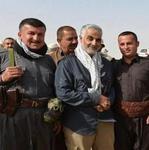
Qassem Soleimani (center) with his bodyguards near the frontlines of Tikrit.
Iran benefits from the threat of an Islamic State, and if the US continues its courtship of Tehran, it may find the Islamic State replaced by an Islamic Republic.
****************
Testifying on Capitol Hill on March 3, Joint Chiefs Chairman General Martin Dempseycharacterized the joint attempts of the Iraqi military, Iraqi Shia militias, and Iran’s Islamic Revolutionary Guards Corps (IRGC) at taking back control of Tikrit, Saddam Hussein’s hometown, from the Islamic State, as “a positive thing.” “Frankly,” General Dempsey said, “it will only be a problem if it results in sectarianism.”
General Dempsey’s caveat is an interesting one, since there is every reason to believe that Shia control of Tikrit will result in further sectarianism. While the US administration says in its most recent National Security Strategy that it desires to “degrade and ultimately defeat ISIL [Islamic State]” in an attempt to “support Iraq … free itself from sectarian conflict and the scourge of extremists,” Tehran is actively perpetuating the sectarian crisis in Iraq.
The threat of the Islamic State, coupled with American “strategic patience,” not only makes the Iraqi Shia more dependent on Tehran and legitimizes Iran’s military presence in Iraq, it also provides the regime in Tehran with another bargaining chip in nuclear negotiations with the P5+1 Group.
In the past, the Iraqi Shia have demonstrated little interest in reducing themselves to puppets of Tehran. During the war with Iraq from 1980-1988, Iraqi nationalism trumped sectarian identity: the Shia constituted the rank and file of the Iraqi military, and Shia leaders in Iraq kept their distance from the regime in Tehran. After the collapse of Saddam Hussein’s regime in 2003, Iraq became a sanctuary to Iranian clerics critical of the regime in Tehran, including Hossein Khomeini, grandson of the founder of the Islamic Republic.
But Iraq did not remain a refuge for long. The civil war in Iraq, followed by the rise of Islamic State, forced moderate Iraqi Shia, who otherwise would have pursued a line independent of Iran, to become dependencies of Tehran. After being rebuffed by the US following the Islamic State’s takeover of Mosul in 2014, General Qassem Atta, head of the Iraqi National Intelligence Service, asked Tehran for help and received assistance within 48 hours. Iraqi Prime Minister Haider al Abadi continues to press Washington for more support in his fight against the Islamic State and uses US hesitancy to justify reliance on Iran, which according to Vice President Iyad Allawi,only increases Iran’s influence in Iraq and could lead to dismantlement of the Iraqi state.
The Obama administration may desire to help secure the survival of the Iraqi state, but the small contingent of US advisers in Iraq is relying on a heavily Iranian-influenced Iraqi sectarian intelligence and security apparatus. The Iraqi security forces are predominantly Shia, and in addition, Shia militias and “advisers” from the IRGC Quds Force are now fighting as legitimate Iraqi forces.
This creates an environment in which targeting operations developed by Iranian forces and the militias have primacy over those developed by the US, leading to the possibility that Washington could be portrayed by Islamic State as complicit in the indiscriminate targeting of Sunnis. Such operations will be perceived the same way by the very Sunnis we need to fight Islamic State, thus undermining the US strategy to “support Iraq … free itself from sectarian conflict and the scourge of extremists.”
Any US reliance on Iranian support in the fight against the Islamic State is also likely to strengthen Tehran’s bargaining position in the nuclear negotiations.
Although both US and Iranian negotiators maintain that nothing but the nuclear issue is being discussed, this of course is fiction. On Sept. 22, Fars News, quoting an anonymous American source, reported that Secretary of State John Kerry and Mohammad Javad Zarif, Iran’s foreign minister, discussed the nuclear issue as well as the fight against the Islamic State. And Admiral Ali Shamkhani, Iran’s Supreme National Security Council Secretary, has also connected both issues. Clearly, Tehran’s cooperation with Washington in the fight against the Islamic State comes at a price, which Washington must pay at the negotiating table in Geneva.
Iran has Washington where it wants it. Iran wants a favorable deal, and the Obama administration is signaling that such a deal is forthcoming. US “strategic patience” is allowing Iran to increase its influence and presence in Iraq and Syria. Assad is waiting out the Americans and the international community, and Shia militias are now viewed as legitimate forces in Iraq, Syria, and Yemen. But most importantly, US “strategic patience” signals to Iran an unwillingness to jeopardize the talks by linking them to Iran’s role in Iraq, Syria, and Yemen.
Iran benefits from the threat of an Islamic State, and if the US continues its courtship of Tehran, it may find the Islamic State replaced by an Islamic Republic.
Iranian Gen. Qassem Soleimani on Tikrit battlefront
US President Barack Obama’s plans for Iran, which were spectacularly challenged by Binyamin Netanyahu in his Congress speech Tuesday, March 3, were manifested 10,000 kilometers from Washington in the firestorm over Tikrit, the important Sunni town north of Baghdad. There, Iranian-led Iraqi troops are on the offensive against the Islamic State in the biggest ground battle fought in Iraq since the Iraqi army fell apart and scattered last June against the conquering Islamist march through western and central Iraq.
For four reasons, this battle is loaded with ramifications for Obama’s Iran policy and the Islamic Republic’s drive for recognition as the leading Middle East power:
1. For Tehran it is a high-stake gamble for prestige, Its top military strategist, Al Qods Brigades chief Gen. Qassem Soleimani, was thrown into the Tikrit operation, to become the first high-ranking general Iran has ever placed publicly up front in direct command of a key battle as a guarantee of its success.
2. However, three days after the offensive was launched on Sunday, March 1, the 25,000 Iranian and Iraqi troops, backed by Iraqi Shiite militias, were still fighting outside its gates, upsetting the high hopes of a swift victory and breakthrough into the city.
Islamist forces slowed their advance by strewing hundreds of mines and roadside bombs on all the roads leading to Tikrit, while teams of suicide bombers jumped out and blew themselves up amidst the invading army – a tactic seen before in the battle for the Syrian Kurdish town of Kobani.
ISIS boasted that one of the suicide bombers was an American citizen whom they dubbed “Abu Dawoud al-Amriki.”
3. The United States has no military input in the battle – neither US advisers on the ground nor aerial bombardment. On Tuesday, March 3, while Netanyahu was advising Congress in reference to the relative merits of radical Iran and ISIS that “the enemy of your enemy is the enemy,” Gen. Martin Dempsey, Chairman of the US Joint Chiefs of Staff, revealed some of the Obama administration’s thinking on the subject.
He said Iran and its allies (Iraqi Shiite militias) had taken part in the Iraq war ever since 2004. “But the Tikrit campaign signals a new level of involvement,” he said. “This is the most overt conduct of Iranian support in the form of artillery and other things” and “…could turn out to be a positive thing.”
These comments corroborated DEBKAfile’s disclosures on the US-led war on ISIS, which defined America as confining itself to air strikes over Iraq and Syria and assigning the brunt of the ground war to Iran’s Revolutionary Guards forces – a division of labor, which Israeli military chiefs watch with increasing concern as it brings the Iranian peril closer than ever to Israel, DEBKAfile’s military sources report.
The Iraq format is replicated in southern Syria, where the same Gen. Soleimani, joined by a group of fellow Iranian generals, is leading an operation to seize that part of the country from Syrian rebel hands, including the Golan town of Quneitra .
4. The role Obama has assigned Iran in the two embattled Middle East countries bears directly on the scope of his concessions in the bargaining for a comprehensive nuclear deal.
In Baghdad’s Firdos Square, where in 2003 U.S. Marines helped Iraqis topple the statue of Saddam Hussein, there is now a billboard featuring Iran’s Supreme Leader Ayatollah Khameini.
**********************
The U.S. is training a national army for a nation that does not exist.
The Iraqi Army and Shiite militias have now launched an operation to retake Tikrit, a Sunni city 95 miles north of Baghdad that was Saddam Hussein’s hometown. The Americans are standing back. The U.S.-led coalition air forces are not flying missions in support because this is essentially an Iranian-organized and -led operation dominated by Shiite militias that answer to Tehran as much as Baghdad. This may be the shape of things to come.
In mid-February, a Pentagon official made headlines by announcing an April-May time frame for an Iraqi offensive to take Mosul from the so-called Islamic State. Mosul is the second-largest city in Iraq. As The Daily Beast reported last week, the Pentagon now says the April/May date is no longer operative. The Iraqi Army, it was explained, is not ready.
It may never be ready.
Staff Sgt. Tanya Thomas/US Army
At the beginning of 2014, the Iraqi Army comprised 17 divisions. By the end of the year, it was at most seven divisions, possibly as few as five. And, even at full strength, the Iraqi Army was not much of a fighting force.
In spite of outnumbering the ISIS attackers by a ratio of between 10/1 and 15/1, the Iraqi Army lost Mosul in just 10 hours on June 10, 2014. The ISIS forces came to Mosul in pickup trucks. The defenders had armored American Humvees, tanks, helicopters, artillery, and advanced rifles, all of which ended up in ISIS’s hands. Two months later, ISIS used these American weapons to attack the Kurds. The United States, which provided weapons worth billions to the Iraqi Army, is now spending hundreds of millions on airstrikes to destroy them.
Pentagon planners understand the deficiencies of the Iraqi Army. It is disorganized, poorly led, politicized, corrupt, and plagued by sectarian and ethnic divisions. But, where they go wrong is to imagine that these problems can be corrected with better leadership, training, and a policy of inclusiveness towards disaffected Sunnis and Kurds.
In fact, the problems of the Iraqi Army reflect the problems of Iraq where Shiites and Sunnis don’t agree on what it means to be Iraqi and where the Kurds unanimously don’t want to be Iraqi at all. The deficiencies of the army cannot be corrected because they reflect the realities of the society.
The Obama administration and virtually all American foreign policy experts blame former Iraqi Prime Minister Nouri al Maliki’s sectarian policies for contributing to the rise of ISIS. In this telling, Maliki alienated Sunnis by breaking promises to include the Sons of Iraq (the Sunni militia that was key to the defeat of al Qaeda in 2007) in the Iraqi Army, by appointing Shiite loyalists as top officers, and by marginalizing Sunnis in the army, government, and society. Maliki’s administration was sectarian, corrupt and ineffective. But, he may have been right about the Sunnis.
George W. Bush engineered a revolution in Iraq, albeit apparently unaware that he was doing so. The 2003 invasion ended 80 years of Sunni Arab dictatorships and replaced them with democratically elected governments. In each of the elections held since 2005, Iraqi Shiites voted overwhelmingly for Shiite religious parties.
Sunnis, even the many who are not particularly religious, do not accept that the Iraqi identity should be defined in a way that excludes them or treats them as a minority. Many Sunnis believe that Iraq’s new rulers are more loyal to their Shiite co-religionists in Iran than they are to Iraq.
Iran’s decades-long sponsorship of Iraq’s Shiite parties, including the Dawa party of both Maliki and current Prime Minister Haider al Abadi—reinforces Sunni perceptions, which, in any event, may not be wrong. In Baghdad’s Firdos Square, where in 2003 U.S. Marines helped Iraqis topple the statue of Saddam Hussein, there is now a billboard featuring Iran’s Supreme Leader Ayatollah Khameini.
As the Shiites see it, the Sunnis have refused to accept majority rule. They remember—as American planners seem to have forgotten—that Sunni tribal leaders welcomed and supported the al Qaeda extremists who, between 2003 and 2006, assassinated Shiite clerics, massacred Shiite pilgrims, and bombed markets and bus stations in Shiite cities and towns.
The Sunnis turned against al Qaeda not out of revulsion with the killing of Shiites or because they wanted reconciliation, but rather because the extremists had turned on the tribal leaders. When al Qaeda demanded money, daughters and fealty, the Sunni sheikhs had enough. Helped with American cash, they formed militias that finished off al Qaeda in Mesopotamia in a matter of months.
Maliki understood full well that there was no genuine reconciliation between the Shiite religious parties and the Sunnis. He minimized the Sunni role in the Iraqi Army (and central government) because he saw no value in incorporating Sunnis into an army whose primary mission is to protect a Shiite state from Sunnis. And, he was not wrong in his judgment.
When ISIS approached Mosul, some Sunni officers and troops acted as a fifth column providing intelligence and weapons to the attackers. Sunni soldiers who surrendered either went home or joined ISIS. The Shiite commanders fled to nearby Kurdistan, leaving Shiite recruits to face torture and execution (all recorded in videos) at the hands of ISIS.
Ever since Bush’s administrator in Iraq, L. Paul Bremer III, dissolved Saddam Hussein’s army in 2003, the United States has struggled to create an effective Iraqi army. It is impossible to build a real national army when Iraqis do not have a shared idea of the nation and when its components see each other as the enemy.
There are, of course, effective fighting forces in Iraq that are combatting ISIS. The Kurdistan Peshmerga pushed ISIS out of territory it took in August and continue to battle ISIS around Kirkuk, Makhmur, and Mosul. The Kurds have sustained nearly 1,000 casualties and, supported by American close air support, inflicted many times that number on ISIS.
The Kurds, of course, are motivated to defend Kurdistan. They may support a Mosul operation from their territory, but they have made it clear that they will not sacrifice Kurdish lives in a Sunni Arab city or on behalf of a country, Iraq, that they don’t want to be part of.
Shiite militias—armed and, in some cases, led by the Iranians—defended Baghdad and Samarra (home to an important Shiite shrine) last summer. More recently, they have pushed ISIS out of villages in religiously and ethnically mixed Diyala province (sometimes clashing with Peshmerga units).
The Iraqi Army itself is increasingly a sectarian institution. Ironically, this may make it a more effective fighting force. Sunni Arabs who remain in the army are reluctant to sacrifice their lives on behalf of a Shiite state, especially if it means fighting against fellow Sunnis. (Many recruits signed up not to defend Iraq but for a salary, which also contributes to a reluctance to get killed.) By contrast, the Shiite militias fought hard in 2014 to defend their homes and their religion. To the extent that the Iraqi Army becomes more like a Shiite militia (albeit paid and better armed), it may share the militias’ zeal.
The Pentagon still sees the Iraqi Army as a national institution and, as a result, provides it with the lion’s share of U.S. military assistance. Seeing it as another of the ethnic and sectarian forces in Iraq is probably more realistic and may lead to a more effective distribution of weaponry. Currently, more U.S. weapons go to an Iraqi Army that is not ready to fight than to a Kurdistan Pershmerga that is fighting. (Iran supplies the Shiite militias as part of the informal division of labor among the anti-ISIS forces.)
If the offensive against Tikrit now underway should fail (and the Iraqi Army has had considerable difficulty trying to take even some small villages adjacent to a large air base in Anbar province), it will not auger well for a Mosul campaign.
But, success in Tikrit will not necessarily translate into success in Mosul. A foreign army—and this is exactly how Mosul’s Sunnis will see the Iraqi Army—fighting house to house in a city of 3 million is certain to kill a lot of civilians even if the Army behaves well, which is unlikely.
Should it lose Mosul, ISIS would still have substantial territory in Iraq, a pool of resentful Sunnis and a sanctuary in Syria.
In a deeply divided Iraq, a successful government offensive to take Mosul may not solve much.
(Perhaps the Congress should invite President al-Sisi to address it on fighting the Non-Islamic Islamic State and its cohorts. How would Obama react?– DM)
The Egyptian president was stirred into action by the barbaric beheading on Feb. 15 of 21 Egyptian Coptic Christians who had found work in Libya.
*********************
Egyptian President Abdel-Fatteh El-Sisi has deployed his troops for all-out war on ISIS strongholds in Libya, the first Arab ruler to challenge the Islamists in a fellow Arab country, DEBKAfile’s military sources report.
His intiative dramatizes the spillover of the Islamist State’s threat across the Middle East, and the fading impetus of the US-led coalition effort to reverse Islamic State gains in Iraq and Syria.
Our Washington sources report that the Obama administration’s planned spring campaign to free Iraqi Mosul from the Islamic State’s occupation is stuck in the sand. Democratic and Republican lawmakers alike accuse the president of having no clear war strategy and of holding back from the US-led coalition the fighting manpower necessary for a successful operation.
Answering questions in the Senate Wednesday, Feb. 25, the coalition commander, retired Gen. John Allen, said he had no hard-and-fast timeline for the war. The influential Democratic Senator Barbara Boxer of California responded angrily: Your answers show one thing about the timeline defined by the White House as an enduring ground operation: “There is none.”
Jihadi John, who was filmed beheading ISIS victims, was revealed Thursday, Feb. 26, as a northwest Londoner of Kuwaiti descent called Mohammed Emwaz, who had been known to British intelligence. This was leaked by US sources to signal Washington’s aggravation over the relatively passive British role in the war on the Islamic State.
Also released was a video showing Islamic barbarians smashing priceless Assyrian artifacts in a Mosul museum – following which Friday, four ISIS members were burned alive for refusing to join the savage spree to vandalize the relics of an ancient world civilization.
Even so, US-led air strikes against ISIS targets in Syria and Iraq remain sporadic, no better than pinpricks.
The Egyptian president was stirred into action by the barbaric beheading on Feb. 15 of 21 Egyptian Coptic Christians who had found work in Libya.
El-Sisi first launched a series of air strikes against ISIS and allied Islamist militias in one of their Libyan strongholds in Darnah, following which he has now ordered Egyptian commando and marine forces to prepare for sea landings to seize the town and destroy the terrorist elements there, another landmark operation in the war on Islamist terror. .
Part of the Libyan terrorist movement and one of ISIS’s closest allies is the Ansar al-Sharia militia, which in September 2012 burned down the US consulate in Benghazi and murdered the US ambassador and three other American officials.
Cairo’s Darnah operation is believed to be days away. It is scheduled to take place at the same time as another anti-terrorist operation, which El-Sisi is planning to launch on Egypt’s longest-running front against the Islamist threat in Sinai, 2,000 kilometers east of Darnah. There, Egyptian and ground forces will go into action against the ISIS affiliate’s hideouts.
He is also considering aerial bombardments of the Gaza Strip to target Hamas’ military arm whose active collaboration with the jihadis has been confirmed by intelligence.
Some of the militias which have divided Darnah, a town of app. 50,000, among themselves, have declared their territories provinces of Abu Bakr Al-Baghdadi’s Islamic Caliphate.
According to our military sources, Egyptian forces will be assigned to attack the town from the north after a beach landing. They plan to link up with allied Libyan militias commanded by the former Qaddafi regime general Khalifa Hifter, who will come from Benghazi to strike the town from the south. Khalif and his armed men have been pursuing a relentless war on the inroads made by al Qaeda in Libya, as well as the Muslim Brotherhood, with quiet backing from Cairo.
The London-based Arabic Alquds Alarabi, which is known for its solid sources in the Middle East, reported this week that Gen. Hafter had recently paid at least two secret visits to Cairo to collect the weapons he needs for his part in the Darnah offensive and coordination.
After one of those trips, the paper reports, Hafter set out for Jordan where he had meetings with Israeli military and intelligence officials.









 anneinpt
 artaxes
 danmillerinpanama
 davidking1530
 Peter Hofman
 Joseph Wouk
 Peter
Peter Louisiana Steve
 WarSclerotic

Recent Comments