Archive for the ‘Democracy’ category

FLASHBACK — Bill Kristol’s Candidate: It’s ‘Important to Say’ White Working Class Communities ‘Deserve to Die’

June 1, 2016

FLASHBACK — Bill Kristol’s Candidate: It’s ‘Important to Say’ White Working Class Communities ‘Deserve to Die’, BreitbartJulia Hahn, June 1, 2016

Bill-Kristol-and-David-French-AP-Photos-640x480

According to new reports, The Weekly Standard’s Bill Kristol wants fellow professional Republican and National Review staff writer, David French, to run an independent presidential campaign.

The prospect of a French run has received some support via Twitter from professional Republicans who oppose the candidate selected by the voters. However, French’s prior controversial writings could alienate a core constituency of the American electorate— namely, white working-class voters.

While Donald Trump has called on the GOP to become a “worker’s party”— a development Sen. Jeff Sessions called for two years ago, ironically, in the pages of the National Review— French has defended the idea that white working-class communities “deserve to die.”

Specifically, French wrote a piece in support of Kevin D. Williamson, who had said:

The truth about these dysfunctional, downscale communities is that they deserve to die. Economically, they are negative assets. Morally, they are indefensible. Forget all your cheap theatrical Bruce Springsteen crap. Forget your sanctimony about struggling Rust Belt factory towns and your conspiracy theories about the wily Orientals stealing our jobs. Forget your goddamned gypsum, and, if he has a problem with that, forget Ed Burke, too. The white American underclass is in thrall to a vicious, selfish culture whose main products are misery and used heroin needles. Donald Trump’s speeches make them feel good. So does OxyContin. What they need isn’t analgesics, literal or political. They need real opportunity, which means that they need real change, which means that they need U-Haul.

French described Williamson’s piece as “excellent” and said that Williamson’s words were “fundamentally true and important to say.”

French went on to dismiss the struggles white working class Americans endure.

“Citizens of the world’s most prosperous nation, they face challenges — of course — but no true calamities,” French wrote.

While French suggests that the decline of America’s middle class and manufacturing power is no true calamity, others could argue that the greater a nation or culture, the more sorrowful it is to witness its decline — much the same way that history would mourn the destruction of the Palace of Versailles more than the totaling of Justin Bieber’s car.

French insists that the devastation of the working-class’ livelihoods is unrelated to failed federal policies such as mass immigration:

[I] have seen the challenges of the white working-class first-hand. Simply put, Americans are killing themselves and destroying their families at an alarming rate. No one is making them do it. The economy isn’t putting a bottle in their hand. Immigrants aren’t making them cheat on their wives or snort OxyContin. Obama isn’t walking them into the lawyer’s office to force them to file a bogus disability claim.

French, instead, suggests that the decimation of these communities is due to the laziness of the American worker:

Millions of Americans aren’t doing their best. Indeed, they’re barely trying. My church in Kentucky made a determined attempt to reach kids and families that were falling between the cracks, and it was consistently astounding how little effort most parents and their teen children made to improve their lives. If they couldn’t find a job in a few days — or perhaps even as little as a few hours — they’d stop looking. If they got angry at teachers or coaches, they’d drop out of school. If they fought with their wife, they had sex with a neighbor. And always — always — there was a sense of entitlement. And that’s where disability or other government programs kicked in. They were there, beckoning, giving men and women alternatives to gainful employment. You don’t have to do any work (your disability lawyer does all the heavy lifting), you make money, and you get drugs.

Mr. French’s blame-the-victim approach is notable for two reasons. First, it presents a novel view of human sociology in which people can lose their cultural pride, their means of economic survival, their sense of identity, their self-worth, and even suffer direct discrimination with no corresponding fallout. Second, it underscores one of the unique aspects of professional Republicanism. While professional Democrats advocate for the use of government power on behalf of their base, professional Republicans like Mr. French seem to argue that their own base deserves what’s coming and, as penance, should be left defenseless.

When readers responded with outrage to French’s piece, French doubled down in a post entitled “The Great White Working-Class Debate: Just Because I’m ‘Nasty’ Doesn’t Mean I’m Wrong.”

In recent decades, these white working class communities — and their inhabitants — have been economically devastated and are quite literally dying off. A study by Princeton economists revealed that white, middle-aged working-class Americans without a college degree are experiencing a rapid rise in morbidity. The report found that the rise in their death rates was tied to, what The New York Times described as the “pessimistic outlook among whites about their financial futures.”

“Only H.I.V./AIDS in contemporary times has done anything like this,” one of the Princeton economists told The New York Times.

Even French’s boss, Rich Lowry, in his own column about the mortality rates of the white working-class, hinted that a kind of loss of social pride might be the cause. “The white working class is dying from the effects of a long-running alienation from the mainstream of American life,” Lowry wrote. In his piece, Lowry seems to perhaps be hinting at what Pat Buchanan described more starkly:

A lost generation is growing up all around us. In the popular culture of the ’40s and ’50s, white men were role models. They were the detectives and cops who ran down gangsters and the heroes who won World War II. … They were doctors, journalists, lawyers, architects and clergy. … They were the Founding Fathers. … What has changed in our culture? Everything. The world has been turned upside-down for white children. In our schools the history books have been rewritten and old heroes blotted out, as their statues are taken down and their flags are put away.

Ironically, while French has said that his “life’s work” has been “building a conservative movement that represents our nation’s best hope for the greatness Trump claims to crave,” French’s candidacy could help install Hillary Clinton as President and put her in a position to end forever the chances of the conservative movement’s electoral success.

As National Review’s Rich Lowry seemed to suggest more than a decade ago, large-scale Latin American immigration will be “suicide” for the Republican Party. As National Review warned two decades ago, “The Republican hour is rapidly drawing to a close … being drowned — as a direct result of the 1965 Immigration Act.”

Today, the U.S. foreign-born population is already at an all-time high of 42.4 million. Every three years, the U.S. adds another city of Los Angeles made up entirely of foreign-born immigrants. Yet Clinton has publicly released on her website a plan to dissolve the nation’s borders within her first 100 days in office.

Similarly, while French claims to be concerned about the rapid pace of Muslim immigration, his candidacy could help install a president who is openly campaigning on expanding Muslim migration. Based on the minimum numbers she has put forward thus far, Clinton would import 730,000 permanent migrants from the Muslim world during her first term alone.

Yet admittedly, French is not opposed to all aspects of a Clinton presidency. As French has previously said, “On trade, Clinton will almost certainly be superior to Trump”— noting that Clinton “would probably maintain the trade-policy status quo, and while that status quo creates winners and losers — as any status quo would — free trade has long been an overall positive for American families.”

The Republican electorate, however, seems to disagree. While many candidates in the GOP primary championed French’s views of ideological “free trade,” those candidates were resoundingly rejected by voters.

Sweden: Is Islam Compatible with Democracy?

May 28, 2016

Sweden: Is Islam Compatible with Democracy? Gatestone InstituteIngrid Carlqvist, May 28, 2016

♦ It is not a secret that democracy can be used to abolish democracy.

♦ It may have finally begun to dawn on the people that Swedish Sweden will soon be lost forever, and in many areas replaced by a Middle Eastern state of affairs, where different immigrant groups (mainly Muslims) make war on each other as well as on the Swedes.
♦ According to Dr. Peter Hammond, in his book Slavery, Terrorism and Islam: The Historical Roots and Contemporary Threat, the goal of Islam is not to convert the whole world, but rather, to establish sharia law all over the world.

♦ There is no country where Islam is dominant that can be considered a democracy with freedom of speech and equal justice under law.

In Sweden’s last census in which citizens were asked about their religious beliefs, in 1930, fifteen people said that they were Muslims. Since 1975, when Sweden started its transformation from a homogenous, Swedish country into a multicultural and multi-religious one, the number of Muslims has exploded. Now, approximately one million Muslims live here — Sunni, Shia and Ahmadiyya from all the corners of the world — and Mosques are built and planned all over the country.

No one, however, seems to have asked the crucial question upon which Sweden’s future depends: Is Islam compatible with democracy?

The Swedish establishment has not grasped that Islam is more than a private religion, and therefore it dismisses all questions about Islam with the argument that Sweden has freedom of religion.

Two facts point to Islam not being compatible with democracy. First, there is no country where Islam is dominant that can be considered a democracy with freedom of speech and equal justice under law. Some point to Malaysia and Indonesia — two countries where flogging and other corporal punishments are meted out, for example, to women showing too much hair or skin, as well as to anyone who makes fun of, questions or criticizes Islam. Others point to Turkey as an example of an “Islamic democracy” — a country which routinely imprisons journalists, political dissidents and random people thought to have “offended” President Erdogan, “Islam” or “the nation.”

Second, Muslims in Europe vote collectively. In France, 93% of Muslims voted for the current president, François Hollande, in 2012. In Sweden, the Social Democrats reported that 75% of Swedish Muslims voted for them in the general election of 2006; and studies show that the “red-green” bloc gets 80-90% of the Muslim vote.

It is no secret that democracy can be used to abolish democracy — yet, this crucial issue is completely taboo in Sweden. Politicians, authorities and journalists all see Islam as just another religion. They seem to have no clue that Islam is also a political ideology, a justice system (sharia) and a specific culture that has rules for virtually everything in a person’s life: how to dress; who your friends should be; which foot should go first when you enter the bathroom. Granted, not all Muslims follow all these rules, but that does not change the fact that Islam aspires to control every aspect of human life — the very definition of a totalitarian ideology.

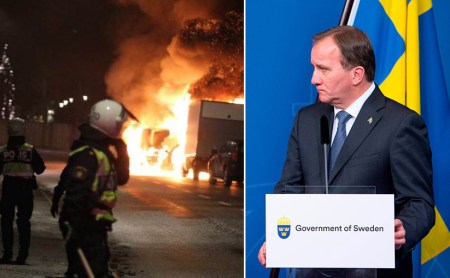
While the establishment closes its eyes to the problems that come with a rapidly growing Muslim population in Sweden, ordinary Swedes seem to be growing increasingly upset. Prime Minister Stefan Löfven, however, appears to be at a complete loss as to why this is. He recently told the British newspaper, Financial Times:

“But the more surreal thing is that all the numbers are going in the right direction, but the picture the public have is that the country is now going in the wrong direction. It’s not only a question about if they are afraid of the refugee crisis; it’s as if everything is going in the wrong direction.”

This comment says a lot about how disconnected Prime Minister Löfven is from the reality that ordinary Swedes are facing. The mainstream media withhold information about most of the violence that goes on in, and around, the asylum houses in the country, and it is not very likely that Stefan Löfven reads the alternative media sites; he and others in power have, in unison, dubbed them “hate sites.” He obviously has no idea about the anger and despair many Swedes are now feeling. It may have finally begun to dawn on them that Swedish Sweden will soon be lost forever, and in many areas replaced by a Middle Eastern state of affairs where different immigrant groups (mainly Muslims) make war on each other as well as on the Swedes.

1625While the establishment closes its eyes to the problems that come with a rapidly growing Muslim population in Sweden, ordinary Swedes seem to be growing increasingly upset. Prime Minister Stefan Löfven (right), however, appears to be at a complete loss as to why this is. Pictured at left: The results of rioting in a Stockholm suburb, December 2014.

The people suffering most cruelly in the “New Sweden” are the elderly. The costs of immigration borne by the welfare state have led to a quarter of a million retirees living below the EU poverty line. Meanwhile, the government recently added another 30 billion kronor (about $3.6 billion) to the migration budget. The 70 billion kronor ($8.4 billion) Sweden will spend on asylum seekers in 2016 is more than what the entire police force and justice system cost, more than national defense costs, and twice the amount of child benefits.

Sweden’s 9.5 million residents are thus forced to spend 70 billion kronor on letting citizens of other countries come in. In comparison, the United States, with its 320 million residents, spent $1.56 billion on refugees in 2015. The editorial columnist PM Nilsson commented in the business paper, Dagens Industri:

“To understand the scope of the increase in spending, a historic look back can be worthwhile. When the right bloc came to power in 2006, the cost was 8 billion [kronor] a year. In 2014, it had gone up to 24 billion. That summer, then Minister of Finance Anders Borg talked about the increase being the most dramatic shift in the state budget he had ever seen. The year after, 2015, the cost rose to 35 billion, and in 2016, it is projected to rise to 70 billion.”

For many years, the politicians managed to fool the Swedish people into thinking that even if immigration presented an initial cost, the immigrants would soon enable the country to turn a profit. Now, more and more research indicates that the asylum seeker immigrants rarely or never find work. The daily newspaper Sydsvenskan reported in February, for example, that 64% of Malmö’s immigrants are still unemployed after living in Sweden for ten years. The government openly calculates in its budget that in four years, 980,000 people will be living on either sickness benefits, disability pensions, unemployment benefits, “introduction benefits” or social welfare.

Swedes, who for many years have paid the highest taxes in the world without whining, are now taking to social media to express their anger that their money is going to citizens of other countries. More and more Swedes are choosing to emigrate from Sweden, mainly to the other Nordic countries, but also to Spain, Portugal and Great Britain, where taxes on pensions are considerably less.

But there are worse problems than the economic aspect. A sense of insecurity and fear has gripped the many Swedes who live close to asylum houses. On some level, the government seems to have grasped that danger: in a recent decision to continue maintaining border controls, Interior Minister Anders Ygeman wrote:

“The Swedish Civil Contingencies Agency (Myndigheten för samhällsskydd och beredskap), MSB, makes the assessment that the flow of migrants still brings challenges to upholding security in society, when it comes to the ability to maintain certain important public functions, among other things. Several of these challenges are expected to persist over time. The Police Authority’s assessment is still that a serious threat to public order and internal security exists. The Immigration Service still advocates border controls.”

Despite these ominous words, politicians still do not seem to understand that many Swedes are already experiencing “a serious threat to public order and internal security.” New asylum houses are opening at an alarming pace, against the will of the people living near them. In the Stockholm suburb of Spånga-Tensta, on April 15, local authorities held a public meeting, the purpose of which was to allow local residents to ask the politicians and officials questions about planned housing for 600 migrants — next to a school. The meeting, which was filmed, showed a riotous mood among those gathered there, many shouting that they were going to fight “until their last breath” to keep the plans from materializing.

Some of the comments and questions were:

  • “We have seen how many problems there have been at other asylum houses – stabbings, rapes and harassment. How can you guarantee the safety for us citizens? This is going to create a sense of us against them, it’s going to create hate! Why these large houses, why not small ones with ten people in each? Why haven’t you asked us, the people who live here, if we want this? How will you make this safe for us?”
  • “We already have problems at the existing asylum houses. It’s irresponsible of you to create a situation where we put our own and our children’s health in jeopardy, with people who are not feeling well and are in the wrong environment. Why is this house right next to a school? What is your analysis?”
  • “Will Swedes be allowed to live in these houses? Our young people have nowhere to live. You politicians should solve the housing issue for the people already living here, not for all the people in the world.”

When the chairman of the meeting, Green Party representative Awad Hersi, of Somali descent, thanked the audience for the questions without giving any answers, the mood approached that of a lynch mob. People shouted: “Answer! Answer our questions! We demand answers!”

Everything points to the so far docile Swedes now having had enough of the irresponsible immigration policy that has been going on for many years, under socialist and conservative governments alike.

People are furious at the wave of rapes that have given Sweden the second-highest rate of rape in the world, after only Lesotho, and that recently forced the Östersund police to issue a warning to women and girls not to go outside alone after dark. People are scared: the number of murders and manslaughters has soared. During the first three months of this year alone, there have been 40 murders and 57 attempted murders, according to statistics compiled by the journalist Elisabeth Höglund.

The authorities have long claimed that lethal violence in Sweden is on the decline, but that is compared to a record-breaking year, 1989, when mass immigration to Sweden was already in full swing. If one instead were to compare the present to the 1950s and 1960s, when Sweden was still a homogenous country, the number of murders and manslaughters has doubled. Recently, the Swedish National Council for Crime Prevention (Brottsförebyggande rådet), BRÅ, had toadmit that lethal violence did, in fact, increase in 2015, when 112 people were killed — 25 more than the year before. It was also revealed that the kind of lethal violence that has gone down was run-of-the-mill drunken homicides committed by Swedes, while the number of gangster-style hits carried out by immigrants has gone up dramatically. Improved trauma care for wounded victims also helps keep the number of murders and manslaughters down.

A recent poll showed that 53% of Swedes now think immigration is the most important issue facing the country. The change from 2015 is dramatic — last year, only 27% said that immigration was most important. Another poll showed that 70% of Swedes feel that the amount of immigration to Sweden is too high. This is the fourth year in a row that skepticism about the magnitude of immigration has increased.

More and more people also seem to worry about the future of Sweden as a democracy with an increasing number of Muslims — through continued immigration as well as Muslim women having significantly more children than Swedish women do.

As statistics on religious beliefs are no longer kept, no one knows exactly how many Muslims are in Sweden. Last year, a poll showed that Swedes believe 17% of the population is Muslim, while the actual number, according to the polling institute Ipsos Mori, may be more like 5%. The company does not account for how it arrived at this number, and it is in all likelihood much too low. Ipsos Mori probably counted how many members Muslim congregations and organizations have, but as Islam is also a culture, and the country is equally affected by the Muslims who do not actively practice their faith, yet live according to Islamic culture.

In 2012, the Swedish alternative newspaper, Dispatch International, calculated how many Muslims were registered residents of Sweden at that time, based on the Swedish name registry. The number the paper arrived at was 574,000, plus or minus 20,000. For obvious reasons, illegals and asylum seekers were not included. The actual number may therefore have been much higher.

Since then, close to 300,000 people have sought asylum in Sweden. Not all of them have had their applications approved, but despite that, very few actually leave Sweden. The Immigration Service told Gatestone Institute that only 9,700 people were deported last year. Most asylum seekers are Muslim, which means that the number of Muslims in Sweden is fast approaching one million, or 10% of the population.

In his book Slavery, Terrorism and Islam: The Historical Roots and Contemporary Threat, published in 2005, Dr. Peter Hammond describes what has always happened throughout history when the number of Muslims in a country increases. Admittedly generalities, Hammond outlines the following:

  • As long as the Muslims make up about 1%, they are generally considered a peace-loving minority who do not bother anyone.
  • At 2-3%, some start proselytizing to other minorities and disgruntled groups, especially in prison and among street gangs.
  • At 5%, Muslims have an unreasonably large influence relative to their share of the population. Many demand halal slaughtered meat, and have been pushing the food industry to produce and sell it. They have also started to work toward the government giving them autonomy under sharia law. Hammond writes that the goal of Islam is not to convert the whole world, but rather, to establish sharia law all over the world.
  • When Muslims reach 10%, historically, lawlessness increases. Some start to complain about their situation, start riots and car fires, and threaten people they feel insult Islam.
  • At 20%, violent riots erupt, jihadi militia groups are formed, people are murdered, and churches and synagogues are set ablaze.
  • When the Muslims reach 40% of the population, there are widespread massacres, constant terror attacks and militia warfare.
  • At 60%, there is the possibility of uninhibited persecution of non-Muslims, sporadic ethnic cleansing, possible genocide, implementation of sharia law and jizya (the tax for “protection” that unbelievers must pay).
  • When there are 80% Muslims in the country, they have taken control of the government apparatus and are, as in, for instance, Syria, Afghanistan, Pakistan and Iraq, committing violence in the name of Islam or political power.
  • When 100% are Muslims, the peace in the house of Islam is supposed to come — hence the claim that Islam is the “religion of peace.”

Hammond also writes that in many countries, such as France, Belgium, Great Britain and Sweden, most of the Muslim population lives in Islamic enclaves — and apparently prefer not to be assimilated into a Western society. This detachment strengthens the group internally, allowing them to exercise greater power than their share of the population might indicate.

Hammond’s description of the 10%-limit accurately describes Sweden. In the so-called exclusion areas, there are car torchings every day, and riots occur in the cities. (To name but a few examples, there were serious riots in Malmö 2008, Gothenburg 2009, Stockholm 2013, and Norrköping and Växjö 2015.) Sometimes, the unrest starts after a local Muslim has been arrested or shot by the police. Muslim leaders then immediately say they sympathize with their people’s reaction. During the Husby riots in 2013, Rami Al-Khamisi of the youth organization “Megafonen”wrote: “We can see why people are reacting this way.”

The artist Lars Vilks, who drew the Muslim prophet Muhammed as a roundabout dog, has been the target of several assassination attempts, and now lives under round-the-clock police protection.

Yet, almost no one in Sweden is willing to speak of these problems and how it all fits together. For months, Gatestone Institute has called politicians, civil servants, organizations and various minority groups, to ask how they feel about Islam in Sweden. Do they think Islam is compatible with democracy, freedom of speech and legal equality — and if so, in what way or what way not?

The questions seemed to provoke anger as well as fear. Some of the people we called said they were angry at the mere questions, but assured the callers that Islam poses no problem whatsoever for Sweden. Others appeared frightened and refused to answer altogether. In the hopes of getting at least some honest answers, we presented ourselves as ordinary, concerned Swedes. Countless people hung up the phone, and in general, many answers pointed to an abysmal ignorance about what Islam is, what consequences the Islamization of a country might have, or how much trouble Sweden really is in. The country appears totally unprepared for what lies ahead.

Pamela Geller: EU Now Vows to Block Populist Parties, Another Sop To Europe’s Invaders

May 25, 2016

Pamela Geller: EU Now Vows to Block Populist Parties, Another Sop To Europe’s Invaders, Breitbart, Pamela Gekker, May 24, 2016

GettyImages-493750110-640x480Getty

It was reported Tuesday that the European Commission is moving to make sure that their hegemonic hold on European politics isn’t broken by populist parties that want to save Europe from the Muslim migrant invasion.

“Norbert Hofer failed in his bid for Austria’s presidency, but he would have been cut out of EU decision-making,” reported the Times of London.

“The EU will isolate and use sanctions against any far-right or populist governments that are swept to power or presidential office on the wave of popular anger against migration.”

The Times quoted Jean-Claude Juncker, president of the European Commission, saying flatly: “There is no debate or dialogue with the far-right.”

This is the modern face of fascism: the “anti-fascists.”

In the twentieth century, the idea of totalitarianism was a German initiative and most European countries fell into line. Forty-five thousand concentration camps located throughout Europe speaks to the enthusiastic support the Germans received.

In the 21st century, the European Union is the Reich, and they mean for their power to be absolute. Juncker made it clear that the parties they call “far-right” will never have a voice in the EU no matter how big their vote totals get.

“Far right” – what is that, anyway? Nazis? The Nazi Party was far-left: the National Socialist German Workers Party. What is far-right? Anti-Islamization? Anti-immigration? Pro-freedom?

When you import an influx of Muslims, you get jihad. It’s hardly rocket science. The West faces jihad terror because a certain percentage of the Muslim population will kill in the cause of Islam. Yet Juncker and the other European Commission authorities are not moving to stop the migrant influx, but to crush dissent from parties that want to save Europe’s free and pluralistic societies.

It seems the Nazis are back, in a different uniform and with a cheekier narrative, but the objective is very much the same.

Let’s be honest, they slaughtered six million Jews and imported 25 million Jew-haters. The problem for them is the fact that their new immigrants hate Europeans, too. But instead of facing that fact and doing something about it, the European Union is paving the way for the suicide of Europe and the West by guilt-tripping Europeans into thinking it’s morally wrong to oppose the migrant invasion.

Eight hundred thousand more Muslim migrants are lining up to invade Europe. Greece has its hands full. Muslim migrants are storming the border. They are violently rioting in refugee camps. Terror, terror, and more terror — and even aside from terror, there is the fact that Muslims are the only immigrant group that comes to Western countries with a ready-made model of society and government (sharia) which they believe to be superior to what we have here, and they work to institute it.

And that is exactly what they are doing now in Europe — by force, or lawsuit, or intimidation. But as far as the European Union is concerned, “Islamophobia” is the real problem that they need to confront.

The Europeans learned all the wrong lessons from the horrors of World War II. The lesson that Europe had decided to avail itself of in the aftermath of Auschwitz was not that they were evil and behaved like monsters, but rather that everything was caused by nationalism and therefore what they really needed to do was create a European Union that would obviate their need for nationalism, so that they could become this transnational gobbledygook, and they’ll all get together and therefore they won’t have another Auschwitz.

Wrong.

The lesson they should have learned was that they were evil and they have to be good. That is the lesson they never learned. They have to be able and willing to make moral distinctions and stand up for the good and fight evil, and that is something the Europeans refuse to do.

They did not learn that lesson.

The UK could send a powerful message – a clear rebuke – to the EU’s authoritarian tendencies by voting for Brexit on June 23rd. Whether the British people can surmount the media’s propaganda campaign and all the political fear-mongering remains to be seen.

Let Me Ask America a Question

April 15, 2016

Let Me Ask America a Question, Wall Street Journal, Donald Trump, April 14, 2016

Let me ask a question

On Saturday, April 9, Colorado had an “election” without voters. Delegates were chosen on behalf of a presidential nominee, yet the people of Colorado were not able to cast their ballots to say which nominee they preferred.

A planned vote had been canceled. And one million Republicans in Colorado were sidelined.

In recent days, something all too predictable has happened: Politicians furiously defended the system. “These are the rules,” we were told over and over again. If the “rules” can be used to block Coloradans from voting on whether they want better trade deals, or stronger borders, or an end to special-interest vote-buying in Congress—well, that’s just the system and we should embrace it.

Let me ask America a question: How has the “system” been working out for you and your family?

I, for one, am not interested in defending a system that for decades has served the interest of political parties at the expense of the people. Members of the club—the consultants, the pollsters, the politicians, the pundits and the special interests—grow rich and powerful while the American people grow poorer and more isolated.

No one forced anyone to cancel the vote in Colorado. Political insiders made a choice to cancel it. And it was the wrong choice.

Responsible leaders should be shocked by the idea that party officials can simply cancel elections in America if they don’t like what the voters may decide.

The only antidote to decades of ruinous rule by a small handful of elites is a bold infusion of popular will. On every major issue affecting this country, the people are right and the governing elite are wrong. The elites are wrong on taxes, on the size of government, on trade, on immigration, on foreign policy.

Why should we trust the people who have made every wrong decision to substitute their will for America’s will in this presidential election?

Here, I part ways with Sen. Ted Cruz.

Mr. Cruz has toured the country bragging about his voterless victory in Colorado. For a man who styles himself as a warrior against the establishment (you wouldn’t know it from his list of donors and endorsers), you’d think he would be demanding a vote for Coloradans. Instead, Mr. Cruz is celebrating their disenfranchisement.

Likewise, Mr. Cruz loudly boasts every time party insiders disenfranchise voters in a congressional district by appointing delegates who will vote the opposite of the expressed will of the people who live in that district.

That’s because Mr. Cruz has no democratic path to the nomination. He has been mathematically eliminated by the voters.

While I am self-funding, Mr. Cruz rakes in millions from special interests. Yet despite his financial advantage, Mr. Cruz has won only three primaries outside his home state and trails me by two million votes—a gap that will soon explode even wider. Mr. Cruz loses when people actually get to cast ballots. Voter disenfranchisement is not merely part of the Cruz strategy—it is the Cruz strategy.

The great irony of this campaign is that the “Washington cartel” that Mr. Cruz rails against is the very group he is relying upon in his voter-nullification scheme.

My campaign strategy is to win with the voters. Ted Cruz’s campaign strategy is to win despite them.

What we are seeing now is not a proper use of the rules, but a flagrant abuse of the rules. Delegates are supposed to reflect the decisions of voters, but the system is being rigged by party operatives with “double-agent” delegates who reject the decision of voters.

The American people can have no faith in such a system. It must be reformed.

Just as I have said that I will reform our unfair trade, immigration and economic policies that have also been rigged against Americans, so too will I work closely with the chairman of the Republican National Committee and top GOP officials to reform our election policies. Together, we will restore the faith—and the franchise—of the American people.

We must leave no doubt that voters, not donors, choose the nominee.

How have we gotten to the point where politicians defend a rigged delegate-selection process with more passion than they have ever defended America’s borders?

Perhaps it is because politicians care more about securing their private club than about securing their country.

My campaign will, of course, battle for every last delegate. We will work within the system that exists now, while fighting to have it reformed in the future. But we will do it the right way. My campaign will seek maximum transparency, maximum representation and maximum voter participation.

We will run a campaign based on empowering voters, not sidelining them.

Let us take inspiration from patriotic Colorado citizens who have banded together in protest. Let us make Colorado a rallying cry on behalf of all the forgotten people whose desperate pleas have for decades fallen on the deaf ears and closed eyes of our rulers in Washington, D.C.

The political insiders have had their way for a long time. Let 2016 be remembered as the year the American people finally got theirs.

Cartoon of the Day

April 14, 2016

H/t Dry Bones

America’s Democracy

D16321_1

Trump: The system is rigged, it’s crooked

April 11, 2016

Trump: The system is rigged, it’s crooked, Fox and Friends via You Tube, April 11, 2016

Palestinians: Presidents for Life, No Elections

April 1, 2016

Palestinians: Presidents for Life, No Elections, Gatestone InstituteKhaled Abu Toameh, April 1, 2016

♦ We hear often that Mahmoud Abbas is keen on having Palestinians vote in a democratic election. Yet Abbas turned 81 last week and appears ready to remain at the helm until his last day — free elections for Palestinians be damned. That makes sense: Hamas could easily best Abbas in such an election.

♦ Hamas and Abbas’s Fatah are still far from achieving any form of reconciliation. This, despite all the talk about “progress” that has been reportedly achieved in talks between the two parties taking place in Doha, Qatar.

♦ Hamas is also cracking down on journalists, academics, unionists and even lawyers in the Gaza Strip.

♦ Yet Abbas’s West Bank rivals Hamas in Gaza, in terms of a lack of human rights and freedom of speech. The idea of free and democratic elections there is a joke. Abbas will leave a legacy of chaos.

Best birthday wishes to Palestinian Authority (PA) President Mahmoud Abbas, who turned 81 last week. The octogenarian appears ready to remain at the helm until his last day — free elections for Palestinians be damned.

Abbas has inherited a tradition of tyranny. His predecessor, Yasser Arafat, was also president for life. Both have plenty of company, joining a long list of African presidents who earned the notorious title of “President for Life” – in Uganda, Equatorial Guinea, Angola, Zimbabwe, Sudan, Chad, Eritrea and Gambia. And let us not forget the Arab dictators in these ranks.

One might hope for at least a deputy — someone to fill the impending and inevitable power vacuum in the PA. Not likely.

Abbas has fiercely resisted demands from leaders of his ruling Fatah faction to name a deputy president or a successor. His reasoning: the time is not “appropriate” for such a move. Palestinians should instead concentrate their energies on rallying international support for a Palestinian state.

The PA president acquired his “private fiefdom,” as it is called by his detractors, in a January 2005 election, when Abbas was given a four-year mandate.

Such mandate seems to have been rewritten by the standing president. January 2016 marked the beginning of the eleventh year of Abbas’s four-year term in office. But it is business as usual in Ramallah.

We hear on a monthly basis that Abbas is keen on having Palestinians cast their ballots in a free and democratic vote. Yet we have seen no evidence to this effect. That make sense: Hamas could easily best Abbas in such an election. Despite his advancing age, Abbas still has clear memories of January 2006, when Hamas was permitted to run in the parliamentary election and won.

Abbas is also acutely aware that Hamas, which holds hostage nearly two million Palestinians in the Gaza Strip, would never allow a free vote there — especially for Abbas loyalists who have been seeking to undermine its rule.

Just a few days ago, a Hamas “military” court in the Gaza Strip sentenced two senior Palestinian Authority security officers, Sami Nisman and Naim Abu Ful, to 15 and 12 years in prison respectively, on charges of spying for the Palestinian Authority and plotting terror attacks against Hamas targets.

The verdicts are yet another sign that Hamas and Abbas’s Fatah are still far from achieving any form of reconciliation. This, despite all the talk about “progress” that has been reportedly achieved in talks between the two parties. Unconfirmed reports earlier this week leaked details of sticking points between Hamas and Fatah negotiators, have been meeting in Doha, Qatar, under the auspices of the Gulf state, towards forming a new unity government and holding new presidential and parliamentary elections. Qatar is the largest source of funds for the Muslim Brotherhood and its offshoot, Hamas.

Abbas’s fear of holding elections in the Gaza Strip is not without justification. In addition to the crackdown on his loyalists and security officers there, Hamas is also cracking down on journalists, academics, unionists and even lawyers.

Last week, Hamas security forces raided the offices of the Palestinian Bar Association in Gaza City and confiscated computers. The raid came as a result of the controversy surrounding the Bar Association not submitting lawyers’ financial and administrative records, in addition to complaints filed by some lawyers against the Bar Association, according to a statement released by the Palestinian Center for Human Rights (PCHR). The raid, some Palestinians claim, is in the context of Hamas’s effort to crack down on lawyers who are affiliated with the rival Fatah faction.

Yet Abbas’s West Bank rivals Hamas in Gaza, in terms of a lack of human rights and freedom of speech. The president’s security forces are in the midst of a massive and ongoing crackdown on political opponents of all stripes, making the idea of free and democratic elections there a joke. Abbas cannot tolerate the idea of having a deputy: how would he consider the establishment of a new party or the emergence of a potential candidate for the presidency.

Senior figures who have dared to challenge Abbas’s autocratic rule have already found themselves targeted by the president and his men. Ask former Prime Minister Salam Fayyad, who had his organization’s bank accounts seized by Abbas, or Mohamed Dahlan, the former Fatah commander and minister who was forced to flee the Palestinian territories after falling out with Abbas and his sons. Perhaps deposed PLO Secretary-General Yasser Abed Rabbo, who overnight was stripped of his powers and thrown to the dogs for speaking out against the president, would have a word to say. In Ramallah, they call them the “Abbas victims.”

909Palestinian Authority President Mahmoud Abbas (left), who turned 81 last week, has fiercely resisted demands from leaders of his ruling Fatah faction to name a deputy president or a successor. Senior figures who have dared to challenge Abbas’s autocratic rule have been targeted by the president — such as Mohamed Dahlan (right), the former Fatah commander and minister who was forced to flee the Palestinian territories after falling out with Abbas and his sons. (Image sources: U.S. State Dept., M. Dahlan Office)

We would need a crystal ball to know what will happen the day after Abbas disappears from the scene. Perhaps, say some, we shall witness a scene reminiscent of the old days of the Soviet Union “Politburo,” with the next president chosen by a group of Fatah and PLO leaders who will meet in Ramallah. This seems the most likely scenario, in the absence of any chance of free and democratic elections, and in light of the continued split between the two Palestinian entities in the West Bank and Gaza Strip.

We do not need a crystal ball, however, to know that Abbas will leave a legacy of chaos. His adamant refusal to name a deputy or even discuss the issue of succession in public has already created tensions among the top brass of the PLO and Fatah. The Palestinian public, for its part, has precious little confidence in its leaders.

The behind-the-scenes power struggle that has been quietly raging in Ramallah for the past few months is likely to lead to a state of paralysis in the Palestinian arena and leave the Palestinians without an acceptable leader. Or, as senior Fatah official Tawfik Tirawi put it, Abbas will be the last president for the Palestinians.

Palestinians are plagued with leaders who desire one thing: personal power. The Palestinians are marching away from achieving a state, partly because they seem incapable of the fundamental political principle of free and democratic elections. The day after does not look promising.

Saudi Arabia Ambassador Explains that There Is Nothing Hypocritical In Demanding Elections For Syria Since Saudi Citizens Are Content Not To Have Full Democratic Rights

March 28, 2016

Saudi Arabia Ambassador Explains that There Is Nothing Hypocritical In Demanding Elections For Syria Since Saudi Citizens Are Content Not To Have Full Democratic Rights, Jonathan Turley’s Blog, Jonathan Turley, March 28, 2016

Saudi democracy

Saudi Arabia UN Ambassador Abdallah al-Mouallimi has finally resolved the rather glaring inconsistency of the Kingdom demanding elections in Syria while denying full elections to Saudi Arabians. The reason is simple according to Al-Mouallimi: Saudi citizens are the happiest in the world and would not want a democratic choice.

Al-Mouallimi insists that it is entirely unnecessary to given Saudi citizens democratic rights because they are happier “than almost any other country in the world.” Well, perhaps not those religious minorities who are denied a place to worship or those women who must get permission from younger brothers or husbands to travel (and cannot drive) or those girls denied basic opportunities and educational advancement. Then there are those political dissidents who are arrested for questioning the system or the royal family.

In an interview for Al Jazeera by British journalist Mehdi Hasan, Al-Mouallimi insisted that “Elections are not the panacea for everything. Just because there are elections in Syria doesn’t mean there have to be elections in Saudi.”

He added “The key question is: Is the population content and happy and satisfied with the form of government they have and I would like to claim if you went to Saudi Arabia and conducted a survey… you will find a high degree of support for the system.”

This happiness is based on a “mutual acceptance,” which of course does not apply to those political opponents arrested for criticizing the government. Putting aside all those who disagree with the government, Al-Mouallimi explained “I can tell you that mutual acceptance is much higher in Saudi Arabia than almost any other country in the world.”

Political parties remain banned in the Kingdom and questioning the monarchy is illegal.

Source: Independent


