Archive for the ‘Coalition’ category

Exclusive: ISIS Gaining Ground in Syria, Despite U.S. Strikes

January 15, 2015

Exclusive: ISIS Gaining Ground in Syria, Despite U.S. Strikes, The Daily Beast, January 15, 2015
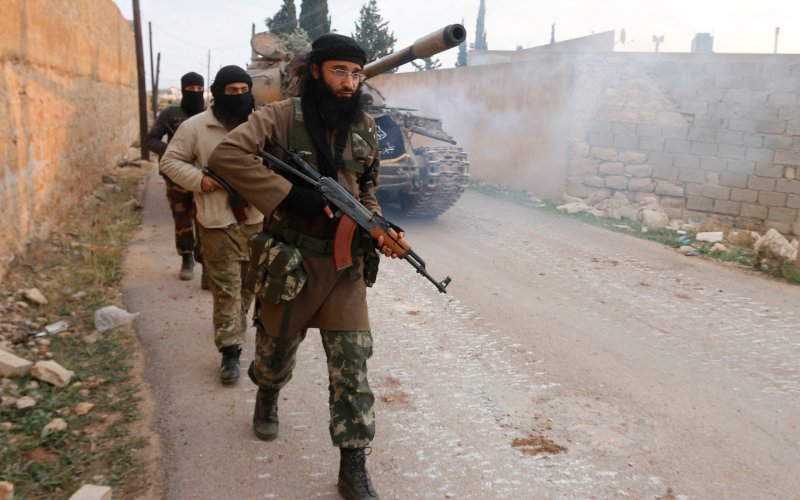
1421322880562.cachedHosam Katan/Reuters

American jets are pounding Syria. But ISIS is taking key terrain—and putting more and more people under its black banners.

ISIS continues to gain substantial ground in Syria, despite nearly 800 airstrikes in the American-led campaign to break its grip there.At least one-third of the country’s territory is now under ISIS influence, with recent gains in rural areas that can serve as a conduit to major cities that the so-called Islamic State hopes to eventually claim as part of its caliphate. Meanwhile, the Islamic extremist group does not appear to have suffered any major ground losses since the strikes began. The result is a net ground gain for ISIS, according to information compiled by two groups with on-the-ground sources.In Syria, ISIS “has not any lost any key terrain,” Jennifer Cafarella, a fellow at the Washington, D.C.-based Institute for the Study of War who studies the Syrian conflict, explained to The Daily Beast.Even U.S. military officials privately conceded to The Daily Beast that ISIS has gained ground in some areas, even as the Pentagon claims its seized territory elsewhere, largely around the northern city of Kobani. That’s been the focus of the U.S.-led campaign, and ISIS has not been able to take the town, despite its best efforts.Other than that, they are short on specifics.

1421269431538.cachedClick to Enlarge (Coalition For a Democratic Syria)

“Yes, they have gained some ground. But we have stopped their momentum,” one Pentagon official told The Daily Beast.

A map developed by the Coalition for a Democratic Syria (CDS), a Syrian-American opposition umbrella group, shows that ISIS has nearly doubled the amount of territory it controls since airstrikes began last year.

“Assessing the map, ISIS has almost doubled its territorial control in Syria. But more importantly, the number of people who now live under ISIS control has also increased substantially,” CDS political adviser Mouaz Moustafa said.

With the fall of that much territory into ISIS hands, Syrians who once lived in ungoverned or rebel held areas are now under ISIS’s grip. Of course, in an irregular war like this one, control of people is far more important than control of territory. In that regard, too, things appear to be going in the wrong direction.

In the first two months following American airstrikes, about a million Syrians who had previously lived in areas controlled by moderates now lived in areas controlled by extremist groups al Nusra or ISIS, according to CDS, citing conversations with European diplomats who support the Syrian opposition.

The area of ISIS’s expansion includes large segments of the Homs Desert, which begins far south of the contested northern city of Aleppo. It stretches below the presumed capital of ISIS in Syria, Raqqa, and all the way to the Iraqi border. It is largely rural and not an area that ISIS has had to fight for. Rather the group took control of uncontested parts of the countryside while skirting key regime strongholds in the area, Cafarella said.

But that does not mean that land is not valuable to ISIS. That newly acquired terrain allows ISIS troops to target and threaten more valuable areas, Cafarella said.

Since the U.S. campaign began in August, “there are little buds of ISIS control in eastern Homs, al Qalamoun [which borders northern Lebanon], and southern Damascus that do appear to be growing because of that freedom of operation that can connect those western cells to key ISIS terrains in Raqqa and Deir ez Zour” in northern and eastern Syria.

Moustafa, the CDS political adviser, blamed ISIS territorial gains on a lack of “strategic coordination between coalition strikes and moderate forces inside Syria, meaning that the Free Syrian Army and aligned groups cannot use the strikes to retake territory.” Further, Moustafa told The Daily Beast, coalition strikes have given other extremist groups sympathy for ISIS.

One frustration of the Syrian opposition groups is that the bombing campaign has been focused at the heart of ISIS controlled territory, rather than at the front lines, where ISIS territorial gains could be pushed back.

“The coalition strikes seem similar to drone campaigns in Yemen or Pakistan, targeting only leadership. The front-line strength of ISIS has undoubtedly increased even as some of these targeted strikes take out mid-level individual leaders,” Moustafa said.

As of Sunday, the U.S. and its coalition partners had conducted 790 airstrikes in Syria, according to Pentagon statistics. In all, the U.S. has spent $1.2 billion on its campaign against ISIS in Iraq and Syria.

In its public comments, the U.S. military has said repeatedly the effort against ISIS is on the right track. However it often does this by conflating its war in Iraq and Syria. Ask a question about what is happening in Syria, and U.S. officials will stress that ISIS has not gained ground in Iraq. Ask if the U.S. effort is working in Syria, and the military often points to the fact that ISIS has failed to take control of Kobani.

During a Jan. 6 press briefing, for example, when a reporter asked “where ISIS’s relative strength is right now,” Navy Rear Adm. John Kirby replied by talking exclusively about the U.S. effort in Iraq, naming cities were the military believed ISIS’s momentum has been “halted.”

When the reporter pressed for an answer on what was happening in Syria, Kirby struggled, saying, “I couldn’t give you a—a specific point at which, you know, we believe, well geez, we’ve halted their momentum. It—it’s come slowly, in various stages. But I think it’s safe to say that over the last three to four weeks, we—we’ve been confident that that momentum has largely been blunted.”

On Friday, Kirby proclaimed that ISIS had lost 700 square kilometers since the campaign began—over half the size of New York City or about four times the size of the District of Columbia. But the Pentagon spokesman could not say what percentage that area marked of total ISIS-controlled land. Nor could he say if that loss was in Iraq, Syria, or combined in both nations. As Kirby asserted: “I’m frankly not sure how relevant that is. I mean, it’s—they have less ground now than they did before. They’re trying to defend what ground that they have. They’re not going on the offense much, and they’re really trying to preserve their own oxygen.”
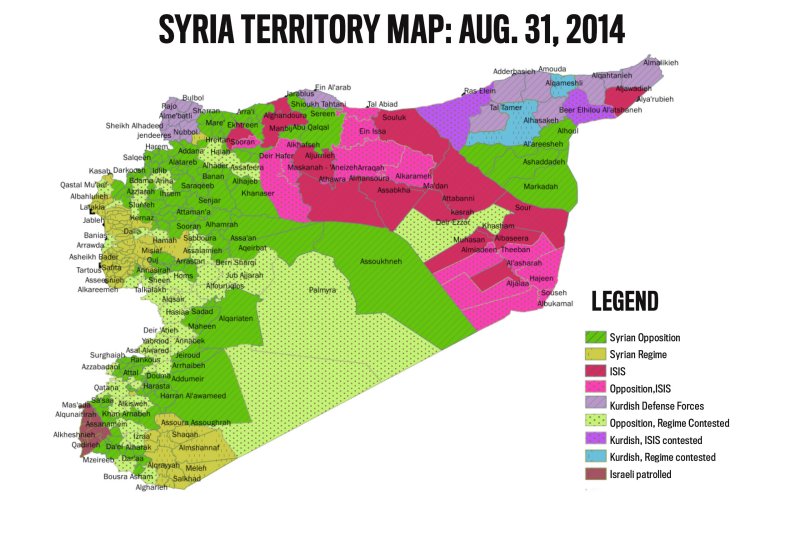
1421269455425.cachedClick to Enlarge (Coalition For a Democratic Syria)

The American military has not been able to take full advantage of the difficulties ISIS is facing. A worldwide drop in oil prices threatens the recently declared state’s ability to raise revenue, while declining standards in public services, distribution of aid, and provision of electricity threaten to undercut the group’s support across the territories it controls. ISIS has also not been able to follow through on its military quest to challenge the Iraqi government all the way to Baghdad.

The U.S. military stressed it is waging an “Iraq first” war, that is focused on eliminating ISIS from that country first. There, the U.S. can turn to Iraqi troops on the ground to assess its efforts. But there is no equivalent resource on the ground in Syria. Perhaps because of that, the U.S. military has offered a far more detailed assessment of the air campaign in Iraq than the one in Syria.

The Combined Joint Task Force in charge of the American air campaign refused to answer a Daily Beast query about ISIS gains in Syria, even as it striking targets there. U.S. Central Command replied, “As a matter of policy we do not discuss intelligence issues.”

Information on the maps:

The maps provided by the Coalition for a Democratic Syria show the areas controlled by moderate Syrian rebels, the Syrian regime, ISIS, Syrian al Qaeda affiliate al Nusra, as well as territories contested by these groups. The maps were developed by a field team from the Coalition for a Democratic Syria (CDS), an umbrella group of Syrian American organizations. The maps were sourced through on-the-ground networks including civilian councils, humanitarian organizations, armed actors, and media monitoring of independent Syrian channels.
Saudi Government Daily: U.S. Secretly Cooperating With Iran At Arabs’ Expense

December 15, 2014

Saudi Government Daily: U.S. Secretly Cooperating With Iran At Arabs’ Expense, MEMRI, December 14, 2014

(Fact, fiction or a mix of both? — DM)

Yousuf Al-Kuwailit, who writes the editorials of the Saudi government daily Al-Rai, opined in a December 7, 2014 editorial that, despite the tension that has ostensibly prevailed between the U.S. and Iran ever since the Islamic Revolution, in practice there is secret cooperation between them. As part of this cooperation, he said, Iraq has become nothing but an arena for assuring the interests of these two countries, and Iran has been granted freedom of action in Syria and Lebanon.

Referring to the U.S.-Iran nuclear talks, he said they were a farce that would end in contracts and deals, and perhaps even an alliance, between the two countries. He therefore called on the Arabs not to regard the U.S. as a reliable ally, and warned that the U.S. may force the Gulf states to reconcile with Iran, to the detriment of their interests.

The following are excerpts from the article: [1]

21428Yousuf Al-Kuwailit

“The U.S. appointed the Shah as policeman of the Arab Gulf, turned Iran into a base for conflict with the USSR, and provided Iran with up-to-date weaponry and a nuclear reactor. [Iran, for its part] attempted to take advantage of this situation, as it saw itself as a superpower. [Only] the strength of the USSR… prevented Iran from undertaking military adventures outside its own borders. With [the rise to power of Ayatollah Ruhollah] Khomeini, despite everything that happened at the U.S. Embassy [in Tehran in 1980], when dozens of its staffers were taken hostage and [then-U.S. president Jimmy] Carter carried out a reckless and unsuccessful operation [in attempt to free them]… [despite all this] nothing spoiled the U.S.’s relationship with this country, which it considers one of its strategic and economic outposts by virtue of its location and its history. So the farce… about Iran’s nuclear reactors and non-conventional weapons has taken a clear and final direction, in the form of several deals [between the two countries]…

“Cyrus [the Great],[2] who attacked and destroyed the Arabs, is the spiritual father of the Nazi trend that has characterized Iran’s governments, whether secular or religious. Racial supremacism vis-à-vis the Arabs is a popular [Iranian] obsession. It exists and it is eternal, and even if the mullahs don black turbans [indicating that they are] descendants of the Prophet and have Arab roots, they do not really recognize these roots, but do this only in order to market their national policy to us, prior to marketing their religious school of thought [i.e. the Shi’a]. Anyone who thinks that diplomatic arrangements are aimed at anchoring coexistence between the Arabs and the Iranian ‘Aryans’ is disregarding the nature of the historical reasons [for the tension between the two sides] and its deep roots in the [Iranian] public mentality.

“In order to better understand the unfolding of events, [we need to realize that]  the U.S. and its allies set out the initial plan to divide the Arab [regions] a long time ago, and that the Sikes-Picot agreement is only the first outcome [of that plan]. [We must also realize] that handing over Iraq [to Iran], and annexing Syria and later Lebanon to it, and the [silent] agreement [between the two countries] that Iran would have a free hand in these countries – all these  are only a prelude to  more dangerous activity.

“[Accordingly], relying on the U.S. or thinking it a reliable ally without properly understanding the strategic changes and aims, place us in a situation [of self-delusion], because all the historic elements of power see how positions and policies change but interests remain. This principle will be ultimately applied to all the countries that have a relationship with the U.S., whether economic or strategic, because the Arabs are part of a geographic area whose borders are changing, including through the disappearance of the centrally[-ruled] state in favor of states [based on] sect or nationality.

“One simple event in recent days is the Iranian Air Force’s incursion into Iraq to attack ISIS positions, which the U.S. confirmed but Iran denied. At the same time, the U.S. also ignores the incursion of [Iranian] ground troops under the command of [IRGC Qods Forces commander] Qassem Soleymani into Iraq, [which has been taking place] ever since the U.S. first started managing [Iraq’s] affairs… [In fact,] U.S. Secretary of State John Kerry stated that any Iranian military attack on ISIS was positive. This exposes the significant coordination between the two countries, and belies the statements of U.S. military circles denying any cooperation or coordination [with Iran] in the war on ISIS…

“In the era of [former Iraqi prime minister Nouri] Al-Maliki, Iraq become nothing but an arena for assuring the interests of two players: Iran and the U.S. This came about as part of an agreement that began with [head of the occupational authority of Iraq after the 2003 invasion Paul] Bremer, and no Iraqi government will put an end to it, unless the Iraqis [dare to] oppose their homeland’s dependence on another country – something that is difficult and complicated to do.

“Ultimately, even if the talk about the American-Iranian hostility is true, everything points towards new contracts between the two which are likely to turn into alliance. We could possibly see catastrophic days if the U.S. forces the Gulf states to reconcile with Iran, which will end in a way that will not serve our interests. This is an outcome that should not surprise us, if the reality of [U.S.-Gulf] friendship evolves into [U.S.] dictates [to the Gulf states].”


Endnotes:

[1] Al-Riyadh  (Saudi Arabia), December 7, 2014.

[2] Cyrus the Great founded the Achaemenid Empire, circa 600 BCE.

The new Ottoman emperor

December 3, 2014

The new Ottoman emperor, Israel Hayom, Clifford D. May, December 3, 2014

[T]here is mounting evidence that weapons and fighters are crossing from Turkey into Syria, where they are delivered to Islamic State fighters. Turkish officials are turning a blind eye, or maybe even facilitating the traffic. Stolen oil is moving in the other direction, sold to raise cash for Islamic State. Inside Turkey, as well, Schanzer and Tahiroglu write, Islamic State has “established cells for recruiting militants and other logistical operations.” Last weekend, Turkey’s main Kurdish party accused the Erdogan government of allowing Islamic State fighters to attack the Syrian Kurdish town of Kobani from within Turkey.

******************

Turkey should have been part of the solution. Instead it has become part of the problem. The problem, of course, is the spread of jihadism throughout the Middle East, North Africa and beyond.

Turkish policies have been aiding and abetting the Nusra Front, an al-Qaida affiliate; the Islamic State group, which has turned large swaths of Syria and Iraq into killing fields; the Islamic Republic of Iran, still ranked by the U.S. government as the world’s leading sponsor of terrorism and well on its way to becoming nuclear-armed; and the Muslim Brotherhood, including Hamas, the group’s Palestinian branch.

Troubling, too, is the rhetoric we’ve been hearing from Turkish leaders. Turkish Science, Industry and Technology Minister Fikri Isık claimed last week that it was Muslim scientists who first discovered that the earth is round. Two weeks earlier, Turkish President Recep Tayyip Erdogan insisted that Muslim sailors reached the Americas 300 years before Columbus — only to find that well-established Muslims in Cuba had built a beautiful mosque.

Such myth-making might be dismissed as nothing more than attempts to play to Islamic pride. Less easy to excuse is Erdogan’s increasing xenophobia. “Foreigners,” he recently observed, “love oil, gold, diamonds, and the cheap labor force of the Islamic world. They like the conflicts, fights and quarrels of the Middle East.” He added that Westerners “look like friends, but they want us dead, they like seeing our children die. How long will we stand that fact?”

If Turkey were just another tin-pot dictatorship, none of this would much matter. But Turkey is a Muslim-majority (98 percent) republic with a dynamic economy (not dependent on the extraction of petroleum), a member of NATO (making it, officially, an American ally), and a candidate for membership in the European Union (though that possibility now appears remote).

Just three years ago, U.S. President Barack Obama listed Erdogan as one of five world leaders with whom he had especially close personal ties. He regarded the Turkish leader as a moderate, his interpreter of — and bridge to — the tumultuous and confusing Islamic world.

Today, as detailed in a new report by Jonathan Schanzer and Merve Tahiroglu, my colleagues at the Foundation for Defense of Democracies, Erdogan is refusing to allow the American-led coalition formed in August to launch strikes against Islamic State from Turkish soil.

Worse, there is mounting evidence that weapons and fighters are crossing from Turkey into Syria, where they are delivered to Islamic State fighters. Turkish officials are turning a blind eye, or maybe even facilitating the traffic. Stolen oil is moving in the other direction, sold to raise cash for Islamic State. Inside Turkey, as well, Schanzer and Tahiroglu write, Islamic State has “established cells for recruiting militants and other logistical operations.” Last weekend, Turkey’s main Kurdish party accused the Erdogan government of allowing Islamic State fighters to attack the Syrian Kurdish town of Kobani from within Turkey.

The FDD report cites numerous sources alleging that Turkey also has given assistance to the Nusra Front. To be fair: The Turkish government, like the Obama administration, seeks the fall of Syrian dictator Bashar Assad, satrap of the Islamic Republic of Iran. A Turkish official is quoted as saying that Nusra fighters are essential to that effort, adding: “After Assad is gone, we know how to deal with these extremist groups.”

Do they? Hamas is an extremist group and one of its top leaders, Saleh al-Arouri, has been permitted to set up his headquarters in Turkey. In August, Israel’s Shin Bet security agency said it had thwarted a Hamas-led plot to topple Palestinian Authority President Mahmoud Abbas — and that Arouri was behind it. Arouri also claimed responsibility — in the presence of Turkey’s deputy prime minister — for the kidnapping and murder of three Israeli boys in the West Bank early last summer, an act of terrorism that led to the 50-day war between Israel and Hamas in Gaza.

There’s more: credible allegations that Turkey has helped Iran’s rulers evade sanctions; the fact that Turkey imprisons more journalists than any other country; Erdogan’s comparison of Israelis to Nazis (guess which he regards as more “barbaric”); and his pledge to “wipe out Twitter. I don’t care what the international community says. They will see the Turkish republic’s strength.”

To understand what Turkey has become, it helps to know a little about what Turkey used to be. Istanbul was once Constantinople, a Christian capital of the ancient world. In 1453, it fell to the fierce armies of the Ottoman Empire and the Islamic caliphate. Islam’s political and religious leaders soon established the Sublime Porte, the central government of their growing imperial realm.

Almost 500 years later, in the aftermath of World War I, the empire collapsed and the caliphate was dissolved. Modern Turkey arose from the ashes thanks to the leadership of Mustafa Kamal Ataturk, a visionary general who believed that progress and prosperity could be achieved only by separating mosque and state. His goal was to make Turkey a nation, one as modern and powerful as any in Europe.

A century later, the world looks rather different. There are good reasons to believe Europe is in decline and America in retreat (these are disparate phenomena). While it may be delusional to believe that Columbus encountered Muslims in the Caribbean, it is not crazy to believe that, over the decades ahead, fierce Muslim warriors will profoundly alter the world order once more.

Viewed in this light, Erdogan looks like a neo-Ottoman, one who dreams of commanding Muslims — and those who have submitted to them — in many lands. If that’s accurate, the rift between Turkey and the West can only widen.

US-led warplanes cut through to ISIS targets in Syria & Iraq over Israel

December 2, 2014

US-led warplanes cut through to ISIS targets in Syria & Iraq over Israel, DEBKAfile, December 2, 2014

Flights over Israel

All US and European coalition strike and surveillance flights against ISIS forces in Syria and Iraq under Operation Inherent Resolve have been reaching their targets through the skies of Israel and Jordan, US, European and civilian monitors of global air force movements report. The bodies engaged in minute-by-minute observations of the movements of military strike and refueling craft across the world have released detailed images mapping those routes. They reveal that US and European warplanes are refueling at two points over the Mediterranean Sea before entering Israeli airspace.

They are using two corridors (see attached map) which run over central and northern Israel.

In the first, US planes reach high altitudes over an area just north of Tel Aviv and head east to pass over Jordan to reach Iraq. They are focusing of late on striking ISIS-Al Qaeda-occupied sites in the Anbar Province of western Iraq and the Euphrates basin.

The Islamists have taken to hiding newly established bases in the dense river bank vegetation, from where they are almost impossible to detect by military and spy satellites.

The second US air corridor runs over Haifa Bay, then east over the Jezreel Valley and thence to Hama at the southern tip of the Golan, where the Israeli, Jordanian and Syrian borders converge. The next lap takes the assault fleet into eastern Syria to strike ISIS forces at Abu Kemal and Deir A-Zor and other locations on Syria’s eastern border with Iraq.

The US air force turned to the Israeli route to Syria after Jordan’s King Abdullah declined to provide access over his realm to coalition warplanes bent on striking jihadist targets in Syria. He only permitted them to fly over his kingdom to Iraq, with permission from Baghdad.

Neither Washington, Jerusalem nor Amman are willing to confirm or deny that these trajectories are being used for reaching ISIS targets in Syria and Iraq – although several military websites have made such data public with detailed maps.

The US and Israel have opted for reticence out of three considerations:

1. Reluctance to reveal that Israel and Jordan are partners in Operation Inherent Resolve;

2. Equally embarrassing would be the disclosure that the use of their air space was subject to the permission of the Israeli and Jordanian governments;

3. The scale of the operation also needs to be kept under wraps: US air strikes are managed from three commands: US Central Command in Tampa, Florida; its forward command at the US Al Udeid Air Base in Qatar; and NATO Headquarters in Brussels, which coordinates US and European air operations with the Middle East air forces taking part in the mission against ISIS.

DEBKAfile’s military sources note that, notwithstanding the broad scale of the coalition air offensive against ISIS, to which 20 countries are contributing more than 200 aircraft, its achievements are unimpressive to say the least.

Although official communiqués refer to scores of air strikes (55 at the end of last week), less than 10 strikes per day are actually taking place. This is far below the intensity required for re-tilting the military balance against the Islamists.

The only noteworthy gain to come out of this grand offensive is the decision taken by ISIS leader Abu Bakr Al-Baghdad to draw a line against expanding his territorial conquests in Syria and Iraq in order to save his organization from further losses from US and allied air strikes. He has determined to focus now on stabilizing and shoring up his gains. ISIS has thus shifted from a strategy of expansion to one of defense.


