Archive for the ‘China and North Korea’ category

UN Passes Mega-Ultra Toughest-Ever North Korea Sanctions, Again

September 12, 2017

UN Passes Mega-Ultra Toughest-Ever North Korea Sanctions, Again, PJ MediaClaudia Rosett, September 12, 2017

(Eliminating Kim Kimchi Jong-un is not a viable solution. China won’t permit regime change and, if China did, there is no reason to assume that Kim’s replacement would be an improvement. Please see also, UN Security Council passes new sanctions against North Korea. Frank Gaffney offers some good ideas and they don’t involve more useless sanctions. — DM)
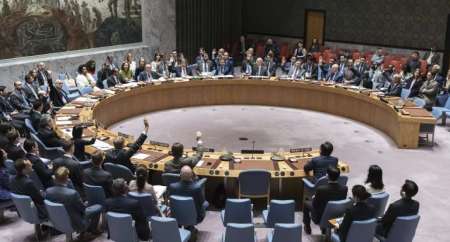
The fifteen members of the Security Council are seen voting in favor of the new sanctions at a United Nations Security Council meeting regarding nuclear non-proliferation in light of the September 3rd test explosion of a missile-capable nuclear bomb by the Democratic Peoples’ Republic Of Korea (DPRK), at UN Headquarters in New York, NY, USA on September 11, 2017. At the meeting, Council members voted upon a draft Resolution calling for increased economic sanctions against the DPRK. Resolution 2375 was unanimously adopted by the 15 members of the Council. (Photo by Albin Lohr-Jones)(Sipa via AP Images)

Unless the real mission behind these sanctions is to help achieve the only real remedy — which is to take down the Pyongyang regime (not bargain with it) — then beware.
***************************

Yet again, the United Nations Security Council has voted unanimously for a resolution imposing the toughest-ever sanctions on North Korea. This round, responding to North Korea’s test of what Pyongyang claimed was a hydrogen bomb, goes by the label of Resolution 2375, and marks the ninth time over the past 11 years that the UN Security Council — voting unanimously — has approved new sanctions in response to North Korean nuclear and missile tests.

Each round has been tougher than the last. In March, 2016 for instance, following North Korea’s fourth nuclear test, the UN passed Resolution 2270, which former Ambassador Samantha Power described as “so much tougher than any prior North Korea resolution.” Less than nine months later, following North Korea’s fifth nuclear test, came UN Resolution 2321, hailed by CNN as “Toughest UN sanctions yet… .”

You get the idea. This parade of tough-tougher-toughest and tougher-than-toughest UN sanctions has been going on since the UN Security Council in 2006, following North Korea’s first nuclear test, unanimously approved Resolution 1718, imposing sanctions that President Bush described at the time as “swift and tough.”

I’m all in favor of being ultra-tough on North Korea (make that mega-ultra-jumbo-tough, even better). This latest round aims to constrict North Korea’s oil supply, ban its textile imports, curtail its smuggling and end its revenues from joint ventures and laborers working abroad. That’s on top of the web of previous strictures.

But by now one might begin to suspect that sanctions, however tough, are not going to stop Kim Jong Un’s nuclear missile program. It’s a bad sign that these UN resolutions, which routinely begin by listing the relevant previous resolutions, have now achieved a degree of layering that resembles portions of such monstrosities as the Affordable Care Act. The UN has not yet posted the full text of this latest resolution, #2375. But a reasonable proxy can be found in the prior resolution, passed on August 5. Just add one more layer:

“Recalling its previous relevant resolutions, including resolution 825 (1993), resolution 1540 (2004), resolution 1695 (2006), resolution 1718 (2006), resolution 1874 (2009), resolution 1887 (2009), resolution 2087 (2013), resolution 2094 (2013), resolution 2270 (2016), resolution 2321 (2016), and resolution 2356 (2017), as well as the statements of its President of 6 October 2006 (S/PRST/2006/41), 13 April 2009 (S/PRST/2009/7) and 16 April 2012 (S/PRST/2012/13),”

There are two basic problems here.

The first problem is that sanctions are not an airtight proposition. They are more like a sieve than an impermeable barrier. They leak. They erode. For sanctions violators, part of the game is to set up new fronts and devise new deceptions; part is to wait until the immediate crisis passes, and enforcement starts to flag. North Korea has long experience at evading and adapting to sanctions. So do its chief patrons, Russia and China. So does its partner-in-proliferation, Iran, and Iran’s mascot, Syria.

And whatever the reach and coercive financial power of the mighty U.S., it has not sufficed to date to persuade scores of UN member states to comply with the list of sanctions above. The UN fields a Panel of Experts on North Korea sanctions who have been turning in terrific, regular and hefty reports on compliance — or lack of compliance — by UN member states.

Three years ago, in their 2014 report, these experts noted that the problem was not lack of sanctions measures, but lack of compliance:

“At the present time, the Panel does not see new measures as necessary in order to further slow the prohibited programmes of the Democratic People’s Republic of Korea, to dissuade it from engaging in proliferation activities or to halt its trade in arms and related materiel. Rather, the Panel believes that Member States already have at their disposal adequate tools.”

The UN requires its member states to submit “implementation reports” on how they plan to comply with UN sanctions. Out of the UN’s 193 member states, scores of countries simply don’t do it. Just last week, in an interim report dated Sept. 5, the UN Panel of Experts noted that for the two sanctions resolutions passed last year, the number of non-reporting states remains “significant” — as in, roughly half the UN membership.

Of course, even when countries do submit their implementation reports, that’s no guarantee that North Korea will be deprived of goods for its proliferation programs. For instance, while China has dutifully been filing the required reports to the UN, the Panel of Experts, in their Sept. 5 report, mentioned that North Korea’s military parade this past April included missiles transported on three-axle trucks that had a Chinese manufacturer’s logo on the fuel tank.

In response to the Panel, Chinese authorities provided an array of comments. They posited that such trucks, exported from 2010-2014, were “not under embargo of the Security Council.” They said the exporter and manufacturer of the trucks could not be identified, due to lack of “Vehicle Identification Number and other relevant information.” And they noted that the sales contract “requested explicitly ‘the buyer to ensure the civilian use of the trucks and comply with concerned provisions of Chinese laws and Security Council resolutions.’ “

Ummm…is that supposed to be reassuring?

For North Korea, yet more sanctions might indeed raise the cost of provisioning its nuclear missile program, and shrink the resources available — at least until the regime finds new ways to adapt. But North Korea’s regime has an unswerving record of placing its military and weapons programs above the needs of North Korea’s people. It’s highly unlikely that UN Security Council Resolution 2375 will persuade Kim to abjure ICBMs and hydrogen bombs, in favor of allocating resources to cold and hungry North Koreans.

Which brings us to the second big problem with these UN resolutions. They all aim, quite explicitly, to bring North Korea back to the bargaining table. This is an idea all too prevalent in Washington as well. In testimony on North Korea to the Senate Banking Committee last week, former Acting Secretary of the Treasury Adam Szubin summed it up, saying that sanctions “are meant to incentivize behavioral change.”

Dream on. If North Korea’s regime does come to the bargaining table, that might look like a change in behavior. But everything in the record by now should be telling us that North Korea won’t be coming to relinquish its nuclear missile program. It will be coming to cash in, again, on the illusions of American diplomats. It will be coming to cash in, yet again, on the blinkered expertise of a host of former U.S. officials now treated as sages of North Korea policy because they were intimately involved in nuclear deals… that failed.

Those bargains, and attempted bargains, stretching back to 1994, helped pave the way to the current crisis of nuclear bombs and intercontinental ballistic missiles in the hands of a totalitarian North Korean regime that threatens and mocks the U.S., aspires to subjugate South Korea, is pushing East Asia toward a nuclear arms race, and doubles as a rogue munitions merchant to the world’s worst predators.

On paper, Resolution 2375 might sound like a formula for success, or at least a good move in that direction. Slather more sanctions — the toughest yet! — on North Korea, and hope it leads to a deal. There will now be a new round of Washington conferences, and Op-eds, and reports, and testimony, dissecting and embellishing on the latest sanctions and, when these toughest-ever sanctions turn out to be inadequate to stop Kim’s nuclear projects, recommending yet more sanctions. In Washington, it’s become an industry unto itself — expanding in tandem in tandem with North Korea’s flourishing nuclear program.

Unless the real mission behind these sanctions is to help achieve the only real remedy — which is to take down the Pyongyang regime (not bargain with it) — then beware.
 

UN Security Council passes new sanctions against North Korea

September 12, 2017

UN Security Council passes new sanctions against North Korea, Fox Business News via YouTube, September 11, 2017

As noted in the blurb beneath the video,

Lt. Col. Michael Waltz (Ret.) and Center for Security Policy President Frank Gaffney on the U.N. implementing new sanctions against North Korea.

Fat Kim threatens Trump (again)

September 5, 2017

Fat Kim threatens Trump (again), American ThinkerGary Gindler, September 5, 2017

(This is the most fascinating, and best, suggestion on dealing with North Korean nukes I have read thus far –  force China to take care of the problem. Please see also, Chinese Official Says China Might Invade Taiwan If “Peaceful Reunification Takes Too Long.” — DM)

It’s time for Trump to make an unconventional move – a move no one expects.

It is better not to increase the U.S. military potential in the region.  On the contrary, it is better to completely withdraw all American troops from both South Korea and Japan.

In fact, American troops need to be relocated not into the continental U.S., but to Taiwan.

This move by Trump will make China stop playing the role of an outside observer.  China will be faced with a choice – either China joins Trump on this issue, or she will never get back Taiwan, where the headquarters of the 7th U.S. Navy Fleet will now be located.

Of course, America’s allies in the region, Japan and South Korea, in the face of the withdrawal of U.S. troops, will quite justifiably demand new guarantees of protection from the U.S. government.  America should renew its lend-lease program from the Second World War and lease over to Japan and South Korea, for a term of 99 years, all the nuclear weapons they will ask for.  The military budgets of these countries will skyrocket.  China’s inaction toward the Fat Kim regime will lead to the fact that in addition, China will get two unfriendly nuclear powers armed to the teeth at her own border.

***********************

After Kim Jong-un tested his hydrogen bomb, everything in the world went just as we could expect.  Someone started saber-rattling, and someone insisted that the problem of nuclear North Korea cannot be solved by military means under any circumstances.

Both use very serious arguments.  Those who support appeasement of Kim quite reasonably note that the capital of South Korea, with its 25 million-strong population, is at an artillery salvo distance from the border with North Korea.  Even a limited volley from the north will lead to hundreds of thousands of civilian casualties.  Supporters of a massive blow to North Korea argue that it is better to have thousands of casualties among Koreans than to wait until the hydrogen bomb explodes over San Francisco and Americans become the victims.

Both sides have numerous supporters in the highest echelons of power in Washington.

Meanwhile, Fat Kim does not present a threat to the United States at present.  Fat Kim is a threat to President Trump.

Fat Kim is not a dumb bump.  He’s just one of the players in the next political show of the Axis countries.  The North Korean crisis allows others hostile to America – countries such as Iran, Russia, and Syria (i.e., Axis countries) – to check Trump’s resolve.  China is not a member of this Axis, but it watches Trump with great pleasure as he tries to get out of this entrapment.

All the Axis countries are linked by longstanding nuclear technology ties.  Of all the Axis countries, only Syria lacks this technology (the Syrian nuclear reactor, which was built by North Korean engineers, was bombed by Israel in 2007).

The Axis countries are waiting for Trump’s move.  A standard geopolitical analysis shows that there are many options for Trump, but they all range from bad to very bad.

It’s time for Trump to make an unconventional move – a move no one expects.

It is better not to increase the U.S. military potential in the region.  On the contrary, it is better to completely withdraw all American troops from both South Korea and Japan.

In fact, American troops need to be relocated not into the continental U.S., but to Taiwan.

This move by Trump will make China stop playing the role of an outside observer.  China will be faced with a choice – either China joins Trump on this issue, or she will never get back Taiwan, where the headquarters of the 7th U.S. Navy Fleet will now be located.

Of course, America’s allies in the region, Japan and South Korea, in the face of the withdrawal of U.S. troops, will quite justifiably demand new guarantees of protection from the U.S. government.  America should renew its lend-lease program from the Second World War and lease over to Japan and South Korea, for a term of 99 years, all the nuclear weapons they will ask for.  The military budgets of these countries will skyrocket.  China’s inaction toward the Fat Kim regime will lead to the fact that in addition, China will get two unfriendly nuclear powers armed to the teeth at her own border.

If Trump adds to this the ban on trade with all countries that have trade relations with North Korea, then China, with four fifths of its economy dependent on the U.S. market, will suffer the most.

There is every reason to believe that China will make a reasonable choice.  Most likely, she will do this much earlier than the first transport from Japan with the U.S. Marine Corps docks in Taipei.  It is unreasonable to assume that China does not have a well conceived plan for rapid regime change in North Korea.

If wisdom escapes the Chinese communists, then as the icing on the cake, they will get a united Korea at their side.  Capitalistic.  And nuclear.


North Korea’s Ultimatum to America

September 5, 2017

North Korea’s Ultimatum to America, Front Page MagazineCaroline Glick, September 5, 2017

(We should strike North Korea and eliminate it as a nuclear threat. We have first-strike capability which, if used can eliminate the danger to South Korea and Japan as well as to America. Perhaps we should wait — but not long — until North Korea “tests” a missile directed toward Guam. Then we should act immediately and without warning. We can even do it successfully without using our own nukes. On the other hand, we have a new option. Please see also, How to neutralize the North Korea threat. It might, or might not, work. If it works as advertised, great. If it fails, we will have lost very little. –DM)

Originally published by the Jerusalem Post

If the US strikes North Korea in a credible manner and successfully diminishes its capacity to physically threaten the US, America will have taken the first step towards rebuilding its alliances in Asia.

On the other hand, if the current round of hostilities does not end with a significant reduction of North Korea’s offensive capabilities, either against the US or its allies, then the US will be hard pressed to maintain its posture as a Pacific power. So long as Pyongyang has the ability to directly threaten the US and its allies, US strategic credibility in East Asia will be shattered.

***********************************

The nuclear confrontation between the US and North Korea entered a critical phase Sunday with North Korea’s conduct of an underground test of a thermonuclear bomb.

If the previous round of this confrontation earlier this summer revolved around Pyongyang’s threat to attack the US territory of Guam, Sunday’s test, together with North Korea’s recent tests of intercontinental ballistic missiles capable of reaching the continental US, was a direct threat to US cities.

In other words, the current confrontation isn’t about US superpower status in Asia, and the credibility of US deterrence or the capabilities of US military forces in the Pacific. The confrontation is now about the US’s ability to protect the lives of its citizens.

The distinction tells us a number of important things. All of them are alarming.

First, because this is about the lives of Americans, rather than allied populations like Japan and South Korea, the US cannot be diffident in its response to North Korea’s provocation. While attenuated during the Obama administration, the US’s position has always been that US military forces alone are responsible for guaranteeing the collective security of the American people.

Pyongyang is now directly threatening that security with hydrogen bombs. So if the Trump administration punts North Korea’s direct threat to attack US population centers with nuclear weapons to the UN Security Council, it will communicate profound weakness to its allies and adversaries alike.

Obviously, this limits the options that the Trump administration has. But it also clarifies the challenge it faces.

The second implication of North Korea’s test of their plutonium-based bomb is that the US’s security guarantees, which form the basis of its global power and its alliance system are on the verge of becoming completely discredited.

In an interview Sunday with Fox News’s Trish Regan, former US ambassador to the UN John Bolton was asked about the possible repercussions of a US military assault against North Korea for the security of South Korea.

Regan asked, “What are we risking though if we say we’re going to go in with strategic military strength?… Are we going to end up with so many people’s lives gone in South Korea, in Seoul because we make that move?” Bolton responded with brutal honesty.

“Let me ask you this: how do you feel about dead Americans?” In other words, Bolton said that under prevailing conditions, the US faces the painful choice between imperiling its own citizens and imperiling the citizens of an allied nation. And things will only get worse. Bolton warned that if North Korea’s nuclear threat is left unaddressed, US options will only become more problematic and limited in the years to come.

This then brings us to the third lesson of the current round of confrontation between the US and North Korea.

If you appease an enemy on behalf of an ally then you aren’t an ally.

And eventually your alliance become empty of all meaning.

For 25 years, three successive US administrations opted to turn a blind eye to North Korea’s nuclear program in large part out of concern for South Korea.

Presidents Bill Clinton, George W. Bush and Barack Obama all sought to appease North Korea’s aggressive nuclear adventurism because they didn’t believe they had a credible military option to deal with it.

In the 1980s, North Korea developed and deployed a conventional arsenal of bombs and artillery along the demilitarized zone capable of vaporizing Seoul.

Any US military strike against North Korea’s nuclear installation it was and continues to be argued, would cause the destruction of Seoul and the murder of millions of South Koreans.

So US efforts to appease Pyongyang on behalf of Seoul emptied the US-South Korean alliance of meaning. The US can only serve as the protector of its allies, and so assert its great power status in the Pacific and worldwide, if it prevents its allies from being held hostage by its enemies.

And now, not only does the US lack a clear means of defending South Korea, and Japan, America itself is threatened by the criminal regime it demurred from effectively confronting.

Regardless of the means US President Donald Trump decides to use to respond to North Korea’s provocative actions and threats to America’s national security, given the nature of the situation, it is clear that the balance of forces on the ground cannot and will not remain as they have been.

If the US strikes North Korea in a credible manner and successfully diminishes its capacity to physically threaten the US, America will have taken the first step towards rebuilding its alliances in Asia.

On the other hand, if the current round of hostilities does not end with a significant reduction of North Korea’s offensive capabilities, either against the US or its allies, then the US will be hard pressed to maintain its posture as a Pacific power. So long as Pyongyang has the ability to directly threaten the US and its allies, US strategic credibility in East Asia will be shattered.

This then brings us to China.

China has been the main beneficiary of North Korea’s conventional and nuclear aggression and brinksmanship.

This state of affairs was laid bare in a critical way last month.

In mid-August, Trump’s then chief strategist Steve Bannon was preparing a speech Trump was set to deliver that would have effectively declared a trade war against China in retaliation for its predatory trade practices against US companies and technology. The speech was placed in the deep freeze – and Bannon was forced to resign his position – when North Korea threatened to attack the US territory of Guam with nuclear weapons. The US, Trump’s other senior advisers argued, couldn’t declare a trade war against China when it needed China’s help to restrain North Korea.

So by enabling North Korea’s aggression against the US and its allies, China has created a situation where the US has become neutralized as a strategic competitor.

Rather than advance its bilateral interests – like curbing China’s naval aggression in the South China Sea – in its contacts with China, the US is forced into the position of supplicant, begging China to restrain North Korea in order to avert war.

If the US does not act to significantly downgrade North Korea’s offensive capabilities now, when its own territory is being threatened, it is difficult to see how the US will be able to develop an effective strategy for coping with China’s rise as an economic and strategic rival in Asia and beyond. That is, the US’s actions now in response to North Korea’s threat to its national security will determine whether or not the US will be in a position to develop and implement a wider strategy for maintaining its capacity to project its economic and military power in the Pacific in the near and long term.

Finally, part of the considerations that need to inform US action now involve what North Korea’s success in developing a nuclear arsenal under the noses of successive US administrations means for the future of nuclear proliferation.

In all likelihood, unless the North Korean nuclear arsenal is obliterated, Pyongyang’s nuclear triumphalism will precipitate a spasm of nuclear proliferation in Asia and in the Middle East. The implications of this for the US and its allies will be far reaching.

Not only can Japan and South Korea be reasonably expected to develop nuclear arsenals. Saudi Arabia, Egypt, Jordan and other inherently unstable Arab states can be expected to develop or purchase nuclear arsenals in response to concerns over North Korea and its ally Iran with its nuclear weapons program linked to Pyongyang’s.

In other words, if the US does not respond in a strategically profound way to Pyongyang now, it will not only lose its alliance system in Asia, it will see the rapid collapse of its alliance system and superpower status in the Middle East.

Israel, for one, will be imperiled by the sudden diffusion of nuclear power.

Monday morning, North Korea followed up its thermonuclear bomb test with a spate of threats to destroy the United States. These threats are deadly even if North Korea doesn’t attack the US with its nuclear weapons. If the US does not directly defeat North Korea in a clear-cut way now, its position as a superpower in Asia and worldwide will be destroyed and its ability to defend its own citizens will be called into question with increasing frequency and lethality.

North Korea Nuclear Test Puts Pressure on China and Undercuts Xi

September 4, 2017

North Korea Nuclear Test Puts Pressure on China and Undercuts Xi, New York Times

(Assuming the accuracy of the analysis, it is doubtful that President Trump has much economic or other leverage with China vis a vis North Korea. — DM)

President Xi Jinping of China arriving on Sunday for the opening ceremony of a business forum in Fujian Province. Credit Pool photo by Mark Schiefelbein

The biggest concern for China’s leadership is the possibility of North Korea turning on China, the country’s only ally. “If cornered, North Korea could take military action against China, given the relationship has reached a historic low,” Mr. Zhao said.

China supplies more than 80 percent of the North’s crude oil, and suspending delivery would be the ultimate economic sanction, more far-reaching than those imposed, with China’s support, by the United Nations.

 ****************************

BEIJING — It was supposed to be Xi Jinping’s moment to bask in global prestige, as the Chinese president hosted the leaders of some of the world’s most dynamic economies at a summit meeting just weeks before a Communist Party leadership conference.

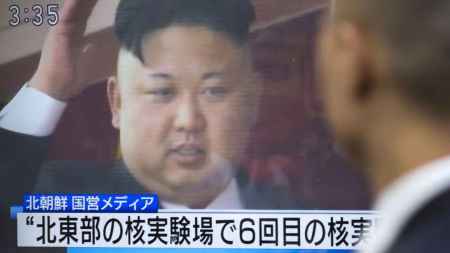
But just hours before Mr. Xi was set to address the carefully choreographed meeting on Sunday, North Korea’s leader, Kim Jong-undetonated his sixth nuclear bomb.

Mr. Kim has timed his nuclear tests and missile launches with exquisite precision, apparently trying to create maximum embarrassment for China. And on Sunday, a gathering in southeast China of leaders from Russia, Brazil, India and South Africa, members of the so-called BRICS group, was immediately overshadowed by news of the test, which shook dwellings in China and revived fears of nuclear contamination in the country’s northeast region.

This is not the first time Mr. Kim has chosen a provocative moment to flaunt his country’s weapons. In May, he launched a ballistic missile hours before Mr. Xi spoke at a gathering of world leaders in Beijing assembled to discuss China’s signature trillion dollar One Belt, One Road project.

The confluence of North Korea’s nuclear testing and Mr. Xi’s important public appearances is not a coincidence, analysts said. It is intended to show that Mr. Kim, the leader of a small, rogue neighboring state, can diminish Mr. Xi’s power and prestige as president of China, they said. In fact, some analysts contended that the latest test may have been primarily aimed at pressuring Mr. Xi, not President Trump.

“Kim knows that Xi has the real power to affect the calculus in Washington,” said Peter Hayes, the director of the Nautilus Institute, a research group that specializes in North Korea. “He’s putting pressure on China to say to Trump: ‘You have to sit down with Kim Jong-un.’”

What Mr. Kim wants most, Mr. Hayes said, is talks with Washington that the North Korean leader hopes will result in a deal to reduce American troops in South Korea and leave him with nuclear weapons. And in Mr. Kim’s calculation, China has the influence to make that negotiation happen.

While some Chinese analysts say North Korea should be made to pay a price for its contempt of China, the North’s ally and major trading partner, they were not optimistic that Sunday’s test would change Mr. Xi’s determination to remain above the fray and not get his hands sullied trying to force Mr. Kim to change his ways.

Even the North’s claim that the weapon detonated was a hydrogen bomb that could be mounted on an intercontinental ballistic missile would probably not sway Mr. Xi, they said.

“This sixth nuclear test should force China to do something radical; this will be a political test,” said Cheng Xiaohe, a nuclear expert at Renmin University. “But the mood is not moving that way.”

China’s Foreign Ministry did express “strong condemnation” of the test. But despite the North’s repeated incitements, the Chinese leadership is likely to stick to its position that a nuclear-armed North Korea is less dangerous to China than the possibility of a political collapse in the North, Mr. Cheng said. That could result in a unified Korean Peninsula under the control of the United States and its ally, South Korea.

China fears such an outcome if it uses its greatest economic leverage: cutting off the crude oil supplies that keep the North’s rudimentary economy running.

“Cutting off oil supplies could severely impact North Korean industries and undermine the regime’s stability, a solution which China and Russia have serious qualms about,” said Zhao Tong, a fellow at the Carnegie-Tsinghua Center for Global Policy in Beijing.

China has put forward a proposal that hinges on North Korea stopping its nuclear testing in exchange for an end to American military exercises around the Korean Peninsula.

But Mr. Xi is consumed at the moment with domestic matters, Chinese analysts said. The political machinations surrounding the Communist Party’s National Congress that will convene in Beijing in mid-October to select new members of the ruling elite are at the top of his agenda. Mr. Xi will be awarded his second five-year term at the meeting.

China always aims for domestic calm in the period leading up to the secretive congress, and so it is unlikely to do anything before Oct. 19, the start of the conclave, Mr. Zhao said.

The biggest concern for China’s leadership is the possibility of North Korea turning on China, the country’s only ally. “If cornered, North Korea could take military action against China, given the relationship has reached a historic low,” Mr. Zhao said.

China supplies more than 80 percent of the North’s crude oil, and suspending delivery would be the ultimate economic sanction, more far-reaching than those imposed, with China’s support, by the United Nations.

Even The Global Times, the nationalist, state-run newspaper, said several months ago that China should consider cutting off its oil supplies to North Korea if Mr. Kim detonated a sixth nuclear bomb. But with the party congress looming, the paper modified its position Sunday.

“The origin of the North Korean nuclear issue is the sense of uncertainty that is generated by the military actions of the U.S./South Korea military alliance,” the paper said. “China should not be at the front of this sharp and complicated situation.”

There were also some doubts whether severing oil supplies would make much a huge difference to the North Korean regime. “The economic effects will be substantial but not regime crippling,” said Mr. Hayes of the Nautilus Institute, which specializes in the North’s energy needs.

The hardships, he said, would be most felt by ordinary people, with less food getting to market and fewer people able to travel between cities in buses.

The North’s army has oil stockpiles for routine nonwartime use for at least a year, Mr. Hayes said. “They can last for about a month before they run out of fuel in wartime, at best; likely much earlier,” he said.

Another major concern for the Chinese government is the fears of residents in the northeast of the country about nuclear contamination from North Korea’s test site at Punggye-ri, not far from the Chinese border.

Many residents in Yanji in Jilin Province, which borders the North, said they felt their apartments shake after the test. Some posted photos of stocks of food and drinks shattered on the floors of a grocery store. At first residents believed the cause was an earthquake, they said, and only later in the day heard the news from state-run media that North Korea had detonated a nuclear bomb.

“I was in my study when the earthquake began,” said Sun Xingjie, an assistant professor at Jilin University in Changchun about 350 miles from the North Korean test site. Mr. Sun said he checked with friends on social media, and they determined from the location and the depth of the explosion that it was a nuclear test.

Even though there is no evidence of any contamination from the test reaching China, it is a worry of residents, Mr. Sun said.

“We are at the border region, so we have a sense of fear about leakage from the nuclear test,” he said.

Cadence Column: Asia, August 28, 2017

August 28, 2017

Cadence Column: Asia, August 28, 2017,   via China Daily Mail, August 28, 2017

China should be upset over North Korea for deeper reasons than on the surface. Trump’s “fire and fury” comment a few weeks ago was the clear explanation.

Donald Trump was not in favor of the W. Bush invasion of Iraq. Trump does not like large footprints of war. If this administration authorizes action in North Korea, it would not be anything like Iraq. It would be surgical and instant. There might not be time to react.

With the threat growing from China’s venture missions—flying its flag on man-made islands since it can’t find other ways to fly its flag on more soil—the Pentagon would be foolish not to seek an opportunity for a small demonstration. By not bringing North Korean threats to an absolute halt, China may be giving the US just that opportunity.

China and Russia neither want North Korea to be volatile nor shut down. Perhaps they don’t understand North Korea’s political DNA. It seems they all want to have their cake and eat it too and blame the world if they can’t, a mindset common in Communist regimes.

So, Communism itself is on trial, for its ability to deliver on its goals. But, so on trial also is Democracy’s ability to respond if Communism fails to deliver.

Donald Trump Wins Round One with North Korea

August 11, 2017

Donald Trump Wins Round One with North Korea, BreitbartJoel B. Pollak, August 11, 2017

NICHOLAS KAMM/AFP/Getty Images

Update: Fourth, the Chinese government is now indicating that it will not defend North Korea from a retaliatory strike if the regime attacks the U.S. (which includes Guam). The Global Times, which reflects the view of the Chinese government, indicated that China would stop the U.S. from trying to overthrow the North Korean regime but would not defend North Korea if it struck the U.S. first. That is a significant change from the status quo ante.

The situation remains unstable, and could escalate. But Trump’s rhetoric is not, as former Obama adviser Susan Rice claims, the problem. In fact, it is part of the solution. It has, at the very least, restored some of our deterrence.

*****************************************

The mainstream media are aghast at President Donald Trump’s comments on North Korea as he promises “fire and fury” and warns that American military solutions are “locked and loaded.”

The political elite, and the foreign policy establishment, oscillate between bitter scorn and sheer panic at his tactics. But one does not have to be convinced of Trump’s rhetorical genius to note that he has already re-framed the conflict in a way that is advantageous to the U.S.

First, Trump has radically changed the costs of a potential conflict, for both sides. The dominant paradigm of nuclear face-offs is mutually assured destruction (MAD), which is why the Soviet Union and the U.S. never attacked each other during the Cold War. Most of the discussion about North Korea has followed the same pattern, because of the threat of ICBMs to the U.S. mainland. After Trump threatened to annihilate North Korea, however, Kim Jong-un threatened to attack … Guam. Trump doubled down, indicating that a North Korean attack on Guam would trigger an attack against the regime. That shifted the costs of a war radically in our favor and against theirs.

Second, it is noteworthy that the North Korean threat to Guam did not refer to nuclear weapons, but rather hinted at conventional missile strikes. There is no way to know for sure that the regime would not use nuclear weapons, if indeed the North Koreans can miniaturize them, but a conventional attack is certainly less serious than a nuclear one. In threatening the most violent possible attack, Trump elicited a response that is significantly less threatening.

Third, Trump diverted attention away from North Korea’s more vulnerable neighbors, South Korea and Japan. Of course the North Koreans could attack them if the U.S. launched a war. But instead of talking about the potential deaths of millions of people in densely-populated areas, the world is now talking about the qualms felt by a few people on a remote island. That makes Trump’s words look less scary, and eases pressure for the U.S. to back down.

Update: Fourth, the Chinese government is now indicating that it will not defend North Korea from a retaliatory strike if the regime attacks the U.S. (which includes Guam). The Global Times, which reflects the view of the Chinese government, indicated that China would stop the U.S. from trying to overthrow the North Korean regime but would not defend North Korea if it struck the U.S. first. That is a significant change from the status quo ante.

The situation remains unstable, and could escalate. But Trump’s rhetoric is not, as former Obama adviser Susan Rice claims, the problem. In fact, it is part of the solution. It has, at the very least, restored some of our deterrence.

Trump, Putin, Xi: Talking fades to shows of force

July 31, 2017

Trump, Putin, Xi: Talking fades to shows of force, DEBKAfile, July 31, 2017

(Please see also, Haley Says ‘No Value’ in Another UN Resolution Against North Korea: ‘The Time for Talk Is Over’. — DM)

The message from Beijing was clear: The threat to Chicago and Los Angeles would have to be dealt with by the White House in Washington, not Beijing.

********************************

Over the weekend, three world leaders, US president Donald Trump, Russia’s Vladimir Putin and China’s leader Xi Jinping stepped off the diplomatic path over their differences on world issues and switched to displays of military might.

In a show of force after North Korea’s two ICBM tests, two US B-1B bombers capable of delivering nuclear weapons, escorted by South Korean and Japanese fighters, took off from Guam Saturday, July 29 and cut across the Korean peninsula. There was no word on whether they entered North Korean skies.

Further west, US Vice President Mike Pence toured East European capitals. Speaking in Tallinn, Estonia, he assured “our Baltic allies” – as well as Georgia and Montenegro, his next destinations: “We are with you and will stand with you on behalf of freedom.”  He said that the president would soon sign the latest round of sanctions voted on by Congress, since “Russia’s destabilizing activities and support for rogue regimes and its activities in Ukraine are unacceptable.”

Shortly after President Donald Trump criticized China over failing to deal with North Korea, President Xi Jinping in a general’s uniform viewed a huge military parade Sunday marking the People’s Liberation Army’s 90th anniversary. Xi is the PLA’s commander in chief. Whereas the annual parade usually takes place in Beijing, this one was staged at the remote Zhurihe military base in Inner Mongolia., with the participation of 12,000 soldiers, 100 bombers and fighters and a display of 600 weapons systems, 40 percent of them new products of China’s arms industries.
“The world isn’t safe at the moment,” the Chinese president told his people. “A strong army is needed more than ever.”

The Russian president meanwhile showcased his naval might in a huge parade of vessels stretching from the Dnieper River in Moscow to Saint Petersburg, through the Baltic port of Kaliningrad, to Crimea on the Black Sea and up to Russia’s Syrian base at Tartus.  Taking part were 50 warships and submarines.

Standing on the deck of the presidential warship as it sailed past the Kremlin’s walls, Putin congratulated the Russian navy on its great advances.

He then disembarked, headed to his office and ordered 755 U.S. diplomats to leave the country by Sept. 1, in retaliation for the new round of sanctions against Russia ordered by the US Congress. More than 1,000 people are currently employed at the Moscow embassy and three US consulates in Russia.

“We waited for quite some time that maybe something will change for the better, had much hope that the situation will somehow change, but, judging by everything, if it changes, it will not be soon,” Putin said. “It is time for us to show that we will not leave anything unanswered.” He added menacingly that there are many areas of Russian-American cooperation whose discontinuation would be harmful to the US. “I hope we don’t have to go there,” he said.

These muscle-flexing steps by the three world powers add up to an ominous shift from their brink-of-cold war diplomatic interaction to a new level with the potential for tipping over into limited military clashes.

The penny has finally dropped for Trump that President Xi has no intention of cracking down on North Korea’s Kim Jong-un, even though he declared after a successful second test of an intercontinental ballistic missile that “the US mainland is without our striking range.”

The message from Beijing was clear: The threat to Chicago and Los Angeles would have to be dealt with by the White House in Washington, not Beijing.

Xi may accept that the US president may eventually be forced to take some military action against North Korea’s missile and nuclear facilities. But he may also be counting on such action being a one-off, like the 59-US Tomahawk missile barrage that hit the Syrian air base of Shayrat on April 7.  Because that dramatic strike was not the start of an organized campaign against the regime in Damascus, it failed to unseat Bashar Assad and in fact made him stronger. Once America has vented its anger, the Chinese president hopes its military offensive against Kim will be over and done with.

For six months, Putin waited to see whether Trump was able to beat down the media-boosted war waged against his presidency by political and intelligence enemies at home, much of it focused on the Russian dimension. His patience with the US president and his troubles at home is clearly at an end.

On Sunday, July 30, Russian Deputy Foreign Minister Sergei Ryabkov called the new sanctions “completely weird and unacceptable,” adding “If the US side decides to move further towards further deterioration we will answer, we will respond in kind. We will mirror this. We will retaliate,” he stressed.

The gloves have clearly come off for the ramping up of friction among the three powers in the various world flashpoint arenas, whether in Europe, the Far East, or other places.

Haley Says ‘No Value’ in Another UN Resolution Against North Korea: ‘The Time for Talk Is Over’

July 31, 2017

Haley Says ‘No Value’ in Another UN Resolution Against North Korea: ‘The Time for Talk Is Over’ Washington Free Beacon , July 31, 2017

( Sounds like serious shit… – JW )

Nikki Haley / Getty Images

U.S. Ambassador to the United Nations Nikki Haley said Sunday that she is ready to take action and not just hold more talks following North Korea’s latest intercontinental ballistic missile (ICBM) launch.

Haley released a statement denying that the U.S. was seeking to form an emergency session at the U.N. She said that it would be useless and even counterproductive to further sanction the regime of North Korean leader Kim Jong-un without action.

“There is no point in having an emergency session if it produces nothing of consequence,” she said. “North Korea is already subject to numerous Security Council resolutions that they violate with impunity and that are not complied with by all U.N. Member States.”

“An additional security council resolution that does not significantly increase the international pressure on North Korea is of no value,” Haley said. “In fact, it is worse than nothing, because it sends the message to the North Korean dictator that the international community is unwilling to seriously challenge him.”

She directly addressed China, the regime’s closest ally, and said that Beijing must intervene. China has insisted that it is not responsible for North Korea, even as the U.S. has accused the Chinese leadership of propping up Pyongyang.

“China must decide whether it is finally willing to take this vital step. The time for talk is over,” Haley said. “The danger the North Korean regime poses to international peace is now clear to all.”

President Donald Trump also focused his Twitter fire on China. He said on Saturday that China does nothing on North Korea despite having “easy” options to “solve this problem.”

I am very disappointed in China. Our foolish past leaders have allowed them to make hundreds of billions of dollars a year in trade, yet…

…they do NOTHING for us with North Korea, just talk. We will no longer allow this to continue. China could easily solve this problem!

China hit back on Monday after Trump’s tweets. The Chinese Foreign Ministry, in a statement sent to Reuters, said the international community needs to work together to address the North Korean nuclear issue and that China is not responsible for Pyongyang’s aggression.

South Korea announced Saturday that it will begin talking with the Trump administration about expanding the country’s nuclear capabilities. The Chinese have opposed any actions that would put Seoul in control of nuclear weapons.

Japanese Prime Minister Shinzo Abe also told reporters that the Trump administration promised to “take all necessary measures to protect” Japan.

North Korea launched its latest test missile into Japanese waters on Friday.

LISTEN: Secretary of State Rex Tillerson takes questions in off-camera news briefing

July 7, 2017

LISTEN: Secretary of State Rex Tillerson takes questions in off-camera news briefing, PBS via YouTube, July 7, 2017

According to the blurb beneath the video,

Secretary of State Rex Tillerson spoke and took questions at an off-camera news briefing on Friday after participating in talks with Russia at the G20. Treasury Secretary Steven Mnuchin also spoke briefly before Tillerson.


