Archive for the ‘China and North Korea’ category

Trump is Right, Tillerson is Wasting His Time on North Korea

October 2, 2017

Trump is Right, Tillerson is Wasting His Time on North Korea, Power LinePaul Mirengoff, October 2, 2017

(Please see also, China openly discussing collapse of North Korea. — DM)

If there is any hope of changing North Korea’s behavior, it rests not with Tillerson’s diplomacy or with the direct effect of threatening Kim Jong Un. Rather, it rests with China acting out of self-interest.

******************************

A day after Secretary of State Tillerson said he was reaching out to North Korea in hopes of starting a new dialogue, President Trump belittled the idea. He tweeted:

I told Rex Tillerson, our wonderful Secretary of State, that he is wasting his time trying to negotiate with Little Rocket Man. Save your energy Rex, we’ll do what has to be done!

Trump is right. North Korea isn’t going to negotiate away its nuclear arsenal and it’s not going to freeze its nuclear program until the program has the capacity to inflict the level of damage Kim Jong Un deems necessary to deter the U.S. — namely the capacity to hit major U.S. cities.

Michael Green, President George W. Bush’s chief Asia adviser, acknowledged that “the president is right on this one in the sense that Pyongyang is clear it will not put nuclear weapons on the negotiating table, nor will the current level of sanctions likely convince them to do so. . . .”

The incoherence of Tillerson’s approach is underscored by this incoherent statement by Sen. Bob Corker:

I think that there’s more going on than meets the eye. I think Tillerson understands that every intelligence agency we have says there’s no amount of economic pressure you can put on North Korea to get them to stop this program because they view this as their survival.

If no amount of economic pressure can induce North Korea to stop its nuclear program because of its centrality to the regime’s survival, then what are the likely outcomes of Tillerson negotiating with the regime? The likely outcomes are (1) no agreement or (2) acceptance of North Korea continuing its program, in effect on North Korean terms.

These have been the outcomes of past U.S. diplomacy with North Korea. As Trump tweeted: “Being nice to Rocket Man hasn’t worked in 25 years, why would it work now?”

The question remains, though, why did Trump publicly undercut his Secretary of State on Twitter. According to reports, the president was furious at Tillerson for contradicting his public position that now is not the time for talks. That seems like reason enough for the president’s tweeting. It may be reason enough to sack Tillerson.

Some have suggested that Trump is attempting a good cop, bad cop approach to Kim Jong Un. It seems to be true that the North Koreans are mightily confused by conflicting signals coming from Washington. According to a number of sources, they are frantically talking to American sources in an attempt to understand the true intentions of the Trump administration. And Trump has often touted the advantages of keeping our adversaries uncertain about his intentions.

It’s far from clear, however, that this is the right approach in the context of a fledgling nuclear power led by an inexperienced ruler about whom we don’t know much. My guess is that Trump’s rhetoric will unsettle North Korea, but is no more likely than Tillerson’s diplomacy to deter it from expanding its nuclear program.

At the same time, it will not prompt Kim Jong Un to start a war he otherwise doesn’t want, as Trump’s critics suggest might happen. Where’s the advantage to the regime in that?

If one is inclined to view Trump’s rhetoric as rationally calculated to achieve a positive purpose, I think that purpose would be to influence China. If China believes Trump might launch a preemptive attack on North Korea, it might apply a stranglehold on the regime, especially if it also sees South Korea and Japan possibly moving towards developing a nuclear arsenal.

If there is any hope of changing North Korea’s behavior, it rests not with Tillerson’s diplomacy or with the direct effect of threatening Kim Jong Un. Rather, it rests with China acting out of self-interest.

China openly discussing collapse of North Korea

October 2, 2017

China openly discussing collapse of North Korea, American ThinkerThomas Lifson, October 2, 2017

China has sent an unmistakable signal that Kim Jong-un had better not rely on the historic alliance between China and North Korea to resist President Trump’s demands. In fact, as he dallies with his troop of teen sex slaves, he had better keep in mind that Beijing is wondering what it might be like with the Kim dynasty out of the way.

The Chinese way of delivering such a harsh message is to use a third party. Preferably one without a policy role, but who clearly speaks for the ruling elite. Someone, for instance, like the Dean of International Studies at Beijing University (the Harvard, Yale, Princeton, and Stanford of China). Patrick Baert of AFP writes:

Jia Qingguo, dean of the School of International Studies at Peking University, raised eyebrows earlier in September when he published an article entitled: “Time to prepare for the worst in North Korea”.

The paper was published in English in East Asia Forum, a website of the Australian National University, but it is unlikely that he could have released it without the approval of Chinese authorities.

Jia urged Beijing to start discussing contingency plans with the United States and South Korea — talks that the two nations have sought in the past but China has resisted for fear of upsetting Pyongyang.

 “When war becomes a real possibility, China must be prepared. And, with this in mind, China must be more willing to consider talks with concerned countries on contingency plans,” Jia wrote.

This comparatively mild language is telling KJU that in a war, China might not be on the North Korean side.

Observers say the public debate might be a tactic to try and coerce Pyongyang into cooling its weapons programme, with its nuclear and missile tests visibly angering Beijing, which has backed tough new United Nations sanctions on the country.

But it may also indicate growing calls to overhaul its relationship with the North, a longterm ally that it defended during the 1950-53 Korean War and has a mutual defence pact with.

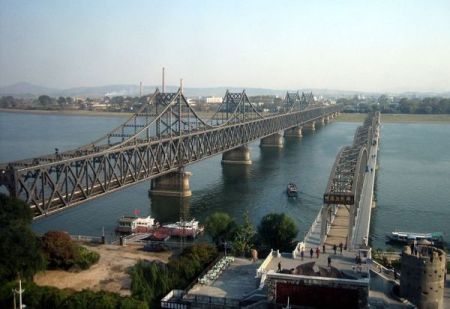
Yalu River bridges from China into North Korea at Dandong, Liaoning, Provicne/

As most readers know, the Korean War never ended. So, an “overhaul” of the relationship could only mean weakening or abandoning the alliance, and allowing the war to be fought to completion — without Beijing backing Pyongyang in the fighting.   Even raising this possibility, indirectly and via a scholarly journal published in English, is calculated to let Kim know he could be on his own.

This could indicate a shift in the tectonic plates of China’s geostrategy:

But there are also signs of a genuine shift in perceptions over how China should handle North Korea.

David Kelly, director of research at Beijing-based consultancy China Policy, said the thinking among Chinese academics was: “We could do better without them, a unified Korea would be incredibly good for China, the northeast would boom”.

China has long supported North Korea because it serves as a buffer from US troops stationed in South Korea, but Barthelemy Courmont, a China specialist at the Institute of Strategic and International Relations in Paris, said Pyongyang’s downfall could be good for Beijing, especially economically.

“China now believes that a collapse of North Korea would not necessarily be to its disadvantage,” Courmont said.

“If North Korea were to fall in a peaceful way, China would be best positioned for its reconstruction. China is the only country capable of overseeing the reconstruction of North Korea,” he said.

This has to be related to the current “conflict” between SecState Tillerson and President Trump that has progs reveling in what they see as amateur hour. The New York Times:

President Trump undercut his own secretary of state on Sunday, calling his effort to open lines of communication with North Korea a waste of time, and seeming to rule out a diplomatic resolution to the nuclear-edged confrontation with Pyongyang.

A day after Secretary of State Rex W. Tillerson said he was reaching out to Pyongyang in hopes of starting a new dialogue, Mr. Trump belittled the idea and left the impression that he was focused mainly on military options. Mr. Trump was privately described by advisers as furious at Mr. Tillerson for contradicting the president’s public position that now is not the time for talks.

This sounds more like Good cop/bad cop than outright conflict. As with President Reagan, Trump is regarded as a bit of a madman, who might just start a nuclear war. Even Kim Jong un understands that North Korea cannot win such a conflict. But now, the old passivity and delay that characterized American policy towards North Korea for the past three decades is over.

If (and it is a big if), China switches over to a policy of Korean reunification and dumps the embarrassment in Pyongyang, it would be an achievement of President Trump that echoes Nixon opening relations with China and Regan winning the Cold War.


President Trump JUST Drops Executive Order NOW Kim Jong Un Is Panicking(VIDEO)!!!

September 26, 2017

President Trump JUST Drops Executive Order NOW Kim Jong Un Is Panicking(VIDEO)!!!, Global News via YouTube, September 26, 2017

(The title seems excessively dramatic, but Dear Leader Kim will feel the new sanctions China claims to support.  The more interesting segments of the video deal with our military options. — DM)

https://www.youtube.com/watch?v=5maJZEN_fXA

The blurb beneath the video states,

President Trump drops executive order now Kim Jong Un is panicking. President Trump signed an executive order targeting North Korea’s trading partners, calling it a powerful new tool aimed at isolating the regime. Foreign banks will face a clear choice. Do business with the United States or facilitate trade with the lawless regime in North Korea.

A North Korea nuclear test over the Pacific? Logical, terrifying

September 22, 2017

A North Korea nuclear test over the Pacific? Logical, terrifying, ReutersHyonhee ShinLinda Sieg, September 22, 2017

“To put a live nuclear warhead on a missile that’s only been tested a handful of times, overflying potentially populated centers. If it…doesn’t go exactly as planned….it could be a world changing event.”

If Kim’s threat materializes, it will be a “tipping point” for China, and may prompt many other countries to demand an “end to the regime,” said David Albright, founder of the non-profit Institute for Science and International Security in Washington.

“No one has tested above ground for decades and the radioactive fallout could be terrifying to many,” Albright said.

****************************

SEOUL/TOKYO (Reuters) – Detonating a nuclear-tipped missile over the Pacific Ocean would be a logical final step by North Korea to prove the success of its weapons program but would be extremely provocative and carry huge risks, arms control experts said on Friday.

North Korean Foreign Minister Ri Yong Ho suggested leader Kim Jong Un was considering testing “an unprecedented scale hydrogen bomb” over the Pacific in response to U.S. President Donald Trump’s threat at the United Nations to “totally destroy” the country.

“It may mean North Korea will fire a warhead-tipped (intermediate range) Hwasong-12 or Hwasong-14 intercontinental ballistic missile and blow it up a few hundred kilometers above the Pacific Ocean,” said Yang Uk, a senior researcher at the Korea Defence and Security Forum in Seoul.

“They may be bluffing, but there is a need for them to test their combined missile-bomb capability. They could have already prepared the plan and are now trying to use Trump’s remarks as an excuse to make it happen,” said Yang.

Such an atmospheric test would be the first globally since China detonated a device in 1980, according to the International Atomic Energy Agency.

Tests of nuclear-tipped ballistic missiles are rarer still. The United States’ only test of an operational ballistic missile with a live warhead was fired from submarine far out in the Pacific Ocean in 1962.

China was widely condemned for a similar test with a missile that exploded over its Lop Nur test site in the country’s west in 1966.

North Korea’s six nuclear tests to date have all been underground, the most recent earlier this month by far its largest.

“We have to assume they *could* do it, but it is exceedingly provocative,” said Vipin Narang, an associate professor of political science at  Massachusetts Institute of Technology.

“To put a live nuclear warhead on a missile that’s only been tested a handful of times, overflying potentially populated centers. If it…doesn’t go exactly as planned….it could be a world changing event.”

North Korea has fired two ballistic missiles over Japan’s north Hokkaido region in the past month as part of a series of tests that experts say have illustrated unexpectedly rapid advances.

“They said Pacific Ocean, which pretty much means firing a missile over Japan,” said Melissa Hanham, a senior research associate at the U.S.-based Middlebury Institute of International Studies at Monterey, California. “They want to shut us all up for doubting they could build it.”

SERIOUS FALLOUT

While a missile would be the most ideal means of delivery, it is also possible to put a bomb on a ship and detonate on the surface of the ocean or in the sea, the experts said.

Either way, the radioactive fallout could be significant, as well as the diplomatic backlash from around the world. North Korea’s recent missile launches over Japan especially drew stern rebukes from Tokyo and the international community.

Japan’s Chief Cabinet Secretary Yoshihide Suga called Pyongyang’s remarks and behavior “completely unacceptable”.

Narang said a test high enough over the ocean would limit the radioactive fallout but risks included damage from an electro-magnetic pulse, something Pyongyang has hinted it might employ on an attack on the United States or its allies.

“If it doesn’t go exactly as planned and the detonation occurs at a lower altitude we could see some EMP-like effects for anything in the area. A lot of dead fish too.”

Pyongyang has launched dozens of missiles this year as it spurs a program aimed at mastering a nuclear-tipped missile that can strike the United States, in addition to its Sept 3 nuclear test.

If Kim’s threat materializes, it will be a “tipping point” for China, and may prompt many other countries to demand an “end to the regime,” said David Albright, founder of the non-profit Institute for Science and International Security in Washington.

“No one has tested above ground for decades and the radioactive fallout could be terrifying to many,” Albright said.

Other experts said such an atmospheric nuclear test is unlikely for now due to its substantial technical and diplomatic risks.

Joshua Pollack, editor of the Washington-based Nonproliferation Review, said it would be an “end-to-end demo of everything.”

“But I would be surprised if this were their very next move. They have yet to test an ICBM at full range into the Pacific,” said Pollack. “That will probably come first.”

Korea: Escalation Is A Two-Way Street

September 19, 2017

Korea: Escalation Is A Two-Way Street, Strategy Page, September 15, 2017

(This is a lengthy article but provides very useful insights. — DM)

The latest North Korean nuclear and missile tests have caused Chinese public opinion towards North Korea to become even more hostile. According to opinion polls North Korea has, over the last few years, turned into a larger military threat to China than the U.S. or anyone else. To deal with this China has increased the number of troops and border police stationed near the North Korean border and conducted more military exercises in the area. This also addresses another Chinese fear (that gets less publicity in China) that a government collapse in North Korea would send millions of desperate, and opportunistic, North Koreans into China. There is no way China or the Chinese living along the North Korean border would tolerate that. Meanwhile China is becoming more hostile to North Koreans no matter what their legal or economic status is. Part of that is because North Korea has become a very unpleasant place for Chinese to visit or do business in.

******************************

Every nation has its priorities and for North Korea it is all about image. Most people see that in terms of North Korean nuclear weapons and ballistic missiles. But there are other equally important (to the North Korean leaders) issues that get little publicity, and that is intentional. In mid-2017 North Korea ordered its secret police to expand its operations in northeast China (the area just across the northern border) so as to suppress news about the growing number of senior and mid-level officials who are, often with their families, illegally leaving North Korea. The single incident that prompted this new secret police effort was the suicide of one of these families (all five of them). The five took poison after being arrested by Chinese police and facing repatriation to North Korea, where the entire family would probably die anyway but more slowly and painfully. The secret police were ordered to increase efforts to prevent such defections in the first place. That will be difficult because the mood among many North Korean officials can best be described as suppressed (so the secret police don’t take note) panic and increased efforts to escape from the country and get to South Korea.

Senior North Korean officials who have gotten out in the last few years all agree that Kim Jong Un is considered a failure by more and more North Koreans and that his days are numbered, even if China does not step in and take over beforehand. Yet these senior officials report that Kim Jong Un could keep his police state going into the late 2020s. But time is not on his side and the signs backing that up are increasingly obvious. Kim Jong Un has triggered a trend that will destroy him and nothing he does seems to fix the problem. He believes having workable nukes and a reliable delivery system (ballistic missiles) will enable him to extort the neighbors for enough goodies to bail him out. That is a high-risk strategy. Kim Jong Un is betting everything on this and none of the potential victims seems ready to give in and are instead planning to meet nuclear threats with force not surrender. Escalation and intimidation work both ways.

Coming Up Short

North Korea has reduced its physical standards for military service. Previously conscripts had to be 150 cm (59 inches) tall and weigh at least 48 kg (106 pounds). But that standard has been reduced over the last decade to 137 cm (54 inches) and 43 kg (95 pounds). Now the government is urging teenage boys to volunteer for service when they are 15 years old. Actually, local officials have been given quotas and are coercing families of 15 year old boys to go along with this. With all the food shortages and unemployment the government sees that as an incentive. But most teenagers prefer to try their luck with the market economy and eventually make enough money to get out of North Korea.

The government needs more soldiers because of a lower birthrate and the inability to reverse the problem. South Korea also has this problem but for different reasons. By 2010 South Korea had the lowest birth rate (1.15 children per woman, on average) in the world and held that dubious achievement for two years in a row. This is because of growing affluence over the last half century. South Korea is now one of the wealthiest nations on the planet. At the current birth rate, the South Korean population is expected to stop growing in the 2020s, after reaching about 52 million (about twice the population of the north). If the birth rate stays under 2.1, the population will then begin to shrink. In North Korea, the birth rate is 1.9, and is also declining, because of increasing poverty and famine. For example, life expectancy in the north has declined from 72.7 years in the early 1990s, to 69.3 now. That’s ten years less than in South Korea. Northerners are not only living shorter lives, they are also shorter. A study of teenagers in the north and south revealed that the northerners are 8 percent shorter, and weigh nearly 20 percent less. It’s not as bad with older adults, because they were not born during the famine (which began after Cold War Russian subsidies ended in the early 1990s).

By 2012 there was a very visible shortage of recruits for the North Korean armed forces. A lower birth rate in the 1990s, because of the famine (that killed five percent of the population back then) has reduced the number of 18 year old recruits for the army and security forces. So fewer exemptions are being allowed, and more 17 years olds are being taken. That escalated to pressuring 16 year olds to volunteer. Now the government is after 15 year olds. North Korean men serve at least six years (and up to ten) in the military, keeping them out of trouble for that time in their lives (18-24), when they are most likely to act out revolutionary fantasies. The military is really a large prison system. While the troops are trained to use weapons, they get little ammunition for training, and the weapons are locked up most of the time. Young North Koreans increasingly know how poor they are, and in greater and greater detail. The soldiers born during the great famine of the 1990s are well-aware that they are physically much smaller than their South Korean counterparts. They also know that the average South Korean lives ten years longer and lives a much more pleasant life. All the more reason to limit the time North Korean troops can handle their weapons, especially when they have ammunition (which is actually very infrequently.)

By 2017 North Korean army officers were ordered to encourage their troops to steal food during the harvest and that failure to do so could result in punishment and would definitely result in hunger. Naturally this has caused more popular anger towards the military. This is nothing new. In 2016 hungry troops grew bolder because the government made it clear they would not punish soldiers unless people are killed or badly injured during these incidents. Police are often called to catch soldiers who have robbed someone. At first this was usually troops breaking into a house seeking food and valuables. The soldiers that are caught are often arrested but must be taken back to their base where the military takes over. The soldiers are “punished” with some verbal abuse for getting caught and that is all. The government was desperate because earlier efforts to address the problem had failed. In 2015 there was a new program to expand food production by the military. Troops were allowed to raise pigs as well as the usual vegetable and grain crops. Meat has been in particularly short supply for the troops in the past few years and hungry troops often steal small livestock (chickens, ducks and pigs), kill them on the spot and carry them off to be cooked and eaten before returning to base. As more reports came in it became apparent that most military units didn’t have enough to eat, either because the food was not to be had or, as is more often the case, corruption (someone in a position of power stole it.) This led to more soldiers stealing food from civilians or selling military clothing and equipment on the black market so they could buy food. Soldiers have opportunities to steal food and sell stolen goods when they are off their base doing construction or farm work. This is how troops spend a lot of their time and they receive no extra pay or food even when the outside work requires heavy (and calorie consuming) labor. All this is illegal, but commanders were not eager to punish hungry soldiers. For commanders their troops have become profitable slaves who can be rented out with the commanders getting part of the payment. Now the government insists that disobedient slaves be executed.

Visible Signs Of Decline

Declining discipline in the police is more evident in many obvious ways. For example a growing number of North Korean women are operating openly as prostitutes (usually near border areas where there are more foreigners). These women get $20 or more per customer but get to keep less than 20 percent of that because the rest goes to bribes (for police) and “fees” to various middlemen (or women) who supervise it all. Thus it is not surprising that these young (from late teens to 30s) women will also offer to sell drugs (usually meth) to customers as well. Many of these prostitutes are married and some have children but no money to keep the kids fed and healthy.

With the growth of free markets and police getting jealous, greedy and corrupted by demanding and getting bribes, there has also developed criminal gangs. These groups often have connections (usually financial) with the security forces and of course the gangsters are all veterans. The gangs act as middlemen between donju (free market entrepreneurs) and the government but as a matter of law, the gangs do not exist. As a matter of fact the gangs are very real and one of the fastest growing sectors of the market economy.

China Chooses Sides

The latest North Korean nuclear and missile tests have caused Chinese public opinion towards North Korea to become even more hostile. According to opinion polls North Korea has, over the last few years, turned into a larger military threat to China than the U.S. or anyone else. To deal with this China has increased the number of troops and border police stationed near the North Korean border and conducted more military exercises in the area. This also addresses another Chinese fear (that gets less publicity in China) that a government collapse in North Korea would send millions of desperate, and opportunistic, North Koreans into China. There is no way China or the Chinese living along the North Korean border would tolerate that. Meanwhile China is becoming more hostile to North Koreans no matter what their legal or economic status is. Part of that is because North Korea has become a very unpleasant place for Chinese to visit or do business in.

News of the bad treatment Chinese are suffering in North Korea gets around, even when the Chinese government tries to keep the worst examples out of the news. Chinese individuals and firms doing business in North Korea complain that the North Koreans have become even more unreliable when it comes to handling foreign investments from China. In the past China could impose some degree of discipline on North Korea for abuse of Chinese investors and investments. The North Koreans are increasingly ignoring this sort of pressure and as a result Chinese investors are backing away from current and planned investments. China could order state owned firms to do business in North Korea but does not because these firms are poorly run compared to the privately owned firms and would suffer even larger losses when dealing the increasingly treacherous and unreliable neighbor.

North Korea used to be a dependable place, at least for Chinese with the right connections in the Chinese government. While corruption in China has declined in the past few years it appears to have gotten worse in North Korea, to the point where long-term deals are avoided and transactions are made carefully, usually with payment before delivery. The smugglers and various other criminal gangs in China that do business with their North Korean counterparts have been forced to operate this way as well and for the same reasons. South Korea and Japan have already learned how unreliable North Korea can be when it comes to business deals and Russia has already adopted the wary approach to economic deals with North Korea.

China has visibly increased enforcement of economic sanctions on North Korea but this has not made North Korea any more willing to negotiate. The growing number of police and secret police night patrols in areas where North Korean smugglers long operated is hard to miss, as is the fact that when North Korean smugglers are encountered they get arrested and taken away. Even higher bribes (over $3,000 to make an arrest not happen) no longer work because the Chinese cops will still demand that amount of cash before they will turn the smugglers over to North Korean officials. China never came down so hard on North Korean smuggling before.

China is also cracking down on North Korean drug production and smuggling. This is a matter of self-defense for China and is effective because North Korea make the highest profits from methamphetamine (“meth”). But this drug requires a key ingredient (phenylacetic acid, in the form of white crystals) to be smuggled in from China. Now the Chinese are cracking down on that as well as the meth coming into China. North Korea is seeking another, probably more expensive, supplier in Russia.

While Russia is still doing business with North Korea China and Russia are also cooperating with many of the new rules banning North Korean workers they long employed legally. This exported labor was outlawed by the latest round of sanctions. North Korea responded by quietly ordering overseas workers to stay where they are and work illegally (in deals arranged by their government minders). Yet in many instances the export ban on slave labor is being enforced by Russia and especially China and that is hurting North Korea economically.

The North Koreans see this as yet another challenge that can be worked around. While it is true that there are still a lot of corrupt Chinese and Russians willing to do business with North Korea if the bribe is large enough, that is not working as well as it used to in China. This is because North Korea is very unpopular with Chinese in general and a growing number of senior Chinese officials in particular. Russians are less upset with North Korea and, while having fewer economic resources than China, are more receptive to shady deals. The problem is that North Korea has become very dependent on the much larger and still expanding Chinese economy. Russia simply cannot supply a lot of what North Korea needs. It is possible to still buy the forbidden goods in China and have them shipped to a fictitious customer in Russia who will quietly send it to North Korea. That does not always work and when it does it costs a lot more than getting the goods directly from China. North Korea has less cash for the extra expenses. The Chinese know this and are quite willing to slowly squeeze until North Korean leaders are all dead or more receptive to Chinese needs (no nukes next door and fewer desperate illegal migrants). Yet there is the growing risk that North Korea will get (or thinks it has) reliable nukes and keep threatening China. That is not the desired outcome but the Chinese have quietly reminded leaders of both Koreas (and their foreign allies) that in the past China has occupied much of Korea when the Koreans become troublesome.

Meanwhile China is not happy with South Korea either, fearing the growing military power of South Korea and the recent installation of a THAAD anti-missile battery despite vigorous Chinese diplomatic and economic efforts to prevent that. The diplomatic and economic pressure continues but the South Koreans are in no mood to back off as long as the North Korean threat remains. South Korea believes China could do more to eliminate the North Korean threat. While many, if not most, Chinese and Russians agree with that the Russian and Chinese governments still see economic opportunities in North Korea and are unwilling to do anything drastic.

September 14, 2017: In coincidental, nearly simultaneous, events North Korea fired a ballistic missile over Japan while South Korea fired two Hyunmoo 2 ballistic missiles. One of these failed while the other accurately hit the target area (at sea) 250 kilometers away. The North Korean missile travelled about 2,200 kilometers and landed in the Pacific. Japan said it tracked the missile and did not try to intercept because it was obvious the missile was following a trajectory that would take it far from Japan. The identity of the North Korean missile was not known.

South Korea has developed a longer (500 kilometer) version; Hyunmoo 2C. South Korea developed a 180 kilometer range ballistic missile (Hyunmoo 1) and a 300 kilometer one (Hyunmoo 2) in the 1980s. Both are about 13 meters (40 feet) long and weigh 4-5 tons. Both of these were based on the design of the U.S. Nike-Hercules anti-aircraft missile, which South Korea used for many years.

September 13, 2017: Google and YouTube have banned videos from North Korean media, apparently because it is a source of income for North Korea and now in violation of sanctions. This reduces open source access to North Korean TV although intelligence agencies will still be able to get these.

China has restricted access to Mount Paektu, apparently for safety reasons related to the recent North Korean nuclear test, which was conducted 110 kilometers away. Mount Paektu is a dormant volcano on the Chinese border. In fact, half the volcano is in China, where it is a popular tourist destination for South Koreans. That’s because Koreans and Manchus (as in Manchuria, the native people of northeast China) both consider Mt Paektu as a sacred place where their tribes originated thousands of years ago. In 2013 North Korea put some silos for their long range (2,000-3,000 kilometers) ballistic missiles up there because that part of North Korea is a triangle, surrounded on two sides by China. This makes it difficult for the Americans to launch air attacks without entering Chinese territory and makes it easier for North Korean anti-aircraft forces to defend against cruise missile. On the down side, Paektu is a dormant volcano that is active (lava flows and the like) about once a century. The last time it erupted (throwing large quantities of rocks and dust into the atmosphere) was in 1703 and an eruption in the late 10th century blew the top off the mountain and created the current 4.5 kilometers wide crater lake. Volcanologists consider Paektu capable of another major eruption but North Korea considers that less likely than an American air attack. So the silos stay, despite the risk of destruction by lava flows and earthquakes. Before all these silos were built North Korea planned to keep its long range ballistic missiles mobile and launch them from any number of launch sites (a flat field where the missile could be fueled and the guidance system programmed before launch.) Bad weather could complicate the use of mobile launchers (washing out bridges or blocking roads with snow). The quality of North Korean roads has also declined sharply (from lack of maintenance) since the late 1990s. Then there is the increased American surveillance (from satellites, U-2s and high-altitude UAVs) that makes mobile missiles more vulnerable to air or missile attack. Silos can also be attacked from the air, but in a war the more numerous and shorter range ballistic missiles to the south would also be subject to air attack as these missiles would be aimed at the South Korean capital. North Korea apparently believes that silos protected by a sacred volcano are a worthwhile investment to ensure that some of long-range missiles will get launched during a crises. China is more concerned about nuclear radiation coming from North Korea.

September 12, 2017: Chinese radiation monitors on the North Korean border recorded levels were up seven percent since the September 3rd test and have appeared to have peaked. This data was released because the population along the border know that they face some health risks if radiation levels increase too much for too long.

September 11, 2017: The UN approved new economic sanctions against North Korea and China said it would enforce them all and repeated that it had been enforcing sanctions since March. The new sanctions limit the export of refined petroleum product to two million barrels a year and ban North Korea from importing liquefied natural gas. This followed China condemning North Korea nuclear tests openly in the UN for the first time.

Meanwhile the United States continues to call on China and Russia to do more to halt the North Korean evasion of sanctions via corrupt officials and businesses in China and Russia. China in particular does not want too much international attention focused on that corruption, which has long been quite active along the North Korean border and still is. The United States is not being diplomatic in pointing this out but it is correct in showing how Chinese enforcement of sanctions does not really work unless China effectively curbs the Chinese corruption that enables North Korea to continue doing whatever it wants. For the North Korea the increased sanctions pressure merely increases costs (larger bribes are required in China and Russia).

September 10, 2017: Chinese banks have been warning its customers to stay away from bitcoin because of the threat from North Korean hackers, who are believed to be responsible for several recent multi-million dollar thefts from bitcoin exchanges. North Korea is believed to be targeting bitcoin and other Internet based cryptocurrencies even though North Korea has used bitcoin exchanges as a substitute for sanctions that ban it from accessing the international banking system. The Chinese government fears that North Korean hackers are now going after Chinese firms, something they are not supposed to do because China is still the main source of foreign trade. This sort of irrational behavior leads China to fear that North Korea would even be foolish to become a real military threat to China.

September 9, 2017: China orders all Chinese banks (including foreign banks licensed to operate in China) to not only stop opening accounts for North Koreans but also to close any such accounts immediately. This is a very harmful economic sanction and the North Koreans respond by ignoring the new rules any way they can.

September 8, 2017: North Korea has quietly freed a Russian yacht it had seized in mid-June. A North Korean warship seized the Russian yacht when both were 80 kilometers off the coast. The yacht and the vessel towing it to Vladivostok were definitely in international waters and the Russian ambassador demanded the release of the yacht and three man crew. North Korea was not responsive until now. This was similar to a May 2016 incident where North Korean warship seized a Russian sailing yacht some 160 kilometers from the east coast of North Korea (very much in international waters). The yacht and crew of five were taken to a North Korean port. The yacht was released two days later and continued on its way to its original destination (Vladivostok) for a sailboat race. In both cases North Korea would not say why they took the yacht and then released it.

September 7, 2017: South Korea has completed deploying an entire THAAD battery to a site some 300 kilometers south of the North Korean border. The United States will share radar data generated by the high-powered radar installed as part of a THAAD anti-missile battery that began arriving in early 2017. The THAAD battery is operated by American personnel and costs $3.5 million a year to operate. The battery consists of six truck-mounted missile launchers (eight missiles per launcher), a fire control and communications unit and an AN/TPY-2 radar. Villagers living near the site of the THAAD base oppose the presence of the anti-missile battery because it will be a target for North Korean (or even Chinese) attack. Locals also fear (without any evidence) that the powerful THAAD radar will cause health problems.

September 6, 2017: A recent online opinion survey in China showed that 66 percent believed North Korea was a larger military threat to China than the United States. Only 10 percent felt the Americans were a larger threat and 15 percent believed the U.S. was no threat at all. This is consistent with earlier surveys only the degree of hostility towards North Korea keeps increasing. Chinese see North Korea has a poorly managed nation that is ungrateful towards China and unpredictable.

September 4, 2017: North Korean living near the site of the recent underground nuclear weapons test are demanding compensation for the damage done to their home by the earthquake (estimated to be 5.6 on the Richter scale) the test produced. Across the Yalu River some Chinese buildings also suffered damage from the quake and several aftershocks.

South Korea announced that its policy towards North Korea will now on “punishment” rather than negotiation.

September 3, 2017: North Korea carried out its sixth nuclear test. This one appeared to be the largest one yet indicating a yield of 100-200 tons and described as a hydrogen bomb. The first nuclear test was in 2006 (less than one kiloton) but the first one that was truly successful occurred in 2013 (6 kilotons) and despite the fact that the test was not a complete success, the nuclear bomb program continued with two tests in 2016. In late 2015 Kim Jong Un claimed that North Korea had developed a hydrogen (fusion) bomb. Foreign experts openly expressed skepticism given that North Korea didn’t really have a reliable fission type nuclear bomb yet. You need an efficient fission bomb to trigger the fusion reaction that makes the “H-Bomb” so much more destructive than a fission bomb of the same weight and size. Nuclear test number four in January 2016 was described by North Korea as a fusion (H-bomb) test when it clearly was not, or not a successful one. That would be in contrast to the 2013 test which appeared to be seven kilotons and a complete detonation. The second test was a two kiloton weapon in 2009. Western intelligence believed that the original North Korean nuclear weapon design was flawed, as the first two tests were only a fraction of what they should have been. The first one was less than a kiloton and called in the trade, a “fizzle.” The second test was less of a fizzle and apparently a modified version of the original design. Thus North Korea needed more tests to perfect their bomb design and was still years away from a useful nuclear weapon even though the second bomb appeared to be more effective. The third test in 2013 was considered overdue and that may have been because more time was spent designing and building a smaller device that could fit into a missile warhead. The second 2016 test is still something of a mystery. U.S. intelligence agencies have collected air samples (as have most other neighboring countries) from the test which can tell much about the design of the bomb. The January 2016 nuke appeared to be the same as the 2013 one. The second 2016 test in September appeared to be a better design and was about ten kilotons. North Korea insisted this was a fusion bomb. Air samples are still being collected on the test today but it will take weeks to analyze the samples and come to some useful conclusion. The sheer size of the most recent test indicated either a fusion bomb or an enhanced fission bomb. But for a yield of over 100 tons a fusion bomb is more likely. Such designs have been around and in use since the late 1940s. After the Soviet Union collapsed in 1991 a lot of Russian nuclear weapons designers and technicians were out of a job and the pensions of the retired ones were suddenly worth a lot less. The security for nuclear weapons designs, especially much older ones, became a lot more lax. There were plenty of opportunities to obtain previously unavailable tech.

August 29, 2017: North Korea fired a Hwasong-12 ballistic missile over Japan. This was the 18th North Korean ballistic missile test of 2017 and this one appeared to break into pieces before it fell into the ocean after travelling 2,700 kilometers from North Korea. This was the second successful test of the Hwasong-12.

August 28, 2017: South Korea announced its largest increase (6.9 percent for 2018) in its defense budget since 2009. This is a direct result of the increasing threat from North Korea. Next year South Korea will spend $38 billion, which is more than a third larger than the annual GDP of North Korea (which spends about a third of GDP on defense compared to less than three percent in South Korea). South Korea is in the top ten of national economies, something which annoys North Korea but is admired by the other neighbors (including China). Meanwhile Japan is also increasing its defense spending by 2.5 percent in 2018 (to $48 billion). Japan, like China and the U.S., are among the top five economies on the planet. Japan, because of the post-World War II constitution the United States insisted on (and Japan did not much object to) has been largely demilitarized considering the size of its economy. That is changing and the U.S. has dropped nearly all restrictions on what weapons it will export to South Korea and Japan and is ignoring treaties it has with both nations that restrict what types of advanced weapons (like ballistic missiles and nukes) they can develop. The Americans would still prefer that South Korea and Japan not build nukes (which both these nations could easily and quickly do). China and Russia would also prefer that Japan and South Korea remain non-nuclear weapon nations. But if North Korean military ambitions and threats (especially against South Korea and Japan) are not curbed popular opinion in South Korea and Japan is becoming more comfortable with the having their own nukes.

August 25, 2017: China banned North Korea from establishing any new businesses in China or expanding existing ones. Russia has done the same, but the Chinese are a much larger market and apparently intent on following through. Meanwhile the August 15 order for Chinese firms to halt imports of minerals and seafood cost some Chinese firms with physical operations (trucks, mines) and warehouses in North Korea to suffer losses because they were given only 24 hours to get this stuff back to China and that was not enough time. This was especially true when many North Korean officials demanded special payments before these goods could be moved.

August 24, 2017: A Russian Tu-95 bomber flew south from a base north of Korea until it got close enough to South Korea to cause South Korean F-16s to come up and investigate. Russia said it was a scheduled training flight.
Korean Peninsula Draws Range of Military Drills in Show of Force Against North Korea

September 18, 2017

Korean Peninsula Draws Range of Military Drills in Show of Force Against North Korea, Washington Free Beacon, Ben Blanchard and Hyonhee Shin, September 18, 2017

BEIJING/SEOUL (Reuters) – The U.S. military staged bombing drills with South Korea over the Korean peninsula and Russia and China began naval exercises ahead of a U.N. General Assembly meeting on Tuesday where North Korea’s nuclear threat is likely to loom large.

The flurry of military drills came after Pyongyang fired another mid-range ballistic missile over Japan on Friday and the reclusive North conducted its sixth and most powerful nuclear test on Sept. 3 in defiance of United Nations sanctions and other international pressure.

A pair of U.S. B-1B bombers and four F-35 jets flew from Guam and Japan and joined four South Korean F-15K fighters in the latest drill, South Korea’s defense ministry said.

The joint drills were being conducted “two to three times a month these days”, Defence Minister Song Young-moo told a parliamentary hearing on Monday.

In Beijing, the official Xinhua news agency said China and Russia began naval drills off the Russian far eastern port of Vladivostok, not far from the Russia-North Korea border.

Those drills were being conducted between Peter the Great Bay, near Vladivostok, and the southern part of the Sea of Okhotsk, to the north of Japan, it said.

The drills are the second part of China-Russian naval exercises this year, the first part of which was staged in the Baltic in July. Xinhua did not directly link the drills to current tension over North Korea.

China and Russia have repeatedly called for a peaceful solution and talks to resolve the issue.

On Sunday, however, U.S. Ambassador to the United Nations Nikki Haley said the U.N. Security Council had run out of options on containing North Korea’s nuclear program and the United States might have to turn the matter over to the Pentagon.

In response, Chinese Foreign Ministry spokesman Lu Kang said the most pressing task was for all parties to enforce the latest U.N. resolutions on North Korea fully, rather than “deliberately complicating the issue”.

Military threats from various parties have not promoted a resolution to the issue, he said.

“This is not beneficial to a final resolution to the peninsula nuclear issue,” Lu told a daily news briefing.

U.S. President Donald Trump has vowed that North Korea will never be able to threaten the United States with a nuclear-tipped ballistic missile.

Asked about Trump’s warning last month that the North Korean threat to the United States would be met with “fire and fury”, Haley said: “It was not an empty threat.”

Washington has also asked China to do more to rein in its neighbor and ally, while Beijing has urged the United States to refrain from making threats against the North.

FUEL PRICES SURGE

The U.N. Security Council unanimously passed a U.S.-drafted resolution a week ago mandating tougher new sanctions against Pyongyang that included banning textile imports and capping crude and petrol supply.

North Korea on Monday called the resolution “the most vicious, unethical and inhumane act of hostility to physically exterminate” its people, system and government.

“The increased moves of the U.S. and its vassal forces to impose sanctions and pressure… will only increase our pace toward the ultimate completion of the state nuclear force,” the North’s foreign ministry spokesman said in a statement carried by its official KCNA news agency.

Gasoline and diesel prices in the North have surged since the latest nuclear test in anticipation of a possible oil ban, according to market data analyzed by Reuters on Monday.

The international community must remain united and enforce sanctions against North Korea after its repeated launch of ballistic missiles, Japanese Prime Minister Shinzo Abe said in an editorial in the New York Times on Sunday.

Such tests were in violation of Security Council resolutions and showed that North Korea could now target the United States or Europe, he wrote.

Abe also said diplomacy and dialogue would not work with North Korea and concerted pressure by the entire international community was essential to tackle the threats posed by the north and its leader, Kim Jong Un.

However, the official China Daily argued on Monday that sanctions should be given time to bite and that the door must be left open to talks.

“With its Friday missile launch, Pyongyang wanted to give the impression that sanctions will not work,” it said in an editorial. “Some people have fallen for that and immediately echoed the suggestion, pointing to the failure of past sanctions to achieve their purpose.

“But that past sanctions did not work does not mean they will not. It is too early to claim failure because the latest sanctions have hardly begun to take effect. Giving the sanctions time to bite is the best way to make Pyongyang reconsider,” the newspaper said.

Pyongyang has launched dozens of missiles as it accelerates a weapons program designed to provide the ability to target the United States with a powerful, nuclear-tipped missile.

It says such programs are needed as a deterrent against invasion by the United States, which has 28,500 troops stationed in South Korea. On Saturday, it said it aimed to reach an “equilibrium” of military force with the United States.

The United States and South Korea are technically still at war with North Korea because the 1950-53 Korean conflict ended with a truce and not a peace treaty.

(Reporting by Ben Blanchard in BEIJING, Hyonhee Shin and Soyoung Kim in SEOUL; Editing by Paul Tait and Simon Cameron-Moore)

UNSCR 2375: What Just Happened Here?

September 16, 2017

UNSCR 2375: What Just Happened Here? 38 North, September 15, 2017

(This is about the watered-down UN Security Council resolution imposing more sanctions on North Korea. Essentially, the Security Council poked North Korea with a feather. North Korea’s response was probably to giggle. Please see also, H.R. McMaster: ‘There is a military option’ for North Korea and my parenthetical comment there about China — DM)

The bigger question is why the US went into this round of sanctions looking like it was ready to call China’s bluff by publicly putting forward a resolution that Beijing would have to veto. It appeared that Washington may have chosen to use the draft resolution as a way to justify applying secondary sanctions widely once the Chinese and/or Russians vetoed the draft. Instead, the US opted (wisely in this author’s view) to maintain Council and P-5 unity. But in terms of public perception, it now it appears to have blinked in the face of Chinese obstruction. It would be interesting to know what arrangements were made between the two capitals and whether this is an indicator of quiet Chinese action that will increase pressure on Pyongyang out of public view. There are reports, which this author cannot confirm, that several large state owned Chinese banks are winding up their North Korean operations. If it is not the case that more US-Chinese cooperation is going on behind the scenes, this author is left to wonder why the US put so much on the table publicly only to walk away with so little.

******************************

On Monday evening, the United Nations Security Council quickly and unanimously passed another sanctions resolution against North Korea in a rapid response to its sixth—and strongest—nuclear weapons test just days earlier. In the context of past international sanctions and diplomatic actions in dealing with the North Korean nuclear and missile programs one could have applauded the rapid and unanimous action that will increase the economic price North Korea pays for its actions. After all, the resolution did not have to suffer the usual lengthy US-PRC and P-5 negotiations that have frequently delayed or even halted past UNSC responses. But, because the US released a much tougher draft and appeared to be headed towards a show down with Russia and China in the Council, outside observers are scratching their heads a bit over what was achieved and whether the US “won” or “lost” on the resolution. It looks like the US backed down, but it is possible there is more going on behind the scenes. Certainly the resolution itself is unlikely to be decisive.

For those who had hoped the US had finally gotten fed up with Chinese and Russian efforts to shield Pyongyang from regime-threatening pressure and would present them with a choice of accepting a tough resolution in New York or dealing with draconian secondary sanctions aimed at Beijing and Moscow, this resolution is bad news. For those who feared a rupture of P-5 unity, the eruption of a US-China trade war to overshadow the North Korea crisis and an end to any reasonable path to a diplomatic solution to the crisis, the resolution puts those bad outcomes off for another day. From a technical point of view, the resolution marginally ratchets up pressure on Pyongyang—although far less than the resolution’s authors would have us think.

The most interesting question—one this author is in no position to answer—is what happened between Washington and Beijing that shifted the resolution from one of confrontation to one of minor evolution in sanctions. As we look now to crafting a response to North Korea’s latest provocation—a second test flight of the Hwasong-12 over Japanese territory—it is important to know if UNSCR 2375 reflected some new understanding of a way forward shared by Washington and Beijing. If not, it is unclear what just happened here.

What Does The UNSCR Do?

The press has already reported on the key components of the resolution. These include:

  • New language on interdiction of North Korean ships (Operative Paragraphs 7-12);
  • A cap on petroleum and refined product imports to North Korea and a ban on natural gas imports (Operative Paragraphs 13-15);
  • A sun setting of all North Korean labor export arrangements and a reduction of most joint ventures (Operative Paragraphs 17-18); and
  • A ban on North Korean textile exports (Operative Paragraph 16).

It is unlikely that anything in these provisions will break the back of the North Korean regime. Indeed, while the provisions on petroleum and refined product may build a base for future action, the remaining sanctions are unlikely to do very much at all, in and of themselves, to increase pain on the DPRK.

Take, for example, the interdiction language. While the language may increase psychological pressure on that floating crap game that is the international system of providing flags of convenience to questionable shipping operators, it gives no new authority to those interested in halting illegal North Korean shipments of conventional arms, missiles, missile production equipment, or chemical weapons precursors to clients in the Middle East and Africa. The US has long believed it already had authority under international law to board and inspect vessels on the high seas if it had sound reasons to suspect they were carrying material prohibited by UN Security Council Resolutions, so long as the state flagging the vessel gave its permission. This new resolution simply restates what already exists under international law. It is a far cry from what the US proposed in its draft, which would have given member states the right to use force to board and inspect vessels suspected of carrying prohibited cargo under authority of the UN Charter. While that draft provision gave many of us pause, given the current level of tensions, it would have had the virtue of giving the US and others authority to deal with North Korea’s use of long-distance cargo ships delivering prohibited goods to a number of African and Middle Eastern clients who currently refuse to shut down their prohibited arms, missile and chemical weapons deals with Pyongyang. This resolution will not.

Similarly, the ban on textile exports looks like it will hit the DPRK hard. Trade statistics indicate North Korea earns hundreds of millions of dollars on textile exports. This, unfortunately, is likely an economic mirage. In fact, the North Korean textile trade is largely a labor export without moving the laborers. Garment manufacture is driven by one central factor: labor costs. Chinese manufacturers send production machinery, cloth and even zippers and buttons to North Korea and allow cheap, abused North Korean workers to assemble garments that are then re-exported to China. So while statistics may show hundreds of millions of dollars of textile exports, they should also show machinery and textile imports of significant value. The only real foreign exchange earnings involved for North Korea, therefore, will be the wages of the North Korean workers and the payments to their employers—far less than the hundreds of millions of dollars of paper earnings. If enforced, it is likely the textile trade with China will end as Chinese garment manufacturers find another Asian country with cheap labor to use, but the net economic impact on North Korea will be not very great.

The sun setting of true labor exports could—if it were enforceable—have a significant impact on North Korea’s foreign exchange earnings. However, it—like all foreign labor arrangements—is quite hard to enforce. One need only ask oneself how many foreign workers are harvesting crops or doing home construction in the US or working in low level service jobs in Europe to know how hard it will be to enforce this ban. (Estimates vary by millions of workers in both cases.) Moreover, the US and Europe have competent and honest customs and immigration services; the same cannot necessarily be said for Russia, China or the Middle East where most North Korean workers operate. Sadly, while this provision in the resolution may slow down the North’s earnings from the uncompensated labor of its people, it is more likely to force the business underground so that the workers may be subject to even greater abuse. At least the cost of abusing these workers will rise as their employers will likely have to make significant payoffs to various inspectors to have them look the other way when it comes to paperwork like work authorizations.

Much the same could be written about joint ventures. However, it may well be that this is one area where increased sanctions scrutiny will persuade reputable firms to look to less risky markets for investment opportunities. This is especially the case if the US is serious about ramping up its use of secondary sanctions against Chinese investors.

The headline sanction in the resolution, of course, involved oil and refined petroleum products. The provisions in the resolution fall far short of a ban on oil supply. They seek to impose a cap on petroleum and perhaps a cut in refined product imports. But the convoluted language of Operative Paragraph 14 indicates that the drafters and those they were trying to persuade had to sacrifice clarity for comity in order to get consensus language. Since no one really knows how much petroleum or refined product the DPRK is importing (estimates vary by over 20 percent between US and IEA statistics for instance), the most important result of this provision will be to require suppliers to report on their exports of refined product. (Sadly, crude shipments have no such reporting requirement so the cap on shipments of crude is really on the honor system.)  It will be interesting to see who is willing to step up and state they are in the refined product business with North Korea. Suppliers have an incentive to do so since future exports will be based on past exports. (Of course, they also have a disincentive since some oil is possibly being used as compensation for illegal North Korean exports of missiles, chemical weapons precursors or conventional arms.)

At a minimum, the sanction will thus give us greater clarity on the refined product issue. Will the caps in the resolution pinch the DPRK? It is unclear. There are some reports that the DPRK is already having difficulty importing refined product, perhaps because it cannot find financial channels with which to pay for the imports. Other experts insist the DPRK has sufficient stockpiles to ride out sanctions for the short and medium term and that it could substitute coal (of which it will have large amounts now that exports are banned) for some of its oil needs. The DPRK has shown vulnerability to heavy fuel oil shortages in the past. But, it also has shown a hard hearted willingness to let much of its population freeze in the dark if that is what it takes to keep gas in the fuel tanks of the leadership’s Mercedes. The best way to look at this provision is as a marker for possible future bans on oil supply.

Bigger Picture

The bigger question is why the US went into this round of sanctions looking like it was ready to call China’s bluff by publicly putting forward a resolution that Beijing would have to veto. It appeared that Washington may have chosen to use the draft resolution as a way to justify applying secondary sanctions widely once the Chinese and/or Russians vetoed the draft. Instead, the US opted (wisely in this author’s view) to maintain Council and P-5 unity. But in terms of public perception, it now it appears to have blinked in the face of Chinese obstruction. It would be interesting to know what arrangements were made between the two capitals and whether this is an indicator of quiet Chinese action that will increase pressure on Pyongyang out of public view. There are reports, which this author cannot confirm, that several large state owned Chinese banks are winding up their North Korean operations. If it is not the case that more US-Chinese cooperation is going on behind the scenes, this author is left to wonder why the US put so much on the table publicly only to walk away with so little.

Observers of this long-running crisis should take some heart that by maintaining Council—particularly P5—unity that there are still possibilities for US-Chinese cooperation to end this crisis diplomatically. They should be less impressed by UNSCR 2375’s potential for immediate impact.

H.R. McMaster: ‘There is a military option’ for North Korea

September 15, 2017

H.R. McMaster: ‘There is a military option’ for North Korea, Washington ExaminerJoel Gehrke , September 15, 2017

(In other news, China has said it opposes North Korea’s new missile activity and 

the essence of the Korean Peninsula nuclear issue is a security issue and the crux is the disagreements between the DPRK and the United States.

“China is neither the focus of the Korean Peninsula nuclear issue, nor the core to resolving the issue. Neither is it the propellent of the current tensions,” she said, urging parties directly concerned to take up their due responsibilities.

Translation: It’s your problem; deal with it as you want but don’t do anything we won’t like. — DM)

President Trump’s top national security aide said Friday that there is a military option for handling North Korea’s missile and nuclear testing, even though it’s an option the Trump administration does not want to employ.

“There is a military option,” White House national security adviser H.R. McMaster said at the White House. “Now, it’s not what we would prefer to do. So, what we have to do is call on all nations, call on everyone to do everything we can to address this global problem short of war. So, that is implementing now these significant sanctions that have just now gone into place. And it is convincing everyone to do everything that they can — and that it’s in their interest to do it.”

But McMaster acknowledged that the clock is ticking with each provocative test North Korea runs.

“We’re out of time,” McMaster said. “We’ve been kicking the can down the road, and we’re out of road.”

McMaster was joined at the White House by U.S. Ambassador to the United Nations Nikki Haley, who agreed that the UN is running out of options when it comes to imposing new economic sanctions.

“There’s not a whole lot the Security Council is going to be able to do from here,” Haley said.

Haley’s comments suggest that she won’t revive an attempt to push an oil embargo through the U.N. Security Council, after China and Russia opposed the measure last week. Instead, she argued that the resolution which passed instead of the more-stringent embargo would be a strong deterrent to the regime if it is implemented effectively.

“If you look at the resolutions that have passed over the last month, the two of them, they cut 30 percent of their oil, they banned all the laborers, they based 90 percent of the exports, they banned joint ventures,” Haley said. “in the words of North Korea, we’ve strangled their economic situation at this point.”

McMaster said the sanctions will take time to have a maximum affect, but North Korea’s decision to launch yet another ballistic missile over Japan put renewed urgency in his public message. That’s an apparent warning to Russia and China, both of which oppose additional U.S. military buildups in the Asia-Pacific region.

Their comments came one day after Secretary of State Rex Tillerson called on China to implement the oil embargo unilaterally.

“China supplies essentially all of North Korea’s oil,” Tillerson told reporters in London. “I am hopeful that China — as a great country, a world power — will decide on their own and will take it upon themselves to use that very powerful tool of oil supply to persuade North Korea to reconsider its current path towards weapons development, to reconsider its approach to dialogue and negotiations in the future.”

China Sold Trucks Used With North Korean Missiles

September 14, 2017

China Sold Trucks Used With North Korean Missiles, Washington Free Beacon, September 14, 2017

(Please see also, What if South Korea acted like North Korea? — DM)

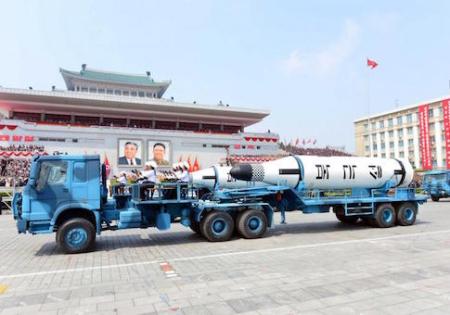
KN-11 launcher

The UN panel included a vague warning to China to stop its the missile-related transfers.

“The panel recalls and reaffirms its recommendation to member states on enhanced vigilance over the export of commercial vehicles that could be converted for military use,” the report said.

********************************

Chinese military support to North Korea’s missile programs included transfers of rocket transporters, according to a new report by a United Nations panel of experts.

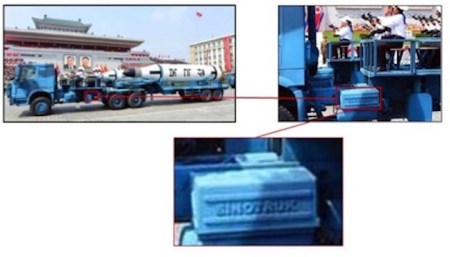
The report by the expert panel of the UN Security Council identified Chinese-origin trucks shown in a military parade last April carrying China’s new KN-11 submarine-launched ballistic missile.

“The trucks carried the ‘Sinotruk’ logo on the fuel tank and shared some identical features with the Sinotruk Howo 6×6 series trucks shown at the 10 October 2015 military parade,” the report said.

It is the second significant transfer of strategic missile technology from China identified by the panel.

In June 2013 the panel revealed the sale by China in 2011 of six to eight transporter erector launchers, known as TELs, that are now part of North Korea’s first road-mobile intercontinental ballistic missile system, the KN-08.

China claimed the KN-08 TEL vehicles were sold as lumber haulers. However, analysts said the 16-wheel launchers are too wide for logging roads. The launchers are made by the Sanjiang Special Truck Co. of the China Aerospace Science and Industry Corporation (CASIC).

An earlier UN report in April said Chinese electronic components were found in debris of a North Korean missile test that landed in the Sea of Japan in 2016.

The latest disclosure on Chinese military assistance to North Korea comes amid reports the regime of Kim Jong Un is rapidly developing long-range nuclear missiles while stepping up threats to fire them at American cities and territory.

Rep. Robert Pittenger (R., N.C.) said the report on Chinese support shows that China has not been a good faith partner to the United States on North Korea.

“We must continue to pressure the Chinese, via any means necessary, to ensure they correct their actions related to North Korea, human rights, illegal maritime claims, and a variety of other related national security concerns,” Pittenger said.

Rick Fisher, a military affairs analyst, said the Chinese assistance increased the threat to the United States.

“Let’s be clear, North Korea’s is able to wage surprise offensive nuclear strikes against the United States only because China has supplied the means for North Korea’s missiles to be mobile, to reach launch positions before the United States can strike them,” Fisher said.

“This is really is no less an outrage than Nikita Khrushchev’s supplying nuclear missiles to Fidel Castro’s Cuba,” he said. “Yet for over four years President Obama did not once publicly mention this Chinese outrage, and so far, neither has President Trump.”

Fisher, a senior fellow at the International Assessment and Strategy Center, said the report on Sinotruk vehicles carrying KN-11s provides new evidence of China’s covert role in assisting Pyongyang’s missile launch systems.

Other Chinese vehicles spotted with missiles in the April parade include what appeared to be a Sinotruk A7 tractor-trailer cab, seen carrying a new, unidentified North Korean medium-range missile. Mobile 300-millimeter precision-guided artillery rockets also were seen on the same Sinotruk vehicle as the KN-11. The artillery rockets were first paraded in 2015 and the Sinotruk carriers appeared upgraded in the April procession with a hardened grille.

The Chinese trucks were shown in videos and photos published by North Korean state media.

“Via Sinotruk, China is enabling North Korea to build larger tractor-trailer style TELs that in the future could perhaps transport multiple-warhead variants of its large, solid fuel ICBM,” said Fisher.

“Mobility will be crucial to the missions of North Korea’s new, large, solid-fuel ICBMs.”

Neither Sinotruk nor CASIC were included in recent sanctions announced by the Treasury Department imposed on 10 Chinese and Russian companies involved in illicit North Korean trade.

The UN report outlined some of the advances made by the North Koreans, including the first flight tests in February and July of new long-range missiles and new rocket engines, as well as the flight test of a Scud variant with a maneuvering warhead.

Maneuvering warheads are more difficult to track and shoot down with anti-missile interceptors.

The recent missile developments represent “a significant expansion and diversification of [North Korea] programs.”

“These new systems will allow the country to achieve greater range, responsiveness, reliability, and penetrating capabilities,” the report said.

The report said the second long-range Hwasong-14 ICBM tested on July 28 was “an improved version” of the missile tested on July 4.

The UN panel included a vague warning to China to stop its the missile-related transfers.

“The panel recalls and reaffirms its recommendation to member states on enhanced vigilance over the export of commercial vehicles that could be converted for military use,” the report said.

The UN also was urged to add the purchaser of the trucks, the Korea Daesong General Trading Corp., also known as the Korea Daesong Trading Co. No. 11, to be added to the list of sanctioned companies. A second company, Korea Kumsan Trading Corp., also was recommended for sanctions.

The report says the Chinese stated in response to UN inquiries that the missile carriers appeared similar to those made by the China National Heavy Duty Truck Group Co. (CNHTC) Ltd., also known as Sinotruk, that were exported to North Korea between 2010 and 2014.

According to the report, the Chinese defended the transfers as not prohibited under the Security Council embargo.

“Furthermore, in the sales contract, CHNTC explicitly requested the buyer to ensure the civilian use of the trucks,” the Chinese said.

China then claimed it could not confirm that the trucks seen in the parade, bearing the mark “Sinotruk” on the fuel tank, were produced by the Chinese companies because Beijing was not provided the vehicle identification numbers.

The report was published on Sept. 5, two days after Pyongyang detonated a large underground nuclear explosion. The report does not mention the nuclear test, North Korea’s sixth test blast.

The Security Council on Saturday voted to impose additional sanctions on North Korea, including a ban on Pyongyang’s largest export, coal.

However, the experts’ report said North Korea has easily evaded China’s restriction of coal purchases from North Korea.

North Korea “continued to violate sectoral sanctions through the export of almost all of the commodities prohibited in the [UN] resolutions, generating at least $270 million in revenue during the reporting period,” the report said.

After China suspended coal import in February, North Korea “has been rerouting coal to other member states including Malaysia and Vietnam, and has shipped coal through third countries,” the report said.

“The panel’s investigations reveal that the country is deliberately using indirect channels to export prohibited commodities, evading sanctions.”

To evade financial sanctions, Pyongyang stationed agents abroad that were able to conduct financial transactions for North Korean entities.

“Financial institutions in numerous member states wittingly and unwittingly have provided correspondent banking services to front companies and individuals of the Democratic People’s Republic of Korea engaged in prohibited activities,” the report said.

China was not named as the member state guilty of facilitating banking services for the North Koreans.

The report notes that North Korea “has made significant technological progress” in advancing its weapons of mass of destruction despite sanctions.

“The country also continues to flout the arms embargo and robust financial and sectoral sanctions, showing that as the sanctions regime expands, so does the scope of evasion,” the report said.

“For the first time in the history of the sanctions regime against the country, the use of a chemical warfare agent was reported by Malaysia, which accused [North Korea] of using VX [nerve agent] in the February 2017 assassination of Kim Jong Nam, reported to be Kim Jong Un’s half-brother, in Kuala Lumpur.”

What if South Korea acted like North Korea?

September 14, 2017

What if South Korea acted like North Korea? Washinton Times, Victor Davis Hanson, September 13, 2017

(One of VDH’s best articles, a thought experiment. — DM)

ANALYSIS/OPINION:

Visitors watch the North side from the unification observatory in Paju, South Korea, Wednesday, Sept. 13, 2017. South Korea said Wednesday it conducted its first live-fire drill for an advanced air-launched cruise missile it says will strengthen its pre-emptive strike.

[I]f China were in America’s position, we would have likely witnessed a tragically destructive war a long time ago.

China should make the necessary corrections now, before things get even worse.

*********************************

Think of the Korean Peninsula turned upside down.

Imagine if there were a South Korean dictatorship that had been in power, as a client of the United States since 1953.

Imagine also that contemporary South Korea was not the rich, democratic home of Kia and Samsung. Instead, envision it as an unfree, pre-industrialized and impoverished failed state, much like North Korea.

Further envision that the U.S. had delivered financial aid and military assistance to this outlaw regime, which led to Seoul possessing several nuclear weapons and a fleet of long-range missiles.

Next, picture this rogue South Korean dictatorship serially threatening to incinerate its neighbor, North Korea — and imagine that North Korea was ruled not by the Kim dynasty, but by a benign government without nuclear weapons.

Also assume that the South Korean dictatorship would periodically promise to wipe out Chinese cities such as Shanghai and Beijing. The implicit message to the Chinese would be that the impoverished South Koreans were so crazy that they didn’t care whether they, too, went up in smoke — as long a dozen of their nuclear-tipped missiles could blow up Chinese cities and paralyze the second-largest economy in the world. Assume that these South Korean threats had been going on without consequences for over a decade.

Finally, in such a fantasy scenario, what if the United States falsely claimed ignorance of much of its South Korean client’s nuclear capability and threats. America instead would plead that it regretted the growing tension and the reckless reactions of China to the nuclear threats against it. Washington would lecture China that the crisis was due in part to its support for its North Korean ally.

For effect, the United States would occasionally issue declarations of regret and concern over the situation — even as it warned China not to do anything to provoke America’s provocateur ally.

In such a fantasy, American security experts and military planners would gleefully factor a roguish nuclear South Korea into U.S. deterrent strategy. The Pentagon would privately collude with the South Korean dictatorship to keep the Chinese occupied and rattled, while the U.S. upped shipments of military weaponry to Seoul and overlooked its thermonuclear upgrades.

The American military would be delighted that China would be tied down by having an unhinged nuclear dictatorship on its borders, one that periodically threatened to kill millions of Chinese. South Korea would up the ante of its bluster by occasionally test-launching missiles in the direction of its neighbor.

Question: How long would China tolerate having weapons of mass destruction pointed at its major cities by an unbalanced tyrannical regime?

In response, would Beijing threaten a nuclear Seoul with a preemptory military strike, even though the Chinese would know that Seoul could first do a lot of nuclear damage?

Would China conclude that the United States was the real guilty party because it tacitly sanctioned South Korea’s possession of nuclear weapons?

Would China then warn the U.S. to pressure Seoul to disarm?

Would Beijing cease all trade with America?

Would China boycott, embargo or blockade South Korea?

Would China be furious that after ensuring that its own client, North Korea, remained non-nuclear and played by the rules, America had deliberately done exactly the opposite: empowering its dictatorial client, South Korea, to become a nuclear power in order to threaten China?

In other words, if China and North Korea found themselves in the same respective positions of current America and South Korea, the world may well have already seen a preemptive Chinese attack on Seoul to remove its nuclear capability.

The international community would already have seen China expel the conniving Americans from Chinese embassies, cut trade with the U.S., disrupt American banks and threaten the use of force against the U.S. mainland.

The truth of the North Korea missile crisis is not the boilerplate assumption that China is the key to the solution, but rather that China is by design the root of the problem.

China did not fail to realize that North Korea was developing a nuclear arsenal. Rather, it calculated that North Koreawould do exactly what it is now doing, and that such nuclear roguery would serve China’s strategic interests both on the Korean peninsula and in its rivalries with the United States and with America’s allies in Asia.

In other words, if China were in America’s position, we would have likely witnessed a tragically destructive war a long time ago.

China should make the necessary corrections now, before things get even worse.

• Victor Davis Hanson is a classicist and historian with the Hoover Institution at Stanford University.