Archive for the ‘Caliphate’ category

Imperialism, Obama style

December 20, 2014

Imperialism, Obama style, Dan Miller’s Blog, December 20, 2014

Obama condemns “wicked” U.S. imperialism for supporting American values such as freedom and democracy abroad. Simultaneously, he tries to precipitate “regime change” in Israel so that she will support His values and those of Palestinians rather than American and Israeli values of freedom and democracy.

The Palestinians have placed before the United Nations Security Council a “peace proposal” intended to force Israel to agree to creation of a Palestinian state and “an Israeli withdrawal to the pre-1967 lines” by the end of 2017. Secretary Kerry has argued that the matter should not be considered until after the Israeli Knesset elections in March. According to an article in Foreign Policy,

Speaking at an annual luncheon with the 28 European Union ambassadors, Kerry cautioned that any action by the U.N. Security Council would strengthen the hands of Israeli hardliners who oppose the peace process. . . . [Emphasis added.]

“Kerry has been very, very clear that for the United States it was not an option to discuss whatever text before the end of the Israeli election,” according to a European diplomat.

The diplomat, who spoke on condition of anonymity because the luncheon was confidential, said that Kerry explained that Israel’s liberal political leaders, Shimon Peres and Tipzi Livni, had expressed concern that a Security Council move to pressure Israel on the eve of election would only strengthen the hands of Israeli hardliners, including Prime Minister Benjamin Netanyahu, and Naftali Bennett, an implacable foe of a Palestinian state and leader of the right-wing Jewish Home party. Netanyahu is also fiercely opposed to the Palestinians effort to secure Security Council backing for its statehood drive. [Emphasis added.]

Kerry said Livni had “told him that such a text imposed by the international community would reinforce Benjamin Netanyahu and the hardliners in Israel,” as well as the hardliners in Palestine, according to the European diplomat.

The message, said another European diplomat, was that U.N. action would “give more impetus to more right-wing parties, that there was a risk this could further embolden the more right-wing forces along the Israeli political spectrum.” [Emphasis added.]

Kerry’s remarks highlight the Obama administration’s delicate balancing act when it comes to its tense relationship with the Israeli government. On the one hand, senior  administration officials make little attempt to hide the personal dislike between Netanyahu and President Barack Obama or their sharp disagreements on issues ranging from the peace process to Iran. On the other hand, Kerry and other top policymakers have tried to avoid saying or doing anything that could be seen as meddling in the Israeli election in an effort to oust Netanyahu and replace him with a more centrist prime minister. [Emphasis added.]

On an open microphone in March of 2012, Obama

told Dmitry Medvedev that he would have more flexibility after November’s election to deal with contentious issues such as missile defence. . . .

Obama’s candid remark was considered a gaffe because He made it assuming that the microphone had been turned off and that no one other than Medvedev would hear Him. Kerry, however, candidly but intentionally told twenty-eight European Union ambassadors that it is U.S. policy to encourage the Israeli left, to diminish the Israeli right and to make it more difficult for Prime Minister Netanyahu to remain in office. Aside from his incredible naivete, why did Kerry do that?

For Obama and European leaders, Israel is reducible to the peace process. And the Israeli left depends on the support of foreign governments for its network of foreign funded non-profit organizations. The Israeli left can’t let go of its exploding version of ObamaCare [Palestine] because the left is becoming a foreign organization with limited domestic support. Its electorate isn’t in Israel; it’s in Brussels. [Emphasis and bracketed insert added.]

. . . .

Escalating a crisis in relations has been the traditional way for US administrations to force Israeli governments out of office. Bill Clinton did it to Netanyahu and as Israeli elections appear on the horizon Obama would love to do it all over again.

There’s only one problem.

The United States is popular in Israel, but Obama isn’t. Obama’s spats with Netanyahu ended up making the Israeli leader more popular. The plan was for Obama to gaslight Israelis by maintaining a positive image in Israel while lashing out at the Jewish State so that the blame would fall on Netanyahu. [Emphasis added.]

Kerry’s remarks — covered by Israeli media — seem, contrary to his intentions, likely to enhance the chances of Israeli “hardliners” on the “right,” to hurt the chances of those on the left and hence to increase PM Netanyahu’s chances of remaining in office. Even leaving that aside, how will Kerry’s remarks favoring regime change be viewed by other increasingly reluctant U.S. allies in the Middle East?

Israeli “hardliners” have already yielded to the Palestinians as much as, if not more than, they can without greatly endangering the security of Israel because there is no Palestinian entity with which peace can be made other than through Israel’s suicide.

The remarks of the Islamic preacher at the mosque in Jerusalem reflect a general Palestinian view.

Interestingly, the speaker doesn’t mention the longing for Palestinian statehood or independence. Instead, he talks of the establishment of the “Islamic Caliphate.” “Oh Allah’” he states, “Hasten the establishment of the State of the Islamic Caliphate,” and further rants, “Oh Allah hasten the pledge of allegiance to the Muslim Caliph.” He spews forth the latter statement three times to chants of “Amen!” from the large, approving crowd congregating around him.

These comments, which would register horror and revulsion in the West (at least in some quarters) are almost banal among Palestinians. In fact, a similar video featuring a different speaker some days earlier at the same venue, conveyed identical sentiment, expressing admiration for the Islamic State and calling for murder of Jews and annihilation of America. [Emphasis added.]

Here’s the other video referenced in the article:

Guttural anti-Semitism is ingrained and interwoven in the fabric of Palestinian society. Despite their minuscule numbers, 78% of Palestinians believe that Jews are responsible for most of the world’s wars while a whopping 88% believe that Jews control the global media and still more believe that Jews wield too much power in the business world. [Emphasis added.]

Much of the blame for this can be placed squarely on the doorstep of Mahmoud Abbas’s Palestinian Authority, which subjects the Palestinian population to a steady diet of hate-filled, Judeophobic rhetoric through state-controlled media and educational institutions. It is so well entrenched that the process of deprogramming, if it were ever attempted, would take generations to reverse. [Emphasis added.]

As noted in the Wall Street Journal article linked in the quote immediately above,

To understand why peace in Palestine is years if not decades away, consider the Palestinian celebrations after Tuesday’s murder in a Jerusalem synagogue of five Israelis, including three with joint U.S. citizenship. Two Palestinian cousins armed with meat cleavers and a gun attacked worshipers during morning prayers, and the response was jubilation in the streets.

The Popular Front for the Liberation of Palestine claimed responsibility, while Hamas praised the murders as a “response to continued Israeli crimes.” The main obstacle to peace isn’t Jewish settlements in the multireligious city of Jerusalem. The barrier is the culture of hatred against Jews that is nurtured by Palestinian leaders. [Emphasis added.]

Palestinian Prime Minister Mahmoud Abbas condemned the killings, but not without calling for Israel to halt what he called “invasions” of the holy Al Aqsa Mosque in Jerusalem. Mr. Abbas has previously said the Temple Mount was being “contaminated” by Jews, despite assurances by Prime Minister Benjamin Netanyahu that the Dome of the Rock and Al Aqsa Mosque are for Muslim worship only. The Memri news service reports that the Oct. 29 issue of the Palestinian daily Al-Hayat Al-Jadida was full of false accusations that Israel is damaging Jerusalem’s holy sites. [Emphasis added.]

Moreover,

An overwhelming majority of Palestinian Arabs support the recent spate of terrorist attacks against Israelis, an opinion poll released Tuesday finds, according to The Associated Press (AP).[Emphasis added.]

The poll also found that more than half of Palestinian Arabs support a new “intifada” (uprising) against Israel, and that Hamas would win presidential elections if they were held today. [Emphasis added.]

Palestinian Arab pollster Khalil Shikaki said the results reflected anger over Israeli statements about Jerusalem, as well as a loss of hope following the collapse of U.S.-brokered peace talks and Israel’s recent war with Hamas in Gaza.

Shikaki heads the Palestinian Center for Policy and Survey Research, which interviewed 1,270 people in the Palestinian Authority-assigned areas of Judea and Samaria and Gaza last week. The poll had an error margin of 3 percentage points.

“There is an environment in which violence is becoming a dominant issue,” Shikaki told AP. “This seems to be one of the most important driving forces.”

Hamas is, if possible, even worse than Abbas’ Palestinian Authority.

Both Hamas and Abbas’ Palestinian Authority seek the death of Israeli Jews and the destruction of Israel, the only democratic and free nation in the Middle East. Kerry’s ill-conceived efforts to assist them at the expense of Israel, most recently by actively seeking to promote Israel’s left wing, to diminish its right wing and hence to empower Palestinians intent upon the death of Israel, may well fail. Succeed or fail, those efforts are consistent with Obama’s preference for Islamic dictators over democracy coupled with freedom.

Barack Mitsvah

The new Ottoman emperor

December 3, 2014

The new Ottoman emperor, Israel Hayom, Clifford D. May, December 3, 2014

[T]here is mounting evidence that weapons and fighters are crossing from Turkey into Syria, where they are delivered to Islamic State fighters. Turkish officials are turning a blind eye, or maybe even facilitating the traffic. Stolen oil is moving in the other direction, sold to raise cash for Islamic State. Inside Turkey, as well, Schanzer and Tahiroglu write, Islamic State has “established cells for recruiting militants and other logistical operations.” Last weekend, Turkey’s main Kurdish party accused the Erdogan government of allowing Islamic State fighters to attack the Syrian Kurdish town of Kobani from within Turkey.

******************

Turkey should have been part of the solution. Instead it has become part of the problem. The problem, of course, is the spread of jihadism throughout the Middle East, North Africa and beyond.

Turkish policies have been aiding and abetting the Nusra Front, an al-Qaida affiliate; the Islamic State group, which has turned large swaths of Syria and Iraq into killing fields; the Islamic Republic of Iran, still ranked by the U.S. government as the world’s leading sponsor of terrorism and well on its way to becoming nuclear-armed; and the Muslim Brotherhood, including Hamas, the group’s Palestinian branch.

Troubling, too, is the rhetoric we’ve been hearing from Turkish leaders. Turkish Science, Industry and Technology Minister Fikri Isık claimed last week that it was Muslim scientists who first discovered that the earth is round. Two weeks earlier, Turkish President Recep Tayyip Erdogan insisted that Muslim sailors reached the Americas 300 years before Columbus — only to find that well-established Muslims in Cuba had built a beautiful mosque.

Such myth-making might be dismissed as nothing more than attempts to play to Islamic pride. Less easy to excuse is Erdogan’s increasing xenophobia. “Foreigners,” he recently observed, “love oil, gold, diamonds, and the cheap labor force of the Islamic world. They like the conflicts, fights and quarrels of the Middle East.” He added that Westerners “look like friends, but they want us dead, they like seeing our children die. How long will we stand that fact?”

If Turkey were just another tin-pot dictatorship, none of this would much matter. But Turkey is a Muslim-majority (98 percent) republic with a dynamic economy (not dependent on the extraction of petroleum), a member of NATO (making it, officially, an American ally), and a candidate for membership in the European Union (though that possibility now appears remote).

Just three years ago, U.S. President Barack Obama listed Erdogan as one of five world leaders with whom he had especially close personal ties. He regarded the Turkish leader as a moderate, his interpreter of — and bridge to — the tumultuous and confusing Islamic world.

Today, as detailed in a new report by Jonathan Schanzer and Merve Tahiroglu, my colleagues at the Foundation for Defense of Democracies, Erdogan is refusing to allow the American-led coalition formed in August to launch strikes against Islamic State from Turkish soil.

Worse, there is mounting evidence that weapons and fighters are crossing from Turkey into Syria, where they are delivered to Islamic State fighters. Turkish officials are turning a blind eye, or maybe even facilitating the traffic. Stolen oil is moving in the other direction, sold to raise cash for Islamic State. Inside Turkey, as well, Schanzer and Tahiroglu write, Islamic State has “established cells for recruiting militants and other logistical operations.” Last weekend, Turkey’s main Kurdish party accused the Erdogan government of allowing Islamic State fighters to attack the Syrian Kurdish town of Kobani from within Turkey.

The FDD report cites numerous sources alleging that Turkey also has given assistance to the Nusra Front. To be fair: The Turkish government, like the Obama administration, seeks the fall of Syrian dictator Bashar Assad, satrap of the Islamic Republic of Iran. A Turkish official is quoted as saying that Nusra fighters are essential to that effort, adding: “After Assad is gone, we know how to deal with these extremist groups.”

Do they? Hamas is an extremist group and one of its top leaders, Saleh al-Arouri, has been permitted to set up his headquarters in Turkey. In August, Israel’s Shin Bet security agency said it had thwarted a Hamas-led plot to topple Palestinian Authority President Mahmoud Abbas — and that Arouri was behind it. Arouri also claimed responsibility — in the presence of Turkey’s deputy prime minister — for the kidnapping and murder of three Israeli boys in the West Bank early last summer, an act of terrorism that led to the 50-day war between Israel and Hamas in Gaza.

There’s more: credible allegations that Turkey has helped Iran’s rulers evade sanctions; the fact that Turkey imprisons more journalists than any other country; Erdogan’s comparison of Israelis to Nazis (guess which he regards as more “barbaric”); and his pledge to “wipe out Twitter. I don’t care what the international community says. They will see the Turkish republic’s strength.”

To understand what Turkey has become, it helps to know a little about what Turkey used to be. Istanbul was once Constantinople, a Christian capital of the ancient world. In 1453, it fell to the fierce armies of the Ottoman Empire and the Islamic caliphate. Islam’s political and religious leaders soon established the Sublime Porte, the central government of their growing imperial realm.

Almost 500 years later, in the aftermath of World War I, the empire collapsed and the caliphate was dissolved. Modern Turkey arose from the ashes thanks to the leadership of Mustafa Kamal Ataturk, a visionary general who believed that progress and prosperity could be achieved only by separating mosque and state. His goal was to make Turkey a nation, one as modern and powerful as any in Europe.

A century later, the world looks rather different. There are good reasons to believe Europe is in decline and America in retreat (these are disparate phenomena). While it may be delusional to believe that Columbus encountered Muslims in the Caribbean, it is not crazy to believe that, over the decades ahead, fierce Muslim warriors will profoundly alter the world order once more.

Viewed in this light, Erdogan looks like a neo-Ottoman, one who dreams of commanding Muslims — and those who have submitted to them — in many lands. If that’s accurate, the rift between Turkey and the West can only widen.

A Turkish Quest to “Liberate” Jerusalem

November 13, 2014

A Turkish Quest to “Liberate” Jerusalem, Gatestone InstituteBurak Bekdil, November 13, 2014

Both Turkey’s President Erdogan and its Prime Minister Davutoglu have declared countess times that Gaza and Jerusalem (in addition to Syria, Iraq, Egypt, Somalia, and the Maghreb) are Turkey’s “domestic affairs.”

In truth, there is no mention of any city’s name in the Qur’an.

Turks have a different understanding of what constitutes an occupation and a conquest of a city. The Turkish rule is very simple: The capture of a foreign city by force is an occupation if that city is Turkish (or Muslim) and the capture of a city by force is conquest if the city belongs to a foreign nation (or non-Muslims).

For instance, Turks still think the capture of Istanbul in 1453 was not occupation; it was conquest.

In a 2012 speech, President Recep Tayyip Erdogan (then Prime Minister) said: “Just like Mecca, Cairo and Istanbul are cities of the Qur’an.” In truth, there is no mention of any city’s name in the Qur’an. Never mind.

“Conquest,” Turkey’s top Muslim cleric, Professor Mehmet Gormez, declared in 2012, “is not to occupy lands or destroy cities and castles. Conquest is the conquest of hearts!” That is why, the top Turkish cleric said, “In our history there has never been occupation.” Instead, Professor Gormez said, “in our history, there has always been conquest.” He further explained that one pillar of conquest is to “open up minds to Islam, and hearts to the Qur’an.”

It is in this religious justification that most Turkish Islamists think they have an Allah-given right to take infidel lands by the force of sword — ironically, not much different from what the tougher Islamists have been doing in large parts of Syria and Iraq. Ask any commander in the Islamic State and he would tell you what the jihadists are doing there is “opening up minds to Islam, and hearts to the Qur’an.”

Both President Erdogan and Prime Minister Ahmet Davutoglu have declared countless times that Gaza and Jerusalem (in addition to Syria, Iraq, Egypt, Somalia and the Maghreb) are Turkey’s “domestic affairs.”

This author wrote in this journal on Oct. 30:

In reality, with or without the normalization of diplomatic relations between Ankara and Jerusalem, the Turks have never hidden their broader goals in the Arab-Israeli dispute: that Jerusalem should be the capital of a Palestinian state; and that Israel should be pushed back to its pre-1967 borders. Until then, it will be ‘halal’ [permitted in Islam] for Erdogan to blame Israel for global warming, the Ebola virus, starvation in Africa and every other misfortune the world faces.

As if to confirm this whimsical view, Deputy Prime Minister Yalcin Akdogan has blamed Israel for democratic failings in the Arab world. “Israel works with [undemocratic] regimes and keeps its ship afloat.” So, it is because of Israel that Arab nations have never established democratic culture — before or after 1948; or before or after the Arab Spring revolts. But fortunately, Palestinians have a new “protector.”

From Prime Minister Davutoglu’s public speech on November 7:

Al-Aqsa [mosque in Jerusalem] will one day be liberated. The Israelis should know that the oppressed Syrians have a protector. The oppressed Palestinians too have a protector. That protector is Turkey. Just as Bursa [the Turkish city where he spoke] ended its occupation, the honorable Palestinians, honorable Muslims will end the [Israeli] occupation. Just as Osman Gazi [a sepulchre in Bursa] was liberated, al-Aqsa too will be liberated. Al-Quds [Jerusalem] is both our first prayer direction and has been entrusted with us by history. It has been entrusted with us by Hazrat Omar. The last freedom seen in Jerusalem was under our [Ottoman] rule. Al-Quds is our cause. It is the occupying, oppressive Israeli government that has turned the Middle East into a quagmire.

Echoing that view, President Erdogan said that protecting Islamic sites in the Holy Land is a sacred mission (for his government), and bluntly warned that any attack against the al-Aqsa mosque is no different than an attack on the Kaaba in the holy city of Mecca.

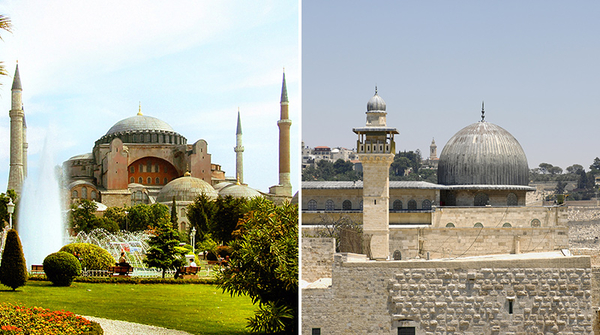
792Spot the difference: In the eyes of Turkey’s political and religious leadership, Istanbul and its Hagia Sophia (once a Greek Orthodox Basilica) were legitimately “conquered” by the Muslim Ottomans, while Jerusalem and its al-Aqsa mosque (built atop the ruins of the Jewish Temples) are illegally “occupied” by Israel. (Images source: Wikimedia Commons)

No doubt, after Gaza, al-Aqsa (and Jerusalem) has become a powerful Turkish obsession, and a treasure-trove of votes, especially in view of Turkey’s parliamentary elections next June. And do not expect the Turkish leadership only to corrupt facts. Plain fabrication is a more favored method. All the same, someone, sometimes, would unwillingly reveal the truth often when trying to corrupt other facts.

Since Davutoglu claimed that “Jerusalem has been entrusted with the Turks by Hazrat Omar,” it may be useful to refresh memories. Hazrat Omar is Omar bin Al-Khattab (579-644), one of the most powerful and influential Muslim caliphs in history. Within the context of “conquest vs. occupation,” he was referenced by the top cleric, Professor Gormez in a 2012 speech:

After Hazrat Omar conquered al-Quds [Jerusalem], he was invited to pray at a church [as there were no mosques yet in Jerusalem]. But he politely refused because he was worried that the [conquering] Muslims could turn the church into a mosque after he prayed there.

Since medieval historical facts cannot have changed over the past two years, the top Turkish ulama [religious scholar], referencing a most powerful Muslim caliph, is best witness that when the Muslims had first arrived in Jerusalem there was not a single mosque in the city. Why? Because Jerusalem was not a Muslim city. Why, then, do Turkish Islamists claim that it is Muslim? Because it once had been “conquered.” Would the same Turks surrender Istanbul to the occupying forces that took the city after World War I because its capture in 1920 made it a non-Turkish city? No, that was not conquest, that was occupation!

Had Messrs Erdogan and Davutoglu been schoolchildren, such reasoning might have been called bullying and cheating.

Inside The ISIS-Al Qaeda Merger Talks

November 11, 2014

Inside The ISIS-Al Qaeda Merger Talks, Daily BeastJamie Dettmer, November 11, 2014

(If Abu Bakr al-Baghdadi — the Islamic State leader whose disagreements with al Qaeda led to a split — is dead or otherwise out of the game, will that help to facilitate an Islamic State –  Jabhat al Nusra union? — DM)

The merger, if it comes off, would have major ramifications for the West. It would reshape an already complex battlefield in Syria, shift forces further against Western interests, and worsen the prospects for survival of the dwindling and squabbling bands of moderate rebels the U.S. is backing and is planning to train.

******************

U.S. airstrikes have helped drive ISIS and al Nusra together, and the Khorasan group is trying to cement the deal. The big losers: Everybody else—except Assad.

ISTANBUL—Jihadi veterans known collectively as the Khorasan group, which have been targeted in two waves of airstrikes by U.S. warplanes, are trying to broker an alarming merger between militant archrivals the Islamic State and Jabhat al Nusra, the official Syrian branch of al Qaeda.

The merger, if it comes off, would have major ramifications for the West. It would reshape an already complex battlefield in Syria, shift forces further against Western interests, and worsen the prospects for survival of the dwindling and squabbling bands of moderate rebels the U.S. is backing and is planning to train.

“Khorasan sees its role now as securing an end to the internal conflict between Islamic State and al Nusra,” says a senior rebel source. The first results are already being seen on the ground in northern Syria with a coordinated attack on two rebel militias favored by Washington.

All three of the groups involved in the merger talks—Khorasan, Islamic State (widely known as ISIS or ISIL), and al Nusra—originally were part of al Qaeda. Khorasan reportedly was dispatched to Syria originally to recruit Westerners from among the thousands of jihadi volunteers who could take their terror war back to Europe and the United States. But among ferocious ideologues, similar roots are no guarantee of mutual sympathy when schisms occur.

Current and former U.S. officials say they are unaware of any cooperation between ISIS and al Nusra, and they doubt that a merger or long-term association could be pulled off. “I find it hard to believe that al Nusra and Islamic State could sink their differences,” says a former senior administration official. “The rift between them is very deep,” he adds.

But senior Syrian opposition sources say efforts at a merger are very much under way and they blame Washington for creating the circumstances that make it possible. Moderate rebels accuse the Obama administration of fostering jihadi rapprochement by launching ill-conceived airstrikes on al Nusra while at the same time adamantly refusing to target the forces of Syrian President Bashar al-Assad in the U.S. military intervention in the region.

This, they say, has created the opening for a possible understanding between the jihadists and is creating sympathy for al Nusra. Other Islamist rebels and the wider population in insurgent-held areas in northern Syria question American motives and designs and remain furious at the U.S. decision not to help topple Assad.

“Al Nusra knows more airstrikes are coming, so why wait,” says an opposition source. If the Americans are going to lump them together with ISIS, maybe best to join forces. “What made the possibility of their coming together are the airstrikes.”

The opposition sources, who agreed to interviews on the condition they not be identified, warn that mounting cooperation between the two jihadist groups already is evident in specific operations.

Earlier this month, ISIS sent more than a hundred fighters in a 22-vehicle column to assist its onetime competitor, al Nusra, in the final assault on a moderate Islamist rebel alliance, the Syrian Revolutionaries Front, commanded by Jamal Maarouf in Idlib province.

The jihadis also targeted a secular brigade of insurgents, Harakat al-Hazm, which the U.S. has supplied with advanced anti-tank weaponry, because it tried to intervene and separate the SRF and al Nusra.

“Da’esh fighters weren’t really needed,” says one of the sources, “Al Nusra had sufficient numbers but the support given is highly symbolic.” (Da’esh is the Arabic acronym for ISIS.)

The coordination being claimed between the two groups would be the first time ISIS militants have cooperated with al Nusra since the winter ,when al Qaeda’s overall leader Ayman al-Zawahiri issued what seemed a definitive statement: “Al Qaeda announces that it does not link itself with [ISIS] … It is not a branch of the al Qaeda group, does not have an organizational relationship with it.”

The al Qaeda old guard and the ambitious ISIS leader Abu Bakr al-Baghdadi, who bristled at orders from Zawahiri, fell out over strategy and the attacks that his mainly foreign fighters were mounting against Syrian rebels. But the rift was, not least, a matter of personalities and egos. Al-Baghdadi has since attempted to declare himself the true leader of all true Muslims (by his lights) as the Caliph of the Islamic State. Zawahiri is not about to sign on to that.

Thus reports that al-Baghdadi may have been badly wounded or even killed in a U.S.-led coalition airstrike mounted last week near Mosul, while they may sound like good news for the coalition, could be even better news for the jihadis. Syrian rebel sources say al-Baghdadi’s elimination might well assist an agreement being struck between ISI and al Nusra.

The senior opposition sources say the coordination in the fight with the Syrian Revolutionaries Front was agreed on at a meeting held just west of Aleppo between representatives of the two jihadi groups and overseen by members of the Khorasan group.

U.S. intelligence agencies accuse the Khorasan veterans of plotting attacks against commercial airliners in the West. The U.S. targeted them with a wave of sea-launched cruise missiles on Sept. 23 and last week hit again with wide-ranging airstrikes on al Nusra positions as well, partly in a bid to hit the veterans. Several members of the group have been killed, but top leaders are still thought to have escaped the targeting and U.S. officials say they can’t confirm who has survived and who hasn’t.

There were representatives at the meeting from other hardline groups as well, such as Jund al-Aqsa, a jihadi offshoot, and Ahrar al-Sham, a group al Qaeda was instrumental in forming.

At the meeting a few nights before the final jihadi push against the SRF, which was attended by al Nusra leader Abu Mohammad al-Golani, the participants agreed, say opposition sources, that the Syrian Revolutionaries Front should be eliminated as an effective fighting force.

The assault on the weekend of Nov. 1 sealed weeks of battles between al Nusra and the SRF. The jihadis have now captured a series of towns and villages in Idlib province—Maarshorin, Maasaran, Dadikh, Kafr Battikh, Kafr Ruma, Khan al-Subul, and Deir Sunbul, Maarouf’s hometown. And al Nusra fighters have in recent days moved further north, coming within three miles of the important crossing on the Turkish border at Bab al-Hawa. The SRF has been left with virtually no territory.

Meanwhile, the secular Hazm movement was forced by al Nusra fighters to withdraw from its strongholds in Idlib, including Khan al-Subul, where it stored about 10 percent of its equipment. Hazm denies reports that jihad fighters managed to seize U.S.-supplied TOW anti-tank missiles, but concedes that al Nusra was able to secure 20 tanks, five of which were fully functional, six new armored personnel carriers recently supplied from overseas, and dozens of the group’s walkie-talkies, with the result that Hazm fighters elsewhere had to ditch their sets lest ISIS listen in.

(Some Hazm members bought the walkie-talkies themselves from Best Buy during a visit to the U.S.—suggesting that aside from TOW missiles the Obama administration has not been that generous in supplying the brigade.)


The Poison Tree

October 24, 2014

The Poison Tree, Washington Free Beacon, October 24, 2014

(Rather than chopping the tree down, we are watering and fertilizing it. — DM)

APTOPIX Mideast Israel USArab protesters wave Islamic flags in front of the U.S. embassy in Tel Aviv, Israel / AP

Six years into the Obama presidency, not only has the vocabulary of jihad been removed from official rhetoric and counterterrorism policy, but troops have been removed from Iraq, troops are withdrawing from Afghanistan, the administration has condemned Israeli settlement activity while coddling Hamas’ backers in Ankara and Doha, “torture” has been banned, the White House intends to close Guantanamo unilaterally, Hosni Mubarak was abandoned in favor of the Muslim Brotherhood, and the president is desperate for a partnership with the Islamic theocracy of Iran.

We must recognize the global and unitary nature of the threat. We must recognize that there is only one way to deal with a poison tree: You chop it down.

***************

Last month, addressing the U.N. General Assembly, Benjamin Netanyahu made a connection between the Islamic State and Hamas. These terrorist entities, Netanyahu said, have a lot in common. Separated by geography, they nonetheless share ideology and tactics and goals: Islamism, terrorism, the destruction of Israel, and the establishment of a global caliphate.

And yet, Netanyahu observed, the very nations now campaigning against the Islamic State treated Hamas like a legitimate combatant during last summer’s Israel-Gaza war. “They evidently don’t understand,” he said, “that ISIS and Hamas are branches of the same poisonous tree.”

The State Department dismissed Netanyahu’s metaphor. “Obviously, we’ve designated both as terrorist organizations,” said spokesman Jen Psaki. “But ISIL poses a different threat to Western interests and to the United States.”

Psaki was wrong, of course. She’s always wrong. And, after the events of the last 48 hours, there ought not to be any doubt as to just how wrong she was. As news broke that a convert to Islam had murdered a soldier and stormed the Canadian parliament, one read of another attack in Jerusalem, where a Palestinian terrorist ran his car over passengers disembarking from light rail, injuring seven, and killing 3-month-old Chaya Zissel Braun, who held a U.S. passport.

Islamic State, al Qaeda, Hamas—these awful people are literally baby killers. And yet they produce a remarkable amount of dissension, confusion, willful ignorance, and moral equivalence on the part of the men and women who conduct U.S. foreign policy. “ISIL is not ‘Islamic,’” President Obama said of the terrorist army imposing sharia law across Syria and Iraq. “Obviously, we’re shaken by it,” President Obama said of the attack in Canada. “We urge all sides to maintain calm and avoid escalating tensions in the wake of this incident,” the State Department said of the murder of a Jewish child.

“Not Islamic,” despite the fact that the Caliphate grounds its barbarous activities in Islamic law. “Shaken,” not stirred to action. “All sides,” not the side that targets civilians again and again and again. The evasions continue. They create space for the poison tree to grow.

The persistent denial of the ideological unity of Islamic terrorism—the studied avoidance of politically incorrect facts that has characterized our response to the Ft. Hood shooting, the Benghazi attack, the Boston Marathon bombing, the march of the caliphate across Syria and Iraq, and the crimes of Hamas—is not random. Behind it is a set of ideas with a long history, and with great purchase among the holders of graduate degrees who staff the Department of Justice, the National Security Council, Foggy Bottom, and the diplomatic corps. These ideas are why, in the words of John McCain, the terrorists “are winning, and we’re not.”

A report by Katherine Gorka of the Council on Global Security, “The Bad Science Behind America’s Counter-Terrorism Strategy,” analyzes the soil from which the poison tree draws strength. Since the Iranian revolution of 1979, Gorka writes, U.S. policymakers have faced a dilemma: “how to talk about Islam in a way that is instructive in dealing with Muslims who are enemies but not destructive to those who are friends.” For decades, the preferred solution has been to declare America’s friendship with Islam, and to distinguish between jihadists and everyday Muslims.

One of Gorka’s earliest examples of this policy comes from former Assistant Secretary of State Edward Djerejian, who said in 1992, “The U.S. government does not view Islam as the next ‘ism’ confronting the West or threatening world peace.” Similar assurances were uttered by officials in the Clinton administration, by Clinton himself, and by President George W. Bush. The policy was meant to delegitimize terrorism by denying the terrorists’ claim that they are acting according to religious precepts. “Policymakers believed that by tempering their language with regard to Islam, they might forestall further radicalization of moderate Muslims and indeed even potentially win moderates into the American circle of friendship.”

George W. Bush, Gorka notes, combined his rhetorical appeals to moderate Muslims with denunciations of the immorality of terrorism and illiberalism. And yet, for the government at large, downplaying the religious and ideological component to terrorist activities became an end in itself.

The Global War on Terror was renamed the “global struggle against violent extremism.” In 2008 the Department of Homeland Security published a lexicon of terrorism that said, “Our terminology must be properly calibrated to diminish the recruitment efforts of extremists who argue that the West is at war with Islam.” State Department guidelines issued in 2008 said, “Never use the terms jihadist or mujahedeen to describe a terrorist.”

Then came Obama. As a candidate, he stressed his experiences in Indonesia and Pakistan. He told Nick Kristof of the New York Times that the call of the muezzin is “one of the prettiest sounds on Earth at sunset.” In one of his first major addresses as president, he traveled to Cairo to inaugurate a new beginning with the Muslim world. His counterterrorism adviser, now director of the CIA, called jihad a “legitimate tenet of Islam,” and referred to Jerusalem as “Al Quds.”

The change in the manner in which the government treated Islamism was profound. “Whereas the 9/11 Commission report, published under the presidency of George W. Bush in July 2004 as a bipartisan product, had used the word Islam 322 times, Muslim 145 times, jihad 126 times, and jihadist 32 times,” Gorka writes, “the National Intelligence Strategy of the United States, issued by the Obama administration in August 2009, used the term Islam 0 times, Muslim 0 times, jihad 0 times.” The omission is stunning.

For Bush, terrorism consisted of immoral deeds committed by evil men animated by anti-Western ideology. Obama downplayed such judgmental language. He preferred an interpretation of terrorism as discrete acts of wrongdoing by extremists, driven by resentments and grievances such as the American failure to establish a Palestinian state, American support for secular Arab dictatorships, American forces in the Middle East, U.S. wars in Afghanistan and Iraq, the terrorist prison at Guantanamo Bay, and, infamously, an anti-Islamic YouTube video. “The logic that follows,” Gorka writes, “is that once those grievances are addressed, the extremism will subside.”

Some logic. Six years into the Obama presidency, not only has the vocabulary of jihad been removed from official rhetoric and counterterrorism policy, but troops have been removed from Iraq, troops are withdrawing from Afghanistan, the administration has condemned Israeli settlement activity while coddling Hamas’ backers in Ankara and Doha, “torture” has been banned, the White House intends to close Guantanamo unilaterally, Hosni Mubarak was abandoned in favor of the Muslim Brotherhood, and the president is desperate for a partnership with the Islamic theocracy of Iran.

The result? The Islamic State rules Mosul, threatens Baghdad, and has conquered half of Syria as Bashar Assad gasses the other half. Libya has collapsed into tribal warfare. Egypt has gone from military dictatorship to Islamic authoritarianism and back again. An Islamic strongman rules Turkey, Hamas murders with impunity, Al Jazeera broadcasts anti-American and anti-Semitic propaganda around the world, and the Taliban are biding time in Afghanistan. Not only is al Qaeda not on the run, it governs more territory than at any point since 2001. It is once again the “strong horse,” attracting jihadists to its crusade who inevitably turn their attention to the West.

“Without an ideological catalyst,” Gorka writes, “grievances remain merely grievances. They are dull and banal. They only transform into acts of transcendental violence when ignited by Sayyid Qutb or Osama bin Laden or Abu Bakr al Baghdadi. It is the narrative of Holy War that gives value to local grievances, not the other way around.” Before we can hope to “degrade and ultimately destroy” the Islamic State or the al Qaeda movement, we must recognize the poison tree of jihad for what it is. We must recognize the global and unitary nature of the threat. We must recognize that there is only one way to deal with a poison tree: You chop it down.

Syria tribal revolt against Islamic State ignored, fueling resentment

October 21, 2014

Syria tribal revolt against Islamic State ignored, fueling resentment, Washington PostLiz Sly, October 20, 2014

(Aside from responding to anticipated domestic political pressure after the (non-Islamic) Islamic State beheaded an American, what are we doing in Iraq and Syria and why? Are we trying to win hearts and minds, to maintain the semblance of a coalition of the unwilling or merely to do “something?” — DM)

“When you see your relatives being slaughtered, you will be forced to accept compromises you would otherwise never have been prepared to accept,” he said. “And when you see the world has abandoned you, you will do nothing about it.”

******************

The cost of turning against the Islamic State was made brutally apparent in the streets of a dusty backwater town in eastern Syria in early August. Over a three-day period, vengeful fighters shelled, beheaded, crucified and shot hundreds of members of the Shaitat tribe after they dared to rise up against the extremists.

By the time the killing stopped, 700 people were dead, activists and survivors say, making this the bloodiest single atrocity committed by the Islamic State in Syria since it declared its existence 18 months ago.

The little-publicized story of this failed tribal revolt in Abu Hamam, in Syria’s eastern Deir al-Zour province, illuminates the challenges that will confront efforts to persuade those living under Islamic State rule — in Iraq as well as Syria — to join the fight against the jihadist group, something U.S. officials say is essential if the campaign against the militants is to succeed.

The Abu Hamam area has now been abandoned, and many of the bodies remain uncollected, offering a chilling reminder to residents elsewhere of the fate that awaits those who dare rebel.

Just as powerful a message for those living under the militants’ iron fist was the almost complete international silence on the bloodbath.

(Please go to the link for a video — DM)

The fiercest fighting in days shook the Syrian border town of Kobane, forcing more refugees to pour into Turkey for shelter from the violence. (Reuters)

News of the massacre coincided with President Obama’s decision to order airstrikes to turn back an Islamic State advance unfolding farther east in Iraq, toward the Kurdish regional capital of Irbil, as well as humanitarian airdrops to help desperate Iraqi Yazidis trapped on a mountain by the onslaught.

Many Syrians in the opposition are starting to complain about unequal treatment.

U.S. warplanes have carried out more airstrikes on Islamic State forces besieging the Kurdish town of Kobane on Syria’s border with Turkey than on any other single location in Iraq or Syria. And Washington announced Sunday that U.S. planes had airdropped weapons and medical supplies to the beleaguered Kurdish fighters there.

Yet even now, Washington has directed little effort toward helping Sunni Arabs who want to fight the militants but lack the resources to do so, said Abu Salem, who was among the Shaitat tribesman and rebel commanders who gathered recently in an apartment in the Turkish border town of Reyhanli to recount the killings of their clansmen.

“We saw what the Americans did to help the Yazidis and the Kurds. But they have done nothing to help the Sunnis against the Islamic State,” he said.

Abu Salem and the other men said they did not so much begrudge the efforts to help Kurds as wonder why no one had helped them when their community was under attack. The carnage inflicted on the Shaitat tribe has instilled in the Abu Hamam survivors a loathing for the Islamic State and the warped brand of Islamist politics for which it stands, said Abu Siraj, another of the tribesmen. A former lawyer, he, like most of the men, asked to be identified only by his nom de guerre because he fears being tracked even to Turkey by the jihadists.

“Now we hate everyone who prays,” he said. “Now we hate even beards.”

But finding support for efforts to organize against the militants is proving hard, he said, pulling out his mobile phone to show a photograph released that day of the trussed, decapitated body of a friend who had purportedly been caught attempting to throw a hand grenade against them.

“When you see your relatives being slaughtered, you will be forced to accept compromises you would otherwise never have been prepared to accept,” he said. “And when you see the world has abandoned you, you will do nothing about it.”

U.S. officials say the Kobane attacks were not intended to show preference for one community over another, but rather served as an opportunity to take aim at the large number of militant fighters who converged on the town to capture it. The Pentagon claims to have killed hundreds of Islamic State militants around Kobane, in keeping with the wider U.S. goal of targeting the Islamists’ infrastructure and resources in Syria to downgrade their ability to reinforce and finance their operations in Iraq.

The primary focus of the American strategy, Gen. Lloyd Austin, the U.S. Central Command leader, stressed last week, remains on Iraq, and on preventing the Islamic State from projecting power there.

“Iraq is our main effort, and it has to be,” he said at a news conference in Washington. “And the things we are doing right now in Syria are being done primarily to shape the conditions in Iraq.”

Such comments have reinforced perceptions among Syrians that the U.S.-led air war does not have their interests at heart. Differences over the purposes and direction of the war risk alienating the many rebel groups that were engaged in battling the Islamic State before the U.S. government intervened, said Steven Heydemann of the U.S. Institute of Peace.

“It’s already become an impediment,” he said. “I don’t think the administration has fully taken on board how much damage the way they’ve conducted this campaign has done to the relationships they’ve developed with some of these actors.”

‘We were finished’

The Sunni areas of Syria occupied by the Islamic State would seem to be a more likely venue for a revolt than Iraq, where the extremists’ extensive territorial gains this year were aided by local Sunni insurgents and tribes alienated by the discriminatory behavior of the Shiite-led Iraqi government.

In Syria, however, the Islamic State’s conquests came at the expense of local rebels who already had fought to eject their government and then found themselves outgunned and outmaneuvered by the newly emerging Islamist extremists.

The Shaitat tribe, along with many others in the oil-rich province of Deir al-Zour bordering Iraq, spent much of this year battling to retain control of their area against encroachments by the Islamic State, and they might have prevailed had the Islamic State not swept into the Iraqi city of Mosul in June, rebels say. The vast amounts of U.S. weaponry the Islamic State captured were trundled across the rapidly dissolving border with Syria, said Abu Salem, who commanded a rebel battalion in the area before he escaped to Turkey.

“After they took Mosul, we were finished,” he said.

Abu Hamam and a cluster of villages nearby were targeted. After the new armaments from Iraq arrived, “we realized we had no hope. We were surrounded. We wanted to save our people,” said Abu Abdullah, another of the Shaitat fighters, describing how they agreed to a truce with the militants in mid-July.

The Islamic State was permitted to enter the town and establish a garrison, but local leaders were left in charge, he said.

Relations quickly frayed. The crunch came, the tribesmen in Reyhanli said, when Islamic State fighters whipped a local man who was caught smoking a cigarette in the street, a crime under the Islamic State’s harsh interpretation of Islam. The man’s brother, incensed, shot at a passing Islamic State patrol, killing one of its fighters.

The brother was arrested and publicly beheaded, triggering an outpouring of rage. Residents marched on the Islamic State’s headquarters, forcing its fighters to flee. The militants then brought in reinforcements and began shelling the town, using artillery they had captured the previous month in Iraq.

After a three-day barrage, the Islamic State militants moved in. They rounded up all the surviving men and boys older than 15 they could find and set about systematically killing them, the fighters in Reyhanli said.

A photo essay on an Islamic State blog boasted of the different ways tribesmen were killed, including beheadings, mass shootings and a crucifixion. A video shows how the militants lined up scores of captives on a road, their hands bound, then set about clumsily decapitating them, one by one. The executioners, speaking in Tunisian, Egyptian and Saudi accents, taunted those not yet dead by swinging severed heads in front of their faces and telling them, “It’s your turn next.”

The tribesmen in Reyhanli, like many other rebel fighters in Deir al-Zour now living in Turkey or elsewhere in Syria, said they managed to slip away using fake identity cards or escape routes honed during their battle against the government.

They said they are plotting their return, to take revenge and fight — without counting on international support.

“We are tribal people. We will never forget to avenge,” said Abu Salem, the commander of the group. “But we will do it by ourselves, in our own way. We won’t take any help from anyone.”

Guest Column: The Road from Qatar to the Gaza Strip

October 16, 2014

Guest Column: The Road from Qatar to the Gaza Strip, The Investigative Project on Terrorism, Reuven Berko, October 15, 2014

1073

Throughout its history, Hamas, like ISIS, has been committed to the concept of the global caliphate, which it plans to help construct by creating its own Islamic emirate on the ruins of the State of Israel.

****************

In a recent speech, Israeli Ambassador to the United Nations Ron Prosor mentioned the central role of Qatar in supporting international terrorist organizations. Money flowing from Qatar to Hamas, for example, paid for the terrorist attack tunnels dug from the Gaza Strip under the security fence into Israeli territory, and for the thousands of rockets fired at Israeli civilian targets in both the distant and recent past. In response, State Department spokesperson Marie Harf rushed to Qatar’s defense, claiming it had an important, positive role in finding a solution for the Israeli-Palestinian conflict.

Qatar’s funding for Islamist terrorist organizations all over the world is an open secret known to every global intelligence agency, including the CIA. It was exposed by Wikileaks, which clearly showed that funds from Qatar were transferred to al-Qaida. Qatar also funds the terrorist movements opposing the Assad regime in Syria, such as the Al-Nusra Front, encourages anti-Egyptian terrorism in the Sinai Peninsula and within Egypt itself, and is involved in Islamic terrorism in Africa and other locations. It accompanies its involvement in terrorism targeting Israel and Egypt (through the Muslim Brotherhood) with vicious and inflammatory propaganda on its Al-Jazeera TV channel.

Qatar also spends millions of dollars supporting the Islamic Movement in Israel, a branch of the Muslim Brotherhood headed by Sheikh Ra’ed Salah. The Islamic Movement is responsible for ongoing acts of provocation on the Temple Mount and in Judea and Samaria, and incites the entire Islamic world against Israel, claiming that the Jews are trying to destroy the Al-Aqsa mosque and replace it with the Jewish Temple. The incitement continued even as the Islamic Movement’s sister movement, Hamas, fired rockets at Jerusalem and endangered both the mosques on the Temple Mount and Jerusalem’s sites sacred to Judaism, Christianity and Islam.

As Qatar’s representative, the Islamic Movement, which has not yet been outlawed in Israel, contributed to Hamas what it could during Operation Protective Edge by instigating riots, blocking roads and seeking to foment a third intifada which, according to the plan, would be joined by Israeli Arabs to augment the deaths of thousands of Israelis killed by rockets and the mass murders through the attack tunnels planned for the eve of the Jewish New Year.

In his recent UN speech, Israeli Prime Minister Benjamin Netanyahu rebutted Palestinian Authority President Mahmoud Abbas’ accusations of Israeli “genocide” of the Palestinian people. He reminded his audience of Hamas’ use of Gazan civilians as human shields and of the rockets fired to attack specifically civilian Israeli targets. Unfortunately, he did not mention the Hamas charter, which calls for the murder of all the Jews. The fact that Abbas now heads a national consensus government in which Hamas is a full partner commits him to the slaughter of the Jewish people – a true genocide – and it is to the disgrace of the international community that such an individual was permitted to address the UN instead of being tried for war crimes.

In fact, the similarities between Hamas and ISIS are clearly stated in the Hamas charter, which defines Hamas as part of the Muslim Brotherhood’s global Islamic movement. One of its objectives is to fight “infidel Christian imperialism” and its Zionist emissaries in Israel in order to impose the Sharia, Islamic religious law, on the world. According to the charter’s paragraph 7, Hamas’ intention is to slaughter every Jew, as ordered by Muhammad and those who accept his legacy. That is the basis for the threat issued by ISIS “Caliph,” Abu Bakr al-Baghdadi, that under his leadership, Islam will “drown America in blood.”

Throughout its history, Hamas, like ISIS, has been committed to the concept of the global caliphate, which it plans to help construct by creating its own Islamic emirate on the ruins of the State of Israel. Since its founding, Hamas has attacked Israel and murdered thousands of its citizens exactly as ISIS has attacked and murdered “infidels.” They share the same slogans, with “There is no god but Allah” and “Allah, Prophet Muhammad” inscribed on their flags and headbands. Hamas terrorists have blown themselves up in Israel’s coffee shops, hotels, restaurants, buses, malls and markets, wherever there are large concentrations of civilians. The way Hamas executed suspected collaborators during the final days of Operation Protective Edge bore the hallmarks of the al-Qaida execution of Daniel Pearl and the ISIS beheading of James Foley and others.

In the decades during which Hamas has carried out a continual series of deadly terrorist attacks against Israel, wearing the same “Allah, Prophet, Muhammad” headbands as ISIS terrorists, the international community rarely voices its support for Israel, or takes into account that by defending itself Israel also defends the West, which has failed to understand that “political Islam” inspired by the Muslim Brotherhood was setting up shop in the free world’s backyard and that the ticking bomb was set to go off sooner than expected. The West has not clearly condemned Qatar for openly supporting Hamas and its terrorist activities against Israel or demanded that it stop.

While Israel responded to Hamas’ rocket attacks on civilian targets to keep thousands, if not tens of thousands, of Israeli civilians from being killed, the international community demanded “proportionality.” That requirement kept Israel from responding as it should have and encouraged Hamas to fire ever more rockets at “military targets” such as Tel Aviv and Jerusalem. When Israel built its security fence to keep Hamas suicide bombers from infiltrating into Israeli territory to blow themselves up in crowds of civilians, the international community opposed it, rushed to embrace the Palestinians’ vocabulary of “racism” and “apartheid,” and willingly played into the hands of Hamas and Abbas. This reaction occurred although Israel is the only truly democratic country in the Middle East, where Jews and Arabs can live in peace without “apartheid.”

Today President Obama says he “underestimated” the threat posed by ISIS, while Israel has been warning the world of extremist military Islam for at least a decade, as Netanyahu warned the world of a nuclear Iran in his UN speech.

The international community has been curiously silent about the genuine apartheid in the Arab states neighboring Israel. There, descendants of the original 1948 Palestinian refugees, by now in their fourth generation, still live in refugee camps, do not have citizenship, and are excluded from jobs and social benefits. Israel, however, absorbed hundreds of thousands of Jewish refugees, many of them destitute, who fled Europe and were expelled from the Arab countries when the state was founded, and were given citizenship and enjoy full rights, as do the Arabs who remained in Israel after the War of Independence.

Israel, which has nothing against the Palestinian people, would like to see the Gaza Strip rebuilt for both humanitarian reasons and to give Hamas something to lose. Radical Islamic elements around the globe, however, including Hamas, ISIS, al-Qaida, the Al-Nusra Front and Hizballah, all financed by Qatar, do not want to see the Israeli-Palestinian conflict resolved. They all have the same global agenda, based on fueling the conflict to unite Islam around it, under their leadership.

Therefore, Qatar continues to support global Islamic terrorism. On Sept. 13, Qatar paid the Al-Nusra Front a ransom of $20 million to free abducted UN soldiers from Fiji. The world praised Qatar for its philanthropy, but in effect, it was a brilliant act of manipulation and fraud, both filling the Al-Nusra Front’s coffers and representing itself as the Fijians’ savior. Qatar is using the same underhanded trick in the Gaza Strip. After sending Hamas millions of dollars to fund its anti-Israeli terrorist industry, itpledged $1 billion to help rebuild the Gaza Strip during last weekend’s conference in Cairo.

While the world hopes Operation Protective Edge was the last round of Palestinian-Israeli violence, senior Hamas figures reiterate their position of gearing up to fight Israel again. Not one Hamas leader is willing to agree to a full merger with the Palestinian Authority to establish a genuine unified Palestinian leadership. Hamas rejects even the idea of disarming or demilitarization as part of an agreement to rebuild the Gaza Strip and promote the peace process. Unfortunately, no one has suggested it as a pre- condition for any U.S. dollars that will be contributed to the reconstruction of Gaza.

All that is left now is to hope that the billions of dollars poured into the Gaza Strip for its rebuilding will be accompanied by the disarmament of Hamas and the establishment of an honest mechanism for overseeing the money and materials Egypt and Israel allow into the Gaza Strip. It is imperative that they not be diverted to rebuild Hamas’ terrorist infrastructure and tunnels, or to bribe UNRWA officials to look the other way, as has happened so often in the past. There is every indication that only Hamas and Qatar know whether there is anything to justify that hope.

Dr. Reuven Berko has a Ph.D. in Middle East studies, is a commentator on Israeli Arabic TV programs, writes for the Israeli daily newspaper Israel Hayom and is considered one of Israel’s top experts on Arab affairs.

Islamic State, Al-Qaeda, Islam and Iran

October 10, 2014

(Please listen to this twenty-two minute interview with Clare M. Lopez. She highlights Iran’s central involvement and the benefits it receives. — DM)


Muslim Leaders Sign Letter Against ISIS, But Endorse Sharia

October 1, 2014

Muslim Leaders Sign Letter Against ISIS, But Endorse Sharia, Clarion ProjectRyan Mauro, October 1, 2014

(Abdullah Bin Bayyah is among the “moderate” Islamists signing the letter. He was noted favorably in Obama’s September 24, 2014 address to the UN General Assembly. — DM)

Islamic-State-Stoning-From-Dabiq-Magazine-IP_0A picture of a the sharia punishment of stoning from the Islamic State’s Dabiq magazine (Issue #2)

A published letter to the Islamic State (ISIS)  signed by 126 international Muslim leaders and scholars, including top American leaders, is getting major press for rebutting the theological arguments behind the actions of Islamic State. Unfortunately, the same letter endorsed the goal of the Islamic State of rebuilding the caliphate and sharia governance, including its brutal hudud punishments.

Point 16 of the letter states, “Hudud punishments are fixed in the Qu’ran and Hadith and are unquestionably obligatory in Islamic Law.” The criticism of the Islamic State by the scholars is that the terrorist group is not “following the correct procedures that ensure justice and mercy.”

The Muslim “moderates” who signed the letter not only endorsed the combination of mosque and state; they endorsed the most brutal features of sharia governance as seen in Iran, Saudi Arabia and elsewhere.

An example of a hudud punishment is the death penalty for apostates (Muslims who leave Islam). The letter does not dispute or oppose that. It says that labeling Muslims as apostates is only permissible when an individual “openly declares disbelief.”

The signatories are not condemning the execution of apostates, only how the Islamic State is deciding who qualifies as an apostate.

Point 7 states that Islam forbids the killing of diplomats, journalists and aid workers, but it comes with a very important exception.

“Journalists—if they are honest and of course are not spies—are emissaries of truth, because their job is to expose the truth to people in general,” it reads.

This is actually an endorsement of targeting journalists that Muslims feel are unfair. Islamists, including Islamic State supporters, often claim that the journalists they kill are propagandists and/or spies, meeting the letter’s standards.

Point 22 of the letter states, “There is agreement (ittifaq) among scholars that a caliphate is an obligation upon the Ummah. TheUmmah has lacked a caliphate since 1924 CE. However, a new caliphate requires consensus from Muslims and not just from those in a small corner of the world.”

A caliphate is a pan-Islamic government based on sharia; virtually all Islamic scholars agree that this objective requires the elimination of Israel. It is also fundamentally (and by definition) expansionist.

Again, the “moderate” signatories endorse the principles of the Islamic State and other jihadists but criticize their implementation.

Point 5 states, “What is meant by ‘practical jurisprudence’ is the process of applying Shari’ah rulings and dealing with them according to the realities and circumstances that people are living under.”

It continues, “Practical jurisprudence [fiqh al-waq’i] considers the texts that are applicable to peoples realities at a particular time, and the obligations that can be postponed until they are able to be met or delayed based on their capabilities.”

This is an endorsement of the Islamist doctrine of “gradualism.” This is an incremental strategy for establishing sharia governance, supporting jihad and advancing the Islamist cause.

The Islamic Circle of North America (ICNA), whose leader is a signatory of the letter, preaches this concept in its own publications. An ICNA teaching guide published by the Clarion Project preaches gradualism as its strategy for implementing sharia governance and resurrecting the caliphate.

ICNA’s manual directs Muslims to use deception and infiltrate the government. The gradualist strategy is part of a jihad that includes war with the ultimate goal of conquering the world.

A weakness in the letter is the vague terminology that gives room for terrorist groups like Hamas to justify their violence.

For example, point 8 states that “Jihad in Islam is defensive war. It is not permissible without the right cause, the right purpose and without the right rules of conduct.”

The letter goes into detail about these qualifications in order to condemn the tactics of the Islamic State, but the terms of a “defensive war” are not spelled out. All Islamist terrorists consider their attacks “defensive.”

Muslim-American activist Michael Ghouse pointed out the need for clarification in a conversation with me about the letter. He said:

“Define the right cause. Is fighting against India in Kashmir a jihad? Was the war between Iraq and Iran two decades ago a jihad? This group needs to continue to update these situations to let the common Muslim know what is right and what is wrong, lest he commits himself to the jihad.

Islamists regularly redefine words like “clear disbelief,” “democracy,” “justice,” “peace” and “terrorism” on their own terms. The use of subjective language like “innocents,” “mistreat,” “defensive” and “rights” leave much room for interpretation.

This is what enabled a terrorism-supporting cleric named Sheikh Abdullah Bin Bayyah to sign the letter. He is linked to the Muslim Brotherhood, has called for attacks on U.S. soldiers in Iraq, supports Hamas and seeks the destruction of Israel.

The Islamist leaders behind the anti-Islamic State letter are still endorsing Islamic sharia law, which is oppressive and incompatible with Western values. The implementation of sharia is what drives all Islamic extremism.

The letter also utilizes Islamist thinkers that formed the intellectual foundation for today’s extremism. For example, it cites Ibn Taymiyyah. Terrorism expert Atto Barkindo writes, “Some scholars suggest there is probably no other Islamic theologian, medieval or otherwise, who has had as much influence on radical political ideology of Islam as Ibn Taymiyya.” This includes the leaders of Al Qaeda.

Ghouse told the Clarion Project that sharia as encoded by such scholars, needs revising. “Classical texts that are referred to in the list are part of the problems,” Ghouse said. “We need to make a commitment to question and revise the exegeses of the Ulemas [scholars] like Ibn-Kathir, Ibn Taymiyyah, Maududi, Hassna al-Banna and others. We cannot equate them to Quran and Hadith.”

The letter does make a much-needed rebuttal to the murdering of diplomats, noncombatants, labeling of Yazidis as apostates, attacks on Christians, forced conversions and torture. It states that Arab Christians are exceptions to the “rulings of jihad” because of “ancient agreements that are around 1400 years old.”

The letter also does tries to persuade Muslims to reject the Islamic State because of its tactics and procedures; however, it reinforces the Islamist basis of those actions.

Far from proving that the Muslim-American signatories are “moderate,” the letter actually exposes them as Islamist extremists because of their endorsements of sharia governance, its brutal hudud punishments and the resurrection of the caliphate.

These 18 leaders include:

Al Qaeda official warns against Islamic State in new speech

September 27, 2014

Al Qaeda official warns against Islamic State in new speech, Long War Journal, Thomas Joscelyn, September 27, 2014

“We call to restore the rightly-guided Caliphate on the prophetic method, and not on the method of deviation, lying, breaking promises, and abrogating allegiances – a caliphate that stands with justice, consultation, and coming together, and not with oppression, infidel-branding the Muslims, killing the monotheists, and dispersing the rank of the mujahideen,” al Basha says, according to SITE’s translation.

Although al Basha does not mention the Islamic State by name, his description of al Qaeda’s proposed caliphate is intended to undermine al Baghdadi’s claim to power. Al Basha’s reference to “abrogating allegiances” is probably a reference to the oath of allegiance (bayat) that Abu Bakr al Baghdadi swore to Ayman al Zawahiri and then broke.

**********************

A senior al Qaeda official, Muhammad bin Mahmoud Rabie al Bahtiyti, also known as Abu Dujana al Basha, has released a new audio message seeking to undermine the Islamic State, which was disowned by al Qaeda’s general command in February.

Al Basha’s speech was released by al Qaeda’s official propaganda arm, As Sahab, on Sept. 26. It was first obtained and translated by the SITE Intelligence Group.

Al Qaeda’s senior leaders have not directly addressed the Islamic State’s claim to rule over a caliphate stretching across large portions of Iraq and Syria. Instead, they have sought to undermine the Islamic State’s ideological legitimacy in a variety of more subtle ways. (Other parts of al Qaeda’s international network have specifically rejected the Islamic State’s caliphate claim.)

Al Basha does not name the Islamic State, but his speech is clearly aimed at the group and its supporters.

Al Basha sets forth al Qaeda’s goals, saying the group is dedicated “to the oneness of Allah … as we call to disbelieve the tyrant and disavow polytheism and its people.” Al Basha says al Qaeda seeks “to establish the absent Shariah and empower this religion.”

It is often claimed, wrongly, that al Qaeda is interested only in attacking the West, or carrying out mass casualty attacks. But the organization has repeatedly stated that its jihadists seek to create societies based on their radical version of sharia law. Al Qaeda wants to build Islamic emirates, or states, based on this sharia. It is for this reason that most of al Qaeda’s resources since its founding have been devoted to waging insurgencies against governments in the Muslim-majority world that it deems to be corrupt.

Imposing sharia and creating Islamic emirates are steps to al Qaeda’s ultimate stated goal, which al Basha explains.

“We call to restore the rightly-guided Caliphate on the prophetic method, and not on the method of deviation, lying, breaking promises, and abrogating allegiances – a caliphate that stands with justice, consultation, and coming together, and not with oppression, infidel-branding the Muslims, killing the monotheists, and dispersing the rank of the mujahideen,” al Basha says, according to SITE’s translation.

Although al Basha does not mention the Islamic State by name, his description of al Qaeda’s proposed caliphate is intended to undermine al Baghdadi’s claim to power. Al Basha’s reference to “abrogating allegiances” is probably a reference to the oath of allegiance (bayat) that Abu Bakr al Baghdadi swore to Ayman al Zawahiri and then broke.

Al Qaeda-allied jihadists have argued against the Islamic State’s caliphate claim, saying it was imposed on Muslims and even jihadists without consultation. And this is a theme in a Basha’s speech.

In al Qaeda’s ideological schema, the caliphate can be resurrected only after respected jihadists give it their seal of approval. Al Baghdadi’s organization has tried to impose its caliphate throughout much of Iraq and Syria, frequently fighting with other jihadist organizations, including the Al Nusrah Front, al Qaeda’s official branch in Syria. Leading jihadist ideologues have criticized Baghdadi’s caliphate on this basis, as well as for other reasons.

Al Basha warns against “extremism,” which, ironically enough, is one of al Qaeda’s key charges against the Islamic State. In Syria and elsewhere, al Qaeda has been attempting to portray itself as a more reasonable jihadist organization. Because the Islamic State refuses to consult with other Muslims and jihadist groups, not just in creating a caliphate, but also in other matters, al Qaeda accuses the group of pursuing an extremist path. Of course, al Qaeda is extremist by any reasonable standard, and has spilled more Muslim than non-Muslim blood throughout its existence. Still, because of the Islamic State’s excessive violence, particularly in Syria, al Qaeda has been marketing itself as a more mainstream jihadist organization.

Al Basha addresses the jihadists’ rank and file, urging them to avoid joining the Islamic State and subtly encouraging Baghdadi’s fighters to defect from his army. Al Basha openly worries that the jihad in Syria has been squandered because of the infighting between the groups opposed to Bashar al Assad’s regime. Al Qaeda blames the infighting on the Islamic State.

“I address my speech and my advice to my brothers on the frontlines in Sham [Syria] among those who have been deceived by slogans and titles, to use your heads and have insight, and to weigh the matters fairly,” al Basha says. “Rescue the ship of jihad, and reach it before it deviates from its course and settles on the path of the people of desires. Strive to turn off the sedition and restore cohesion among the mujahideen.”

At the end of his audio speech, al Basha addresses those jihadists who disapprove of al Qaeda’s understated response to the Islamic State’s caliphate claim. Al Basha says that he and others wanted to defend al Qaeda emir Ayman al Zawahiri’s reputation against the Islamic State’s slanders, but Zawahiri ordered them not to.

“The Sheikh [Zawahiri] ordered his brothers to be silent and not protect his honor,” al Basha says. “He considered that out of concern for the benefit of this Ummah [Muslim community], and a hope that Allah will fix the condition, and that the sedition will be suppressed.”

Al Qaeda’s leaders and branches have repeatedly urged the jihadists in Syria to reconcile. However, their efforts have been fruitless.

Veteran al Qaeda leader

Al Basha has taken on a more prominent and public role for al Qaeda in recent years. In December 2013, he argued that jihad is necessary to implement sharia law in Egypt. In late August he issued a statement urging followers to strike American and Israeli interests in support of Muslims in Gaza.

Although al Basha was not initially a public persona for al Qaeda, he was well-known to US counterterrorism officials for years. In January 2009, the US Treasury Department designated al Basha as an al Qaeda terrorist, noting that he was Zawahiri’s son-in-law. Al Basha was located in Iran at the time.

Treasury found that he “served on an al Qaeda military committee and provided military training that included urban warfare tactics for al Qaeda members.” Among other duties, al Basha “drafted training manuals for al Qaeda as well as a book on security that was used as a template for al Qaeda’s surveillance operations.”

Al Basha is a longtime member of Egyptian Islamic Jihad as well as al Qaeda, and was reportedly involved in al Qaeda’s 1995 bombing of the Egyptian Embassy in Islamabad, Pakistan.

Zawahiri tasked al Basha with moving members of Zawahiri’s family to Iran after the Sept. 11, 2001 terrorist attacks.