Archive for the ‘BDS’ category

Obama Won’t Enforce Anti-BDS Provision Language in Trade Bill he just Signed

July 1, 2015

Obama Won’t Enforce Anti-BDS Provision Language in Trade Bill he just Signed, The Jewish PressLori Lowenthal Marcus, July 1, 2015

(To enforce the anti-BDS provisions of the legislation Obama just signed would be Islamophobic. Or something. — DM)
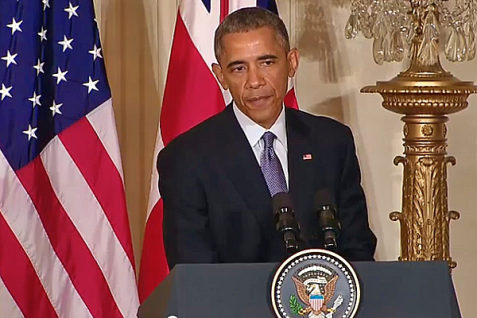
Obama (1)U.S. President Barack Obama Photo Credit: WhiteHouse.Gov screen capture

This week the United States officially put on notice its trade partners that it will not countenance boycotts or other economic warfare against Israel.

After signing the relevant trade legislation into law, however, the White House signaled to all its trade partners that they are still free to boycott goods made in the disputed territories, despite the clear language of the legislation the president signed.

This week the Trade Promotion Authority bill was passed by Congress and signed into law by President Barack Obama.

The TPA is primarily focused on international trade between the U.S. and Europe. It also included a section which addresses trade between the U.S. and Israel.

That part of the legislation, the U.S.-Israel Trade and Commercial Enhancement Act, bans boycotts and other means of economic warfare against Israel or the “Israeli-controlled territories.” This amendment, introduced by Rep. Peter Roskam (R-Ill-6) with bi-partisan co-sponsorship, was unanimously adopted into the PTA in April.

The passage of the TPA, including the anti-BDS section, should sound a death knell for the BDS (Boycott of, Divestment from and Sanctions against Israel) Movement. It should.

However, as pro-Israel Americans and Israelis learned only a few weeks ago in the Jerusalem passport case (Zivotofsky v. Kerry), there are certain spheres of international decision making over which the president has exclusive, or at least primary and controlling, control. Obama claims that international trade is one of those areas, even though Article 1, Section 8, clause 3, expressly gives Congress the power to regulate foreign commerce.

So even though the TPA is intended to act as a strong deterrent to European and other countries to pass and enforce boycotts of Israeli products, the White House has already signaled that it will not extend its protection to any goods produced in the disputed territories.

The anti boycott of Israel language in the TPA is: “actions by states, nonmember states of the United Nations, international organizations or affiliated agencies of international organizations that are politically motivated and are intended to penalize or otherwise limit commercial relations specifically with Israel or persons doing business in Israel or in Israeli-controlled territories.” [emphasis added.]

In a statement which Matt Lee of the Associated Press attributed to State Dept. spokesperson John Kirby, the administration made clear that despite signing the TPA, the position of the White House remains, as it has been, that the U.S. opposes boycotts of the State of Israel, but it also opposes the presence of Jews in the disputed territories of Judea and Samaria and the Golan Heights.

In the statement the administration argues that by “conflating Israel and ‘Israeli-controlled territories’ a provision of the Trade Promotion Authority legislation runs counter to longstanding U.S. policy towards the occupied territories, including with regard to settlement activity,” and says that every U.S. administration has opposed “settlement activity.”

It goes on to point out that the “U.S. government has never defended or supported Israeli settlements and activity associated with them and, by extension, does not pursue policies or activities that would legitimize them.”

The U.S. administration announced that it will not jeopardize the holy grail of the two-state solution by enforcing the U.S. law as written and which its leader signed. In the statement it claims that “both parties have long recognized that settlement activity and efforts to change facts on the ground undermine the goal of a two-state solution to the conflict and only make it harder to negotiate a sustainable and equitable peace deal in good faith.” It is on this basis, ostensibly to promote a peaceful solution to the Arab-Israeli conflict, that this administration

Professor Eugene Kontorovich of the Northwestern University School of Law analyzes several other provisions of the U.S-Israel trade aspect of the TPA which have been largely overlooked. In particular, Kontorovich points out, U.S. courts cannot recognize or enforce the judgment of any foreign court “that doing business in or being based in the West Bank or Golan Heights violates international law or particular European rules.”

Who Is Blocking Palestinian Elections?

June 4, 2015

Who Is Blocking Palestinian Elections? The Gatestone InstituteKhaled Abu Toameh, June 4, 2015

  • Fatah is afraid that Hamas’s chances of winning the elections, especially in the West Bank, are very high. Hamas is not willing to relinquish control over the Gaza Strip, certainly not to Abbas and the Palestinian Authority, who were expelled from there in 2007.
  • Each party cares only about its own interests, while at the same time lying to the world that it is all Israel’s fault. Hamas continues to invest enormous resources in digging new tunnels, in preparation for a new war with Israel.
  • All this is being done with the help of anti-Israel governments around the world, and groups such as the Boycott, Divestment and Sanctions (BDS) movement, whose only goal is to delegitimize Israel and demonize Jews rather than to help the Palestinians.

One year after Palestinian Authority (PA) President Mahmoud Abbas announced the establishment of the Palestinian Fatah-Hamas “national consensus” government, the two rival parties remain as far apart as ever.

The “national consensus” government, headed by Prime Minister Rami Hamdallah, was formed after a series of “understandings” between Fatah and Hamas on the basis of previous “reconciliation” agreements between the two sides.

A year later, it has become obvious that the “national consensus” government has failed to achieve its main objectives: the reconstruction of the Gaza Strip; ending the conflict between Hamas and Fatah, and preparing for new presidential and parliamentary elections.

Fatah and Hamas can only blame each other for the failure of the latest attempt to end their dispute and do something good for their people. There is no way this time that they could lay the blame on Israel.

The two parties had a chance to cooperate on the reconstruction of the Gaza Strip in the aftermath of last year’s military confrontation between Israel and Hamas. The international community even offered to assist in the mission, but Fatah and Hamas chose to continue fighting each other at the expense of Palestinians in the Gaza Strip. Until today, the two rival Palestinian parties have not been able to reach agreement on a mechanism for the transfer of funds from international donors to the Gaza Strip.

Fatah claims that Hamas wants to steal the money, while Hamas is already accusing Fatah and the Palestinian Authority government of working to lay their hands on the funds.

Fatah and Hamas agreed back then that the Hamdallah government would remain in office for only six months — the period needed to prepare for long overdue presidential and legislative elections in the West Bank and Gaza Strip. But the “interim” government has just completed its first year in power, while the chances of holding new elections under the current circumstances are non-existent.

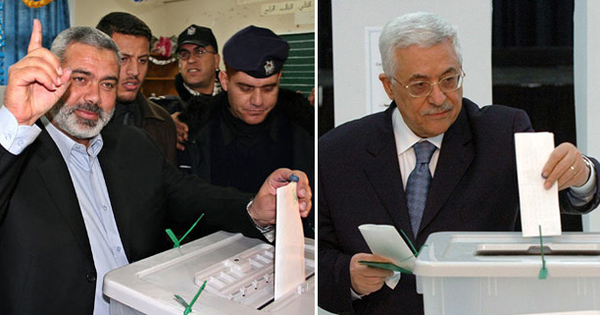
1096One man, one vote, one time? Hamas leader Ismail Haniyeh (left) and Fatah leader Mahmoud Abbas (also president of the Palestinian Authority) are pictured voting in the last election for the Palestinian Legislative Council, which took place in 2006.

Again, the two sides do not seem to be interested at all in sending Palestinians to the ballot boxes. Each side has many good reasons to avoid holding new elections in the West Bank and Gaza Strip.

First, Fatah and Hamas do not trust each other, and each side is convinced that the other would try to steal the vote. How can there be free and democratic elections while Hamas and Fatah continue to arrest and torture each other’s supporters in the Gaza Strip and West Bank?

Second, Fatah is afraid that Hamas’s chances of winning the elections, especially in the West Bank, are very high. That is because many Palestinians still do not trust Abbas and Fatah, whom they accuse of maintaining close security ties with Israel. Moreover, many Palestinians remain disillusioned with Fatah because of its failure to combat financial and administrative corruption and pave the way for the emergence of new leaders.

There is no way that Hamas and Fatah can cast the blame on Israel regarding the issue of elections. If they were really interested in holding new elections, they could do so with the help of the international community, as was the case with previous votes in 2005 and 2006. Israel even helped the Palestinian hold those elections.

When several Hamas candidates from east Jerusalem ran in the January 2006 parliamentary election, Israel did nothing to stop them. Israel even opened its post offices in the city to allow Arab voters from the city (who hold Israeli-issued ID cards) to vote in the election.

Charges made by some Palestinians and anti-Israel groups around the world, to the effect that Israel is responsible for “foiling” efforts to achieve Palestinian unity, are baseless. Although the Israeli government initially opposed the Fatah-Hamas “reconciliation” deal that was reached in 2014, it has not stopped the Palestinian prime minister and some of his cabinet members from visiting the Gaza Strip to pursue the implementation of the accord. In fact, Prime Minister Hamdallah has since visited the Gaza Strip twice, after receiving permission from Israel to go through the Erez border crossing.

Recently, ten Palestinian ministers were forced to leave the Gaza Strip, after Hamas placed them under house arrest in their hotel and banned them from meeting with locals. The ministers entered the Gaza Strip through the Erez border crossing. They came to the Gaza Strip to help solve the problem of thousands of Hamas government employees who have not received salaries for more than a year, and to discuss issues related to the reconstruction of the Gaza Strip.

So while Israel facilitated the visits by Hamdallah and his ministers to the Gaza Strip, it was Hamas that expelled them and prevented them from carrying out their duties. Had Israel expelled the ministers from the Gaza Strip or stopped them from entering the area, the country would have been condemned by the international community for “blocking” efforts to achieve Palestinian unity and rebuild the Gaza Strip.

Today, it has become unavoidably clear that Fatah and Hamas, and not Israel, are responsible for the ongoing plight of the Palestinians in the Gaza Strip. The two parties are unlikely to resolve their differences in the near future, further exacerbating the misery of their people. Each party cares only about its own interests, while at the same time lying to the world that it is all Israel’s fault. Hamas is not willing to relinquish control over the Gaza Strip, certainly not to Abbas and the Palestinian Authority, who were expelled from there in 2007. As for Abbas, he does not seem to be interested in regaining control over a problematic area such as the Gaza Strip, where most of the population lives under the poverty line and in refugee camps.

Yet instead of being honest with their people and admitting their failure to improve their people’s living conditions, Hamas and Fatah continue to wage smear campaigns against each other and, at the same time, also against Israel.

The campaigns that Hamas and Fatah are waging against Israel, particularly in the international community, are designed to divert attention from their failure to provide their people with basic services or any kind of hope.

While ignoring the plight of the Palestinians in the Gaza Strip, the Palestinian Authority leaders were prepared to invest huge efforts and resources in trying to have Israel suspended from the International Federation of Association Football (FIFA). It is as if the Palestinians had solved all their major problems and all that they needed to do now was to stop Israeli soccer players from playing in international matches.

Hamas, for its part, continues to invest enormous resources in digging new tunnels, in preparation for another war with Israel. The money that is being invested in the tunnels and the purchase and smuggling of weapons could benefit many families who lost their homes during the last war. But Hamas, like the Palestinian Authority, does not care about the misery of the Palestinians in the Gaza Strip. They want to fight Israel to the last Palestinian. And this is all being done with the help of anti-Israel governments around the world, and groups such the Boycott, Divestment and Sanctions (BDS) movement, whose only goal is to delegitimize Israel and demonize Jews rather than to help the Palestinians.

