Archive for the ‘Baghdad’ category

800,000-strong Shiite militia calls for formal recognition by Baghdad

January 18, 2015

800,000-strong Shiite militia calls for formal recognition by Baghdad, RUDAW, January 18, 2015

(RUDAW is a Kurdish media network. Hezbollah was conceived by Muslim clerics and funded by Iran following the Israeli invasion of Lebanon in 1982. From the inception of Hezbollah to the present, the elimination of the State of Israel has been one of Hezbollah’s primary goals. [Footnotes omitted.] — DM)

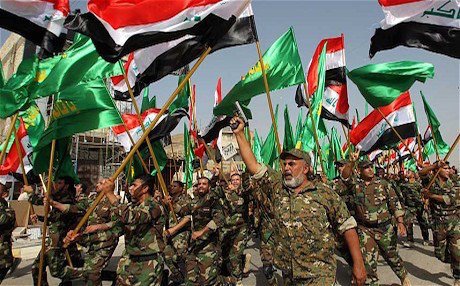
97644Image1Thousands of Shiite men responded to a call for jihad after ISIS stormed across Iraq in June and captured a third of the country. AFP photo.

BAGHDAD, Iraq – The leader of Iraq’s Hezbollah met with Shiite clerical authorities in Najaf Sunday to discuss formal recognition of hundreds of thousands of militiamen by the government and putting them on official payroll, a Hezbollah statement said.

Sheikh Abbas al-Mahmadawi, leader of the Shiite militia group Hezbollah, said that he met with Shiite clerics in Najaf, including Ayatollah Muhammad Saeed al-Hakim, to seek recognition “for the success of the militia groups in the fight against the Islamic State (ISIS).”

Al-Mahmadawi added that the Shiite volunteer militia should be recognized by the authorities and compensated financially “because many of them do not have any salaries and many have been wounded and handicapped.”

According to al-Mahmadawi, there are 800,000 volunteer Shiite fighters in Iraq who joined the fight against ISIS last June.

But he added that “the numbers have been inflated by some political parties” by more than double.

“We do not have any such numbers on the ground which is put down as 2 million volunteers,” he said in a statement following his visit to Najaf.

Al-Mahmadawi hoped that Baghdad would put the Shiite militia on its payroll now that the country is about to pass this year’s budget.

Thousands of Shiite men responded to a call for jihad against ISIS by Iraq’s Grand Ayatollah Ali Sistani last year, when the extremist Sunni group captured Mosul and made a lightening advance towards Baghdad and important Shiite shrines.

A great number of Shiite militiamen are based in the towns of Jalawla and Saadiya, north of Diyala, which they jointly liberated from ISIS in November.

Local residents, mainly the Kurdish population, have remained apprehensive about returning to their homes for fear of the armed militia groups, which operate outside government control and have been accused by Sunnis of acting as vigilantes.

On Saturday, Iraq’s parliament speaker Salim al-Jibouri met with Kurdish leaders in Sulaimani on forming a joint committee to facilitate the return of displaced peoples to Jalawla and Saadiya.

Meanwhile, around 200 tribal and political figures in Diyala met on Saturday to discuss normalizing the situation in the province after some of the fiercest battles between ISIS and a joint force of Peshmerga and Shiite militia groups.

Encircling Baghdad: The Country that Became a City-State

November 11, 2014

Encircling Baghdad: The Country that Became a City-State, Gatestone InstituteLawrence A. Franklin, November 11, 2014

(Please see also ISIS Expected to Take Aim at the ‘Baghdad Belt’ and Analysis: ISIS, allies reviving ‘Baghdad belts’ battle plan. — DM)

The goal of the Islamic State might be to create enough chaos in the capital city of Baghdad to cause a mass exodus of its Shia population southward, thus ceding Baghdad to the Sunnis by default.

Is it still possible to salvage if not Iraq, at least Baghdad? Sunni Muslim troops, led by ISIS (now the so-called Islamic State, or IS) and fighting against the Iraqi government, have virtually surrounded Baghdad. Iraq’s largest province, al-Anbar, is almost totally occupied by anti-regime forces. Only a portion of Fallujah remains outside of occupation by the IS-led forces. After the IS took over the city of Hit, regular Iraqi units fell back into a defensive posture at al-Asad, the largest military facility in Anbar. Several key population centers to the north and northeast have also fallen, and there is still heavy fighting around the oil refineries of the northern city of Baiji.

IS’s gains north of Baghdad last month prompted U.S. aircraft bombing sorties. Since June, the central government also has lost ground east of the capital; Diyala Province barely remains under Shia control. After the collapse of government forces in Hillah, south of the capital, and IS’s mid-June seizures of Iskandariyah and Mahmoudiyah, barely six miles south of the Baghdad, routes to Iraq’s Shia heartland have also now been jeopardized.

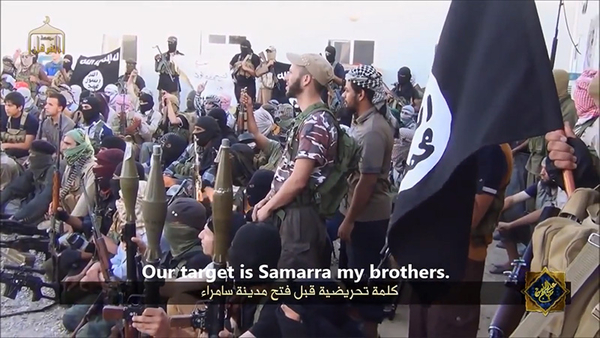
786Islamic State fighters receive a pre-battle briefing and sermon before their attack on Samarra, 125km north of Baghdad.

While the fall of the capital is certainly not imminent, IS’s strategy appears clear. Opposition forces will likely continue to tighten the noose around Baghdad in an attempt to create a sense of isolation. IS will avoid, for now, any large-scale assault on Baghdad for three reasons: it does not have the manpower; Shia militias outnumber enemy forces and will fight zealously to keep the Shia in control of the capital; and a major attack might cause remaining U.S. ground forces to become actively involved in the conflict.

One indicator that American forces might join the fight in a more serious way, if Baghdad appeared truly threatened, was the Pentagon decision on October 12 to employ Apache Attack helicopters against IS forces when they approached Baghdad International Airport. This week, on November 8, U.S. President Barack Obama also approved sending up to 1,500 more U.S. troops to Iraq, although stressing that that “would not be in combat.” The increase would raise the number of U.S. troops in Iraq to just under 3,000, or about eight times fewer than likely needed to re-salvage Iraq.

Meanwhile, fighting has come within two miles of the capital, with IS taking Abu Ghraib.

At present, the IS-led Sunni coalition appears determined to inculcate a feeling of despair among the capital’s Shia citizenry. The daily suicide bombing attacks in Shia neighborhoods must be taking a psychological toll. The suicide bombers are foreign fighters, mostly from North Africa. In the past few months alone, they have killed hundreds of Shia citizens. The operational planners of these assaults apparently know the layout of the capital, a familiarity that suggests they may have been former Baath Party military officers under the reign of Saddam Hussein.

The daily roadside bombs and car bombs are adding to the concern that the security situation in the capital is spiraling out of control. Moreover, there can be little doubt that some within the Sunni neighborhoods are giving logistical and intelligence support to the encircling IS. That intelligence certainly appears to have been available in the October 14 targeted killing of Baghdad’s pro-Iranian commander of the Badr Brigade, Ahmad al-Khafaji. Additional pro-Sunni elements probably have established a network of safe houses to support enemy infiltrators.

The day that the fate of Iraq as a united state irrevocably turned toward disintegration occurred in December 2013, when the largely Shia security forces stormed the Sunni protest camp in Anbar Province’s capital of Ramadi. Not even those tribal sheikhs who may have hoped for reconciliation with the Shia-led regime could reverse the process of permanent alienation. After former Iraqi Vice President Nouri al-Maliki’s fall from power on August 14, newly installed Prime Minister Haider al-Abadi has fared no better. Moreover, he seemingly has even less influence within the governing Shia coalition than al-Maliki originally possessed. He has moved too slowly, it seems, to reach out to Sunnis. Furthermore, with IS at the gates of Baghdad, the new administration did not name a new Minister of Defense and Interior until October 17.

The goal of IS’s siege strategy may be to create enough chaos in Baghdad to cause a mass exodus of its Shia population southward to the Shia provinces of Najaf and Karbala, thus ceding Baghdad to the Sunnis by default.

The US War Against ISIS Is Barely Degrading, Certainly Not Destroying The Militants

October 25, 2014

The US War Against ISIS Is Barely Degrading, Certainly Not Destroying The Militants, International Business Times , October 24, 2014

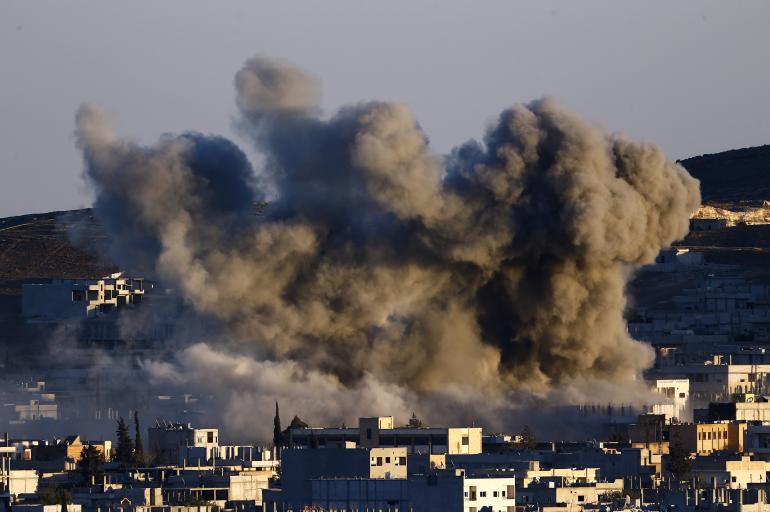
kobaneSmoke rises over Syrian town of Kobani after an airstrike, as seen from the Mursitpinar crossing on the Turkish border, Oct. 21, 2014. Reuters/Kai Pfaffenbach

The U.S.-led air campaign in Syria has killed 521 Islamic State fighters in the past month, according to the Syrian Observatory for Human Rights, a group monitoring the civil war. But the heavy death toll does not mean the United States is winning its fight to “degrade and destroy” the Sunni extremist group. Experts say that won’t happen until the group also known as ISIS loses support and its fighters begin defecting. 

“Until that happens, we will not see a quantum shift in the war in Iraq and Syria,” said Wayne White, a former deputy director of the State Department’s Bureau of Intelligence and Research’s Office of Analysis for the Near East and South Asia.

Since June, ISIS has gained control of large swaths of land that stretch from Kobani on the Syrian-Turkish border to the outskirts of Baghdad. The group is currently waging campaigns in several different areas of both countries, but has focused its forces in recent weeks on capturing the Kurdish city of Kobani. As a result, the U.S.-led air campaign has targeted several ISIS convoys and strongholds in Kobani and is air-dropping weapons and other resources to the Syrian Kurds fighting there.

“Like many aerial campaigns you can cite from history, it is a gradual process,” White said. “ISIS has a finite number of heavy weapons, and they are being picked off. And ISIS is losing a lot of combatants that are not easily replaced. ISIS is driven to expand its domain, and every time it tries to expand it is putting its fighters out in the open where they can be taken out. The question is: How long will the degrading take until you get to the destruction … a long time.”

Witnesses on the ground in Kobani told International Business Times that ISIS had been pushed back from the center of the city, but that the fighting was still raging on the outskirts. Meanwhile, ISIS is making gains in other parts of Syria and in Baghdad. According to the Syrian Observatory, ISIS fighters seized Tal Shaer, a town just west of Kobani, this week. And in Baghdad, the Sunni militant group has claimed responsibility for several car and suicide bomb attacks that have killed dozens of people in the last two weeks.

The uptick in ISIS attacks since June in Iraq has not only caused hundreds of civilian deaths, but has also infiltrated the psyche of the Iraqi people, especially those living in the capital, Noof Assi, a woman from Baghdad, told the International Business Times.

At the beginning of the ISIS campaign, “Baghdad looked like a ghost city,” Assi said. “People were staying at home or fleeing, saving food and fuel.”

Now, she said, people in Baghdad are used to the ISIS insurgency. Discussions in shops, cafes and restaurants have shifted. No longer are Iraqis talking about the destruction that ISIS is inflicting on the country. Now, people are talking about how many people are beginning to support the militant group.

“There are people talking about people of Mosul,” she said of the big northern city. “Some people are saying that they betrayed Iraq and welcomed ISIS.”

The State Department and White House have both confirmed that part of the U.S. strategy to fight ISIS is to undercut its propaganda and recruitment, especially on social media. So far, though, the U.S. has not launched a successful countercampaign.

In September, the State Department produced and distributed a graphic mock Islamic State propaganda video via social media. The video, “Welcome to ISIS Land,” was published by the State Department’s Center for Strategic Counterterrorism Communications.

The mock video showed graphic images of the militant group committing war crimes that have been widely reported over the past two months and that are now being investigated by the United Nations. The video looks similar to those ISIS promotes on social media like Twitter and YouTube. Despite the counterpropaganda drive, ISIS continues to expand on social media, and more and more Western fighters, as well as Iraqi and Syrian civilians, are joining up.

While some experts say the only way the U.S. will defeat ISIS is by sending in ground troops, others say more credit should be given to the Syrian Kurdish fighters — who now seems to be only force on the ground in Iraq and Syria that is regaining territory ISIS took over in prior months.

“They are the only boots on the ground in the entire Iraqi-Syrian theater capable of standing up to ISIS,” White said. “They are absolutely fierce fighters. The Iraqi Kurds are not.”

The War on ISIS: More Than One Battle

October 23, 2014

The War on ISIS: More Than One Battle, Wall Street Journal,  Max Boot, October 22, 2014

Kobani no longer looks to be in imminent danger of falling. It is even possible that ISIS will give up the fight and pull out. If this happens, it will certainly be good news. The remaining residents of Kobani would be saved from slaughter and their relief would give a moral boost to anti-ISIS efforts. But any celebration should be muted. Winning at Kobani will be no more devastating to ISIS than was the American victory at Khe Sanh to North Vietnam.

The problem is that ISIS can readily replace the fighters it loses in Kobani, and heavy weapons are not essential to its guerrilla style of warfare. Even as ISIS is losing a little ground at Kobani, it is gaining strength elsewhere.

Only 12 U.S. advisory teams have been deployed and only at the brigade level. The other 14 Iraqi brigades identified by the U.S. as “reliable partners” have no advisers at all. None of these advisers, moreover, is allowed to accompany Iraqi troops into combat, where they can be most effective. The U.S. also is not stepping in to offer direct assistance and training to the Sunnis of Anbar Province to allow them to fight back against ISIS, as they did against al Qaeda in Iraq in 2007-08.

Through the limited application of air power—a mere handful of daily strikes—the U.S. may achieve tactical progress to blunt ISIS’s momentum. But Khe Sanh showed the limits of tactical military victories if they are not married to larger strategic gains—and those are elusive in Iraq and Syria today

********************

On Jan. 21, 1968, North Vietnamese troops attacked the U.S. Marine garrison at Khe Sanh in South Vietnam near the border with Laos. A 77-day siege ensued, with the U.S. pouring in ever more firepower. The U.S. would drop 100,000 tons of bombs because Gen. William Westmoreland was determined that Khe Sanh not become another defeat like Dien Bien Phu, which had effectively ended France’s colonial presence in Vietnam 14 years earlier.

And it didn’t. Eventually the siege was relieved and the attacking forces melted away, having suffered more than 5,000 fatalities (while the defenders lost about 350 men).

Today, no one except some veterans and military historians remembers Khe Sanh because in the end it had scant strategic significance: Even though the U.S. won the battle, it lost the war. Not long after having “liberated” Khe Sanh, the U.S. dismantled the base because it served little purpose.

This history is worth mentioning because of the parallels, limited and inexact to be sure, between Khe Sanh and Kobani, a Kurdish town in northern Syria. Jihadist forces of Islamic State, also known as ISIS, have been besieging Kobani for weeks, and the U.S. has been ramping up efforts to prevent the town from falling. U.S. airstrikes have apparently taken a heavy toll, eliminating ISIS fighters, artillery, armored vehicles and other heavy weapons. Airstrikes have now been joined by airdrops of weapons and ammunition to the Kurdish defenders. Turkey, which had hitherto not lifted a finger to save Kobani, announced Monday that it would allow Iraqi Kurdish fighters to traverse Turkish territory to join in defending the town.

Kobani no longer looks to be in imminent danger of falling. It is even possible that ISIS will give up the fight and pull out. If this happens, it will certainly be good news. The remaining residents of Kobani would be saved from slaughter and their relief would give a moral boost to anti-ISIS efforts. But any celebration should be muted. Winning at Kobani will be no more devastating to ISIS than was the American victory at Khe Sanh to North Vietnam.

The problem is that ISIS can readily replace the fighters it loses in Kobani, and heavy weapons are not essential to its guerrilla style of warfare. Even as ISIS is losing a little ground at Kobani, it is gaining strength elsewhere.

Its fighters are advancing in Anbar Province with little resistance. They are poised on the outskirts of Baghdad; soon they may be within mortar range of Baghdad International Airport, whose closure would be a disaster. On Monday alone, its car bombs and suicide bombers in Baghdad and Karbala claimed at least 33 lives, a day after a suicide bomber in Baghdad killed at least 28 people in a Shiite mosque. The pattern is reminiscent of the terrorist atrocities perpetrated in 2006 by al Qaeda in Iraq, ISIS’s predecessor, aimed at rallying Sunnis to the terrorists’ side by provoking a civil war with Shiites.

As in those dark days, Sunni extremism is provoking an equally extreme response from Iranian-backed Shiites. The replacement of Nouri al-Maliki as Iraq’s prime minister with Haidar al-Abadi, an apparently less sectarian Shiite, was a small step in the right direction for which the Obama administration deserves credit. But there is little reason to think the Iranian hold over a substantial portion of the Iraqi state has been broken.

The Iraqi Parliament has approved ministers to run the two security ministries—Interior and Defense. While the Defense pick is Sunni technocrat Khalid al-Obedi, the Interior pick is far more worrisome: Mohammed Salem al-Ghabban is a member of the Badr Organization, one of the chief Iranian-backed Shiite militias that is further destabilizing Iraq with attacks on Sunni neighborhoods. The likelihood is that Mr. Ghabban will take orders from his ultimate sponsor, Gen. Qasem Suleimani, head of Iran’s Quds Force.

This means that the Interior Ministry, in charge of Iraq’s police forces, will become, if it is not already, a wholly owned subsidiary of the Shiite militias and their Iranian string-pullers. This happened in 2006 when the Iraqi police became notorious for kidnapping and torturing Sunnis. This helped bring Iraq to the brink of all-out civil war and will do so again if not checked.

The only way to counteract the Iranian capture of the Interior Ministry is to bolster the Iraqi army as an independent fighting force, but there is little sign of this occurring. Shiite sectarians have also deeply penetrated the army and the U.S. has little ability to counteract this insidious development because President Obama will not send a large number of “embedded” advisers to work alongside army units that remain more professional and less politicized.

Only 12 U.S. advisory teams have been deployed and only at the brigade level. The other 14 Iraqi brigades identified by the U.S. as “reliable partners” have no advisers at all. None of these advisers, moreover, is allowed to accompany Iraqi troops into combat, where they can be most effective. The U.S. also is not stepping in to offer direct assistance and training to the Sunnis of Anbar Province to allow them to fight back against ISIS, as they did against al Qaeda in Iraq in 2007-08.

In Syria the U.S. is also doing little to oppose the Assad dictatorship, leaving it free to continue attacks on areas held by moderate militias affiliated with the Free Syrian Army. This, too, is feeding the radicalization of Syria and Iraq by convincing many Sunnis, rightly or wrongly, that the U.S. is acquiescing to Iranian regional domination—and that ISIS is the only reliable defender that Sunnis have. That impression will be strengthened if the Obama administration reaches a deal with Iran next month that will allow Tehran to maintain its capacity to develop a nuclear weapon.

Through the limited application of air power—a mere handful of daily strikes—the U.S. may achieve tactical progress to blunt ISIS’s momentum. But Khe Sanh showed the limits of tactical military victories if they are not married to larger strategic gains—and those are elusive in Iraq and Syria today.

US Embassy in Baghdad Shelled With Rockets: Reports

October 22, 2014

US Embassy in Baghdad Shelled With Rockets: Reports, RIANOVISTI, October 22,2014

(Please see also BREAKING: Reports Say ISIS Hits US Embassy in Baghdad with Mortars for background information. — DM)

Embasy BaghdadThe US Embassy in Iraq located in central Baghdad has been shelled with rockets.

BAGHDAD, October 22 (RIA Novosti) – The US Embassy in Iraq located in central Baghdad has been shelled with rockets, Al-Mustakillah news agency reported Wednesday citing a security source.

“On Tuesday night the US Embassy was hit with three rockets. They were fired from a park area in the Dora district [in southern Baghdad],” the agency’s source said.

Earlier on Tuesday, Al-Sumaria TV channel reported a mortar shelling of the so-called “green zone” in the center of the capital, housing government buildings and foreign missions. Security forces surrounded the area to repel a potential attack.

Peshmerga head speaks of struggle against IS

October 18, 2014

Peshmerga head speaks of struggle against IS, Al-Monitor, Faraj Obaji, October 17, 2014
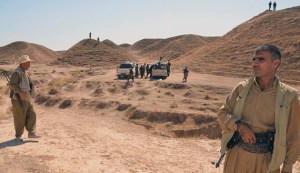
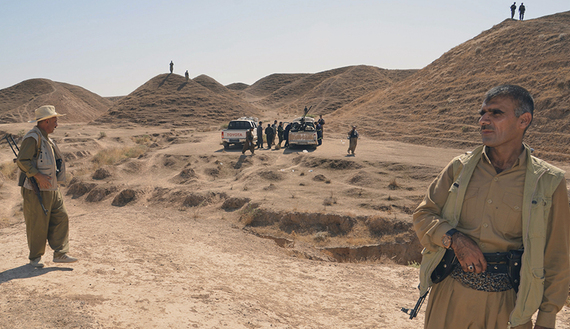
Kurdish peshmerga fighters stand guard around vehicles left behind by fleeing Islamic State militants during clashes in the al-Zerga area near Tikrit cityKurdish peshmerga fighters stand guard around vehicles with weapons and ammunition left behind by fleeing Islamic State militants during clashes in the al-Zerga area near Tikrit city in Salahuddin province, Oct. 8, 2014. (photo by REUTERS)

Commenting on the criticism of certain Kurdish parties inside Kobani, regarding the lack of support provided by KRG to the besieged city, he said, “Despite the differences with certain Kurdish political parties in the city, the KRG expressed its readiness to support our brothers in the city and we asked Washington and its allies to help the resisting Kurdish fighters.

“We helped them as much as possible, and the KRG’s president affirmed this. But, we cannot offer more. We are still waiting for international aid. The region initially includes 5 million people, add to that one and a half million displaced from Syria and the Iraqi provinces. We are helping them and taking care of them, and this is a huge burden.”

******************

Eliminating the Islamic State (IS) in Iraq does not seem to be an easy mission that will happen anytime soon; it seems rather impossible. The terrorist attacks against Iraq exposed how weak the Iraqi army is, how fragile its military structure and intelligence services are, and how it is unable to protect its country against any attack.

Some believe that the responsibility of the army’s failure to fight IS should be borne by the political authority ruling the country since 2004, which was unable to build an army based on a unified doctrine. Others consider the policies adopted by former Prime Minister Nouri al-Maliki faulty and the maliciousness allowed the terrorist group to enter the country, while the political conflicts between the central government and the Sunni leaderships provided an embracing environment for the group in Sunni provinces.

Secretary-General of the Ministry of Peshmerga Lt. Gen. Jabbar Yawar spoke to An-Nahar regarding the situation in Iraq in general, and in the Kurdistan Regional Government (KRG) in particular, in light of the IS threat, which occupied a number of Iraqi provinces, reaching the besieged Kobani.

The peshmerga harasses IS

The Kurdish military leader welcomed the international aid provided to the KRG, which is fighting a crucial battle against IS. He said, “The military aid which reached KRG saved it from falling into the hands of the terrorist group and allowed peshmerga forces to move from the negative defense position to the striker position, inflicting heavy losses on IS.”

Yawar does not hesitate to say, “The peshmerga forces’ position in the fight against IS is much better than the Iraqi army’s position. We are in a continuous fight along the 1,050-kilometer [650-mile] border of five Iraqi provinces, starting from Mosul to Erbil and passing through Kirkuk, Saladin and Diyala.”

He said, “The peshmerga forces have liberated the Mosul Dam and continues to liberate the rest of the regions that have fallen into the hands of IS, while creating plans to completely achieve this.”

The fall of Mosul and Anbar

Yawar attributed the fall of Mosul and Anbar to several reasons, most importantly, the fragility of the army in both provinces. He said, “The army in Mosul was fragile, and its six military units failed to withstand IS. There were also the political conflicts between the Sunni blocs and the government in Baghdad, which prevented these forces from fighting IS in Mosul, Saladin and parts of Kirkuk. These forces either handed over their advanced and heavy weapons to the group and fled, or joined and began to fight alongside IS.”

“The lack of a unified fighting doctrine among the army, and the shortage of air support, were all elements that contributed in the army’s quick collapse and IS’ occupation of a number of Iraqi provinces, especially the Sunni ones,” he said.

The difficulty in liberating Sunni regions

On the subject of the army’s situation in provinces in general, Yawar said that he found “a certain difficulty in liberating the Sunni-dominated regions from IS, such as Anbar, Saladin and Mosul, especially after it fell into the hands of the terrorists who took over its weapons on June 10.” He said that although they used all available means, the Iraqi forces were unable to liberate the city of Heet in Anbar and Tikrit, the center of Saladin province. “The situation on the field unfortunately proves that IS only controls the Sunni-dominated regions. We hope that our Sunni brothers, who are suffering the group’s injustice, will cooperate with the federal government and the KRG in order to eliminate this terrorist group,” he explained.

How did IS reach Erbil’s borders?

When asked how IS was able to reach KRG even though its intentions to occupy the region were obvious, Yawar answered with regret: “We knew before the group attacked Mosul on June 10 that it was up to no good in Iraq and Mosul. We were alerted by the joint committees and meetings that we used to hold in Baghdad, that there were some suspicious and dangerous movements on the borders with Syria. We were advised to strike them at an early stage, but we did not listen. The federal government and its former prime minister, Nouri al-Maliki, believed our proposals were political outbidding. Even when IS attacked Mosul, we asked them to allow us to support the federal forces there, but they told us that they were able to fight back themselves. Then Mosul fell, its residents fled and, due to Maliki’s faulty policy, IS was able to reach Baghdad’s borders.”

When asked why the terrorist group was able to reach Erbil, Yawar said, “When IS’ attack began, the peshmerga fought with all its strength, but it does not own advanced weapons such as the ones the group took from Mosul, because Maliki’s government never reinforced, trained or funded the peshmerga forces, although they are official governmental forces, according to the federal constitution.

“Despite all this, the peshmerga withstood IS from June 10 until the beginning of August. However, when we ran out of munitions and had no source of getting any, the group was able to penetrate our defense and move toward Erbil. Yet, thanks to Washington’s assistance and some of the countries participating in the international alliance, we were able to change the negative defense equation in Erbil and attack IS to liberate our lands,” he said.

Baghdad will not fall

The Kurdish leader ruled out the possibility of Baghdad falling for the time being, according to the available security data. “Until now, the Iraqi army can protect Baghdad and prevent the penetration of IS, which has spread in neighboring regions, such as Amiriya, Fallujah, Saqlawiyah and Ramadi,” he said.

We helped Kobani as much as we could

Commenting on the criticism of certain Kurdish parties inside Kobani, regarding the lack of support provided by KRG to the besieged city, he said, “Despite the differences with certain Kurdish political parties in the city, the KRG expressed its readiness to support our brothers in the city and we asked Washington and its allies to help the resisting Kurdish fighters.

“We helped them as much as possible, and the KRG’s president affirmed this. But, we cannot offer more. We are still waiting for international aid. The region initially includes 5 million people, add to that one and a half million displaced from Syria and the Iraqi provinces. We are helping them and taking care of them, and this is a huge burden.”

Yawar said, “The region has not been able to help Kobani like it should, due to its tough and complex geographic location, as it is 300 kilometers [185 miles] from the Syrian border, and it’s hard for aid to reach it. Kobani’s situation is geographically similar to Gaza or Sinjar.”

Raids

Yawar is not afraid that IS, which he believes is an extension of al-Qaeda in Afghanistan, will persist. He said, “The situation in Iraq and Syria today is similar to that of Tora Bora and Afghanistan. The airstrikes are beneficial for the peshmerga, Kobani and even for the Iraqi government, as they halt the advance of IS militants and drain them. These strikes also destroy IS warehouses and heavy weapons. But, to free these areas completely from IS, a comprehensive international operation should be put in place, like the one in Afghanistan, and there should be an actual training campaign for the Iraqi forces to defend themselves. However, I rule out the possibility of a foreign land intervention in Iraq, with the existing conflict between the ruling political parties.”

No Kurdish expansion

Political circles have been talking about a Kurdish expansion in an attempt to build the awaited state. In this regard, Yawar says, “We are part of the federal state, and neither of us expands into the other’s territories. Until now, there aren’t any official international borders between us and the federal state. We have some problems in many regions administratively. But the KRG and Baghdad are both facing IS threat. We should destroy it first, then resort to the constitution to solve the pending problems with the Baghdad government regarding the land, oil, the budget and Peshmerga.”
 

Kurds make grisly discoveries after retaking ISIS-held territory

October 15, 2014

Kurds make grisly discoveries after retaking ISIS-held territory, Hot Air, Noah Rothman, October 14, 2014

(How serious are we and our coalition of the unwilling about at least degrading the Islamic State? — DM)

There is mixed news from the two fronts in Iraq and Syria where coalition airpower and indigenous partner forces on the ground are fighting Islamic State militants.

Near the Syrian border city of Kobani, reports indicate that Kurdish defenders are beginning to make some gains as they continue to defend the city against the ISIS onslaught. A key hill atop which ISIS fighters famously planted their flag late last week has reportedly been retaken by Kurdish forces.

“The advance came as the US said it had conducted 21 air strikes near the town, slowing down the IS advance,” the BBC revealed. “Tall Shair hill had been captured more than 10 days ago by IS militants.”

As ISIS retreated from the front near the Syrian-Turkish border, Kurdish forces made a series of gruesome discoveries.

“Refugees in Suruc, Turkey, have told how relatives and neighbors were beheaded by [ISIS] militants, while another spoke of how he had seen ‘hundreds’ of decapitated corpses in the besieged town,” The Independent reported on Tuesday.

Amin Fajar (38) a father-of-four who left Kobane and made it across the border and into Suruc, told a British newspaper: “I have seen tens, maybe hundreds, of bodies with their heads cut off.

“Others with just their hands or legs missing. I have seen faces with their eyes or tongues cut out – I can never forget it for as long as I live.”

The Daily Telegraph confirmed The Independent’s reporting about the activities in which ISIS engaged in the areas under their control:

“I have seen tens, maybe hundreds, of bodies with their heads cut off. Others with just their hands or legs missing. I have seen faces with their eyes or tongues cut out — I can never forget it for as long as I live,” Amin Fajar, a 38-year-old father of four, told the Daily Mail about the incredible scene in Kobane.

“They put the heads on display to scare us all.”

Another resident, 13-year-old Dillyar, watched as his cousin Mohammed, 20, was captured and beheaded by the black-clad jihadis as the pair tried to flee the battle-scarred town.

“They pushed him to the ground and sawed his head off, shouting, ‘Allahu Akbar,’ ” the boy said. “I see it in my dreams every night and every morning I wake up and remember everything.”

This unconfirmed video featuring Kurdish fighters in Kobani, flagged by Jeff Gauvin, reveals the extent of the damage done to the city over the course of weeks of fighting.

While America’s partners on the ground are enjoying some successes in Syria, the dispatches from Iraq are far more grim.

There, ISIS continues its siege on Anbar province in preparation for an assault on the capital city of Baghdad. After taking control of a military training base on Monday, CNN reported that ISIS has surrounded one of the largest Iraqi airbases in the country on Tuesday and is preparing to take it.

“According to police sources,” CNN’s Ben Wedeman reported, “the Ayman Asad Airbase, which is about 110 miles to the west of Baghdad – one of the biggest bases in Anbar province – is now surrounded by ISIS fighters, and the people on the base are expecting an attack within the coming hours on that base.”

“We understand that there are Iraqi soldiers who have already fled the base,” Wedeman continued. “We were getting reports for several hours that some of the soldiers had left, shedding their uniforms, leaving their weapons behind.”

That depressing revelation should concern military advisors who believe Iraqi forces defending Baghdad can hold out against an ISIS assault on Baghdad despite outnumbering the attackers by a reported six-to-one ratio. These latest developments reinforce the position of Army Chief of Staff Gen. Raymond Odierno who said with some trepidation recently he was only “somewhat” confident Baghdad could hold out.

CBS: Islamic State Gains Ground, ‘Closer To Total Control’ Of Anbar Province

October 14, 2014

You Tube, October 14, 2014

ISIS on verge of seizing “complete control” in Anbar: tribal official

October 9, 2014

ISIS on verge of seizing “complete control” in Anbar: tribal official, Asharq al-Awsat, October 9, 2014

(According to Wikipedia, “The paper was founded with the approval of the Saudi royal family and government ministers, and is noted for its support of the Saudi government.[2] The newspaper is owned by Faisal bin Salman, a member of the Saudi royal family.[3]“– DM)

A man looks at a vehicle belonging to the Iraqi security forces in the Anbar province town of HitA man looks at a vehicle belonging to the Iraqi security forces in the Anbar province town of Hit, Iraq, on October 6, 2014. (Reuters)

It was Anbar’s police force that was protecting citizens from ISIS, he said, adding that military forces were actively hindering efforts to combat the extremist group. “Unfortunately, the military has become a source of assistance for ISIS because for the most part ISIS is able to attack and defeat the military, taking control of their arms and equipment,” said Ibrahim.

**********************

Baghdad, Asharq Al-Awsat—Iraq’s restive western province of Anbar is on the verge of completely falling into the hands of the Islamic State of Iraq and Syria (ISIS) unless urgent action is taken to address military failures, the Anbar Tribal Council warned on Wednesday.

The Anbar Tribal Council, the senior-most Sunni tribal organization in the province, is backing central government attempts to combat ISIS but has complained to Baghdad about the appointment of Lt. Gen. Rashid Fleih as head of the Anbar Military Command, calling for him to be replaced. In comments to Asharq Al-Awsat, Anbar Tribal Council member Faris Ibrahim said “[Fleidh] is unable to do anything.”

“The security situation in Anbar Province is going from bad to worse due to a lack of support, as well as the almost complete absence of security and military leadership. The military leadership is unable to devise new plans to address ISIS advances on the ground,” Ibrahim added.

“ISIS has strongly advanced in a number of areas in the province following the formation of the international alliance, as part of attempts to impose their position on the ground as a fait accompli.”

The Anbar Tribal Council member alleged that ISIS is also setting up sleeper cells in the province with the objective of entrenching its position and securing even more territory.

More than 500,000 residents of Anbar province have been displaced by fighting between Iraqi forces and ISIS since the conflict began in December 2013. Despite Iraqi military efforts and the formation of an international alliance to combat the terrorist group, ISIS has continued to advance in Iraq. ISIS forces most recently took over the town of Hit last week, leading to attempts by Shi’ite volunteer fighters backed by Iraqi military forces to recapture the western town.

“It is strange that while ISIS is developing its presence and capabilities on the ground in Anbar, military and security leadership are not doing anything new to address this. As a result of this, most parts of Anbar province are now completely in ISIS’s hands, including Ramadi city center,” Ibrahim told Asharq Al-Awsat.

It was Anbar’s police force that was protecting citizens from ISIS, he said, adding that military forces were actively hindering efforts to combat the extremist group. “Unfortunately, the military has become a source of assistance for ISIS because for the most part ISIS is able to attack and defeat the military, taking control of their arms and equipment,” said Ibrahim.

International efforts to combat ISIS in Iraq have focused on central and northern parts of the country, where ISIS is actively advancing. The terrorist group had initially advanced into Iraq from Syria through the western province, which had been the center of a Sunni-led protest movement against former Prime Minister Nuri Al-Maliki’s government over its perceived sectarian bias.

The government put together by the new premier, Haider Al-Abadi, has received a cautious welcome from Iraq’s Sunnis. However, the Anbar Tribal Council has called for Baghdad and the anti-ISIS international alliance to do more for Anbar.

Faris Ibrahim called on Baghdad to do more to tackle ISIS in Anbar, saying it was a critical front in the overall struggle, yet remained overlooked.

He said: “These operations have not reached the required level. It is strange that Anbar province has been completely forgotten over the past three months with the focus being on Mosul and the northern provinces. However, everybody knows that Anbar is the main incubator of ISIS and it is expanding to Iraq’s other regions from here . . . Therefore ignoring Anbar has led to disaster, as we are seeing today.”

Islamic State reportedly on Baghdad’s outskirts after week of victories

October 4, 2014

Islamic State reportedly on Baghdad’s outskirts after week of victories, Sydney Morning Herald, Mitchell Prothero, October 14, 2014

A diplomat in Irbil, the capital of the autonomous Kurdistan region, said an IS  presence in Abu Ghraib would put Baghdad International Airport within artillery range of the militants.

The airport is a key lifeline for Western embassies and holds a joint operations centre staffed by US military advisers.

***********************

Irbil, Iraq: Islamic State militants have taken control of key cities in Iraq’s western province of Anbar and have begun to besiege one of the country’s largest military bases in a weeklong offensive that’s brought them within artillery range of Baghdad.

IS,  also known as ISIS, and its tribal allies have dominated Anbar since a surprise offensive last December, but this week’s push was particularly worrisome, because for the first time this year Islamist insurgents were reported to have become a major presence in Abu Ghraib, the last Anbar town on the outskirts of the capital.

“Daash is openly operating inside Abu Ghraib,” according to an Iraqi soldier, who used the common Arabic term for IS . “I was at the 10th Division base there two days ago, and the soldiers cannot leave or patrol,” he said, asking that he be identified only as Hossam “Daash controls the streets.”

Hundreds of kilometres to the west, IS  forces continued their push into the Syrian Kurdish city of Kobane, where it appeared unlikely that Turkey would intervene to stop the advance. Kurdish officials from the town said the Turkish government had yet to respond to their pleas for weapons, and reports from the Turkish-Syrian border said there was no evidence Turkey was preparing to take action.

A diplomat in Irbil, the capital of the autonomous Kurdistan region, said an IS  presence in Abu Ghraib would put Baghdad International Airport within artillery range of the militants.

“We know they have captured substantial numbers of 155mm howitzers,” said the diplomat, whose country is participating in the US-led anti-IS coalition.

“These have a range of about [30 kilometres] and if they are able to hold territory in Abu Ghraib then the concern they can shell and ultimately close [the airport] becomes a grave concern.”

The airport is a key lifeline for Western embassies and holds a joint operations centre staffed by US military advisers.

Anbar is a predominantly Sunni Muslim province that remains deeply suspicious of the Shiite-dominated government in Baghdad, and IS has pressed to expand its control there since last winter’s initial offensive. In the past week, the militants have scored a string of other victories in the province.