Archive for the ‘Assad’ category

Obama Is Losing Iraq Just as LBJ Lost Vietnam

June 3, 2015

Obama Is Losing Iraq Just as LBJ Lost Vietnam, Commentary Magazine, June 3, 2015

Which way will Obama go now? Will he be another Johnson or a Bush? All signs, alas, point to the former. Thus it is particularly appropriate that to show progress (what used to be known as “light at the end of the tunnel”) the administration is now resorting to the discredited body counts of Vietnam days.
**********************

The Obama White House’s mental synapses must be short-circuiting right now. If the president were a robot (rather than just being a bit robotic), he would by now be repeating over and over: “Does not compute! Does not compute!” Neither of his basic operating assumptions about the anti-ISIS campaign are coming true; in fact, both are being refuted by reality in ways that suggest a fundamental flaw in the underlying mental software.

Assumption No. 1 was that a US air campaign could degrade ISIS and allow its defeat by US allies on the ground. There is no question that the US air campaign has taken a toll. Deputy Secretary of State Tony Blinken just bragged that 10,000 ISIS fighters have been killed since the start of bombing in August. Yet this is hard to square, as Bill Roggio notes at Long War Journal, with previous CIA estimates that ISIS only had 20,000 to 30,000 fighters. If Blinken’s number is right, ISIS should have lost one-half to one-third of its fighters, yet somehow during that time it has actually gained ground in both Iraq and Syria — oh, and estimates of its overall strength have not varied.

This means that either previous CIA estimates were gross underestimates (Roggio believes ISIS had at least 50,000 fighters to begin with) or that it has managed to replenish its losses—or both. Either way, what we are seeing now is what President Lyndon Johnson and Gen. William Westmoreland discovered for themselves in Vietnam: namely that it’s impossible to win a war of attrition against a foe that has a lot more will to fight and suffer losses than you do.

Assumption No. 2 can be summed up as “the enemy of my enemy is my friend.” In both Syria and Iraq, the Obama administration calculated that Iran was the enemy of ISIS — after all, the Iranian regime is Shiite and ISIS is a Sunni organization. Thus the administration has tacitly embraced Iran’s allies — Iraqi Shiite militias and the Syrian regime of Bashar Assad — as the lesser evil in the expectation that they would do for us the dirty work of stopping ISIS. It’s a little hard to square this naïve assumption with the latest news, aptly summed up in a New York Times headline: “Assad’s Forces May Be Aiding ISIS Surge.” There are credible reports that Assad’s air force is making bombing runs in support of an ISIS offensive to capture Aleppo, a major city, from other rebel groups.

Why would Assad do this? Because he wants to reduce the battle in Syria to himself vs. ISIS on the assumption that with such an extremist foe, the rest of the world will be compelled to back him. By contrast, the more moderate rebel forces are viewed as a greater threat to his regime because they are capable of winning greater external backing. Iran is also relatively satisfied to have ISIS in control of Sunni areas in both Syria and Iraq because this gives Tehran the excuse it needs to consolidate its control over Alawite and Shiite areas — and Iran knows that it can’t rule over Sunni areas anyway.

There is nothing particularly novel about this development. There is a long history of reports suggesting deals between Assad and ISIS which range from a non-aggression pact to an agreement to cooperate in selling oil which has been captured by ISIS, while in Iraq it has long been obvious that Iranian militias are more interested in protecting Baghdad and the Shiite south than they are in pushing ISIS out of Mosul or Ramadi. The administration has just chosen to look the other way both in Syria and in Iraq rather than take on board facts that are at odds with its fundamental assumptions.

The Obama administration is now at a turning point in Iraq. It is roughly at the same place where the US was in Vietnam in 1967 and Iraq in 2006. In all those cases, the falsity of the assumptions under which we had been fighting had been revealed. The question was whether the president would execute a change of strategy. LBJ did not really do that, beyond his ineffectual bombing pauses and refusal to provide 200,000 more reinforcements to Gen. Westmoreland. It was left to Nixon and Gen. Creighton Abrams to transform the US war effort. By contrast, in Iraq in 2007 George W. Bush did execute a transformation of his strategy that rescued a floundering war effort.

Which way will Obama go now? Will he be another Johnson or a Bush? All signs, alas, point to the former. Thus it is particularly appropriate that to show progress (what used to be known as “light at the end of the tunnel”) the administration is now resorting to the discredited body counts of Vietnam days.
Iranian Rev Guards ready to intervene in Syria to save Assad. Soleimani: Expect major events in Syria

June 3, 2015

Iranian Rev Guards ready to intervene in Syria to save Assad. Soleimani: Expect major events in Syria, DEBKAfile, June 3, 2015

elite_forces_Revolutionary_GuardIranian Revolutionary Guards elite forces

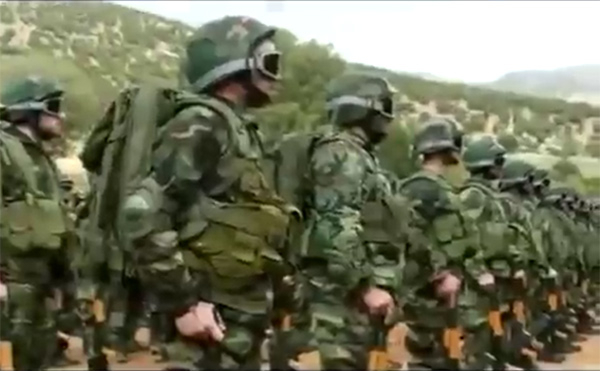
Tehran is believed to be preparing to dispatch a substantial Revolutionary Guards (IRGC) special operations unit to Syria to tackle the separate rebel and ISIS advances closing in on the Assad regime, Western and Arab intelligence sources report. They say the Syrian army is already setting aside an area in northern Syria for the Iranian troops to take up position.

If this happens, DEBKAfile’s military sources note that it would be the Revolutionary Guards first direct intervention in the nearly five-year Syrian war. Up until now, Tehran has carefully avoided putting Iranian boots on the ground in both Syria and Iraq. The only place where Iranian forces are directly engaged in battle is at Iraq’s main refinery town of Baiji, where small infantry and artillery units have been trying – without success thus far – to dislodge ISIS forces from the refinery complex.

In the other Syrian and Iraqi war arenas – and elsewhere – Tehran follows the practice of using local Shiite militias as surrogates to fight its wars, providing them with training and arms. The Guards have also brought Shiite militias over from Pakistan and Afghanistan.

That Tehran is about to change course to save Bashar Assad was indicated in a surprise statement Tuesday, June 2 by Gen. Qassem Soleimani, supreme commander of Iranian forces fighting outside the country. After urgent consultations in Damascus with President Assad and his military chiefs, the Iranian general said enigmatically that “major developments” are to be expected in Syria “in the next few days.” Another source quotes him more fully as saying: “In the next few days, the world will be pleasantly surprised [by the arrangements] we [the IRGC] working with Syrian military commanders are currently preparing.”

DEBKAfile, which Sunday, May 31, exclusively disclosed Soleimani’s post-haste arrival in Damascus, now reports from its military sources that Hizballah military chiefs were summoned to Damascus to attend those consultations. On his way to the Syrian capital, those sources also reveal that the Iranian general stopped over at the Anbar warfront in western Iraq near the Syrian border.

The IRGC expeditionary force, according to Gulf sources, will have to initial objectives to recover Jisr al-Shughour in northwestern Syria and Palmyra. The first has been taken over by Syrian rebels of the Army of Conquest, a band of Sunni militias sponsored by the United States, Saudi Arabia, Turkey and Qatar; the second was captured by the Islamic State last month.

The recovery of the two cities and their return to Syrian government control would deflect the immediate threats posed by opposition and Islamist forces to the highways from Homs to Damascus and the Mediterranean port of Latakia. This, in turn, would relieve the Assad regime of much of the military pressure threatening its survival.

Russia said abandoning Assad as Syria regime collapses further

May 31, 2015

Russia said abandoning Assad as Syria regime collapses further, YNet News, Roi Kais, May 31, 2015

The report also quoted Syrian opposition sources as saying that Hezbollah and Iranian military experts have left Assad’s war room in Damascus, along with Russian experts.

*********************

Asharq Al-Awsat says Moscow has pulled military experts from Assad’s war room in Damascus, evacuated non-essential personnel and stopped declaring there is no alternative to Assad.

Russia is pulling away from its relationship with embattled Syrian President Bashar Assad and withdrawing key personnel from Damascus, the London-based Arabic newspaper Asharq Al-Awsat reported Sunday, citing senior Gulf and Western officials.

“The Kremlin has begun to turn away from the regime,” the newspaper said.

The report also quoted Syrian opposition sources as saying that Hezbollah and Iranian military experts have left Assad’s war room in Damascus, along with Russian experts.

There have been increasing signs in recent days that the Assad regime is disintegrating, four years into the civil war that has engulfed Syria. Last week, the Syrian president lost control of another province, which comes on the heels of previous reports that Islamic State already controls more than 50% of the country.

According to the same Gulf and Western sources, the change in the Russian position takes place against the backdrop of negotiations between the Gulf states and Moscow, a Russian response to economic sanctions imposed on it due to the war in Ukraine.

Syrian opposition sources told Asharq that Russia has evacuated 100 of its senior officials and their families from Syria via the airport in Latakia. They said that those leaving include experts who worked in the war room in Damascus, along with the Iranian experts and Hezbollah officials. According to the report, they have not been replaced.

Putin and AssadPutin and Assad. Allies no more. (Photos: EPA and AFP)

On Thursday, Russia confirmed that an Ilyushin II-76 aircraft took 66 Syrian nationals from Latakia to Moscow airport, as well as a number of citizens from other countries, and at the same time delivered humanitarian aid to the war-torn country. Russia has remained silent on removal of the military experts.

According to Asharq al-Awsat, Russia has in the last three months also cut down the number of employees at its embassy in Damascus, leaving only essential staff. Opposition forces have also claimed that Russia has not been abiding by the maintenance contracts with Syria for the Sukhoi aircraft, leading to a rare visit to Tehran last month by Syrian Defense Minister Fahd Jassem al-Freij, who was forced to ask Iran to intervene with Russia on this matter.

The newspaper, which is notably supportive of the Saudi regime, also quoted an apparently surprising response by the head of the Russian delegation at a meeting last month, when asked by the Western Europe security chiefs for Moscow’s perspective on Syria’s future.

“What matters to Russia is maintaining its strategic interests and ensuring the future of the minorities, the unity of Syria and the struggle against extremists,” the delegation chief said. Western diplomatic sources at the meeting said the unprecedented statement brings to an ends years of the Russian official line that there is no alternative to Assad.

602610501001095640360noThe rebels draw closer to Latakia (Photo: Reuters)

At the same time, there have been growing Arab media reports of a more serious dialogue than ever before between Russia and the United States on an agreement regarding the crisis in Syria. The Lebanese newspaper Al-Nahar quoted diplomatic sources in Geneva on Sunday as saying that the two sides are seeking an arrangement that will take into account the interests of regional and international parties, in particular Turkey, Iran and the Gulf states.

On Thursday, senior diplomatic sources told Al-Hayat that there has been a noticeable change in the Russian position toward Syria that Moscow is for the first time willing to discuss with the Americans the exact details of a transition period for the country, and even raise the names of individual military and political officials to oversee it.

Another sign of Assad’s difficulties comes from the Turkish news agency Anatolia, which cited opposition sources as saying that after four years of war, the regime controls less than 8% percent of the country’s oil and gas fields, while Islamic State controls more than 80% percent.


Behind the Lines: Hezbollah – Born in Lebanon, dying in Syria?

May 30, 2015

Behind the Lines: Hezbollah – Born in Lebanon, dying in Syria? Jerusalem PostJonathan Spyer, May 30, 2015

(Please see also, Iran weighs turning Hizballah’s anti-Israel missiles against ISIS to save Damascus and Baghdad. — – DM)

Hezbolla1Hassan Nasrallah talks to his Lebanese and Yemeni supporters via a giant screen during a speech against US-Saudi aggression in Yemen, in Beirut’s southern suburbs on April 17.. (photo credit:REUTERS)

With the minority communities that formed the core of Assad’s support no longer willing or able to supply him with the required manpower, the burden looks set to fall yet further onto the shoulders of Assad’s Lebanese friends.

What this is likely to mean for Hezbollah is that it will be called on to deploy further and deeper into Syria than has previously been the case.

The Israeli assessment is that with its hands full in Syria, Hezbollah will be unlikely to seek renewed confrontation with Israel.

**********************

The latest reports from the Qalamoun mountain range in western Syria suggest that Hezbollah is pushing back the jihadis of Jabhat al-Nusra and Islamic State.

The movement claims to have taken 300 square kilometers from the Sunni rebels.

The broader picture for the Shi’ite Islamists that dominate Lebanon, however, is less rosy.

The Iran-led alliance of which Hezbollah is a part is better-organized and more effectively commanded than its Sunni rivals. The coalition’s ability to marshal its resources in a centralized and effective way is what has enabled it to preserve the Assad regime in Syria until now.

When President Bashar Assad was in trouble in late 2012, an increased Hezbollah mobilization into Syria and the creation by Iran of new, paramilitary formations for the regime recruited from minority communities was enough to turn the tide of war back against the rebels by mid-2013.

Now, however, the numerical advantage of the Sunnis in Syria is once more reversing the direction of the war.

With the minority communities that formed the core of Assad’s support no longer willing or able to supply him with the required manpower, the burden looks set to fall yet further onto the shoulders of Assad’s Lebanese friends.

What this is likely to mean for Hezbollah is that it will be called on to deploy further and deeper into Syria than has previously been the case.

In the past, its involvement was largely confined to areas of particular importance to the movement itself. Hezbollah fought to keep the rebels away from the Lebanese border, and to secure the highways between the western coastal areas and Damascus.

The movement’s conquest of the border town of Qusair in June 2013, for example, formed a pivotal moment in the recovery of the regime’s fortunes at that time.

But now, Hezbollah cannot assume that other pro-regime elements will hold back the rebels in areas beyond the Syria-Lebanese frontier.

This means that the limited achievement in Qalamoun will prove Pyrrhic, unless the regime’s interest can be protected further afield.

Hezbollah looks set to be drawn further and deeper into the Syrian quagmire.

Movement Secretary-General Hassan Nasrallah acknowledged this prospect in his speech last Sunday, marking 15 years since Israel’s withdrawal from southern Lebanon.

In the talk, Nasrallah broadened the definition of Hezbollah’s engagement in Syria.

Once, the involvement was expressed in limited sectarian terms (the need to protect the tomb of Sayyida Zeinab in Damascus from desecration).

This justification then gave way to the claimed need to cross the border precisely so as to seal war-torn Syria off from Lebanon and keep the Sunni takfiris (Muslims who accuse other Muslims of apostasy) at bay.

On Sunday, Nasrallah struck an altogether more ambitious tone. Hezbollah, he said, was fighting alongside its “Syrian brothers, alongside the army and the people and the popular resistance in Damascus and Aleppo and Deir al-Zor and Qusair and Hasakeh and Idlib. We are present today in many places, and we will be present in all the places in Syria that this battle requires.”

The list of locations includes areas in Syria’s remote north and east, many hundreds of kilometers from Lebanon (Hasakeh, Deir al-Zor), alongside regions previously seen as locations for the group’s involvement.

Nasrallah painted the threat of Islamic State in apocalyptic terms, describing the danger represented by the group as one “unprecedented in history, which targets humanity itself.”

This language fairly clearly appears to be preparing the ground for a larger and deeper deployment of Hezbollah fighters into Syria. Such a deployment will inevitably come at a cost to the movement; only the starkest and most urgent threats of the kind Nasrallah is now invoking could be used to justify it to Hezbollah’s own public.

The problem from Hezbollah’s point of view is that it too does not have inexhaustible sources of manpower.

The movement has lost, according to regional media reports, around 1,000 fighters in Syria since the beginning of its deployment there. At any given time, around 5,000 Hezbollah men are inside the country, with a fairly rapid rotation of manpower. Meanwhile, Hezbollah’s entire force is thought to number around 20,000 fighters.

Faced with a task of strategic magnitude and ever-growing dimensions in Syria, there are indications the movement is being forced to cast its net wider in its search for manpower.

A recent report by Myra Abdullah on the Now Lebanon website (associated with anti-Hezbollah elements in Lebanon) depicted the party offering financial inducements to youths from impoverished areas in the Lebanese Bekaa, in return for their signing up to fight for Hezbollah in Syria.

Now Lebanon quoted sums ranging from $500 to $2,000 as being offered to these young men in return for their enlistment.

Earlier this month, Hezbollah media eulogized a 15-yearold youth, Mashhur Shams al-Din, who was reported as having died while performing his “jihadi duties” (the term usually used when the movement’s men are killed in Syria).

All this suggests that Hezbollah understands a formidable task lies before it, and that it is preparing its resources and public opinion for the performance of this task.

As this takes place, Hezbollah seems keen to remind its supporters and the Lebanese public of the laurels it once wore in the days when it fought Israel.

The pro-Hezbollah newspaper As-Safir recently gained exclusive access to elements of the extensive infrastructure the movement has constructed south of the Litani River since 2006. The movement’s Al-Manar TV station ran an (apparently doctored) piece of footage this week purporting to show Hezbollah supporters filming a Merkava tank at Mount Dov. Nasrallah, in his speech, also sought to invoke the Israeli enemy, declaring Islamic State was “as evil” as Israel.

The Israeli assessment is that with its hands full in Syria, Hezbollah will be unlikely to seek renewed confrontation with Israel.

It is worth noting, nevertheless, that a series of public statements in recent weeks from former and serving Israeli security officials have delivered a similar message regarding the scope and depth of the Israeli response, should a new war between Hezbollah and Israel erupt.

Israel Air Force commander Maj.-Gen. Amir Eshel, former IAF and Military Intelligence head Maj.-Gen. (res.) Amos Yadlin, former national security adviser Maj.-Gen. (res.) Giora Eiland and other officials speaking off the record expressed themselves similarly in this regard.

Hezbollah plainly has little choice regarding its deepening involvement in Syria, Nasrallah’s exhortations notwithstanding.

The organization is part of a formidable, if now somewhat overstretched regional alliance, led by Iran.

This alliance regards the preservation of the Assad regime’s rule over at least part of Syria as a matter of primary strategic importance.

Hezbollah and the Shi’ites it is now recruiting are tools toward this end. It would be quite mistaken to underestimate the efficacy of the movement; it is gearing up for a mighty task, which it intends to achieve. Certainly, many more Hezbollah men will lose their lives before the fighting in Syria ends, however it eventually does end.

Given the stated ambitions of the movement regarding Israel and the Jews, it is fair to say this fact will be causing few cries of anguish south of the border.

On achievements and ideas

May 29, 2015

On achievements and ideas, Israel Hayom, Maj. Gen. (ret.) Yaakov Amidror, May 29, 2015

Lately it looks as though the Islamic State group has managed to rack up highly significant geographic achievements. These coups will lead to the group controlling the enormous expanse of territory west of Baghdad to the Syrian border beyond Palmyra by establishing rule in the north and east of the crumbling Syrian state.

The occupation of Ramadi, one end of an arch that bridges between the Iraqi capital and Palmyra in the heart of northern Syria, serves as a base for future gambits of even greater importance. We shouldn’t wonder if the group needs a little time to “digest” the new areas it has conquered, to take care of any local population that might resist, if any such remains, and to settle its rule on the rest of the residents and prepare for retaliatory attacks by the Syrian and Iraqi armies and their auxiliary militia forces.

It appears that in Iraq and Syria — but more importantly, in the U.S. — it is understood that the counterattack stage could turn out to be critical. If the group overcomes these strikes, it is hard to imagine what might stop it in the future, barring full-scale involvement by the U.S. military that would include heavy ground forces.

After the counter-strikes, the moment the organization feels secure in its new area, and we cannot know how long that will take, it will face the standard dilemma presented by such situations: What next? By nature, a group like this cannot refrain from action for long. It needs constant movement; it is thirsty for new gains and fears the “stagnation” that could affect it after a period of calm. The group is still in its dynamic stage, continuing to rise. It has four options for action, and no one knows which one its leaders will choose. It is possible that they themselves have not made up their minds and are still not ready to decide, at least until the results of any possible counterattack become clear.

Islamic State’s next “natural” effort could be toward Baghdad, to strengthen its rule of everything west of the Iraqi capital. The goal would be to strike a fatal blow to the Shiite government’s operational ability in the Sunni regions the group has taken thus far, and maybe even to bring down the present Iraqi regime.

Such a move would doubtless put pressure on the ruling Shiites and their Iranian allies, because when an organization like this approaches areas with a dense Shiite population, as well as the cities most holy to Shiites, the latter envision a mass slaughter. So there is no question that a move like that, if successful, would force the Iranians to make some tough decisions, mainly about whether to opt for direct military intervention.

The group has another option in Iraq: to the north, beyond Kurdistan. If it managed to take control of the areas where the Kurds are currently extracting oil, it would enjoy maximal success, running nearly an entire country and putting heavy pressure on Turkey. That looks tempting, because the West hasn’t taken care to adequately arm the Kurds, the only ones so far who have fought the group successfully.

It is also possible that after its great success in Iraq, the group will prefer to entrench its rule over northern Syria — in other words, seize control of Aleppo and Homs. That would be an ambitious plan given the size of the geographic area, but it appears any resistance there would be weaker than it would be in a metropolis like Baghdad or from the fierce Kurds. If Islamic State took Aleppo and Homs, it would improve its chances of eventually taking action against the Kurds, particularly their Syrian wing.

In Syria, the main ones opposing the group would be President Bashar Assad’s exhausted army. In that area, other Sunni groups from what is known as the army of insurgents might join Islamic State, granting it legitimacy in the eyes of the locals. A move like that could lead to a dramatic change in Assad’s position and force Hezbollah to spread its forces even thinner. A loss of Hezbollah’s strategic homefront and the presence of its Sunni haters breathing down the neck of the Alawite minority, on the coast of Latakia, means a threat to a region that is vital to Hezbollah and to the Iranians’ position in Syria, and eventually in Lebanon. The Iranians and Hezbollah would do almost anything to protect these, because any threat to them is an existential one. If the Islamic State group acquires control of Alawite or Shiite areas, it will exterminate everyone there. This is a life or death struggle. That’s clear to everyone.

The ambitious option

And there is a fourth option, which for now seems less appealing and therefore less likely, although not impossible. It’s possible that to avoid clashing with Shiite strength around Baghdad or with Alawite and Hezbollah desperation en route to Damascus, the group will turn its attention to Amman.

All the residents of Jordan are Sunni, and some of them could begin to identify with a serious, successful Sunni group that purports to act on behalf of Sunnis, who are in distress because of the Shiite dynamic in the Middle East. The group could asses that it would be easier for it to operate against Jordan, and if it does so successfully it would have more convenient access to Saudi Arabia — the crown jewel of the Muslim world.

Saudi Arabia is the target that anyone who talks about an “Islamic caliphate” dreams of, because it is home to Mecca and Medina, the two holiest cities for any Muslim. In acting against Jordan, the group could combine a military maneuver with an attempt to influence the kingdom from inside by exploiting the social and economic problems in Jordan that have worsened because of the mass influx of refugees from Syria.

Today, the chances of the organization succeeding in Jordan appear very slim. The Jordanian army, unlike the armies of Iraq and Syria, is both serious and professional and among many Jordanians, the king is popular as well as legitimate. Jordan is no easy prey, and it would certainly have the help of everyone for whom the kingdom’s stability is important.

In any case, it is obvious that the American intervention thus far has not brought the U.S. any closer to the goal defined by President Barack Obama of “destroying the organization.” The opposite — it has grown stronger and expanded its area of control since the U.S. declared war on it. The last chance the U.S. has to continue its current policy, avoiding the deployment of massive American ground forces, is conditional upon its ability to give the Iraqi army the assistance it needs in the attack it is promising to execute, and possibly on helping the Syrian army indirectly.

The Americans will take a look at themselves after these battles, when it becomes clearer whether the group’s recent successes are the regular ups and downs seen in conflicts like these, or whether they have altered its standing, and Islamic State will now take advantage of the momentum to move on more ambitious targets.

Filling the Vacuum in Syria

May 28, 2015

Filling the Vacuum in Syria, The Gatestone InstituteYaakov Lappin, May 28,2015

  • The idea that, because Sunni and Shi’ite elements are locked in battle with one another today, they will not pose a threat to international security tomorrow, is little more than wishful thinking.
  • The increased Iranian-Hezbollah presence needs to be closely watched.
  • A policy of turning a blind eye to the Iran-led axis, including Syria’s Assad regime, appears to be doing more harm than good.

As the regime of Bashar Assad continues steadily to lose ground in Syria; and as Assad’s allies, Iran and Hezbollah, deploy in growing numbers to Syrian battlegrounds to try to stop the Assad regime’s collapse, the future of this war-torn, chaotic land looks set to be dominated by radical Sunni and Shi’ite forces.

The presence of fundamentalist Shi’ite and Sunni forces fighting a sectarian-religious war to the death is a sign of things to come for the region: when states break down, militant entities enter to seize control. The idea that, because Sunni and Shi’ite elements are locked in battle with one another today, they will not pose a threat to international security tomorrow, is little more than wishful thinking.

The increased presence of the radicals in Syria will have a direct impact on international security, even though the West seems more fixated on looking only at threats posed by the Islamic State (ISIS), and disregards the possibly greater threat posed by the Iranian-led axis. It is Iran that is at the center of the same axis, so prominent in entangling Syria.

The threat from ISIS in Syria and Iraq to the West is obvious: Its successful campaigns and expanding transnational territory is set to become an enormous base of jihadist international terrorist activity, a launching pad for overseas attacks, and the basis for a propaganda recruitment campaign.

It has already become a magnet for European Muslim volunteers. Their return to their homes as battle-hardened jihadists poses a clear danger to those states’ national security.

Yet the threat from the Iranian-led axis, highly active in Syria, is more severe. With Iran, a threshold nuclear regional power, as its sponsor, this axis plans to subvert and topple stable Sunni governments in the Middle East and attack Israel. Iran’s axis also has its sights set on eventually sabotaging the international order, to promote Iran’s “Islamic revolution.”

This is the axis upon which the Assad regime has become utterly dependent for its continued survival.

Today, the radical, caliphate-seeking Sunni organization, ISIS, controls half of Syria, while hardline Lebanese Shi’ite Hezbollah units can be found everywhere in Syria, together with their sponsors, Iran’s Islamic Revolutionary Guards Corps (IRGC) personnel, fighting together with the Assad regime’s beleaguered and worn-out military forces.

The increased Iranian-Hezbollah presence needs to be closely watched. According to international media reports, an IRGC-Hezbollah convoy in southern Syria, made up of senior operatives involved in the setting up of a base designed to launch attacks on the Golan Heights, was struck and destroyed by Israel earlier this year. The Hashemite Kingdom of Jordan too hasreason to be concerned.

1088Lebanese Shi’ite Hezbollah fighters are deeply involved in Syria’s civil war. (Image source: Hezbollah propaganda video)

Syria has become a region into which weapons, some highly advanced, flow in ever greater numbers, allowing Hezbollah to acquire guided missiles, and allowing ISIS and the Al-Nusra Front to add to their growing stockpile of weaponry.

Other rebel organizations, some sponsored by Saudi Arabia, Turkey, and Qatar, are also wielding influence in Syria. These groups represent an effort by Sunni states to exert their own influence there.

Despite all the efforts to support it, the Assad regime suffered another recent setback when ISIS seized the ancient city Palmyra in recent days, making an ISIS advance on Damascus more feasible. To the west, near the Lebanese border, Al-Qaeda’s branch in Syria, the Al-Nursa Front, also made gains. It threatened to enter Lebanon, prompting Hezbollah to launch a counter-offensive to take back those areas.

These developments provide a blueprint for the future of Syria: A permanently divided territory, where conquests and counter-offensives continue to rage, and the scene of an ongoing humanitarian catastrophe, producing waves of millions of refugees that could destabilize Syria’s neighbors. Syria is set to remain a land controlled by warring sectarian factions, some of whom plan to spread their destructive influence far beyond Syria.

Events in Syria have shown that the notion that air power can somehow stop ISIS’s advance is a fantasy. More importantly, they have also illustrated that Washington’s policy of cooperation with Iran in a possible “grand bargain” to stabilize the region, while failing to take a firmer stance against the civilian-slaughtering Assad regime, is equally fruitless.

A policy of turning a blind eye to the Iran-led axis, including Syria’s Assad regime, appears to be doing more harm than good.

Assad pulls air force out of Deir ez-Zour, the third Syrian air base surrendered to ISIS

May 27, 2015

Assad pulls air force out of Deir ez-Zour, the third Syrian air base surrendered to ISIS, DEBKAfile, May 27, 2015

ISIS__fighting__between_Homs_and_Palmyra_27.5.15ISIS in combat between Homs and Palmyra

Just a week after losing the big Palmyra air base to the Islamic State – and with it large stocks of ammo and military equipment – Syrian military and air units Wednesday, May 27, began pulling out of the big air base at Deir ez-Zour. This was Bashar Assad’s last military stronghold in eastern Syria and the last air facility for enabling fighter-bombers to strike ISIS forces in northeastern Syria and the western Iraqi province of Anbar.

His surrender of the Deir ez-Zour base is evidence that the Syrian president has run out of fighting strength for defending both his front lines and his air bases. He is also too tied down to be able to transfer reinforcements from front to front. He is therefore pulling in the remnants of his army from across the country for the defense of the capital, Damascus.

DEBKAfile’s military sources report that the Islamic State now has in its sights the Syrian army’s biggest air facility, T4 Airbase, which is located on the fast highway linking Homs with Damascus 140 km away.

It is home base for the bulk of the air force’s fighters and bombers. In its hangars are an estimated 32 MiG-25 fighters, as well as smaller numbers of MiG-25PDS interceptors, designed for combat with the Israeli air force, MiG-25RBT bombers-cum-surveillance planes; MiG-25PU trainers, which are routinely used to strike rebel forces in crowded built-up areas, and advanced MiG-29SM fighter jets.

Stationed there too are 20 advanced Su-24M2 bombers, the strategic backbone of the Syrian air force.

T4 Airbase also holds the largest Syrian stocks of guided bombs, air-to-air and air-to-ground missiles.

In the last few hours, air crews have been frantically removing these warplanes from T4 and distributing them among smaller bases in central Syria, at the cost of their operational effectiveness.

In the space of a week, therefore, Bashar Assad has lost three of his major air bases, including Palmyra, where Iranian and Russian air freights had been landing regularly with fresh supplies of ordnance and spare parts for his army.

Our military experts say that this bonanza frees ISIS to cut off the eastern, northern and central regions from the capital, and deprive the Syrian and Hizballah units battling for control of the Qalamoun Mts of air support against rebel and Islamist forces.

If they manage to take T4 as well, the Islamists will be able to prevent US jets from taking off for strikes against them in Syria, or bombing the their forces which have seized long stretches of the fast highway from Homs to Damascus.

Qalamoun battle is do-or-die for Bashar Assad, Hassan Nasrallah and Iran’s Gen. Soleimani

May 9, 2015

Qalamoun battle is do-or-die for Bashar Assad, Hassan Nasrallah and Iran’s Gen. Soleimani, DEBKAfile, May 9, 2015

(??????????? — DM)

Qalamoun_battle_5.15Hizballah flag aloft in Qalamoun battle

President Obama has just lately adopted a plan some members of his National Security Council put forward: It is to get the Iranians moving on the nuclear deal by applying a painful prod in the form of a wedge in the Revolutionary Guards (IRGC) leadership. IRGC chief Gen. Ali Jafari is being elevated as a “moderate” and the “good guy” of the regime, while Gen. Soleimani, the Al Qods chief, who orchestrates IRGC’s external subversive operations, is fingered as the “bad guy.’

*****************

Two contenders are locked in a fateful contest to win the strategic Qalamoun Mts. on the Syrian-Lebanese border: The Syrian army and its Hizballah ally are fighting tooth and nail against the opposition Army of Conquest, which is spearheaded by Nusra Front, Al Qaeda’s Syrian branch. This battle has all of a sudden attained the proportions of a critical regional contest, which poses dire consequences for the Iran-Syrian-Hizballah alliance at large and its three prime movers, Syrian President Bashar Assad, Hizballah leader Hassan Nastrallah, and their overall commander, Iran’s Gen. Qassem Soleimani, head of the Al Qods Brigades.

With so much hanging in the balance, it is no wonder that Hizballah issued confused communiqués on the battle, until Nasrallah interceded Tuesday, May 5 to say: “We have not issued a statement, and we will not issue a statement. When we launch a (Qalamoun) operation, it will be obvious to everyone.”

The operation is, however, already in full flight. Neither Nasrallah nor anyone else can predict its outcome for sure, because a radical, unforeseen shift has taken place in the balance of strength. For the first time in nearly five years of Syrian civil war, the United States has lined up with Saudi Arabia, Turkey, Qatar and the UAE to give the Syrian opposition heavy weapons. Had they been supplied earlier, the war might have ended sooner and many of the hundreds of thousands of victims might have been saved.

Also, after a long silence, senior Obama administration spokesmen were finally willing to blast the Assad regime for his heinous war crimes.

Friday, May 8, three senior spokesmen confirmed as “strong and credible” the reports that the Syrian army had reverted to the use of chemical weapons. They were Robert Malik, US ambassador to the Hague-based Organization for the Prohibition of Chemical Weapons, US Undersecretary of State Antony Nlnken and US ambassador to the UN Samantha Power.

They were willing to “disclose” a fact – long common knowledge in the region – that the Syrian army had retained a part of its chemical stockpile. This disclosure exposed the much-acclaimed US-Russian accord concluded by Secretary of State John Kerry and Foreign Minister Sergei Lavrov at the end of 2013, forcing Assad to surrender his chemical arsenal, as a more or less dead letter.

On the heels of the US accusation, PCWU international inspectors revealed that traces of sarin and VX nerve agents were found in Syria last December and in January.

The new Obama administration’s diplomatic offensive against Assad came as the Qalamoun showdown attained momentous proportions, after two weeks of heavy Syrian military war reverses in the north. The sharp US edge was also directed at Gen. Soleimani, who is responsible for Iran’s supply of chorine-filled barrel bombs dropped by the Syrian air force on civilians in rebel-held areas.

Washington has refocused its attention on Syrian-Iranian chemical warfare out of two broader considerations:

1. Iran’s cavalier contempt for the international accords and treaties banning chemical weapons raises tough questions about Tehran’s credibility and trustworthiness for upholding the comprehensive nuclear accord currently in negotiation with the Six Powers. Can Iran be trusted to honor any commitment to allow the “intrusive inspections” of its nuclear sites, which President Barack Obama has pledged as the underpinning of any accord?

2.  President Obama has just lately adopted a plan some members of his National Security Council put forward: It is to get the Iranians moving on the nuclear deal by applying a painful prod in the form of a wedge in the Revolutionary Guards (IRGC) leadership. IRGC chief Gen. Ali Jafari is being elevated as a “moderate” and the “good guy” of the regime, while Gen. Soleimani, the Al Qods chief, who orchestrates IRGC’s external subversive operations, is fingered as the “bad guy.’

Jafary is also to receive economic incentives for accepting the nuclear accord, while denouncing Soleimani, leading light of Iran’s military interventions in Iraq, Syria and Yemen, may have the added benefit of forcing Tehran to pull in its horns in those conflicts.

Time will tell whether this tactic is effective. As matters stand in May 2015, it is hoped that undercutting Soleimani’s repute will impinge on the level of Iranian military involvement in Syria, Iraq and Yemen. A decision by Tehran to downscale its military support for the Syrian and Hizballah armed forces may undo them in the battle of Qalamoun. This defeat will seriously undermine Assad, Nasrallah and Soleimani. And so the Syrian opposition and its backers have all the more reason to push hard to win this fateful encounter.

King Abdullah II: We’re War With “Outlaws Of Islam” – Special Report

April 14, 2015

King Abdullah II: We’re War With “Outlaws Of Islam” – Special Report via You Tube, April 13, 2015

(He seems quite diplomatic, but what does he actually think? — DM)


Assad looses ISIS against Palestinians trapped in Yarmouk camp – a sinister new partnership

April 8, 2015

Assad looses ISIS against Palestinians trapped in Yarmouk camp – a sinister new partnership, DEBKAfile, April 8, 2015

Yarmouk_Palestinian_camp__Damascus_5.4.15The Yarmouk Palestinian camp in Damascus in April 2015

Obama’s rapprochement with Iran and its Middle East allies has produced an incredibly sinister new twist in the Syrian war as it enters its fifth year. The atrocity-ridden conflict finds 16,000 Palestinians trapped in horrible conditions in the Yarmouk refugee camp of Damascus and beset by two enemies: the Islamic State and the President Bashar Assad’s army.

The world has been shown three players in the vicious Yarmouk contest: The Islamic State of Iraq and the Levant, whose jihadis are slashing through the refugee camp and massacring its Palestinian inmaes, the second player, and the Syrian army, the third, which appears to be fighting to keep the Islamists from reaching central Damascus. The camp lies 8.5 km from Assad’s presidential palace.

The Islamists are usually presented as fighting to settle a score with the camp’s inmates, because the Hamas majority is aligned with Iran and Hizballah, ISIS’s deadliest foes.

But even this evil scenario is not crazy enough to cover the new patchwork of alliances revealed here by DEBKAfile’s military and intelligence sources.

Syrian troops were actually directed by Assad to open the roads to Damascus and give the Islamists a free path to their Palestinian victims. This saved ISIS the need to detach substantial strength from other fronts for its Yarmouk operation.

ISIS is winning its cheapest victory yet as a result of a secret understanding reached by the Syrian president with the Islamists’ leader Abu Bakr al-Baghdadi, which evolved from their covert partnership in the oil and gas fields of eastern Syria.

When Al Baghdadi captured 90 percent of those fields last year, Assad was short of military strength to dislodge the invaders without diluting the forces fighting on more important strategic fronts, such as Damascus, the capital, Deraa in the South and Aleppo in the north. So the Syrian ruler cold-bloodedly negotiated an understanding with the ISIS caliph on four points:

1. The Syrian army and air force would abstain from attacking ISIS positions and also refrain from any effort to recapture the fields.

2. ISIS would pump out the oil and gas and transfer these products to Damascus, which would then use its distribution facilities to sell the fuel on the black market after retaining a portion for domestic consumption.

3.  Damascus and the Islamists would share out the revenue between them. Last year, ISIS was earning $2-4 million a day, an income which went far toward bankrolling the terrorist group’s war operations.

4.  Syrian power stations would keep Islamist bases supplied with electricity.

The Syrian ruler then decided, our sources report, to build on this alliance as an opportunity for another move: The outsourcing of some of his war challenges. The plan was for Assad to control from afar the action conducted by the jihadis without having to put Syrian boots on the ground.

The Yarmouk operation was the first tryout of Assad’s battlefield ties with the Islamists.

The Syrian ruler had three goals in mind when he targeted the Palestinians:

(a) To show his closest allies Iran and Hizballah that he was not totally reliant on them for war support, but retained a free hand to fight on without them.

(b) To punish the Palestinian Hamas, which rules the Yarmouk camp, for withholding its support from his regime during the entire civil war.

Hamas needed to understand that the group’s reconciliation with Tehran and Hizballah did not count as absolution in Damascus. Assad had a separate accounting of his own with the Palestinian extremists.

(c)  Assad gained a new lease of life from Washington’s turnabout toward recognizing the legitimacy of his presidency (signaled by US Secretary of State John Kerry’s acceptance of Bashar Assad as part of any peace moves for Syria). He also exploited US acceptance of Iran’s expansionist designs in the region as a point in his favor.

The Syrian ruler decided he felt confident enough to make the Palestinians his high card in his games with Israel, Jordan and the Palestinian Authority in Ramallah. Assad wanted them all to understand that he was riding high enough to control the fate of the Palestinians: It was up to him to decide whether to save them or throw them to the wolves – which he did by letting ISIS loose against them.