Archive for the ‘Assad’ category

World powers agree to more talks on Syria crisis

October 31, 2015

World powers agree to more talks on Syria crisis, Al Jazeera, October 31, 2015

(But please see, Iran-US Talks Limited to Nuclear Issue: MPs — DM)

Friday’s talks included an Iranian delegation for the first time.

***********************

Major powers meeting in Vienna for talks on Syria have found enough “common ground” to meet for a new round of talks in two weeks, even as the conflict enters a new phase with the deployment of US special forces in the country.

President Barack Obama has ordered the deployment of fewer than 50 commandos to help coalition forces coordinate with local troops, Josh Earnest, the White House spokesperson, said on Friday.

The troop announcement came as diplomats in the Austrian capital representing 17 countries and the EU agreed to launch a broad new peace attempt to gradually end Syria’s long civil war – a declaration that avoided any decision on when President Bashar al-Assad might leave.

A Syrian member of parliament said the decision is an aggression because it does not involve the government’s agreement.

Sharif Shehadeh told AP news agency on Saturday that the troops will have no effect on the ground, but Washington wants to say that it is present in Syria.

It is not clear how many rebel groups would agree to a plan that does not result in Assad’s immediate departure.

Sergey Lavrov, Russia’s foreign minister, said on Friday a US decision to deploy special forces in Syria would make cooperation between the armed forces of the two countries more important.

“I am sure that neither the United States nor Russia want [the conflict] to become a so-called proxy war,” Lavrov said after the talks in Vienna.

“But it is obvious for me that the situation makes the task of cooperation between the militaries more relevant.”

Friday’s talks included an Iranian delegation for the first time.

Representatives from Britain, Egypt, France, Germany, Italy, Lebanon, the EU and other Arab states also attended.

The participation by Russia and Iran in the attempt could mark a new and promising phase in the diplomacy since those countries have staunchly backed Assad.

‘Tough conversations’

Any ceasefire agreement that may come as a result of the peace effort would not include the Islamic State of Iraq and the Levant (ISIL) group, which controls large parts of northern Syria and has its capital there.

“There were tough conversations today,” John Kerry, US secretary of state, said on Friday. “This is the beginning of a new diplomatic process.”

Kerry acknowledged that those present have major differences regarding the Assad government.

“But we cannot allow the differences to get in the way of diplomacy to end the killing.”

Federica Mogherini, the European Union foreign policy chief, said there is “hope” for a political process to advance, saying that those involved in the talks “found common ground” for further discussion.

“It was a very long and very substantial meeting. This was not an easy one, but for sure a historical one,” she said while praising “those who took difficult decisions” in joining the talks.

Lavrov said those present in the meeting spent a “long time” pushing for an inclusive Syrian-led peace process.

Among the points agreed upon during the talks was that ISIL cannot be allowed to reign in Syria, he said.

In a rare hint of diplomatic progress, Iran indicated it would back a six-month political transition period in Syria followed by elections to decide Assad’s fate, although his opponents rejected the proposal as a trick to keep him in power.

In addition to Assad’s fate, on which delegates said no breakthrough had been expected, sticking points have long included the question of which rebel groups should be considered “terrorists” and who should be involved in the political process.

Al Jazeera’s Mohammed Jamjoom, reporting from Vienna on Friday, said that there was a “mood of optimism” following the talks.

“There is a sense of hopefulness, which has been absent in these talks for quite a long time now,” he said.

The talks came as Syrian government air strikes continued in rebel-held territories, killing at least 61 people and wounding over 100 others in the Damascus suburb of Douma on Friday.

A further 80 people were killed in government and Russian air strikes in Aleppo province.

Russia overrides Middle East cyber waves

October 26, 2015

Russia overrides Middle East cyber waves, DEBKAfile, October 26, 2015

Latakia_Habaniya480

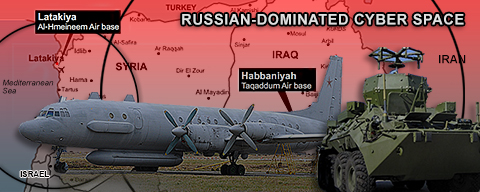
Aloft over Syria, the IL-20 can supply Russian forces and commanders with a complete, detailed picture of the situation on the ground. Its close proximity to Israel, moreover, enables this wonder plane to scoop up a wealth of data from across the border – not just on IDF military movements on the Golan, but also to eavesdrop on electronic activity and conversations in Jerusalem, Military Staff Headquarters in Tel Aviv, Air Force bases in southern Israel and even the nuclear complex in Dimona in the Negev.

******************

The distance as the crow flies between Russia’s Syrian air base Al-Hmeineem near Latakia and its Iraqi host facility at Al Taqaddum Air base is 824 km (445 nautical miles). From the Latakia base to Israel, the distance is just 288 km or 155 nautical miles, a hop and a skip in aerial terms. Syria’s ruler Bashar Assad first let Moscow in with the use of a base where 30 fighter and bombing jets are now parked. Iraqi Prime Minister Haider al-Abadi followed suit Saturday, Oct. 24 by granting the Russian Air force the use of a facility 74 km from Baghdad.

Their presence in the two bases draws a strong arc of Russian aerial control at the heart of Middle East. By boosting its two extremities with state-of-the-art electronic warfare systems, Moscow has imposed a new reality whereby it will soon be almost impossible for any air or ground force, American or Israeli, to go into military action above or inside Syria or Iraq without prior coordination with the Russians.

The bricks of Russian domination are now almost all in place.

In the last week of September, two Ilyushin-20 (IL-20 Coot) super-surveillance planes stole into Syrian airspace, to provide a major upgrade for the Russian air fleet of Sukhoi-30 fighter jets, cargo planes and attack helicopters gathering for combat in Syria.

This was first revealed by DEBKA Weekly’s military and intelligence sources on Oct. 2.

The IL-20s, the Russian Air Force’s top-line intelligence-gathering aircraft, brought over from the Baltic Sea, have exceptional features as an intelligence platform. Their four turboprop engines enable it to stay airborne for over 12 hours, using its thermal and infrared sensors, antennas, still and video cameras, and side-looking airborne (SLAR) radar to collect a wide range of data from long distances, day or night, in almost any kind of weather.

The Coot-20 collates the data gathered and transmits it to intelligence or operational command centers in Moscow or its Latakia air base by powerful jam-resistant communications systems, satellites and other methods.

Aloft over Syria, the IL-20 can supply Russian forces and commanders with a complete, detailed picture of the situation on the ground. Its close proximity to Israel, moreover, enables this wonder plane to scoop up a wealth of data from across the border – not just on IDF military movements on the Golan, but also to eavesdrop on electronic activity and conversations in Jerusalem, Military Staff Headquarters in Tel Aviv, Air Force bases in southern Israel and even the nuclear complex in Dimona in the Negev.

DEBKAfile’s military sources add that an Il-20 Coot has been sighted in the last few days at the Iraqi Al Taqaddum Air base near Baghdad.

Then, on Oct. 4, our sources reveal, another Russian super-weapon was brought to Syria by Russian cargo ships: Nine MT-LB armored personnel carriers fitted with the Borisoglebsk 2 electronic warfare systems, which are among the most sophisticated of their kind in the world.

These APCs were secretly driven aboard tank carriers to Nabi Yunis, which is the highest peak of the Alawite Mountains along the coastal plain of northwest Syria, and stands 1,562 meters (5,125 feet) above sea level. To render the highly complicated Borisoglebsk 2 device system impermeable to attack, our electronic warfare experts describe it as fitted into the interior and walls of the nine APCS, along with receivers that can pick up transmissions on a wide range of frequencies on the electromagnetic spectrum.

From their mountain aerie, its antennas and powerful transmitters are designed to intercept and jam almost any radio signal carried by the electromagnetic waves in military or civilian use.

Russian strategists posted this top-of-the-line system in Syria to enable the Russian air force to operate unhindered in Middle Eastern skies and, just as importantly, to neutralize US-led coalition special forces operating deep within Syrian territory, and block or disrupt the operations of rebel groups and Islamic State forces.

The Borisoglebsk 2 system has only just started rolling off top secret Russian assembly lines. It took five years to plan and manufacture the system, which went into service for the first time at the beginning of this year on the Ukraine battlefield.

From its vantage point in Syria, the Russian electronic warfare system could seriously impair the performance of Israeli intelligence and communication networks arrayed across the Golan and along the northern border in the upper and western Galilee. It could run interference against the IDF’s use of unmanned aerial vehicles (unless they were autonomous), the field operations of Israeli Special Operations forces and air and naval networks, which depend on communications networks in their defense of the country’s northern borders.

I got Syria so wrong

October 15, 2015

I got Syria so wrong, Politico, October 15, 2015

Fully complicit in the Assad regime’s impressive portfolio of war crimes and crimes against humanity, Iran relies on its client to secure its overland reach into Lebanon. And Russia works to sustain Assad as a rebuke to Washington. All the while, the eastern part of Syria is run by the self-styled Islamic State, or ISIL, itself a criminal enterprise. For the most part, the two titans of crime — the Assad regime and the Islamic State — have been able to live and let live, concentrating their hideous repertoires of violence on civilians and on armed rebels offering a nationalistic alternative to both. The result is widespread and profound hopelessness. Many Syrians are giving up on their beloved Syria. They are voting with their feet.

*********************

I spent early 2011 trying to ease tensions between Syria and its neighbors. I never predicted the brutality that would come from inside.

Now and then I am asked if I had predicted, way back in March 2011 when violence in Syria began, that within a few years a quarter-million people would be dead, half the population homeless and hundreds of thousands of defenseless civilians terrorized, traumatized, tortured and starved. The companion question, more often than not, is if I had forecast the failure of the West to offer any protection at all to Syrian civilians subjected to a systematic campaign of mass homicide. Having first been exposed to Syria as a teenage exchange student, I was expected by questioners to know something about the place. And as a State Department officer, I was assumed to know something about my government.

But no. It took me the better part of eighteen months to comprehend fully the scope of an unfolding humanitarian and political catastrophe. By September 2012, when I resigned my State Department post as adviser on Syrian political transition to Secretary of State Hillary Clinton, I knew that Syria was plunging into an uncharted abyss — a humanitarian abomination of the first order. And I knew that the White House had little appetite for protecting civilians (beyond writing checks for refugee relief) and little interest in even devising a strategy to implement President Barack Obama’s stated desire that Syrian President Bashar Assad step aside. But at the beginning, nothing drawn from my many years of involvement in Syria inspired accurate prophesy.

That Russia’s recent military intervention in Syria has shocked the Obama administration is itself no surprise. For nearly two years, Washington had chased Moscow diplomatically in the belief that the Kremlin’s soothing words about supporting political transition in Syria were truthful. That which was obvious to many — Russia’s desire to perpetuate Assad in office — is now jarringly clear to the administration. That training and equipping anti-Assad rebels to fight anyone but Assad has been dropped like a bad habit by an administration warned not to proceed along these lines is hardly a bolt from the blue.But the White House is not alone in failing to accurately forecast the severity of the Syrian disaster.

The major reason for my lack of foresight: It didn’t have to turn out this way, and I remain mildly surprised that it did. It is not that Syrians were without grievances concerning the way they were being governed. Widespread unemployment, underemployment and opportunity deficits were already prompting those with means among the best and brightest to leave the country. Although the regime’s corruption, incompetence and brutal intolerance of dissent were hardly state secrets, Assad was not universally associated by Syrians with the system’s worst aspects: “If only the president knew” was a phrase one heard often. Some Syria watchers believed that the Arab Spring would visit the country in the form of political cyclone. I did not. I did not think it inevitable that Assad — a computer-savvy individual who knew mass murder could not remain hidden from view in the 21st century — would react to peaceful protest as violently as he did, with no accompanying political outreach. And as Syria began to descend into the hell to which Assad was leading it, I did not realize that the White House would see the problem as essentially a communications challenge: getting Obama on “the right side of history” in terms of his public pronouncements. What the United States would do to try to influence Syria’s direction never enjoyed the same policy priority as what the United States would say.

Back in early 2011, it seemed possible not only to avoid violent upheaval in Syria but to alter the country’s strategic orientation in a way that would counter Iran’s penetration of the Arab world and erase Tehran’s land link to its murderous Hezbollah militia in Lebanon. Much of my State Department time during the two years preceding Syria’s undoing was thus spent shuttling back and forth between Damascus and Jerusalem, trying to build a foundation for a treaty of peace that would separate Syria from Iran and Hezbollah on the issue of Israel.

There was a degree of idealism in my quest, born in the brain of an American teenager many years before. But there was another personal element as well. Long before Hezbollah murdered Mr. Lebanon — Prime Minister Rafik Hariri — in 2005, it had brutally and pathologically tortured to death a friend of mine serving as an unarmed United Nations observer, Marine Lt. Col. Rich Higgins. Peace between Israel and Syria would require Damascus to cut all military ties to Hezbollah. It would require Syria to stop facilitating Iran’s support to Hezbollah. It would set the stage for a Lebanon-Israel peace that would further marginalize Lebanon’s murder incorporated. Peace for its own sake is good. But the prospect of beating Hezbollah and its Iranian master was inspiring. This prospect, more than anything else, motivated the mediation I undertook as a deputy to Special Envoy George Mitchell in the State Department.

Assad, told me in late February 2011 that he would sever all anti-Israel relationships with Iran, Hezbollah and Hamas and abstain from all behavior posing threats to the State of Israel, provided all land lost by Syria to Israel in the 1967 war — all of it — was returned. My conversation with him was detailed in terms of the relationships to be broken and the behavior to be changed. He did not equivocate. He said he had told the Iranians that the recovery of lost territory — the Golan Heights and pieces of the Jordan River Valley — was a matter of paramount Syrian national interest. He knew the price that would have to be paid to retrieve the real estate. He implied that Iran was OK with it. He said very directly he would pay the price in return for a treaty recovering everything.

Israeli Prime Minister Benjamin Netanyahu was interested. He was not at all eager to return real estate to Syria, but he found the idea of prying Syria out of Iran’s grip fascinating. And the negative implications for Hezbollah of Lebanon following Syria’s peace accord with Israel were not lost on him in the least. Although there were still details to define about the meaning of “all” in the context of the real estate to be returned, Netanyahu, too, knew the price that would ultimately have to be paid to achieve what he wanted.

But by mid-April 2011 the emerging deal that had looked promising a month earlier was off the table. By firing on peaceful demonstrators protesting police brutality in the southern Syrian city of Deraa, gunmen of the Syrian security services shredded any claim Assad had to governing legitimately. Indeed, Assad himself — as president of the Syrian Arab Republic and commander in chief of the armed forces — was fully responsible for the shoot-to-kill atrocities. Even so, he told Barbara Walters in a December 2011 ABC TV interview, “They are not my forces, they are military forces belong[ing] to the government . . . I don’t own them, I am the president. I don’t own the country, so they are not my forces.”

Before the shooting began the United States and Israel were willing to assume Assad had sufficient standing within Syria to sign a peace treaty and — with American-Israeli safeguards in place — make good on his security commitments before taking title to demilitarized territories. But when he decided to try to shoot his way out of a challenge that he and his first lady could have resolved personally, peacefully and honorably, it was clear he could no longer speak for Syria on matters of war and peace.

Some of my U.S. government colleagues from bygone days tell me we dodged a bullet: that an uprising against the Assad regime’s arrogance, cluelessness and corruption in the middle of treaty implementation would have caused real trouble. Others believe we were too slow: that a treaty signing in early 2011 could have kept the gale force winds of the Arab Spring from unhinging Syria. I don’t know. I don’t know if Assad or Netanyahu would, in the end, have done a deal. What I do know is that I felt good about where things were in mid-March 2011. What I also know is that by mid-April hope of a treaty was gone, probably never to return in my lifetime.

Assad’s decision to apply lethal violence to something that could have been resolved peacefully was the essence of betrayal. He betrayed his country so thoroughly as to destroy it. Four years on, he reigns in Damascus as a satrap of Iran and a dependent of Moscow. In the end, he solidified Israel’s grip on land lost in 1967 by his defense minister father.

Fully complicit in the Assad regime’s impressive portfolio of war crimes and crimes against humanity, Iran relies on its client to secure its overland reach into Lebanon. And Russia works to sustain Assad as a rebuke to Washington. All the while, the eastern part of Syria is run by the self-styled Islamic State, or ISIL, itself a criminal enterprise. For the most part, the two titans of crime — the Assad regime and the Islamic State — have been able to live and let live, concentrating their hideous repertoires of violence on civilians and on armed rebels offering a nationalistic alternative to both. The result is widespread and profound hopelessness. Many Syrians are giving up on their beloved Syria. They are voting with their feet.

There is no end in sight to this vicious bloodletting. Iran and Russia could stop the gratuitous mass murder but opt not to do so. Moscow now facilitates it with military intervention. The United States could stop it or slow it down significantly without invading and occupying Syria — indeed, without stretching the parameters of military science. But it has adamantly refused to do so. Meanwhile, the minions of the Islamic State loot and destroy the world heritage site of Palmyra while subjecting much of eastern Syria to their own brand of violent rule and internal terror.

Both sides of this debased criminal-terrorist coin need to be addressed urgently. Assad’s barrel bombing of Deraa in the south — where peaceful protests against regime brutality first attracted international notice in March 2011 — along with his bombing of Aleppo and Idlib in the north must be stopped cold. These horrific devices kill the innocent and recruit for the Islamic State: precisely as they are intended to do. Means exist far short of invasion and occupation to make it difficult for Assad regime helicopters to deliver their deadly cargoes. What is required is a clear statement of intent by Obama, one communicated to the Department of Defense, so that options can be produced for presidential decision and execution.

With regard to ISIL, a professional ground combat component provided by regional powers is desperately needed to work with coalition aircraft to sweep this abomination from Syria and permit a governmental alternative to the Assad regime to take root inside Syria. With central and eastern Syria free of both the regime and ISIL, an all-Syrian national stabilization force can be built. Western desires for a negotiated end to the Syrian crisis would be based, under these circumstances, on more than a wish and a hope.

The United States should neither seek nor shy away from confrontation with Russian forces in Syria. Moscow will not like it if its client’s ability to perform mass murder is impeded. Russia will not be pleased if ISIL, its false pretext for military intervention in Syria, is swept from the table. Ideally, Russia will not elect to escort regime aircraft on their mass homicide missions. And it would be difficult for even Russian President Vladimir Putin to articulate outrage if ISIL is crushed militarily. But if Russia seeks out armed confrontation with the United States in Syria, it would be a mistake for Washington to back down. People like Putin will push until they hit steel. And he will not stop in Syria.

Having failed miserably as a prophet in 2011 does not deter me from predicting the following: Obama will bequeath to his successor a problem of gargantuan dimensions if he does not change policy course now. Left to the joint ministrations of Assad and the Islamic State, Syria will continue to hemorrhage terrified, hungry and hurt human beings in all directions while terrorists from around the globe feast on the carcass of an utterly ruined state. Western Europe now reaps a whirlwind of desperate and displaced humanity it thought would be limited to Syria’s immediate neighborhood.

My failure to predict the extent of Syria’s fall was, in large measure, a failure to understand the home team. In August 2011, Barack Obama said Assad should step aside. Believing the president’s words guaranteed decisive follow-up, I told a congressional committee in December 2011 that the regime was a dead man walking. When the president issued his red-line warning, I fearlessly predicted (as a newly private citizen) that crossing the line would bring the Assad regime a debilitating body blow. I still do not understand how such a gap between word and deed could have been permitted. It is an error that transcends Syria.

I want the president to change course, but I fear that Syrians — Syrians who want a civilized republic in which citizenship and consent of the governed dominate — are on their own. I’ve been so wrong so many times. One more time would be great. It would mean saving thousands of innocent lives. It would mean real support for courageous Syrian civil society activists who represent the essence of a revolution against brutality, corruption, sectarianism and unaccountability. It would mean the reclamation of American honor. It would mean preserving my near-perfect record of getting things wrong. It would be a godsend.

Russia and Iran Moving to Corner the Mideast Oil Supply

October 15, 2015

Russia and Iran Moving to Corner the Mideast Oil Supply, American ThinkerSteve Chambers, October 15, 2015

It looks like Vladimir Putin and the ayatollahs are preparing to corner the world’s oil supply – literally.

Last May I wrote on this site that Iran was in the process of surrounding the Saudi/Wahhabi oil reserves, along with those of the other Sunni Gulf petro-states.  I added that, “Iran’s strategy to strangle Saudi/Wahhabi oil production also dovetails with Putin’s interests.  As the ruler of the second largest exporter of oil, he would be delighted to see the Kingdom’s production eliminated or severely curtailed and global prices soar to unseen levels.  No wonder he is so overtly supporting Iran.”

We’ve now seen Putin take a major, menacing step in support of the Iranians by introducing combat forces into Syria.  Many analysts argue that he’s doing this both to protect his own naval base at Tartus and as some sort of favor to the Iranians.  Are those really sufficient inducement for him to spend scarce resources and risk Russian lives, or does he have bigger ambitions in mind?  Given the parlous state of Russia’s economy, thanks in very large part to the recent halving of oil prices, he must relish the opportunity now presented to him, in an axis with Iran, to drive those prices back to prior levels.

The Iranians, for their part, must welcome this opportunity as well, for two huge reasons: first, when sanctions are finally lifted, thanks to their friend in the White House, Iran’s oil production will only aggravate the current global excess oil supply, reducing their cash flow (although they will still repatriate the $150 billion released by the nuclear deal).  They and the Russians must both be desperate to find a way to prevent further oil price declines.  And second, Iran’s mortal sectarian enemies and rivals for leadership of all of Islam are the Saudi/Wahhabi clan, so the prospect of simultaneously hurting them while strengthening themselves must seem tremendously tantalizing.

To achieve this, the Russian-Iranian axis can pursue the encirclement strategy of the Arabian Peninsula that Iran has already been overtly conducting, as I described in May, and is evident by referring to the map below.

195414_5_

Iran and its allies already control the border across the Saudi/Wahhabi Kingdom’s northern frontier, although the Iranian grip on the Syrian portion is tenuous – hence the Russian intervention.  Now Iran is also fighting a bitter proxy war with the Kingdom in Yemen, where Iran is backing coreligionist Shi’ites.  From Yemen, Iran can also threaten the Bab-al-Mandeb that provides access to the Red Sea, multiplying the pressure it already exerts on the Kingdom by threatening the Strait of Hormuz at the entrance to the Persian Gulf from its own territory.

Moreover, Iran is widely believed to be supporting the Shi’a who live on top of the Saudi/Wahhabi oil reserves in the Eastern Province.  The natural affinity between the Shi’a of Arabia and Iran has long worried the royal family and led them to discriminate against their Shi’ite subjects, fostering resentment among them.  Attacks on the Shi’a community early this year have increased tensions.  On top of all that, Iran is reportedly behind the recent Shi’a unrest in Bahrain, which Iran considers it lost “14th province” – much as Saddam viewed Kuwait in the late 1980s.

With this being the current state of the Mideast chessboard, consider how the game can unfold.  With Russian assistance, Iran can save its Syrian puppet and reinforce its defensive enclave in the Allawite homeland in the northwest of its putative boundaries.  Then the combined forces of the axis can turn on ISIS, all the while boasting of doing the world a favor, and reduce its territorial control if not extirpate it entirely.  Of course, the Saudi/Wahhabis will probably do whatever they can to assist their vicious ideological offspring, but it would be hard to bet against the axis.

As the axis pacifies Syria, it can then begin pressure the Saudi/Wahhabis and other Sunni petro-states to curtail their oil production enough both to accommodate the increased Iranian flow and to lift prices back to acceptable levels.  $100 a barrel must sound like a nice target.

The axis’s initial pressure will probably be diplomatic, applied by both principal powers.  However, with Iran’s foothold-by-proxy in Yemen and their influence in the Eastern Province and Bahrain, it could easily foment more general violence against the Saudi/Wahhabis, even within the Kingdom itself.  Iran could likewise twist Bahrain’s arm and thereby rattle the cages of the lesser Sunni petro-states.  Then, by trading a reduction in oil for a reduction in violence, the axis could achieve its objective.

If not, the Iranians could escalate the violence further.  Perhaps ideally from the Iranian perspective, the Saudi/Wahhabis would overreact and provide Iran with an excuse to strike directly at the geographically highly concentrated Arabian oil fields and support facilities.  Iran might not be willing to risk royal retaliation by attacking on its own, but it could be emboldened with Russian backing by air and sea, and perhaps even a nuclear umbrella.  In that scenario, the proud Arabs would be forced to bow to the will of their ancient Persian foes – particularly since it is obvious that the US under its current president could not be relied upon for support.

An attack on the Kingdom’s fields would cause a severe and lengthy disruption of Mideast oil supply, which would dreadful for the rest of the world – but certainly not the worst-case scenario.  Such a disruption would precipitate another nasty global recession and could severely weaken the US, Europe, and China, all of whose economies are fragile and probably brittle.  Thus the damage inflicted could far outlast the disruption itself.  This could be yet another highly attractive incentive for Putin and his ayatollah allies.

So, Putin and the ayatollahs have powerful motives to corner the world’s oil market and therefore the US and the rest of the world are facing an enormous risk.  The horrible pity of this is that the US could easily demonstrate the futility of the Russian-Iranian axis trying to take the world hostage with Mideast oil, simply by opening up our surface deposits of oil shales in the Rockies.  As I showed in this analysis last March, these resources could make Mideast oil irrelevant.

The US’ surface oil shales are completely different from the deep shales that are accessed through directional drilling and fracking and that grab all the headlines; the deep shales are a mere side show in terms of reserves.  The surface shales hold up to 3 trillion barrels of oil versus about 50 billion barrels of tight oil accessed by fracking.  The total global proven reserves of oil are 1.6 trillion barrels, and the Canadian tar sands have 1.6 to 2.5 trillion barrels (although they’re officially listed at 175 billion barrels, which are incorporated in the global total).  So, the US and Canada together essentially can triple the global supply of oil, and at prices in the $60-75/barrel range.  Meanwhile, Mideast reserves are about 800 billion barrels – half of Canada’s oil sands, perhaps less than a third of the US surface shales.  The world no longer needs the Muslim oil.

Unfortunately, the vast majority of the Rockies surface shales sit on Federal land, and while George W. Bush opened up those lands for development, Obama rescinded that policy.  These reserves now sit almost entirely idle.

As with any petroleum deposit, these surface shale reserves can’t be turned on with the wave of a wand.  But they can be opened for development with just a pen, and not even a phone.  For the protection of this country, and the good of the world, our current president should immediately open these reserves for development, with great fanfare.  If he will not use our military to protect our interests, he should at least use our economic weapons.

There is no time to lose.  Russia is on the march, in unison with the emboldened and enriched Iranians, thanks again to our president.  Putin and the ayatollahs know they will enjoy only another 464 days with this president and that none of his likely replacements will be so complacent and flexible, to use his own term.  We should therefore expect that they will want to make as much hay as they can while the sun reflects off of Obama’s insouciant grin.


Czar Putin defends the West

October 14, 2015

Czar Putin defends the West, American ThinkerJames Lewis, October 14, 2015

Vladimir Putin isn’t a nice liberal, but he is a realist, which is much more than any Western leader can say today. Without realism it is impossible to act morally. Without realism, everything turns into an Obamaesque kabuki play.

********************************

Well, Obama has systematically undercut our friends in the Middle East, and Vladimir Putin is picking up the pieces. Obama promised big change — only not the ones we see happening. As Obama promised the radical left, America is now drastically weakened; but oddly enough, peace hasn’t busted out all over.

So here comes the Czar of all Russias to rescue Christian civilization from a bloody nightmare in Syria and Iraq. While the United States is supplying major weapons to brutal Sunni gangs who keep committing horrific war crimes, jihadis are taking advantage of the chaos to make genocidal attacks on Arab Christians, Egyptian Copts, Orthodox Armenians, Kurds, Yazidis, and Druze. (And each other — of course.)

Every time another domino falls, this administration looks more shell-shocked. Their comforting delusions are crumbling. Today they’ve stopped even pretending to understand what’s going on.

Even Obama’s surrender to Iran’s nuclear obsessions is now failing. Today, none of the European “partners” in that miserable appeasement are still willing to sign Obama’s Diktat; not even the Iranians, who are getting everything they want without Obama. It’s a total capitulation, with sinister consequences to come soon.

The Germans have doubled their profitable trade with Tehran, while  Russia and China are making huge military and nuclear power plant sales. Seven thousand Iranian Revolutionary Guards are fighting against U.S.-sponsored jihadis in Syria, along with ten times as many Hizb’allah fighters. Iran’s strategic noose around Saudi Arabia is tightening, and the naval chokepoint of Aden is under direct military threat.

The CIA failed to predict Putin’s intervention in Syria, yet for months everybody from Israel to Saudi Arabia has been sending top-level negotiators to Moscow. It’s the only thing they could do, after we threw them to the sharks. For nations in mortal peril, it’s any port in a storm.

And yes, it’s a fair bet that all the players carried gifts for the Tsar, to make sure they would not be victimized by the new hegemon.

The CIA failed to predict the Russian move into Syria. But you don’t need a huge intelligence “community” to see the obvious. This White House isn’t interested in the truth anyway. Obama can’t stand being contradicted, and the CIA is responding by not telling him what he doesn’t want to hear.

Syria’s President Assad is as ruthless as any dictator in the Middle East, but he based his power on protecting minorities, like his own Alawites. Like Muammar Gadaffi in Libya, he kept a precarious peace among hostile factions.

Christian bishops in the Middle East see Putin as their sole protector in the double bind between jihad and a militantly atheist West. To persecuted minorities in the Middle East, Putin has seized the moral high ground.

We have no idea what Putin is going to do next. Russia has the potential of becoming a major stabilizing force in the Middle East. But his convictions are becoming clearer. He understands Syria along the lines of his war with Chechnya: His actions there were ruthless but effective. ISIS has thousands of Chechnyan jihadis, now with combat experience, and ready to assault Russia. Putin will not tolerate that, just as China won’t tolerate its own Muslim rebels in Syria-Iraq returning to attack its vulnerable Uighur flank.

Putin carries street cred in a world of jihadist gangs. In 2002, Chechnyan terrorists murdered school children in Beslan and bombed the Dubrovka Theater. Putin reacted with brutal efficiency. His rise to power since that time is based on knocking down the Chechnyan rebellion, by bombarding entire cities. Much of Putin’s popularity among regular Russians is based on his brutal suppression of violent Islam.  But the Islamists attacks still continue.

Obama has just spent half a billion dollars to arm and train “Syrian moderates,” who took the money and ran, to join the worst terrorist gangs in the neighborhood. This week we heard that 70% of our military equipment sent to “Syrian moderates” ended up in the hands of ISIS.

I know we’re not supposed to say words like “Christian civilization,” but Vladimir Putin believes them. He isn’t wrong. For four centuries, until Lenin murdered the last Romanovs in 1918, the Tsars prided themselves on being the defenders of Christianity. Like the Vatican, the Russian Orthodox Church claims a direct line of apostolic descent from the early Christian churches, by way of the Byzantine Empire. And yes, there were plenty of wars between Polish Catholics and Russian Orthodox.

There was cruel persecution of Jews whenever a scapegoat was wanted. But today the Ottoman Turks are still remembered with a special horror in Eastern and Southern Europe. Sometimes you have to choose between bad and worse.

(Several years ago Pope Benedict quoted the Byzantine Emperor Manuel Paleologus II, condemning the sadistic cruelties of jihadist Islam. Telling the truth horrified liberals around the world, the way it always does. That quote came from a time shortly before the Byzantine Empire was destroyed by jihad, leaving the remaining Orthodox Churches bereft of their original lands.)

Putin has his picture taken regularly with the Patriarch of Moscow, probably for political reasons, but also because he has a deep sense of history. Unlike every cowardly Western liberal politician who can’t say the words “Muslim barbarism,” Putin is very clear about jihad. He understands the history of horrific Muslim assaults on Russia. He knows that jihad war has not changed one little bit in a thousand years. Like Samuel Huntington, the first historian of the jihad war, Putin also understands in a very profound way that this is a war for civilization.

Vladimir Putin isn’t a nice liberal, but he is a realist, which is much more than any Western leader can say today. Without realism it is impossible to act morally. Without realism, everything turns into an Obamaesque kabuki play.

Putin was raised by an Orthodox mother and a Marxist father. He came to power by brutally putting down a Muslim terrorist rebellion in Chechnya, using the standard Russian method of bombarding entire cities until they surrendered.

As a rising KGB colonel, Putin saw his world falling apart under Gorbachev, who tried to liberalize the Soviet Empire, only to see it collapse. In his eyes, democratic liberalism doesn’t work, Soviet Marxism didn’t work, and he certainly doesn’t want nuclear jihad to win.

Americans are used to thinking of Soviet Russia as a militant atheist regime, which tried to destroy religious faith wherever it could, for seven or eight decades. One of the astonishing facts of the 20th century is the survival of traditional religion under decades of Marxist oppression. It sometimes seems as if faith tends crumble in rich consumer societies; but persecution and misery bring it back.

When the Soviet Union was beginning to crumble in the late 1980s, some members of the Central Committee were quoted as exclaiming “Bozhe moye!” — My God!! whenever another piece of bad news came in. Religion had survived, even at the secret heart of the heart of the Communist Party. The same is happening in China today.

So Putin has gone back to the Tsarist practice of using the Orthodox Church to build national unity. He is also religiously tolerant as long as it’s peaceful. As long as they don’t threaten the Tsar, people can practice their faith. (But not when it comes to militant gay movements).

If Putin is smart, he won’t abuse his new credibility and power in the Middle East. Russia stands to gain numerous benefits, as long as it is perceived to be preserving an acceptable balance of power. That also means finding a position between Iran and Saudi Arabia, between Israel and Iran, and between Europe and the oil it depends on. Russia can reap huge benefits just from protecting mutually hostile oil regimes from each other; by saving their cookies, Putin also gets into the oil game.

Putin now runs the biggest military near the world’s oil spigot, even as shale deposits are quickly being exploited all over the world.

This is a time of constant probing to discover the parameters of the new hegemony.

So far, Putin’s intervention has been cheap,  taking advantage of historically stupid moves by the Euro-American Left. Putin can use his new-found influence in the Middle East to rebuild Russia’s economy in a world of fast-falling oil prices.
 

Obama arms Islamic terrorists who called for “slaughtering Americans like cattle”

October 12, 2015

Obama arms Islamic terrorists who called for “slaughtering Americans like cattle,” Front Page Magazine, Daniel Greenfield, October 12, 2015

(Surely Obama, with access to top military and intelligence officials, knows precisely what he’s doing. Not only that, it couldn’t be his mess. Somebody else has to be blamed. Right? — DM)

logo_of_ghuraba_al-sham_front

The Syrian Civil War is a mess. Whether or not that disclaimer appears at the top of every article and post, you should assume that it does. There are factions and splinter groups that are constantly merging and reforming.

Which is why backing anyone in the war is hazardous. But here’s the latest phase of Obama’s “I don’t know what the hell I’m doing in Syria” strategy.

The U.S. military airdropped 50 tons of small arms ammo and grenades in northern Syria on Sunday, a senior defense official told Fox News, representing the Pentagon’s shift from training rebel fighters to equipping them.

Coming just two days after the Defense Department announced it was effectively ending its current training program, the airdrop delivery was made Sunday by four C-17 transport aircraft. The 112 pallets contained ammunition for M-16s and AK-47s.

This time, the official said Syrian Kurds were not recipients of the U.S. airdrop — only Syrian Arabs fighting ISIS. There is sensitivity in Washington over arming Syrian Kurds, whom Turkey sees as an enemy but the U.S. counts as a NATO ally.

Who is actually getting the weapons? Here’s whom the weapons are meant to be going to…

The alliance calling itself the Democratic Forces of Syria includes the Kurdish YPG militia and Syrian Arab groups, some of which fought alongside it in a campaign that drove Islamic State from wide areas of northern Syria earlier this year.

The Arab groups in the new alliance are operating under the name “The Syrian Arab Coalition” – a grouping which U.S. officials have said would receive support under a new U.S. strategy aimed at fighting Islamic State in Syria.

So Turkey has forced the US to deny weapons to the Kurdish part of the alliance. The Syriac Military Council is in the alliance too, but it’s unclear if they’re getting resupplied.

So that just leaves the Syrian Arab Coalition. And who is in the Syrian Arab Coalition?

“We met the Americans and this has been approved and we have been told these new arms … are on their way,” said Abu Muazz, a spokesman for the Raqqa Revolutionaries Front, a grouping of mainly Arab tribal insurgents who are mostly drawn from the Raqqa area.

Tribal insurgents. Sounds okay, right? Except that name doesn’t appear to be in use. This may be the Raqqa Revolutionaries’ Brigade whose Arabic name is Liwa Thuwwar al-Raqqa which was formerly allied with the Al Nusra Front… which is Al Qaeda. Since then Liwa claims to have split from Nusra and is fighting ISIS. But Nusra is also fighting ISIS.

Aymenn Jawad Al-Tamimi has a summary of the relationship that runs several paragraphs. (The Syrian Civil War is a mess. See above.)

The new alliance includes the YPG, various Arab groups including Jaysh al-Thuwwar (Army of Rebels) and the Arab tribal Jaysh al-Sanadeed, and an Assyrian Christian group, according to a statement announcing its establishment.

Except we’re apparently not arming the YPG. It’s unclear if we’re arming the Assyrians. But we are arming Jaysh al-Thuwwar, which is a coalition of a bunch of other groups formerly part of the FSA. The Sanadeed appear to actually be closely linked to the YPG.

But it gets messier from here.

Another faction in the new coalition, Jaysh al-Qasas, worked with IS in 2014. FSA commanders say its leader spends most of his time in Turkey and his fighters are most interested in looting.

Of course the FSA, which used to be US backed, has every reason to trash talk the current aid recipients.

“They are fighters who have moved from one militia to another,” says Abdul Rahman, a commander with the Army of Mujahideen , which is aligned with Jaish al Fata, or the Army of Conquest, the Islamist rebel alliance.“Most of them are rejects. They are not reliable — we don’t trust them,” he told VOA.

“I generally agree with the testimony of those rebels you have spoken to,” says Aymenn Jawad al-Tamimi, a fellow at U.S.-based think tank the Middle East Forum. He says that armed groups in one of the largest of the factions, the Dawn of Freedom, have “reputations for corruption.”

“The main groups of the coalition are splinters from larger rebel militias and in the case of Dawn of Freedom it is essentially a regrouping of militias that had reputations for criminality in North Aleppo, such as Ghuraba al-Sham,” he told VOA. Some of the factions were thrown out of an Islamist rebel alliance.

Al-Tamimi added: “The other components of the rebel allies with the YPG are small groups of locals who fled their homes in Deir ez-Zor and Jarabulus” after the Islamic State overran the towns. Some are members of the Shammar tribe in eastern Syria, which has suffered repeated IS reprisals and massacres.

Opportunists is about the nicest thing we could say about them. But it also means they’re likely to resell weapons or engage in fake battles. And when a lot of fighters move from one militia to another, we could very well end up directly arming ISIS or Al Qaeda groups.

But don’t worry, when this falls apart, Obama will blame Hillary Clinton or McCain and claim that he never wanted to do it in the first place. Because Obama never takes responsibility.

Oh by the way, here’s something on Ghuraba al-Sham.

Ghuraba al-Sham comprising mainly Turks and fighters from former Soviet bloc countries…

As Syrian preacher Dr. Mahmud al-Aghasi, known as Abu al-Qaqa, left an Aleppo mosque after Friday prayers on September 28, an assassin stepped out of a car and opened fire with an automatic weapon. The controversial preacher received mortal wounds to the head and body, while three others were wounded. Little information on the case has emerged from the normally secretive and tightly controlled Syrian state. Most of what is known comes from al-Qaqa’s own followers in Ghuraba al-Sham (Strangers of Greater Syria), some of whom chased the killer for two to three kilometers before apprehending him.

It gets worse. Much, much worse.

On the CDs, Abu al-Qaqa is shown speaking to worshipers under the banner of a then-unknown group, Guraba al-Sham (Strangers of Greater Syria). This became the umbrella under which he operated, and whose name was imprinted on all of his CDs. On camera, he tells his followers, who are assembled before him at a mosque: “We will teach our enemies a lesson they will never forget.” He then asks: “Are you ready?” Thundering chants respond affirmatively from his audience, who get worked up into tears as they listen, and he carries on: “Speak louder so [US President George W Bush] can hear you!” Their tears make him weep as well, as he gets impassioned with anti-Americanism and adds: “Guests have come to our land … slaughter them like cattle. Burn them! Yes, they are the Americans!”

So that’s who we’re arming. The pet militia of a guy who played a key role in funneling terrorists to kill Americans in Iraq.

Today the Iraqi government aired the confession of Mohammed Hassan al Shemari, a Saudi al Qaeda member who claims to be the leader of the terror group’s forces in Diyala province. Sherari said Syrian intelligence, or the Mukhabarat, actively supports al Qaeda in Iraq. From Reuters:

Shemari said when he arrived in Syria from Saudi Arabia, he was met by a militant who took him to an al Qaeda training camp in Syria. The head of the camp was a Syrian intelligence agent called Abu al-Qaqaa, he said. “They taught us lessons in Islamic law and trained us to fight. The camp was well known to Syrian intelligence,” he said.

Once inside Iraq he undertook more training in its vast desert province of Anbar, bordering Syria, alongside 30 other foreign fighters. He then met a purported al Qaeda in Iraq leader, Omar al-Baghdadi, who he said appointed him head of al Qaeda in the violent Diyala province.

He launched gun attacks on police checkpoints in Diyala, kidnapping Iraqi officers and extorting money for their release or killed them with knives and set up suicide bombings, he said.

Assad at the time was collaborating with Al Qaeda in conducting attacks on Americans. Which is why all the Russian propaganda claiming that the US created ISIS and that Assad is the only bulwark against them is laughable. Assad was their former pal. Guraba al-Sham is a group of former Jihadists backed by Assad to kill Americans that turned against Assad.

And their dead leader really hated America.

“Our hearts are filled with joy when we hear about any resistance operations in Iraq against the American invaders. We ask people to keep praying to Allah to help achieve victory for Iraq against the US,” Sheikh Qaqa says.

Qaqa’s Islamic values go far beyond vocal – and popular – hostility toward US Mideast policy. For example, he openly calls for an Islamic state based on sharia law in Syria…

“Yes, I would like to see an Islamic state in Syria and that’s what we are working for,” Qaqa says. There are even indications that Qaqa’s support base is becoming organized. His followers hold meetings in a building that serves as an office and library. Several of his followers wear camouflage military trousers.

So we’re arming the Islamic State to fight the Islamic State. It’s a plan that can’t fail.

Sheikh Qaqa was also known as the godfather of Fatah al-Islam. Fatah al-Islam was officially classified as a terror group under Bush, but not under Obama. It was inspired by Al Qaeda and worked with Zarqawi, the leader of what would become ISIS.

It attempted to carry out terrorist attacks in Europe and it’s currently allied with ISIS.

Heck of a job, John Kerry. Heck of a job.

Fast-roping toward war in the Middle East

October 10, 2015

Fast-roping toward war in the Middle East, Washington Times, Ken Allard, October 8, 2015

(Oh well,


Not on our side

— DM)


Home to the Arab world’s largest population and the region’s geopolitical crossroads, Egypt had been a key American strategic ally ever since Anwar Sadat. But Mr. Obama backed the Islamist dictatorship of Mohammed Morsi, even after 30 million Egyptians took to the streets in July, 2013 to force his overthrow. When Mr. Obama cut off military ties with the new Egyptian regime of President Abdel Fattah al-Sisi, the Russians swiftly stepped in to reverse a generation of American statecraft. Unlike the amateurs in the West Wing, Russian strategists and diplomats have no difficulty connecting dots or reading maps.

Neither do our few remaining allies in the Middle East, who can be forgiven for drawing their own conclusions, given the Egyptian reversal, those Syrian red-lines, the recent Iranian arms control deal and the steady expansion of Iranian influence throughout the region.

*****************************

The Russians are rapidly reinforcing their bridgehead in Syria, adding ground troops to their air, marine and naval forces. It is a classic air, land and sea intervention by a military establishment that understands how combined arms build synergies and broaden capabilities. As Jed Babbin pointed out in these pages on Wednesday, the broad-shouldered Russian intervention is the direct counterpoint to the “inaction, indecision and dithering” that have long characterized President Barack Obama’s foreign policy.

Russian President Vladimir Putin has called Mr. Obama’s bluff. He has also deployed a Russian expeditionary force bristling with robust anti-aircraft and ground-attack weapons, even firing cruise missiles from warships in the Caspian Sea. Such a deployment is precisely what Mr. Putin believes necessary to insure that Russian jets and helicopters dominate the skies over Syria. Fox News reports that Russian jets have already shadowed U.S. Predator drones on three occasions, a quiet but unsubtle message that the unmanned aircraft are flying only because of Russian forbearance.

Depending solely on Mr. Putin’s strategic objectives, that prevailing restraint can vanish in an instant. Union and Confederate commanders, for example, routinely practiced counter-reconnaissance throughout the Shenandoah Valley campaign of 1864. When planning a surprise attack or defending a vulnerable position, their first objective was to prevent enemy cavalry from having an unobstructed view of one’s own dispositions. What cavalry did back then, air forces and satellites do today.

Updating an ancient principle for the digital age, Norman Schwarzkopf destroyed Saddam Hussein’s radars, reconnaissance systems and intelligence assets before American airpower launched the opening salvos of Operation Desert Storm. Today’s Russian generals grew up practicing the basic principles of Soviet electronic warfare: Intercept the enemy’s communications, jam him or destroy him. Above all: Use the electromagnetic spectrum and state-of-the-art Russian air defenses to offset hi-tech American airpower. In Syria, that campaign has already begun.

Pandering to an American public that is militarily and strategically illiterate, some presidential candidates have reflexively called for “no-fly zones” to be set up in Syria. Predictably, Donald Trump has even expressed enthusiasm for Mr. Putin’s alleged intent to combat ISIS. But seriously, folks, why would Vladimir Putin go to the considerable trouble of staging the largest foreign deployment of Russian forces since the Cold War only to cater to western conceits about no-fly zones? Even if he did, who would set up and enforce them? Having made a power play to control Syria (and therefore a major chunk of the Middle East) why on earth would Mr. Putin content himself solely with attacking ISIS? (If you are having trouble following this logic, then you probably are a member of the White House staff “perplexed” by Russian objectives.

As a highly trained KGB apparatchik, Syria is not Mr. Putin’s first rodeo. While it has become obligatory in Washington policy salons to deplore Crimea and eastern Ukraine, Egypt’s recent history offers a better clue to Russia’s long-range goals.

Home to the Arab world’s largest population and the region’s geopolitical crossroads, Egypt had been a key American strategic ally ever since Anwar Sadat. But Mr. Obama backed the Islamist dictatorship of Mohammed Morsi, even after 30 million Egyptians took to the streets in July, 2013 to force his overthrow. When Mr. Obama cut off military ties with the new Egyptian regime of President Abdel Fattah al-Sisi, the Russians swiftly stepped in to reverse a generation of American statecraft. Unlike the amateurs in the West Wing, Russian strategists and diplomats have no difficulty connecting dots or reading maps.

Neither do our few remaining allies in the Middle East, who can be forgiven for drawing their own conclusions, given the Egyptian reversal, those Syrian red-lines, the recent Iranian arms control deal and the steady expansion of Iranian influence throughout the region. Because it is a tough and unforgiving neighborhood, where would you place your bets if you lived there? Do you ally yourself with the rising regional power or the one seemingly intent only on defeat and retreat? As a friend points out, “Obama only attacks oilmen, Wall Street, the police, pro-lifers, the NRA, Christians, conservative Republicans, and traditional U.S. allies. Remember when they were the good guys?”

In this confusing world, it is important to remember that things can get worse, particularly given the fog of war with lots of heavily armed aircraft moving at high speeds over surprisingly small operating areas. War is justly famed for confounding the best intentions, for proving that the only assumption which holds true is the one you were certain could never happen.

How ironic that the place where three of the world’s great religions were born might yet spark a global confrontation where no holds are barred.

Russian Website Calls For Volunteers For Russia’s Military Activity In Syria

October 8, 2015

Russian Website Calls For Volunteers For Russia’s Military Activity In Syria, Middle East Media Research Institute, October 8, 2015

A Russian website, Dobrovolec.org, has posted a call for volunteers to enlist for Russia’s military activity in Syria.

Dobrovolec was founded in the winter of 2014, during the Crimean crisis, and at that time called for volunteers to enlist for military activity in Ukraine. It describes itself as non-profit “military volunteer movement” that is not affiliated with any political, religious or commercial organization. Its “About Us” section states: “Our initiative was founded as a project to promote the organization of self-defense units during the events of the ‘Russian Spring’ in Crimea and eastern Ukraine… Our activity is not limited to the conflicts in Novorossiya–Ukraine; currently we are actively participating in organizing a volunteer movement in Syria…”

The website also states that it is not in the business of recruiting mercenaries, because this contravenes Russian law. However, in its call for volunteers to fight in Syria, it states that enlistment will be “contract-based.”

The following are excerpts from its call:[1]

Dobrovolec.org: “We Are Enlisting Volunteers To Participate In Special Activities” In Syria

25167“Russians in Syria!” – the call for volunteers on Dobrovolec.org

“We hereby announce that we are enlisting volunteers to participate in special activities as part of the Russian mission aimed at stabilizing the situation in the [Middle East] region, protecting important facilities, and strengthening Russia’s military-political presence in Syria in order to prevent the formation there of a pro-American or extremist religious regime that will threaten the entire civilized world.

“Enlistment is contract-based, for a minimum of six months, with arrangements for leave. More information will be provided at the gathering point, whose location will be given following the initial interview and the submission of the necessary documents…

“Candidates must be:

  • Men aged 23 or over
  • Without a criminal record
  • In good physical and mental health
  • With military experience (preference for contract-based activity and combat experience / military education)
  • Who comply with the physical requirements of the [Russian] Ground Forces (for their age group) for firearms and tactical training.
  • Without alcohol or drug abuse problems and [other] bad habits; knowledge of foreign languages – an advantage.”

The website provides several forms for candidates to fill out and an email address for submitting them.

Russian President’s Spokesman: Supporting Volunteer Units Is Not The Role Of The State

It should be noted that Admiral Vladimir Komoyedov, head of the armed forces committee in Russia’s parliament, did not rule out that a Russian volunteer unit, including fighters who gained experience in Donbass (in eastern Ukraine), may join the Syrian government forces. He added that what attracts volunteers to Syria is the possibility of earning money, among other factors.[2] However, Russian Foreign Minister spokeswoman Maria Zakharova stressed in response to his claims that Russia had no plans to carry out ground operation in Syria, and that “there are no official plans to call up, sign up or recruit any volunteers.”[3] Dmitry Peskov, a spokesman for Russian President Vladimir Putin, likewise said that supporting volunteer units was not the role of the state and that this issue was currently not on the agenda.[4]

Endnotes:

[1] Dobrovolec.org, no date.

[2] Interfax.ru, October 5, 2015.

[3] Mid.ru/foreign_policy, October 6, 2015.

[4] Ria.ru/world, October 6, 2015.

Inspector Clouseau could not be reached for comment

October 7, 2015

Inspector Clouseau could not be reached for comment, Power LineScott Johnson, October 6, 2015

Reading the page-one story (accessible here via Google) by Adam Entous in today’s Wall Street Journal, I’m not sure whether to laugh or cry. The Obama administration appears to be shocked, shocked that Vladimir Putin has not been entirely straightforward with them about Russian intentions in Syria. Entous reports:

Russia has targeted Syrian rebel groups backed by the Central Intelligence Agency in a string of airstrikes running for days, leading the U.S. to conclude that it is an intentional effort by Moscow, American officials said.

The assessment, which is shared by commanders on the ground, has deepened U.S. anger at Moscow and sparked a debate within the administration over how the U.S. can come to the aid of its proxy forces without getting sucked deeper into a proxy war that President Barack Obama says he doesn’t want. The White House has so far been noncommittal about coming to the aid of CIA-backed rebels, wary of taking steps that could trigger a broader conflict.

“On day one, you can say it was a one-time mistake,” a senior U.S. official said of Russia’s strike on one of the allied rebel group’s headquarters. “But on day three and day four, there’s no question it’s intentional. They know what they’re hitting.”

U.S. officials say they now believe the Russians have been directly targeting CIA-backed rebel groups that pose the most direct threat to Mr. Assad since the campaign began on Wednesday, both to firm up regime positions and to send a message to Mr. Obama’s administration.

Russian officials said last week that they had launched the air campaign in Syria to fight the extremist group Islamic State and other terrorists—adopting the language that the Syrian regime uses to refer to all its opponents. U.S. intelligence officials said the primary mission of the operation appeared to be shoring up the Assad regime and preventing rebels gaining any additional ground on government-controlled areas, rather than fighting Islamic State.

Hope abides, however, as the Obama administration continues to repose its faith in the good will of the Supreme Leader and lesser authorities leading the Islamic Republic of Iran.

Judge Jeanine: New world order emerging thanks to Obama

October 6, 2015

Judge Jeanine: New world order emerging thanks to Obama, Fox News via You Tube, October 4, 2015


