Archive for the ‘Assad’ category

Russians let Hizballah into Daraa, breaking their promise to Israel

January 28, 2016

Russians let Hizballah into Daraa, breaking their promise to Israel, DEBKAfile, January 28, 2016

Syria_South

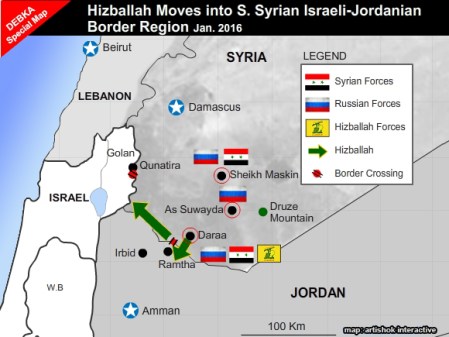
On Wednesday, Jan. 27 a large Hizballah force entered the southern Syrian town of Daraa, a critically dangerous event for Israel’s security. The way to the town, which lies near the Jordanian border and across from the Israeli Golan, was opened before Hizballah by none other than Russian forces. This was a blatant violation of President Vladimir Putin’s commitments to Prime Minister Binyamin Netanyahu and Jordanian King Abdullah not to permit Iranian and Iran-backed forces, such as Hizballah and Iraqi and Afghani Shiite militias, reach their borders in consequence of Russia’s military intervention in the Syria war.

Daraa is just 32 km from the southern Golan and 12 km from the Jordanian border. Hizballah forces in this town are therefore within easy striking distance from northern Israeli and Jordan.

What happened Wednesday was that a sizeable Hizballah contingent made it into Daraa, the day after a Syrian unit under the command of Russian officers captured the town of Sheikh Maskin, cutting off rebel forces east of Daraa from their comrades to the west.

Control of Sheikh Maskin is the key to the crossroads leading to Damascus in the north, the Druze Mountain town of es-Suwaida in the east, and Quneitra on Golan opposite Israel’s northern defenses.

The battle for Sheikh Maskin was the first in the Syrian conflict to be directly fought under Russian command. Its fall sparked accounts of Russian officers commanding Syrian troops in different parts of Syria.

So far, Israel has not reacted to the Hizballah force’s advance, notwithstanding public statements by Prime Minister Binyamin Netanyahu and Defense Minister Moshe Ya’alon that this would never be allowed to happen.

DEBKAfile’s military sources explain this reticence by a persistent misreading of the Syrian crisis in the higher ranks of the Israeli defense establishment. Military Intelligence chief Maj. Gen. Herzl Halevi, who has a good grasp of its complexities, is a lone voice against the defense minister and IDF chief of staff, Lt. Gen. Gady Eisenkot

In Amman, however, King Abdullah and his generals signified both alarm and fury. DEBKAfile’s sources report that Wednesday morning, the king shot off an urgent message to President Putin demanding an explanation for the Russian officers’ action in opening the door of Daraa to hostile Hizballah fighters.

Jordan has fought Hizballah and its conspiracies for three years, ever since its security forces seized an arms cache that Hizballah had smuggled into the kingdom for a terror cell to mount attacks in the northern province of Irbid. Amman is now concerned that Hizballah is close enough to make a grab for Al-Ramtha, the only border crossing between Syria and Jordan. That would be a feather in the cap of Iran’s Lebanese proxy, as the first Arab border crossing to fall to a Hizballah force outside Lebanon, and one, moreover, located athwart a main regional water source, the Yarmouk River.

As of Thursday morning, Jan. 28, Abdullah had not received a reply to his missive from Putin, but a message did come through to Amman from Syrian President Bashar Assad.

Using a back-door intelligence channel, he sent a notice in the name of Gen. Bahjat Suleiman, former Syrian ambassador to Jordan until he was expelled in May 2014, that King Abdullah must now face the consequences of his long support for the rebels of southern Syria.

The monarch was also advised to prepare for the influx of thousands of fleeing rebel fighters whom the combined Syrian and Hizballah forces were pushing towards the Jordanian border.

The next hours will be critical for the development of a similar crisis on the Israel-Syrian border in the Golan region.

Putin bypasses Israel, sets up joint war room for S. Syria with Jordan

January 14, 2016

Putin bypasses Israel, sets up joint war room for S. Syria with Jordan, DEBKAfile, January 14, 2016

Jordan_specail_forces

By teaming up with Jordan for a joint war room to cover operations in southern Syria, Putin has gone around Netanyahu’s back and acquired a helper for evicting Syrian rebels from southern Syria.

***************************

In a pivotal step reflecting the changeability of military and political deals in Israel’s neighborhood, Jordan has almost overnight agreed to establish a shared war room with Russia for the concerted conduct of their operations in Syria. This represents an extreme reversal of Amman’s policy. Until now, Jordan fought against Russia’s protégée Bashar Assad from a joint war room north of Amman called the US Central Command Forward-Jordan, as part of a lineup with the US, Saudi Arabia and Israel.

But this week Jordan shifted onto a new plane.

DEBKAfile’s military and intelligence sources say Jordanian King Abdullah’s decision to team up with Moscow starts a whole new ball game rolling on policy-making and intelligence-sharing. He doesn’t plan to shut down his shared command center with the US and Israel, but the center of gravity of Jordan’s military and intelligence efforts will be redirected to the new center with Russia, representing a major earthquake in those areas.

Amman is working hard to downplay the new partnership, presenting it as designed to foster better coordination between the American and Russian military efforts in Syria and the war on the Islamic State.

That picture is misleading.

With all due respect to the Jordanian monarch, his military and his intelligence services, they are not exactly qualified for the role of coordinator between the two world powers. The US and Russian presidents handle this in person. And in fact, the new Russian-Jordanian war room did come up, according to our Washington and Moscow sources, in the latest telephone conversation between the two presidents on Jan. 13.

Obama then held a quick meeting with King Abdullah at Andrews Air Force Base in Maryland and asked for an explanation.

For the various rebel militias holding out in large parts of southern Syria, including the Israeli border regions, the new Jordanian-Russian war room is bad news. Hitherto, Jordan provided the rebels with their main pipeline for fighters, weapons and funds from the US, Saudi Arabia and the UAE. The US even ran training camps in Jordan for Syrian rebel fighters.

This pipeline is now likely to be shut down or reduced to a minimum.

The Jordanians gloss over their shift, claiming it is designed to force the Syrian rebels of the South to accept a ceasefire and join peace talks with the US and Russia on Syria’s future. That is no more than diplomatic-speak for the real purpose, which is to compel them to give up the fight against Assad, and make way for Moscow to achieve its key objective, which is to restore the Assad regime’s control over the South.

Ever since his major intervention in Syria, Putin has tried to persuade Prime Minister Binyamin Netanyahu to pull the rug from under the Israeli-backed rebels in the South. They are deemed as a necessary buffer for securing Israel’s northern border and blocking the reimposition of Assad’s authority there.

The content of the exchanges between Putin and Netanyahu has only been shared with tight circles of confidants in Jerusalem and the Kremlin, so little is reliably known about their areas of agreement and dispute.

There is no doubt that the prime minister spoke firmly about Israel’s abiding concern that, once Assad regained control of the South, he would open the door up to the Israeli border and let in his allies and Israel’s arch enemies, Hizballah and the mostly-Iraqi Shiite militias fighting under the command of officers from Iran’s Revolutionary Guard Corps.

By teaming up with Jordan for a joint war room to cover operations in southern Syria, Putin has gone around Netanyahu’s back and acquired a helper for evicting Syrian rebels from southern Syria.

Assad again controls Damascus thanks to Russian air strikes and intelligence

December 26, 2015

Assad again controls Damascus thanks to Russian air strikes and intelligence, DEBKAfile, December 26, 2015

Allous_Killed_25.12.15

Less noticed, was the UN plan to remove at the same time several thousands ISIS fighters from the Syrian capital and transport them to their Syrian headquarters. The latter project has not been trumpeted for good reason: It implies UN recognition of ISIS as a party in the Syria war.

***************************

The Russian air strike that Friday, Dec. 25, killed Zahran Aloush, founder of the most powerful Syrian rebel group Jaysh al-Islam and his deputy, gave President Bashar Assad a big break in the Syrian war, thanks to his powerful backer, Vladimir Putin.

This grave loss will accelerate the breakup of Syrian rebel strongholds in and around Damascus. It will also hasten the evacuation under a UN-sponsored ceasefire of at least 2,000 rebels from the Damascus region. Less noticed, was the UN plan to remove at the same time several thousands ISIS fighters from the Syrian capital and transport them to their Syrian headquarters. The latter project has not been trumpeted for good reason: It implies UN recognition of ISIS as a party in the Syria war.

For nearly five years, the war seesawed back and forth, with neither the Syrian army nor the insurgents gaining the upper hand for long, even after Tehran threw its Lebanese proxy, Hizballah,  into the fray to bolster Assad’s army.

Interventions by the US, Saudi Arabia, Qatar, the UAE, Jordan and Israel were too trifling and hesitant to tilt the balance in favor of the anti-Assad insurgent militias. Weapons supplies were inferior and tardy and kept the rebels heavily outgunned by the Syrian army’s tanks, helicopters and fighter jets, and helpless against the Iranian-made barrel bombs dropped by the Syrian air force.

The Obama administration was the architect of this uneven support strategy, going so far as to constrain the rebels’ other foreign backers against giving them the resources for carrying the day, aside from local victories.

This strategy had the effect of prolonging the vicious conflict – until it was cut short by two events:

1. In the summer of 2014, the Islamic State of Iraq and the Levant arrived in full force to capture the northern Iraqi city of Mosul, scattering seven Iraqi armed divisions to the four winds, and grabbing  their sophisticated American weapons, along with their arsenals, that were crammed with good American tanks, armored personnel carriers, and an assortment of surface, antitank and antiair missiles.

Part of this booty was diverted to ISIS Syrian headquarters in Raqqa.

2.  A year later, in late September 2015, President Vladimir Putin embarked on a massive buildup of Russian military strength in Syria – notably, his air and missile forces – for direct intervention in the war.

In contrast to President Barack Obama, who sought to keep his hand on the conflict by a complicated system of dribbling arms to select Syrian rebel groups, Putin went all out with massive military and strategic backing to assure the Syrian ruler and his Iranian ally of victory.

The Russian strategy is now becoming evident:  It is to drive the rebels out of the areas they have captured around the main cities of Latakia, Aleppo, Idlib, Homs, Hama and the capital, Damascus, giving them two options: join the opposition front around the table for negotiating an end to the war, or total eradication – even though Moscow and Washington have yet to agree which of the rebel militias belong around that table.

According to Moscow’s scale of priorities, the fight against the Islamic State must wait its turn until after Bashar Assad’s authority as president is fully restored and his country returns to his army’s control.

But on the way to this objective, Putin has run up against a major impediment: the failure of Iranian, Shiite militia, Hizballah and Syrian army ground forces keep up with his pace. The plan was for Russian air strikes and missiles to clear rebels out of one area after another and for pro-Assad ground troops to storm in and take over.

But these troops are proving too slow to press the advantage given them by the Russians.

Last week, the Russians decided to use their intelligence assets to speed things up. They borrowed an Israeli counter-terror tactic to start targeting key rebel chiefs for liquidation.

The death of the Jaysh al-Islamc commander as the result of a Russian airborne rocket strike on Friday was an intelligence feat rather than a military one. Just as Israel last Sunday used its clandestine assets in Damascus to precisely target the Hizballah-Iranian arch terrorist Samir Quntar at his home in the Jaramana district, so the Russians directed their agents on the ground to mark the secret meeting of Jaysh al-Islam commanders at Marj al-Sultan at the precise moment for taking them down.

This blow to the rebel movement, plus the mass-evacuation of its fighters from the Syrian capital, are major steps towards bringing the Syrian capital back under the control of the Syrian dictator.

US bows to Russian demand to keep Assad in office. Israel follows suit

December 16, 2015

US bows to Russian demand to keep Assad in office. Israel follows suit, DEBKAfile, December 16, 2015

kerry-meets-putin-moscow_15.12.15

After two tries, US Secretary of State John Kerry finally turned President Barack Obama away from his four-year insistence that Bashar Assad must go, as a precondition for a settlement of the Syrian conflict. Tuesday, night, Dec. 15, the Secretary announced in Moscow: “The United States and our partners are not seeking so-called regime change.”

After Kerry’s first try, Obama still stuck to his guns. He said in Manilla on Nov.19 that he didn’t believe the civil war in Syria “will end while the dictator remains in power.”

Almost a month went by and then, Tuesday night, after a day of dickering with Foreign Minister Sergei Lavrov culminating in a joint conference with Putin at the Kremlin, Kerry confirmed this evolution in US policy. The focus now, he said, is “not on our differences about what can or cannot be done immediately about Assad.” Rather, it is on facilitating a peace process in which “Syrians will be making decisions for the future of Syria.”

Rather, it is on facilitating a peace process in which “Syrians will be making decisions for the future of Syria.”

This statement brought Washington in line with Moscow’s demand for the Syrian president’s future to be determined by his own people.

This statement brought Washington in line with Moscow’s demand for the Syrian president’s future to be determined by his own people.

On this demand, Iran’s Ayatollah Ali Khamenei is even more obdurate than Putin.

DEBKAfile’s Middle East sources wonder about the measure of freedom the Syrian people can expect while it is clamped firmly in a military vice by Russia, Iran and Hizballah. However, this was of no immediate concern to the big power players. Washington’s surrender to the Russian and Iranian line on Assad’s future was offered in the short-term hope of progress at the major international conference on the Syrian question taking place in New York Friday.

Another major US concession – this one to Tehran – was scarcely noticed.

Earlier Tuesday, the UN nuclear watchdog’s 35-nation board in Vienna closed its investigation into whether Iran sought atomic weapons, opting to back the international deal with Tehran rather than dwell on Iran’s past activities.

This motif of going forward toward the future rather than dwelling on the past was a repeat of the argument for keeping Assad in power. It provided an alibi for letting Tehran get away with the suspicion of testing a nuclear detonation at its Parchin military complex, without forfeiting sanctions relief, by the simple device of denying access to UN nuclear agency monitors to confirm those suspicions.

In a single day, the Obama administration handed out certificates of legitimacy to the Syrian dictator, who is responsible for more than a quarter of a million deaths, and to Iran’s advances toward a nuclear weapon.

These epic US policy reversals carried three major messages:

1. The Obama administration has lined up behind Putin’s Middle East objectives which hinge on keeping Bashar Assad in power.

2. Washington endorses Russia’s massive military intervention in Syria, although as recently as last month Obama condemned it as doomed to failure.

3. The US now stands behind Iran – not just on the Syrian question – but also on the existence of an Iranian-Syrian-Hizballah alliance, based on a solid land bridge from Iran and the Gulf up to the Mediterranean coast under Russian military and political protection and influence.

Even more surprising were the sentiments heard this week in Jerusalem.

Our military and intelligence sources cite officials urging the government to accept the American policy turnaround. In some military circles, senior voices were heard commenting favorably on Assad’s new prospects of survival in power, or advising Israel to jump aboard the evolving setup rather than obstructing it.

Those same “experts” long claimed that Assad’s days were numbered. They were wrong then and they are wrong now.

Israel was forced to yield on the Iranian nuclear program, but its acceptance of the permanence of Assad and the indefinite presence in Syria of his sponsors, Iran and Hizballah, will come at a high price for Israel in the next conflict.

Under secret Moscow-Cairo deal, first Egyptair passenger flights to Damascus, Aleppo

December 7, 2015

Under secret Moscow-Cairo deal, first Egyptair passenger flights to Damascus, Aleppo, DEBKAfile, December 7, 2015

Egyptair_resume_flights_toDamascus-and-Aleppo_2.12.15

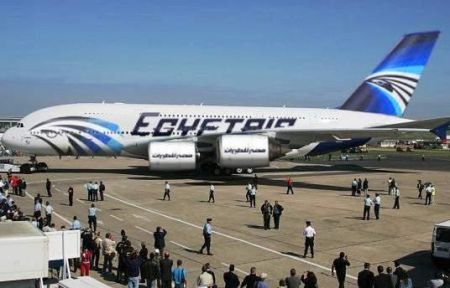
A new secret pact has taken shape in the Middle East. Last week, the offices of Russian Vladimir Putin and Egyptian President Abdel-Fatteh El-Sisi secretly formulated a tripartite accord for strengthening the ties between Moscow, Cairo and the Assad regime in Damascus, DEBKAfile’s exclusive military sources reveal. The pact had its first visible manifestation in the unannounced landings last Wednesday, Dec. 2, of the first Egyptair passenger flights at Damascus international airport and Aleppo in northern Syria.

The Egyptian national airline thus became the first of any Arab airline to renew flights to the war-torn Syrian capital since 2012. (see photo)

President El-Sisi’s gesture was tantamount to an eloquent vote of support for the Syrian ruler Bashar Assad in the face of his opponents in the Arab arena. It was also a demonstration of confidence in the Russian policy of preserving the Syrian ruler in power in the face of powerful voices in the West and the region calling for his ouster.

By sending a passenger plane to a Syrian airport, Egypt’ signaled its affirmation that Russian military intervention in Syria was making the embattled country a safer place where airliners could land without fear.

Moscow therefore attached supreme importance to the opening of the Egyptian-Syrian civilian air route, so much so that President Vladimir Putin pushed hard for it to take place ahead of the conference of Syrian rebel groups opening in Saudi Arabia Tuesday, Dec. 8.

In diplomatic communications with Riyadh, the Russians urged the Saudi hosts to prevail on the rebel groups whom they support with arms and cash to agree to enter into direct negotiations with Assad for ending the war.

Putin rewarded the Egyptian president for his gesture by ordering Russian airlines to resume their flights to Egypt. Those flights were suspended after the Russian Metrojet airliner was downed over Sinai by terrorists on Oct. 31 and 224 lives were lost in the crash. Their resumption will see Russian tourists again visiting Egypt, restoring a precious source of revenue to the strapped Egyptian economy, estimated at $5 bn per annum.

Our sources in Moscow declined to say whether the Russian passenger planes would again be calling at Sharm El-Sheikh like the ill-fated Metrojet. For the time being, they will most likely land at Cairo.

The Russian president is now trying to persuade El-Sisi to carry on making gestures for enhancing Assad’s standing.

Oh by the way, Turkey is trying to get into a war w/Iraq

December 6, 2015

Oh by the way, Turkey is trying to get into a war w/Iraq, Front Page Magazine, Daniel Greenfield, December 6, 2015

hqdefault_1

Open question: What does Turkey’s deranged Islamist leader have to do to be disavowed by NATO, Europe and the US?

Erdogan armed terrorists in Syria, but pretty much everyone is doing that. He nearly began a war with Russia. Now Iraq keeps ordering Turkish troops off its soil. But they’re there at the supposed request of Sunnis militias around Mosul. Possibly to fight ISIS. But considering Turkey’s track record and Baghdad’s protests, probably not.

It’s a given that Baghdad, which has become a puppet regime for Iran, would oppose arming Sunni militias. Its preferred means of operation is through Iranian trained Shiite militias.

Since Turkey is really in Syria to overthrow Assad, it looks like its version of the Sunni-Shiite conflict is spreading to Iraq. Essentially Turkey is advancing into a war with the Shiite axis of Iran-Syria and its Russian patron, not to mention all the various Shiite terror militias.

I won’t object if Sunni and Shiite terrorists and their state sponsors shoot and bomb each other. Especially if it’s Turkey and Iran, but as long as Turkey is in NATO, its lunatic tyrant trying to revive the Ottoman Empire has the ability to drag us into his wars.

And that’s an obvious problem.

Turkey should not be in NATO. And only a madman would consider it for EU membership.

But Erdogan’s migrant games have forced Germany to come crawling to him offering cash and EU membership acceleration.

Obama, who was once closest to Erdogan, is obviously not about to cut him off no matter what he does. But the United States is now in the strange position of having a ridiculously confused presence in a Muslim civil war.

Obama is backing Sunni Jihadists in Syria and Shiite Jihadists in Iraq. He refuses to arm Sunni militias in Iraq, but stands by while Turkey carries out what is effectively an illegal invasion of Iraq. (Remember that one the next time Kerry squeals about Jews living in Jerusalem.) He backs Kurdish militias that Turkey is bombing. He’s trying to appease Iran and Turkey at the same time and it can’t work.

The only thing Obama has managed to do is shove the United States in the middle of a Muslim civil war while making occasional noises about un-Islamic ISIS.

No, the Islamic State Will Not Be Defeated — and if It Is, We Still Lose

November 25, 2015

No, the Islamic State Will Not Be Defeated — and if It Is, We Still Lose, BreitbartBen Shapiro, November 24, 2015

GettyImages-497044984-640x480

Barack Obama has now created an unwinnable war.

While all of the 2016 candidates declare their strategies for victory against ISIS, President Obama’s leading from behind has now entered the Middle East and the West into a free-for-all that cannot end any way but poorly.

The best way to understand the situation in Syria is to look at the situation and motivation of the various players. All of them have varying agendas; all of them have different preferred outcomes. Few of them are on anything approaching the same page. And Barack Obama’s failure of leadership means that there is no global power around which to center.

ISIS. ISIS has gained tremendous strength since Barack Obama’s entry to power and pullout from Iraq. They currently control northern Syria, bordering Turkey, as well as large portions of northern Iraq. Their goal: to consolidate their territorial stranglehold, and to demonstrate to their followers that they, and not other competing terrorist groups like Al Qaeda, represent the new Islamic wave. They have little interest in toppling Syrian dictator Bashar Assad for the moment. They do serve as a regional counterweight to the increasingly powerful Iranians – increasingly powerful because of President Obama’s big nuclear deal, as well as his complete abdication of responsibility in Iraq.

Iran. Iran wants to maximize its regional power. The rise of ISIS has allowed it to masquerade as a benevolent force in Iraq and Syria, even as it supports Assad’s now-routine use of chemical weapons against his adversaries, including the remnants of the Free Syrian Army (FSA). Iran has already expanded its horizons beyond Iraq and Syria and Lebanon; now it wants to make moves into heretofore non-friendly regions like Afghanistan. Their goal in Syria: keep Bashar Assad in power. Their goal in Iraq: pushing ISIS out of any resource-rich territories, but not finishing ISIS off, because that would then get rid of the global villain against which they fight.

Assad. The growth of ISIS has allowed Assad to play the wronged victim. While the FSA could provide a possible replacement for him, ISIS can’t credibly do so on the international stage. Assad knows that, and thus has little interest in completely ousting them. His main interest is in continuing to devastate the remaining FSA while pretending to fight ISIS.

Egypt/Saudi Arabia/Jordan. As you can see, ISIS, Iran, and Assad all have one shared interest: the continued existence of ISIS. The same is not true with regard to Egypt, Saudi Arabia, and Jordan, all of whom fear the rise of radical Sunni terrorist groups in their home countries. They are stuck between a rock and a hard place, however, because openly destroying ISIS on behalf of Alaouite Assad, they embolden the Shia, their enemies. Egypt, Saudi Arabia, and Jordan would all join an anti-ISIS coalition in the same way they did against Saddam Hussein in 1991, but just like Hussein in 1991, they won’t do it if there are no Sunni alternatives available. Tunisia, Saudi Arabia, and Jordan are the top three sources of foreign fighters for ISIS.

Turkey. The Turks have several goals: to stop the Syrian exodus across their borders, to prevent the rise of the Iranians, and to stop the rise of the Kurds. None of these goals involves the destruction of ISIS. Turkey is Sunni; so is ISIS. ISIS provides a regional counterweight against Iran, so long as it remains viable. It also keeps the Kurds occupied in northern Iraq, preventing any threat of Kurdish consolidation across the Iraq-Turkey border. They will accept Syrian refugees so long as those other two goals remain primary – and they’ll certainly do it if they can ship a hefty portion of those refugees into Europe and off their hands.

Russia. Russia wants to consolidate its power in the Middle East. It has done so by wooing all the players to fight against one another. Russia’s involvement in the Middle East now looks a good deal like American involvement circa the Iran-Iraq War: they’re playing both sides. Russia is building nuclear reactors in Egypt, Jordan, Turkey and Iran. They’re Bashar Assad’s air force against both the FSA and ISIS. Russia’s Vladimir Putin doesn’t have a problem with destroying ISIS so long as doing so achieves his other goal: putting everyone else in his debt. He has a secondary goal he thought he could chiefly pursue in Eastern Europe, and attempted with Ukraine: he wants to split apart the North Atlantic Treaty Organization, which he rightly sees as a counterbalance to check Russian aggression. Thanks to today’s Turkish attack on a Russian plane, and thanks to the West’s hands-off policy with regard to the conflict, Putin could theoretically use his war against ISIS as cover to bombard Turkish military targets, daring the West to get involved against him. Were he to do so, he’d set the precedent that NATO is no longer functional. Two birds, one war.

Israel. Israel’s position is the same it has always been: Israel is surrounded by radical Islamic enemies on every side. Whether Iranian-backed Hezbollah or Sunni Hamas and ISIS, Israel is the focus of hate for all of these groups. Ironically, the rise of Iran has unified Israel with its neighbors in Jordan, Egypt, and Saudi Arabia. All three of those countries, however, can’t stand firmly against ISIS.

All of which means that the only country capable of filling the vacuum would be the United States. Just as in 1991, a major Sunni power is on the move against American interests – but unlike in 1991, no viable option existed for leaving the current regime in power. And the US’ insistence upon the help of ground allies is far too vague. Who should those allies be, occupying ISIS-free ISISland?

The Kurds have no interest in a Syrian incursion. Turkish troops movements into ISIS-land will prompt Iranian intervention. Iranian intervention into ISIS-land would prompt higher levels of support for Sunni resistance. ISIS-land without ISIS is like Iraq without Saddam Hussein: in the absence of solidifying force, chaos breaks out. From that chaos, the most organized force takes power. Russia hopes that should it destroy ISIS, Assad will simply retain power; that may be the simplest solution, although it certainly will not end the war within the country. There are no good answers.

Barack Obama’s dithering for years led to this. Had he lent his support in any strong way to one side, a solution might be possible. Now, it’s not.

The high price the world could pay for Obama’s Syria, Iraq policy

November 9, 2015

The high price the world could pay for Obama’s Syria, Iraq policy, Center for Security Policy, Fred Fleitz, November 9, 2015

1896925188

As I’ve discussed on Fox News.com before, President Obama’s Syria/Iraq policy is not a policy.  It is a non-policy to do as little as possible about the chaos in these countries so he can hand this mess to the next president.

The Obama administration has announced two major policy shifts in two years to deal with the Iraq/Syria crisis and the threat from ISIS.  Neither exhibited the decisive leadership that the world expects from the United States.  Both were reactive and piecemeal moves to counter multiple humiliations of America.

This has created a growing global perception of American weakness and indecisiveness that will embolden America’s enemies for the remainder of the Obama presidency and possibly beyond.

The first policy shift, announced in a speech by President Obama on September 10, 2014 in response to a series of ISIS beheadings, was supposed to “degrade and ultimately defeat” ISIS.  The president said this effort would include “a systematic campaign of airstrikes” in Iraq and Syria, training and equipping of moderate Syrian rebels, increased support to the Iraqi army and stepped up humanitarian assistance.

The failure of the September 2014 policy shift was obvious soon after it began.  Pinprick airstrikes in Syria did not stop ISIS from making gains on the ground.  In Iraq, ISIS took the city of Ramadi last May despite being outnumbered 10-1 by the Iraqi army.  The Iraqi army and the Iraqi Kurds clamored for more arms while the Obama administration sat on its hands.

Obama’s 2014 policy shift suffered a spectacular collapse this fall when a failed $500 million program to train and equip moderate Syrian rebels was cancelled and Russia intervened in Syria and began conducting airstrikes against anti-Assad rebels, many backed by the United States.  Iran also stepped up its presence in Syria by sending troops who are fighting to prop up the Assad government.

This rapid collapse of President Obama’s Syria/Iraq policy over the last few weeks has caused serious damage to American credibility.  Russian President Putin mocked and ignored President Obama as he sent Russian forces into Syria.  An intelligence sharing agreement was signed between Russia, Syria, Iraq and Iran.  Iraqi lawmakers even called on Russia to conduct airstrikes against ISIS positions in their country.

The Obama administration responded to these setbacks with a new policy shift that looks even worse than the last one.

The president is sending “fewer than 50” special operations troops to help advise an alliance of Syrian Arab rebels.  Given the lack of a clear policy and confusing rules of engagement, such a small deployment will be scoffed at by America’s adversaries and may be at risk of being captured.  On Monday, President Obama made the preposterous claim that this deployment is consistent with his pledge of “no boots on the ground” in Syria and Iraq because these troops will not be on the front lines fighting ISIS.

The New York Times reported on November 2 the Syrian Arab rebel alliance that U.S. special operations troops are supposed to be advising doesn’t yet exist and is dominated by Syrian Kurds who mostly want to carve out their own state and have little interest in fighting to take back Arab territory from ISIS.  Moreover, American military support of the Syrian Kurds worries Turkey because of their close ties with the PKK, a Kurdish terrorist group in Turkey.

The U.S. dropped 50 tons of weapons for the Arab alliance in late September.  Although U.S. officials initially said Syrian Arabs and not Syrian Kurds were the recipients of the airdrop, according to the New York Times, Syrian Kurdish fighters had to retrieve these weapons because the Arab units for which they were intended did not have the logistical capability to move them.

The Obama administration’s latest Iraq/Syria policy shift includes a renewed call for Assad to leave office and a new round of Syrian peace talks.

New U.S. demands that Assad step down make little sense due to increased Russian and Iranian support.

The first round of U.S.-brokered Syrian peace talks were held last week in Vienna.  17 nations participated, including, for the first time, Iran.  The talks produced a vague communique endorsing a future cease-fire, a transitional government, a new constitution and elections in which Syrians would select a new government.  However, it seems unlikely the Assad regime – which was excluded from the talks – or its Russian and Iranian backers will ever support free and fair elections.

Russia and Iran rejected a timeline proposed by U.S. Secretary of State John Kerry at the peace talks under which Assad would step down in four to six months and national elections would be held in 18 months.  This puts a cease-fire out of reach since most Syrian rebels will not agree to a peace process that leaves Assad in power.

The Syria talks were overshadowed by the unwise decision by the Obama administration to include Iran because its presence legitimized its interference in Syria and Iraq.  This also made the talks tumultuous due to open feuding between Iranian and Saudi officials.  More talks are scheduled but Iranian officials have said they may not participate due to their differences with the Saudis.

So far, Mr. Obama has not agreed to Pentagon recommendations to back Iraqi forces with Apache helicopters or to allow U.S. military advisers to serve on the front lines with Iraqi forces.  These proposals are still reportedly under consideration.  Meanwhile, Republican congressmen continue to demand the Obama administration directly arm the Iraqi Kurds who are struggling to battle ISIS with inadequate and obsolete weapons.

America’s friends and allies know President Obama is pursuing a Syria/Iraq non-policy to run out the clock.  They know Mr. Obama’s initiatives are not serious policies but minor gestures that allow the president to be seen as doing something now while also enabling him to claim after he leaves office that he did not put U.S. boots on the ground in Iraq and Syria nor did he get America into another war.

Alliances in the Middle East are already shifting because of President Obama’s Syria/Iraq non-policy.  Russia is filling a power vacuum in the region and is building a new alliance with Iraq, Iran and Syria.  Russia has improved its relations with Egypt and Israel. Although the Saudis are working with the Obama administration to arm moderate Syrian rebel fighters, Riyadh is frustrated that the U.S. is considering compromise solutions which could leave Assad in power.  Saudi Arabia also reportedly is considering providing surface-to-air missiles to the Syrian rebels, a move the U.S. opposes since these missiles could fall into the hands of ISIS.

America’s enemies are certain to try to exploit the run-out-the-clock foreign policy that President Obama apparently plans to pursue for the remainder of his term in office.  This could mean a surge in global provocations, terrorism and violence from North Korea to the South China Sea to Afghanistan and to the Middle East due to the disappearance of American leadership over the next 15 months.

Remember that the weakness and incompetence of President Clinton’s foreign policy emboldened Al Qaeda to step up terrorist attacks against U.S troops and led Osama bin Laden to believe that the September 11, 2001 terrorist attacks would drive the United States from the Middle East.  With Barack Obama dithering away America’s global credibility, a catastrophic terrorist attack like 9/11 could happen again.

The New Cold War: The Russia-Shia Alliance VS the Islamic State

November 1, 2015

The New Cold War: The Russia-Shia Alliance VS the Islamic State, Counter Jihad Report, Brian Fairchild, October 31, 2015

(An excellent summary and analysis of the consequences of the Obama Middle East vacuum. — DM)

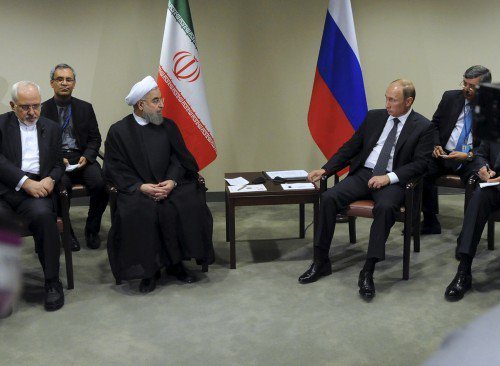
rtx1sy30_iran_russia_un_092015-e1443810243164Russia’s President Vladimir Putin (2nd R) meets with Iran’s President Hassan Rouhani (2nd L) on the sidelines of the United Nations General Assembly in New York, September 28, 2015. REUTERS/Mikhail Klimentyev.

Just one month ago, the US was the only major military player in the Middle East, but that has all changed.  Russia’s aggressive and well-planned military campaign in Syria has tilted the balance of power in the region away from the US and toward Russia and its new Shia-dominated quadrilateral alliance.  As a result, the US plan to effect regime change in Syria is now impossible, but more importantly, US influence in Iraq is steadily diminishing, and thus, the number of options available to American military commanders to degrade the Islamic State are also diminishing.

***********************

The New Cold War:

In late-September 2015 Russia and Iran launched a clandestine strategic military campaign to support Syria’s Bashar al-Assad.  Russia’s bold move took the West by surprise and changed the balance of power in the Middle East in Russia’s favor.  It will go down in history as the milestone depicting Russia’s first aggressive military action outside of its own sphere of influence since the fall of the Soviet Union, and, when viewed from a global strategic perspective, will be remembered as the first clear sign that a New Cold War had erupted between the US and Russia.

Russia’s Middle Eastern campaign is formed around the new “quadrilateral alliance”, which has divided the region into two sectarian blocs:  the Russian-led Shia Muslim alliance, which forms a powerful “Shia Crescent” stretching from Iraq, through Iran and Syria, to Lebanon, and the Sunni Arab bloc led by Saudi Arabia with minimal backing by the United States.

Thus far, Russia’s campaign has been executed seamlessly. Upon entering Syria clandestinely, Russian forces immediately deployed sophisticated surface to air missile defense batteries as well as top-of the-line jet fighters to protect Russian and Syrian forces from the US coalition.  Once air defenses were in place, Moscow began a barrage of airstrikes targeting anti-Assad rebels in order to re-establish and consolidate Assad’s power.  The airstrikes were subsequently integrated with ground operations carried-out by Syrian military units, Iranian Quds forces, Shia militia from Syria and Iraq, and Hezbollah fighters.  There are also credible news reports that Cuban Special Forces have joined the fray for the first time since Cuba’s proxy wars in Angola and central Africa in the 1970’s on behalf of the Soviet Union.

The Russia-Shia Alliance and its Effect on Iraq, Jordan, and the Kurds:

Iraq:

In tandem with its military campaign, Russia launched a diplomatic campaign that has been just as effective.  Iraq is the geographical base for US coalition operations against the Islamic State in Iraq and Syria, but American influence in Iraq has steadily diminished over the past year.

In early October 2015, Iraq secretly established a new Russia-Iran-Syria-Iraq intelligence center in the middle of Baghdad that surprised and angered American military commanders.  Worse, after Russia’s increasingly effective Syrian air campaign, Iraqi Prime Minister Haider al-Abadi called for Russia to begin unilateral airstrikes against the Islamic State in Iraq.  The Pentagon became so alarmed by the possibility that Russia might get a strategic foothold in Iraq that on October 21, 2015, it dispatched Chairman of the Joint Chiefs of Staff General Joseph Dunford to Baghdad to deliver an ultimatum to the Iraqi leadership.  Dunford told the Iraqi Prime Minister and Defense Minister that Iraq had to choose between cooperating with Russia or the US.  Upon his departure from Baghdad, General Dunford told the media that he received assurances that Iraq would not seek Russian assistance, but just three days later, Iraq officially authorized Russian airstrikes in-country.

Jordan:

On that same day, another of America’s most dependable allies, the Kingdom of Jordan, announced its agreement to create a new Russian-Jordanian military coordination center to target the Islamic State and that this center would go well beyond just a formal information exchange.  According to Jordan’s Ambassador to Russia:

  • “This time, we are talking about a specific form of cooperation — a center for military coordination between two countries. Now we will cooperate on a higher level. It will not be just in a format of information exchange: we see a necessity ‘to be on the ground’ as Jordan has a border with Syria”

The Kurds:

Moscow is attempting to undermine US relations with the Kurds.  Since the rise of the Islamic State, the US has sought to provide anti-Islamic State military support to the Kurdish Regional Government (KRG) in northern Iraq via the Iraqi central government, but the Iraqi government has no desire to see the KRG gain additional power in the north so this mission has been largely ineffective.  The US has had a measure of success providing limited support to the Kurdish People’s Protection Units (YPG), but has balked at providing full support because any support whatsoever angers Turkey due to contacts between the YPG and the Kurdish Worker’s Party (PKK), a separatist organization, that seeks to overthrow the Turkish government.  On October 29, 2015, Turkish president Erdogan demonstrated this anger when he vehemently criticized US support for the YPG and stated that Turkey would attack the YPG on the Iraqi side of the border if it attempts to create a separatist Kurdish administrative zone.  Because Turkey is a NATO ally, Turkish threats cause the US significant political and diplomatic problems, but they will not deter Putin from moving to organize and utilize Kurdish forces in pursuit of his goals; in early October, he went out of his way to show disdain for Turkey and NATO by allowing his Syrian-based jets to illegally invade Turkish airspace.

No Kurdish group is happy with the current situation of getting limited support from the United States to fight the Islamic State, but all of them have expressed interest in cooperating with Russia.  Significantly, Sergey Ivanov, the head of the Kremlin administration, specifically urged cooperation between the Syrian Kurdish militia and the US-backed YPG.

The Russia-Shia Alliance and the Islamic State:

The Shia composition of the quadrilateral alliance is extremely significant because it plays directly into the Islamic State narrative.  The Islamic State and the majority of the world’s Muslims are Sunni, but in the heart of the Middle East, the Shia governments of Iran, Iraq, Syria, and Lebanon, with Russian support, dominate, and these countries surround the Islamic State’s new “caliphate” on three sides.  Understanding this strategic disadvantage, the Islamic State knows that it must muster as much international Sunni support as possible to survive, so it carries-out a relentless policy to polarize the international Sunni population against the Shia.

The chance to remove Bashar al-Assad, who represents the Shia Alawite sect, was the primary reason the Islamic State moved to Syria from Iraq, and removing al-Assad from power served as its initial rallying cry to the global Sunni community.  It was this rallying cry that created the dangerous “foreign fighter” phenomenon that subsequently brought more than 30,000 radical Sunni Muslims from around the world to the new caliphate.

The Islamic State repeatedly emphasizes in its official publications and statements its contention that Shia Muslims are not true Muslims and must be eradicated, and, in these communications, it refers to Shia Muslims as “Rafidah” (rejecters).  But of all the Shias in the world, the Islamic State has a particular hatred for the Shia Iranians, who are Persian rather than Arab, and who ruled Islam during the ancient Safavid (Persian) empire, which the Islamic State regards as religiously illegitimate.  It therefore refers to Iranians as the “Safavid Rafidah”.

Moreover, the Islamic State accuses the US and Russia of being modern day “crusaders” who have joined forces with the Iranians to destroy Sunni Islam, a contention made clear on March 12, 2015, when its spokesman Abu Mohamed al-Adnani stated:

  • The Safavid Rāfidah (Shia Iranians) today have entered a new stage in their war against the Sunnis. They have begun to believe that it is within their power to take areas of the Sunnis and control them completely. They no longer want a single Muslim from the Sunnis living in the empire they desire…O Sunnis…if the Islamic State is broken…then there will be no Mecca for you thereafter nor Medina…Sunnis! The Crusader-Safavid (Christian-Iranian) alliance is clear today.  Here is Iran with its Great Satan America dividing the regions and roles amongst each other in the war against Islam and the Sunnis…We warned you before and continue to warn you that the war is a Crusader-Safavid was against Islam, and war against the Sunnis…”

The Shia Alliance and the Saudis:

Saudi Arabia considers itself to be the leader of the world’s Sunni population and the custodian of Islam’s two most holy places:  the mosques of Mecca and Medina where the prophet Muhammad received Allah’s revelations.  Because Iran is the Kingdom’s religious and regional nemesis the Islamic State’s anti-Shia narrative resonates greatly among many Saudis who are increasingly alarmed at Iran’s growing military influence and power.  In a letter signed by 53 Saudi Islamic scholars in early October 2015, the clerics lashed out at Iran, Syria and Russia and echoed the main points made by the Islamic State:

  • “The holy warriors of Syria are defending the whole Islamic nation. Trust them and support them … because if they are defeated, God forbid, it will be the turn of one Sunni country after another”

Saudi King Salman was willing to allow this unofficial letter to be published because it permitted the Saudi government an indirect manner to issue a warning to Iran, but as the Russian-Iran alliance continued to make military gains throughout October, the Kingdom’s anxiety was such that it decided to allow its Foreign Minister to issue the following direct warning to Iran:

  • “We wish that Iran would change its policies and stop meddling in the affairs of other countries in the region, in Lebanon, Syria, Iraq and Yemen…We will make sure that we confront Iran’s actions and shall use all our political, economic and military powers to defend our territory and people…”

Conclusion:

The New Cold War:

Just one month ago, the US was the only major military player in the Middle East, but that has all changed.  Russia’s aggressive and well-planned military campaign in Syria has tilted the balance of power in the region away from the US and toward Russia and its new Shia-dominated quadrilateral alliance.  As a result, the US plan to effect regime change in Syria is now impossible, but more importantly, US influence in Iraq is steadily diminishing, and thus, the number of options available to American military commanders to degrade the Islamic State are also diminishing.

Five days after Iraq rejected General Dunford’s ultimatum and authorized Russian airstrikes in Iraq, Secretary of Defense Ashton Carter ignored this fact in his testimony before the Senate’s Armed Forces Committee when he stated that the United States plans to increase the number of airstrikes in Iraq as well as direct action raids by US special operations forces in Iraq.

Unfortunately, such an increase in US military actions require Iraqi permission, and for the second time in a week, Iraq rejected the United States.  On October 28, 2015, Prime Minister al-Abadi’s spokesman told the media that Iraq has no intention of allowing increased American participation because:

  • “This is an Iraqi affair and the government did not ask the U.S. Department of Defense to be involved in direct operations…”

If Iraq enforces this restriction, and limits the US to only training and arming Iraqi forces while allowing Russia to conduct aggressive operations in-country, the situation could become untenable for the United States, further reducing America’s ability to degrade the Islamic State.

The Islamic State:

Once Russia consolidates Assad rule in Syria, Putin will undoubtedly use the new Russia-Shia alliance to move against the Islamic State.  Because the alliance dominates the geographical terrain on three sides of the “caliphate” and has demonstrated a willingness to engage in unified military air and ground operations, it is likely that Russian airpower and Shia ground forces will succeed in dismantling many Islamic State elements in Syria and Iraq.

Such success by the Russia-Shia alliance, especially if it forces the evacuation of the capital of the Islamic State’s “caliphate” in Raqqa, Syria, will further polarize and enrage radical Sunnis and likely increase the number of foreign fighters from Europe and the Middle East.  It will also likely result in more domestic lone jihad attacks in the US and Russia, a call the Islamic State has already made in its October 13, 2015statement:

  • “…the Islamic State is stronger today than yesterday, while at the same time America is getting weaker and weaker…America today is not just weakened, it has become powerless, forced to ally with Russia and Iran…Islamic youth everywhere, ignite jihad against the Russians and the Americans in their crusaders’ war against Muslims.”

If the Islamic State experiences set-backs and defeats in Syria and Iraq such defeats would likely motivate it to launch mass casualty attacks in the United States and Europe in order to prove to its followers that it remains relevant. Mass casualty attacks in tandem with increased lone jihad attacks would make an already bad domestic security situation, grave.

On October 23, 2015, FBI Director Comey revealed that the FBI is pursuing approximately 900 active cases against Islamic State extremists in the United States and that this number continues to expand.  Comey added that should the number of cases continue to increase, it won’t be long before the FBI lacks the adequate resources to “keep up”.   Europe, too, faces grave security challenges.  A few days after Comey’s revelations, the head of MI5, Britain’s domestic intelligence service, stated that the terror threat in the United Kingdom from the Islamic State and al Qaeda is the highest he has “ever seen”.
Putin has no long term strategy, says administration w/no long term strategy

October 31, 2015

Putin has no long term strategy, says administration w/no long term strategy, Front Page Magazine, Daniel Greenfield, October 31, 2015

hqdefault

This is an administration that believes you win wars with word games

Obama claimed that Putin is acting in Syria out of weakness and is being all reactive. Then he reacted by shipping weapons to Sunni rebels, a move he had originally rejected, and sending American soldiers into combat as boots on the ground.

Now DNI James Clapper is claiming that Putin is being impulsive and has no long term strategy. This comes from an administration that changed its mind several times about intervening in the Syrian Civil War and keeps saying it still doesn’t have a plan for defeating ISIS.

Clapper said Putin was “very impulsive and opportunistic” as he increased Russian support for close ally President Bashar al-Assad in Syria’s roiling civil war.

“I personally question whether he has some long-term strategy or whether he is being very opportunistic on a day-to-day basis,” Clapper told CNN’s Jim Sciutto. “And I think his intervention into Syria is another manifestation of that.”

Being “opportunistic” is actually how real life battles are fought. You have a strategy, but you seize advantages based on the evolving situation on the ground.

So far Putin’s long term strategy has been to expand Russian influence in the region. It’s working really well. Russia is back to being the regional alternative to the US. It’s securing strategic territories and its allies are expanding their sphere of influence.

On top of that, Putin managed to avert US air strikes on Assad with his fake WMD deal. Then he helped Iran secure its nuclear weapons program with the Iran deal. (I’ll grant that he had a lot of help from Obama and Kerry there.) Now he’s angling to get Obama on board a peace deal that keeps Assad in power and ends US support for the rebellion. Considering this administration’s foreign policy track record, he’ll probably get his way. While the administration clown car taunts him as weak and opportunistic and reactive and impulsive.

In the Cold War, the Soviets trash talked while the US got things done. Under Obama, the US talks trash and Russia gets things done. But this is an administration that believes you win wars with word games.

How is that working out for them?