Archive for the ‘Al Qaeda’ category

Analysis: Osama bin Laden’s documents pertaining to Abu Anas al Libi should be released

January 4, 2015

Analysis: Osama bin Laden’s documents pertaining to Abu Anas al Libi should be released, Long War Journal, Thomas Joscelyn, January 3, 2015

(Release of the documents should further diminish the U.S. Government’s claims that al Qaeda died with bin Laden. How about any documents in the possession of Abu Anas al Libi when he was captured in Turkey in 2013? Might they contradict governmental claims about what happened during the “unanticipated” September 11, 2012 terrorist attack on the U.S. installation in Benghazi, why it happened and the nature of the U.S response? — DM)

Anas-al-Libi

The Obama administration made a concerted push to portray Osama bin Laden as a doddering old man who was operationally irrelevant.

What we know about Abu Anas al Libi’s al Qaeda role challenges all of these assessments.

Releasing any bin Laden files further implicating al Libi in the East Africa attacks would only strengthen the US government’s case to the public.

***************

A senior al Qaeda operative known as Abu Anas al Libi has died in the US as he was awaiting trial. Al Libi was captured in Tripoli during a raid by US forces in late 2013. He had been wanted for his role in the August 1998 US Embassy bombings for more than a decade prior to his arrest.

The US government has in its possession numerous pieces of evidence concerning al Libi’s al Qaeda role, including files recovered in May 2011 from Osama bin Laden’s home in Pakistan.

The Long War Journal has consistently advocated for the release of bin Laden’s files. The Obama administration has released just 17 documents, and a handful of videos, from a total cache of more than 1 million files. Many more of these files, if not almost all of them, should be declassified and released. There are no sources or methods to protect, as everyone knows how this information was obtained. The only files that should remain classified are those that have a direct bearing on the US government’s current counterterrorism operations against al Qaeda.

Now that al Libi has passed away, the US government has another opportunity to be more transparent with respect to bin Laden’s files. After all, at least some of the documents probably would have been released to the public during al Libi’s trial.

Just weeks ago, in mid-December, Benjamin Weiser of The New York Times reported that US prosecutors were seeking to use files recovered during the raid on bin Laden’s compound in al Libi’s trial.

A close reading of the Times‘ account reveals that prosecutors intended to use at least five separate letters recovered in bin Laden’s safe house.

It does not appear that any of these letters were included in the set of 17 documents released by the Obama administration through the Combating Terrorism Center at West Point. None of Abu Anas al Libi’s letters to al Qaeda’s leaders were released.

The first letter described by the Times is from Atiyyah Abd al Rahman, a senior al Qaeda leader, to bin Laden dated June 19, 2010. Rahman explained that al Libi was one of “the last brothers” to be released from Iran. Al Libi “came only a week ago and I met him and sat with him,” Rahman wrote, according to the Times’ summary. Rahman appointed al Libi to al Qaeda’s security committee. “It is normal for any person after a long absence, especially in jail, that he needs some time to figure out how things work,” Rahman noted. Rahman recommended that bin Laden send al Libi a letter, because al Libi was seeking “reassurance.”

A second letter, dated Oct. 13, 2010, is a five-page missive from al Libi to Osama bin Laden. “Your forever lover, Your brother,” al Libi signs the letter. Al Libi explains, according to the Times, that the al Qaeda “brothers,” including bin Laden’s sons and other al Qaeda operatives, fled to Iran under orders from Taliban leader Mullah Omar.

A third letter from Rahman to bin Laden was written “[a]bout a month later,” according to the Times, meaning it was penned sometime in November 2010. Rahman recommended that al Libi be accepted back into al Qaeda’s leadership ranks. Rahman described al Libi as “determined,” “visionary,” and “difficult somewhat,” but also noted that bin Laden knew him. Interestingly, Rahman complained that al Libi had violated al Qaeda’s operational security regulations by “contacting his family in Libya, despite knowing that we don’t allow any communications.”

Al Libi “knows that he was wanted by the Americans,” Rahman wrote to bin Laden, according to the Times’ summary. “He contacted them via phone repeatedly!”

In a fourth letter, written in March 2011, al Libi requested permission to join some other operatives who were returning to Libya to fight against Muammar al Qaddafi’s regime. It is better to “move out sooner rather than later” al Libi wrote.

Rahman forwarded al Libi’s letter to bin Laden, the Times reported, and Rahman explained to bin Laden that he approved al Libi’s request. This is the fifth letter prosecutors sought to introduce. Rahman noted that al Libi was “a little upset with me for the delay in getting back to him.”

A “builder of al Qaeda’s network in Libya”

Al Libi did in fact return to his native Libya. As a member of al Qaeda’s security committee who returned to North Africa only after receiving permission from his superiors in al Qaeda (Rahman), it is safe to assume that he was doing the terrorist organization’s bidding when he set up shop in his homeland.

Indeed, as The Long War Journal previously reported, an unclassified report published in August 2012 highlighted al Qaeda’s strategy for building a fully operational network in Libya. The report (“Al Qaeda in Libya: A Profile”) was prepared by the federal research division of the Library of Congress (LOC) under an agreement with the Defense Department’s Combating Terrorism Technical Support Office (CTTSO).

Abu Anas al Libi played a key role in al Qaeda’s plan for the country, according to the report’s authors. He was described as the “builder of al Qaeda’s network in Libya.”

Al Qaeda’s senior leadership (AQSL) has “issued strategic guidance to followers in Libya and elsewhere to take advantage of the Libyan rebellion,” the report reads. AQSL ordered its followers to “gather weapons,” “establish training camps,” “build a network in secret,” “establish an Islamic state,” and “institute sharia” law in Libya.

Abu Anas al Libi was identified as the key liaison between AQSL and others inside the country who were working for al Qaeda. “Reporting indicates that intense communications from AQSL are conducted through Abu Anas al Libi, who is believed to be an intermediary between [Ayman al] Zawahiri and jihadists in Libya,” the report notes.

Al Libi is “most likely involved in al Qaeda strategic planning and coordination between AQSL and Libyan Islamist militias who adhere to al Qaeda’s ideology,” the report continues.

Al Libi and his fellow al Qaeda operatives “have been conducting consultations with AQSL in Afghanistan and Pakistan about announcing the presence of a branch of the organization that will be led by returnees from Iraq, Yemen, and Afghanistan, and by leading figures from the former LIFG.” The term “LIFG” refers to the Libyan Islamic Fighting Group, an al Qaeda-linked jihadist group formed in Libya in the 1990s.

One of al Libi’s key allies inside Libya was another senior al Qaeda operative, Abd al Baset Azzouz, who has been close to al Qaeda’s senior leaders for decades.

Azzouz was sent to Libya by Zawahiri and “has been operating at least one training center.” Azzouz “sent some of his estimated 300 men…to make contact with other militant Islamist groups farther west.”

Azzouz was reportedly captured in Turkey last month. [See LWJ report, Representative of Ayman al Zawahiri reportedly captured in Turkey.]

Release bin Laden’s files

The Obama administration made a concerted push to portray Osama bin Laden as a doddering old man who was operationally irrelevant. Citing bin Laden documents shown to him by the White House, the Washington Post’s David Ignatius described the jihadist leader as a “lion in winter.” CNN‘s Peter Bergen similarly reported that bin Laden was in retirement at the time of his death. The Combating Terrorism Center at West Point, working off of only those documents provided by the Obama administration, portrayed bin Laden as being sidelined.

What we know about Abu Anas al Libi’s al Qaeda role challenges all of these assessments. He was reintegrated into al Qaeda’s chain of command after his release from Iranian custody. His role was approved by Rahman, who served as one of bin Laden’s top subordinates before being killed in a US drone strike. Rahman made sure that al Libi joined al Qaeda’s security committee — an internal body that is not factored into any public assessments of al Qaeda’s structure or hierarchy. And al Qaeda approved al Libi’s return to Libya. Other evidence subsequently unearthed by the US government shows that al Libi was acting as one of al Qaeda’s top operatives in North Africa at the time of his capture.

This evidence should be released to the public, so we can judge for ourselves how al Qaeda operates.

In addition, any documents or files recovered from bin Laden’s compound that deal with the August 1998 US Embassy bombings should be released as well. After al Libi was captured in Libya, his family claimed he had played no role in the twin attacks, which were al Qaeda’s most successful operation prior to Sept. 11, 2001. However, there is abundant evidence, including testimony given before a US district court, indicating that al Libi was a key player in the bombings. Releasing any bin Laden files further implicating al Libi in the East Africa attacks would only strengthen the US government’s case to the public.

The Islamization of Britain in 2014

December 30, 2014

The Islamization of Britain in 2014, The Gatestone InstituteSoeren Kern, December 30, 2014

“Britain remains the world’s leading recruiting ground for al-Qaeda.” — Con Coughlin, Daily Telegraph.

When she sought help from the police and a lawyer, “the family of the defendants were insulted that she had gone to the law. They wanted her back within the family fold… Therefore, it was decided that she should be forced to comply or be killed.” — Prosecutor of Ahmed A-Khatib, who murdered his wife for becoming “too westernized.”

British school teachers are afraid to teach their students about Christianity out of fear of offending Muslims. — Roger Bolton, BBC Radio 4’s Feedback program.

Rather than taking steps to protect British children, police, social workers, teachers… and the media deliberately played down the severity of the crimes [of Muslim sexual grooming gangs] in order to avoid being accused of “Islamophobia” or racism. — From the report “Easy Meat: Multiculturalism, Islam and Child Sex Slavery.”

A group of British lawyers launched a website, Sharia Watch UK. The group called Sharia law “Britain’s Blind Spot.”

After Adebolajo, who murdered and tried to behead British soldier Lee Rigby with a meat cleaver, was given a “whole-life” prison term, his brother said his sibling was the victim of “Islamophobia.”

“The problem of honor-based violence and forced marriages in England is “worse than people think.” — Claire Phillipson, Wearside Women in Need

The Muslim population of Britain reached 3.4 million in 2014 to become around 5.3% of the overall population of 64 million, according to figures extrapolated from a recent study on the growth of the Muslim population in Europe. In real terms, Britain has the third-largest Muslim population in the European Union, after France and Germany.

Islam and Islam-related issues were omnipresent in Britain during 2014, and can be categorized into four broad themes: 1) Islamic extremism and the security implications of British jihadists in Syria; 2) the continuing spread of Islamic Sharia law in Britain; 3) the sexual exploitation of British children by Muslim gangs; and 4) Muslim integration into British society.

What follows is a chronological review of some of the main stories involving the rise of Islam in Britain during 2014.

In January, an analysis of census data showed that nearly 10% of the babies and toddlers in England and Wales are Muslim. The percentage of Muslims among children under five is almost twice as high as in the general population. By way of comparison, fewer than one in 200 people over the age of 85 are Muslim, an indication of the extent to which the birth rate is changing the religious demographic in Britain.

Also in January, Muslim fundamentalists threatened to behead a fellow British Muslim after he posted an innocuous image of Mohammed and Jesus on his Twitter account. The death threats against Maajid Nawaz, a Liberal Democrat Party candidate for British Parliament, added to the growing number of cases in which Islamists are using intimidation tactics to restrict the free speech rights of fellow Muslims in Europe.

On January 16, a Muslim woman was arrested by counter-terrorism police at Heathrow Airport as she was preparing to board a flight to Turkey. Nawal Masaad, 26, is accused of trying to smuggle £16,500 ($27,000; €20,000) in her underwear to jihadists in Syria. She and her alleged co-conspirator, Amal El-Wahabi, 27—a Moroccan who does not work and claims British social welfare benefits for herself and two young sons—were the first British women to be charged with terrorism offenses linked to the conflict in Syria.

On January 23, the head of Scotland Yard’s counter-terrorism unit, Commander Richard Walton,revealed that 14 British minors were arrested on charges linked to the Syrian conflict in January alone, compared to 24 for the whole of 2013. He said it was “almost inevitable” that some fighters would try to mount attacks in Britain upon their return.

On January 16, British Islamist Abu Waleed outlined his vision of an Islamic state in Britain, and called for Christians to be humiliated so that they would convert to Islam. In a video, he said:

“If the Muslim sees a kaffir [non-Muslim] with nice clothes, the kaffir has to take his clothes off and give them to the Muslim. The kaffir, when he walks down the street, he has to wear a red belt around his neck, and he has to have his forehead shaved, and he has to wear two shoes that are different from one another. He [the non-believer] is not allowed to walk on the pavement, he has to walk in the middle of the road, and he has to ride a mule. That is, my dear brothers, the Islamic state.”

In Bristol, the city council approved a controversial plan to convert a former comedy club into a mosque. In Cambridgeshire, a Muslim group submitted plans to convert a warehouse into a new mosque. In Cambridge, locals opposed a plan to build a £17.5 million ($28.5 million; €21 million) mega-mosque, claiming it could be “a front for terrorism.” In Blackburn, home to nearly 100 mosques, city councilors were urged to reject a plan to open a mosque in a residential neighborhood.

In Southend, local residents celebrated after a four-year battle resulted in the closing of an illegal mosque. In Newton Mearns, south of Glasgow, plans were abandoned to build a mosque within the grounds of a school in one of the most affluent suburbs of Scotland, due to local criticism of the move.

In Catherine-de-Barnes, a tiny village in western central England, local residents objected to plans for a large, Muslim-only cemetery, which will include space for 4,000 followers of Islam to be buried, and 75 parking spaces for visitors. The village has a population of just 613, which means the cemetery could eventually hold six-and-a-half times as many people as Catherine-de-Barnes itself.

In February, official statistics showed that net immigration to the United Kingdom surged to 212,000 in the year ending September 2013, a significant increase from 154,000 in the previous year. The new immigration data cast doubt on a pledge by Prime Minister David Cameron to get net migration—the difference between the number of people entering Britain and those leaving—down to the “tens of thousands” before the general election in May 2015.

Separately, data released by the National Crime Agency showed a 155% rise in British children groomed by sex gangs during 2013.

Also in January, a Muslim extremist who hacked a soldier to death on a London street in May 2013, launched a taxpayer-funded appeal against his murder conviction. Michael Adebolajo, 29, who tried to behead the British soldier Lee Rigby with a meat cleaver, maintained that he should not have been convicted because he is a “soldier of Allah” and therefore Rigby’s killing was an act of war rather than premeditated murder.

Adebolajo and his co-defendant, Michael Adebowale, 22, were found guilty by a jury in December 2013, and were sentenced on February 26. Adebolajo was given a “whole-life” prison term and Adebowale was given a minimum term of 45 years. Adebolajo’s brother said his sibling was the victim of “Islamophobia.”

On February 16, The Sunday Times reported that about 250 British jihadists who went to train and fight in Syria had returned to the UK and were being monitored by the security services. Senior officials said the high number of “returnees”—five times the figure that had been previously reported—underlined the growing danger posed by “extremist tourists” going to the war-torn region. MI5 and police said they feared that “returnees” could be preparing a Mumbai-style gun attack on civilians, possibly in a crowded public place in London.

On February 14, three Muslim vigilantes who terrorized innocent members of the public as the self-styled “Muslim Patrol” were banned from promoting Sharia Law in Britain for a period of five years.

In March, British authorities launched an investigation into the source of a document that purportedly outlined a plot by Muslim fundamentalists to Islamize public schools in England and Wales. The four-page document described a strategy—dubbed Operation Trojan Horse—to oust non-Muslim head teachers and staff at state schools in Muslim neighborhoods and replace them with individuals who would run the schools according to strict Islamic principles.

Also in March, a report entitled, “Easy Meat: Multiculturalism, Islam and Child Sex Slavery,”showed how officials in England and Wales were aware of rampant child grooming—the process by which sexual predators befriend and build trust with children in order to prepare them for abuse—by Muslim gangs since at least 1988. Rather than taking steps to protect British children, however, police, social workers, teachers, neighbors, politicians and the media deliberately downplayed the severity of the crimes perpetrated by the grooming gangs in order to avoid being accused of “Islamophobia” or racism.

Meanwhile, official figures revealed that record levels of Muslims are serving jail sentences and that the numbers are still growing. Across England and Wales the proportion has risen from 8% one decade ago to 14% now. In London, the figure is 27%, which is more than double the 12% of the capital’s population who are Muslim.

On March 27, ITV News reported that the problem of honor-based violence and forced marriages in England is “worse than people think,” but that many people are afraid of speaking out because they do not want to be branded as being “racist.” Claire Phillipson from Wearside Women in Need said:

“I have no doubt that all over the North East [England] first, second, third generation English young women are being forced into marriage.

“Schools and communities are keeping silent about it, because they are concerned that they would be called racist, Islamophobic. They don’t quite know where the line between culture, religion and human rights should be drawn.”
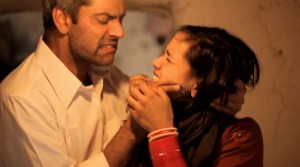
860An image from the video “Right to choose: Spotting the signs of forced marriage – Nayana”, produced by the UK Foreign & Commonwealth Office.

On March 13, the Law Society, the main professional association representing and governing the legal profession in England and Wales, issued ground-breaking guidance to help lawyers draft Sharia-compliant wills and estate planning documents. The move effectively enshrined Islamic Sharia law in the British legal system for the first time.

In April, the British government launched a public consultation on whether or not to introduce student loans that are compliant with Islamic Sharia law, which forbids loans that involve the payment of interest.

Critics said that the dispute over interest-bearing student loans follows stepped-up demands for Sharia-compliant banking and insurance as well as credit cards, mortgages and pension funds, which—taken together—are contributing to the establishment of parallel Islamic financial and legal systems in Britain.

Separately, Lloyds Bank was accused of reverse religious discrimination after dropping overdraft fees for Muslims but not for others. The bank said that non-Muslims would have to pay up to £80 (€97, $135) a month for an overdraft, but that for Muslims “there won’t be any charges.”

Meanwhile, the fast food giant Subway removed ham and bacon from almost 200 outlets in Britain and switched to halal (Arabic for “permitted” or “lawful”) meat alternatives, apparently in an attempt to please its Muslim customers.

On April 9, Home Secretary Theresa May published her annual report on the government’s strategy for countering terrorism. The report concluded that battle-hardened British jihadists returning from the war in Syria now pose the most serious threat to British security.

On April 17, the Sheffield Crown Court found Aras Hussein, 21, guilty of beheading his girlfriend, Reema Ramzan, 18, with a kitchen knife in her apartment in Sheffield in June 2013. He was sentenced to life, with a minimum of 20 years in prison.

On April 30, a jury at the Manchester Crown Court heard how Ahmed Al-Khatib, 35, murdered his wife for becoming “too westernized.” The prosecution told the jury that the mother of three had been “in fear of her husband” and “believed he might one day kill her.” She eventually sought help from the police and a lawyer. The prosecutor said:

“The family of the defendants were insulted that she had gone to the law. They wanted her and her children back within the family fold… Therefore, it was decided that she should either be forced to comply or be killed.”

On April 19, the Charity Commission, a government agency that regulates charities in the UK,announced a crackdown on Muslim charities that send money to jihadist groups in Syria.

On April 24, British counter-terrorism officials launched a nationwide campaign aimed at encouraging Muslim women to contact the police if they were concerned that their family members or close friends might be preparing to travel to Syria to fight.

Also on April 24, a group of British lawyers launched a new organization called “Sharia Watch UK” to “highlight and expose those movements in Britain which advocate and support the advancement of Islamic law in British society.” The group called Sharia law “Britain’s Blind Spot.”

In May, a senior adviser to Lutfur Rahman, the extremist-linked mayor of the heavily Islamized London Borough of Tower Hamlets, threatened Muslim riots unless people stop questioning the manner of his re-election. Rahman narrowly won re-election on May 23 as an independent, but the result was cast into doubt amid dozens of reports of voter intimidation and a chaotic count that took more than five days to declare a final result. Rahman was expelled from the Labour Party in 2010 after The Telegraph revealed his close links to an Islamic extremist group, the Islamic Forum of Europe.

On May 19, a jury in New York found Abu Hamza, the former imam of Finsbury Park mosque in north London, guilty on all 11 counts following a four-week trial. The one-eyed, handless Hamza was charged with organizing a terrorist camp in the US, taking hostages in Yemen and sending one of his followers from London to train with al-Qaeda in Afghanistan. The guilty verdicts followed a lengthy battle over his extradition from the UK, which began in 2004 but was only carried out in 2012. At the same time, Scotland Yard and MI5 were accused of ignoring warnings that Hamza was establishing an international hub of terrorism in London as far back as 1999. Despite Abu Hamza’s conviction, Britain remains the world’s leading recruiting ground for al-Qaeda.

On May 16, the Telegraph reported that Aminu Sadiq Ogwuche, a British-born “ringleader” of the Islamist group Boko Haram, responsible for kidnapping hundreds of schoolgirls in Nigeria, was radicalized while studying at a British university. Ogwuche, the son of a retired Nigerian colonel, was said by fellow students at the University of Glamorgan in Wales to call himself “The Lion of Allah” and threatened to cut off the hands and feet of non-Muslims while living in the UK.

On May 9, the mother of Nicky Reilly—a convert to Islam who tried to blow up a restaurant packed with diners in Exeter in 2008—told the BBC’s Radio 4 that the would-be suicide bomber was turned into “a loaded gun” by Islamic extremists in Britain. The 22-year-old changed his name to Mohammad Abdulaziz Rashid Saeed-Alim in 2004 in tribute to the jihadists who attacked New York on September 11, 2001. Kim Reilly said: “They were telling him he would be in paradise with 44 virgins, and he believed it.”

On May 7, Pizza Express, a British restaurant chain, revealed that halal meat was being used in all of its chicken dishes in all of its 434 restaurants across the UK. Under Islamic law, chicken can only be eaten if the bird’s throat has been slit while it is still alive. A Koranic verse is also recited during the ritual. On May 15, it emerged that at least a dozen top universities, including Oxford University, have been secretly serving halal meat to unsuspecting students.

On May 30, a Somalian doctor with a practice in Birmingham was struck off the medical register after he was found by a medical malpractice tribunal to have told an undercover reporter how to arrange female genital mutilation abroad for her two nieces.

In June, Tablighi Jamaat, a radical Islamic group committed to “perpetual jihad” to spread Islam around the world, edged one step closer to building one of the world’s largest mosques in London after a star Muslim opponent of the controversial project was intimidated into silence. The proposed mega-mosque would be built on a 16-acre site near the Olympic Stadium, and would have a capacity for more than 9,000 worshippers.

On June 17, British Prime Minister David Cameron warned that British citizens and other Europeans fighting alongside Islamist insurgents in Iraq and Syria posed the biggest threat to Britain’s national security.

But on June 22, the Financial Times reported: “The Foreign and Commonwealth Office has halved its counter-terrorism budget even as officials warn of the most severe threat to the UK from overseas terror groups since the London bombings in 2005.”

Also on June 22, the Sunday Times reported that British jihadists are faking their deaths on the battlefield in Syria in an attempt to return to the UK undetected. In one instance, the martyrdom of a fighter in Syria was announced by his colleagues on social media, only for police to arrest the “dead” individual at the port town of Dover.

The Times also reported that a British jihadist using the nom de guerre Abu Rashash Britani recently posted a message on Twitter that said: “When we establish khilafah [an Islamic state], a battalion of mujahideen shud head to UK & capture David Cameron & Theresa May n behead them both :)”

Another jihadist from Birmingham named Junaid Hussain tweeted that the “black flag of jihad” will soon fly over Downing Street. He also tweeted: “Imagine if someone were to detonate a bomb at voting stations or ambushed the vans that carry the casted votes. It would mess the whole system up.” Hussain re-tweeted a warning from a like-minded countryman for British people to “watch out,” because “we’ll come back to the UK and wreak havoc.”

Meanwhile, a 19-year-old jihadist from Portsmouth named Muhammad Hassan promised a “killing spree” of British citizens if he were ever to return to Britain.

On June 16, a new law entered into effect, which makes forced marriage a self-standing criminal offense in England and Wales and is punishable by up to seven years in prison. Research commissioned by the government estimates that up to 8,000 young women in Britain are the victims of forced marriages each year, but charities say the actual number is far higher because many victims are afraid to come forward.

On June 12, the BBC reported that some Muslim families in Britain have begun hiring bounty hunters to track down the victims of forced marriage who try to run away.

On June 25, Britain became the first Western nation to issue Islamic bonds, completing a plan that was more than seven years in the making. Investors placed £2.3 billion ($3.9 billion) of orders, more than 11 times the amount of bonds on offer.

On June 24, the Minister of State for Universities and Science, David Willetts, said that a Sharia-compliant alternative to the conventional student loan could become available in the UK beginning in 2016. He said: “It would be a tragedy if any student, particularly a Muslim student because of concerns about so-called interest rates, were put off from going to university.” He added: “This does not mean we are introducing Sharia law in the UK.”

On June 6, the British Ministry of Defense (MoD) admitted that non-Muslim soldiers are unknowingly being fed halal meat on military bases.

Also in June, an investigation found that all of the chicken and lamb meat being served at the University of Warwick is halal. A first-year student commented:

“It’s disgusting that only Islamic meat is provided and no others. How is it acceptable for me to eat blessed meat of another religion that is different to my own? To effectively impose a monopoly on my choice leads me to question whether their religion (Islam) is prioritized over my own.”

On June 9, government inspectors found that the library at Olive Tree Primary School, a Muslim school in Luton, included books that advocate stoning and lashing. Leaders of the school accused the inspectors of “Islamophobia.”

In July, analysts at SITE, a group that monitors radical Islamic propaganda, reported that a growing number of British women have moved to Syria to raise children under the Islamic State. One such woman is Aqsa Mahmood, a 20-year-old woman from Glasgow, Scotland who left for Syria in November 2013.

Mahmood attended private schools and had wanted to become a doctor, but she dropped out of university without warning and vanished overnight in order to become a jihadist and marry an IS fighter. Using the jihadist name of Umm Layth (Arabic for “Mother of the Lion”) Mahmood uses social media to encourage other British Muslim women to leave their families behind and join the jihad in Syria. She wrote: “Once you arrive in the land of jihad, the Islamic State is your family.”

On July 3, the Inner London Crown Court sentenced six Muslims to a combined 36 years in prison for attacking two black men with a baseball bat because they were not Muslim. Judge Ian Darling said: “Not only was there a religious aspect to this offense, but there was an undoubted racial element.”

On July 4, a British jihadist who uses the nom de guerre Abu Osama told the BBC’s Radio 5:

“If and when I come back to Britain it will be when this Khilafah, the Islamic state, comes to conquer Britain, and I come to raise the black flag of Islam over Downing Street, over Buckingham Palace, over Tower Bridge and over Big Ben.”

On July 6, a British jihadist using the alias Abu Dugma al-Britani, warned that the Islamic State would capture Downing Street and hold executions in Trafalgar Square. Using Twitter, he wrote: “Downing Street will be a base for Muslims. Trafalgar Square is where public executions will take place. Army of Islamic State is coming.”

On July 8, Lord Richard Scott, a former British Supreme Court judge, called on Christians to marry Muslims to tackle Islamophobia. He said:

“Of my two sons one has become a Muslim and of my two daughters one of those has become a Muslim, and I have 12 lovely grandchildren, seven of whom are little Muslims.

“The family relationships since those events took place have been as happily familial, as close and as good as any parent or grandparent could wish.

“I do just wonder that if an improvement is needed between the faith groups, one way of promoting that might be to encourage interfaith marriages.”

On July 14, a Muslim checkout worker at a Tesco supermarket in London refused to sell non-Muslim customer ham and wine because it was Ramadan. The checkout clerk told Julie Cottle that he would not touch the items because they are considered forbidden by Islam and advised her to use the self-service tills instead. When Cottle complained to the manager, he backed the worker’s right to refuse to serve her because it was the holy month of Ramadan and he was fasting. Tesco later apologized for the incident and said the worker had been “spoken to.”

On July 18, a government report leaked to the Guardian revealed that a group of Islamic fundamentalists, mostly men of Pakistani origin, infiltrated the management of at least ten schools in Birmingham, sometimes breaking the law in order to introduce Muslim worship and sex segregation. Their activities were unimpeded by council officials who were fearful of allegations of Islamophobia and who forced ousted teachers to sign gagging clauses rather than treating their complaints seriously as whistleblowers.

On July 28, the Star City entertainment complex in Birmingham barred non-Muslims from entering a cinema because they were not celebrating the Islamic festival Eid. One non-Muslim complained on Facebook:

“My friends family have just been refused entry at VUE cinema as they are not Muslim this is a shocking disgrace. If the shoe was on the other foot there would be uproar. Can you imagine banning all Muslims to star city because it’s Christmas.”

In August, data released by the Office of National Statistics [ONS] showed that Mohammed was the most popular given to boys born in Britain in 2013. Although the ONS claimed that Oliver was the top name with 6,949 boys, it was in fact Mohammed when the top three spellings for the name (Muhammad, 3,499; Mohammed, 2,887 and Mohammad, 1,059) are combined to yield 7,445 boys.

On August 21, it emerged that there are now more British Muslims fighting for the Islamic State than for Britain’s military.

On August 23, the former Archbishop of Canterbury, Lord Carey, warned that radical Islam is on the rise and “imperiling our way of life, threatening to undermine the values that have been bitterly won over the centuries.” He called on Britons to “recover a confidence in our own nation’s values. For too long we have been self-conscious and even ashamed about British identity.” He added:

“By embracing multiculturalism and the idea that every culture and belief is of equal value we have betrayed our own traditions of welcoming strangers to our shore.

“The fact is that for too long the doctrine of multiculturalism has led to immigrants establishing completely separate communities in our cities. This has led to honor killings, female genital circumcision and the establishment of sharia law in inner-city pockets throughout the UK.”

On August 26, Alexis Jay, the leader of an independent inquiry in the sexual abuse of children in Rotherham, released a horrifying report that found that gangs of mainly Muslim men of Pakistani heritage had groomed, terrorized and abused at least 1,400 girls, some as young as 11, in Rotherham over a 16-year period between 1997 and 2013.

On August 31, the Independent on Sunday reported that a House of Commons committee would launch an investigation into whether Tony Blair’s Labour government knew about the Rotherham child abuse scandal as far back as 2001, but refused to act because of his government’s desire to pacify Muslim communities.

On August 30, a straw poll conducted by the BBC’s Saturday Morning Live Show found that 95% of respondents said that they think multiculturalism in Britain is a failure.

In September, new census data showed that the number of Muslim children in Birmingham was greater than the number who are Christian for the first time. Of Birmingham’s 278,623 children, 97,099 were registered as Muslim and 93,828 as Christian. There were also 54,343 children who were recorded as following no religion, showing the rising trend of atheism in the country.

On September 12, London Deputy Mayor Stephen Greenhalgh warned that London children under the age of ten are being “trained to be junior jihadis,” a disturbing sign of the growing extremist threat in the capital. He said:

“It’s pretty horrendous when you hear how some of these children are being radicalized. The threat of radicalization of young people is real and this is a problem that is going to be with us not just for a couple of years, but for the next generation.”

On September 5, it emerged that networks of Islamic radicals are recruiting British jihadists through mosques and prayer centers. Previously, most British jihadists were recruited via online networks. But a combination of a Turkish border clampdown and a focus by counter-terrorist police on taking down online networks has made recruitment on the ground more important.

On September 3, eight Muslim men were charged with sexually abusing girls under the age of 16. The charges followed series of police raids involving 120 officers in the Thames Valley. On September 9, five Muslim men went on trial in Sheffield, accused of trafficking a 13-year-old girl for sex.

On September 10, the government announced that Muslim students will be offered Sharia-compliant interest free student loans in an effort to get more Islamic pupils to go to university.

In September, a customer at a Leicester branch of KFC was refused a hand-wipe as it might offend Muslims. Graham Noakes, 41, said staff at the fast food chain’s outlet in St George’s retail park refused to give him a hand-wipe because it was against its halal policy. Staff said this was because the wipes are soaked in an alcohol-infused liquid and alcohol is forbidden in the Koran.

In October, a 75-year-old retiree was arrested for “racism” after saying “I’m not Muslim” when he was asked to remove his shoes at security at Stansted Airport. Paul Griffith was charged with causing “racially or religiously aggravated harassment, alarm or distress.”

In October, a taxi company in Rochdale, a town tainted by a child sex-grooming scandal perpetrated by Muslim gangs, began offering customers “white” or “local” drivers on demand. The move came after two local drivers of Pakistani origin were jailed for their part in the rape and trafficking of young white girls.

On October 23, the BBC reported that a memorial for Lee Rigby, a British soldier who was murdered by two Muslim converts in May 2013, will not bear his name. Greenwich Council said a stone would be placed in St George’s Chapel garden, opposite Woolwich Barracks where Rigby was based, but that the memorial would pay tribute to all fallen servicemen and woman. Local MP Nick Raynsford said that a Rigby memorial would attract “undesirable interest from [Islamic] extremists.”

On October 16, a new report showed that in just six months, nearly 2,000 women and girls in England were treated by the National Health Service after undergoing female genital mutilation [FGM]. In September alone, 467 female patients in England were newly identified as having been subjected to FGM. The data published by the Health and Social Care Information Centre [HSCIC] were the first official figures to have been published on the numbers of FGM cases seen in hospitals in England.

On October 30, a new study found that child sexual exploitation has become “the social norm” in many parts of Greater Manchester. The report—Real Voices, Child Sexual Exploitation In Greater Manchester—estimated that nearly 650 children reported missing in towns across Greater Manchester in 2014 were at risk of child sexual exploitation or serious harm. But despite almost 13,000 reports of child sex abuse in the past six years, only about 1,000 people have been convicted. The report’s author—Labour MP Ann Coffey—was criticized for failing to address the fact that many street grooming gangs are made up of Muslim men. She said it would be “wrong” to focus on “Asian” gangs targeting teenage girls.

On October 30, a Populus survey found that one in seven young British adults has “warm feelings” towards Islamic State. A tenth of Londoners and one in 12 Scots view Islamic State favorably, but sympathy for the militant group reaches its highest levels among the under-25s.

In November, British police foiled an Islamist plot to behead Queen Elizabeth at a Remembrance Day event at the Cenotaph, a war memorial situated on Whitehall in London.

In London Borough of Croydon, a couple from Afghanistan threatened to kill their daughter if she rejected a forced marriage and to behead her if she contacted authorities for help.

On November 5, Sir Bernard Hogan-Howe, the Metropolitan Police Commissioner, told an international terrorism conference that his officers are “struggling to cope” with the speed of immigration and because many of those coming to Britain speak different languages and hold different views of authority.

On November 16, senior officials at Scotland Yard advised British police officers not to wear their uniforms on the way to and from work amid concerns that Islamic extremists are plotting to target them on the streets.

On November 10, The Times reported that British intelligence officials warned senior ministers that the scale of terrorist activity is so great that an attack is “almost inevitable” in the coming months.

On November 26, the British government unveiled sweeping new counter-terrorism measures which—if approved by Parliament—would give the United Kingdom some of the “toughest powers in the world” to fight Islamic terrorism.

On November 12, the BBC reported that the British Islamist Abu Rumaysah skipped bail after being arrested on terrorism charges and is thought to be in Syria, despite being banned from leaving the UK. Rumaysah left London on a bus bound for Paris after blundering police failed to confiscate his passport. On November 2, 60 Minutes aired an interview with Rumaysah, who said:

“Ultimately, I want to see every single woman in this country [Britain] covered from head to toe. I want to see the hand of the thief cut. I want to see the adulterer stoned to death. I want to see Sharia law in Europe. And I want to see it in America, as well. I believe our [Sharia] patrols are a means to an end.”

On November 1, a new report by Sharia Watch UK exposed the activities of Islamist speakers on British university campuses. The report—Learning Jihad—documented how Islamists are making anti-Semitic remarks, deriding Western notions of human rights, advocating female genital mutilation and calling for a raft of strict Sharia punishments such as stoning adulterers to death.

On November 11, the new Muslim owner of the exclusive Bermondsey Square Hotel in London abruptly banned alcohol and pork from the bar and grill at the hotel, in order to run it “in accordance with Sharia law.” The £220 ($340)-a-night hotel is believed to be one of the first in the UK to introduce the strict Muslim policy, but staff said the changes have caused business to plummet, with many reservations cancelled.

Also on November 11, it was reported that thousands of Muslim school children in East Lancashire were being offered a pork-based vaccine as part of a major new flu immunization program. The new nasal spray, which is made with gelatin derived from pigs, is part of a pilot project, but Muslim leaders complained that the decision not to offer an alternative was “outrageous” because they consider the spray to be ‘haram’ or sinful. Public Health England, which is leading the project, said in a statement: “There is no suitable alternative to [the porcine-based] Fluenz [vaccine].”

On November 13, police in Manchester arrested 13 members of human trafficking gang after a pregnant woman was duped into travelling to England before being sold into a sham Sharia law marriage. The 20-year-old Slovakian woman, who was 25 weeks pregnant, was tricked into flying to Luton airport in May believing that she would be able to meet her sister. After meeting a man at the airport who claimed to be her sister’s friend, however, she was taken to an address in Oldham. She then discovered that she had been sold to a Muslim man who had paid the gang £15,000 (€19,000; $23,000) to provide her a sham marriage. Police say the purpose of the marriage, which took place under a Sharia ceremony in Rochdale in July, was to improve the man’s chances of avoiding deportation from the UK.

On November 10, the BBC reported that police in Rotherham not only ignored, but actively obstructed investigations into child abuse victims, apparently because the perpetrators were Muslim. On November 19, the Birmingham Mail reported that the Birmingham City Council “buried” a politically incorrect government-funded report that revealed to sexual exploitation of young white girls by Muslim men. The author of the report, Jill Jesson, told the newspaper that the report was never published and all copies were to be destroyed. She said:

“I was employed to do the work because I think they thought I would be objective,” she said. “I was told to reveal what I saw. I did – and some people didn’t like it.

“Every time a news item has come on about sexual grooming of young girls and girls in care, and the link, too, between private hire drivers, I have thought, ‘I told them about that in 1991 but they didn’t want to acknowledge it.’ I think the problem has got worse and worse over time.”

On November 24, the Law Society withdrew controversial guidelines for lawyers on how to draft “Sharia compliant” wills amid complaints that they encouraged discrimination against women and non-Muslims. The guidelines advised lawyers on how to write Islamic wills in a way that would be recognized by courts in England and Wales. They set out principles that meant women could be denied an equal share of inheritances while unbelievers could be excluded altogether.

In December, a radio presenter for the BBC Radio 4’s Feedback program, Roger Bolton, wrotean article for the Radio Times, a weekly magazine, in which he warned that British school teachers are afraid to teach their students about Christianity out of fear of offending Muslims. Bolton said that this was creating a generation of British youth who are ignorant about Christian culture and its role in British history. He cited a study that found that a quarter of British children indicated that they have never read, seen or heard of Noah’s Ark,’ that a similar proportion had never heard of the Nativity, that 43% had never heard of the Crucifixion of Jesus Christ, and that 53% had never read, seen or heard of Joseph and his coat of many colors.

On December 10, a new report by a human rights group exposed the vulnerability of Muslim women living in Islamic “marriages” in the UK. The report—Equal and Free? 50 Muslim Women’s Experiences of Marriage in Britain Today—found that the widespread practice of polygamy has left Muslim women without legal rights upon “divorce,” entirely dependent on their “husbands” for financial support, and often unable to leave sham “marriages” for fear of social ostracism or bringing “shame” to their family.

On December 11, the House of Lords held debates on female genital mutilation [FGM] and the “impact of Sharia Law on the United Kingdom.” Lord Faulks, Minister of State for Civil Justice and Legal Policy, cited research that “revealed that approximately 60,000 girls are at risk of FGM in the UK.” In the following debate, Baroness Cox said: “The establishment of Sharia courts or councils in this country has promoted the application of gender-discriminatory provisions in ways which are currently causing considerable distress for many women.” She also asked why “polygamy is allowed to flourish” in Britain even though bigamy is illegal.

Finally, December saw the launch of the faceless “Deeni Doll,” (deeni is Arabic for “faith”) which is adorned with a traditional hijab headdress, but has no nose, mouth, or eyes, in order to comply with Islamic rulings regarding the depictions of facial features. The toy, which retails for £25 ($40), was designed by a former teacher at a Muslim school in Lancashire. She said:

“I came up with the idea from scratch after speaking to some parents who were a little concerned about dolls with facial features. Some parents won’t leave the doll with their children at night because you are not allowed to have any eyes in the room. There is an Islamic ruling which forbids the depiction of facial features of any kind and that includes pictures, sculptures and, in this case, dolls.”

US military continues to claim al Qaeda is ‘restricted’ to ‘isolated areas of northeastern Afghanistan’

November 19, 2014

US military continues to claim al Qaeda is ‘restricted’ to ‘isolated areas of northeastern Afghanistan,’ Long War Journal, Bill Roggio, November 19, 2014

A recently issued report on the status of Afghanistan by the US Department of Defense has described al Qaeda as being primarily confined to “isolated areas of northeastern Afghanistan.” But information on Afghan military and intelligence operations against the global jihadist group contradicts the US military’s assessment.

The Defense Department released its “Report on Progress Toward Security and Stability in Afghanistan” in October. The report, which “covers progress in Afghanistan from April 1 to September 30, 2014,” contains only nine mentions of al Qaeda. Five of those mentions simply reference the mission to conduct “counterterrorism operations against remnants of core al Qaeda and its affiliates.”

The US military’s report states that “[s]ustained ISAF [International Security Assistance Force] and ANSF [Afghan National Security Forces] counterterrorism operations prevented al Qaeda’s use of Afghanistan as a platform from which to launch transnational terrorist attacks during this reporting period.”

Then the report goes on to describe al Qaeda as “isolated” in the northeastern part of the country, a reference to the remote mountainous provinces of Kunar and Nuristan.

“Counterterrorism operations restricted al Qaeda’s presence to isolated areas of northeastern Afghanistan and limited access to other parts of the country,” the report continues. “These efforts forced al Qaeda in Afghanistan to focus on survival, rather than on operations against the West. Al Qaeda’s relationship with local Afghan Taliban organizations remains intact and is an area of concern.”

Al Qaeda’s operations contradict US military claims

For years, the US military has claimed that al Qaeda is constrained to operating in northeastern Afghanistan, but ISAF’s own data on raids against the terrorist group and its allies has indicated otherwise. According to ISAF press releases announcing operations between early 2007 and June 2013, al Qaeda and its allies were targeted 338 different times, in 25 of 34 of Afghanistan’s provinces. Those raids took place in 110 of Afghanistan’s nearly 400 districts. [See LWJ report, ISAF raids against al Qaeda and allies in Afghanistan 2007-2013.]

Continuing this pattern, while the latest DoD report, which covers the period between April 1 and Oct. 30 of this year, claims that al Qaeda is restricted to northeastern Afghanistan, reported Afghan military and intelligence operations during the same time period indicate that al Qaeda remains active beyond Kunar and Nuristan.

The most high-profile operation against al Qaeda was conducted in Nangarhar province in October. Afghanistan’s National Directorate of Security reported that al Qaeda leader Abu Bara al Kuwaiti was killed in a US airstrike in Lal Mandi in Nangarhar’s Nazyan district. The airstrike took place at the home of Abdul Samad Khanjari, who was described as al Qaeda’s military commander for the province.

Abu Bara likely served in al Qaeda’s General Command. He was close to al Qaeda emir Ayman al Zawahiri, and had served as an aide to Atiyah Abd al Rahman, al Qaeda’s former general manager who was killed in a US drone strike in Pakistan in August 2011. Abu Bara wrote Atiyah’s eulogy, which was published in Vanguards of Khorasan, al Qaeda’s official magazine. US intelligence officials have told The Long War Journal that Abu Bara was the most senior al Qaeda leader killed in Afghanistan in years. [See LWJ report, Senior al Qaeda leader reported killed in US airstrike in eastern Afghanistan.]

Another senior al Qaeda leader known to operate in Afghanistan is Qari Bilal. In August, Afghan officials said that he commands more than 300 fighters in the northern province of Kunduz, where several districts are controlled or contested by the Taliban. Bilal is also a member of the Islamic Movement of Uzbekistan, an al Qaeda-linked group that has integrated its operations with the Taliban in northern Afghanistan.

Bilal escaped from a Pakistani jail in 2010, entered Afghanistan, and was subsequently captured by ISAF special operations forces in 2011. He was later freed by Afghan officials and rejoined the fight. [See LWJ report, Senior IMU leader captured by ISAF in 2011 now leads fight in northern Afghanistan.]

This month, Afghan officials announced the capture of Eqbal al Tajiki, a citizen of Tajikistan who served with al Qaeda’s network in Kunduz. Sediq Sediqi, the spokesman for the Interior Ministry, said that Eqbal “is an active member of the al Qaeda network” who was “transferred by his colleagues to northern parts of Afghanistan to carry out terrorist activities,” according to Afghan Channel One TV. Sediqi said Eqbal had “received terrorist training in North Waziristan for three years.”

Eqbal may have been a member of the Qari Salim Group, “a high-profile Al Qaeda affiliate” that is commanded by Qari Khaluddin, Pajhwok Afghan News noted in October. Khaluddin “had recently trained in Pakistan’s city of Quetta.” The group is said to have been plotting to attack a military base in Kunduz.

Another al Qaeda group known to be operating in Afghanistan is Junood al Fida. In early October, Junood al Fida released video that purported to show the group taking control of the district of Registan in the southern province of Kandahar.

Junood al Fida, which is comprised of Baluch jihadists, has sworn loyalty to the Taliban but also describes Qaeda emir Ayman al Zawahiri as “Our Shaykh al Habeeb” [beloved leader] and its “Ameeruna” [our chief]. The group’s propaganda routinely attacks the US. [See LWJ reports, Baloch jihadist group in southern Afghanistan announces death of commander and Jihadist group loyal to Taliban, al Qaeda claims to have captured Afghan district.]


Inside The ISIS-Al Qaeda Merger Talks

November 11, 2014

Inside The ISIS-Al Qaeda Merger Talks, Daily BeastJamie Dettmer, November 11, 2014

(If Abu Bakr al-Baghdadi — the Islamic State leader whose disagreements with al Qaeda led to a split — is dead or otherwise out of the game, will that help to facilitate an Islamic State –  Jabhat al Nusra union? — DM)

The merger, if it comes off, would have major ramifications for the West. It would reshape an already complex battlefield in Syria, shift forces further against Western interests, and worsen the prospects for survival of the dwindling and squabbling bands of moderate rebels the U.S. is backing and is planning to train.

******************

U.S. airstrikes have helped drive ISIS and al Nusra together, and the Khorasan group is trying to cement the deal. The big losers: Everybody else—except Assad.

ISTANBUL—Jihadi veterans known collectively as the Khorasan group, which have been targeted in two waves of airstrikes by U.S. warplanes, are trying to broker an alarming merger between militant archrivals the Islamic State and Jabhat al Nusra, the official Syrian branch of al Qaeda.

The merger, if it comes off, would have major ramifications for the West. It would reshape an already complex battlefield in Syria, shift forces further against Western interests, and worsen the prospects for survival of the dwindling and squabbling bands of moderate rebels the U.S. is backing and is planning to train.

“Khorasan sees its role now as securing an end to the internal conflict between Islamic State and al Nusra,” says a senior rebel source. The first results are already being seen on the ground in northern Syria with a coordinated attack on two rebel militias favored by Washington.

All three of the groups involved in the merger talks—Khorasan, Islamic State (widely known as ISIS or ISIL), and al Nusra—originally were part of al Qaeda. Khorasan reportedly was dispatched to Syria originally to recruit Westerners from among the thousands of jihadi volunteers who could take their terror war back to Europe and the United States. But among ferocious ideologues, similar roots are no guarantee of mutual sympathy when schisms occur.

Current and former U.S. officials say they are unaware of any cooperation between ISIS and al Nusra, and they doubt that a merger or long-term association could be pulled off. “I find it hard to believe that al Nusra and Islamic State could sink their differences,” says a former senior administration official. “The rift between them is very deep,” he adds.

But senior Syrian opposition sources say efforts at a merger are very much under way and they blame Washington for creating the circumstances that make it possible. Moderate rebels accuse the Obama administration of fostering jihadi rapprochement by launching ill-conceived airstrikes on al Nusra while at the same time adamantly refusing to target the forces of Syrian President Bashar al-Assad in the U.S. military intervention in the region.

This, they say, has created the opening for a possible understanding between the jihadists and is creating sympathy for al Nusra. Other Islamist rebels and the wider population in insurgent-held areas in northern Syria question American motives and designs and remain furious at the U.S. decision not to help topple Assad.

“Al Nusra knows more airstrikes are coming, so why wait,” says an opposition source. If the Americans are going to lump them together with ISIS, maybe best to join forces. “What made the possibility of their coming together are the airstrikes.”

The opposition sources, who agreed to interviews on the condition they not be identified, warn that mounting cooperation between the two jihadist groups already is evident in specific operations.

Earlier this month, ISIS sent more than a hundred fighters in a 22-vehicle column to assist its onetime competitor, al Nusra, in the final assault on a moderate Islamist rebel alliance, the Syrian Revolutionaries Front, commanded by Jamal Maarouf in Idlib province.

The jihadis also targeted a secular brigade of insurgents, Harakat al-Hazm, which the U.S. has supplied with advanced anti-tank weaponry, because it tried to intervene and separate the SRF and al Nusra.

“Da’esh fighters weren’t really needed,” says one of the sources, “Al Nusra had sufficient numbers but the support given is highly symbolic.” (Da’esh is the Arabic acronym for ISIS.)

The coordination being claimed between the two groups would be the first time ISIS militants have cooperated with al Nusra since the winter ,when al Qaeda’s overall leader Ayman al-Zawahiri issued what seemed a definitive statement: “Al Qaeda announces that it does not link itself with [ISIS] … It is not a branch of the al Qaeda group, does not have an organizational relationship with it.”

The al Qaeda old guard and the ambitious ISIS leader Abu Bakr al-Baghdadi, who bristled at orders from Zawahiri, fell out over strategy and the attacks that his mainly foreign fighters were mounting against Syrian rebels. But the rift was, not least, a matter of personalities and egos. Al-Baghdadi has since attempted to declare himself the true leader of all true Muslims (by his lights) as the Caliph of the Islamic State. Zawahiri is not about to sign on to that.

Thus reports that al-Baghdadi may have been badly wounded or even killed in a U.S.-led coalition airstrike mounted last week near Mosul, while they may sound like good news for the coalition, could be even better news for the jihadis. Syrian rebel sources say al-Baghdadi’s elimination might well assist an agreement being struck between ISI and al Nusra.

The senior opposition sources say the coordination in the fight with the Syrian Revolutionaries Front was agreed on at a meeting held just west of Aleppo between representatives of the two jihadi groups and overseen by members of the Khorasan group.

U.S. intelligence agencies accuse the Khorasan veterans of plotting attacks against commercial airliners in the West. The U.S. targeted them with a wave of sea-launched cruise missiles on Sept. 23 and last week hit again with wide-ranging airstrikes on al Nusra positions as well, partly in a bid to hit the veterans. Several members of the group have been killed, but top leaders are still thought to have escaped the targeting and U.S. officials say they can’t confirm who has survived and who hasn’t.

There were representatives at the meeting from other hardline groups as well, such as Jund al-Aqsa, a jihadi offshoot, and Ahrar al-Sham, a group al Qaeda was instrumental in forming.

At the meeting a few nights before the final jihadi push against the SRF, which was attended by al Nusra leader Abu Mohammad al-Golani, the participants agreed, say opposition sources, that the Syrian Revolutionaries Front should be eliminated as an effective fighting force.

The assault on the weekend of Nov. 1 sealed weeks of battles between al Nusra and the SRF. The jihadis have now captured a series of towns and villages in Idlib province—Maarshorin, Maasaran, Dadikh, Kafr Battikh, Kafr Ruma, Khan al-Subul, and Deir Sunbul, Maarouf’s hometown. And al Nusra fighters have in recent days moved further north, coming within three miles of the important crossing on the Turkish border at Bab al-Hawa. The SRF has been left with virtually no territory.

Meanwhile, the secular Hazm movement was forced by al Nusra fighters to withdraw from its strongholds in Idlib, including Khan al-Subul, where it stored about 10 percent of its equipment. Hazm denies reports that jihad fighters managed to seize U.S.-supplied TOW anti-tank missiles, but concedes that al Nusra was able to secure 20 tanks, five of which were fully functional, six new armored personnel carriers recently supplied from overseas, and dozens of the group’s walkie-talkies, with the result that Hazm fighters elsewhere had to ditch their sets lest ISIS listen in.

(Some Hazm members bought the walkie-talkies themselves from Best Buy during a visit to the U.S.—suggesting that aside from TOW missiles the Obama administration has not been that generous in supplying the brigade.)


Islamic State, Al-Qaeda, Islam and Iran

October 10, 2014

(Please listen to this twenty-two minute interview with Clare M. Lopez. She highlights Iran’s central involvement and the benefits it receives. — DM)


Is it a ‘war’? An ‘armed conflict’? Why words matter in the U.S. fight vs. the Islamic State.

October 8, 2014

Is it a ‘war’? An ‘armed conflict’? Why words matter in the U.S. fight vs. the Islamic State, Washington PostKaren DeYoung, October 7, 2014

(The teachings of “international law” are amorphous; meanings depend largely on who interprets it and why. See also  Humpty Dumpty: “”When I use a word,” Humpty Dumpty said, in rather a scornful tone, “it means just what I choose it to mean—neither more nor less.” “The question is,” said Alice, “whether you can make words mean so many different things.”  “The question is,” said Humpty Dumpty, “which is to be master—that’s all.” — DM)

When is a war not a war? Does it matter, when a bomb is dropped or a missile launched, whether it’s called “counterterrorism,” or “armed conflict,” or “hostilities”?

Actually, it does — especially to a president who has said he wants to keep American military action within the bounds of U.S. and international law, and to administration officials who have spent countless hours in recent weeks parsing the language used to describe operations in Syria.

It matters to the American people, who have said in surveys that they favor airstrikes against Islamic State militants in both Syria and Iraq but aren’t much interested in fighting another Middle East ground war. It also matters to Congress, which has not authorized a war since World War II but may decide to approve this specific “use of military force.”

For civilians on the ground, the likelihood of being hit by a U.S. airstrike may be different under President Obama’s narrow guidelines for non-war counterterrorism than under broader international rules governing “armed conflict.” And European allies, several of which have joined U.S. air operations in Iraq, remain uncertain of the international legal justification for military action in Syria.

The administration’s definition of what it is doing has continued to evolve in recent weeks. As government lawyers struggle to provide the president with maximum flexibility under both domestic and international law, the results at times have seemed both inconsistent and confusing.

When Obama announced on Sept. 10 that he had authorized offensive U.S. military action, he emphasized the potential threat the Islamic State posed to the U.S. homeland and said his objective was to “degrade and ultimately destroy” the group. Neither the president nor White House briefers who provided additional context for his remarks mentioned a request by the government of Iraq to conduct airstrikes in Syria.

Yet that request is now cited as a key international legal underpinning for the strikes that began on Sept. 22. It is not clear when it was initially made. On Sept. 23, U.S. Ambassador to the United Nations Samantha Power referred to an Iraqi letter sent to the U.N. secretary general three days earlier reporting an appeal to the United States to “lead international efforts to strike ISIL sites and military strongholds in Syria in order to end the continuing attacks on Iraq.”

Power cited the U.N. Charter’s recognition of the legitimacy of using force for both individual and collective self-defense. She did not mention the objective of destroying the Islamic State, also known as ISIL and ISIS.

The day after Obama’s nationwide address, CNN asked Secretary of State John F. Kerry whether the United States was at war with the Islamic State. That was the “wrong terminology,” Kerry said. “What we are doing is engaging in a very significant counterterrorism operation.”

Three days later, on CBS’s “Face the Nation,” Kerry called such semantic debates “a waste of time.” But, he said, “If people need a place to land . . . yes, we’re at war with ISIL.”

Obama, who has said in the past that the United States is “at war with al-Qaeda,” seemed to disagree when asked the war question about the Islamic State on CBS’s “60 Minutes” on Sept. 28.

“This is not America against ISIL,” he said. “This is America leading the international community to assist a country [Iraq] with whom we have a security partnership with, to make sure that they are able to take care of their business.”

When reporters asked the Pentagon press secretary, Rear Adm. John F. Kirby, on Tuesday whether the U.S. military was “at war with ISIL,” his response was succinct. “Yes, yes,” Kirby said.

Administration lawyers, seeking outside advice, have discussed the Iraq and Syria operations with a number of former officials. “We have encouraged them . . . to clarify publicly their legal theories under both domestic and international law,” said a participant in some of those closed-door discussions who would only discuss a private meeting on the condition of anonymity.

‘Armed conflict’ vs. ‘war’

International law, which uses the words “armed conflict” instead of “war,” applies whether states are fighting each other or against “non-state actors,” such as terrorist groups, although terrorists by definition do not follow the rules.

The law recognizes the possibility of civilian casualties. But governments cannot intentionally target civilians, and any action putting civilians at risk must be proportionate to the importance of the military objective.

In guidelines for lethal counterterrorism action he outlined last year, Obama imposed the narrower standard of “near certainty” that there would be no civilian casualties. But “that was then and this is now,” said John B. Bellinger III, State Department legal counsel in the George W. Bush administration. “I mean that seriously. When they were coming up with all those rules a year ago, they thought the terrorist threat was heading in one direction. Now it seems to be a completely different direction.”

Amid reports of civilian casualties from U.S. strikes in Syria — which the Pentagon said it had not confirmed — administration officials said the “near certainty” standard applied only “outside areas of active hostilities,” based on “among other things, the scope and intensity of the fighting,” said a senior administration official who spoke on the condition of anonymity about legal conclusions.

“We consider Iraq and Syria to be ‘areas of active hostilities,’ based on what we are seeing on the ground right now,” the official said. “This is not the same as a determination that an armed conflict is taking place in the country at issue.” Nevertheless, the official said, the administration has chosen to comply with laws applicable to armed conflict where possible civilian casualties are concerned.

But “in international law, there is only one concept — an armed conflict, or not,” said one former senior administration official who spoke on the condition of anonymity to candidly describe the administration’s quandary. The United States, the former official said, now recognizes something in between — a new category of “a hot battlefield, or an area of active hostilities.”

The administration has also said its actions are a legal response to the threat because Syria is “unwilling or unable” to fight the Islamic State itself. Naz Modirzadeh, founding director of the Harvard Law School Program on International Law and Armed Conflict, called that concept an example of “folk international law.”

Established law, she wrote Thursday on the Lawfare blog, includes no such distinction for violations of sovereignty.

The role of Congress

Under the Vietnam-era War Powers Resolution, the president must notify Congress whenever he sends U.S. forces into “hostilities” and must withdraw them after 60 days unless lawmakers agree.

Obama observed the requirement when launching U.S. military operations in Libya in the spring of 2011 but then adopted what critics called an elastic definition in deciding that the situation did not constitute “hostilities” that put U.S. military personnel at risk, and thus was not subject to the deadline.

In Iraq and Syria, Obama sent the notifications but has said he does not need congressional approval, because U.S. actions are separately justified by the president’s constitutional authority as commander in chief and the 2001 Authorization for Use of Military Force (AUMF) against al-Qaeda and its associates.

Last year, Obama proposed narrowing, and ultimately repealing, the al-Qaeda measure as outdated in an era in which that organization’s core leadership had been “decimated” and new, independent terrorist threats were emerging. Although he pledged to consult Congress on new authorizations for new threats, and some legislation was proposed, nothing had happened by the time the Islamic State took over vast territory in both Syria and Iraq.

The Islamic State and al-Qaeda have mutually and publicly rejected any association with each other. But the administration has said the once-rejected AUMF is valid, because the Islamic State is rooted in an al-Qaeda-linked group born in Iraq a decade ago.

Surrender in the War of Ideas

October 7, 2014

Surrender in the War of Ideas, Washington Free Beacon, October 7, 2014

(The U.S. Constitution, ignored by the Obama Administration whenever convenient, has very little to do with the matter. In any event, Obama has repeatedly claimed that the Islamic State is not Islamic, thus erroneously interpreting and supporting what he apparently considers to be Islamic religious doctrine. — DM)

Constitutional religious clause prevents Obama administration from countering Islamic State ideology.

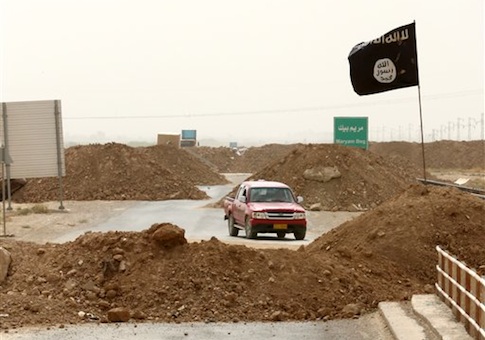
Mideast IraqIslamic State militants pass a checkpoint bearing the group’s trademark black flag in the village of Maryam Begg in Kirkuk, 290 kilometers (180 miles) north of Baghdad, Iraq / AP

Obama stated in a speech on Sept. 10 that ISIL is “not Islamic” despite the group’s use of a fundamental Islamic precept of jihad, or holy war, in expanding its reach and imposing anti-democratic, hardline Islamic sharia law in areas it now controls.

Analysts and statements by the president and other administration spokesmen also indicate the administration may not clearly understand ISIL ideology, a required first step in developing a counter to it.

The Obama administration, under pressure from domestic Muslim advocacy organizations, has adopted a politically correct approach toward Islam and terrorism that has resulted in removing mentions of Islam from its current policies and programs. Instead, counterterrorism programs and policies are carried out under the less-specific rubric of “countering violent extremism” (CVE).

******************

The Obama administration is failing to wage ideological war against Islamic State of Iraq and the Levant (ISIL or ISIS) terrorists over fears that attacking its religious philosophy will violate the constitutional divide between church and state, according to an in-depth inquiry by the Washington Free Beacon.

Instead, the task of countering what President Obama called the “warped ideology” of ISIL is being farmed out to foreign states and Muslim communities that often share some of the same goals as the groups the administration calls violent extremists. This approach allows the administration to avoid identifying links between terrorism and Islam.

“While the government has tried to counter terrorist propaganda, it cannot directly address the warped religious interpretations of groups like ISIL because of the constitutional separation of church and state,” said Quintan Wiktorowicz, a former White House counterterrorism strategist for the Obama administration.

“U.S. officials are prohibited from engaging in debates about Islam, and as a result will need to rely on partners in the Muslim world for this part of the ideological struggle,” he said in an email interview.

Is ISIL Islamic?

Obama announced last month for the first time that his new counterterrorism strategy includes programs aimed at countering ISIL’s ideology. But a review of administration efforts shows very little—if anything—is being done to defeat or destroy the terrorist group’s religious ideology in a war of ideas.

At the United Nations on Sept. 24, the president asked the world body to come up with a plan over the next year designed to counter ISIL and al Qaeda’s ideology. He said ending religious wars through an ideological campaign in the Middle East will be “generational” and led by those who live in the region. No external power, the president insisted, can change “hearts and minds,” and as a result the United States would support others in the unspecified program of “counter extremist ideology.”

The administration’s so-called soft power approach to countering Islamist terrorism also appeared to have difficulty with clearly defining the religious doctrine behind the ideology of the resurgent al Qaeda offshoot now rampaging its way across Iraq and Syria.

Obama stated in a speech on Sept. 10 that ISIL is “not Islamic” despite the group’s use of a fundamental Islamic precept of jihad, or holy war, in expanding its reach and imposing anti-democratic, hardline Islamic sharia law in areas it now controls.

Analysts and statements by the president and other administration spokesmen also indicate the administration may not clearly understand ISIL ideology, a required first step in developing a counter to it.

Sebastian Gorka, a counterterrorism specialist, said the major problem for the administration in countering ISIL ideology is that most senior officials hold “post-modern” and “secular” views.

“As a result, they have almost no ability to understand the drivers of violent terrorists which are religious,” said Gorka, the Horner chairman of military theory at the Marine Corps University.

“When you don’t take religion seriously, it’s almost impossible for you to comprehend the philosophy of a suicide bomber, or someone who cuts off the heads of people in the name of jihad,” Gorka said.

Senior State Department officials have expressed the view that ideology plays no role in Islamist terror and is spawned instead by “local grievances” such as poverty or other economic and social privation, Gorka said. “That is utterly fallacious. If that were true, half of India would be terrorists,” he said.

The latest issue of the ISIL English-language magazine Dabiq reveals some of the group’s ideology, using references to Islamic practices of jihad and sharia law. “The Islamic State has long maintained an initiative that sees it waging jihad alongside a dawah [proselytizing campaign] that actively tends to the needs of its people,” the magazine said, adding that the group “fights to defend the Muslims, liberate their lands, and bring an end to tawaghit[the evil corrupt system].”

The magazine also sought to legitimize its mass executions, beheadings, and other atrocities as religiously justified responses to all opponents who refuse to submit to its ideology.

The president stated in his Sept. 10 speech announcing the anti-ISIL strategy that the group is “not Islamic” because it kills Muslims and innocents, something he asserted no religion condones, and a claim disputed by many experts on Islam.

“I’ve studied Islam and I did not find a very peaceful religion,” said a current senior U.S. counterterrorism specialist who disagrees with the administration’s approach of not directly addressing the Islamic nature of terrorism in counter-ideology efforts.

Wictorowicz, the former counterterrorism strategist, defended the State Department approach. “Having spoken to them at length about this, their position is that Islam, as a religion, is not the issue,” he said. “It is particular interpretations of Islam that are, in part, driving support for violence.”

Not fighting a war of ideas

The Obama administration, under pressure from domestic Muslim advocacy organizations, has adopted a politically correct approach toward Islam and terrorism that has resulted in removing mentions of Islam from its current policies and programs. Instead, counterterrorism programs and policies are carried out under the less-specific rubric of “countering violent extremism” (CVE).

Discussing Islam also has been placed off limits in many government and intelligence community counterterrorism programs as a result of pressure groups and Muslim advisers who insist such topics would violate constitutional separation of church and state issues.

That pressure has inhibited the U.S. government from addressing Islamist ideology in a significant way, critics say. Instead, the government has been forced to indirectly counter claims by terrorists, such as the false notion that the United States and the West are at war with Islam. It used public diplomacy programs and global “messaging” campaigns whose effectiveness has been questionable, to try and counter such claims.

James Glassman, former undersecretary of state for public diplomacy, said “absolutely,” that the administration is hampered by concerns over First Amendment constitutional religious issues from conducting aggressive counter-ideology efforts against groups such as al Qaeda and ISIL.

“There is reticence, especially at State, to criticize a noxious political ideology based on a religion,” said Glassman, now with the American Enterprise Institute.

Glassman said from the start, Obama has played down the war of ideas in the struggle against terrorism.

During the transition from the Bush to Obama administration, “I was told by the Obama operatives assigned to State that the term ‘war of ideas’ was not to be used,” Glassman said.

“The war of ideas had been my focus at State, but the administration had no interest in continuing the work we were doing,” he said. “Ideology provides the environment and the justification for the activities of al Qaeda and ISIL. It must be dealt with—just as we dealt with communism from 1945 to 1990. It’s a long battle.”

“The way around the problem is leadership,” Glassman said. “The president needs to make clear—as President Bush did immediately after 9/11—that the terrorists have constructed a phony ideology and that they are trying to take over an entire religion.”

Obama appears to be in the early stages of doing that “but it is very late in the game and he needs to devote resources, not just words, to the war of ideas,” Glassman said.

Looking for allies

Obama told the United Nations in a speech to the General Assembly Sept. 24 that “extremist ideology” has spread despite more than a decade of military and intelligence efforts to kill al Qaeda leaders. Groups such as ISIL and al Qaeda have “perverted one of the world’s great religions,” he said.

The world, and specifically “Muslim communities,” the president said, must now take steps to “explicitly, forcefully, and consistently reject the ideology of al Qaeda and ISIL.”

However, most of the Islamic countries, such as Saudi Arabia and Turkey, so far have not denounced the ISIL ideology and do not appear to be engaged in counter-ideological campaigns designed to discredit the motivating force behind the group.

The president elaborated in the U.N. speech on his administration’s approach to countering ISIL’s message, but not its Islamist ideology. He called for a “new compact” among civilized peoples to stop the “corruption of young minds by violent ideology.”

He called for cutting off funding and contesting terrorists’ use of social media to recruit and propagandize. Additionally, he called upon religious leaders of all faiths to join together and propagate the Christian concept of “do unto thy neighbor as you would have done unto you.”

“The ideology of ISIL or al Qaeda or Boko Haram will wilt and die if it is consistently exposed, confronted, and refuted in the light of day,” Obama said.

Wiktorowicz said he agrees more needs to be done. “Not enough resources are being devoted to the counter-ideology component of the administration’s strategy,” he said. “The long war is the war against violent ideologies and there hasn’t been the resource investment since 9/11. As a result of this and other factors, we’re seeing the reincarnation of al Qaeda as ISIL in Iraq and Syria.”

Wiktorowicz also said the administration is working with partners in the Muslim world “who can push back against the ideology.”

“The Salafi jihadists, however, have assassinated and intimidated Islamic scholars and others who have spoken out against violence, increasing the danger for the brave individuals involved in the counter-ideological struggle,” he said.

A hashtag campaign

To date, the allied campaign against ISIL is limited to U.S.-led missile, drone, and air strikes against vehicles and command posts of the group in territories it controls in Iraq and Syria. The bombing has slowed but not reversed territorial gains by the group.

The Obama strategy as outlined last month will involve four elements: Air strikes; support for local forces on the ground; counterterrorism efforts to prevent ISIL attacks; and humanitarian assistance to deal with the mass of refugees fleeing ISIL control.

Under the counterterrorism program, the president declared: “Working with our partners, we will redouble our efforts to cut off its funding; improve our intelligence; strengthen our defenses; counter its warped ideology; and stem the flow of foreign fighters into and out of the Middle East.”

Asked for specifics on what the White House is doing to counter ISIL ideology, White House and National Security Council spokesmen declined to discuss the matter. Ned Price, an NSC spokesman, provided a recent White House “fact sheet” that contains no reference to counter-ideology efforts.

Price said White House counterterrorism coordinator Lisa Monaco was “too busy” to discuss the counter-ideology campaign.

The fact sheet mentions various steps being taken, including the adoption of a “whole-of-government-approach,” cutting off funds to ISIL, and preventing foreigners from joining the group. An international group called the Global Counterterrorism Forum and other, non-government organizations also are said to be focusing on unspecified efforts to prevent foreign fighters from joining ISIL.

At the State Department, a State-led interagency Center for Strategic Counterterrorism Communications is engaged in “messaging” on social media and elsewhere. But those efforts appear limited to a counter-terror Twitter feed with few followers and limited reach.

A glimpse into the center’s activity was disclosed in February by a Saudi national who said he was paid to use Twitter in an online campaign to discredit Syrian jihadists.

The Saudi said he was unemployed when he was approached with an offer of money to attend a U.S. workshop with instructors who schooled him on the covert campaign against both al Qaeda and rival ISIL in Syria. The goal was to use Twitter to link both groups to Iran and its Lebanese surrogate, Hezbollah, he said.

The training included the use of hashtags designed to expand the reach of tweets to the largest number of people, particularly women. Instructions were relayed to the Saudi from a special iPhone application downloaded from the State Department web site.

State Department spokesmen ignored repeated emails seeking comment on the counter-ideology campaign, and the department’s public affairs office blocked the Free Beacon from speaking to officials in the center, without explanation.

Ideology as the center of gravity

At the Pentagon, spokesman Adm. John Kirby told reporters two days after the president’s speech that a “purely military solution” would not be enough to destroy ISIL.

“It also is going to take the ultimate destruction of their ideology,” Kirby said.

Ideological destruction, Kirby said, will be done through “good governance” in Iraq and in Syria. “And in a responsive political process so that the people that are falling sway to this radical ideology are no longer drawn to it,” he said. “That’s really the long-term answer.”

Because ISIL is not a formal military organization but a terrorist group, its center of gravity, in military terms, is the group’s ideology, Kirby said, adding that one non-military goal is delegitimizing ISIL while using U.S. and allied forces to destroy its ability to conduct attacks and control territory in the region.

Kirby did not elaborate and referred questions to the Central Command, the military command in charge of military operations against ISIL.

Lt. Col. Steven Wollman, a Central Command spokesman, said the command’s counter ideology efforts against ISIL are focused on exposing al Qaeda and ISIL “fallacies, particularly their incongruity with Islam and their penchant for violence, crime, and terror.”

“We demonstrate that despite their claims of creating a Caliphate for the good of the Muslim world their sole method is violence and only violence which has no positive short term or long term impact on the population,” Wollman said in a statement to the Free Beacon.

“To do so we highlight their total disregard for basic human needs and desires such as education, medical care, a free press, use of tobacco, and an expectation of freedom of choice.”

Additionally, the command said ISIL’s use of extreme violence such as beheadings, mass executions, and rape are “totally out of line of any Islamic teachings,” an aspect highlighted to local and regional audiences.

Terrorist groups also are using all forms of communication, including social media to recruit, fundraise, and spread violent ideology, Wollman said.

“It would be inappropriate to disclose all the specifics of what we are currently doing to counter the al Qaeda and ISIL fallacies campaign, but I can tell you that this command’s information operations activities are focused on foreign audiences across the region,” Wollman said, adding that message dissemination includes website, social media, print media, radio, and television in local languages.

“We align our efforts with other U.S. government agencies, and often are in direct support of U.S. ambassadors and with the knowledge of our partnered nations,” he said.

Additionally, “all of this is conducted by, with, and through our partner nations, often with our partner’s face on the message,” Wollman said.

“We also conduct training on how to combat extremist ideologies with our regional partner nations, as part of Foreign Internal Defense, Security Force Assistance, Building Partner Capacity, and other State Department-led activities.”

‘We won that battle already’

The administration’s point man for propaganda and so-called “soft power,” Rick Stengel, a former Time magazine reporter who is now undersecretary for public diplomacy, said in a recent speech that the administration is not trying to wage a war of ideas against ISIL.

“I would say that there is no battle of ideas with ISIL,” Stengel said. “ISIL is bereft of ideas, they’re bankrupt of ideas. It’s not an organization that is animated by ideas. It’s a criminal, savage, barbaric organization—I feel like we won that battle already.”

However, ISIL and its supporters are using social media effectively both to promote their Islamic-centered ideology and to recruit both foreign and regional fighters to their cause.

Twitter and Facebook have cracked down on ISIL supporters since the new counterterrorism campaign began last month. But the group has found ways to circumvent the crackdown, through innovative ways of creating new social media accounts.

In fact, the group has been so successful online that U.S. and foreign intelligence agencies have been able to use information publicly available on the Internet to track and identify ISIL targets for bombing. In response, ISIL supporters on Twitter and Facebook have launched a campaign to limit the information about the group online to undermine the bombing strikes.

ISIL also uses social media to link to recruitment videos and publications that, according to U.S. officials, have gained wide circulation.

All the videos and publications highlight the group’s adherence to Islamic principles.

Dutch Military Retreats Before… Tweets!

October 5, 2014

Dutch Military Retreats Before… Tweets!, Gatestone InstituteTimon Dias, October 5, 2014

A country that has to hide its soldiers on its own soil and protect its Jewish schools with Military Police cannot possibly maintain that its social cohesion is intact and that it has no real problems with elements of its Muslim minority. Sadly, just like the punch-line that “IS has nothing to do with Islam,” most top government officials and politicians are still in full blown denial about the scale and deep seriousness of this social and cultural problem.

By ordering Dutch soldiers to be “invisible” in The Netherlands, what message is the government sending to it enemies, let alone its own citizens?

Jihadists now know that a few tweets from a single Dutch jihadist can fundamentally alter Dutch defense policy. It will order the personnel tasked with keeping The Netherlands safe to hide.

A country that has to hide its soldiers on its own soil and protect its Jewish schools with Military Police cannot possibly maintain that it has no real problems with elements of its Muslim minority.

The Dutch Ministry of Defense has advised its soldiers not wear their uniforms in public. Dutch vice Prime Minister Lodewijk Asscher of the Labour Party emphasized that the proposal was merely advice.

The Dutch military, however, clearly ordered — instead of advised — its personnel to hide their military professions in public.

Dutch customs officials, whose uniforms could be mistaken as military, received the same advice.

The reason for this display of woefully misplaced ‘conscientiousness’ was a series of threats by the Dutch jihadist known as Muhajiri Shaam, a member of the al-Qaeda-affiliated group Jahbat-al Nusra.

Shaam tweeted: “So, now Dutch F-16’s. Dutch people: your government just made you a target”.

In a more elaborate threat, Shaam stated: “The West offered more than 90 million lives during the first and second World War for their self-glorified democracy. So the Ummah must be prepared to sacrifice even more lives for a righteous State which rules under the laws of Allah. The world has suffered the oppressive darkness of Western capitalism for long enough. It’s time they get a taste of divine justice.”


730Threats tweeted by the jihadist known as Muhajiri Shaam, pictured above, have caused the Dutch military to order its soldiers not to wear uniforms in public.

Shaam’s warnings followed in the wake of Dutch support for the military campaign against the new so-called “Islamic State” [IS].

The Dutch government last week pledged six F-16 fighter jets, two spare F-16’s, and a maximum of 130 military advisors to train forces opposing IS.

These threats are being taken very seriously. The Dutch government fears attacks on its military personnel; more specific threats against Dutch soldiers have now been voiced by Dutch jihadists. This is not the first time Dutch soldiers have been ordered to become unrecognizable as members of the military. The same order was issued during the beginning of the Iraq war in 2003 and during the release of Freedom Party leader Geert Wilders’ movie Fitna.

By ordering Dutch soldiers to become “invisible” in The Netherlands, what message is the government sending to its enemies, let alone its own citizens? Dutch-Iranian law professor Afshin Ellian rightfully asks: if Dutch soldiers aren’t safe anymore, than who is? Jihadists now know that a few tweets from a single Dutch jihadist can fundamentally alter Dutch defense policy. Dutch citizens now know that a few tweets from a single Dutch jihadist will send shivers down their government’s spine and that — instead of making sure all threats are neutralized — it will order the personnel tasked with keeping them safe, to hide.

The Dutch-Israeli psychotherapist and author Martin van Vliet voices his concern: “Are we supposed to be protected by a military that orders its soldiers to start wearing the invisibility cloak as soon as they find out combating Jihad is not a video game without risks? The Dutch would be right not to place their trust in their military.”

Such an operational transformation — due to a tweet — can only embolden Islamists to become more audacious and violent. At the same time, it can also prompt Dutch citizens to take more drastic measures to secure their own safety. Although the government was likely trying to deescalate the situation and safeguard its military personnel, its action can only work as a catalyst for further social unrest, inter-cultural tensions and overall escalation.

Fortunately, some soldiers are refusing the order. Lieutenant Colonel Willem Schoonebeek, for instance, stated: “I will not be led by the dictatorship of a loud minority. This uniform represents the organization that our Defense Department is. We provide safety in The Netherlands and beyond. It would be strange to participate in a mission in Iraq, while being too scared to advertise your profession in The Netherlands.”

In parallel to Dutch soldiers “disappearing” from the street scene, Amsterdam’s Jewish schools now have to be protected by the Royal Military Police [RMP] at the request of the City Council, the Justice Department and the police. As the RMP is a police unit, it is still allowed to be recognizable as such.

A country that has to hide its soldiers on its own soil and protect its Jewish schools with Military Police cannot possibly maintain that its social cohesion is intact and that it has no real problems with elements of its Muslim minority. Sadly, just like the punch-line that “IS has nothing to do with Islam,” most top government officials and politicians are still in full blown denial about the scale and deep seriousness of this social and cultural problem.

Isis reconciles with al-Qaida group as Syria air strikes continue

September 28, 2014

Isis reconciles with al-Qaida group as Syria air strikes continue, The Guardian, September 28, 2014

(But we have been told authoritatively that the Islamic State is not Islamic. How, then, could strikes against it possibly be a “war on Islam?” — DM)

Jabhat al-Nusra denounces US-led attacks as ‘war on Islam’, and leaders of group holding meetings with Islamic State.

Kobani strikeA still from a video from a plane camera shows smoke rising after an air strike near Kobani. Photograph: Reuters

Barack Obama said the intelligence community did not appreciate the scale of the threat or comprehend the weakness of the Iraqi army. In an interview on CBS 60 Minutes, he said: “Over the past couple of years, during the chaos of the Syrian civil war, where essentially you have huge swaths of the country that are completely ungoverned, they were able to reconstitute themselves and take advantage of … chaos. And so this became ground zero for jihadists around the world.”

*********************

Air strikes continued to target Islamic State (Isis) positions near the Kurdish town of Kobani and hubs across north-east Syria on Sunday, as the terror group moved towards a new alliance with Syria’s largest al-Qaida group that could help offset the threat from the air.

Jabhat al-Nusra, which has been at odds with Isis for much of the past year, vowed retaliation for the US-led strikes, the first wave of which a week ago killed scores of its members. Many Nusra units in northern Syria appeared to have reconciled with the group, with which it had fought bitterly early this year.

A senior source confirmed that al-Nusra and Isis leaders were now holding war-planning meetings. While not yet formalised, the addition of at least some al-Nusra numbers to Isis would strengthen the group’s ranks and further its reach at a time when air strikes are crippling its funding sources and slowing its advances in both Syria and Iraq.

Al-Nusra, which has direct ties to al-Qaida’s leader, Ayman al-Zawahiri, denounced the attacks as a “war on Islam”, in an audio statement posted over the weekend. A senior al-Nusra figure told the Guardian that 73 members had defected to Isis last Friday alone and that scores more were planning to swear allegiance in coming days.

“We are in a long war,” the group’s spokesman, Abu Firas al-Suri, said on social media platforms. “This war will not end in months nor years, this war could last for decades.”

In the rebel-held north there is growing resentment among Islamist units of the Syrian opposition that the strikes have done nothing to weaken the Syrian regime. “We have been calling for these sorts of attacks for three years and when they finally come they don’t help us,” said a leader from the Qatari-backed Islamic Front, which groups together Islamic brigades. “People have lost faith. And they’re angry.”

British jets flew sorties over Isis positions in Iraq after being ordered into action against the group following a parliamentary vote on Friday.

David Cameron has suggested he might review his decision to confine Britain’s involvement to Iraq alone, but for now the strikes in support of Kurdish civilians and militants in Kobani were being carried out by Arab air forces from Saudi Arabia, Jordan, the UAE and Bahrain.

The US was reported to have carried out at least six strikes near the centre of Kobani, where the YPG Kurdish militia is fighting a dogged rearguard campaign against Isis, which is mostly holding its ground despite the jet attacks.

Kobani is the third-largest Kurdish enclave in Syria, and victory for Isis there is essential to its plans to oust the Kurds from lands they have lived in for several thousand years. Control of the area would give the group a strategic foothold in north-east Syria, which would give it easy access to north-west Iraq.

Isis continued to make forays along the western edge of Baghdad, where its members have been active for nine months. The Iraqi capital is being heavily defended by Shia militias, who in many cases have primacy over the Iraqi army, which surrendered the north of the country.

That rout – one of the most spectacular anywhere in modern military history – gave Isis a surge of momentum and it has since seized the border with Syria, menaced Irbil, ousted minorities from the Ninevah plains and threatened the Iraqi government’s hold on the country.

Barack Obama said the intelligence community did not appreciate the scale of the threat or comprehend the weakness of the Iraqi army. In an interview on CBS 60 Minutes, he said: “Over the past couple of years, during the chaos of the Syrian civil war, where essentially you have huge swaths of the country that are completely ungoverned, they were able to reconstitute themselves and take advantage of … chaos. And so this became ground zero for jihadists around the world.”

Al Qaeda official warns against Islamic State in new speech

September 27, 2014

Al Qaeda official warns against Islamic State in new speech, Long War Journal, Thomas Joscelyn, September 27, 2014

“We call to restore the rightly-guided Caliphate on the prophetic method, and not on the method of deviation, lying, breaking promises, and abrogating allegiances – a caliphate that stands with justice, consultation, and coming together, and not with oppression, infidel-branding the Muslims, killing the monotheists, and dispersing the rank of the mujahideen,” al Basha says, according to SITE’s translation.

Although al Basha does not mention the Islamic State by name, his description of al Qaeda’s proposed caliphate is intended to undermine al Baghdadi’s claim to power. Al Basha’s reference to “abrogating allegiances” is probably a reference to the oath of allegiance (bayat) that Abu Bakr al Baghdadi swore to Ayman al Zawahiri and then broke.

**********************

A senior al Qaeda official, Muhammad bin Mahmoud Rabie al Bahtiyti, also known as Abu Dujana al Basha, has released a new audio message seeking to undermine the Islamic State, which was disowned by al Qaeda’s general command in February.

Al Basha’s speech was released by al Qaeda’s official propaganda arm, As Sahab, on Sept. 26. It was first obtained and translated by the SITE Intelligence Group.

Al Qaeda’s senior leaders have not directly addressed the Islamic State’s claim to rule over a caliphate stretching across large portions of Iraq and Syria. Instead, they have sought to undermine the Islamic State’s ideological legitimacy in a variety of more subtle ways. (Other parts of al Qaeda’s international network have specifically rejected the Islamic State’s caliphate claim.)

Al Basha does not name the Islamic State, but his speech is clearly aimed at the group and its supporters.

Al Basha sets forth al Qaeda’s goals, saying the group is dedicated “to the oneness of Allah … as we call to disbelieve the tyrant and disavow polytheism and its people.” Al Basha says al Qaeda seeks “to establish the absent Shariah and empower this religion.”

It is often claimed, wrongly, that al Qaeda is interested only in attacking the West, or carrying out mass casualty attacks. But the organization has repeatedly stated that its jihadists seek to create societies based on their radical version of sharia law. Al Qaeda wants to build Islamic emirates, or states, based on this sharia. It is for this reason that most of al Qaeda’s resources since its founding have been devoted to waging insurgencies against governments in the Muslim-majority world that it deems to be corrupt.

Imposing sharia and creating Islamic emirates are steps to al Qaeda’s ultimate stated goal, which al Basha explains.

“We call to restore the rightly-guided Caliphate on the prophetic method, and not on the method of deviation, lying, breaking promises, and abrogating allegiances – a caliphate that stands with justice, consultation, and coming together, and not with oppression, infidel-branding the Muslims, killing the monotheists, and dispersing the rank of the mujahideen,” al Basha says, according to SITE’s translation.

Although al Basha does not mention the Islamic State by name, his description of al Qaeda’s proposed caliphate is intended to undermine al Baghdadi’s claim to power. Al Basha’s reference to “abrogating allegiances” is probably a reference to the oath of allegiance (bayat) that Abu Bakr al Baghdadi swore to Ayman al Zawahiri and then broke.

Al Qaeda-allied jihadists have argued against the Islamic State’s caliphate claim, saying it was imposed on Muslims and even jihadists without consultation. And this is a theme in a Basha’s speech.

In al Qaeda’s ideological schema, the caliphate can be resurrected only after respected jihadists give it their seal of approval. Al Baghdadi’s organization has tried to impose its caliphate throughout much of Iraq and Syria, frequently fighting with other jihadist organizations, including the Al Nusrah Front, al Qaeda’s official branch in Syria. Leading jihadist ideologues have criticized Baghdadi’s caliphate on this basis, as well as for other reasons.

Al Basha warns against “extremism,” which, ironically enough, is one of al Qaeda’s key charges against the Islamic State. In Syria and elsewhere, al Qaeda has been attempting to portray itself as a more reasonable jihadist organization. Because the Islamic State refuses to consult with other Muslims and jihadist groups, not just in creating a caliphate, but also in other matters, al Qaeda accuses the group of pursuing an extremist path. Of course, al Qaeda is extremist by any reasonable standard, and has spilled more Muslim than non-Muslim blood throughout its existence. Still, because of the Islamic State’s excessive violence, particularly in Syria, al Qaeda has been marketing itself as a more mainstream jihadist organization.

Al Basha addresses the jihadists’ rank and file, urging them to avoid joining the Islamic State and subtly encouraging Baghdadi’s fighters to defect from his army. Al Basha openly worries that the jihad in Syria has been squandered because of the infighting between the groups opposed to Bashar al Assad’s regime. Al Qaeda blames the infighting on the Islamic State.

“I address my speech and my advice to my brothers on the frontlines in Sham [Syria] among those who have been deceived by slogans and titles, to use your heads and have insight, and to weigh the matters fairly,” al Basha says. “Rescue the ship of jihad, and reach it before it deviates from its course and settles on the path of the people of desires. Strive to turn off the sedition and restore cohesion among the mujahideen.”

At the end of his audio speech, al Basha addresses those jihadists who disapprove of al Qaeda’s understated response to the Islamic State’s caliphate claim. Al Basha says that he and others wanted to defend al Qaeda emir Ayman al Zawahiri’s reputation against the Islamic State’s slanders, but Zawahiri ordered them not to.

“The Sheikh [Zawahiri] ordered his brothers to be silent and not protect his honor,” al Basha says. “He considered that out of concern for the benefit of this Ummah [Muslim community], and a hope that Allah will fix the condition, and that the sedition will be suppressed.”

Al Qaeda’s leaders and branches have repeatedly urged the jihadists in Syria to reconcile. However, their efforts have been fruitless.

Veteran al Qaeda leader

Al Basha has taken on a more prominent and public role for al Qaeda in recent years. In December 2013, he argued that jihad is necessary to implement sharia law in Egypt. In late August he issued a statement urging followers to strike American and Israeli interests in support of Muslims in Gaza.

Although al Basha was not initially a public persona for al Qaeda, he was well-known to US counterterrorism officials for years. In January 2009, the US Treasury Department designated al Basha as an al Qaeda terrorist, noting that he was Zawahiri’s son-in-law. Al Basha was located in Iran at the time.

Treasury found that he “served on an al Qaeda military committee and provided military training that included urban warfare tactics for al Qaeda members.” Among other duties, al Basha “drafted training manuals for al Qaeda as well as a book on security that was used as a template for al Qaeda’s surveillance operations.”

Al Basha is a longtime member of Egyptian Islamic Jihad as well as al Qaeda, and was reportedly involved in al Qaeda’s 1995 bombing of the Egyptian Embassy in Islamabad, Pakistan.

Zawahiri tasked al Basha with moving members of Zawahiri’s family to Iran after the Sept. 11, 2001 terrorist attacks.