You Tube, October 14, 2014
Archive for the ‘Air strikes’ category
The Unresolved Problem with Boots on the Ground
October 10, 2014The Unresolved Problem with Boots on the Ground, Commentary Magazine, Michael Rubin, October 10, 2014
(If the U.S. were to put boots on the ground, how many would be needed to do what? Trainers? Spotters for airstrikes? Infantry? Artillery? Psychological operations? Field medics? Something else? Could we shift from a peacetime mode to a wartime mode in time to do significant damage to the Islamic State, et al? — DM)
[T]here is nothing more dangerous to any potential ground troops than to be inserted into a warzone without broad public consensus about their mission and to have a commander-in-chief who has consistently met the requests of forces in the field with indecision and a failure to deliver what ground commanders consider their minimum basic needs.
****************
A growing chorus of analysts, generals, and even cabinet secretaries who served under President Obama suggest that Obama’s stated goal to “degrade and ultimately destroy” ISIS is not going to occur by means of air power alone. That might be true, although it’s also true that Obama hasn’t used airpower to its full effect. To read a Pentagon press release is to read reports of five, six, or seven airstrikes. Given that an aircraft carrier can launch planes every 30 to 40 seconds, this suggests that the Obama administration is effectively committing the equivalent of three or four minutes of dedicated aircraft carrier time to achieve its goals. And even then, many of the strikes Obama has ordered (and the president has said that he approves every strike carried out inside Syria) attack empty buildings or equipment far away from the fronts of the fight.
But even if boots on the ground are necessary with an augmented air campaign, there is one problem that is unsolvable, and that is the personality and lack of commitment of the commander-in-chief. President Obama has the strategic equivalent of Attention Deficit Disorder. Despite his September 10 speech, it’s unclear whether he is truly committed to destroying ISIS or was simply reacting to the spike in public outrage following the murder of James Foley.
Now make no mistake: I personally feel that the defeat of ISIS is an overwhelming national interest, and that the goal should not simply be “deradicalization” for its fighters, but rather their death. That said, there is nothing more dangerous to any potential ground troops than to be inserted into a warzone without broad public consensus about their mission and to have a commander-in-chief who has consistently met the requests of forces in the field with indecision and a failure to deliver what ground commanders consider their minimum basic needs.
What can be done? Unfortunately, there’s no good answer with such lackluster leadership in the White House and Congress. But those serving in uniform and placing themselves in harm’s way should not be a political football. At present, however, that is exactly how the president and some members of both parties treat them and the ISIS problem. Until there is focus and responsibility in both the White House and Congress, and recognition that military action cannot be governed by polls or political timelines, it is foolhardy to insert ground forces. Regardless of how they might be needed and how determined ISIS is to strike the United States, ground troops without serious leadership would be unwise. Never again should there be a deployment of ground forces without political consensus, broad public support. If these are lacking and we have to pay the consequence, then that will be a “teachable moment” for the public about the importance of freedom and the nature of the evil that the United State must confront.
Bombing for show? Or for effect?
October 10, 2014Bombing for show? Or for effect? Washington Post Opinion, Charles Krauthammer, October 9, 2014
The indecisiveness and ambivalence so devastatingly described by both of Obama’s previous secretaries of defense, Leon Panetta and Bob Gates, are already beginning to characterize the Syria campaign.
The Iraqis can see it. The Kurds can feel it. The jihadists are counting on it.
*********************
During the 1944 Warsaw uprising, Stalin ordered the advancing Red Army to stop at the outskirts of the city while the Nazis, for 63 days, annihilated the non-Communist Polish partisans. Only then did Stalin take Warsaw.
No one can match Stalin for merciless cynicism, but President Recep Tayyip Erdogan of Turkey is offering a determined echo by ordering Turkish tanks massed on the Syrian border, within sight of the besieged Syrian town of Kobane, to sit and do nothing.
For almost a month, Kobane Kurds have been trying to hold off Islamic State fighters. Outgunned, outmanned and surrounded on three sides, the defending Kurds have begged Turkey to allow weapons and reinforcements through the border. Erdogan has refused even that, let alone intervening directly. Infuriated Kurds have launched demonstrations throughout Turkey protesting Erdogan’s deadly callousness. At least 29 demonstrators have been killed.
Because Turkey has its own Kurdish problem — battling a Kurdish insurgency on and off for decades — Erdogan appears to prefer letting the Islamic State destroy the Kurdish enclave on the Syrian side of the border rather than lift a finger to save it. Perhaps later he will move in to occupy the rubble.
Moreover, Erdogan entertains a larger vision: making Turkey the hegemonic power over the Sunni Arabs, as in Ottoman times. The Islamic State is too radical and uncontrollable to be an ally in that mission. But it is Sunni. And it fights Shiites, Alawites and Kurds. Erdogan’s main regional adversary is the Shiite-dominated rule of Syria’s Bashar al-Assad. Erdogan demands that the United States take the fight to Assad before Turkey will join the fight against the Islamic State.
It took Vice President Biden to accidentally blurt out the truth when he accused our alleged allies in the region of playing a double game — supporting the jihadists in Syria and Iraq, then joining the U.S.-led coalition against them. His abject apologies to the United Arab Emirates, Saudi Arabia and Turkey notwithstanding, Biden was right.
The vaunted coalition that President Obama touts remains mostly fictional. Yes, it puts a Sunni face on the war. Which is important for show. But everyone knows that in real terms the operation remains almost exclusively American.
As designed, the outer limit of its objective is to roll back the Islamic State in Iraq and contain it in Syria. It is doing neither. Despite State Department happy talk about advances in Iraq, our side is suffering serious reverses near Baghdad and throughout Anbar province, which is reportedly near collapse. Baghdad itself is ripe for infiltration for a Tet-like offensive aimed at demoralizing both Iraq and the United States.
As for Syria, what is Obama doing? First, he gives the enemy 12 days of warning about impending air attacks. We end up hitting empty buildings and evacuated training camps.
Next, we impose rules of engagement so rigid that we can’t make tactical adjustments. Our most reliable, friendly, battle-hardened “boots on the ground” in the region are the Kurds. So what have we done to relieve Kobane? About 20 airstrikes in a little more than 10 days, says Centcom.
That’s barely two a day. On the day after the Islamic State entered Kobane, we launched five airstrikes. Result? We hit three vehicles, one artillery piece and one military “unit.” And damaged a tank. This, against perhaps 9,000 heavily armed Islamic State fighters. If this were not so tragic, it would be farcical.
No one is asking for U.S. ground troops. But even as an air campaign, this is astonishingly unserious. As former E.U. ambassador to Turkey Marc Pierini told the Wall Street Journal, “It [the siege] could have been meaningfully acted upon two weeks ago or so” — when Islamic State reinforcements were streaming in the open toward Kobane. “Now it is almost too late.”
Obama has committed the United States to war on the Islamic State. To then allow within a month an allied enclave to be overrun — and perhaps annihilated — would be a major blow.
Guerrilla war is a test of wills. Obama’s actual objectives — rollback in Iraq, containment in Syria — are not unreasonable. But they require commitment and determination. In other words, will. You can’t just make one speech declaring war, then disappear and go fundraising.
The indecisiveness and ambivalence so devastatingly described by both of Obama’s previous secretaries of defense, Leon Panetta and Bob Gates, are already beginning to characterize the Syria campaign.
The Iraqis can see it. The Kurds can feel it. The jihadists are counting on it.
U.S. airstrike in Mosul underscores military questions ahead in dealing with Iraqi cities
October 9, 2014U.S. airstrike in Mosul underscores military questions ahead in dealing with Iraqi cities, Washington Post, Dan Lamothem October 9, 2014
(Will the IDF be asked for advice on limiting civilian casualties as it did, successfully, in Gaza? Probably not. Soliciting and following it would be politically inconvenient. — DM)
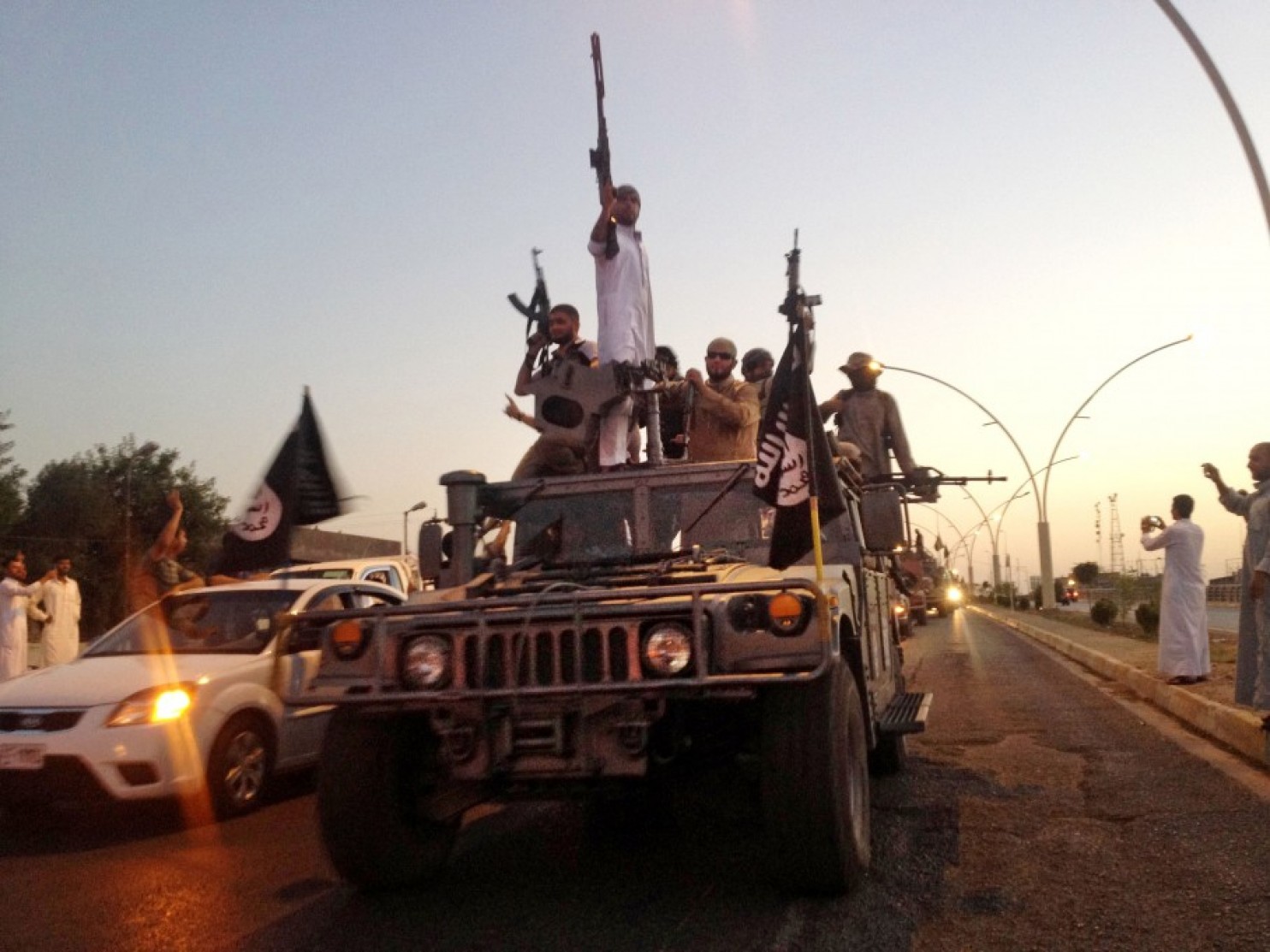 Militants from the Islamic State parade down a main street in Mosul, Iraq, in June in a Humvee they commandeered from Iraqi troops. (AP Photo, File)
[T]he planning, along with the U.S. launching its first airstrike inside Mosul on Wednesday, raises questions about how the United States and its partners will be able to assist in an urban military campaign if their mission is restricted to an air campaign and advising Iraqi forces.
***************
Shortly after retired U.S. Gen. John Allen arrived in Baghdad as the new U.S. envoy to the coalition against the Islamic State, he made it perfectly clear what part of the plan against the Islamic State militant group included: taking back Mosul.
The city, Iraq’s second most populous, fell to Islamist fighters in June, as they captured broad sections of the country’s north. Mosul has remained under their control since, with religious shrines destroyed, women forced into marriage and human rights activists and others murdered after publicly disagreeing with the Islamic State.
Plans to retake Mosul already are underway. Kurdish militia troops are preparing for a complex battle to retake the city, according to a Los Angeles Times report. And Allen said Iraqi forces will launch operations to retake Mosul within the next year. [Emphasis added. — DM]
“It’s not a single battle,” he said, according to the New York Times. “It’s a campaign.”]
But the planning, along with the U.S. launching its first airstrike inside Mosul on Wednesday, raises questions about how the United States and its partners will be able to assist in an urban military campaign if their mission is restricted to an air campaign and advising Iraqi forces.
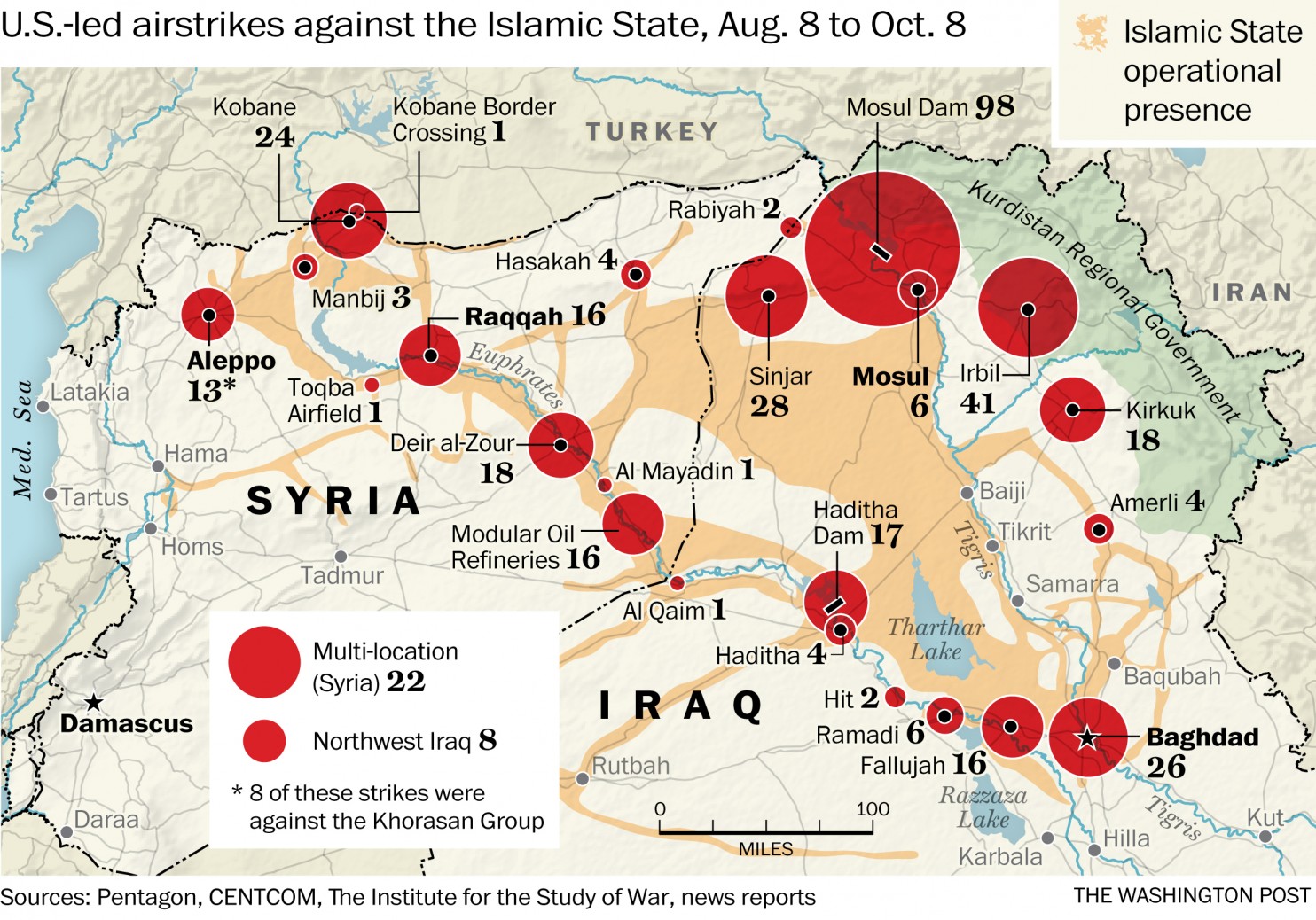
The U.S. has launched hundreds of airstrikes in Iraq and Syria in the last two months against the Islamic State, but until Wednesday they all had been carried out outside population centers. The primary targets have been militant training camps and groups of fighters who have massed in vehicles or on foot, making them obvious marks for U.S. aircraft.
As the U.S. and its partners intensified their airstrikes against the militant group in recent days, they hit a variety of targets around many of Iraq’s other major cities, including Baghdad, Irbil, Fallujah and Ramadi. Some of the strikes have been designed to keep militants out of areas they do not control, but Fallujah fell to the Islamic State months ago, and Ramadi, the capital of Anbar province, remains heavily contested.
Officials in Anbar told the Wall Street Journal this week that they are concerned the entire province could fall in coming days. They also raised concerns that too much attention has been devoted to Kobane, a Syrian town on the Turkish border that is under assault by the Islamic State and also is in danger of falling.




 anneinpt
 artaxes
 danmillerinpanama
 davidking1530
 Peter Hofman
 Joseph Wouk
 Peter
Peter Louisiana Steve
 WarSclerotic
Recent Comments