Archive for the ‘Air strikes’ category

Yemen war: Saudis prevented Russian evacuations by air, bombed Moscow’s spy center in Aden

April 7, 2015

Yemen war: Saudis prevented Russian evacuations by air, bombed Moscow’s spy center in Aden, DEBKAfile, April 7, 2015

Russias_Yemen_consulate_damaged_in_Saudi-led_airstrikes_1.4.15Russia’s bombed out consulate in Aden

Saudi Arabia has gone head to head with Russia as Iran’s ally in Yemen.

Moscow claims to have evacuated hundreds of Russian nationals from Yemen by an air lift running out of Sanaa airport, but DEBKAfile’s exclusive intelligence and military sources reveal that not a single Russian plane has taken off from any Yemeni airport since March 27, when Saudi Arabia launched its military offensive against the pro-Iranian Houthi rebels.

The Saudiis warned Russia that they would not be responsible for the safety of any flights landing at a Yemeni airport or the passengers assembled there for evacuation, while their air force conducted strikes against the rebels. Having achieved control of Yemen’s skies in the early stages of their intervention, the Saudis declared its air space a no-fly zone.

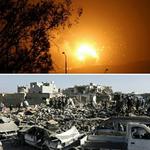
This warning gained substance when, on April 1, Saudi F-15 warplanes bombed the Russian consulate in the second largest Yemeni city, Aden. A Russian witness said that not a single window was left in the building and all Russian citizens would have to leave the town.

According to DEBKAfile’s sources, the building was in fact completely demolished in order to dismantle Russia’s regional intelligence-gathering center which operated out of the consulate building and fed Iranian intelligence with data on military movements in the neighborhood.

It functioned according to the same system as Russian spy stations in Syria, which routinely keep their Iranian colleagues au fait with military activities, including Israeli army movements.

The intelligence gathered by the Aden facility was no doubt passed on by Iranian agents to the Houthi commanders, certainly after Al Qods Brigades chief Gen. Qassem Soleimani arrived in Sanaa to direct the rebel offensive after the Saudi offensive was launched.

In normal times, the Russian spy facility would have been responsible for surveillance over navigation through the Bab el-Mandeb Strait and the warships sailing between Red Sea, the Gulf of Aden and the Indian Ocean.

The next chapter of the Russian evacuation story unfolded on Thursday, April 2, the day after the consulate was razed: The Russians tried activating their connections in Cairo to obtain Saudi permission to land a plane in Sanaa, where hundreds of Russians had crowded to await passage to safety.

The Saudis relayed their refusal to Moscow through Cairo.

Then, on Friday, April 3, a flight landed at Moscow’s Chkalovsky Airport carrying Russian evacuees from Yemen, followed by a second flight which landed at an unnamed Russian military airport.

DEBKAfile’s sources report that neither of those planes were actually permitted to take off from Sanaa, but flew in from Cairo. After the Saudi ban on flights through Yemeni airports, Moscow had no choice but to rescue its nationals from the embattled country by sea aboard ships that carried them to Egypt.


Egypt seizes Bab el Mandeb ahead of Iran. Saudis bomb Iran-backed Yemeni Houthis. US launches air strikes over Tikrit

March 26, 2015

Egypt seizes Bab el Mandeb ahead of Iran. Saudis bomb Iran-backed Yemeni Houthis. US launches air strikes over Tikrit, DEBKAfile, March 26, 2015

Yemen3_1

The separate operations in Yemen and Iraq attested to the widening breach between the Sunni Arab camp and the Obama administration and the former’s resolve to thwart US strategy for buying a nuclear deal with Tehran by empowering Iran to attain the rank of leading Middle East power.

**********************

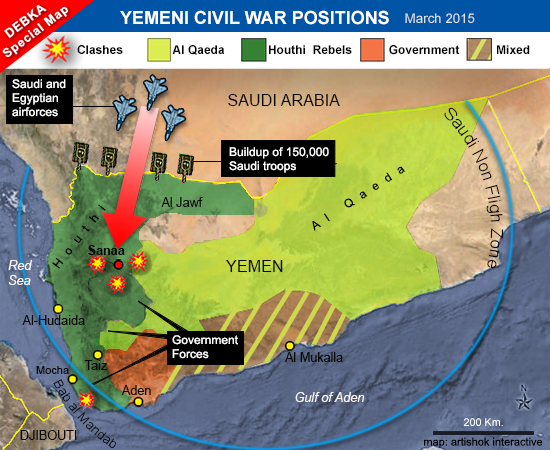
In a surprise step, Egyptian marine naval and marine forces Thursday morning, March 26, seized control of the strategic Bab El-Mandeb Straits to foil Tehran’s plans to grab this important energy shipping gateway between the Red Sea, the Gulf of Aden and the Suez Canal, DEBKAfile’s military sources report from the Gulf. Egypt disguised the raid as a counter-piracy operation. It rounded off the Saudi-led air strikes launched the same morning against Iran-backed Houthi rebels in Yemen. These operations signaled the start of a major Sunni Arab revolt against Iran’s approaching takeover of Yemen, through its Houthi proxy, and advances in other strategic positions in the Middle East, with Washington’s support.

Thursday morning too, the US launched the US launched its first air strikes against Islamic State positions in the Iraqi city of Tikrit, rallying to the aid of the Iranian-commanded Iraqi operation, which had failed to dislodge the jihadis in two weeks of fighting.

The separate operations in Yemen and Iraq attested to the widening breach between the Sunni Arab camp and the Obama administration and the former’s resolve to thwart US strategy for buying a nuclear deal with Tehran by empowering Iran to attain the rank of leading Middle East power.

DEBKAfile reported earlier Thursday morning:

Iran’s Revolutionary Guards (IRGC) are now leading war action in four Mid East arenas: Syria, Iraq, Yemen and Lebanon, while building Shiite “popular” armies deferring to Tehran in three: Syria, Iraq and Yemen.

The formal announcements coming from Riyadh and Washington attempted to gloss over the open breach. The Saudis Wednesday indicated that their military buildup on the Yemeni was “purely defensive,” while Washington subsequently declared support for the Saudi-Gulf-Egyptian air strikes after they began.

According to our Washington sources, President Obama decided Wednesday to accede to the Iraqi premier Haider al-Abadi’s request for air support to de-stall the Tikrit operation against ISIS. Iran’s Al Qods Brigades chief, Gen. Qassem Soleimani, who commanded the operation from the start has departed the scene.

Nothing has been said to indicate whether the Iranian forces, including Revolutionary Guards officers, remain in the area. It appears that the Obama administration prefers as little as possible to be mentioned about US-Iranian battlefield coordination in Iraq versus the Islamists, especially since it was not exactly a big success. At the same time, US air strikes launched to support ground forces are bound to be coordinated with their commanders, who in this case happen to be mostly Iranian. In the last two weeks of the Tikrit operation, liaison between the US and Iranian military in Iraq was routed through the office of the Iraqi Prime Minister in Baghdad.

Early Thursday, Riyadh reported that the Saudi Royal Air Force had taken out Houthi air defenses, destroyed numerous Houthi fighter planes and were imposing a wide no-fly zone over Yemen.

Egypt is providing political and military support for Saudi-GCC operation against Houthi fighters in Yemen, the Egyptian state news agency said Thursday. Egypt’s Foreign Ministry was quoted as saying this support could involve Egyptian air, naval and ground forces, if necessary.

DEBKAfile’s military sources add: The Saudis declared Yemeni air space a no-fly zone to achieve to goals: (1) To deny the Yemeni forces advancing on the key port city of Aden access to air cover which would undoubtedly have been forthcoming from mutinous elements of the Yemeni air force. Without it, the rebel advance would be severely hobbled, and, (2) to prevent Iranian warplanes from landing at Yemeni air bases with deliveries of military equipment and ammunition their Houthi proxies.

Gulf sources disclose that Saudi Arabia has placed 100 warplanes and 150,000 troops with heavy weapons at the disposal of the operation against Iran’s Yemeni proxy, the Zaydi Houthis, as well as pressing into service Pakistani, Moroccan and Jordanian military units. This force is a sign that Riyadh intends of following up its air action with a ground invasion across the border into Yemen to crush the revolt in its backyard.

Developing…

Israeli fighter jets stage warning passes against Syrian air force intruders over Golan. Air tension high

February 24, 2015

Israeli fighter jets stage warning passes against Syrian air force intruders over Golan. Air tension high, DEBKAfile, February 24, 2015

Barrel-bombs-Qunitra_23.2.15Syrian barrel bombs dropped on Quneitra

Israeli fighter jets flew passes over the Golan Monday, Feb. 23 as a warning to Syrian helicopters and fighter planes to stop encroaching on the no-fly zone, in violation of standing Israeli-Syrian armistice agreements. This is reported by DEBKAfile’s military sources.

The Syrian warplanes planes came over Quneitra Monday to drop barrel bombs on Syrian rebel forces holding the town. Spotters on Israeli Golan counted at least 30 bombs dropped by helicopters under cover of Syrian air force jets. Their crews took no notice of the Israeli fighter jets and drones present at the time and continued their attacks regardless.

At the end of the Syrian operation, Israeli aircraft conducted its warning passes over the Golan town.

Our sources report that this was the second day in a row that the Syrian air force had bombed the same sector. Sunday, they struck rebel positions in the Tel Al-Harra area 6-8 km from the Israeli Golan border. Israel’s inaction then encouraged Damascus to move its warplanes closer to the border the next day and fly into the no-fly zone.

This time, Israeli avoided a direct clash, but broadcast a warning that a confrontation was possible if the Syrians returned for a repeat. Western and Middle East military sources interpret the Israeli flights over Quneitra Monday as a clear warning to Damascus that Israel will not tolerate Syrian air raids close to its Golan lines or any incursions in airspace banned by their armistice agreements.

Six months ago, on Sept. 23, an Israeli Patriot air defense battery downed a Syrian Sukhoi-24 which ventured into its air space. The plane crashed just inside the Syrian border. The IDF claimed at the time that the Syrian plane had strayed across the border by mistake – and so the incident ended. However, Israeli commanders were certain that there was no mistake and that the Syrians were testing the alertness of Israel’s air defenses and gauging its readiness to deploy its air might for challenging aerial incursions.


What Is the Islamic State Trying to Accomplish?

February 7, 2015

What Is the Islamic State Trying to Accomplish? National Review on line, Andrew C. McCarthy, February 7, 2015

(As soon as Obama defeats climate change, he may begin to focus on other less important problems.  — DM)

pic_giant_020715_SM_ISIS-Fighter(Image: ISIS video)

The Islamic State and al-Qaeda are our problem.

*********************

The Islamic State’s barbaric murder of Lieutenant Mouath al-Kasaebeh, the Jordanian air-force pilot the jihadists captured late last year, has naturally given rise to questions about the group’s objectives. Charles Krauthammer argues (here and here) that the Islamic State is trying to draw Jordan into a land war in Syria. It is no doubt correct that the terrorist group would like to destabilize Jordan — indeed, it is destabilizing Jordan. Its immediate aim, however, is more modest and attainable. The Islamic State wants to break up President Obama’s much trumpeted Islamic-American coalition.

As the administration proudly announced back in September, Jordan joined the U.S. coalition, along with the United Arab Emirates, Saudi Arabia, Bahrain, and Qatar. The only potential value of the coalition is symbolic: It has enabled the president to claim that Muslim countries were lining up with us against the Islamic State. Militarily, the coalition is of little use. These countries cannot defeat the Islamic State.

Moreover, even the symbolism is insignificant. Symbolism, after all, cuts both ways. As I pointed out when the administration breathlessly announced the coalition, our five Islamic partners have only been willing to conduct (extremely limited) aerial operations against the Islamic State. They would not attack al-Qaeda targets — i.e., the strongholds of al-Nusra (the local al-Qaeda franchise) and “Khorasan” (an al-Qaeda advisory council that operates within al-Nusra in Syria).

Obviously, if the relevance of the five Islamic countries’ willingness to fight the Islamic State is the implication that the Islamic State is not really Islamic, then their unwillingness to fight al-Qaeda equally implies their assessment that al-Qaeda is representative of Islam. The latter implication no doubt explains why the Saudis, Qatar, and the UAE have given so much funding over the years to al-Qaeda . . . the terror network from which the Islamic State originates and with which the Islamic State shares its sharia-supremacist ideology.

I’ll give the Saudis this: They don’t burn their prisoners alive in a cage. As previously recounted here, though, they routinely behead their prisoners. In fact, here’s another report from the British press just three weeks ago:

Authorities in Saudi Arabia have publicly beheaded a woman in Islam’s holy city of Mecca. . . . Laila Bint Abdul Muttalib Basim, a Burmese woman who resided in Saudi Arabia, was executed by sword on Monday after being dragged through the street and held down by four police officers.

She was convicted of the sexual abuse and murder of her seven-year-old step-daughter.

A video showed how it took three blows to complete the execution, while the woman screamed “I did not kill. I did not kill.” It has now been removed by YouTube as part of its policy on “shocking and disgusting content”.

There are two ways to behead people according to Mohammed al-Saeedi, a human rights activist: “One way is to inject the prisoner with painkillers to numb the pain and the other is without the painkiller. . . . This woman was beheaded without painkillers — they wanted to make the pain more powerful for her.”

The Saudi Ministry of the Interior said in a statement that it believed the sentence was warranted due to the severity of the crime.

The beheading is part of an alarming trend, which has seen the kingdom execute seven people in the first two weeks of this year. In 2014 the number of executions rose to 87, from 78 in 2013.

Would that the president of the United States were more worried about the security of the United States than about how people in such repulsive countries perceive the United States.

In any event, the Islamic State is simply trying to blow up the coalition, which would be a useful propaganda victory. And the strategy is working. It appears at this point that only Jordan is participating in the airstrikes. While all eyes were on Jordan this week for a reaction to Lieutenant al-Kasaebeh’s immolation, the administration has quietly conceded that the UAEsuspended its participation in bombing missions when the pilot was captured in December.

The explanation for this is obvious: The Islamic countries in the coalition know they can’t stop the Islamic State unless the United States joins the fight in earnest, and they know this president is not serious. The White House says the coalition has carried out a total of about 1,000 airstrikes in the last five months. In Desert Storm, we did 1,100 a day.

Seven strikes a day is not going to accomplish anything, especially with no troops on the ground, and thus no search-and-rescue capability in the event planes go down, as Lieutenant al-Kasaebeh’s did. With no prospect of winning, and with a high potential of losing pilots and agitating the rambunctious Islamists in their own populations, why would these countries continue to participate?

The Islamic State knows there is intense opposition to King Abdullah’s decision to join in the coalition. While the Islamic State’s sadistic method of killing the pilot has the king and his supporters talking tough about retaliation, millions of Jordanians are Islamist in orientation and thousands have crossed into Syria and Iraq to fight for the Islamic State and al-Qaeda. There will continue to be pressure on Jordan to withdraw. Without a real American commitment to the fight, this pressure will get harder for Abdullah to resist.

Jordan has no intention of getting into a land war the king knows he cannot win without U.S. forces leading the way. But the Islamic State does not need to lure Jordan into a land war in order to destabilize the country — it is already doing plenty of that by intensifying the Syrian refugee crisis, sending Jordanians back home from Syria as trained jihadists, and trying to assassinate Abdullah.

I will close by repeating the larger point I’ve argued several times before. We know from experience that when jihadists have safe havens, they attack the United States. They now have more safe havens than they’ve ever had before — not just because of what the Islamic State has accomplished in what used to be Syria and Iraq (the map of the Middle East needs updating) but because of what al-Qaeda has done there and in North Africa, what the Taliban and al-Qaeda are doing in Afghanistan, and so on.

If we understand, as we by now should, what these safe havens portend, then we must grasp that the Islamic State, al-Qaeda, and the global jihad constitute a threat to American national security. That they also (and more immediately) threaten Arab Islamic countries is true, but it is not close to being our top concern. Ensuring our security is a concern that could not be responsibly delegated to other countries even if they had formidable armed forces — which the “coalition” countries do not.

The Islamic State and al-Qaeda are our problem.

Revenge: Jordan releases video of strikes against ISIS in Operation named after murdered pilot

February 6, 2015

Revenge: Jordan releases video of strikes against ISIS in Operation named after murdered pilot
John Hawkins February 6, 2015 Via Right Wing News


(The article said it best, ‘Obama’s incompetence led to the rise of ISIS in Iraq and now, he’s in the background while a sandy backwater like Jordan is taking the lead. Obama could AT LEAST send them better equipment to fight with. God help us survive the idiot we have in the White House for another two years.’ – LS)

I’m guessing this wasn’t the reaction those dirty savages in ISIS expected when they burned a Jordanian pilot alive.

Jordan has released a slickly-edited video that shows its war planes being prepared for bombing strikes against Islamic State jihadists in Syria.

The footage, understood to have been broadcast on state TV, shows troops messages on plane-mounted missiles before the fleet of fighter jets are launched from the base.

The mission – dubbed Operation Martyr Moaz in memory of the pilot brutally killed by ISIS – is the latest show of force from the nation, which has promised a ‘harsh’ war against the terror group.

It comes just hours after Jordanian fighter pilots made a diversion over the hometown of their murdered comrade, Moaz al-Kasasbeh, on their return from an air raid this morning.

Dozens of jets bombed ISIS training centers and weapons storage sites in Syria and struck targets neighbouring Iraq for the first time – intensifying attacks against the militants.

…It has now been two days ISIS released a horrific 22-minute long video showing the pilot being burnt alive while locked in a cage.

The act has been widely condemned as among the most sickening ever committed to film and has sent waves of revulsion across the region.

In response, Jordan executed two Iraqi militants connected with ISIS, including Sajida al-Rishawi, the female would-be suicide bomber whose freedom ISIS had originally demanded in exchange for releasing Kasasbeh.

The air strike video, released today on the YouTube channel of a national radio station, is the latest show of strength. It is understood to have been recorded at Muwaffaq Salti Air Base.

The military’s statement, read on state TV, was entitled, ‘This is the beginning and you will get to know the Jordanians’ – an apparent warning to ISIS.
It said the strikes will continue ‘until we eliminate them.’

Obama’s incompetence led to the rise of ISIS in Iraq and now, he’s in the background while a sandy backwater like Jordan is taking the lead. Obama could AT LEAST send them better equipment to fight with. God help us survive the idiot we have in the White House for another two years.

Inside The ISIS-Al Qaeda Merger Talks

November 11, 2014

Inside The ISIS-Al Qaeda Merger Talks, Daily BeastJamie Dettmer, November 11, 2014

(If Abu Bakr al-Baghdadi — the Islamic State leader whose disagreements with al Qaeda led to a split — is dead or otherwise out of the game, will that help to facilitate an Islamic State –  Jabhat al Nusra union? — DM)

The merger, if it comes off, would have major ramifications for the West. It would reshape an already complex battlefield in Syria, shift forces further against Western interests, and worsen the prospects for survival of the dwindling and squabbling bands of moderate rebels the U.S. is backing and is planning to train.

******************

U.S. airstrikes have helped drive ISIS and al Nusra together, and the Khorasan group is trying to cement the deal. The big losers: Everybody else—except Assad.

ISTANBUL—Jihadi veterans known collectively as the Khorasan group, which have been targeted in two waves of airstrikes by U.S. warplanes, are trying to broker an alarming merger between militant archrivals the Islamic State and Jabhat al Nusra, the official Syrian branch of al Qaeda.

The merger, if it comes off, would have major ramifications for the West. It would reshape an already complex battlefield in Syria, shift forces further against Western interests, and worsen the prospects for survival of the dwindling and squabbling bands of moderate rebels the U.S. is backing and is planning to train.

“Khorasan sees its role now as securing an end to the internal conflict between Islamic State and al Nusra,” says a senior rebel source. The first results are already being seen on the ground in northern Syria with a coordinated attack on two rebel militias favored by Washington.

All three of the groups involved in the merger talks—Khorasan, Islamic State (widely known as ISIS or ISIL), and al Nusra—originally were part of al Qaeda. Khorasan reportedly was dispatched to Syria originally to recruit Westerners from among the thousands of jihadi volunteers who could take their terror war back to Europe and the United States. But among ferocious ideologues, similar roots are no guarantee of mutual sympathy when schisms occur.

Current and former U.S. officials say they are unaware of any cooperation between ISIS and al Nusra, and they doubt that a merger or long-term association could be pulled off. “I find it hard to believe that al Nusra and Islamic State could sink their differences,” says a former senior administration official. “The rift between them is very deep,” he adds.

But senior Syrian opposition sources say efforts at a merger are very much under way and they blame Washington for creating the circumstances that make it possible. Moderate rebels accuse the Obama administration of fostering jihadi rapprochement by launching ill-conceived airstrikes on al Nusra while at the same time adamantly refusing to target the forces of Syrian President Bashar al-Assad in the U.S. military intervention in the region.

This, they say, has created the opening for a possible understanding between the jihadists and is creating sympathy for al Nusra. Other Islamist rebels and the wider population in insurgent-held areas in northern Syria question American motives and designs and remain furious at the U.S. decision not to help topple Assad.

“Al Nusra knows more airstrikes are coming, so why wait,” says an opposition source. If the Americans are going to lump them together with ISIS, maybe best to join forces. “What made the possibility of their coming together are the airstrikes.”

The opposition sources, who agreed to interviews on the condition they not be identified, warn that mounting cooperation between the two jihadist groups already is evident in specific operations.

Earlier this month, ISIS sent more than a hundred fighters in a 22-vehicle column to assist its onetime competitor, al Nusra, in the final assault on a moderate Islamist rebel alliance, the Syrian Revolutionaries Front, commanded by Jamal Maarouf in Idlib province.

The jihadis also targeted a secular brigade of insurgents, Harakat al-Hazm, which the U.S. has supplied with advanced anti-tank weaponry, because it tried to intervene and separate the SRF and al Nusra.

“Da’esh fighters weren’t really needed,” says one of the sources, “Al Nusra had sufficient numbers but the support given is highly symbolic.” (Da’esh is the Arabic acronym for ISIS.)

The coordination being claimed between the two groups would be the first time ISIS militants have cooperated with al Nusra since the winter ,when al Qaeda’s overall leader Ayman al-Zawahiri issued what seemed a definitive statement: “Al Qaeda announces that it does not link itself with [ISIS] … It is not a branch of the al Qaeda group, does not have an organizational relationship with it.”

The al Qaeda old guard and the ambitious ISIS leader Abu Bakr al-Baghdadi, who bristled at orders from Zawahiri, fell out over strategy and the attacks that his mainly foreign fighters were mounting against Syrian rebels. But the rift was, not least, a matter of personalities and egos. Al-Baghdadi has since attempted to declare himself the true leader of all true Muslims (by his lights) as the Caliph of the Islamic State. Zawahiri is not about to sign on to that.

Thus reports that al-Baghdadi may have been badly wounded or even killed in a U.S.-led coalition airstrike mounted last week near Mosul, while they may sound like good news for the coalition, could be even better news for the jihadis. Syrian rebel sources say al-Baghdadi’s elimination might well assist an agreement being struck between ISI and al Nusra.

The senior opposition sources say the coordination in the fight with the Syrian Revolutionaries Front was agreed on at a meeting held just west of Aleppo between representatives of the two jihadi groups and overseen by members of the Khorasan group.

U.S. intelligence agencies accuse the Khorasan veterans of plotting attacks against commercial airliners in the West. The U.S. targeted them with a wave of sea-launched cruise missiles on Sept. 23 and last week hit again with wide-ranging airstrikes on al Nusra positions as well, partly in a bid to hit the veterans. Several members of the group have been killed, but top leaders are still thought to have escaped the targeting and U.S. officials say they can’t confirm who has survived and who hasn’t.

There were representatives at the meeting from other hardline groups as well, such as Jund al-Aqsa, a jihadi offshoot, and Ahrar al-Sham, a group al Qaeda was instrumental in forming.

At the meeting a few nights before the final jihadi push against the SRF, which was attended by al Nusra leader Abu Mohammad al-Golani, the participants agreed, say opposition sources, that the Syrian Revolutionaries Front should be eliminated as an effective fighting force.

The assault on the weekend of Nov. 1 sealed weeks of battles between al Nusra and the SRF. The jihadis have now captured a series of towns and villages in Idlib province—Maarshorin, Maasaran, Dadikh, Kafr Battikh, Kafr Ruma, Khan al-Subul, and Deir Sunbul, Maarouf’s hometown. And al Nusra fighters have in recent days moved further north, coming within three miles of the important crossing on the Turkish border at Bab al-Hawa. The SRF has been left with virtually no territory.

Meanwhile, the secular Hazm movement was forced by al Nusra fighters to withdraw from its strongholds in Idlib, including Khan al-Subul, where it stored about 10 percent of its equipment. Hazm denies reports that jihad fighters managed to seize U.S.-supplied TOW anti-tank missiles, but concedes that al Nusra was able to secure 20 tanks, five of which were fully functional, six new armored personnel carriers recently supplied from overseas, and dozens of the group’s walkie-talkies, with the result that Hazm fighters elsewhere had to ditch their sets lest ISIS listen in.

(Some Hazm members bought the walkie-talkies themselves from Best Buy during a visit to the U.S.—suggesting that aside from TOW missiles the Obama administration has not been that generous in supplying the brigade.)


Our enemies are on the ballot today as well and remember, they have a vote.

November 4, 2014

Our enemies are on the ballot today as well and remember, they have a vote. LTC Allen B. West (U.S. Army, ret.), November 4, 2014

(Not even the force of Obama’s character, honed during his time as a community organizer, is degrading or destroying the Islamic State. Is he is the one for whom IS had been waiting?– DM)

isis_flag-300x180

[T[his is what happens when you have a cast of amateurs masquerading as national security experts or advisors — such as Susan Rice, Dan Pfeiffer or Ben Rhoades. This is what happens when you have a truly inept Secretary of Defense in Chuck Hagel, and a lack of trust and belief in the combined experience of the senior U.S. military generals. And all comes back to the desk of Valerie Jarrett.

*********************

Today is the critical 2014 midterm Election Day and I won’t beleaguer you with many posts today, but here’s something about which we need be aware.

As President Obama touted, his policies are on the ballot today – but I haven’t heard any candidates or incumbents discussing his foreign policies at length.

Obama’s solution to the ISIS crisis was to arm the Free Syrian Army — we have written often about how that is a flawed strategy. As former Commandant of the Marine Corps General James T. Conway stated, it didn’t have a snowball’s chance in hell of succeeding — and it only took three months, from August 8th, for that prediction to come to fruition.

As reported by the UK Guardian, “The U.S. plan to rally proxy ground forces to complement its air strikes against ISIS militants in Syria is in tatters after jihadis ousted Washington’s main ally from its stronghold in the north over the weekend. The attack on the Syrian Revolutionary Front (SRF) by the al-Qaida-aligned Jabhat al-Nusra came after weeks of clashes between the two groups around the city of Idlib, which has remained one of the last bastions of regime control in northern Syria throughout the civil war. Militants overran the command center of the SRF’s leader, Jamal Maarouf, in Deir Sonbol in a humiliating rout that came as U.S. and Arab air forces continued to attack ISIS in the Kurdish town of Kobani, 300 miles east, in an effort to prevent the town from falling.”

This represents the utter failure of strategy based on rhetoric, rather than the implementation of a sound strategy. Barack Hussein Obama truly believed that talk is the best means to evade a crisis — not realizing that the enemy has a vote.

We have never launched a full-scale air campaign against ISIS aimed to degrade and destroy the Islamic terrorist enemy. We continue to witness ISIS operating on multiple fronts conducting offensive operations — something we discussed here – and their main effort versus supporting efforts.

The Guardian says, “the defeat of Maarouf is a serious blow to the U.S. strategy of building a proxy coalition against Isis. It comes amid a groundswell of anger at the U.S. strikes across the opposition-held north, which have done nothing to slow the intensity of attacks from Bashar al-Assad’s air force, especially in Aleppo. “We thought the Americans were going to help us,” said an SRF spokesman. “But not only have they abandoned us, they have been helping the tyrant Bashar instead. We will move past this betrayal and get back to Jebel al-Zawiya [the group’s heartland], but it is going to take some time.”

So much for that faux alliance and promise from Obama.

According to the Guardian, “a survivor from one of the Syrian bombed refugee camps, Haithem Ahmed, who fled with his family to Turkey, said the Syrian regime had been emboldened by the U.S. attacks on a common enemy and was acting with increasing impunity. “It is obvious that the U.S. is supporting Assad,” he said. “Don’t bother trying to argue with me or anyone else about it. They are aiding the war against us. Their leaders are weak and they are liars.”

In addition, we failed to realize that the forces of Jabhat al-Nusra and ISIS have bonded in an alliance — something we also reported on here. The al-Nusra front, which was supposed to be fighting against the Assad regime, decided to turn against the Free Syria Army forces, the SRF, to take away any ground options of Obama.

So Obama’s intent of outsourcing to the FSA is truly a non-viable option – as a matter of fact, it’s the option that has been degraded and destroyed. Obama’s decision not to attack ISIS but rather just support the free Syrian elements to defend their territories has been a disaster.

Confusion abounds in the Obama administration, as the Guardian reports “the U.S. defense secretary, Chuck Hagel, is reported to have warned national security adviser Susan Rice of a blowback among opposition communities in northern Syria because U.S. strategy against Assad has not been clearly defined.”

Ladies and gents, this is what happens when you have a cast of amateurs masquerading as national security experts or advisors — such as Susan Rice, Dan Pfeiffer or Ben Rhoades. This is what happens when you have a truly inept Secretary of Defense in Chuck Hagel, and a lack of trust and belief in the combined experience of the senior U.S. military generals. And all comes back to the desk of Valerie Jarrett.

But if the events in Syria are disturbing, “In Iraq, Isis has reportedly killed over 230 members of a tribe in western Anbar province in the last ten days, including dozens of women and children. The killings were some of the worst bloodshed in the country since the militants swept through northern Iraq in June.”

In this midterm election we need to realize we have no national security strategy whatsoever — not in the Middle East, not towards Iran, not towards Russia, and certainly not towards China. ISIS and Islamo-fascists are just handing the Obama administration its collective arse and embarrassing it at every turn.

The sad result is that more men, women and children are being slaughtered and sold off into slavery — yes, in the 21st century. Perhaps someone out in Colorado could tell Senator Mark Udall there’s a real “War on Women” going on — not that made up political stuff. But hopefully after tonight, it will be a moot point as far as he’s concerned.

There is much at stake in the Middle East and a lack of a determined strategic vision and resolute commitment is evident to both “allies” and foes. ISIS and the Islamists have a vision, a strategy, and developing alliances and growing recruiting numbers. This is a war of ideologies, but we have a president who refuses to acknowledge that premise — perhaps because he supports the Islamist ideology.

The Guardian says, “Kobani has become a defining struggle between ISIS and the U.S., as much as it is between the jihadis and the Kurds who, with U.S. help, beat back an advance on Irbil in August. If ISIS was able to take Kobani it could boast a significant victory. A victory over the secular Kurds would help advance its hardline interpretation of Islam, which has seen it rule areas it controls along strict medieval precepts that are rooted in an uncompromising understanding of Islamic teachings.”

The ideology must be defeated foremost. The enemy must then be destroyed in detail. The failed policy of doing neither is on the ballot today.

It is a time for choosing.

Military Upset with White House ‘Micromanagement’ of ISIS War

October 31, 2014

Military Upset with White House ‘Micromanagement’ of ISIS War, Daily BeastJosh RoginEli Lake, October 31, 2014

(The impatient (non-Islamic) Islamic State seems unwilling to play “dither along with us” with the Obama Administration while awaiting news that the You Tube video which caused the entire mess has been taken down and its creator suitably punished. Please see also U.S. strategy against Islamic State hits major hurdles. — DM)

1414748715741.cached

[M]ilitary officers and civilian Pentagon leaders tell The Daily Beast, is the ISIS war’s decision-making process, run by National Security Advisor Susan Rice. It’s been manic and obsessed with the tiniest of details. Officials talk of sudden and frequent meetings of the National Security Council and the so-called “Principals Committee” of top defense, intelligence, and foreign policy officials (an NSC and three PCs in one week this month); a barrage of questions from the NSC to the agencies that create mountains of paperwork for overworked staffers; and NSC insistence on deciding minor issues even at the operational level.

“We are getting a lot of micromanagement from the White House. Basic decisions that should take hours are taking days sometimes,” one senior defense official told The Daily Beast.

*****************

The Pentagon brass placed in charge of implementing Obama’s war against ISIS are getting fed up with the short leash the White House put them on.

Top military leaders in the Pentagon and in the field are growing increasingly frustrated by the tight constraints the White House has placed on the plans to fight ISIS and train a new Syrian rebel army.

As the American-led battle against ISIS stretches into its fourth month, the generals and Pentagon officials leading the air campaign and preparing to train Syrian rebels are working under strict White House orders to keep the war contained within policy limits. The National Security Council has given precise instructions on which rebels can be engaged, who can be trained, and what exactly those fighters will do when they return to Syria. Most of the rebels to be trained by the U.S. will never be sent to fight against ISIS.

Making matters worse, military officers and civilian Pentagon leaders tell The Daily Beast, is the ISIS war’s decision-making process, run by National Security Advisor Susan Rice. It’s been manic and obsessed with the tiniest of details. Officials talk of sudden and frequent meetings of the National Security Council and the so-called “Principals Committee” of top defense, intelligence, and foreign policy officials (an NSC and three PCs in one week this month); a barrage of questions from the NSC to the agencies that create mountains of paperwork for overworked staffers; and NSC insistence on deciding minor issues even at the operational level.

“We are getting a lot of micromanagement from the White House. Basic decisions that should take hours are taking days sometimes,” one senior defense official told The Daily Beast.

Other gripes among the top Pentagon and military brass are about the White House’s decision not to work with what’s left of the existing Syrian moderate opposition on the ground, which prevents intelligence sharing on fighting ISIS and prevents the military from using trained fighters to build the new rebel army that the President has said is needed to push Assad into a political negotiation to end the conflict.

The New York Times reported Wednesday that Defense Secretary Chuck Hagel himself is among the critics of Obama’s strategy in Syria. Hagel wrote a memo last week to National Security Advisor Susan Rice warning that Obama’s Syria strategy was unclear about U.S. intentions with respect to Syrian President Bashar al Assad, undermining the plan.

Hagel stood by the memo Thursday. “We owe the president and we owe the National Security Council our best thinking on this. And it has to be honest and it has to be direct,” he told reporters.

But the top uniformed military leaders in charge of the operation are also struggling to work around the White House policy constraints and micromanagement, including Joint Chiefs Chairman Gen. Martin Dempsey, Gen. Lloyd Austin, commander of CENTCOM, and Gen. Michael Nagata, the SOCOM lead official in charge of the Syrian train and equip program, according to multiple officials and persons briefed by those generals.

Nagata has been tasked to build a new rebel army from scratch but is not permitted to work with existing brigades, meaning he must find and vet new soldiers, mostly sourcing from Syrian refugee camps in Turkey, Jordan, and Lebanon. What’s more, the size of the program will produce only 5,000 fighters a year after the training begin, most of whom who will serve as “local defense forces” and not actually go after ISIS, according to two officials briefed on the plan. Of those forces, 500 would be given additional training in “counterterrorism.” That’s a small attack force to face an ISIS military that is estimated to have tens of thousands of fighters.

Dempsey told reporters Thursday that the recruiting and vetting of soldiers for the new Syrian rebel army has not yet begun, although sites for the training camps have been chosen.

“At this point we still don’t know how long it’s going to take to send in the trained guys,” a senior Defense official said. “The situation is changing so much on the ground it’s hard to plan it out.”

Dempsey has twice made public statements that seemed to reveal his dissatisfaction with the White House policy. Last month, he said it would take 12,000 to 15,000 ground troops to effectively go after ISIS in Iraq and Syria. Earlier this month, he suggested that U.S. ground troops might be necessary to fight ISIS in the future, a comment he later walked back.

Many military officials, including at CENTCOM’s headquarters in Tampa and their air base in Qatar (where the ISIS air campaign is run) are barred from even communicating with Syrian opposition representatives unless those rebels are on a White House / State Department approved list. Many Syrian opposition leaders complain that Free Syrian Army brigades fighting ISIS now are offering help in making the ISIS strikes effective, but are getting no response from the administration.

The international coalition against ISIS, led on the U.S. side by retired Gen. John Allen and State Department official Brett McGurk, is working with Sunni tribes in Iraq to coordinate against ISIS. But they are not working with the corresponding tribes on the Syrian side of the mostly non-existent Iraq-Syria border. ISIS has slaughtered hundreds of these tribesmen in Eastern Syria who refused to yield to the group’s demands.

Meanwhile, the Free Syrian Army, largely written off by the White House, has been suffering heavy losses to ISIS as well as to the al-Qaeda affiliated al Nusrah Front, which has opened up a third fighting front against the FSA in cities like Idlib. FSA brigades that have been vetted by the U.S. government, including the Syrian Revolutionaries Front and Harakat Hazm, have seen their non-aggression pact with al Nusrah disappear.

“Al Qaeda has captured a number of villages from the FSA in Idlib and the fighting continues to be intense. The FSA needs urgent Coalition support in this fight because if Al Qaeda captures Jabal al-Zawiyeh in Idlib, extremists will be positioned to cut off a critical line of supply from the Turkish border,” said Oubai Shahbandar, advisor to the Syrian National Coalition. “So the question is: Will Coalition airstrikes help the FSA fight al Qaeda or will they allow Al Qaeda to overrun moderate forces?”

NSC Spokeswoman Bernadette Meehan declined to comment on the criticisms coming from the Pentagon and military about the White House’s approach to ISIS and training the Syrian rebels. But on Wednesday, Deputy National Security Advisor Tony Blinken, who is rumored to be Obama’s choice to replace Bill Burns as Deputy Secretary of State, defended the White House strategy but said that FSA is just not a viable partner.

“For more than two years working with and supporting the moderate opposition, we’ve made some gains in making it more effective and trying to position it as a counterweight to Assad.  Now we’re intensifying that support,” he said at the Carnegie Endowment for International Peace. “The coalition can do real damage to ISIL through the air. But without forces on the ground to hold territory from which ISIL has been removed, we will not be able to shrink and eventually eliminate the safe haven.”

Secretary of State John Kerry said Thursday that there is no military solution to the Syria crisis and said the U.S. is reaching out to countries like Russian and Iran to seek a new political negotiation. Syrian National Coalition President Hadi al Bahra told The Daily Beast last month that there is no genuine interest in the West for a new political process, which he described as being “in a coma.”

“There have been so many things said on Syria that were not delivered, nobody thinks the President really wants to do anything on Syria. Even currently serving officials realize that you cannot bomb your way out of this and you need to have a plan for a political solution, but we don’t have it,” said Andrew Tabler, senior fellow at the Washington Institute for Near East Policy. “There’s needs to be a fully thought out strategy with a political dimension that involves the opposition. If you don’t do that, you can’t solve this problem.”

U.S. strategy against Islamic State hits major hurdles

October 31, 2014

U.S. strategy against Islamic State hits major hurdles, LA Times, 

(Happy Halloween from the Obama Administration. — DM)

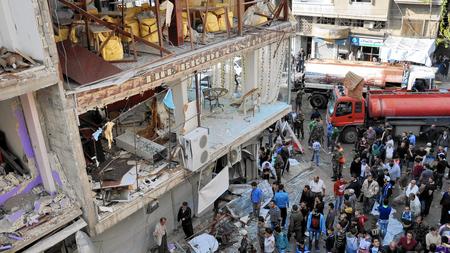
la-epa-epaselect-syria-homs-car-bomb-jpg-20141030Syrian police and residents inspect the site of a car bombing in Homs on Oct. 29. The U.S. plan to raise a rebel army in Syria to fight Islamic State has run into steep political and military obstacles. (European Pressphoto Agency)

The Obama administration’s plan to raise a 15,000-strong rebel army in Syria has run into steep political and military obstacles, raising doubts about a key element of the White House strategy for defeating Islamic State militants in the midst of a civil war.

Pentagon concerns have grown so sharp that Defense Secretary Chuck Hagel sent a two-page memo to the White House last week warning that the overall plan could collapse because U.S. intentions toward Syrian President Bashar Assad are unclear, according to a senior defense official who read the memo but was not authorized to speak publicly.

President Obama has called on Assad to step down, but he has not authorized using military force, including the proposed proxy army, to remove the Syrian leader.

At a news conference Thursday, Hagel declined to discuss his memo to national security advisor Susan Rice, but he acknowledged that Assad has inadvertently benefited from more than five weeks of U.S.-led airstrikes against the Islamic State, one of the most powerful antigovernment forces in Syria’s bitter conflict.

Secretary of State John F. Kerry sought to paper over the problem Thursday, telling a forum in Washington that the proposed proxy army “can have an impact on Assad’s decision-making so we can get back to a table where we could negotiate a political outcome, because we all know there is no military resolution of Syria.”

Rebel leaders in Syria say they would reject joining a U.S.-backed force that is not aimed at defeating Assad, their main enemy.

Senior U.S. military officers also privately warn that the so-called Syrian moderates that U.S. planners hope to recruit — opposition fighters without ties to the Islamic radicals — have been degraded by other factions and forces, including Assad’s army, during the war.

It will take years to train and field a new force capable of launching an offensive against the heavily armed and well-funded Islamic State fighters, who appear well-entrenched in northern Syria, the officers say.

“We’re not going to be able to build that kind of credible force in enough time to make a difference,” said a senior U.S. officer who is involved in military operations against the militants and who asked for anonymity because he was not authorized to speak publicly. “We’ve watched the moderate opposition dwindle and dwindle and now there’s very little left.”

The Pentagon plan calls for putting 5,000 rebel fighters into Syria in a year, and 15,000 over the next three years.

It is the least developed and most controversial part of the multi-pronged U.S. strategy, which also includes near-daily airstrikes in Iraq and Syria, deployment of U.S. military advisors and other support to assist Iraqi government and Kurdish forces, along with attempts to choke off the militants’ financing from oil sales and foreign donors.

When officers involved in high-level Pentagon deliberations in the summer raised concerns about building a rebel army from scratch, they were overruled by senior commanders, who warned that airstrikes alone would not defeat the militants, one of the officers said.

But Pentagon unease has intensified in recent weeks as Jordan and Turkey, two allies that the Obama administration is counting on to help train the proposed proxy force, made it clear that they are lukewarm to the plan, two U.S. officials said.

Washington and its allies are chiefly split over whether the proposed force should focus on reclaiming Syrian territory now held by the Islamic State militants, which is the U.S. priority, or should also battle troops loyal to Assad, the allies’ main concern.

Turkey said this month that it would train a portion of the Syrian force, joining Saudi Arabia in training on its territory. U.S. officials don’t expect to assemble the first group of “moderate” rebels, drawing them from inside Syria or from crowded refugee camps in nearby countries, until early next year at the earliest.

But Turkish officials have signaled that the rebels it trains would concentrate on battling Assad’s forces, not Islamic State, once they return to Syria.

Jordan has not joined the training effort, although it hosts a separate, smaller, CIA-run operation for Syrian insurgents.

U.S. officials say greater involvement by Turkey and Jordan would allow them to increase the number who can be trained, and provide easier conduits for support and resupply when they return to Syria.

The dispute reflects the complex calibrations now in play as the Islamic State militants shake long-established political and military fault lines in the Middle East.

Most dramatically, perhaps, U.S. forces are now in at least tacit alignment with traditional enemies such as Iran and Hezbollah, the Lebanon-based militant and political group, against a common threat.

Syrian rebel leaders and Arab allies complain that the U.S.-led airstrikes have helped Assad by weakening one of his most powerful foes and enabling his army to step up attacks on other rebel factions.

A spokesman for the Free Syrian Army, an umbrella organization claiming to represent largely autonomous rebels in Syria, said fighters were incensed by the U.S. insistence on focusing entirely on Islamic State.

“They have forgotten that tens of thousands of civilians are suffering because of the regime,” said the spokesman, who did not want his name published because it could endanger his family. “Our main cause is the regime, and that will remain our main cause.”

A rebel commander, a defector from the Syrian army who also asked for anonymity, agreed. The U.S. plan “doesn’t work for us,” he said.

“They are concerned with ISIS … but we are concerned with the regime more than ISIS,” he said, using one of several acronyms for Islamic State.

U.S. Central Command, which is overseeing the effort to build a Syrian force, says questions about its direction will be resolved once the fledgling program is underway.

“We are early on in this and there’s much to be figured out,” said Maj. Curtis J. Kellogg, a spokesman for Central Command.

Frederic C. Hof, a former special advisor to President Obama for Syria, said the U.S. plan “is going to be a tough sell” in Syria.

“You can always get people by providing weapons, ammo and pay, but your appeal to a large number of Syrians will increase dramatically if it is a force whose goal is eventually to govern all of Syria,” not just beat one faction, he added.

The caution reflects, in part, a U.S. desire to reassure Iran, one of Assad’s closest backers, that it is not seeking to oust him by force. If the U.S. backtracked on that promise, Iran might step up military support for Assad.

Tehran also could respond by using local Shiite militias to attack U.S. personnel or facilities in Iraq. The Iranian-backed Shiite militias in Iraq have coordinated their attacks on Islamic State with the U.S.-backed government in Baghdad.

“If we really focus on Assad, the Iranian piece of this coalition [against Islamic State] will fracture, and we will have Shia militants trying to target us,” said the senior U.S. military officer.

The U.S. experience with proxy military forces is laced with disappointment.

The Kennedy administration backed a failed invasion of the Bay of Pigs in Cuba in 1961 after training a counterrevolutionary brigade. In the 1980s, the Reagan administration bankrolled the Contras in Nicaragua, who were unsuccessful against the Sandinistas’ socialist revolution.

“We’ve helped arm insurgencies before,” Bruce Riedel, a former CIA analyst who now is a senior fellow at the Brookings Institution. “Nearly all of them have been complete failures or marginal to the final outcome. But there was one spectacular success.”

The CIA, working with Pakistan and Saudi Arabia, covertly poured $4 billion into arming a rebel force in Afghanistan from 1979 to 1989, helping them drive out Soviet forces. Riedel, who wrote a book about the undertaking, said the CIA operation hastened the fall of the Soviet Union and the end of the Cold War.

The Syrian rebel forces, with their fractured leadership and rival sponsors, bear similarities to the competing Afghan mujahedin factions during that war, Riedel said. If the U.S. can secure tight-knit partnerships with neighboring countries on training the rebels, it could also see success against Islamic State.

“There’s no reason we can’t do it again,” he said. “But it doesn’t happen overnight.”
The US War Against ISIS Is Barely Degrading, Certainly Not Destroying The Militants

October 25, 2014

The US War Against ISIS Is Barely Degrading, Certainly Not Destroying The Militants, International Business Times , October 24, 2014

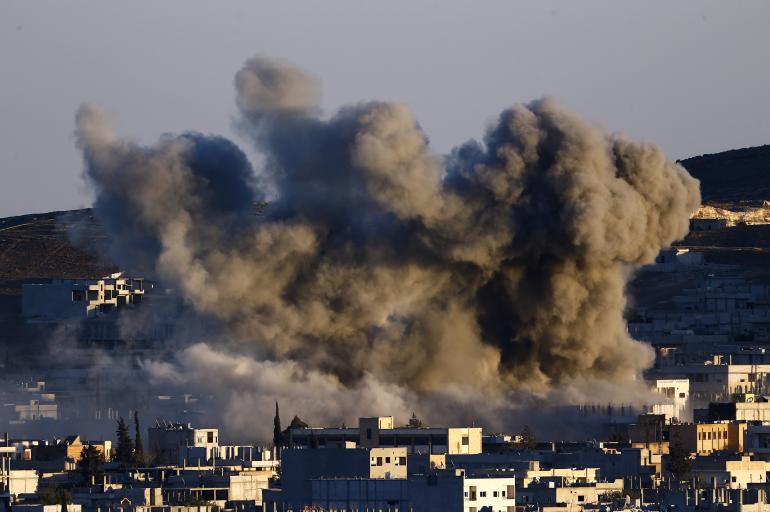
kobaneSmoke rises over Syrian town of Kobani after an airstrike, as seen from the Mursitpinar crossing on the Turkish border, Oct. 21, 2014. Reuters/Kai Pfaffenbach

The U.S.-led air campaign in Syria has killed 521 Islamic State fighters in the past month, according to the Syrian Observatory for Human Rights, a group monitoring the civil war. But the heavy death toll does not mean the United States is winning its fight to “degrade and destroy” the Sunni extremist group. Experts say that won’t happen until the group also known as ISIS loses support and its fighters begin defecting. 

“Until that happens, we will not see a quantum shift in the war in Iraq and Syria,” said Wayne White, a former deputy director of the State Department’s Bureau of Intelligence and Research’s Office of Analysis for the Near East and South Asia.

Since June, ISIS has gained control of large swaths of land that stretch from Kobani on the Syrian-Turkish border to the outskirts of Baghdad. The group is currently waging campaigns in several different areas of both countries, but has focused its forces in recent weeks on capturing the Kurdish city of Kobani. As a result, the U.S.-led air campaign has targeted several ISIS convoys and strongholds in Kobani and is air-dropping weapons and other resources to the Syrian Kurds fighting there.

“Like many aerial campaigns you can cite from history, it is a gradual process,” White said. “ISIS has a finite number of heavy weapons, and they are being picked off. And ISIS is losing a lot of combatants that are not easily replaced. ISIS is driven to expand its domain, and every time it tries to expand it is putting its fighters out in the open where they can be taken out. The question is: How long will the degrading take until you get to the destruction … a long time.”

Witnesses on the ground in Kobani told International Business Times that ISIS had been pushed back from the center of the city, but that the fighting was still raging on the outskirts. Meanwhile, ISIS is making gains in other parts of Syria and in Baghdad. According to the Syrian Observatory, ISIS fighters seized Tal Shaer, a town just west of Kobani, this week. And in Baghdad, the Sunni militant group has claimed responsibility for several car and suicide bomb attacks that have killed dozens of people in the last two weeks.

The uptick in ISIS attacks since June in Iraq has not only caused hundreds of civilian deaths, but has also infiltrated the psyche of the Iraqi people, especially those living in the capital, Noof Assi, a woman from Baghdad, told the International Business Times.

At the beginning of the ISIS campaign, “Baghdad looked like a ghost city,” Assi said. “People were staying at home or fleeing, saving food and fuel.”

Now, she said, people in Baghdad are used to the ISIS insurgency. Discussions in shops, cafes and restaurants have shifted. No longer are Iraqis talking about the destruction that ISIS is inflicting on the country. Now, people are talking about how many people are beginning to support the militant group.

“There are people talking about people of Mosul,” she said of the big northern city. “Some people are saying that they betrayed Iraq and welcomed ISIS.”

The State Department and White House have both confirmed that part of the U.S. strategy to fight ISIS is to undercut its propaganda and recruitment, especially on social media. So far, though, the U.S. has not launched a successful countercampaign.

In September, the State Department produced and distributed a graphic mock Islamic State propaganda video via social media. The video, “Welcome to ISIS Land,” was published by the State Department’s Center for Strategic Counterterrorism Communications.

The mock video showed graphic images of the militant group committing war crimes that have been widely reported over the past two months and that are now being investigated by the United Nations. The video looks similar to those ISIS promotes on social media like Twitter and YouTube. Despite the counterpropaganda drive, ISIS continues to expand on social media, and more and more Western fighters, as well as Iraqi and Syrian civilians, are joining up.

While some experts say the only way the U.S. will defeat ISIS is by sending in ground troops, others say more credit should be given to the Syrian Kurdish fighters — who now seems to be only force on the ground in Iraq and Syria that is regaining territory ISIS took over in prior months.

“They are the only boots on the ground in the entire Iraqi-Syrian theater capable of standing up to ISIS,” White said. “They are absolutely fierce fighters. The Iraqi Kurds are not.”