Archive for the ‘Afghanistan’ category

Taliban claim insider attack at Kabul Airport that killed 3 US contractors

January 31, 2015

Taliban claim insider attack at Kabul Airport that killed 3 US contractors, Long War Journal, Bill Roggio, January 30, 2015

(Nothing to see here; they are just insurgents. Please see White House Struggles To Distinguish Between The Islamic State and Taliban Prisoner Swaps. — DM)

The Taliban claimed last evening’s attack at Kabul International Airport that killed three American contractors. The insider or green-on-blue attack, where a member of the Afghan security forces kills Coalition personnel, is the first of its kind recorded this year.

The attacker, who was dressed in an Afghan military uniform, killed the three contractors and wounded one, Major General Haq Nawaz Haqyar, the commander of Afghan police at the airport, told Pajhwok Afghan News. An Afghan was also killed in the shooting, Haqyar said. It is unclear if the Afghan who was killed was the shooter.

The US Department of Defense confirmed that three Americans and an Afghan were killed in the shooting.

Taliban spokesman Zabihullah Muhajid claimed the attack in two statements on his Twitter account, and said it was executed by Ihsanullah, an “infiltrator … from Laghman province working inside Kabul airport.”

“The attack killed 3 American terrorists and wounded 4 others before the infiltrator was martyred by return fire,” Muhajid claimed. The tweet included the hashtag “Khaibar,” a reference to the Taliban’s offensive that was announced in May 2014. The Taliban said it will continue to launch insider attacks, as well as encourage Afghan soldiers to execute such operations.

The Taliban have devoted significant effort into attempts to kill NATO troops and foreigners by infiltrating the ranks of Afghan security forces. Mullah Omar affirmed this in a statement released on Aug. 16, 2012, when he claimed that the group had “cleverly infiltrated in the ranks of the enemy according to the plan given to them last year [2011],” and he urged government officials and security personnel to defect to the Taliban as a matter of religious duty. Omar also noted that the Taliban had created the “Call and Guidance, Luring and Integration” department, “with branches … now operational all over the country,” to encourage defections. [See Threat Matrix report, Mullah Omar addresses green-on-blue attacks.]

Overall number of insider attacks still unknown

The last known insider attack took place on Sept. 16, 2014 in the western province of Farah. In that attack, an Afghan soldier gunned down a Coalition trainer inside a military base.

The previous attack occurred on Aug. 5 at a training center in Kabul. An Afghan soldier killed a US major general and wounded 16 more military personnel, including a US brigadier general, a German general, five British troops, and at least one Afghan officer. The Taliban did not claim credit for the attack, but praised the Afghan soldier who executed it.

There were four insider attacks recorded in Afghanistan in 2014, according to The Long War Journal’s statistics. The number of reported green-on-blue attacks on Coalition personnel in Afghanistan has dropped steeply since a peak of 44 in 2012. In 2013, there were 13 such attacks. [For in-depth information, see LWJ special report, Green-on-blue attacks in Afghanistan: the data.]

The decline in attacks may be due to several factors, including the continuing drawdown of Coalition personnel, reduced partnering with Afghan forces, and the adoption of heightened security measures in interactions between Coalition and Afghan forces.

However, many insider attacks remain unreported. If an attack by Afghan personnel does not result in a death or injury, and it is not reported in the press, the Coalition will not release a statement on the incident.

The International Security Assistance Force (ISAF), which was disbanded at the end of 2014, told The Long War Journal in March 2012 that “these statistics,” the number of attacks that did not result in a casualty, are “classified.”

“[A]ttacks by ANSF on Coalition Forces … either resulting in non-injury, injury or death … these stats as a whole (the total # attacks) are what is classified and not releasable,” Lieutenant Colonel Jimmie Cummings, ISAF’s former Press Desk Chief, told The Long War Journal. Cummings said that ISAF is “looking to declassify this number.” The number was never declassified.

 

US military continues to claim al Qaeda is ‘restricted’ to ‘isolated areas of northeastern Afghanistan’

November 19, 2014

US military continues to claim al Qaeda is ‘restricted’ to ‘isolated areas of northeastern Afghanistan,’ Long War Journal, Bill Roggio, November 19, 2014

A recently issued report on the status of Afghanistan by the US Department of Defense has described al Qaeda as being primarily confined to “isolated areas of northeastern Afghanistan.” But information on Afghan military and intelligence operations against the global jihadist group contradicts the US military’s assessment.

The Defense Department released its “Report on Progress Toward Security and Stability in Afghanistan” in October. The report, which “covers progress in Afghanistan from April 1 to September 30, 2014,” contains only nine mentions of al Qaeda. Five of those mentions simply reference the mission to conduct “counterterrorism operations against remnants of core al Qaeda and its affiliates.”

The US military’s report states that “[s]ustained ISAF [International Security Assistance Force] and ANSF [Afghan National Security Forces] counterterrorism operations prevented al Qaeda’s use of Afghanistan as a platform from which to launch transnational terrorist attacks during this reporting period.”

Then the report goes on to describe al Qaeda as “isolated” in the northeastern part of the country, a reference to the remote mountainous provinces of Kunar and Nuristan.

“Counterterrorism operations restricted al Qaeda’s presence to isolated areas of northeastern Afghanistan and limited access to other parts of the country,” the report continues. “These efforts forced al Qaeda in Afghanistan to focus on survival, rather than on operations against the West. Al Qaeda’s relationship with local Afghan Taliban organizations remains intact and is an area of concern.”

Al Qaeda’s operations contradict US military claims

For years, the US military has claimed that al Qaeda is constrained to operating in northeastern Afghanistan, but ISAF’s own data on raids against the terrorist group and its allies has indicated otherwise. According to ISAF press releases announcing operations between early 2007 and June 2013, al Qaeda and its allies were targeted 338 different times, in 25 of 34 of Afghanistan’s provinces. Those raids took place in 110 of Afghanistan’s nearly 400 districts. [See LWJ report, ISAF raids against al Qaeda and allies in Afghanistan 2007-2013.]

Continuing this pattern, while the latest DoD report, which covers the period between April 1 and Oct. 30 of this year, claims that al Qaeda is restricted to northeastern Afghanistan, reported Afghan military and intelligence operations during the same time period indicate that al Qaeda remains active beyond Kunar and Nuristan.

The most high-profile operation against al Qaeda was conducted in Nangarhar province in October. Afghanistan’s National Directorate of Security reported that al Qaeda leader Abu Bara al Kuwaiti was killed in a US airstrike in Lal Mandi in Nangarhar’s Nazyan district. The airstrike took place at the home of Abdul Samad Khanjari, who was described as al Qaeda’s military commander for the province.

Abu Bara likely served in al Qaeda’s General Command. He was close to al Qaeda emir Ayman al Zawahiri, and had served as an aide to Atiyah Abd al Rahman, al Qaeda’s former general manager who was killed in a US drone strike in Pakistan in August 2011. Abu Bara wrote Atiyah’s eulogy, which was published in Vanguards of Khorasan, al Qaeda’s official magazine. US intelligence officials have told The Long War Journal that Abu Bara was the most senior al Qaeda leader killed in Afghanistan in years. [See LWJ report, Senior al Qaeda leader reported killed in US airstrike in eastern Afghanistan.]

Another senior al Qaeda leader known to operate in Afghanistan is Qari Bilal. In August, Afghan officials said that he commands more than 300 fighters in the northern province of Kunduz, where several districts are controlled or contested by the Taliban. Bilal is also a member of the Islamic Movement of Uzbekistan, an al Qaeda-linked group that has integrated its operations with the Taliban in northern Afghanistan.

Bilal escaped from a Pakistani jail in 2010, entered Afghanistan, and was subsequently captured by ISAF special operations forces in 2011. He was later freed by Afghan officials and rejoined the fight. [See LWJ report, Senior IMU leader captured by ISAF in 2011 now leads fight in northern Afghanistan.]

This month, Afghan officials announced the capture of Eqbal al Tajiki, a citizen of Tajikistan who served with al Qaeda’s network in Kunduz. Sediq Sediqi, the spokesman for the Interior Ministry, said that Eqbal “is an active member of the al Qaeda network” who was “transferred by his colleagues to northern parts of Afghanistan to carry out terrorist activities,” according to Afghan Channel One TV. Sediqi said Eqbal had “received terrorist training in North Waziristan for three years.”

Eqbal may have been a member of the Qari Salim Group, “a high-profile Al Qaeda affiliate” that is commanded by Qari Khaluddin, Pajhwok Afghan News noted in October. Khaluddin “had recently trained in Pakistan’s city of Quetta.” The group is said to have been plotting to attack a military base in Kunduz.

Another al Qaeda group known to be operating in Afghanistan is Junood al Fida. In early October, Junood al Fida released video that purported to show the group taking control of the district of Registan in the southern province of Kandahar.

Junood al Fida, which is comprised of Baluch jihadists, has sworn loyalty to the Taliban but also describes Qaeda emir Ayman al Zawahiri as “Our Shaykh al Habeeb” [beloved leader] and its “Ameeruna” [our chief]. The group’s propaganda routinely attacks the US. [See LWJ reports, Baloch jihadist group in southern Afghanistan announces death of commander and Jihadist group loyal to Taliban, al Qaeda claims to have captured Afghan district.]


Afghanistan Going off the Rails as U.S. Withdrawal Speeds Up

October 31, 2014

Afghanistan Going off the Rails as U.S. Withdrawal Speeds Up, Foreign PolicyGopal Ratham, October 30, 2014

(Will today’s sideshow soon move to the circus big tent? — DM)

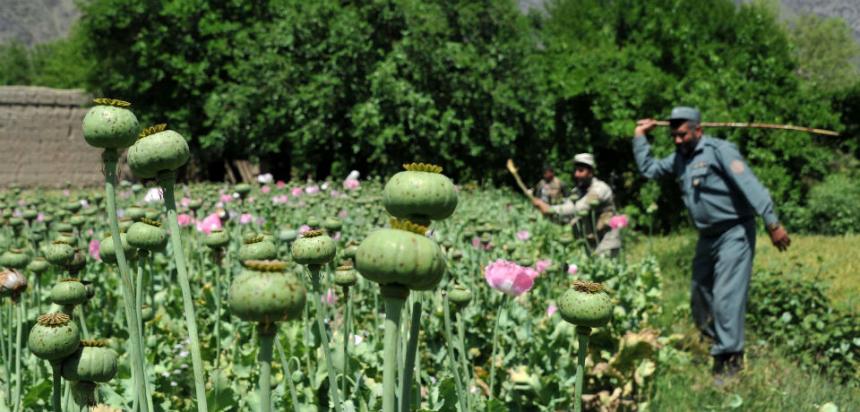
Insurgent attacks rise as poppy cultivation reaches a post-Taliban high in Afghanistan.

487292753-sigar-cropped_0

While the world’s eyes are trained on Iraq, Syria, and the fight against the Islamic State, a new report to Congress by the government’s reconstruction watchdog warns that Afghanistan, where U.S. troops have been fighting the Taliban and other insurgent groups in the longest war in American history, remains dangerously unstable even as the American military withdrawal accelerates.

Insurgent attacks have reached the highest levels since 2011, the Afghan army has sustained heavy combat losses and is experiencing high attrition rates, and opium poppy cultivation has more than doubled from its pre-1999 levels when the Taliban ruled the country, potentially undermining the Afghan state’s legitimacy even as the nation is experiencing budget shortfalls, the Office of the Special Inspector General for Afghanistan Reconstruction, or SIGAR, said in a quarterly report sent to Congress Thursday.

The dire warnings come as a new Afghan coalition government led by President Ashraf Ghani and his rival Abdullah Abdullah —  who assumed the role of a chief executive officer — has taken power after a contentious election and political standoff. The new government signed security agreements with the United States and NATO allowing international coalition forces to remain in the country after December. The Obama administration has said it will gradually withdraw the remaining 24,000 American troops, with the last leaving the country in 2016. The NATO forces are likely to follow the same pattern, leaving Afghan military forces to take full responsibility for security after 2016.

As part of that plan, U.S. Marines and British forces on Monday ended their combat mission and vacated two of their largest bases in Afghanistan — Camp Bastion and Camp Leatherneck — in the Helmand province, the site of some of the most violent battles of the 13-year-long war. Since the arrival of forces in 2001, about 350 Marines and 407 British troops have died in Helmand, theWashington Post reported. The departure of the last remaining coalition troops there was carried out in secrecy to prevent Taliban attacks — further evidence of the coalition’s tenuous security gains.

Poppy cultivation, a barometer of the underground economy that plays a role in financing the insurgency, is soaring, the report warned. About 209,000 hectares of land were under poppy cultivation in 2013, an increase of 36 percent from the previous year, the SIGAR report said, citing statistics from the U.N. Office of Drugs and Crime. The size of the crop has doubled since 1999, when the Taliban ruled the country and opium was grown on 91,000 hectares.

Afghanistan’s opium cultivation supports the equivalent of about 411,000 jobs, exceeding the overall size of the Afghan national security forces, and generates about $3 billion of revenue from drug exports, the report said.

The booming drug trade is potentially fueling the Taliban-led insurgency that still remains strong in the country’s south, southeast, and east. Citing U.N. statistics, the report said that the total number of attacks for the nine months ending Aug. 15 totaled 15,968, or 61 a day — the second-highest level since 2011 after the fall of the Taliban. Military officials and Western observers believe international terrorist groups and the Taliban took advantage of the months-long uncertainty over the outcome of Afghan presidential elections that finally ended Sept. 29 with the formation of the coalition government led by Ghani.

Afghan security forces, which have been leading the fight against the Taliban, face high rates of attrition and combat casualties, the report said.

Between September 2013 and August 2014, more than 36,000 Afghan army personnel were dropped from rolls, and between March 2012 and August 2014 more than 2,850 troops were killed in action with another 14,600 wounded, the report said.

The report, in a strong slap at the Pentagon, said the U.S.-led coalition had made it difficult to independent assessments of the capability of the Afghan forces by abruptly classifying details of the country’s military capabilities. That raises the disturbing possibility that the United States is trying to paper over significant and lingering problems with the Afghan forces already struggling to fill the security vacuum left by the departing American forces.

The inspector general’s office “is deeply troubled by the decision” of the international coalition “to classify the executive summary of the report that assesses the capability of the ANSF which were unclassified prior to this quarter,” the report said. “ISAF’s classification of the report summary deprives the American people of an essential tool to measure the success or failure of the single most costly feature of the Afghanistan reconstruction effort.”

The coalition military decided to classify the Afghan military capability “to address potential concerns about operational security,” an ISAF military official said in an email. “After careful review, it was determined that the entirety of the report was classified to include the executive summary which contained Afghan-provided readiness information.”

Providing such information openly could jeopardize Afghan security forces, the official said, adding that SIGAR will continue to get the information it needs to carry out its congressionally mandated duties.

Unlike previous years, in 2014 the Taliban has attacked Afghan forces on multiple fronts, said Omar Samad, a former Afghan ambassador to France, who is now president of Silk Road Consulting, a Washington-based geopolitical advisory firm.

Although such attacks have dealt a psychological blow to Afghan forces, it’s not clear if the Taliban has been able to retain control of territories, said Samad who just returned from Kabul.

“What will make a big difference in the next year or two is the effective use of air power,” Samad said. “We don’t know yet whether ANSF who are in training mode now will have the right equipment and training to carry out operations needed or whether they’ll have to be complemented by NATO forces after 2014.”

To make matters worse for the new Afghan government, the country’s finance ministry is facing serious budget shortfalls, the report said. For the first seven months of the Afghan financial year that began Dec. 21, 2013, the domestic revenues missed government targets by 22 percent and declined 3.8 percent compared with the same period last year, the report said.

“I don’t think it’s a surprise to Afghans and those who follow it closely that this year would be a challenging year,” Samad said. Mismanagement of the country’s economy in the last years of former President Hamid Karzai have made the challenges “bigger than expected,” he added.

Jen Psaki on withdrawal from Afghanistan

October 3, 2014

Jen Psaki on withdrawal from Afghanistan, You Tube, October 2, 2014

(Please see also Obama’s Ex-CIA Chief Slams White House for ‘Hesitation and Half Steps’ — DM)

