On Watch: Episode 4 – The So-called ‘Hack’, Judicial Watch via YouTube, January 17, 2017
AFDI video: New Yorkers prefer martial law to Trump, Jihad Watch,
It isn’t directly discussed in this video, but one of the principal reasons why Trump is so widely hated is because he wants to defend America from, among other things, the jihad terror threat. This video shows how deeply the Leftist cultural rot has set in: people don’t understand or appreciate the importance of a peaceful transfer of power to the opposition, and they no doubt think that defending the U.S. against the global jihad is inherently “racist” and “Islamophobic.”
AFDI Unveils Shocking New Video Showing New Yorkers Prefer Martial Law to Trump
NEW YORK, January 16: The human rights advocacy group the American Freedom Defense Initiative (AFDI) today unveiled a shocking new video, filmed at Times Square in New York City, showing that all too many New Yorkers would prefer that Barack Obama impose martial law and postpone the inauguration than allow Donald Trump to become President of the United States on Friday.
AFDI President Pamela Geller noted: “Rosie O’Donnell recently called for Obama to impose martial law and postpone the inauguration of Donald Trump until the president-elect could be prosecuted for crimes she did not name.”
Geller added: “We sent AFDI correspondent Laura Loomer to Times Square to ask people whether or not they agreed with this outrageous, deeply un-American and unconstitutional proposal. We were sure that the vast majority of people would say No, Rosie is crazy, the inauguration and the peaceful transfer of power should go on as always. And some did. But an alarming number didn’t.”
Explained Geller: “These people have no understanding of the rule of law or the value of a peaceful transition of power. They’re a testament to the failure of teachers in the U.S. and elsewhere to explain why America is unique. But some people still knew. Those people were heartening. But the fact that so many agreed with Rosie O’Donnell’s proposal for martial law and the postponement of the inauguration shows one reason why America is in such deep crisis today: vast numbers of people don’t even appreciate the uniqueness and strength of our republic. Most disquieting of all, such people will not be willing to defend it.”
AFDI stands for:
CNN/ORC Poll: Roughly 80 Percent Of Americans Do Not Believe That Russian Hacking Changed The Outcome of the Election, Jonathan Turley’s Blog, Jonathan Turley, January 17, 2017
(UPDATE: This post has been removed by the author and replaced with a different analysis of the poll. The replacement article now states that “A new CNN/ORC poll shows roughly 8 out of 10 voters followed the controversy but 58 percent doubt that the hacking influenced the outcome of the election. [This posting was updated]”– DM)

Ironically, in the end, the emails showed the public that the establishment in Washington is every bit as corrupt and dishonest as they thought. It was only the messenger not the message that came as a surprise.
*********************************
The Democratic establishment has been pushing hard on a new narrative that Hillary Clinton lost not because of her record negatives polling going back years on truthfulness or the desire of the voters for a non-establishment candidate or the baggage carried by Clinton into the election. Rather, it was the hacking by the Russians with a bit of help from FBI Director James Comey, according to this universal spin. The media has assisted to a degree by referring to the “Russian hacking of the election,” which is obviously not true. The election was not hacked. No voting machines or tallies were hacked. Emails were hacked and none of those emails appear to have been altered. They were real emails showing highly dishonest conduct by key players. Despite the virtual mantra from Washington, voters are clearly not buying it. A new CNN/ORC poll shows roughly 8 out of 10 voters do not believe that the hacking changed the outcome of the election.
I have previously discussed the difficult sell that Democrats would have to make on the hacking spin. As revealed by the intelligence report, the emails were not false or tampered with as claimed by Donna Brazile (who appears immune for media follow ups). The Democrats are trying ton trigger outrage among citizens that the hacking revealed true and disturbing emails of lying and vicious dealing by insiders in Washington. It did not work during the campaign and is clearly not working now. That does not mean that citizens are not concerned with Russian hacking. However, citizens have been hearing for years of our own hacking and surveillance of our allies, let alone opposing governments. More importantly, (while ignored by the Democratic leadership at their own peril), voters were in an anti-establishment mood and many relished the fact that establishment figures were exposed like Brazile for things like feeding questions to the Clinton campaign. Of course, there was clearly a selective release of such emails against Democrats and that is a valid objection. However, it takes a lot to get the public upset about being told how insiders lied to them or tried to rig the primary for Clinton.
What is interesting is the the Democrats are continuing this full-court press on the same hacking line despite the polls — a repeat of the strategies from the election. There is no question that the hacking should focus all Americans on the vulnerability of our system and the constant threat from hostile powers like Russia. Yet, the DNC was aware of that danger before the election and yet had a laughable security system. In combination with Clinton’s reckless use of a personal server at Secretary of State, it shows a level of negligence and recklessness that was surprising given years of hacking cases. Ironically, in the end, the emails showed the public that the establishment in Washington is every bit as corrupt and dishonest as they thought. It was only the messenger not the message that came as a surprise.
Trump and the American Divide, City Journal, Victor Davis Hanson, Winter 2017
In sum, Donald Trump captured the twenty-first-century malaise of a rural America left behind by globalized coastal elites and largely ignored by the establishments of both political parties. Central to Trump’s electoral success, too, were age-old rural habits and values that tend to make the interior broadly conservative. That a New York billionaire almost alone grasped how red-state America truly thought, talked, and acted, and adjusted his message and style accordingly, will remain one of the astonishing ironies of American political history.
*****************************
At 7 AM in California’s rural Central Valley, not long before the recent presidential election, I stopped to talk with an elderly irrigator on the shared border alleyway of my farm. His face was a wrinkled latticework, his false teeth yellow. His truck smelled of cigarettes, its cab overflowing with flotsam and jetsam: butts, scribbled notes, drip-irrigation parts, and empty soda cans. He rolled down the window and muttered something about the plunging water-table level and whether a weak front would bring any rain. And then, this dinosaur put one finger up on the wheel as a salutation and drove off in a dust cloud.
Five hours later, and just 180 miles distant, I bought a coffee at a Starbucks on University Avenue in Palo Alto, the heart of Silicon Valley, the spawn of Stanford University. Two young men sat at the table next to me, tight “high-water” pants rising above their ankles, coat cuffs drawn up their forearms, and shirts buttoned all the way to the top, in retro-nerd style. Their voices were nasal, their conversation rapid-fire— politics, cars, houses, vacations, fashion, and restaurants all came up. They were speaking English, but of a very different kind from the irrigator’s, accentuating a sense of being on the move and upbeat about the booming reality surrounding them.
I hadn’t just left one part of America to visit another, it seemed, but instead blasted off from one solar system to enter another cosmos, light-years distant. And to make the contrast even more radical, the man in the truck in Fresno County was Mexican-American and said that he was voting for Trump, while the two in Palo Alto were white, clearly affluent—and seemed enthused about Hillary Clinton’s sure win to come.
The postelection map of Republican and Democratic counties mirrored my geographical disconnect. The Donald Trump nation of conservative red spanned the country, to within a few miles of the two coasts, covering 85 percent of the nation’s land area. Yet Clinton won the popular vote, drawing most of her support in razor-thin, densely populated blue ribbons up and down the East and West Coast corridors and in the Great Lakes nexus. As disgruntled liberal commentator Henry Grabar summed up the election result: “We now have a rural party and an urban party. The rural party won.” This time around, anyway.
The urban party has been getting beat up a lot, even before Trump’s surprising victory. Not only have the Democrats surrendered Congress; they now control just 13 state legislatures and 15 governorships—far below where they were pre–Barack Obama. Over the past decade, more than 1,000 elected Democratic state lawmakers have lost their jobs, with most of the hemorrhaging taking place outside the cities. As political analyst Ron Brownstein puts it, “Of all the overlapping generational, racial, and educational divides that explained Trump’s stunning upset over Hillary Clinton . . . none proved more powerful than the distance between the Democrats’ continued dominance of the largest metropolitan areas, and the stampede toward the GOP almost everywhere else.”
“Everywhere else” basically means anywhere but the two coasts. After the election, in liberal, urban America, one often heard Trump’s win described as the revenge of the yahoos in flyover country, fueled by their angry “isms” and “ias”: racism, anti-Semitism, nativism, homophobia, Islamophobia, and so on. Many liberals consoled themselves that Trump’s victory was the last hurrah of bigoted, Republican white America, soon to be swept away by vast forces beyond its control, such as global migration and the cultural transformation of America into something far from the Founders’ vision.
As insurance, though, furious progressives also renewed calls to abolish the Electoral College, advocating for a constitutional amendment that would turn presidential elections into national plebiscites. Direct presidential voting would shift power to heavily urbanized areas—why waste time trying to reach more dispersed voters in less populated rural states?—and thus institutionalize the greater economic and cultural clout of the metropolitan blue-chip universities, the big banks, Wall Street, Silicon Valley, New York–Washington media, and Hollywood, Democrat-voting all.
Barack Obama’s two electoral victories deluded the Democrats into thinking that it was politically wise to jettison their old blue-collar appeal to the working classes, mostly living outside the cities these days, in favor of an identity politics of a new multicultural, urban America. Yet Trump’s success represented more than simply a triumph of rural whites over multiracial urbanites. More ominously for liberals, it also suggested that a growing minority of blacks and Hispanics might be sympathetic with a “country” mind-set that rejects urban progressive elitism. For some minorities, sincerity and directness might be preferable to sloganeering by wealthy white urban progressives, who often seem more worried about assuaging their own guilt than about genuinely understanding people of different colors.
Trump’s election underscored two other liberal miscalculations. First, Obama’s progressive agenda and cultural elitism prevailed not because of their ideological merits, as liberals believed, but because of his great appeal to urban minorities in 2008 and 2012, who voted in solidarity for the youthful first African-American president in numbers never seen before. That fealty wasn’t automatically transferable to liberal white candidates, including the multimillionaire 69-year-old Hillary Clinton. Obama had previously lost most of America’s red counties, but not by enough to keep him from winning two presidential elections, with sizable urban populations in Wisconsin, Michigan, Ohio, and Pennsylvania turning out to vote for the most left-wing presidential candidate since George McGovern.
Second, rural America hadn’t fully raised its electoral head in anger in 2008 and 2012 because it didn’t see the Republican antidotes to Obama’s progressive internationalism as much better than the original malady. Socially moderate establishmentarians like the open-borders-supporting John McCain or wealthy businessman Mitt Romney didn’t resonate with the spirit of rural America—at least not enough to persuade millions to come to the polls instead of sitting the elections out. Trump connected with these rural voters with far greater success than liberals anticipated. Urban minorities failed in 2016 to vote en bloc, in their Obama-level numbers; and rural Americans, enthused by Trump, increased their turnout, so that even a shrinking American countryside still had enough clout to win.
What is insufficiently understood is why a hurting rural America favored the urban, superrich Trump in 2016 and, more generally, tends to vote more conservative than liberal. Ostensibly, the answer is clear: an embittered red-state America has found itself left behind by elite-driven globalization, battered by unfettered trade and high-tech dislocations in the economy. In some of the most despairing counties, rural life has become a mirror image of the inner city, ravaged by drug use, criminality, and hopelessness.
Yet if muscular work has seen a decline in its relative monetary worth, it has not necessarily lost its importance. After all, the elite in Washington and Menlo Park appreciate the fresh grapes and arugula that they purchase at Whole Foods. Someone mined the granite used in their expensive kitchen counters and cut the timber for their hardwood floors. The fuel in their hybrid cars continues to come from refined oil. The city remains as dependent on this elemental stuff—typically produced outside the suburbs and cities—as it always was. The two Palo Altoans at Starbucks might have forgotten that their overpriced homes included two-by-fours, circuit breakers, and four-inch sewer pipes, but somebody somewhere made those things and brought them into their world.
In the twenty-first century, though, the exploitation of natural resources and the manufacturing of products are more easily outsourced than are the arts of finance, insurance, investments, higher education, entertainment, popular culture, and high technology, immaterial sectors typically pursued within metropolitan contexts and supercharged by the demands of increasingly affluent global consumers. A vast government sector, mostly urban, is likewise largely impervious to the leveling effects of a globalized economy, even as its exorbitant cost and extended regulatory reach make the outsourcing of material production more likely. Asian steel may have devastated Youngstown, but Chinese dumping had no immediate effect on the flourishing government enclaves in Washington, Maryland, and Virginia, filled with well-paid knowledge workers. Globalization, big government, and metastasizing regulations have enriched the American coasts, in other words, while damaging much of the nation’s interior.
Few major political leaders before Trump seemed to care. He hammered home the point that elites rarely experienced the negative consequences of their own ideologies. New York Times columnists celebrating a “flat” world have yet to find themselves flattened by Chinese writers willing to write for a fraction of their per-word rate. Tenured Harvard professors hymning praise to global progressive culture don’t suddenly discover their positions drawn and quartered into four part-time lecturer positions. And senators and bureaucrats in Washington face no risk of having their roles usurped by low-wage Vietnamese politicians. Trump quickly discovered that millions of Americans were irate that the costs and benefits of our new economic reality were so unevenly distributed.
As the nation became more urban and its wealth soared, the old Democratic commitment from the Roosevelt era to much of rural America—construction of water projects, rail, highways, land banks, and universities; deference to traditional values; and Grapes of Wrath–like empathy—has largely been forgotten. A confident, upbeat urban America promoted its ever more radical culture without worrying much about its effects on a mostly distant and silent small-town other. In 2008, gay marriage and women in combat were opposed, at least rhetorically, by both Barack Obama and Hillary Clinton in their respective presidential campaigns. By 2016, mere skepticism on these issues was viewed by urban elites as reactionary ignorance. In other words, it was bad enough that rural America was getting left behind economically; adding insult to injury, elite America (which is Democrat America) openly caricatured rural citizens’ traditional views and tried to force its own values on them. Lena Dunham’s loud sexual politics and Beyoncé’s uncritical evocation of the Black Panthers resonated in blue cities and on the coasts, not in the heartland. Only in today’s bifurcated America could billion-dollar sports conglomerates fail to sense that second-string San Francisco 49ers quarterback Colin Kaepernick’s protests of the national anthem would turn off a sizable percentage of the National Football League’s viewing audience, which is disproportionately conservative and middle American. These cultural themes, too, Trump addressed forcefully.
Is there something about the land itself that promotes conservatism? The answer is as old as Western civilization. For the classical Greeks, the asteios(“astute”; astu: city) was the sophisticated “city-like” man, while the agroikos(“agrarian”; agros: farm/field) was synonymous with roughness. And yet there was ambiguity as well in the Greek city/country dichotomy: city folk were also laughed at in the comedies of Aristophanes as too impractical and too clever for their own good, while the unpolished often displayed a more grounded sensibility. In the Roman world, the urbanus (“urbane”; urbs: city) was sometimes too sophisticated, while the rusticus (“rustic”; rus: countryside) was often balanced and pragmatic.
Country people in the Western tradition lived in a shame culture. Family reputation hinged on close-knit assessments of personal behavior only possible in small communities of the like-minded and tribal. The rural ethos could not afford radical changes in lifestyles when the narrow margins of farming safety rested on what had worked in the past. By contrast, self-reinvention and social experimentation were possible only in large cities of anonymous souls and varieties of income and enrichment. Rural people, that is, don’t honor tradition and habit because they’re somehow better human beings than their urban counterparts; a face-to-face, rooted society offers practical reinforcement for doing so.
In classical literature, patriotism and civic militarism were always closely linked with farming and country life. In the twenty-first century, this is still true. The incubator of the U.S. officer corps is red-state America. “Make America Great Again” reverberated in the pro-military countryside because it emphasized an exceptionalism at odds with the Left’s embrace of global values. Residents in Indiana and Wisconsin were unimpressed with the Democrats’ growing embrace of European-style “soft power,” socialism, and statism—all the more so in an age of European constitutional, financial, and immigration sclerosis. Trump’s slogan unabashedly expressed American individualism; Clinton’s “Stronger Together” gave off a whiff of European socialist solidarity.
Farming, animal husbandry, mining, logging—these traditional bodily tasks were often praised in the past as epitomes of the proper balance between physical and mental, nature and culture, fact and theory. In classical pastoral and Georgic poetry, the city-bound often romanticized the countryside, even if, on arrival, they found the flies and dirt of Arcadia bothersome. Theocritus and Virgil reflected that, in the trade-offs imposed by transforming classical societies, the earthiness lost by city dwellers was more grievous to their souls than the absence of erudition and sophistication was to the souls of simpler farmers and shepherds.
Trump, the billionaire Manhattanite wheeler-dealer, made an unlikely agrarian, true; but he came across during his presidential run as a clear advocate of old-style material jobs, praising vocational training and clearly enjoying his encounters with middle-American homemakers, welders, and carpenters. Trump talked more on the campaign about those who built his hotels than those who financed them. He could point to the fact that he made stuff, unlike Clinton, who got rich without any obvious profession other than leveraging her office.
Give the thrice-married, orange-tanned, and dyed-haired Trump credit for his political savvy in promising to restore to the dispossessed of the Rust Belt their old jobs and to give back to farmers their diverted irrigation water, and for assuring small towns that arriving new Americans henceforth would be legal—and that, over time, they would become similar to their hosts in language, custom, and behavior.
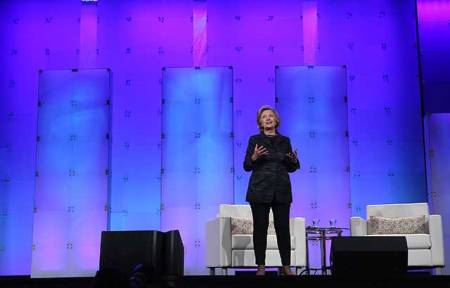 Hillary Clinton, speaking here at a Silicon Valley conference, drew strong support from technocratic elites. (JUSTIN SULLIVAN/GETTY IMAGES)
Changes come more slowly to rural interior areas, given that the sea, the historical importer of strange people and weird ideas, is far away. Maritime Athens was liberal, democratic, and cosmopolitan; its antithesis, landlocked Sparta, was oligarchic, provincial, and tradition-bound. In the same way, rural upstate New York isn’t Manhattan, and Provo isn’t Portland. Rural people rarely meet—and tend not to wish to meet—the traders, foreigners, and importers who arrive at ports with their foreign money and exotic customs.
The “Old Oligarch”—a name given to the author of a treatise by an anonymous right-wing grouch of fifth-century BC Athens—described the subversive hustle and the cornucopia of imported goods evident every day at the port of Piraeus. If one wished to destroy the purity of rural, conservative society, his odd rant went, then the Athens of Pericles would be just about the best model to follow. Ironically, part of Trump’s attraction for red-state America was his posture as a coastal-elite insider—but now enlisted on the side of the rustics. A guy who had built hotels all over the world, and understood how much money was made and lost through foreign investment, offered to put such expertise in the service of the heartland—against the supposed currency devaluers, trade cheats, and freeloaders of Europe, China, and Japan.
Language is also different in the countryside. Rural speech serves, by its very brevity and directness, as an enhancement to action. Verbosity and rhetoric, associated with urbanites, were always rural targets in classical literature, precisely because they were seen as ways to disguise reality so as to advance impractical or subversive political agendas. Thucydides, nearly 2,500 years before George Orwell’s warnings about linguistic distortion, feared how, in times of strife, words changed their meanings, with the more polished and urbane subverting the truth by masking it in rhetoric that didn’t reflect reality. In the countryside, by contrast, crops either grow or wither; olive trees either yield or remain barren; rain either arrives or is scarce. Words can’t change these existential facts, upon which living even one more day often depends. For the rural mind, language must convey what is seen and heard; it is less likely to indulge adornment.
Today’s rural-minded Americans are little different. Trump’s appeal to the interior had partly to do with his politically incorrect forthrightness. Each time Trump supposedly blundered in attacking a sacred cow—sloppily deprecating national hero John McCain’s wartime captivity or nastily attacking Fox superstar Megyn Kelly for her supposed unfairness—the coastal media wrote him off as a vulgar loser. Not Trump’s base. Seventy-five percent of his supporters polled that his crude pronouncements didn’t bother them. As one grape farmer told me after the Access Hollywood hot-mike recordings of Trump making sexually vulgar remarks had come to light, “Who cares? I’d take Trump on his worst day better than Hillary on her best.” Apparently red-state America was so sick of empty word-mongering that it appreciated Trump’s candor, even when it was sometimes inaccurate, crude, or cruel. Outside California and New York City and other elite blue areas, for example, foreigners who sneak into the country and reside here illegally are still “illegal aliens,” not “undocumented migrants,” a blue-state term that masks the truth of their actions. Trump’s Queens accent and frequent use of superlatives—“tremendous,” “fantastic,” “awesome”—weren’t viewed by red-state America as a sign of an impoverished vocabulary but proof that a few blunt words can capture reality.
To the rural mind, verbal gymnastics reveal dishonest politicians, biased journalists, and conniving bureaucrats, who must hide what they really do and who they really are. Think of the arrogant condescension of Jonathan Gruber, one of the architects of the disastrous Obamacare law, who admitted that the bill was written deliberately in a “tortured way” to mislead the “stupid” American voter. To paraphrase Cicero on his preference for the direct Plato over the obscure Pythagoreans, rural Americans would have preferred to be wrong with the blunt-talking Trump than to be right with the mush-mouthed Hillary Clinton. One reason that Trump may have outperformed both McCain and Romney with minority voters was that they appreciated how much the way he spoke rankled condescending white urban liberals.
Poorer, less cosmopolitan, rural people can also experience a sense of inferiority when they venture into the city, unlike smug urbanites visiting red-state America. The rural folk expect to be seen as deplorables, irredeemables, and clingers by city folk. My countryside neighbors do not wish to hear anything about Stanford University, where I work—except if by chance I note that Stanford people tend to be condescending and pompous, confirming my neighbors’ suspicions about city dwellers. And just as the urban poor have always had their tribunes, so, too, have rural residents flocked to an Andrew Jackson or a William Jennings Bryan, politicians who enjoyed getting back at the urban classes for perceived slights. The more Trump drew the hatred of PBS, NPR, ABC, NBC, CBS, the elite press, the universities, the foundations, and Hollywood, the more he triumphed in red-state America.
Indeed, one irony of the 2016 election is that identity politics became a lethal boomerang for progressives. After years of seeing America reduced to a binary universe, with culpable white Christian males encircled by ascendant noble minorities, gays, feminists, and atheists—usually led by courageous white-male progressive crusaders—red-state America decided that two could play the identity-politics game. In 2016, rural folk did silently in the voting booth what urban America had done to them so publicly in countless sitcoms, movies, and political campaigns.
In sum, Donald Trump captured the twenty-first-century malaise of a rural America left behind by globalized coastal elites and largely ignored by the establishments of both political parties. Central to Trump’s electoral success, too, were age-old rural habits and values that tend to make the interior broadly conservative. That a New York billionaire almost alone grasped how red-state America truly thought, talked, and acted, and adjusted his message and style accordingly, will remain one of the astonishing ironies of American political history.
Democrats hunker down for ‘permanent opposition’ to Donald Trump presidency, Washington Times, Valerie Richardson, January 12, 2017
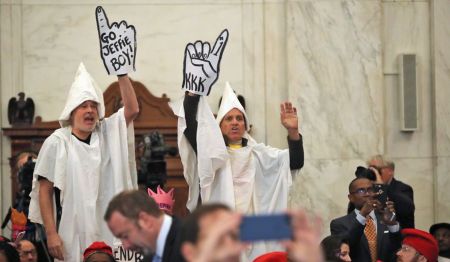 Protesters dressed as Ku Klux Klan members disrupt the Senate Judiciary Committee’s confirmation hearing for Attorney General-designate Sen. Jeff Sessions on Tuesday. (Associated Press)
For those stunned to see Tuesday’s Senate confirmation hearing disrupted by shouts, changs and protesters dressed as Ku Klux Klan members: Get used to it.
President-elect Donald Trump won’t take office for another week, but Democrats and left-wing groups have already laid the groundwork for a relentless four-year assault on his presidency, vowing to disrupt and discredit his administration long before he signs his first bill.
Trump campaign manager Kellyanne Conway and former House Speaker Newt Gingrich have a name for it: the permanent opposition.
“And Trump’s got to get used to the idea. ‘That’s OK, that’s just noise,’” Mr. Gingrich said.
Nobody expects the losing party to celebrate after a presidential race, but political analysts say the postelection frenzy of fundraising, war rooms, protests and social media hysteria represents an alarming departure from the traditional stoic acceptance of years past.
“This is dramatically different from what we’ve seen,” said conservative author David Horowitz, chronicler of left-wing movements and author of the 2012 book “The New Leviathan: How the Left-Wing Money Machine Shapes American Politics.”
“A democracy only works if the factions, the divisions are done peacefully and resolved peacefully, and compromises are made,” Mr. Horowitz said. “There’s a honeymoon after the election in which the losing party defends the legitimacy of the election result. That’s why we’ve had peace since the Civil War in this country.”
Democrats have countered that Mr. Trump’s campaign statements in favor of policies such as repealing Obamacare and building a wall to stop illegal immigration from Mexico have forced them to mobilize before the Jan. 20 inauguration.
“While we don’t yet know the harmful proposals the next administration will put forward, thanks to Donald Trump’s campaign, Cabinet appointments and Twitter feed, we do have an idea of what we will be dealing with, and we must be prepared,” said California Assembly Speaker Anthony Rendon.
The Democrat-controlled California Legislature took the unprecedented step last week of hiring former U.S. Attorney Eric H. Holder Jr. to fight Mr. Trump, and New York Gov. Andrew Cuomo has called his state a refuge for minorities who feel they are under attack by the still-hypothetical Trump administration.
Democrats say Republicans didn’t make it easy for President Obama, who had barely got comfortable in the White House before the tea party announced its arrival with a march on Washington in September 2009.
On the other hand, conservatives never tried to upend the 2008 Electoral College result by urging electors to defect, or called for his impeachment before he took office, or organized dozens of demonstrations to coincide with his inauguration.
All of that and more have followed Mr. Trump since his Nov. 8 election victory against Democratic nominee Hillary Clinton.
“You don’t criticize it in advance of it happening,” Mr. Horowitz said. “I’m amused at all these attacks on Trump as an authoritarian. Well, an authoritarian is a form of ruler. He hasn’t ruled anything.”
Mr. Obama and Mrs. Clinton have stayed largely above the fray in public, encouraging the electorate to give Mr. Trump a chance, but their top supporters are moving in another direction entirely.
The Center for American Progress Action Fund, backed by the Democracy Alliance, a millionaire and billionaire’s club of top Democratic donors, launched on Dec. 15 its Resist campaign, vowing to marshal its resources behind an effort to “push back rapidly and forcefully against the excesses of the Trump administration.”
“We will organize in our communities and congressional offices. We will march in the streets and apply pressure through social media,” says the Resist post. “And we will forge ahead. We will stand up for progressive values and lay the groundwork for a progressive resurgence in the years to come.”
The center isn’t exactly a fringe group. It was founded by John Podesta, who ran Mrs. Clinton’s campaign and served as a White House adviser to Mr. Obama.
For Democrats, the strategy clearly has benefits. In addition to juicing fundraising, vowing to fight Mr. Trump has helped unify supporters and patch up fractures that emerged during the primary campaign between Mrs. Clinton and Sen. Bernard Sanders of Vermont.
On the other hand, promoting a state of never-ending political battle may come back to haunt the party. Swing voters may grow weary and ultimately tune out the constant anti-Trump outcry, as many of them did during the election.
Liberal comedian Bill Maher said Democrats cried wolf so many times in past presidential races that nobody believed their warnings about Mr. Trump.
Democrats also risk being associated with some of the more extreme elements taking part in the massive resistance to Mr. Trump. One example is RefuseFascism.org, whose organizers include Weather Underground bomber Bill Ayers and Carl Dix, a founding member of the Revolutionary Communist Party.
The group clearly has connections: It ran a full-page ad Wednesday in The Washington Post, signed by liberal celebrities such as Ed Asner, Debra Messing and Rosie O’Donnell, that urged millions to join a “month of resistance” with “protests that don’t stop” in which “people refuse to leave, occupying public space.”
On her personal Twitter feed, Miss O’Donnell told her 900,000 followers about her idea for resisting Mr. Trump — martial law. “I fully support imposing martial law — delaying the inauguration — until Trump is ‘cleared’ of all charges,” Miss O’Donnell tweeted.
Although the comedian failed to specify what official charges should prevent Mr. Trump from taking office, she did link to an image describing environments where military control of the civilian population “might be best.”
Dozens of groups are urging thousands to protest the Jan. 20 inaugural in Washington, leading to concerns about violence and vandalism that could deliver a public relations hit to anti-Trump groups such as Occupy Inauguration.
Republican strategist Mike McKenna called the uproar “sad and pathological.” “Politically, it is really a mistake,” he said.
“The longer they go without coming to grips about what has happened over the last eight years with respect to the dissolution of the Democrat Party as a national party,” Mr. McKenna said, “that’s not good for anyone.”
Fixating on Mr. Trump also prevents Democrats from promoting a positive message for voters, especially if he winds up scoring policy victories early on in his administration.
“His job is to produce for the American people,” Mr. Gingrich said, “and frankly, to the degree that the Democrats decay into just being the anti-Trump party, they will keep themselves in the minority a long time.”
Defending national security, when convenient, Washington Times, Tammy Bruce, January 11, 2017
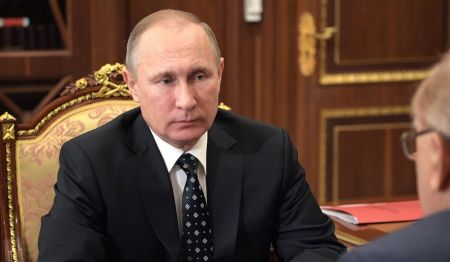 Russian President Vladimir Putin meets with Moscow State University rector Viktor Sadovnichy in the Kremlin in Moscow, Russia, Tuesday, Jan. 10, 2017. (Alexei Druzhinin/Sputnik, Kremlin Pool Photo via AP)
A main refrain from Democrats these days (and the scraggly band of Never Trumpers, apparently now led by Sen. John McCain) remains how the Russians “hacked the election.” Observers understand this is meant to delegitimize the election of Donald Trump, but what it also exposes is the rank hypocrisy of crusty and desperate political operatives and federal bureaucrats.
Russian President Vladimir Putin meets with Moscow State University rector Viktor Sadovnichy in the Kremlin in Moscow, Russia, Tuesday, Jan. 10, 2017. (Alexei Druzhinin/Sputnik, Kremlin Pool Photo via AP)
A main refrain from Democrats these days (and the scraggly band of Never Trumpers, apparently now led by Sen. John McCain) remains how the Russians “hacked the election.” Observers understand this is meant to delegitimize the election of Donald Trump, but what it also exposes is the rank hypocrisy of crusty and desperate political operatives and federal bureaucrats.
After all, under President Obama the United States has not only been interfering in other countries’ elections, the State Department has used taxpayer dollars to do so, as Mr. Obama has gone to one nation to personally harass and threaten voters in a country not his own.
Having the pleasure of being on CBS News’ “Face the Nation” last Sunday, the first question I was asked by host John Dickerson was about the Russians “hacked our election” narrative. My response was a reminder: The Russians didn’t hack into the election, they appear to have hacked into the Democratic National Committee.
Pretty much what the Democrats are doing to Donald Trump since he won the election.
While all of us are appalled at the idea that any foreign nation would interfere in our election, one of the great questions among both Republicans and Democrats has been, why didn’t Mr. Obama act at the time on signs that Russia was active in trying to influence voters?
Two electoral news items broke in July 2016: On July 12, a Washington Post headline read, “NGO connected to Obama’s 2008 campaign used U.S. tax dollars trying to oust Netanyahu.” Their story detailed the findings of a Senate subcommittee investigation that confirmed “allegations that an NGO with connections to President Obama’s 2008 campaign used U.S. taxpayer dollars attempting to oust Israeli Prime Minister Benjamin Netanyahu in 2015.”
The story was lost in the middle of presidential primary season, but then a mere 10 days later on July 22, WikiLeaks published a trove of emails from the hacked Democratic National Committee — emails which exposed, among other things, the DNC favoring Mrs. Clinton over her opponent Sen. Bernie Sanders, as well as the sycophantic relationship the Democrats enjoyed with mainstream media.
Apparent Russian involvement in the hacking of the DNC and attempt to influence voters has driven calls for the U.S. to retaliate and, in fact, Mr. Obama has issued sanctions against various Russian officials as a result.
Yet, in its July article, The Washington Post reported Mr. Obama’s administration had used $350,000 U.S. taxpayer dollars to interfere beyond basic media propaganda in Israel’s national election.
“Among the [Senate] report’s most damning findings, evidence was found that the “durable campaign resources” built during the grant with taxpayer dollars included “a larger voter contact database, a professionally trained network of grass-roots activists across the country, and an enhanced social media presence on Facebook and Twitter. [Grant recipient] OneVoice was even permitted to use State Department funds to hire an American political consulting firm called 270 Strategies — run by Obama 2008 campaign veterans — to train its activists in how to execute a ‘grass-roots mobilization’ campaign,” The Post explained.
Moreover, Free Beacon reported at the time equally disturbing behavior: “The [Senate] investigation determined that OneVoice redirected State Department funds to anti-Netanyahu efforts and that U.S. officials subsequently erased emails containing information about the administration’s relationship with the nonprofit group.”
And then there’s Brexit, also in summer 2016. Mr. Obama personally traveled to London in an effort to influence the vote to “stay or leave” the European Union. At a public appearance, the president of the United States threatened British voters, “The U.K. is going to be in the back of the queue,” for trade deals with the U.S. if they dared to vote “leave,” The Hill reported.
Beyond the fact that the Obama administration itself was engaging in foreign election interference, there were other reasons why our government did nothing to address the meddling.
In December, CNN reported its investigation found a variety of reasons why the Obama administration allowed the Russian “hacking” to go unanswered, including fear of wider Russian cyber-retaliation to “vulnerable” U.S. infrastructure systems and concern about impacting negotiations with Russia over Syria.
Ultimately, CNN reported, “Administration officials were sure Trump would lose in November and they were worried about giving him any reason to question the election results.”
In other words, the Obama administration’s situational ethics amounts to a transactional relationship with the United States itself: Our national security would only be defended if it was politically convenient.
So as the legacy media, Democratic Party operatives and establishment bureaucrats continue to decry Russian meddling during an election (as we all do) one might argue that the Russians were inspired by Mr. Obama himself, providing another highlight of our feckless president’s propensity to screw things up and make things worse for us.
U.S. Intelligence Report Contradicts Donna Brazile In Email Scandal, Jonathan Turley’s Blog, Jonathan Turley, January 7, 2017
(Those damn Ruskies — or whoever — put the truth before the American public about the “dishonest, disloyal, and often despicable” conduct of the Dems. What jerks! It’s no wonder that Obama is so angry with them. — DM)
The report states that the email material did not contain “any evident forgeries.” In other words, they were real emails not forged.
The emails showed how the Washington establishment — including the press corp — misled the public and colluded behind the scenes. It is a hard sell to tell the public that they should be disgusted by Russia showing them how their leaders are dishonest, disloyal, and often despicable in their conduct.
************************
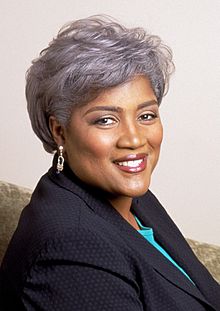
We discussed earlier how Donna Brazile, the interim chair of the Democratic National Committee, denied the legitimacy of emails that showed her leaking a question to Hillary Clinton that would be asked verbatim at the CNN downhill event. The media has largely declined to investigate the claim, including confirming the receipt of the earlier email from the Clinton staffer. Now additional emails allegedly show Brazile secretly feeding information to the Clinton campaign. Again, there has been relatively little media attention to the story and CNN issued a remarkably weak response that it was “uncomfortable” with the new disclosures on Brazile’s actions while a CNN commentator. While CNN Worldwide President Jeff Zucker called Brazile’s actions “disgusting” and others have denounced her actions, the DNC has stuck with Brazile and, despite the ease of questioning the other recipients to confirm or disprove Brazile’s claims. Now, the declassified intelligence report appear to directly dispute what Brazile has said but it is unclear if anyone in the media is willing to pursue the story against one of the most powerful figures in Washington Democratic circles.
The report states that the email material did not contain “any evident forgeries.” In other words, they were real emails not forged. Yet, Brazile repeatedly insisted that the emails were doctored or forged. She dismissed the email and told Megyn Kelly that “I have seen so many doctored emails. I have seen things that come from me at 2 in the morning that I don’t even send. I will not sit here and be persecuted, because your information is totally false.” At the time, I noted that no one seemed even remotely interested in questioning the recipient: Clinton Campaign Adviser Jennifer Palmieri. Media could have asked to see the original emails since both Brazile and Palmieri had them. Instead, it was complete silence.
Now the question is whether the Washington media corp will confront Brazile and demand to see these emails to determine whether she knowingly lied to the public and the press.
The report also highlights the difficulty that many in Washington are facing in trying to rally the public against Russian hacking. Many citizens may not be as mortified that Russia revealed how their leaders were lying to them. The emails showed how the Washington establishment — including the press corp — misled the public and colluded behind the scenes. It is a hard sell to tell the public that they should be disgusted by Russia showing them how their leaders are dishonest, disloyal, and often despicable in their conduct.
Biden declares ‘it is over’ as he declares Trump the winner, Washington Examiner,
Vice President Joe Biden on Friday shut down a Democratic challenge to the congressional certification.
“It is over,” he said when the third challenge was lodged by a House Democrat, to a rousing cheer from Republicans.
Biden later gaveled down similar protests from Reps. Barbara Lee, D-Calif., Sheila Jackson Lee, D-Texas, and Raul Grijalva, D-Ariz. Jackson Lee stood four times to protest, but each time was shut down by Biden.
Parliamentary rules prohibit “debate in a joint session,” Biden said at one point. “The objection cannot be entertained” without a senator’s signature, he added.
Democrats were expected to protest Donald Trump‘s election, but were not expected to be able to slow down the proceedings significantly because no senators joined House Democrats. Their protests were on grounds varying from complaints that members of the Electoral College in various states were illegitimate, to voting rights violations on Election Day to Russia’s interference in the election.
House members from Florida, Georgia and several other states rose to object but without the sign off from one of their home state senators, Biden rules the protests out of order.
Toward the end of the process, Rep. Maxine Waters, D-Calif., stood and asked if any senator would stand with House members, but none did.
But at the end, Biden announced the expected result: Trump got 304 electoral votes, and Hillary Clinton got 227. Just as Biden finished, three protesters interrupted the process and were escorted out of the gallery.
The final tally gave seven electoral votes two other candidates. Former Secretary of State Colin Powell got 3 votes, and Ohio Gov. John Kasich, former Rep. Ron Paul, Sen. Bernie Sanders, and Native American activist Faith Spotted Eagle each got one vote.




 anneinpt
 artaxes
 danmillerinpanama
 davidking1530
 Peter Hofman
 Joseph Wouk
 Peter
Peter Louisiana Steve
 WarSclerotic
Recent Comments