Author Archive

Putin to Meet Iran’s Rouhani, Turkey’s Erdogan in Tehran for Syria War Talk

July 15, 2018

By Adelle Nazarian July 14, 2018 Breitbart

Source Link: Putin to Meet Iran’s Rouhani, Turkey’s Erdogan in Tehran for Syria War Talk

{Now Putin wants to step in and save Iran’s oil industry from sanctions by investing billions. Russia’s deal with Germany must be quite lucrative. – LS}

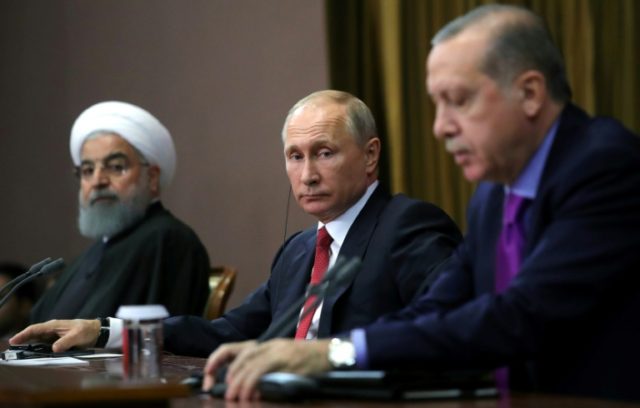
The Iranian government claimed Friday that Russian President Vladimir Putin will “soon” head to Tehran to meet Iranian President Hassan Rouhani and Turkish President Recep Tayyip Erdogan to discuss the status of Syria’s civil war.

Iran’s state-run Mehr News agency reported on Friday that Ali-Akbar Velayati, Senior Aide to Iran’s Supreme Leader Ayatollah Ali Khamenei, said, “Putin said that he will go to Tehran soon to take part in [Turkey-Iran-Russia] meeting on Syria.”

Velayati made the announcement on Thursday after meeting with Putin in Moscow.

Khamenei’s senior aide called the dialogue between Tehran and Moscow “constructive, clear, and friendly.”

According to Turkey’s state-run Andalou Agency, Velayati’s meeting with Putin “has become the subject of debate in Iran” among Iranians. The publication noted, “Although Velayati has no official role in Iran’s Foreign Ministry, he is widely regarded as Khamenei’s second most trusted advisor on Syria after Qasem Soleimani, the leader of Iran’s Revolutionary Guards Quds Force.”

In addition to talk about Syria on Thursday, Velayati said Putin announced that Moscow plans to invest up to $50 billion in the Islamic Republic’s oil and gas sector, and noted that Russian firms could replace Western oil companies that have left or are leaving Iran to comply with America’s demands that nations stop importing Iranian oil by November 4 or face sanctions.

According to Russian state news outlet RT {Russia’s official propaganda network – LS}, Velayati also delivered messages from Khamenei and from President Hassan Rouhani to Putin.

In November 2015, Putin visited Iran for the first time in eight years to discuss the Syrian conflict.

In April, Iran, Russia, and Turkey held trilateral talks in Ankara, where they strategized about Syria’s future after the United States announced it would slowly phase out its presence there. Despite his reluctance to do so, President Donald Trump agreed to keep roughly 2,000 troops in Syria until the Islamic State (ISIS, ISIL, Daesh) terrorist group is completely defeated.

The Islamic State claimed responsibility for a suicide bombing in the southern region of Syria on Tuesday that killed and wounded at least 50 of what the terrorist group described as “Crusader Russian Forces” and “the Apostate Nusayri Army.” Nusayri is reportedly a derogatory term used to refer to Syrian President Bashar al Assad’s soldiers.

The jihadist terrorist group still poses a great risk to parts of Syria’s population.

Also on Tuesday, the Maghawir al-Thowra reportedly detained 11 Islamic State fighters inside the deconfliction zone in southern Syria.

“This is evidence of our partner forces’ effectiveness in the fight,” Army Maj. Gen. James Jarrard, commander of Special Operations Joint Task Force Operation Inherent Resolve,”said, according to the Department of Defense. “As [ISIS’] movement from southwest Syria continues, our partners will interdict and disrupt these forces to ensure the defeat of [ISIS] in the region.”

This week, the Andalou Agency also suggested that Putin’s recent meetings with Trump have drawn suspicion from “much of the Iranian public … especially in terms of Syria.” The publication wrote, “Putin’s recent meetings with Israeli Prime Minister Binyamin Netanyahu and U.S. President Donald Trump have only exacerbated these suspicions.”


Palestinians fire 17 rockets into Israel as IDF bombs tunnel, Hamas base in Gaza

July 14, 2018

Iron Dome intercepts 5 projectiles, one rocket falls in a kibbutz; no injuries reported in Israel or in Gaza; flare up comes after IDF officer wounded by grenade in border riot.


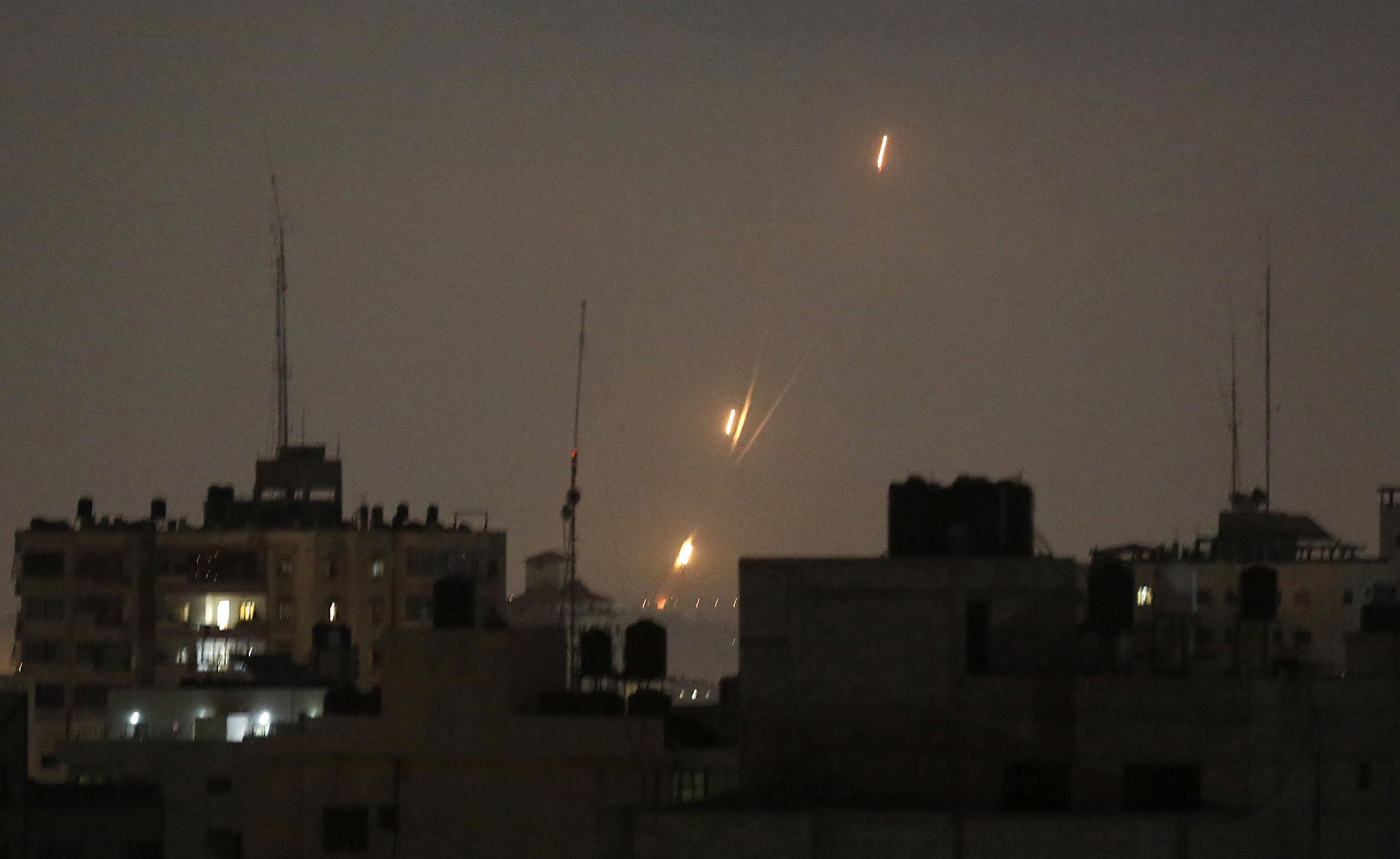
Illustrative: Flames from rockets fired by Palestinians are seen over Gaza Strip heading toward Israel, in the early morning of May 30, 2018. (AP Photo/Hatem Moussa)

By TOI Staff July 13, 2018 Times of Israel

Source Link: Palestinians fire 17 rockets into Israel as IDF bombs tunnel, Hamas base in Gaza

{Meanwhile, back at the ranch.  – LS}

Israeli aircraft hit several sites in the Gaza Strip early Saturday including a terror tunnel and several Hamas bases after an IDF officer was wounded by a grenade during a riot on the border, the army said. Following the air raids, Palestinian terror groups launched a barrage of at least 17 rockets or mortars into Israel.

The army said five of the launches were intercepted by the Iron Dome system. There were no reports of injuries. However, one rocket landed inside a kibbutz in the Shar HaNegev Regional Council area.

The IDF said aircraft had attacked “an offensive terror tunnel in the southern Gaza Strip, in addition to several terror sites in military compounds throughout the Gaza Strip, among them complexes used to prepare arson terror attacks and a Hamas terror organization training facility.”

No injuries were reported in Gaza.

Following the airstrikes rocket warning sirens wailed repeatedly in Israeli communities around the Gaza Strip, including the Sdot HaNegev Regional Council area and the town of Sderot. Residents reported sounds of explosions, Israel Radio reported.

About 30 minutes after the first wave, sirens sounded again in the Hof Ashkelon Regional Council area and in the Eshkol region. Residents were warned to spend the night in bomb shelters.

The army said it held Hamas responsible for all violence emanating from Gaza, which it has ruled since 2007.

“The Hamas terror organization is responsible for the events transpiring in the Gaza Strip and emanating from it and will bear the consequences for its actions against Israeli civilians and Israeli sovereignty,” the army said, adding that “the IDF views Hamas’ terror activity with great severity and is prepared for a wide variety of scenarios.”

The violence came after an IDF officer was moderately wounded Friday afternoon when a grenade was hurled at him by assailants during clashes at the Gaza border fence, the army reported Friday night.

The military said soldiers fired back at the attackers and identified hitting them. The officer was rushed to Beersheba’s Soroka Medical Center and has family has been notified.

It was the most serious attack on Israeli forces in over three months of border protests, during which time soldiers have on several occasions been targeted with gunfire and bombs.

Israel has long accused Hamas of using the weekly border demonstrations as cover to carry out attacks against Israel.

Earlier the Hamas-run health ministry said a 15-year-old Palestinian was killed during the clashes with the Israeli army along the Gaza border.


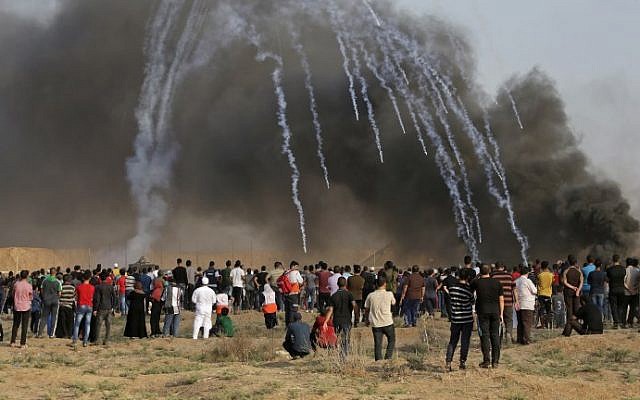
A picture taken on July 13, 2018 shows tear gas canisters fired by Israeli forces landing amidst protesters during a demonstration along the border with Israel east of Gaza City. (AFP/Mahmud Hams)

It was not clear whether that incident was tied to the attack that wounded the officer.

The Israeli military said thousands took part in the demonstrations, and that soldiers were attacked with grenades, bombs, Molotov cocktails and rocks. Troops responded with less-lethal means and fired live rounds in certain cases, including at one person who tried to cut through the security fence.

Gaza officials said 220 others were hurt in the riots. Most were treated at the scene, while several dozen were taken to hospital. Friday’s violence was held under the banner of “Identifying with Khan al-Ahmar,” a West Bank Bedouin village whose planned demolition by Israel is being debated at the High Court.

Also Friday, two soldiers were lightly injured in a car crash near the Gaza border in the afternoon when a utility trailer connected to their vehicle overturned. The soldiers were taking part in efforts to put out a large fire caused by an incendiary kite at Kibbutz Or Haner.

Firefighters said they managed to get the blaze under control, with the help of several teams and four firefighting planes.


Israeli soldiers walk amidst smoke from a fire in a wheat field near the Kibbutz of Nahal Oz, along the border with the Gaza Strip, which was caused by incendiaries tied to kites flown by Palestinian protesters from across the border., May 14, 2018. (Jack Guez/AFP)

Officials said 15 separate fires had erupted in the Gaza periphery since the morning due to incendiary kites and balloons. All were brought under control.

Since March 30, weekly clashes have taken place on the Gaza border, with Israel accusing Hamas of using the demonstrations as cover to carry out attacks and attempt to breach the security fence. The “March of Return” protests have also seen Palestinians fly airborne incendiary devices toward Israeli territory, sparking hundreds of fires in southern Israel and causing millions of shekels in estimated damages.

The Israeli army has reportedly notified Hamas in recent days that if the incendiary kite and balloon attacks from the Gaza Strip don’t cease, Israel will respond with major military action.

The threat comes amid a period of increased tension between Israel and the Gaza-ruling terror group. On Monday, Israel announced it was shutting down the Kerem Shalom border crossing — the Strip’s main crossing for commercial goods — in response to the endless stream of incendiary and explosive kites and balloons that have been flown into southern Israel, sparking fires that have burned thousands of acres of land and caused millions of shekels in damages. Humanitarian and essential supplies continue to enter Gaza.

The IDF has sought to avoid an escalation of hostilities on the southern front despite the attacks, but according to the Haaretz daily, the political pressure to act has been building as the economic and psychological harm caused by the fires takes its toll.


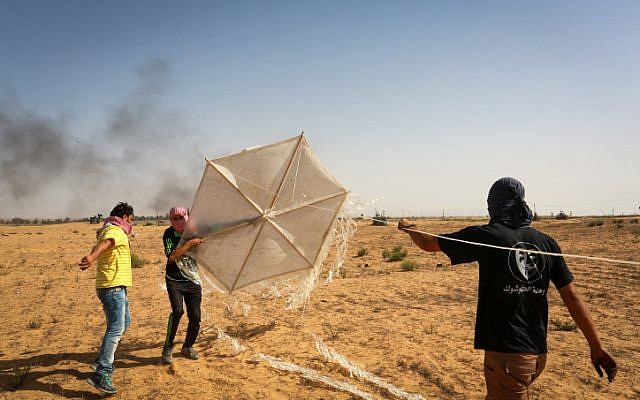
Palestinians prepare a kite with flammable materials that they will fly into southern Israel from Rafah, in the southern Gaza Strip, on June 22, 2018. (Abed Rahim Khatib/Flash90)

Israeli officials have conveyed this to Hamas through an intermediary, and said a significant Israeli response was inevitable if the current situation continued, the paper reported.

The army is now examining options for a significant and painful military response against Hamas that would be pinpoint enough not to spark a full-fledged war, the report said.

Friday’s report came a day after an Israeli drone fired two missiles toward a group of Palestinians flying incendiary balloons into southern Israel from the northern Gaza Strip, according to Palestinian media.

This was the second such airstrike in less than 24 hours.

The IDF confirmed that one of its aircraft fired at a cell that had launched balloons toward Israel from northern Gaza. No injuries were reported in the airstrike, which the official Palestinian Wafa news outlet said occurred near the northern Gaza town of Beit Hanoun.

Multiple Palestinian news outlets, including Wafa, reported that Israel conducted two strikes on Thursday, one near Beit Hanoun and a second east of the city of Jabaliya in the northern Gaza Strip.

An IDF spokesperson denied the Palestinian reports, saying he was “only familiar with one airstrike.”

The southern Israeli Eshkol regional council reported that a number of incendiary and booby-trapped balloons had been flown into the area throughout Thursday morning.


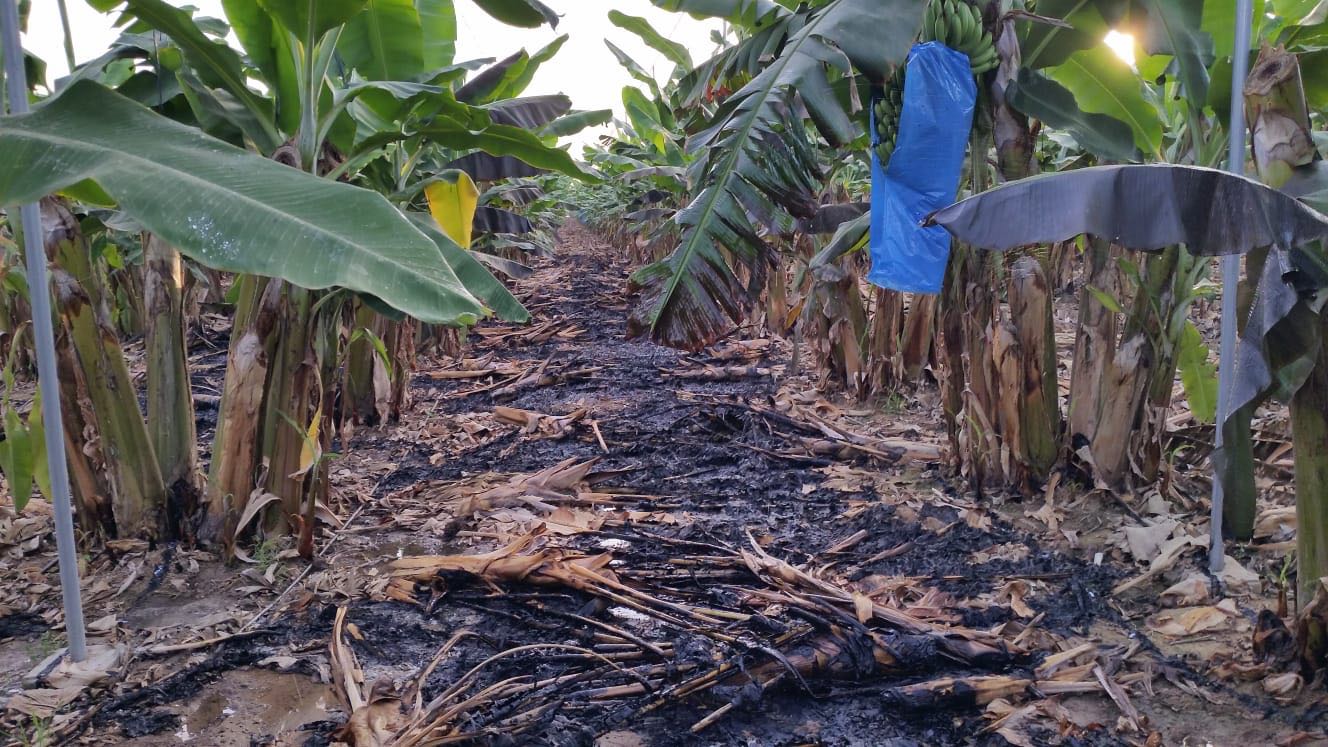
A banana field that was damaged by a fire sparked by an incendiary balloon from the Gaza Strip, in the southern Israel Eshkol region on July 12, 2018. (Eshkol Security)

On Wednesday, incendiary kites and balloons sparked 19 fires of varying sizes in Israel, according to local government officials. Fifteen of them occurred in the Eshkol region, which abuts the southern Gaza Strip. The other four occurred in the Sha’ar Hanegev region, which lies to the northeast of the coastal enclave.

In response, the Israeli military conducted an airstrike against a group of Palestinians it said was launching incendiary balloons toward Israel from the southern Gaza Strip, east of the city of Rafah. There, too, no injuries were reported.

After shuttering Kerem Shalom, the army said humanitarian aid, notably food and medicine, would still be allowed into Gaza, but would require special permission from the military liaison, Maj. Gen. Kamil Abu Rokon, to the Palestinians.

The military said the closure would continue so long as Palestinians persist in launching incendiary kites and balloons into Israel.


A Strategic Reset for NATO

July 13, 2018

Donald Trump’s criticism that the alliance isn’t fit for form is valid. NATO needs an overhaul.


Image: A U.S. Air Force pilot looks at a KC-135 aerial refueling aircraft as he refuels his F-16 fighter during the U.S.-led Saber Strike exercise in the air over Estonia June 6, 2018. REUTERS/Ints Kalnins

By Zalmay Khalilzad July 10, 2018 National Interest

Source Link: A Strategic Reset for NATO

{Excellent article and outstanding photo. I suggest you visit the source web page and view this pic in higher resolution. Truly inspiring.  I’ll dub it ‘Photo of the Week’  – LS}

At the NATO summit this week, President Donald Trump will undoubtedly criticize allies for not spending enough on defense and for pursuing their own economic wellbeing, in part at the expense of the United States. The president has been lambasted for criticizing U.S. allies and indeed, our alliances are important and represent some of the greatest achievements of U.S. foreign policy. However, Trump’s criticisms are justified. NATO must reform; it is not sustainable in its present form.

The alliance is ill-structured, ill-equipped and ill-financed to deal with the European region’s two major security problems—an aggressive Russia and the spillover of instability and terrorism from the Middle East and North Africa—leaving aside emerging global security challenges. Worse, at times some members can even be said to have enabled the threat. One example being the massive German purchase of Russian gas, which provides Putin with ongoing financing. To deal effectively with these challenges on an equitable and sustained basis among allies, the terms of the partnership must be renegotiated and its common ground redefined. This is in Europe’s best interest too.

Despite the best efforts of the Clinton, Bush (43) and Obama administrations, Russia has embarked on a more aggressive path, going to war against Georgia and Ukraine, conducting cyber attacks on Estonia and otherwise threatening the Baltic states. For the first time since the end of the Cold War, NATO members are directly threatened by Russian aims. Efforts at finding common ground with Russia based on mutual interest in a changing global environment should continue, but so must preparations to deal with threats from Russia.

Also, Europe faces a threat from the south, as the crisis in the Middle East and Europe’s permissive asylum laws and expansive welfare systems have triggered a flow of hundreds of thousands of refugees. The series of terrorist attacks in Europe inspired or coordinated by the Islamic State is one consequence. This terrorist threat—which combines external and internal security problems—is one NATO is ill designed to address.

Many of NATO’s members have effectively disarmed since the end of the Cold War, with only eight of NATO’s twenty-eight members even spending the required 2 percent of GDP on defense. Meanwhile, the United States faces major fiscal constraints, particularly rising entitlement costs and interest payments, and growing demands to meet its other global responsibilities, particularly in the Western Pacific. Additionally, many European members have favorable balances of trade vis-à-vis the United States, giving credence to the claim that we subsidize them on defense and they take advantage of us on trade.

Gentle persuasion by past presidents failed to induce Europeans to spend more on defense. By contrast, Trump’s demands for greater burden sharing are starting to have an effect. Yet much more still needs to happen. Moreover, we need to focus not just on inputs—how much money is spent—but also on outputs. A reformed NATO must hold members accountable in terms of actual military capabilities they can field. Those who care about NATO should criticize free-riding alliance members, not the efforts of Trump to get the alliance to up its game. At the same time, the Trump administration needs to articulate alliance priorities and the steps needed to adequately address them.

A Strategic Reset for NATO

In a new arrangement, NATO members would first agree on specific plans and capabilities needed to meet the threats from the East and the South as well as an operational division of labor. This doesn’t mean abandoning the requirement to spend 2 percent of GDP on defense, but instead would require every NATO member to commit to spending the necessary resources to meet identified defense responsibilities, which in some cases could require expenditure of more than 2 percent.

Specifically, the alliance should collectively take three steps to field an agreed set of defense outputs:

– Develop integrated defense plans within the NATO military committee for dealing with the Russian threat in northeast Europe, and instability and terrorist threats emanating from the Middle East and North Africa, thereby creating a strategy and a division of labor. This will entail a combined planning effort of the major NATO powers and the members living nearest or most directly affected by these threats.

– Agree to specific outputs—forces, weapons systems, operational capabilities, logistics support, and command and control—that each NATO member must develop and maintain at high readiness. This should take into account the capabilities that are needed now but also look to exploit emerging technologies to solve military problems more effectively as these technologies mature.

– Engage in realistic large-scale annual exercises—analogous the Exercise REFORGER of the Cold War—that will serve as a deterrent for would be aggressors, demonstrate resolve and compliance with NATO commitments and identify shortfalls for remediation.

In addition, the United States should candidly inform the European NATO members that the larger share of these agreed upon capabilities must come from them. We must explain that geopolitical realities require the United States to augment our own defense commitments in other priority regions, especially the Western Pacific. They must also understand that the American public expects wealthy countries to defend themselves principally on their own, with the United States playing a supporting role on an as-needed basis.

We must deliver the hard message that the future of the U.S. commitment under Article 5 is contingent on European performance. Those capabilities provided by the United States should be specifically tailored to reinforce NATO war plans and the security of the front-line states. European states would carry the burden on the southern threat, which affects their states domestically.

This would form the basis of a new global division of labor where America’s European allies assume the primary role for the security of Europe; the United States, Japan, South Korea and Australia would assume the primary role for security in the Western Pacific; and collectively, America and its global and regional allies would share roles in providing for security in the Middle East. Thus, working together, America and its allies would be meeting critical security demands in three critical regions.

Elements of the New Construct

To address the Russian threat in northeast Europe, the United States should lead the planning effort in NATO to develop the requirements for forces capable of deterring and, if necessary, defeating Russian irregular and conventional aggression, and to deter nuclear use. While the specifications for these forces requires comprehensive military analysis, we can conclude that a small tripwire force is inadequate to the task.

Among the capabilities that European NATO members would need to develop would include the following:

– An integrated air defense and surface-to-surface strike capability that would create an anti-access/area denial (A2/AD) belt covering the territory of NATO members and extending into adjacent areas of Russia.

– A counter-A2/AD capability that would defeat Russia battle networks and weapons systems, and Moscow’s ability to threaten NATO forward-deployed forces and reinforcements.

– A special operations forces capability sufficient to counter Russia’s sub-conventional operations involving the so-called “little green men.”

– A ground maneuver force that would combine the kind of light infantry that Hezbollah used against Israel’s offensive forces with heavy armor and artillery units that would consolidate territorial control.

As part of the new NATO security construct, the United States should offer to take the following steps:

– Maintain a small, highly capable ground maneuver force in Europe that would partner with a larger European force.

– Maintain a POMCUS capability in Europe, proximate to the locales where it would likely be needed, that would enable a surge of U.S. capability on a rapid basis if needed. Other major NATO powers, such as France, Germany and the UK should also provide POMCUS-style capability.

– Sell to European allies and partners, or license the right to produce, the high-end weapons systems needed to create the required European A2/AD, counter A2/AD, and maneuver force capabilities. Interoperability is vital and should be programmed into the strategy and plans.

– Agree to back up European arsenals of precision-guided munitions with U.S. stockpiles and production capabilities.

– Provide European NATO members with access to U.S. high-fidelity training capabilities and technologies.

– Provide the C4ISR capabilities that would enable integrated NATO operations in the event of conflict.

– Undertake a new look at what would be needed at every step in the escalation ladder—including tactical and intermediate-range nuclear forces—to ensure that Russia would not gain an advantage though escalating to high levels of conflict. This would be a first step to address any deficiencies in our deterrent.

A similar process should be undertaken regarding the threat from MENA. The flood of migrants from MENA and the infiltration of terrorists into European countries should be treated as a first order security problem for NATO. While these challenges principally affect European security, the United States should work through NATO to help enable European members better to address these challenges. This should include the following steps:

– Assist European NATO members in creating stabilization forces capable of brokering political compacts in fragile states, training local security forces, and building key state institutions.

– Work with European NATO members to develop a political-military plan for the stabilization of Libya and play a supporting role to the main European effort, which will likely require deployment of stabilization forces and establishment of a beachhead to deal with the source of refugees embarking across the Mediterranean Sea.

– Develop a counter-terrorism intelligence fusion and operations center that is part of the NATO command structure, thus coordinating the police, internal security and military responses to terrorism.

– Develop an agreed strategy and political-military plan to defeat the remnants of the Islamic State which is a threat to the member states.

A Trump Doctrine for NATO

In essence, the new construct is analogous to the Nixon Doctrine, only this time for the wealthy countries of Europe. Nixon pledged to come to the defense of allies in the developing would should they be threatened or attacked by major power. However, he insisted under the Nixon Doctrine that these states principally carry the burden for internal defense and lesser contingencies, though assisted with U.S. training and economic and military aid. In Europe today, European NATO members are fully capable of providing for their own defense.

To implement this doctrine, the United States should play an active supporting role and develop a three- to five-year timeline and program to create the needed European capabilities. We need to shore up vulnerabilities now, but this has to be part of a plan to create European capabilities and to set limits on the U.S. role that enable us to prioritize the challenge in East Asia, deal with ongoing threats in the Middle East, and work within our fiscal constraints.

Zalmay Khalilzad was the Director of Policy Planning in the Department of Defense and U.S. Ambassador to Afghanistan, Iraq and the United Nations.
 

Iran will leave Syria, Iraq only if Baghdad, Damascus want it, aide to Khamenei says

July 13, 2018

Reuters Staff July 13, 2018 Writing by Parisa Hafezi, editing by Larry King

Source Link: Iran will leave Syria, Iraq only if Baghdad, Damascus want it, aide to Khamenei says

Bonus Link: After a week of Russian propaganda, I was questioning everything

{I think the USA and Israel might have something to say about that. Besides, anyone smell the Russian propaganda? – LS}

MOSCOW (Reuters) – A top aide to Iranian Supreme Leader Ayatollah Ali Khamenei said on Friday that Iran would immediately withdraw its “military advisers” from Syria and Iraq only if their governments wanted it to.

“Iran and Russia’s presence in Syria will continue to protect the country against terrorist groups and America’s aggression … We will immediately leave if Iraqi and Syrian governments want it, not because of Israel and America’s pressure,” said Ali Akbar Velayati in a conference in Moscow.

Iran and Russia back Syrian President Bashar al-Assad in the country’s civil war.

{Back Syria in civil war?  How about helping Assad murder more of his own people while displacing millions more.  Put that in your morality pipe and smoke it. – LS}

What Good is Nato, if Germany is Paying Russia Billions for Gas and Energy

July 12, 2018

By News on the Net —— Bio and Archives–July 12, 2018

Source Link: What Good is Nato, if Germany is Paying Russia Billions for Gas and Energy

Bonus Link: Where in the World Is the U.S. Military?

Bonus Link: What’s Trump’s Position on NATO?

{Maybe it’s time we rethink our participation in NATO.  And what about all the bases we own and operate in Europe? Quite a large investment and seemingly endless expense for the American taxpayer. – LS}

What good is NATO if Germany is paying Russia billions of dollars for gas and energy? Why are there only 5 out of 29 countries that have met their commitment? The U.S. is paying for Europe’s protection, then loses billions on Trade. Must pay 2% of GDP IMMEDIATELY, not by 2025.

{In other words, stop screwing with us.  – LS}


IRAN: Demonstrators shout “Death to the Dictator” and “America is not our enemy”

July 10, 2018

July 10, 2018 by Bare Naked Islam

Source Link: IRAN: Demonstrators shout ‘Death to the Dictator’ and ‘America is not our enemy’

{In anticipation of a fast getaway, Mullah accounts in Swiss banks must be filling up with Iranian cash as we speak. – LS}

Iranians take to the streets to protest the regime and say “No to Gaza.” “No to Lebanon.” “Palestine and Syria make us miserable.”

Unlike Obama who did NOTHING to support the Iranian protesters, Trump’s actions against Iran have given the people the courage to speak out against the tyrannical government and hopefully start a revolution that will oust the radical mullahs.


IRGC’s Salami vows fight from Lebanon against ‘poisoned dagger’ in ‘body of the Islamic ummah’

July 10, 2018

by World Tribune Staff, July 9, 2018

Source Link: IRGC’s Salami vows fight from Lebanon against ‘poisoned dagger’ in ‘body of the Islamic ummah’

{Seems Iran is still looking for a proxy to do the dirty work. – LS}

Hizbullah has over 100,000 missiles “ready for launch,” said the deputy commander of Iran’s Islamic Revolutionary Guard Corps (IRGC), who vowed Iran would fight Israel from Lebanese soil.

IRGC deputy chief Hossein Salami said the “problem” of the State of Israel’s existence could be solved primarily by using the “mighty power” of Hizbullah, Iran’s terror proxy in Lebanon, the Middle East Media Research Institute (MEMRI) reported.

“Seventy years have passed since the policy of England and America planted in the Islamic world an accursed and criminal tree [i.e. Israel],” Salami said at the recent Iran Quds Day event. “For 70 years, this poisoned dagger has been embedded in the body of the Islamic ummah, and all the problems of the Islamic world stem from the existence of the false, counterfeit, historically rootless, and identity-less regime named Israel.”

“In addition to the threat to Palestine’s existence, the Zionist regime constitutes a threat as well to the entire Islamic world. That is the philosophy of the establishment of this regime: … [Israel] brings the range of America’s missiles against the Islamic world 12,000 kilometers closer, and becomes a tool for imposing America’s policy against the Islamic world.

“The Imam [Ayatollah Ruhollah Khomeini] spread the rationale of eradicating Israel [from the world] as a new notion in the world’s political discourse… Since then, the Zionists have not succeeded in triumphing over the Muslims in any war.”

Salami said that “In some places, the breadth of this regime is barely 34 km, and in order to destroy it, it will take only one ‘Jerusalem operation’ to destroy it.”

The “Jerusalem Operation” was Iran’s name for its operation against Iraq during the Iran-Iraq war in the 1980s.

Salami also vowed that Iran “will not disarm,” even though the world wants to “weaken the foundations of our might.” {Nukes? – LS}

“Today, we have changed the balance of might, but we will not settle for that… In today’s global order, either you have might, and thus honor, or you must surrender,” he said. “We must squeeze the throats of the enemies from afar. We must give them no chance to come near us, or to focus on us. We are monitoring them from afar, and grabbing them by the throat in other places,” Salami said. {Yet more baloney from Salami. – LS}

“We are creating might in Lebanon because we want to fight our enemy from there with all our strength. The Iranian people pursues the enemy everywhere in the world, and does not allow this country to be in danger.”

Germany considers Iranian bid to withdraw 300 million euros cash: Bild

July 9, 2018

By One America News Network July 9, 2018

Source Link: Germany considers Iranian bid to withdraw 300 million euros cash: Bild

{Suddenly, the Mullahs are concerned about Iranian citizens traveling abroad. Must be credit card problems for their children enrolled in western universities. – LS}

BERLIN (Reuters) – German authorities are considering a request by Iran to withdraw 300 million euros from bank accounts held in Germany and transfer the cash to Iran, Bild newspaper reported Monday, citing unnamed government officials.

Tehran is seeking withdraw the funds from the Europaeisch-Iranische Handelsbank AG (eihbank) because it is worried that it could run out of cash when fresh U.S. sanctions against its financial sector take effect, Bild said.

Washington has announced new sanctions on Iran and ordered all countries to stop buying Iranian oil by November and foreign firms to stop doing business there or face U.S. blacklists.

One of the world’s biggest shipping lines, France’s CMA CGM, announced on Saturday it was pulling out of Iran for fear of becoming entangled in U.S. sanctions after U.S. President Donald Trump abandoned the 2015 nuclear agreement in May.

Iran told the German Financial Supervisory Authority (BaFin) it needed the cash from the accounts “to pass on to Iranian citizens who require cash while travelling abroad, given their inability to access recognised credit cards,” Bild said.

BaFin was now reviewing the request, which had been briefed to senior officials in the chancellery, foreign ministry and finance ministry, the newspaper reported.

The finance ministry had no immediate comment. The Bundesbank, BaFin and the foreign ministry declined to comment. A spokeswoman for eihbank declined to comment, citing bank secrecy laws.

U.S. and Israeli intelligence agencies fear the money could be used to fund armed groups in the Middle East, but German government officials said they had no indications of such plans, Bild reported.

Foreign ministers from the five remaining signatory countries to the nuclear deal — Britain, France, Germany, China and Russia — offered a package of economic measures to Iran on Friday but Tehran said they did not go far enough.

(Reporting by Andrea Shalal; Editing by Robin Pomeroy)


Top Iranian general: Forces in Syria ‘awaiting orders’ to destroy Israel

July 9, 2018

Hossein Salami says Tehran also ‘creating might in Lebanon to fight our enemy from there with all our strength’ and eradicate ‘evil Zionist regime’

By Times Of Israel staff July 9, 2018

Source Link: Top Iranian general: Forces in Syria ‘awaiting orders’ to destroy Israel

{Somehow, I think Israel has already considered that possibility. – LS}

In a recent speech, the deputy commander of Iran’s Revolutionary Guards (IRGC) boasted that the “Islamic army in Syria” in the Golan Heights was awaiting orders to eradicate the “evil regime” of Israel.

He also said the Tehran-backed Hezbollah terror group had 100,000 missiles aimed at Israel.

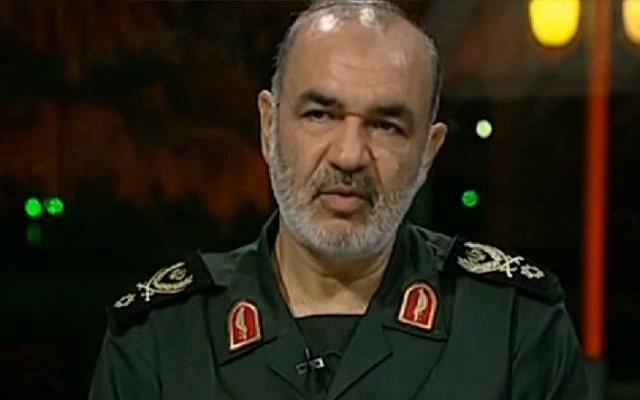
IRGC Deputy Commander Hossein Salami (YouTube screen capture)

In a recent speech, the deputy commander of Iran’s Revolutionary Guards (IRGC) boasted that the “Islamic army in Syria” in the Golan Heights was awaiting orders to eradicate the “evil regime” of Israel.

He also said the Tehran-backed Hezbollah terror group had 100,000 missiles aimed at Israel.

“We are creating might in Lebanon because we want to fight our enemy from there with all our strength,” he stated. “Hezbollah today has tremendous might on the ground that can on its own break the Zionist regime. The Zionist regime has no strategic-defensive depth.”

In the speech for the anti-Israel al-Quds Day in June, translated by the Middle East Media Research Institute (MEMRI), Hossein Salami said that the dangers Israel faces today are greater than at any time in history.

“Today an international Islamic army has been formed in Syria, and the voices of the Muslims are heard near the Golan,” he said. “Orders are awaited, so that… the eradication of the evil regime [Israel] will land and the life of this regime will be ended for good. The life of the Zionist regime was never in danger as it is now.”

Salami stressed that “the Zionist regime constitutes a threat… to the entire Islamic world. That is the philosophy of the establishment of this regime.”

He praised Ayatollah Ruhollah Khomeini, who led the 1979 Iranian revolution, for making the destruction of Israel a goal of the regime.

Khomeini “spread the rationale of eradicating Israel as a new notion in the world’s political discourse,” Salami said. “Since then, the Zionist regime is fearful, delusional, and worried.”

Israel has for years warned of Iran’s ongoing attempts to entrench itself in Syria, and has been waging a quiet campaign to prevent Tehran from establishing a new front on its border. That campaign came into the light and shifted into more open conflict in February, when an Iranian drone carrying explosives briefly entered Israeli airspace, before it was shot down. In response Israel launched a counterattack on an air base in Syria, hitting the mobile command center from which the drone had been piloted and killing at least seven members of the IRGC.

Tehran vowed revenge after the T-4 army base strike. On May 10, the IRGC’s al-Quds Force launched 32 rockets at Israel’s forward defensive line on the Golan Heights border. Four of them were shot down; the rest fell short of Israeli territory.

In response, over the next two hours, Israeli jets fired dozens of missiles at Iranian targets in Syria and destroyed a number of Syrian air defense systems. The operation was widely seen as a success in Israel.

But Salami boasted of Iran’s success in launching the rockets, claiming the barrage silenced Israel.

“When the Zionists bombed the T-4 base in Syria and killed some young men, they thought that they would get no reaction. They thought that America’s and England’s support could frighten the resistance front. They thought that no one would respond,” Salami said. “But the response came in the Golan, and dozens of missiles were fired, along with the message ‘If you respond, we will flatten the heart of Tel Aviv into dust.’ They were silent, and did nothing further.”

Iran has been accused by Israel, the Trump administration, Saudi Arabia and other Middle East countries of supporting terrorism and instability in the region.

Salami blamed Israel for all the Middle East’s troubles.

“All the problems of the Islamic world stem from the existence of the false, counterfeit, historically rootless, and identity-less regime named Israel,” he said.

On Sunday Syrian air defenses were activated near the T-4 air base, in response to an airstrike on the facility, which Syrian state media attributed to the Israeli military, although as a rule, the Israeli military does not comment on its operations abroad.

The Creeping War against Iran is Still on the Cards

July 8, 2018

08.07.2018 Author: Salman Rafi Sheikh

Source Link: The Creeping War against Iran is Still on the Cards

{Watching the Mullahs squirm at the hands of their own people will be the premier sight to behold. – LS}

On June 27 and June 28, in a series of tweets from his official account, the US secretary of state Mike Pompeo went out of the way to praise protests in Iran, calling it a backlash against the “corruption, injustice and incompetence of their leaders.” It was no surprise to see Israel’s Netanyahu also praising the Iranians, asking further as to “why is Iran so poor? Why is unemployment so rampant? The answer is in two words: the regime. Iran’s dictators plunder the country’s wealth… The Iranian people are the ones that suffer.”  Clearly, both the United States and Israel are, if not directly fuelling the protests, certainly involved in an active encouragement of the crisis, an indication of how desirable the goal of regime change in Iran remains. Their encouragement isn’t simply restricted to social media. In fact, the US withdrawal from the Iran deal despite the EU’s opposition and the IAEA’s confirmation of Iranian compliance is also a part of their policy of regime change. Withdrawal has rather expectedly been followed by resumption of sanctions, a step that has always been taken with one cardinal objective in mind: forcing the country into an economic crisis so that wide spread protests may take place, leading to an overthrow of the undesirable regime. Above mentioned tweets and video messages confirm this undoubtedly, also confirming how the Trump administration has ‘pivoted’ to an Israeli agenda, totally scrapping the Obama administration’s legacy of a hard negotiated settlement with Iran.

Clearly, a joint US-Israeli plan against Iran is working, indications of which had already started to come as early as December 2017 when, as a senior US official said, after two days of talks at the White House, US and Israeli officials had reached an understanding, signing a secret pact, to counter Iranian actions. Several working groups, in this behalf, had also been established with an explicit purpose of targeting Iran’s nuclear and missile programme, Iran’s actions in Syria and its support for Hezbollah.

While the reported signatory to this document is the ousted national security adviser, H.R. McMaster, the appointment of John Bolton, the confirmed paid speaker for an Iranian militant group, does also confirm, as we have previously pointed out, how regime change agenda is absolutely back on Iran.

John Bolton, as could be expected, is now already deeply involved in setting up task forces to unsettle Iran in a big way. The purpose of this force is—again unsurprisingly—to exploit protests in Iran to the advantage of both the US and Israel.

The task force, with its world-wide anti-Iran mission, has been established at a time when the remaining signatories of Iran-nuke deal are trying to persuade Iran to stay in the deal. According to Iran’s IRNA news agency, Iranian officials will be meeting EU officials in Vienna on Friday, July 6, to discuss the new “incentive package” the EU has prepared to preserve the deal.

Israel, however, has other plans. According to the reports, the purpose of the task-force is also to use Iran’s internal crisis to build international opposition against the regime. As such, Israel will be sending diplomatic missions to EU, the UNO and even the World Bank to build pressure on what the Israeli officials call the “ayatollahs” in Iran to globally isolate them, put them under sanctions, heat things up in Iran and thus force them out of power.

The plan is also a clear manifestation of what Saudia’s Muhammad Bin Salman, a partner of the US and Israel against Iran, had said a year ago about fighting the war between the Sunni and the Shia not anywhere else, certainly not in Saudi Arabia, but within Iran itself.

Planning for this is already underway. And, an important aspect of this is, apart from encouraging internal crisis by strangulating its economy, is also to stir up Baloch insurgency in Iran by building Arab support for the Baloch against Iran. A Saudi funded think-tank, Arabian Gulf Centre for Iranian Studies, said in one of its 2016 report that the Saudis could “persuade Pakistan to soften its opposition to any potential Saudi support for the Iranian Baluch”, arguing further that “Arab support for the Iranian Baluch is a matter of strategic necessity in confronting the Iranian hegemony in the region.”

By thus heating things up, it is clear that the US-Israel and Saudia are not avoiding a war with Iran; they’re actually preparing the ground for it as Iran has already warned to increase the enrichment level to 20 per cent if the agreement falls apart.

And, If push comes to shove, this would be a win for the hawks in both the US and Israel, who have long been advocating to scrap the deal and have completely ignored sane voices within the same administration. For instance, within the US even, a number of still serving officials from the military and defence establishment had warned against and opposed the US decision to withdraw from the deal.

Even the defence secretary James Mattis is on record to have said that he has read the agreement thrice and found it to be “pretty robust”; Chair of the Joint Chiefs of Staff Gen. Joseph Dunford says, “Iran is adhering to its JCPOA obligations” and that quiting the deal “would have an impact on others’ willingness to sign agreements”; the head of US Strategic Command, Gen. John Hyten says, not only is Iran in compliance with JCPOA”  but also “it’s our job to live up to the terms of that agreement”; and the head of US Central Command, Gen. Joseph Votel says the nuclear deal is “in our interest” because it “addresses one of the principle threats that we deal with from Iran.”

With the latent reasons for withdrawing from the deal thus now in the limelight and certainly not unknown to any observer of geo-politics, one can certainly expect that a US-Israeli-Saudi effort to topple the Iranian regime from within is in its practical phase, which means that the nexus is shifting its geo-political chessboard from Syria to Iran. How long before we would start hearing people from within Iran, gaining foreign support, and chanting such slogans as “Ayatollahs must go”!