(May God bless and protect the good people of Israel. – LS)
(May God bless and protect the good people of Israel. – LS)
Russian Missile Sales to Iran Cross White House ‘Red Line’
BY: Adam Kredo April 14, 2015 5:00 am Via The Washington Free Beacon
(Still more on those pesky ‘red lines’. – LS)
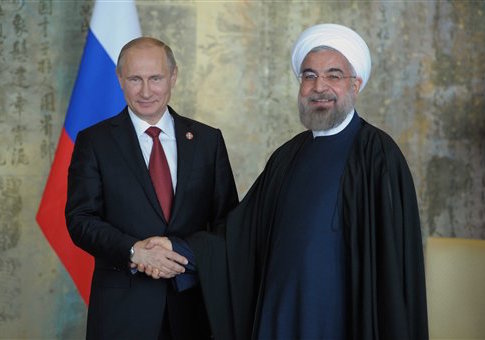
Russia’s announcement on Monday that it will proceed with the sale of advanced missile systems to Iran crosses a so-called “red line” established by the Obama administration in 2010, according to comments by senior administration officials.
Following years of dissent from the United States, Russia announced on Monday that it would proceed with the sale of the advanced S-300 air defense missile system to Iran, which has been vying to purchase the hardware for years.
The announcement sparked criticism from the Obama administration, which has been pressuring Iran since at least 2010 to withhold the sale.
Russia’s previous ban on selling Tehran the powerful defense system was hailed as a coup by the Obama administration and promoted by it as an example of President Obama’s ability to rein in Russian intransigence on the military front.
However, Monday’s announcement by Russia threatens to complicate an already fractured relationship with Moscow and throw into further jeopardy the ongoing negotiations with Tehran over its nuclear program.
Experts have warned that the reversal threatens to split the international coalition currently working to halt Iran’s nuclear program—a narrative that the White House is working to downplay
The Russian executive order effectively “lifts the ban on transit of the S-300 air defense missile systems via Russian Federation territory (including by air), export from the Russian Federation to the Islamic Republic of Iran, and transfer of the S-300 to the Islamic Republic of Iran outside the Russian Federation’s territory, using ships or aircraft flying the Russian Federation flag,” according to an announcement by Moscow.
Russia’s decision to arm Tehran with the S-300 system erodes a long-promoted narrative by the Obama administration about its success in preventing Russian proliferation.
One senior Obama administration official speaking in 2010 described the S-300 sale as a “red line” for the United States that “couldn’t be crossed,” according to Foreign Policy.
“They’ve made that very clear to us for the last two years that this is not a symmetrical transaction for them and they don’t share the same threat assessment as us vis-a-vis Iran,” the official was quoted as telling Foreign Policy in a 2010 article focused on “how the Obama team convinced Russia not to sell arms to Iran.”
The White House claimed that Moscow’s decision to ban arms sales to Tehran would usher in a new era of cooperation between the United States and Russia.
“The decision was a bold one that acknowledges how important it is to us and how important [Former Russian President] Medvedev takes this reset with President Obama,” the administration official said.
Obama administration officials also told Foreign Policy that it had “made clear to Medvedev and other Russian officials that the sale of the S-300 to Iran was a red line that couldn’t be crossed.”
Monday’s announcement by Russia flies in the face of this purported diplomatic success and left the Obama administration scrambling to respond. Officials in both the White House and State Department declined to discuss with the Washington Free Beacon its previous declaration about Russia’s deal with Iran violating a so-called red line.
“We’ve seen those reports, as they relate to the possible sale of the S-300 anti-ballistic missile system to Iran,” White House Press Secretary Josh Earnest told reporters on Monday.
The United States, he added, “has previously made known our objections to that sale” and did so again on Monday in private phone calls with the Kremlin.
The sale of the S-300 system to Iran could violate international economic sanctions still in place, Earnest said.
State Department spokeswoman Marie Harf said that while the sale of the S-300 to Iran would not violate United Nations Security Council sanctions on Tehran, it remains a concern to the United States.
“We don’t believe it’s constructive at this time for Russia to move forward with it,” Harf told reporters.
“We think given Iran’s destabilizing actions in the region, in places like Yemen or Syria or Lebanon, that this isn’t the time to be selling these kinds of system to them,” Harf explained. “So in general, that’s what our concerns are based on.”
Elliott Abrams, a former White House National Security Council (NSC) member, wrote that the breakdown in the Obama administration’s campaign to block the sale is yet another sign of Washington’s waning influence.
“American ‘red lines’ aren’t what they used to be, Medvedev is gone, and the ‘reset’ with Russia is an embarrassment,” Abrams wrote at the Council on Foreign Relations (CFR). “So is the way the Obama administration claimed credit for changing Russia’s policy toward Iran.”
Hillary Clinton’s Anti-Israel History
Via The Lid blogsite

(Ladies and Gentlemen, please allow me to introduce the next president of the United States and leader of the not-so-free world…Hillary Rodham Clinton! Let the inauguration begin! So sit back kiddies, grab a bag of popcorn and stay tuned for the upcoming clown show. – LS)
An article appearing in the Jewish Daily Forward announced the formation of “Jewish Americans Ready For Hillary!” A truth those progressive Jews for Hillary ignore, with the possible exception of the time from her first campaign New York’s Senate seat in 2000 to her resignation from the Senate to become Secretary of State in January 2009, except for the time she needed New York’s Jewish voting bloc, Hillary Clinton has never been pro-Israel.
On their website, “Jewish Americans Ready For Hillary!” claim, “Throughout her career, Hillary Clinton has fought for the issues that matter most to Jewish Americans.”
Of one issue that “matters most to Jewish Americans,” Hillary Clinton is most certainly not a supporter that is the health and security of the Jewish State of Israel.
Even before her marriage to Bill, Hillary Clinton was opposing Israel and promoting the forces of terrorism. In his book American Evita on page 49, Christopher Anderson writes.
At a time when elements of the American Left embraced the Palestinian cause and condemned Israel, Hillary was telling friends that she was “sympathetic” to the terrorist organization and admired its flamboyant leader, Yasser Arafat. When Arafat made his famous appearance before the UN General Assembly in November 1974 wearing his revolutionary uniform and his holster on his hip, Bill “was outraged like everybody else,” said a Yale Law School classmate. But not Hillary, who tried to convince Bill that Arafat was a “freedom fighter” trying to free his people from their Israeli “oppressors.”
On page 50 the author relates an experience that Hillary and and her future husband had during a trip to Arkansas in 1973.
It was during this trip to his home state that Bill took Hillary to meet a politically well-connected friend. When they drove up to the house, Bill and Hillary noticed that a menorah-the seven branched Hebrew candelabrum (not to be confused with the more common and subtler mezuzah)-has been affixed to the front door.
“My daddy was half Jewish,” explained Bill’s friend. “One day when he came to visit , my daddy placed the menorah on my door because he wanted me to be proud that we were part Jewish. And I wasn’t about to say no to my daddy.”
To his astonishment, as soon as Hillary saw the menorah, she refused to get out of the car. “Bill walked up to me and said that she was hot and tired, but later he explained the real reason.” According to the friend and another eyewitness, Bill said, “I’m sorry, but Hillary’s really tight with the people in the PLO in New York. They’re friends of hers, and she just doesn’t feel right about the menorah.”
Hillary’s attitude did not change when she became first lady. In May 1998 Ms Clinton became the first member of any presidential administration ever to call for a Palestinian State. She told a youth conference on Middle East peace in Switzerland, that she supports the eventual creation of an independent Palestinian state. Her spokesperson, Marsha Berry told reporters: “These remarks are her own personal view.”
In November 1999, while on a purported State visit to the Middle East, she publicly appeared with Yasser Arafat’s wife Suha. Mrs. Arafat made a slanderous fa allegation:
“Our [Palestinian] people have been submitted to the daily and intensive use of poisonous gas by the Israeli forces, which has led to an increase in cancer cases among women and children.” Suha also accused Israel of contaminating much of the water sources used by Palestinians with “chemical materials” and poisoning Palestinian women and children with toxic gases.”
Mrs. Clinton sat by silently listening to a real-time translation, and the terrorist’s wife hug and a kiss when she finished speaking.
Later, many hours after the event, and only after a media furor put her on the spot for what many view as a bit more than a mere political “boo boo Mrs. Clinton called on all sides to refrain from “inflammatory rhetoric and baseless accusations,” including Israel, whose leaders made no such accusations.
Glossing over this repugnant affair, Hillary Clinton has yet to specifically contradict and denounce the monstrous lies uttered by Yasser Arafat’s wife in her presence. Only years later did she make feeble attempt at an excuse, the translator screwed up.
Before her tenure in the State Departing, Bill and Hillary Clinton made mega dollars from their extensive involvement with Dubai. Besides being a leader in the movement to boycott Israel, Dubai is the “Hong Kong” of the Arab world. And a major commerce and shipping point for the “business-side” of terrorism. Bill and Hilary are major friends of Dubai, to the point where the Clinton Foundation have established Dubai Study departments in universities in the US and London. They worked hard at granting legitimacy to this Jew-hating, terrorist supporting nation.
While she was running for President in 2007, San Francisco Examiner columnist P.J. Corkery, wrote that Clinton made $10 million a year from Yucaipa a Dubai firm. Ron Berkle, the owner of Yucaipa companies was a major fund-raiser for Bill and Hillary.
The Clintons also had a connection to the worlds biggest exporter of terrorism, Saudi Arabia, the Saudi Royal Family donated $10,000,000 to the Clinton Library.
According to a 1993 New York Times article, Prince Turki bin Feisal was a college classmate of Bill’s at Georgetown University and (at the time of the article’s writing) was the head of the Saudi Arabian intelligence service. While he was still governor of Arkansas, it looks like Bill Clinton cashed in on that relationship, “work[ing] hard to secure a multimillion-dollar Saudi donation to a Middle Eastern studies program at the University of Arkansas.” Due to the intervention of the Gulf War, the first installment of $3.5 million didn’t arrive until 1992, with another $20 million arriving after Bill Clinton’s first inauguration.
During her Senate years Ms. Clinton became a vocal supporter of Israel because she needed the Jewish vote.
One of her first actions after leaving the Senate to become Secretary of State was to ignore a previous deal with Israel and call for the end of the construction of new homes in existing settlement neighborhoods. Five years later her call for the end of building is till is haunting Israeli/Palestinian peace talks.
As Secretary of State, Hillary Clinton first demanded the “settlement” freeze in 2009 and was quickly backed up by Obama. What she perceived as a minor concession (a “settlement” freeze including no new housing units in existing communities) was for Israel a grave sacrifice. For all intents and purposes Clinton was telling Israeli parents their married children could no longer live in their neighborhoods
This was a major error by the Clinton State Department and it was compounded by their inclusion of Jerusalem in the mix and the constant public berating of the Jewish State by Clinton and Obama.
Clinton’s demand for a building freeze in existing settlement communities broke a US/Israel agreement made during the Bush administration. Ms Clinton said there was never an agreement between Israel and the US about natural expansion of existing settlements. But Elliot Abrams who negotiated the agreement for the United States said Clinton’s contention is simply not true.
Immediately the Palestinians seized upon the Hillary-created settlement issue. Seeing an opportunity to avoid talking, they used the administration’s demands, to make a “settlement” freeze a precondition to further talks even though there were negotiations and construction going on simultaneously before Hilary Clinton became Secretary of State.
In August 2009 Prime Minister Netanyahu announced a ten-month “settlement” freeze. It was approved by the cabinet and implemented on November 25, 2009 and was to run till September 25, 2010. Despite pressure from the United States, the Palestinians refused to join any talks the first 9+ months of the freeze; they did not come to the negotiation table till September 2010, three weeks before the freeze ended.
As the end of the construction halt approached, the US began to negotiate with the Israel to extend the freeze. Based on their experience with Clinton denying the deal negotiated by Elliot Abrams during the Bush Administration, Israel demanded that any proposal be presented in writing, as any oral deal with Clinton and the Obama administration was worth the paper on which is was printed on.
The written offer never came; the Secretary of State wasn’t negotiating in good faith. Instead Ms Clinton was playing “Bait and Switch.” As Israel waited for a letter clarifying America’s guarantees in exchange for a proposed building ban for Jewish residents of Judea and Samaria, a diplomatic source finally came forward saying that no such letter is on its way. The United States Secretary of State Hillary Clinton misled Prime Minister Benjamin Netanyahu.The source, a senior diplomat with inside knowledge of Netanyahu’s recent meetings in Washington, said Clinton made commitments when talking to Netanyahu, but later slipped out of them by claiming that she had not been speaking on behalf of U.S. President Obama – who, she said in the end, did not give his approval.
In 2011 speaking at the at the Saban Center for Middle East Policy at the liberal Brookings Institute, Clinton expressed concern for Israel’s social climate in the wake of limitations the regarding female singing in the IDF and gender segregation on public transportation. Both were accommodations made to the Orthodox communities in Israel
She referred to the decision of some IDF soldiers to leave an event where female soldiers were singing; she said it reminded her of the situation in Iran. It did? Wow! In Iran the women would have been lashed or executed. In Israel they sang, but the people who felt it was against their religious beliefs walked out. Most senior officers in the IDF supported the women’s right to sing.
Clinton also poke of her shock that some Jerusalem buses had assigned separate seating areas for women. “It’s reminiscent of Rosa Parks,” she said, taking the typical progressive position that faith should not matter outside a place of worship. Clinton’s statement was part of the continued attempt by the Obama administration/Clinton State Department to de-legitimize the Israeli democracy and destroy one of the reasons for American support of Israel, the fact it is the only democracy in the Middle East.
Now Hillary Clinton is running for President. She will campaign on the basis that she is a friend of Israel, just as Barack Obama did in 2008. The truth is as Secretary of State; she was the architect of the policy of the most anti-Israel president since the rebirth of Israel in 1948. It was a policy which reflected views she has held her entire life, with the exception of the nine year period where she ran for and held the office of U.S. Senator from New York State.
Iran Sitting on Nuclear Weapons and ICBMs Makes Our World Safer According to the Administration
by Sara Noble April 10, 2015 Via the Independent Sentinel

(An ICBM breakout this year? I imagine the payload is not far behind. – LS)
The so-called nuclear agreement told Tehran they could: keep their underground Fordow fuel enrichment plant; they didn’t have to dismantle their Arak plutonium facility; they had the right to enrich uranium; and the centrifuges spinning are fine as well. Iran is now insisting that sanctions must be immediately canceled and the inspections are to be limited with no oversight of military dimensions.
The nuclear agreement is not an agreement at all.
One should always be suspicious of miraculous last-minute deals. It was more likely a tactic employed to keep the talks going without congressional interference.
More important than what is in the agreement, is what is not.
Since 2014, we have known that Iran is close to developing ICBMs, yet President Obama has sought to dismantle or disrupt U.S. ICBM systems and has not included ICBMs in the current nuclear talks with Iran. In fact, the deal is leaving in place enough nuclear capability for Iran to put nuclear warheads of some ICBMs even before the sunset clause is reached.
Why is Iran building them? You don’t build ICBMs in order to deliver insignificant explosives. Their only purpose is to carry nuclear warheads. Iran does not need an ICBM to hit Tel Aviv. Intercontinental missiles are for reaching other continents like North America.
The nuclear agreement is the end of nonproliferation. Iran is a rogue state that is illegally enriching with our blessing. The arms race has already begun in fragile countries with paper governments and transitory values.
President Obama’s alleged goal was nonproliferation to give us a safer world, but among the many mistakes he is making with the nuclear agreement is ignoring Iran’s missile development.
The 2014 Annual Report on Military Power of Iran stated that “Iran could have an ICBM capability by 2015,” said Rep. Mike Rogers (R., Ala.), chairman of the House Armed Services strategic forces subcommittee last July when the report became public.
“We have known this [Iran’s interest in developing ICBMs] since well before the Obama administration,” Rogers said. “This unchanging fact is one of the reasons I have been and continue to be concerned about the administration’s efforts to dismantle our missile defenses.”
Rogers said that suggestions that somehow the danger of Iran’s developing long-range missile capabilities has diminished, or that the Pentagon report has altered U.S. intelligence assessments “is untrue.”
Lt. Gen. Michael Flynn, former head of the Defense Intelligence Agency confirmed that Iran is close to having ICBM capability.
James Clapper, the director of national intelligence, told the Senate Select Committee on Intelligence, Jan. 29, 2014, that “Iran would choose a ballistic missile as its preferred method of delivering nuclear weapons.”
There is some dispute over the year, but whether or not Iranian ICBMs will be ready this year or five years from now, there is no question that Iran is developing a robust missile program.
The concern that they will have ICBMs by 2015 appears to be jumping the gun but it’s not far off.
Iran is developing ballistic missiles with a range of up to 6,000 kilometers, capable of holding parts of the American homeland at risk but it might not come for five years or more.
According to the Center for Nonproliferation Studies, such capability is still only aspirational because as scientist David Wright points out, building ICBMs is tricky. In fact, it is unlikely that Iran would be capable of fielding an ICBM until 2020 at the earliest and even then its missiles would be “too large and cumbersome to be placed on a mobile platform.”
Iran currently has the largest and most diverse ballistic missile arsenal in the Middle East. Israel has more capable ballistic missiles, but fewer in number and type.
Iran is currently reliant on foreign suppliers for key ingredients and components which have not been readily forthcoming from Russia and China up until now, but Iran will come into large sums of money when the sanctions are removed. They are quickly becoming a powerful and dominant force in the region. Iran has also just forged a partnership with Russia.
Iran’s space program, which includes the successful launch of a small, crude satellite into low earth orbit using the Safir carrier rocket, proves the country’s growing ambitions and technical prowess.
Iran has an expanding nuclear and missile program representing Iran’s ultimate goals of attacking what it calls “the little Satan” (Israel) and “the great Satan” (the United States).
In a video obtained by Israel in January of this year, a new and previously hidden missile and launch site in Iran was at first thought to be capable of sending a rocket into space or launching an ICBM.
While this idea has been debunked as a misreading of satellite imagery by outfits such as Janes 360, the same publication said the facility is not yet complete. They also advised that while Iran claims they do not need missiles with a longer range than what they currently have, there are indications that they continue to work on long-range rockets.
Jane’s has seen a surge of activity at the Bid Ganeh missile development facility and Iran has invested significant resources into building a new launch facility near Shahrud that “could test longer-range, solid-fuel missiles”.
Sen. Bob Menendez, D-N.J., recently made a stunning comment at a Senate Foreign Relations Committee hearing on Iran.
“The more I hear from the administration and its quotes, the more it sounds like talking points that come straight out of Tehran,” the Democratic lawmaker said.
He has been an outspoken critic of Obama’s approach with Iran and Cuba. He is now under indictment on corruption charges. While the investigation into his dealings has been ongoing for two years, the timing of the indictment is curious.
Republican Sen. Bob Corker, R-Tenn., told Jerusalem news agencies he can’t understand why the president promises to veto upcoming congressional legislation about Iran even before it’s been written.
“For Congress not to have the ability to weigh in on this, which has such geo-political importance and where Congress has played such an important role, is ridiculous and candidly irresponsible for Congress not to play a role,” Corker said.
Wouldn’t we all like to know the answer to that and as to why ICBMs are being ignored. It appears that Obama only intends to kick the can down the road to the next president while setting up a more dangerous chessboard on which to play. We should keep in mind that Iranians invented the game of chess and they lie.
The people behind the Obama platform, fully support a policy of appeasement and say things like this.
This is why our Constitution has safeguards to prevent one man from ruling alone. Hypothetically and using an extreme but not impossible example, one man alone could be a fool, a subversive, or a madman. Unfortunately, Congress has been rendered near-useless and there is a wide opening for fatal mistakes.
President Obama thinks ignoring Iran’s ICBM aspirations and their sitting on nuclear weapons makes for a safer world.
We have already appeased evil leaders, ignoring reality, sacrificing allies, and it hasn’t worked. It can’t work, it will never work.
‘Obama: In future, Iran could build nuclear bomb almost immediately’
Yoni Hersch, Eli Leon, Israel Hayom Staff and News Agencies

(At what point do they breakout? Is having a fully functional nuclear device minus the ‘fuse’ considered on the verge of a breakout? If so, then merely inserting the ‘fuse’ only takes a few minutes. Think about it. – LS)
U.S. President Barack Obama: In years 13, 14 and 15 of nuclear deal with Iran, the breakout times would be shrunk almost to zero • House Speaker John Boehner: It is clear that the deal with Iran is a direct threat to global peace and security.
U.S. President Barack Obama is persisting with his effort to rally support for the framework nuclear agreement reached between six world powers and Iran last week, but on Tuesday he admitted that Iran could have the capability to build a nuclear bomb almost immediately after the first 13 years of the deal, if it is finalized.
Under the framework for a final deal, Iran would be kept at least a year away from a nuclear bomb for the first decade, Obama said, as he pressed ahead in his campaign to sell the deal to skeptics. Pushing back on criticism that the deal allows Iran to keep enriching uranium, Obama told NPR that enrichment is not the prime concern, because Iran will be capped for a decade at 300 kilograms — not enough to convert to a stockpile of weapons-grade material.
“What is a more relevant fear would be that in year 13, 14, 15, they have advanced centrifuges that enrich uranium fairly rapidly, and at that point, the breakout times would have shrunk almost down to zero,” Obama said.
Yet Obama insisted that the world would have better insight into Iran’s capabilities because of extensive inspections in the earlier years of the deal.
“The option of a future president to take action if in fact they try to obtain a nuclear weapon is undiminished,” Obama said.
In response to Obama, International Relations, Intelligence and Strategic Affairs Minister Yuval Steinitz said, “If [Obama] says we have insurance here for 10 years, I say we don’t have insurance here for even one or two years, unless the loopholes are closed, and only then could it become a more reasonable agreement.”
Republican House Speaker John Boehner also criticized Obama’s statements, saying, “President Obama himself today confirmed exactly what critics of the deal have argued: his ‘deal’ would pave the way for a nuclear-armed Iran in the near future. The Iranian regime has consistently taken a long view on its regional — indeed global — ambitions of exporting its revolution. After multiple evasions of international inspections to date, no one should believe that the proposed inspections and verification are bullet-proof. It is clear that this ‘deal’ is a direct threat to peace and security of the region and the world.”
In the NPR interview, Obama was asked about Prime Minister Benjamin Netanyahu’s demand that any final nuclear deal with Iran include an explicit Iranian commitment to Israel’s right to exist.
“Well, let me say this — it’s not that the idea of Iran recognizing Israel is unreasonable,” Obama replied. “It’s completely reasonable and that’s U.S. policy. And I’ve been very forceful in saying that our differences with Iran don’t change if we make sure that they don’t have a nuclear weapon — they’re still going to be financing Hezbollah, they’re still supporting Assad dropping barrel bombs on children, they are still sending arms to the Houthis in Yemen that have helped destabilize the country. There are obvious differences in how we are approaching fighting ISIL in Iraq, despite the fact that there’s a common enemy there.
“So there’s still going to be a whole host of differences between us and Iran, and one of the most profound ones is the vile, anti-Semitic statements that have often come out of the highest levels of the Iranian regime. But the notion that we would condition Iran not getting nuclear weapons, in a verifiable deal, on Iran recognizing Israel is really akin to saying that we won’t sign a deal unless the nature of the Iranian regime completely transforms. And that is, I think, a fundamental misjudgment.
“I want to return to this point. We want Iran not to have nuclear weapons precisely because we can’t bank on the nature of the regime changing. That’s exactly why we don’t want to have nuclear weapons. If suddenly Iran transformed itself into Germany or Sweden or France, there would be a different set of conversations about their nuclear infrastructure.
“So, you know, the key here is not to somehow expect that Iran changes — although it is something that may end up being an important by-product of this deal — but rather it is to make sure that we have a verifiable deal that takes off the table what would be a game-changer for them if in fact they possess nuclear weapons.”
Directly addressing the citizens of Israel, Obama said, “What I would say to the Israeli people is, you are right to be suspicious of Iran; there’s no reason why you should let your guard down with respect to Iran. We have to make sure that Israel has the capabilities to protect itself not only from Iran, but also proxies like Hezbollah. But ultimately, Iran is deterrable, and it is deterrable not just because of Israel’s superior military and intelligence capabilities, but also because you got a really strong ally in the United States of America.”
Meanwhile, Central Intelligence Agency Director John Brennan said Tuesday that opponents of the framework nuclear agreement with Iran are being “disingenuous” when they say the deal could still allow Iran to build nuclear weapons.
Speaking to an audience of students and faculty at Harvard University, Brennan said the framework deal was likely the most realistic one that could be reached. “The individuals who say that this deal provides a pathway for Iran to a bomb are being wholly disingenuous, in my view, if they know the facts and understand what is required for a program,” Brennan said. “I certainly am pleasantly surprised that the Iranians have agreed to so much here.”
Brennan, who has headed the CIA since 2013, said he understood that some critics of the deal were wary that even with a final nuclear deal, Iran would have still the ability “to cause more trouble” in the Middle East.
“That’s a legitimate issue, concern and argument, but that’s why I say what they shouldn’t be doing is trying to pull apart this deal … that’s as solid as you’re going to get,” Brennan said. “You’re not going to get the Iranians to just totally dismantle everything and say, ‘OK, we’re not going to pursue any type of nuclear capability from a peaceful perspective.”
Brennan claimed it was a hopeful sign that the Iranian regime had been willing to engage in eight days of talks in Switzerland, noting that Iranian President Hassan Rouhani had “much greater reasonableness.”
(Now that is complete and utter BS – LS)
‘THE REAL NUCLEAR DEADLINE: JAN. 20, 2017’
by JOEL B. POLLAK1 Apr 2015 Via Breitbart

(Could be the world’s first unilateral treaty. How pathetic. – LS)
Once again, the Iran deal confirmed by diplomats in Lausanne, Switzerland has failed to materialize. And the only thing more pathetic than the repeated collapse of the talks is the spectacle of U.S. Secretary of State John Kerry staying on, even after diplomats from China, Russia, France and Germany have packed their bags and gone home. He is simply unwilling to admit failure. But the Iranian regime is happy to entertain his illusions, and so their delegation has stayed behind, too.
At this stage, the best Kerry can hope for is some kind of memorandum outlining areas of agreement in the broader terms, and a photo-op for the cameras that will minimize the embarrassment to him and to President Barack Obama. He is not in any position to negotiate additional concessions on behalf of the P5+1 (though he may try). He will try to put a brave face on the conference and remind reporters that the final deadline is July 1–then hope Congress sits on its hands until then.
Why are the Iranians holding out? They have won so many concessions–including an agreement to allow continued enrichment at an illegal underground facility–that it seems logical for them to take their winnings off the table. By going “all in,” and demanding immediate sanctions relief as well as the right to retain their enriched uranium stockpile, Iran is–at least theoretically–risking a total collapse of the talks, and potentially missing an opportunity to lock in their gains.
Clearly, the Iranian regime believes that the Obama administration will not go to war, and that it will not back an Israeli strike, either–meaning that Iran probably has the leverage to pick up future negotiations where these talks have left off. All it needs to do is flatter Obama–which is why it is in Iran’s interest to play along with Kerry even as it denies him the prize. But in the background, the Iranians surely understand that there is a real deadline, beyond the talks: January 20, 2017.
That is the last day that President Obama will be in office. And his replacement, whether Democrat or Republican, is going to be less pliable. The trick, for Iran, is to drag the talks out for as long as possible without allowing them to be deferred to the next administration, when its leverage will be diminished significantly. (Recall that Iran released the U.S. hostages on the day President Ronald Reagan took office in 1981, after having negotiated carefully with a defeated Jimmy Carter.)
There is another possibility: namely, that Iran could be far closer to a nuclear weapon than the world currently knows. That could explain why Iran keeps ratcheting up its demands every time a deal creeps closer (that, and Obama’s appeasement). Iran may not fear the P5+1 leaving the table because it may already possess much of what the P5+1 are hoping to prevent it from building. Deal or no deal, it could test a nuclear bomb the day Kerry finally goes home–and blame him for leaving.
(If I had to wager a bet, I’d put my money on this possibility. – LS)
‘Iran is placing guided warheads on Hezbollah rockets’
By YAAKOV LAPPIN 03/31/2015 15:41 Via The Jerusalem Post

(Looks like everyone is teaming up and preparing for war. – LS)
Col. Aviram Hasson, of the Defense Ministry’s missile defense administration says Hezbollah gets a lot of accurate weapons from Iran.
Iran is placing guided warheads on its rockets and smuggling them to Hezbollah in Lebanon, a senior Defense Ministry official said Tuesday.
Speaking at the Israel Air and Missile Defense Conference in Herzliya, Col. Aviram Hasson, who is involved in preparing IDF air defenses, said Iran was converting Zilzal unguided rockets into accurate, guided M-600 projectiles by upgrading their warheads.
Hasson, who is in charge of upper-tier missile defenses at HOMA – part of the Defense Ministry’s Administration for the Development of Weapons and Technological Infrastructure – described Iran as a “train engine that is not stopping for a moment. It is manufacturing new and advanced ballistic missiles and cruise missiles. It is turning unguided rockets that had an accuracy range of kilometers into weapons that are accurate to within meters.”
Hezbollah, he continued, “is getting a lot of accurate weapons from Iran. It is in a very different place compared to the Second Lebanon War in 2006.”
For Israel, the “ultimate defense is a combination of counter-attack, active defenses, and passive defense [civilian compliance with Home Front Command safety instructions],” he argued.
Riki Ellison, founder and chairman of the US Missile Defense Advocacy Alliance, also spoke at the conference, which was organized by the iHLS defense website and the Israel Missile Defense Association.
The alliance is a nonprofit organization advocating for the deployment and development of missile defenses.
Ellison said the US always kept at least one warship in the Mediterranean with an Aegis naval missile defense system to ensure that Israel was protected against long-range Iranian ballistic missiles.
“It can stand off the coast and shoot long-shots coming in from Iran,” he said.
The US is keen to see Israel complete its multi-layered blanket of missile defenses, which would enable it to defend against Iranian missiles without the Aegis and thereby free up the US Navy’s ships for deployment elsewhere, he added.
Ellison told the delegates that the US remained firmly committed to Israel’s security, irrespective of recent disagreements between President Barack Obama and Prime Minister Benjamin Netanyahu.
He added that the US could deploy its Terminal High Altitude Area Defense (THAAD) batteries “if necessary, to come into Israel to support your country’s defense.”
America is “fully supportive” of Israel getting fully capable Arrow 3 and David’s Sling defense systems, Ellison said.
(Was it enough? Should he have said more? – LS)
Experts: Iran Housing Nuke Materials in North Korea, Syria
BY: Adam Kredo March 31, 2015 11:10 am Via The Washington Free Beacon

(Sneaky little devils, those Mullahs. – LS)
LAUSANNE, Switzerland — A top State Department official on Monday dismissed reports that Iran may be hiding key nuclear-related assets in North Korea and implied that she was unaware of the possibility, despite the publication this weekend of several articles by top analysts expressing alarm at the extent of nuclear cooperation between Tehran and Pyongyang.
Marie Harf, a spokeswoman for the State Department, dismissed as “bizarre” the reports, which described the transfer of enriched uranium and ballistic missile technology back and forth between the two rogue regimes.
The existence of an illicit Iranian nuclear infrastructure outside of the Islamic Republic’s borders would gut a nuclear deal that the administration has vowed to advance by Tuesday, according to these experts and others.
If Iran is not forced to disclose the full extent and nature of its outside nuclear work to the United States, there is virtually no avenue to guarantee that it is living up to its promises made in the negotiating room, according to multiple experts and sources in Europe apprised of the ongoing talks.
Gordon Chang, a North Korea expert who has written in recent days about Iran’s possible “secret program” there, described the State Department’s dismissal of these reports as naïve.
“Let me see if I get this straight: The country with the world’s most highly developed technical intelligence capabilities does not know what has been in open sources for years?” Chang said. “No wonder North Korea transfers nuclear weapons technology to Iran and others with impunity.”
“The North Koreans could go on CNN and say, ‘Hey, Secretary Kerry, we’re selling the bomb to Iran,’ and the State Department would still say they know nothing about it,” Chang said. “No wonder we’re in such trouble.”
Other Iranian experts specializing in the country’s military workings also have raised recent questions about Tehran’s collaboration with North Korea.
Ali Alfoneh and Reuel Marc Gerecht, both senior fellows at the Foundation for Defense of Democracies (FDD), have revealed that a nuclear reactor destroyed in Syria in 2007 by Israel was likely a North Korean-backed Iranian project.
Gerecht told the Free Beacon in a follow-up interview that key issues regarding Iran’s past military work and outside collaboration are being ignored in the negotiating room as diplomats rush to secure a tentative deal by Tuesday night.
“It certainly appears that the administration has backed away from [previous military dimensions] questions,” Gerecht said. “The plan appears to be to let the [International Atomic Energy Agency] continue its so far fruitless effort to gain access to sensitive sites, personnel, and paperwork, but to keep these questions out of the talks.”
“The administration is doing this because it fears the Iranians would walk out,” he added. “Any military work revealed by the Iranians would prove the Supreme Leader and [President] Rouhani liars.
Despite concerns from countries such a France over the issue, the United States has attempted to accommodate Iran, Gerecht said.
“The White House wants to believe that monitoring of known sites will be sufficient. It’s a bit mystifying given the Iranian track record and the CIA’s longstanding inability to penetrate the nuclear-weapons program (it’s just too hard of a target to do this reliably),” he explained. “But since they fear a breakdown, they bend their credulity in Iran’s favor. This has been the story of the negotiations from the beginning.”
Alfoneh also told the Free Beacon that Iran should be pressed by the United States to disclose the full extent of its nuclear relationship with North Korea.
“I certainly think the Islamic Republic should come clean concerning its past record of nuclear activities: Did the Islamic Republic ever try to build a nuclear weapon? If not, how are we to understand the opaque references to Tehran-Pyongyang nuclear cooperation in the 1990s?” Alfoneh said.
“As long as the Islamic Republic does not provide a clear record of its nuclear activities in the 1980s and 1990s, and as long as we do not know the full scope of Tehran-Pyongyang nuclear cooperation, there is always the risk of the two states renewing that cooperation, which in turn would jeopardize any agreement the Islamic Republic and the P5+1 Group may reach,” he said.
Another potential complication includes the ability of international inspectors to discern the extent of Iran’s nuclear work in Syria.
“Syria’s current chaos makes it virtually impossible for inspectors to do their job even if the Syrians were compliant,” according to Emanuele Ottolenghi, a onetime advisor to foreign ministries in Europe.
There is no way to determine whether Syria is housing any other nuclear sites on behalf of the Iranian, according to Ottolenghi, another senior fellow at FDD.
“Syria has covered up its nuclear activities after the 2007 [Israeli Air Force] raid on Deir al-Azour,” he said. “After four years of inconclusive efforts, the [International Atomic Energy Agency] ended up deferring the issue to the [United Nations Security Council] after declaring Syria in non-compliance.”
First on CNN: Iranian aircraft buzzes Navy helicopter in Persian Gulf
By Barbara Starr, CNN Pentagon Correspondent Tue March 31, 2015

(One little spark is all it’s going to take for this whole damned fiasco to spiral out of control. – LS)
Washington (CNN) An Iranian military observation aircraft flew within 50 yards of an armed U.S. Navy helicopter over the Persian Gulf this month, sparking concern that top Iranian commanders might not be in full control of local forces, CNN has learned.
The incident, which has not been publicly disclosed, troubled U.S. military officials because the unsafe maneuver could have triggered a serious incident.
It also surprised U.S. commanders because in recent months Iranian forces have conducted exercises and operations in the region in a professional manner, one U.S. military official told CNN.
“We think this might have been locally ordered,” the official said.
The incident took place as the U.S. and other world powers meet with Iran in Switzerland to negotiate a deal limiting Tehran’s nuclear program. At the same time, Iran has been active in supporting proxies in several hotspots in the Persian Gulf and neighboring regions.
The Navy MH-60R armed helicopter was flying from the deck of the USS Carl Vinson on a routine patrol in international airspace, the official said.
An unarmed Iranian observation Y-12 aircraft approached. The Iranian aircraft made two passes at the helicopter, coming within 50 yards, before the helicopter moved off, according to the official.
The official said the helicopter deliberately broke off and flew away in a ‘predictable’ manner so the Iranians could not misinterpret any U.S. intentions.
The Navy helicopter was in radio contact with the ship during the encounter, but there was no contact between the two aircraft and no shots were fired.
The Navy crew took photos of the incident but the military is not releasing them.
The U.S. administration is considering a potential demarche protest against Iran, the official said.
CNN has reached out to Iranian officials but has not received a response.
This type of Iranian observation aircraft generally operates over the Gulf several times a month. But after the recent incident, U.S. naval intelligence did not see it again for two weeks, leading to the conclusion that the incident may have been ordered by a local commander who was then reprimanded by higher-ups.
The Pentagon has noted for the last several years that most encounters with the Iranian military at sea or in air are conducted professionally, but that some missions run by Iranian Revolutionary Guard Corps forces have been too aggressive against U.S. forces in the area.
The U.S. military’s concern has been that one of these incidents could escalate into a military encounter.
This incident “might have been buffoonery” the official said, but there is always a risk from such actions.
The incident comes as the Navy patrols the Gulf of Aden to watch for Iranian ships the U.S. believes are trying to bring weapons to resupply the Houthi rebels in Yemen. The Navy would share such intelligence with Saudi Arabia, a second U.S. official told CNN.




 anneinpt
 artaxes
 danmillerinpanama
 davidking1530
 Peter Hofman
 Joseph Wouk
 Peter
Peter Louisiana Steve

Recent Comments