Author Archive

Welcome to The New World Disorder

June 5, 2015

Nuke Deal Could Result in Iran Joining Eurasian Security Bloc Led by Russia and China

By Patrick Goodenough June 5, 2015 Via CNS News

putin-kremlin
Straight out of a James Bond movie, Russian and China plot to take over the world.

(Iran under the protective arms of the Bloc? Could be the best place to be when announcing to the world that you now have nukes. – LS)

(CNSNews.com) – Apart from other benefits Iran may accrue as a result of an international agreement on its nuclear program, Russia on Thursday held out another, long sought-after reward – membership in a growing Eurasian security bloc, which some observers view as a means to counterbalance the West and NATO.

After hosting a meeting in Moscow of foreign ministers from Shanghai Cooperation Organization (SCO) member-states, Foreign Minister Sergei Lavrov gave the clearest indication yet that Iran’s decade-old bid to join the group will succeed.

“Iran has been actively engaging in SCO issues as an observer since 2005,” Lavrov said. “Bloc members have discussed Iran’s application for SCO membership and reached consensus to raise Iran’s status in the organization after its nuclear issue is solved.”

June 30 is the deadline for Iran and the P5+1 group – the U.S., Britain, France, Russia, China and Germany – to reach a final agreement resolving the lengthy nuclear stand-off.

Ten days later Russia will host a summit of SCO leaders in the southern city of Ufa.

Last September, as Russia looked forward to holding the rotating presidency of the six-country bloc, Lavrov said that the SCO hoped to begin a long-deferred expansion “during the Russian presidency.”

Whether he was including Iran in that prediction remains to be seen. Meanwhile two other countries knocking on the door, India and Pakistan, look set to join: “We adopted recommendations paving the way for India and Pakistan’s accession to the SCO,” Lavrov said on Thursday.

Current members of the SCO are Russia, China, and the former Soviet Central Asian republics of Kazakhstan, Kyrgyzstan, Tajikistan and Uzbekistan.

Official observer states are Iran, India, Pakistan, Afghanistan and Mongolia, while Turkey, Belarus and Sri Lanka are “dialogue partners.”

Together the current members account for one-quarter of the world’s population, and control resource-rich territory stretching from the Caucasus to the Pacific Ocean.

Should India, the world’s second-largest country by population, and Pakistan become members, the SCO’s combined population will be more than two-fifth of the global total.

From its beginnings as the Shanghai Five in the late 1990s the bloc’s stated mission has centered on regional security, including combating “terrorism, extremism and separatism.”

Beyond regular joint military exercises and security coordination, SCO members also cooperate in other fields, including economic development, law enforcement including drug trafficking, transportation, disaster relief and culture.

SCO officials and governments, especially core members Russia and China, have long dismissed Western concerns about the bloc being a counterweight to NATO or the West in general, insisting that the organization poses no threat to “any third party.”

Nonetheless, Russian media outlets and analysts in particular characterize the SCO as a “counter balance” to NATO, and Russian leaders at times use phrases alluding to Moscow’s rejection of a U.S.-dominated world system, for instance calling the SCO “an important factor in the emergence of a new polycentric world order.”

U.S. officials were troubled when in 2005 the bloc called for the U.S. to set a deadline for withdrawing from Central Asia troops who were supporting operations in Afghanistan. Months later, SCO member Uzbekistan year expelled the U.S. from the strategically-located Karshi-Khanabad airbase, amid strained relations over human rights abuses.

Also in 2005, the SCO turned down a request from the United States to become an observer – at the same time as it gave Iran, India and Pakistan observer status.

Addressing the foreign ministers gathered in Moscow, Putin said Wednesday that “the SCO is gaining greater weight and importance all the time, as it addresses the issues of greatest priority for our countries and for the region as a whole.”

On Thursday, a member of the Iranian delegation led by Foreign Minister Mohammad Javad Zarif predicted that the SCO could “become the main competitor of the G7” – the Group of 7 major industrialized countries: the U.S., Canada, Japan, Britain, Germany, France and Italy.

(Russia formally joined the G7 – which thus became the G8 – in 2002, but its membership was suspended in March 2014 in response to the Ukraine crisis.)

Iranian deputy foreign minister Ebrahim Rahimpour told Russia’s official Sputnik news agency that the SCO “will become stronger as an international institution if the organization accepts new members,” adding that Iran wants “want the SCO region to be strong and independent.”

Saudis to Israel: We Don’t Recognize You, But We Can Sure Use Your Help

June 5, 2015

Israelis and Saudis Reveal Secret Talks to Thwart Iran

JUN 4, 2015 4:42 PM EDT By Eli Lake Via Bloomberg


Representatives of Saudi Arabia and the Nonexistent State of Israel shake hands after discussing their options in saving Saudi Arabia’s ass from Iran.

(At this point, the Saudis have to ask themselves…’Is the formation of a Palestinian state worth the cost of risking your own state?’ Somehow, I think the Iranian threat will have an impact on their reasoning and will inspire them to kick the proverbial Palestinian can down the road. I know this isn’t the point of the article, but it does raise a lot of questions that go beyond a united front against Iran. Besides, they need Israel more than Israel needs them. – LS)

Since the beginning of 2014, representatives from Israel and Saudi Arabia have had five secret meetings to discuss a common foe, Iran. On Thursday, the two countries came out of the closet by revealing this covert diplomacy at the Council on Foreign Relations in Washington.

Among those who follow the Middle East closely, it’s been an open secret that Israel and Saudi Arabia have a common interest in thwarting Iran. But until Thursday, actual diplomacy between the two was never officially acknowledged. Saudi Arabia still doesn’t recognize Israel’s right to exist. Israel has yet to accept a Saudi-initiated peace offer to create a Palestinian state.

It was not a typical Washington think-tank event. No questions were taken from the audience. After an introduction, there was a speech in Arabic from Anwar Majed Eshki, a retired Saudi general and ex-adviser to Prince Bandar bin Sultan, the former Saudi ambassador to the U.S. Then Dore Gold, a former Israeli ambassador to the United Nations who is slotted to be the next director general of Israel’s foreign ministry, gave a speech in English.

While these men represent countries that have been historic enemies, their message was identical: Iran is trying to take over the Middle East and it must be stopped.

Eshki was particularly alarming. He laid out a brief history of Iran since the 1979 revolution, highlighting the regime’s acts of terrorism, hostage-taking and aggression. He ended his remarks with a seven-point plan for the Middle East. Atop the list was achieving peace between Israel and the Arabs. Second came regime-change in Iran. Also on the list were greater Arab unity, the establishment of an Arab regional military force, and a call for an independent Kurdistan to be made up of territory now belonging to Iraq, Turkey and Iran.

Gold’s speech was slightly less grandiose. He, too, warned of Iran’s regional ambitions. But he didn’t call for toppling the Tehran government. “Our standing today on this stage does not mean we have resolved all the differences that our countries have shared over the years,” he said of his outreach to Saudi Arabia. “But our hope is we will be able to address them fully in the years ahead.”

It’s no coincidence that the meetings between Gold, Eshki and a few other former officials from both sides took place in the shadow of the nuclear talks among Iran, the U.S. and other major powers. Saudi Arabia and Israel are arguably the two countries most threatened by Iran’s nuclear program, but neither has a seat at the negotiations scheduled to wrap up at the end of the month.

The five bilateral meetings over the last 17 months occurred in India, Italy and the Czech Republic. One participant, Shimon Shapira, a retired Israeli general and an expert on the Lebanese militant group Hezbollah, told me: “We discovered we have the same problems and same challenges and some of the same answers.” Shapira described the problem as Iran’s activities in the region, and said both sides had discussed political and economic ways to blunt them, but wouldn’t get into any further specifics.

Eshki told me that no real cooperation would be possible until Israel’s prime minister, Benjamin Netanyahu, accepted what’s known as the Arab Peace Initiative to end the Israeli-Palestinian conflict. The plan was first shared with New York Times columnist Tom Friedman in 2002 by Saudi Arabia’s late King Abdullah, then the kingdom’s crown prince.

Israel’s quiet relationships with Gulf Arab states goes back to the 1990s and the Oslo Peace Process. Back then, some Arab countries such as Qatar allowed Israel to open trade missions. Others allowed an Israeli intelligence presence, including Abu Dhabi, the capital of the United Arab Emirates.

These ties became more focused on Iran over the last decade, as shown by documents released by WikiLeaks in 2010. A March 19, 2009, cable quoted Israel’s then-deputy director general of the foreign minister, Yacov Hadas, saying one reason for the warming of relations was that the Arabs felt Israel could advance their interests vis-a-vis Iran in Washington. “Gulf Arabs believe in Israel’s role because of their perception of Israel’s close relationship with the U.S. but also due to their sense that they can count on Israel against Iran,” the cable said.

But only now has open cooperation between Saudi Arabia and Israel become a possibility. For Gold, it represents something of a sea change. In 2003, he published a book, “Hatred’s Kingdom,” about Saudi Arabia’s role in financing terrorism and Islamic extremism. He explained Thursday that he wrote that book “at the height of the second intifada when Saudi Arabia was financing and fundraising for the murder of Israelis.” Today, Gold said, it is Iran that is primarily working with those Palestinian groups that continue to embrace terrorism.

Gold went on to say that Iran is now outfitting groups such as Hezbollah in Lebanon with precision-guided missiles, as opposed to the unguided rockets Iran has traditionally provided its allies in Lebanon. He also said Iranian Revolutionary Guard Corps forces propping up the Bashar al-Assad regime are now close to the Israeli-Syrian border.

A few years ago, it was mainly Israel that rang the alarm about Iranian expansionism in the Middle East. It is significant that now Israel is joined in this campaign by Saudi Arabia, a country that has wished for its destruction since 1948.

The two nations worry today that President Barack Obama’s efforts to make peace with Iran will embolden that regime’s aggression against them. (Hint…it already has. – LS)It’s unclear whether Obama will get his nuclear deal. (Another Hint:  He will and it will be worthless. – LS) But either way, it may end up that his greatest diplomatic accomplishment will be that his outreach to Iran helped create the conditions for a Saudi-Israeli alliance against it.  (I never would have believed it….the Arab states running for cover under Israel’s undelared nuclear umbrella for protection.  What a crazy world we live in. – LS)


Iran Outsources Peaceful Nuclear Development to Country With Virtually No Electricity

June 4, 2015

Iran Outsourcing Nuclear Program to Korea

BY RYAN MAURO Thu, June 4, 2015 Via The Clarion Project


Iranian observers participate in a nuclear power plant test (Photo: © Reuters)

(Thanks for nothing, China. – LS)

The information about Iran’s ties to North Korea further highlights the “one step back, two steps forward” nuclear strategy of the Iranian regime.

The National Council of Resistance in Iran (NCRI), an opposition group famous for exposing Iran’s secret nuclear sites as early as 2002, claims that seven North Korean nuclear and missile experts were in Iran for one week in late April. The report substantiates concerns that Iran is outsourcing its nuclear weapons program to North Korea so it can cash in on a deal with the U.S.

The seven visitors allegedly had expertise in nuclear warheads and guidance systems for ballistic missiles. The International Atomic Energy Agency (IAEA) says it has “credible” evidence that Iran has worked on nuclear warheads for its Shahab-3 ballistic missiles as late as 2003, despite the regime’s denials.

The Iranian opposition group says the North Koreans stayed in an eight-story building named the Imam Khomeini Complex that is controlled by the Defense Ministry. It is located near the Shahid Hemmat Industrial Complex, which has a history of hosting North Korean scientists and is linked to the regime’s nuclear and ballistic missile program. It is sanctioned by the U.S. Treasury Department.

The NCRI says that this was the third North Korean nuclear team to come to Iran this year and that a fourth trip consisting of nine experts is planned for June.

It also claims to have specific information about a visit to North Korea in 2013 by Iranian Revolutionary Guards Corps nuclear scientist Mohsen Fakhrizadeh. Fakhrizadeh is suspected of being present for a nuclear weapons test in North Korea. The NCRI revealed that he traveled via China using the pseudonym of Dr. Hassan Mohseni.

Fakhrizadeh is believed to be overseeing Iran’s work on nuclear warheads, triggers for nuclear explosions and other bomb technologies. Iran refuses to let international inspectors interview him or to have access to the Parchin site where much of his research happened.

Fakhrizadeh runs the Organization of Defensive Innovation and Research, a Revolutionary Guards organization that was birthed in 2011. It is the successor to a previous nuclear weapons front that was disbanded in 2003. The IAEA says that he is using some of the same personnel from his previous outfit.

“[During the North Korea visit, Fakhrizadeh, accompanied by two other SPND nuclear experts, stayed in Hotel Koryo in Pyongyang. To keep his visit secret, Mansour Chavoshi, Tehran’s Ambassador to Pyongyang, personally welcomed Fakhrizadeh and facilitated his communications and exchanges with North Korean officials. Fakhrizadeh spent only two hours in the Iranian regime’s embassy in Pyongyang and made no other visits to the embassy during this trip,”writes NCRI official Alireza Jafarzadeh.

NCRI says that members of the Iranian Revolutionary Guards Corps and the Defense Ministry are also known to visit North Korea often. It is consistently reported that Iranian scientists are present when North Korean nuclear and missile tests are carried out.

It may not be a coincidence that the North Koreans have expandedtheir uranium enrichment program just as Iran agreed to limit its own. And just as Iran halted its plutonium reactor at Arak, North Korea restarted its plutonium reactor at Yongbyon that had been shut down since 2007. It is estimated that North Korea’s nuclear weapons stockpile could increase from 10-16 bombs to 100 by 2020.

The Iranian and Syrian regimes have a history of outsourcing their nuclear work to North Korea. In 2007, Israel blew up a nuclear site in Syria that was believed to have been built by the North Koreans. A senior defector from the Iranian regime revealed that Iran had financed the $1-2 billion project.

“While [Iranian] President Hassan Rouhani talks with diplomats in Geneva about the shape of a comprehensive agreement, his weapons specialists are likely beavering away in the hills of northeast North Korea, laying the groundwork for Iran’s first detonation—or maybe its fourth,” writes Gordon Chang, an expert on North Korea.

The information about Iran’s ties to North Korea further highlights the “one step back, two steps forward” nuclear strategy of the Iranian regime. As North Korea advances, so does Iran—especially if a lucrative deal allows the regime to invest its new wealth in North Korea’s weapons of mass destruction programs.

If the regime curtails its nuclear activities inside Iran but continues them outside Iran, then Iran won’t have disarmed its nuclear program; it will have merely dispersed it.


IAF Reminds Hezbollah of the Existence of a Jewish State

June 3, 2015

Reports: IAF Jets Strike Targets in Syrian Border Area

By Roi Kais Latest Update:06.02.15, 15:32 Via Israel News


Photo: Archives/Herzl Yosef

(In my opinion, Hezbollah is probably using the cover of battle with ISIS to move more military hardware in the area that is intended for eventual use against Israel. The only other explanation I can think of is air support for Hezbollah but that is certainly not an option. – LS)

Lebanese media says attacks took place in area where Hezbollah is fighting rebels aiming to oust Assad; Hezbollah denies attacks.

Israel Air Force jets struck targets in the are of the Lebanon-Syrian border in the Bekaa valley, Lebanese media reported Tuesday afternoon.

The reports said that there were wounded in the strikes. The intended target was initially unclear in the reports.

According to the reports, the two attacks occurred in the mountain region where Hezbollah has been fighting rebels aiming to oust Syrian President Bashar Assad.

Hezbollah officials, in an interview with Al-Manar television and the Lebanese news website Al-Ahad, both affiliated with the organization, denied reports of the attacks in the Bekaa Valley.

According to the same sources the sound heard in the border region between Syria and Lebanon was due to the penetration of airplanes into Lebanese airspace.

If the reports are proven to be correct, Tuesday would not be the first time that Israel has struck targets in lebanon deemed to be a threat to national security. Such strikes have included the destruction of missile shipments to Hezbollah.


Israel’s Glass: Half Full or Half Empty?

June 3, 2015

Analysis: With Syria crumbling, Israel’s security situation has never been better

By YOSSI MELMAN 06/03/2015 17:11 Via The Jerusalem Post

IDF Tanks
Israeli soldiers stand atop tanks in the Golan Heights near Israel’s border with Syria. (photo credit:REUTERS)

(A nation divided will not stand. – LS)

The deputy IDF chief’s assertion that the Syrian civil war has improved Israel’s security shows that the country we once knew no longer exists as a single, sovereign entity.

Deputy IDF Chief of Staff Maj.-Gen. Yair Golan said Tuesday that Israel’s security situation on the northern border has improved as a result of the Syrian civil war, which has served to drain the blood of Hezbollah.

On the surface, these appear to be trivial remarks, which have been repeated by military experts and analysts over the past several years. But to hear them from such a senior military authority is refreshingly new.

As far as Prime Minister Benjamin Netanyahu and Defense Minsiter Moshe Ya’alon are concerned, these comments verge on heresy. If our security situation has improved, does the IDF really need additions to its budget? And what about the approach taken by Netanyahu, who continues to warn, on every possible occasion, of the threat of Iran, Hezbollah, and Islamic State?

Indeed, Israel’s strategic situation has never been better. Arab states that were once armed to the teeth, such as Libya and Iraq, have fallen apart. Egypt is a military and intelligence ally of Israel in its fight against Hamas the Sinai terror threat.

Syria, prior to the civil war, 50 months ago, was the greatest threat to Israel, and even then, to those who knew the truth, the country did not serve as that much of a serious threat. Today, Syria no longer actually exists as one sovereign, political entity, but rather it is broken up into territories. A small region in the northeast is the Kurdish enclave. Half of the country’s land, most of which is desert, mainly in the east, is controlled by Islamic State. In northern Syria and in the South on the border with Israel, in the Golan Heights, control is largely in the hands of the Nusra Front (the al-Qaida affiliate which has been made more moderate by funding from Qatar). The rest, which includes Damascus, the center of Aleppo, Homs and the coastal strip on the ports of Latakia and Tartus, in which Assad’s Alawite minority resides, remain in control of the regime. Soon, a new Druse enclave is also likely to be formed in the area of Druse Mountain in southeast Syria, near the approach to the Jordan border.

The Syrian Army is crumbling. Iran is providing reinforcements to save what remains of the Assad regime, with the understanding that their is a limit to how much they can demand that Hezbollah serve as cannon fodder in a war to save Assad.

The situation in Syria has fallen into chaos. The US Embassy Syria tweeted on its official account Tuesday that the Syrian Air Force was striking rebel positions in the Aleppo area, helping Islamic State, which is also fighting against the regime, but is mainly focusing its efforts against its adversaries among the opposition to Assad.

It is difficult to logically explain what is happening in Syria, and who is against who. There is a feeling that everyone is against everyone. With this being the case, any speculative report or rumor spreads wings and wins immediate headlines, which is how it was reported Tuesday in the Lebanese media that the Israeli Air Force again struck targets in Lebanon. Hezbollah-affiliated al-Manar television was quick to deny the reports, and Israel, as is its custom, neither confirmed nor denied the reports.

Anything is possible. It could be an Israeli attack or a false report. Nothing reported on the Syrian civil war is out of the realm of possibility.


Lost Tribe of Israel Found in White House

June 2, 2015

Obama: ‘I Am The Closest Thing To A Jew That Has Ever Sat In This Office’

By JAMIE WEINSTEIN Senior Editor 6/2/2015 Via Daily Caller

(Kind of makes you feel all warm and fuzzy inside, n’est-ce pas? – LS)

President Barack Obama apparently thinks he’s the closest thing to a Jewish president America has ever had.

Speaking to JPUpdates.com, top Obama confidant David Axelrod described a moment where the president expressed exasperation to him over being derided as anti-Israel by some.

“You know, I think I am the closest thing to a Jew that has ever sat in this office,” the president claimed, according to Axelrod. “For people to say that I am anti-Israel, or, even worse, anti-Semitic, it hurts.”


Bolton Supports Shock and Awe

June 2, 2015

Ambassador Bolton Says Israel Must Strike Iran Soon

By Yoni Kempinski, Ari Yashar First Publish: 6/1/2015, 10:50 AM Via Israel National News

(Iran’s nuclear clock is now reset to 20 months and counting. – LS)

Clock running out as Iran marches to nuclear arsenal with ‘legitimization’ of deal, which is part of Obama’s ‘wrong ideology.’

On the sidelines of the Israel Day Concert in New York’s Central Park on Sunday, former US Ambassador to the UN John Bolton gave a rundown of Iran’s nuclear program and the impending deal on curbing it, in an exclusive Arutz Sheva interview.

While negotiations between Iran and world powers have reached an interim agreement ahead of a June 30 deadline for a final deal, Bolton predicts that the Iran negotiations are “doomed to failure.”

“I don’t think Iran has any intention of giving up its efforts to get deliverable nuclear weapons,” said the former ambassador. “Even if a deal is signed sometime in the summer I think the ayatollahs will violate it even before the ink is dry.”

Lending credence to those suspicions, top Iranian officials have said they will start using advanced IR-8 centrifuges that are 20 times as effective as standard ones as soon as a deal is reached, even as the US asserts a deal will limit the usage of advanced centrifuges.

According to Bolton, the West doesn’t have enough knowledge about Iran’s covert nuclear program, nor does it possess any sufficient mechanism to monitor possible violations of a future deal, meaning such a deal will only “legitimize Iran’s path to nuclear weapons.”

So why is US President Barack Obama so earnestly pressing for a deal with Iran?

In Bolton’s estimation his actions stem from a belief that negotiations can change the nature of the hostile Islamic regime, because Obama “is driven by an ideology that sees American influence as part of the problem, and if he can show the ayatollahs that we are no threat to them that they will happily give up their 30-year pursuit of nuclear weapons. I just think that’s flatly wrong.”

Faced with the threat of a nuclear armed Iran, Israel will have to choose whether to strike Iran’s nuclear facilities based on estimations that within the next 20 months Iran will be able to produce a nuclear arsenal.

Israel must decide soon, he added, because once Iran has the bomb, “any attack would risk nuclear retaliation.”

In the case of an Israeli strike on Iran’s nuclear sites, the Jewish state will have Congressional pressure to help it against Obama’s antagonism to such a development, according to Bolton. Ahead of such a strike it will need to stress how the attack is part of its legitimate right to self-defense, and after the strike it will need to resupply with US aid.


In a Gesture of Peace, Russia Agrees to Build Second Nuke Plant in Iran

June 1, 2015

Russia to Start Construction On New Iranian Nuke Plant

BY: Adam Kredo June 1, 2015 1:48 pm Via The Washington Free Beacon

(Putin needs a little cash to cover all those S-300 shipments.  Besides, he’s got a lot of uranium coming in from his investments in the United States ….thanks to Hillary and Bubba. – LS)

Russia announced on Monday that it would start construction this year on a second nuclear plant in Iran, according to regional reports.

Russia’s Rosatom State Atomic Energy Corporation made the announcement early on Monday, stating that it will begin building a second nuclear power plant in Iran’s southern region later this year, according to Iran’s state-controlled Fars News Agency.

Meanwhile, an earthquake struck Monday morning near the site of Iran’s current nuclear power plant in Bushehr, near where the second plant will be built.

Iranian media outlets reported the quake as hitting a 4.4 magnitude with no injuries occurring as a result. Iran’s southern region is prone to such incidents.

Iranian officials announced in late 2014 that it had already begun the initial stages of construction on at least two nuclear plants in the region. In November, Tehran finalized a deal with Russia to aid in the construction of these plants.

“We have entered the executive phase of the construction of these two nuclear power plants based on the contract signed between Tehran and Moscow in March to construct the plants,” Behrouz Kamalvandi, deputy chief of Iran’s Atomic Energy Agency, was quoted as saying at the time.

The construction of these new plants is not barred under the terms of a current agreement between Iran and Western powers to curb the Islamic Republic’s nuclear program.

“In general, the construction of light water nuclear reactors is not prohibited by U.N. Security Council resolutions, nor does it violate the [interim agreement struck in 2013],” a State Department official told the Washington Free Beacon in January.

Iranian officials said on Monday that its negotiators would not give up further ground as talks reach the final stage in June.

“These are the final days of the negotiations and both sides naturally try to see more of their demands met, and they may even make use of provocative remarks through their officials and unofficial people,” Mohammad Baqer Nobakht, a spokesman for the Iranian government, was quoted as saying on Monday.

“But what matters is the issues that are written and not speeches, and we are striving to materialize the Iranian nation’s rights in full in what is written,” he said.

Jihadists Fail to Shoot Protesters For Fear of Return Fire

June 1, 2015

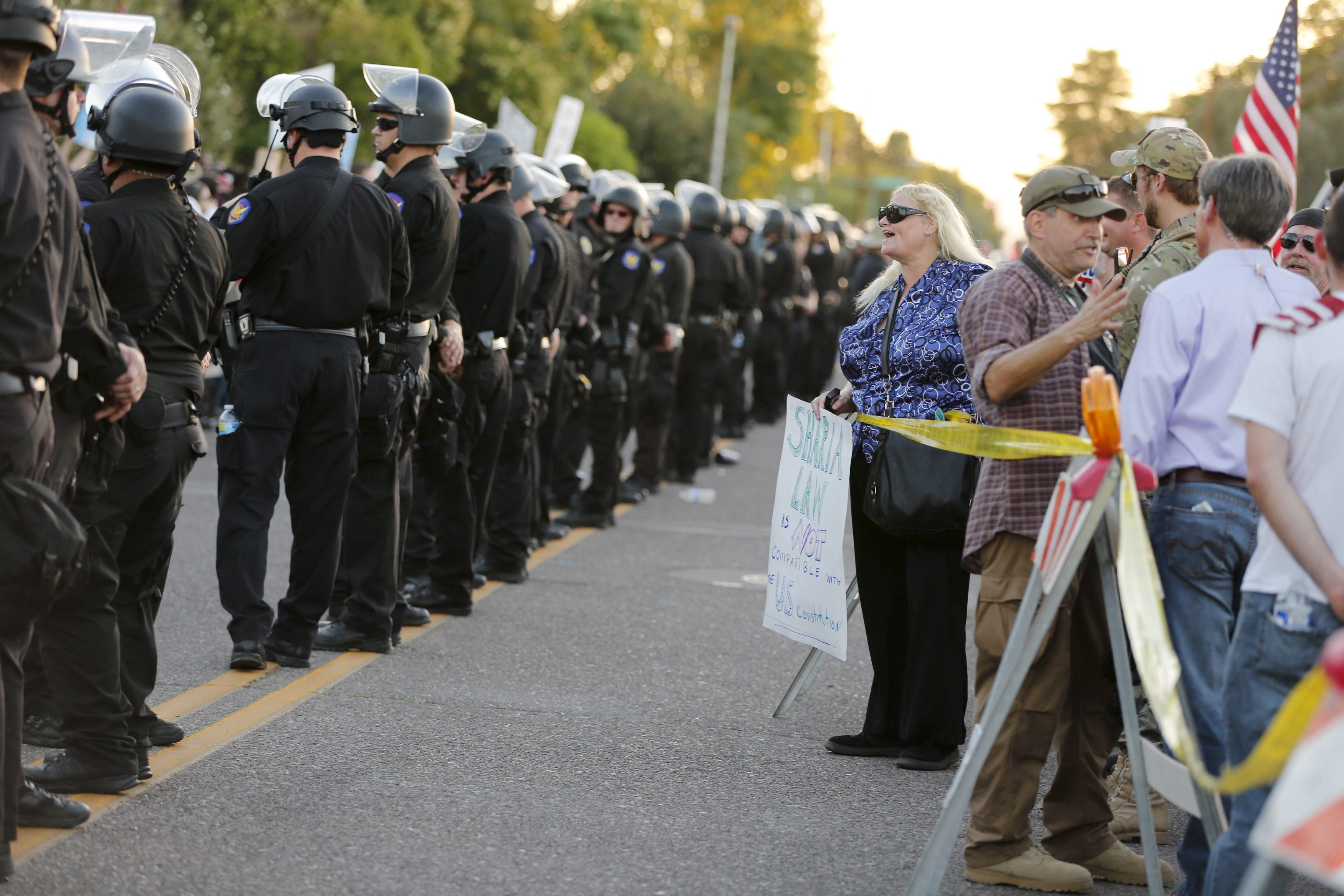
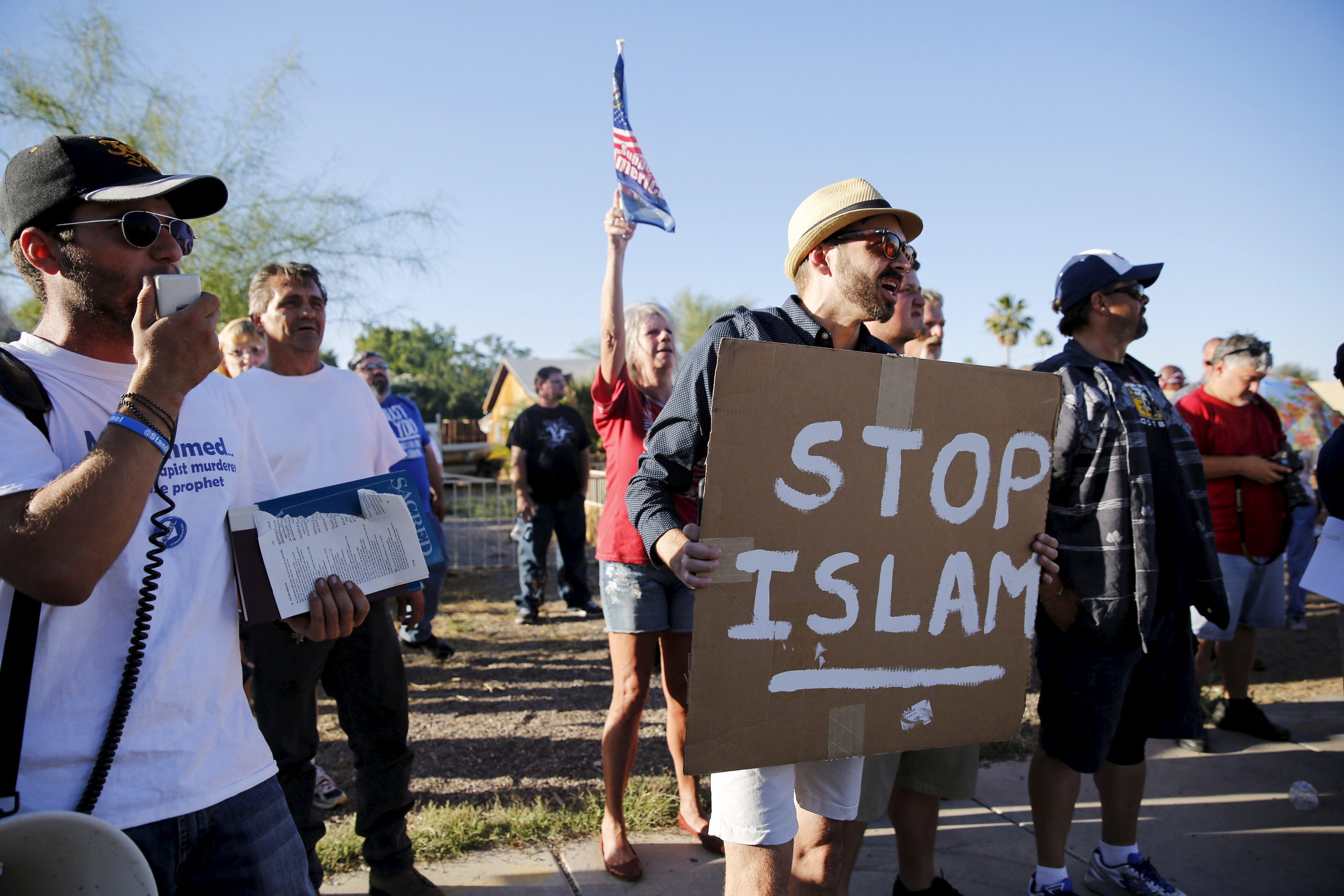
ARMED AMERICAN PROTESTORS SURROUND ISLAMIC COMMUNITY CENTER OF PHOENIX

by BREITBART NEWS 30 May 2015

(The price of shooting fish in a barrel just went up. – LS)

PHOENIX (AP) — About 500 protesters gathered outside a Phoenix mosque on Friday as police kept two groups sparring about Islam far apart from each other.
Women attend "Freedom of Speech Rally Round II" across street from Islamic Community Center in PhoenixPolice line separates people attending "Freedom of Speech Rally Round II" from counter demonstrators outside Islamic Community Center in PhoenixDemonstrators shout during "Freedom of Speech Rally Round II" outside Islamic Community Center in Phoenix

The rally initially was organized by a Phoenix man who says he is a former Marine who fought in the Iraq War and believes Islam is a violent religion. He led about 250 people who carried pistols, assault rifles, American flags and drawings of Muhammad to the Islamic Community Center of Phoenix.

That group was met by an equally sized group of protesters, some holding signs promoting love and peace, who came to show their support for the mosque and Muslim community.

As the two sides argued and yelled, dozens of police officers formed a line between them and kept them separated. There were no reports of injuries or arrests at the protest, which lasted a couple of hours and gained attention around the country on social media. Phoenix police estimated about 500 protesters showed up, roughly 250 on each side.

The protest came about month after a shootout outside a Muhammad cartoon-drawing contest in a Dallas suburb. Two Phoenix men showed up at the event with assault rifles and were killed by police. The men formerly worshipped at the Phoenix mosque where Friday’s protest took place.

Drawings of Muhammad are deemed insulting to many followers of Islam and have sparked violence around the world.


Permission to Shoot Here Boss

May 29, 2015

Obama Preventing Our Air Force from Firing on ISIS Forces With Absurd ‘Rules’ of Engagement’

By Warner Todd Huston Via Publius’ Forum

(Micromanagement on steriods. – LS)

Our Air Force jet pilots are beginning to gripe about Obama’s ISIS-supporting “rules of engagement” and saying that Obama is telling them they aren’t allowed to fire on ISIS targets. That is right, Obama is preventing our military from killing ISIS terrorists.

Apparently ISIS has their own leader in Washington and it’s Barack Obama who seems to be making sure that ISIS fighters are protected from American power.

U.S. military pilots carrying out the air war against the Islamic State in Iraq and Syria are voicing growing discontent over what they say are heavy-handed rules of engagement hindering them from striking targets.

They blame a bureaucracy that does not allow for quick decision-making. One Navy F-18 pilot who has flown missions against ISIS voiced his frustration to Fox News, saying: “There were times I had groups of ISIS fighters in my sights, but couldn’t get clearance to engage.”

He added, “They probably killed innocent people and spread evil because of my inability to kill them. It was frustrating.”

Sources close to the air war against ISIS told Fox News that strike missions take, on average, just under an hour, from a pilot requesting permission to strike an ISIS target to a weapon leaving the wing.

No wonder ISIS is so bold. They have a most powerful ally in the White House.