Author Archive

CIA Chief: There is “A Real Risk” That North Korea Will Aid Iran’s Pursuit of a Nuclear Bomb

January 24, 2018

by BICOM | 01.24.18 11:37 am The Tower

Source: CIA Chief: There is “A Real Risk” That North Korea Will Aid Iran’s Pursuit of a Nuclear Bomb

{I doubt this is a surprise to anyone. – LS}

The head of CIA warned that a cash-starved and expansionist North Korea could sell its nuclear weapons and ballistic missile technology to other countries, including Iran, and that failure to halt such activity could trigger a global nuclear arms race.

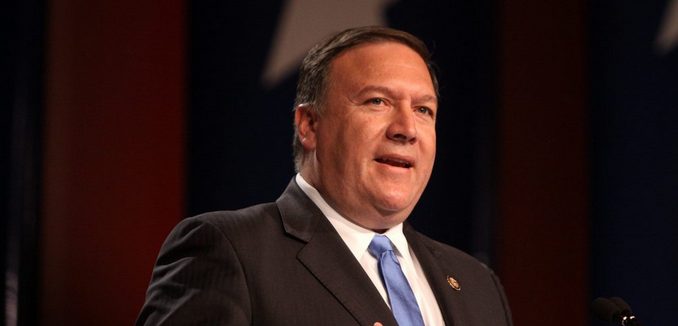
CIA Director Mike Pompeo spoke about national security challenges at the U.S.-based think-tank the American Enterprise Institute on Tuesday.

Pompeo was asked if Iran could use its existing cooperation agreements with North Korea to clandestinely advance its own nuclear weapons program without being discovered by the U.S.

Pompeo said Iranian and North Korean nuclear cooperation is “a real risk,” and “we think we have a pretty good understanding of what is taking place there today. Having said that, I am the first person to admit that intelligence organizations can miss important information.”

“These are terribly difficult problems in incredibly tight spaces, and when you are moving information, it is sometimes difficult to detect that that information has moved,” Pompeo said of such technology transfers. “So if someone asks me as the senior intelligence leader of the CIA, can you guarantee this [would be uncovered], I would say absolutely not.” Pompeo said the CIA and other U.S. intelligence agencies were working to prevent that.

Pompeo referred to the fear of a global nuclear arms race if North Korea or Iran achieves the ability to mass-produce nuclear weapons: “It doesn’t take too much imagination to understand that if they continue to have that nuclear weapons system… many other countries around the world will decide ‘me too,’ that I want to have one of those things that that guy has.”

North Korea has a history of clandestine military relations with Middle East states. Cooperation between the North Korean and Iranian ballistic missile programmes began in 1985 when Iran financed North Korea’s Scud-B development programme in exchange for the option to purchase production models. That investment bore dividends in 1991 when North Korea developed the 500km range Scud-C missile and sold the weapon and its technology back to Iran and Syria.

In 2007, the Israeli military bombed a suspected North Korean nuclear reactor in Syria that the U.S. believed was built for the purpose of producing plutonium for nuclear weapons.

FBI Official: FBI Agents Threatened Physical Harm to President Trump In Missing FBI Texts & Other “Frightening” Communications

January 24, 2018

Posted on January 23, 2018 by Investigative Bureau True Pundit

Source: FBI Official: FBI Agents Threatened Physical Harm to President Trump In Missing FBI Texts & Other “Frightening” Communications

{Treasonous behavior such as this should not be allowed to go unpunished. But, it’s going to take time. All evidence must be verified and referenced properly to prevent a ‘political backlash’. In essence, it must be indisputable. The same goes for all the other revelations out there, i.e. the so-called ‘memo’. The Democrats are already claiming this is merely the GOP’s interpretation of evidence. – LS)

“This is much larger than just texts between two FBI agents.”

A high-ranking FBI official confirms a number of the missing 50,000 FBI text messages — as well as other text and email messages among FBI brass — reportedly discussed initiating physical harm to President Donald Trump.

The FBI official urged the U.S. Department of Homeland Security — which oversees the U.S. Secret Service — to launch an investigation of the Justice Department, the FBI and all text messages missing and otherwise that threatened the President.

“This is dangerous territory and all FBI text messages and personal phones should be examined,” the official said. “It would reveal some frightening conversations.”

Did FBI brass discuss the assassination of President Donald Trump? If not, what was the nature of the threats against the president from inside the alleged premiere law enforcement agency in the United States?

“(Director) Wray wants a lid on this,” the FBI official said. “Many know there was talk of harming Trump politically but there is a group here (in D.C. HQ) that understands it goes deeper. We need a special counsel or Homeland Security. Somebody has to clean this up outside of DOJ. It is unacceptable.

“This is much larger than just texts between two FBI agents.”

The FBI official called on President Trump to do what is necessary to weed out corruption in the FBI.

“Text messages just don’t disappear,” the FBI official said. “Not here. Someone outside DOJ has to look at all emails and texts. These (FBI bosses) are bad people. You’ve only scratched the surface.”

The high-ranking FBI official called on lawmakers and the Inspector General to focus on the text and email messages of FBI Deputy Director Andrew McCabe. The official referred to McCabe’s official and personal correspondences “an anti-Trump treasure trove.”

As reported in March 2017 by True Pundit, McCabe openly threatened President Trump and then-National Security Adviser Gen. Mike Flynn, saying first we “Fuck Flynn and then we Fuck Trump” to several high-ranking FBI bosses who cheered his comment.

From that True Pundit Exclusive:

McCabe, the second highest ranking FBI official, emphatically declared at the invite-only gathering with raised voice: “Fuck Flynn and then we Fuck Trump,” according to direct sources. Many of his top lieutenants applauded and cheered such rhetoric. A scattered few did not.

This was one of several such meetings held in seclusion among key FBI leaders since Trump was elected president, FBI sources confirm. At the congregation where McCabe went off the political rails and vowed to destroy Flynn and Trump, there were as many as 16 top FBI officials, inside intelligence sources said. No lower-level agents or support personnel were present.

If you are among the millions of Americans who have pondered in recent months whether the Obama-era “Deep State” intelligence apparatus and FBI are working for or against Trump, this is the first definitive proof that the country’s once-premiere law enforcement agency has gone rogue.

The non-elected hierarchy that steer the FBI have declared war on President Trump and his White House inner circle. Make no mistake.

Flynn has since been indicted and plead guilty to a charge of lying to the FBI from an investigation supervised by McCabe after a FBI interview conducted by Peter Strzok, one of the agents busted sending anti-Trump texts. And Trump remains under investigation by U.S. Special Counsel Robert Mueller, a figure linked to several conflicts of interest in the case including prior deals with McCabe.

As reported yesterday in True Pundit, members of the FBI and Justice Department’s top brass at their Washington D.C.headquarters and other field offices are now using burner phones to stay under the radar of federal investigators and lawmakers, according to FBI insiders.

The shocking revelations come on the heels of news that the FBI deleted thousands of text messages between anti-Trump FBI agents before investigators could review their content.

While that is disturbing on one level, FBI and DOJ hierarchy employing the telecom habits of drug cartel bosses reaches a new low for the once-heralded federal law enforcement agency and the DOJ. And breaks federal laws as well.

The FBI “failed to preserve” five months worth of text messages exchanged between Peter Strzok and Lisa Page, the two FBI employees who made pro-Clinton and anti-Trump comments while working on the Clinton email and the Russia collusion investigations.

And now more text messages are missing from more FBI agents, according to the Justice Department.

That means 50,000 text messages.

Fifty.

Thousand.

Per The Hill yesterday, Attorney General Jeff Sessions on Monday announced the Justice Department will investigate missing text messages sent between two FBI agents critical of President Trump, joining the chorus of Republican lawmakers who are eager to recover the exchange.

GOP officials have seized on the messages as evidence of FBI bias against Trump in the probes into Russian election meddling and Hillary Clinton‘s use of a private email server as secretary of State.

“We will leave no stone unturned to confirm with certainty why these text messages are not now available to be produced and will use every technology available to determine whether the missing messages are recoverable from another source,” Sessions said in a statement.

Turkey says seeks no clash with U.S., Russia, but will pursue Syria goals

January 23, 2018

January 23, 2018 By Tuvan Gumrukcu and Ellen Francis One America News Network

Source Turkey says seeks no clash with U.S., Russia, but will pursue Syria goals

{I have to agree with one of the comments on this article, “Erdogan, who lacked the cajones to take on ISIS when they were just over the border, now sends his forces to attack the Kurds – who fought and turned back ISIS .” Besides, when will Turkey learn it cannot have it both ways. – LS}

ANKARA/BEIRUT (Reuters) – Turkey seeks to avoid any clash with U.S., Russian or Syrian forces but will take any steps needed for its security, a Turkish minister said on Tuesday, the fourth day of its air and ground offensive against Kurdish forces in northwest Syria.

The United States and Russia both have military forces in Syria and have urged Turkey to show restraint in its campaign, named Operation Olive Branch, to crush the U.S.-backed Kurdish YPG in the Afrin region on Turkey’s southern border.

The operation has opened a new front in Syria’s multi-sided civil war and could threaten U.S. plans to stabilize and rebuild a large area of northeast Syria – beyond President Bashar al-Assad’s control – where the United States helped a force dominated by the YPG to drive out Islamic State fighters.

Turkish Foreign Minister Mevlut Cavusoglu reiterated Ankara’s demand that Washington stop supporting the YPG, and said President Tayyip Erdogan would discuss the issue by telephone on Wednesday with U.S. President Donald Trump.

Ankara has said the operation will be swift, but Erdogan’s spokesman signaled an open-ended cross-border campaign, saying it would end only when some 3.5 million Syrian refugees now living in Turkey could safely return home.

Turkey’s military, the second largest in NATO, conducted air strikes and artillery barrages against targets in Afrin, and its soldiers and allied Syrian rebels tried to push into the Kurdish-held district from west, north and eastern flanks.

With heavy cloud hindering air support in the last 24 hours, advances have been limited and Kurdish fighters have retaken some territory. Turkish troops and the Syrian fighters have been trying to take the summit of Bursaya Hill, overlooking the eastern approach to Afrin town.

The Syrian Observatory for Human Rights, a Britain-based war monitor, said 23 civilians had been killed in Turkish shelling and air strikes, and thousands were fleeing the fighting.

However, Syrian government forces were preventing people from crossing government-held checkpoints to reach the Kurdish-held districts of nearby Aleppo city, it said.

Erdogan told French President Emmanuel Macron on Tuesday Turkey was taking all measures to prevent civilian casualties in the Afrin operation, sources at the presidential palace said. The two leaders agreed to stay in close contact on the issue.

YPG THREAT

U.S. Defense Secretary Jim Mattis said Turkey’s offensive was distracting from efforts to defeat Islamic State.

Ankara says the jihadist group is largely finished in Syria and that the greater threat comes from the YPG, which it sees as an extension of a Kurdish group that has waged a decades-long separatist insurgency inside Turkish own borders.

Erdogan has said Turkey aims to destroy YPG control not just in the Afrin enclave but also in the mainly Arab town of Manbij to the east.

“Terrorists in Manbij are constantly firing provocation shots. If the United States doesn’t stop this, we will stop it,” Cavusoglu was reported as saying on Tuesday.

“Our goal is not to clash with Russians, the Syrian regime or the United States, it is to battle the terrorist organization,” broadcaster Haberturk quoted him as saying.

“I must take whatever step I have to. If not, our future as a country is in jeopardy tomorrow… We will not live with fear and threats,” Cavusoglu said.

He tweeted that a lieutenant had become the second Turkish soldier to be killed in the operation. The Observatory said 43 rebel fighters fighting alongside the Turks had also been killed, as well as 38 on the Kurdish side.

Later on Tuesday Cavusoglu discussed the crisis with U.S. Secretary of State Rex Tillerson during a conference in Paris.

Erdogan’s spokesman, Ibrahim Kalin, said the military operations would continue until Syrian refugees in Turkey “return home safely and the separatist terror organization has been cleansed from the region”.

The Kurdish-led administration of northeastern Syria appealed for a mass mobilization in defense of Afrin. “We call on all our people to defend Afrin and its pride, and contribute in all the related activities,” it said, without elaborating.

A U.N. report, citing local sources, said about 5,000 people in the Afrin district had been displaced as of Monday but that some of the most vulnerable had been unable to flee. It said the United Nations was ready to provide aid to 50,000 in Afrin.

MANBIJ FEARS

Washington’s central goal in the region is to prevent Turkey from driving Syrian Democratic Forces (SDF), the U.S.-backed umbrella group that is dominated by the YPG, out of Manbij, U.S. officials say.

Unlike Afrin, where no U.S. forces are stationed, there are some 2,000 U.S. military personnel deployed in the eastern region of Manbij, which extends for 400 km (250 miles) along Turkey’s border.

YPG spokesman Nouri Mahmoud said Turkish shelling on Monday had killed three people in the Syrian border town of Ras al-Ayn, pointing to the risk of widening hostilities along the frontier.

Ras al-Ayn is located in Kurdish-controlled territory some 300 km (190 miles) east of Afrin. It was one of several locations in northeast Syria targeted in cross-border attacks from Turkey on Monday, Mahmoud said.

The United States hopes to use the YPG’s control in northern Syria to give it the diplomatic muscle it needs to revive U.N.-led talks in Geneva on a deal that would end Syria’s civil war.

Ankara has been infuriated by the U.S. support for the YPG, which is one of several issues that have brought ties between Washington and its Muslim NATO ally close to breaking point.

“The future of our relations depends on the step the United States will take next,” Cavusoglu said.

NATO joined the chorus of calls for Turkish restraint.

“From NATO’s perspective, we want to say that the reaction (Turkey’s military operation) should be proportionate and in a limited time and area,” NATO Deputy Secretary General Rose Gottemoeller told Turkey’s NTV channel during a visit to Ankara.

US arms on way to Taiwan, including Stinger missiles

January 23, 2018

A US soldier carries an FIM-92 Stinger MANPAD missile. Photo: YouTube via US Army

New weapons coming from the US are a boost to the island’s sea and air defenses against mainland China

By Asia Times staff January 23, 2018 5:15 PM

Source: US arms on way to Taiwan, including Stinger missiles

{Actually, this is nothing compared to China’s support for a nuclear North Korea to antagonize and threaten the US. – LS}

Around 250 FIM-92 Stinger MANPADS (Man-Portable Air-Defense System) missiles, torpedo service-life extension packs, and Standard Missile 2 spare modules are among the latest batch of arms that Taiwan is to take delivery of from the United States for its navy and marine corps.

Taiwan’s National Defense Ministry announced the implementation of the deal, worth NT$13.35 billion (US$453.6 million), on Monday.

“Shipments are already on the way,” a Taiwanese defense official told the Central News Agency.

The Stinger missiles are of the lightweight, shoulder-fired, infrared-homing surface-to-air type but are versatile enough to be launched from tanks, other vehicles and helicopters.

The lethality and economy of these missiles have long been proved in numerous wars including the Soviet incursion in Afghanistan and the Syrian Civil War since their introduction in the early 1980s by the US Army. They are used by militaries across the globe.

It is rumored that the US Secret Service has Stinger missiles to defend the president, a notion that has never been dispelled.

The Taiwanese Army will take delivery of the missiles later this year.

In addition to marine infantry battalions, units slated to receive the Stinger missiles include the navy’s Guang Hua VI-class fast attack boats and Tuo Jiang-class corvettes, which currently lack adequate anti-aircraft weaponry, Taipei Times reported, citing a source in the Defense Ministry.

The Stinger missiles are meant to provide much-needed anti-aircraft firepower to the navy’s smaller combat craft and augment the survivability of ships and marines, while increasing the attrition rate of a foe’s air units, the source said.

The deals were signed with the American Institute in Taiwan – Washington’s de facto embassy on the island Beijing insists is a renegade province of China – in December 2015 after the Barack Obama administration cleared the way for such sale, at a time when Sino-US ties were still amicable.

The stated contractual time frame for the Stinger missile deal covers 2017 to 2020.
A port quarter view of the guided missile destroyer USS KING (DDG-41), showing a Mark 10 twin launcher with RIM-67A Standard (SM-1 ER) extended range surface-to-air missiles.


A port quarter view of the guided-missile destroyer USS King, showing a Mark 10 twin launcher with RIM-67A Standard (SM-1 ER) extended-range surface-to-air missiles. Photo: WikiMedia

“Standard Missile” refers to a family of US-made shipborne guided missiles. Analysts say it’s likely that the spare modules sold to Taiwan are for the RIM-67 Standard ER extended-range surface-to-air and anti-ship missiles, for Taiwan to assemble its own copycat versions to fend off an invasion from the People’s Republic of China in the event of a war, as well as to discourage the People’s Liberation Army’s incessant sea-air intrusions into Taiwan’s defense zones since last year.

The actual commencement of delivery of these arms will once again rile Beijing, though the Chinese Foreign Ministry is yet to state any response.

U.S. Oil Production Will Soon Overtake Saudi Arabia’s

January 22, 2018

Written by Bob Adelmann Monday, 22 January 2018 The New American

Source: U.S. Oil Production Will Soon Overtake Saudi Arabia’s

{A little ingenuity can go a long way. – LS}

Fatih Birol, head of the Paris-based International Energy Agency (IEA), told a congressional committee last week, “What we see is a result of the shale revolution [fracking]. The U.S. is becoming the undisputed leader of oil and gas production worldwide. [U.S.] oil production is growing very strongly and will continue to grow. We think that this growth is unprecedented [both in the] size of the growth and the pace of the growth.”

In 1973, Saudi Arabia punished U.S. citizens with an oil embargo in retaliation for the U.S. government’s support for Israel during the Yom Kippur War. It could do so because it held the biggest hammer: Saudi Arabia controlled the world’s largest reserves of crude oil and the kingdom. Within months, the price of oil quadrupled in the United States, resulting in shortages and rationing. Gas stations were closed, and when they reopened they were forced to restrict gasoline purchases to “odd” and “even” days depending upon their customers’ license plate numbers. The federal government imposed “double-nickel” (55 mph) speed limits on highways, and experimented with “daylight saving” time in order to reduce the impact of the embargo.

Those days are long gone and not likely ever to return. Saudi Arabia and its OPEC cartel are slowly being reduced to bit players in the global energy market. Saudi Crown Prince Mohammed bin Salman saw that coming more than two years ago when he announced the kingdom’s “Saudi Vision 2030,” a plan to diversify his country’s economy away from its dependence on oil and gas revenues. He created a “sovereign wealth fund” to invest in various schemes and projects to expand public service sectors such as healthcare, education, infrastructure, recreation, and tourism. Part of the plan was to take advantag of the country’s unique geographical location as a central hub connecting Asia, Africa, and Europe.

To do all of that, the crown prince needed money — lots of money — to transform his country and move it away from its dependence on oil and gas revenues. In April 2016, he announced that he would be offering for sale up to five percent of his oil company, Saudi Aramco, hoping to raise an initial $500 billion, as the company was estimated to be worth $10 trillion. But with the decline in oil prices, his country’s stagnant oil and gas production, and the coming of age of the fracking revolution in the United States, estimates of the real marketable value of Aramco have continued to drop. The latest estimate is that the company is worth about $2 trillion, with the sale of that five percent (if it happens at all) generating a paltry $100 billion.

It’s been two years since that announcement, and the offering continues to be delayed. The latest delay is pushing the public offering of shares into the second half of 2018.

All of which raises a question: What happened to rebalance the equation against Saudi Arabia in favor of the United States? What happened was George P. Mitchell. A son of poor Greek immigrants (who entered the U.S. legally in 1901), Mitchell served in the U.S. Army Corps of Engineers during World War II. After the war he joined his brother Johnny in starting an oil exploration business in Houston.

Fast-forward to the late 1970s. Mitchell was using company resources to explore ways of getting more natural gas out of shale formations at such a rate that his board of directors and investors were getting nervous. It took almost 20 years and the threat of near-bankruptcy before Mitchell and his company’s engineers finally developed the magic formula of techniques and materials to extract gas, and then oil, from shale.

In 2002 Mitchell sold his company, Mitchell Energy & Development Corporation, to Devon Energy Corporation for $3.1 billion.

Why couldn’t Saudi Arabia have done the same thing? Why did it wait until the issue became an existential threat with the development of fracking in the United States?

Part of the answer has to be the culture. In Saudi Arabia, the country’s vast reserves — some 360 billion barrels of recoverable oil, at last count — belong to Aramco, i.e., the government. What is the incentive then for an entrepreneur to risk his capital, his time, his reputation, and his energy to try to find a way to squeeze more production out of those reserves?

In the United States, the culture is vastly different. The oil in the vast Permian Basin (which lies under west Texas and eastern New Mexico), for example, belongs to the people who successfully negotiate the land leases and then develop it. They take risks with their own money (and that of other people — investors) and spend themselves into exhaustion both physically and financially in the hopes of striking it rich. If they succeed, they get to keep what they have reaped. If they don’t, they eat their losses and perhaps return for another go at it in the future. It is the peculiar, some say unique, mixture of limited government intervention, the enforcement of contracts at law, and the exhilaration that comes from success, that drives people such as George Mitchell to change the world.

It was thus inevitable that the United States, given that peculiar culture, would eventually become the “undisputed leader” of the world in energy development. It has an unfair advantage over every statist economy on the planet. All it took was time, and George Mitchell, to soon relegate Saudi Arabia to second place.

Pence kicks off Middle East tour in Egypt amid Arab anger over Jerusalem

January 20, 2018

By Maram Mazen and Dave Clark January 20, 2018 5:11 pm The Times of Israel

Source: Pence kicks off Middle East tour in Egypt amid Arab anger over Jerusalem

{When have the ‘Arabs’ not been angry? – LS}

US vice president to meet with Sissi in Cairo before heading to Jordan, Israel; no talks with Palestinians who are boycotting the US vice president.

CAIRO (AFP) — US Vice President Mike Pence arrived in Egypt Saturday to begin a delayed Middle East tour overshadowed by anger in the Arab world over Washington’s recognition of Jerusalem as Israel’s capital.

Controversy over US President Donald Trump’s decision to move the American embassy in Israel to Jerusalem had led to the cancellation of a number of planned meetings ahead of the trip originally scheduled for December.

While the deadly protests that erupted in the West Bank and Gaza Strip at the time have subsided, concerns are mounting over the future of the UN aid agency for Palestinian refugees, known as UNRWA.

Washington has frozen tens of millions of dollars of funding for the cash-strapped body, putting at risk operations to feed, teach, and treat hundreds of thousands of Palestinians.

The Palestinian Authority, already furious over the Jerusalem decision, has denounced the US administration and had already refused to meet Pence in December.

But the vice president’s press secretary, Alyssa Farah, said he would still meet the leaders of Egypt, Jordan, and Israel on the high-stakes four-day tour.

Pence is scheduled to hold talks with Egyptian President Abdel Fattah el-Sissi on Saturday before traveling to Amman for a one-on-one meeting with King Abdullah II on Sunday.

The trip had been pushed back in December as a crunch tax vote loomed on Capitol Hill.

Key security partners

The leaders of both countries, the only Arab states that have peace treaties with Israel, would be key players if US mediators ever manage to get a revived Israeli-Palestinian peace process off the ground, as Trump says he wants.

They are also key intelligence-sharing and security partners in America’s various covert and overt battles against Islamist extremism in the region, and Egypt is a major recipient of aid to help it buy advanced US military hardware.

Sissi, one of Trump’s closest allies in the region, had urged the US president before his Jerusalem declaration “not to complicate the situation in the region by taking measures that jeopardize the chances of peace in the Middle East.”

Ahmed al-Tayeb, the grand Imam of Al-Azhar, Egypt’s highest institution of Sunni Islam, cancelled a meeting with Pence in protest at the Jerusalem decision.

The head of Egypt’s Coptic Church, Pope Tawadros II, did the same, saying Trump’s move “did not take into account the feelings of millions of Arab people.”

After Jordan — the custodian of Christian and Muslim holy sites in Jerusalem’s Old City — Pence will head to Israel for talks with Prime Minister Benjamin Netanyahu on Monday.

He will also deliver a speech to the Knesset and meet President Reuven Rivlin during the two-day visit.

Pence can expect a warm welcome after Trump’s decision on Jerusalem, which was welcomed by Israeli but denounced by the Palestinians.

Israel captured the West Bank and East Jerusalem from Jordan in the 1967 Six Day War. It later extended Israeli sovereignty to East Jerusalem in a move never recognized by the international community.

Israel claims all of Jerusalem as its united capital, while the Palestinians see East Jerusalem as the capital of their future state.

The international community considers East Jerusalem illegally occupied by Israel, and currently all countries have their embassies in the commercial capital Tel Aviv.

‘Matter of years’

The State Department has begun to plan the sensitive move of the US embassy to Jerusalem, a process that US diplomats say may take years to complete.

This week reports surfaced that Washington may temporarily designate the US consulate general in Jerusalem as the embassy while the search for a secure and practical site for a long-term mission continues.

A senior State Department official, speaking on condition of anonymity, told reporters that Secretary of State Rex Tillerson has yet to make a decision on either a permanent or interim location for the mission.

“That is a process that takes, anywhere in the world, time. Time for appropriate design, time for execution. It is a matter of years and not weeks or months,” he said.

Pence — himself a devout Christian — will visit the Western Wall, one of the holiest sites of Judaism in Jerusalem’s Old City, and pay his respects at the Yad Vashem Holocaust memorial.

Time to Kick Turkey Out of NATO?

January 19, 2018

Michael J. Totten January 19, 2018 World Affairs

Source: Time to Kick Turkey Out of NATO?

{That would be like a huge multi-national corporation kicking out a major subsidiary. Not going to happen. – LS}

The case for evicting Turkey from NATO got stronger this week.

First, the United States announced the backing of a Kurdish security force—the People’s Protection Units, or YPG—in Rojava, the quasi-independent Kurdish region in northeastern Syria along the Turkish border. Then Turkey’s President Recep Tayyip Erdogan says he will “strangle” that American-backed force “before it’s even born.” Russia, Iran and Syria’s Assad regime are standing with Erdogan.

The YPG, along with the multiethnic Syrian Democratic Forces which the YPG dominates, are the only armed groups indigenous to Syria that are willing and able to take on ISIS and win, and they’re the only significant armed faction in Syria’s dizzying civil war that isn’t ideologically hostile to the West. In October of last year, they finally liberated Raqqa, the “capital” of the ISIS “caliphate,” while the Russian and Syrian militaries were busy pounding rebels instead in the west.

The Turks would rather have the Assad regime—and by extension Russia, Iran and Hezbollah—rule over the Syrian Kurds whom they consider terrorists. The United States is “building an army of terror” along the southern border, Erdogan says. “Either you take off your flags on those terrorist organisations, or we will have to hand those flags over to you, Don’t force us to bury in the ground those who are with terrorists…Our operations will continue until not a single terrorist remains along our borders, let alone 30,000 of them.”

This is not how a NATO ally behaves. It’s how an enemy state behaves. There is truly no getting around this. We can argue all we want—and I have—that keeping Turkey in NATO is better than kicking Turkey out of NATO because it’s better to deal with a troublesome country inside an ostensibly friendly framework than outside one.

There are limits, though, even if those limits aren’t clearly defined. A direct Turkish attack against the United States would clearly be over the line whether a line is defined or not, as would a direct attack against another NATO member state. Attacking a non-NATO ally is more ambiguous, especially when the non-NATO ally in question isn’t even a state. (It’s not like Turkey is threatening to attack Israel, Japan or Morocco.)

None of this could have been foreseen when NATO was founded in 1949 or when Turkey was admitted in 1952. NATO was founded as a united Western front against the Soviet Union, which occupied or indirectly controlled half of Europe, including a third of Germany. Iran’s Islamic Republic, the Syrian Baath Party regime, armed Kurdish separatist movements, ISIS—none of these even existed then, and only the Kurdish movements could even have been imagined.

The world has dramatically changed, as has NATO. In 1952, Turkey was a crucial member in good standing while Estonia was part of the Soviet Union. In 2018, Estonia is a member in good standing while Turkey is behaving as a belligerent. No one should be surprised that alliances have shifted after seven decades. Alliances always shift over time. Enemies become friends and vice versa. Not even Britain has been a constant friend of the United States, and not even Russia has been a constant enemy.

Changes like these happen slowly, and the West is having a hard time processing the fact that Turkey is increasingly hostile, though it has been for some time now. It started when Ankara denied the use of its territory, including Incirlik Air Base, during the war against Saddam Hussein, mostly because Turkey didn’t want Iraqi Kurdistan to become an economic and military powerhouse. Later, Erdogan helped Iran transfer weapons to Hezbollah in Lebanon and implicitly sided with ISIS in Syria because he didn’t want an independent Kurdish region to rise up in Syria as it had in Iraq. More recently, he has taken American citizens hostage and purchased a missile system from the Kremlin. And how he’s threatening to destroy the only competent Western-friendly militia in all of Syria.

Last August, as Erdogan visited his “dear friend” Vladimir Putin in Moscow, NATO issued a telling statement. “Turkey is a valued ally, making substantial contributions to NATO’s joint efforts… Turkey’s NATO membership is not in question.”

Stop right there. Of course Turkey’s NATO membership is in question. Otherwise, why bother denying it? NATO isn’t denying that the United Kingdom or Canada doesn’t belong in NATO any longer. NATO is only denying that Turkey’s membership is in question, which is another way of saying it is. Anyway, you can type “Turkey out of NATO” into Google and spend a year wading through the results.

The statement continues: “Our Alliance is committed to collective defence and founded on the principles of democracy, individual liberty, human rights and the rule of law.” Indeed, the alliance was founded on all of those principles, none of which increasingly authoritarian Turkey adheres to any longer.

If Turkey were not in NATO, it would not be admitted. It’s grandfathered in at this point.

It’s much easier to say no to an aspiring member that doesn’t belong than to evict a longstanding member who no longer belongs, especially when there’s no clear criteria for banishment. It’s about time, then, for NATO to have a serious discussion about what the criteria for banishment is. That alone might improve Turkey’s behavior. If it doesn’t, we’ll have other options.

For Real ‘Collusion,’ Look At Obama’s Dirty Dealings With Iran

January 19, 2018


Obama’s scheming with the Mullahs reveals a troubling pattern.

January 19, 2018 Ari Lieberman Front Page Mag

Source: For Real ‘Collusion,’ Look At Obama’s Dirty Dealings With Iran

{A little karma at this point could go a long way. We may see some coming out in the form of FISA. – LS}

  By now it should be readily apparent to all, even those afflicted with Trump Derangement Syndrome, that the Trump-Russia collusion narrative is a spent force or as leftist political commentator Van Jones put it, “a big nothingburger.” Nearly a year has passed since the appointment of special counsel Robert Mueller and not a scintilla of evidence demonstrating collusion has been forthcoming. Moreover, the investigation itself has been plagued by scandal and partisanship placing a cloud of taint over the entire inquiry. Nevertheless, Mueller’s Russia probe will continue to putter along and after wasting millions of taxpayer dollars (as of December 2017, the cost has reportedly reached a staggering $7 million) the former G-Man will get a trickle of indictments and plea bargains on peripheral figures for matters wholly unrelated to the original investigation. Democrats will then pat themselves on the back and Mueller will go back to obscurity.

Democrats and their allies in the establishment media have cleverly succeeded in temporarily deflecting America’s attention away from the real collusion story, one with real substance and far greater ramifications. A persuasive case can be made that former president Barack Obama colluded with a sworn enemy of the United States, the Islamic Republic of Iran. With each passing day, another disquieting facet of the Obama administration’s dealings with the Islamic Republic is revealed and when taken in totality, paints a disturbing picture of the administration’s underhanded efforts to placate and appease the mullahs and their proxies, including Hezbollah.

The Obama administration’s current dealings with Iran began with an outright fabrication to the American people. On August 5, 2015 Obama asserted that negotiations with the Iranians commenced in 2013. Obama argued that the ascent of the “moderate” Hassan Rouhani offered the United States an opportunity to engage with the Iranians. This was in fact, a bald-faced lie. Circumventing the State Department and using Sen. John Kerry (whose Iran connections are a matter of public record) as its point man, the administration began engaging with Iran in 2011 when the toxic Mahmoud Ahmadinejad was president. For the record, Ahmadinejad is a rabid Holocaust denier. Four years later, Obama sealed his infamous Joint Comprehensive Plan of Action, alternatively known as the Iran deal, which gave the Iranians $150 billion worth sanctions relief while simultaneously providing them with a legal pathway toward acquiring nuclear weapons.

The flow of lies and deceit continued from there. The JCPOA was, to put it mildly, a flawed agreement, one in which the benefits flowed one way. Charles Krauthammer aptly described it as the worst agreement in U.S. diplomatic history. But there were alarming elements of the agreement, chiefly secretive side arrangements between Iran and the IAEA, which were so patently egregious and absurd that even Obama understood that it would render the agreement a hard sell. Under these side arrangements, Iran’s highly opaque Parchin military facility was off limits to international inspectors undermining Obama’s claim that the agreement provided for anytime, anywhere intrusive inspections. Consequently, Obama tried and failed to keep this information from Congress.

Even more disturbing than the administration’s attempt to obfuscate elements of the Iran deal was the manner in which it illegally weaponized the NSA and other domestic intelligence services to spy on members of Congress and leaders of Jewish groups and then leak their identities. You read that correctly. The Obama administration adopted tactics employed by two-bit, paranoid dictators and exploited loopholes in surveillance laws to keep one step ahead of the opposition. Meetings with Israeli officials opposed to the Iran deal were monitored and the contents of those meetings as well as the identities of those who attended were scandalously leaked to sympathetic journalists, who proceeded to mouth administration talking points. The administration also employed subtle use of anti-Semitic stereotypes implying that those opposed to the Iran deal maintained dual loyalties or were agents for Israel. In a grotesque display of anti-Semitic stereotyping, the New York Times, one of the media outlets shilling for Obama, actually implied that congressional members who voted against the deal were motivated by their Jewish ethnicity or high proportion of Jews residing within their districts. Obama’s talking points, which seemed to mimic Tehran’s, were trickling down to his echo chamber in a well-orchestrated scheme.

Bad deals are one thing and can always be attributed to amateurish negotiating skills (found in abundance in Obama’s negotiating team) but Obama’s dealings with Iran went far beyond ineptitude. In May 2016 it was revealed that Secretary of State John Kerry appealed to European banks to do business with Iran. Kerry instantly transformed himself from secretary of state to Iran lobbyist. Knowing that the Iranian Revolutionary Guard Corps controls much of Iran’s economy, the bank heads wanted no part of what Kerry had to offer and curtly showed him the door.

Another even more startling revelation soon followed. It has long been America’s policy not to pay ransom to tyrants and terrorists in exchange for captive hostages but that policy was shattered when Obama agreed to give the mullahs $400 million in exchange for American hostages held without cause by Iran. A further $1.3 billion was transferred later.

The administration alleged that the money was transferred in settlement of Iranian legal claims stemming from a pre-revolution, aborted arms deal, and had no nexus to the hostages. But that argument is unconvincing. The initial $400 million transfer was initiated contemporaneous with the hostages’ release. Moreover, the transaction was an all-cash deal – untraceable the way the mullahs like it – conducted in the dead of night away from prying eyes, the way the Obama administration liked it. As I previously noted, if it walks like a ransom payment and talks like a ransom payment, it’s likely a ransom payment despite the administration’s contrary protestations. The administration did grudgingly acknowledge that the money could have ended up in the hands of the IRGC. Anyone possessing an ounce of common sense knows that the $1.7 billion almost certainly lined the coffers of the IRGC, and was probably also parsed out to Iranian proxy terror groups like Hezbollah, which receives between $700 million and $1 billion annually from Tehran.

What the administration also failed to note was that the United States maintained an $817 million counterclaim against the Islamic Republic stemming from breaches of Iranian contractual obligations. The United States also maintained subrogated claims against Iran to the tune of $3.9 billion. With the stroke of a pen, Obama relinquished these valid legal claims and allowed Iran to get off scot-free. In addition, as part of the ransom deal, Obama authorized the release of seven convicted Iranian felons and expunged warrants on 14 others. Unlike Iran’s American detainees, these individuals actually committed crimes and were afforded due process.

Obama promised the American people that the JCPOA’s had strict mechanisms for enforcement and that these would ensure Iranian compliance but that too was untrue. Twice since the signing of the JCPOA, Iran exceeded its prescribed 130 metric ton limit for heavy water, which is used as a moderator in reactors fueled by natural uranium, and is critical for the production of plutonium. But incredibly, instead of punishing the Iranians for their transgressions, the Obama administration rewarded the mullahs by issuing its consent to allow the Iranians to receive 116 metric tons of natural uranium from Russia. According to experts, the uranium could be enriched to weapons-grade sufficient for the production of at least 10 nuclear bombs.

Ironically, in light of the Obama-era, Uranium One scandal, and Russia’s concomitant acquisition of 20 percent of America’s mining capacity, there’s a fair likelihood that at least some of the Russian uranium came from American uranium mines. This is because at least some uranium from Uranium One’s mining operations in America was exported abroad, despite assurances by the Nuclear Regulatory Commission that the company lacked an export license and therefore, could not export uranium produced at their American facilities; yet another fabrication.

It goes from bad to worse. In his zeal to curry favor with the Islamic Republic, Obama shut down a highly successful and lengthy DEA operation – codenamed Project Cassandra – aimed at thwarting Hezbollah drug trafficking, arms trafficking and money laundering schemes. As a result, Hezbollah and their IRGC patrons continued their nefarious operations virtually unmolested. That means that Hezbollah drugs continued to pour into the U.S., Hezbollah Explosively Formed Projectiles (EFP) continued to make their way into the hands of anti-American insurgents and drug money, stained with the blood of Americans, continued to be laundered to the tune of billions of dollars.

We’re not done just yet. There is bipartisan agreement that the IRGC is a group that actively supports international terrorism. The overseas arm of the IRGC is the so-called Quds Force. Quds Force operatives have been fomenting unrest in Lebanon, Syria, Iraq, Bahrain, Yemen, Gaza and Afghanistan. They’ve also been active in India, Africa, Southeast Asia, Central & South America, and Europe. In fact, a cell of Quds Force operatives was recently exposed executing surveillance operations against Israeli and Jewish targets in Germany. A kindergarten was on the list of surveilled targets demonstrating just how deeply depraved the IRGC truly is. The Quds Force is led by a nasty sort named Qassem Soleimani, whose activities have earned him a spot on the U.S. sanctions list.

According to recently surfaced reports, three years ago, Israel decided to rid the world of this menace and was on the verge of accomplishing this objective through a targeted liquidation in Damascus. Soleimani’s removal from the scene would have severely disrupted Quds Force operations. The operation however, never materialized because the Obama administration tipped off Tehran to Israel’s plans. Soleimani dodged a bullet and has since been working tirelessly to foment unrest and undermine America’s interests.

It’s not the first time that the Obama administration betrayed covert Israeli activities to a sworn enemy. In 2012, the Obama administration leaked damaging information that inexplicably sought to sabotage a burgeoning strategic alliance between Israel and Azerbaijan. Such an alliance would have enabled Israel to seek alternate bases in close proximity to Iran from which it could conduct military operations including surveillance and rescue missions, refueling and maintenance and even direct military strikes. The damaging disclosure severely undermined Israel’s strategic position. Some have suggested that Obama leaked the information in an effort to derail an Israeli preventative strike against Iran’s nuclear facilities while others have noted that he was motivated by pure malevolence.

So what is it called when a president …

* Initiates secret negotiations with a Holocaust denier and then lies about it;
* Signs an agreement with Iran that allows Iran’s most opaque nuke facility to avoid inspection and then attempts to hide this fact from Congress;
* Weaponizes intelligence services to illegally spy on Americans to secure passage of the JCPOA;
* Gives the Iranian government, and by extension, the IRGC, $1.7 billion in cash;
* Relinquishes all valid legal claims against the Islamic Republic, including judgements against the regime for acts of terrorism;
* Releases convicted Iranian felons without cause or justification and removes others from INTERPOL list;
* Fails to call out Iran when it materially breaches the terms of the JCPOA;
* Rewards Iran’s bad behavior by giving consent for the transfer of natural uranium to Iran;
* Informs Iran about an ally’s intention to knock off a sworn enemy of the United States;
* Informs Iran about an ally’s covert operations.

At best, it’s called being a mullah lackey but an equally persuasive argument can be made for collusion. The depth and breadth of Obama’s scheming with Tehran is something that cannot be ignored. The prevailing view is that in his zeal to secure a deal with Iran, Obama lost all sense of reality to the point of compromising U.S. national security interests. Others have suggested that Obama harbored a genuine soft spot for the IRGC and its overseas Quds Force component. Either way, for the sake of transparency and national security the DOJ or Congress must fully investigate this matter forthwith, and do so in expeditious fashion.
Report: ‘Thousands of Christians, Ahmadis, and Hindus’ Fleeing Pakistan to Survive

January 18, 2018

by Edwin Mora 17 Jan 2018 Breitbart

Source: Report: Thousands of Christians, Ahmadis, and Hindus Fleeing Pakistan to Survive

{And then there’s this little matter concerning a Pakistani nuclear arsenal. – LS}

Christians and other minorities in Pakistan are bolting away from the predominantly Muslim nation by the “thousands” as Islamabad ignores harassment at the hands of Islamic extremists, reports Asia Times.

“Thousands of Christians, Ahmadis, and Hindus are fleeing as the government turns a blind eye to Islamic groups’ harassment of other faiths and beliefs; even atheists have now gone quiet,” notes the news outlet, adding “A closer look at the situation reveals that religious minorities and atheists are at a higher risk than ever.”

The report comes soon after U.S. President Donald Trump’s administration placed Pakistan on a U.S. watchlist for countries of “particular concern” over “severe violations of religious freedom” after the commander-in-chief blasted Islamabad for harboring jihadists.

“This is only going to get worse,” Ibn Abdur Rehman, secretary-general of the Human Rights Commission of Pakistan, told Asia Times, referring to the persecution of religious minorities. “The state has surrendered to the radical Islamists and plans on gradually taking away every last bit of freedom from its citizens.”

Pakistan reportedly uses its controversial anti-blasphemy law, which carries a harsh sentence of life in prison or death, to target religious minorities, namely Christians.

In 2017, a judge in the Islamabad High Court decreed that “blasphemers are terrorists,” reports Asia Times.

“Islamabad’s capitulation to the radical Islamist mob has endangered the Ahmadiyya [Muslim] community, which has been the target of death threats made openly since the party besieged the capital a few months ago,” it adds.

Asia Times learned from Pakistani Senator Ramesh Kumar that “around 5,000 Hindus leave Pakistan every year” because of religious persecution.

“This includes forced marriages and kidnapping for ransom, as well as attacks on Hindu temples,” notes the news outlet.

Pakistan and the Open Doors group also accuse “Hindu extremists” in India of persecution against Muslims and Christians. Indian and Pakistan are regional rivals.

Despite adding Pakistan to the U.S. “Special Watch List,” the U.S. Commission on International Religious Freedom (USCIRF) argues that the Trump administration’s move “does not go nearly far enough,” reports Newsmax.

“While the Trump administration earlier this year put Pakistan on its ‘Special Watch List’ for countries that ‘engage in or tolerate severe violations of religious freedom, it stopped short of slapping Pakistan with the much more serious Country of Particular Concern designation (CPC),” it reports, citing USCIRF.

As mandated by law, the U.S. Secretary of State deems a nation as a Country of Particular Concern when it is guilty of “particularly severe violations of religious freedom, including torture or inhuman treatment.”

“USCIRF, an independent U.S. federal government commission dedicated to defending global religious freedom, has been pushing the State Department to designate Pakistan a Country of Particular Concern for 15 years,” notes Newsmax.

“Given the strong stance that President Trump has taken on Pakistan recently,” USCIRF chairman Daniel Mark reportedly said, “the failure to designate Pakistan as a CPC this year comes as a surprise and disappointment.”

Pakistan has also begun to target atheists in the country. An unnamed atheist who organizes underground meetings for local skeptics and appeared in the BBC documentary Pakistan’s Secret Atheists told Asia Times:

After the social media crackdown, many of us deactivated our profiles fearing abduction, especially after secular bloggers were abducted in January last year. But there’s also a reluctance among atheists about meeting up at homes. Our homes and the internet used to be our safe spaces to share ideas, but even those have been taken away from us.

Nevertheless, the news outlet acknowledges, “While local atheists can pass off as Muslims – if that is their birth religion in Pakistan, Hindus and Christians are more visible targets [for jihadists].”

Syria Responds to Tillerson’s US Military Engagement Pledge

January 18, 2018

U.S. Secretary of State Rex Tillerson speaks to the Hoover Institution at Stanford University in Stanford, Calif., Jan. 17, 2018.

By Cindy Saine January 18, 2018 VoaNews

Source: Syria Responds to Tillerson’s US Military Engagement Pledge

{The endgame for Syria must address regime change. – LS}

STATE DEPARTMENT —

Syria’s Foreign Ministry said Thursday the U.S. military’s presence in Syria is an act of aggression and a violation of sovereignty.

The comments came after U.S. Secretary of State Rex Tillerson outlined plans in a speech Wednesday for the United States to remain engaged diplomatically and militarily in Syria long after the defeat of the radical Islamic State group.

The United States has led a coalition carrying out airstrikes against Islamic State targets in Syria and Iraq since 2014, and the Pentagon said last month there are about 2,000 U.S. troops in Syria.

Tillerson discussed the way forward for the United States in Syria at an event at the conservative leaning Hoover Institution at Stanford University. He listed a number of reasons why it is crucial for the U.S. to remain in the troubled country, including preventing a resurgence of the Islamic State and al-Qaida terrorist groups.

“ISIS has one foot in the grave, and by maintaining an American military presence in Syria until the full and complete defeat of ISIS is achieved, it will soon have two,” Tillerson said, using an acronym for the militant group.

“We cannot allow history to repeat itself in Syria,” he said, referring to what he described as mistakes made by the Obama administration in withdrawing U.S. troops prematurely from Iraq and failing to stabilize Libya after NATO airstrikes that led to the ousting of the late President Moammar Gadhafi.

Reasons to remain engaged

Tillerson said there are also other reasons for the United States to remain engaged in Syria.

“A total withdrawal of American personnel at this time would help [Syrian President Bashar al-] Assad. A stable, unified and independent Syria ultimately requires post-Assad leadership in order to be successful. Continued U.S. presence to ensure the lasting defeat of ISIS will also help pave the way for legitimate local civil authorities to exercise responsible governance of their own liberated areas.”

Tillerson told former Secretary of State Condoleezza Rice, who asked him questions at the event, that the lives of Syrian civilians are still at stake.
Secretary of State Rex Tillerson, right, and former Secretary of State Condoleeza Rice speak to the Hoover Institution at Stanford University in Stanford, Calif., Wednesday, Jan. 17, 2018.


Secretary of State Rex Tillerson, right, and former Secretary of State Condoleeza Rice speak to the Hoover Institution at Stanford University in Stanford, Calif., Wednesday, Jan. 17, 2018.

“The priority right now in Syria is to stop people being killed,” he said, adding they are still being killed by the thousands. He called President Assad a brutal murderer of his own people who can never provide long-term stability.

Tillerson said the main goals of U.S. stabilization efforts in Syria are to create the conditions for Syrian refugees to return to the country, to curb Iranian influence in the region and to pave the way for U.N.-supervised elections aimed at securing new leadership in Damascus.

The Wilson Center’s Aaron David Miller, a Middle East expert and a former adviser to a number of secretaries of state, told VOA he sees a number of similarities between the policy outlined by Tillerson and Obama administration policy on Syria.

“Here’s how they’re same: other-worldly goals without the will or capacity to achieve them … [an insistence on] no nation-building,” Miller said.

He said the Trump administration’s policy differs from the previous administration in that Tillerson is advocating staying in Syria for a very long time.

UN-backed Geneva process

Tillerson’s plan relies on the U.N.-backed Geneva process aimed at brokering a political solution to the civil war in Syria. United Nations special envoy to Syria Staffan de Mistura announced Wednesday that the U.N. would host the Syrian government and opposition for peace talks in Vienna on January 25 and 26.

De Mistura’s office said in a statement the meeting will focus largely on constitutional issues.

“The special envoy looks forward to the participation of both delegations in this special meeting. He expects that delegations will be coming to Vienna prepared for substantive engagement with him and his team with a specific focus on the constitutional basket of the agenda towards the full implementation of Security Council resolution 2254,” the statement read, referring to a 2015 resolution demanding an end to attacks against civilian targets.

The scheduled talks will occur days before a slated peace congress in Russia aimed at finding a settlement to the civil war that began in March 2011.