
U.S. Treasury Department 5-08-2018
{Here are the official details regarding sanctions and the JCPOA withdrawal. – LS}
Note: This document is in PDF format. Click HERE or the source link above to view.
U.S. Treasury Department 5-08-2018
{Here are the official details regarding sanctions and the JCPOA withdrawal. – LS}
Note: This document is in PDF format. Click HERE or the source link above to view.

By Thomas Erdbrink May 8, 2018 New York Times
Source: Iran, Angry and Divided, Fears Deeper Crisis if Nuclear Deal Ends
{Again, I say this is a not-so-Trump-friendly source. Regardless, Iran will suffer, but not as much as our soldiers did when blown up by Iranian IED’s – LS}
{UPDATE: President Trump reinstated all the sanctions and said he will add the most severe sanctions possible. I suspect the banking system in Iran will be targeted and Iran’s oil income will be cut off. In other words, their economy will see new lows post haste. We shall see their reaction as this whole thing is still in motion and will be for some time. – LS}
TEHRAN — The sense of crisis in Iran runs deep and wide. The economy is in free fall. The currency is plummeting. Rising prices are squeezing city dwellers. A five-year drought is devastating the countryside. The pitched battle between political moderates and hard-liners is so perilous that there is even talk of a military takeover.
Now, the lifeline offered by the 2015 nuclear deal, which was supposed to alleviate pressure on Iran’s economy and crack open the barriers to the West, is threatened, too: President Trump is expected to announce that he is withdrawing the United States from the agreement as soon as Tuesday, according to European diplomats.
The chief loser will be the country’s moderate president, Hassan Rouhani, who will now look weakened, foolish and burned for the risk he took in dealing with the Americans. His opponents, hard-liners, will gain influence, analysts say.
But in the long term, the unraveling of the nuclear agreement could be bad news for the entire Iranian leadership, already buffeted by mounting popular dissatisfaction over the economy and a lack of freedoms and prospects. It could be bad news for average Iranians, too.
“We will see more migration, more unemployment, more bankruptcies, more impoverishment,” said Amirhossein Hasani, who once made kitchen equipment but now tries to make a living selling foreign exchange. “Some might think this will lead to regime change, but protests will be cracked down and the government will be able to run the country. We will just get poorer.”
Even before Mr. Trump’s decision, the nuclear deal had not lived up to its promise of economic salvation for Iranians. Mr. Rouhani sold it as the solution to many of the country’s problems. He promised that foreign companies would flood Iran with investment and know-how, bringing jobs and opportunity to millions of unemployed people.
He also said that the compromise would lift Iran out of its international isolation, something illustrated by several airlines restarting connections to Tehran after the deal had been struck.

Students clashed with police officers in riot gear around Tehran University during anti-government protests in December. But the unrest was nationwide.CreditEuropean Pressphoto Agency
But deeper-rooted problems such as uncompetitive investment laws, widespread corruption and arrests of dual nationals by hard-line security forces dampened the boom the president had promised. Foreign businesses showed up in sizable numbers, but balked at the conditions that confronted them.
But what really cut back the potential benefits of the agreement was American sanctions, which have continued to prevent any serious bank from working in Iran. They also prevent almost all normal financial transactions, depriving Iran of much-needed credit and foreign investments.
The return of even broader sanctions in some form could put even more pressure on the economy.
“Someone, please change our fate, whoever, even Trump,” said Ali Shoja, a cleaner who said he can’t afford to support his three sons. “I used to be a driver, now I clean. What’s next? I cannot become a beggar.”
Hard-liners, who have long lost popular support but control security forces, the judiciary and state television, are set to declare victory, since they have always argued that the United States can never be trusted in any deal.
They will use the opportunity to undermine Mr. Rouhani and to try to seize power. But Mr. Rouhani himself came in after eight years with a hard-liner, Mahmoud Ahmadinejad, at the helm. That both moderate and hard-line approaches have now failed has only deepened the sense of crisis.
Dissatisfaction over state policies is so widespread many wonder if the Islamic Republic and its current ideology are even sustainable, fueling talk of bringing in a military strongman to set things straight.
“This is a big failure for Mr. Rouhani — America has cheated on him by not keeping its promises,” said Jalal Jalalizadeh, a former member of Parliament. “But in the end we are all losers. Now it is clear that only direct and open talks with the United States can ever solve this.”
In fact, a collapse of the nuclear deal doesn’t leave Iran with many options. Iran’s every move will be scrutinized by the United States and Israel, perhaps sparking a military confrontation the country can hardly afford.

A rally against anti-government protesters in January. Hard-liners hope an end to the nuclear deal would reinforce their arguments against trusting the United States.CreditEbrahim Noroozi/Associated Press
Hard-liners say Iran should return to enriching uranium, as it was doing before the nuclear agreement.
“We will break the cement of Arak; we will reopen the heart of the nuclear plant,” Abolfazl Hassan Beigi, a hard-line member of Parliament, told local media, referring to a nuclear site Iran said it has disabled as part of the deal. “The Islamic Republic of Iran will start its nuclear activities again more powerfully than before, which will be a loss for America and its allies.”
But others point out that such moves could invite military action.
“I am for direct talks and transparent talks between Iran and America, the sooner the better,” said Abolghasem Golbaf, an analyst promoting change in the country. The talks should be open, for all to follow, he said. “When they talk secretly, they may make mistakes and nothing can be corrected. Iran and America should sit face to face at negotiation table.”
If the nuclear deal falls apart, Iranians are likely to find plenty of blame to go around, directing anger at both sides in the political deadlock, as well as at the United States. Nationwide protests in December and January — aimed at the entire leadership class — illustrated the depth of Iranian disillusionment.
“We could witness a blind explosion of anger and we will not know the outcome of such an event,” said Davoud Hermidas-Bavand, a professor of international relations who has taught at the National Defense University.
“Many people are ready to support anyone who can provide them some hope,” he said. “But you have to take into account that Iranians are also nationalistic and will definitely not blindly follow countries they view as harmful to Iranian interests.”
Some say they are surprised to even hear people saying they support Mr. Trump, whom they see as someone willing to solve their problems.
“When I sit in the taxi or bus I sometimes overhear common people saying they adore Trump, he at least honors his promises in campaign, they say,” said Ali Sabzevari, a now-unemployed publisher. “Powerless people take resort to a hero, no matter who is the hero — Hitler or Trump, anyone can be their hero.”
Others disagree.
“The common people will hate America more if Trump withdraws,” said Hamidreza Taraghi, a hard-line analyst. “They will face hardship and be poor. They will hate Trump. That’s good

By JOSH LEDERMAN and CATHERINE LUCEY AP 5-8-2018
Source: Trump decides to exit nuclear accord with Iran
{May I remind you this is an AP story. As a result, it will not be too flattering of Mr. Trump. That being said, now…let’s really talk. – LS}
WASHINGTON (AP) — President Donald Trump plans to follow through on his campaign threat to pull out of the landmark nuclear accord with Iran, according to two people familiar with his thinking, dealing a profound blow to U.S. allies and potentially deepening the president’s isolation on the world stage.
Trump’s decision means Iran’s government must now decide whether to follow the U.S. and withdraw or try to salvage what’s left of the deal. Iran has offered conflicting statements about what it may do — and the answer may depend on exactly how Trump exits the agreement.
The 2015 pact itself does not contain any provisions for leaving, but Trump was expected to re-impose most, if not all, of the sanctions on Iran that were eased under the deal. That would erase the economic benefits promised to Iran under the deal and be tantamount to the United States walking away.
It wasn’t immediately clear which sanctions would be slapped back on Iran and how quickly. But grace periods of a few months to half a year are expected to be granted so that businesses and governments can wind down operations that would violate re-imposed U.S. sanctions, the individuals said.
A slower withdrawal process could allow more room for Trump to reverse course later and decide to stay — if he secures the additional restrictions on Iran that European nations tried unsuccessfully to negotiate to prevent him from withdrawing. Indeed, as administration officials briefed congressional leaders about Trump’s plans Tuesday, they emphasized that just as with a major Asia trade deal and the Paris climate pact that Trump has abandoned, he remains open to renegotiating a better deal, one person briefed on the talks said.
The agreement, struck in 2015 by the United States, other world powers and Iran, lifted most U.S. and international sanctions against the country. In return, Iran agreed to restrictions on its nuclear program making it impossible to produce a bomb, along with rigorous inspections.
In a burst of last-minute diplomacy, punctuated by a visit by Britain’s top diplomat, the deal’s European members gave in to many of Trump’s demands, according to officials, diplomats and others briefed on the negotiations. Yet they still left convinced he was likely to re-impose sanctions.
Macron was to have a conference call with British Prime Minister Theresa May and German Chancellor Angela Merkel about half an hour before Trump’s announcement.
Trump spoke with French President Emmanuel Macron and Chinese leader Xi Jinping about his decision Tuesday. Macron vigorously supports the deal and tried to persuade Trump to stay committed to it during a visit to Washington last month.
The British Foreign Secretary traveled to Washington this week to make a last-minute pitch to the U.S. to remain in the deal, according to a senior British diplomat. The diplomat, who spoke on condition of anonymity, said the British objective will remain to uphold and maintain the deal.
Hours before the announcement, European countries met to underline their support for the agreement. Senior officials from Britain, France and Germany met in Brussels with Iran’s Deputy Foreign Minister for Political Affairs, Abbas Araghchi.
If the deal collapses, Iran would be free to resume prohibited enrichment activities, while businesses and banks doing business with Iran would have to scramble to extricate themselves or run afoul of the U.S. American officials were dusting off plans for how to sell a pullout to the public and explain its complex financial ramifications, said U.S. officials and others, who weren’t authorized to speak ahead of an announcement and requested anonymity.
Building up anticipation, Trump announced on Twitter he would disclose his decision at 2 p.m. at the White House.
In Iran, many were deeply concerned about how Trump’s decision could affect the already struggling economy. In Tehran, President Hassan Rouhani sought to calm nerves, smiling as he appeared at a petroleum expo. He didn’t name Trump directly, but emphasized that Iran continued to seek “engagement with the world.”
“It is possible that we will face some problems for two or three months, but we will pass through this,” Rouhani said.
Under the most likely scenario, Trump would allow sanctions on Iran’s central bank — intended to target oil exports — to kick back in, rather than waiving them once again on Saturday, the next deadline for renewal, said individuals briefed on Trump’s deliberations. Then the administration would give those who are doing business with Iran a six-month period to wind down business and avoid breaching those sanctions.
Depending on how Trump sells it — either as an irreversible U.S. pullout, or one final chance to save it — the deal could be strengthened during those six months in a last-ditch effort to persuade Trump to change his mind. The first 15 months of Trump’s presidency have been filled with many such “last chances” for the Iran deal in which he’s punted the decision for another few months, and then another.
Other U.S. sanctions don’t require a decision until later, including those on specific Iranian businesses, sectors and individuals that will snap back into place in July unless Trump signs another waiver. A move on Tuesday to restore those penalties ahead of the deadline would be the most aggressive move Trump could take to close the door to staying in the deal.
Even Trump’s secretary of state and the U.N. agency that monitors nuclear compliance agree that Iran, so far, has lived up to its side of the deal. But the deal’s critics, such as Israel, the Gulf Arab states and many Republicans, say it’s a giveaway to Tehran that ultimately paves the path to a nuclear-armed Iran several years in the future.
Iran, for its part, has been coy in predicting its response to a Trump withdrawal. For weeks, Iran’s foreign minister had been saying that a re-imposition of U.S. sanctions would render the deal null and void, leaving Tehran little choice but to abandon it as well. But on Monday, Rouhani said Iran could stick with it if the European Union, whose economies do far more business with Iran than the U.S., offers guarantees that Iran would keep benefiting.
For the Europeans, a Trump withdrawal would also constitute dispiriting proof that trying to appease him is futile.
The three EU members of the deal — Britain, France and Germany — were insistent from the start that it could not be re-opened. But they agreed to discuss an “add-on” agreement that wouldn’t change the underlying nuclear deal, but would add new restrictions on Iran to address what Trump had identified as its shortcomings. Trump wanted to deter Iran’s ballistic missile program and other destabilizing actions in the region. He also wanted more rigorous nuclear inspections and an extension of restrictions on Iranian enrichment and reprocessing rather than letting them phase out after about a decade.
Negotiating an add-on agreement, rather than revising the existing deal, had the added benefit of not requiring the formal consent of Iran or the other remaining members: Russia and China. The idea was that even if they balked at the West’s impositions, Iran would be likely to comply anyway so as to keep enjoying lucrative sanctions relief.
Although the U.S. and Europeans made progress on ballistic missiles and inspections, there were disagreements over extending the life of the deal and how to trigger additional penalties if Iran were found violating the new restrictions, U.S. officials and European diplomats have said. The Europeans agreed to yet more concessions in the final days of negotiating ahead of Trump’s decision, the officials added.
Iranian Foreign Minister Javad Zarif (left) meets with Venezuelan President Nicolás Maduro on August 27, 2016 in Caracas, Venezuela. (Image source: Euronews video screenshot)
by Judith Bergman May 8, 2018 at 5:00 am Gatestone Institute
Source Link: Iran in the US Backyard
{You ever get the feeling the world would be a better place without Iran’s current regime? It’s long past time we enforce the Monroe Doctrine. – LS}
Iran and Hezbollah have been operating in Latin America since the 1980s, effectively undisturbed. During this time, Iran and its proxy, the terrorist organization Hezbollah, have been Islamizing Latin America, seemingly to create a forward base of operations for the Islamic Republic in the backyard of the United States.
No Latin American country has designated Hezbollah a terrorist organization: Hezbollah can operate with relative impunity there. In April 2017, a Hezbollah operative, Mohamad Hamdar, arrested in Peru, was acquitted of all terrorism-related charges. The Peruvian court found that Hamdar’s role within Hezbollah was in itself insufficient to consider him a terrorist[1]. This legal vacuum regarding Hezbollah might also be why Islamic terrorism, drug-trafficking and organized crime in the region is frequently underestimated.
According to testimony at a United States House of Representatives panel hearing on Iran’s global terrorism network on April 17, 2018, Iran and Hezbollah have converted and radicalized thousands of Latin Americans to Shia Islam. In some Latin American countries, such as Venezuela, Iran’s and Hezbollah’s efforts have even been promoted by local political elites. Venezuelan Vice President Tareck El Aissami — of Lebanese and Syrian origins and with ties to both cocaine trafficking and Hezbollah — oversaw the illicit sale and distribution of at least 10,000 Venezuelan passports and other documents to persons from Syria, Iraq and other Middle Eastern countries. These reportedly included Hezbollah terrorists and members of Iran’s Islamic Revolutionary Guards Corps. More than a decade ago, a US congressional report warned that Venezuela was providing support to radical Islamic groups, including the supply of identity documents. El Aissami could, in the foreseeable future, become president of Venezuela.
Not only has Latin America’s passive acceptance of Iranian infiltration also allowed the Islamic Republic to create large networks of mosques and cultural centers across the region; in addition, Iran and Hezbollah operate in multiple areas and across multiple sectors, both licit and illicit, apparently to strengthen and expand their influence in Latin America and to enrich Hezbollah as a way to finance its growing terrorist and paramilitary activities.
These areas of operation encompass diplomacy, commercial enterprise, religious dominance, and perhaps most significantly, substantial criminal activity. Iran has employed diplomacy to evade sanctions imposed on it before the Iran “nuclear deal.” Mahmoud Ahmadinejad, then president of Iran, visited Latin America six times during 2005-2012, and Iranian Foreign Minister Mohammad Javad Zarif went on a tour of six Latin American nations in 2016. These diplomatic efforts resulted in, among other things, access to the use of Venezuelan territory to advance Iran’s solid rocket-fuel production.
Culturally, Iran has helped Hezbollah establish itself as the dominant force among Shia Muslim communities throughout the region, and has taken control of their mosques, schools and cultural institutions. In 2012, there were 32 Iranian cultural centers across Latin America the purpose of which is to facilitate the spread of the Iranian Islamic revolution; today, less than a decade later, the number of centers has grown to more than 100. Among other ways of presumably spreading its influence, Iran also runs a Spanish-language 24-hour news broadcast, HispanTV — operated by IRIB, Iran’s state-owned public broadcasting corporation — which broadcasts across Latin America.
Hezbollah has become a substantial international crime syndicate, which utilizes its position in Latin America to deal in drug trafficking, weapons trafficking, human trafficking, trade in counterfeit goods and money laundering, the proceeds of which it uses to finance its activities.
Drugs, such as cocaine, are funneled into the United States to be sold there. Some investigators believe that Hezbollah amasses $ 1 billion a year from its criminal activities, which involve close cooperation with Latin American drug cartels and criminal syndicates. Together, these create havoc in Latin America and contribute to driving immigration into the United States. One expert recently described Hezbollah as “the gold standard” of the crime-terror convergence.
In 2008, the US began a secret law enforcement project, Operation Cassandra, to stop Hezbollah’s activities in Latin America. According to an exposé in Politico, however, the Obama administration obstructed that operation:
“In practice, the administration’s willingness to envision a new role for Hezbollah in the Middle East, combined with its desire for a negotiated settlement to Iran’s nuclear program, translated into a reluctance to move aggressively against the top Hezbollah operatives, according to Project Cassandra members and others.”
After Israel’s revelations on April 30, 2018, that the Iran deal was based on Iranian lies, it is probably safe to conclude that the Obama administration empowered Iran and its proxy in Latin America to ensure the Iran deal, which has apparently turned out to be nothing but a smokescreen for Iran’s nuclear plans.
Having a seasoned and generously state-funded terrorist organization such as Hezbollah in the US’s backyard unsurprisingly poses a genuine threat to the US homeland. According to Emmanuel Ottolenghi, speaking at the April hearing on Iran’s global terrorism networks:
“A survey of cases prosecuted against Hezbollah operatives in the past two decades shows that the terror group remains a threat to the security of the U.S. homeland and the integrity of its financial system. Iran and Hezbollah sought to carry out high casualty attacks against U.S. targets multiple times. Additionally, they built networks they used to procure weapons, sell drugs, and conduct illicit financial activities inside the United States.
…
“operatives blend in; they nestle within existing expatriate communities; they find spouses; and set up seemingly legitimate businesses, acquiring permanent residency and citizenship in the process – all attributes that are part of their cover story”.
One recent example of Hezbollah operatives in action in the United States was the arrest of Samer El Debek and Ali Mohammad in New York. Both held US citizenship and had been trained by Hezbollah — including in the use of weapons such as rocket-propelled grenade launchers and machine guns — and acted on its behalf in the US. The two were charged with serious terrorism charges, such as conducting surveillance of potential targets in America[2].
The question is, whether the US government will adopt a comprehensive strategy to counter the ongoing efforts of Iran and Hezbollah to solidify their base of operations in Latin America against the United States and US interests. Such a strategy, as pointed out by several experts at the April 17 hearing, does not currently appear to be in place.
Judith Bergman is a columnist, lawyer and political analyst.
[1] The prosecution appealed and Hamdar will be tried again this year on the same terrorism charges in the Peruvian Supreme Court. If convicted he will be the first Hezbollah operative to be sentenced in Latin America, amounting to a de facto designation of Hezbollah as a terrorist group in Peru.
[2] These included military and law enforcement facilities in New York City, as well as conducting missions in Panama to locate the U.S. and Israeli Embassies and to assess the vulnerabilities of the Panama Canal and ships in the Canal.

Anders Hagstrom Justice Reporter 12:02 PM 05/07/2018 The Daily Caller
Source Link: IT’S OFFICIAL: First ‘US Embassy’ Road Signs Go Up In Jerusalem
{A sign of the times. – LS}
Israel put up the first “U.S. Embassy” road signs in its capital of Jerusalem Monday morning, weeks after President Donald Trump announced the U.S. would move its embassy from Tel Aviv and recognize Israel’s capital.
The signs read in English, Hebrew, and Arabic and were put in place one week before the U.S. officially transfers its embassy to the city, Reuters reported Monday. The U.S. had technically recognized Jerusalem as Israel’s capital for decades, but past presidents put off transferring the embassy from Tel Aviv to placate the Palestinian contingent.
This is not a dream – it's reality! This morning, I installed the signs for the new #USembassy in #Jerusalem!
Jer… twitter.com/i/web/status/9…—
Mayor Nir Barkat (@NirBarkat) May 07, 2018
“This is not a dream. It is reality. I am proud and moved to have hung this morning the first new signs that were prepared for the U.S. Embassy,” wrote Jerusalem Mayor Nir Barkat on Twitter.
The Palestinian Authority continues to be enraged by the move, however, claiming it severely threatens any hope of lasting peace between Israel and Palestine.
“This [embassy] move is not only illegal but will also thwart the achievement of a just and lasting peace between two sovereign and democratic states on the 1967 borders, Israel and Palestine living side by side in peace and security,” Palestinian negotiator Saeb Erekat said in a statement.
The U.S. hopes there is still a possibility for peace, however. Israel has made repeated offers of a two-state solution, once even offering to internationalize Jerusalem, but the Palestinians rejected them.
“By recognizing Jerusalem as the capital of Israel and the seat of its government, we’re recognizing reality,” U.S. Secretary of State Mike Pompeo said last week. “I also stress, as President Trump has said in December, the boundaries of Israeli sovereignty in Jerusalem remain subject to negotiations between the parties, and we remain committed to achieving a lasting and comprehensive peace that offers a brighter future for both Israel and the Palestinians.”

Source Link: Trump: John Kerry Shadow Dealing With Iran ‘Possibly Illegal’
Saagar Enjeti White House Correspondent 10:32 AM 05/07/2018 The Daily Caller
{Ketchup Boy better watch his step. – LS}
President Donald Trump took aim at former Secretary of State John Kerry for engaging in surreptitious talks with Iranian and European diplomats as a private citizen in attempts to save the 2015 Iranian nuclear deal, in a Monday tweet.
Kerry reportedly has engaged in private meetings with Iranian foreign minister Javad Zarif to discuss the future of the nuclear deal. The former secretary of state’s conduct has come under scrutiny for possibly violating the Logan Act, which prohibits private citizens from negotiating with foreign governments in dispute with the U.S.
Trump is considering withdrawing from the 2015 nuclear agreement with Iran in the coming weeks after refusing to certify the Islamic Republic’s compliance. The president has long railed against the deal as one of the worst ever negotiated by the U.S. and how it does not address issues of concern to the U.S., like Iran’s ballistic missile program and its eventual expiration.
BY JPOST.COM STAFF, ANNA AHRONHEIM MAY 6, 2018 20:26
Source Link: REPORT: IRAN PLANNING TO LAUNCH A BARRAGE OF MISSILES AGAINST ISRAEL
{Proxy or no proxy, Tehran may feel the heat from this one. – LS}
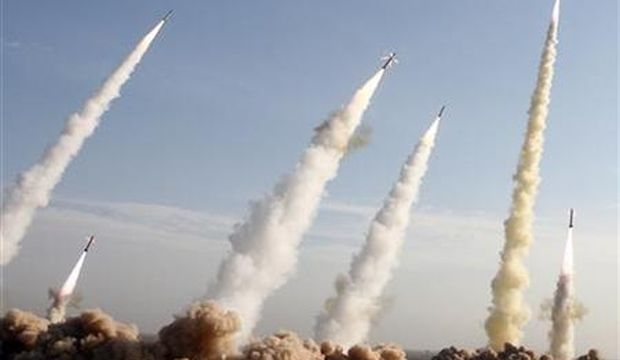
Iran is preparing a barrage of missiles to launch against Israeli military positions from Syrian territory, Hebrew media reported Sunday, citing defense officials.
Iran plans to avenge alleged Israeli strikes on its bases in Syria, Ma’ariv defense analyst Alon Ben David said, by targeting military targets in northern Israel.
As of now, Israel isn’t “on the eve of war against Iran,” he said, “but the Iranians do want revenge for their losses.”
Iran plans to use Shiite militias already deployed in Syria along with experts from Hezbollah, according to Channel 2 News military analyst Roni Daniel. The proxies would be overseen by general Qasem Soleimani, commander of the Islamic Revolutionary Guard Corps abroad.
Tensions have risen dramatically between the two arch-enemies following the infiltration of a Iranian drone into northern Israel, which the IDF says was armed and on a sabotage attack mission against the Jewish State.
Israel is said to have been preparing for a direct attack from Iran’s Revolutionary Guard Corps since mid-April in response to a strike allegedly carried out by the Jewish state against an Iranian operated airbase in Syria which killed seven IRGC soldiers.
A senior IDF official confirmed to The New York Times in late April that Israel was behind the attack, stating that the February incident “opened a new period” between the Jewish state and the Islamic Republic.
Following the strike, Ali Akbar Velayati, the top aid to Iranian Supreme Leader Ali Khamenei, warned Israel “should be waiting for a powerful response” to the strike on the airfield, saying “it will not remain unanswered.”

by Benjamin Kerstein MAY 3, 2018 1:36 PM Algemeiner
Source Link: Hezbollah ‘Settlers’ Changing Syria’s Demography Under Iranian Direction
{Settlements in Syria? Where’s the outcry from the UN? – LS}
Hezbollah “settlers” are reportedly replacing the native Syrian population as part of a conscious plan to change the country’s demographics.
Under Iranian direction, the Lebanese Shi’ite terrorist group has been fighting on behalf of Syrian dictator Bashar al-Assad’s regime since the Syrian civil war broke out in 2011. It also dominates southern Lebanon, where it has established a massive terrorist infrastructure in order to threaten Israel.
According to a column in the Lebanese paper Al-Nahar written by Ahmad Ayyash and translated by the Middle East Media Research Institute (MEMRI), Hezbollah’s “involvement in the Syria war is not confined to military action aimed at propping up the Syrian regime. [Its goals] extend much further than that, and have to do with an Iranian settlement project whose implementation began several years ago. The aim [of this project] is changing the demography [of Syria] by settling [it with members of] Iran-backed [Shi’ite] militias from Afghanistan, Lebanon, and other countries in the region.”
Ayyash accused the world of “ignoring the ongoing plan of demographic cleansing, as part of which tens of thousands of Syrians were transferred from their homes in Ghouta to northern Syria several days ago, and thousands of others left eastern Al-Qalamun, near Damascus, [as part of a move] ‘brokered by Russia,’”
“[These] tens of thousands of Syrians left their ancestral homes,” added Ayyash, “where their families had been living for generations.”
Ayyash attributed this policy directly to Iran, which is Hezbollah’s chief financier and uses the group as a proxy to influence events in Lebanon and Syria.
“The world is oblivious [to the fact] that Iran has been acting vigorously to fill the demographic vacuum [left by these Syrians],” Ayyash wrote, with Hezbollah “acting as the chief executive arm of this [project].”
Hezbollah, Ayyash asserted, was actively preventing Syrian refugees from returning to their homes. “Several weeks ago,” he says, “Al-Nahar received information that people from Al-Qusayr had appealed to the Syrian regime for permission to return to their properties in that town, and had received permission to do so. But when they reached the town, they found themselves facing Hezbollah militiamen, who are still militarily occupying the town, and who ordered them back, saying: ‘Whoever gave you permission [to return is welcome] to give you back your property.’”
The ambitions of Hezbollah’s settlement project are large, Ayyash noted. “According to the information [we received], Hezbollah is investing in developing thousands of acres in this area, known for its fertile fields, and will directly reap the profits,” he said.
“One of the most disturbing aspects of the Iranian plan in Syria,” he added, “was reported by our colleague, [Lebanese journalist] Randa Taqi Al-Din, in the dailyAl-Hayat. She cited French sources, who assessed that Hezbollah will transform from the ‘Lebanese Hezbollah’ into the ‘Syrian Hezbollah,’ because its members are currently settling in Syria along with the Iranians.”

By McKinley Corbley – May 3, 2018 Good News Network
Source Link: When a WWII Veteran Couldn’t Walk to His Wife’s Grave, Two Men Carried Him There
{Our greatest generation. – LS}
When a 96-year-old veteran was too weak to walk to his wife’s grave, he was resigned to paying his respects from the car – until two onlookers insisted on going the distance for him instead.
George Boone had been a pilot who was a prisoner of war to the Nazis during WWII. As a means of paying tribute to his services, Boone was flown from North Carolina to Washington D.C. by the Honor Flight Network – an organization that pays for veterans to visit their respective memorials at the nation’s capital.
While they were in the city, Boone asked if they could visit the grave of his late wife Alma, who was laid to rest in 2008.
Though it was technically not a stop on the Honor tour, they were more than happy to oblige.
Unfortunately, they arrived at the cemetery on Saturday only for Boone’s son Jon to realize that he had forgotten his father’s wheelchair. When he asked if his father had the strength to walk, the veteran said no.
The two Honor Flight volunteers who had escorted the father and son then offered to carry George to the grave – and though he was initially reluctant, he eventually accepted. The men made a chair with their arms and carried the veteran all the way to the resting site. For ten minutes, they held George so he could pay his respects.
One of the men was so touched by the exchange, he offered to carry George back to the car on his back.
“He said, ‘This is my honor and privilege. I’m going to carry you. Wrap your arms around my neck, I’ve got you,’” Jon recounted to CNN. “And off they went.”
“Without a doubt, it gives you so much pride to be an American,” Jon Boone said. “It’s not all what we see on the news. There are incredible people out there waiting to do good things and show acts of kindness.”

by Tyler Durden Thu, 05/03/2018 Zero Hedge
Source Link: Pentagon Accelerates Testing Of New B61 Nuclear Gravity Bomb
{Speak softly and carry a big stick. – LS}
President Donald Trump’s promises to rebuild the American nuclear arsenal are starting to bear fruit, and according to a US Air Force general update from May 1, the US has already conducted more than two dozen tests of its new B61-12 guided nuclear gravity bomb.
As Military.com reports, plans to spend over $1 trillion to modernize the US “nuclear triad” – nuclear bombers and missiles launched from land-based silos and submarines – have been fast-tracked thanks to the new Nuclear Posture Review, as well as increased military spending authorized during the Trump administration.
As discussed before, the new gravity nuke has been in development for years, but Trump’s orders have sped up testing to the point where most of the air force’s mainstay military planes have been approved to carry it. And it’s widely expected that the B-2 Spirit and the futuristic B-21 Raider will be approved to carry the B61 as well. In addition to testing the B61-12, the NPR also calls for modernizing the air-launched cruise missile and intercontinental ballistic missile components of the nuclear triad.
As it stands, the US nuclear triad consists of the submarine-launched ballistic missiles, strategic bombers, which carry both gravity bombs and cruise missiles, along with land-based ICBMs. But the B61 possess an advanced capability that its cousins don’t: Underground penetration. This allows it to strike fortified command and control centers, while its explosive yield is estimated at 50 kilotons.
“We’ve already conducted 26 engineering, development and guided flight tests,” of the B61-121 gravity bomb Lieutenant General Jack Weinstein told the Air Force Association breakfast on Tuesday. “The program’s doing extremely well,” he said. – Sputnik.
{Actually, the above quote came from Military dot Com. – LS}
Weinstein explained that the bombs are capable of being carried by the B-52 Stratofortress and B-2 Spirit, which can launch both conventional or nuclear payloads, and also legacy fighters such as the F-16 Fighting Falcon and F-15E Strike Eagle.
“When I say ‘dual-capable aircraft,’ I need to be really specific,” he said. “Dual-capable aircraft is called the B-52 and B-2 – it does conventional and nuclear. It also means F-16s and Strike Eagles, and other aircraft our NATO partners fly.”
During tests back in 2015, the F-35 flew with the B61-12 to measure its vibration in the aircraft’s weapons bay. Both of the fourth-generation fighters will be able to deploy the B61-12 bomb. The B61-12 also conducted its third and final developmental test flight aboard an F-15E in 2015.
RT points out that the US could deploy its new B61 bombs to NATO bases in Europe – something Russia says would be tantamount to a violation of the nuclear nonproliferation treaty. {Of course, RT would say such a thing. – LS}
The US isn’t the only superpower revamping its nuclear arsenal: earlier this year, Russian President Vladimir Putin shocked the world by unveiling during his annual state of the union address a new nuclear ICBM capable of evading US anti-ballistic missile defenses.
One hopes that the US Military Industrial Complex will be foiled in its attempts to put these two weapons in head-to-head combat, even if it means lower profits for shareholders.




 WarSclerotic
Recent Comments