Author Archive

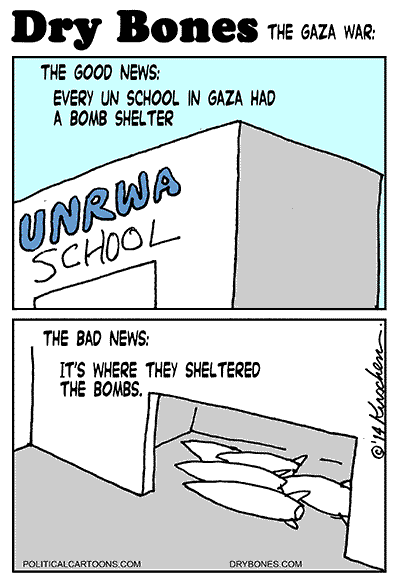
UNRWA = United Nations Rocket Warehousing Agency

August 13, 2014


United Nations Rocket Warehousing Agency (Again)

UN Rocket Warehousing Agency Logo largeDing Ding – Seconds out, Round Three! Buried (much like they hide weapons) at the end of an unrelated story on the UN site with this title: “Citing humanitarian impact, Ban warns against further escalation in Gaza conflict” we find the THIRD admission of weapons concealment by, what shall be forthwith be known as, the United Nations Rocket Warehousing Agency (UNRWA):

In a related development, UNRWA said that a cache of rockets was found today at one of its schools in central Gaza. The discovery came during a regular UNRWA inspection of the school, which was closed for the summer and not being used as a shelter. All the relevant parties have been notified. “We condemn the group or groups who endangered civilians by placing these munitions in our school,” said UNRWA spokesperson Chris Gunness. “This is yet another flagrant violation of the neutrality of our premises. We call on all the warring parties to respect the inviolability of UN property.”

As ever we have no firm idea what they did with the rockets but the chances are high they gave them back to the terrorists. Again. Here are the previous times they’ve done this: The Answer To My Question: UNRWA Supplies Weapons To Hamas Terrorists Weapons Found At UNRWA School. Again And lets not forget that Hamas likes to fire rockets from next to these schools and sometimes these go astray. Deaths In Beit Hanoun: Hamas Crime And UNRWA Cover-Up? H/t to my Facebook friend John for the new name of UNRWA.

Senators want UNRWA investigated over ‘troubling’ Gaza role

Norwegian TV 2 says many journalist have been thrown out from Gaza if they say or do things Hamas does not like

August 13, 2014

http://www.tv2.no/2014/08/10/nyheter/5887617  (Norwegian)

– Journalister blir utvist fra Gaza fordi Hamas ikke liker det de gjør

GAZA ( TV 2) Reporter Pål T. Jørgensen forteller at pressen har fått strenge restriksjoner og trusler i Gaza.

IDF successfully tests system designed to detect terror tunnels

August 12, 2014

IDF successfully tests system designed to detect terror tunnels

By JPOST.COM STAFF
08/11/2014 18:13

Senior army officer says system passed lab tests, currently undergoing field testing; could be deployed around Gaza within 1 year; system will cost at least NIS 1.5 billion.


Tunnel uncovered by IDF in Gaza , July 23 Photo: IDF SPOKESMAN’S OFFICE

A system designed to detect infiltration tunnels proved successful in laboratory tests for the first time ever and is now being tested in the field, a senior IDF officer said Monday.

If the field test proves successful, the system can be deployed around the Gaza Strip within approximately one year, the officer added.

The system will cost from NIS 1.5 billlion to NIS 2.5 billion to deploy.

The officer said that the IDF is also working to improve the Iron Dome.  It is believed that, in the future, Israel’s enemies will try to overcome the rocket defense system by launching a number of missiles and rockets at the same time, including more advanced projectiles that can reach a greater height than those previously fired from Gaza. Among the improvements being worked on is giving the Iron Dome the ability to intercept rockets over enemy territory, before they enter Israel.

The officer also touted the Trophy tank defense system for its success in saving the lives of IDF soldiers during Operation Protective Edge.

He said the Trophy system had neutralized dozens of anti-tank missiles fired at tanks and armored personnel carriers during the operation.

The officer said the defense establishment was in need of an additional NIS 3 billion in order to bolster Israel’s ground forces.

Jordan is Palestine

August 12, 2014

Jordan is Palestine

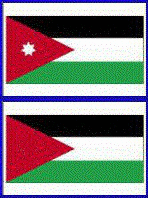
Which is Palestinian
and which is Jordanian?

On the same day Dutch politician, Geert Wilders, delivered a speech in Tel Aviv where he declared that Jordan is indeed the state of the Palestinians, the Argentinean government also made a declaration, it said it recognized a Palestinian state in pre-1967 borders of Judea, Samaria and Gaza. Both statements caused a stir in many places around the world.

PVV Dutch MP, Geert Wilders:
“Jordan is Palestine and Palestine is Jordan.”

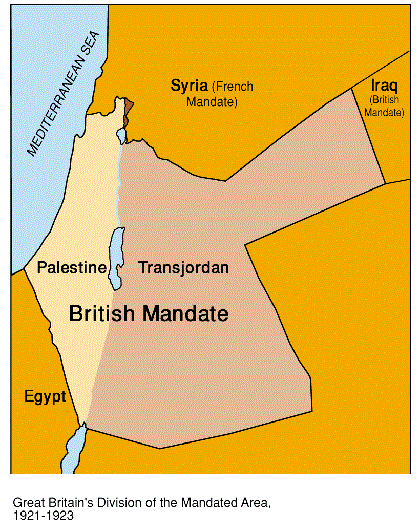
In light of the far reaching ramifications of both statements, they should be then scrutinized for their veracity and historical factuality. First of all, is Jordan a Palestinian state? When looking at the map of the British mandate for what was known then as “Palestine”, it becomes quite clear what area was originally earmarked for the Jewish homeland.

At the end of the First World War, the division of responsibilities for the administering of the Middle East areas fell to the various Western powers victorious over the Ottoman Turks, as mandates, under the auspices of the League of Nations, it was during that time that the famous Balfour Declaration was made:

November 2nd, 1917

Dear Lord Rothschild,

I have much pleasure in conveying to you, on behalf of His Majesty’s Government, the following declaration of sympathy with Jewish Zionist aspirations which has been submitted to, and approved by, the Cabinet.

“His Majesty’s Government view with favour the establishment in Palestine of a national home for the Jewish people, and will use their best endeavours to facilitate the achievement of this object, it being clearly understood that nothing shall be done which may prejudice the civil and religious rights of existing non-Jewish communities in Palestine, or the rights and political status enjoyed by Jews in any other country.”

I should be grateful if you would bring this declaration to the knowledge of the Zionist Federation.

Yours sincerely,

Arthur James Balfour

The Balfour Declaration was accepted by the British Mandate in 1917, which then became subject to a White Paper that many believe reneged on it’s earlier promise, that being a commitment to allowing Jews a homeland. But the paper did insist however that:

“the Jewish community should know that it is in Palestine as of right and not on the sufferance. That is the reason why it is necessary that the existence of a Jewish National Home in Palestine should be internationally guaranteed, and that it should be formally recognized to rest upon ancient historic connection.”

Palestine Facts states that: “The area of the Mandate was originally 118,000 square kilometers (about 45,000 square miles). In 1921, Britain took the 91,000 square kilometers of the Palestine Mandate east of the Jordan River, and created Trans-Jordan (later the Arab country of Jordan) as a new Arabprotectorate. Jews were barred by law from living or owning property east of the Jordan river, even though that land was over three-fourths of the original Mandate.”

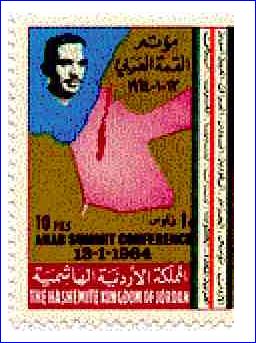
A Jordanian State stamp dating from 1964, bearing the likeness of King Hussein and pictures Mandated Palestine as an undivided territory

The Arab official line before a “two state solution” became stated policy of Israel and the West, was that the people in Trans-Jordan cum Jordan were indivisible from those Arabs inside Israel proper, Judea and Samaria. In fact there are statements by leading Arabs buttressing the notion that indeed: Jordan is Palestine and Palestine is Jordan.

This is the royal decree and sentiments of two of the kings of Jordan.

“Palestine and Jordan are one…” said King Abdullah in 1948.

“The truth is that Jordan is Palestine and Palestine is Jordan,” said King Hussein of Jordan, in 1981.

“Palestine is Jordan and Jordan is Palestine; there is only one land, with one history and one and the same fate,” Prince Hassan of the Jordanian National Assembly was quoted as saying on February 2, 1970.

Abdul Hamid Sharif, Prime Minister of Jordan declared, in 1980, “The Palestinians and Jordanians do not belong to different nationalities. They hold the same Jordanian passports, are Arabs and have the same Jordanian culture.”

What are we to conclude from this other than the historical perspective at the time, that being, they (the Arabs) saw themselves as being part of Palestine/Palestinian. Around 70%of the Jordanian population today, still see themselves as Palestinians. Even Yasser Arafat and his PLO thugs looked to Jordan as being a part of their homeland.

Abu Toameh:

When the PLO tried to establish a state-within-a-state in the kingdom in the late 60′s and early 70′s, Jordan’s King Hussein ordered the army to launch a massive assault on the refugee camps in the kingdom, massacring thousands of Palestinians in what has since become to be known as Black September.

The Palestinians who were expelled from Jordan to Lebanon later played a major role in the Lebanese civil war. Over 100,000 people are believed to have been killed in that war, which lasted for more than a decade.

Lets face facts, the three state solution has become an intractable mess, there is no room for budging on the Israeli side, every square centimeter given to these Arabs as a permanent part of a second Palestinian state, spells trouble for the Jewish state as it’s used as a launching pad for further aggression against it.

The Palestinians (which used to mean Jews in Palestine before Israel became a state) are not able to form a state for themselves, because they refuse to accept the responsibility for actually running it. They have proven themselves to be more comfortable in accepting massive amounts of foreign aid, while they continually try to chip away at Israeli legitimacy on the world stage.

Time to end the pretending that these Arabs are really serious about wanting a state of their own, and accept the fact that it’s the massive amounts of foreign aid that really interests them most, as well as the hope of one day getting rid of the highly successful  Jewish one. KGS

Ending the Israeli-Palestinian Conflict Is No Longer a Vital American Interest

August 12, 2014
By

Since the breakdown of negotiations between the Israelis and Palestinians at the end of March, the Obama administration has become openly critical of Israeli Prime Minister Benjamin Netanyahu’s government and more inclined to mediate between the parties rather than siding with one party against another. That has continued through the war in Gaza and the various calls for a ceasefire.

But as the here-and-gone-and-back-again ceasefire makes abundantly clear, the administration’s new stance has had little impact on the Israelis or the Palestinians or on the war, because it has not come as part of a concerted effort or a discernible strategy. That partly reflects administration disillusionment with the peace process, but it also reflects overall political changes in the Middle East. These changes have reduced the importance to the Obama administration, and perhaps to future American administrations, of resolving the Israeli-Palestinian conflict.

The first clear sign that the administration was displeased with Netanyahu came in Ynet reporter Nahum Barnea’s interviews in early May with senior American officials who blamed Netanyahu for the breakdown of the negotiations. Later that month, the Obama administration indicated that itwould defy the Israelis by recognizing and working with the new unity government created by Fatah and Hamas. That was a complete reversal from the administration’s stance three years ago when it joined Israel in denouncing a similar unity pact between Fatah and Hamas.

After Hamas rejected the first Egyptian-Israeli ceasefire proposal (which would have ended Israeli airstrikes and Hamas rocket attacks, allowed Israeli ground forces to destroy tunnels, and said nothing about the blockade of Gaza), Kerry worked out with Qatar and Turkey, which were representing Hamas’s interests, a new ceasefire plan that didn’t allow the Israelis to stay and that committed the two sides to renewing negotiations, originally promised in the December 2012 ceasefire, to ease the blockade, and to address “all security issues.”  The Israelis angrily rejected the proposal.

On August 6, as ceasefire talks began in Cairo, Obama endorsed Hamas’s central demand. He told a press conference that he wanted the negotiations to address the removal of the blockade. The Palestinians in Gaza, he said, needed to see “some prospects for an opening of Gaza so that they do not feel walled off and incapable of pursuing basic prosperity.” In each of these measures, the administration distanced itself from Netanyahu and the Israelis and attempted, by taking the Palestinians more into account, to play the role of honest broker between the warring parties.

None of these efforts have, however, had any effect. Obama concluded the August 6 press conference by saying that “the U.S. goal right now is to make sure the ceasefire holds,” but two days later hostilities have recommenced. The United States may, perhaps, have been unable to do anything, but it made failure almost certain by not following up any of its initiatives or by undertaking them in a surprisingly slapdash manner. After announcing in May it would recognize the new unity government, and advising it on its membership, the administration sat by while the Netanyahu government used the kidnapping and murder of three Israeli teenagers to round up Hamas’s leadership and supporters in the West Bank. The move was clearly aimed at undermining the unity government.

When the war between Israel and Hamas broke out in July, Kerry was in China. Instead of cutting short his visit and attempting to secure a ceasefire, as Secretary of State Hillary Clinton had done in November 2012 when fighting erupted in Israel and Gaza during her visit to Cambodia, Kerry allowed Egyptian President Abdel Fattah el-Sisi, a sworn enemy of the Muslim Brotherhood, of which Hamas is a wing, to work out a cease-fire agreement with Netanyahu that Hamas was bound to reject.

When Kerry finally swung into action after Hamas rejected the cease-fire proposal, he worked out a proposal with Qatar and Turkey without consulting Egypt, the Israelis, or Mahmoud Abbas and the Palestinian Authority. Kerry’s proposaland the way he had gone about framing itwas criticized not just by the Israelis but by the Palestinian Authority and Egyptians. Ha’aretz diplomatic correspondent Barak Ravid, no fan of Netanyahu’s, wrote that Kerry’s “conduct in recent days over the Gaza ceasefire raises serious doubts over his judgment and perception of regional events. It’s as if he isn’t the foreign minister of the world’s most powerful nation, but an alien, who just disembarked his spaceship in the Middle East.”

Sadly, the story doesn’t end there. After having played little role in the recent 72-hour cease fire proposal, Kerry declined to participate personally in the Cairo talks, leaving a senior aide to represent the United States. The obvious contrast, of course, was with former Secretary of State Henry Kissinger who in similar circumstances might have been shuttling frantically among all the interested parties, but Kerry’s and the Obama administration’s conduct in Gaza even contrasts with that of Obama and former Secretary of State Hillary Clinton in November and December of 2012. It’s not as if Kerry and Obama were space aliens, but that the events in Gaza seemed to appear to them as happening on another planet and requiring only intermittent attention. What has happened?

One obvious reason for Obama and Kerry’s growing indifference is their failure to spur negotiations between Netanyahu and Abbas. Obama gave up in May 2011. He allowed Kerry to try his luck during the last twelve months, but he didn’t participate actively himself. Obama doesn’t like to take initiatives that might fail. And he and Kerry now appear to regard the Israeli-Palestinian conflict as irredeemable and irresolvable. But there are also broader geopolitical factors in play.

In the past, when American presidents and secretaries of state lent their time and prestige to resolve the Israeli-Palestinian conflict, it was because they were concerned about American relations with Israel’s neighbors. Earlier, it was also because of the U.S.-Soviet rivalry in the Middle East. Henry Kissinger’s shuttle diplomacy was motivated by preventing another Saudi-led oil boycott (which was originally provoked by American aid to Israel during the 1973 Yom Kippur War). Kissinger also wanted to keep Egypt in the American Cold War camp. George H.W. Bush initiated the Madrid conference on the conflict in 1991 as part of a pledge to Arab countries whose support he solicited in the first Persian Gulf War.

Similarly, George W. Bush participated in the Quartet and endorsed a two-state solution as part of the effort to solidify Tony Blair’s support and Saudi acquiescence in invading Iraq. And Bush and Obama during his first term were concerned that the continuation of the Israeli-Palestinian conflict was recruiting followers to Al Qaeda and its allied groups in the Middle East and North Africa. In addition, Obama was under pressure to intervene in November 2012 from Egyptian President Mohamed Morsi, who was sympathetic to Hamas as a branch of the Muslim Brotherhood. There were strong regional and even global reasons for intervening in each of these cases. But these factors are not so much in play anymore.

The pressure from surrounding Arab states to resolve the conflict has eased, particularly in the wake of the failure of the Arab Spring. Lebanon, Syria, and Iraq are preoccupied with their own internal problems. Egypt’s el-Sisi is more sympathetic to Netanyahu than to Hamas’s Khalid Mishal. The Saudis are still committed to their own initiative for resolving the conflict, but like el-Sisi, have no affection for Hamas. And the threat of terrorism in the regiontypified by Islamic State in Iraq and Syriais no longer so clearly tied to the continuation of the Israeli-Palestinian conflict. So while the surrounding Arab states are always under public pressure to end Israeli attacks against Palestinians, Arab leaders have not displayed the same urgency.

The pressure that existed in 1975 or even 2005 doesn’t exist. As a result, Obama and Kerry do not feel the same urgency to act. In Iraqwhere the world’s oil supply is threatenedthey might feel urgency, but not in Israel and Gaza, no matter how dreadful the war’s humanitarian consequences. In the language of diplomacy, ending the Israeli-Palestinian conflict is no longer a vital interest for America.

Opinion: No Longer an Arab–Israeli Conflict (This is the original)

August 12, 2014
Written by :
on : Monday, 11 Aug, 2014

Opinion: No Longer an Arab–Israeli Conflict

The war in Gaza is the second stage of a process of change regarding the nature of what used to be called “the Arab–Israeli conflict.” The first stage was the conflict between Israel and Hezbollah in 2006, in which Iran, a non-Arab state, fought Israel in a proxy war via Hezbollah. The weapons, financing and training of Hezbollah is Iranian. In the recent conflict Iran has also backed both Hamas and Palestinian Islamic Jihad, as well as the leaders of both organizations, Khaled Mishal and Ramadan Shalah, who have consulted closely with Tehran. While Iran was the main player in the war of 2006, what is new this time around is that Turkey has been brought in, through an alliance with Qatar, as political backup for Hamas and as the regional sponsor of the Muslim Brotherhood.

The nature of the conflict has also changed from conventional warfare, where the armies of opposing states face each other on the battlefied, to asymmetrical warfare, where armies fight guerrilla battles against political movements in cities. The conflict that was between Arab states against Israel, and led to wars in 1948, 1967, and 1973, with the outcome of the latter leading to peace between Egypt and Israel, is no longer a reality. Israel’s wars now are with movements such as Hezbollah and Hamas, not with Arab states, and the patrons of these movements—Iran and Turkey—are obviously non-Arab.

The relative disengagement of Arab states and the anti-Hamas rhetoric in the Arab, and especially the Egyptian, media suggest a sea-change in public perception of the conflict throughout the Arab world. The anti-Turkey, anti-Iran, anti-Hamas, anti-Qatar, and anti-Brotherhood rhetoric makes the current conflict look like an Israel/Hamas–Turkey–Iran–Qatar one, with the rest of the Arab world’s support existing only on Twitter and other social media forums.

Qatar, the only Arab country actively supporting Hamas, has been isolated from the rest of the Gulf states for the last three months, after Saudi Arabia, the UAE and Bahrain withdrew their ambassadors from Doha. Thus what used to be called an Arab–Israeli conflict is no more. What does this mean and what are its implications for wider regional stability?

In the past, Israel’s strategy has been to narrow the scope of the conflict and downscale it from an Arab–Israeli conflict to a Palestinian–Israeli conflict. In fact, the strategy looked like it was working until the recent Gaza war. Israel managed not only to make it a Palestinian–Israeli conflict, but also a war against only one faction of the Palestinian movement, Hamas, on the narrowest piece of Palestinian territory, Gaza. But the involvement of both Turkey and Iran has had the opposite effect. The conflict has been widened and regionalized rather than reduced as Israel intended.

The conflict in now regionalized at the geopolitical level, with Iran and Turkey directly involved through their backing Hezbollah and Hamas respectively. The conflict has also become religious in nature rather than ethnic, especially after the Israeli government insisted on the Jewish identity of their state. The conflict has also become more sectarian on the Arab side due to the new rift within Islam between Shi’ite and Sunni Muslims.

The involvement of moderate Sunni Arab states is one of nothing more than providing a forum for negotiation between Israel and the Palestinians in Cairo, or in the case of the Gulf states, providing aid for reconstructing Gaza or southern Lebanon.

Out of this, there is some good news and some bad news. The bad news is that the widening of the conflict has contributed to greater instability across the region. The recent Gaza war made Hamas, not the PLO, the darling of the radical Arab street, in much the same way that the 2006 war between Israel and Hezbollah made Hassan Nasrallah an Arab hero. This empowers political movements rather than states, and fuels greater violence throughout the region. The Islamic State of Iraq and Syria is just the most recent manifestation.

The good news, however, is that if Israel wants to strike a grand deal with the Arabs, now is the time to do it. Arab states are in their weakest political positions for a long time, and given their internal political upheavals they are ready to sign a comprehensive deal. The biggest obstacle here, however, is the Israeli side. Can Israel produce a Sadat-like figure willing to make a daring move in the same way the late Egyptian president did, by going to Cairo or Riyadh and signing a comprehensive deal? Perhaps an even more daring move would be to go to Tehran. The ball is firmly in Israel’s court now.

Swedish politician quits after ‘Jewish pigs’ slur online

August 12, 2014

Politician quits after 'Jewish pigs' slur online

A soldier near Gaza. Photo: Tsafrir Abayov/TT

Politician quits after ‘Jewish pigs’ slur online

Published: 05 Aug 2014 11:28 GMT+02:00
Updated: 05 Aug 2014 14:28 GMT+02:00

Omar Omeirat, Social Democrat candidate for the town council of Filipstad, central Sweden, gave a speech in the town on Friday evening advocating diversity and openness.

On Saturday he sang a very different tune.

“The entire Muslim world is sitting and watching while our brothers and sisters in Palestine are slaughtered by the Jewish pigs,” Omeritat wrote on his Facebook page.

“May Allah strengthen those who defend Palestine, and be merciful towards the dead Muslims. Amen.”

His Facebook page also included a flag used by the Islamist group Isis, local paper NWT reported.

The post quickly became public knowledge, and the young politician came under fire for his choice of words.

“I called Omar about what he had written, and he said that he had watched a film where Palestinian women and children were murdered by Jews,”  Åsa Hååkman Feldt, Social Democrat spokeswoman in Filipstad, told The Local.

Omeirat quickly regretted the post, and updated his Facebook status to an apology.

“He never meant to judge people who are Jews, Christians, or anything else,” Feldt explained. “He just meant to judge Israel as a state.”

On Tuesday it was announced he would be stepping down from his position.

“I regret what I said,” Omeirat told Sveriges Television. “It was the wrong choice of words and no one should say something like that.”

Feldt confirmed that Omeirat had decided to leave politics, and said it was entirely his own choice.

“Of course we condemn his statement,” Feldt told The Local. “But it is Omar himself who has decided that he should take the consequences for his actions and leave the party.”

Feldt called the situation “unusual”, saying that the most common reason to step down is sickness. She explained that the town’s voting slips are already printed and that Omeirat’s name will still be on the list, but that he will not be eligible for a position in autumn elections.

“You really have to think about what you write on Facebook, especially as a politician,” Feldt added. “It’s a public record and there are consequences.”

Last month Social Democrat party leader Stefan Löfven was criticized for expressing his thoughts about Gaza, when he wrote on Facebook that “Israel has the right to defend itself”.

—-


Löfven: Israel has the right to defend itself

Stefan Löfven meets a member of the Jewish community to discuss anti-Semitism during a recent visit to Malmö. Erika Oldberg/TT

Löfven: Israel has the right to defend itself

Published: 13 Jul 2014 14:31 GMT+02:00
Updated: 13 Jul 2014 14:31 GMT+02:00

The election favourite posted the comment on Saturday night and within minutes he was on the receiving end of angry replies from users of the social network.

“Israel must respect international law but obviously has the right to defend itself. It is a huge tragedy that the violence escalates,” Löfven wrote.

Most of the comments were critical of the political party leader’s stance with one user posting; “Israel kills right now Palestinian children every day. Is that self-defence?”

Several other people said they had no intention in voting for Löfven in September following the remark.

Others said he was letting the Social Democrats down by not maintaining the stance of the late Olof Palme and Anna Lindh, who were critical of Israel when they were in office.

“It is fairly modest wording but that makes no difference, it is an issue where there is only room for two opinions,” political scientist Stig-Björn Ljunggren told Aftonbladet.

Löfven’s comment appears to clash with a statement released by the Social Democrats’ foreign policy spokesperson Urban Ahlin. In a press release issued on Thursday Ahlin stated that the party needed to be clear in its reaction against the Israeli bombing of Gaza.

He also condemned the Hamas rocket fire against Israel and called for a peaceful two-state solution.

“It’s very surprising (what Löfven wrote) as it differs from what the party’s foreign policy spokesperson Urban Ahlin said the other day,” Ulf Bjereld, a professor of political scientist at Gothenburg University, told Aftonbladet.

On Saturday several demonstrations were held across Sweden in protest over the Gaza bombings. A manifestation in Stockholm attracted over a 1,000 people with many carrying signs which were critical of Israel.

At the time of writing Löfven’s post has attracted more than 2,300 comments. He has yet to speak publicly on the furore surrounding his remark.

The Local/pr

We Support You: CUFI Visits Israel’s ‘Rocket Town’

August 11, 2014

Israel Palestine Conflict: Female Soldiers Shell Gaza Every 2 Minutes

August 11, 2014

Iraqi president to push out al-Maliki, names new P.M.

August 11, 2014