Author Archive

US Navy nabs Iranian missile shipment to Houthis in Arabian Sea 

February 14, 2020

Source: US Navy nabs Iranian missile shipment to Houthis in Arabian Sea | The Times of Israel

US military says 150 anti-tank guided missiles and three surface-to-air weapons found on small vessel headed to Yemen

The United States military said Thursday it had seized an Iranian weapons shipment on a small sailing vessel in the Arabian Sea that was bound for Houthi rebels in Yemen.

The weapons showed signs of Iranian “design and manufacture,” according to a Reuters report.

They included 150 anti-tank guided missiles as well as three surface-to-air missiles.

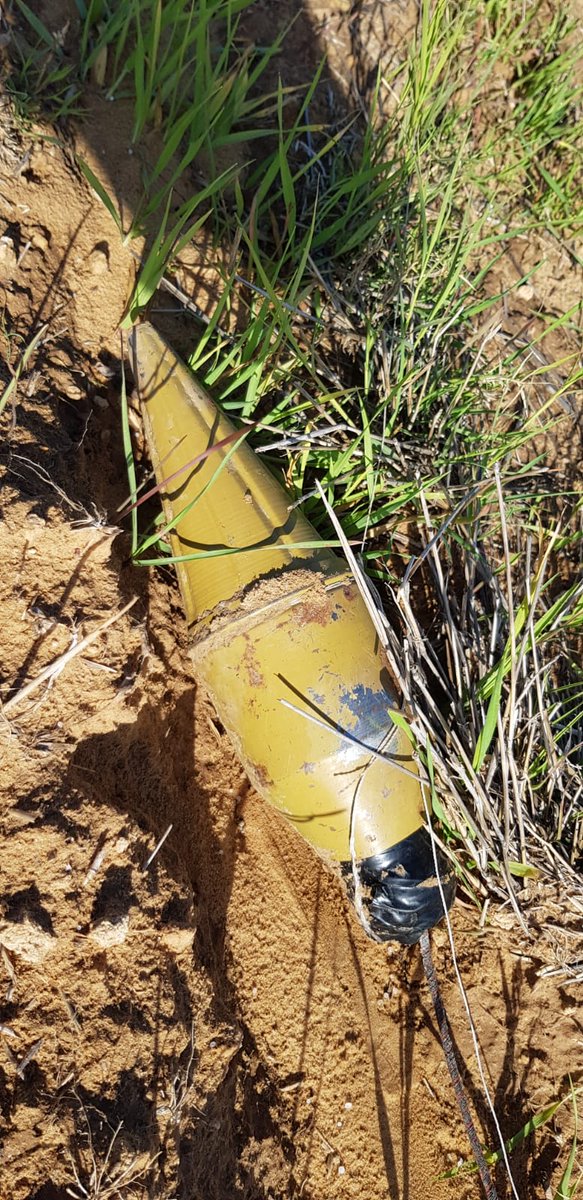
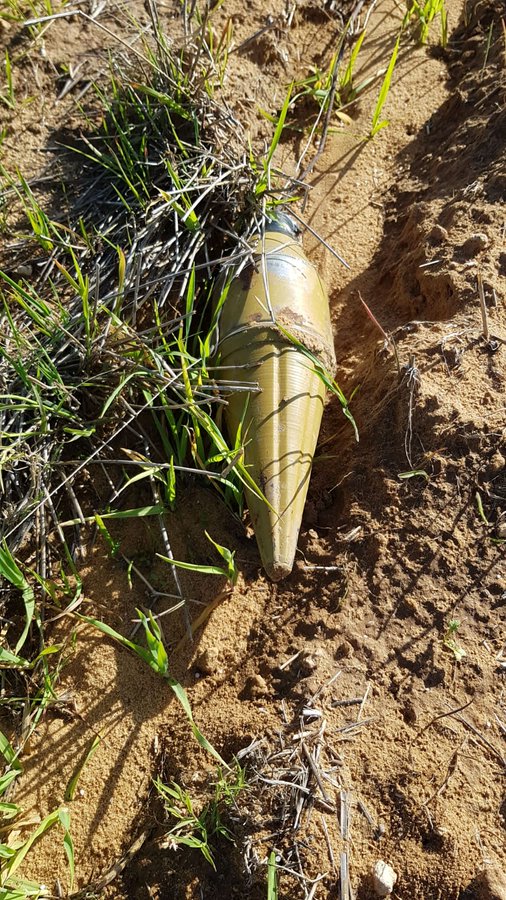
According to the US Navy, sailors from the USS Normandy, a missile cruiser, boarded a dhow bound for Yemen in the Arabian Sea and discovered “150 ‘Dehlavieh’ anti-tank guided missiles (ATGM), which are Iranian-manufactured copies of Russian Kornet ATGMs.

The US Navy guided-missile cruiser USS Normandy (CG-60) underway in the Atlantic Ocean on February 16, 2018 as part of the Harry S. Truman Carrier Strike Group (HSTCSG) while conducting its composite training unit exercise (COMPTUEX). (Wikipedia/US Navy photo by Mass Communication Specialist 2nd Class Scott Swofford/public domain)

“Other weapons components seized aboard the dhow were of Iranian design and manufacture and included three Iranian surface-to-air missiles,” the statement said.

The weapons were “identical” to those seized in a similar operation last November by the USS Forrest Sherman.

The Houthi rebels in Yemen have maintained close ties to Iran, which has provided them with weapons, training and financial support.

The US has consistently accused Iran of illegally smuggling arms to the Houthis, and has seized numerous weapons shipments in transit in recent months.

Iranian weapons smuggling into Yemen violates two UN Security Council resolutions, one that prohibits Iran from shipping weapons outside its border, and another that prohibits supplying weapons to the Houthis amid Yemen’s prolonged and bloody civil war.


US Senate votes to restrain Trump’s military powers against Iran

February 14, 2020

Source: US Senate votes to restrain Trump’s military powers against Iran | The Times of Israel

Democratic sponsor of measure, which picks up support of 8 Republicans, says it is aimed at reasserting Congress’ authority to declare war; House can take up bill later this month

US President Donald Trump speaks during a meeting with Ecuadorian President Lenin Moreno in the Oval Office of the White House, February 12, 2020, in Washington. (AP Photo/Evan Vucci)

US President Donald Trump speaks during a meeting with Ecuadorian President Lenin Moreno in the Oval Office of the White House, February 12, 2020, in Washington. (AP Photo/Evan Vucci)

WASHINGTON (AP) — The Senate approved a bipartisan measure Thursday limiting US President Donald Trump’s authority to launch military operations against Iran.

The measure, authored by Democratic Senator Tim Kaine of Virginia, says Trump must win approval from Congress before engaging in further military action against Iran. Eight Republicans joined with Democrats to pass the resolution by a 55-45 vote.

Kaine and other supporters said the resolution was not about Trump or even the presidency, but instead was an important reassertion of congressional power to declare war.

While Trump and other presidents “must always have the ability to defend the United States from imminent attack, the executive power to initiate war stops there,” Kaine said. “An offensive war requires a congressional debate and vote.”

The Democratic-controlled House passed a separate, nonbinding war powers resolution last month. The House could take up the Senate resolution later this month, said House Majority Leader Steny Hoyer.

Two-thirds votes in the House and GOP-run Senate would be needed to override an expected Trump veto.

Democratic Senator Tim Kaine of Virginia, joined at left by Republican Senator Mike Lee of Utah, meets with reporters just after the Senate advanced a resolution asserting that US President Donald Trump must seek approval from Congress before engaging in further military action against Iran, at the Capitol in Washington, February 12, 2020. (AP Photo/J. Scott Applewhite)

Answering a claim by some of Trump’s supporters and Trump himself that the measure would send a signal of weakness to Iran and other potential adversaries, Kaine said the opposite was true.

“When we stand up for the rule of law — in a world that hungers for more rule of law — and say ‘this decision is fundamental, and we have rules that we are going to follow so we can make a good decision,’ that’s a message of strength,” Kaine said.

Republican Senator Mike Lee of Utah agreed. Lee supports Trump’s foreign policy, including toward Iran, but said Congress cannot escape its constitutional responsibility to act on matters of war and peace.

“What the American people and the entire world will see from the debate we’re about to have in the Senate is that there is abundant support for the United States taking tough positions with regard to Iran,” Lee said Wednesday. “And as part of that we want to make sure that any military action that needs to be authorized is in fact properly authorized by Congress. That doesn’t show weakness. That shows strength.”

The principle of congressional approval is established for an important reason, Kaine said. “If we’re to order our young men and women… to risk their lives in war, it should be on the basis of careful deliberation by the people’s elected legislature and not on the say-so of any one person.”

Trump disputed that, arguing in two tweets Wednesday that a vote against Kaine’s proposal was important to national security and pointed to the January 3 drone strike that killed Iran’s top general, Qassem Soleimani.

“We are doing very well with Iran and this is not the time to show weakness. Americans overwhelmingly support our attack on terrorist Soleimani,” Trump said. “If my hands were tied, Iran would have a field day. Sends a very bad signal. The Democrats are only doing this as an attempt to embarrass the Republican Party. Don’t let it happen!”

Tehran responded to the US attack on Soleimani by launching missiles at two military bases in Iraq that house American troops. The attack caused traumatic brain injuries in at least 64 US soldiers, the Pentagon said.

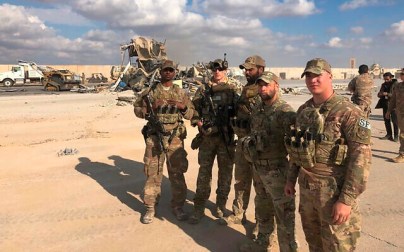
US soldiers stand at a site of Iranian bombing at Ain al-Asad air base in Anbar, Iraq on January 13, 2020. (AP Photo/Qassim Abdul-Zahra)

Democrats and Republicans alike criticized a briefing by the Trump administration shortly after the drone strike, saying US officials offered vague information about a possible attack being planned by Iran but no substantial details.

Kaine has long pushed for action reasserting congressional power to declare war. At Republicans’ request, he removed initial language that targeted Trump in favor of a generalized statement declaring that Congress has the sole power to declare war. The resolution also directs Trump to terminate use of military force against Iran or any part of its government without approval from Congress.

Republican Senator Susan Collins of Maine, a co-sponsor, called the resolution “much needed and long overdue.” She said that over the past decade, “Congress has too often abdicated its constitutional responsibility on authorizing the sustained use of military force.”

Senate Majority Leader Mitch McConnell and many other Republicans opposed the resolution, saying it would send the wrong message to US allies.


Iran Guards commander threatens to hit Israel, US if ‘slightest error’ made

February 14, 2020

Source: Iran Guards commander threatens to hit Israel, US if ‘slightest error’ made | The Times of Israel

Threat comes in response to Times of Israel report Defense Minister Bennett said US agreed to counter Iran in Iraq, while Israel fights it in Syria

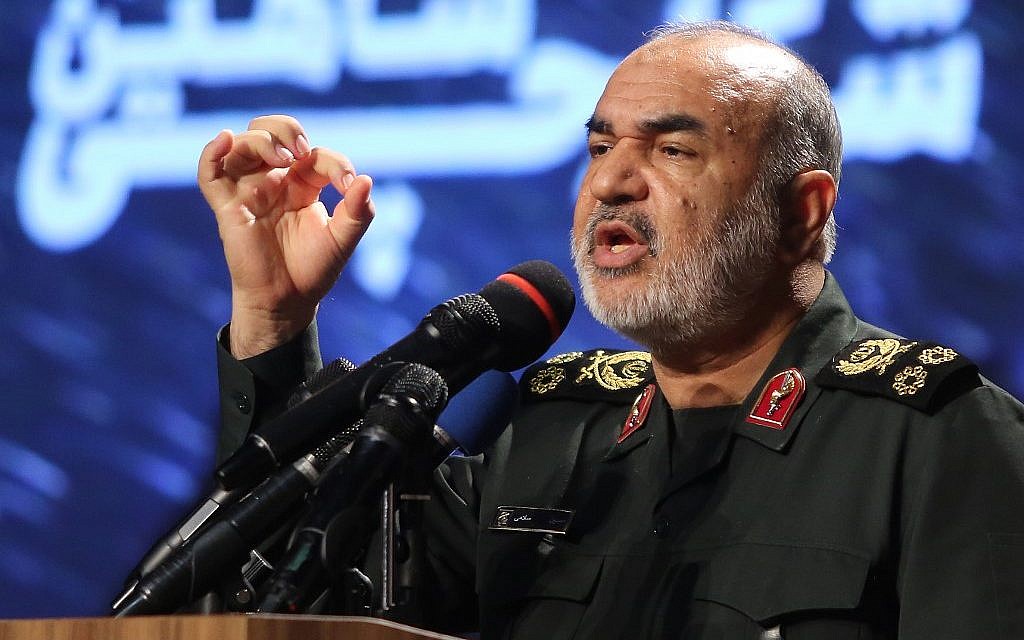
Iranian Revolutionary Guards commander Maj. Gen. Hossein Salami speaks at Tehran's Islamic Revolution and Holy Defense museum, during the unveiling of an exhibition of what Iran says are US and other drones captured in its territory, on September 21, 2019. (Atta Kenare/AFP)

Iranian Revolutionary Guards commander Maj. Gen. Hossein Salami speaks at Tehran’s Islamic Revolution and Holy Defense museum, during the unveiling of an exhibition of what Iran says are US and other drones captured in its territory, on September 21, 2019. (Atta Kenare/AFP)

The commander of Iran’s Islamic Revolutionary Guard Corps on Thursday threatened to target both Israel and the United States if they make an “error.”

Iranian Major General Hossein Salami, who made the comment in a speech broadcast live on state TV, was responding to a report by The Times of Israel on recent remarks by Defense Minister Naftali Bennett.

Bennett said at a campaign event at a synagogue on Saturday that Jerusalem and Washington have agreed Israel will be in charge of countering Iranian influence in Syria, while the US will do so in Iraq.

Salami said that in light of that remark, Iran will view both countries as responsible in case of military action against it.

“If you make the slightest error, we will hit both of you,” he said, according to Reuters.

He also warned Israel not to rely on the United States, Iran’s Press TV reported.

“You should [instead] definitely look to the sea because that is going to be your eventual residing place,” he was quoted as saying.

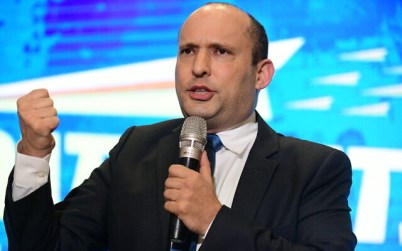
Defense Minister Naftali Bennett attends the campaign launch of his right-wing Yamina party on February 12, 2020 (Tomer Neuberg/Flash90)

Salami was speaking at a ceremony to mark 40 days since the death of IRGC Quds Force commander Qassem Soleimani, who was killed alongside Iraqi militia leader Abu Mahdi al-Muhandis on January 3 by a US airstrike in Baghdad.

Earlier Thursday, a spokesman for the IRGC warned the US that the killing of Soleimani will lead to the “liberation” of Jerusalem.

“The cowardly and craven assassination of commander Soleimani and Abu Mahdi al-Muhandis by the Americans will lead to the liberation of Jerusalem by the grace of God,” Brig. Gen. Ramazan Sharif was quoted as saying by the Tasnim news agency.

Sharif said Soleimani’s mission was to support armed opposition to Israel.

“His martyrdom, too, was also a help to that cause,” Sharif said, according to the Mehr news agency.

Senior Revolutionary Guard commander Gen. Qassem Soleimani, center, attends a meeting with Supreme Leader Ayatollah Ali Khamenei (not seen) and Revolutionary Guard commanders in Tehran, Iran, September 18, 2016 photo. (Office of the Iranian Supreme Leader via AP)

Iran has repeatedly threatened Israel over Soleimani’s killing in recent weeks.

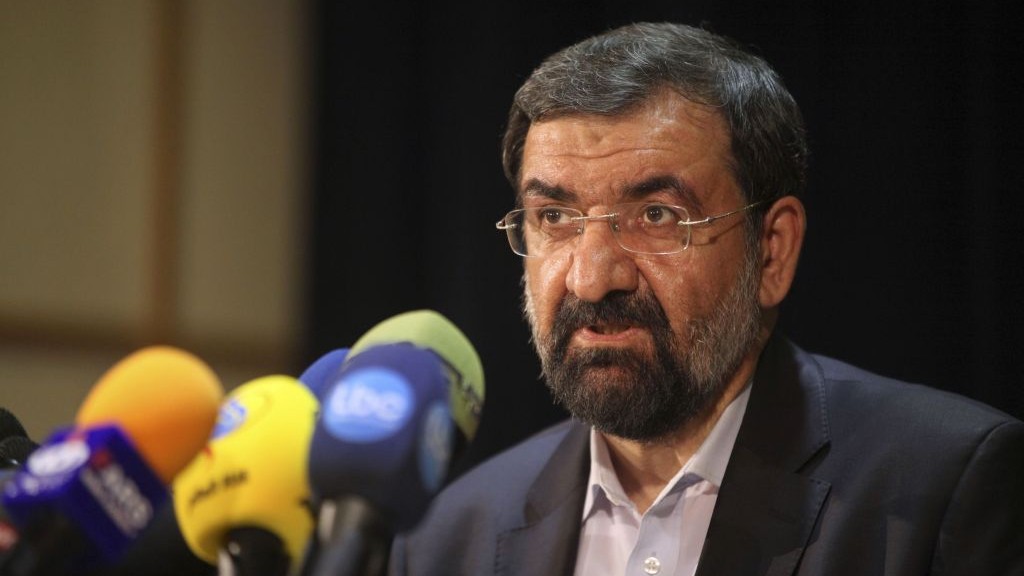
Over the weekend, former IRGC head Mohsen Rezaei told Lebanon’s Hezbollah-affiliated al-Mayadeen TV station that Iran is just looking for an excuse to attack Israel and “raze Tel Aviv to the ground.”

“If they [the US] do something, we can use it as a pretext to attack Israel, because Israel played a role in the martyrdom of General Soleimani,” he said, blaming Israel for tipping off the Americans to Soleimani’s location.

Mohsen Rezaei (MEMRI screenshot)

Rezaei, the secretary of Iran’s powerful Expediency Council, is considered a top politician and an adviser to Supreme Leader Ayatollah Ali Khamenei.

In January, he threatened that Iran would destroy Haifa and “Israeli military centers” in revenge for Soleimani’s killing.

Following an Iranian missile attack on a US base in Iraq and repeated Iranian threats, Prime Minister Benjamin Netanyahu warned Tehran against attacking Israel.

“We’re standing steadfast against those who seek our lives. We’re standing with determination and with force. Whoever tries to attack us will receive a crushing blow in return,” he declared last month at a conference in Jerusalem.


UAE reportedly held talks with Iran behind Washington’s back in September 

February 14, 2020

Source: UAE reportedly held talks with Iran behind Washington’s back in September | The Times of Israel

Secret meeting was part of Emirati effort to cool regional tensions amid escalating Middle East violence, alarmed American officials, according to NY Times report

Mourners attend a funeral ceremony for Iranian Gen. Qassem Soleimani and his comrades, who were killed in Iraq in a U.S. drone strike on Friday, at the Enqelab-e-Eslami (Islamic Revolution) square. in Tehran, Iran, Jan. 6, 2020. (AP Photo/Ebrahim Noroozi)

Emirati and Iranian officials held secret talks in the UAE capital of Abu Dhabi in September in an effort to cool Middle East tensions amid escalating violence between Tehran and Washington, according to a Thursday report.

The meeting in the UAE, a key US ally, was held behind Washington’s back, and alarmed the White House and American security officials when their intelligence agencies found out about it, The New York Times reported.

The US National Security Council convened a meeting following the revelation, worrying that Washington’s regional effort to oppose Iran could be falling apart.

The UAE is a firm ally to the US in the region, and had encouraged Washington to take an assertive stance against Tehran.

The secret meeting came amid the Trump administration’s “maximum pressure” campaign of financial measures aimed at curbing Iranian aggression and nuclear ambitions. Instead of bowing to the pressure, Iran launched attacks in several countries on oil installations, fuel tankers, and US forces.

Iran sought to use the attacks to harm international oil trade, and increase prices for the US, in response to the American sanctions.

Iran also wanted to punish supporters of the US policies, and believed that US President Donald Trump had no interest in furthering American military involvement in the Middle East.

Tehran also stepped up cyber attacks against the US and its Middle Eastern allies in response to the oil sanctions, the report said.

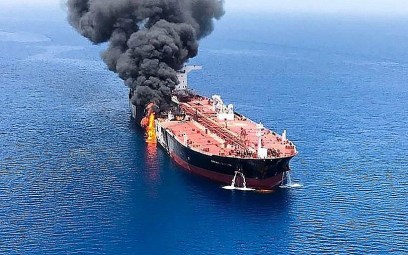
A picture obtained by AFP from Iranian News Agency ISNA on June 13, 2019, shows fire and smoke billowing from a tanker said to have been attacked in the waters of the Gulf of Oman, near the Strait of Hormuz. (ISNA/AFP)

The Iranian military response ran in tandem to a diplomatic offensive by Iranian Foreign Minister Mohammad Javad Zarif, and was headed by general Qassem Soleimani.

Zarif and Soleimani met weekly to coordinate their efforts, and met before and after Zarif visited foreign countries, Zarif said in a recent interview.

The meeting in Abu Dhabi appeared to be a setback for a vision of the region pushed by the Trump administration, and Prime Minister Benjamin Netanyahu, of a unified front against Iran consisting of the US, Israel and some Sunni-majority countries.

Iranian officials, including Vice President Eshaq Jahangiri, in August weighed entering talks with the US in exchange for sanctions relief, although its military continued its campaign with strikes on oil facilities in Saudi Arabia in September, the report said.

Trump refrained from taking direct military action following the attack, instead sending US troops to Saudi Arabia.

In this photo taken on a trip organized by the Saudi information ministry, a man stands in front of the Khurais oil field in Khurais, Saudi Arabia, September 20, 2019, after it was hit in a September 14 missile and drone attack blamed on Iran. (AP Photo/Amr Nabil)

Washington’s inaction prompted doubt about its commitment in its Middle East allies, including the Emiratis, especially after Trump’s firing in September of National Security Adviser John Bolton, who long advocated for a tough stance against Iran.

The UAE concluded that it could step in to lessen tensions in the region with the talks. Saudi Arabia also weighed negotiating with Iran through intermediaries in Iraq or Pakistan, with Soleimani reportedly acting to facilitate talks with both countries.

On a trip to Israel in October, US Secretary of State Mike Pompeo held a briefing with Mossad chief Yossi Cohen, who told Pompeo that Iran was moving toward its goal of breaking apart the US-led front.

The gradual escalation, with both sides expecting the other to step back, led to the shocking US killing of Soleimani on January 3, and Iran’s direct attacks on bases housing US troops in Iraq, a measure Tehran had previously avoided.

The attack caused traumatic brain injuries in 109 US soldiers, the Pentagon said.

Both US and Israeli intelligence believe that Iran will remain on course rather than entering talks, despite the sanctions and killing of Soleimani, the report said.

On Thursday, Trump’s ability to hit Iran was curtailed by a bipartisan Senate measure that says Trump must win approval from Congress before engaging in further military action against Iran. Eight Republicans joined with Democrats to pass the resolution by a 55-45 vote.

The Democratic-controlled House passed a separate, nonbinding war powers resolution last month.


4 Iranians, 3 Syrians said killed in Damascus strikes; PM: Maybe Belgium did it

February 14, 2020

Source: 4 Iranians, 3 Syrians said killed in Damascus strikes; PM: Maybe Belgium did it | The Times of Israel

Late night attack reportedly hits weapons sent from Tehran, Syria accuses Israel of conducting raid; Netanyahu: ‘Perhaps it was the Belgian air force’

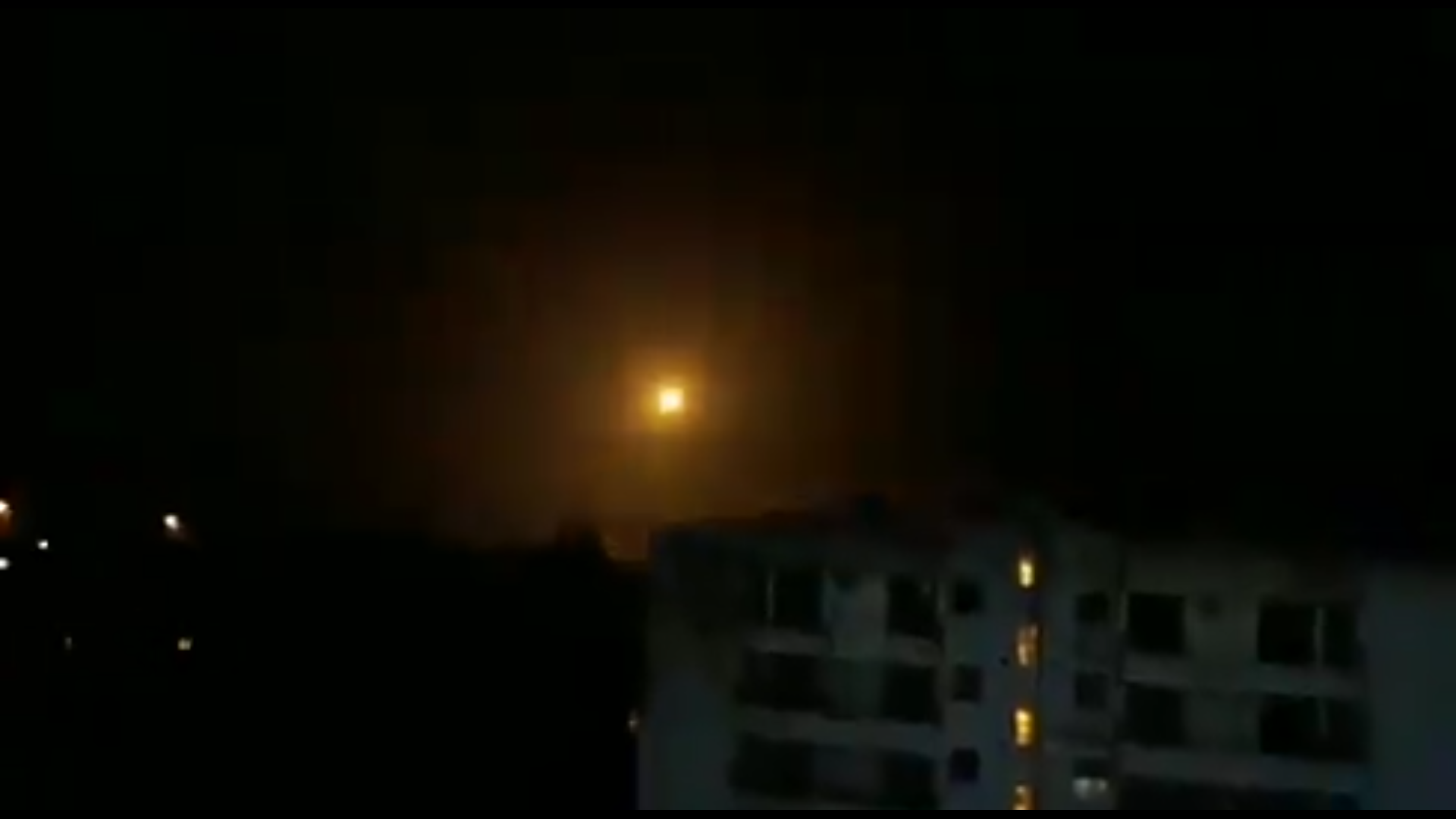
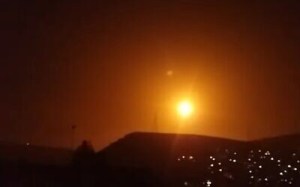
A Syrian anti-aircraft missiles shoots across the sky near Damascus during an attack on a target near the capital on February 13, 2020. (Screen capture: social media)

A Syrian anti-aircraft missiles shoots across the sky near Damascus during an attack on a target near the capital on February 13, 2020. (Screen capture: social media)

Four members of Iran’s Islamic Revolutionary Guard Corps and three Syrian soldiers were killed in airstrikes around Damascus late Thursday night which Syria attributed to Israel, according to a Britain-based Syrian civil war monitor.

At approximately 11:45 p.m., incoming missiles struck five weapons depots near Damascus International Airport, including an attack on a military position south of the Syrian capital, the al-Arabiya news channel reported, citing unidentified sources.

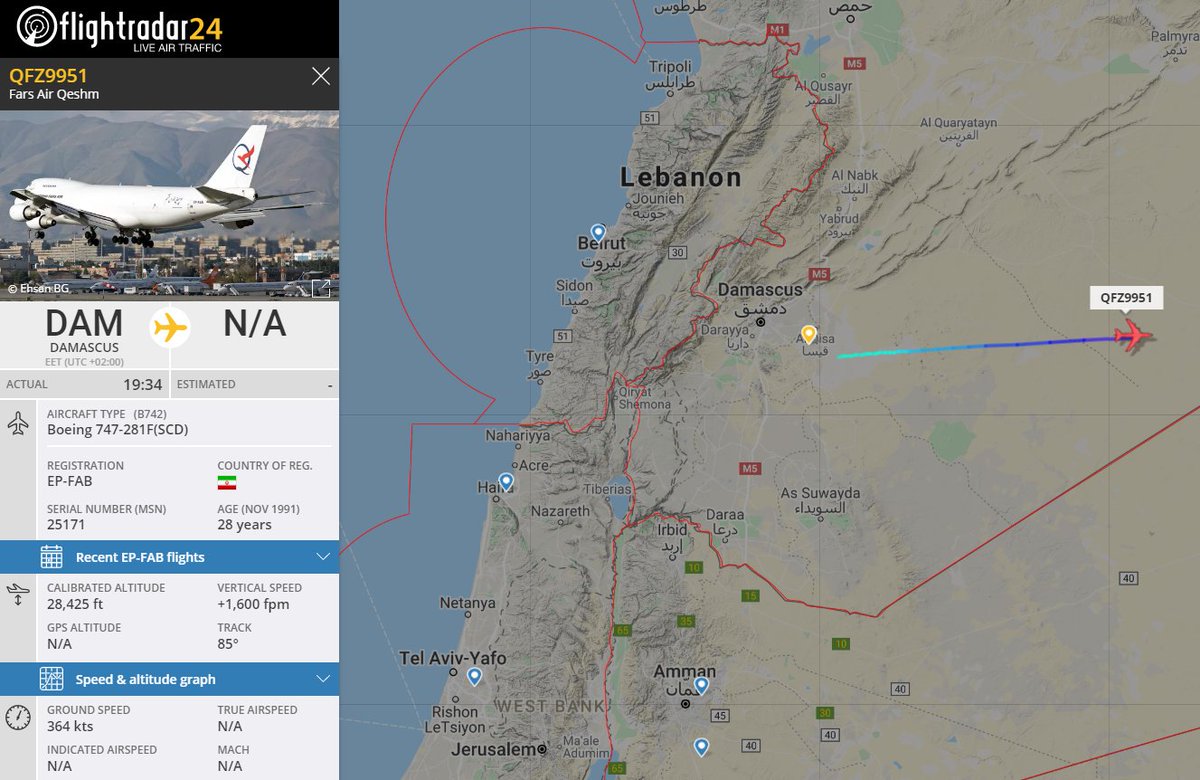
The attack came hours after a shipment — reportedly of munitions — arrived at the airport from Tehran, according to flight data.

The Syrian Observatory for Human Rights monitor reported that in total seven people were killed in the strikes, four of them from the IRGC and three from the Syrian military.

Gerjon | חריון@Gerjon_

After a quick stop (landing after 16:13, taking off before 17:39 UTC – Less than 1.5 hours!) Iranian IRGC-linked EP-FAB is already on the way back out, now .

Because night time, that’s when the air strikes happen.

View image on Twitter

Both Syria and the Observatory said Israel was behind the strike. The Israeli military did not comment on the matter, in accordance with its long-standing policy of neither confirming nor denying such operations abroad.

Asked about Israel’s alleged involvement in a Friday morning interview to Radio Haifa, Prime Minister Benjamin Netanyahu said: “I don’t comment on one operation or another.

“I don’t know what happened at night. Maybe it was the Belgian air force,” he quipped.

Videos posted to social media by residents of the area showed explosions in mid-air lighting up the night, apparently as Syrian anti-aircraft missiles burst in the sky.

The Syrian state media outlet SANA said that the country’s air defenses intercepted many of the incoming missiles, an oft-heard Syrian claim that most defense analysts dismiss as false, empty boasts.

Earlier on Thursday, the commander of Iran’s Islamic Revolutionary Guard Corps threatened to target both Israel and the United States if they “make the slightest error.”

The late night strikes came just over a week after a series of strikes on several targets near Damascus in the predawn hours of last Thursday morning, which reportedly killed 23 pro-Iranian fighters.

The Israel Defense Forces did not acknowledge carrying out the strikes, but Syrian state media blamed Israel, and over the weekend Defense Minister Naftali Bennett seemingly took credit for it, saying Israel had carried out an attack against Iran in the past week and noting: “Foreign media reported this week that 23 Syrians and Iranians were killed there. Those are large numbers and we will do more and more.”

Israel has long maintained that it will not tolerate efforts by Iran — a close ally of Syrian dictator Bashar Assad — to establish a permanent military presence in Syria and would take steps to thwart such entrenchment. Israel accuses Iran of seeking to set up a military presence in Syria that could be used as a launchpad for attacks against the Jewish state.

An Israeli military position, right, is seen on the top of Mount Hermon in the Golan Heights, where the borders between Israel, Syria and Lebanon meet. April 9, 2019. (AP Photo/Hussein Malla)

Though Israeli officials generally refrain from taking responsibility for specific strikes in Syria, they have acknowledged conducting hundreds to thousands of raids in the country since the start of the Syrian civil war in 2011.

These have overwhelmingly been directed against Iran and its proxies, notably the Lebanese Hezbollah terror group, but the IDF has also carried out strikes on Syrian air defenses when those batteries have fired at Israeli jets.


Tehran warns Israel of ‘crushing response’ to aggression 

February 13, 2020

Source: Tehran warns Israel of ‘crushing response’ to aggression | The Times of Israel

Threat follows reported Israeli airstrikes outside Damascus, and warning from Iran that it could raze Tel Aviv

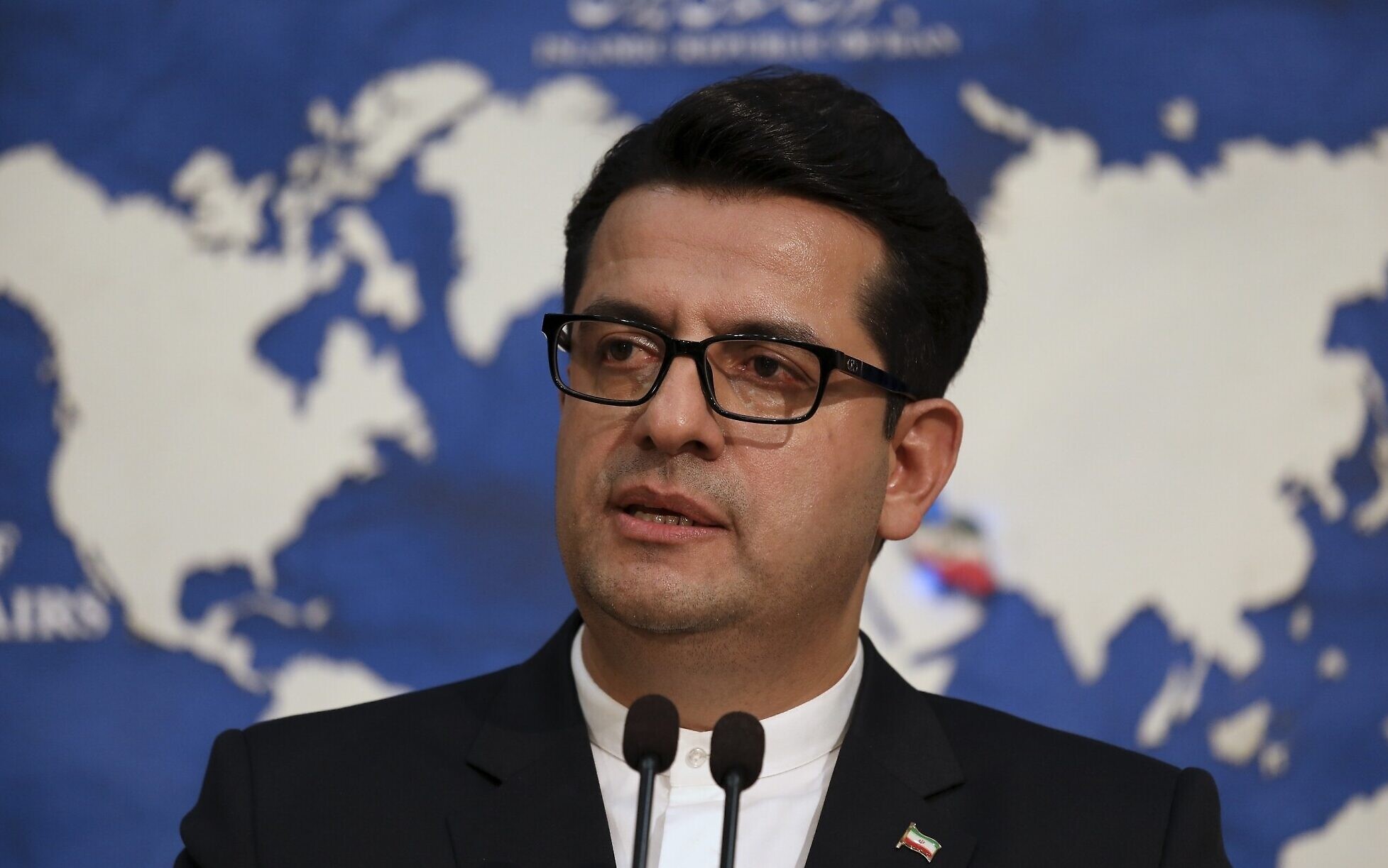
In this May 28, 2019 photo, Iran's Foreign Ministry spokesman Abbas Mousavi speaks at a press conference in Tehran, Iran (AP Photo/Vahid Salemi)

In this May 28, 2019 photo, Iran’s Foreign Ministry spokesman Abbas Mousavi speaks at a press conference in Tehran, Iran (AP Photo/Vahid Salemi)

The Islamic Republic will provide a “crushing response” to any Israeli aggression against its regional interests, a senior Iranian official said on Wednesday.

“The Islamic Republic of Iran will give a crushing response that will cause regret to any kind of aggression or stupid action from this regime against our country’s interests in Syria and the region,” Reuters quoted foreign ministry spokesman Abbas Mousavi as saying.

The statement was first published by the semiofficial Mehr news agency.

Last week, Syrian state media reported (and Defense Minister Naftali Bennett later confirmed) that Israel launched strikes against several targets near Damascus, triggering the country’s air defense systems.

Over the weekend, a former leader of Iran’s Revolutionary Guards warned that Iran is just looking for an excuse to attack Israel and “raze Tel Aviv to the ground,” blaming Israel for allegedly helping the US kill top commander Qassem Soleimani.

Explosions are seen in the skies over Damascus as the Syrian military fires anti-aircraft weapons at incoming missiles during an attack attributed to Israel on February 6, 2020. (SANA)

Israel has long maintained that it would not tolerate efforts by Iran — a major ally of Syrian dictator Bashar Assad — to establish a permanent military presence in Syria and would take steps to thwart such entrenchment.

Israel accuses Iran of seeking to set up a military presence in Syria that could be used as a launchpad for attacks against the Jewish state. Jerusalem has also vowed to retaliate to any attacks on Israel from Syria.

Israeli officials have acknowledged conducting hundreds to thousands of raids in the country since the start of the Syrian civil war in 2011.

These have overwhelmingly been against Iran and its proxies, notably the Lebanese Hezbollah terror group, but the IDF has also carried out strikes on Syrian air defenses when those batteries have fired at Israeli jets. In recent months, the IDF has also confirmed conducting operations in Iraq against Iranian entrenchment efforts there as well.

Earlier this week, Bennett said that Jerusalem and Washington have divided up the fight against Iran, with Israel taking responsibility for countering the Islamic Republic in Syria and the United States in Iraq.

Russian Ambassador to Syria Alexander Yefimov on Monday condemned Israel for its alleged strikes in Syria, the latest of which was reported to have killed more than 20 Syrian and Iranian military officials.

“The Israeli raids are, of course, provocative and very dangerous for the situation in Syria,” Yefimov said in an interview with Sputnik Arabic, according to an English translation by Syrian news site Al-Masdar. “The [Israeli] missiles are falling not only in the areas bordering Israel, but also reaching areas deep in Syria, in the eastern part of the country and even in residential areas in Damascus. It is regrettable that civilians become victims of these raids.”

Israel and Russia have coordinated their military efforts in Syria in recent years, in order to avoid friction and accidental conflict. Israeli officials do not generally discuss the full extent of that coordination, but they stress that the Israeli military does not seek Russian permission before carrying out operations.

Judah Ari Gross contributed to this report.


US envoy explains deal’s asymmetry: We trust Israel, but PA can’t keep a bargain 

February 12, 2020

Source: US envoy explains deal’s asymmetry: We trust Israel, but PA can’t keep a bargain | The Times of Israel

Why does Trump’s plan allow the Israelis to annex soon but have a Palestinian state only arise in four years? To ‘bridge the asymmetry’ between the two sides, David Friedman says

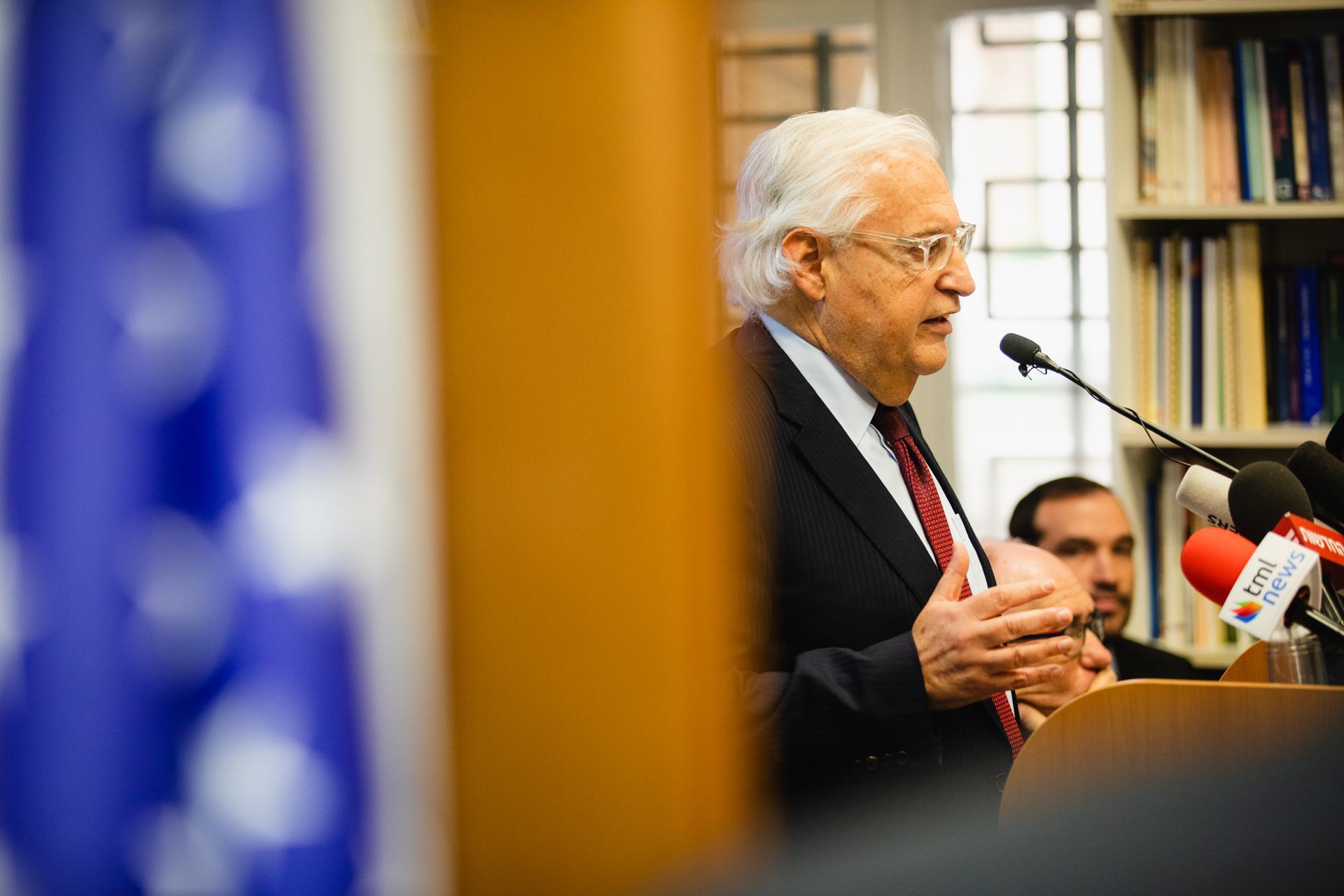
US Ambassador to Israel David Friedman addressing a briefing hosted by the Jerusalem Center for Public Affairs, February 9, 2020 (Reouven Ben Haim/JCPA)

US Ambassador to Israel David Friedman addressing a briefing hosted by the Jerusalem Center for Public Affairs, February 9, 2020 (Reouven Ben Haim/JCPA)

The White House’s so-called “Deal of the Century” strongly favors Israel because it is a democracy that can be relied upon to uphold any agreement, whereas the Palestinians have a long way to go before they are trustworthy partners, US Ambassador to Israel David Friedman said Sunday.

Critics of US President Donald Trump’s peace plan often complain that it grants Israel the right to soon annex the parts of the West Bank that the proposal earmarks for Israel to retain, while the Palestinians would only get their state at the end of four years — and then, only if a long list of conditions have been meet.

If the plan is meant to eventually lead to peace between Israelis and Palestinians, why is one side allowed to take the spoils right away, while the other side has to wait four years, The Times of Israel asked Friedman during a briefing Sunday at the Jerusalem Center for Public Affairs.

In his answer, the US envoy spoke of the need to bridge the “asymmetry” between the State of Israel, which is a dependable ally, and what he described as the failed wannabe state that is the Palestinian Authority. He also argued that Jerusalem would have never have made the concessions it did upon accepting the plan’s outline — including agreeing not to build any new settlements in the areas designated for a future Palestinian state — if it had not been granted the right to quickly annex the parts envisioned to be part of Israel.

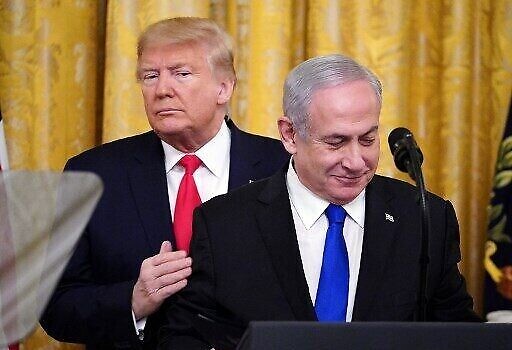
US President Donald Trump, left, and Prime Minister Benjamin Netanyahu take part in an announcement of Trump’s Middle East peace plan in the East Room of the White House in Washington, DC on January 28, 2020. (Mandel Ngan/AFP)

“This is a completely asymmetric relationship,” Friedman said of Israel and the Palestinian Authority. “Israel is a democracy. You can hold it to its word. It has an enormous relationship with the United States on multiple levels and that relationship is very solid. It is in a position today to keep its part of the bargain.”

By contrast, the Palestinians are currently “not in a position to keep any bargain,” Friedman said. “The Palestinians are not united. Their government is not democratic. Their institutions are weak. Their respect for all types of norms that we hold dear — not just democracy but human rights, freedom of religion, freedom of the press — is nonexistent.”

Palestinian Authority President Mahmoud Abbas holds a placard showing maps of (L to R) ‘historical Palestine,’ the 1947 United Nations partition plan on Palestine, the 1948-1967 borders between the West Bank and Gaza Strip and Israel, and a current map of the Palestinian-controlled territories without Israeli-controlled areas and settlements, during an Arab League emergency meeting discussing US President Donald Trump’s peace proposal, at the league headquarters in the Egyptian capital Cairo on February 1, 2020. (Khaled Desouki/AFP)

The White House felt the need to “bridge that asymmetry,” he went on. “If Israel is ready today, why shouldn’t they get what they’re agreeing to today? If the Palestinians are going to be ready in four years, well, then they can get what they can get in four years.”

The only way to encourage the Israelis into agreeing to adopt the Trump plan and to freeze settlement building in the area earmarked for a future Palestine was to “provide them today with what they’re entitled to in exchange for that,” Friedman posited.

“I have no doubt that Israel would never agree to a naked freeze of four years just on the possibility that the Palestinians might a) be willing to negotiate and b) achieve the milestones [required of them by the plan]. We just couldn’t have gotten it,” he said.

The administration took great care to tell the Palestinians that they don’t have to say yes or no to the plan right away, Friedman said.

US Ambassador to Israel David Friedman addressing a briefing hosted by the Jerusalem Center for Public Affairs, February 9, 2020 (Matty Stern/U.S. Embassy Jerusalem)

“We understand that you’re in a very difficult position — you’re not united, you have numerous streams of conflict that weaves around your body politic. So take your time, digest it, and you will not be penalized by the passage of time,” he said, addressing the Palestinian leadership.

“If it takes you three or four years to get there, the territory that is earmarked for you, the integrity of that territorial opportunity, will be preserved.”

Israel has never agreed to a four-year freeze of settlement construction, Friedman stressed. The only previous moratorium of settlement expansions — for 10 months — took place during the Obama administration and “was a waste of time,” he claimed, since it did not succeed in bringing the Palestinians back to the negotiating table.

For Israel to annex the part it will keep now in exchange for refraining from taking more of the territory reserved for Palestine is a formula that “seemed like a very fair trade — for us, for the Palestinians and for Israel,” Friedman said.

The Times of Israel also asked Friedman what happens after four years — will Israel get a green light to apply sovereignty over the remaining parts of the West Bank if the Palestinians have still not engaged on the proposal?

Not necessarily, Friedman replied.

“At the end of four year years, if there is no progress and no basis to extend that period of time — and that would be an extension the parties themselves would have to agree to — then it would return to what it is today,” the ambassador said.

The areas Israel will not have annexed by then would continue to be administered by COGAT, the Defense Ministry unit currently in charge of implementing Israeli government policies in the West Bank, according to Friedman.

There is no specific event that would automatically occur at the end of the four years that started on January 28, when the peace plan was unveiled at the White House, he said. “Hopefully there would be another initiative,” he added.


PM threatens Hamas with dire ‘surprise’; Gaza answers with fresh rocket attack 

February 12, 2020

Source: PM threatens Hamas with dire ‘surprise’; Gaza answers with fresh rocket attack | The Times of Israel

Israel’s response to wave of rocket, balloon attacks ‘will be different from anything that came before,’ Netanyahu warns in TV interview; no injuries in attack

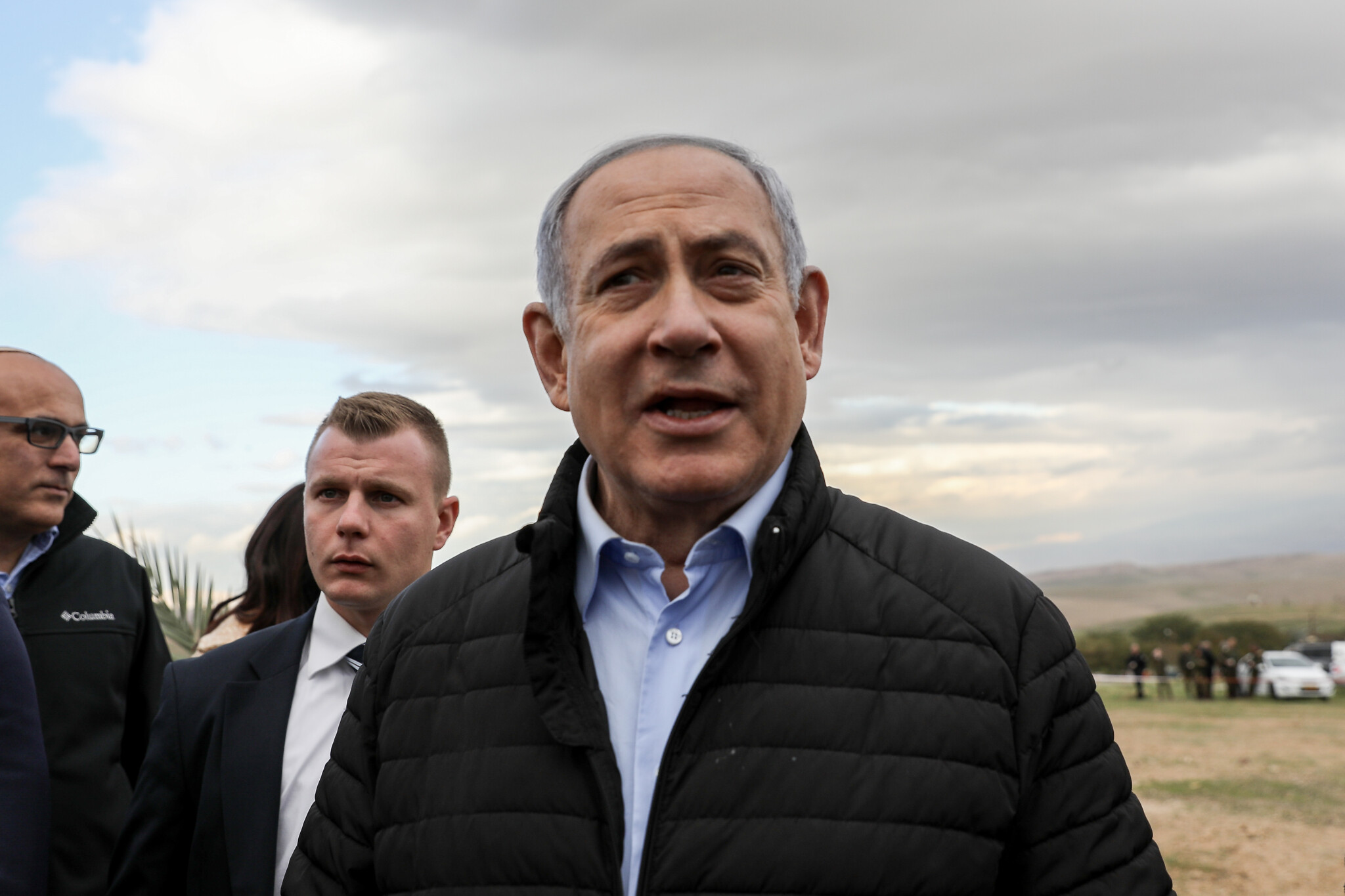
Prime Minister Benjamin Netanyahu at a tree planting event for the Jewish holiday of Tu Bishvat in the West Bank settlement of Mevo'ot Yericho, in the Jordan Valley, February 10, 2020. (Flash90)

Prime Minister Benjamin Netanyahu at a tree planting event for the Jewish holiday of Tu Bishvat in the West Bank settlement of Mevo’ot Yericho, in the Jordan Valley, February 10, 2020. (Flash90)

Prime Minister Benjamin Netanyahu on Tuesday threatened Hamas leaders with “the surprise of their lives” if a spate of attacks from the Gaza Strip didn’t come to an end. Minutes later, yet another rocket was fired from Gaza at Israel’s south.

“I’m telling you as prime minister, I don’t rush to war,” Netanyahu said in an interview with Channel 20 on Tuesday night. “I don’t puff out my chest, bang drums and blow trumpets. But we’re preparing for Hamas the surprise of their lives. I won’t say what it is, but it will be different from anything that came before.”

Whether Israel carries out its “surprise,” he added, “is entirely up to them. If they don’t come to their senses with the rockets and don’t stop the balloons, it’s only a matter of time before we deploy it. Remember what I’m telling you,” he said.

The last several weeks have seen a marked uptick in rocket and incendiary balloon attacks from the Strip, raising tensions and threatening fragile truce talks.

Shortly after Netanyahu finished speaking, the IDF reported a mortar shell had been fired from Gaza and landed in an open area in Israel’s south. No one was hurt in the attack.

Netanyahu’s was the latest in a series of warnings from Israeli leaders that rocket and incendiary balloon attacks from Gaza would be met with a dramatic military escalation. Thus far Israel has made do with tit-for-tat airstrikes on usually empty Hamas posts.

On Sunday, Netanyahu warned Gazan terror groups that Israel was prepared to take “crushing action.”

Prime Minister Benjamin Netanyahu (2nd-R) attends the weekly cabinet meeting in Jerusalem on February 9, 2020. (Ronen Zvulun/Pool/AFP)

“I want to make this clear: We won’t accept any aggression from Gaza. Just a few weeks ago, we took out the top commander of Islamic Jihad in Gaza, and I suggest that Islamic Jihad and Hamas refresh their memories,” Netanyahu said at the opening of the weekly cabinet meeting at his office in Jerusalem.

“I won’t lay out in detail all our actions and plans in the media, but we’re prepared for crushing action against the terror groups in Gaza. Our actions are powerful, and they’re not finished yet, to put it mildly.”

Defense Minister Naftali Bennett similarly issued a warning to Hamas leaders in Gaza, warning on Sunday that Israel would take “lethal action against them” if their “irresponsible behavior” didn’t cease.

He warned that Israeli military action would be “unbearable” for Hamas.

Screen capture of Defense Minister Naftali Bennett from a video he produced in which he warns of an Israeli response to Gaza rocket and incendiary balloon attacks, February 9, 2020. (Channel 12 screen capture)

“We won’t announce when or where. This action will be very different from those taken in the past. No one will be immune. Hamas faces a choice: choose life and economic prosperity, or choose terror and pay an unbearable price. Their actions will determine [which it will be].”

Observers see the return of rocket fire after several months of calm as an attempt by Gazans to press their demands that Israel ease or lift its blockade of the enclave in exchange for calm. Both sides insist they are not seeking a return to war.

An Egyptian security delegation that visited the Gaza Strip on Monday conveyed a message from Netanyahu to Hamas in which he demanded “a return to calm,” the Lebanese pro-Hezbollah Al-Akhbar newspaper reported, citing unnamed Palestinian sources.

Netanyahu’s message, which the Egyptian delegation received from Israeli security officials in Tel Aviv on Sunday, included a threat that Israel would “deliver a major blow to Hamas with American and international cover” if calm does not resume, the sources told the daily.

Hamas officials told the Egyptian delegation in response to Netanyahu’s message that it “does not seek an escalation,” but “the economic pressure that Gazans are experiencing and the failure to implement calming understandings will create greater pressure on the border region,” the sources said.
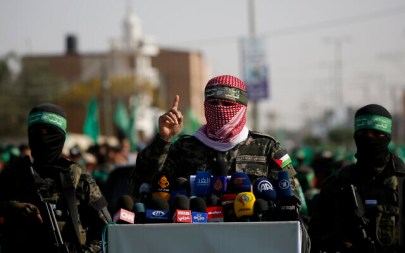
A spokesman for the armed wing of Gaza-ruling Hamas terror group talks to the press in the town of Khan Younis, southern Gaza Strip, November 11, 2019. (AP Photo/ Hatem Moussa)

“There will be no free calm as long as there is procrastination, delay and tightening [of restrictions],” the sources also quoted the Hamas officials as saying.

Since the second half of 2018, Egypt, alongside the United Nations and Qatar, has played a key role in brokering informal ceasefire understandings between Hamas, which controls Gaza, and Israel.

The understandings have largely entailed Israel lifting restrictions on the movement of goods and people into and out of Gaza, in exchange for Hamas maintaining relative quiet in the border region between the Strip and the Jewish state.

The Hamas officials also told the Egyptians that “the occupation doing anything stupid or assassinating resistance leaders would unleash a major war that would significantly impact the occupation’s state and leaders,” the sources added.

Illustrative: An Israeli missile launched from the Iron Dome missile defense system, designed to intercept and destroy incoming short-range rockets and artillery shells, is seen above Gaza City on November 13, 2019. (Mahmud Hams/AFP)

Palestinian terrorists in the Gaza Strip began flying explosive and incendiary devices into Israel using clusters of balloons and kites beginning in 2018. The practice has waxed and waned over time, but has picked up considerably in recent weeks, with dozens of these balloon-borne bombs landing in towns and farming communities adjacent to the Palestinian enclave.

The Israel Defense Forces’ Home Front Command on Friday released a poem for children warning them against the dangers of the balloon-borne bombs flown from Gaza.

חדשות 13

@newsisrael13

מתיחות בדרום | ראש נפץ של RPG מחובר לבלונים נחת בשדות של קיבוץ רוחמה שבמועצה אזורית שער הנגב. מדובר בצרור בלוני הנפץ השישי שנחת היום בעוטף @bokeralmog

(צילום: יובל קניגספלד)

View image on TwitterView image on TwitterView image on Twitter
In addition to being attached to colorful balloons, some of the explosive devices have been disguised as other child-friendly objects such as books and soccer balls.

Few injuries have been caused by these airborne attacks, but they have caused extensive damage to Israeli agricultural fields, parks and forests, especially during the country’s dry summer months.


Israeli laser defense system successfully intercepts multiple drone targets

February 12, 2020

Source: Israeli laser defense system successfully intercepts multiple drone targets | The Times of Israel

Rafael says its Drone Dome C-UAS had 100% success in all scenarios, including stopping maneuvering quarries; can address threats at military and civilian sites

An Israeli-developed drone defense system successfully intercepted multiple targets and shot them down with a laser beam, aerospace company Rafael said Wednesday.

Rafael’s Drone Dome C-UAS was also able to track and hit small drones that were maneuvering in flight, a more challenging target.

“The system achieved 100% success in all test scenarios,” Rafael said in a statement.

Drome Dome provides “effective detection, full identification and neutralization of multiple Micro and Mini UAV threats,”it said.

In a video of the tests, a vehicle-mounted system was shown engaging the targets, including drones that were sharply changing direction. In one test, three drones flying in formation were shot down in succession.

“Drone Dome is designed to address threats posed by hostile drones both in military and civilian sites, offering advanced solutions for maneuvering forces and military facilities, critical border protection, as well as civilian targets such as airports, public facilities, or any other sites that might be vulnerable to the increasing threat of both terror and criminal drones,” the company said.

The Drone Dome air defense system mounted on a vehicle. (Rafael – Advanced Defense Systems)

Previous reports have said that in addition to melting drones with its laser for a “hard kill,” Drone Dome has sophisticated electronic systems that enable operators to interfere with the signals of a hostile drone and even take control of the device, bringing it to ground in a “soft kill” interception.

In 2018 the British Daily Mail newspaper reported that the British military used Drone Dome to ground an intruding unmanned aerial vehicle that shuttered the airfield at London’s Gatwick Airport for over 36 hours, stranding tens of thousands of passengers.

Six of the Refael systems were sold to the UK Ministry of Defense in an estimated $20 million deal, according to Israel’s Globes financial daily.

Later reports said Drone Dome was not used at Gatwick, as the system had not yet been delivered to the UK military.

In December 2019 Israeli security forces revealed details about another new laser system they hope will help quash the scourge of airborne incendiary devices launched from the Gaza Strip — carried by balloons, kites and drones — which have started countless fires and burned large swaths of Israeli land since they began being widely used nearly two years ago.

The system, dubbed Light Blade, is intended to shoot the threats out of the sky before they can enter Israeli territory. It was developed for police and the Israel Defense Forces by three engineers from the private sector who worked with Ben Gurion University researchers and technological departments of the Israel Police and IDF.


Top Iranian official: We’re looking for a pretext to raze Tel Aviv to the ground 

February 11, 2020

Source: Top Iranian official: We’re looking for a pretext to raze Tel Aviv to the ground | The Times of Israel

Former leader of Revolutionary Guards also says Tehran has ‘precise information’ on all US military and civilian activity in the region, from ships to individual soldiers

Former chief of Iran's Revolutionary Guard, Mohsen Rezaei. (photo credit: AP Photo/Vahid Salemi)

Former chief of Iran’s Revolutionary Guard, Mohsen Rezaei. (photo credit: AP Photo/Vahid Salemi)

A former leader of Iran’s Revolutionary Guards has warned that Iran is just looking for an excuse to attack Israel and “raze Tel Aviv to the ground,” blaming Israel for allegedly helping the US kill top commander Qassem Soleimani.

Speaking to Lebanon’s Hezbollah-affiliated al-Mayadeen TV station on Saturday, Mohsen Rezaei was asked if Iran would carry out its previous threats to attack Israel in the event of a war with the US.

“You should have no doubt about this. We would raze Tel Aviv to the ground for sure. We have been looking for such a pretext,” Rezaei said in remarks translated by the Middle East Media Research Institute (MEMRI) and released Monday.

Rezaei, the secretary of Iran’s powerful Expediency Council, is considered a top politician and an adviser to Supreme Leader Ayatollah Ali Khamenei.

“If they (the US) do something, we can use it as a pretext to attack Israel, because Israel played a role in the martyrdom of General Soleimani,” he said, blaming Israel for tipping off the Americans to Soleimani’s location.

“We were waiting for the Americans to give us a pretext to strike Tel Aviv, just like we attacked Ayn Al-Assad,” he said referring to the US military base in Iraq, which Iran hit with several missiles in response to Soleimani’s killing.

This is not the first time Rezaei has threatened to destroy Israeli cities.

“Iran’s revenge against America for the assassination of Soleimani will be severe… Haifa and Israeli military centers will be included in the retaliation,” he said in January.

Following the Iranian attack on the US base and repeated Iranian threats, Prime Minister Benjamin Netanyahu warned Iran against attacking Israel.

“We’re standing steadfast against those who seek our lives. We’re standing with determination and with force. Whoever tries to attack us will receive a crushing blow in return,” he declared at a conference in Jerusalem.

Worshipers in Iran chant slogans during Friday prayers ceremony by a banner showing slain Iranian Revolutionary Guard general Qassem Soleimani, left, and Iraqi Shiite senior militia commander Abu Mahdi al-Muhandis, who were killed in Iraq in a US drone attack on January 3, and a banner which reads in Persian: ‘Death To America,’ at Imam Khomeini Grand Mosque in Tehran, Iran, January 17, 2020. (Office of the Iranian Supreme Leader via AP)

In his interview Saturday,  Rezaei also said Iran was extensively monitoring US troops and shipping in the Middle East and could easily target them in a conflict.

“Naturally, we have precise information, thanks be to Allah. All the American bases are under our surveillance now. All the American aircraft carriers are under our control,” he said.

“We know the number of American ships in the Indian Ocean and the Sea of Oman, and where they are in the Persian Gulf, and what they have in Qatar and Bahrain, and [we know about] their activity in Iraq,” Rezaei said.

He said Iran even tracked individual US soldiers, and had information on hotels they stayed at, who their friends were and even “where they get their meat and food.”

“Our information is very precise. We bombed the Ayn Al-Assad base on the basis of detailed calculations. We knew that it was a very important site for the Americans that we had to strike,” he said.

The Pentagon said Monday that the number of US service members diagnosed with traumatic brain injuries has shot up to more than 100 as more troops suffer the aftereffects of the Iranian ballistic missile attack early last month in Iraq.