Source: Iran shows off drones that can reach Israel, threat increases – The Jerusalem Post
It is a message to Israel, the US and allies: We can reach you.
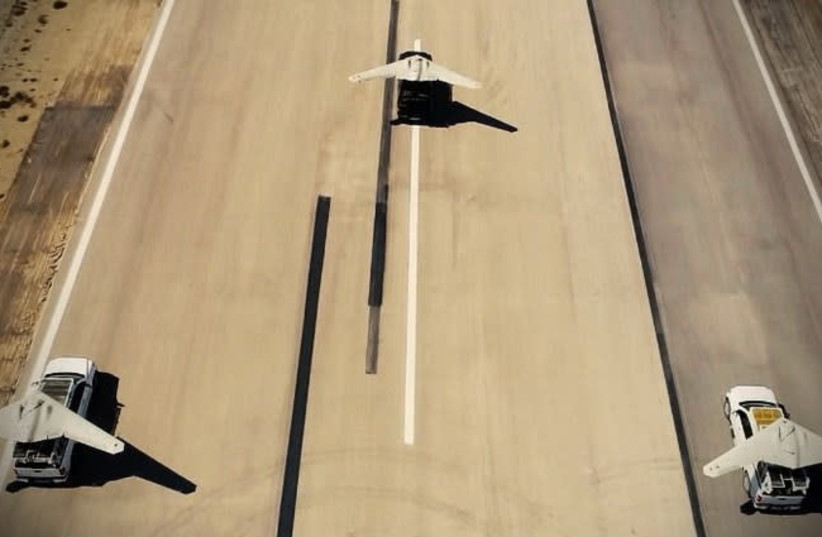
Iran has been producing drones since the 1980s and is an innovator in drone warfare. It used 25 drones and cruise missiles to attack Saudi Arabia last September, and has flown drones into Israeli airspace.
Iran’s Defense Minister Brig.-Gen. Amir Hatami showed off the drones on Saturday. He said that one jet-powered UAV could fly at speeds of 900 km. per hour at an altitude of 12,000 meters. This would rival the best drones that the US and other countries are now using. These drones have a range of up to 1,500 km., he said, and can fly for several hours. It is a message to Israel, the US and their allies: We can reach you.
Iran says it has provided a “mass delivery” of the Ababil-3 and Karar drones to the air force. The country has a new drone unit that it established in recent years and its IRGC has been using drones to target various enemies, including ISIS. The Ababil-3, Hatami says, can fly 150 km., and the Karar is armed with various weapons that now give the drones “pinpoint” attack abilities. The implication is that these drones have guided bombs and can operate like cruise missiles.
The Ababil-3 is a redesign of earlier Iranian drones, with twin tails. It is likely based on a South African design which itself may have been borrowed from old Israeli designs, such as the Israeli Hunter or Mastiff. The Ababil-3 is supposed to be a medium-range reconnaissance drone, but Iran says it has “combat” potential and can carry other payloads as well. It has an electro-optical add-on that enables it to collect footage. Iran used this capability in September 2018 to target Kurdish dissidents in Iraq, filming its missile attacks with a drone.
Meanwhile, the Karar is designed to be a “strategic” drone that Iran says can be used as a kamikaze drone – basically like a cruise missile. Iran has successfully deployed these kinds of technologies to the Houthi rebels in Yemen, who have used them against Saudi Arabia in dozens of attacks.
The new drones allegedly have some sort of guided missile or smart bomb ordnance. It’s not clear if Iran has perfected the technology and ranges it ascribes to its drones, but attacks in Iraq, Syria and Saudi Arabia are evidence that Iran’s drone threat is increasing.Iranian drones have been sent to Syria’s T-4 base. One of them flew into Israeli airspace in February 2018 and was shot down by a helicopter. Iranian-backed Hezbollah also deployed drones in the Golan in the fall of 2019. Israel carried out an airstrike in August 2019 to neutralize the Hezbollah drone team.
Iran has recently seen some of its shipments of drone parts stopped by the US Navy on the way to Yemen. These included gyroscopes and other technology that Tehran has used elsewhere in drone exports and drone warfare.
THE REASON Iran is unveiling its drones now is linked to its annual army day. However, Iran also used army day to showcase efforts to fight the coronavirus. Iran has more than 5,000 dead from COVID-19, and the drone unveiling is therefore a way to show that Iran continues its technological advances despite US sanctions and the pandemic. Iranian IRGC fast boats harassed the US Navy last week in the Persian Gulf – and in the past, Iranian drones have flown over a US aircraft carrier and provoked American ships. The USS Boxer downed an Iranian drone last year.
Iran’s drones are its version of an air force. Since Iran does not have a very strong army, the drones are used to pose a strategic threat to enemies. Tehran uses the drones to threaten attacks on infrastructure in other states, and it exports them to what it calls the “axis of resistance,” its proxies across the region. Its goal is to upgrade the abilities of groups such as Hezbollah and the Houthis, groups which don’t have air forces and are ostensibly at the mercy of much more powerful adversaries when it comes to air power.
But the drone threat, in Iran’s view, can be a game changer, by posing a threat that is difficult to detect or stop. That was illustrated in the attack on Saudi Arabia, when Iranian drones penetrated both radar defenses and air defenses.
Since Iranian drones are generally not very fast moving and have no stealth abilities, they can be easily detected. Iran has attempted to get around that by using them like cruise missiles, or claiming it has new jet-powered advances. Since the Islamic Republic already has an advanced rocketry program for ballistic missiles, there is no doubt that it has the ability to build different systems. Until they are used, however, it is unclear what their real capabilities are. In Saudi Arabia, Iranian-designed drones have flown hundreds of kilometers, penetrating deep into the country’s interior.
Iran has continued to threaten Israel through shipments of precision guided munitions to Hezbollah. Its drone arm is one of many technologies it uses in these continuing efforts.
Source: Netanyahu okays plan to gradually reopen parts of economy, ease restrictions | The Times of Israel
PM’s office says ‘pilot’ to be conducted allowing some industries to resume operations if they meet Health Ministry guidelines; exercise up to 500 meters from home to be permitted

Prime Minister Benjamin Netanyahu green-lighted a general plan to ease restrictions on economic activity and “stay home” orders, potentially allowing some businesses to open as soon as next week.
A statement from Netanyahu’s office described the plan, which still must be approved by the full cabinet, as “responsible, cautious and gradual” and said it would allow for a limited opening of businesses.
No specific timeline for the plan was detailed, but according to Hebrew media reports some businesses could reopen as early as next week.
According to Netanyahu’s office, the Finance Ministry will draw up a “pilot plan” for some sectors of the economy to open in accordance with Health Ministry social distancing guidelines. Criteria will be drawn up for certification that will allow businesses to open.
Among the criteria likely to be included are regular disinfecting, taking customers’ temperatures and abiding by social distancing regulations, according to reports.
The industries and businesses that would be allowed to take part in the pilot would be decided on in the next two days, but malls, open-air markets and businesses that involve physical contact will not yet be allowed to reopen.
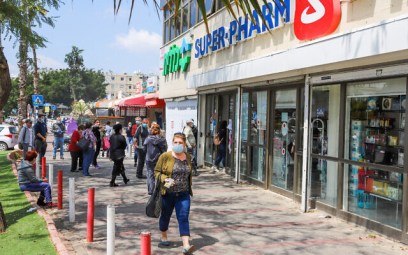
The statement also said that restrictions on movement will be slightly eased, with Israelis allowed to exercise in pairs up to 500 meters from their homes, up from the 100 meter limit currently in place.
Special education would also be allowed to resume but preschools and schools will not yet reopen.
A final decision will be brought for cabinet approval Saturday evening,
“Changes are likely during the deliberations over the next days,” the statement said.

Quoting sources close to Defense Minister Naftali Bennett, Hebrew media reports said numerous industries would be allowed to resume operations Sunday, though there was no confirmation of this in the statement from the Prime Minister’s Office.
Almost all factories will be allowed to resume work under the plan, according to Channel 12 news.
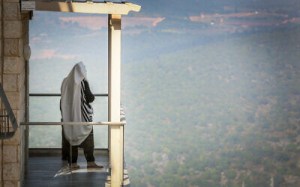
There was no indication from the statement that restrictions banning group prayer would be eased, despite a push by ultra-Orthodox ministers for more freedom for religious gatherings.
Interior Minister Aryeh Deri, who heads the ultra-Orthodox Shas party, urged the government to permit prayer gatherings of 10-15 people, provided the services are held outdoors and the worshipers stand apart in accordance with social distancing rules.
Israeli officials have been mulling in recent days how to begin to roll back some restrictions in response to figures which appear to indicate that the spread of the coronavirus has been halted or slowed in most communities.
As of Thursday evening, there have been 12,758 confirmed coronavirus cases in Israel, with 143 deaths. New daily cases have remained steady at 300-450 per 24-hour period, and serious cases and those on ventilators have not risen significantly for at least a week, according to Health Ministry figures.
Netanyahu met Thursday with ministers and top officials for the first discussion of a strategy to ease the coronavirus restrictions and revive the economy, with officials from the health and finance ministries clashing over the proper approach.
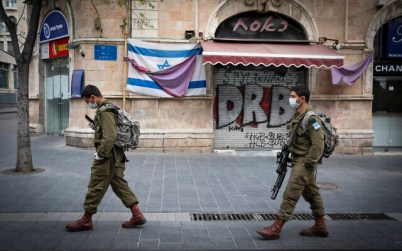
While the Health Ministry has recommended a particularly slow and cautious strategy that would see businesses stay closed for at least another month, the Finance Ministry is demanding that restriction begin being eased as early as possible.
Most experts believe any gradual reopening of economic activity will involve a process of trial and error that may necessitate some restrictions being reimposed.
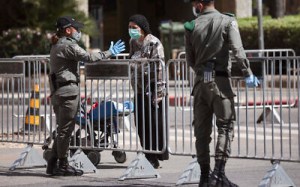
Earlier in the day, the ministerial committee formulating Israel’s response to the coronavirus outbreak approved a decision to relax lockdown restrictions in the ultra-Orthodox city of Bnei Brak, while extending closure rules in Jerusalem neighborhoods until April 19.
The ultra-Orthodox town of 200,000 near Tel Aviv has the second highest infection numbers in the country — 2,150 as of Thursday morning. Jerusalem leads with 2,418 cases.
Two weeks ago Bnei Brak was placed under a strict lockdown, with residents only allowed to leave municipal boundaries to work in key industries or to receive medical care. Some two dozen Jerusalem neighborhoods were put under lockdown on Sunday, most of them ultra-Orthodox.
Thousands of police to patrol and dozens of roadblocks set up as people barred from leaving hometowns and neighborhoods until Thursday at 5 a.m
Today, 5:57 pm
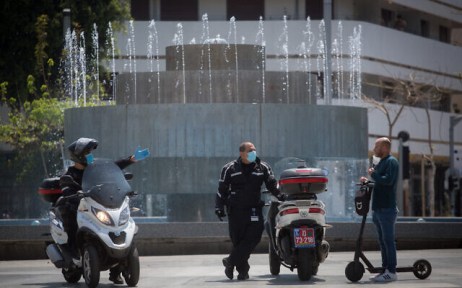
For the second time in a week, Israel was under a complete lockdown as authorities sought to prevent people taking part in celebrations for the end of the Passover holiday and the Mimouna festival, fearing gatherings could cause a spike in conronaviris infections.
From Tuesday at 5 p.m. until Thursday at 5 a.m., Israelis will be barred from leaving their hometowns, or in the case of Jerusalem, the neighborhoods in which they live, according to the restrictions.
Some 9,000 police and Border Police will enforce the lockdown and 44 roadblocks will be set up on intercity roads. The focus of the police effort was expected to begin Wednesday evening for the start of Mimouna, a North African holiday, that normally sees people hosting large gatherings and traveling from home to home.
Bakeries and restaurants will remain closed until Thursday morning at 2 a.m., though supermarkets will be permitted to operate from Wednesday evening and food deliveries are permitted. This was to prevent crowds from gathering after Passover ends to purchase breads and other “unleavened” goods that many traditionally refrain from consuming during the holiday.
Public transportation has been canceled until Thursday at 5 a.m.
The rules do not apply to Arab communities.

Prime Minister Benjamin Netanyahu on Monday night directed Israelis to celebrate the last night of Passover and Mimouna only with those they live with, as was the case for the first night of the holiday last week.
Netanyahu said the government was working on a plan to gradually lift restrictions on economic and educational activities and would decide on steps later this week, while stressing that these would be “slow and responsible.”
“I say to you from here: We’ll go out to a different reality from the one we knew before the global crisis,” he said.
He warned that even if the outbreak is contained, there is no way to prevent the virus from returning until a vaccine is developed.
“Only when a coronavirus vaccine is found will we be able to move on to the world of tomorrow, which will be like the world of yesterday,” he said. “But this is not the situation at the moment; therefore, everything will continue to be managed responsibly in order to protect the most precious thing we have – life itself.”

The new lockdown announced by Netanyahu came after he held consultations with ministers earlier in the day, with the Health Ministry reportedly concerned that the festive atmosphere during the last day of Passover and Mimouna would lead to a slackening of social distancing that has been a central plank in the country’s strategy for curbing the virus spread.
Israel is already under partial lockdown orders requiring all citizens to remain within 100 meters of their homes unless attending essential industries and jobs. Schools, leisure sites and most stores have been shuttered. The public has been ordered to only leave home for essential needs and all public gatherings have been banned. Intercity travel is generally permitted, provided the requirements for travel are met.
However, additional lockdown orders were applied Sunday to several Jerusalem neighborhoods with high coronavirus infection rates, with around 100 checkpoints set up around the capital to prevent travel to and from the restricted zones.
As of Tuesday evening, 119 people have died in Israel of COVID-19, the disease caused by the coronavirus. The Health Ministry updated Israel’s number of confirmed coronavirus cases to 11,868, including 136 people on ventilators.
Source: Israelis required to wear face masks when out in public | The Times of Israel
As Health Ministry directive takes effect Sunday, police to allow grace period
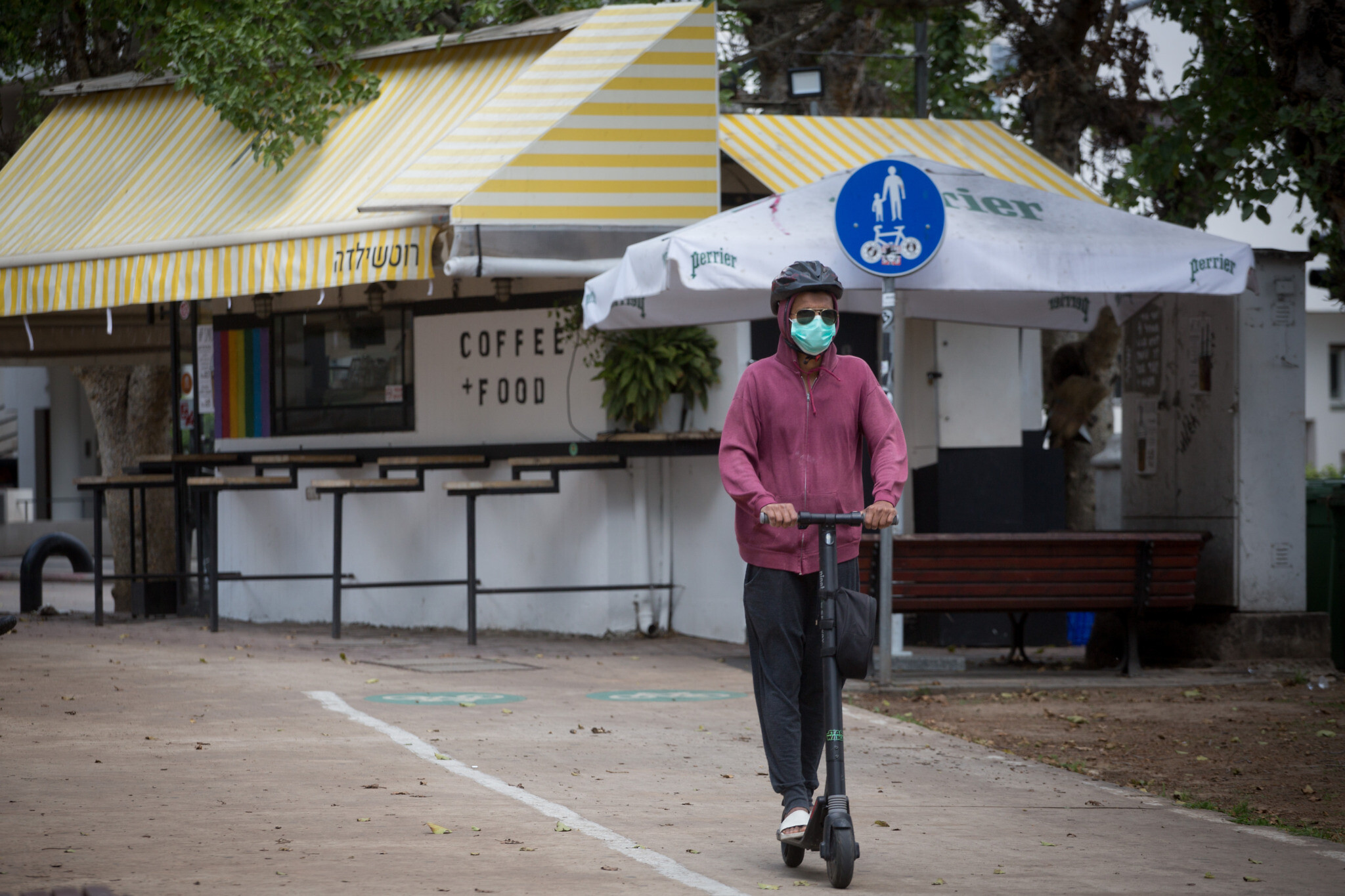
Israelis are required to wear faces masks when venturing outside in accordance with a new Health Ministry directive that came into effect on Sunday morning. The measure was approved by the government this past week.
Under the new rules, masks must be worn when leaving home and should cover the nose and the mouth. This does not apply to children under age 6; people with emotional, mental or medical conditions that would prevent them from wearing a mask; drivers in their cars; people alone in a building; and two workers who work regularly together, provided they maintain social distancing.
The masks can be homemade, makeshift, or bought, according to the authorities. The order had previously been issued as a recommendation.
“A face mask greatly reduces the likelihood of being infected and infecting others,” the ministry said, adding that it obstructed respiratory droplets.
Israelis are allowed outdoors under certain conditions, such as to buy food and medicine.
The Health Ministry sent out a reminder on Saturday about the new regulation and aired an infomercial during the nightly news about the benefits of wearing a face mask including instructions on how to fashion one using a bandana and hair ties.
The face mask order came as the World Health Organization (WHO) questioned the effectiveness of such a policy.
The WHO released updated guidelines Tuesday on face masks, saying there was “limited evidence” suggesting a mask worn by a person with the coronavirus would protect those around them, and “no evidence” it was effective for those who are healthy.
Moreover, it warned people to reserve medical masks for health care professionals and cautioned of a false sense of security by mask-wearers.
It added: “The use of masks made of other materials (e.g., cotton fabric), also known as nonmedical masks, in the community setting has not been well evaluated. There is no current evidence to make a recommendation for or against their use in this setting.”




 anneinpt
 artaxes
 danmillerinpanama
 davidking1530
 Peter Hofman
 Joseph Wouk
 Peter
Peter Louisiana Steve
 WarSclerotic
Recent Comments