Author Archive

Masks, virus tests, closed meetings: How Pompeo will visit Israel amid pandemic 

May 9, 2020

Source: Masks, virus tests, closed meetings: How Pompeo will visit Israel amid pandemic | The Times of Israel

US secretary of state and entourage exempt from entry restrictions, will confine movements to airport and strictly controlled work settings during brief visit next week
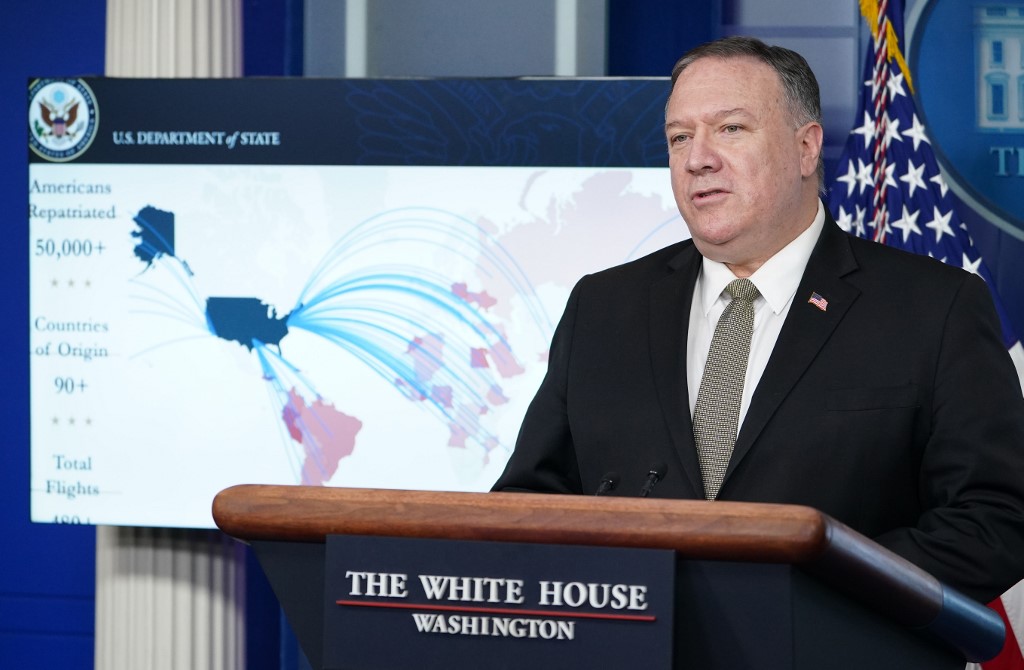
US Secretary of State Mike Pompeo speaks during a briefing on April 8, 2020 in the Brady Briefing Room at the White House, in Washington, DC. (Mandel Ngan/AFP)

US Secretary of State Mike Pompeo next week will become the first senior foreign official to visit Israel since it put in place strict travel restrictions to stem the spread of the coronavirus.

Pompeo’s visit will require medical precautions to prevent infections, which were coordinated with Israeli officials, Israel’s Channel 13 reported Friday.

Dr. William Walters, the US State Department’s deputy chief medical officer, said Friday that everyone flying with Pompeo will be tested for the virus one or two days before the flight, will be checked for symptoms before boarding, and will wear face coverings during the trip.

Pompeo and his small traveling party will be exempt from Israel’s virus restrictions that bar foreign visitors from entering and require returning Israelis to self-quarantine for 14 days. Pompeo is currently undergoing daily checks by medical personnel, Walters said.

Pompeo will be on the ground in Israel for only several hours on Wednesday before returning to Washington from his first overseas trip since making an unannounced visit to Afghanistan in March.

Everyone who meets with the US team during the trip will be checked for COVID-19 symptoms. Pompeo’s movements will be strictly controlled and limited to working meetings and the airport, and he will not meet with anyone in public settings.

People wear protective face masks as they shop at the Carmel market in Tel Aviv, May 8, 2020. (Miriam Alster/FLASH90)

The visit announcement comes amid concerns over the virus spreading in the White House. Katie Miller, US Vice President Mike Pence’s press secretary, tested positive for COVID-19 on Friday. On Thursday, White House officials confirmed that a member of the military serving as one of  US President Donald Trump’s valets had tested positive for the virus.

The trip is expected to focus on Prime Minister Benjamin Netanyahu’s plans to annex portions of the West Bank, the US State Department said Friday.

Pompeo will see Netanyahu and his new coalition partner Benny Gantz as the Trump administration tries to return to business as normal by resuming governmental travel and reopening an economy devastated by the COVID-19 outbreak.

Pompeo will “discuss US and Israeli efforts to fight the COVID-19 pandemic, as well as regional security issues related to Iran’s malign influence,” spokeswoman Morgan Ortagus said in a statement.

The top US diplomat for the Middle East, David Schenker, declined to comment on the status of the annexation discussions, noting that a joint US-Israeli mapping committee had not yet completed its work in determining the specific boundaries that might be proposed by Israel or accepted by the United States.

Alone among most governments, the Trump administration has said it will support the annexation of West Bank territory claimed by the Palestinians for an eventual state as long as Israel agrees to enter peace talks with the Palestinians.
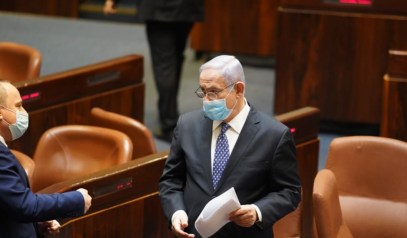
Prime Minister Benjamin Netanyahu in the Knesset, April 30, 2020 (screen capture via Knesset website)

Pompeo’s arrival will coincide with the swearing-in of Israel’s new government, which is expected to be formally installed on May 13. Schenker said the trip to Israel was in the works before it became clear that the swearing in ceremony would happen on the same day.

After battling to a stalemate in three inconclusive elections over the past year, Netanyahu and his chief rival, former army chief Gantz, last month agreed to form a joint government.

Under the deal, Netanyahu will serve as prime minister while Gantz will hold the new position of “alternate prime minister,” giving each side effective veto power over the other. The pair agreed to trade positions after 18 months.

Their “emergency” government is meant to focus on the coronavirus crisis during its first six months. But their coalition agreement also permits Netanyahu to introduce an annexation proposal to the government after July 1, even if Gantz objects.

Annexation advocates believe they have a narrow window to redraw the Mideast map before November’s US presidential election. They also believe it would give Trump a boost with pro-Israel voters, particularly the politically influential evangelical Christian community. The presumptive Democratic nominee, Joe Biden, has said he opposed unilateral moves by Israel in keeping with what had been decades of US policy prior to Trump.

The annexation agreement says that any step must be coordinated with the US while also keeping regional stability and peace agreements in consideration.

Netanyahu’s plan to annex portions of the West Bank has been met with harsh criticism from nearly the entire international community, including Washington’s European allies and key Arab partners, with the prominent exception of the United States. Trump’s much-vaunted Mideast peace plan allows for the possibility of US recognition of such annexations provided Israel agrees to negotiate under the framework of the proposal that was unveiled in January.

That plan calls for the creation of a Palestinian state but gives it limited autonomy on a fraction of the land it has sought. The Palestinians have rejected the proposal outright.

 

In first since March, Israel sees no new deaths in 24-hour period 

May 9, 2020

Source: In first since March, Israel sees no new deaths in 24-hour period | The Times of Israel

Death toll remains at 245 since Friday morning; active virus cases continue to drop with number of sick at 4,886, of which 65 are on ventilation

A medical team member wearing protective gear takes a swab from a woman to test for the coronavirus at Shaare Zedek hospital in Jerusalem on April 30, 2020 (Nati Shohat/Flash90)

A medical team member wearing protective gear takes a swab from a woman to test for the coronavirus at Shaare Zedek hospital in Jerusalem on April 30, 2020 (Nati Shohat/Flash90)

The number of active coronavirus cases in Israel continued to drop Saturday, with 4,886 current patients out of 16,444 cases identified since the start of the pandemic, and only three new cases diagnosed since Friday night.

Also notably, no new deaths had been reported over the past 24 hours, with the death toll holding steady at 245 since Friday morning. It was the first instance in which no new fatalities were seen in a 24-hour period since March 28.

Of those who are ill, 81 people were in serious condition, of which 65 were on ventilators, and 51 people were in moderate condition. The rest were suffering mild symptoms only.

Those who have recovered from the disease numbered 11,313.

With the number of new cases in Israel steadily dropping, Saturday night would mark two weeks since there have been more than 200 infections recorded in a 24-hour period, and one week where new cases didn’t exceed 100 per day.

Amid the sustained drop in infections, the government has increasingly rolled back restrictions meant to curb the outbreak, opening some schools and allowing many businesses to reopen.

Prime Minister Benjamin Netanyahu has said that all lockdown restrictions could be removed by the middle of June and the government on Monday canceled the 100-meter limit on Israelis traveling from their homes for activities deemed nonessential, as well as restrictions preventing people from visiting with family.

Malls, outdoor markets and gyms reopened Thursday morning after over six weeks of closure, with shoppers reported at shopping centers throughout the country.

Netanyahu warned, though, that Israel could have to reassess enforcing social distancing measures if there are more than 100 new coronavirus cases a day, a doubling of cases within 10 days, or over 250 people with serious symptoms in hospitals.

Israel’s National Emergency Authority fears a second wave of coronavirus infections and is calling on the government to use the relative lull in cases to prepare hospitals for a substantial increase in respiratory ventilation and treatment capacities.


Satellite images show damage to presumed missile workshop near Aleppo

May 8, 2020

Source: Satellite images show damage to presumed missile workshop near Aleppo | The Times of Israel

Private intel firm ImageSat International releases photographs of target of airstrike in Syria attributed to Israel earlier this week

Satellite images purporting to show the damage to a missile factory outside Aleppo, Syria caused by airstrikes attributed to Israel on May 4, which were released on May 7, 2020. (ImageSat International)

Satellite images purporting to show the damage to a missile factory outside Aleppo, Syria caused by airstrikes attributed to Israel on May 4, which were released on May 7, 2020. (ImageSat International)

An airstrike attributed to Israel earlier this week caused major damage to a presumed missile workshop outside Aleppo in northern Syria, according to satellite images released Thursday by an Israeli intelligence firm.

Late Monday night, the Israeli military conducted two rounds of airstrikes on Iran-linked targets in Syria, including one against a weapons factory in al-Safira outside Aleppo and a second against militia bases in Deir Ezzor in the east of the country, according to the Syrian Observatory for Human Rights war monitor.

Those attacks appeared to be the sixth and seventh strikes attributed to Israel against Iran-linked forces in Syria in the past two weeks. There was no word on the raids by the Israel Defense Forces, which rarely comments on individual cross-border attacks, though Defense Minister Naftali Bennett appeared to confirm Israel’s role in the strikes, repeatedly saying in the days preceding and following them that Israel was working to expel Iran from Syria.

On Thursday evening, the satellite imagery analysis firm ImageSat International released photographs of the weapons factory that was struck in the raids, showing significant damage to one of the structures.

“The workshop probably had a critical role in the missile production and assembly process, and possibly included unique machinery. Such an attack can stop the production process at this site,” the firm wrote in its assessment.

An explosion is seen following an alleged Israeli attack on a Hezbollah arms cache near Homs in central Syria on May 1, 2020. (Screen capture: Twitter)

In recent years, Jerusalem has accused Iran of helping the Hezbollah terror group develop advanced precision-guided missiles. Israel has vowed to prevent Hezbollah from obtaining such munitions, threatening military action in order to do so.

According to the Syrian Observatory for Human Rights, the airstrike on the al-Safira facility caused massive secondary explosions.

A Syrian security official told the Kremlin-backed Sputnik news outlet that the Israeli aircraft that conducted the Aleppo attack came from the region of the US military’s al-Tanf military base, which is near the Syrian border with Jordan and Iraq and is surrounded by a large de-confliction zone.

A spokesman for the US-led coalition battling the Islamic State jihadist group said it was not responsible for the strikes.

According to the Observatory, the strike on Tehran-backed militia bases in the Deir Ezzor region killed 14 pro-Iranian fighters, who were all either Iranian or Iraqi nationals.

The Britain-based monitor did not report any deaths in the strike on the weapons factory outside Aleppo.

Last Tuesday, Bennett appeared to confirm that Israel was responsible for recent attacks against pro-Iranian forces in Syria, saying that the military was working to drive Tehran out of the country.

Defense Minister Naftali Bennett of Yamina in the plenum hall of the Knesset on February 10, 2020. (Yonatan Sindel/Flash90)

“We have moved from blocking Iran’s entrenchment in Syria to forcing it out of there, and we will not stop,” Bennett said in a statement.

“We will not allow more strategic threats to grow just across our borders without taking action,” he said. “We will continue to take the fight to the enemy’s territory.”

Bennett did not explicitly confirm Israel’s involvement in that airstrike, though his comments were seen as a clear hint to that effect.

Israeli military officials have warned that acknowledging such strikes adds pressure on Iran and its proxies to retaliate in order to save face.

On Tuesday, a senior Israeli defense official said Israel was putting pressure on Iran to leave Syria and would continue to do so until the Islamic Republic completely withdrew its forces from the country, though he refused to explicitly confirm Israel’s role in the recent airstrikes.

Jerusalem says Iran’s presence in Syria, where it is fighting in support of President Bashar Assad, is a threat, as Tehran seeks to establish a permanent foothold along Israel’s northern borders. Israel has also threatened to take military action to prevent Iran from providing the Lebanon-based Hezbollah terror group with advanced weaponry, specifically precision-guided missiles.

Though Israeli officials generally refrain from taking responsibility for specific strikes in Syria, they have acknowledged conducting hundreds to thousands of raids in the country since the start of the Syrian civil war in 2011.

These have overwhelmingly been directed against Iran and its proxies, notably Hezbollah, but the IDF has also carried out strikes on Syrian air defenses when those batteries have fired at Israeli jets.

Agencies contributed to this report.


Pompeo planning trip to Israel despite coronavirus restrictions 

May 7, 2020

Source: Pompeo planning trip to Israel despite coronavirus restrictions – Axios

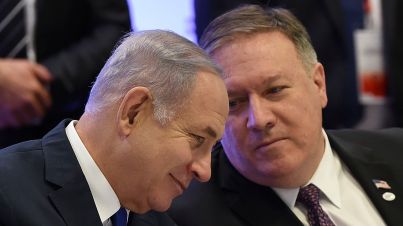
Pompeo (R) with Netanyahu last year. Photo: Janek Skarzynski/AFP via Getty

Secretary of State Mike Pompeo is planning to travel to Israel next week for a 24-hour visit, Israeli officials tell me.

Why it matters: This will be the first visit of a senior foreign official to Israel since coronavirus travel restrictions came into place. This will also be Pompeo’s first trip abroad since the crisis became a global pandemic.

Pompeo is expected to arrive next Tuesday and return to Washington the next day, Israeli officials tell me.

  • The trip would come days before Israel’s new government is slated to be sworn in, and Pompeo is expected to meet Prime Minister Benjamin Netanyahu and Benny Gantz, his rival-turned-coalition-partner.
  • It’s unclear why Pompeo is planning to travel in person, or how the visit could be impacted by Israel’s social distancing restrictions and emergency regulations which demand that any person arriving from abroad enter 2 weeks of confinement.
  • State Department spokeswoman Morgan Ortagus said the department has “no trips to announce right now.”

Update: Pompeo was asked about this report during a press briefing on Wednesday morning.

“I don’t have any travel to confirm, but I think in the upcoming hours and days you’ll see an announcement. We’re hoping to get back out and be on the ground to do the things the State Department needs to do — that we need to physically be located in those places for. We’re hoping we can get that started up before too long. It’ll start off smaller but we’re hoping to get back at it.”


Israel allegedly strikes Iran in Syria; Germany threatens Hezbollah – TV7 Israel News 05.05.20 

May 6, 2020


Iran’s military advancement amid COVID19 – Jerusalem Studio 511 

May 6, 2020


Defense officials: Iran pulling out of Syria as Israel pummels its forces there 

May 6, 2020

Source: Defense officials: Iran pulling out of Syria as Israel pummels its forces there | The Times of Israel

Amid increased reports of IDF strikes on Tehran-linked bases, security officials say Israel wants to make clear to Damascus that Iran is a burden, not an ally

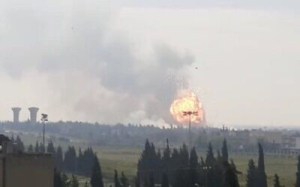
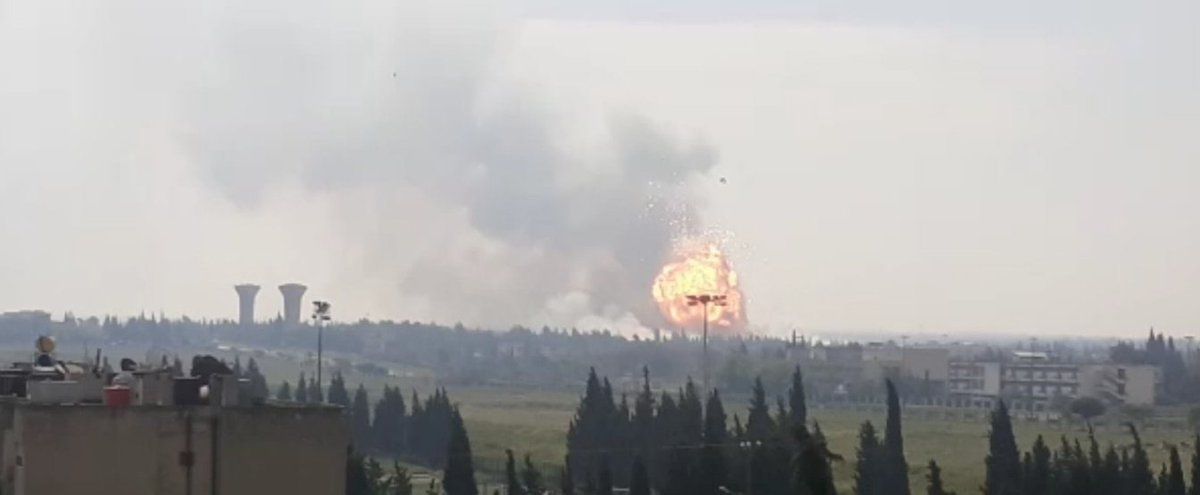
An explosion is seen following an alleged Israeli attack on a Hezbollah arms cache near Homs in central Syria on May 1, 2020. (Screen capture: Twitter)

An explosion is seen following an alleged Israeli attack on a Hezbollah arms cache near Homs in central Syria on May 1, 2020. (Screen capture: Twitter)

Iranian forces are pulling out of Syria and closing military bases there, Israeli defense officials said Tuesday, amid increasing reports of Israeli airstrikes on Iran-linked militias in the country in recent months, including two such incidents late Monday night in which 14 Iran-linked fighters were reported killed.

The Israeli officials refused to comment on these reported attacks, maintaining Israel’s policy of ambiguity, under which it generally acknowledges taking action against Iran in Syria without specifically confirming individual strikes, under the assumption that public confirmation increases the likelihood of retaliation.

Though Israel’s fight against Iran in Syria has been ongoing for nearly a decade, after Tehran began sending its troops and its proxies into Syria at the outbreak of the country’s civil war in 2011, recent months have seen an increase in the number of strikes against Iran-linked sites in the country, targeting locations across the country with the highest concentration around Syria’s capital Damascus.

The officials, who spoke on condition of anonymity, said that this effort appears to be bearing fruit as Iranian forces have begun leaving the country, evacuating a small number of military bases previously under their control in the process. Independently, there has also been a drop in the number of Shiite militias operating in Syria, though this decrease is because of the natural progression of the civil war and not because of Israel’s actions.

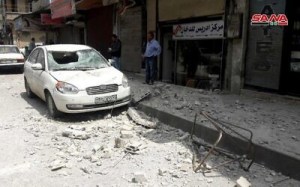
Damage caused to a street from secondary explosions after an alleged Israeli attack on a Hezbollah arms cache near Homs in central Syria on May 1, 2020. (Syrian state media SANA)

The officials said that while Israel does not believe the Iranians will accept these setbacks without responding in some way, an imminent retaliation does not appear to be in the offing.

“We are determined, more determined [than Iran], and I can tell you why — for Iran, Syria is an adventure happening 1,000 kilometers away from home. For us, it’s our lives,” Defense Minister Naftali Bennett said Tuesday.

“Iranian soldiers who come to Syria and operate there, their lives are in their hands. They are putting their lives at risk, they are paying that price and will continue to do so. We will not give up and we will not allow the establishment of an Iranian forward operating base in Syria,” Bennett said.

The number of transport flights from Iran to Syria, bringing advanced munitions into the country, have also dropped dramatically in the past half-year, apparently the result of Israeli strikes on the airports in Syria where these flights would land.

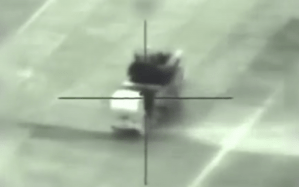
A moment before an Israeli missile destroys a Syrian SA-22 air defense system on May 10, 2018. (Israel Defense Forces)

Alongside the uptick in the number of strikes on Iran-backed forces in Syria, Israel has also reportedly targeted a larger number of Syrian military air defense systems.

“Syria is paying a growing price for the Iranian presence in its territory, for a war that isn’t [Syria’s]. Iran has turned from an asset to Syria into a burden,” the defense officials told reporters.

They added that Israel plans to keep up its pressure on Iran until its military leaves Syria for good.

Though the officials boasted of Iran’s departure from Syria as a recent development, the Israel Defense Forces has been saying since at least 2018 that its operations against Iran have forced Tehran to radically change and scale back its plans for Syria.

Jerusalem has long maintained that Iran was working to establish a permanent military presence in Syria in order to use it as a springboard for attacks against Israel — similar to what Tehran accomplished by supporting its proxy Hezbollah. That organization began as a small terrorist group in southern Lebanon carrying out deadly but minor attacks on IDF troops, but has gone on to become one of the most powerful military forces in the region, with capabilities exceeding those of many sovereign nations.

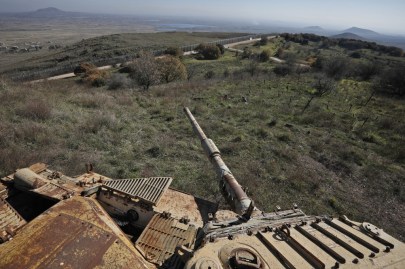
A picture taken from the remains of a tank dating back from the 1973 war, shows the Syrian town of Quneitra, as seen from the Golan Heights, on December 23, 2019. (JALAA MAREY / AFP)

In recent years, Israel has also warned that Iran was helping Hezbollah convert its massive arsenal of simple rockets into far more lethal precision-guided missiles, a project that the IDF has designated as the second-most significant threat to the country after Tehran’s nuclear program.

Indeed, one of the strikes attributed to Israel on Monday night targeted a Syrian military research center, which was reportedly involved in this precision project.

A burning vehicle at the Baghdad International Airport following an airstrike in Baghdad, Iraq, in which Iranian Gen. Qassem Soleimani was killed January 3, 2020. (Iraqi Prime Minister Press Office via AP)

The defense officials partially credited the successes against Iran in Syria to the US strike on the commander of the Islamic Revolutionary Guard Corps’s expeditionary Quds Force, Qassem Soleimani, earlier this year, which left Tehran without one of its most skilled generals.

For Israel, either path Iran decides to take in Syria — remain there or fully leave — is potentially beneficial. If Iran leaves, Israel will have successfully prevented the opening of another front against it. If Iran stays in Syria, where Israel maintains intelligence and aerial superiority, the IDF would be able to continue striking Iranian forces, exacting a heavy price from Tehran, while being able to defend against and thwart Iranian attacks


Rocket fired from Gaza into Israel, IDF tanks respond, hitting 3 Hamas positions 

May 6, 2020

Source: Rocket fired from Gaza into Israel, IDF tanks respond, hitting 3 Hamas positions | The Times of Israel

Rocket lands in open area in Eshkol region, no injuries or damage reported; army says it shelled military targets in north of Strip

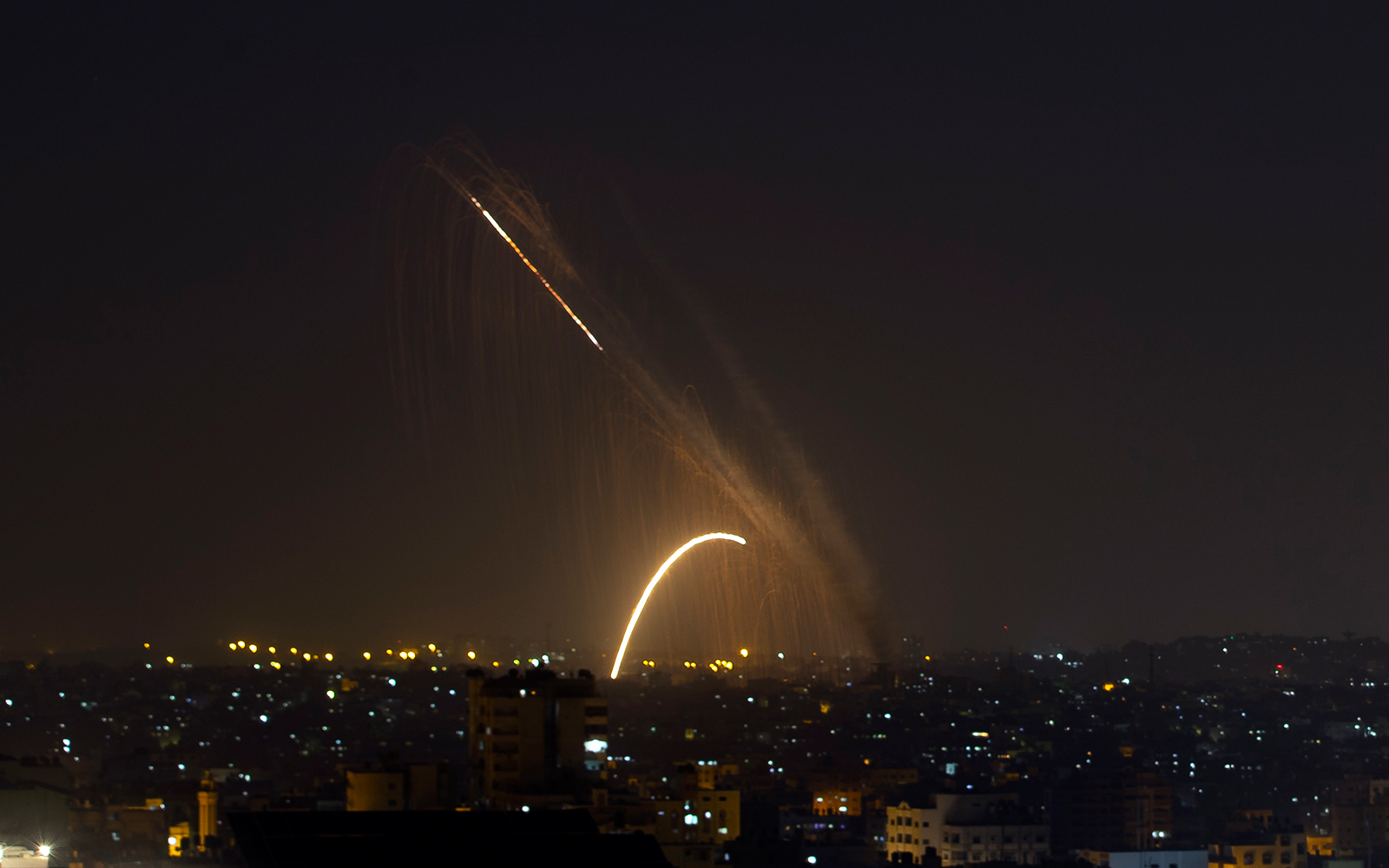
Illustrative: Rockets are launched from the Gaza Strip toward Israel, November 13, 2019. (AP Photo/Khalil Hamra)

Illustrative: Rockets are launched from the Gaza Strip toward Israel, November 13, 2019. (AP Photo/Khalil Hamra)

Palestinian terrorists in the Gaza Strip fired a rocket into Israel early Wednesday that landed in an open area, causing no injuries or damage, the IDF said.

The army said that as the projectile was detected to be heading to an open area in the Eshkol region, rocket warning sirens were not sounded, but people in the area were notified with text messages.

The IDF said that in response tanks shelled three “Hamas military positions in the northern Gaza Strip.”

There has been a lull in violence in recent weeks with both Israel and the Palestinians focused on combating the outbreak of the coronavirus.

Israel and Hamas, which rules Gaza, have also been negotiation a possible prisoner swap.

The possibility of a deal to return two Israeli captives — Avera Mengistu and Hisham al-Sayed — and the bodies of two IDF soldiers being held in the Gaza Strip has appeared to pick up momentum recently, with the government’s chief negotiator for the release of Israelis held by the terror group updating families last week regarding the prisoner swap talks.

The Wednesday meeting between Yaron Blum and the families of Sergeant First Class Oron Shaul and Lieutenant Hadar Goldin, both killed in action during the 2014 Gaza war, came after Prime Minister Benjamin Netanyahu earlier convened the ministerial committee responsible for returning Israeli captives to discuss efforts to reach a prisoner exchange with Hamas, Channel 13 reported.

Left to right: Oron Shaul, Hadar Goldin and Avraham Mengistu. (Flash90/The Times of Israel)

Hamas in recent weeks has expressed interest in reaching a deal that would see it return Mengistu and al-Sayed, who are believed to have entered Gaza of their own accord over five years ago, and the remains of Shaul and Goldin.

However, the terror group, which is the de facto ruler in the Strip and openly seeks Israel’s destruction, has said that in order for such a deal to take place, Israel must first release all teenage, female and elderly prisoners in addition to those who were rearrested after the 2011 Gilad Shalit prisoner swap deal, when more than 1,000 terror convicts were freed in exchange for a single IDF soldier.

The issue of the captives was reportedly delaying Israel’s okay for new investment money to be funneled into blockaded Gaza, and Hamas was growing desperate to lift part of the blockade amid the global coronavirus pandemic and economic downturn.

Some Israeli defense bodies are said to believe a prisoner swap would bring quiet to the often tense border for the immediate future.

Israel and Hamas have in the past failed to advance in the talks, in part because each has demanded a different timetable. Hamas has demanded two rounds of prisoner releases — the first in exchange for information on the captives, the second in exchange for the actual delivery to Israel of the captives and the soldiers’ bodies. Israel has refused, insisting that any deal must take place in a single exchange.

The coalition deal inked last month between Benjamin Netanyahu and Benny Gantz also opens a possible political window for a deal, as Gantz’s Blue and White faction would likely support an exchange even if some of Netanyahu’s right-wing allies do not.


(Pt.I) Netanyahu Unveils Next Steps in Israel’s COVID19 Strategy 

May 5, 2020


Mossad gave Berlin intel on Hezbollah ops on German soil ahead of ban — report

May 4, 2020

Source: Mossad gave Berlin intel on Hezbollah ops on German soil ahead of ban — report | The Times of Israel

Unnamed Israeli official tells TV Germans were provided info on warehouses where terror group stashed materials for explosives, as well as money laundering networks

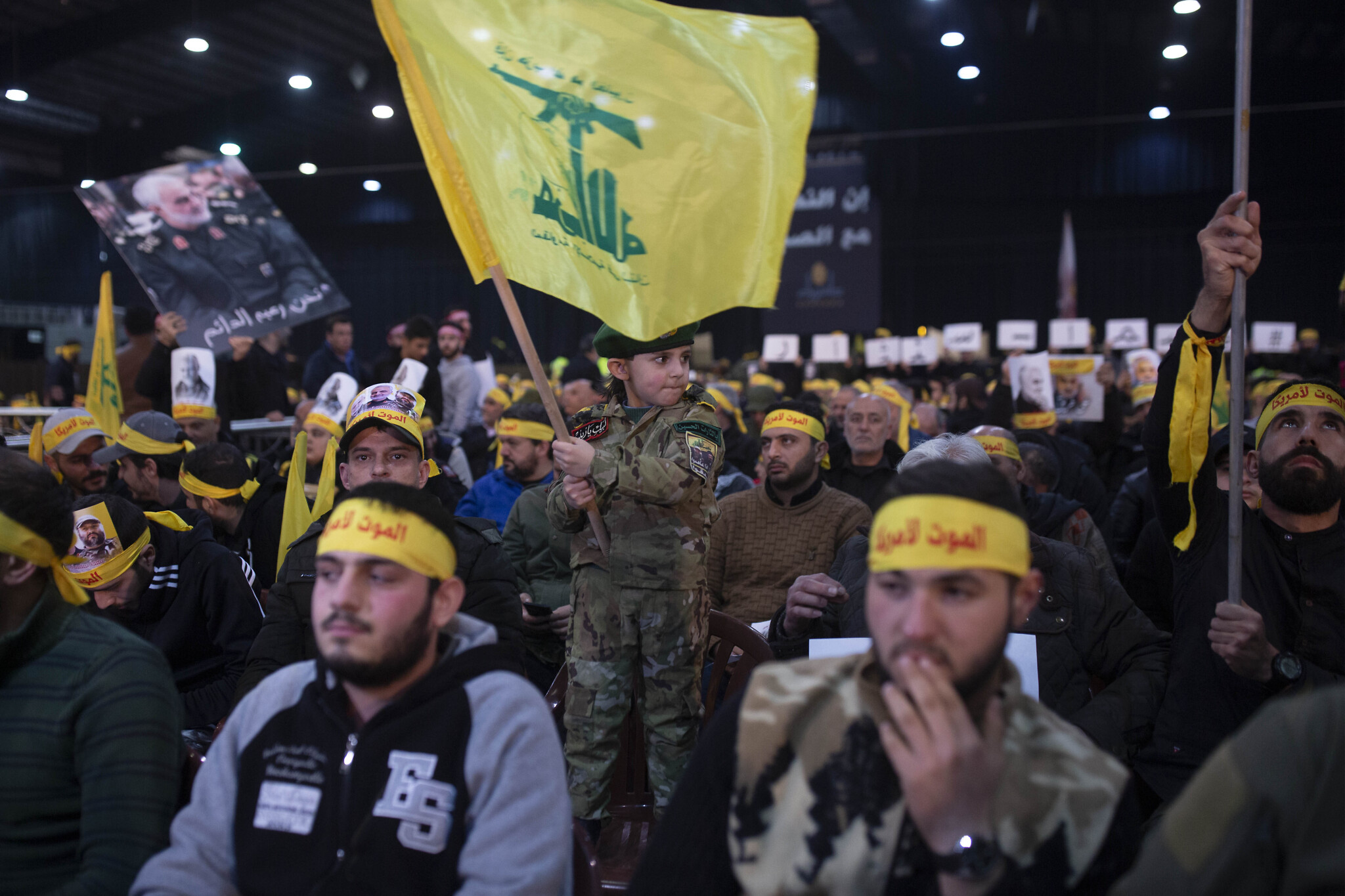
A child in tiny military fatigues waves the Hezbollah flag as supporters of the group's leader Sayyed Hassan Nasrallah wait for his televised speech in a southern suburb of Beirut, Lebanon, Sunday, Jan. 5, 2020 following the US airstrike in Iraq that killed Iranian Revolutionary Guard Gen. Qassem Soleimani. (AP Photo/Maya Alleruzzo)

A child in tiny military fatigues waves the Hezbollah flag as supporters of the group’s leader Sayyed Hassan Nasrallah wait for his televised speech in a southern suburb of Beirut, Lebanon, Sunday, Jan. 5, 2020 following the US airstrike in Iraq that killed Iranian Revolutionary Guard Gen. Qassem Soleimani. (AP Photo/Maya Alleruzzo)

Israel’s Mossad spy agency gave information to Germany on Hezbollah’s activities on its soil ahead of the country banning the Lebanese terror group this week, Channel 12 news reported Saturday.

Germany branded the entirety of the Iranian-backed group — both the military and political wings — a “Shiite terrorist organization” on Thursday, with dozens of police and special forces storming mosques and associations across the country linked to the group.

According to the TV report, Israel carried out a months-long delicate operation to assess the group’s operations in Germany and presented its findings to German intelligence and law agencies.Mossad reportedly gave Germany information about warehouses in the south of the country where Hezbollah stashed hundreds of kilograms of ammonium nitrate, a material used to make explosives.

Israeli intelligence was also said to have handed over details of key individuals in Hezbollah’s operations in Germany, including money networks used to launder cash and transfer millions of euros into the terror group’s bank accounts as well as to fund activities within the country.

Hezbollah supporters take part in a rally to mark al-Quds day in Beirut, Lebanon, May 31, 2019. (AP Photo/Hassan Ammar)

An unnamed Israeli official told Channel 12 that the operation was complex and provided key evidence to German authorities.

“The move is the result of many months of work with all parties in Germany. The heads of services were required to present explicit evidence and legal proof… linking the organization to significant terrorist activity, and that is what we did,” the official said.

“Bruno Kahl, the head of the German intelligence organization BND, is a close friend of Mossad,” he added.

Germany on Thursday officially announced that it has outlawed activities by Hezbollah. In a dramatic departure from Berlin’s previous policy, which was based on the European Union’s stance, the new ban does not differentiate between the group’s military and political wings.

Hezbollah activities “violate criminal law and the organization opposes the concept of international understanding,” said German Interior Minister Horst Seehofer.

The group, headed by Hassan Nasrallah, denies Israel’s right to exist and “supports the armed terrorist fight” against the Jewish state, his ministry said in a statement issued Thursday. “It is to be expected that Hezbollah will continue to plot terrorist acts against Israel and Israeli interests also outside the Middle East.”

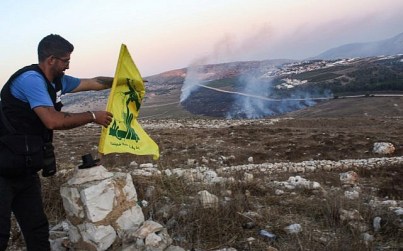
A man fixes a Hezbollah flag at the ‘Garden of Iran’ Park in the Lebanese village of Maroun al-Ras on September 1, 2019, as fires blaze on the Lebanese side along the border following an exchange of fire with Israel. (Mahmoud Zayyat/AFP)

Early on Thursday, German police raided four groups associated with Hezbollah in various locations across the country to ensure that “evidence of potential sub-organizations in Germany could not be destroyed when this ban was announced,” the Interior Ministry said.

Since there is no formal German branch of Hezbollah, Berlin cannot outlaw the organization as such, according to an Interior Ministry statement. Hence the government undertook to ban Hezbollah’s activities, which has the same legal consequences, the statement explained: “It is prohibited to use or display symbols and to organize and participate in assemblies; assets are confiscated and forfeited. Violations of bans on organizations and activities are equally punishable.”

The new policy prohibits the showing of Hezbollah signs and symbols in public, including “in an assembly or in print, audio or visual media, pictures or portrayals.” Even the symbol of the Imam al-Mahdi Scouts, Hezbollah’s youth movement, is banned. The group’s assets will be confiscated.

Israel welcomed Berlin’s new policy. “It is a very important decision and a valuable and significant step in the global fight against terrorism,” Foreign Minister Israel Katz said in a statement released shortly after the decision was announced. “I would like to express my deepest appreciation to the German government for this step and I am sure that many governments in the Middle East as well as the thousands of victims of Hezbollah’s terror join in thanking them for this decision.”

Foreign Minister Israel Katz at a Likud election campaign stop in Jerusalem, September 16, 2019. (Yonatan Sindel/Flash90)

Katz called on other European countries to follow the German move. “All the parts of Hezbollah, including the social, political and military wings, are terror organizations and they should be treated as such,” he said.

Prime Minister Benjamin Netanyahu praised Germany for the move and also called on other countries to follow suit. “Any country advocating peace needs to expel terror groups and not give them any direct or indirect support,” he said in a statement released by his office.

German authorities estimate that 1,050 people living in the country are affiliated with Hezbollah.

Iran on Friday slammed Germany’s ban on the activities of the Lebanese terrorist organization on its soil, saying it would face consequences for its decision to give in to the “propaganda machine” of Israel and US.

In a statement issued overnight, Iran’s foreign ministry said the Hezbollah ban ignores “realities in West Asia.”

The Islamic Republic said the move was based solely on the goals of the “propaganda machine of the Zionists and America’s confused regime.”

In this Oct. 25, 2019 file photo, supporters of Hezbollah leader Hassan Nasrallah hold his pictures and waves Hezbollah flags in the southern suburb of Beirut, Lebanon. (AP Photo/Hassan Ammar)

It “strongly” condemned the decision it said showed “complete disrespect to the government and nation of Lebanon, as Hezbollah is a formal and legitimate part of the country’s government and parliament.”

Iran said Hezbollah had a “key role in fighting Daesh’s terrorism in the region,” using the Arabic acronym for the Islamic State group.

“The German government must face the negative consequences of its decision in the fight against real terrorist groups in the region,” it added.

Raphael Ahren contributed to this report.