Author Archive

Iran snipes at IAEA over demand to access suspected nuclear sites, blames Israel 

June 17, 2020

Source: Iran snipes at IAEA over demand to access suspected nuclear sites, blames Israel | The Times of Israel

Diplomats set to advance UN resolution, the first to criticize Tehran since 2012, after inspectors barred from suspicious facilities flagged by Jerusalem

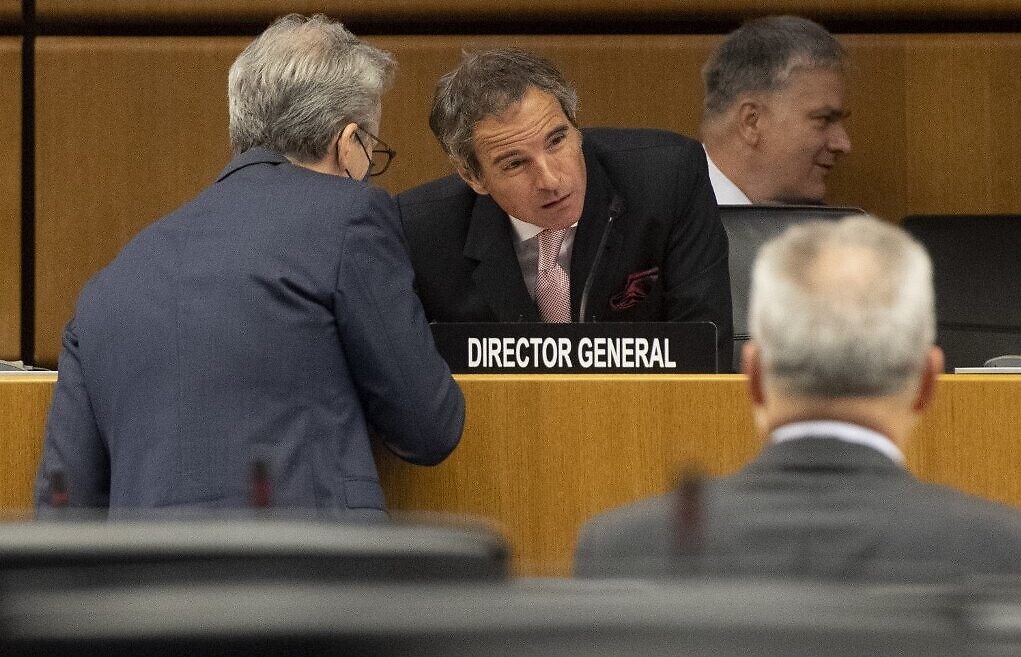
Rafael Grossi, director general of the International Atomic Energy Agency, at a meeting of the Board of Governors of the IAEA at the agency's headquarters in Vienna, Austria, June 15, 2020. (Joe Klamar/ AFP)

Rafael Grossi, director general of the International Atomic Energy Agency, at a meeting of the Board of Governors of the IAEA at the agency’s headquarters in Vienna, Austria, June 15, 2020. (Joe Klamar/ AFP)

VIENNA — Iran criticized on Tuesday a plan to put forward a resolution at a meeting of the UN’s nuclear watchdog urging the country to allow access to two disputed sites.

European states are expected to put the resolution before the International Atomic Energy Agency’s (IAEA) board of governors’ meeting this week.

“Introduction of this resolution aiming to call on Iran to cooperate with the Agency… is disappointing and absolutely counterproductive,” said Kazem Gharib Abadi, Iran’s UN ambassador in Vienna.

Diplomats say the resolution will call on Iran to provide access to two locations where past nuclear activity may have occurred — sites to which the IAEA has been trying to gain access for months.

At the start of this week’s meeting on Monday, IAEA Director General Rafael Grossi repeated his appeal to Iran to “cooperate immediately and fully” and grant access.

Even though the sites in question are not thought to be directly relevant to Iran’s current nuclear program, the agency says it needs to know if activities going back almost two decades have been properly declared and all materials accounted for.

But in Tuesday’s statement, Gharib Abadi warned that if the resolution was adopted “Iran would have no choice but to take appropriate measures, the consequences of which would be upon the sponsors of such political and destructive approaches.”

He did not specify what these measures would be. The IAEA’s board of governors hasn’t passed a resolution critical of Iran since 2012.

While it would be largely symbolic in character, it could be a prelude for the dispute being referred to the UN Security Council, the only UN body that can impose sanctions.

Gharib Abadi’s statement argued that the IAEA’s access requests were based on allegations from Israel.

Additional information provided by the IAEA in support of its requests “were merely some commercial satellite imageries that contained no convincing underlying reason” to provide access, he added.

Despite the row over the sites, the IAEA says it still has the access it needs to Iran’s nuclear facilities to monitor its current activities, as the agency is mandated to do under the landmark deal between Iran and world powers reached in 2015.

However, the deal has been unraveling since US President Donald Trump withdrew from it two years ago and went on to re-impose swingeing economic sanctions on Iran.

In retaliation, Iran has been slowly abandoning limits on its activities set out under the deal, including on the size and enrichment level of its uranium stockpile.

Iran has accused the European parties to the deal — France, the UK and Germany — of not doing enough to mitigate the impact of American sanctions.

In his statement Gharib Abadi hinted that pressing ahead with the resolution could cause “complication and difficulties” for the future of the 2015 accord.


Coronavirus death toll up to 302 as Tel Aviv flagged as new epicenter 

June 15, 2020

Source: Coronavirus death toll up to 302 as Tel Aviv flagged as new epicenter | The Times of Israel

Country’s economic hub now home to more active cases than anywhere outside Jerusalem; fatalities include man, 26, who was country’s youngest victim

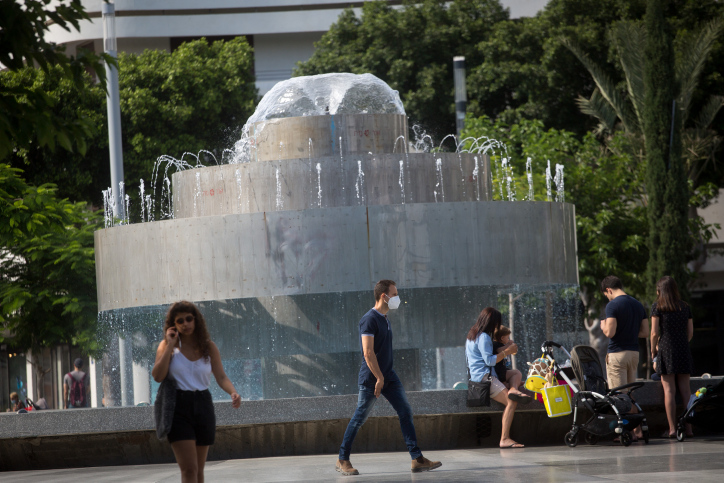
Israelis, some wearing protective face masks and some not, in Tel Aviv on June 9, 2020. (Miriam Alster/Flash90)

Two people died of COVID-19 overnight, officials said Monday morning, bringing the nation’s death toll to 302 as the pace of new infections appeared to continue to ramp up in Tel Aviv and elsewhere.

The Prime Minister’s Office tallied 73 new coronavirus cases overnight, bringing the count to 19,128. Since Sunday morning there have been 120 new confirmed cases, according to the figures, which differed slightly from ones released by the Health Ministry.

Thirty-two patients are in serious condition, including 25 people on ventilators. There are over 3,400 active cases, marking a sharp increase from earlier this month, when the number of sick dropped below 2,000.

One of the two fatalities appeared to be a 26-year-old man who succumbed late Sunday, becoming the country’s youngest virus victim.

Oshri Asulin (Facebook)

Oshri Asulin, from Kfar Saba, was sedated and in intensive care for over a month before his death, Hebrew media reported. He died at Sheba Medical Center in Tel Hashomer, where he was being treated after developing a rare heart condition that has been reported in a small number of cases of children who also caught the virus.

There were no immediate details about the second victim.

The tally of 114 new cases came hours after the ministry confirmed that only 83 new cases were found from Saturday evening to Sunday evening, the lowest tally since June 6 and second lowest since the number of new virus cases began to rebound from just a handful daily at the start of the month.

Customers at cafes in Tel Aviv on June 2, 2020. (Miriam Alster/Flash90)

According to official figures, Tel Aviv is seeing the fastest spread of the virus and is currently home to more active carriers than anywhere but Jerusalem, which has long been the country’s largest pandemic epicenter.

Nearly a third of the city’s approximately 400 cases have been linked to asylum-seekers in south Tel Aviv, Channel 12 news reported.

Police officers arrive to close synagogues in the city of Bnei Brak on April 1, 2020. (Yossi Zamir/Flash90)

The city had largely avoided the initial wave of the virus, which struck hardest in ultra-Orthodox communities that were slow to adhere to social distancing guidelines.

On Sunday, Sigal Sadetzky, the head of health services at the Health Ministry, told Knesset lawmakers that Israel was seeing the start of a second wave of the coronavirus pandemic after the government took steps over the last month to reopen the economy and roll back restrictions on movement.

“We had a long period of more than two weeks with a calm of less than 20 infections a day, and it started to climb and climb, and now we are seeing close to 200 new sick people a day,” Sadetzky said.

“What characterizes the wave we are seeing now is that it’s across the country. We don’t really know how to identify at-risk groups,” she said.

Jerusalemites wearing face masks on June 11, 2020. (Olivier Fitoussi/Flash90)

Rather than being in a localized hotspots, “we see it running all around and spreading over a very wide geographical area,” she added.

Much of the resurgence of COVID-19, the disease caused by the coronavirus, has been blamed on the education system, which has seen hundreds of cases in schools and kindergartens. The entire education system was shuttered for two months during the lockdown that began in mid-March.

Times of Israel staff contributed to this report


Netanyahu warns ‘no improvement’ in coronavirus infection rate

June 14, 2020

Source: Netanyahu warns ‘no improvement’ in coronavirus infection rate

Speaking during weekly cabinet meeting, PM says number of new diagnoses continues to increase by 200 every 24 hours, which he calls ‘a red flag’; cites study that says wearing of face masks could prevent another wave of the outbreak

Nina Fuchs,Itamar Eichner|
Published: 06.14.20 , 13:04
Prime Minister Benjamin Netanyahu on Sunday said there has been “no improvement” in the number of new daily coronavius cases.
Israel over the past few weeks has seen a resurgence of COVID-19 as more and more businesses reopen, with the daily toll topping 200 new cases on Friday for the first time since April.

בנימין נתניהו

Prime Minister Benjamin Netanyahu
(Photo: EPA)
“Unfortunately, there is currently no improvement in the infection rate,” he said at the start of the weekly cabinet meeting. “The number of infections continues to be about 200 per day, which is a red flag.
Advertisement
He once again urged the public to adhere to public health orders and cited a research published in the UK, which claims that protective face masks prevent the spread of the pathogen.
“I reiterate, everyone must obey the guidelines and respect the rules of the Health Ministry,” he said. “I would like to bring the government and the public’s attention to a study by the University of Cambridge and the University of Greenwich, which showed that wearing masks is a very effective way to prevent further outbreaks,” he added.

בנימין נתניהו

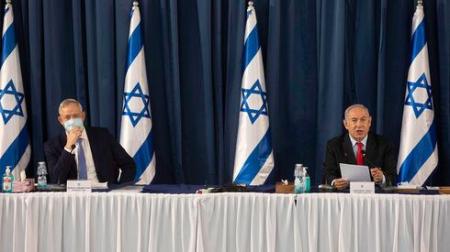
Defense Minister Benny Gantz and PM Netanyahu during cabinet meeting
(Photo: EPA)
“The study found the use of masks by half of the population would lower the transmission coefficient to below one.”
Netanyahu, nevertheless, said for the time being the government wants to continue reopening the economy and provide financial help to the industries hit the hardest by the fallout from the recent lockdown.
“Today, we will bring the NIS 50 million aid program for Eilat for the government’s approval. We will work to strengthen tourism in the area. Domestic tourism will partially replace foreign tourism.


Iran edging closer to nuclear bomb, Israeli defense officials assess – report

June 14, 2020

Source: Iran edging closer to nuclear bomb, Israeli defense officials assess – report | The Times of Israel

Officials said to tell Gantz Tehran hasn’t increased uranium enrichment during pandemic, but is still just 2 years away from bomb

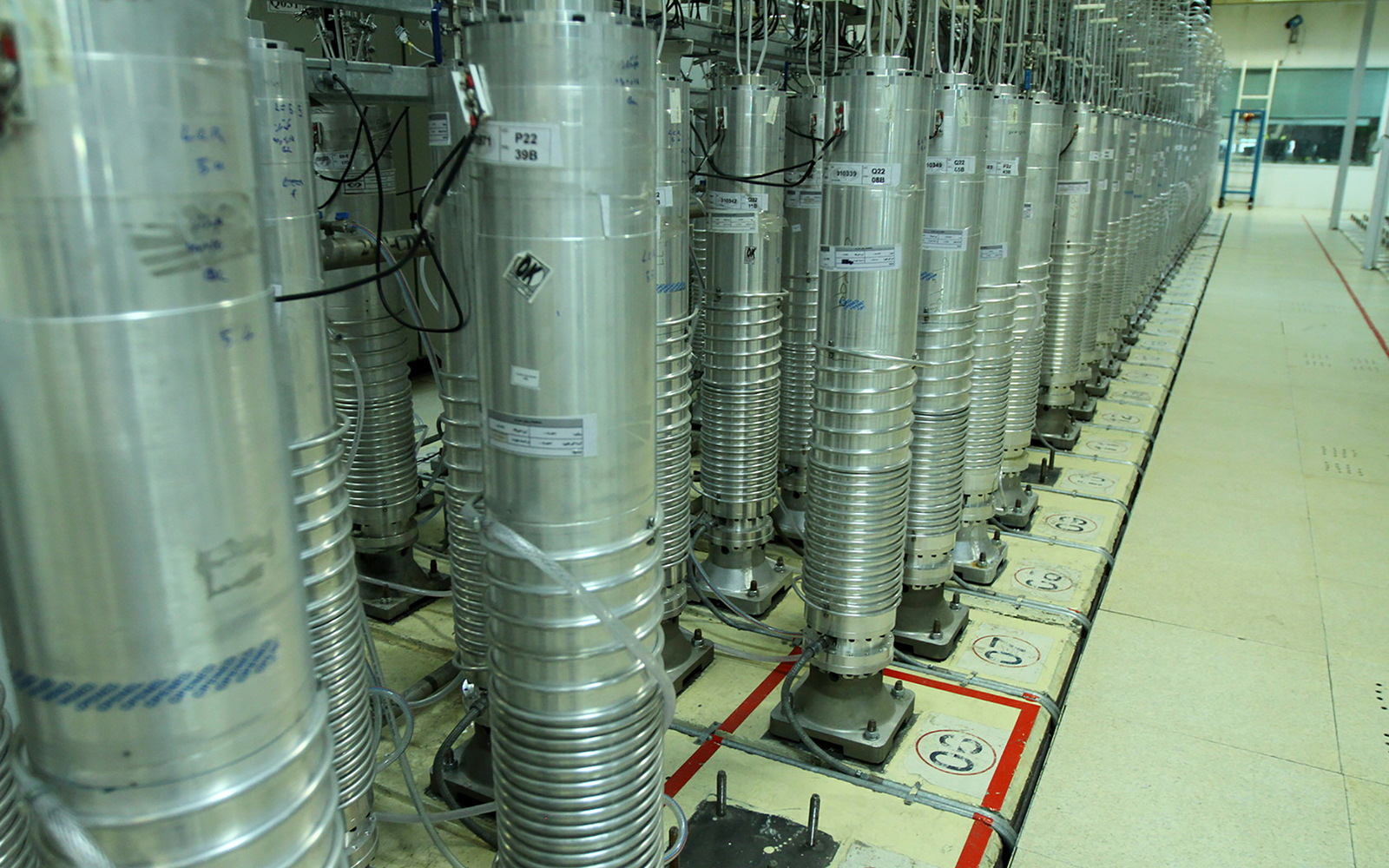
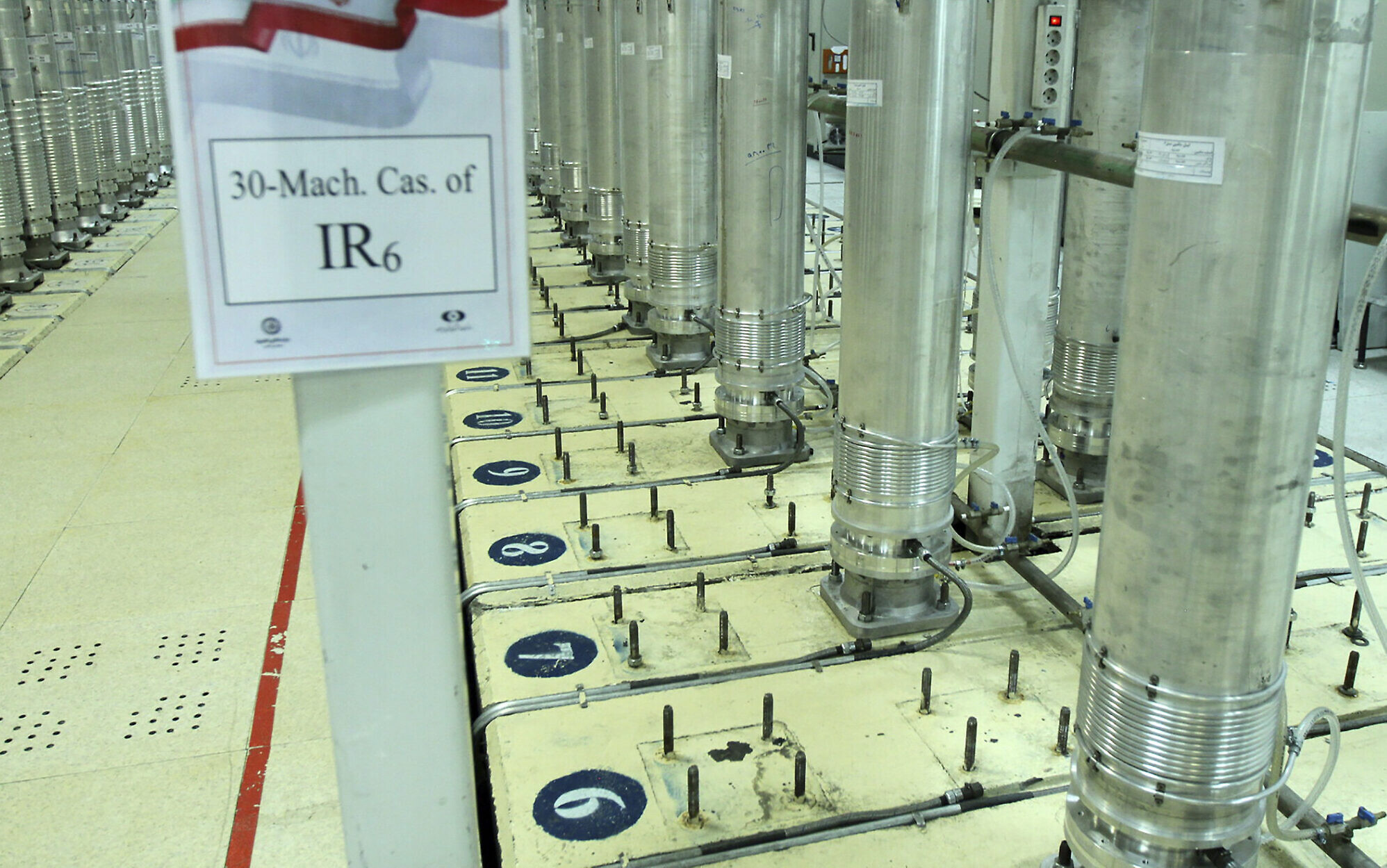
Centrifuge machines in the Natanz uranium enrichment facility in central Iran, November 5, 2019. (Atomic Energy Organization of Iran via AP)

Israeli defense officials believe Iran hasn’t increased the pace of its nuclear enrichment in recent months, but nevertheless could be just two years from producing an atomic weapon, a report said Sunday.

The Walla news site quoted the unnamed senior officials as saying Jerusalem estimates the Islamic Republic continues to enrich uranium at a four percent level, the same as when the coronavirus crisis hit earlier this year.

However, the report said Defense Minister Benny Gantz has been presented with an assessment that Tehran is just six months away from producing all the components of an atomic bomb, and two years away from assembling such a bomb.

The sources were quoted as saying that if Iran decides to hasten its enrichment, Israel would have to “reconsider” its reaction to the development and to the crumbling of the 2015 nuclear deal, with “all options” put on the table.

They said that full attention was not being currently paid to the subject by US President Donald Trump’s administration, which is preoccupied with his reelection campaign.

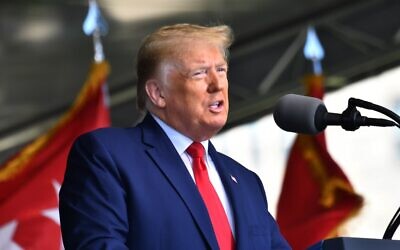
US President Donald Trump delivers the commencement address at the 2020 US Military Academy Graduation Ceremony at West Point, New York, on June 13, 2020. (Nicholas Kamm / AFP)

Still, the officials added that Trump’s term was very positive toward Israel and included security cooperation at levels not seen for decades. Some officials were said to fear that a change of power in Washington would set back Israel in its struggle against Iran.

The International Atomic Energy Agency said in a report earlier this month that Iran was breaching the landmark pact and has for months blocked inspections at two sites where nuclear activity may have occurred in the past.

The Vienna-based agency noted “with serious concern that, for over four months, Iran has denied access to the agency… to two locations.”

Iran insisted Thursday that it was ready to resolve any issues with the UN nuclear watchdog, expressing “disappointment” over the IAEA’s report.

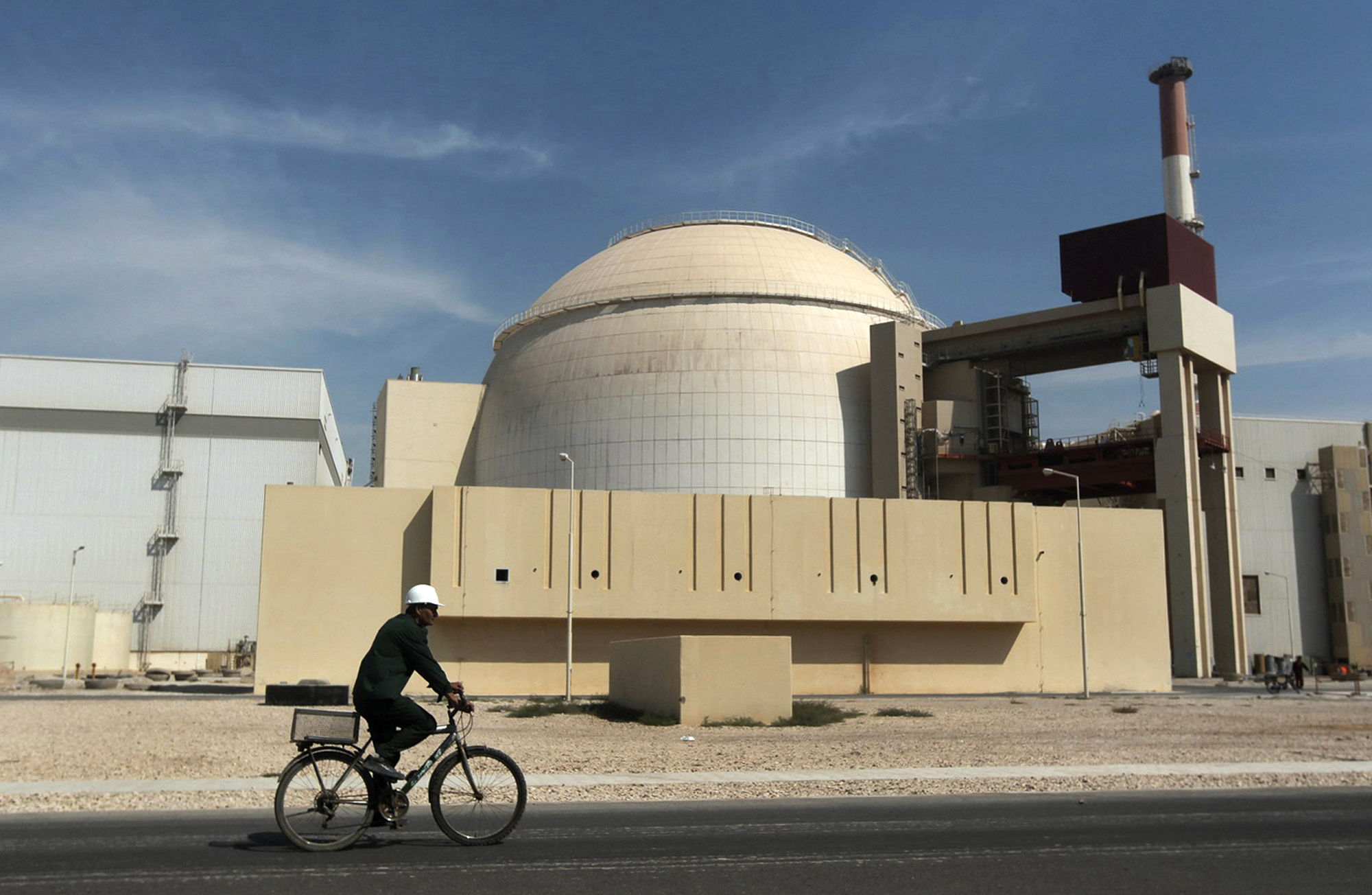
The Bushehr nuclear power plant outside the southern city of Bushehr, Iran. (AP Photo/Mehr News Agency, Majid Asgaripour)

Iran argues that the requests for access are based on “fabricated information,” accusing the United States and Israel of trying to “exert pressure on the agency.”

Israel has claimed that its intelligence services have new information on Iran’s alleged previous nuclear weapons program.

The IAEA has said that its access requests were based on “concrete information” that had been validated. The report is expected to be discussed at a meeting of the agency’s board of governors starting Monday.

In a separate report, also to be discussed during the board meeting, the IAEA warned that Iran’s enriched uranium stockpile is now almost eight times the limit set in the nuclear deal the country signed with world powers in 2015.

Iran has been progressively breaking restrictions laid down in the 2015 deal in retaliation for US withdrawal from the accord in 2018 and its subsequent re-imposition of sanctions.

AFP contributed to this report.


UN says Iran arms used in attack on Saudis, Tehran may have breached 2015 deal 

June 13, 2020

Source: UN says Iran arms used in attack on Saudis, Tehran may have breached 2015 deal | The Times of Israel

Iranian weapons, missile parts seized by US in recent months may have been moved ‘in manner inconsistent’ with resolution endorsing nuke deal, according to new report

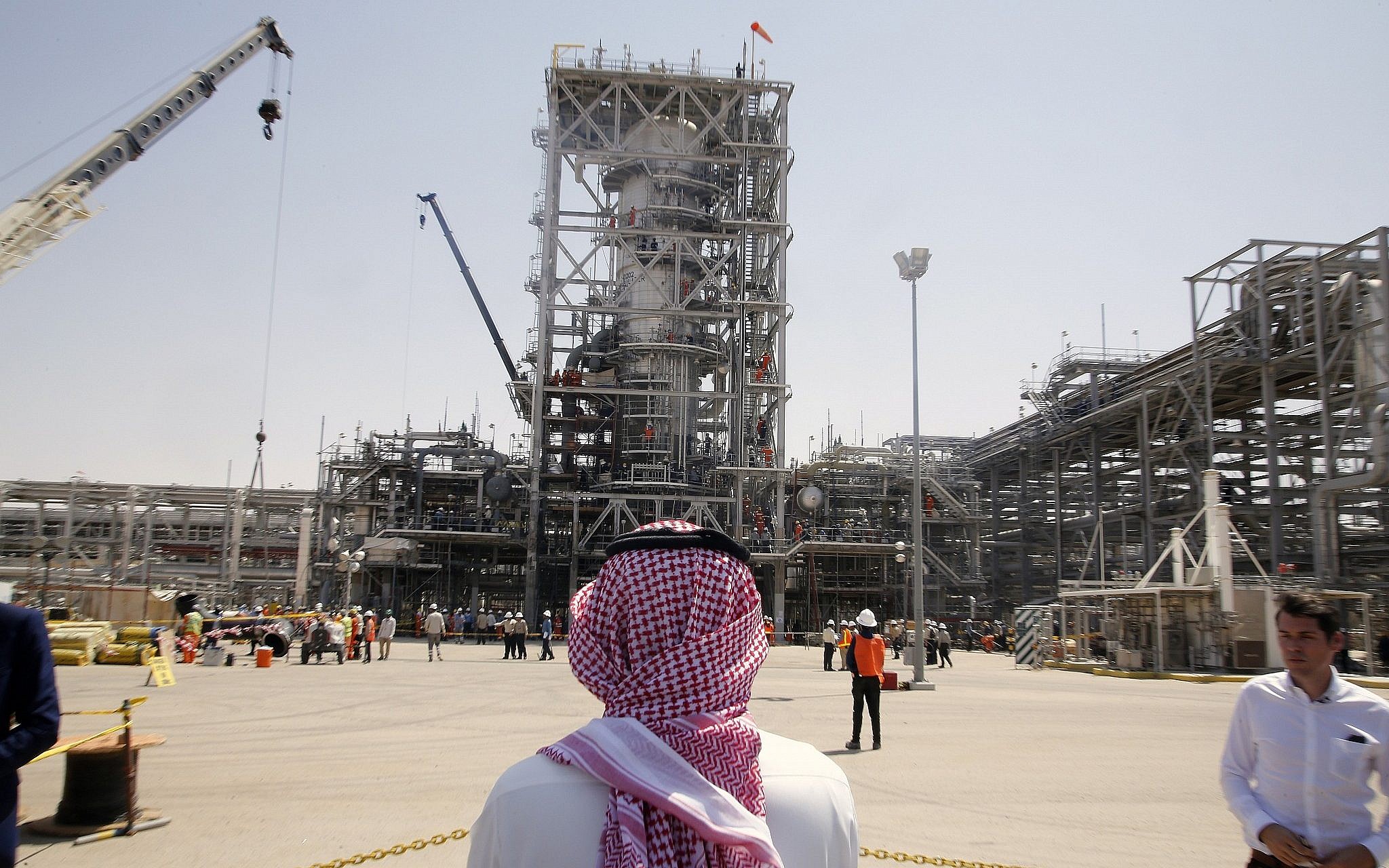
In this photo taken on a trip organized by the Saudi information ministry, a man stands in front of the Khurais oil field in Khurais, Saudi Arabia, September 20, 2019, after it was hit in a September 14 missile and drone attack blamed on Iran. (AP Photo/Amr Nabil)

In this photo taken on a trip organized by the Saudi information ministry, a man stands in front of the Khurais oil field in Khurais, Saudi Arabia, September 20, 2019, after it was hit in a September 14 missile and drone attack blamed on Iran. (AP Photo/Amr Nabil)

UNITED NATIONS (AP) — The United Nations says it has determined that Iran was the source for several items in two arms shipments seized by the United States and for debris left by attacks on Saudi Arabia’s oil installations and an international airport, according to a new report.

UN Secretary-General Antonio Guterres said some of the items seized by the US in November 2019 and February 2020 “were identical or similar” to those found after the cruise missiles and drone attacks on Saudi Arabia in 2019.

He said in a report to the UN Security Council obtained Friday by The Associated Press that some items seized by the US in international waters off Yemen are not only Iranian but may have been transferred “in a manner inconsistent” with the council resolution that endorsed the 2015 Iran nuclear deal.

The secretary-general was reporting on the implementation of the 2015 resolution enshrining the nuclear agreement aimed at preventing Iran from developing nuclear weapons. It includes restrictions that took effect on Jan. 16, 2016, on transfers to or from Iran of nuclear and ballistic missile material as well as arms.

The Security Council is scheduled to discuss the resolution’s implementation on June 30, and the US is expected to press for the UN arms embargo against Iran, which is part of it, to be extended indefinitely before it expires in October.

In this September 20, 2019, file photo, taken during a trip organized by the Saudi information ministry, workers fix the damage in Aramco’s oil separator at a processing facility after the September 14 attack blamed on Iran in Abqaiq near Dammam in the Kingdom’s Eastern Province. (AP Photo/Amr Nabil, File)

Iran’s UN Mission responded to the report Friday saying: “Iran categorically rejects the observations contained in the report concerning the Iranian connection to the export of weapons or their components that are used in attacks on Saudi Arabia and the Iranian origin of alleged US seizures of armaments.”

Its statement said the UN “lacks the capacity, expertise, and knowledge to conduct such a sophisticated and sensitive investigation,” adding that the report reproduces exact claims by the United States. “In essence, the US is sitting in the driver’s seat to shape the so-called ‘assessment’ regarding the Iranian connection to the attacks,” Iran said.

President Donald Trump withdrew the United States from the nuclear agreement in May 2018 and re-imposed US sanctions that had been eased or lifted. American officials contend Iran is working to obtain nuclear-capable missiles, which the Iranians deny.

US President Donald Trump signs a Presidential Memorandum withdrawing from the Iran nuclear deal from the Diplomatic Reception Room of the White House, on May 8, 2018. (AP Photo/Evan Vucci)

The nuclear agreement is still supported by the five other parties — France, Britain, Russia and China, which are all veto-wielding Security Council members, and Germany, which is currently serving a two-year term on the council.

According to Guterres report, the arms shipments seized by the US were assessed by the UN Secretariat to include parts of anti-tank guided missiles from Iran with 2016, 2017 and 2018 production dates as well as thermal weapon optical sights with design characteristics similar to those produced by an Iranian company, and a computer keyboard with Farsi markings associated with an anti-ship missile.

Guterres said UN experts also assessed that sections and components of cruise missiles recovered by the US from the sites of attacks on Saudi Arabia’s Abha International Airport in June and August 2019 and on Saudi Aramco oil facilities at Abqaiq and Khurays in September 2019 “are of Iranian origin.”
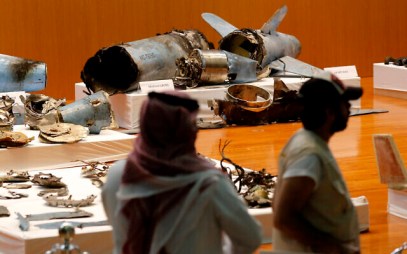
Illustrative: The Saudi military displays what they say are an Iranian cruise missile and drones used in recent attacks on its oil industry at Saudi Aramco’s facilities in Abqaiq and Khurais, during a press conference in Riyadh, Saudi Arabia, September 18, 2019. (AP Photo/Amr Nabil, File)

As for the delta-wing drones used in attacks on Saudi oil facilities in May and September 2019, Guterres said, “the Secretariat assesses that the un-crewed aerial vehicles and/or parts thereof used in the two attacks are of Iranian origin.”

The report also links Iranian material from the US seizures and the Saudi attacks.

Guterres said the UN is also reviewing information in an Israeli letter last month on imagery of four Iranian anti-tank guided missiles “being employed in Libya” and information provided last month by Australia on its June 2019 seizure of arms from a dhow in international waters off the Gulf of Oman.

The UN’s atomic watchdog agency said earlier this month that Iran has continued to increase its stockpiles of enriched uranium above limits in the agreement and remains in violation of its deal with world powers.

In his report, Guterres reiterated strong support for the Iranian nuclear agreement and expressed regret for the US withdrawal and Iran’s actions since July 2019 to stop performing its nuclear commitments. He urged all countries “to avoid provocative rhetoric and actions that may have a negative impact on regional stability.”

The secretary-general said the Trump administration’s imposition of sanctions on Iran since 2018 remains “contrary to the goals” in the nuclear deal and the UN resolution endorsing it, and may also impede Tehran’s ability to implement some provisions of the agreement and the resolution.

Illegal weapons seized by the US Navy in the Arabian Sea, Feb. 9, 2020. (US Navy/Mass Communication Specialist 2nd Class Michael H. Lehman)

He urged Iran to return to the agreement’s requirements and to “urgently address” concerns raised by the United Kingdom, Germany and France in relation to the 2015 resolution.

The three countries urged Guterres in a letter in December to inform the Security Council that Iran’s ballistic missile activity is “inconsistent” with a provision in the resolution calling on Iran “not to undertake any activity related to ballistic missiles designed to be capable of delivering nuclear weapons.”

The provision does not require Tehran to halt such activity, and the Iranian government insists all its missile activities are legal and not nuclear-related.

On Jan. 14, France, Germany and the UK announced that they had referred Iran’s actions violating limits in the nuclear agreement to the deal’s dispute resolution mechanism.

Guterres urged all parties to the agreement “to resolve all differences” within that mechanism.
 

Israel’s growing security challenges, Part 2 – Jerusalem Studio 521 

June 10, 2020


Netanyahu calls for sanctions on Iran, vows to curb its ‘aggression’ 

June 9, 2020

Source: Netanyahu calls for sanctions on Iran, vows to curb its ‘aggression’ | The Times of Israel

PM accuses Tehran of ‘systematically’ breaching 2015 nuclear deal by hiding uranium sites and enriching fissure material

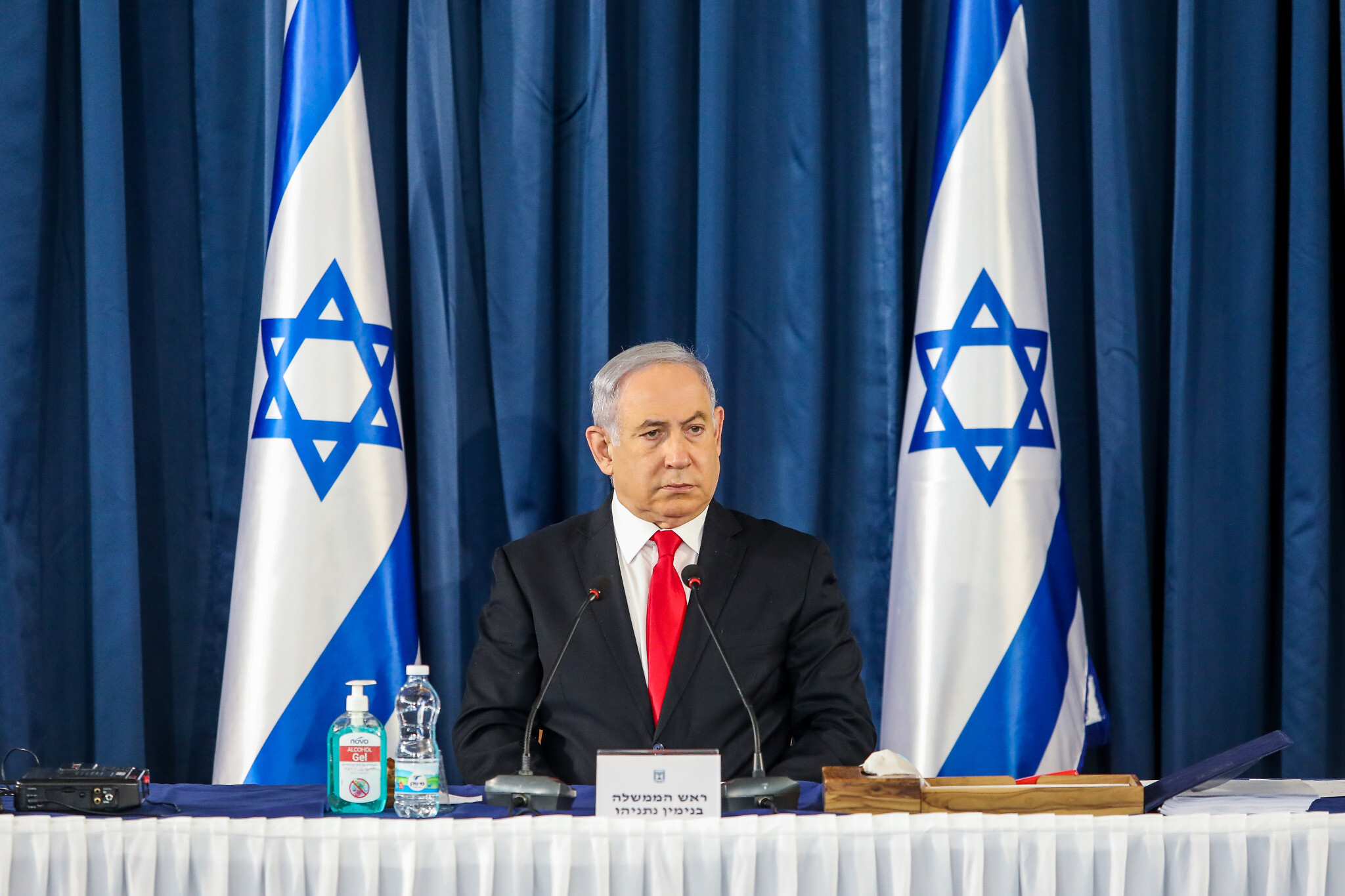
Prime Minister Benjamin Netanyahu chairs the weekly cabinet meeting in Jerusalem on June 7, 2020. (Marc Israel Sellem/POOL)

Prime Minister Benjamin Netanyahu urged world powers Sunday to reimpose tough sanctions against Iran, vowing to curb Tehran’s regional “aggression” hours after another deadly strike, thought to be carried out by Israel, on pro-Iranian fighters in Syria.

“The International Atomic Energy Agency has determined that Iran refused to give the agency’s inspectors access to secret sites where Iran conducted secret nuclear military activity,” the prime minister said at the start of the weekly cabinet meeting in Jerusalem.

The UN nuclear watchdog said Friday that Iran had accumulated enriched uranium at nearly eight times the limit under a landmark 2015 deal, and has for months blocked inspections at sites where nuclear activity may have taken place.

Netanyahu accused Iran of “systematically violating its commitments by hiding sites, enriching fissile material and in other ways.”

“In light of these discoveries, the international community must join the US and reimpose crippling sanctions on Iran,” he said.

Iran has been progressively rolling back on its commitments under the 2015 agreement in response to US President Donald Trump’s unilateral 2018 withdrawal from the accord and re-imposition of sanctions.

The deal to curb Iran’s nuclear activities in return for sanctions relief was signed with the United States — under Trump’s predecessor Barack Obama — along with Britain, France, Germany, Russia and China.

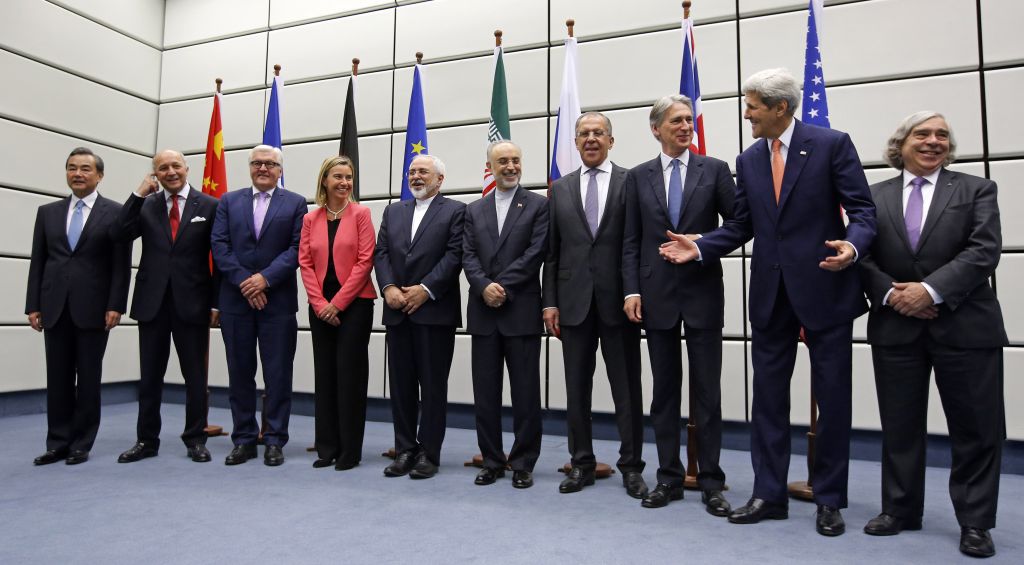
Participants in the talks on the Iran nuclear deal pose for a group photo at the UN building in Vienna, Austria, on July 14, 2015. (Carlos Barria, Pool Photo via AP)

Tehran has accused the remaining signatories of failing to sufficiently support it in the wake of Washington’s withdrawal.

In his Sunday remarks, Netanyahu reiterated Israel’s longstanding vow to “act against Iran’s aggression” and “not let Iran obtain nuclear weapons.”

Israel “will continue to act systematically against Iran’s attempts to establish a military presence on our borders,” he said.

Late Saturday evening, at least 12 Iraqi and Afghan fighters in a pro-Iran base in eastern Syria’s rural Deir Ezzor province died in eight strikes by unidentified aircraft.

The Britain-based Syrian Observatory for Human Rights could not identify the aircraft, but said Israel was likely behind the attack.

Israel has carried out hundreds of strikes targeting regime and Iranian-backed forces.

A spokeswoman for the IDF refused to comment on the Saturday evening strikes.


Report: 12 Pro-Iran Militia Killed in Strike in Syria

June 7, 2020


UN atomic watchdog says Iran now violating all restrictions of nuclear deal

June 6, 2020

Source: UN atomic watchdog says Iran now violating all restrictions of nuclear deal | The Times of Israel

Confidential report says Tehran continues to increase its stockpiles of enriched uranium and enriching beyond levels allowed under nuclear deal

This photo released by the Atomic Energy Organization of Iran on November 5, 2019, shows centrifuge machines at Natanz uranium enrichment facility in central Iran. (Atomic Energy Organization of Iran via AP)

This photo released by the Atomic Energy Organization of Iran on November 5, 2019, shows centrifuge machines at Natanz uranium enrichment facility in central Iran. (Atomic Energy Organization of Iran via AP)

VIENNA (AP) — Iran has continued to increase its stockpiles of enriched uranium and remains in violation of its deal with world powers, the United Nations’ atomic watchdog said Friday.

The International Atomic Energy Agency reported the finding in a confidential document distributed to member countries and seen by The Associated Press.

The agency said that as of May 20, Iran’s total stockpile of low-enriched uranium amounted to 1,571.6 kilograms (1.73 tons), up from 1,020.9 kilograms (1.1 tons) on Feb. 19.

Iran signed the nuclear deal in 2015 with the United States, Germany, France, Britain, China and Russia. Known as the Joint Comprehensive Plan of Action, or JCPOA, it allows Iran only to keep a stockpile of 202.8 kilograms (447 pounds).

The IAEA reported that Iran has also been continuing to enrich uranium to a purity of up to 4.5%, higher than the 3.67% allowed under the JCPOA. It is also above the pact’s limitations on heavy water.

The nuclear deal promised Iran economic incentives in return for the curbs on its nuclear program. President Donald Trump pulled the US out of the deal unilaterally in 2018, saying it needed to be renegotiated. Iran has since slowly violated the restrictions to try and pressure the remaining nations to increase the incentives to offset new, economy-crippling US sanctions.

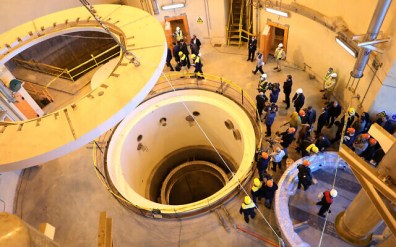
In this photo released by the Atomic Energy Organization of Iran, technicians work at the Arak heavy water reactor’s secondary circuit, as officials and media visit the site, near Arak, southwest of the capital Tehran, Iran, Monday, Dec. 23, 2019 (Atomic Energy Organization of Iran via AP)

The ultimate goal of the JCPOA is to prevent Iran from developing a nuclear bomb. Since the US withdrawal, Iran has stockpiled enough uranium to produce a weapon, although the government in Tehran insists it has no such goal and that its atomic program is only for producing energy.

According to the Washington-based Arms Control Association, Iran would need roughly 1050 kilograms (1.16 tons) of low-enriched uranium — under 5% purity — and would then need to enrich it further to weapons-grade, or more than 90% purity, to make a nuclear weapon.

With the nuclear deal in place, Iran’s so-called breakout time — the period Tehran would need to build a bomb if it chose to — stood at around a year. As Iran has stepped away from the limits of the 2015 deal, it slowly has narrowed that window.

However, that doesn’t mean Iran would immediately rush toward building a bomb if all the materials were in place.

Before agreeing to the nuclear deal, Iran enriched its uranium up to 20% purity, which is just a short technical step away from the weapons-grade level of 90%. In 2013, Iran’s stockpile of enriched uranium was already more than 7,000 kilograms (7.72 tons) with higher enrichment, but it didn’t pursue a bomb.

Israel and the US accuse Iran, which has repeatedly vowed to destroy the Jewish state, of lying about it’s nuclear program.

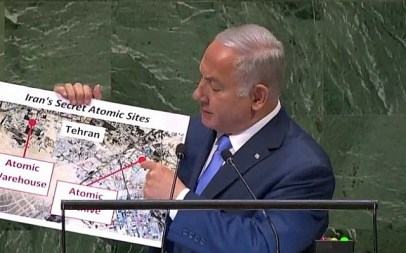
Screen capture from video of Prime Minister Benjamin Netanyahu showing a diagram of what he said was a previously unknown Iranian nuclear site, during his address to the 73rd UN General Assembly, September 27, 2018. (United Nations)

As the country has expanded its nuclear program, Iran has been open about the violations and continues to allow inspectors for the UN atomic agency access to facilities to monitor their operations.

It is now in violation of all restrictions outlined by the JCPOA, which Tehran says it hopes will pressure the other nations involved to increase economic incentives to make up for hard-hitting sanctions imposed by Washington after the U.S. withdrawal.

Though Iran has been hard hit by the new coronavirus pandemic, the IAEA said it has maintained its verification and monitoring activities in the country, primarily by chartering aircraft to fly inspectors to and from Iran.

It cited “exceptional cooperation” from authorities in Austria, where it is based, and Iran in facilitating the operation.

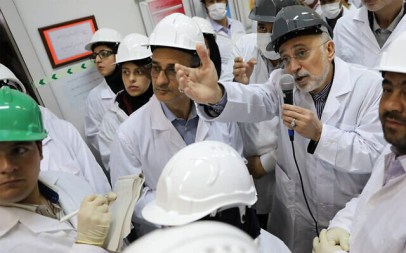
In this photo released on Monday, Nov. 4, 2019 by the Atomic Energy Organization of Iran, Ali Akbar Salehi, head of the organization, speaks with media while visiting Natanz enrichment facility, in central Iran. (Atomic Energy Organization of Iran via AP)

The agency raised concerns, however, about access to two of three locations it identified in March as places where Iran possibly stored undeclared nuclear material or undertook nuclear-related activities without declaring them to international observers.

Activities at all three sites are thought to have been from the early 2000s. The IAEA said in its current report that it had determined that one site had undergone “extensive sanitization and leveling” in 2003 and 2004 and there would be no verification value in inspecting it.

It said Iran has still blocked access to the other two locations, one of which was partially demolished in 2004 and the other at which the agency observed activities “consistent with efforts to sanitize” the facility from July 2019 onward.


1967 Six Day War: British Military Analysis 

June 5, 2020


June 5 is the anniversary.