Author Archive

Arabic media: Israeli cyberattack struck Natanz nuclear facility 

July 4, 2020

Source: Arabic media: Israeli cyberattack struck Natanz nuclear facility – The Jerusalem Post

The Kuwaiti paper argues that Iran has now lost 80% of its stock of this gas.

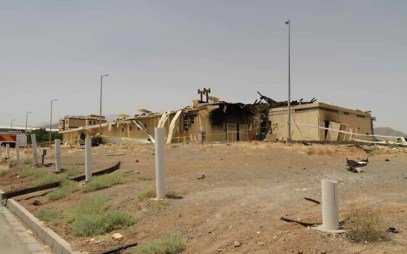
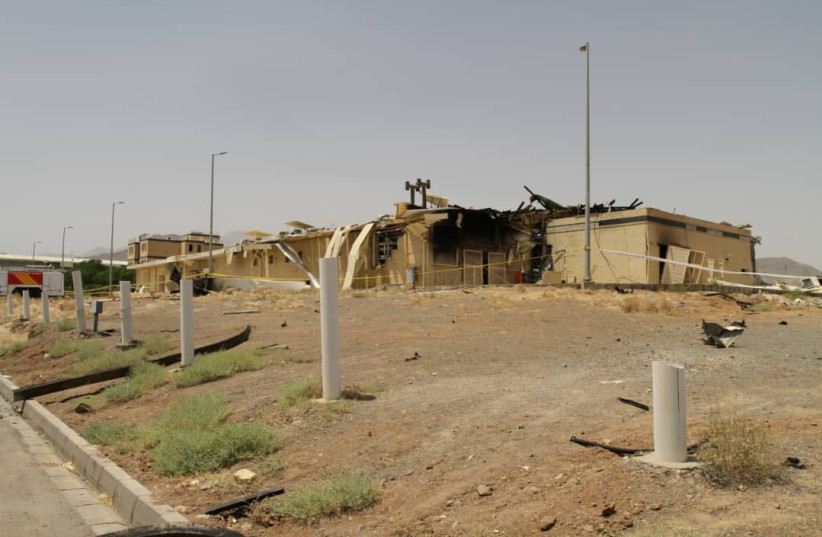
 view of a damage building after a fire broke out at Iran's Natanz Nuclear Facility, in Isfahan, Iran, July 2, 2020. (photo credit: REUTERS)
view of a damage building after a fire broke out at Iran’s Natanz Nuclear Facility, in Isfahan, Iran, July 2, 2020.
(photo credit: REUTERS)
Kuwait’s Al-Jarida newspaper, which covers security incidents and sometimes alleges Israeli involvement, says that Israel carried out a cyber attack on the Natanz nuclear facility on Thursday. The incident has been downplayed by Iran but experts say that a sensitive warehouse that deals with centrifuges was damaged.

According to the report a source informed Al-Jarida that a cyber attack hit the facility. The report linked this to an earlier cyber attack on Israeli water infrastructure that Iran allegedly carried out and then another cyber attack on an Iranian port in May. It also links the Natanz cyber attack to the earlier Stuxnet computer worm attack in 2010.

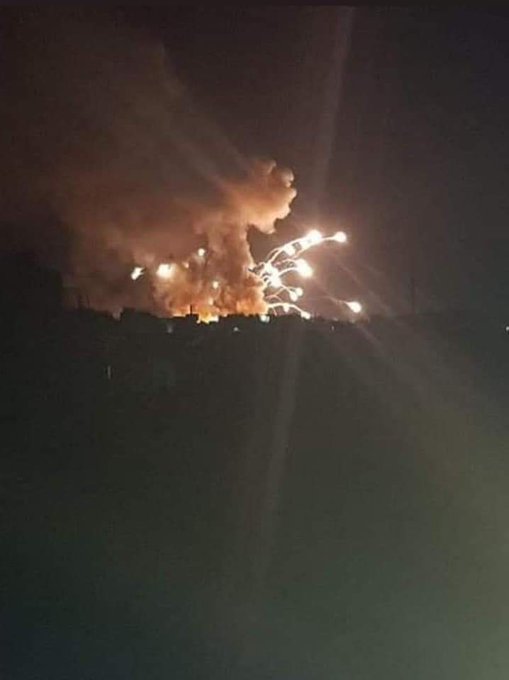
These are coordinated sabotage operations, according to the newspaper. The Natanz incident explosion and another explosion near Parchin targeted UF6 gas storage that was used for uranium enrichment. This is uranium hexafluoride gas.

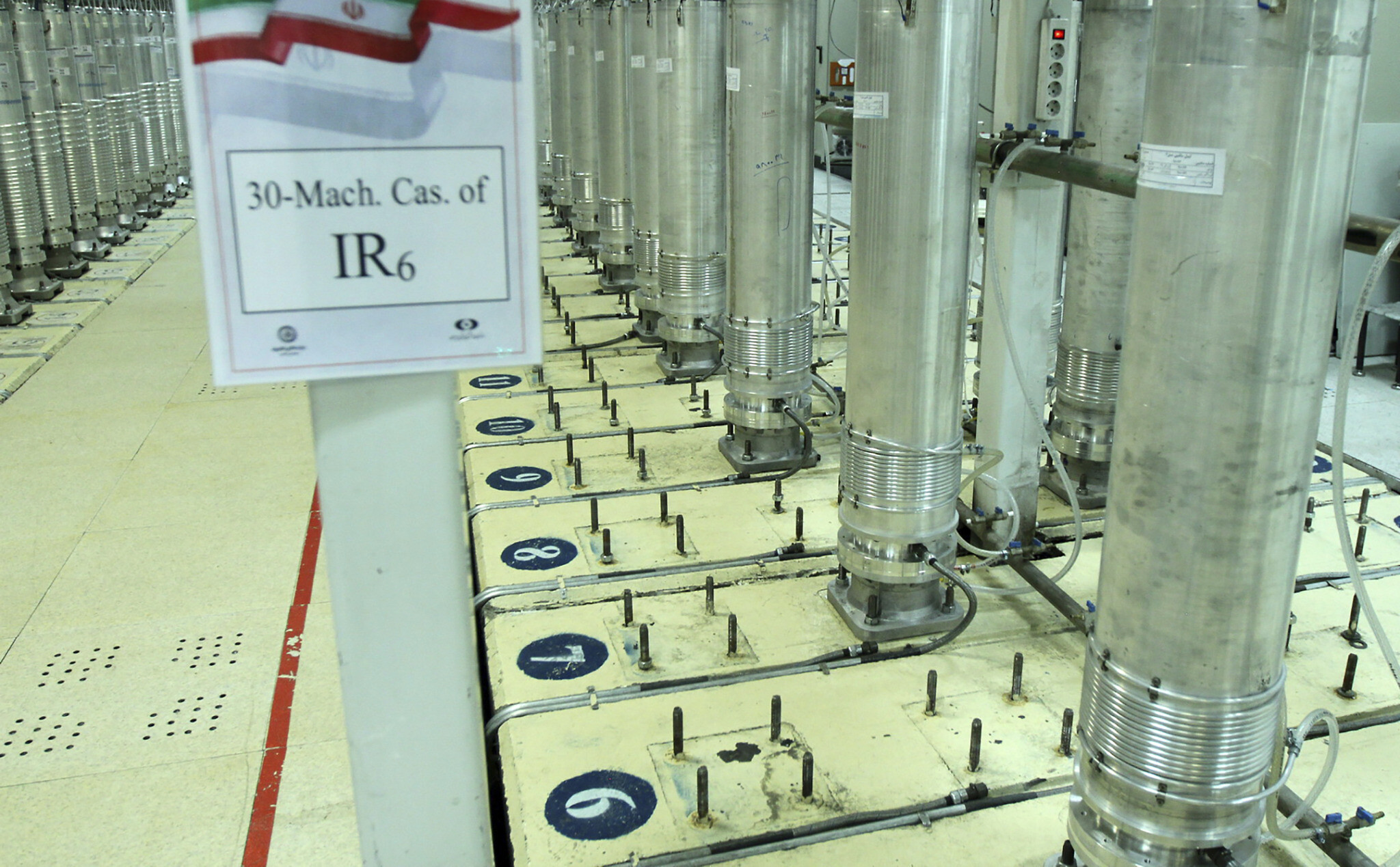
In November, 2019 Iran unveiled the production and injection of the gas into IR-6 centrifuges. These are the advanced centrifuges Iran has increased at Natanz. The Atomic Energy Organization of Iran (AEOI)’s Ali Akbar Salehi has spoken openly about the gas and the new centrifuges. Iran added around 30 of these IR-6 centrifuges to Natanz in November 2019, making at least 60 in total at the site.

The Kuwaiti paper argues that Iran has now lost 80% of its stock of this gas. “This is likely to be an electronic attack on the computer network that controls the storage compression tanks. Iran will need about two months to compensate for the gas that was lost.”

The Natanz explosion led to a “crack in the reactor building. Specialized groups went to the reactor to discover whether there was leakage in radioactive materials.” Iran says there was no leak at the site.


Israel said bracing for retaliation as Tehran points fingers over nuke site fire 

July 4, 2020

Source: Israel said bracing for retaliation as Tehran points fingers over nuke site fire | The Times of Israel

Analysts say blast destroyed lab where Iran develops next generation centrifuges to speed up uranium enrichment; one source says Iran nuclear program set back two months

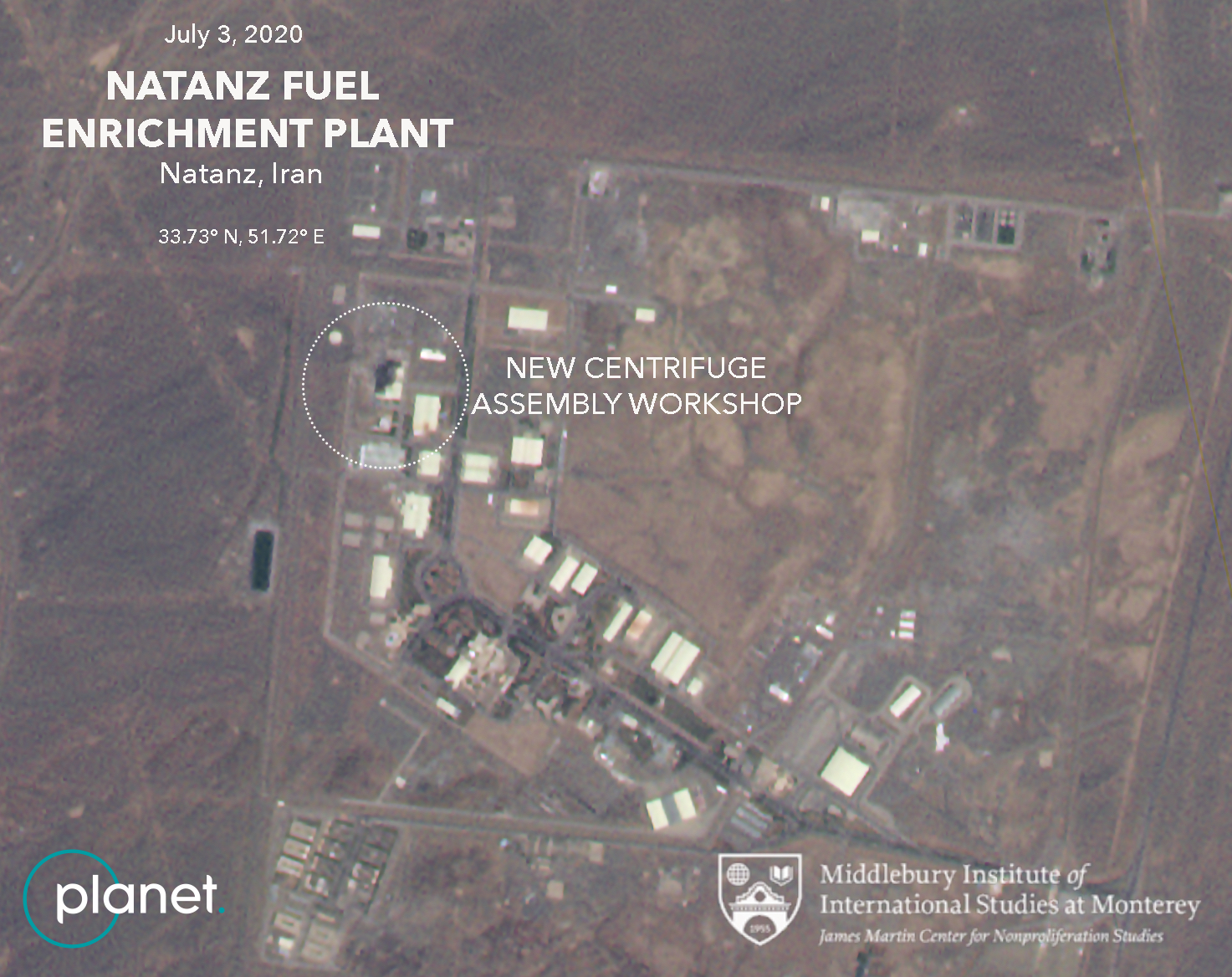
This Friday, July 3, 2020 satellite image from Planet Labs Inc. that has been annotated by experts at the James Martin Center for Nonproliferation Studies at Middlebury Institute of International Studies shows a damaged building after a fire and explosion at Iran's Natanz nuclear site. (Planet Labs Inc., James Martin Center for Nonproliferation Studies at Middlebury Institute of International Studies via AP)

This Friday, July 3, 2020 satellite image from Planet Labs Inc. that has been annotated by experts at the James Martin Center for Nonproliferation Studies at Middlebury Institute of International Studies shows a damaged building after a fire and explosion at Iran’s Natanz nuclear site. (Planet Labs Inc., James Martin Center for Nonproliferation Studies at Middlebury Institute of International Studies via AP)

Israel is reportedly bracing for a possible Iranian retaliation as officials in Tehran suggested on Friday that a mystery fire and explosion at a top-secret nuclear complex could have been caused by an Israeli cyberattack.

An Israeli TV report Friday night said the attack “destroyed” a laboratory where Iran was developing advanced centrifuges for faster uranium enrichment, and a Kuwaiti report quoted an unnamed source assessing that the strike set back the Iranian nuclear program by two months.

Three Iranian officials told the Reuters news agency they believed the incident at the Natanz enrichment facility early Thursday was the result of a cyberattack, and two of them said Israel could have been behind it, but offered no evidence.

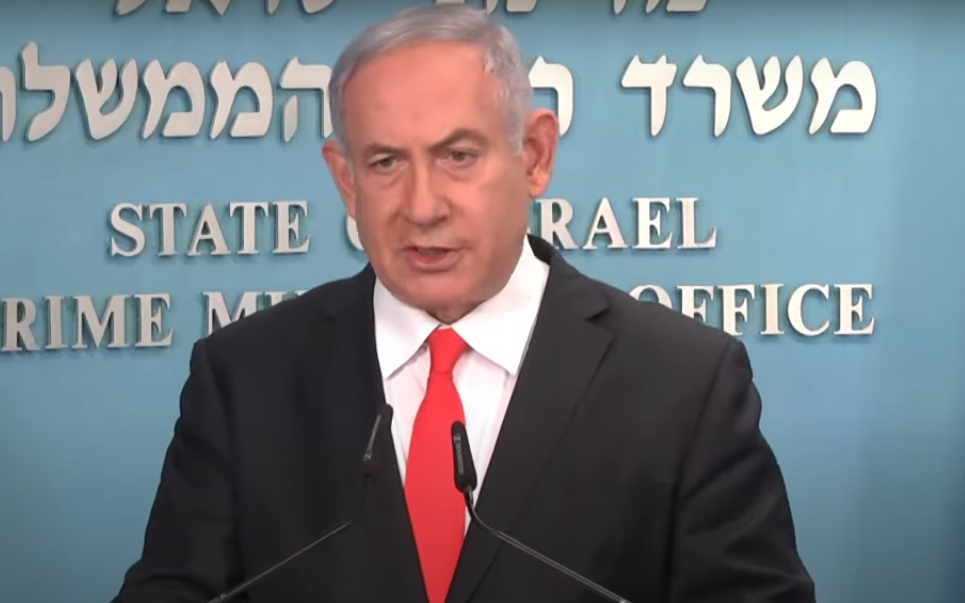
Asked about reports of the incident at a press conference Thursday evening, Israel’s Prime Minister Benjamin Netanyahu brushed aside the question: “I don’t address these issues,” he said.

Prime Minister Benjamin Netanyahu delivers a press statement from his office in Jerusalem, July 2, 2020. (Screen capture: YouTube)

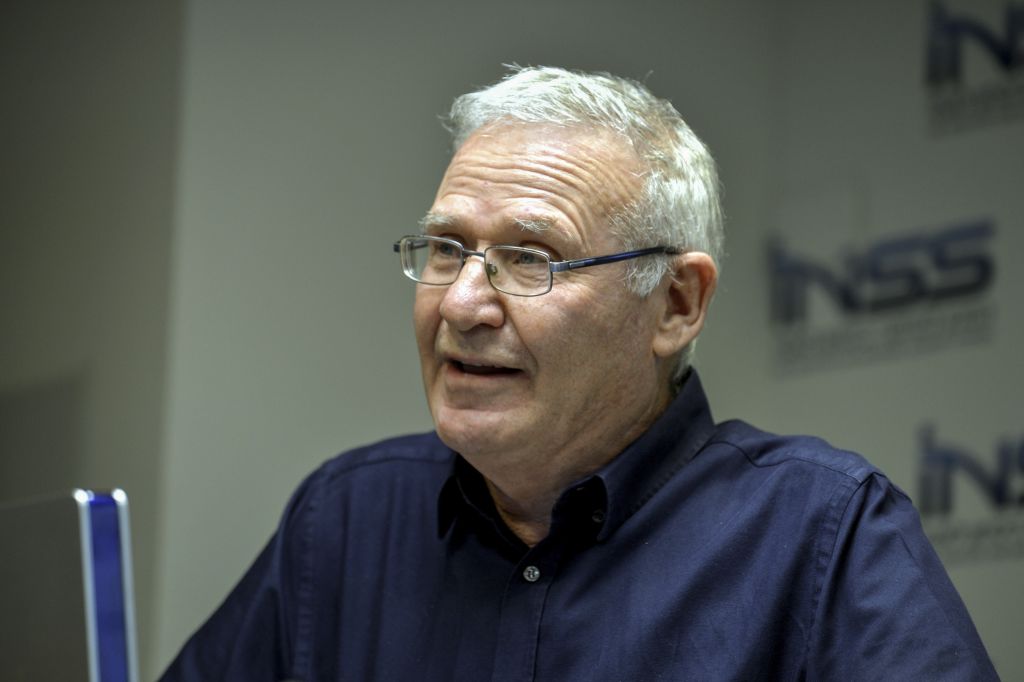
But Amos Yadlin, the head of the Institute for National Security Studies, and a former head of IDF military intelligence, tweeted Friday that, “According to foreign sources, it appears that the prime minister focused this week on Iran rather than [his plan for West Bank] annexation. This is the policy I’ve been recommending in the last few weeks.”

Added Yadlin: “If Israel is accused by official sources then we need to be operationally prepared for the possibility of an Iranian reaction (through cyber, firing missiles from Syria or a terror attack overseas).”

Amos Yadlin (Flash90)

Officially, Iran reported an “accident” occurred Thursday at the Natanz nuclear complex in central Iran, saying there were no casualties or radioactive pollution. But top generals also said Iran would respond if the incident turned out to be a cyberattack.

“If it is proven that our country has been attacked by cyberattacks, we will respond,” warned Gen. Gholam Reza Jalali, the head of Iran’s military unit in charge of combating sabotage, according to a report late Thursday by the Mizan news agency.

Centrifuge machines in the Natanz uranium enrichment facility in central Iran, November 5, 2019. (Atomic Energy Organization of Iran via AP, File)

Israel’s Channel 13 TV military analyst Alon Ben-David said Friday evening that the attack hit “the facility where Iran develops more advanced centrifuges — what are meant to be the next stage of the nuclear program, to produce enriched uranium at a far faster rate. That facility yesterday took a substantial hit; the explosion destroyed this lab.

“Those were centrifuges that were supposed to be installed underground at the Natanz facility; they were intended to replace the old centrifuges and produce a lot more enriched uranium, a lot more quickly,” he aded. “They suffered a blow. It has to be assumed that at some stage, they will want to retaliate.”

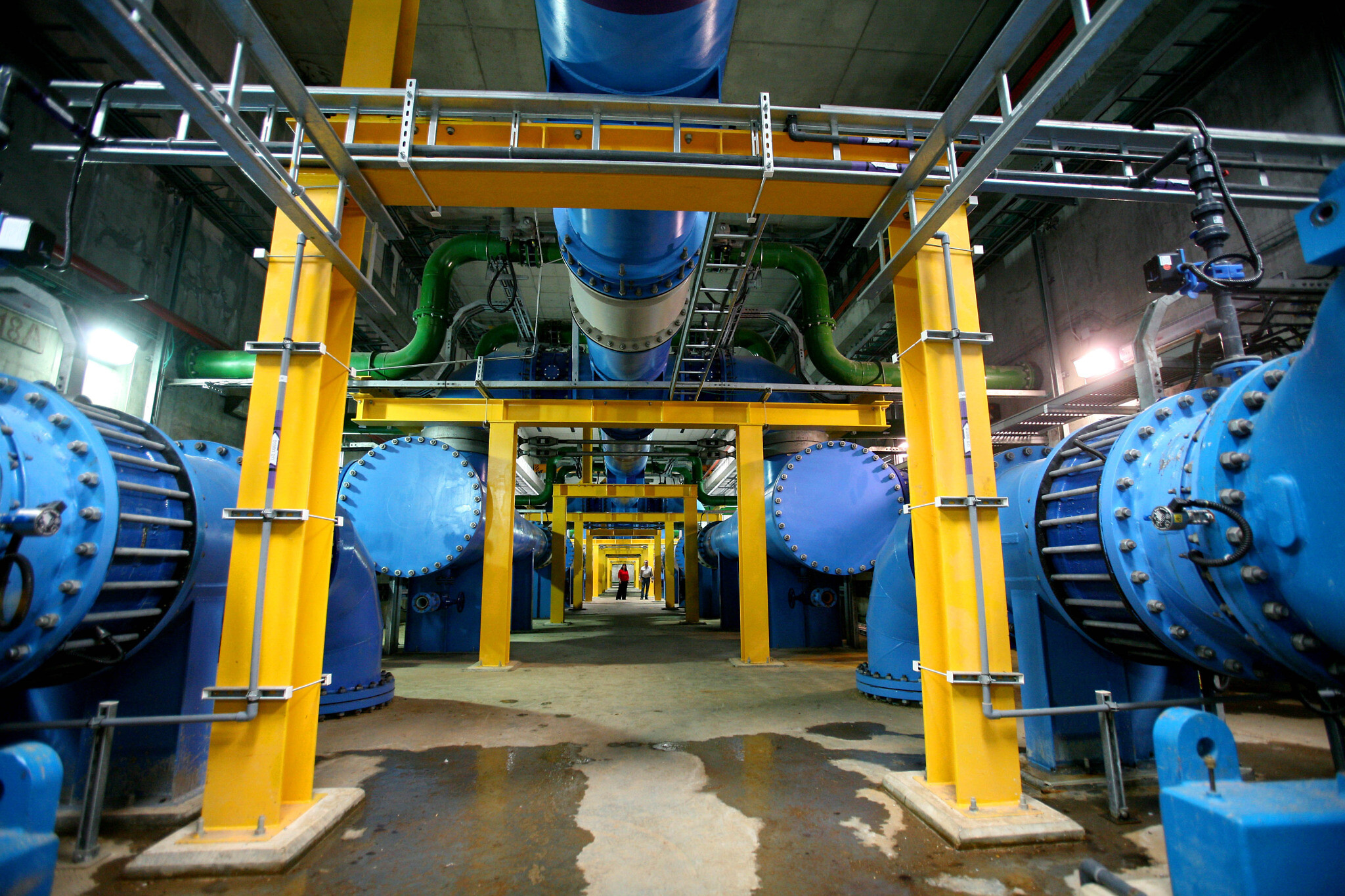
View of the Eshkol Water Filtration Plant in northern Israel, on April 17, 2007. (Moshe Shai/FLASH90)

Ben-David said Israel was “bracing” for an Iranian response, likely via a cyberattack. In an April cyberattack attributed by western intelligence officials to Iran, an attempt was made to increase chlorine levels in water flowing to residential Israeli areas.

Hours after the Natanz fire and reported explosion on Thursday, Iran’s state news agency IRNA published an editorial warning that “if there are signs of hostile countries crossing Iran’s red lines in any way, especially the Zionist regime (Israel) and the United States, Iran’s strategy to confront the new situation must be fundamentally reconsidered.”

IRNA also reported that unnamed Israeli social media accounts had claimed the Jewish state was responsible for the “sabotage attempts.”

It stressed that Iran had tried “to prevent escalations and unpredictable situations while defending its position and national interests.”

Natanz, located some 250 kilometers (155 miles) south of Tehran, includes underground facilities buried under some 7.6 meters (25 feet) of concrete, which offers protection from airstrikes.

There was “no nuclear material (at the damaged warehouse) and no potential of pollution,” the spokesman for Iran’s Atomic Energy Organisation Behrouz Kamalvandi told state television.

This photo released on July 2, 2020, by the Atomic Energy Organization of Iran, shows a building after it was damaged by a fire, at the Natanz uranium enrichment facility some 200 miles (322 kilometers) south of the capital Tehran, Iran. (Atomic Energy Organization of Iran via AP)

Kamalvandi said no radioactive material or personnel were present at the warehouse within the Natanz site in central Iran, one of the country’s main uranium enrichment plants.

He noted that the cause was being investigated, and said it had caused “some structural damage” without specifying the nature of the accident.

The Iranian Atomic Energy Organization released a photo purportedly from the site, showing a one-story building with a damaged roof, walls apparently blackened by fire and doors hanging off their hinges as if blown out from the inside.

The next stage of the nuclear program

Two US-based analysts who spoke to The Associated Press on Thursday, relying on released pictures and satellite images, identified the affected building as Natanz’s new Iran Centrifuge Assembly Center.

On Friday, a Kuwaiti newspaper reported Israel was responsible for two recent blasts at Iranian facilities — the one at Natanz, and another at a missile production site days earlier.

The Al-Jareeda daily cited an unnamed senior source as saying that an Israeli cyberattack caused a fire and explosion at Natanz.

According to the source, this was expected to set back Iran’s nuclear enrichment program by approximately two months.

The newspaper also reported that last Friday Israeli F-35 stealth fighter jets bombed a site located in the area of Parchin, which is believed to house a missile production complex — an area of particular concern for the Jewish state, in light of the large number and increasing sophistication of missiles and rockets in the arsenals of Iranian proxies, notably Lebanon’s Hezbollah.

Fighter jets from the IAF’s second F-35 squadron, the Lions of the South, fly over southern Israel (IDF spokesperson)

Neither of these claims were confirmed by Israeli officials, who have been mum on the reports.

The reported Israeli strikes followed an alleged Iranian attempt to hack into Israel’s water infrastructure in April, an effort that was thwarted by Israeli cyber defenses, but if successful could have introduced dangerous levels of chlorine into the Israeli water supply and otherwise seriously interrupted the flow of water throughout the country.

Ultimately, the alleged Iranian cyberattack caused minimal issues, according to Israeli officials.

The alleged Israeli attacks also came amid an ongoing campaign of so-called maximum pressure by the United States in the form of crushing sanctions on Iran and Iranian officials.

The BBC’s Persian service said it received an email from a group identifying itself as the “Cheetahs of the Homeland” claiming responsibility for the attack. The email was received prior to the announcement of the Natanz fire.

The group, which claimed to be dissident members of Iran’s security forces, had never been heard of before by Iran experts and the claim could not be immediately authenticated by The Associated Press.

The site of the fire corresponds to a newly opened centrifuge production facility, said Fabian Hinz, a researcher at the James Martin Center for Nonproliferation Studies at the Middlebury Institute of International Studies in Monterey, California. He said he relied on satellite images and a state TV program on the facility to locate the building, which sits in Natanz’s northwest corner.

A fire has burned a building above Iran’s underground Natanz nuclear enrichment facility, though officials say it did not affect its centrifuge operation or cause any release of radiation. (AP graphic)

David Albright of the Institute for Science and International Security similarly said the fire struck the production facility. His institute previously wrote a report on the new plant, identifying it from satellite pictures while it was under construction and later built.

Iranian nuclear officials did not respond to a request for comment about the analysts’ comments.

Last Friday, a large blast was felt in Tehran, apparently caused by an explosion at the Parchin military complex, which defense analysts believe hold an underground tunnel system and missile production facilities.

According to the al-Jareeda report on Friday, that explosion was caused by missiles dropped by a number of Israeli F-35 stealth fighter jets. The newspaper reported that the aircraft took off from southern Israel and carried out the bombing run without the need to refuel.

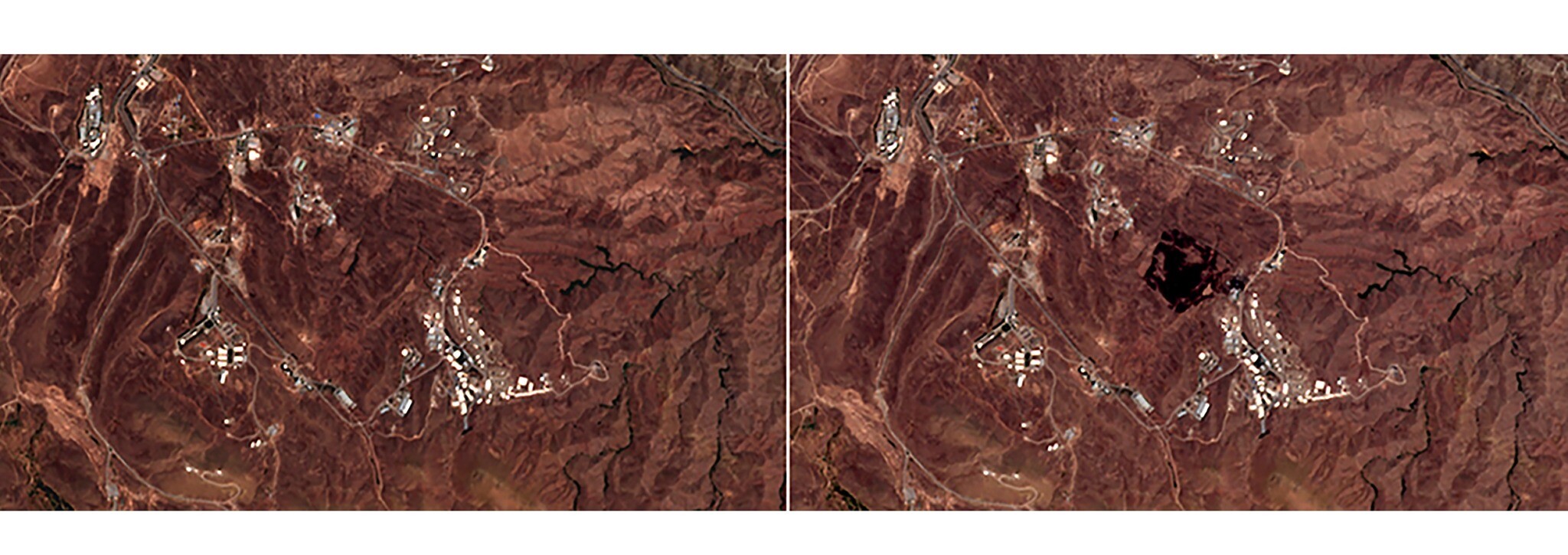
This Friday, June 26, 2020, photo combo from the European Commission’s Sentinel-2 satellite shows the site of an explosion, before, left, and after, right, that rattled Iran’s capital. Analysts say the blast came from an area in Tehran’s eastern mountains that hides a underground tunnel system and missile production sites. The explosion appears to have charred hundreds of meters of scrubland. (European Commission via AP)

The Fars news agency, which is close to the country’s ultra-conservatives, initially reported that Parchin blast was caused by “an industrial gas tank explosion” near a facility belonging to the defense ministry. It cited an “informed source” and said the site of the incident was not related to the military.

However, this was largely disregarded by defense analysts as satellite photographs of the Parchin military complex emerged showing large amounts of damage at the site.

Later, Iranian Defense Ministry spokesman Davood Abdi blamed the blast on a leaking gas that he did not identify and said no one was killed in the explosion.

Satellite photos of the area, some 20 kilometers (12.5 miles) east of downtown Tehran, showed hundreds of meters (yards) of charred scrubland not seen in images of the area taken in the weeks ahead of the incident. The building near the char marks resembled the facility seen in the state TV footage.

The gas storage area sits near what analysts describe as Iran’s Khojir missile facility. The explosion appears to have struck a facility for the Shahid Bakeri Industrial Group, which makes solid-propellant rockets, said Fabian Hinz.

The Washington-based Center for Strategic and International Studies identified Khojir as the “site of numerous tunnels, some suspected of use for arms assembly.” Large industrial buildings at the site visible from satellite photographs also suggest missile assembly being conducted there.

Iranian officials themselves also identified the site as being home to a military base where the International Atomic Energy Agency previously said it suspects Iran conducted tests of explosive triggers that could be used in nuclear weapons. Iran long has denied seeking nuclear weapons, though the IAEA previously said Iran had done work in “support of a possible military dimension to its nuclear program” that largely halted in late 2003.

Western concerns over the Iranian atomic program led to sanctions and eventually to Tehran’s 2015 nuclear deal with world powers. The US under President Donald Trump unilaterally withdrew from the accord in May 2018, leading to a series of escalating attacks between Iran and the US, and to Tehran abandoning the deal’s production limits.

Judah Ari Gross contributed to this report


The Case for Israe: Democracy’s Outpost – Alan Dershowitz 

July 1, 2020

Israel is under attack – not only by terrorists who deny its basic right to exist, but also in the court of world opinion, which seeks to marginalize Israel as a human rights pariah that sanctions apartheid.

Rising in vigorous defense of the Jewish homeland in this landmark documentary, Alan Dershowitz, distinguished Harvard Law School professor and outspoken champion of human rights, presents evidence from leading diplomats, historians, legal experts and government officials on both sides of the political spectrum to make the definitive case for Israel’s legitimacy and right to self-defense.

Dershowitz argues forcefully that real peace in the Middle East can only occur when the Palestinians, Arabs, and their allies finally value the creation of a Palestinian homeland more than they oppose the presence of a Jewish state. Through incisive conversations with commentators ranging from Ambassador Dennis Ross and former Israel Supreme Court President Aharon Barak to then Opposition Leader Bibi Netanyahu and historians Michael Oren and Benny Morris, Dershowitz refutes deeply entrenched misperceptions about Israel’s history,

Jewish claims to a homeland, individual rights under Israel’s democratic system of government, the security fence, and military conduct in the face of terrorist attacks. He closes with a formidable warning that the greatest threat to Israel is also the greatest threat to international peace and security: Iran’s aggressive nuclear ambitions.ther.[137]

Jerusalem’s security challenges for 2020 – Jerusalem Studio 478

July 1, 2020


US envoy: Military action against Iranian nuclear program ‘always on the table’ 

July 1, 2020

Source: US envoy: Military action against Iranian nuclear program ‘always on the table’ | The Times of Israel

Brian Hook, US pointman on Iran, says Trump willing to use force to prevent Tehran acquiring nukes; downplays fears annexation could harm Israel’s ties with Arab states

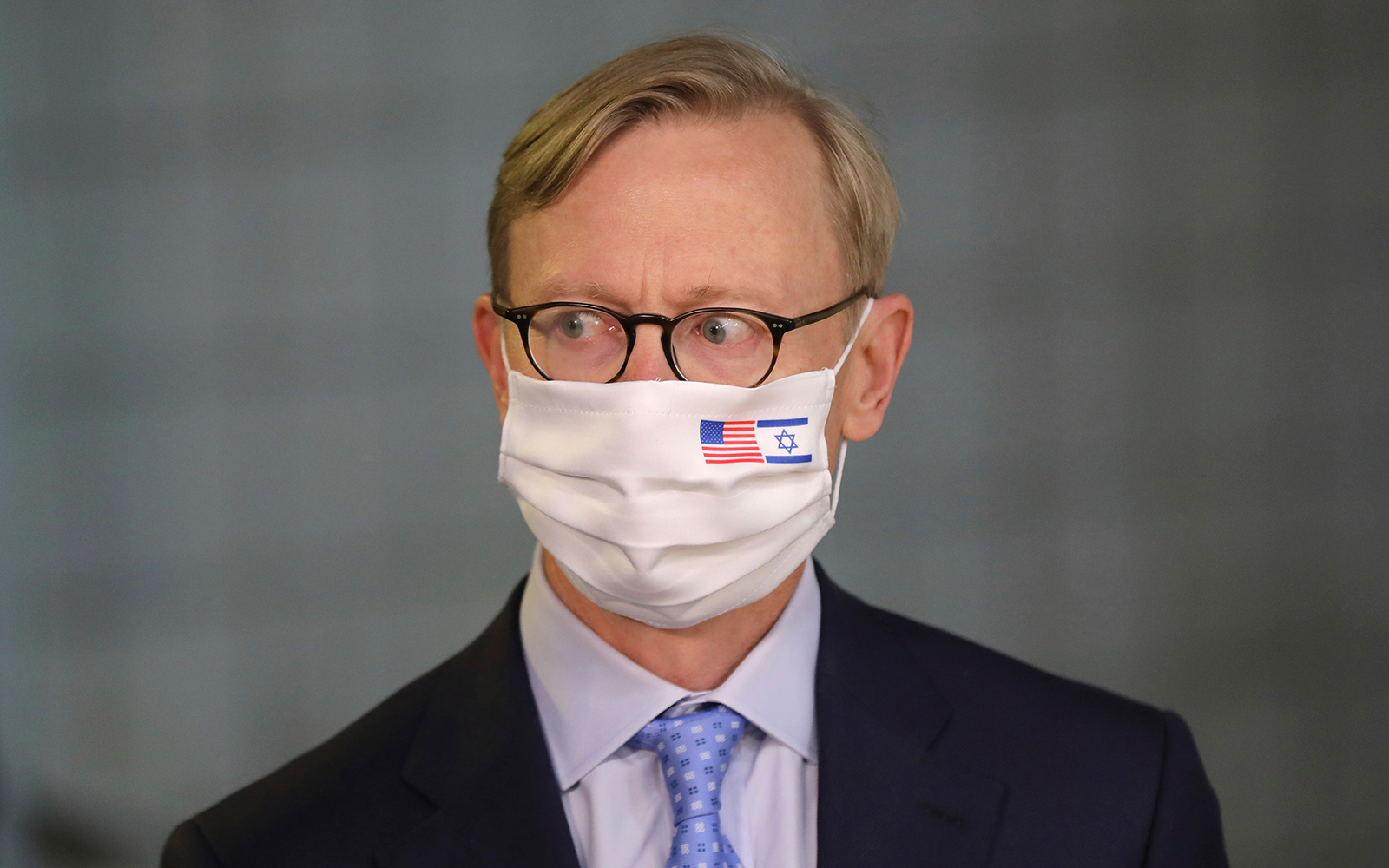
US special envoy for Iran, Brian Hook, attends a press briefing with Prime Minister Benjamin Netanyahu at the Prime Minister's office in Jerusalem, June 30, 2020. (Abir Sultan/Pool via AP)

US special envoy for Iran, Brian Hook, attends a press briefing with Prime Minister Benjamin Netanyahu at the Prime Minister’s office in Jerusalem, June 30, 2020. (Abir Sultan/Pool via AP)

The Trump administration’s envoy for Iran said Tuesday that the White House was willing to take military action against Tehran to prevent the regime from acquiring nuclear weapons.

Brian Hook, the US special representative for Iran, said during a visit to Jerusalem that “the military option is always on the table.”

“We’ve made very clear, the president has, that Iran will never acquire a nuclear weapon,” Hook said in an interview with Channel 13.

“The Israeli people and the American people and the international community should know that President Trump will never allow them to have a nuclear weapon,” Hook said.

Hook is on a Middle East tour meeting with US allies to seek support for Washington’s demand of extending a 13-year UN weapons embargo on Iran set to expire in October. He visited the United Arab Emirates over the weekend.

In a meeting with Hook on Tuesday in Jerusalem, Prime Minister Benjamin Netanyahu urged the US to move forward with its threat to reimpose “snapback” sanctions on Iran.

Netanyahu urged that “in response to repeated Iranian provocations and violations… it is time to implement, now, snapback sanctions. I don’t think we can afford to wait. We should not wait for Iran to start its breakout to a nuclear weapon because when that happens it will be too late for sanctions.”

If the UN Security Council fails to extend the embargo, the US would seek to trigger the broad array of “snapback” sanctions due to Iran’s violations of the 2015 nuclear deal with world powers.

The US abandoned that deal in 2018, triggering a series of Iranian violations in the ensuing years.

Hook told Channel 13 that the US would prefer to extend the arms embargo over sanctions.

“When you play by Iran’s rules, Iran wins, so we are making the national security case for extending the arms embargo that has been in place for 13 years,” Hook said.

Russia and China, which are both members of the UN Security Council, oppose the embargo, however. Their support, or abstention from a vote, would be needed to extend the embargo.

“I’m hopeful because Russia and China also would like to see a peaceful and stable Middle East,” Hook said.

He highlighted ties between Israel and Arab states, which have likely been strengthened by shared concern over threats from Iran, and downplayed fears that Israel’s planned annexation of parts of the West Bank could damage those ties.

“We very much like the steps that have been taken by a number of governments I think to deal with Iranian aggression and we would very much like to see the Palestinians come to the table. With respect to annexation, that is a decision for the Israeli government to make. We are working on building support for the peace vision,” Hook said.

In his meeting with Hook, Netanyahu warned that the Iranian regime “deliberately deceives the international community. It lies all the time. It lies on solemn pledges and commitments that it took before the international community. It continues its secret program to develop nuclear weapons. It continues its secret program to develop the means to deliver nuclear weapons.”

He vowed that Israel would “do whatever is necessary to prevent Iran from developing nuclear weapons,” and told Hook, “I know that’s your position as well.”

“This is a policy, Brian, that we have adopted as well. We are absolutely resolved to prevent Iran from entrenching itself militarily in our immediate vicinity. We take repeated and forceful military action against Iran and its proxies in Syria and elsewhere if necessary,” said Netanyahu.

Prime Minister Benjamin Netanyahu, right, meets with US Special Representative for Iran Brian Hook in Jerusalem on June 30, 2020. (Haim Tzach/GPO)

Iranian officials have suggested they could expel international inspectors monitoring the country’s nuclear program in response to an arms embargo extension, or even withdrawal entirely from the nuclear Non-Proliferation Treaty.

The UN arms embargo so far has stopped Iran from purchasing fighter jets, tanks, warships and other weaponry, but has failed to halt its smuggling of weapons into war zones in Syria, Yemen, Lebanon and Iraq.

US Secretary of State Mike Pompeo on Tuesday urged the UN Security Council to extend the embargo, warning that its expiration would risk the stability of the oil-rich region.

“Iran will hold a sword of Damocles over the economic stability of the Middle East, endangering nations like Russia and China that rely on stable energy prices,” Pompeo told the virtual session. Both countries on Tuesday spoke out against extending the embargo.

European allies of the United States have voiced support for the embargo but also oppose new sanctions, saying the bigger issue is Iran’s nuclear program.

US sanctions imposed since the Trump administration’s withdrawal from the nuclear deal have created intense financial pressure on Tehran that have led to sporadic anti-government protests, including nationwide demonstrations in November that Amnesty International says saw over 300 people killed. While the Trump administration has maintained it doesn’t seek to overthrow Iran’s government, its pressure campaign has exacerbated public anger against its Shiite theocracy.

Since Trump’s withdrawal from the nuclear deal, Iran has broken all the accord’s production limits. The UN’s International Atomic Energy Agency, which monitors Iranian nuclear activity as part of the deal, says Tehran’s stockpile of low-enriched uranium continues to grow.

While not at weapons-grade levels, the growing stockpile and increased production shortens the one-year timeline analysts believe Iran would need to have enough material for a nuclear weapon if it chose to pursue one. Iran long has denied seeking atomic bombs, though the IAEA previously said Iran had done work in “support of a possible military dimension to its nuclear program” that largely halted in late 2003 following the US invasion of Iraq.


PM Netanyahu Meets US Special Representative for Iran Brian Hook 

June 30, 2020


9 Iran-backed fighters killed in 2nd raid in Syria in 24 hours — monitor 

June 29, 2020

J

Source: 9 Iran-backed fighters killed in 2nd raid in Syria in 24 hours — monitor | The Times of Israel

Syrian Observatory for Human Rights says Israel ‘likely responsible’ for strikes near Iraqi border that came hours after similar incident killed 6 other Tehran-backed fighters

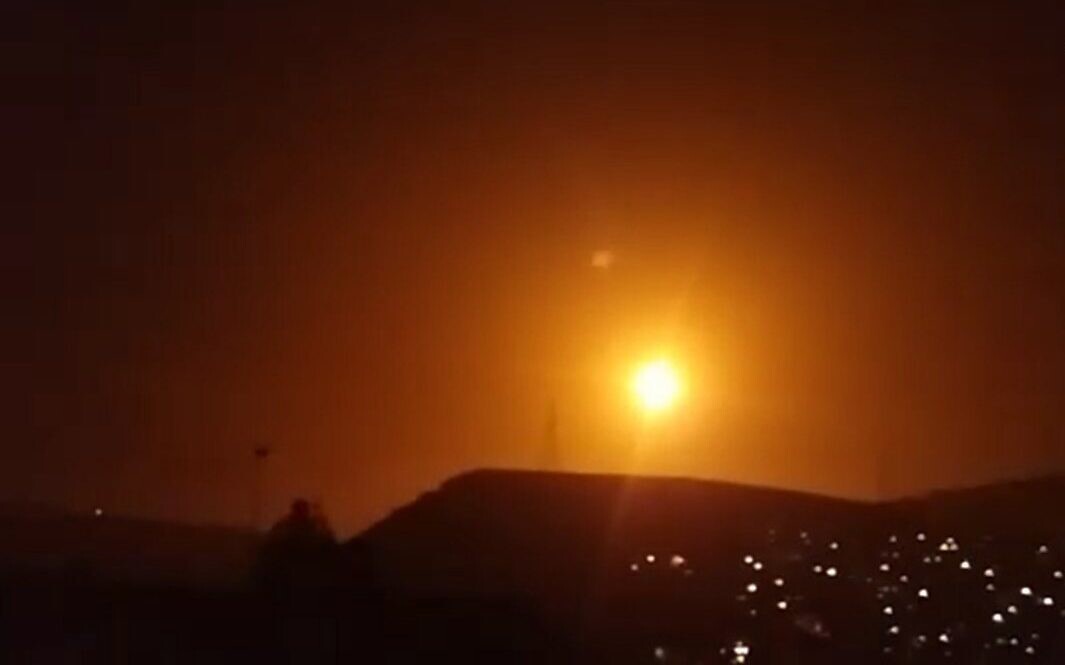
Explosions are seen in the skies over Damascus as the Syrian military fires anti-aircraft weapons at incoming missiles during an attack attributed to Israel on February 6, 2020. (SANA)

Airstrikes targeting positions of Iran-backed militias in eastern Syria killed nine fighters on Sunday in the second such raid in 24 hours, a war monitor said.

The Britain-based Syrian Observatory for Human Rights said Israel was “likely responsible” for the strikes near the Iraqi border.

The strikes took place in Al-Siyal desert in the Albukamal countryside, east of Deir Ezzor, the monitor said.

They came hours after a similar raid killed six other Tehran-backed fighters, raising the total toll to 15 killed in 24 hours, according to the monitor.

The fighters killed in the early Sunday raids were mostly Iraqi nationals, according to Observatory head Rami Abdul Rahman.

There was no official comment from Israel.

Heshmat Alavi@HeshmatAlavi

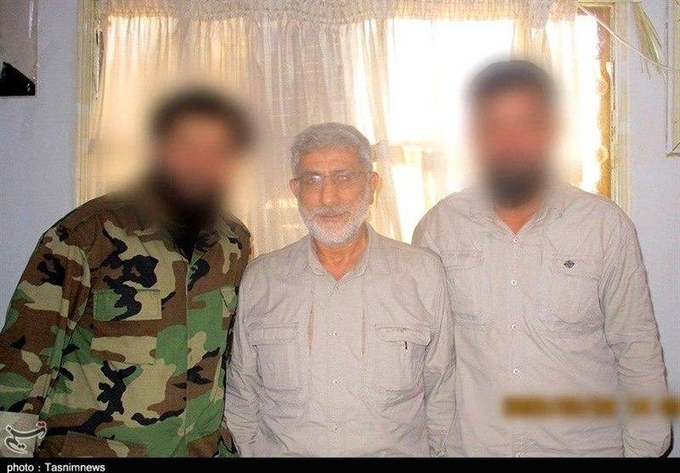
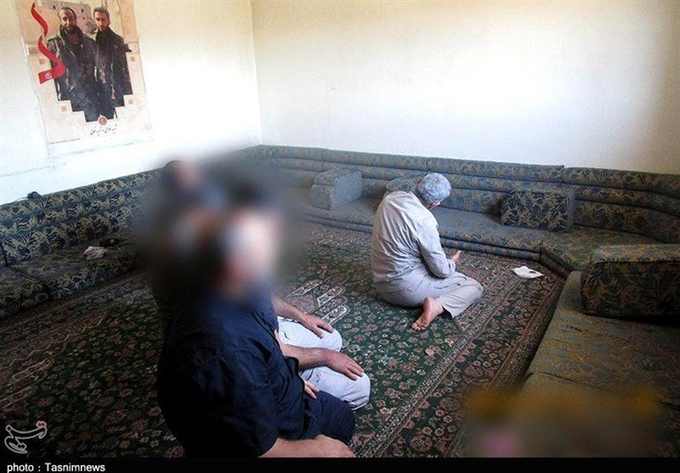
state media are reporting Revolutionary Guards (IRGC) Quds Force chief Esmail Ghaani recently visited Albu Kamal in east .

Images from the Tasnim news agency

View image on TwitterView image on Twitter

Israel has launched hundreds of strikes in Syria since the start of the civil war in 2011. It has targeted government troops, allied Iranian forces and fighters from the Lebanese Shiite terror group Hezbollah.

It rarely confirms details of its operations in Syria, but says Iran’s presence in support of President Bashar Assad and Hezbollah is a threat and that it will continue its strikes.

On Saturday, airstrikes also blamed on Israel hit positions belonging to regime forces and Iran-backed militias near the border with Iraq, the Observatory said.

Four Syrian nationals were among the six fighters killed in that attack, the monitor added.

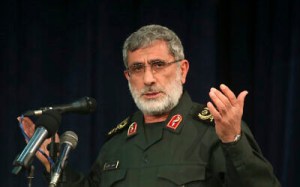
In this Nov. 5, 2016 photo, Gen. Esmail Ghaani speaks in a meeting in Tehran, Iran. (Mohammad Ali Marizad/Tasnim News Agency via AP)

The strike came hours after semi-official media in Iran reported that Islamic Revolutionary Guards Corps head Esmail Ghaani had visited Iranian troops in the area and had spoken out against Israel and the US.

Ghaani took over as the head of the hard-line paramilitary force earlier this year following the assassination of Qassem Soleimani.

During the visit, Ghaani accused Israel and the US of propping up the Islamic State terror group, according to Reuters.

Saturday’s raids came only days after Israeli strikes in the eastern province of Deir Ezzor and the southern province of Suweida killed seven fighters, including two Syrian soldiers, according to the Observatory.

The uptick in attacks has prompted concern among Iran-backed forces in east Syria that Israeli agents may be among their ranks, the monitor said.

These forces have arrested four people on suspicion of providing intelligence to Israel, the war monitor reported on Sunday, shortly before the latest raids.

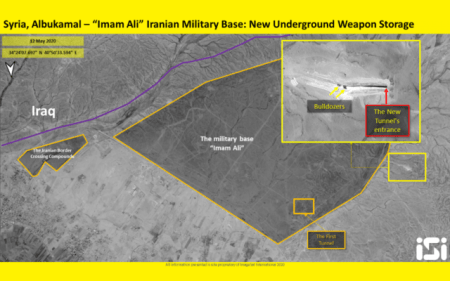
This photo released by ImageSat International on May 13, 2020, shows apparent construction on an underground weapons storage facility on a military base suspected of being controlled by Iran in eastern Syria’s al-Bukamal region. (ImageSat International)The al-Bukamal region in Syria is seen as critical to Tehran’s effort to establish a land corridor from Iran, through Iraq and Syria, and out to the Mediterranean Sea in order to more easily move weapons and fighters throughout the Middle East.

The al-Bukamal region in Syria, near Iraq, is seen as critical to Tehran’s effort to establish a land corridor from Iran, through Iraq and Syria, and out to the Mediterranean Sea in order to more easily move weapons and fighters throughout the Middle East.

In May, private Israeli satellite imagery analysis firm ImageSat International released photos it said showed that Iran was constructing a new underground weapons storage facility at the Imam Ali base in the al-Bukamal region of Syria, which is believed to be run by Iranian forces.

According to the image analysis company, such tunnels are likely meant to store Iranian missiles en route to Tehran’s proxies throughout the region.

𝖙𝖆𝖑𝖎𝖆 ♡@stephy_nancy

فرصة عمل ع ليبيا 🇱🇾 2000 دولار بالشهر
آكل شارب ميت 😀
خط النقل من محافظتك لدمشق ومن مطار دمشق لبنغازي
من إدلب لأنقرة ومن مطار أنقرة لطرابلس

يلعن روسيا ويلعن تركيا سوا .

Maya_maguy💚@SonaMjaaynaa

ولسا قلبي ما برد مبارح اسرائيل ضربت معمل بصل كلو ذخائر بحماه /السلميه
يعني فوق مو مخزين اسلحة لعند ربنا بمنطقه سكنية ابصر مين عاطين احداثيات الموقع والله … تسمعي صوات الولاد والصياح والدنيا عم ترج
مو احري بهيك عيشة
كل الليل تمرق سيارة اتقفط وقوم
تعبنا

View image on TwitterView image on Twitter
See Maya_maguy💚‘s other Tweets

Times of Israel staff contributed to this report


Blast near Tehran blew up secret tunnels and missile production sites – DEBKAfile

June 27, 2020

Source: Blast near Tehran blew up secret tunnels and missile production sites – DEBKAfile

Satellite photos published by AP on Saturday, June 27, show the big blast at Parchin Friday occurred at the site of an underground tunnels system and missile production site hidden in mountains east of Tehran. Officials first claimed it was caused by a gas leak in the “public area” of the Parchin military base, where Iran had in the past been suspected of conducting high-explosive tests for nuclear warheads.

The gas storage area sits near what analysts describe as Iran’s Khojir missile facility. The explosion appears to have struck a facility for the Shahid Bakeri Industrial Group, which makes solid-propellant rockets, according to one analyst cited by the news agency. Large industrial buildings at the site visible from satellite photographs also suggest missile assembly being conducted there.

Last year, the US Defense Intelligence Agency said Iran overall has the largest underground facility program in the Middle East, which “supports most facets of Tehran’s ballistic missile capabilities, including the operational force and the missile development and production program.” Iran has said that the cause of the explosion, which sent a huge fireball over Tehran and charred wide areas of scrubland, is under investigation.
The last major blast at a missile base near Tehran in 2011, that killed Revolutionary Guard’s missile program chief Hassan Tehrani Moghaddam, was initially described by officials as an accident although Israel was suspected.

DEBKAfile reported earlier:

A large blast at the big Parchin military facility associated in the past with nuclear warhead development was claimed by Iran’s defense ministry spokesman as occurring at a gas storage facility in the public area of the site – not the military base. 30km outside Tehran. The explosion on Thursday night, June 25, sent orange flames and plumes of smoke shooting high in the sky. The spokesman said the fire had been extinguished and there were no casualties.
At around the same time, half of the Iranian city of Shiraz was blacked out by an explosion at the local power station. The two incidents – both under investigation -raised panicky concern on social media of a possible attack on the country.

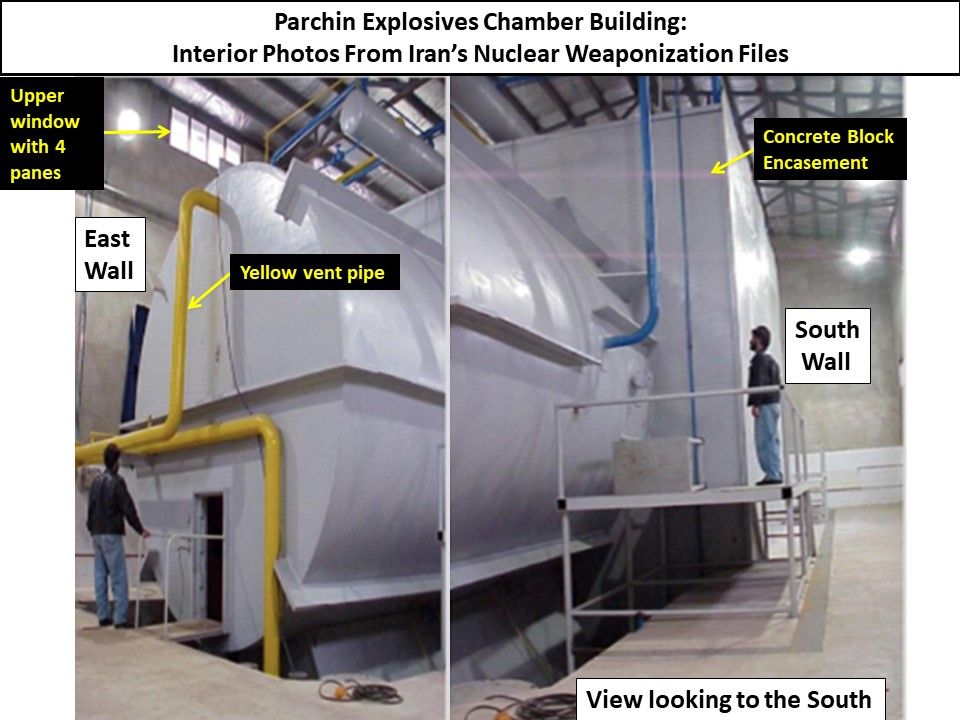
The nuclear watchdog has for years been denied access to the Parchin military facility to investigate past allegations that it was used prior to 2004 for the secret testing of high explosive components for a nuclear warhead, which Tehran just as consistently denied.

Subsequently, on April 30, 2018, an archive seized by Israel in Tehran revealed that the Parchin site was a key part of Iran’s ongoing nuclear weapons research and development program. This archive contained documentary evidence that in 2003 Iran was operating a nuclear weapons program, codenamed the AMAD Plan, which aimed to build five nuclear weapons and prepare an underground nuclear test site. Parchin was a key part of that program, used for a specialized, difficult to develop, neutron initiator to start the chain reaction in a nuclear explosion. Some of the equipment is believed to be held ready for later use, potentially when Iran’s 2015 nuclear accord with the six world powers expires.
Last week, the International Atomic Energy Agency claimed its inspectors were still denied access to two sites suspected of nuclear activity on the grounds that Iran’s military facilities are out of bounds to external inspection.


Ex-Mossad head to ‘Post’: No one will stop Iran from going nuclear 

June 27, 2020

Source: Ex-Mossad head to ‘Post’: No one will stop Iran from going nuclear – The Jerusalem Post

INTELLIGENCE AFFAIRS: Ex-Mossad head Shabtai Shavit talks about post-nuke Iran, annexation, the CIA, China and counterintelligence.

FORMER DIRECTOR-GENERAL of the Mossad Shabtai Shavit speaks in Tel Aviv in 2017. (photo credit: MIRIAM ALSTER/FLASH90)
FORMER DIRECTOR-GENERAL of the Mossad Shabtai Shavit speaks in Tel Aviv in 2017.
(photo credit: MIRIAM ALSTER/FLASH90)
Nothing will stop Iran’s pursuit of nuclear weapons, so Israel must work on a menacing deterrent capability to keep the Islamic Republic in check even beyond its eventual attainment of them, former Mossad director Shabtai Shavit has told The Jerusalem Post.

Speaking to the Post about the English version of his book Head of the Mossad (University of Notre Dame Press), which will be out in stores in September, Shavit covered a wide range of other issues, including annexation, cooperation with the CIA, US-China quantum technology competition and counterintelligence.

In the book, he describes how he knows the Iranian people up close from living in Iran in the mid-1960s for 18 months, and from how he cooperated with Iranian intelligence (pre-Islamic Republic) while in Kurdistan in 1973.

Regarding Iran, he said, “I speak as an intelligence man and not as a politician. My starting point – an intelligence officer cannot make assumptions – is to be ready for the worst-case scenario, that down the road they’ll develop nuclear weapons.”

“They are an empire, and they think of themselves as an empire. They believe they will bring light to the nations. They look down on Arabs. They never forgave the Arab conquest and that Arabic was forced on them” and all of the actions to erase their Persian heritage.

Shavit explained further that even as the 1980-1988 Iran-Iraq War had no victor, Iraq clearly did better, and then-Iranian supreme leader Ruhollah Khomeini said ending the war was “like drinking poison.”

Khomeini had been ready to “send children into battle with explosives… all of these examples show the culture and ethos of Iran as a power that went through very hard times and wants to get back to what it was.”The former Mossad chief noted Iran is a subcontinent in terms of its size, which could fit much of Europe inside it, with a huge population of more than 80 million people of 35-36 different racial backgrounds.

Complimenting Iran, he noted that “they were able to find common ground” as a nation-state, adding that even current Supreme Leader Ayatollah Ali Khamenei comes from a minority racial background descending from Azerbaijan.

He said Iran learned from Iraq’s use of chemical weapons against it during the Iran-Iraq War that it needed to obtain all nonconventional weapons, including nuclear.

Shavit commented, “I have no doubt that Iran is continuing to work today, as we speak, to develop nuclear capabilities. They are doing it clandestinely to avoid provoking the US and the rest of the world.”

“They are advanced… they will decide, on the basis of their overall progress and situation, when it is that they want to hold a press conference to say ‘we have it.’ They could do it even before a nuclear test. When it happens, I don’t think anyone will go attack them. Did anyone do anything when North Korea made its announcement?” he said.

Incidentally, Shavit dismisses Israel’s strikes on the Iraqi and Syrian nuclear programs as not relevant to the far more formidable Iranian adversary.

He stated, “The world learns to live with it…. We need to prepare for the day Iran says they have it. I don’t say this so we should attack preemptively; rather, so we should have deterrence. They should know it is not worth” making trouble for Israel.

The Post asked Shavit if he was referring to the 80-200 nuclear weapons that Israel possesses, according to foreign sources.

While Shavit is always extremely careful not to disclose classified information, he made it clear he was referring to broadcasting to Iran that the onslaught Israel could unleash on them would be far worse than anything they could use to attack Israel.

Similarly, Shavit thought that the key to dealing with Hezbollah is to try to maintain an indefinite ceasefire, but make it clear to Hezbollah that if it attacks Israel in any way, it will face a decisive strike – and to constantly maintain the capabilities for such an onslaught.

Annexation

Shavit is a puzzle when it comes to resolving the Israeli-Palestinian conflict.

On one hand, he vocally opposed the Oslo Accords. On the other hand, he has loudly opposed Prime Minister Benjamin Netanyahu’s push for annexation of 30% of the West Bank, as provided for in US President Donald Trump’s peace plan.

The Post asked Shavit about partial annexation, such as annexing only the Gush Etzion bloc or Ma’aleh Adumim, which the Blue and White Party reportedly favors.

“I don’t want to go down that path. That road is secondary in importance,” he said, deflecting the specific question.

Shavit wanted to explain his perspective on all of the big picture issues.

He said, “I was not against Oslo ideologically. My opposition was procedural. The problem was that there was insufficient background work on all of the military and diplomatic implications. [Shimon] Peres… dragged [Yitzhak] Rabin and Israel into Oslo. The internal process leading to Oslo was not democratic.”

Regarding annexation, Shavit expressed concern that “we will sentence ourselves to being a minority” in terms of demographics and continued democracy.

Also, he warned that Israel would face sanctions – and “we can’t handle such a price.”

The former chief spy said, “I come from an organization whose emblem is ‘outsmart your adversaries.’ We shouldn’t bang our head into the wall.”

Elaborating, he said that if it takes a long time to resolve the Israeli-Arab conflict, “okay, so it will take a long time. Who says that Bibi’s [annexation] push has to happen right now, when there is a second corona[virus] wave and an economic crisis?”

Next, Shavit noted that Trump “tried to get 20,000 people to [a rally] in Tulsa,” with estimates that only around 6,000 came, and that presumptive Democratic presidential nominee Joe “Biden is ahead in all of the polls.”

“In January, if Biden gets to the White House – can Israel stand against the US?” Shavit asked, referencing Biden’s recent statement that annexation would choke the peace process.

Exasperated, he said, “We need to be forward-looking…. For his [Netanyahu’s] legacy, I, as a citizen, need to pay a long-term mortgage” of having to deal with numerous threats and problems that annexation would bring?

Mossad working with hostile actors/countries

Shavit was questioned about whether he had ever been in a position similar to that of current Mossad director Yossi Cohen, who in recent years has acted as a middleman to ensure Qatar continues to bankroll Hamas (so Hamas does not go to war with Israel).

“There is nothing new under the sun. What was will be, and what is happening now has been before. But back then, no one knew or saw. Only those who needed to know knew,” said Shavit smiling.

Shavit implied the Mossad had been involved in all kinds of below-the-radar communications and activities with the Palestinians, Jordan and Syria.

More specifically, he said, and describes in the book in greater detail, when prime minister Rabin “wanted to understand what [former Syrian president Hafez] Assad would really give for peace, he sent me to the king of Morocco to ask him to check with Assad. We just didn’t write about it.”

Problems with NSA and with Shin Bet coronavirus surveillance

In his book, Shavit writes that the National Security Agency in the US has 35,000 employees with an annual budget of $11 billion, dwarfing all of its counterparts, besides perhaps its Russian and Chinese ones. He adds that it can intercept all traffic that passes through fiber-optic cables worldwide and digitally “rob” any laptop.

“The NSA has such powerful capabilities – we are sitting here, and if they flag us for coverage, they can ‘sit’ with us in the room. Do you want to live your life in a world like that?” he asked.

Questioned about whether he sees any connection between his concerns about the NSA and the ongoing current debate about whether the Shin Bet (Israel Security Agency) should be involved in tracking coronavirus-infected citizens, he said “they are connected. I don’t like the use of the Shin Bet for [tracking] coronavirus[-infected citizens],” noting that even Shin Bet director Nadav Argaman opposes the program.

Continuing, he stated, “The decision of those running the country creates a dynamic…. Today, they say it will be used only very selectively. Then there will be a second time, then a third time, then it already gets legitimized.

“This tool was developed for a very limited purpose: to fight terror. This will change it into a routine working tool for the prime minister, and it is against the basic principles of democracy,” he said.

Speaking of the prime minister, when questioned how he would handle having both a prime minister and an alternate prime minister to potentially report to, he said, “I am glad that I don’t need to deal with this dilemma,” while noting traditionally the Mossad chief reports only to the prime minister.

Cooperation with the CIA

Today, Shavit said, “geographic borders are no longer meaningful. Intelligence today requires many deals and lots of global cooperation, like in every other discipline where there is now global cooperation. There are exchanges of intelligence information, in-person meetings” and other partnerships.

However, in the past, he said, “the Americans were always very protective about intelligence, assets and capabilities.”

Without revealing classified specifics, he recounted that one time “I wanted to get some American technology…. But there is always give and take. He [a CIA official whom he was not permitted to name] said ‘what is in it for me?’

“I said ‘the intelligence which I collect, I will give you for free – fair?’ He said ‘no. You come and tell me the intelligence target which you are able to get access to, and then I will provide the technology.’ I said ‘Okay.’ I was the small humble Mossad versus the giant CIA,” said Shavit.

Next, “I suggested an operational target. We did all of the preparation for the operation…. They eventually provided the technology, but with their people. Our people carried them on our backs.”

So “I didn’t get anything out of it. The intelligence was split between the sides. They used the technology,” implying the CIA got the better part of the deal. “I understood this was the situation, so the next time I invested my own resources” for technology.

Quantum technology race with China

Regarding the quantum technological arms race, Shavit said, “The Chinese are developing both quantum computing and communications capabilities for both defense and offense,” and it seems they are racing ahead of the US in this area.

Experts predict that quantum technology will leap past today’s cyber and hacking capabilities.

“I hope someone will tell me that I am wrong, that the US is really working on this” sufficiently.

Continuing, he said, “It is not enough to be first or second. To maintain supremacy, you need to be ahead of the second place party, not just by one generation, but by at least one-and-a-half generations, because everyone steals from each other. So, if someone steals, I should already be looking at what is next.”

Counterintelligence

With the US worried about Chinese technology and spying, the conversation turned to counterintelligence and detecting traitors.

Shavit explained, “In counterintelligence, there is no patent [short cut]…. It is an ongoing war of cat and mouse. You must always invest in it so as not to be surprised, but you will still always be surprised. Ever since people existed on the planet, they have changed their minds, and in different situations they become ready to harm their own country.

“You try to do everything to prevent this. When you draft people, you bring them through a series of nets and you check them and check them. How do you know for sure they won’t become a traitor? You can’t know,” he admitted with some frustration.

But “if you close all of the openings in the network, you won’t have any people. You have no choice.”

He added that some traitors were ideological, in which case “you have no chance to reveal them until after. Five scientists in Cambridge, England, decided ideologically that to ‘save the world,’ they needed to give the USSR nuclear secrets because the world could only continue to exist if both sides had them. If both sides didn’t have, world stability would fall apart. They did it over an ideology,” which no one could have anticipated.

Time has passed since Shavit ran the Mossad, but his experience and insight are still nearly unmatched.
 

New Israeli espionage TV series ‘Tehran’ tackles shadow war with Iran 

June 27, 2020

Source: New Israeli espionage TV series ‘Tehran’ tackles shadow war with Iran | The Times of Israel

Dana Eden, a creator of the show, says she wants to take viewers into the heart of Israel’s archfoe, ‘which is a place we really don’t know and really want to know more about’

A scene in the trailer for the new Israeli television series "Tehran." (Screen capture: YouTube)

A scene in the trailer for the new Israeli television series “Tehran.” (Screen capture: YouTube)

AP — Israel’s latest hit TV series takes the viewers straight into the heart of the country’s archenemy Iran.

“Tehran” tells the story of Tamar Rabinyan, a young Mossad operative tasked with hacking into and disabling an Iranian nuclear reactor so the Israeli military can carry out an airstrike. But when the mission goes wrong, the agent goes rogue, falls in love with a local pro-democracy activist and rediscovers her Iranian roots in the city of her birth.

It’s a story arc that touches on many of the region’s most pressing fault lines. It’s also the latest episode in the golden age of Israeli television.

After numerous Israeli shows inspired American spin-offs such as “Homeland,” “Hostages” and “In Treatment,” Netflix went a step further by running “ Fauda,” the groundbreaking action series on the Israeli-Palestinian conflict, in its original Hebrew-Arabic form with subtitles.

“Tehran” marks the next stage, with Apple TV+ purchasing the rights to the eight-part series and signing on to co-produce its international streaming. The espionage thriller, with dialogue in Hebrew, English and Farsi, premiered on June 22 in Israel. It’s looking to take a page out of the “Fauda” success story, mixing fast-pace action scenes with topical political intrigue and personal backstories that touch on the chaotic nature of the region.

“Although it’s a very entertaining show and it has a lot of action, there are a lot of layers,” said Dana Eden, one of the show’s creators. “We just thought it’s very interesting to try to get into Tehran, into Iran, which is a place we really don’t know and really want to know more about.”

Israel considers Iran to be its most dangerous foe, citing its calls for Israel’s destruction, its development of sophisticated missiles and support for anti-Israel militias in Lebanon and the Gaza Strip. Lebanese group Hezbollah, an Iranian proxy, and Hamas and Palestinian Islamic Jihad, all of whom receive funds, weapons, and other forms of support, are considered terror organizations.

Israeli leaders believe Iran is trying to develop nuclear weapons capabilities, and have frequently hinted at the possibility of a military strike against Iran’s nuclear facilities should international sanctions fail to halt the suspect Iranian atomic program. Mossad agents are believed to have acted behind enemy lines in stealing documents from a secret Iranian nuclear archive.

But before Iran’s 1979 Islamic Revolution, the countries were close allies and Iran was home to a large and thriving Jewish community. Some 250,000 Israelis are of Iranian descent and have stayed close to the music, culture and food of their roots.

“My character reminds me of my mother, my aunt, my grandmother,” said actress Esti Yerushalmi, who plays the role of Rabinyan’s Iranian aunt Arezoo. “I took all of them and put it in my character. [She’s] an Iranian woman who is also a Jew.”

Yerushalmi and her family fled Iran after the revolution when she was 13, and she said that acting in her mother tongue of Farsi was an emotional experience.

“It was hard, because it took me back to my memories from Iran,” she said. “It was very moving for me and also very painful. I miss Iran. I miss all the beauty, all the people. It is a great country, but now I think they’re suffering.”

Actress Esti Yerushalmi (left) a cast member in “Tehran,” and Dana Eden, one of the show’s creators, in Tel Aviv on June 21, 2020. (AP Photo/Ariel Schalit)

The show, co-written by Fauda’s writer Moshe Zonder, features Israeli actress Niv Sultan in the lead and Homeland’s Navid Negahban and Iron Man actor Shaun Toub in supporting roles. It was shot in Athens to replicate the Iranian capital.

The television series has yet to be mentioned by Iranian officials, though Kayhan International, a publication affiliated with the hard-line newspaper of the same name, described the show as an “anti-Iranian production.” The paper, Kayhan, also acknowledged the show, saying in April that it reveals the “pro-West and promiscuous” nature of activists targeting Iran.

In similar fashion to Fauda, creators said they aimed to present a nuanced narrative to a deep-seated conflict that would resonate with all sides.

“We don’t have bad guys and good guys in this show. It’s more complicated and I’m sure that Iranians who watch the show will enjoy it very much,” said Eden, who also co-produced the series. “I’m sure it’s going to be a hit in Iran.”

TOI staff contributed to this report.