Author Archive

Could most of the recent blasts in Iran stem from an internal election battle?

July 25, 2020

https://www.timesofisrael.com/could-most-of-the-recent-blasts-in-iran-stem-from-an-internal-election-battle/

As Tehran facesnprecedented crises — including COVID-19, the economy and frequent explosions — it is hamstrung by a battle between reformists and conservatives, expert says
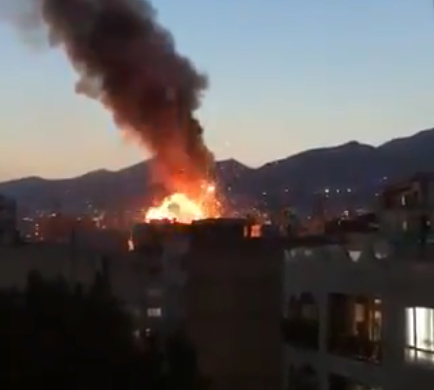
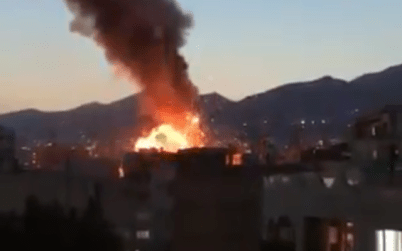
The explosion at a health clinic in Tehran, Iran, on June 30, 2020. (Screen capture: Twitter)

The explosion at a health clinic in Tehran, Iran, on June 30, 2020. (Screen capture: Twitter)

The stream of mysterious explosions and fires in Iran over the past few weeks has stirred the imagination of countless Israelis and media outlets.

Is it possible that a foreign intelligence entity is trying — and managing — to destabilize the Islamic Republic? Is someone trying to drag Iran into a war or a confrontation?

Just this week, there was an explosion at a power station in Isfahan Province and, later the same day, a fire broke out at a phone factory in northwestern Iran. In late June, there was a big explosion near a military facility in Tehran and another one in a civilian hospital in the capital, where 19 people were killed.

However, officials have not been quick to blame Israel, the United States, or the West, at least not in most cases — and there could be a reason for that.

Setting aside the most dramatic incident, the July 2 blast at the nuclear facility in Natanz — which is said by some experts to have significantly set back Iran’s nuclear program, damaging an advanced centrifuge development and assembly plant, and which foreign media reports have attributed to Israel — the other cases have been blamed by the Iranians on such banal causes as poor maintenance, rising temperatures and negligence. (A report on Thursday said the Islamic Revolutionary Guard Corps [IRGC] has concluded that contractor Ershad Karimi was the perpetrator of the Natanz attack.)

This summer in Iran has indeed been hot. This week, temperatures reached 43°C (109°F) in the port city of Bandar Abbas, 35°C (95°F) in Shiraz and 34°C (93°F) in the capital Tehran.

And the national infrastructure is rickety anyway, and every year there are fires and even explosions. Still, this year, their number has increased.

Footage of a fire at a factory near Tabrinz, Iran on July 19, 2020. (Screen capture/Twitter)

Meir Javedanfar, a lecturer on Iranian Diplomatic and Security Studies at the Interdisciplinary Center (IDC) Herzliya, suspects a different cause.

“Since March, we have witnessed hundreds of fires, perhaps even a thousand, across the country. That’s unimaginable. Why would a foreign entity do something like this? What interest do they have to attack a hospital? And I’m not talking about Natanz,” he said.

Meir Javedanfar (YouTube screenshot)

“Somebody’s trying to weaken President [Hassan] Rouhani and tarnish his public image,” he elaborated. “We saw that in the attempt to pass a motion of no confidence in the Iranian Majlis (parliament). Now, the Supreme Leader [Ayatollah Ali] Khamenei has apparently blocked that effort — and all of a sudden, there has been a significant fall in the number of fires and explosions.”

Javedanfar was alluding to the tensions within the conservative wing of Iran’s leadership, which has ruled the parliament since last February’s election.

The elected speaker of the Majlis is Mohammad Bagher Ghalibaf, a well-known conservative who previously ran against Rouhani. Ghalibaf was a top-ranking IRGC official and a commander of its Air Force.

Along with his parliamentary peers, Ghalibaf has been trying to challenge Rouhani and the members of his moderate-reformist wing ahead of the next presidential election, in May 2021.
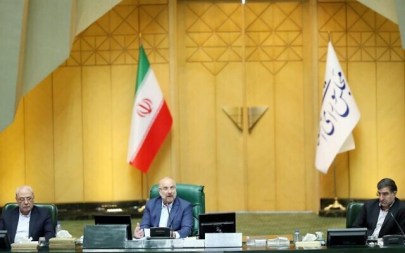
This handout picture provided by the Islamic Consultative Assembly News Agency (ICANA) on May 31, 2020, shows Iranian Parliament speaker Mohammad Bagher Ghalibaf (C) chairing a parliament session in the capital Tehran (ICANA NEWS AGENCY / AFP)

Rouhani, who has been president since 2013, cannot be reelected, but a representative of his moderate wing will aim to succeed him, possibly in a contest against Ghalibaf.

One of the names mentioned as a potential candidate for the moderate wing is Ali Larijani, a former speaker of the Majlis, who was recently appointed as adviser to the supreme leader.

Inundated with problems

The struggle between these two wings is deeply affecting Iran, complicating its response to the coronavirus pandemic that has ravaged the country.

“Rouhani can’t do much in the face of the pandemic and the economy. About 60 percent of the Iranian economy is not steered by elected officials, but by what’s known as the ‘Deep State,’” Javedanfar said.

“These are entities like the Islamic Revolutionary Guard Corps and the allegedly ‘social’ funds. When the first COVID-19 cases were discovered in the sacred city of Qom, Rouhani wanted to impose a lockdown, but Khamenei and the ‘Deep State’ prevented him from doing so. Iran now has very significant problems, and I’m doubtful whether it can deal with them,” said Javedanfar.

Asked whether he thinks Iran will retaliate for the explosion in Natanz, Javedanfar was skeptical.

“In my estimation, the Iranian leadership is trying these days first and foremost to survive, at least until the US presidential election [in November],” he said. “They understand that even if Joe Biden is elected, he isn’t expected to lift the sanctions immediately, but his election would at least inspire hope.

“I don’t know any Iranian administration since 1979 that has had to deal with such significant crises and challenges as today,” he added.
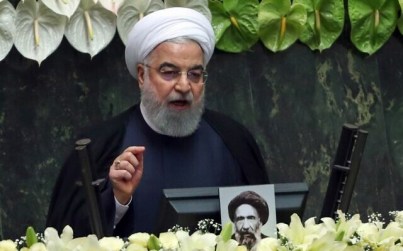
Iranian President Hassan Rouhani delivers a speech during the inaugural session of the new parliament in Tehran on May 27, 2020. (AFP)

Indeed, Iran is inundated with problems that threaten to suffocate its economy and citizens. The most striking figure is the steep fall in the value of the Iranian currency, the rial.

As of January, the rial was 128,000 to the US dollar. In recent weeks, the exchange rate fell as low as 250,000 rials to $1. The past few days have seen a slight improvement, after intervention by the Central Bank of Iran.

Unemployment rates have skyrocketed due to the pandemic, subsidies have been canceled and annual inflation is at 41%, leading to a dramatic rise in the price of basic commodities like rice and poultry.

Real wages have been eroded, and the administration knows full well that a new generation of poor people creates a fertile ground for instability. Even Rouhani’s deputy has acknowledged that Iran’s economy is at a critical stage.

Deliberately inflated numbers?

This week, Rouhani announced there have been an estimated 25 million coronavirus cases in Iran — out of a population of about 82 million — numbers so high as to be implausible. There may conceivably be several million carriers in Iran, but it’s also possible that Rouhani chose to inflate the numbers.

First of all, he may have wanted to create a sense of a crisis too dramatic for his government to handle, as a way to evade responsibility.

Secondly, he may have hoped to restore calm to the Iranian street. After turbulent demonstrations last November over a sudden increase in gasoline prices, the first wave of the pandemic was met with relative equanimity. However, over the past few weeks, protests were renewed on a smaller scale, after authorities decided to execute three organizers of the November protests. The court then announced it would reconsider the verdicts amid fear of a public outcry.

Moreover, it is possible that Rouhani is trying to signal to both Khamenei and the public that parliament and the conservative wing have been trying to curb him in a way that poses a direct threat to Iranian citizens and their health. Wary of the conservatives and well aware of the despair among young people, and the disappointment in his performance, he may be trying to improve the position of his wing ahead of the election in May.
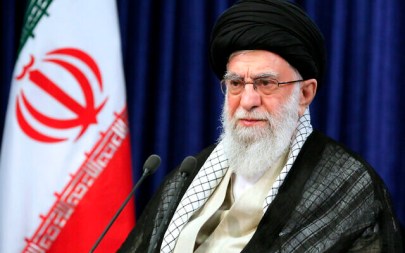
Iranian Supreme Leader Ayatollah Ali Khamenei addresses the nation in a televised speech marking the anniversary of the 1989 death of Ayatollah Ruhollah Khomeini, the leader of the 1979 Islamic Revolution, in Tehran, Iran, June 3, 2020. (Office of the Iranian Supreme Leader via AP)

Either way, the COVID-19 resurgence that started in May is indeed severe. There have been about 200 coronavirus-related deaths in Iran every day, and anger and concern are deepening.

“The situation is terrible,” Javedanfar said. “Those who can are trying to leave the country. There are more cases of depression and aggression. The despair leads people to act illogically, and the administration’s [handling of the crisis] encourages that behavior.

“Tehran’s stock exchange market is somehow booming in the most difficult time financially the country has experienced. We’ve seen unprecedented records. People invest fortunes in various companies that are on the verge of bankruptcy, and the administration resuscitates them. The Telegram channel of the Islamic Revolutionary Guard Corps encourages the public to invest in the stock exchange. Do you understand? People who can’t make a living are selling their cars, farmers are selling their tractors, in the hope of getting rich via the stock market.”

China’s vague deal

One development in Iran’s relationship with the outside world that has received significant attention is the agreement between China and Iran, according to which China will allegedly invest in Iran.

But it is doubtful whether this deal has substance. It seems more like a statement of intent that is meant, on the one hand, to show the United States that China will not accept dictates from US President Donald Trump and, on the other, to serve Iranian interests by giving hope to the public.

The deal includes no concrete or specific elements, at least not for the time being. For now, it seems designed to provide some internal resilience for the Iranian administration.
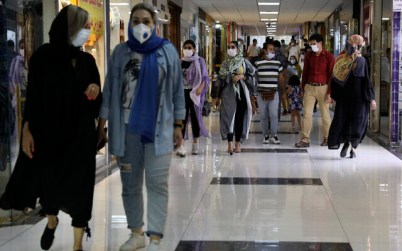
People wearing protective face masks to help prevent the spread of the coronavirus walk through the Nasr Shopping Center in Tehran, Iran, July 15, 2020 (AP Photo/Vahid Salemi)

Facing paralyzing sanctions from the US and the rest of the world, the grim financial situation and the pandemic, the future of the Iranian public and administration is unclear.

Will Iran become more conservative? Perhaps. If a conservative president wins the election, the delicate balance between conservatives and moderates will be disrupted, and all three branches of government will be in the hands of conservatives — the parliament, the presidency and the judiciary, which is currently headed by Ayatollah Ebrahim Raisi, a conservative who has been flagged as a potential heir to Khamenei.

On the other hand, a victory by the moderate wing would send the message that the Iranian leadership wishes to follow the same lines as before, perhaps in the hope of change on the American side.

Neither a conservative takeover nor a balance between conservatives and moderates, however, is likely to bring about the collapse or overthrow of the regime.
IDF strikes Syrian army targets near border after munitions fired at Israel

July 25, 2020
https://www.timesofisrael.com/idf-strikes-syrian-army-targets-near-border-after-munitions-fired-into-israel

Syrian state media says 2 lightly injured; Israeli army says it hit observation posts, intel-gathering tools; strikes come after blasts at border sent shrapnel into Israeli town

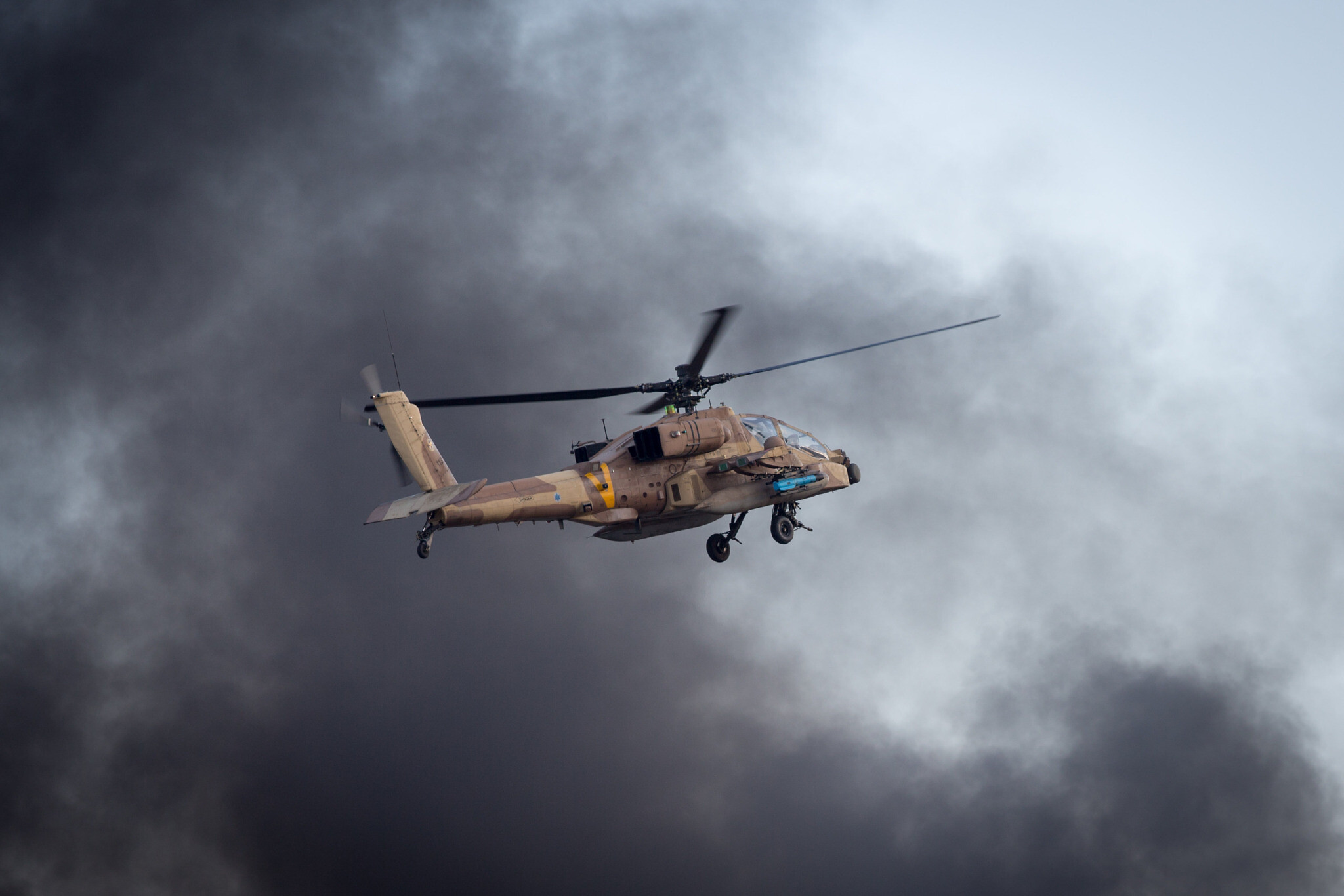
Illustrative: An Israeli Apache helicopter flies during an aerial show at a graduation ceremony for soldiers who have completed the IAF Flight Course, at the Hatzerim Air Base in the Negev desert, December 29, 2016.(Miriam Alster/Flash90)

Illustrative: An Israeli Apache helicopter flies during an aerial show at a graduation ceremony for soldiers who have completed the IAF Flight Course, at the Hatzerim Air Base in the Negev desert, December 29, 2016.(Miriam Alster/Flash90)
Israeli attack helicopters on Friday night struck several military targets in southern Syria belonging to the Syrian military, in response to munitions fired at Israel earlier in the day, the Israel Defense Forces said.

Targets included “observation positions and intelligence-gathering tools inside Syrian posts,” the military said.

Syrian state news agency SANA said the strikes injured two soldiers, hit three sites and caused fires.

Arabic media reports said missiles had hit anti-aircraft batteries near Quneitra in the Syrian Golan Heights.

The incident in the morning saw explosions heard along the border and shrapnel striking a home and a car on the Israeli side in the Druze town of Majdal Shams, causing light damage. The cause was reported to be either anti-aircraft fire toward an IDF observation balloon or an artillery shell fired from Syria toward Israel, possibly by accident.

“The IDF holds the Syrian regime responsible for the fire against Israel earlier today,” the army said in a statement. “The IDF will continue operating with determination and will respond to any violation of Israeli sovereignty.”

The incidents came amid heightened tensions between Israel and the Hezbollah terror group, which maintains a presence in the Syrian Golan Heights, after one of the organization’s fighters was killed in an airstrike attributed to Israel on Monday night.

The US Chairman of the Joint Chiefs of Staff, Gen. Mark Milley, made an unannounced visit to Israel on Friday, meeting with Defense Minister Benny Gantz, IDF chief Lt. Gen. Aviv Kohavi and Mossad director Yossi Cohen, along with other top brass. Israeli television commentators speculated on the possible significance of the visit, particularly regarding the threat posed by Iran and its Lebanese ally Hezbollah.

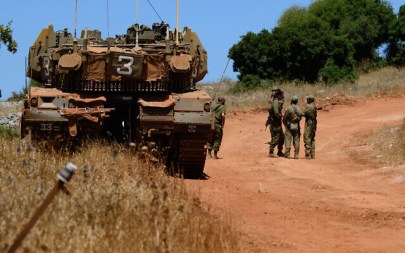
The IDF further stepped up its defenses along the country’s northern borders on Friday, the army said, out of concern the Hezbollah terror group may carry out an attack against military targets along the frontier in retaliation and warned Beirut it would bear responsibility for any possible Hezbollah strike.

“In light of a situational assessment in the IDF and in accordance with the Northern Command’s defense plan, the IDF’s deployment will change in both the military and civilian arena with the goal of strengthening defenses along the northern border,” the IDF said in a statement.

In the past, Hezbollah has vowed to retaliate to losses of its soldiers in Syria with attacks on Israel. This was the case in September, when the terror group fired three anti-tank guided missiles at Israeli military targets along the Lebanese border, narrowly missing an IDF armored ambulance with five soldiers inside, after the IDF killed two of its fighters in Syria the month before.

In a tacit threat, the IDF preemptively warned Beirut that it sees the state of Lebanon as “responsible for all actions emanating from Lebanon.”

Israel Defense Forces soldiers stationed along the border with Lebanon on July 23, 2020. (Basel Awidat/FLASH90)

Beginning at 8 p.m. on Friday night, roadblocks were installed along a number of highways to prevent military vehicles vulnerable to attack from anti-tank guided missiles fired from either Lebanon or Syria, from driving on certain roads.

Entrances to some communities where the military maintains a presence that are exposed to attack were also blocked for IDF vehicles. As the military assessed that Hezbollah planned to attack only IDF targets, civilian vehicles will be able to travel freely throughout the area.

However, the IDF said that some farmers who have fields directly along the border may be blocked from working their lands.

The military also cleared some troops out of positions directly along the border, moving them deeper into Israel, so that they would not represent a clear target for Hezbollah, while still allowing them to defend the frontier.

The IDF has also stepped up its intelligence collection efforts along the border in recent days. Throughout the day on Friday, Lebanese media reported on large numbers of Israeli drones flying overhead.

Judah Ari Gross contributed to this report.

IDF sends reinforcements to north amid threat of Hezbollah attack

July 23, 2020

Source: IDF sends reinforcements to north amid threat of Hezbollah attac

Move comes after terror group accused Israel of killing one of its fighters in an airstrike outside Damascus earlier in the week

Israeli soldiers stand near artillery cannons deployed along the Lebanese border outside the northern Israeli town of Kiryat Shmona on September 1, 2019. (Basel Awidat/Flash90)

Israeli soldiers stand near artillery cannons deployed along the Lebanese border outside the northern Israeli town of Kiryat Shmona on September 1, 2019. (Basel Awidat/Flash90)

The Israel Defense Forces on Thursday announced it was sending reinforcements to the northern border amid the threat of retaliation by the Lebanese Hezbollah terror group over the death of one of its fighters in Syria earlier this week.

“In light of a situational assessment that was held in the IDF, it was decided to send a pinpoint reinforcement of infantry troops to the Northern Command,” the military said.

Also on Thursday, sources close to Hezbollah told the London-based Asharq al-Awsat newspaper that the terror group would likely respond to the death of its fighter on Monday night.

An IDF spokesperson said the reinforcement consisted of one battalion — the Golani Brigade’s 13th Battalion — and a small number of additional troops, who were being sent to the Northern Command’s Galilee Division.

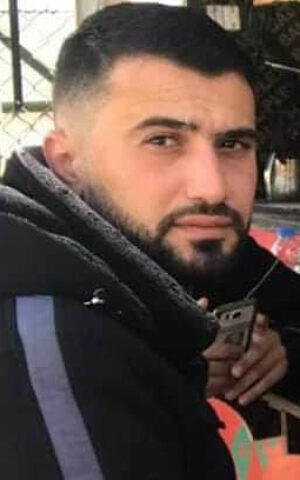
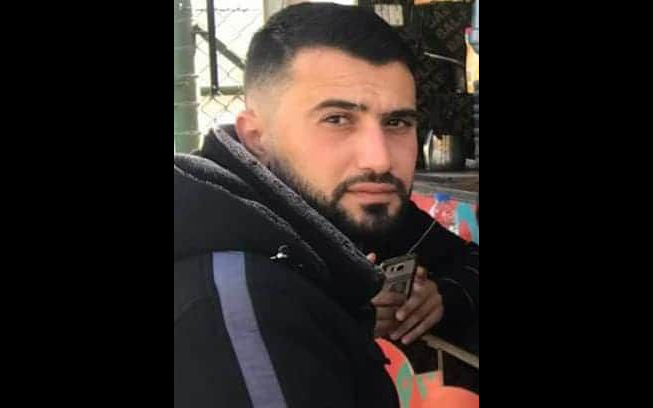
Ali Kamel Mohsen Jawad, a member of the Hezbollah terror group, whom the organization says was killed in an Israeli airstrike on July 20, 2020. (Hezbollah media)

The move came two days after Hezbollah accused Israel of killing one of its members — Ali Kamel Mohsen Jawad — in an airstrike south of Damascus on Monday night, raising the possibility of retaliation against the Jewish state.

In response to the terror group’s announcement about Jawad’s death, both the IDF and Hezbollah went on high alert along the frontier, according to media reports from both sides of the border.

In the past, Hezbollah has retaliated for confirmed deaths of its members at Israel’s hands with attacks on the Jewish state, generally along the Israeli-Lebanese border. As a result of this policy, the IDF generally refrains from killing Hezbollah troops in Syria.

Such an exchange occurred last August, when the IDF killed two Hezbollah members that the military said were taking part in an Iranian-run operation in southern Syria that attempted to attack IDF border positions with armed drones.

“If Israel kills any of our members in Syria, we’ll respond from Lebanon and not in the Shebaa Farms, and we tell the Israeli army on the border to be very cautious and to wait for us,” Hezbollah leader Hassan Nasrallah said in a speech at the time.

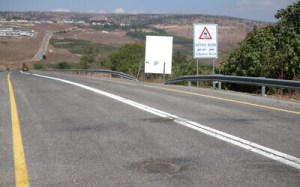
A location near the northern Israeli town of Avivim shows the site where an anti-tank missile fired by Hezbollah fighters hit a road on September 1, 2019, seen on September 10, 2019. (Judah Ari Gross/Times of Israel)

Days later, in response to their deaths — as well as an alleged Israeli drone attack in Beirut that occurred the same night — Hezbollah fired three anti-tank guided missiles at Israeli military targets along the Lebanese border, narrowly missing an IDF armored ambulance in with five soldiers inside.

On Thursday, sources “familiar with [Hezbollah’s] views” told Asharq Al-Awsat that the terror group was abiding by that same “equation that Nasrallah set last year” of retaliating when one of its fighters is killed in Syria.

The airstrike attributed to Israel on Monday night hit weapons depots and military positions belonging to Syrian regime forces and Iran-backed militia fighters, according to the Syrian Observatory for Human Rights.

The group said the aerial bombardments caused several explosions around the town of Kiswah, an area that has long been associated with Iran’s Islamic Revolutionary Guard Corps.

The attack reportedly came in two waves. The Reuters news service reported that the assault hit targets in the towns of Jabal al Mane, Muqaylabiya and Zakiya, causing “huge blasts” and allegedly killing Iranian personnel.

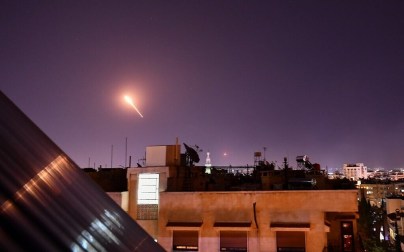
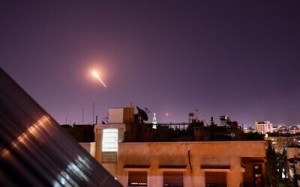
Syrian Air defenses respond to alleged Israeli missiles targeting south of the capital Damascus, on July 20, 2020 (AFP)

Reuters quoted a Syrian analyst with sources on the ground named Zaid al Reys as saying that the target of the attack was a “major ammunition depot.”

Israel has launched hundreds of strikes in Syria since the start of the civil war in 2011. It has targeted government troops, allied Iranian forces and fighters from the Lebanese Shiite terror group Hezbollah.

It rarely confirms details of its operations in Syria, but says Iran’s presence in support of President Bashar Assad and Hezbollah is a threat and that it will continue its strikes.

Monday’s attack came a week and a half after Iran and Syria signed an agreement that would see Tehran upgrade the Syrian military’s air defenses, apparently in response to ongoing Israeli strikes in the country.

It was the first strike in Syria to be attributed to Israel since June, when the Observatory said nine fighters were killed in airstrikes targeting positions of Iran-backed militias near the Iraqi border. Those strikes came hours after a similar raid killed six other Tehran-backed fighters.

Times of Israel staff and AFP contributed to this report.


Hezbollah says one of its fighters killed in Israeli strike in Syria

July 22, 2020

Source: Hezbollah says one of its fighters killed in Israeli strike in Syria | The Times of Israel

Lebanese terror group has consistently retaliated for confirmed deaths of its members at Israel’s hands with attacks along the border

Ali Kamel Mohsen Jawad, a member of the Hezbollah terror group, whom the organization says was killed in an Israeli airstrike on July 20, 2020. (Hezbollah media)

Ali Kamel Mohsen Jawad, a member of the Hezbollah terror group, whom the organization says was killed in an Israeli airstrike on July 20, 2020. (Hezbollah media)

The Hezbollah terror group on Tuesday evening accused Israel of killing one of its members in an airstrike outside Damascus the night before, raising the possibility of retaliation against the Jewish state.

In a statement carried by Hezbollah-controlled media channels, the terror group said its operative Ali Kamel Mohsen Jawad was killed in an act of “Zionist aggression,” apparently referring to a series of airstrikes south of Damascus late Monday night that were attributed to Israel.

In the past, Hezbollah has retaliated for confirmed deaths of its members at Israel’s hands with attacks on the Jewish state, generally along the Israeli-Lebanese border.

Such an exchange occurred last August, when the Israel Defense Forces killed two Hezbollah members that the military said were taking part in an Iranian-run operation in southern Syria that attempted to attack IDF border positions with armed drones.

“If Israel kills any of our members in Syria, we’ll respond from Lebanon and not in the Shebaa Farms, and we tell the Israeli army on the border to be very cautious and to wait for us,” Hezbollah leader Hassan Nasrallah said in a speech at the time.

Syrian Air defenses respond to alleged Israeli missiles south of the capital Damascus, on July 20, 2020 (AFP)

Days later, in response to their deaths — as well as an alleged Israeli drone attack in Beirut that occurred the same night — Hezbollah fired three anti-tank guided missiles at Israeli military targets along the Lebanese border, narrowly missing an IDF armored ambulance in with five soldiers inside.

A Britain-based Syrian war monitoring group reported that five Iran-backed fighters were killed in an Israeli missile strike south of the Syrian capital on Monday night. It was not immediately clear if Jawad was counted among the five.

The missile attack on Monday night hit weapons depots and military positions belonging to Syrian regime forces and Iran-backed militia fighters, according to the Syrian Observatory for Human Rights.

The attack wounded at least seven Syrian troops, according to the official SANA news agency, which said the missiles were launched by warplanes from the Golan Heights.

The five killed were all non-Syrian paramilitary fighters, according to the Observatory.

It added that 11 combatants were wounded in total — four non-Syrian fighters and seven Syrian troops, of whom two were in critical condition.

The group said the aerial bombardments caused several explosions around the town of Kiswah, an area that has long been associated with Iran’s Islamic Revolutionary Guard Corps.

The attack reportedly came in two waves. The Reuters news service reported that the assault hit targets in the towns of Jabal al Mane, Muqaylabiya and Zakiya, causing “huge blasts” and allegedly killing Iranian personnel.

A military source quoted by SANA claimed that most of the missiles were shot down. Such claims of interceptions by Syrian state media are generally dismissed by defense analysts as empty boasts.

Reuters quoted a Syrian analyst with sources on the ground named Zaid al Reys as saying that the target of the attack was a “major ammunition depot.”

Syrian Air defenses respond to alleged Israeli missiles targeting south of the capital Damascus, on July 20, 2020 (AFP)

Israel has launched hundreds of strikes in Syria since the start of the civil war in 2011. It has targeted government troops, allied Iranian forces and fighters from the Lebanese Shiite terror group Hezbollah.

It rarely confirms details of its operations in Syria, but says Iran’s presence in support of President Bashar Assad and Hezbollah is a threat and that it will continue its strikes.

Monday’s attack came a week and a half after Iran and Syria signed an agreement that would see Tehran upgrade the Syrian military’s air defenses, apparently in response to ongoing Israeli strikes in the country.

It was the first strike in Syria to be attributed to Israel since June, when the Observatory said nine fighters were killed in airstrikes targeting positions of Iran-backed militias near the Iraqi border. Those strikes came hours after a similar raid killed six other Tehran-backed fighters.

Times of Israel staff contributed to this report.


How lethally effective is Iran’s air defense system? – DEBKAfile

July 21, 2020

Source: How lethally effective is Iran’s air defense system? – DEBKAfile

The intentions behind the high alert ordered for Iran’s air defenses – reported by US sources from “several” indications – are as opaque as the mystery behind the recent string of explosions at Iran’s key nuclear, military and missile sites.

International speculation has centered on Israel as being responsible for some of the attacks, although this is not confirmed. The only comment came from Defense Minister Benny Gantz on July 5. He said: “Not all the incidents in Iran have anything to do with us.  … All their systems are complex; they have very high security constraints and I am not sure that they always know how to maintain them.”

But if there are opposition groups on the ground in Iran carrying out attacks on key facilities there, it is not clear whether they are acting on directives or funding from external sources. None alone is capable supporting the sweeping effort involved in more than half a dozen strikes at the heart of Iran’s most secure infrastructure since late June.

One of the most critical attacks occurred on July 2, when a fire caused significant damage to the advanced centrifuge production building at the Natanz uranium enrichment center. It is calculated to have retarded Iran’s nuclear program by a year or more. Another blew up a missile production amenity and tunnel network near the Parchin military compound. The most recent was the setting of seven ships on fire at Iran’s southern port of Bushehr.

No one has yet suggested that aerial attacks by hostile fighters, bombers or missiles were the cause of those incidents. Only possible sabotage from the ground or cyberattack has been mentioned. So what moved the Revolutionary Guards (IRGC) to put the country’s air defenses on high alert?  DEBKAfile’s military and Middle East sources postulate a number of considerations:

  1. Preparations for unleashing a retaliatory attack on Israel in the expectation of deadly counteraction, as some Arab media suggest.
  2. Some of the explosions may have been caused by stealth drones which no one has so far admitted. The air defense alert would act as deterrence.
  3. Nervousness at not knowing where the attacks come from, who is responsible and when the next one is coming.
  4. Anxiety lest the next surprise blow – if and when it comes – will endanger the Islamic regime.

So how effective is Iran’s air defense system?

In June 2019, the IRGC claimed to have shot down a large, slow-flying US Global Hawk drone over the Strait of Hormuz with a Khordad 3 missile, a version of the SAM Raad. The Khordad 15 is capable of detecting, intercepting, and destroying six targets simultaneously. The system is said able to detect fighter jetscruise missiles and unmanned combat aerial vehicles (UCAV) from 150 km away and is able to track them within a range of 120km

Iran has 32 batteries of Russian-made S-300 ground-to-air missiles delivered since 2016 (in the face of Israel’s efforts to prevent the transaction). Iran’s aviation industry has also developed home-made versions of this system, including Bavar 373, SAM Tabas and SAM Raad, which are regularly showcased on military parades. They are seen as posing a serious threat. Their radar system is also believed to be highly effective.

The Sayyad-3 missile, used by the SAM system, has a range of 200 km. The system can also detect stealth targets from a distance of 85km. Missiles fired from the much older SA-15 are designed when they explode to pepper flying targets with shrapnel penetrating the fuselages of aircraft and drones.

The most advanced of all these systems are arrayed around Iran’s nuclear-related facilities.

The European Aviation Safety Agency reacted to the Iranian alert without delay on Thursday, July 13, by warning passenger jets against flying through Iranian air space lest they are accidentally targeted by the country’s air defense systems. “The hazardous security situation, poor coordination between Iran’s civil aviation and military operations” were cited as high risk.

The warning came shortly after Tehran admitted to mistakenly shooting down a Ukraine airliner in January killing all 176 passengers aboard  The Iranian government explained that the “misalignment of an air defense unit’s radar system” was the key “human error” that led to the accidental downing of the airliner.

At the time, Tehran’s air defenses had been on high alert following an Iranian attack on US troops in Iraq after the killing of top general Qasem Soleimani by a US drone.

Following the Ukrainian disaster, the US is also concerned that Iran’s unreliability in the operation of its air defense systems means that the transition to a high state of alert could also pose a threat in itself.

Iran, and others, watching Israel stumble over coronavirus

July 21, 2020

Source: Iran, and others, watching Israel stumble over coronavirus – The Jerusalem Post

When Israel had Corona under control, the message conveyed was of a strong, resilient country with a great deal of solidarity able to weather all kinds of storms, even a pandemic.

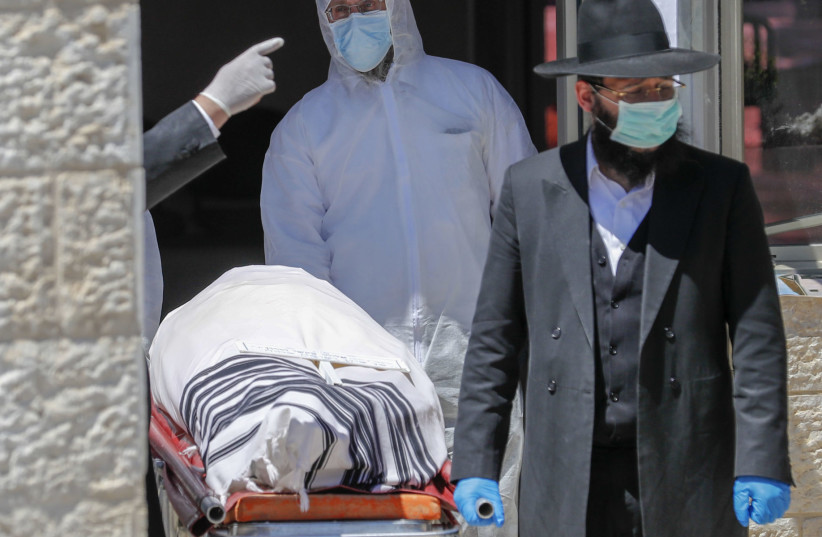
An Israeli rabbi walks alongside the body of Eliahu Bakshi-Doron, the former Sephardic chief rabbi of Israel, who died from complications of the coronavirus (photo credit: AHMAD GHARABLI VIA GETTY IMAGES/JTA)
An Israeli rabbi walks alongside the body of Eliahu Bakshi-Doron, the former Sephardic chief rabbi of Israel, who died from complications of the coronavirus
(photo credit: AHMAD GHARABLI VIA GETTY IMAGES/JTA)
“Which country will triumph in the post-pandemic world,” read an intriguing headline to an op-ed in the New York Times on Monday. And the sub-headline was even more interesting – “Hint: It’s not the United States or China.”

And, no, it’s also not Israel.

Rather, according to Ruchir Sharma, a “global investor,” it is Germany. Why Germany? Well, for starters because it has managed the coronavirus crisis with great aplomb.

“imagine a country, a major Western economic power, where the coronavirus arrived late but the government, instead of denying and delaying, acted early. It was ready with tests and contact tracing to ‘flatten the curve’ swiftly and limited its death rate to orders of magnitude lower than that of any other major Western industrial nation,” Sharma wrote.

“Containing the virus allowed for a brief and targeted lockdown, which helped limit unemployment to only 6 percent. Amid a shower of international praise, the country’s boringly predictable leader experienced a huge spike in popular approval, to 70 percent from 40 percent,” he continued in a piece that fell under the genre of “show me how a country is dealing with COVID-19, and I’ll show you its future.”

So what does that all say about Israel?

If in late April, around Independence Day when it seemed Israel had a good handle on the crisis, pundits wrote that Israel’s successful management of the crisis was sending an important political message to Israel’s foes, then what message is being sent today when Jerusalem is fumbling on the issue?When Israel had Corona under control, the message conveyed was of a strong, resilient country with a great deal of solidarity able to weather all kinds of storms, even a pandemic. This is a particularly important message in a hostile neighborhood where it is always strategically important for Israel to project a sense that it can overcome any and all forms of adversity.

But today, three months later, what image is Israel presenting now?

“Let’s say we are sitting in Tehran,” Maj.-Gen Israel Ziv (ret.), a former head of the IDF’s Operations Directorate, said in a Kan Bet interview on Monday. “We are interested in what is happening in Israel, and what do we see?

“We see that the country that is supposed to be experiencing a crisis is drowning in its own crisis, which is getting worse. The state looks confused, as if it is not being managed, looking like Nasrallah’s spider web.”

This was a reference to Hezbollah head Hassan Nasrallah’s famous speech celebrating Israel’s withdrawal from Lebanon in 2000 when he said that with all its might and weaponry, Israel is as feeble as a spider web.

“When we were watching what was happening in the Arab world during what was called the Arab Spring, we felt a degree of satisfaction – look, they are unstable; look, they are failing,” Ziv said.

“How do we now look in the eyes of the Arabs? We have a managerial crisis, a mess on the street – they are certainly hoping that it will go from demonstrations to anarchy – there is no budget, and the government can’t even make a decision to give the Defense Ministry, which is supposed to always keep its eyes above water, [budgetary] exemptions. And if I’m Iran, I’m thinking this is an extraordinary opportunity.”

Israel’s enemies, Ziv said, are closely watching what is happening here, and the conclusions they draw could have long-lasting ramifications. “We must recover, take matters into our hands, change the national framework for dealing with the crisis, and show the strong Israel.”

In Ziv’s telling, the way Israel deals with the crisis is not only a health or economic issue, but also one that has far-reaching strategic ramifications. Israel’s foes are carefully watching to see, and perhaps exploit, the country’s weaknesses that are on full display.

But not only Israel’s foes are watching, so too are countries who have an image of Israel as a can-do state with tremendous technological prowess and an uncanny ability to deal with short term problems.

Prime Minister Benjamin Netanyahu has adroitly leveraged that perception of the Jewish state over the last decade into significant diplomatic capital.   During this time Israel has made tremendous diplomatic inroads in Asia, Africa, Latin America and the Persian Gulf on the strength of the idea that it is the innovation nation, as Netanyahu likes to call it, which has a great deal to offer.

China, India, Saudi Arabia, the UAE, Ethiopia, Kenya, Uganda, Chad, Brazil and Argentina have all forged closer ties to Israel over the last decade – some more openly than others – not because they suddenly became Zionists, but because ties with Jerusalem benefited them. To a certain extent they looked at Israel as a model.

In the early days of the virus, Netanyahu repeated often that countries around the world were looking to learn from Israel about how to deal with the virus. That is something that raises the stature of a country in the eyes of others.

But what will happen to this leverage if these countries look at how Israel is dealing with the pandemic now, and conclude that it is doing no better – and perhaps even worse – than they themselves are? What does that say about what the country has to offer?

Israel’s image as an efficient, innovative country full of solutions and able to meet any challenge has strategic and diplomatic significance. It is an image it can’t afford to have tarnished. Dealing more effectively with the virus is not only a health and economic imperative, but also a strategic one.


China ‘strategic accord’ could give Iran a $400 billion boost, up military ties

July 13, 2020

Source: China ‘strategic accord’ could give Iran a $400 billion boost, up military ties | The Times of Israel

Under 25 year agreement reportedly finalized, Beijing and Tehran to increase military cooperation, including weapons development and intel sharing; China getting discount oil

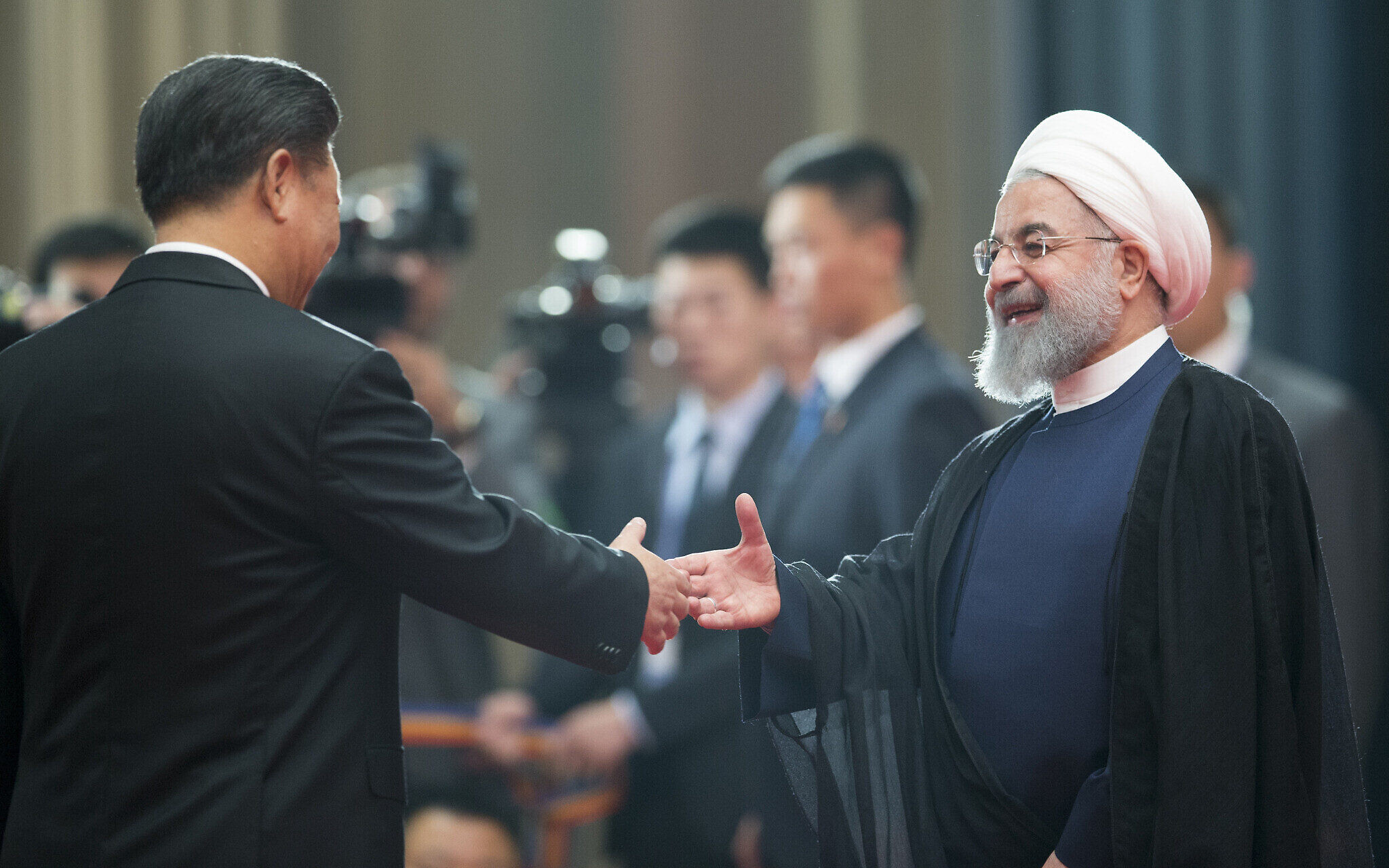
Chinese President Xi Jinping, left, greets Iranian President Hassan Rouhani at the Shanghai Cooperation Organization (SCO) Summit in Qingdao in eastern China's Shandong Province on June 10, 2018. (AP Photo/Alexander Zemlianichenko)

Chinese President Xi Jinping, left, greets Iranian President Hassan Rouhani at the Shanghai Cooperation Organization (SCO) Summit in Qingdao in eastern China’s Shandong Province on June 10, 2018. (AP Photo/Alexander Zemlianichenko)

Negotiations between Iran and China over the creation of a 25-year strategic accord appear to have concluded, with The New York Times on Sunday publishing excerpts from an 18-page agreement labeled “final version” that could see Beijing invest $400 billion over the next 25 years in exchange for discount oil.

The document — which The Times said was dated June 2020 and has yet to be approved by the Majles, Iran’s parliament — detailed how Beijing would receive Iranian oil at a sharply reduced price for the next quarter century in exchange expanding its economic involvement in a variety of fields, including banking and infrastructure, such as telecommunications and transport.

This would potentially include giving the Iranians access to China’s global positioning system and helping roll out an Iranian 5G network.

China is Iran’s top trading partner.

In this photo from January 23, 2016, released by an official website of the office of the Iranian supreme leader, Supreme Leader Ayatollah Ali Khamenei, right, meets with Chinese President Xi Jinping in Tehran, Iran. (Office of the Iranian Supreme Leader via AP)

Tehran has been hit hard by American sanctions reimposed following Washington’s withdrawal from the 2015 nuclear deal in May 2018. Iranian crude exports have been severely curtailed by the US sanctions, as has much of the country’s foreign trade.

The deal could bring Iran as much as $400 billion in Chinese investment over the next quarter century, according to sources with knowledge of the deal who spoke with The Times.

The deal would also encompass military cooperation, including weapons development, combined training and intelligence sharing in order to combat ““the lopsided battle with terrorism, drug and human trafficking and cross-border crimes,” The Times reported.

Both Tehran and Beijing are currently at loggerheads with Washington, Iran over its nuclear program and China over ongoing trade disputes with the Trump administration.

The US has accused China of stealing its intellectual property and engaging in forced technology transfers from US firms doing business there.

The accord said that Iran and China as “two ancient Asian cultures, two partners in the sectors of trade, economy, politics, culture and security with a similar outlook and many mutual bilateral and multilateral interests will consider one another strategic partners,” the paper reported.

Chinese People’s Liberation Army (PLA) soldiers wearing face masks to protect against the spread of the new coronavirus march near the Forbidden City during a plenary session of China’s National People’s Congress (NPC) at the Great Hall of the People in Beijing, May 25, 2020. (AP Photo/Andy Wong)

On Sunday, a senior aide to Iranian President Hassan Rouhani said that the accord could be signed as early as next March, Radio Farda reported.

There has been some pushback in Iran regarding the deal.

Last Monday, Iranian Foreign Minister Mohammad Javad Zarif told lawmakers that their country had been negotiating with the Chinese and that the terms would be announced once a deal is struck.

During the session, Zarif was heckled by lawmakers, largely over his key role in negotiating a 2015 nuclear deal with world powers, which the US unilaterally abandoned in 2018 as a prelude to reimposing biting sanctions.

It was his first address to parliament since a new house started work in late May in the wake of elections that were dominated by conservatives and ultra-conservatives.

Zarif insisted there was “nothing secret” about the prospective China deal.

The nation would be informed “when an accord has been concluded,” he said, adding that the intention had already been made public in January 2016 when Chinese President Xi Jinping visited Tehran.

Iran’s Supreme Leader Ayatollah Ali Khamenei has come out publicly in support of a strategic bilateral partnership with China.

The planned China deal has been a hot topic on Iranian social media since populist ex-president Mahmud Ahmadinejad last month condemned negotiations underway with a foreign country.


Israel’s alleged Natanz strike ‘as complex as Stuxnet,’ a major blow to Iran 

July 11, 2020

Source: Israel’s alleged Natanz strike ‘as complex as Stuxnet,’ a major blow to Iran | The Times of Israel

Blast at centrifuge assembly facility may have set back development by 2 years, experts tell the NY Times, with series of strikes causing ‘extreme internal and external pressure’

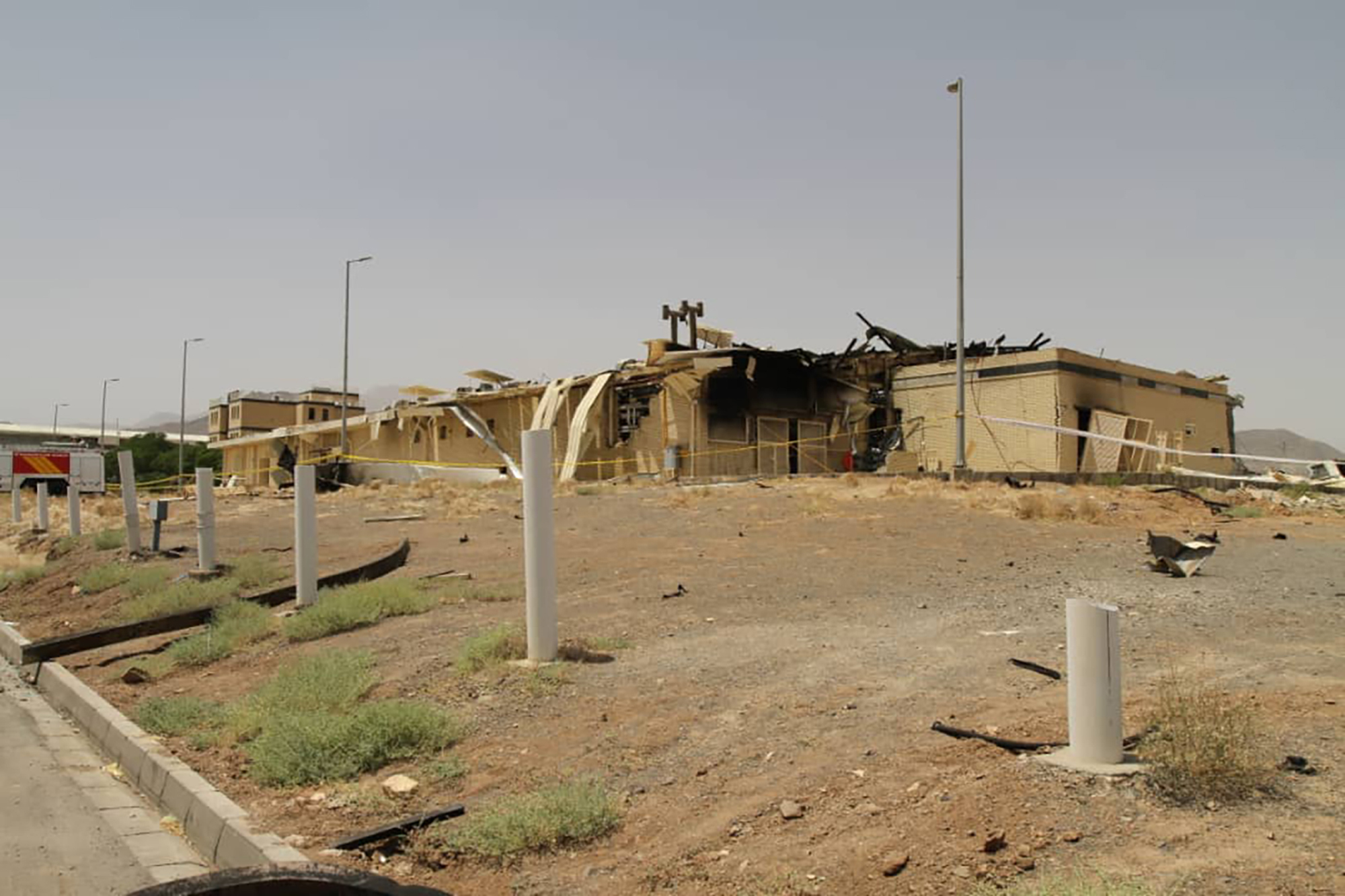
This photo released Thursday, July 2, 2020, by the Atomic Energy Organization of Iran, shows a building after it was damaged by a fire, at the Natanz uranium enrichment facility some 200 miles (322 kilometers) south of the capital Tehran, Iran. (Atomic Energy Organization of Iran via AP)

This photo released Thursday, July 2, 2020, by the Atomic Energy Organization of Iran, shows a building after it was damaged by a fire, at the Natanz uranium enrichment facility some 200 miles (322 kilometers) south of the capital Tehran, Iran. (Atomic Energy Organization of Iran via AP)

An alleged Israeli attack on an advanced centrifuge development and assembly plant at Iran’s Natanz uranium enrichment facility exhibited the complexity of the Stuxnet virus that sabotaged Iranian enrichment centrifuges a decade ago, experts and analysts said in a new report Friday.

Officials with knowledge of the blast at Natanz last week told The New York Times that it was most likely the result of a bomb planted at the facility, potentially at a strategic gas line, but that it was not out of the question that a cyberattack was used to cause a malfunction that led to the explosion.

The Stuxnet virus was uncovered in 2010 and was widely reported to have been developed together by US and Israeli intelligence agencies. It penetrated Iran’s rogue nuclear program, taking control and sabotaging parts of its enrichment processes by speeding up its centrifuges. Up to 1,000 centrifuges out of 5,000 were eventually damaged by the virus, according to reports, setting back the nuclear program.

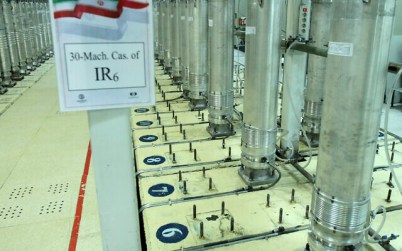
Centrifuge machines in the Natanz uranium enrichment facility in central Iran, November 5, 2019. (Atomic Energy Organization of Iran via AP, File)

The July 2 Natanz explosion was one of a series of mysterious blasts at Iranian strategic sites in recent weeks — the latest of which occurred Friday morning — which have once again been largely attributed to either Washington, Jerusalem, or both.

Friday’s blast “appeared to come from the direction of a missile base,” The Times noted. “If it proves to have been another attack, it will further shake the Iranians by demonstrating, yet again, that even their best-guarded nuclear and missile facilities have been infiltrated.”

Intelligence officials who assessed the damage to the Netanz centrifuge facility told The Times they believed it may have set the Iranians back by as much as two years.

And others asserted that the latest alleged attacks indicated an emergent strategy by Israel and the US — also including Washington’s assassination of top general Qassem Soleimani earlier this year — to carry out covert strikes that will hamper Iran’s regional and nuclear objectives while stopping short of leading to all-out conflict.

Karim Sadjadpour, a senior fellow at Washington-based think tank the Carnegie Endowment for International Peace, told the newspaper that the latest attacks had led to “extreme internal and external pressure” on Iran as it grapples with an economic crisis and punishing US sanctions.

A spokesman for Iran’s foreign ministry said Friday that the cause of the Natanz explosion was not yet known, but warned that the country would retaliate severely if it emerges that a foreign entity was involved, according to the semi-official Fars news agency.

However, he also sought to downplay Israeli involvement, claiming that such reports were only intended to aggrandize Israel and asserting that Jerusalem claims responsibility for incidents “in every corner of the world.”

Iran on Tuesday had called for action against Israel following the damage to the Natanz facility. “This method Israel is using is dangerous, and it could spread to anywhere in the world,” government spokesman Ali Rabiei said during a press conference.

A satellite image from Planet Labs Inc. that has been annotated by experts at the James Martin Center for Nonproliferation Studies at Middlebury Institute of International Studies shows a damaged building after a fire and explosion at Iran’s Natanz nuclear site, on July 3, 2020. (Planet Labs Inc., James Martin Center for Nonproliferation Studies at Middlebury Institute of International Studies via AP)

He added: “The international community must respond and set limits to these dangerous actions by the Zionist regime.”

His comments came as Iran appeared to publicly acknowledge on Tuesday that last week’s fire at Natanz was not an accident.

The latest mysterious blast in Iran came early Friday, as Iranian media reported an explosion in western Tehran, prompting electricity to be cut in surrounding suburbs.

Iran’s official IRIB news agency reported the blast, citing online reports by residents. A member of the Iranian parliament, Hossein Haghverdi, denied that any explosion occurred, saying the power outage was due to a problem at a nearby power station, according to The New York Times.

The mayor of a nearby town, however, confirmed that there was an explosion, but said it came from a factory that filled gas cylinders.

An analyst told The New York Times there were underground military installations in the area.

The explosion at a health clinic in Tehran, Iran, on June 30, 2020. (Screen capture: Twitter)

On Tuesday, an explosion reportedly damaged a factory south of Tehran. According to Iranian media reports, two people were killed and three were injured in the blast at the Sepahan Bresh factory in the Kahrizak district.

The area’s governor said human error was to blame for the incident.

An explosion also reportedly damaged a power plant in the Iranian city of Ahvaz last Saturday. A few hours later, the Islamic Republic News Agency said a chlorine gas leak at a petrochemical center in southeast Iran sickened 70 workers.

A week before the Natanz blast, an explosion was felt in Tehran, apparently caused by an explosion at the Parchin military complex, which defense analysts believe holds an underground tunnel system and missile production facilities.

Israel has also been reported to have been behind a cyberattack in May on an Iranian port facility, causing widespread chaos, apparently in retaliation for an attempt by Tehran to target Israel’s water infrastructure.

Channel 13 news reported that the April assault on Israeli water command and control systems had greatly angered Israeli leaders, who saw it as a significant escalation by Iran and a crossing of a red line because it targeted civil infrastructure.


Explosions, power outages reported near Tehran 

July 10, 2020

Source: Explosions, power outages reported near Tehran – The Jerusalem Post

Al-Arabiya reported that the explosions occurred in missile depots belonging to the IRGC southwest of Tehran.

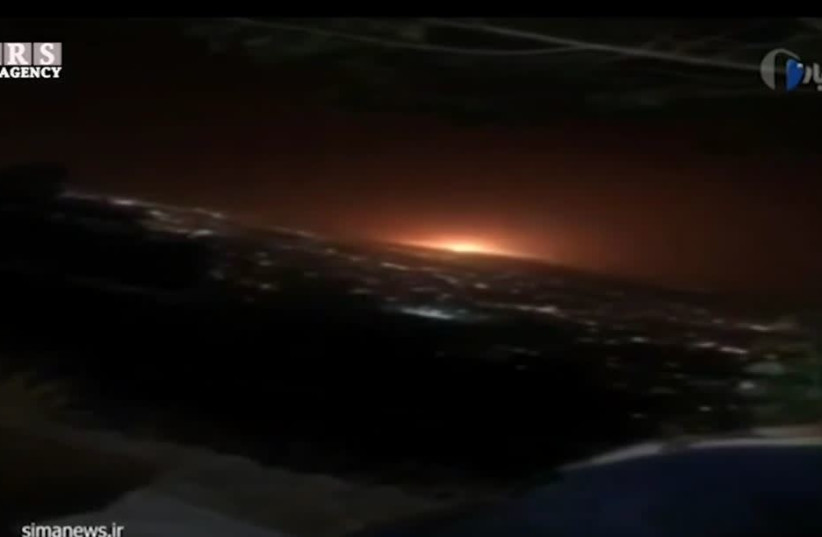
Explosion near Tehran, June 26, 2020 (photo credit: SCREENSHOT FARS NEWS AGENCY)
Explosion near Tehran, June 26, 2020
(photo credit: SCREENSHOT FARS NEWS AGENCY)
Explosions were reported west of Tehran on Thursday night, with some initial reports claiming that the explosions occurred at a missile depot belonging to the Iranian Revolutionary Guards Corps (IRGC).

According to the Iranian Mehr News Agency, the explosions were reported by social media users west of Tehran and in the cities of Garmdareh and Quds.

Power outages were reported in the area after the explosions were heard, according to initial reports.

Al-Arabiya reported that the explosions occurred in missile depots belonging to the IRGC southwest of Tehran.

Thursday’s explosion is the most recent in a series of explosions and fires reported in industrial areas and infrastructure throughout Iran.

On Monday, at least two people were killed and three others injured in a large explosion at the Sepahan Boresh factory in the city of Baqershahr near Tehran, according to Iranian and foreign reports.

The explosion was caused by “negligence in filling oxygen tanks,” the Kahrizak district governor told Radio Free Europe/Radio Liberty on Tuesday. The walls of the Saipa Press Company, located next to the factory, were damaged by the explosion as well.

The location of the explosion is not far from the warehouse where Iran’s nuclear archive was found by Israel in 2018, reported the IntelliTimes intelligence blog. The Saipa Press Company is located about 11 km. northeast from the area where the nuclear archive was found in the Shurabad commercial area. A warehouse where Prime Minister Benjamin Netanyahu claimed that nuclear equipment and material was stored is also located nearby in the Turouzabad area. The International Atomic Energy Agency found traces of uranium at the warehouse in 2019 and began investigating its origin, according to Reuters.

IntelliTimes reported that the Sepahan Boresh factory belongs to the Iranian automotive manufacturer SAIPA. It cooperates with the Iranian Ministry of Defense; the Iranian Revolutionary Guards Corps is involved in the company as well.

On June 26, an explosion was reported at a gas storage facility near Tehran. Iranian media reported that the incident happened in a “public area” in Parchin and not at a military site located nearby. Western security services believe Tehran carried out tests relevant to nuclear bomb detonations in Parchin more than a decade ago; Iran denies this.

Days later, on June 30, another explosion happened at a medical facility in Tehran, killing 19 people. Some initial reports attributed the explosion to oxygen tanks as well.

Later that week, an explosion was reported at a building at the Natanz nuclear facility where centrifuges were reportedly housed.
The Noor News website, close with Iran’s Supreme National Security Council and the Hamshahri newspaper described the Natanz explosion as an “attack” on Tuesday, writing that “there is evidence that it was intentional,” according to Radio Farda.

The report published by Noor stated that the Natanz site is difficult to defend. The extent of the damage and intelligence have strengthened the probability that the Natanz explosion was intentional, according to the report.

On Saturday, a fire broke out at the Shahid Medhaj Zargan power plant in the city of Ahvaz in southwestern Iran, and a chlorine leak sent dozens of employees to the emergency room at a petrochemical plant in the same region on Saturday, according to Iranian media.

The fire at the power plant broke out after a transformer exploded, according to the semi-official Fars News Agency. A spokesman for the Iranian electricity industry later told Iranian media that the “connection” of one of the transformers caused the fire, not an explosion.

About an hour after the fire at the power plant, 70 people were injured from a chlorine gas leak at the Karun Petrochemical Company, located south of Ahvaz, according to the Iranian IRNA news agency. The leak occurred after a pipe from a tank ruptured. The cause of the rupture is being investigated, according to a local official.


Is the Israel-Iran Shadow War Entering a New Phase? 

July 9, 2020