Author Archive

Explosion rocks alleged Hezbollah arms cache in Lebanon, casualties reported

September 23, 2020


Military declares site in Ain Qana a closed zone, amid reports blast was in a weapons depot belonging to the terror group

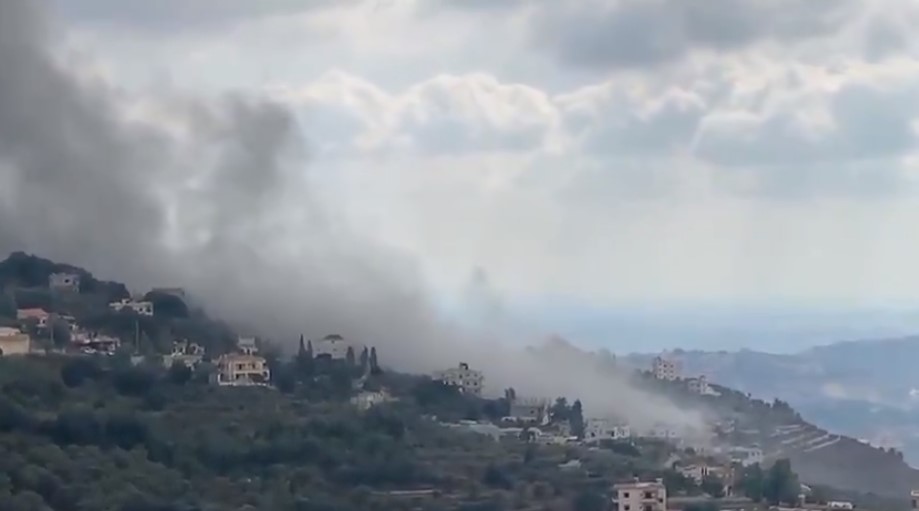
By AARON BOXERMAN22 September 2020, 4:13 pmUpdated at 6:55 pm  4Smoke billows in the Lebanese village of Ain Qana after an unexplained explosion, September 22, 2020. (Twitter screen capture)

A Hezbollah weapons cache exploded in a small town in southern Lebanon on Monday, sending up billowing clouds of black smoke, causing widespread damage and several casualties, according to unconfirmed reports.

While there was no immediate confirmation by officials as to the cause of the explosion in the small town of Ain Qana, an unnamed source told Reuters the site was an arms depot.

UAE-based Al-Hadath, citing security sources, also reported that the explosion took place at a Hezbollah weapons storehouse. Another channel, Lebanon’s MTV, reported several injured.

A Hezbollah official confirmed there was an explosion but declined to give further details. Hezbollah security forces deployed in the area and prevented journalists from investigating on the scene.https://platform.twitter.com/embed/index.html?dnt=true&embedId=twitter-widget-0&frame=false&hideCard=false&hideThread=false&id=1308379892858355712&lang=en&origin=https%3A%2F%2Fwww.timesofisrael.com%2Fexplosion-rattles-hezbollah-stronghold-in-lebanon-casualties-reported%2F&siteScreenName=timesofisrael&theme=light&widgetsVersion=219d021%3A1598982042171&width=550px

Residents said ambulances had carried away several of the wounded, while the National News Agency reported only limited material damage. However, sources in Hezbollah told the Lebanese Broadcasting Corporation International TV news channel that no one was injured in the blast.

Ain Qana is in the hilly Iqleem al-Tuffah region. A prominent Hezbollah tourist site that draws thousands of visitors a year lies on a neighboring hilltop just a ten-minute drive away.

The Lebanese Army said in a statement that its forces were at the scene to conduct an investigation into the cause of the explosion.

Lebanese state media implied that Israel may have been involved in the explosion, but emphasized that the causes “are not known.”

“The explosion that occurred in a house in the town of Ain Qana…coincided with the intensive flight of hostile Israeli military and espionage aircraft, which had not left the airspace of Nabatiyeh and Iqlim al-Tuffah since the morning,” the Lebanese National News Agency reported.

Sources in Hezbollah told LCBI that the explosion was not part of a targeted attack on senior officials in the Lebanese terror group.https://www.youtube.com/embed/BR034Rdkvr4?feature=oembed&showinfo=0&rel=0&modestbranding=1

Every blast in Lebanon since August’s devastating Beirut port explosion has gone viral on social media, with thousands waiting with bated breath to see whether or not a tire fire or gas blaze would turn into the next Lebanese catastrophe. Most Lebanese TV networks gave the explosion in Ein Qana wall-to-wall coverage, with experts and analysis on call to speculate about its source.

Viewers of official Hezbollah TV or one of its affiliates, however, may not have heard of the blast at all until hours later. Official Hezbollah al-Manar TV continued to broadcast reruns about its community projects and features about holy sites in south Lebanon; pro-Hezbollah al-Mayadeen ran a story on Lebanon’s financial crisis instead.

In its nightly news broadcast, an al-Manar newscaster delivered the semi-official Hezbollah line: that a house in Ain Qara had exploded due to unspecified “damages.”

“As usual, the media got up and began theorizing and pontificating and analyzing. They were so exceptional that they even beat the security services to finding out the root cause of the incident,” she said sarcastically.

The Beirut port explosion — which killed over 180 and rendered 300,000 homeless overnight — was caused by ammonium nitrate of unknown provenience. While many corrupt officials allowed the explosive material to remain in the port until the day it unleashed a firestorm in Beirut’s downtown, some evidence suggests that Hezbollah could have been involved in bringing it to Lebanon.

The explosion raised new questions about the placement of Hezbollah weapons caches in civilian areas. Hezbollah has long defended what it considers its right to possess arms as part of its “resistance” to Israel.

“Everyone knows where the weapons are. The issue of these weapons in villages and cities is now an issue of life and death. It is neither justifiable nor acceptable for Hezbollah to consider to store its weapons in such places,” Ali al-Amin, a journalist covering south Lebanon, told UAE-based al-Hadath TV.

Times of Israel staff and agencies contributed to this report.
At UN, Rouhani says next US leader will ‘surrender to the resilience of Iran’

September 23, 2020


Defiant president slams Trump’s new sanctions, implies rebuke for Arab nations warming ties with Israel: ‘We never made a deal over the Holy Quds’

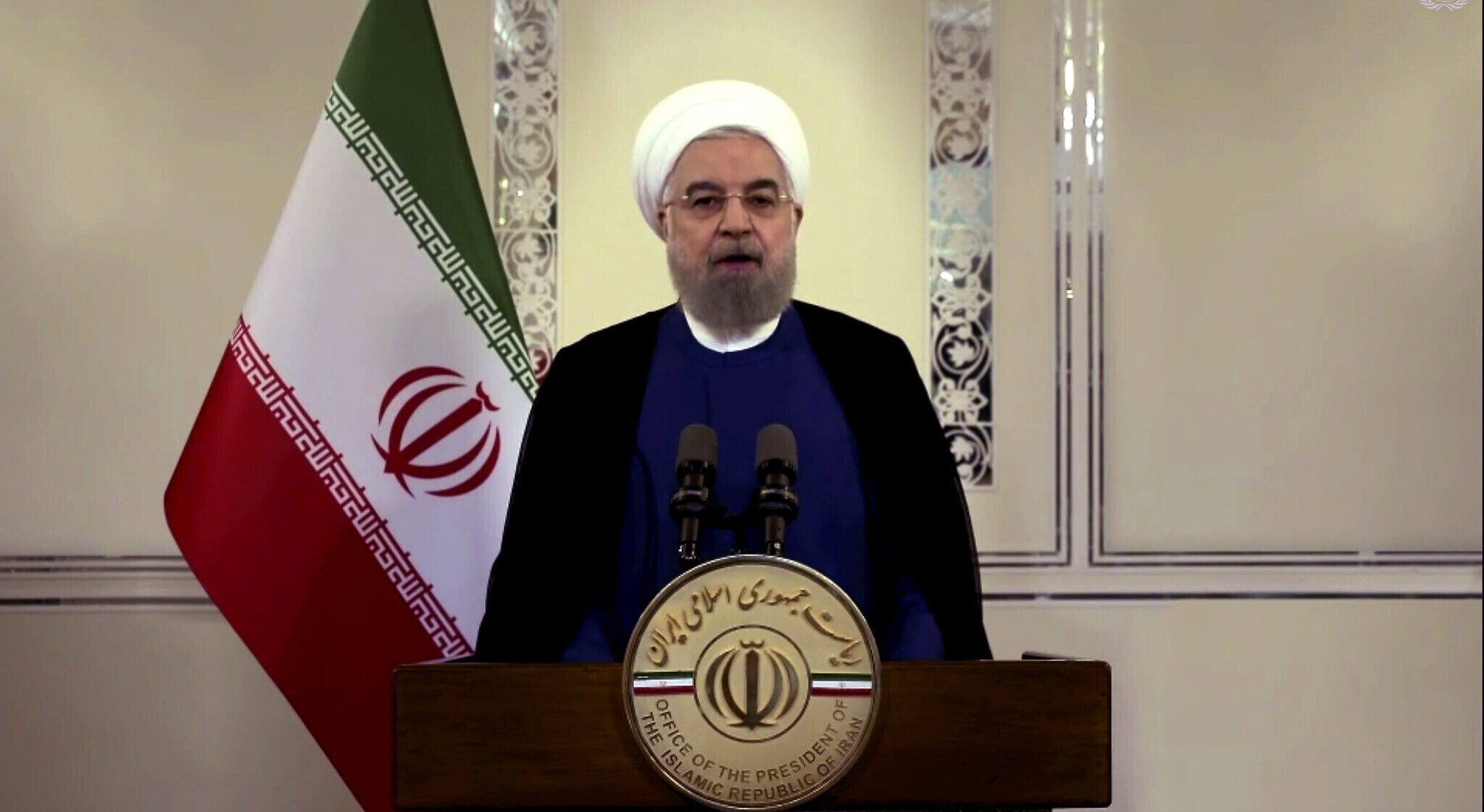
By AGENCIES22 September 2020, 10:43 pm  2Iranian President Hassan Rouhani speaking in a pre-recorded message played during the 75th session of the United Nations General Assembly, at UN headquarters in New York, September 22, 2020. (UNTV via AP)

Iranian President Hassan Rouhani vowed Tuesday that the next US leader must accept Tehran’s demands, ruling out compromise as Donald Trump vies for reelection.

“We are not a bargaining chip in US elections and domestic policy,” Rouhani said in a virtual address to the UN General Assembly. “Any US administration after the upcoming elections will have no choice but to surrender to the resilience of the Iranian nation.”

Tensions have soared between Iran and the United States under Trump, who pulled out of a nuclear accord negotiated by his predecessor Barack Obama and slapped sweeping sanctions on the country.

Joe Biden, Trump’s rival in November 3 elections, staunchly backed the 2015 nuclear deal.

Rouhani delivered a defiant and fiery speech even as his nation grapples with the Middle East’s worst coronavirus outbreak and a weakened economy.

He spoke in a pre-recorded speech to the virtual summit just days after Iran’s currency plunged to its lowest levels ever to the US dollar due to crippling US sanctions imposed by Trump, who pulled the US out of Iran’s nuclear deal with world powers in 2018. The accord had been signed by the Obama administration. The sanctions effectively bar Iran from selling its oil globally.

“The United States can impose neither negotiations nor war on us,” Rouhani said, before adding: “Life is hard under sanctions. However, harder is life without independence.”

Rouhani also compared his country’s plight with that of George Floyd, the Black American who died after a white police officer in Minneapolis pinned him to the ground by pressing a knee into his neck. Floyd’s death sparked nationwide protests in support of Black lives.

Calling it “reminiscent of our own experience,” he said: “We instantly recognize the feet kneeling on the neck as the feet of arrogance on the neck of independent nations.”

Rouhani said Iran “has paid a similar high price” in its quest for freedom and liberation from domination. He insisted his nation “does not deserve sanctions” and described the US as “a terrorist and interventionist outsider” before referring to the 1953 US-backed coup that cemented the control of the shah in Iran, which ultimately pushed the country toward its Islamic Revolution and hostility with the West.

This week, the White House doubled down on its maximum pressure campaign against the Islamic Republic with an executive order to enforce all United Nations sanctions on Iran because Tehran is not complying with the nuclear deal — a move that most of the rest of the world rejects as illegal. Few UN member states believe the US has the legal standing to restore the sanctions because Trump withdrew from the nuclear agreement.

Rouhani accused the US of creating Islamic State, and said US claims that Iran is seeking nuclear weapons were “without any foundation.”

He also hailed Iran’s role in standing “with the people and government of Lebanon against Zionist occupiers, domestic warmongers and foreign plotters” and said it his regime “never ignored occupation, genocide, forced displacement and racism in Palestine.”

In an implied rebuke of Arab countries warming their ties with Israel — including the UAE and Bahrain, which last week signed the Abraham Accords at the White House — he said Iran “never made a deal over the Holy Quds and the fundamental rights of the Palestinian people.”French President Emmanuel Macron at the Elysee Palace in Paris, September 21, 2020. (Michel Euler/AP)

French President Emmanuel Macron said Tuesday that Europe would not compromise with the US over Washington’s move to reactivate sanctions on Iran, warning the snapback could undermine the UN Security Council and increase Middle East tensions.

Macron assailed the “maximum pressure” policy, saying it had failed to curb Tehran’s interference in the region or ensure it would not acquire a nuclear weapon.

“We will not compromise on the activation of a mechanism that the United States is not in a position to activate on its own after leaving the agreement,” Macron told the UN General Assembly’s 75th session by video from Paris.

“This would undermine the unity of the Security Council and the integrity of its decisions, and it would run the risk of further aggravating tensions in the region,” he warned.

In a nod to Washington, Macron said additional frameworks were needed for effectively dealing with the Iranian nuclear program, adding there needed to be a “capacity to complete” the 2015 accord known as the Joint Comprehensive Plan of Action.

These would ensure that “we will provide responses to Iran’s ballistic activity, but also to its destabilization in the region.”

Macron insisted that France, along with its European allies Britain and Germany, would keep up its demand for “full implementation” of the Iran nuclear deal.Screen capture from video shows Iranian supreme leader Ayatollah Ali Khamenei openly weeping as he leads a prayer over the coffin of Gen. Qassem Soleimani, who was killed in Iraq in a US drone strike, in Tehran, Iran, January 6, 2020. (Iran Press TV via AP)

He added that they would “not accept the violations committed by Iran,” which has ramped up its nuclear activity in response to the US withdrawal.

Tensions have run dangerously high this year between Tehran and Washington following a US strike in January that killed Iranian Revolutionary Guard general Qassem Soleimani in Baghdad, prompting Tehran to retaliate with a ballistic missile strike on Iraqi bases housing American troops. The powerful commander was close to Iran’s supreme leader Ayatollah Ali Khamenei, who openly wept at his funeral.

Rouhani mentioned the commander briefly in his speech, referring to him as an “assassinated hero.”

Trump, who faces a stiff reelection battle in November, has ramped up pressure on Iran since taking office and has increased US military presence in the Gulf as a centerpiece of his Mideast foreign policy.

“We are not a bargaining chip in US elections and domestic policy,” Rouhani said.

In his speech earlier Tuesday at the General Assembly, Trump called Iran “the world’s leading state sponsor of terror” and underlined the US killing of Soleimani, boasting, “We withdrew from the terrible Iran nuclear deal and imposed crippling sanctions.”

Planning new sanctions, US said to claim Iran can make nuke in months

September 21, 2020
https://www.timesofisrael.com/planning-new-sanctions-us-said-to-claim-iran-can-make-nuke-in-months/

Officials offers no evidence for assertion that Tehran will have enough material for bomb by year’s end; over 2 dozen individuals and entities linked to arms trade to be penalized

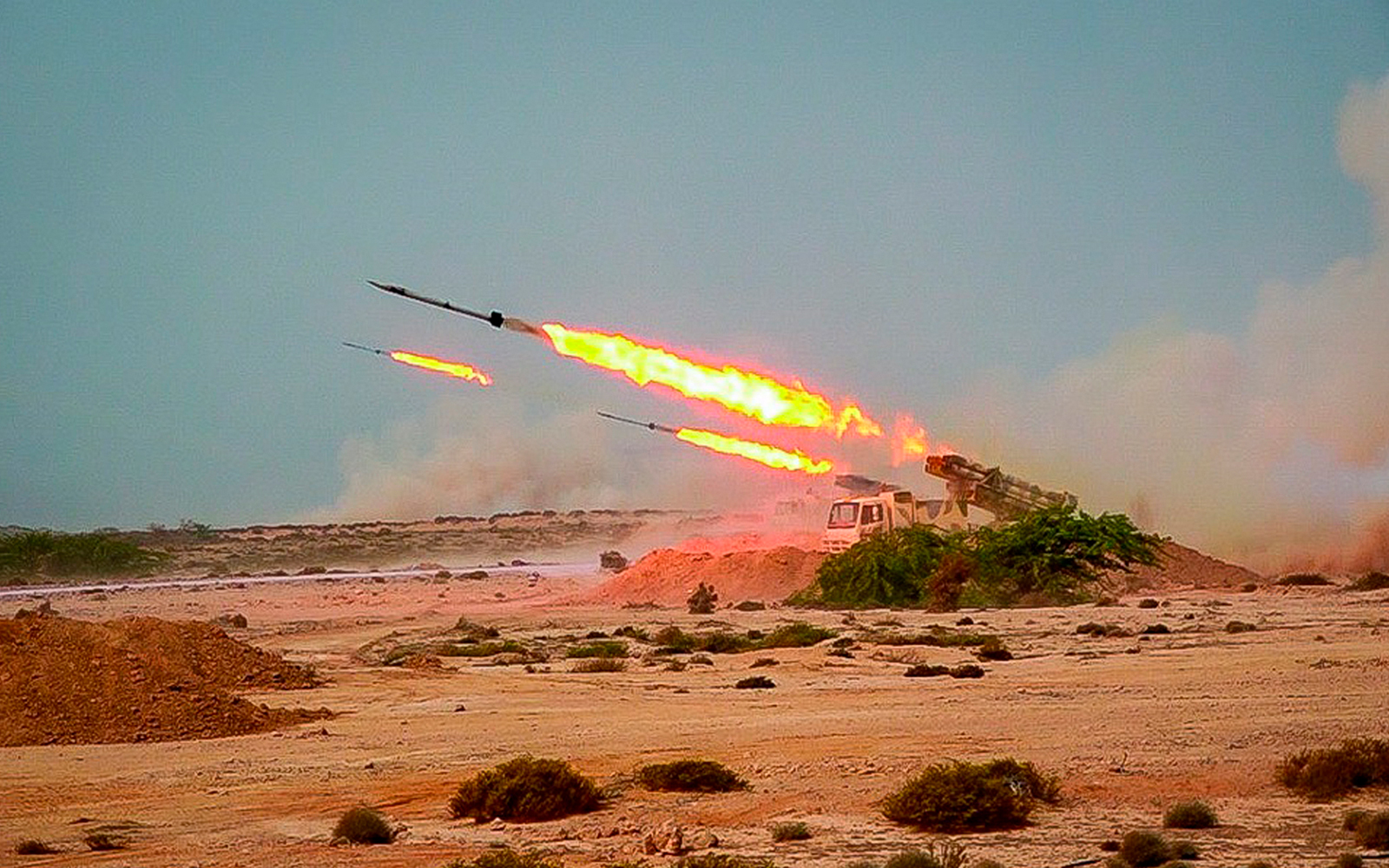
Missiles are fired in an Iranian military exercise by the Islamic Revolutionary Guards Corps, July 28, 2020,. (Sepahnews via AP)

Missiles are fired in an Iranian military exercise bythe Islamic Revolutionary Guards Corps, July 28, 2020,. (Sepahnews via AP)

The US will reportedly place sanctions on more than two dozen people and entities tied to Iran’s nuclear and conventional weapons program, according to a senior US official who claimed the Iranians will have enough fissile material for a nuclear weapon by the end of the year.

Washington has been pushing to reapply international sanctions lifted from Iran under the terms of an unraveling multinational 2015 nuclear agreement, but so far has struggled to find support for the measures at the United Nations.

The US official, who spoke to the Reuters news agency on condition of anonymity, said among those who will be targeted are members of a procurement network supplying dual-use military items for the Iranian missile program and officials in the country’s ballistic missile program.

In addition to the restrictions placed on the targets of the sanctions, the measures will also affect any companies in Europe, Russia, or China that violate the sanctions, Reuters reported.

The sanctions will be announced Monday alongside a US executive order aimed at blocking conventional arms trade with Iran in the wake of the UN’s recent rejection of a US bid to extend an arms embargo on Iran, included in the nuclear deal, that is set to expire on October 18.

“Iran is clearly doing everything it can to keep in existence a virtual turnkey capability to get back into the weaponization business at a moment’s notice should it choose to do so,” said the official.

“Because of Iran’s provocative nuclear escalation, it could have sufficient fissile material for a nuclear weapon by the end of this year,” he said without providing more information. The official said the assessment was based on “the totality” of information available to Washington, including from the UN’s International Atomic Energy Agency”

He also said that Iran and North Korea have resumed their cooperation on long-range missile projects.

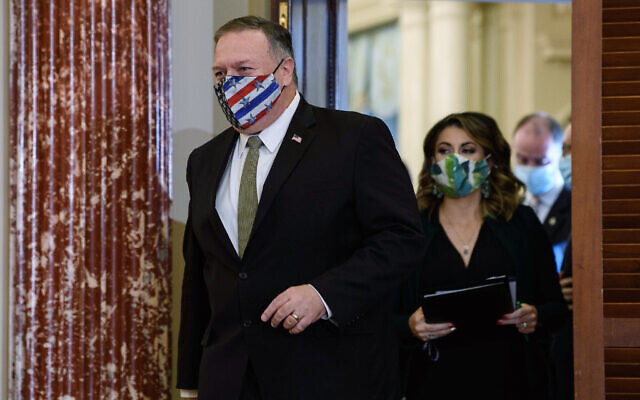
US Secretary of State Mike Pompeo wears a mask as he arrives to hold a press conference at the State Department in Washington, September 16, 2020 in Washington. (Nicholas Kamm/Pool via AP)

A spokesman for Iran’s mission to the UN dismissed the approaching US sanctions as propaganda.

“The US’ ‘maximum pressure’ show, which includes new propaganda measures almost every week, has clearly failed miserably, and announcing new measures will not change this fact,” mission spokesman Alireza Miryousefi told Reuters via email.

“The entire world understands that these are a part of [the] next US election campaign, and they are ignoring the US’ preposterous claims at the UN today. It will only make [the] US more isolated in world affairs,” he said.

The White House declined to comment on the report.

The executive order on arms sales will have a broad definition of conventional weapons to mean any item with military potential, the US official said.

The Reuters report came as UN Secretary-General Antonio Guterres said the United Nations will not support reimposing sanctions on Iran as demanded by the US, until he gets a unlikely green light from the Security Council.

The UN chief said in a letter to the council president obtained Sunday by The Associated Press that “there would appear to be uncertainty” on whether or not US Secretary of State Mike Pompeo triggered the “snapback” mechanism in the Security Council resolution that enshrined the 2015 nuclear deal between Iran and six major powers.

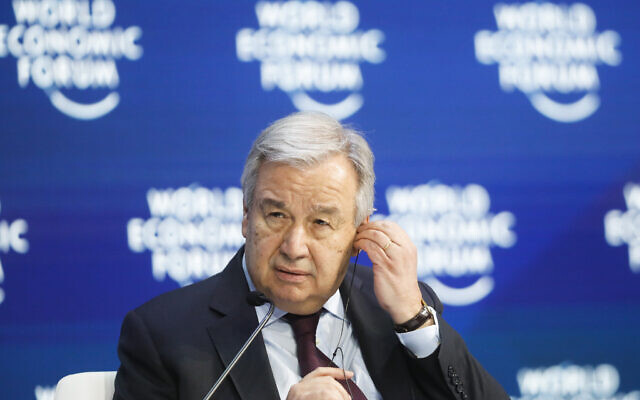
United Nations Secretary-General Antonio Guterres attends a session during the World Economic Forum in Davos, Switzerland, August 25, 2020. (Markus Schreiber/AP)

The Trump administration declared Saturday that all UN sanctions against Iran have been restored, a move most of the rest of the world rejects as illegal and is likely to ignore.

The US announcement is certain to cause controversy during the UN’s annual high-level meetings of the General Assembly starting Monday, which is being held mainly virtually this year because of the COVID-19 pandemic.

On Sunday, Israel’s ambassador to the UN Gilad Erdan sent a letter to Guterres backing the US sanctions announcement and urging “that it is incumbent upon the Secretariat to take all the necessary steps within its purview to ensure the resumption of the effective implementation of the aforementioned resolutions.”

“Iran never renounced its nuclear ambitions or malign activity,” Erdan wrote and claimed that Iran had used relief from the original pre-nuclear deal sanctions “to fund, arm, and train its proxies throughout the Middle East” while “sewing extreme chaos and destruction, and upending the entire region.”

The UN, Erdan wrote, “should apply maximum pressure and take swift action to stop Iran in its tracks. It must ensure, inter alia, that the newly re-imposed [US] sanctions are upheld and enforced.”

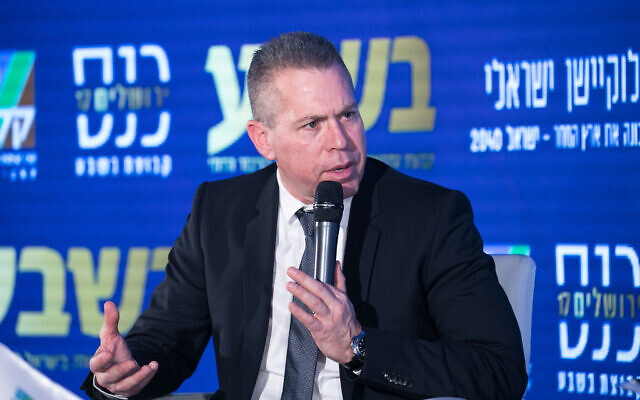
Then public security minister Gilad Erdan speaks at the 17th annual Jerusalem Conference of the ‘Besheva’ group, on February 24, 2020. (Olivier Fitoussi/Flash90)

The US announcement on Saturday came 30 days after Pompeo notified the council that the administration was triggering “snapback” because Iran was in “significant non-performance” with its obligations under the accord, known as the Joint Comprehensive Plan of Action, or JCPOA.

But the overwhelming majority of members in the 15-nation council call the US action illegal because US President Donald Trump pulled the United States out of the JCPOA deal in 2018.

They point to Security Council Resolution 2231, which endorsed the nuclear agreement. It states that “a JCPOA participant state” can trigger the “snapback” mechanism. The US insists that as an original participant it has the legal right, even though it ceased participating.

Guterres noted in the letter that “the Security Council has taken no action subsequent to the receipt of the letter of the US secretary of state, neither have any of its members or its president.”

He said the majority of council members have written to the council president “to the effect that the letter did not constitute a notification” that “snapback” was triggered. And he said the presidents of the council for August and September “have indicated that they were not in a position to take any action in regard to this matter.”

Therefore, Guterres said: “It is not for the secretary-general to proceed as if no such uncertainty exists.”

The UN Secretariat, which Guterres heads, provides support to the Security Council in implementing sanctions, including establishing committees and panels of experts to monitor their implementation along with websites on the nature of sanctions and lists of those on sanctions blacklists.

Guterres said the UN won’t take any action “pending clarification by the Security Council” on whether or not sanctions that have been lifted should be reimposed.

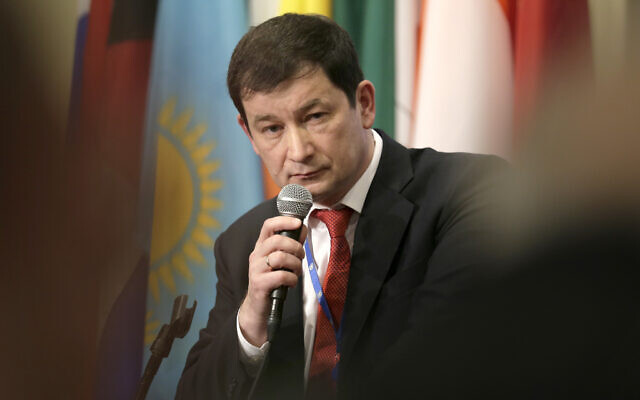
Russian Deputy Ambassador to the United Nations Dmitry Polyanskiy speaks to reporters after a security council meeting at United Nations headquarters, November 26, 2018. (Seth Wenig/AP)

Under the “snapback” provision, UN sanctions eased or lifted by the nuclear deal are re-imposed and must be enforced by UN member states. Those would include hitting Iran with penalties for uranium enrichment to any level, ballistic missile activity and buying or selling conventional weapons.

Those bans were either removed or set to expire under the terms of the 2015 deal in which Iran was granted billions of dollars in sanctions relief in return for curbs on its nuclear program.

China and Russia have been particularly adamant in rejecting the US position, but US allies have not been shy either.

In a letter sent Friday to the Security Council president, Britain, France and Germany — the three European participants that remain committed to the agreement — said the US announcement “is incapable of having legal effect,” so it cannot reimpose sanctions on Iran.

Russia’s deputy ambassador to the UN, Dmitry Polyanskiy, said the US had only isolated itself.

“It’s very painful to see how a great country humiliates itself like this, opposes in its obstinate delirium other members of UN Security Council,” he wrote on Twitter.

European Union foreign policy chief Josep Borrell, who coordinates the JCPOA Joint Commission, reiterated that the US cannot be considered “a JCPOA participant state and cannot initiate the process of reinstating UN sanctions.” Consequently, he said, the sanctions remain lifted.

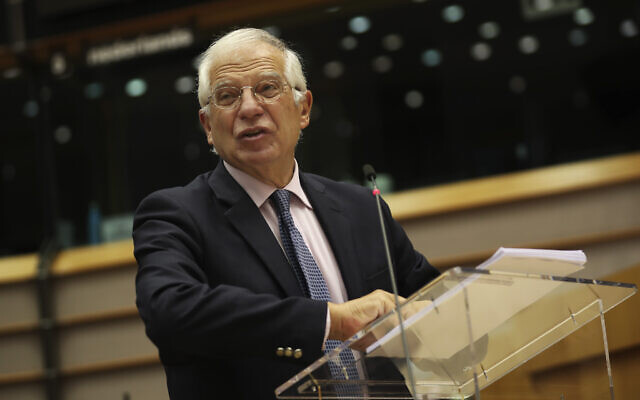
European Union foreign policy chief Josep Borrell addresses European lawmakers at the European Parliament in Brussels, September 15, 2020. (Francisco Seco/AP)

China’s UN Mission tweeted: “US unilateral announcement on the return of UN sanctions on IRAN is devoid of any legal, political or practical effect. … It’s time to end the political drama by the US.”

In its own letter to the Security Council on Saturday, Iran said the US move “is null and void, has no legal standing and effect and is thus completely unacceptable.”

It remains unclear how the administration will respond to being ignored, particularly by its European allies, which have pledged to keep the nuclear deal alive. A wholesale rejection of the US position could push the administration, which has already withdrawn from multiple UN agencies, organizations and treaties, further away from the international community.

Iran’s currency hits new record low against the dollar | The Times of Israel

September 14, 2020

The rial has seen its value fall by 30 percent since June amid severe US sanctions By AP 12 September 2020, 4:12 pm 0 People withraw money from an ATM in Tehran’s grand bazaar on November 3, 2018. (ATTA KENARE / AFP) TEHRAN, Iran — Iran’s currency on Saturday dropped to its lowest value ever against the dollar, and has seen its value fall by 30 percent since June amid severe US sanctions imposed on Tehran. Money exchange shops traded the Iranian rial 262,000 for a dollar. The rial had traded at 256,000 to $1 on Thursday, and markets were closed Friday, the start of the weekend in Iran. The rial has tumbled from a rate of 200,000 in late June. Iran’s currency was at 32,000 rials to the dollar at the time of Tehran’s 2015 nuclear deal with world powers. The currency unexpectedly rallied for some time after US President Donald Trump’s decision more than two years ago to withdraw the US from the nuclear deal and reimpose crippling trade sanctions on Iran. The sanctions have caused Iran’s oil exports, the country’s main source of income, to fall sharply. On Friday, the head of Iran’s central bank Abdolnasser Hemmati said the government was trying its best to control the situation in the currency market. Iranian officials for months have warned exporters to bring their foreign earnings home from abroad or face having their export licenses revoked, and the central bank has warned it would publish the names of violators. In June, the central bank reported that Iranian companies export more than $40 billion in non-oil products per year, and officials say some 50% of that remains abroad.

After UAE and Bahrain deals, Trump said aiming for direct Israel-Morocco flights | The Times of Israel

September 14, 2020


Rabat and Jerusalem have no formal relations, but Israeli tourists are allowed into the country, which is home to the largest Jewish community in the Arab world

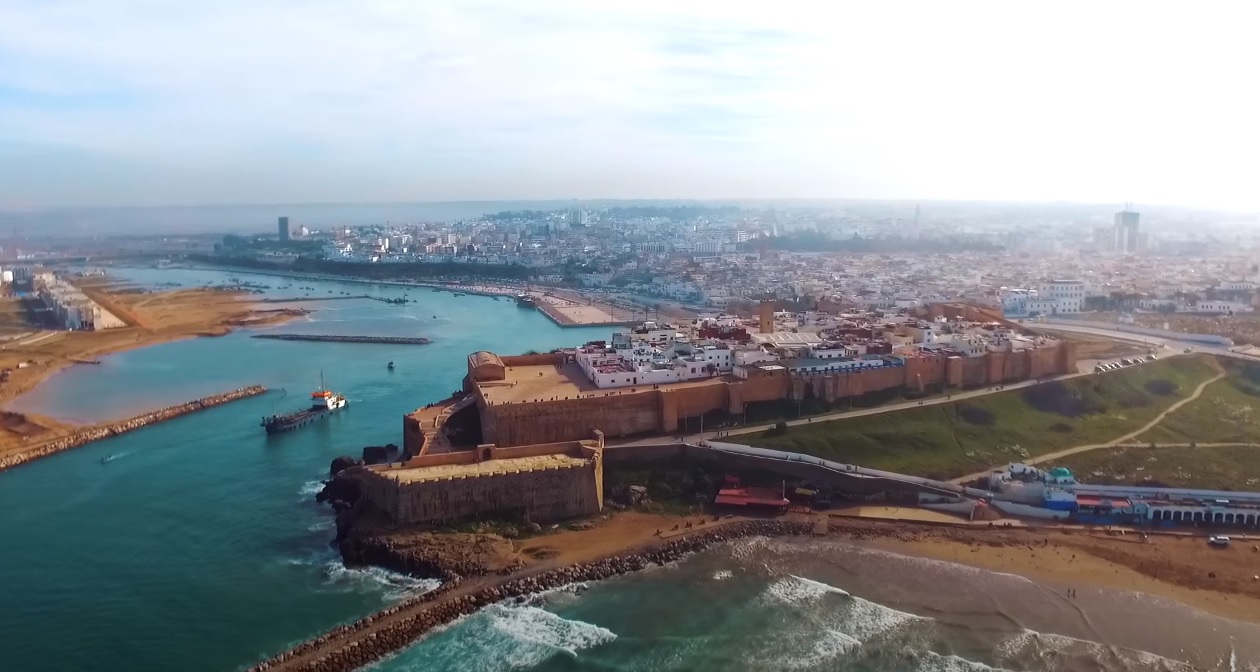
By TOI STAFF12 September 2020, 11:35 pm  5A view of Rabbat, Morocco (YouTube screenshot)

US President Donald Trump is looking toward following up the landmark normalization deals between Israel and the United Arab Emirates and Bahrain with the introduction of direct flights between Israel and Morocco, Channel 12 news reported Saturday.

Morocco is considered an ally of the United States, and has long maintained informal but close intelligence ties with Israel.

Though the countries have no formal relations, Morocco has hosted Israeli leaders, and Israelis are allowed to visit there. Some 3,000 Jews live in Morocco, a fraction of the number from before the 1948 creation of Israel, but still the largest community in the Arab world.

The unsourced TV report said efforts to reach a breakthrough on Israel-Morocco ties some time ago had failed due to unspecified reasons, but the US was hoping the more limited gesture of direct flights was achievable.

The television report also said Washington was continuing to push for Oman and Sudan to forge diplomatic ties with Israel, as part of an effort to rack up as many accomplishments on the global stage as possible before the November 3 elections.

Morocco’s Prime Minister Saad-Eddine El Othmani delivers a speech in Marrakech, Morocco, January 30, 2018. (AP/Mosa’ab Elshamy)

Last month Moroccan Prime Minister Saad-Eddine El Othmani said Rabat would not normalize relations with Israel. But days later he appeared to walk those statements back, saying his comments in opposition to warming ties were made in his capacity as leader of the Islamist PJD party, not as prime minister.

El Othmani added that he had just been reiterating a long-held position of his party. He did not comment further on the matter.

In August, quoting unnamed US officials, the Kan public broadcaster said Morocco was seen as a likely candidate to normalize ties as it already has tourism and trade ties with Israel. The report also cited the North African country’s protection of its small Jewish community.

Establishing formal diplomatic ties with Israel could also improve Morocco’s relations with the US. The report said that in exchange for doing so, Rabat was seeking American recognition of its sovereignty over the disputed Western Sahara territory.

Morocco occupied large swaths of the Western Sahara in 1975 as Spain withdrew from the area and later annexed the territories in a move not recognized internationally.

President Trump Delivers Remarks on the Historic Bahrain Israel Peace Deal – YouTube

September 12, 2020

Iran: Bahrain partner to Israel’s ‘crimes’ through ‘shameful’ normalization deal

September 12, 2020
https://www.timesofisrael.com/iran-bahrain-partner-to-israels-crimes-through-shameful-normalization-deal/

Tehran says ‘Declaration of Peace’ between Israel and Shiite-majority Kingdom, ‘sacrificed the Palestinian cause at the altar of American elections’

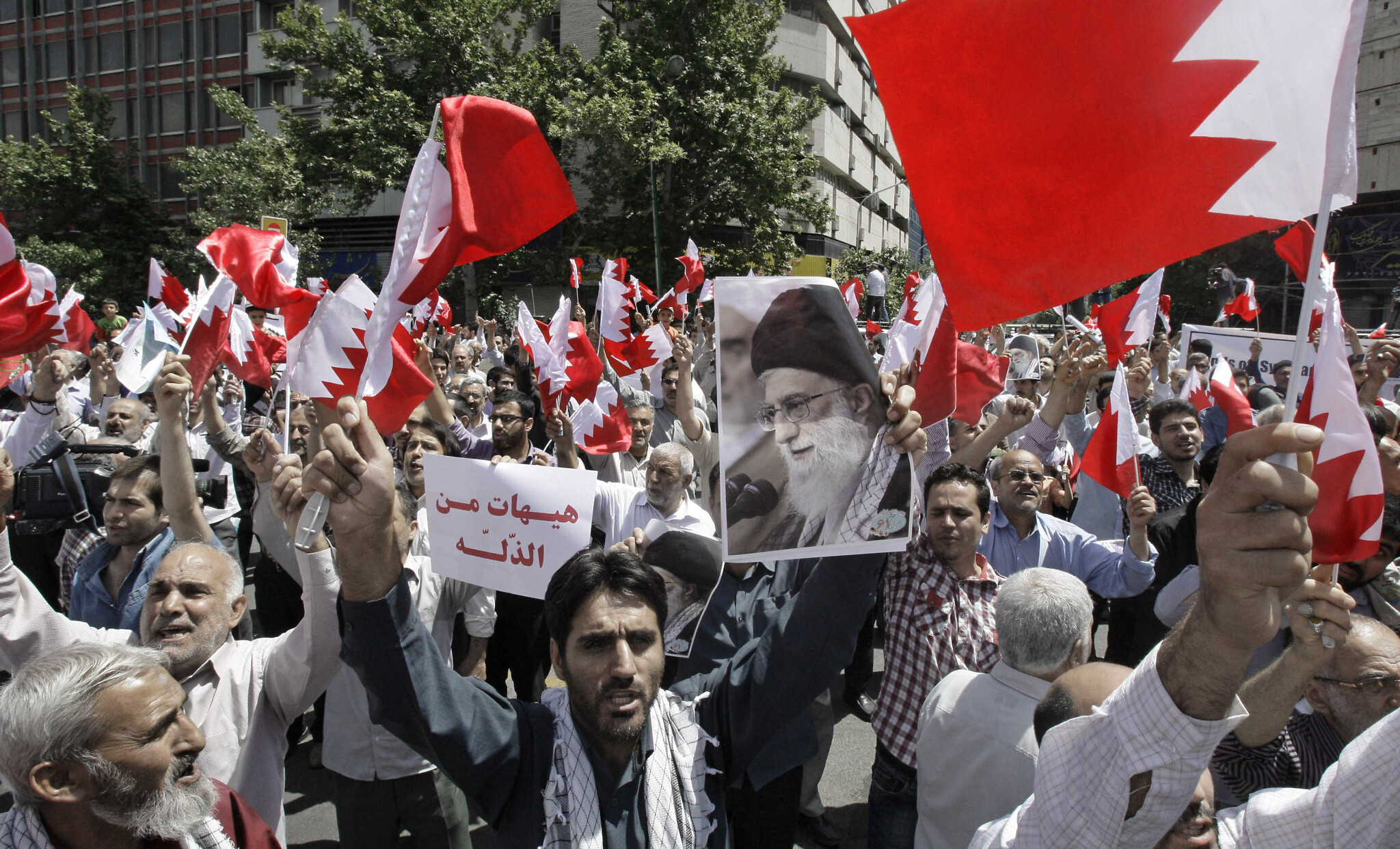
By TOI STAFFToday, 9:26 am  0Iranians wave Bahraini flags as they chant slogans during a demonstration in Tehran, Iran, May 18, 2012 (AP Photo/Vahid Salemi)

Iran said Saturday that Bahrain is now partner to the “crimes” of Israel, after the announcement of a deal to normalize relations between Jerusalem and Manama.

“The rulers of Bahrain will from now on be partners to the crimes of the Zionist regime as a constant threat to the security of the region and the world of Islam,” the foreign ministry said in a statement following the announcement of the agreement.

Iran accused its arch foe Israel of “decades of violence, slaughter, war, terror and bloodshed in oppressed Palestine and the region.”

Iran said that through this “shameful” deal, Bahrain has “sacrificed the Palestinian cause at the altar of American elections.”

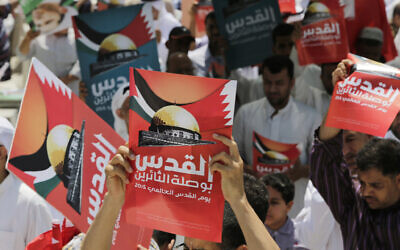
Bahraini protesters hold up placards reading, ‘Jerusalem is the rebels’ compass,’ in support of Palestinians and images of prominent jailed opposition leader Sheikh Ali Salman in Diraz, Bahrain, during a Jerusalem Day rally after Friday prayers, July 10, 2015 (AP Photo/Hasan Jamali)

Its “result will undoubtedly be growing anger and the lasting hatred of the oppressed people of Palestine, Muslims and the free nations of the world,” the Iranian Foreign Ministry said.

The Friday announcement by US President Donald Trump made Bahrain the second Arab country in a month, after the United Arab Emirates, to normalize ties with Israel under US sponsorship.

Iran’s Supreme Leader Ayatollah Ali Khamenei said earlier this month that the UAE had “betrayed” the Muslim world and that he hoped they would “soon wake up and compensate for what they have done.”

Bahrain is acutely aware of threats posed by Iran — the Kingdom has a majority Shiite population, despite being ruled since 1783 by the Sunni Al Khalifa family.

The ruling elites are firmly allied with Saudi Arabia in its rivalry with Shiite Iran, even as the Bahrain’s Shiites have familial, linguistic and political ties with Tehran going back decades.

A Bahraini protester carries a poster with the image of Iran’s late leader Ayatollah Khomeini that reads beneath it: ‘Jerusalem international day is the vulnerable people’s day’ as others wave Palestinian and national flags during a march in the western Shiite village of Malkiya, Bahrain, on Aug. 2, 2013 (AP Photo/Hasan Jamali)

Iran under Shah Mohammad Reza Pahlavi had pushed to take over Bahrain after British protection ended, though Bahrainis in 1970 overwhelmingly supported becoming an independent nation and the UN Security Council unanimously backed that.

Since Iran’s 1979 Islamic Revolution, Bahrain’s rulers have blamed Iran for arming militants on the island and stirring unrest. Iran denies the accusations.

Bahrain’s Shiite majority has accused the government of treating them like second-class citizens. The Shiites joined pro-democracy activists in demanding more political freedoms in 2011, as Arab Spring protests swept across the wider Middle East.

Saudi and Emirati troops ultimately helped violently put down the demonstrations

.

Bahraini anti-government protesters hold a banner with picture of Saudi king Salman, reading in Arabic, ‘We refuse Saudi occupation to Bahrain. Your occupation is under our feet,’ during clashes in Daih, Bahrain, March 14, 2016 .(AP Photo/Hasan Jamali)

Bahrain, alongside the UAE, downgraded its relations with Iran in 2016 amid rising tensions between Saudi Arabia and the Islamic Republic.

Tehran-Riyadh relations deteriorated further last year following a series of attacks on tankers in the Gulf, which Washington blamed on Tehran despite Iranian denials.

Saudi Arabia and Iran take opposing sides in regional conflicts from Syria to Yemen.

Iran’s Saturday announcement came after a joint statement released by the White House a day earlier said Bahrain’s King Hamad bin Salman al-Khalifa spoke earlier in the day with Prime Minister Benjamin Netanyahu “and agreed to the establishment of full diplomatic relations between Israel and the Kingdom of Bahrain.”

Israel and the UAE announced they were normalizing relations on August 13, and a signing ceremony for their accord is being held at the White House on September 15 — Bahrain will now join that ceremony, with its foreign minister Abdullatif Al Zayani and Netanyahu signing “a historic Declaration of Peace,” the joint statement said.US President Donald Trump holds a bilateral meeting with Bahrain’s King Hamad bin Isa Al Khalifa, Sunday, May 21, 2017, in Riyadh. (AP Photo/Evan Vucci)

The joint statement specified that the parties would continue their efforts to achieve a “just, comprehensive and enduring resolution to the Israeli-Palestinian conflict, to enable the Palestinian people to reach their full potential.”

Nonetheless, the accord constitutes another major blow to the Palestinian leader and Palestinian Authority President Mahmoud Abbas, who had condemned the UAE-Israel deal as despicable and a betrayal, and sought in vain to have the Arab League condemn it earlier this week.

The kingdom of Bahrain, a tiny island nation close to the UAE and Saudi Arabia, had been expected by many to be the next country to establish relations with Israel, as it has long made public overtures to the Jewish state. It hosted the first major gathering of the Trump administration’s peace effort, a Peace to Prosperity workshop, in Manama in June 2019. Earlier this month, Bahrain announced that it was opening its airspace to Israeli flights.This combination of pictures created on September 11, 2020 shows a Bahraini man waving a national flag (L) in the capital Manama on March 22, 2011, and an Israeli man holding his country’s national flag on January 24, 2017. (JOSEPH EID and JACK GUEZ / AFP)

In the weeks since the UAE normalization deal was announced on August 13, US and Israeli officials have said other Arab states will follow the Emirates’ lead and normalize ties with Israel, with speculation also focusing on Oman and Sudan.

Trump on Thursday claimed that if he wins another presidential term in November, both Iran and the Palestinians will return to the negotiation table.

“If we win the election, Iran will come and sign a deal with us very rapidly. Within the first, I would say week, but let’s give ourselves a month because their GDP went down [by] 25% [as a result of US-led sanctions], which is like an unheard of number and they’d like to get back to having a successful country again,” Trump said.

“And I think… the Palestinians will get back into the fold,” the president continued, admitting that he was “frankly surprised” that Ramallah has continued to boycott his administration since Washington recognized Jerusalem as Israel’s capital in 2017.

However, he said his administration’s decision to withhold $750 million dollars in annual aid to the Palestinian Authority “is the best way… to bring [the sides] together.”

Jacob Magid, Raphael Ahren and Agencies contributed to this report.
Paul Simon at Ground Zero- Sounds of Silence – Hebrew Subtitles

September 11, 2020

Trump Nominated For The Nobel Peace Prize Over Israel Peace Deal, Announces Iraq Troop Withdrawal

September 10, 2020

Serbia to move embassy to Jerusalem; mostly Muslim Kosovo to recognize Israel

September 6, 2020
https://www.timesofisrael.com/serbia-to-move-embassy-to-jerusalem-mostly-muslim-kosovo-to-recognize-israel/
Gestures to Israel come as part of US-brokered agreement between Balkan nations signed at White House; Israel to establish diplomatic relations with Kosovo
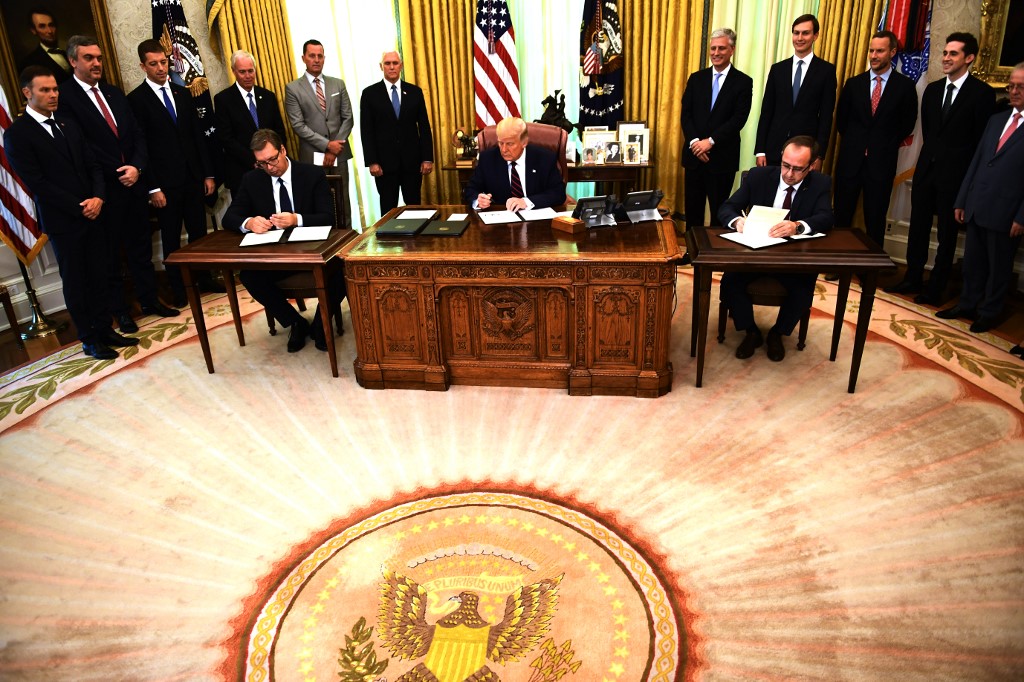
US President Donald Trump signs a document as Kosovar Prime Minister Avdullah Hoti (R) and Serbian President Aleksandar Vucic (L)  sign an agreement on opening economic relations, in the Oval Office of the White House in Washington, DC, on September 4, 2020. (Photo by Brendan Smialowski / AFP)

US President Donald Trump signs a document as Kosovar Prime Minister Avdullah Hoti (R) and Serbian President Aleksandar Vucic (L) sign an agreement on opening economic relations, in the Oval Office of the White House in Washington, DC, on September 4, 2020. (Photo by Brendan Smialowski / AFP)

WASHINGTON  — Serbia announced Friday that it would move its embassy to Jerusalem, while Muslim majority Kosovo is to recognize Israel. The moves come as part of US-brokered discussions to normalize economic ties between Belgrade and Pristina.

Prime Minister Benjamin Netanyahu hailed the moves and said Israel would establish diplomatic relations with Kosovo.

After two days of meetings with Trump administration officials, Serbian President Aleksandar Vucic and Kosovo’s Prime Minister Avdullah Hoti agreed to cooperate on a range of economic fronts to attract investment and create jobs. The White House announcement provided US President Donald Trump with a diplomatic win ahead of the November presidential election and furthers his administration’s push to improve Israel’s international standing.

“Truly, it is historic,” Trump said, standing alongside the two leaders in the Oval Office. “I look forward to going to both countries in the not too distant future.”

Serbia’s decision to move its embassy from Tel Aviv to Jerusalem is a nod to both Israel and the United States. The Trump administration recognized Jerusalem as Israel’s capital in late 2017 and moved the US embassy there in May 2018.

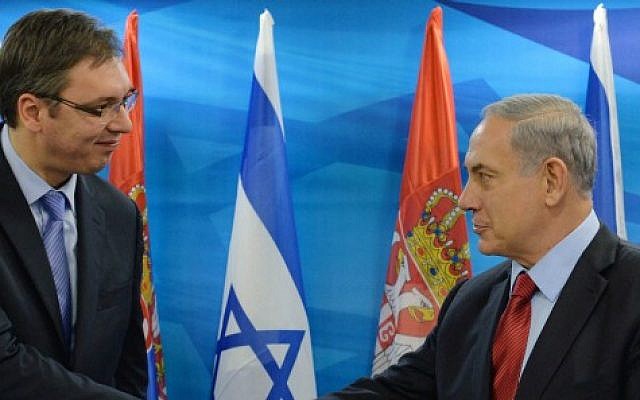
Prime Minister Benjamin Netanyahu (R) meets with Serbian Prime Minister Aleksandar Vucic in PM Netanyahu’s office in Jerusalem. December 1, 2014. (Kobi Gideon/GPO)

The administration has encouraged other countries to do the same but has been widely criticized by the Palestinians and many in Europe because the Israeli-Palestinian conflict remains unresolved. Kosovo, a predominantly Muslim country, has never before recognized Israel nor has Israel recognized Kosovo.

After the announcement Netanyahu thanked Trump for his role in continuing to further Israel’s diplomatic standing.

“I thank my friend President Vucic of Serbia for his decision to recognize Jerusalem as Israel’s capital and move their embassy,” Netanyahu said. ” I also want to thank my friend Donald Trump for his contribution to this achievement.”

A statement from Netanyahu’s office hailed Serbia for being the first European nation to agree to move its embassy and said efforts continued to convince other European nations to also do so.

Netanyahu said that following discussions held in recent days among the Foreign Ministry, National Security Council and others, it was decided that Israel will establish diplomatic relations with Kosovo.

The gestures to Israel are part of the Trump administration’s push to improve the Jewish state’s international standing, which has included forceful denunciations of criticism of Israel at the United Nations and in other international venues. Most recently, the administration brokered a deal for Israel and the United Arab Emirates to normalize relations. That was followed by the first commercial flight between Israel and the UAE, with neighboring Saudi Arabia and Bahrain to allow such flights to pass through their airspace. Additional Arab states, including Sudan, Bahrain and Oman, have been identified as countries that may soon also normalize relations with Israel.

UAE delegates wave to the departing El Al planeat the end of the Israel-UAE normalization talks, with the US, in Abu Dhabi, September 1, 2020 (El Al spokesperson’s office)

Kosovo’s Parliament declared independence from Serbia in 2008, nine years after NATO conducted a 78-day airstrike campaign against Serbia to stop a bloody crackdown against ethnic Albanians in Kosovo.

Most Western nations have recognized Kosovo’s independence, but Serbia and its allies Russia and China have not. The ongoing deadlock and Serbia’s unwillingness to recognize Kosovo have kept tensions simmering and prevented full stabilization of the Balkan region after the bloody wars in the 1990s.

“We cannot accept any document which includes Kosovo’s independence, and that’s full stop,” Vucic told reporters after meetings Thursday at the White House.

Serbia and Kosovo have already OK’d air, rail and transit agreements, including one that would clear the way for the first flight between Pristina and Belgrade in 21 years. The new agreement comprises many more areas of economic cooperation. Business leaders in both nations have been frustrated and have been talking among themselves about ways to foster investment outside of the ongoing political talks brokered by the European Union.

On Monday, Vucic and Hoti are scheduled to go to Brussels to hold talks under the auspices of the EU’s foreign policy chief Josep Borrell and special envoy for the Belgrade-Pristina dialogue Miroslav Lajcak.

The EU has mediated the talks between the two former wartime foes for more than a decade, and the parallel US effort, although focused on economic development, has not been fully embraced by some EU officials.

The White House summit was originally scheduled for June, but it was canceled after Kosovo President Hashim Thaci, who was to lead the Kosovo delegation, was indicted for war crimes by an international court.