Author Archive

Breaking Bad in Iran, Biden and Beyond

December 5, 2020

NATIONAL SECURITY: MIDDLE EAST / MARK ALEXANDER / DEC. 2, 2020

More “shock and awe” against Islamic tyrants, brought to you by, somebody…PRINTLISTEN

“There is a rank due to the United States, among nations, which will be withheld, if not absolutely lost, by the reputation of weakness. If we desire to avoid insult, we must be able to repel it; if we desire to secure peace, one of the most powerful instruments of our rising prosperity, it must be known that we are at all times ready for war.” —George Washington (1793)

If you’re under the age of 45, or have family members who are, you may be familiar with a TV series called “Breaking Bad.” I rarely had the inclination to tune in, both because I didn’t have the time and because in the few episodes I did watch with others, there was nothing remotely redeeming about any of the characters — just a predictable progression toward darkness. (Apparently, that darkness and lack of redemption were the art of the series.)

I did, however, watch the final episode, in which — spoiler alert — the main character, Walter White, dying of cancer, takes revenge on those who betrayed his illicit drug business. (See what I mean about “dark”?) In that episode, Walt rigs a 7.62×51mm M60 machine gun to a remote-controlled turret in the trunk of his car. Once activated, the weapon takes out all the “badder” of the bad guys.

After that episode, I observed that, logistically, the operating mechanics of the M60 remote were completely unrealistic.

It might be that my occasional editorializing about the historical or technical accuracy of theatrics explains why some people resist asking me to watch such programs with them — with apologies to my wife.

And that observation about remote-fired weapons brings me to the events of last week…

Utilizing a method that sent a bigger message than the target, another of Iran’s deadliest actors was terminated last Friday. The target was Mohsen Fakhrizadeh, described by Iran’s Supreme Leader Ayatollah Ali Khamenei as “the country’s prominent and distinguished nuclear and defensive scientist.” But this rodent’s extermination was very different than the precision strike ordered by President Donald Trump a year ago, which took out Iran’s elite terrorist Corps-Quds leader, Gen. Qasem Soleimani, and his Iraqi counterpart, paramilitary commander Abu Mahdi al-Mohandes.

It’s one thing to launch a precision missile against a target — something that could not have also been arranged with Fakhrizadeh because it would have betrayed the perpetrator — but quite another to use, as reliable sources report in this case, a remote-control machine gun mounted in the back of a pickup truck on Iranian soil.

To fully appreciate the “shock and awe” message somebody sent to Iran’s Islamist dictators — the message that they are no longer safe anytime or anywhere — political analyst Dennis Prager notes: “To appreciate how remarkable this operation was, consider this: Fakhrizadeh traveled a different route to work every day, traveled in a bulletproof car and was accompanied by three personnel carriers that transported heavily armed bodyguards. The assassins had cut off electricity to the area surrounding the assassination and disabled all video cameras in the area. They exploded a car next to Fakhrizadeh’s car and had a remote-control machine gun fire at Fakhrizadeh. The entire operation took three minutes.”

The vehicle and weapons system self-destructed after the attack.

Fakhrizadeh was the fifth Iranian nuclear scientist killed since 2007, and the most direct beneficiary of those deaths is, of course, Israel. Israelis are very good at leaving no trace, no fingerprints, but there is little doubt that they had a hand in these attacks.

Israel rightfully has a “zero tolerance” policy on regional Islamic conventional and nuclear threats to its homeland.

Sometimes that hand is overt. Operation Opera in June of 1981 — the Israeli air strike against an Iraqi nuclear reactor under construction southeast of Baghdad — destroyed an Osiris-class reactor provided to then-dictator Saddam Hussein by France. Always the French…

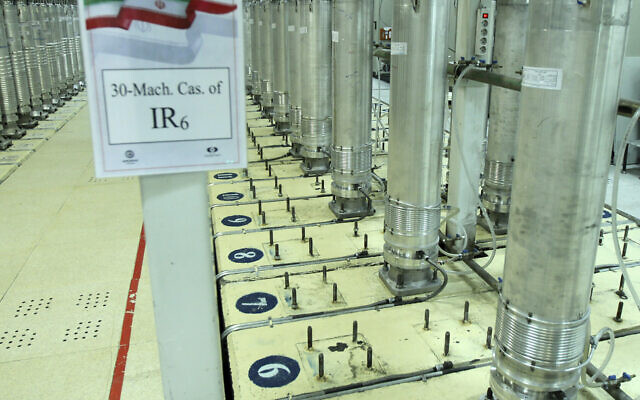
Other times, however, the hand is covert, the work of Israel’s Mossad intelligence agency in conjunction with opposition parties on the ground. The most recent attack on Iran’s nuclear weapons capability was the considerable damage in July to the Natanz nuclear facility, which produces advanced centrifuges for the weaponization of uranium. That explosion “coincided” with other explosions at different facilities.

By way of disclaimer in the latest of what The Washington Post described as “a series of unusual explosions,” Israel’s defense minister, Benny Gantz, insisted: “Not every incident that happens in Iran is necessarily connected to us. All those systems are complex, they have very high safety constraints and I’m not sure [the Iranians] always know how to maintain them.”

OK (wink and nod), it must’ve been simultaneous malfunctions at different locations!

The latest attacks have been directly against Iranian targets rather than Islamic terror proxies like Hezbollah. Clearly, Israel is getting in a few last shots before President Trump leaves office.

Predictably, Barack Obama’s former CIA director, John Brennan, the thug leader of the deep-state coup to take down Trump, condemned the assassination as “a criminal act” and “highly reckless,” labelling it as “murder” and “state-sponsored terrorism.”

For context, Trump has achieved an astounding number of Middle East policy successes, the latest being the historic brokered Saudi/Israeli meeting. Trump’s impressive foreign policy record in the region has earned him three Nobel Prize nominations. (I note “earned” because, unlike the ludicrous Nobel trophy given to Barack Obama for having merely shown up, Trump has actually accomplished substantial objectives in the region and globally.)

These Middle East successes, though, don’t overshadow his policies to contain the greatest external existential threat to the future of American Liberty, Xi Jinping’s oppressive Red Chinese regime, the originator of the devastating CV19 pandemic and puppeteer controller of dictator Kim Jong-un’s North Korea. (Here I note “external” because Joe BidenKamala Harris, and their socialist Democrat Party represent the greatest internal threat to the freedom of American citizens.)

The question for Israel now is this: Will a Biden-Harris regime revert to the Obama-Clinton-Kerry model of foreign policy malfeasance? Obama’s greatest “achievements” in the Middle East were the Benghazi cover-up, appeasing Iran with a catastrophic “nuke deal” brokered by John Kerry, (which Trump immediately and rightly canned), pandering to Syria, empowering the Islamic State, and leaving an epic humanitarian crisis of displaced Syrian refugees on the Jordanian border.

Will Biden, as Obama did before him, embrace Iran and the other bad actors in the region?

Secretary of State Mike Pompeo, the most effective SecState in decades, said after his meeting with Biden-Harris policy officials: “Iran is more isolated than it has ever been, [and] the Gulf states are now working together in ways that literally four years ago I don’t think anybody would have believed was possible. … So whether it’s in the Gulf states or Israel, I think they have come to appreciate that the policies that this administration put in place are the ones that are best for them, for their relationship and partnership with the United States of America.”

That was Pompeo’s effort to make nice, but he knows that Biden will likely follow the “Obama plan” in the region and, if so, Israel’s U.S. support will once again plummet, and the region’s Islamist tyrants will once again gain strength.


P.S. Patriots, the most cost-effective investment you can make to ensure the future of Liberty is to support The Patriot Post. We’re the Web’s most influential grassroots journal for promoting freedom and challenging the dominant Leftmedia narrative. We rely 100% on the voluntary financial support of Patriots like you, so please support our Year-End Campaign today. Thank you.

Semper Vigilans Fortis Paratus et Fidelis
Pro Deo et Libertate — 1776


Please join us in prayer for our nation’s Military Patriots standing in harm’s way in defense of Liberty, for their families, and for our nation’s First Responders. We also ask prayer for your Patriot team, and our mission to, first and foremost, support and defend our Republic’s Founding Principles of Liberty, and to ignite the fires of freedom in the hearts and minds of our countrymen.
Why Mossad’s Yossi Cohen, shadow warrior against Iran, is PM’s chosen successor

December 2, 2020

Iran’s nuclear weapons chief is a trusted Netanyahu loyalist, and his preferred choice to steer Israel through the coming regional chaos

By HAVIV RETTIG GURToday, 6:30 am1Main image by Miriam Alster / Flash90 shows Prime Minister Benjamin Netanyahu and then-national security adviser Yossi Cohen at a press conference at the Foreign Ministry in Jerusalem, October 15, 2015

In August 2019, people close to Prime Minister Benjamin Netanyahu heard him utter a startling sentence.

“There are two people I consider fit to lead Israel — Yossi Cohen and Ron Dermer,” he was quoted by unnamed associates as saying, referring to the head of the Mossad and to Israel’s ambassador to Washington, respectively.

It was uncharacteristic of Netanyahu to speculate about his replacement, or indeed about anything that might suggest an end to his tenure as Israel’s longest-serving prime minister. That fact alone led some to interpret the leaked comment, which was never denied, as a calculated signal to Likud MKs and leadership hopefuls that Netanyahu doesn’t see his politician-colleagues as his equals and plans to throw his support behind an outside loyalist when the time comes.

But others took the comment at face value, and for good reason. Dermer and Cohen are carefully chosen and crisis-tested loyalists who oversee for Netanyahu the two central pillars of his policy – and in his mind, his legacy: The complicated but vital relationship with the US, and the bitter, unrelenting campaign against the Iranian regime.

More than their predecessors, and likely more than their successors, both men are kings of their policy domain, enjoying the prime minister’s trust and able to drive daring policy moves even in uncharted, controversial waters.

Dermer famously orchestrated Netanyahu’s 2015 address to Congress to lambast the Iran nuclear deal, a move taken despite angry resistance from the Obama White House. He was also the key figure in the close relationship Netanyahu would later develop with the Trump White House.

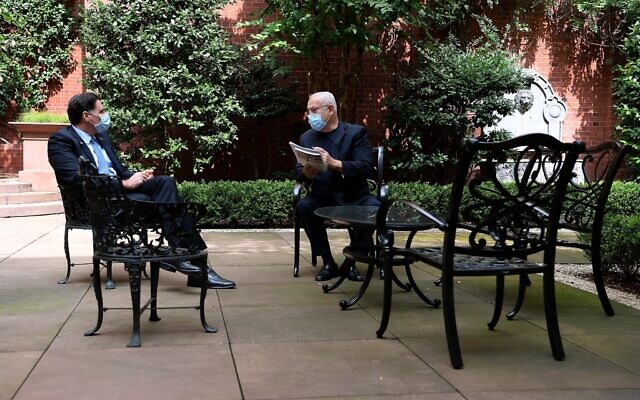
Prime Minister Benjamin Netanyahu with Israel’s Ambassador to the US Ron Dermer in Washington DC on September 14, 2020, a day before the Abraham Accords signing ceremony at the White House. (Avi Ohayon/GPO)

But Dermer, Dermer, it is generally believed, doesn’t seek a political career after his tenure as ambassador comes to an end.

It is spymaster Cohen, the long-time Mossad operations man who is widely believed to be behind the dramatic killing of Iran’s nuclear weapons chief Mohsen Fakhrizadeh last week, who seems willing to take on the mantle of leadership, and seems to have Netanyahu’s blessing for it.

Cohen’s influence is hard to exaggerate. Since he took over the reins of Israel’s spy agency in 2016, the Mossad has grown rapidly in budgets and manpower, expanded its operational infrastructure and engaged in some of the most daring espionage actions the region has ever seen (according to foreign reports, of course). It has all but replaced Israel’s professional diplomatic corps and Foreign Ministry in the most strategically critical theaters, such as Israel’s burgeoning alliances with the Sunni Arab world.

First as national security adviser and then as Mossad director, Cohen has played a key role in helping Netanyahu centralize the most sensitive and significant strategic policy questions within the Prime Minister’s Office, cutting competing institutions and power bases, from the defense and foreign ministries to the security cabinet, out of the loop.

Into the limelight

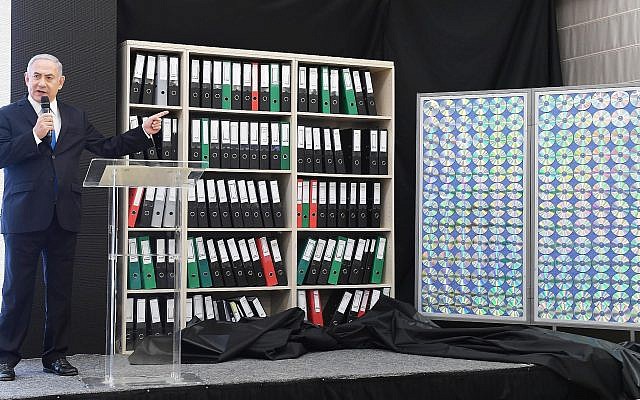
Shortly after Netanyahu’s 2018 announcement that Israel had acquired Iran’s secret nuclear archive in an astonishing nighttime raid on a facility near Tehran, prominent Hebrew-language media let it be known that anonymous sources had confirmed to them that Cohen himself had personally overseen the daring operation.

Prime Minister Benjamin Netanyahu showcases material he says was obtained by Israeli intelligence from Iran’s nuclear weapons archive, in Tel Aviv on April 30, 2018. (Amos Ben-Gershom (GPO)

In April of this year, amid the first coronavirus lockdown, it was again leaked to the press that the Mossad had engaged its “strategic assets” to bring to Israel vitally needed equipment to battle the pandemic, including ventilators and masks. In a moment of unguarded braggadocio by an unnamed Mossad official, it was suggested to reporters that the equipment had been daringly snatched from other unsuspecting nations.

It was a strange and clumsy effort by the vaunted spy agency, the sort that reveals more in its tone than in the information being conveyed. The claim that the Mossad had stolen medical equipment from other nations in the midst of a pandemic turned out to be an ill-judged attempt to imply there was a substantive cloak-and-dagger reason for assigning the purchase of medical equipment to the spy agency. Why hadn’t the Defense Ministry’s procurements division or the Health Ministry, both of which have more experience than the Mossad in negotiating and implementing large purchases abroad, been given the task? Did Israel really steal medical supplies?

It later emerged that the procurements were less exciting than initially suggested. The Mossad had turned to friendly governments and purchased from them equipment they believed they could spare. It made some errors in selecting the equipment, and some have suggested that it paid higher-than-market rates, but these mistakes remain unconfirmed reports, since all details surrounding Mossad activities (all details not leaked by the Mossad, that is) are classified.

And that’s the point. The Mossad’s activities are not accountable to the public in any direct sense. There is no easy way to verify or critique its activities. The organization answers to Netanyahu, and so credit for its successes need not be shared.Mossad chief Yossi Cohen speaks at a Tel Aviv University cyber conference on June 24, 2019. (Flash90)
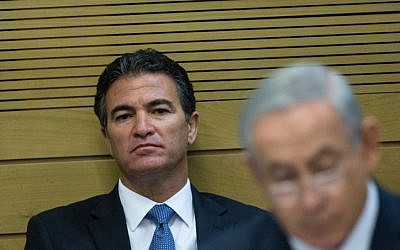
Those features — secrecy, loyalty and a hierarchy answerable directly to the prime minister — make the spy agency the perfect vehicle for a man like Cohen, with Netanyahu’s encouragement and support, to build his brand and public presence. Cohen broke longstanding Mossad tradition in recent years by appearing in public to speak about the agency’s challenges, giving interviews to the press, and sitting in the front row at diplomatic functions, sometimes even smiling to the cameras.

That publicity, alongside his oft-mentioned role in the negotiations leading to Israel’s recent normalization agreements, Netanyahu’s repeated public praise for the spy chief, and a steady stream of leaks to the media about the agency’s exploits in recent years, have made Cohen by far the most visible Mossad chief in the organization’s history.

Dangers mount

But Netanyahu’s faith in Cohen runs deeper than his personal loyalty or the desire to groom a successor.

Cohen comes from a right-wing religious-Zionist family. He is the scion of eight generations of Jerusalemites and the son of a fighter in the right-wing pre-state Etzel militia. He shares a basic cultural and political orientation with the prime minister.Yossi Cohen, then the national security adviser, is seen in a committee meeting at the Israeli parliament on December 8, 2015, sitting behind Prime Minister Benjamin Netanyahu. (Yonatan Sindel/Flash90)

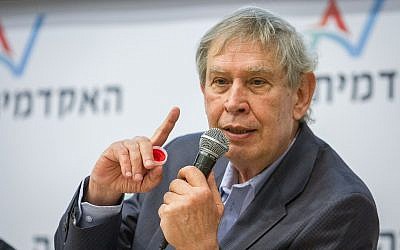
And he shares something else. Cohen and Dermer both agree with Netanyahu’s understanding of the chaos that is to come.

Netanyahu’s defining policy concern flows from his analysis of regional trends. He sees a Middle East set to grow far more dangerous and chaotic in the coming years as the Iranian regime is unleashed from international restrictions and runs roughshod over a politically and militarily debilitated Arab world.

Iran’s defiance of — and determination to overturn — the Westphalian state system in the region has already sparked a return throughout the Middle East to older, deeper loyalties and identities. It no longer makes sense to have an Iran policy distinct from a Lebanon policy, or an Iraq policy that assumes the central government in Baghdad is calling the shots in the country. The region is dividing along more fundamental alliances, between Shiite and Sunni, between conservative and Islamist.

Iranian army troops march at a military parade marking the 39th anniversary of the outset of the Iran-Iraq war, in front of the shrine of the late revolutionary founder Ayatollah Khomeini, just outside Tehran, Iran, September 22, 2019. (Iranian Presidency Office via AP)

In the wake of the Fakhrizadeh assassination, former CIA chief John Brennan took to Twitter to rail against the “state-sponsored terrorism” and “flagrant violation of international law” represented in the killing of a senior Iranian military official.

It was a moment of sharp culture clash. Obama’s spymaster lamented the violation of the Westphalian order, the challenge the assassination represents to the sacred immunities of officialdom. “These assassinations are far different than strikes against terrorist leaders & operatives of groups like al-Qaida & Islamic State, which are not sovereign states,” Brennan explained.https://platform.twitter.com/embed/index.html?dnt=true&embedId=twitter-widget-0&frame=false&hideCard=false&hideThread=false&id=1332400794344312834&lang=en&origin=https%3A%2F%2Fwww.timesofisrael.com%2Fwhy-mossads-yossi-cohen-shadow-warrior-against-iran-is-pms-chosen-successor%2F&siteScreenName=timesofisrael&theme=light&widgetsVersion=ed20a2b%3A1601588405575&width=550px

It’s an understandable view for a former senior American official, but the moral panic rings hollow in the Middle East. Even a cursory glance around the region reveals that the regime led by Ali Khamenei is determinedly transnational, funding, arming and controlling militias in Lebanon, Yemen, Syria and Iraq. It has sent agents to bomb Jewish communities around the world and has spent the better part of the past 25 years trying to escape the strictures of the nuclear non-proliferation treaty.

Not only is the Iranian regime no big believer in the sanctity of state sovereignty (except its own, of course), it shares with other Islamist movements a guiding creed that views the modern state system imposed on the Middle East by European powers a century ago as a straitjacket responsible for no small part of the weakness and disarray in the heartland of Islam.

Brennan’s response and the diplomatic outcry in some quarters that followed Fakhrizadeh’s assassination are viewed in Israel and in large parts of the Sunni Arab world as a kind of willful myopia that offers no safety or answers for those in the region who must contend with the hard reality of an expansionist Iran.

The Middle East is thus entering a dangerous time, according to this view, with powerful adversaries arming quickly, deploying vast arsenals of precision missiles, transnational proxy militias, and even nuclear weapons; with weak states and a quickly evaporating international security architecture as the American retreat leaves behind a vacuum only partly filled by local powers like Israel and Turkey.

Enter Cohen

Israel’s current spymaster rose through the Mossad ranks as an operations man, gaining a reputation for daring and clever exploits and winning the job of deputy director in 2011. It was from that post that he was plucked out by Netanyahu and appointed national security adviser in 2013.v

CCTV footage allegedly showing a Mossad operative during the 2010 assassination of Mahmoud al-Mabhouh in Dubai, as released by the Dubai police. (Screenshot via YouTube)

Those years were a difficult period for Mossad’s operations branch. The killing of Hamas weapons smuggling pointman Mahmoud al-Mabhouh in Dubai in 2010 was caught on security cameras that reportedly exposed the faces of a massive Mossad hit team. After that fiasco, the organization was said to take a step back from daring international escapades. Under agency chief Tamir Pardo, who led the organization from 2011 to 2016, few operations were approved.

Cohen got Netanyahu’s nod for Mossad chief in 2016 after promising the prime minister a return to bold and strategically significant operations — and a laser-like focus on Iran.

Cohen was reportedly key to the retooling of the Mossad’s operations in response to the challenges revealed in the Mabhouh hit: Namely, the ubiquity of cameras, biometric scanners (11 of the alleged Mossad hit team members reportedly had their retinas scanned as a routine measure at Dubai’s airport, scans later shared with Interpol), and other instruments of mass surveillance.

Former Mossad director Tamir Pardo participates in the Meir Dagan Conference for Strategy and Defense at the Netanya Academic College, March 21, 2018. (Meir Vaaknin/Flash90)

“To you it seems fun, that Instagram thing, that your cellphone can identify heads with a yellow square and a person can identify themselves almost automatically using automatic systems almost everywhere,” Cohen told a 2018 Finance Ministry conference. “But a great deal of the problems or challenges faced by [the Mossad] are tied to the fact that your actual passport is your fingerprint, your iris, your face…. Try to imagine in what world Mossad’s operational staff, Mossad’s warriors, are operating.”

The response, according to a detailed report in Haaretz from 2018: the Mossad under Cohen has shifted away from employing Israeli agents directly in foreign operations. In the December 2016 hit on Hamas drone engineer Mohammad a-Zawari in Tunisia, widely attributed to the Mossad, a large and complex international team, each part responsible for only a tiny portion of the operation and probably unaware of the other parts, carried out the strike. The hitmen themselves were reportedly Bosnian nationals.

That new modus operandi, the focus on mercenaries and unwitting accomplices, is likely responsible for the clean getaways in the cases of the stolen nuclear archive (confirmed by Netanyahu as a Mossad operation) and the Fakhrizadeh assassination (on which Israel is officially mum).

Indeed, if even half the reports about the Mossad’s activities since 2016 are correct, Cohen has delivered in spades on his promise to Netanyahu. And Netanyahu has responded with a growing reliance on Cohen and a dramatic expansion of his agency’s budget and personnel.

Benjamin Netanyahu and Yossi Cohen look over documents in a photo posted on social media by Netanyahu on December 7, 2015, shortly after he named Cohen as the new Mossad chief. (PMO/Facebook)

The Mossad’s budget is now reportedly estimated at well over NIS 10 billion ($3 billion) and with a workforce numbering, according to unconfirmed media reports, more than 7,000 — larger than all comparable spy agencies except the CIA. It’s no accident that Cohen’s 2018 comments about espionage in the digital age were made to a conference of the Finance Ministry’s Budgets Department. Officials familiar with the agency’s operations say no budget request made by Cohen is denied.

The Mossad under Cohen has become an instrument of grand strategy for a prime minister worried about very large strategic threats. Its unique place in the Israeli government hierarchy gives it an independence and a flexibility that allows Netanyahu to conduct policy, unobstructed by political adversaries or public scrutiny.

And that has made Cohen himself the indispensable architect of Netanyahu’s far-reaching and many-layered campaign to disrupt Iran’s nuclear and precision-missile programs and construct new strategic alliances against the looming chaos.

Netanyahu sees in Cohen not merely a protégé, but the daring strategist Israel will need to safely weather the coming crisis. His patronage is as much a statement about where Netanyahu believes the Middle East is headed as it is about whom he deems a worthy successor to himself.

Fakhrizadeh’s assassination, if indeed it is Cohen’s handiwork, is only the beginning.

Biden: US will rejoin Iran nuclear deal if Tehran returns to strict compliance

December 2, 2020


President-elect says Iran’s terror proxies must be curbed, raises concern of Mideast nuclear arms race; Rouhani rejects his parliament’s ‘harmful’ bill to boost uranium enrichment

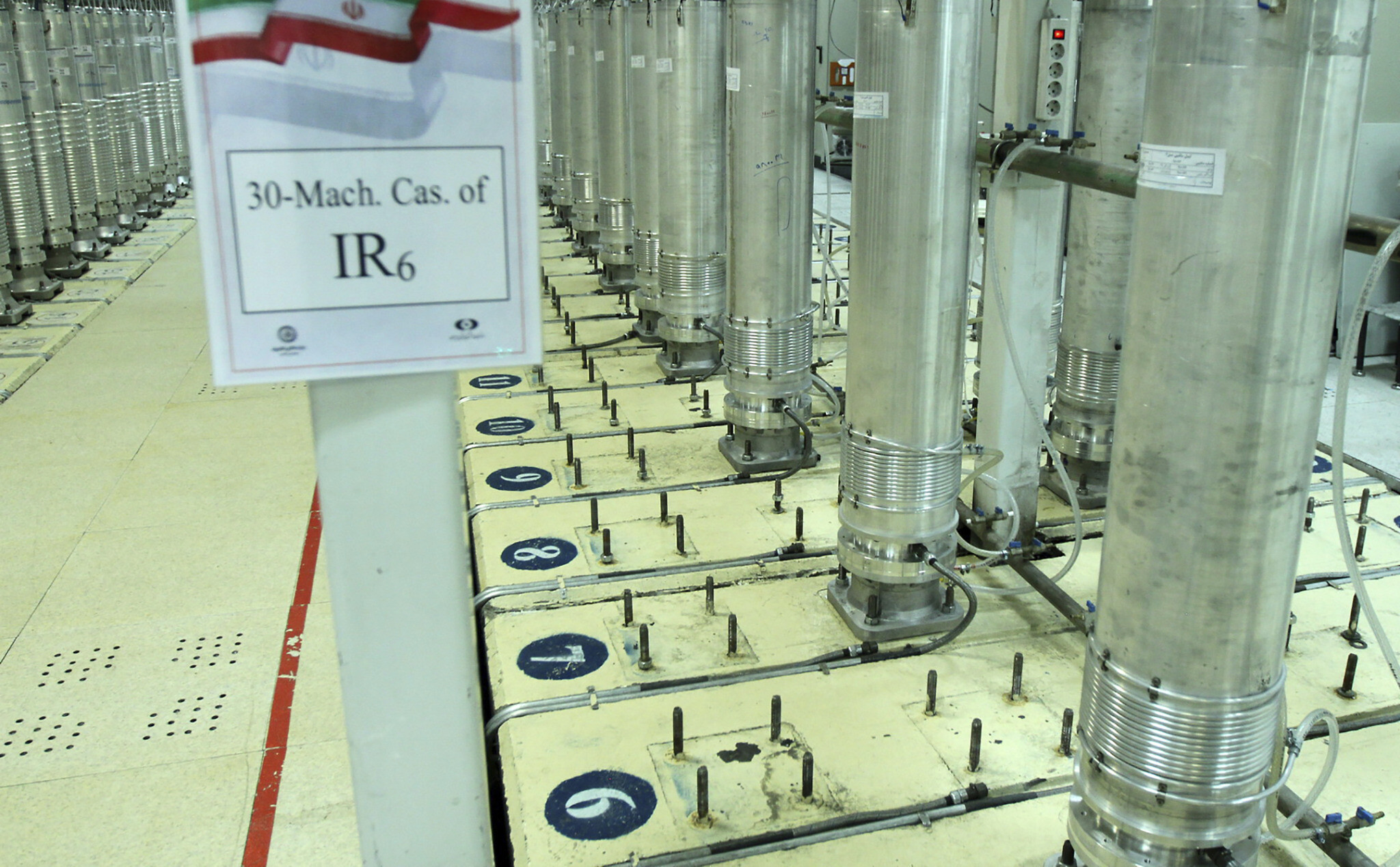
This photo released Nov. 5, 2019, by the Atomic Energy Organization of Iran, shows centrifuge machines in the Natanz uranium enrichment facility in central Iran. (Atomic Energy Organization of Iran via AP, File)

By TOI STAFF and AGENCIESToday, 11:54 am  0This photo released Nov. 5, 2019, by the Atomic Energy Organization of Iran, shows centrifuge machines in the Natanz uranium enrichment facility in central Iran. (Atomic Energy Organization of Iran via AP, File)

US President-elect Joe Biden said that the US would rejoin the nuclear deal with Iran if Tehran went back to strict compliance with the agreement, and promised to take steps to curb the influence of the Islamic Republic’s regional proxies.

Biden told The New York Times in an interview published overnight Tuesday that “there’s a lot of talk about precision missiles and all range of other things that are destabilizing the region,” but “the best way to achieve getting some stability in the region” is to address those issues within the nuclear program.

“In consultation with our allies and partners, we’re going to engage in negotiations and follow-on agreements to tighten and lengthen Iran’s nuclear constraints, as well as address the missile program,” he said, noting that the US always has the option to return to sanctions if necessary.

He raised concerns that if Iran were to get a nuclear bomb, it would increase pressure on Saudi Arabia, Turkey, Egypt and other nations in the region to acquire such weapons.

US President-elect Joe Biden at The Queen theater, November 25, 2020, in Wilmington, Delaware (AP Photo/Carolyn Kaster)

“And the last goddamn thing we need in that part of the world is a buildup of nuclear capability,” Biden said.

“It’s going to be hard, but yeah,” Biden told the Times when specifically asked about an essay he wrote that was published in September.

Biden wrote in the article for CNN prior to the election that “if Iran returns to strict compliance with the nuclear deal, the United States would rejoin the agreement as a starting point for follow-on negotiations.”

According to the Times report, Biden and his team are working on the premise that if the deal is restored on both sides there will need to be new negotiations on the length of time for restrictions on the production of the fissile material necessary for producing a bomb, originally set at 15 years under the 2015 the Joint Comprehensive Plan of Action, or JCPOA.

The US imposed crippling sanctions on Iran after US President Donald Trump unilaterally withdrew from the nuclear agreement in 2018. In response, Iran began publicly exceeding limits set by the agreement while saying it would quickly return to compliance if the United States did the same.

Additionally, Biden said, steps would need to be taken to address Tehran’s terror activities through regional proxies in Lebanon, Syria, Iraq and Yemen.

The report said that the future Biden administration would want the talks with Tehran to include not only the original parties to the deal — Iran, the United States, Russia, China, Britain, France, Germany and the European Union — but also key regional players Saudi Arabia and the United Arab Emirates.

Iranian President Hassan Rouhani in a pre-recorded message played during the 75th session of the United Nations General Assembly, at UN headquarters in New York, September 22, 2020. (UNTV via AP)

The comments came as Iran’s President Hassan Rouhani on Wednesday rejected a bill approved by parliament that would have suspended UN inspections and boosted uranium enrichment, saying it was “harmful” to diplomatic efforts aimed at restoring the 2015 nuclear deal and easing US sanctions.

The tug-of-war over the bill, which gained momentum after the killing of a prominent Iranian nuclear scientist last month, allegedly by Israel, reflects the rivalry between Rouhani and hardline lawmakers who dominate parliament and favor a more confrontational approach to the West.

The bill would have suspended UN inspections and required the government to resume enriching uranium to 20 percent if European nations failed to provide relief from crippling US sanctions on the country’s oil and banking sectors. That level falls short of the threshold needed for nuclear weapons but is higher than that required for civilian purposes.

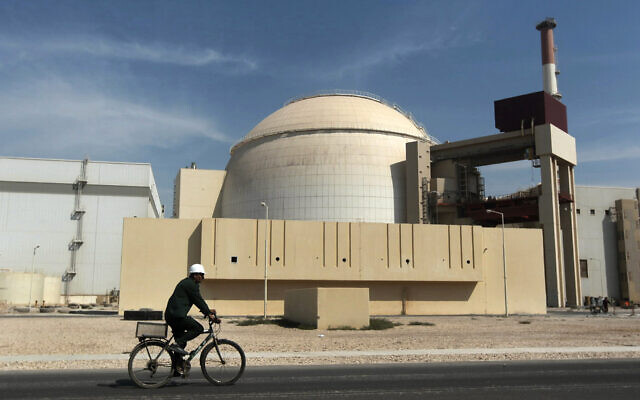
The Bushehr nuclear power plant outside the southern city of Bushehr, Iran. (AP Photo/Mehr News Agency, Majid Asgaripour, File)

Speaking at a cabinet meeting, Rouhani said his administration “does not agree with that and considers it harmful for the trend of diplomatic activities.” He implied the lawmakers were positioning themselves ahead of Iran’s elections planned for June.

He added that “today, we are more powerful in the nuclear field than at any other time.”

The bill is expected to have little if any impact, as Iran’s Supreme Leader Ayatollah Ali Khamenei has the final say on all major policies, including those related to the nuclear program. Rather, it appeared to be a show of defiance after Mohsen Fakhrizadeh, a key figure in Iran’s nuclear program, was killed in an attack Iranian officials have blamed on Israel.

Some analysts have argued the killing was aimed at making it more difficult for Biden to reenter the nuclear deal with Iran.

Prime Minister Benjamin Netanyahu had warned about the threat posed by Fakhrizadeh as early as 2018 and just days ago cautioned against Biden’s plans to reenter the nuclear accord.

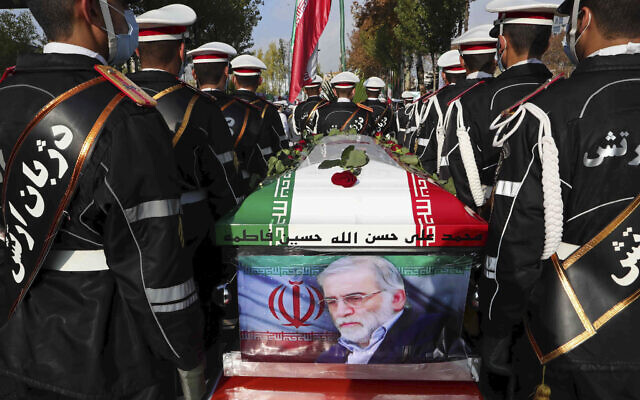
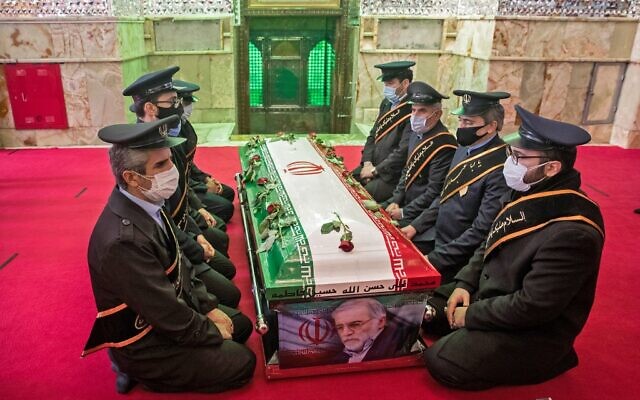
Military personnel stand near the flag-draped coffin of Mohsen Fakhrizadeh, a nuclear scientist who was killed on Friday, during a funeral ceremony in Tehran, Iran, November 30, 2020. (Iranian Defense Ministry via AP)

Fakhrizadeh headed a program that Israel and the West have alleged was a military operation looking at the feasibility of building a nuclear weapon. The International Atomic Energy Agency says that the “structured program” ended in 2003, while Israel says Iran is still aiming to develop nuclear weapons, pointing to its work on ballistic missiles and other technologies.

Iran insists its nuclear program is entirely peaceful, though a trove of Iranian documents stolen from Tehran by the Mossad, which were revealed by Netanyahu in 2018, showed plans by Iran to attach a nuclear warhead to a ballistic missile.

Iran has suffered several devastating attacks this year, including the killing of top general Qassem Soleimani in a US drone strike in January, and a mysterious explosion and fire in the summer that crippled an advanced centrifuge assembly plant at the Natanz uranium enrichment facility, which is widely believed to have been an act of sabotage.

Killing scientist batters, but doesn’t shatter, Biden plans to reenter nuke deal

December 1, 2020


Fakhrizadeh assassination adds to Tehran’s growing list of grievances and could force it to retaliate; still, it doesn’t diminish Iran’s desire to return to a sanction-ending deal

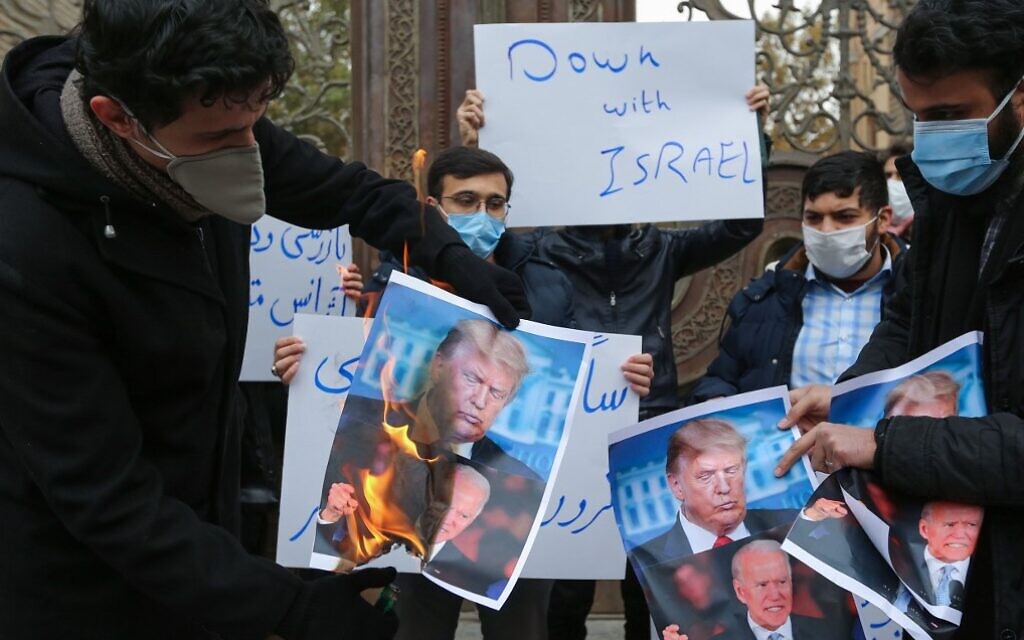
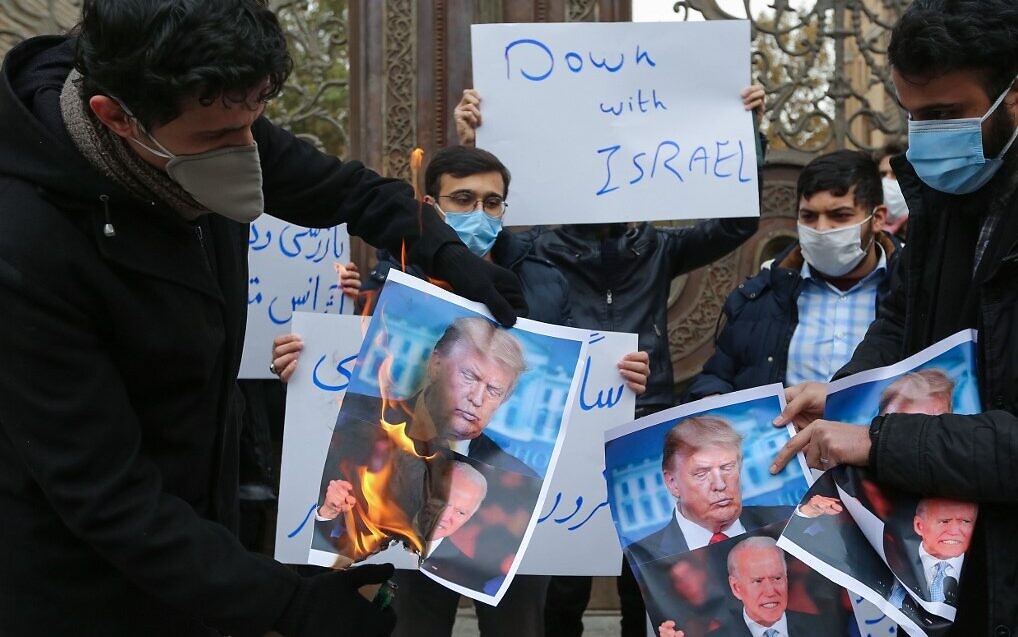
Students of Iran's Basij paramilitary force burn posters depicting US President Donald Trump (top) and President-elect Joe Biden, during a rally in front of the foreign ministry in Tehran, on November 28, 2020, to protest the killing of prominent nuclear scientist Mohsen Fakhrizadeh a day earlier near the capital. (Atta Kenare/AFP)

By JACOB MAGIDToday, 5:00 am  1Students of Iran’s Basij paramilitary force burn posters depicting US President Donald Trump (top) and President-elect Joe Biden, during a rally in front of the foreign ministry in Tehran, on November 28, 2020, to protest the killing of prominent nuclear scientist Mohsen Fakhrizadeh a day earlier near the capital. (Atta Kenare/AFP)

NEW YORK — Within hours of Mohsen Fakhrizadeh’s assassination on Friday, social media accounts affiliated with Iran’s Islamic Revolutionary Guard Corps began posting propaganda images depicting the slain nuclear scientist alongside former IRGC commander Qassem Soleimani and Iraqi comrade Abu Mahdi al-Muhandis, who were killed in a similar targeted attack.

The message coming from the highest levels of the Islamic Republic was that Iran planned not only to avenge the death of the most recent “martyr,” but the killings of Soleimani and al-Muhandis as well.

The operation that took out Fakhrizadeh has been widely attributed to Israel, whereas the January drone strike on Soleimani and al-Muhandis was carried out by the US. To Tehran though, they are part of the same growing list of grievances that many analysts speculate will make President-elect Joe Biden’s plans to re-enter the Iran nuclear accord a much more difficult task.

Several regional experts who spoke with The Times of Israel Monday acknowledged the degree to which Fakhrizadeh’s killing complicates matters for the incoming Biden administration, yet they also argued that Iran’s interest in reaching an agreement to ease crippling American sanctions remains undiminished.

But while the raft of Trump-imposed sanctions could be justified as leverage to be exploited by Biden to entice Tehran back to the negotiating table, targeted killings cannot be placed in the same basket. The Washington-based analysts who spoke to The Times of Israel argued that rather than coaxing a weakened regime into reluctantly making its way to the negotiating table, such strikes are more likely to convince Iran to rebuff talks altogether — which may have been the main aim of the assassination.https://platform.twitter.com/embed/index.html?dnt=true&embedId=twitter-widget-0&frame=false&hideCard=false&hideThread=false&id=1332664877220028418&lang=en&origin=https%3A%2F%2Fwww.timesofisrael.com%2Fkilling-scientist-batters-but-doesnt-shatter-biden-plans-to-reenter-nuke-deal%2F&siteScreenName=timesofisrael&theme=light&widgetsVersion=ed20a2b%3A1601588405575&width=550px

The ‘real target’ of the assassination

The killing of Fakhrizadeh, the scientist that Israel and the US accused of heading Iran’s rogue nuclear weapons program, was part of an effort to “salt the field for Biden and lock the Iranians into a position of intransigence,” argued Hussein Ibish of the Arab Gulf States Institute in Washington (AGSIW).

The Middle East analyst maintained that even before the military-style ambush on the outskirts of Tehran, efforts by Iranian President Hassan Rouhani were vulnerable to the “willingness and ability of hardliners [in the Islamic Republic] to agitate against any resumed dialogue with Washington.”

“The risk any Iranian leaders will be taking in reengaging with the US has [now] greatly increased,” Ibish said.

AGSIW Iran expert Ali Alfoneh went further, arguing that the “nuclear deal was Israel’s real target in the latest assassination.” Jerusalem has not commented on Fakhrizadeh’s killing, but three Western intelligence officials told The New York Times last week that the Jewish state was responsible.Members of Iranian forces pray around the coffin of slain nuclear scientist Mohsen Fakhrizadeh during the burial ceremony at Imamzadeh Saleh shrine in northern Tehran, on November 30, 2020. (HAMED MALEKPOUR / TASNIM NEWS / AFP)
Prime Minister Benjamin Netanyahu had warned about the threat posed by Fakhrizadeh as early as 2018 and just days ago cautioned against Biden’s plans to re-enter the nuclear accord officially known as the Joint Comprehensive Plan of Action.

Alfoneh said that despite the attempt by perpetrators of the Friday strike to “lure” Iran into direct confrontation, he expected Tehran to stick with its practice of “strategic patience” in deciding when to respond to such attacks.

“This is good news for the Biden administration and the prospects for US-Iran negotiations,” he added, while warning that “strategic patience comes at a domestic price, as the Iranian public questions the abilities of the regime’s security services” to protect its most senior officials.

Sanctions relief vs. national honor

Brookings Institute Iran expert Suzanne Maloney appeared less optimistic, saying that Fakhrizadeh’s killing shifted the sides “back into escalation mode.”

“I’m less concerned about the [assassination’s] fallout for the nuclear deal,” she said. “What I am concerned about is how Iran will play its cards throughout the region and how this will impact Israeli and US security.”

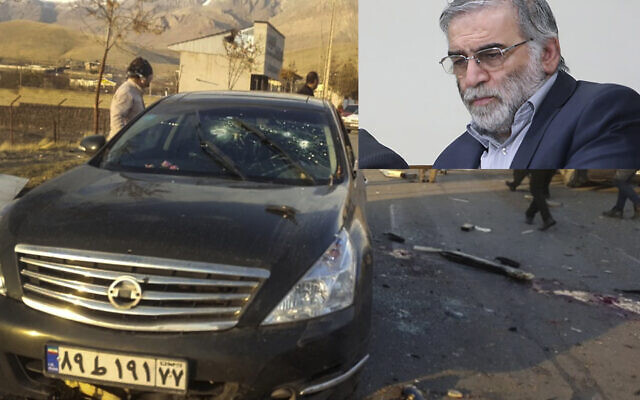
However, Maloney argued that “anxiety over prospects of diplomacy is overstated.”A photo released by the semi-official Fars News Agency shows the scene where Mohsen Fakhrizadeh was killed in Absard, a small city just east of the capital, Tehran, Iran, Friday, Nov. 27, 2020 (Fars News Agency via AP); insert: Mohsen Fakhrizadeh in an undated photo (Courtesy)
What drove Iran toward negotiations with the Obama administration that led to the 2015 agreement was “a fundamental need to re-access the international financial system,” Maloney maintained, asserting that that need remains as crucial as ever.

She acknowledged that Iran’s pursuit of a nuclear program and regional hegemony are “inherently connected,” but argued that Tehran won’t “retaliate to the latest killing by withholding their willingness to talk with US about re-entry into the nuclear deal. They are going to retaliate in the region though.”

The Washington Institute for Near East Policy’s Kate Bauer was not as convinced of the certainty of an Iranian retaliation, be it by slamming the door on the possibility for talks with the Biden administration or by combating US or Israeli interests in the region.

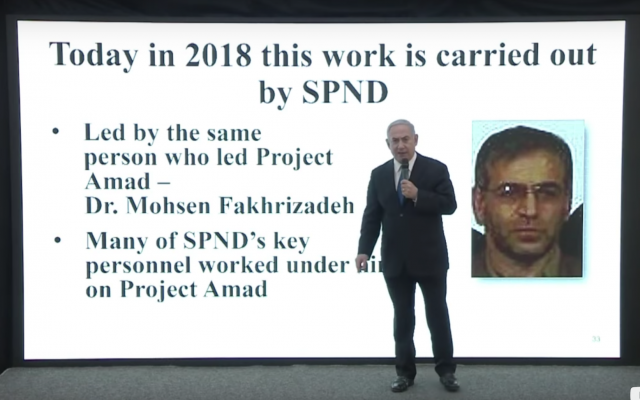
She said Iran is not interested in “flipping the narrative” that has seen European sympathies for Tehran grow amid the Trump administration’s snapback of sanctions against the Islamic Republic following Washington’s 2018 withdrawal from the internationally-backed JCPOA.Prime Minister Benjamin Netanyahu stands in front of a picture of Mohsen Fakhrizadeh, who he named as the head of Iran’s nuclear weapons program, April 30, 2018 (YouTube screenshot)

“There are reasons you can use to argue that Iran will likely to respond, but they probably understand that doing so would put at risk the opportunity to receive relief, which is what they need,” Bauer said, while acknowledging that her stance was reliant on a bit of “wishful thinking.”

Regardless, she maintained that the strike complicates things for Biden, who would have had a hard time returning to the Iran deal even before Fakhrizadeh’s killing.

While Biden has talked about re-entering the JCPOA only after Iran begins complying with the terms of the accord, Tehran has held that it wants to see sanctions relief upfront. Moreover, the president-elect’s aides have said an American re-entry into the deal will require a commitment from Iran to enter follow-up negotiations that will cover non-nuclear issues — a demand that even so-called moderates in the Islamic Republic will have a hard time accepting given that parliamentary elections are just months away.

Leverage or sabotage?

In a January address days after Soleimani’s killing, US Secretary of State Mike Pompeo described the strike as part of a larger plan to “re-establish deterrence” against Iran along with Washington’s sweeping sanctions regime.

Some backers of the administration’s “maximum pressure” policy toward Iran have made the same argument in the aftermath of the Fakhrizadeh assassination, arguing that like sanctions, it could be used as leverage by the Biden administration, which will have an easier time negotiating with a weakened and embarrassed Tehran.Iran’s Judiciary Chief Ayatollah Ebrahim Raisi pays his respect to the body of slain scientist Mohsen Fakhrizadeh among his family, in Tehran, Iran, November 28, 2020. (Mizan News Agency via AP)

But AGSIW’s Ibish argued that the two policies cannot be conflated. “Sanctions are actions that have consequences for an entire society and are ongoing pressure points that can be eased or intensified, like a valve,” he said.

“The killing of a one man — even if he was engaged in nefarious activity — is a different matter because once it’s done it’s done.”

“The sanctions are useable as leverage, [Fakhrizadeh’s killing] is sabotage,” Ibish maintained.

He argued that inside the Iranian regime, it is possible to have “rational conversations” with officials regarding sanctions. “But assassinating senior officials puts them in vengeance [mode] where there’s nothing that can be accomplished. It becomes about pride and honor… which aren’t natural issues to be negotiated.”

Iranian Revolutionary Guards commander reported killed in drone strike

December 1, 2020


Iraqi security forces and local militias sources say Muslim Shahdan and three others died when their vehicle, carrying weapons, was hit just inside Syria after crossing from Iraq

Iran's Revolutionary Guard troops march in a military parade marking the 36th anniversary of Iraq's 1980 invasion of Iran, in front of the shrine of late revolutionary founder Ayatollah Khomeini, just outside Tehran, Iran, September 21, 2016. (AP Photo/ Ebrahim Noroozi, File)

By TOI STAFFToday, 12:24 am  0Iran’s Revolutionary Guard troops march in a military parade marking the 36th anniversary of Iraq’s 1980 invasion of Iran, in front of the shrine of late revolutionary founder Ayatollah Khomeini, just outside Tehran, Iran, September 21, 2016. (AP Photo/ Ebrahim Noroozi, File)

A senior commander in Iran’s Revolutionary Guard was killed in an apparent drone strike along the Syrian-Iraqi border, according to widely circulated reports in Arabic-language media Monday.

Iraqi security sources told Saudi-based al-Arabiya News that a drone killed Muslim Shahdan, a senior commander in the Islamic Revolutionary Guards Corps, in a targeted strike on his car.

Other sources in the Iraqi security services told Lebanese-based al-Hadath that three of his companions perished with him.

The reports did not say who was behind the strike, which reportedly happened early Sunday or late Saturday.

It was the latest in a rapid escalation in military action over the past few weeks that have seen a top Iranian nuclear scientist assassinated and unconfirmed reports of air strikes that have killed pro-Iranian fighters or Iranian troops in Syria. The attacks have all been attributed to Israel.

Two Iraqi security officials separately said that Shahdan’s vehicle was carrying weapons and was hit shortly after it crossed the border from Iraq into Syria, Reuters reported.

Israel and the US have accused Iran and its proxies of attempting to smuggle weapons via Iraq to Syria and Lebanon to be used against the Jewish state.

On Sunday, IDF chief Aviv Kohavi said that Israel would not let up its campaign aimed at keeping Iran-backed fighters from gaining a foothold in Syria.

The campaign has included thousands of airstrikes on targets linked to Iran and alleged weapons convoys, according to reports and accounts from officials speaking anonymously.

However, alleged Israeli strikes on the Syria-Iraq border region are more rare.

Last week, Iran warned that it would bring an end to what it called Israel’s practice of “hit and run” strikes in Syria.

Tehran made the threat following a major Israeli assault in response to what Jerusalem said was a failed Iranian explosives attack on the Golan Heights.

Shahdan’s reported assassination comes days after the killing of prominent Iranian nuclear scientist Mohsin Fakhrizadeh, in an ambush on his convoy outside Tehran on Friday. Israel has been widely reported to be the perpetrator of the targeted killing, although Jerusalem has stayed mum on the issue.

Fakhrizadeh’s death has put Israel and Jewish institutions around the world on high alert, as Iran has publicly vowed revenge and repeatedly claimed Israel stands behind the assassination.

In January, a US drone strike killed senior Revolutionary Guards commander Qassem Soleimani. Iran responded by firing missiles at US bases in Iraqi that caused dozens of injuries.

Iran MPs advance bill to stop UN nuclear inspections, step up enrichment

December 1, 2020


Proposal, days after top nuclear scientist was assassinated, requires several more votes to become law; lawmakers chant ‘Death to Israel’ during session

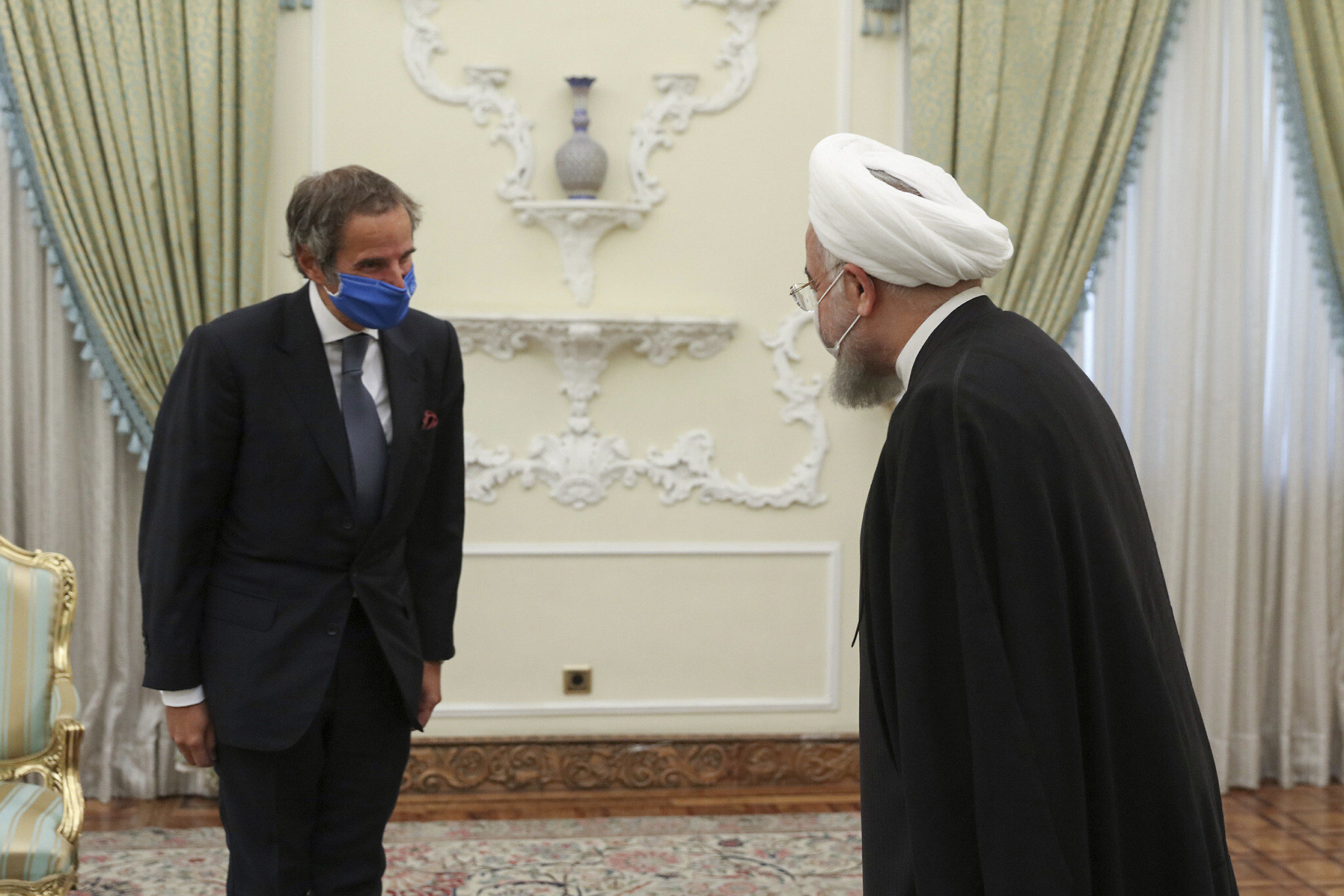
Iranian President Hassan Rouhani, right, welcomes Director General of International Atomic Energy Agency Rafael Mariano Grossi, for their meeting in Tehran, Iran, August 26, 2020. (Iranian Presidency Office via AP)

By AP and TOI STAFFToday, 11:38 am  0Iranian President Hassan Rouhani, right, welcomes Director General of International Atomic Energy Agency Rafael Mariano Grossi, for their meeting in Tehran, Iran, August 26, 2020. (Iranian Presidency Office via AP)

TEHRAN, Iran — Iran’s parliament on Tuesday advanced a bill that would end UN inspections of its nuclear facilities and require the government to boost its uranium enrichment if European signatories to the 2015 nuclear deal do not provide relief from oil and banking sanctions.

The vote to debate the bill, which would need to pass through several other stages before becoming law, was a show of defiance after the killing of the alleged mastermind of Iran’s military nuclear program over the weekend.

The official IRNA news agency said 251 lawmakers in the 290-seat chamber voted in favor, after which many began chanting “Death to America!” and “Death to Israel!”

The bill would give European countries three months to ease sanctions on Iran’s key oil and gas sector, and to restore its access to the international banking system. The US imposed crippling sanctions on Iran after President Donald Trump unilaterally withdrew from the nuclear agreement, triggering a series of escalations between the two sides.

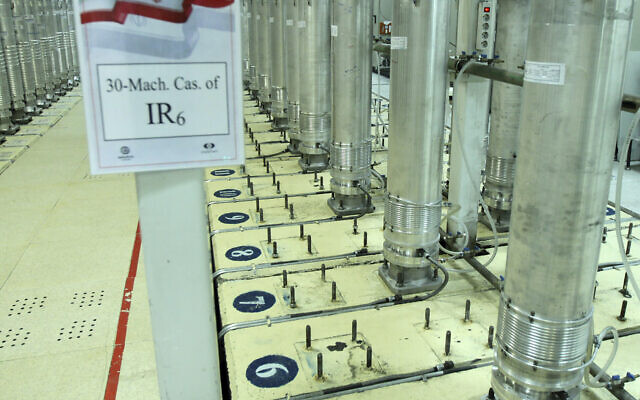
The bill would have authorities resume enriching uranium to 20 percent, which is below the threshold needed for nuclear weapons but higher than that required for civilian applications. It would also commission new centrifuges at nuclear facilities at Natanz and the underground Fordo site.This photo released by the Atomic Energy Organization of Iran on November 5, 2019, shows centrifuge machines at Natanz uranium enrichment facility in central Iran. (Atomic Energy Organization of Iran via AP)
The bill would require another parliamentary vote to pass, as well as approval by the Guardian Council, a constitutional watchdog.

The bill was first tabled in parliament in August but gained new momentum after the killing of Mohsen Fakhrizadeh, seen by Israel as the “father” of Iran’s nuclear weapons program.

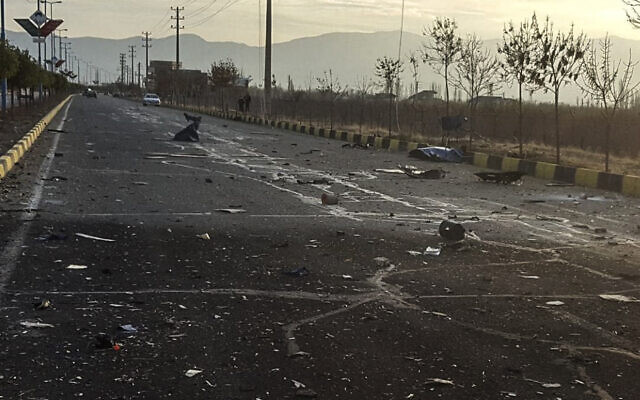
Fakhrizadeh died Friday after his car and bodyguards were targeted in a bomb and gun attack on a major road outside Tehran, heightening tensions once more between the Islamic Republic and its foes.Military personnel stand near the flag-draped coffin of Mohsen Fakhrizadeh, a nuclear scientist who was killed on Friday, during a funeral ceremony in Tehran, Iran, November 30, 2020. (Iranian Defense Ministry via AP)

Israel says Iran maintains the ambition of developing nuclear weapons, pointing to Tehran’s ballistic missile program and research into other technologies. Iran long has maintained that its nuclear program is for peaceful purposes, but has repeatedly threatened to annihilate Israel.

Iran has blamed Fakhrizadeh’s killing on Israel, which has long taken covert action against Tehran and its proxies in the region. Israel has refused to comment on the assassination, but an unnamed Israeli source told the New York Times that it had been involved.

Some Iranian officials have suggested that the International Atomic Energy Agency, which has been regularly inspecting Iran’s nuclear facilities in recent years as part of the 2015 agreement, may have been a source of intelligence for Fakhrizadeh’s killers.

Iran began publicly exceeding uranium enrichment levels set by the nuclear agreement after the US restored sanctions. It currently enriches a growing uranium stockpile up to 4.5% purity.

That’s still far below weapons-grade levels of 90%, though experts warn Iran now has enough low-enriched uranium to reprocess into fuel for at least two atomic bombs if it chose to pursue them.

Killing of nuke chief was done entirely by remote control — Iranian report

November 30, 2020


Semi-official Fars claims operation to kill Mohsen Fakhrizadeh was conducted in three minutes with no human operatives on the ground

By JUDAH ARI GROSS29 November 2020, 8:23 pm 

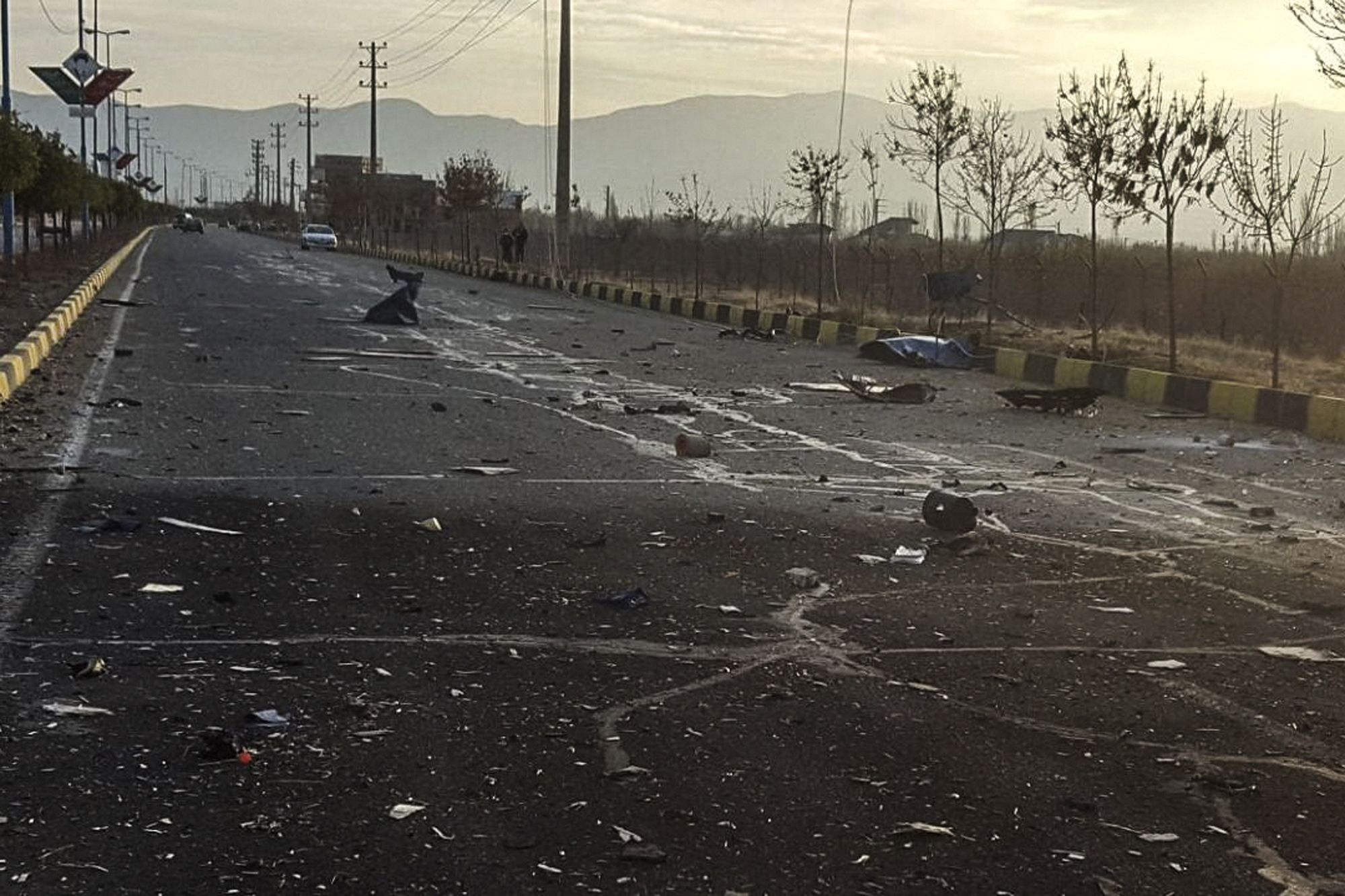
This photo released by the semi-official Fars News Agency shows the scene where Mohsen Fakhrizadeh was killed in Absard, a small city just east of the capital, Tehran, Iran, November 27, 2020. (Fars News Agency via AP)
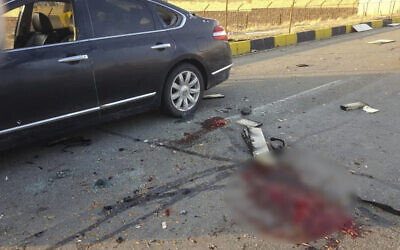
This photo released by the semi-official Fars News Agency shows the scene where Mohsen Fakhrizadeh was killed in Absard, a small city just east of the capital, Tehran, Iran, November 27, 2020. (Fars News Agency via AP)

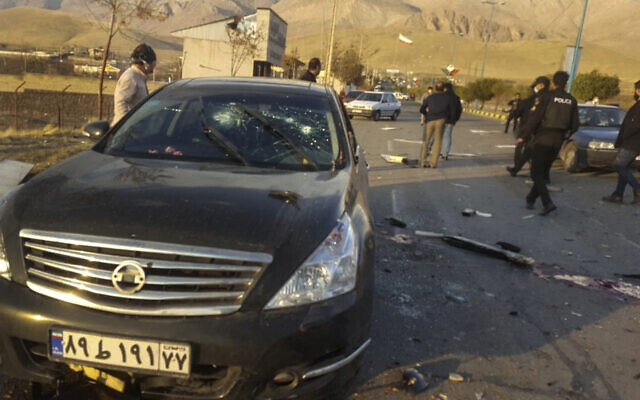
The attack that killed the alleged architect of Iran’s nuclear weapons program on Friday was carried out from afar using a remote-controlled machine gun attached to a car, a leading Iranian news site reported Sunday.

According to the semi-officials Fars news site, the entire operation was conducted with no human agents whatsoever, a significantly different description of the attack than has been presented until now. The account was not attributed to official sources and was not immediately confirmed by Iran.

According to the outlet, the assault took place over the course of three minutes as Mohsen Fakhrizadeh — a brigadier general in Iran’s Islamic Revolutionary Guard Corps, and a key figure in the country’s military research-and-development program long regarded by Israel and the US as the head of its rogue nuclear weapons program — traveled with his wife toward the resort town of Absard, east of Tehran.

The operation kicked off when the lead car in Fakhrizadeh’s security detail traveled ahead to inspect his destination, the report said.Mohsen Fakhrizadeh (Agencies)

At that point, a number of bullets were fired at Fakhrizadeh’s armored car, prompting him to exit the vehicle as he was apparently unaware that he was under attack, thinking that the sound was caused by an accident or some problem with the car, according to Fars news.

The outlet did not specify if those shots were fired from the remote-controlled machine gun or from a different source.This photo released by the semi-official Fars News Agency shows the scene where Mohsen Fakhrizadeh was killed in Absard, a small city just east of the capital, Tehran, Iran, November 27, 2020. (Fars News Agency via AP)

Once Fakhrizadeh exited the vehicle, the remote-controlled machine gun opened fire from roughly 150 meters (500 feet) away, striking him three times, twice in the side and once in his back, severing his spinal cord. Fakhrizadeh’s bodyguard was also hit by the gunfire. The attacking car, a Nissan, then exploded, the report said.

Fakhrizadeh was evacuated to a nearby hospital, where he was pronounced dead. His wife also appears to have been killed in the attack, according to Iranian media.

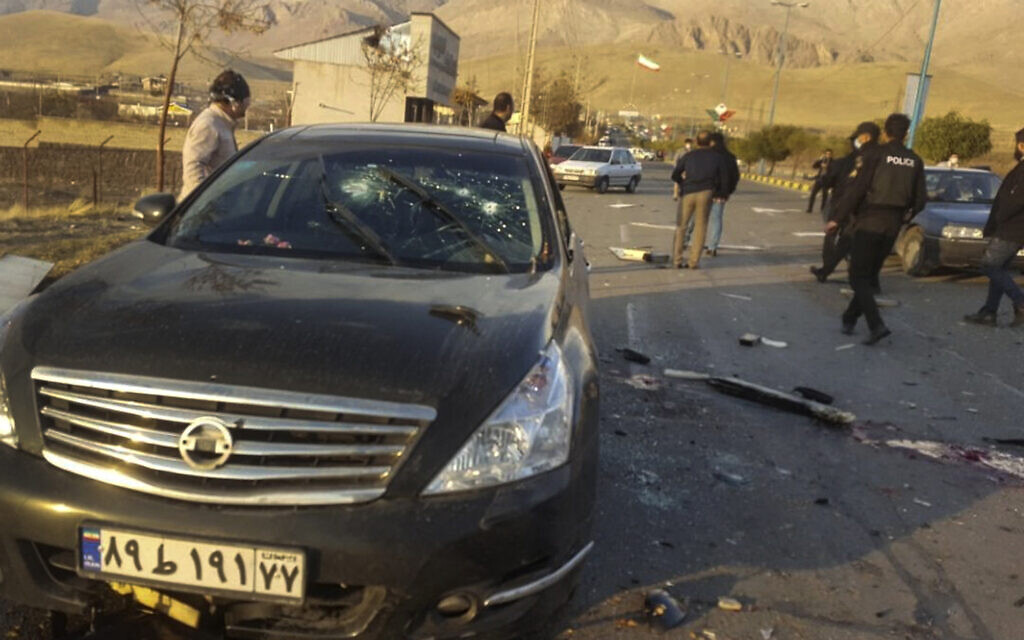
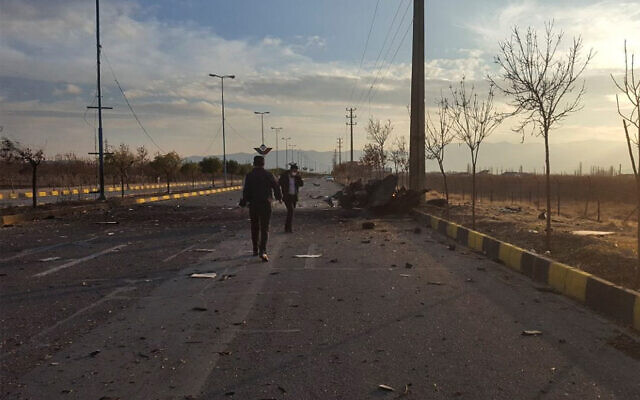
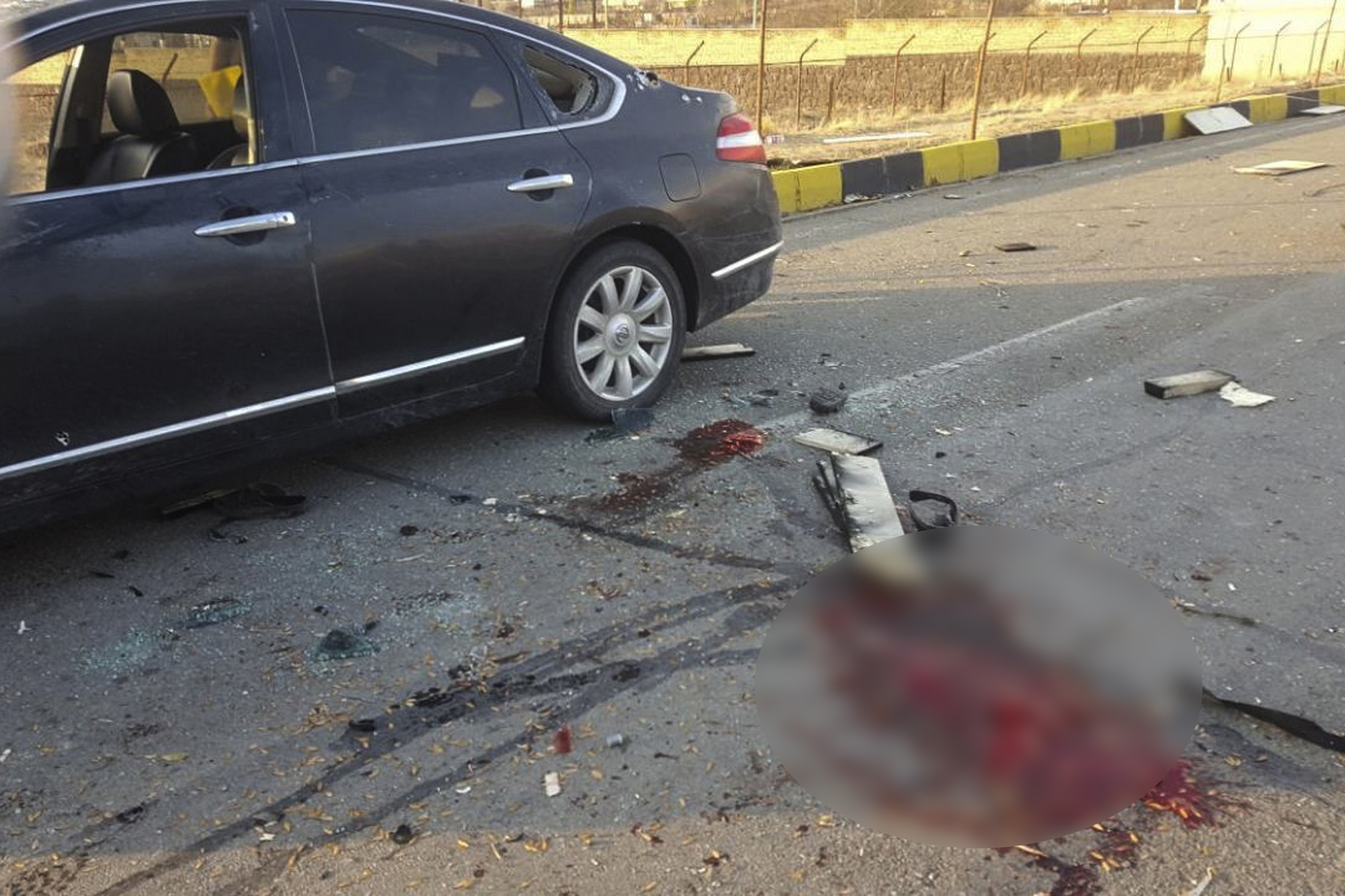
Photos and video shared online showed a sedan with bullet holes in the windshield and back window, blood pooled on the asphalt and debris scattered along a stretch of the road.

This photo released by the semi-official Fars News Agency shows the scene where Mohsen Fakhrizadeh was killed in Absard, a small city just east of the capital, Tehran, Iran, November 27, 2020. Parts of image are blurred for potentially disturbing imagery. (Fars News Agency via AP)

Until now, reports from Iran indicated that an explosion occurred first, forcing Fakhrizadeh’s car to stop, at which point armed agents opened fire at him and his security detail, killing them, before fleeing the scene.

According to Fars news, Iranian authorities tracked down the owner of the Nissan, who left the country on October 29. The name of the owner was not included in the report.

A number of defense analysts cast doubts on the Fars report, noting that photographs of the scene showed what appeared to be precise gunfire aimed at Fakhrizadeh’s car, which a remote-controlled automatic weapon would be unlikely to produce and that better fits the initial descriptions of armed, trained operatives conducting the raid.

Other news outlets have also published contradictory accounts of the killing, including claims that dozens of Israeli operatives were involved.

The highly public killing of Fakhrizadeh prompted widespread condemnation from Iran, which explicitly accused Israel of being responsible for the attack and threatened to exact revenge for it. The United Nations and European Union criticized the operation — without naming Israel — saying it inflamed tensions in the region. Some American Democrats also spoke out against the raid, saying it appeared to be an effort to hobble efforts by US President-elect Joe Biden to rejoin the 2015 nuclear deal, a move that Jerusalem staunchly opposes along with several Sunni Arab states.

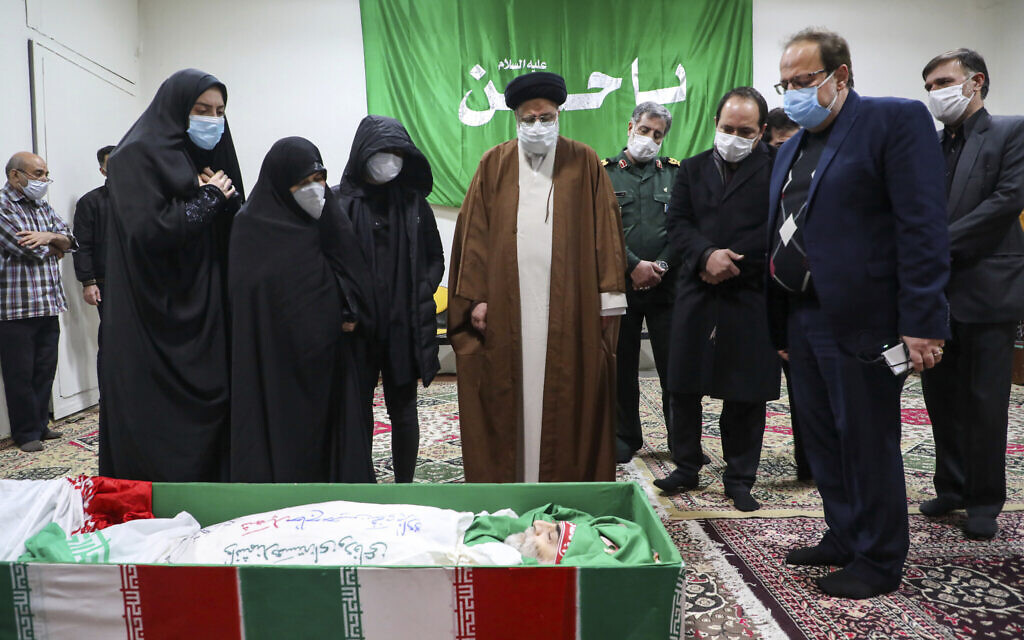
An unnamed Western intelligence source told Channel 12 the killing of the nuclear physicist, described in the past as the “father” of Iran’s project to develop nuclear weapons, was the “pinnacle” of Israel’s long-term plans. Tehran officially denies plans to develop atomic weapons, maintaining its nuclear program is for civilian purposes, though a trove of Iranian documents stolen from Tehran by the Mossad, which where revealed by Prime Minister Benjamin Netanyahu in 2018, showed plans by Iran to attach a nuclear warhead to a ballistic missile.Iran’s Judiciary Chief Ayatollah Ebrahim Raisi pays his respect to the body of slain scientist Mohsen Fakhrizadeh among his family, in Tehran, Iran, November 28, 2020. (Mizan News Agency via AP)
While Israel remained officially mum on the killing of Fakhrizadeh and its alleged role in it, an Israeli minister publicly praised the results of the operation.

“The assassination in Iran, whoever did it, it serves not only Israel, but the whole region and the world,” Energy Minister Yuval Steinitz told the Kan public broadcaster on Sunday.

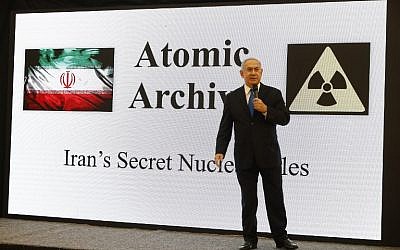
Fakhrizadeh was named by Netanyahu in 2018 as the director of Iran’s nuclear weapons project.

When Netanyahu revealed then that Israel had removed from a warehouse in Tehran a vast archive of Iran’s own material detailing with its nuclear weapons program, he said: “Remember that name, Fakhrizadeh.”

Prime Minister Benjamin Netanyahu delivers a speech on an archive brought out of Iran by the Mossad that documents Iran’s nuclear program, at the Defense Ministry in Tel Aviv on April 30, 2018. (AFP/Jack Guez)

In a video uploaded to Twitter on Friday shortly after news of the alleged killing emerged, Netanyahu, counting off various achievements of the week, noted that this was “a partial list, as I can’t tell you everything… It’s all for you, citizens of Israel, for our country. It’s a week of achievements, and there’ll be more.” According to Intelligence Minister Eli Cohen, Netanyahu was referring to his widely reported — though not officially confirmed — visit to Saudi Arabia.

Israel was bracing for possible Iranian retaliation, putting embassies on high alert. The Israel Defense Forces, however, remained in its normal routine in apparent indication that it did not anticipate an Iranian retaliation in the form of an immediate military strike. At the same time, the IDF said in a statement that it was “aware of the possible developments in the region” and would “maintain full preparedness against any expression of violence against us.”

Iran has suffered several devastating attacks this year, including the killing of top general Qassem Soleimani in a US drone strike in January, and a mysterious explosion and fire that crippled an advanced centrifuge assembly plant at the Natanz uranium enrichment facility, which is widely believed to have been an act of sabotage.

Iran’s atomic program has continued its experiments and now enriches a growing uranium stockpile up to the level of 4.5 percent purity, following the US’s 2018 withdrawal from the nuclear deal. That is still far below weapons-grade levels of 90 percent, though experts warn Iran now has enough low-enriched uranium for at least two atomic bombs if it chose to pursue them.

Amid threats from Tehran, IDF chief says army will keep fighting Iran in Syria

November 30, 2020


After killing of Iranian nuke scientist, Kohavi says military is ‘aware of possible developments,’ but operating as usual; praises troops for thwarting attack on Golan border

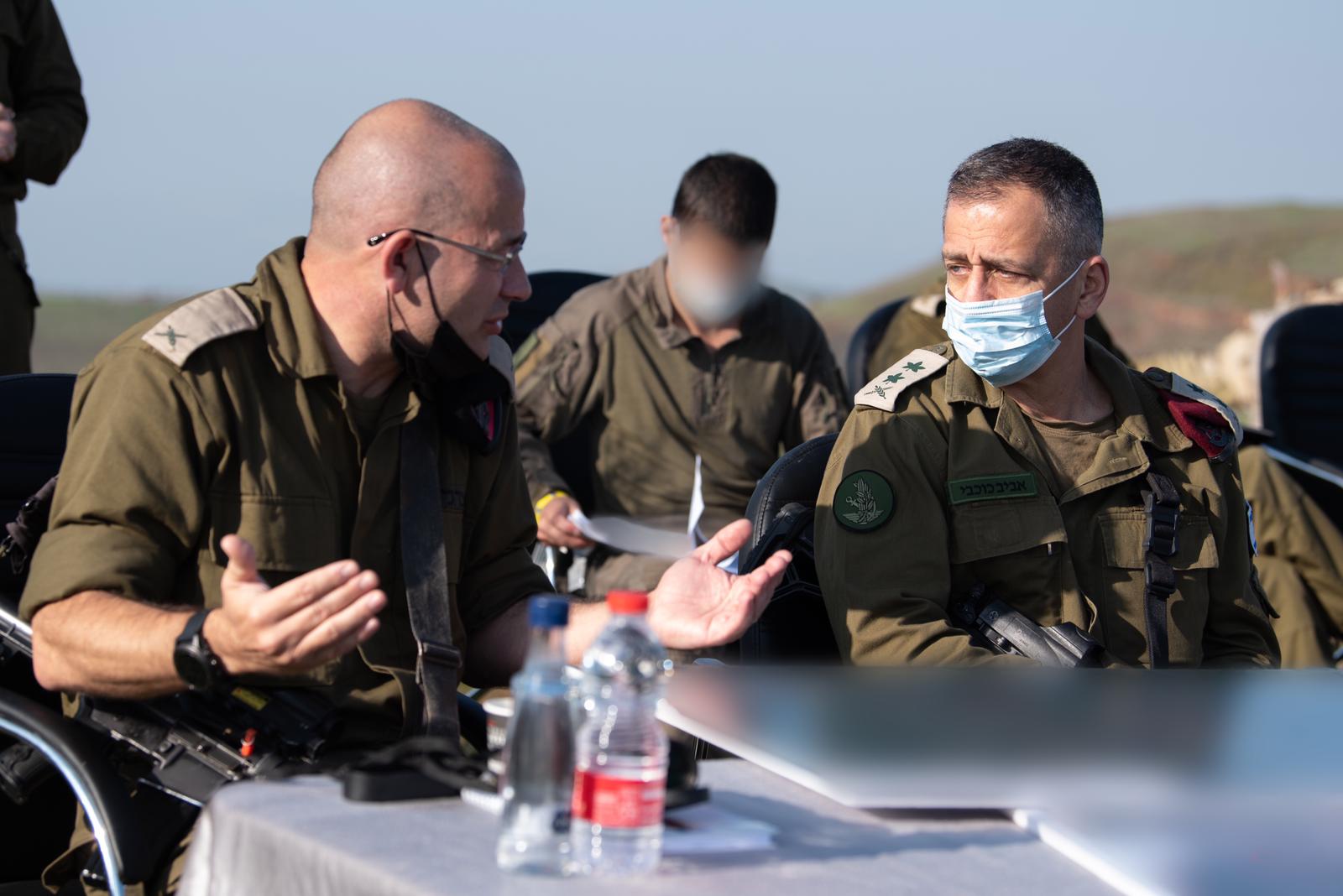
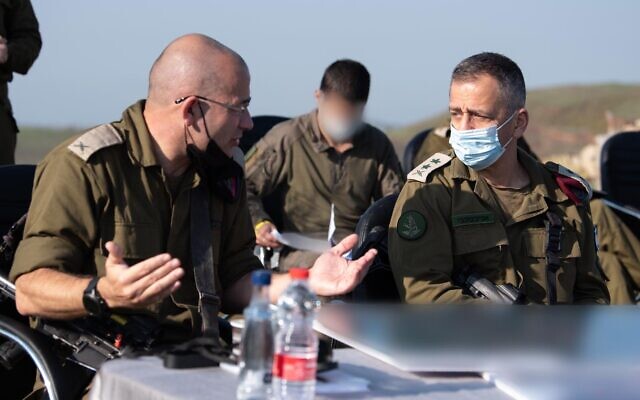
IDF Chief of Staff Aviv Kohavi, right, speaks with the head of the 210th 'Bashan' Division overlooking the Syrian border on November 29, 2020. (Israel Defense Forces)

By JUDAH ARI GROSS29 November 2020, 6:02 pm  0IDF Chief of Staff Aviv Kohavi, right, speaks with the head of the 210th ‘Bashan’ Division overlooking the Syrian border on November 29, 2020. (Israel Defense Forces)

Army chief Aviv Kohavi on Sunday said the military planned to continue fighting Iran’s presence in Syria amid heightened tensions in the region following the killing of Iran’s top military nuclear scientist two days prior.

“Our message is clear: We will continue to operate forcefully as needed against the Iranian entrenchment in Syria and we will continue to maintain full preparedness against any expression of violence against us,” Kohavi said during a tour of the Northern Command.

In the aftermath of Mohsen Fakhrizadeh’s death on Friday in a combined bombing and shooting attack, Iranian military officials and politicians threatened swift revenge against the Jewish state, which it accused of carrying out the operation.

Though Israeli embassies abroad and Jewish communities around the world raised their level of alertness following the killing of Fakhrizadeh, the Israel Defense Forces did not follow suit, an apparent indication that it did not anticipate an Iranian retaliation in the form of an immediate military strike.

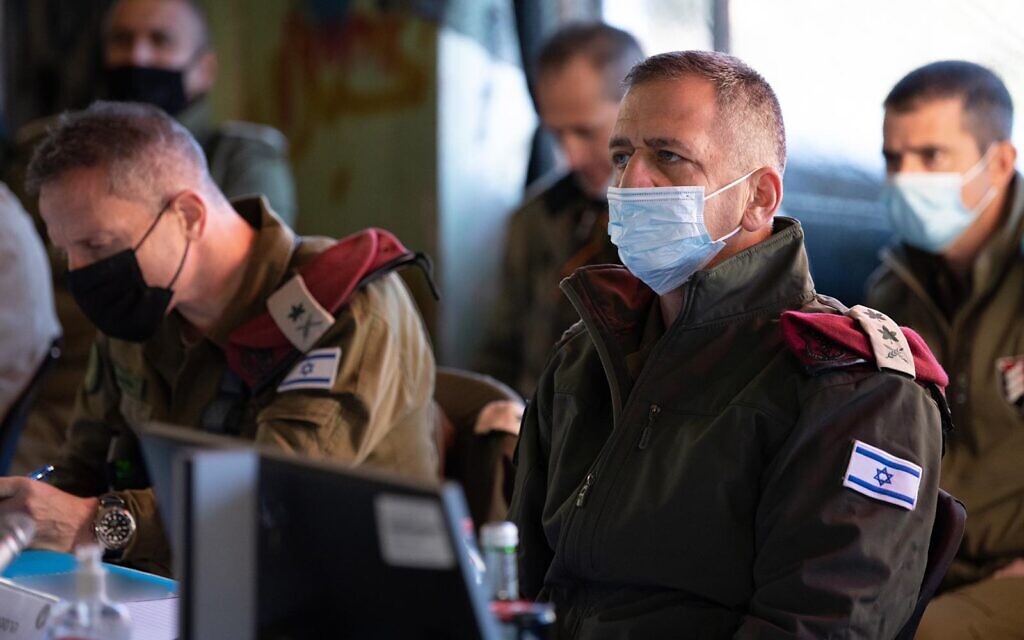
During his visit to the Syrian border, Kohavi noted that despite the heightened tensions in the north, the military was in “full routine,” though it was “aware of the possible developments in the region,” the IDF said in a statement.IDF Chief of Staff Aviv Kohavi, right, sits with head of the IDF Northern Command Maj. Gen. Amir Baram, left, during a visit to northern Israel on November 29, 2020. (Israel Defense Forces)
During the visit, the army chief met with IDF Northern Command chief Maj. Gen. Amir Baram and the head of the 210th Bashan Division, Brig. Gen. Roman Gofman, who is responsible for defending the Golan border.

For the most part, the threat from Iranian proxies — namely Hezbollah and other militias in Syria and Lebanon — is primarily against Israel’s northern borders. Tehran, however, also backs the Palestinian Islamic Jihad terror group and, to a lesser extent, Hamas in the Gaza Strip.

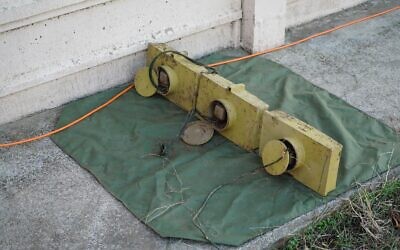
Kohavi toured the border with Syria, where earlier this month Israeli troops uncovered three anti-personnel mines that the military said were planted by Syrian operatives operating under the orders of Iran’s Islamic Revolutionary Guard Corps’ expeditionary Quds Force.

In response to the thwarted bombing attack, which the IDF believed was meant to target the soldiers who patrol the border, the military launched a series of airstrikes on Iranian and Syrian targets inside Syria, killing at least four Syrian soldiers who were operating air defense batteries that were targeted by Israeli fighter jets.

Three anti-personnel mines that Israel says were planted inside Israeli-controlled territory along the border with Syria, which were uncovered on November 17, 2020. (Israel Defense Forces)

Kohavi praised the troops who took part in both the uncovering of the mines and in the retaliatory strikes the following day.

“I came here to discuss the security situation with a focus on Iran’s entrenchment in Syria and in order to thank all those who were involved in the precise and successful effort to expose the mines 10 days ago near the border and in the attack that was carried out afterward in Syria against Iranian and Syrian targets,” he said.

Israel views a permanent Iranian military presence in Syria as an unacceptable threat, which it will take military action to prevent.

The IDF has launched hundreds of strikes in Syria since the start of the civil war in 2011 against moves by Iran to establish a permanent military presence in the country and efforts to transport advanced, game-changing weapons to terrorist groups in the region, principally Hezbollah.

EU condemns killing of Iranian nuclear scientist as ‘criminal act’

November 28, 2020


Brussels urges ‘maximum restraint’ after Tehran points finger at Israel in deadly Friday ambush; Iranian leaders promise response

This photo released by the semi-official Fars News Agency shows the scene where Mohsen Fakhrizadeh was killed in Absard, a small city just east of the capital, Tehran, Iran, Friday, Nov. 27, 2020. (Fars News Agency via AP)

By TOI STAFF and AGENCIESToday, 3:20 pm  0This photo released by the semi-official Fars News Agency shows the scene where Mohsen Fakhrizadeh was killed in Absard, a small city just east of the capital, Tehran, Iran, Friday, Nov. 27, 2020. (Fars News Agency via AP)

The European Union has condemned the killing of a top Iranian nuclear scientist on Friday as a “criminal act” and urged calm and restraint as officials in Tehran blamed Israel for the assassination and vowed to respond.

“In these uncertain times, it is more important than ever for all parties to remain calm and exercise maximum restraint in order to avoid escalation which cannot be in anyone’s interest,” said Peter Sano, lead spokesperson for the external affairs division of the European Union, based in Brussels.

“This is a criminal act and runs counter to the principle of respect for human rights the EU stands for. The High Representative expresses his condolences to the family members of the individuals who were killed, while wishing a prompt recovery to any other individuals who may have been injured,” he
added in a press statement.

The announcement came a day after Iran’s top nuclear scientist Mohsen Fakhrizadeh, linked to Tehran’s military nuclear program, was killed on Friday in Absard, a village just east of the capital that is a retreat for the Iranian elite. Iranian state television said an old truck with explosives hidden under a load of wood blew up near a sedan carrying Fakhrizadeh.

As Fakhrizadeh’s sedan stopped, at least five gunmen emerged and raked the car with gunfire, the semiofficial Tasnim news agency said.This photo released by the semi-official Fars News Agency shows the scene where Mohsen Fakhrizadeh was killed in Absard, a small city just east of the capital, Tehran, Iran, Friday, Nov. 27, 2020. (Fars News Agency via AP)

Fakhrizadeh died at a hospital after doctors and paramedics couldn’t revive him. Others wounded included Fakhrizadeh’s bodyguards. Photos and video shared online showed a Nissan sedan with bullet holes in the windshield and blood pooled on the road.

It was not yet clear how many people died in the ambush.

US officials and most world leaders remained mum on the slaying as of Saturday mid-day, while the UN called for restraint and the former head of the CIA said the assassination was “highly reckless.”

Germany’s Foreign Ministry issued a statement on Saturday urging restraint and urged “all parties to refrain from any steps that could lead to a further escalation of the situation,” Reuters reported.

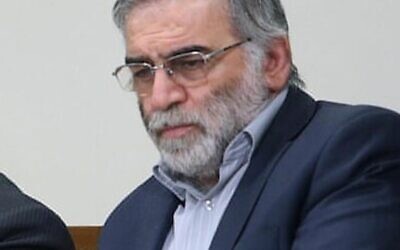
Earlier Saturday, both Iran’s supreme leader Ayatollah Ali Khamenei and Iranian President Hassan Rouhani vowed to respond to the slaying, with Rouhani directly blaming Israel for the assassination.In this cropped photo, Mohsen Fakhrizadeh sits in a meeting with supreme leader Ayatollah Ali Khamenei in Tehran, Iran, January 23, 2019. (Office of the Iranian supreme leader via AP)
Rouhani said that Fakhrizadeh’s death would not stop its nuclear program, something Khamenei said as well. Iran’s civilian nuclear program has continued its experiments and now enriches uranium up to 4.5 percent, far below weapons-grade levels of 90%.

The killing threatens to renew tensions between the US and Iran in the waning days of President Donald Trump’s term, just as President-elect Joe Biden has suggested his administration could return to Tehran’s nuclear deal with world powers from which Trump earlier withdrew. The Pentagon announced early Saturday that it sent the USS Nimitz aircraft carrier back into the Mideast.

In a statement, Khamenei called Fakhrizadeh “the country’s prominent and distinguished nuclear and defensive scientist.”

He said Iran’s first priority after the killing was the “definitive punishment of the perpetrators and those who ordered it.” He did not elaborate.

Rouhani said Iran would “respond to the assassination of Martyr Fakhrizadeh in a proper time.” He added: “The Iranian nation is smarter than falling into the trap of the Zionists. They are thinking to create chaos.”

The attack comes just days before the 10-year anniversary of the killing of Iranian nuclear scientist Majid Shahriari that Tehran also blamed on Israel. That and other targeted killings happened at the time that the so-called Stuxnet virus, believed to be an Israeli and American creation, destroyed Iranian centrifuges.

Those assaults occurred at the height of Western fears over Iran’s nuclear program. Tehran long has insisted its program is peaceful. However, Fakhrizadeh led Iran’s so-called AMAD program that Israel and the West have alleged was a military operation looking at the feasibility of building a nuclear weapon. The International Atomic Energy Agency says that “structured program” ended in 2003.

IAEA inspectors monitor Iranian nuclear sites as part of the now-unraveling nuclear deal with world powers, which saw Tehran limit its enrichment of uranium in exchange for the lifting of economic sanctions.

After Trump’s 2018 withdrawal from the deal, Iran has abandoned all those limits. Experts now believe Iran has enough low-enriched uranium to make at least two nuclear weapons if it chose to pursue the bomb. Meanwhile, an advanced centrifuge assembly plant at Iran’s Natanz nuclear facility exploded in July in what Tehran now calls a sabotage attack

US, world leaders mum on Fakhrizadeh killing; ex-CIA chief calls hit ‘reckless’

November 28, 2020


UN calls for restraint after assassination of Iranian nuclear scientist; Pompeo announces sanctions against supporters of Iran’s missile program; US aircraft carrier sails to Gulf

A photo released by Iran's semi-official Fars News Agency shows the scene where Mohsen Fakhrizadeh was killed in Absard, a small city just east of the capital, Tehran, Iran, Nov. 27, 2020. (Fars News Agency via AP)

By TOI STAFF and AGENCIESToday, 3:01 am  2A photo released by Iran’s semi-official Fars News Agency shows the scene where Mohsen Fakhrizadeh was killed in Absard, a small city just east of the capital, Tehran, Iran, Nov. 27, 2020. (Fars News Agency via AP)

US officials and world leaders remained mum on the killing of Iran’s top nuclear scientist Mohsen Fakhrizadeh as of Friday night, while the UN called for restraint and the former head of the CIA said the assassination was “highly reckless.”

There were no immediate comments from the White House, Pentagon, US State Department, CIA or US President-elect Joe Biden’s transition team.

The leaders of other countries were similarly silent. Israel has not commented on the killing and no group has claimed responsibility.

The former head of the CIA, John Brennan, called the assassination a crime that risked inflaming conflict in the region.

Brennan said he did not know who was to blame for the killing, as Tehran pointed the finger at Israel.Dr. Mohsen Fakhrizadeh in an undated photo. (Courtesy)
“This was a criminal act & highly reckless. It risks lethal retaliation & a new round of regional conflict,” Brennan said in a series of tweets.

“I do not know whether a foreign government authorized or carried out the murder of Fakhrizadeh,” he said. “Such an act of state-sponsored terrorism would be a flagrant violation of international law & encourage more governments to carry out lethal attacks against foreign officials.”

Brennan noted that Fakhrizadeh was not a designated terrorist or a member of a terror group, which would have made him a legal target.

A strong critic of US President Donald Trump, Brennan urged Tehran to “resist the urge” to retaliate and “wait for the return of responsible American leadership on the global stage,” referring to Biden, who will replace Trump in the White House on January 20.

US officials told CNN they were closely monitoring the aftermath of the assassination, but refrained from commenting publicly due to fears of further stoking the already tense regional situation.

The US military is not planning any action against Iran, and believes Tehran would respond quickly to any attacks with missile strikes, the report said, citing multiple US officials.

One American official told the network the killing “would be a big deal” and that US intelligence was looking for more information on the incident.

The USS Nimitz aircraft carrier and other US warships are moving into the Persian Gulf to support American troop withdrawals from Iraq and Afghanistan, but the move was decided before Fakhrizadeh’s assassination, a US defense official told CNN. The USS Nimitz left the Gulf earlier this month for maritime exercises in the Indian Ocean.

US Secretary of State Mike Pompeo announced on Friday evening that the US was sanctioning “four entities in China and Russia for their support of Iran’s missile program, which remains a significant proliferation concern.”

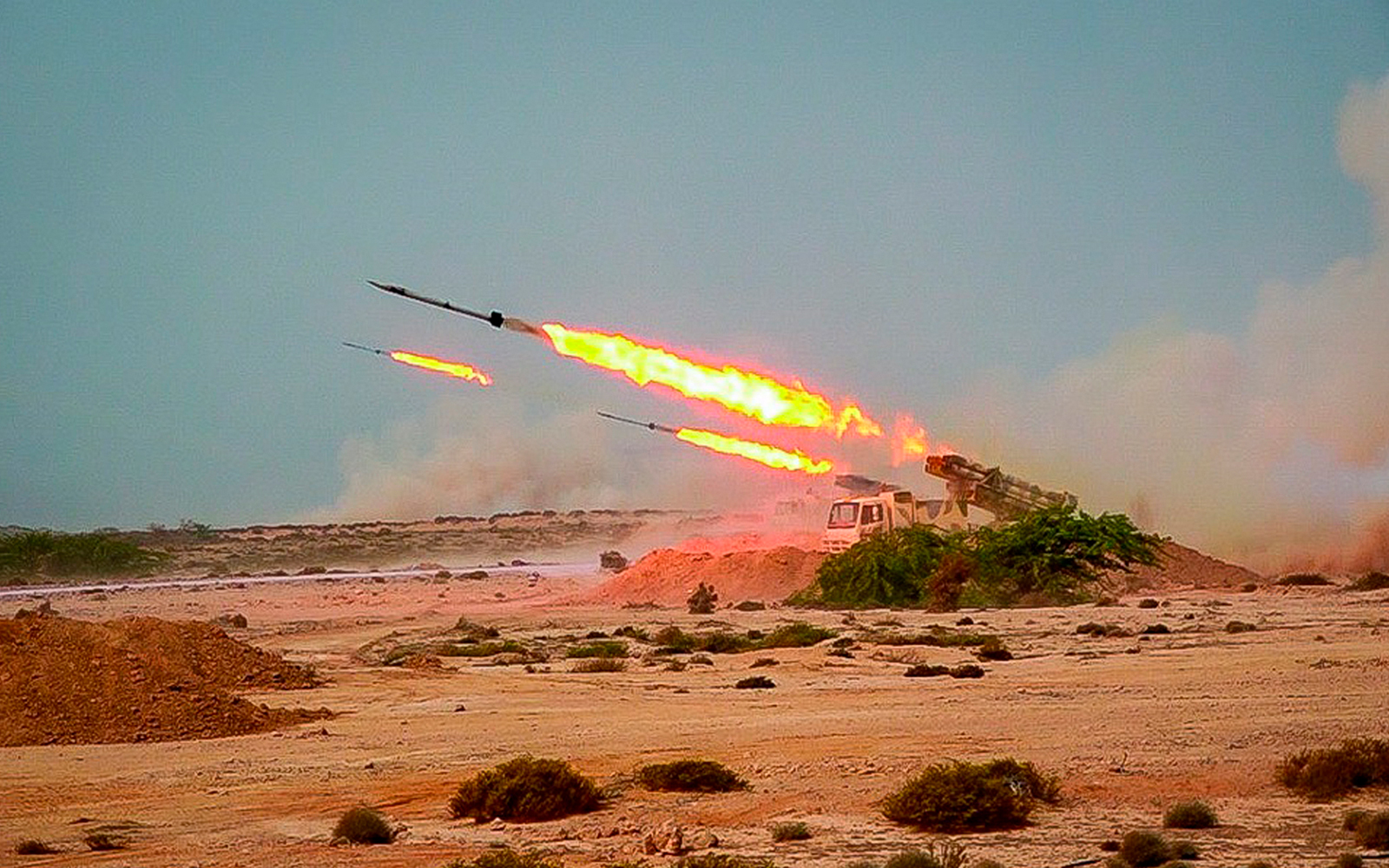
“We will continue to use all our sanctions tools to prevent Iran from advancing its missile capabilities,” Pompeo said, without mentioning the killing of Fakhrizadeh.Missiles are fired in an Iranian military exercise by the Islamic Revolutionary Guards Corps, July 28, 2020. (Sepahnews via AP)
Trump himself retweeted a posting from Israeli journalist Yossi Melman, an expert on the Israeli Mossad intelligence service, about the killing. Melman’s tweet called the killing a “major psychological and professional blow for Iran.”

US Senator Chris Murphy, the leading Democrat on the Senate’s Middle East subcommittee, said, “If the primary purpose of the killing of Mr. Fakhrizadeh was to make it harder to restart the Iran nuclear agreement, then this assassination does not make America, Israel or the world safer.”

“I have not yet been briefed on this incident, but: Every time America or an ally assassinates a foreign leader outside a declaration of war, we normalize the tactic as a tool of statecraft. The risk is that the security benefit can be very short lived,” Murphy said on Twitter.

At the United Nations, Secretary-General Antonio Guterres called for restraint following the killing.

“We have noted the reports that an Iranian nuclear scientist has been assassinated near Tehran today. We urge restraint and the need to avoid any actions that could lead to an escalation of tensions in the region,” his spokesman Farhan Haq said, according to Reuters.

Later on Friday, Iran sent a letter to Guterres and the UN Security Council alleging “serious indications of Israeli responsibility,” Reuters reported.

“Warning against any adventuristic measures by the United States and Israel against my country, particularly during the remaining period of the current administration of the United States in office, the Islamic Republic of Iran reserves its rights to take all necessary measures to defend its people and secure its interests,” said Iran’s UN envoy, Majid Takht Ravanchi.

The Hamas terror group said, “This assassination comes against the background of persistent American and Zionist threats against the Islamic Republic of Iran.”This photo released by the semi-official Fars News Agency shows the scene where Mohsen Fakhrizadeh was killed in Absard, a small city just east of the capital, Tehran, Iran, Nov. 27, 2020. Parts of image are blurred for potentially disturbing imagery. (Fars News Agency via AP)



Fakhrizadeh was killed Friday in an ambush in Absard, a village just east of the capital Tehran, Iran’s defense ministry said. The shadowy scientist was alleged to be the mastermind of Iran’s rogue nuclear weapons program.

Several top Iranian officials indicated they believed Israel was behind the killing in the hours after the attack, with one adviser to the Islamic Republic’s supreme leader vowing revenge.

The killing risks further raising tensions across the Mideast, nearly a year after Iran and the US stood on the brink of war after an American drone strike killed top Iranian general Qassem Soleimani in Baghdad.

It comes just as Biden stands poised to be inaugurated in January, and will likely complicate his efforts to return America to a pact aimed at ensuring Iran does not have enough highly enriched uranium to make a nuclear weapon.

Israel has long been suspected of carrying out a series of targeted killings of Iranian nuclear scientists nearly a decade ago, in a bid to curtail Iran’s nuclear program. Israeli TV coverage noted that Friday’s attack was far more complex than any of those previous incidents. Israel has never acknowledged assassinating people involved in the Iranian nuclear program.