Aviv Kohavi declares Israel will respond ‘forcefully’ to any assault, including by Iranian proxies
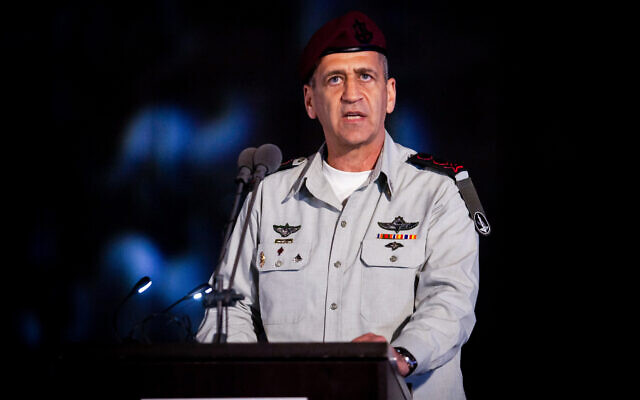
By TOI STAFF21 December 2020, 7:46 pm 0IDF Chief of Staff Aviv Kohavi speaks during an Israeli Navy ceremony in Haifa, on March 4, 2020. (Flash90)
Israel Defense Forces chief of staff Aviv Kohavi on Monday warned Iran against attacking Israel, saying that the Jewish state will retaliate forcefully against any aggression.
“Recently, we have heard increased threats from Iran against the State of Israel. If Iran and its partners, members of the radical axis [Iran, Syria, Hezbollah and Palestinian terror groups], whether in the first circle of states or the second, carry out actions against Israel, they will discover their partnership to be very costly,” Kohavi said at a ceremony honoring exemplary soldiers.
“The IDF will forcefully attack anyone who takes part, from near or far, in activities against the State of Israel or Israeli targets. I am saying this plainly and am describing the situation as it is — the response and all the plans have been prepared and practiced,” he added.
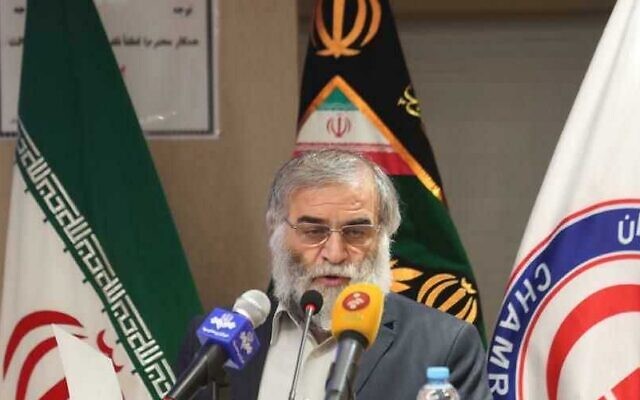
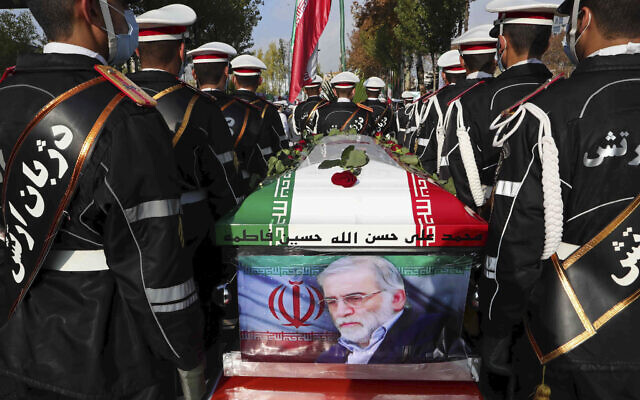
Iran has threatened to attack Israel since the assassination of its top nuclear scientist, Mohsen Fakhrizadeh, in late November, in a raid blamed on the Jewish state.Military personnel stand near the flag-draped coffin of Mohsen Fakhrizadeh, an assassinated top nuclear scientist, during his funeral ceremony in Tehran, Iran, November 30, 2020. (Iranian Defense Ministry via AP)
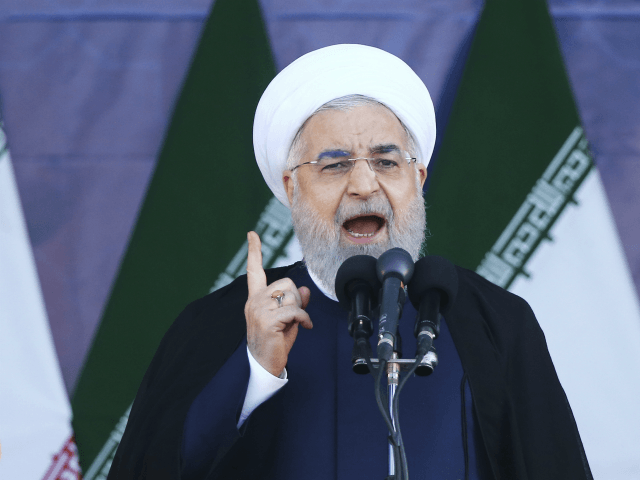
Last week, Iranian President Hassan Rouhani claimed that Israel was behind the killing, which he described as an effort to start a war during the last days of US President Donald Trump’s administration.
Israel, long suspected of killing Iranian nuclear scientists over the last decade, has repeatedly declined to comment on the attack.
“Waging instability and war in the final days of the Trump administration was the main aim of the Zionist regime in the assassination,” Rouhani said.
Rouhani vowed to avenge the killing, and said that his country would not allow Israel to decide the “time or venue“ of any retaliatory action. He said Iran would not allow instability in the region.
Israel insists that Iran still maintains the ambition of developing nuclear weapons, pointing to Tehran’s ballistic missile program and research into other technologies. Iran long has maintained that its nuclear program is for peaceful purposes.
Fakhrizadeh was named by Prime Minister Benjamin Netanyahu in 2018 as the director of Iran’s rogue nuclear weapons project. When Netanyahu revealed then that Israel had removed from a warehouse in Tehran a vast archive of Iran’s own material detailing its nuclear weapons program, he said: “Remember that name, Fakhrizadeh.”Prime Minister Benjamin Netanyahu stands in front of a picture of Mohsen Fakhrizadeh, whom he named as the head of Iran’s nuclear weapons program, April 30, 2018. (YouTube screenshot)
The group, known as Pay2Key, revealed its alleged hack in a tweet.
“Knock Knock! Tonight is longer than longest night for @ILAerospaceIAI,” the group wrote cryptically.
The state-owned Israeli Aerospace Industries said it was looking into the matter.
The Israeli cyber security firm ClearSky, which released a report on Pay2Key three days before the alleged IAI hack, said the group was likely an offshoot of an Iranian hacking cooperative known as Fox Kitten.
Iranian President Hassan Rouhani said Thursday he has “no doubt” a Joe Biden administration will rejoin the 2015 nuclear deal negotiated by Barack Obama and remove sanctions on Iran’s economy while embracing appeasement across the Middle East.
His assertion followed Supreme Leader Ali Khamenei who also backed the swift resumption of Iran’s commitments under the deal if it would finish U.S. sanctions, as Breitbart News reported.
“I have no doubt that the heroic national resistance of Iran is going to compel the future U.S. government to bow … and the sanctions will be broken,” Rouhani said Thursday.
The Washington Postreports the remarks were made at the inauguration of several infrastructure projects, where he spoke via videoconference.
On Wednesday, Khamenei had said in a televised address if U.S. sanctions “can be lifted in a correct, wise, Iranian-Islamic [and] dignified manner, this should be done.”
Tensions between Tehran and Washington soared during Donald Trump’s presidency as his administration brought Israel and the Gulf Arab states closer together while disciplining Iran for its human rights abuses and fostering of Islamic terrorism across the Middle East.
In 2018, Trump pulled Washington out of the Obama-negotiated Joint Comprehensive Plan of Action (JCPOA) nuclear deal with Tehran and reimposed punishing sanctions.
The so-called Iran nuclear deal was regarded as the “crown jewel” of the Obama-Biden administration’s efforts to deal with Tehran, however Trump saw otherwise.
“This was a horrible one-sided deal that should have never, ever been made,” Trump said at the time. “It didn’t bring calm, it didn’t bring peace, and it never will.”
This January, Trump ordered an air strike near Baghdad airport which killed senior Iranian terror organiser Qasem Soleimani.
Just last week a pair of U.S. B-52H Stratofortresses flew a show-of-force mission across the Persian Gulf in a display intended to deter attacks from Iran. The bombers were joined by fighter escorts from Saudi Arabia, Bahrain and Qatar.
An off-the-record conversation between Emirati and Israeli officials reveals a deeper impulse for forging ties than the immediate benefits each country has won for itself
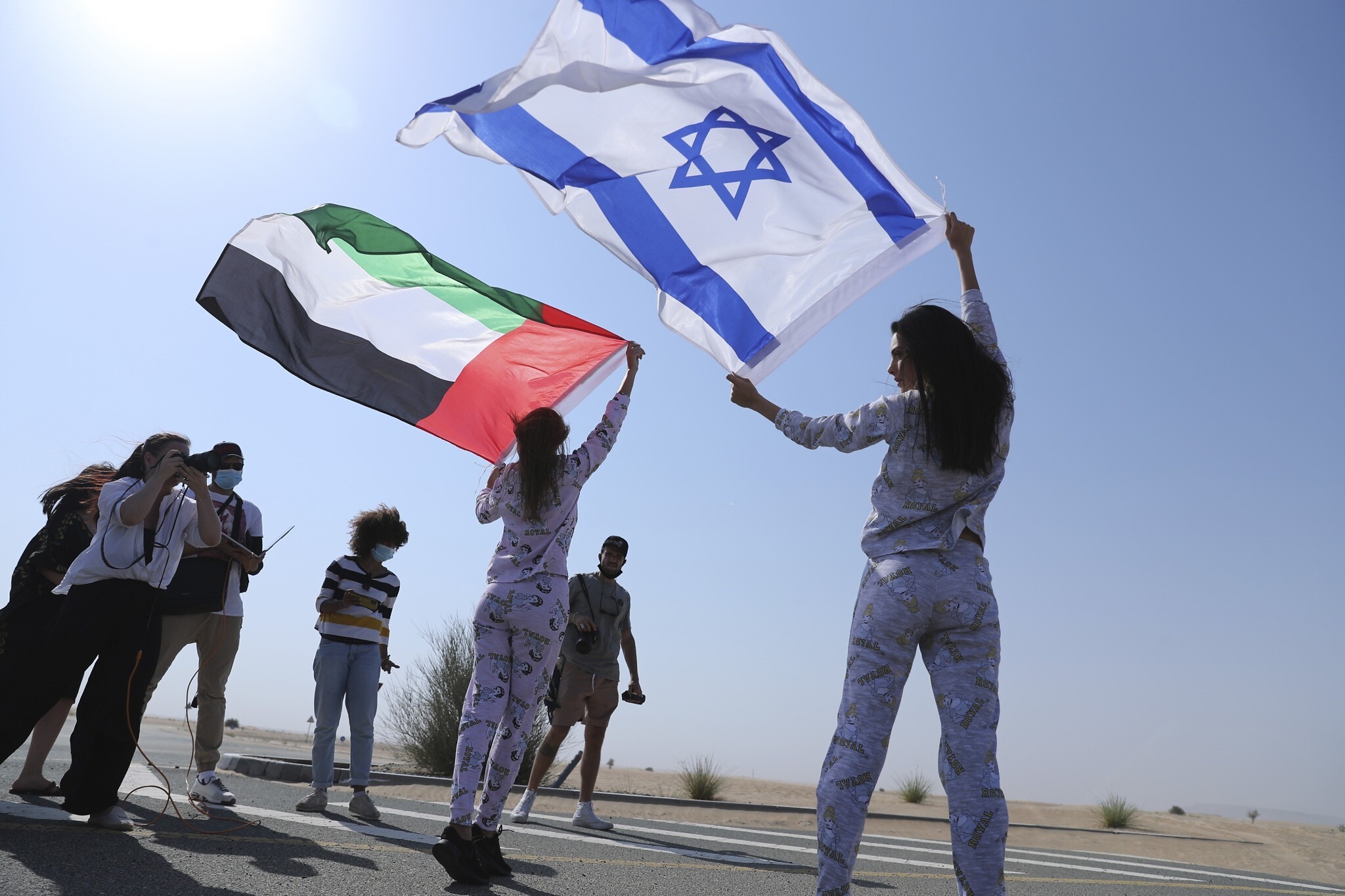
By HAVIV RETTIG GURToday, 12:33 pm 1Israeli model May Tager, right, holds Israel’s blue-and-white flag bearing the Star of David, while next to her Anastasia Bandarenka, a Dubai-based model originally from Russia, waves the Emirati flag, during a photo shoot in Dubai, United Arab Emirates, Sept. 8, 2020. (AP Photo/Kamran Jebreili)
“You think you have chutzpah? We have chutzpah.”
It was an unexpected line from a senior Emirati official, delivered recently in an off-the-record video conference call between current and former Israeli and Emirati officials.
The conversation had turned to business ties, innovation and the cultural differences between the two countries. The official wanted to explain something important about the new Israeli-Arab normalization agreements that Abu Dhabi had helped start: not only why they are happening, but why they seem so inexplicably warm and genuine.
The United Arab Emirates is most visible in this regard, but it isn’t the only one. Bahrain, too, is investing in a warm peace. And Sudan, while agonizing over the step itself — a breach of decades of ideological commitments vis-à-vis the Palestinians — has shown signs of wanting the normalization to reap more benefits than mere diplomatic contact or its removal from the US terror sponsors list.
There is no shortage of benefits that have accrued to the countries that normalized relations with Israel in the waning days of the Trump administration. The Emiratis asked for F-35s, the Moroccans recognition of their claim over Western Sahara, the Sudanese an end to their 27-year stay on the terror list and protection from lawsuits linked to the previous regime.
A protester against the normalization deal between Morocco and Israel in Rabat, Morocco, December 14, 2020. (AP Photo/Mosa’ab Elshamy)
These benefits all explain why each government might agree to establish full diplomatic ties with Israel. But they don’t explain, for example, the Emirati government’s order that hotels offer kosher food in time for the Jewish holiday of Sukkot, or the eagerness of the UAE and Bahrain for direct flights to Tel Aviv, or the decision by one sheikh to buy into Jerusalem’s controversial Beitar soccer club. They don’t explain Morocco’s move in recent weeks to introduce a curriculum about the history and culture of the country’s Jews into state school.
There are costs to that warmth. The Palestinians are furious not only at the opening of diplomatic relations — Egypt and Jordan already broke that taboo — but at what they see as a gratuitous embrace of Israel and Israelis. Iran, Muslim Brotherhood-linked regimes in Turkey and Qatar, and the opinions of many Arabs and Muslims from Morocco to Malaysia are against the move.
If Israel had the population or economy of, say, Germany, the economic factor might be sufficient explanation for the embrace. But it doesn’t. Israel’s population is roughly that of Honduras, its GDP roughly that of Ireland. Israeli tourists are not going to reshape Dubai’s economy, nor are Jewish pilgrims to heritage sites going to dramatically affect Morocco’s prosperity.DP World and Israeli Agrexco officials at the Fresh Market in Dubai, Nov. 2020 (DP World)
What, then, explains the apparent warmth of the new normalization? Where did this sudden show of affection come from?
There are two explanations for the unexpected openness. The first is often heard from Israeli officials, who have generally assumed that the new friendliness is meant to head off criticism. It’s a basic rule of politics both domestic and international: If you’re going to do something controversial, you’ll catch less flak by leaning into it than by apologizing for it.
The Emiratis believe they can neutralize more Arab criticism by embracing a warm peace with Israelis than by keeping their distance, the argument goes.
But there is a second explanation for the new warmth, one suggested by the senior Emirati official to his Israeli colleagues in that call.
At a superficial level, it has to do with the countries’ shared interest in fending off Iran. But the new interest in Israel isn’t about a narrowly conceived defense pact, arms sales or intel sharing. It’s about self-reliance.
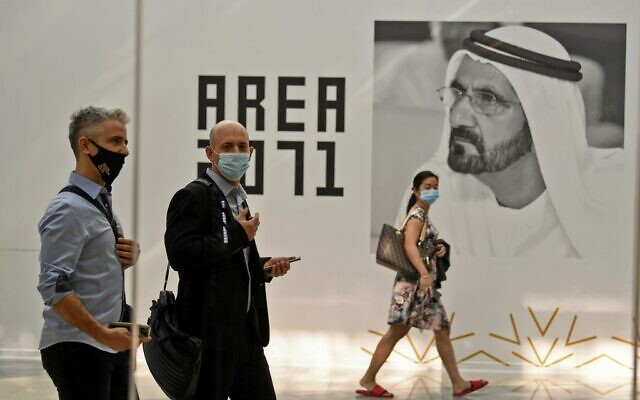
Members of an Israeli high-tech delegation walk past a poster of Dubai’s ruler Sheikh Mohammed bin Rashid al-Maktoum during a meeting with Emirati counterparts at the headquarters of the Government Accelerators in Dubai, on October 27, 2020. (Karim Sahib/AFP)
Sources of strength
Iranian President Hassan Rouhani presented his government’s budget earlier this month. It’s a budget of some 8.4 quadrillion rials, a 74 percent jump from last year’s budget in rial terms — but a 13% drop in its dollar value because of the ongoing crash of Iran’s currency.
The budget is fascinating for many reasons. It ups funding for the military and security forces, including the loyalist Revolutionary Guards. It assumes a $40 barrel of oil and an Iranian capacity to sell that oil in the coming year. It assumes, in short, that Iran’s economy will be liberated from crippling US sanctions once US President-elect Joe Biden takes office in January, and IRGC forces will be able to leap back into action throughout the Arab world.
But the most interesting point about the budget is the bottom line. Iran’s state budget for the coming Persian year (which begins in March) is valued at $33.7 billion.
Israel’s deadlocked parliament, on the other hand, has so far failed to pass a budget law for 2020 nor even propose one for 2021, but its 2019 budget carried a dollar value of some $140 billion when it passed into law. The stopgap spending bills that funded the government over the past year were also in that range.
Iran has a population of over 80 million people. Israel has barely 10 million. A fourfold budget for one-eighth the population means the Israeli government is spending, in extremely rough back-of-the-napkin terms, 32 times more per person than Iran.
In this picture released by the official website of the office of the Iranian supreme leader, worshipers chant slogans during Friday prayers ceremony, as a banner show Iranian Revolutionary Guard Gen. Qassem Soleimani, left, and Iraqi Shiite senior militia commander Abu Mahdi al-Muhandis, who were killed in Iraq in a US drone attack on January 3, 2020, and a banner which reads in Persian: “Death To America,” at Imam Khomeini Grand Mosque in Tehran, Iran, Friday, January 17, 2020. (Office of the Iranian Supreme Leader via AP)
That economic strength means Israel can afford a sprawling, sophisticated $20 billion army, an $8 billion espionage agency that’s second in size only to America’s Central Intelligence Agency (according to unconfirmed reports), and the kind of research and innovation programs that grant it a decisive advantage over Iran in cyber, missile defense and many more technological fields.
Replicating Israel
Lacking natural resources until very recently, Israel achieved that wealth largely on the strength of its human capital. And most of that human capital, fully half of the Jewish population and the large Arab minority in the country, hails from the Middle East.
There is a deep underlying thread of Arab-ness in Israeli Jewish culture that goes beyond the love of hummus and expressive Arabic epithets. Israelis’ assumptions about family, religion, and social and ethnic identity overlap profoundly with Arab-world cultural assumptions.
Israel is the lone OECD member state whose birthrate is high and rising, and the rate is rising among the highly educated and secular. Families are tight-knit and large, politics are centered on cultural, religious, and social tribes rather than policy arguments, and religion is viewed as an arbiter of identity even by those who don’t observe or believe. Taken together, these characteristics set Israel apart from the West, but are shared by many of the Muslim societies that surround it.
What is it about Israel, the most Arab-like people in the West — or perhaps the most Western of Arab-world peoples — that conferred on it its economic and political and military strengths?
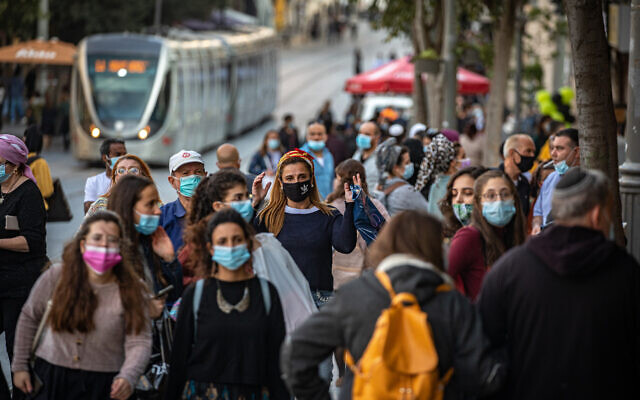
Israelis wearing face masks walk on Jaffa Street in downtown Jerusalem, on November 19, 2020. (Olivier Fitoussi/Flash90)
Jews speak of Israel’s accomplishments with pride, as a way of patting themselves on the back. Some in the Arab world are beginning to speak of those accomplishments, too, but in less sentimental terms. Their interest is diagnostic. What are the Israelis doing right, actually and specifically? And how do we replicate it?
The Emiratis are increasingly convinced that neither Israel nor America will come to their rescue in case of war. The lack of an American response to the Iranian missile assault on the Aramco facility in Saudi Arabia earlier this year drove that point home, but so did the decade-long drawdown of American deployments in the region under both Obama and Trump.
They cannot help noticing, too, that while the Gulf Arabs are protected by a physical American military presence, Israel, for all the financial aid it receives, is not protected by American troops. Israelis alone defend Israel, and even when Israel buys expensive military technologies from abroad, it’s not because it is unable to produce its own.
There is a strategic shift underway in the Emirati and broader Arab thinking about Israel. It is no mere reconciliation nor in any simple sense a defensive alliance. To those now starting to look at Israel beyond the scope of the Arab-Israeli and Palestinian-Israeli conflicts, here is a basically conservative, high-birthrate country that has managed to neutralize or even reverse the trends that plague Arab economies and societies, from their young, unemployed populations to their ethnic and religious sectarianism. Israel’s population is young but its unemployment is low — at least before the coronavirus pandemic — and its division into bickering sectarian tribes, as this writer and others have argued, is the source and main driver of its democracy.
Some in the Arab world now seek to study and absorb those strengths, and through them win for themselves the safety and security Israel has managed to eke out in a chaotic, conflict-prone region.
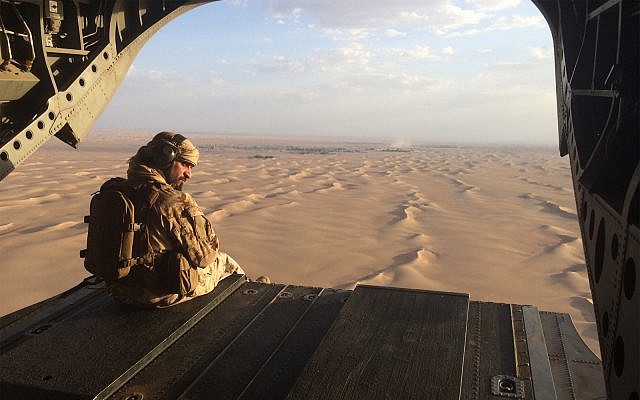
An Emirati gunner watches for enemy fire from the rear gate of a United Arab Emirates Chinook military helicopter flying over Yemen, September 17, 2015. (AP Photo/Adam Schreck, File)
nd for that, they don’t need Israel’s infantry or air forces, but its entrepreneurs and scientists. They need Israelis to bring their culture of innovation, their “chutzpah,” to Abu Dhabi and Dubai.
‘Second home’
It is no accident that even after the signing ceremonies were over and the news cameras gone, it was Bahrain’s industry and commerce minister who was sent to Israel to tour the length and breadth of the country and meet with business and tech leaders to hammer out agreements.
Nor is it an accident that the Emiratis have invested so much in ensuring Israel does not carry out a West Bank annexation, and in buying up its most scandalously racist soccer club — investing, that is, in making Israelis more palatable to the Arab world.
“You think you have chutzpah? We have chutzpah,” the Emirati official told his Israeli counterparts in that video call.
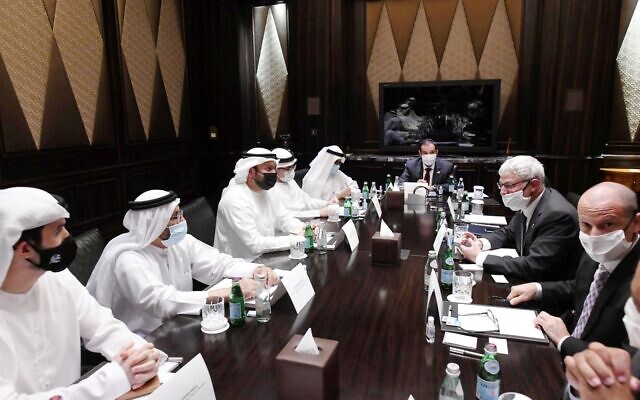
In a conversation about what the two countries stand to gain from the peace, he explained: “We have a very young population. We have a lot of people who are interested in learning from these ties.”Emirati and Israeli officials discuss future cooperation agreements in Abu Dhabi on August 31, 2020. (Amos Ben-Gershom/GPO)
It remains to be seen if Arab states like the UAE can replicate Israel’s strengths. Israelis themselves have only vague notions about the sources of those strengths. Does democracy play a factor? Or can a monarchical state import from a democratic one its culture of innovation without any political adjustments?
The Emiratis are betting that it can, as when a bewildered Israeli asked the Emirati official on the call: “What did ordinary Emiratis think of Israelis before the new ties?”
The official answered: “We’re a country that has a deep respect for our leaders, whose responsibility it is to lead. Our people trust their leaders, so when they decided to make peace with Israel, everyone became very genuinely excited about it.”
There are two ways to hold at bay an enormous and aggressive Iran perched on one’s doorstep. One can rely on stronger friends, or one can become one of those stronger friends. Emirati officials have insisted repeatedly to Israelis visiting the country in recent weeks that they should consider the UAE their “second home.” They mean it more emphatically than their Israeli visitors suspect.
The expected return of former Vice President Joe Biden to the White House will likely end the Trump administration’s “maximum pressure” campaign on Iran, allowing the Islamist regime to expand its influence in the region and triggering alarm among its neighbors.
Biden’s statements on Iran – indicating he would be amenable to a return to the 2015 Iran nuclear deal and further concessions to Tehran – are a wakeup call for Saudi Arabia, the Gulf Cooperation Council (GCC), and Egypt that they can no longer depend on the United States to protect them from a nuclear Iran and the time has come to consider developing their own nuclear arsenals.
Saudi Arabia, eager to have a good working relationship with Biden, wasted no time in congratulating him for his victory and did so in 24 hours. But days later, the Saudi Minister of State for Foreign Affairs Adel al-Jubeir made it clear that Riyadh would definitely consider arming itself with nuclear weapons if Iran acquired them.
Asked in November if Riyadh would consider nuclear development in the face of a nuclear-armed Iran, al-Jubeir said it was “definitely an option.” He has made this threat before. It was voiced when Saudi Arabia feared the mullahs would use the newfound cash they were receiving under the Joint Comprehensive Plan of Action (JCPOA) in 2015 to fund various nefarious activities (i.e., terrorism) and when tensions between Riyadh and Tehran heightened as Iranian supported the Houthi rebels in Yemen.
Since the JCPOA, or Iran nuclear deal, paved the way for Iran to acquire nuclear weapons despite assurances otherwise, any discussions about a new agreement will see Iran demanding nothing less. Tehran is already making it clear, while the U.S. is obliged to return to the nuclear deal, it will cost us to do so.
Foreign Minister Mohammad Javad Zarif, who negotiated the agreement with Secretary of State John Kerry, sounded a bit like an old Smith Barney commercial in which the brokerage house claimed to make money the old fashioned way — by earning it. Zarif claims the U.S. now has to “earn” the right to return to the deal by fulfilling its commitments since its withdrawal — which means he is looking for a similar financial windfall as Tehran received for agreeing to JCPOA originally. Interestingly, and somewhat curiously, since Iran never actually signed JCPOA, a legal argument could be made the U.S. owes Tehran nothing —but it is an argument Biden likely will not make.
Skeptics believing a Middle East nuclear arms race is many years down the road fail to realize Riyadh can join the race almost instantaneously. Having helped Pakistan fund its nuclear defenses for years, Saudi Arabia did so with a tacit understanding that if it needed such weapons from Islamabad, they would be provided. Since Iran continues to be firmly committed to knocking Saudi Arabia off its pedestal as custodian of Islam’s Two Holy Cities, to establishing a Shia caliphate as the leader of the Islamic world, and to triggering the return of the “Hidden Imam” – all goals pointing to a nuclear attack on Saudi Arabia – Riyadh will quickly press Pakistan to make good on their understanding.
The prospect of a Middle East nuclear arms race should make us pause and reflect upon how two former leaders — one Iranian and the other American — viewed a nuclear-armed world.
In 1980, Iranian Supreme Leader Ruhollah Khomeini said, “We do not worship Iran, we worship Allah. I say let this land burn. I say let this land go up in smoke, provided Islam remains triumphant in the rest of the world.” It tells us a militant Iran does not fear its own destruction in its plan to destroy other nations.
In 2009, President Obama described his policy of the “audacity of hope” by announcing he sought to create a world free from nuclear weapons.
Ironically, Obama’s dream could be shattered by a nuclear arms race ignited by his former vice president.
Lt. Colonel James G. Zumwalt, USMC (Ret.), is a retired Marine infantry officer who served in the Vietnam war, the U.S. invasion of Panama, and the first Gulf war. He is the author of Bare Feet, Iron Will–Stories from the Other Side of Vietnam’s Battlefields, Living the Juche Lie: North Korea’s Kim Dynasty and Doomsday: Iran–The Clock is Ticking. He is a senior analyst for Ravenna Associates, a corporate strategic communications company, who frequently writes on foreign policy and defense issues.
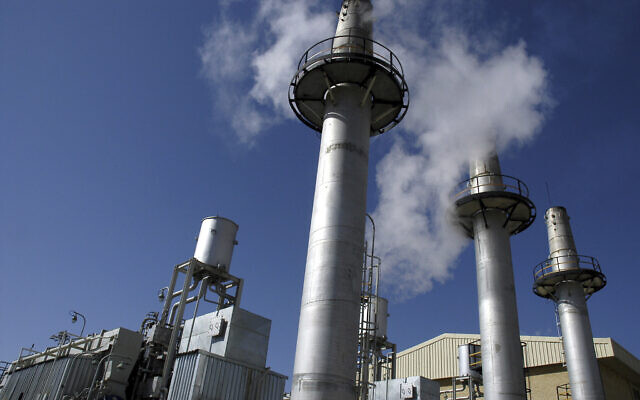
The exterior of the Arak heavy water production facility in Arak, Iran, 360 kilometers southwest of Tehran, October 27, 2004. (AP Photo)
UNITED NATIONS (AP) — Secretary-General Antonio Guterres is urging Iran to address concerns raised about its nuclear and ballistic missile programs and return to “full implementation” of its 2015 nuclear deal with major powers.
The UN chief expressed regret in a report to the Security Council obtained Tuesday by The Associated Press that the Trump administration withdrew from the agreement in 2018 and re-imposed sanctions against Tehran, and at Iran’s 2019 decision to violate limits in the deal including on centrifuges and enriching uranium.
Guterres said in the report on implementation of a council resolution endorsing the 2015 nuclear agreement that for the last five years the nuclear deal “has been largely viewed by the international community as a testament to the efficacy of multilateralism, diplomacy and dialogue, and a success in nuclear nonproliferation.”
But US President Donald Trump has waged war on the nuclear agreement, denouncing it during the 2016 campaign as the worst deal ever negotiated, and he has kept up opposition in the years since the US pullout in 2018.
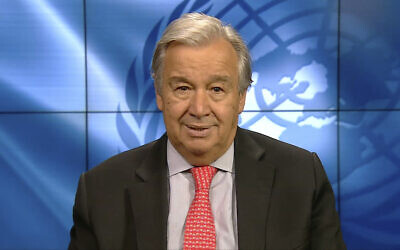
UN Secretary General Antonio Guterres speaks at an online video conference on September 3, 2020 (Ministry of Environment Government of Japan via AP)
The Trump administration maintains the agreement — the Joint Comprehensive Plan of Action or JCPOA — is fatally flawed because certain restrictions on Iran’s nuclear activity gradually expire and will allow the country to eventually develop atomic weapons. In August, Secretary of State Mike Pompeo formally notified the UN that it was invoking a provision of the 2015 deal to restore UN sanctions, citing significant Iranian violations and declaring: “The United States will never allow the world’s largest state sponsor of terrorism to freely buy and sell planes, tanks, missiles and other kinds of conventional weapons … (or) to have a nuclear weapon.”
But the remaining parties to the JCPOA — Russia, China, Britain, France and Germany — as well as the overwhelming majority of the Security Council called the US action illegal because the US had withdrawn from the treaty. The council and the secretary-general both said there would be no action on the US demands — which meant there would be no UN demand for countries to re-impose UN sanctions on Iran.
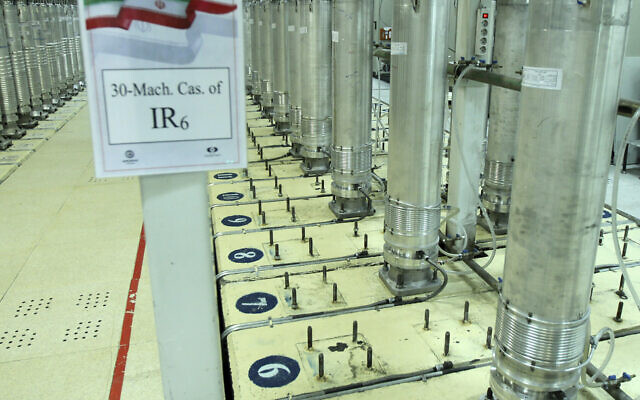
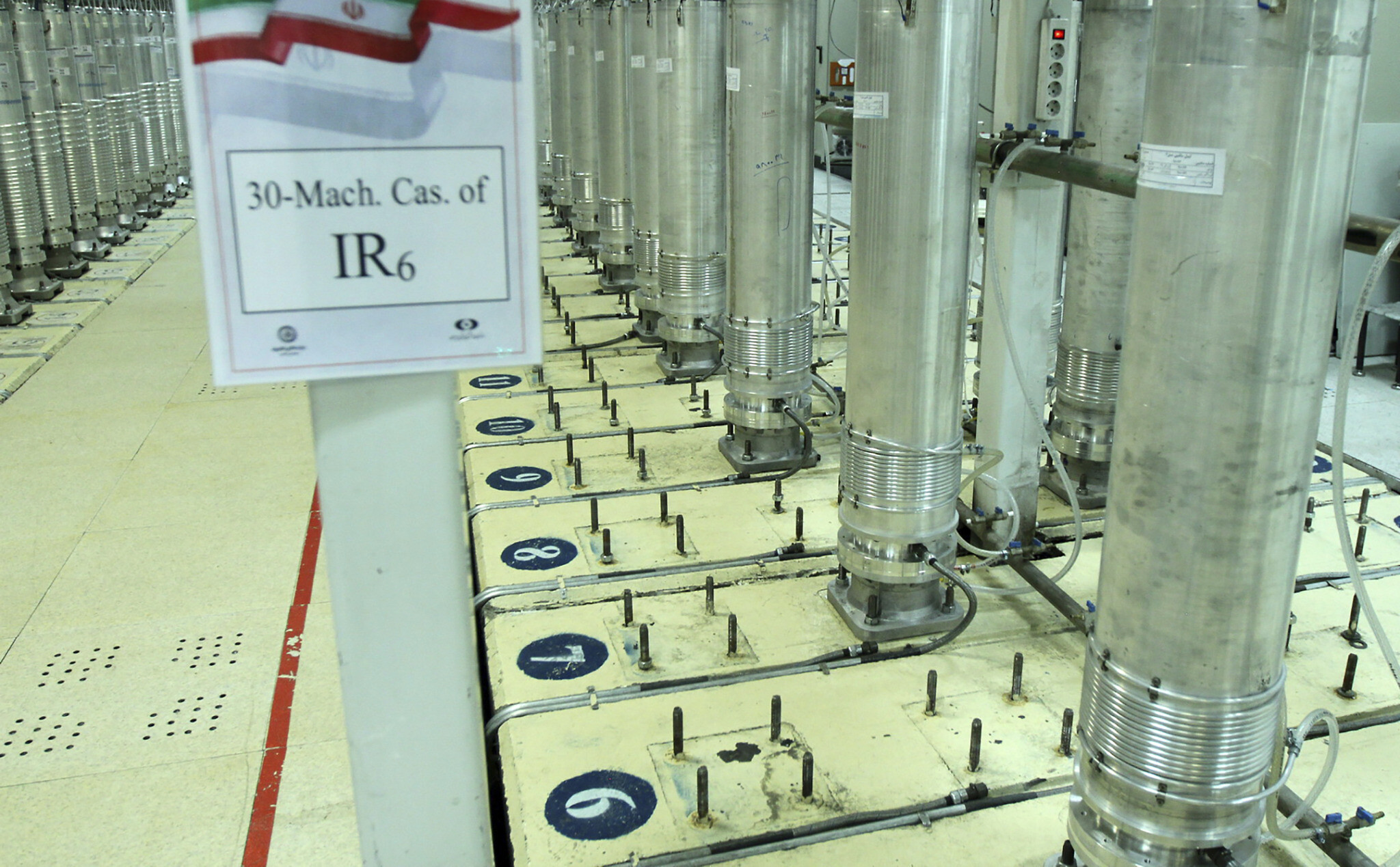
This photo released November 5, 2019, by the Atomic Energy Organization of Iran, shows centrifuge machines in the Natanz uranium enrichment facility in central Iran. (Atomic Energy Organization of Iran via AP, File)
Nonetheless, concerns by the US as well as the European parties to the JCPOA have increased, especially with Iran continuing to violate the deal’s limits. Iran has openly announced all its violations of the nuclear deal in advance and said they are reversible.
The deal promised Iran economic incentives in exchange for the curbs on its nuclear program. Since the US withdrawal and its imposition of new sanctions, Tehran has tried to put pressure on the remaining parties using the violations to come up with new ways to offset the economy-crippling actions by Washington.
Secretary-General Guterres recounted the US actions and Security Council response in the report and stressed again “the importance of initiatives in support of trade and economic relations with the Islamic Republic of Iran, especially during the current economic and health challenges posed by the COVID-19 pandemic.”
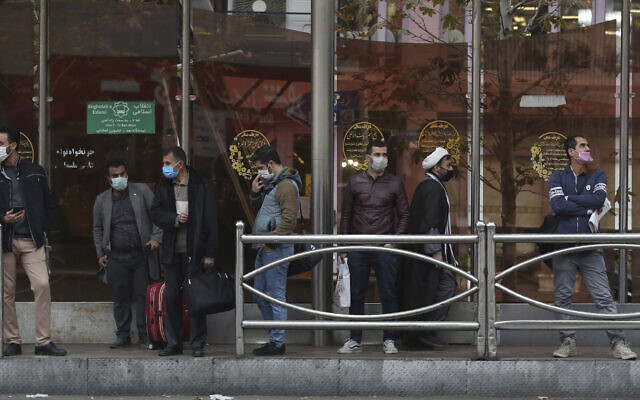
People wearing face masks to help prevent the spread of the coronavirus wait at a bus stop in downtown Tehran, Iran, December 5, 2020. (AP Photo/Vahid Salemi)
As for implementation of the 2015 Security Council resolution endorsing the JCPOA, the secretary-general said he focused on restrictions on nuclear, ballistic missile, and arms-related transfers to or from Iran.
He said Israel provided information about the presence of four alleged Iranian Dehlavieh anti-tank guided missiles in Libya in June. On the basis of photographic evidence, he said, one missile “had characteristics consistent with the Iranian-produced Dehlavieh” but the UN Secretariat has been unable to determine if it had been transferred to Libya in violation of the resolution.
On Australia’s June 2019 arms seizure, Guterres said analysis of high-definition images of some material determined that “the 7.62 mm ammunition in this seizure were not of Iranian manufacture.”
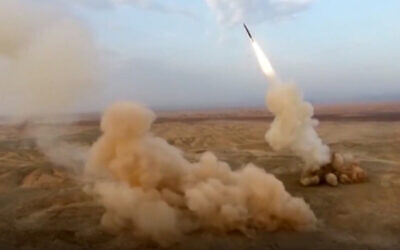
Illustrative — This frame grab from video shows the launching of underground ballistic missiles by the Iranian Revolutionary Guard during a military exercise. (Sepahnews via AP)
The secretary-general said the UN received information that an unnamed “entity” on the sanctions blacklist took actions “inconsistent” with its frozen assets and actions to ship “valves, electronics, and measuring equipment suitable for use in ground testing of liquid propellant ballistic missiles and space launch vehicles” to Iran. He said the UN Secretariat is seeking further information.
The Security Council is scheduled to discuss the report on Dec. 22.
But Iranian president says Tehran will only do so if pact’s other signatories ‘resume all of their commitments’; hints he won’t sign bill to increase uranium enrichment to 20%
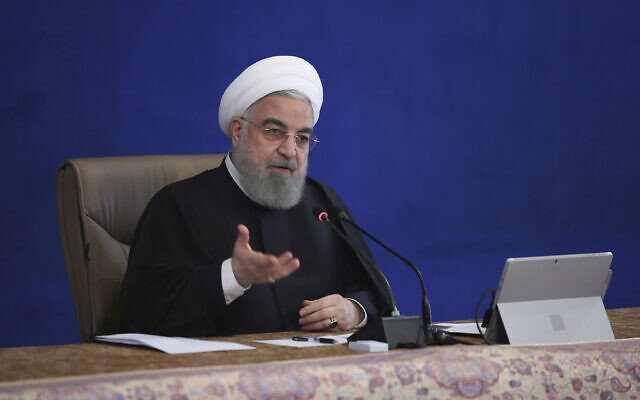
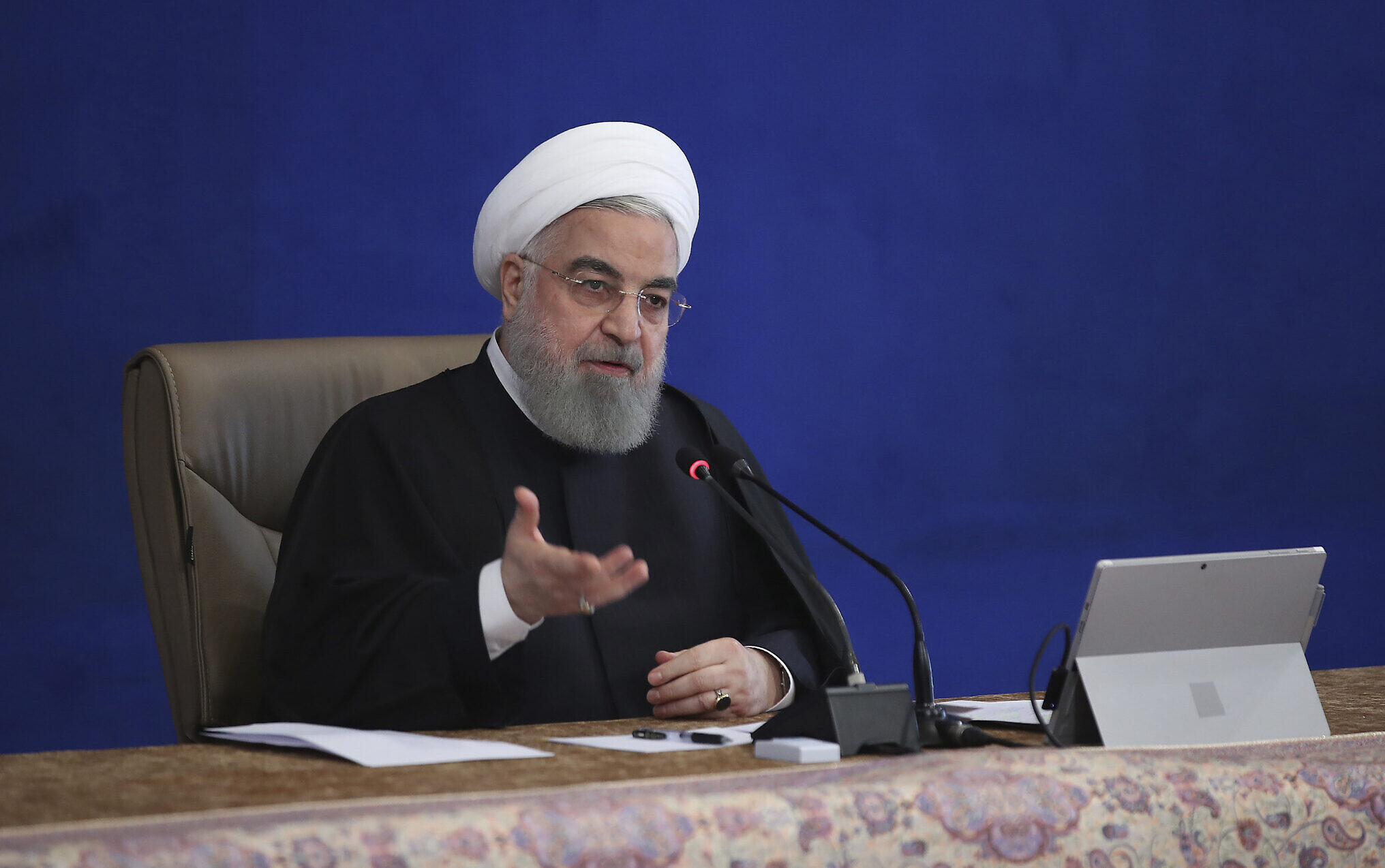
By AFPToday, 4:54 pm 0In this photo released by the official website of the office of the Iranian Presidency, President Hassan Rouhani speaks in a cabinet meeting in Tehran, Iran, December 2, 2020. (Iranian Presidency Office via AP)
TEHRAN, Iran — Iran is ready to return to full compliance with a 2015 nuclear deal with major powers as soon as the other parties honor their commitments, Iranian President Hassan Rouhani said Wednesday.
The agreement between Iran and major powers has teetered on the brink of collapse since outgoing US President Donald Trump pulled out of it in 2018 and reimposed crippling unilateral sanctions.
US President-elect Joe Biden has expressed readiness to return to the agreement but over the past 18 months Iran has suspended the implementation of some of its own obligations, including key limits to its uranium enrichment program.
“Just as soon as the 5+1 or 4+1 resume all of their commitments, we will resume all of ours,” Rouhani said.
He was referring to the five veto-wielding permanent members of the UN Security Council plus Germany with whom Iran reached the nuclear deal.
“I’ve said it before — it doesn’t take time, it’s just a question of willing,” he said in comments to his cabinet aired by state television
This photo released November 5, 2019, by the Atomic Energy Organization of Iran, shows centrifuge machines in the Natanz uranium enrichment facility in central Iran. (Atomic Energy Organization of Iran via AP, File)
Defying criticism from Iran’s ultra-conservatives, Rouhani reiterated his determination to seize the “opportunity” presented by the change of US president in January.
Parliament, which has been controlled by conservatives since a February election marred by record low turnout, passed a bill last week that threatens the prospects for a thaw in relations with Washington.
The bill, which still has to be signed into law by Rouhani, would relaunch Iran’s enrichment of uranium to 20 percent purity and threaten other future measures that would likely sound the death knell of the nuclear deal.
In a blow to the president, the Guardian Council, which arbitrates disputes between parliament and the government, approved the bill last week.
But in his comments on Wednesday, Rouhani appeared to suggest that he would withhold his signature from the bill.
“It is vital that we speak with a single voice,” the president told ministers.
“People voted for a platform… and they want four years of action,” said Rouhani, who won re-election in 2017 with more than 57 percent of the vote.
People wearing face masks to help prevent the spread of the coronavirus wait at a bus stop in downtown Tehran, Iran, December 5, 2020. (AP Photo/Vahid Salemi)
Rouhani said Iran remained unable to purchase COVID-19 vaccines because banks were unwilling to process the transaction for fear of falling foul of US sanctions.
Iran is the Middle Eastern country hardest-hit by the coronavirus pandemic with more than 51,000 deaths from nearly 1.1 million cases, according to official figures.
Vaccines and other humanitarian goods are supposed to be exempt from the US sanctions but in practice few if any banks are willing to take the chance.
“We want to buy the vaccine… the money is… ready but no bank will handle the transaction,” Rouhani told ministers.
France, Germany and UK say announcement by Tehran violates nuclear deal, reiterate commitment to 2015 pact
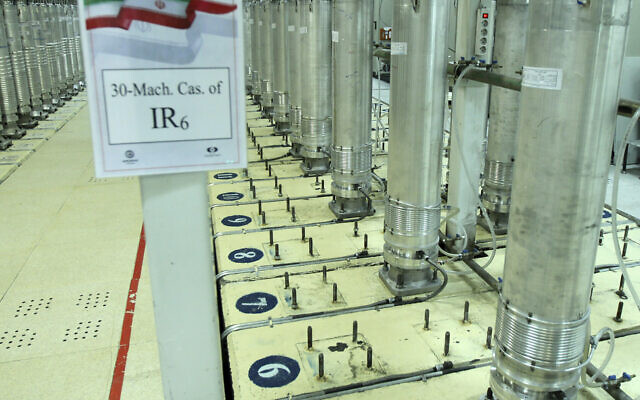
By AGENCIES and TOI STAFFToday, 1:17 pm 0Centrifuge machines in the Natanz uranium enrichment facility in central Iran, November 5, 2019. (Atomic Energy Organization of Iran via AP, File)
Plans by Iran to install advanced centrifuges at its main nuclear enrichment plant in Natanz are “deeply worrying,” France, Germany and the UK said on Monday.
The three governments, dubbed the E3, said the plans were contrary to the 2015 agreement between Tehran and world powers that aimed to restrain Iran’s nuclear program by barring sophisticated centrifuges.
The development came days after Iran informed the International Atomic Energy Agency (IAEA) that it planned to install several cascades, or clusters, of advanced uranium-enriching centrifuges at the Natanz plant in violation of its commitments under the nuclear deal.
“In a letter dated 2 December 2020, Iran informed the Agency that the operator of the Fuel Enrichment Plant (FEP) at Natanz ‘intends to start installation of three cascades of IR-2m centrifuge machines at FEP,” a confidential IAEA report to its member states said, Reuters reported Friday.
Under the deal, Iran is only permitted to use the less advanced, less efficient first-generation IR-1 centrifuges at the fortified underground plant.
The US imposed crippling sanctions on Iran after President Donald Trump unilaterally withdrew from the nuclear agreement in 2018. In response, Iran began publicly exceeding enrichment limits set by the agreement while saying it would quickly return to compliance if the United States did the same.
The three European countries said Monday that the deal, officially called the Joint Comprehensive Plan of Action (JCPOA), was the best and currently the only way to monitor and constrain Iran’s nuclear program.
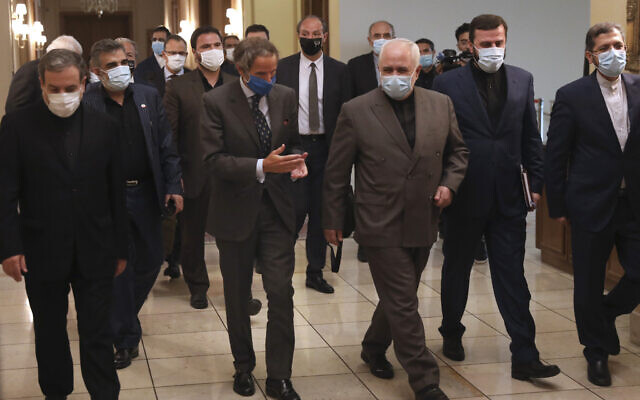
The director general of the International Atomic Energy Agency (IAEA), Rafael Mariano Grossi, center left, speaks with Iran’s Foreign Minister Mohammad Javad Zarif, center, before a meeting in Tehran, Iran, August 25, 2020. (AP Photo/Vahid Salemi)
The IAEA, the UN’s nuclear watchdog, said last month that Iran had installed and begun operating advanced centrifuges at an underground section at Natanz.
“Iran’s recent announcement to the IAEA that it intends to install an additional three cascades of advanced centrifuges at the Fuel Enrichment Plant in Natanz is contrary to the JCPOA and deeply worrying,” the E3 said.
Since May last year, Iran has taken steps to violate that limit and several others laid down in the deal in retaliation for Trump’s withdrawal from the accord in 2018 and subsequent reimposition of sanctions.
Iran is seeking to step up pressure on the incoming Joe Biden US administration to return to the original deal. Biden has indicated he will return to the accord but said he wants to institute changes.
Iran’s Foreign Minister Mohammad Javad Zarif attends a news conference with Venezuela’s Foreign Minister Jorge Arreaza in Caracas, Venezuela, November 5, 2020. (AP Photo/Matias Delacroix)
Iranian Foreign Minister Mohammad Javad Zarif said Thursday his country wouldn’t agree to renegotiate elements of the international accord limiting its nuclear program.
“It will never be renegotiated. Period,” Zarif told a conference in Italy, speaking remotely.
Meanwhile, Israel’s Prime Minister Benjamin Netanyahu doubled down on his stance that Biden’s plan to re-enter the nuclear deal would be misguided.
“It’s a mistake to go back to the JCPOA. You shouldn’t go back to that flawed agreement,” he said in a televised interview with the DC-based Hudson Institute’s Michael Doran.
Last Wednesday, a key Iranian panel signed off on a bill — approved by parliament the previous day — to suspend UN inspections and boost uranium enrichment, sending it to Iran’s President Hassan Rouhani, who opposes the measure.
The move appeared to be a show of defiance after the killing — reportedly by Israel — of Mohsen Fakhrizadeh, a key figure in Iran’s nuclear program seen as the father of its plans to build an atomic bomb.
Report says ex-PM Olmert played top-secret recording of Fakhrizadeh for President Bush in decisive 2008 meeting that boosted US-Israel cooperation against Iran’s nuclear program
Israel intelligence managed to recruit an Iranian official close to the recently assassinated Mohsen Fakhrizadeh and recorded the nuclear scientist speaking about his efforts to produce “five warheads” on behalf of the Islamic Republic, according to a Friday report in the Yedioth Ahronoth daily.
This top-secret recording was played in 2008 by former prime minister Ehud Olmert for then-president George W. Bush during a visit by Bush to Israel and was a key element in convincing the Americans to step up efforts to combat Iran’s nuclear program, the report said.
The report quoted several unnamed Israeli and Middle Eastern intelligence officials, along with recollections from former prime minister Ehud Barak, who was then serving as Olmert’s defense minister.
It said Olmert was so concerned about safeguarding the source of the recording that he refused to play it while anyone else was in the room, including Bush’s national security adviser Stephen Hadley.Israeli Prime Minister Ehud Olmert welcomes US President George W. Bush to Israel, at Ben Gurion International Airport on May 14, 2008. (Nati Shohat/Flash90)
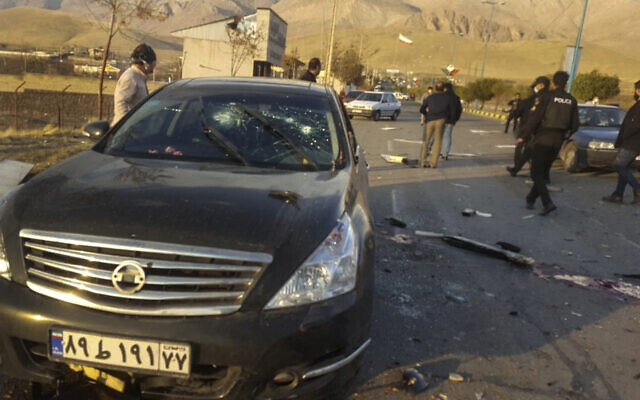
Fakhrizadeh, the scientist said by Israel and the US to head Iran’s rogue nuclear weapons program, was killed in a military-style ambush last Friday on the outskirts of Tehran. The attack reportedly saw a truck bomb explode and gunmen open fire on Fakhrizadeh.
Iran has accused Israel of carrying out the November 27 hit, and threatened revenge. Israel, which has been linked to a succession of killings of Iranian nuclear scientists, has not publicly commented on the allegations that it was responsible. It has warned its citizens traveling abroad that they may be targets of Iranian terror attacks in the wake of the killing.This photo released by the semi-official Fars News Agency shows the scene where Mohsen Fakhrizadeh was killed in Absard, a small city just east of the capital, Tehran, Iran, Friday, Nov. 27, 2020. (Fars News Agency via AP)
According to the Yedioth report, written by the newspaper’s well-connected investigative reporter Ronen Bergman, Israel had been compiling a dossier on Fakhrizadeh for nearly three decades, long discounting the scientist’s claims that he had nothing to do with any weapons program.
For Israel, the recordings were the final proof that Iran’s nuclear program was not peaceful, as Tehran repeatedly claimed.
Olmert was methodical in the way he revealed the material to Bush, the report said.
The US president had come to Israel in May 2008 as the country marked the 60th anniversary of its founding.Former National Security Advisor to president George W. Bush Stephen Hadley at the Saban Forum on December 5, 2015 (YouTube screen grab)
Olmert hosted a dinner at the Prime Minister’s Residence in Jerusalem and just before dessert, Olmert, Bush, Hadley and Barak, who was defense minister at the time, headed to a side-room. It was there that Barak asked Bush if the US could supply Israel with a series of weapons it did not have in its arsenal, according to the report. Yedioth said these were believed to be vertical take-off and landing aircraft, along with bunker-busting bombs.
Hadley in the previous weeks had been briefing Bush about Israeli desires to carry out a strike against Iran’s nuclear program and Bush immediately understood what Barak wanted the weapons for.
According to Barak, Bush responded to the request by pointing at the defense minister and saying, “This guy frightens me.”
Bush then got to the point. “I want you to know the official position of the United States government. The US strongly opposes Israel taking action against the Iranian nuclear program,” Barak recalled the president replying.
“And in order not to be vague, I will tell you that the United States does not intend to act either as long as I serve as president,” Bush added, according to Barak.
Seemingly expecting the negative response from Bush, Olmert decided he’d make use of the recording the next day when he was meeting the president and Hadley at his office.US President George W. Bush visits the historical Masada site together with Israeli Prime Minister Ehud Olmert, May 15, 2008. (Ariel Jerozolimski/Flash90)
According to the report, Olmert asked the national security adviser to leave the room. Hadley insisted on staying, arguing that protocol required him to be present when matters of national security were being discussed.
But Olmert was adamant and Bush assured Hadley it was okay for him to be left alone with the prime minister, the report said.
“I’m going to play you something, but I ask that you not talk about it with anyone, not even with the director of the CIA,” the report quoted Olmert as telling Bush from within the closed-door meeting. Bush reportedly agreed to the request.
Olmert pulled out a recording device, hit play and a man could be heard speaking in Persian.
“The man speaking here is Mohsen Fakhrizadeh,” Olmert reportedly explained. “Fakhrizadeh is the head of the “AMAD” program, Iran’s secret military nuclear project. The one it denies exists at all,” Olmert told Bush according to the report.
The prime minister then revealed that Israeli intelligence services had managed to recruit an Iranian agent close to Fakhrizadeh who had been feeding Jerusalem information on the nuclear scientist for years.
Military personnel stand near the flag-draped coffin of Mohsen Fakhrizadeh, a nuclear scientist who was killed on Friday, during a funeral ceremony in Tehran, Iran, November 30, 2020. (Iranian Defense Ministry via AP)
Olmert provided Bush with an English-language transcript of what Fakhrizadeh had said in Persian.
According to the report, Fakhrizadeh could be heard giving details about the development of Iranian nuclear weapons. However, the Yedioth report only quotes selected phrases, without the word nuclear. The scientist complains that the government is not providing him with sufficient funds to carry out his work. On the one hand, Fakhrizadeh says, in an apparent reference to his superiors, “they want five warheads,” but on the other, “they aren’t letting me work.”
Fakhrizadeh then goes on to criticize colleagues in the defense ministry and the Islamic Revolutionary Guard Corps, according to the report.
Bush read the recording’s translation and reacted with silence. Yedioth claimed the recording served as a “smoking atomic gun” for Olmert.
The premier recognized that Bush would not sell Israel the weapons it was looking for, so he made a new request: full intelligence cooperation on the Iranian nuclear issue.
When Bush agreed, Olmert decided to up the ante and proposed that the two carry out joint operations against Iran’s nuclear project, Yedioth said.
This photo released by the semi-official Fars News Agency shows the scene where Mohsen Fakhrizadeh was killed in Absard, a small city just east of the capital, Tehran, Iran, Friday, Nov. 27, 2020. (Fars News Agency via AP)
The president agreed to this as well, the report said.
Senior officials in Olmert’s office at the time told Yedioth the recording served as a “defining moment” in the two countries’ joint effort to prevent Iran from obtaining a nuclear bomb.
One apparent instance of such cooperation was the Stuxnet computer virus, which was uncovered in 2010 and was widely reported to have been developed together by US and Israeli intelligence. Stuxnet penetrated Iran’s rogue nuclear program, taking control and sabotaging parts of its enrichment processes by speeding up its centrifuges. Up to 1,000 centrifuges out of 5,000 were eventually damaged by the virus, according to reports, setting back the nuclear program.
Yedioth speculated that the Stuxnet plan, called Operation Olympic Games, was born as a result of Olmert’s revelation of the Fakhrizadeh recording to Bush.
However, other reports have said that Bush gave the go-ahead for the operation as early as 2006.
The recording was just one part of the trove of evidence that Israel has gathered on Fakhrizadeh and Iran’s nuclear program over the years, Yedioth noted.
In 2018, the Mossad spirited a huge trove of documentation out of a warehouse in Tehran, detailing Iran’s rogue nuclear program.Prime Minister Benjamin Netanyahu stands in front of a picture of Mohsen Fakhrizadeh, who he named as the head of Iran’s nuclear weapons program, April 30, 2018 (YouTube screenshot)
When Prime Minister Benjamin Netanyahu revealed in April 2018 that Israel had attained the archive, which he said proved that Iran had lied about not seeking a nuclear weapons arsenal, he specified that Fakhrizadeh oversaw the program and said: “Remember that name, Fakhrizadeh.”
Faisal bin Farhan says talks are only path to a sustainable agreement; reiterates Saudis ‘completely open’ to normalizing with Israel once Palestinian state established
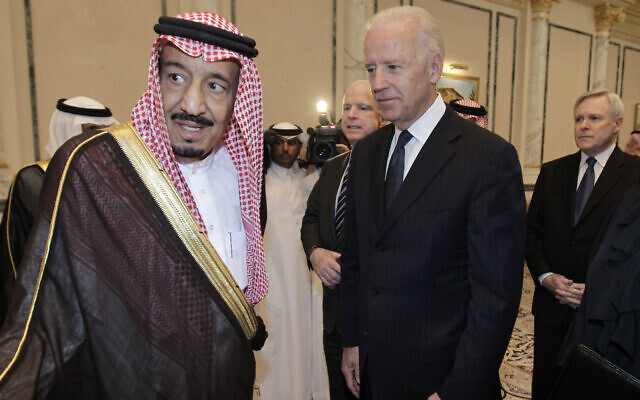
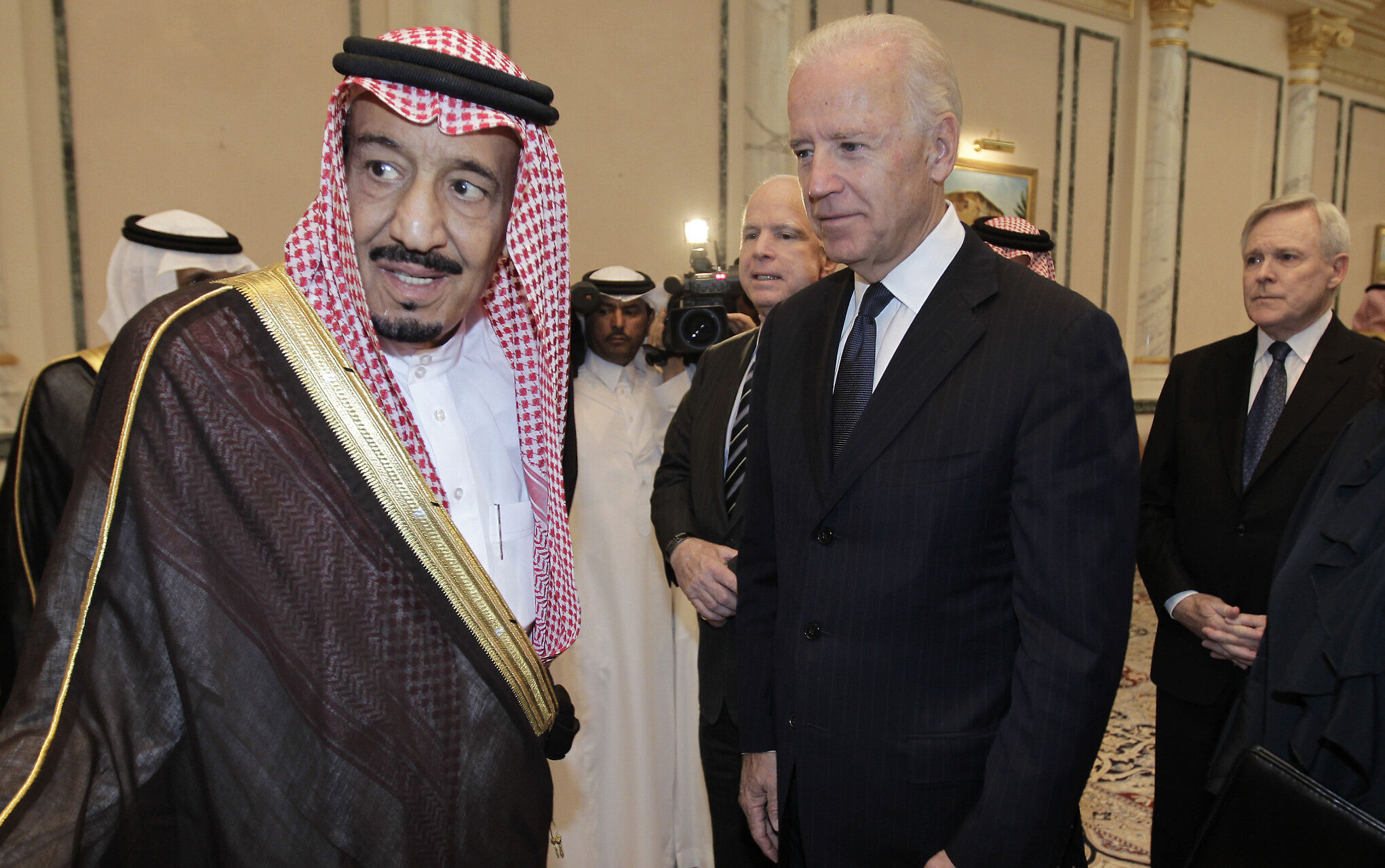
By AGENCIES and TOI STAFF5 December 2020, 5:55 pm 0Then-US vice president Joe Biden, right, offers his condolences to Prince Salman bin Abdel-Aziz upon the death of on his brother Saudi Crown Prince Sultan bin Abdul-Aziz Al Saud, at Prince Sultan palace in Riyadh, Saudi Arabia, October 27, 2011 . (AP Photo/Hassan Ammar, File)
The Gulf states must be consulted if a US nuclear accord with Iran is revived, Saudi Arabia’s top diplomat said Saturday, warning it is the only path towards a sustainable agreement.
US President-elect Joe Biden has signaled he will return the United States to a nuclear accord with Iran and that he still backs the 2015 deal negotiated under Barack Obama, from which Donald Trump withdrew.
A return to the agreement, known formally as the Joint Comprehensive Plan of Action (JCPOA), would delight US allies in Europe, but concern the Gulf states, who have criticized US engagement with Tehran.
Biden has indicated he will bring Iran’s US-allied Arab neighbors, such as Saudi Arabia, which sees Iran as its arch-rival, into the process.
“Primarily what we expect is that we are fully consulted, that we and our other regional friends are fully consulted in what goes on vis a vis the negotiations with Iran,” Saudi Foreign Minister Prince Faisal bin Farhan told AFP.Saudi Foreign Minister Faisal bin Farhan al-Saud addresses the Manama Dialogue security conference in the Bahraini capital, on December 5, 2020. (Mazen Mahdi/AFP)
“The only way towards reaching an agreement that is sustainable is through such consultation,” he said on the sidelines of a security conference in Bahrain’s Manama.
“I think we’ve seen as a result of the after-effects of the JCPOA that not involving the regional countries results in a build up of mistrust and neglect of the issues of real concern and of real effect on regional security.”
Asked whether the Biden administration was already in touch about the shape of a revived Iran deal, Prince Faisal said there were no contacts as yet, but that “we are ready to engage with the Biden administration once they take office.”
“We are confident that both an incoming Biden administration, but also our other partners, including the Europeans, have fully signed on to the need to have all the regional parties involved in a resolution,” he said.
The US imposed crippling sanctions on Iran after Trump unilaterally withdrew from the nuclear agreement in 2018. In response, Iran began publicly exceeding limits set by the agreement while saying it would quickly return to compliance if the United States did the same.
Biden told The New York Times this week that if Iran returned to compliance, the US would rejoin, after which he would seek to tighten Iran’s nuclear constraints and address concerns about both its missile program and Iran’s support for militants in the region.
According to the Times report, Biden and his team are working on the premise that if the deal is restored on both sides there will need to be new negotiations on the length of time for restrictions on the production of the fissile material necessary for producing a bomb, originally set at 15 years under the 2015 Joint Comprehensive Plan of Action, or JCPOA.
Additionally, Biden said, steps would need to be taken to address Tehran’s terror activities through regional proxies in Lebanon, Syria, Iraq and Yemen.Iran’s Foreign Minister Mohammad Javad Zarif attends a news conference with Venezuela’s Foreign Minister Jorge Arreaza in Caracas, Venezuela, November 5, 2020. (AP Photo/Matias Delacroix)
The report said that the future Biden administration would want the talks with Tehran to include not only the original parties to the deal — Iran, the United States, Russia, China, Britain, France, Germany and the European Union — but also key regional players Saudi Arabia and the United Arab Emirates.
Iranian Foreign Minister Mohammad Javad Zarif said Thursday his country won’t agree to renegotiate elements of the international accord limiting its nuclear program.
He also said Iran won’t agree to any curbs on its missile program or backing of regional proxies unless Western countries stop their “malign behavior” in the Middle East.
No normalization without Palestinian state
In his remarks, Bin Farhan reiterated that Saudi Arabia won’t normalize relations with Israel until a Palestinian state is established.
“We have as we have always been… completely open to full normalize relations with Israel. We think Israel will take its place in the region, but in order for that to happen and for that to be sustainable, we do need the Palestinians to get their state and we do need to settle that situation,” he said.
The comments came after Prime Minister Benjamin Netanyahu reportedly held a secret rendezvous last month with Saudi Crown Prince Mohammed bin Salman in the Saudi Red Sea city of Neom, alongside US Secretary of State Mike Pompeo.
It was the first known visit to Saudi Arabia by an Israeli leader, but the talks on Iran and possible normalization reportedly yielded no substantial progress.
The Trump administration had hoped Saudi Arabia would join the UAE and Bahrain in recognizing Israel and forging diplomatic ties, a move seen as increasingly distant in the wake of Joe Biden’s election as US president. But Saudi leaders have hitherto indicated that Israeli-Palestinian peace will have to come first.
It is believed that the two countries have long held clandestine ties, particularly on the issue of Iran.



 Emirati and Israeli officials discuss future cooperation agreements in Abu Dhabi on August 31, 2020. (Amos Ben-Gershom/GPO)


 Saudi Foreign Minister Faisal bin Farhan al-Saud addresses the Manama Dialogue security conference in the Bahraini capital, on December 5, 2020. (Mazen Mahdi/AFP)



 anneinpt
 artaxes
 danmillerinpanama
 davidking1530
 Peter Hofman
 Joseph Wouk
 Peter
Peter Louisiana Steve
 WarSclerotic


Recent Comments