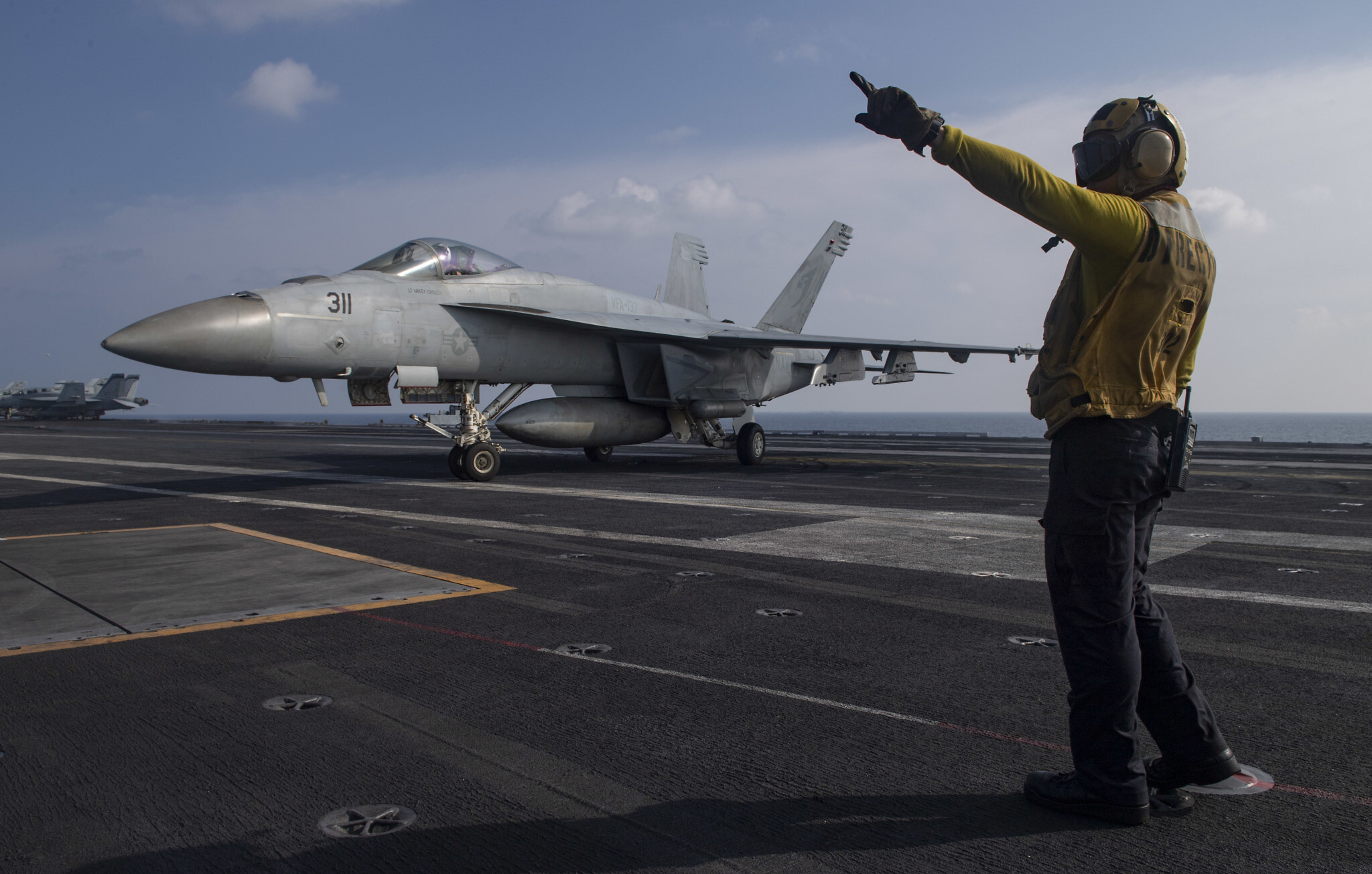
In this photo released by the U.S. Navy, Aviation Boatswain’s Mate 3rd Class Marnell Maglasang, from La Puente, Calif., directs an F/A-18E Super Hornet on the flight deck of the aircraft carrier USS Nimitz in the Arabian Sea, Friday Nov. 27, 2020. The Nimitz returned to the Mideast in a move to support the drawdown of troops in Afghanistan and Iraq according to the Pentagon. (Mass Communication Specialist 3rd Class Cheyenne Geletka/U.S. Navy via AP)
WASHINGTON — The US aircraft carrier USS Nimitz will remain in the Gulf due to “recent threats” by Iran, the Pentagon said Sunday, following reports the ship was returning home in what some read as a sign of de-escalation.
The Nimitz has been patrolling Gulf waters since late November, but American media said this week that the acting US defense secretary, Christopher C. Miller, had ordered the vessel to return home.
The New York Times, quoting US officials, said this move was part of a “de-escalatory” signal to Tehran to avoid a conflict in US President Donald Trump’s last days in office.
However, Miller issued a statement to the contrary late Sunday.
“Due to the recent threats issued by Iranian leaders against President Trump and other US government officials, I have ordered the USS Nimitz to halt its routine redeployment,” he said.
“The USS Nimitz will now remain on station in the US Central Command area of operations. No one should doubt the resolve of the United States of America.”
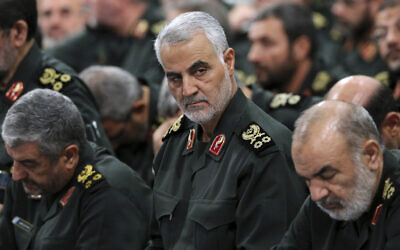
His statement came one year after a US drone strike in Baghdad killed Iran’s revered commander Qasem Soleimani and his Iraqi lieutenant Abu Mahdi al-Muhandis.
Thousands of Iraqi mourners chanted “revenge” and “no to America” on Sunday.
The anniversary of the Baghdad drone strike was also marked in recent days across Iran and by supporters in Syria, Lebanon, Yemen and elsewhere.
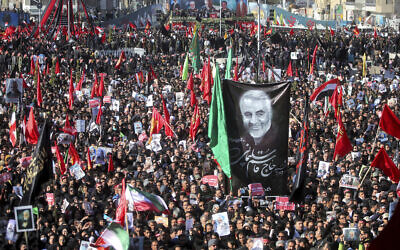
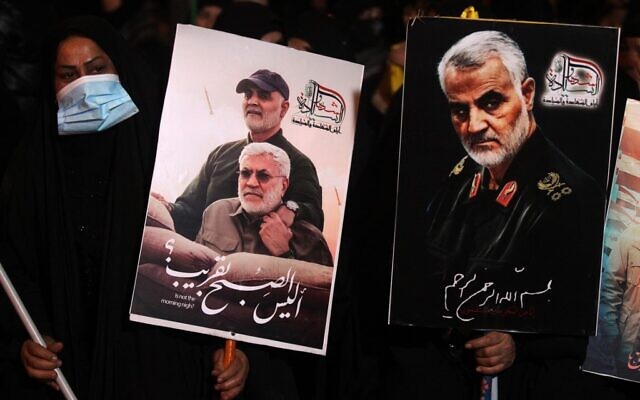
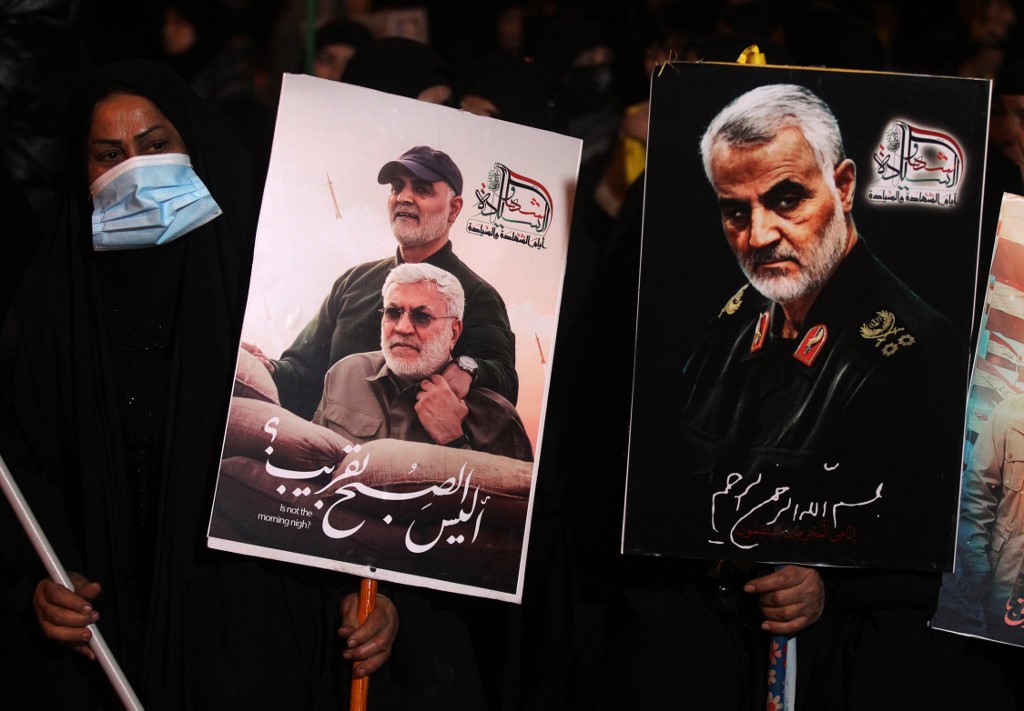
Trump unilaterally withdrew the US from a landmark nuclear deal with Iran and world powers in 2018 and launched a “maximum pressure” campaign against Tehran, reimposing and reinforcing crippling sanctions.Supporters of the Popular Mobilization Forces hold a posters of Abu Mahdi al-Muhandis, deputy commander of the Popular Mobilization Forces, front, and General Qassem Soleimani, head of Iran’s Quds force during a protest marking a year since their killing in a US drone strike, in Tahrir Square, Iraq, January 3, 2021. (Khalid Moha/AP)
The two countries have twice come to the brink of war since June 2019, especially following the killing of Soleimani.
Days after the Soleimani assassination, Iran launched a volley of missiles at Iraqi bases housing US and other coalition troops, with Trump refraining from any further military response.
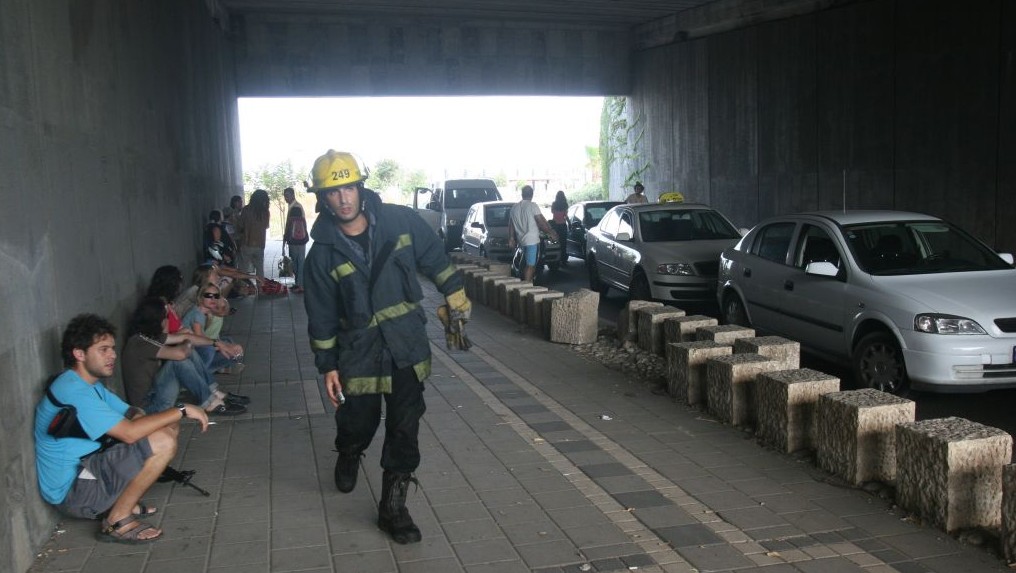
Israeli civilians under cover following a Hezbollah rocket attack in Haifa, August 11 , 2006. (photo credit: Flash90)
A top Iranian commander said Saturday that Supreme Leader Ali Khamenei had given an order for Tehran-backed terror groups to destroy Haifa and Tel Aviv if “any foolishness is committed against Iran,” warning that the Islamic Republic has been working for years on developing the capabilities of its proxies in Lebanon and the Gaza Strip.
“We teach the Resistance Front to make fishing rods, instead of providing fish, and Lebanon and Gaza possess the technology to manufacture missiles,” Amir Ali Hajizadeh, commander of the Revolutionary Guards’ Aerospace Force told the state-run Al-Manar TV channel.
“All the missile capabilities of Gaza and Lebanon have been supported by Iran, and they are the front line for confrontation,” he said.
Noting that “the capabilities of the resistance axis” are much advanced from what they were ten years ago Hajizadeh said, “today, the Palestinians fire rockets instead of throwing stones.”
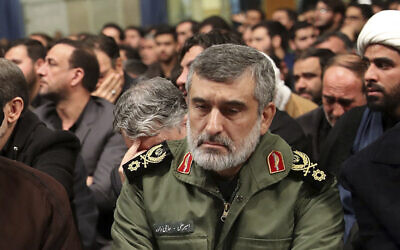
Gen. Amir Ali Hajizadeh, the head of the Revolutionary Guard’s aerospace division, attends a mourning ceremony for general Qassem Soleimani on January 9, 2020, a day after his forces shot down a Ukrainian airliner, in Tehran, Iran. (Office of the Iranian Supreme Leader via AP)
“We have a general order from the guide, Ali Khamenei, to level Haifa and Tel Aviv to the ground, in case any foolishness is committed against Iran, and we have worked over the past years to be able to do so,” he said.
Iran provides support to Hamas and more direct backing to Palestinian Islamic Jihad and Lebanon’s Hezbollah, all of which are sworn to Israel’s destruction.
Haifa and Tel Aviv have been threatened in the past by both Iran and Hezbollah.
Hezbollah leader Hassan Nasrallah recently suggested striking Haifa’s stores of ammonium nitrate, a highly explosive fertilizer that fueled the deadly Beirut port blast in August that killed 193 people and wounded 6,500 others.
The comments came as the Israeli military is preparing for the possibility of a strike by Iran-backed militias in Iraq or Yemen, according to a Friday report. The Israel Defense Forces held discussions last week about possible attacks, including missile and drone strikes, from the Iraqi militias and Houthi groups in Yemen, the Kan public broadcaster reported.
Iran on Sunday marked one year since the death of General Qassem Soleimani in an American drone strike in Baghdad, amid fears in Washington that Tehran could retaliate for the killing on the anniversary.
US officials have expressed concern that Iran may be planning attacks against US-allied targets in neighboring Iraq or elsewhere in the region to coincide with the date. In recent weeks the US military has taken a range of steps designed to deter Iran, while publicly emphasizing that it is not planning, and has not been instructed, to take unprovoked action against Iran.
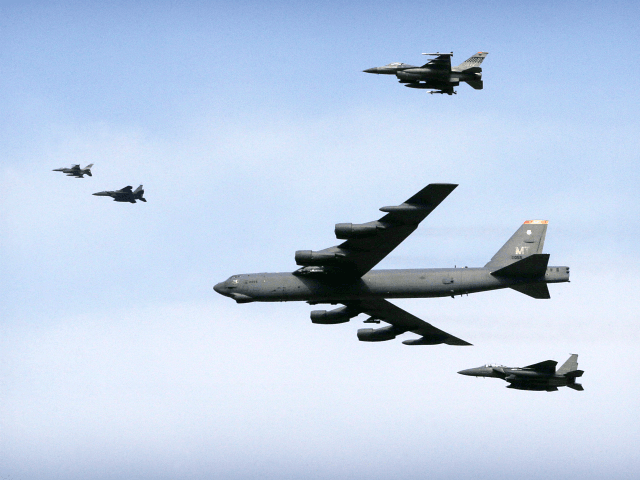
US President Donald Trump has warned Iran against any attack, and the US has flown strategic bombers over the Persian Gulf in a show of force meant to deter Iran from attacking American or allied targets in the Middle East. A US nuclear submarine crossed the Strait of Hormuz and an Israeli submarine reportedly openly crossed the Suez Canal in a show of force directed at Iran a few days earlier.
Iranian officials have issued a stream of threats against the US and Israel as the anniversary of Soleimani’s death approached, while accusing Trump of seeking a “pretext” for war.Supporters of the Iran-backed Popular Mobilization Forces paramilitary pose before a banner showing a montage of (L to R) slain Iraqi PMF commander Abu Mahdi al-Muhandis, Iranian Quds Force Gen. Qassem Soleimani and Lebanese Hezbollah military chief Imad Mughniyeh during a demonstration outside the entrance to the Iraqi capital Baghdad’s highly-fortified Green Zone on November 7, 2020, demanding the departure of remaining US forces from Iraq. (Ahmad Al-Rubaye/AFP)
The US killed Soleimani, who oversaw the Revolutionary Guard’s expeditionary Quds Force, and others in the January 3, 2020, strike near Baghdad International Airport. It came after months of incidents raising tensions between the two countries and ultimately saw Iran retaliate with a ballistic missile strike targeting American troops in Iraq.
Iran has also threatened to attack Israel since the assassination of its top nuclear scientist, Mohsen Fakhrizadeh, in late November, in a raid blamed on the Jewish state.
Israel has long been suspected of carrying out a series of targeted killings of Iranian nuclear scientists nearly a decade ago, in a bid to curtail Iran’s nuclear program.
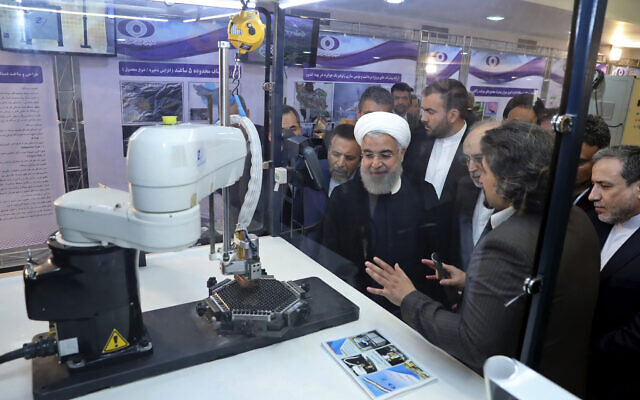
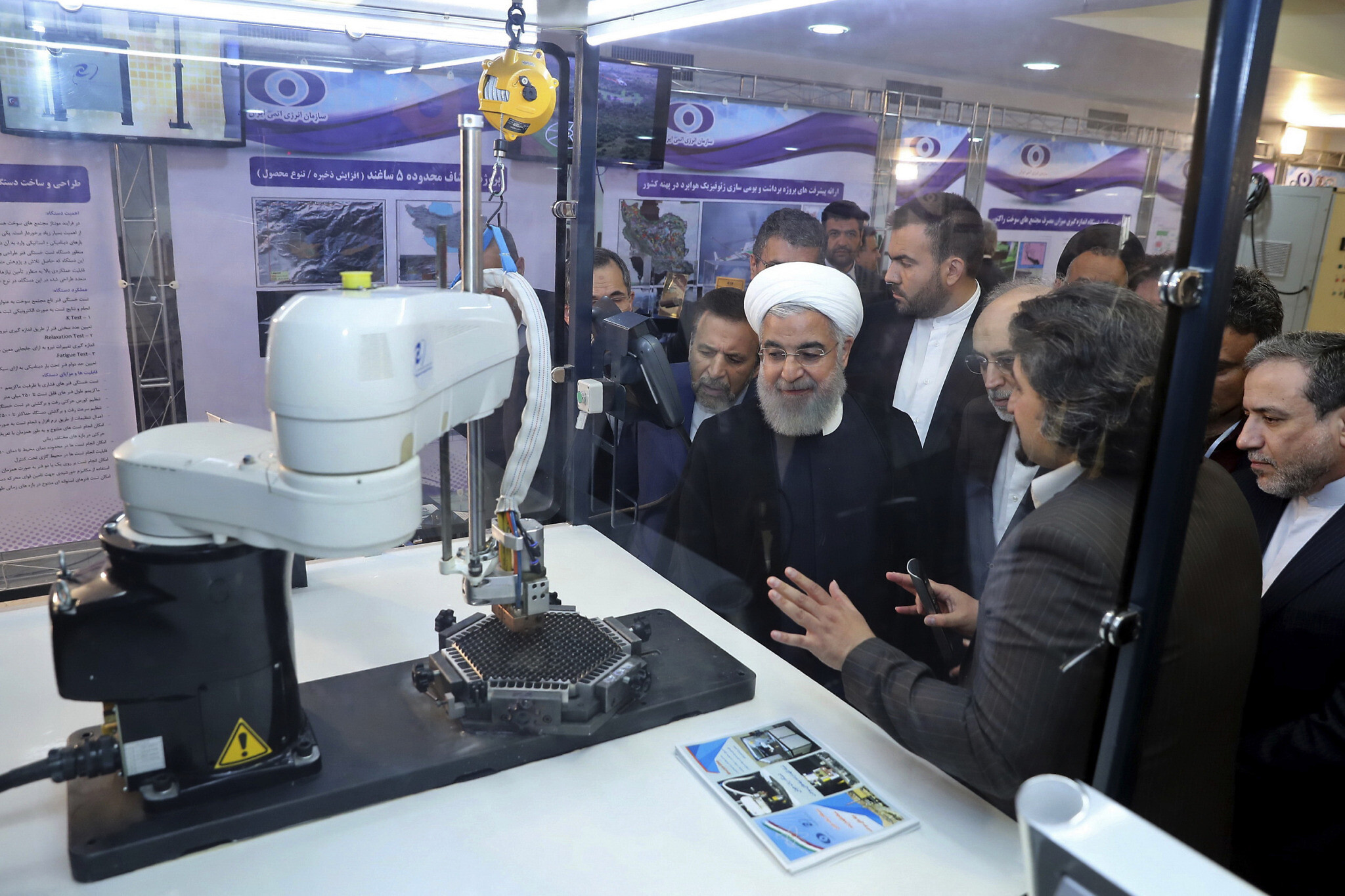
In this April 9, 2018 file photo, released by an official website of the office of the Iranian Presidency, President Hassan Rouhani listens to explanations on new nuclear achievements at a ceremony to mark “National Nuclear Day,” in Tehran, Iran.(Iranian Presidency Office via AP, File)
Iran said Saturday it plans to enrich uranium up to 20 percent at its underground Fordo nuclear facility “as soon as possible,” pushing its program a technical step away from weapons-grade levels as it increases pressure on the West over the tattered atomic deal.
Ali Akbar Salehi, the US-educated head of the civilian Atomic Energy Organization of Iran, offered a military analogy to describe his agency’s readiness to take the next step.
“We are like soldiers and our fingers are on the triggers,” Salehi told Iranian state television. “The commander should command and we shoot. We are ready for this and will produce [20% enriched uranium] as soon as possible.”
The move comes amid heightened tensions between Iran and the US in the waning days of the administration of President Donald Trump, who unilaterally withdrew America from Tehran’s nuclear deal in 2018, and ahead of the Sunday anniversary of a US drone strike that killed a top Iranian general in Baghdad a year ago, that has American officials now worried about possible retaliation by Iran.
The head of Iran’s Atomic Energy Organization Ali Akbar Salehi delivers his speech at opening of the general conference of the IAEA in Vienna, Austria, September 16, 2019. (AP Photo/Ronald Zak)
Iran informed the International Atomic Energy Agency that it intends to produce uranium enriched to up to 20% purity, well beyond the threshold set by the 2015 Vienna accord, the UN nuclear watchdog said Friday.
“Iran informed the agency of its intention to enrich uranium at a rate of up to 20 percent in its Fordo underground plant, to comply with a law recently passed by the Iranian parliament,” an IAEA spokesperson said.
The letter dated December 31 “did not state exactly when this enrichment activity would begin,” the spokesperson added.
Iran has not enriched to such levels since it entered into the 2015 nuclear deal with world powers, which capped its enrichment at 3.67%. Tehran has recently broken that limit as the nuclear deal has disintegrated, reaching 4.5%.
Uranium enriched to 20% is far below the 90% needed to construct nuclear bombs, but the jump from 20% to 90% is actually rather quick compared to the work needed to move from 4% to 20%.
Mourners attend a funeral ceremony for Iranian Gen. Qassem Soleimani and his comrades, who were killed in Iraq in a US drone strike, in the city of Kerman, Iran, January 7, 2020. (Erfan Kouchari/Tasnim News Agency via AP)
Iran’s announcement coincides with the anniversary of the US drone killing of Revolutionary Guard Gen. Qassem Soleimani in Baghdad last year. That attack later saw Iran retaliate by launching a ballistic missile strike injuring dozens of US troops in Iraq. Tehran also accidentally shot down a Ukrainian passenger jet that night, killing all 176 people on board.
As the anniversary approached, the US has sent B-52 bombers flying over the region and sent a nuclear-powered submarine into the Persian Gulf.
On Thursday, sailors discovered a limpet mine on a tanker in the Persian Gulf off Iraq near the Iranian border as it prepared to transfer fuel to another tanker owned by a company traded on the New York Stock Exchange. No one has claimed responsibility for the mining, though it comes after a series of similar attacks in 2019 that the US Navy blamed on Iran. Tehran denied being involved.
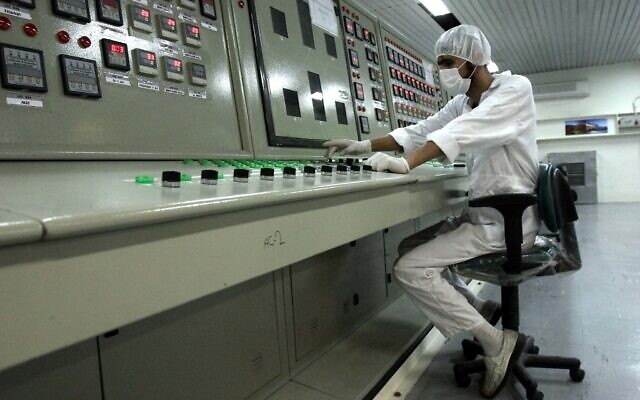
In this Feb. 3, 2007 file photo, a technician works at the Uranium Conversion Facility just outside the city of Isfahan, Iran (AP Photo/Vahid Salemi, File)
Tensions have been increasing since Trump withdrew from the accord in 2018 and began imposing a host of sanctions against Tehran as part of a so-called maximum pressure campaign aimed at buckling Iran and convincing it to agree to a more favorable agreement, in Washington’s eyes.
But Iran has not done so, instead choosing to enrich uranium to numbers far beyond what the deal allowed. The Islamic Republic’s stockpile of enriched uranium is more than 2.4 tons, 12 times the JCPOA limit, though still less than the more than eight tons Iran had enriched before signing the deal.
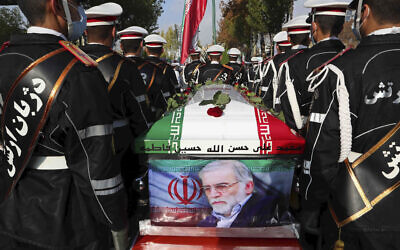
Military personnel stand near the flag-draped coffin of Mohsen Fakhrizadeh, an assassinated top nuclear scientist during his funeral ceremony in Tehran, Iran, November 30, 2020. (Iranian Defense Ministry via AP)
Since the assassination in late November of Iranian nuclear physicist Mohsen Fakhrizadeh, which Iran has blamed on Israel, hardliners in Tehran pledged a response and parliament passed a controversial law calling for the production and storage of “at least 120 kilograms per year of 20 percent enriched uranium” and to “put an end” to the IAEA inspections intended to check that the country is not developing an atomic bomb.
The Iranian government opposed the initiative which was also condemned by the other signatories to the accord who called on Tehran not to “compromise the future.”
Iran has indicated some willingness to return to compliance with the agreement if the US, under incoming president Joe Biden, lifts the sanctions that were put in place after Trump’s withdrawal.
Biden has vowed to re-enter the nuclear agreement if Iran first returns to compliance with it. He has also expressed a desire to negotiate a “longer and stronger” follow-up agreement that would extend the time-limited provisions on the JCPOA, while also addressing Iran’s missile program and curbing the influence of Tehran’s regional proxies.US President-elect Joe Biden delivers remarks at the Queen Theater on December 28, 2020, in Wilmington, Delaware. (Mark Makela/Getty Images/AFP)
Iran has rejected any such negotiations.
The remaining countries that signed the agreement with Iran — Germany, France, Britain, China and Russia — have been trying to keep it from collapsing after the unilateral withdrawal of the United States in 2018.
In late December the countries agreed to “positively address” the possibility of a US return to the accord. Germany’s foreign minister urged Iran not to waste what he called a final window of opportunity.
The three European powers have expressed hope that with the change of administrations in Washington, the US could be brought back into the deal, whose goal is to prevent Iran from developing a nuclear bomb — something Tehran insists it doesn’t want to do.
Centrifuge machines in the Natanz uranium enrichment facility in central Iran, November 5, 2019. (Atomic Energy Organization of Iran via AP)
The deal promises Iran economic incentives in exchange for curbs on its nuclear program, but with the reinstatement of American sanctions, the other nations have been struggling to provide Iran the assistance it seeks.
Iranian Foreign Minister Mohammad Javad Zarif has said that Iran would “rapidly reverse” its violations of the nuclear accord when the United States and the three European powers “perform their duties.”
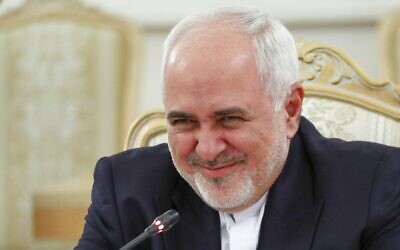
Iranian Foreign Minister Mohammad Javad Zarif smiles during talks in Moscow, Russia, September 24, 2020. (Russian Foreign Ministry Press Service via AP)
Despite Iran’s violations, the International Atomic Energy Agency has reported that Tehran continues to give inspectors full access to its nuclear sites — a key reason the JCPOA member nations say it is worth preserving.
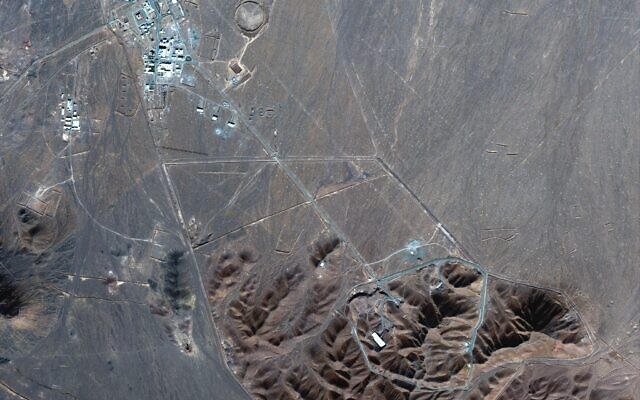
In December, photos obtained by The Associated Press showed that Iran has begun construction on a site at its underground nuclear facility at Fordo.
Iran has not publicly acknowledged any new construction at Fordo, whose discovery by the West in 2009 came in an earlier round of brinkmanship before world powers struck the 2015 nuclear deal with Tehran.
While the purpose of the building remains unclear, any work at Fordo will likely trigger new concern. Already, Iran is building at its Natanz nuclear facility after a mysterious explosion in July there that Tehran described as a sabotage attack.
“Any changes at this site will be carefully watched as a sign of where Iran’s nuclear program is headed,” said Jeffrey Lewis, an expert at the James Martin Center for Nonproliferation Studies at the Middlebury Institute of International Studies who studies Iran.
This Nov. 4, 2020, satellite photo by Maxar Technologies shows Iran’s Fordo nuclear site (Maxar Technologies via AP)
The IAEA as of yet has not publicly disclosed if Iran informed it of any construction at Fordo.
Under the 2015 nuclear deal, Iran agreed to stop enriching uranium at Fordo and instead make it “a nuclear, physics and technology center.”
“This location was a major sticking point in negotiations leading to the Iran nuclear deal,” Lewis said. “The US insisted Iran close it while Iran’s supreme leader said keeping it was a red line.”
Since the deal’s collapse, Iran has resumed enrichment there.
People carry portraits of late Iraqi commander Abu Mahdi al-Muhandis and Iranian commander Qasem Soleimani at Baghdad Airport, in Baghdad on January 2, 2021, at the site of their killing (AHMAD AL-RUBAYE / AFP)
Iran on Sunday marked one year since the death of General Qassem Soleimani in an American drone strike in Baghdad, amid fears in Washington that Tehran could retaliate for the killing on the anniversary.
US officials have expressed concern that Iran may be planning attacks against US-allied targets in neighboring Iraq or elsewhere in the region to coincide with the date. In recent weeks the US military has taken a range of steps designed to deter Iran, while publicly emphasizing that it is not planning, and has not been instructed, to take unprovoked action against Iran.
US President Donald Trump has warned Iran against any attack, and the US has flown strategic bombers over the Persian Gulf in a show of force meant to deter Iran from attacking American or allied targets in the Middle East. A US nuclear submarine crossed the Strait of Hormuz on Monday.
Iranian officials have issued a stream of threats against the US as the anniversary of Soleimani’s death approached, while accusing Trump of seeking a “pretext” for war.
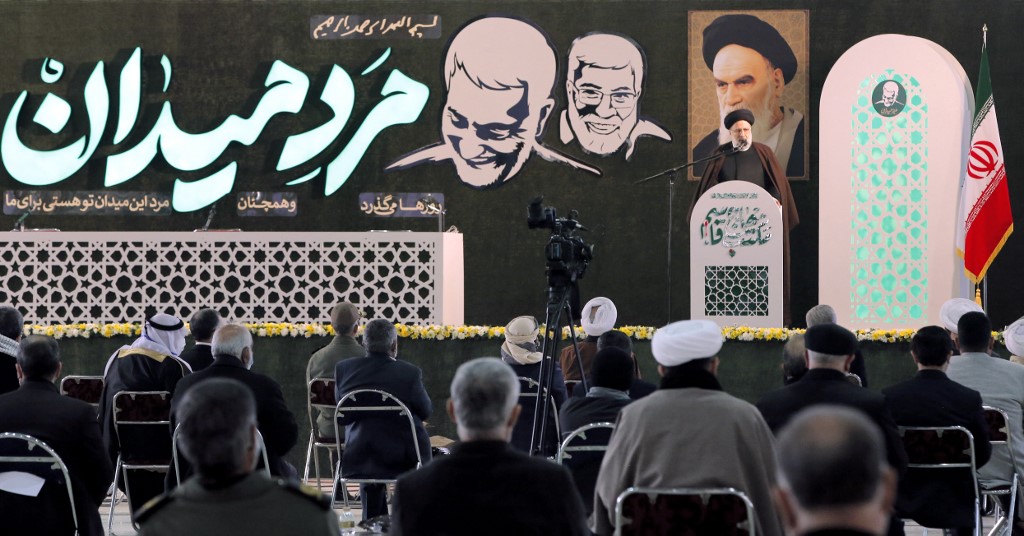
Iranian judiciary chief Ebrahim Raisi speaks during a ceremony on the occasion of the first anniversary of death of former Quds force commander Qasem Soleimani in Tehran, on January 1, 2021. (STR / AFP)
The US killed Soleimani, who oversaw the Revolutionary Guard’s expeditionary Quds Force, and others in the January 3, 2020, strike near Baghdad International Airport. It came after months of incidents raising tensions between the two countries and ultimately saw Iran retaliate with a ballistic missile strike targeting American troops in Iraq.
Iran has also threatened to attack Israel since the assassination of its top nuclear scientist, Mohsen Fakhrizadeh, in late November, in a raid blamed on the Jewish state.
The Israeli military is preparing for the possibility of a strike by Iran-backed militias in Iraq or Yemen, according to a Friday report. The Israel Defense Forces held discussions last week about possible attacks, including missile and drone strikes, from the Iraqi militias and Houthi groups in Yemen, the Kan public broadcaster reported.
Further ratcheting up tensions, the UN nuclear watchdog said Friday that Iran intends to produce uranium enriched up to 20 percent purity, well beyond the threshold set by the 2015 Vienna accord and a short jump from weapons-grade material.
Iranian Foreign Minister Mohammad Javad Zarif speaks outside the Lebanese Foreign Ministry, August 14, 2020. (AP Photo/Hussein Malla
Iranian Foreign Minister Mohammad Javad Zarif claimed Saturday that Israeli agents were planning to attack American targets in order to instigate an aggressive US reaction against Iran and spark armed conflict, warning Trump to avoid such a “trap.” And he warned that any attack against the Islamic Republic by the US would “backfire badly” on Washington’s “BFFs” (an initialism for “best friends forever”), in an apparent reference to the Jewish state.
“New intelligence from Iraq indicate (sic) that Israeli agent-provocateurs are plotting attacks against Americans — putting an outgoing Trump in a bind with a fake casus belli,” Zarif tweeted.
Top Iranian authorities, including supreme leader Ayatollah Ali Khamenei, had previously said that all those involved in Soleimani’s killing would face retribution.
Mourners gather to pay homage to slain Iranian military commander Qassem Soleimani, Iraqi paramilitary chief Abu Mahdi al-Muhandis and other victims of a US attack, in the capital Tehran on January 6, 2020. (Atta Kenare/AFP)
Days after Soleimani’s killing, Iran launched a volley of missiles at Iraqi bases housing US and other coalition troops, with Trump refraining from any further military response.
The Iranian leadership has called the strikes a “slap” and vowed that “severe revenge” awaits.
CNN on Friday reported disagreements within the Pentagon as to the threat level from Iran. Some officials said the threat was the highest it’s been since Soleimani’s killing, with US forces in the region in real danger of attack, while others insisted this was an exaggeration.
“We do see several planning efforts underway and if even some of them are true and they execute they could kill several Americans,” one military official said.
Tensions between Washington and Tehran have soared since 2018, when Trump unilaterally withdrew the US from the Iran nuclear deal and reimposed crippling sanctions.
The two sides have twice come to the brink of war since June 2019, especially following the killing of Soleimani, who headed the foreign operations arm of the Islamic Revolutionary Guard Corps.
Successor to assassinated Quds force commander threatens ‘severe revenge’ which may come from within the United States
By AFPToday, 2:26 pm 0Iranian judiciary chief Ebrahim Raisi speaks during a ceremony on the occasion of the first anniversary of death of former Quds force commander Qasem Soleimani in Tehran, on January 1, 2021. (STR / AFP)
TEHRAN, Iran — Iran’s judiciary chief warned Friday that Qassem Soleimani’s killers will “not be safe on Earth,” as the Islamic Republic began marking the first anniversary of the top general’s assassination in a US strike.
Ebrahim Raisi, speaking at an event in Tehran to pay tribute to Soleimani, said not even US President Donald Trump, who ordered the strike, was “immune from justice.”
Soleimani was killed in a US drone strike at Baghdad airport on January 3, 2020, ratcheting up tensions between decades-old enemies the United States and Iran.
“They will witness severe revenge. What has come so far has only been glimpses” of it, Raisi told the gathering at Tehran University.
Iranian judiciary chief Ebrahim Raisi speaks during a ceremony on the occasion of the first anniversary of the death of former Quds force commander Qasem Soleimani in Tehran, on January 1, 2021. (STR / AFP)
“Do not presume that someone, as the president of America, who appeared as a murderer or ordered a murder, may be immune from justice being carried out. Never,” he said. “Those who had a role in this assassination and crime will not be safe on Earth.”
The event was attended by Iranian officials, and speakers included representatives from allied regional countries and forces, namely Syria, Iraq, Lebanon and Yemen.
A separate event is expected to be held in the coming days in Kerman, Soleimani’s hometown where he is buried.
Soleimani headed the Quds force, the foreign operations arm of the Islamic Revolutionary Guard Corps.
Top Iranian authorities, including supreme leader Ayatollah Ali Khamenei, had previously said that all those involved in his killing would face retribution.
Days after Soleimani’s killing, Iran launched a volley of missiles at Iraqi bases housing US and other coalition troops, with Trump refraining from any further military response.
The Iranian leadership has called the strikes a “slap” and vowed that “severe revenge” awaits.
Iranian Quds force commander Esmail Ghaani (R) and Iranian Revolutionary Guard Corps (IRGC) chief Hossein Salami (L) attend a ceremony on the occasion of the first anniversary of the death of former Quds force commander Qasem Soleimani in Tehran, on January 1, 2021. (STR / AFP)
Soleimani’s successor, Esmail Ghaani, warned during Friday’s event that it may come from anywhere.
“It’s even possible that there are people inside your home [the United States] that will respond to your crime,” he said.
Tensions between Washington and Tehran have soared since 2018, when Trump unilaterally withdrew the US from the Iran nuclear deal and reimposed crippling sanctions.
The two sides have twice come to the brink of war since June 2019, especially following the killing of Soleimani.
(UPI) — Two B-52 “Stratofortress” bombers of the U.S. Air Force arrived in the Middle East in a show of short-notice force, U.S. Central Command said on Wednesday.
CENTCOM’s announcement did not specify a destination for the planes, but emphasized their in-flight refueling capabilities and noted that their “deliberate appearance” was meant to “underscore the U.S. military’s commitment to regional security and demonstrate a unique ability to rapidly deploy overwhelming combat power on short notice.”
The B-52s are part of the 5th Bomb Wing, headquartered at Minot Air Force Base, N.D. The deployment of bombers was CENTCOM’s third to the Middle East in the past 45 days.
On Dec. 10, two B-52s from Barksdale Air Force Base, La., joined aircraft of Saudi Arabia, Bahrain and Qatar in a show of force in the Persian
In November, two B-52s bombers flew over the Middle East in a short-term mission.
The deployments are part of a buildup of tensions as the Middle East prepares for possible retaliation by Iran for the assassination of its top nuclear scientist, Mohsen Fakhrizadeh, by Israel in November.
U.S. officials have also cited the potential for retaliation from Iran on the first anniversary, on Jan. 3, of the death of Iranian Maj. Gen. Qasem Soleimani in a U.S. cruise missile strike by the United States in Iraq.
Both Israel and the United States have positioned missile-carrying submarines in the area, and the U.S. Navy’s Nimitz Strike Group, which includes the aircraft carrier USS Nimitz and over 60 aircraft, has been stationed off the East African coast.
Leader Nasrallah says terror group still committed to avenging its fighter killed in Syria and Iran’s slain top general; alleges Saudi-Israeli plot to assassinate him
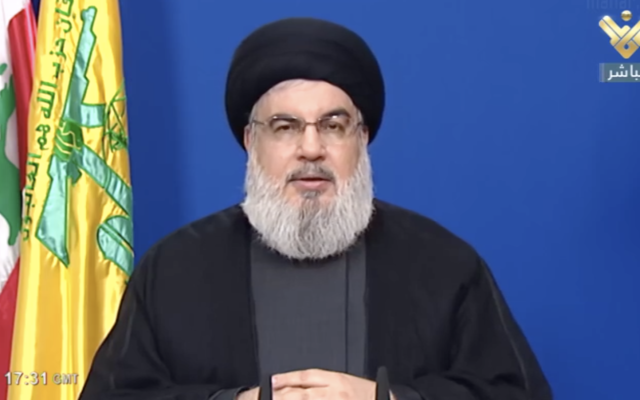
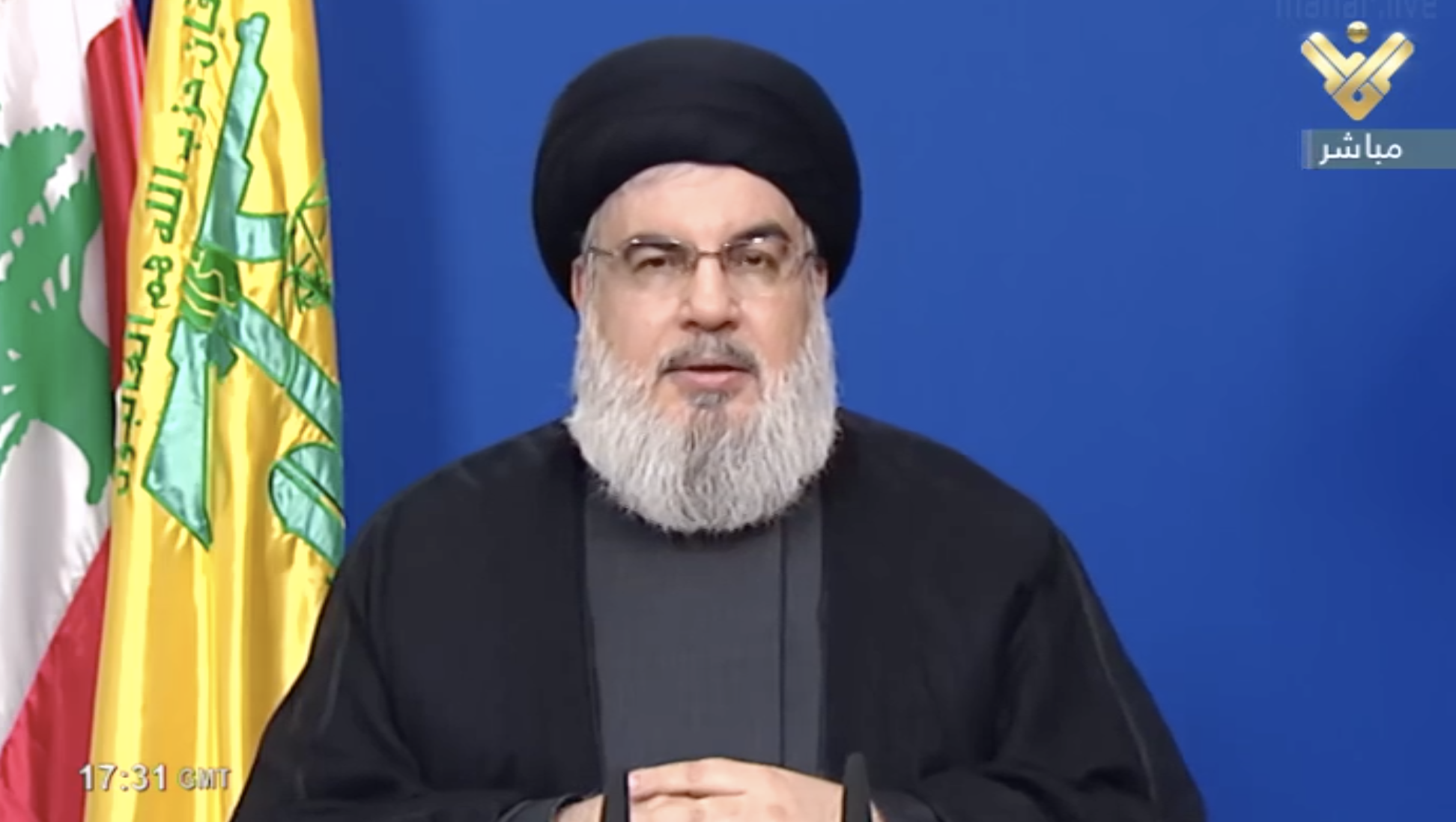
By TOI STAFFToday, 2:45 am 6Hezbollah Secretary General Hassan Nasrallah gives an address on official party al-Manar TV on September 29, 2020. (Screenshot: Al-Manar)
Lebanon’s Hezbollah terror group has doubled the number of its precision missiles over the past year, the organization’s leader Hassan Nasrallah said in an interview published Sunday.
In a wide-ranging interview with the pro-Hezbollah al-Mayadeen news website, Nasrallah also claimed his Iran-backed Shiite group has the ability to accurately hit any part of Israel.
“The number of precision missiles at the resistance’s disposal has now doubled from what it was a year ago,” he said. “Any target across the area of occupied Palestine that we want to hit accurately — we are able to hit accurately.”
Tensions in the region are high following the recent assassination of Iran’s top nuclear scientist Mohsen Fakhrizadeh, in a raid attributed to Israel, and amid fears of further attacks at the tail end of US President Donald Trump’s White House term.
Israel’s Channel 13 reported last month that Nasrallah was sheltering in place amid fears that he may be next on a US-Israeli hit list. The report said Nasrallah was staying put and canceling any “movements” following Fakhrizadeh’s assassination.
The terror leader has been thought to be a target of Israel for years, and some Israeli officials have mocked him for staying in a “bunker” and only making very rare public appearances. Such a hit by Israel would likely seriously inflame the region
.
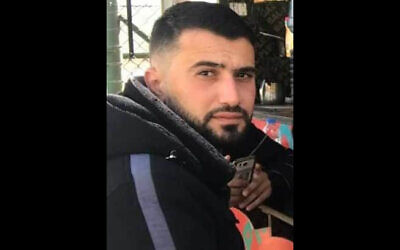
Ali Kamel Mohsen Jawad, a member of the Hezbollah terror group, who the organization says was killed in an Israeli airstrike on July 20, 2020. (Hezbollah media)
In his Sunday interview, Nasrallah said his group still intends to avenge the July death of its fighter, Ali Kamel Mohsen Jawad, in a series of airstrikes in Syria that were attributed to Israel, as well as for the US assassination in January of Iranian top general Qassem Soleimani and Abu Mahdi Al-Muhandis, a pro-Iran militia leader in Iraq.
He alleged that Israel operating drones in Lebanese skies reflects “confusion,” adding that Hezbollah has adequate weapons against the drones and that the group has fired at them on several occasions.
Earlier this month, Hezbollah claimed a drone of its own had managed to enter Israeli airspace undetected by the Israel Defense Forces and took footage of alleged army bases in the Upper Galilee.
In the interview, Nasrallah claimed that its regional foe Saudi Arabia has been seeking to assassinate him for a long time and that the kingdom has involved the United States and Israel in the plan.
“Our data indicates that Saudi Crown Prince Mohammed bin Salman raised the issue of my assassination during his visit to Washington,” he said, adding that the Americans “agreed to a Saudi request to assassinate me, that Israel would implement it.”
Regarding the recent decisions by a series of Arab states to normalize their ties with Israel, Nasrallah said he was “not surprised by the Arab letdown, because most of the Arab regimes used to sell the Palestinians only words.”
He said that the United Arab Emirates, Bahrain, Sudan and Morocco establishing ties with Jerusalem means that a period of “hypocrisy” has ended and “the masks have fallen.”
“As an Islamist, I find the position of the Justice and Development Party in Morocco more painful and more dangerous than the normalization of regimes,” Nasrallah added. “Nothing in the world justifies anyone in the world giving up Palestine.”Military personnel stand near the flag-draped coffin of Mohsen Fakhrizadeh, during a funeral ceremony in Tehran, Iran, November 30, 2020. (Iranian Defense Ministry via AP)
Tensions have recently also been rising between Israel and Iran, with an IDF spokesman telling a Saudi newspaper over the weekend that Israeli submarines are quietly operating “everywhere” and an unnamed Iranian official subsequently telling Al Jazeera that “Tehran’s response to any attack on national security will be strong and wide.”
The anonymous source claimed that Israel “is looking for excuses to drag the region into tension that will create chaos” in the final days of Trump’s term.
Iran has suffered several devastating attacks this year, including the killing of Soleimani in a US drone strike in January, and a mysterious explosion and fire that crippled an advanced centrifuge assembly plant at the Natanz uranium enrichment facility, which is widely believed to have been an act of sabotage.
Army spokesman tells Saudi paper Israel is tracking Iran movements in region, days after Israeli submarine said to cross Suez Canal; Revolutionary Guard says ready for any scenario
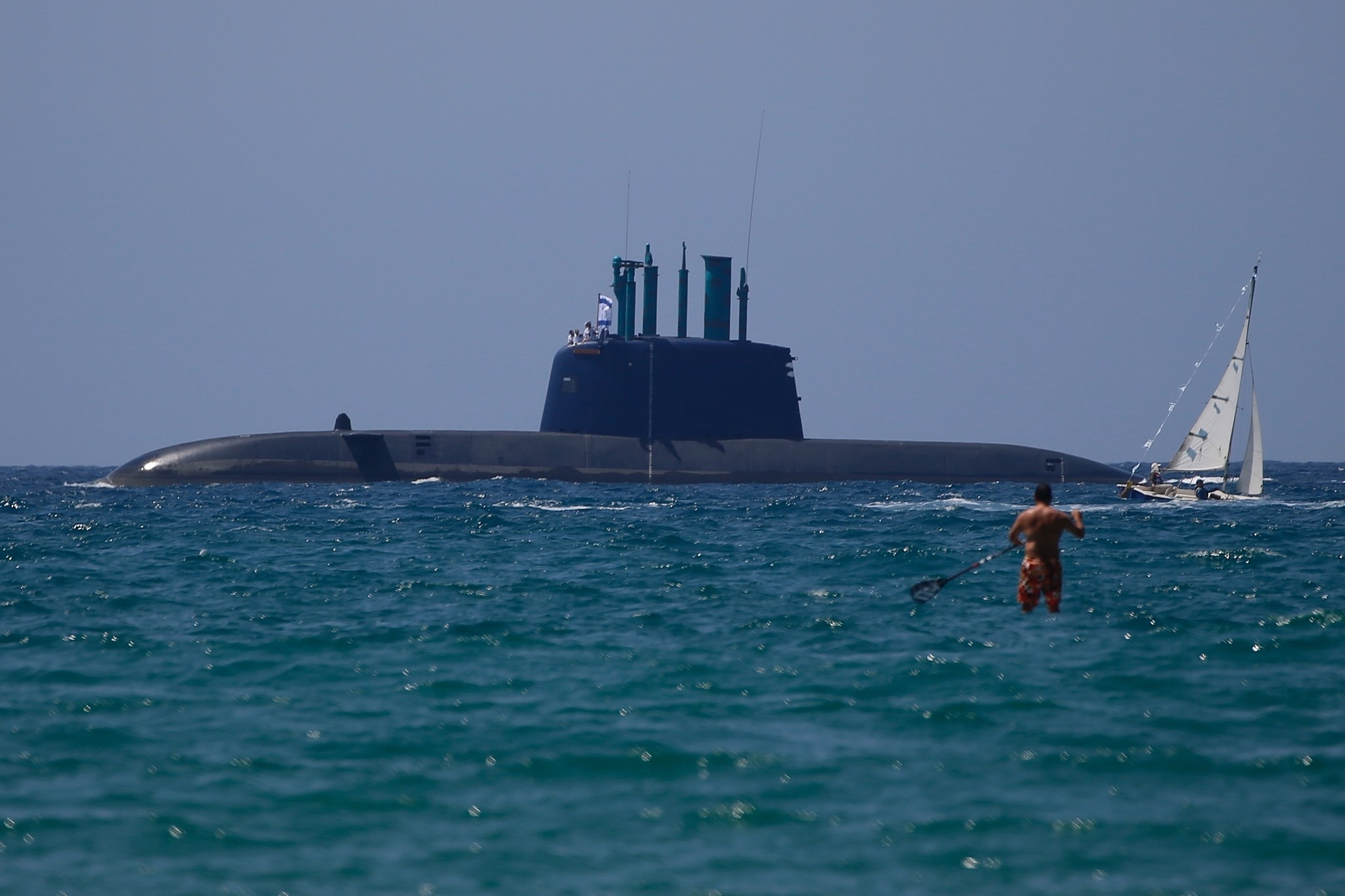
By TOI STAFFToday, 3:27 pm 0Illustrative: An Israeli submarine sails during Independence Day celebrations marking 70 years since the founding of the state in 1948, in Tel Aviv, April 19, 2018. (AP/Ariel Schalit)
After an Israel Defense Forces spokesman told a Saudi newspaper on Friday that Israeli submarines were quietly operating “everywhere,” an unnamed Iranian official told Al Jazeera Saturday that “Tehran’s response to any attack on national security will be strong and wide.”
The anonymous source claimed that Israel “is looking for excuses to drag the region into tension that will create chaos” in the final days of US President Donald Trump’s term.
And the top naval commander in the Islamic Revolutionary Guard Corps warned that Iran was ready to defend itself and was prepared for any scenario.
“Forces, systems and equipment are at the desired level of readiness to defend the water borders, the interests and security of our country,” said IRGC Navy Commander Admiral Alireza Tangsiri.
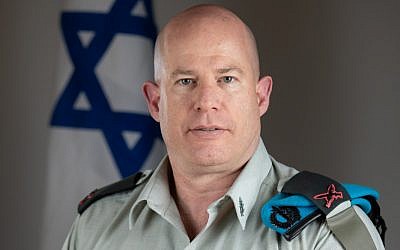
Tangsiri’s comments came after IDF Spokesperson Hidai Zilberman told the Saudi Arabian Elaph news outlet that Israel was tracking Iranian movements around the region, and that Israeli submarines were quietly “sailing everywhere.”
Zilberman gave the interview after an Israeli submarine reportedly openly crossed the Suez Canal last week in a show of force directed at Iran. The move was approved by Egypt, according to the Kan public broadcaster, which cited Arab intelligence sources. The submarine reportedly surfaced and faced the Persian Gulf, which lies on the other side of Saudi Arabia. The intelligence sources said the move was meant to “send a message” to Iran
.
Brig. Gen. Hidai Zilberman, who was nominated to take over as the next IDF spokesperson on June 13, 2019. (Israel Defense Forces)
Zilberman additionally said that although Israel was not aware of any specific plans by Iran to attack the Jewish state, Iranian forces could carry out an attack from Iraq or Yemen, according to a translation of the interview by the Ynet news site.
He said Israel had information indicating Iran was developing unmanned aerial vehicles and “smart missiles” in Iraq and Yemen, and that the weapons could have the ability to strike Israel.
Zilberman said Israel had attacked targets in Syria in the past year, and used 500 smart missiles, without any response from Iran or the Syrian regime. He added that Israel had no intention of letting up its pressure campaign against Iran in Syria.
The IDF has launched hundreds of strikes in Syria since the start of the civil war in 2011 against moves by Iran to establish a permanent military presence in the country and efforts to transport advanced, game-changing weapons to terrorist groups in the region, principally Hezbollah.
Zilberman’s comments were not immediately available in English and the interview contained few direct quotes.
On Monday, IDF Chief of Staff Aviv Kohavi warned Iran against attacking Israel, saying that the Jewish state will retaliate forcefully against any aggression.
Iran has threatened to attack Israel since the assassination of its top nuclear scientist, Mohsen Fakhrizadeh, in late November, in a raid blamed on the Jewish state.
In this Sept. 18, 2016 file photo Revolutionary Guard Gen. Qassem Soleimani, center, attends a meeting with Supreme Leader Ayatollah Ali Khamenei and Revolutionary Guard commanders in Tehran, Iran. (Office of the Iranian Supreme Leader via AP)
In a strikingly similar move to the reported Israeli submarine crossing of the Suez Canal, a US nuclear submarine crossed the Strait of Hormuz on Monday as the anniversary of the killing of Iranian General Qassem Soleimani by a US drone approached.
US military officials fear an attack by Tehran to avenge the powerful Soleimani, leader of the IRGC’s elite Quds force, who was assassinated on January 3, 2020, in a US drone strike near Baghdad airport in Iraq.
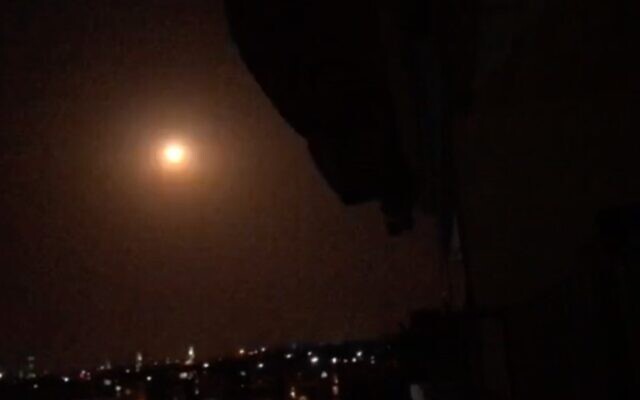
Syria’s defense ministry claims to down Israeli missiles; IAF warplanes reportedly fly over Beirut shortly before attack
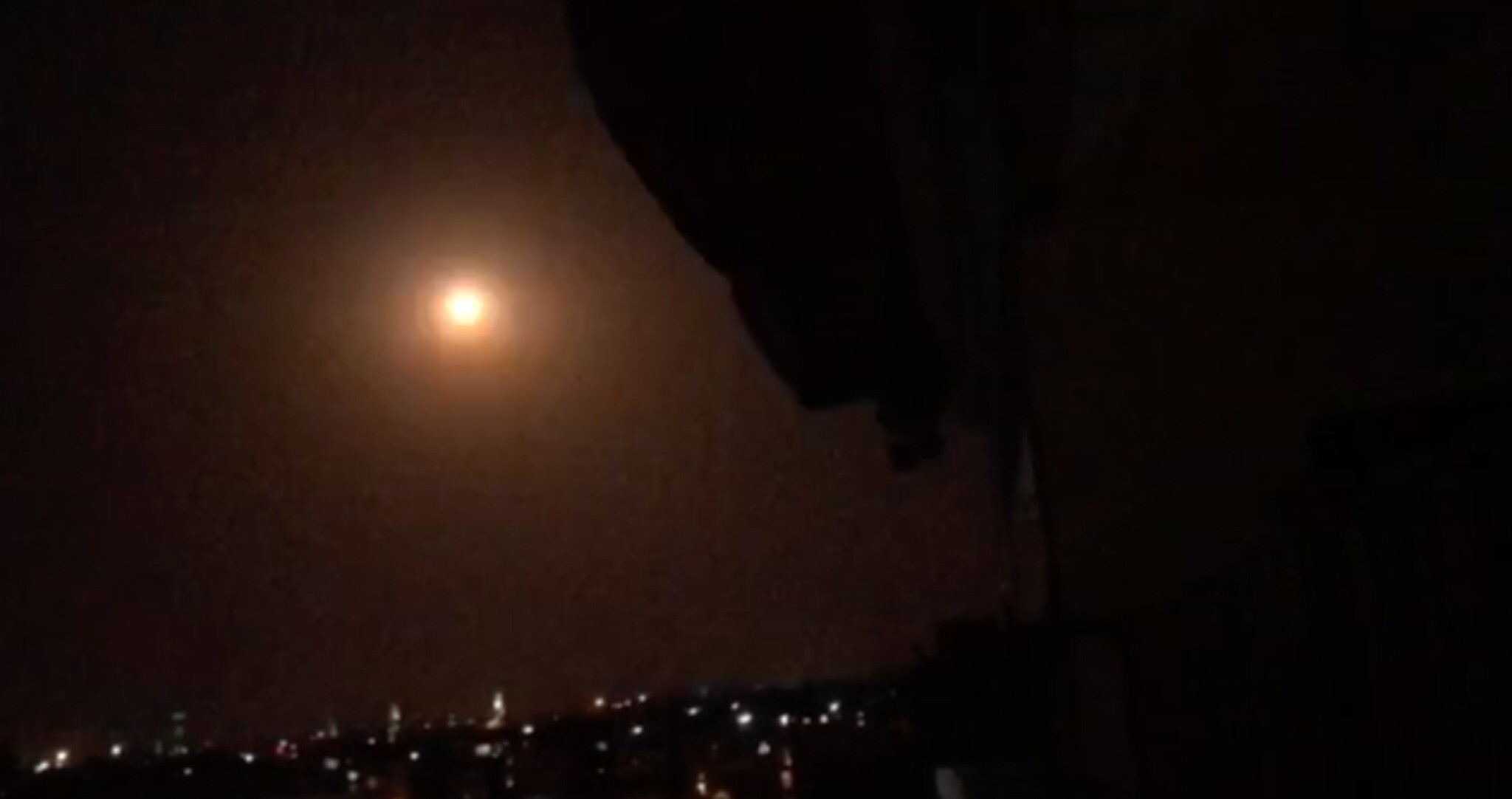
By AGENCIES and TOI STAFFToday, 2:53 am 1Illustrative: A Syrian surface-to-air missile explodes in the sky over southern Syria on August 31, 2020. (SANA)
Syrian state media said Israel carried out airstrikes in the central province of Hama early Friday morning.
Syria’s official news agency SANA said the attack occurred near the town of Masyaf and that the missiles were fired from Lebanese territory.
The Associated Press said Israeli jets flew very low over parts of Lebanon before the strikes, including over Beirut, frightening some of the city’s residents.
The Syrian Ministry of Defense issued a statement saying Israel “launched an aggression by directing a barrage of rockets” from the north of the Lebanese city of Tripoli toward the Masyaf area.
It said Syrian air defenses “confronted the enemy missiles and intercepted most of them.” Syrian war analysts generally dismiss the military’s regular claims of interceptions as false, empty boasts.
Syrian state TV aired footage purporting to show air defenses responding to the Israeli attack.Volume 0%
There was no immediate word on what the target was or whether there were any casualties.
There was no comment from the Israel Defense Forces, which generally maintains a policy of ambiguity regarding its activities against Iran and its proxies in Syria, refusing to publicly acknowledge its actions.
Masyaf is a significant military area for Syrian President Bashar Assad’s regime that includes a military academy and a scientific research center. The general area around Masyaf, which is also believed to have a major Iranian presence, has reportedly been targeted by Israel many times in the past.
The last reported Israeli strikes in Syria took place a month ago in the southern part of the country, near Israel’s border with Syria on the Golan Heights, and reportedly targeted sites associated with Iran and its proxies.
The IDF has launched hundreds of strikes in Syria since the start of the civil war in 2011 against moves by Iran to establish a permanent military presence in the country and efforts to transport advanced, game-changing weapons to terrorist groups in the region, principally Hezbollah.
Vessel said to have surfaced and faced Persian Gulf, in show of force amid threats over killing of nuclear scientist; in similar move, US sub crosses Straight of Hormuz
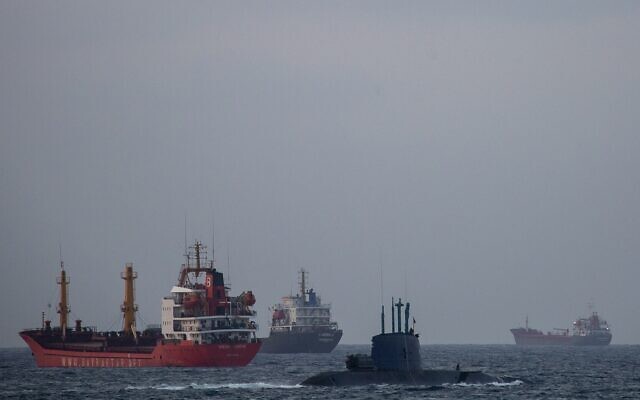
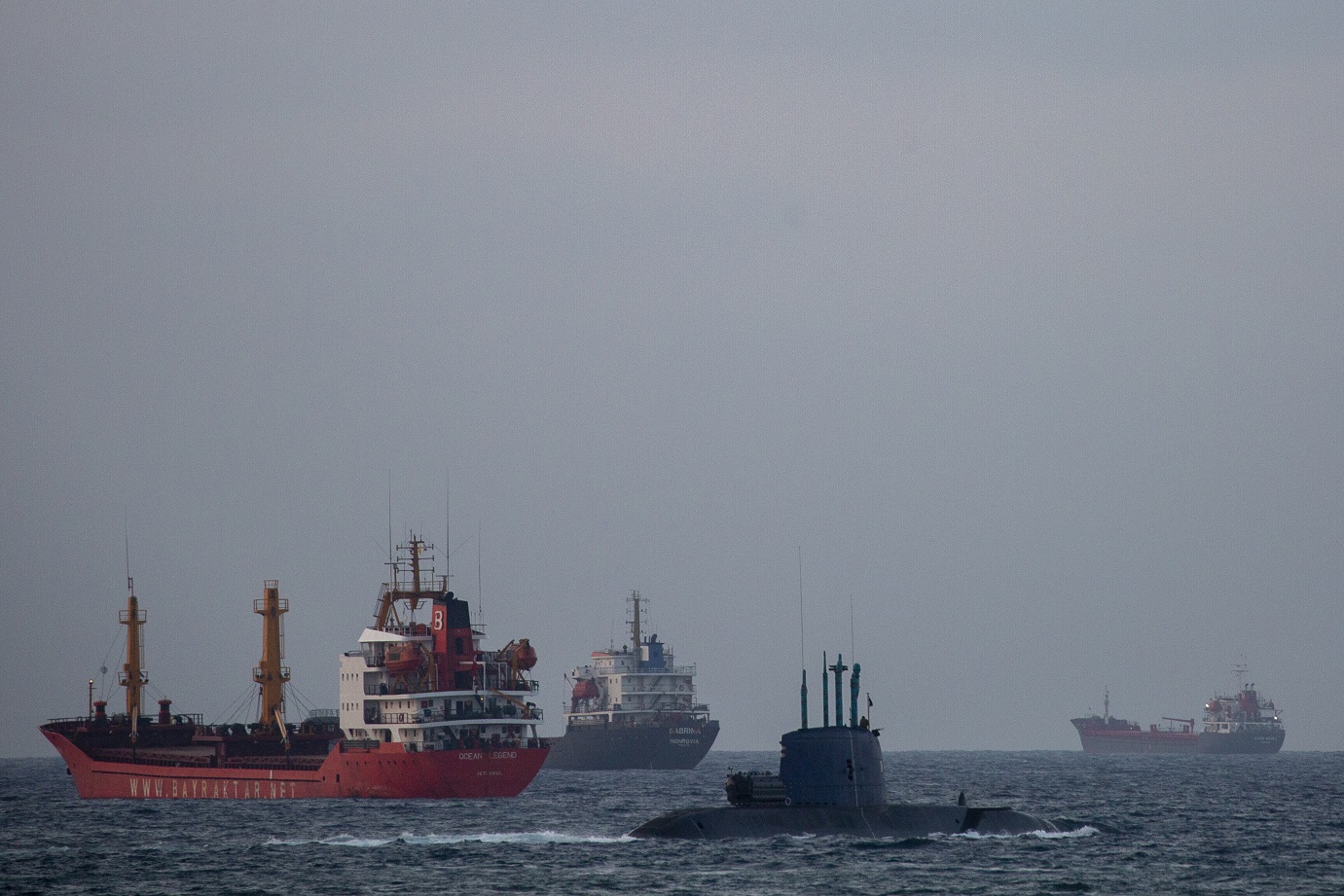
By TOI STAFF and AFP21 December 2020, 10:02 pm 2Illustrative: An Israeli military submarine sails past cargo ships in the Mediterranean Sea, Israel, September 29, 2020. (AP Photo/Ariel Schalit)
An Israeli submarine openly crossed the Suez Canal last week, in a show of force against Iran, the Kan public broadcaster reported Monday night.
The move was approved by Egypt, according to the report, which cited Arab intelligence sources.
The submarine reportedly surfaced and faced the Persian Gulf, which lies on the other side of Saudi Arabia. The intelligence sources said the move was meant to “send a message” to Iran.
The Israel Defense Forces declined to comment, saying it does not respond to “reports of this kind.”
Earlier Monday, IDF Chief of Staff Aviv Kohavi warned Iran against attacking Israel, saying that the Jewish state will retaliate forcefully against any aggression.IDF Chief of Staff Aviv Kohavi speaks during an Israeli Navy ceremony in Haifa, on March 4, 2020. (Flash90)
“Recently, we have heard increased threats from Iran against the State of Israel. If Iran and its partners, members of the radical axis [Iran, Syria, Hezbollah and Palestinian terror groups], whether in the first circle of states or the second, carry out actions against Israel, they will discover their partnership to be very costly,” Kohavi said at a ceremony honoring exemplary soldiers.
“The IDF will forcefully attack anyone who takes part, from near or far, in activities against the State of Israel or Israeli targets. I am saying this plainly and am describing the situation as it is — the response and all the plans have been prepared and practiced,” he added.
Iran has threatened to attack Israel since the assassination of its top nuclear scientist, Mohsen Fakhrizadeh, in late November, in a raid blamed on the Jewish state.
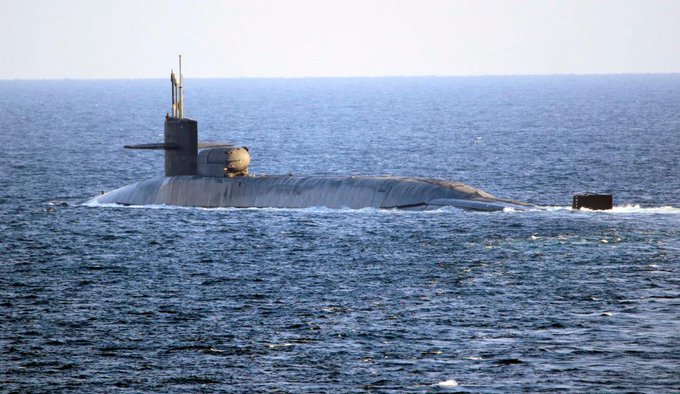
In a strikingly similar move to the reported Israeli submarine crossing of the Suez Canal, a US nuclear submarine crossed the Strait of Hormuz on Monday, in a show of force directed at Iran as the anniversary of the killing of Iranian General Qasem Soleimani by a US drone approached.
The USS Georgia can carry 154 Tomahawk cruise missiles and 66 special forces soldiers, according to a statement from the US Navy, which usually does not disclose the presence of its submersibles around the world.
The statement was illustrated with photos showing the USS Georgia at the surface, escorted by the cruisers USS Port Royal and USS Philippine Sea, in the strategic strait that Iran regularly threatens to block
The Georgia’s presence “demonstrates the United States’ commitment to regional partners and maritime security with a full spectrum of capabilities to remain ready to defend against any threat at any time,” the Navy warned.
US military officials fear an attack by Tehran to avenge the powerful Soleimani, who was assassinated on January 3, 2020, in a US drone strike near Baghdad airport in Iraq.US Marine Corps General Kenneth ‘Frank’ McKenzie, commander of US Central Command, speaks as a picture of Abu Bakr al-Baghdadi is seen during a press briefing October 30, 2019, at the Pentagon in Arlington, Virginia. (Alex Wong/Getty Images/AFP)
The head of US forces in the Middle East, General Frank McKenzie, told journalists Sunday that Washington is “prepared to react” if Iran attacks them.
The anniversary will coincide with a reduction in US military strength in Iraq, and the Pentagon has stepped up demonstrations of force in recent weeks to deter opponents.
Two US B-52 bombers, capable of carrying nuclear weapons, flew over the Gulf region on December 10, and the aircraft carrier USS Nimitz crossed the Gulf waters at the end of November.
A rocket salvo on Sunday targeted the US Embassy in Baghdad, causing damage, but no casualties.
The attack was the third against US military and diplomatic facilities since an October truce with pro-Iran Iraqi factions ended a year-long series of attacks on foreign facilities across Iraq.

 Supporters of the Popular Mobilization Forces hold a posters of Abu Mahdi al-Muhandis, deputy commander of the Popular Mobilization Forces, front, and General Qassem Soleimani, head of Iran’s Quds force during a protest marking a year since their killing in a US drone strike, in Tahrir Square, Iraq, January 3, 2021. (Khalid Moha/AP)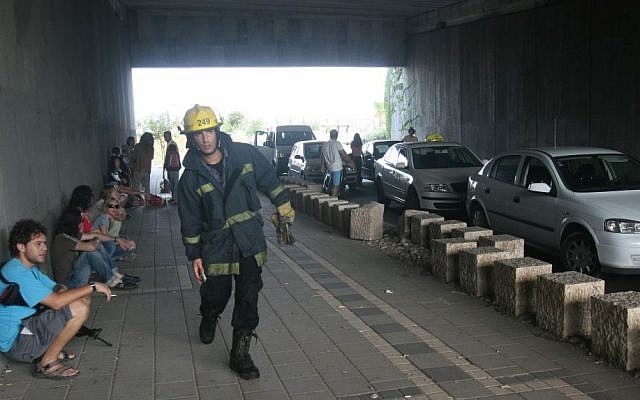

 US President-elect Joe Biden delivers remarks at the Queen Theater on December 28, 2020, in Wilmington, Delaware. (Mark Makela/Getty Images/AFP)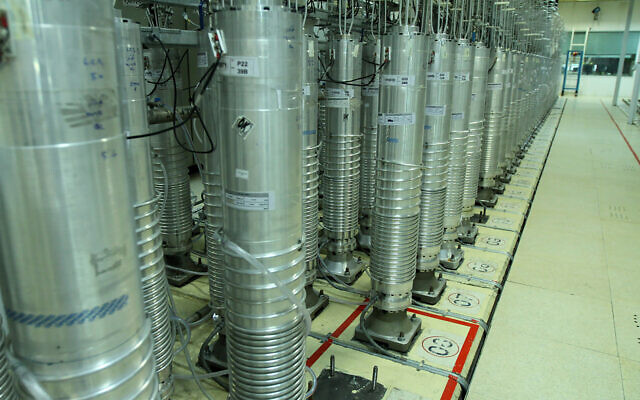



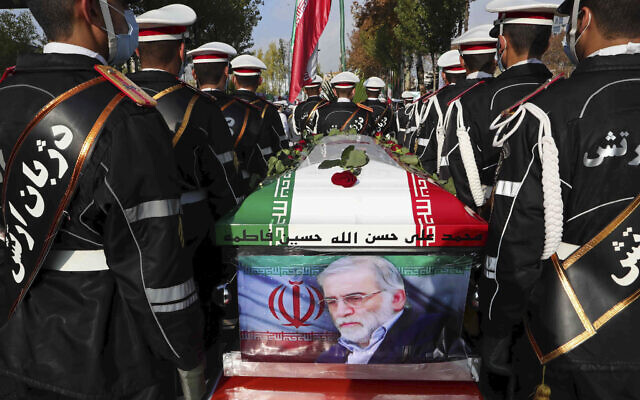 Military personnel stand near the flag-draped coffin of Mohsen Fakhrizadeh, during a funeral ceremony in Tehran, Iran, November 30, 2020. (Iranian Defense Ministry via AP)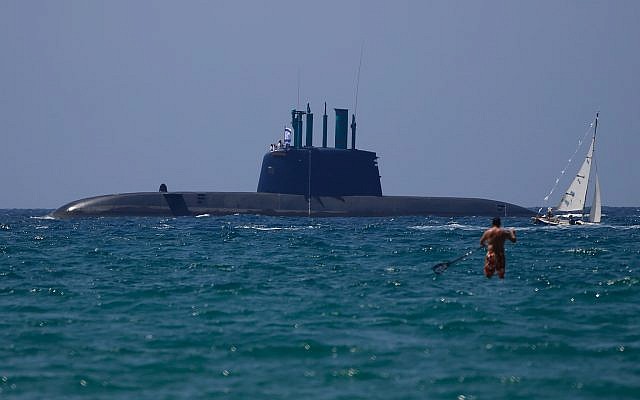




 anneinpt
 artaxes
 danmillerinpanama
 davidking1530
 Peter Hofman
 Joseph Wouk
 Peter
Peter Louisiana Steve
 WarSclerotic
Recent Comments