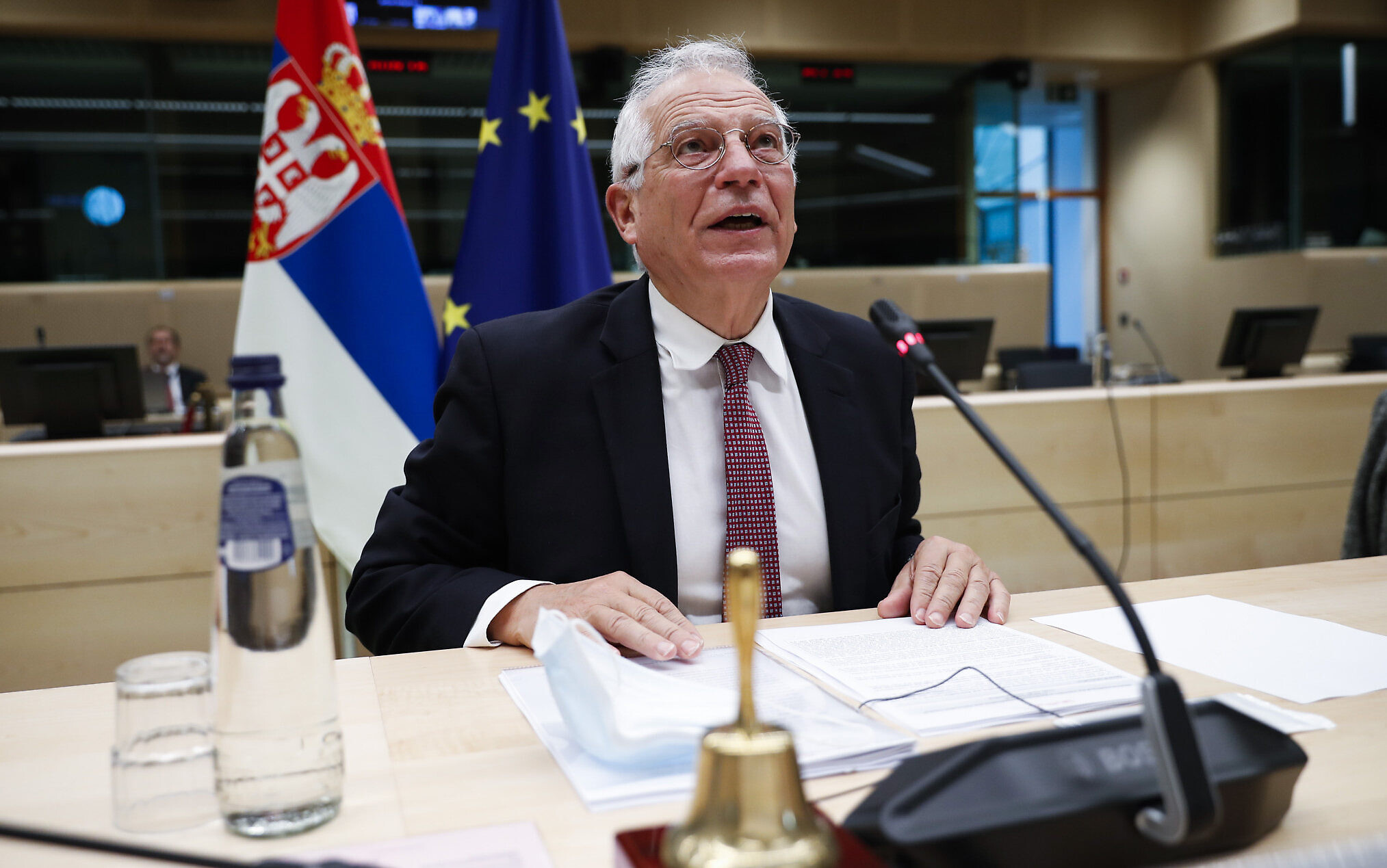
European Union foreign policy chief Josep Borrell speaks during an EU-Serbia videoconference council at the European Council headquarters in Brussels, December 17, 2020. (Francisco Seco/AP)
The European Union said Monday that Iran’s recent move to ramp up uranium enrichment was undermining diplomacy over its nuclear program and urged Tehran to avoid any further escalation.
In a statement on behalf of the 27-nation bloc, European Union foreign policy chief Josep Borrell warned Tehran that its 20 percent enrichment was “a very serious development” with “potentially severe proliferation implications.”
“We urge Iran to refrain from further escalation and reverse this course of action without delay. Continued full and timely cooperation with the (UN nuclear watchdog) IAEA remains critical,” he said.
Borrel said the EU was looking forward to working soon with US President-elect Joe Biden on resurrecting the Iran nuclear deal, and rejected Tehran’s accusation the EU had aligned with Washington’s sanctions.
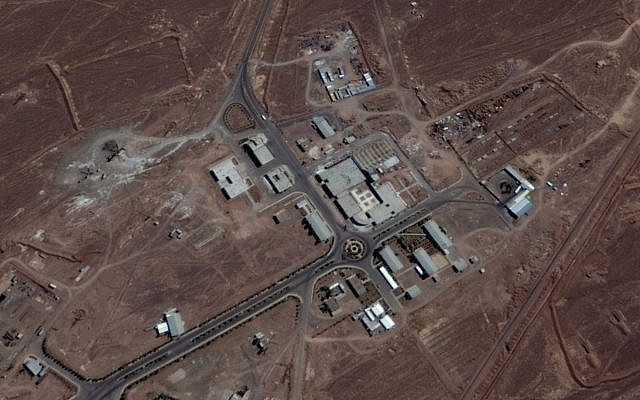
The EU supported “intensive diplomacy with the goal of facilitating a US return to the JCPOA and Iran’s return to full JCPOA implementation,” he said, referring to an acronym for the deal’s official name.A satellite image from September 15, 2017, of the Fordo nuclear facility in Iran. (Google Earth)
Biden, who takes office on January 20, has suggested the United States will return to the Iran deal, which it withdrew from in 2018 under US President Donald Trump, who reinstated and increased US sanctions.
Iran from 2019 has increasingly breached its own commitments under the deal, arguing it has the right to do so under its terms because the US was no longer abiding by it.
Most recently, last week it started again enriching uranium to 20 percent at its Fordo nuclear site, a step just below what is needed to produce material for nuclear weapons.
It has also accused the European signatories — EU members France and Germany and former EU member Britain — of going along with the US sanctions, even as their governments defied Trump to keep the deal alive.
In a likely sign of Biden’s intention to quickly address the Iran nuclear deal, the US president-elect on Monday tapped William Burns, a retired diplomat, to be his CIA chief.
Burns helped lead secret talks with Tehran that set the stage for the 2015 accord with Iran.
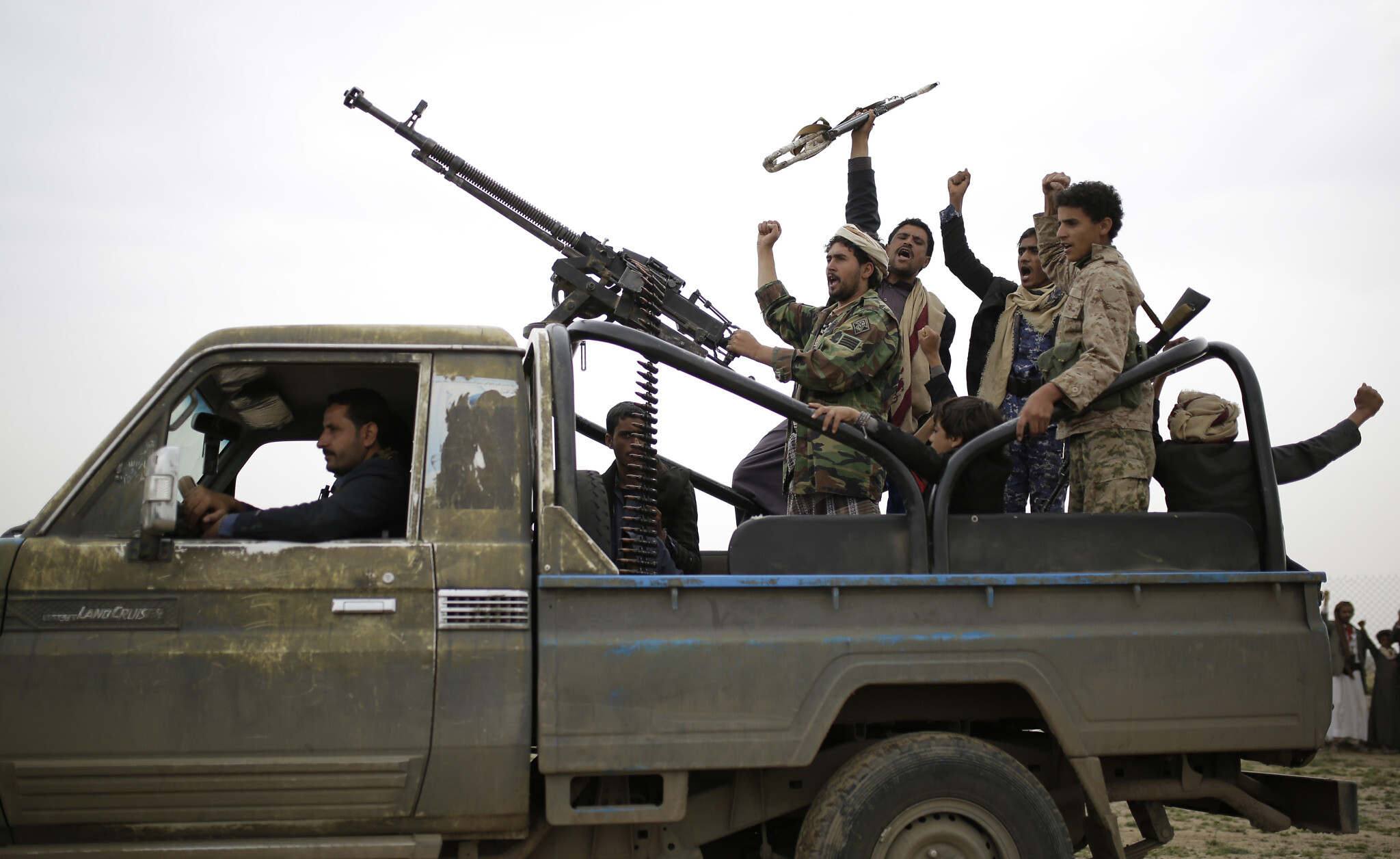
Houthi fighters chant slogans as they take off to a battlefront following a gathering aimed at mobilizing more fighters for the Houthi movement, in Sanaa, Yemen, August 1, 2019. (AP Photo/Hani Mohammed)
The United States will designate Yemen’s Houthi rebels as a terrorist group, US Secretary of State Mike Pompeo said Sunday, a late-term move that aid groups fear will worsen a humanitarian crisis.
With just 10 days left before US President-elect Joe Biden takes office, the action appeared aimed at complicating the new administration’s efforts to restart diplomacy with Iran, which has ties to the Houthis and other terror groups in the region, and to reassess the US relationship with Saudi Arabia, which has led a brutal offensive in Yemen.
“The designations are intended to hold Ansar Allah accountable for its terrorist acts, including cross-border attacks threatening civilian populations, infrastructure and commercial shipping,” Pompeo said in a statement, using the official name of the Houthi movement.
It has led a brutal campaign that has “killed many people, continues to destabilize the region and denies Yemenis a peaceful solution to the conflict in their country,”
Pompeo pointed to a December 30 attack on an airport in Yemen’s second-largest city Aden, which killed 26 people and was blamed by the Saudi-backed government on the Houthi.
The rebel group controls much of Yemen and is already under US sanctions.
But a designation as a terrorist group is expected to scare away outside actors from many transactions with Houthi authorities, including bank transfers and buying food and fuel.
Aid groups as well as members of Biden’s Democratic Party have warned that the move will severely impede efforts to address what the United Nations calls the world’s largest humanitarian crisis.People run following an explosion at the airport in Aden, Yemen, shortly after a plane carrying the newly formed Cabinet landed on December 30, 2020. (AP Photo)
Pompeo insisted that the designations — which will come into effect a day before Biden takes office on January 19 — will not impact relief work.
“We are planning to put in place measures to reduce their impact on certain humanitarian activity and imports into Yemen,” Pompeo said.
“We have expressed our readiness to work with relevant officials at the United Nations, with international and non-governmental organizations and other international donors to address these implications.”
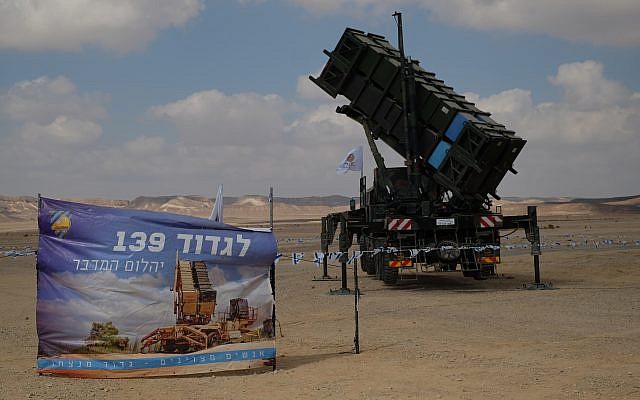
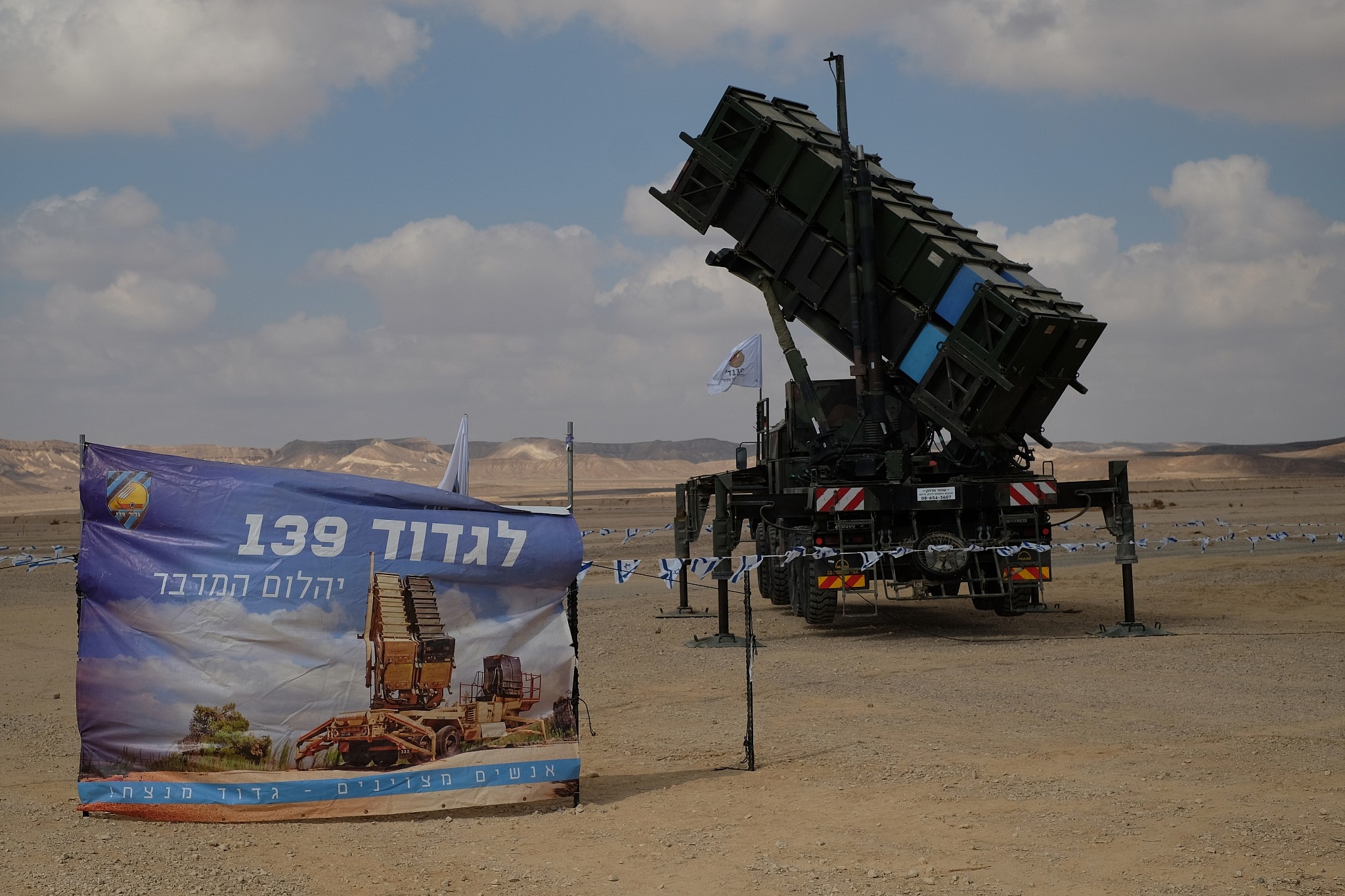
A Patriot anti-missile system in Israel (Shay Levy/Flash90)
Iran has indicated plans to exact revenge for the United States killing of Qassem Soleimani, the influential head of the Islamic Revolutionary Guard Corps’ expeditionary Quds Force, and Mohsen Fakhrizadeh, the head of Iran’s military nuclear program, assassinated, allegedly by Israel.
The Israeli military assessed that such retaliation was likely to come from an Iranian proxy, potentially from the Houthis.
While Netanyahu critics Rice and Kerry won’t be dealing with Iran or Israeli-Palestinian conflict, Israel reportedly concerned about role of former Iran deal negotiator Sherman
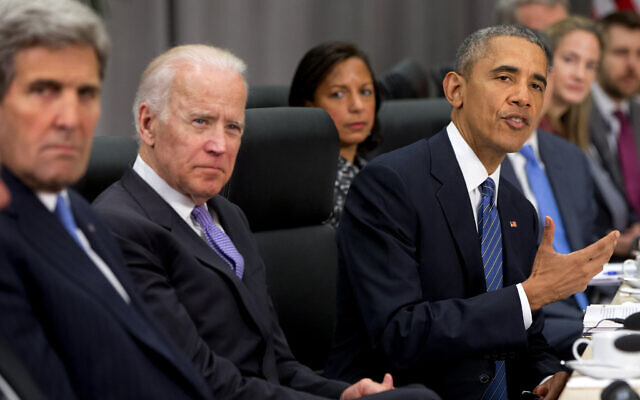
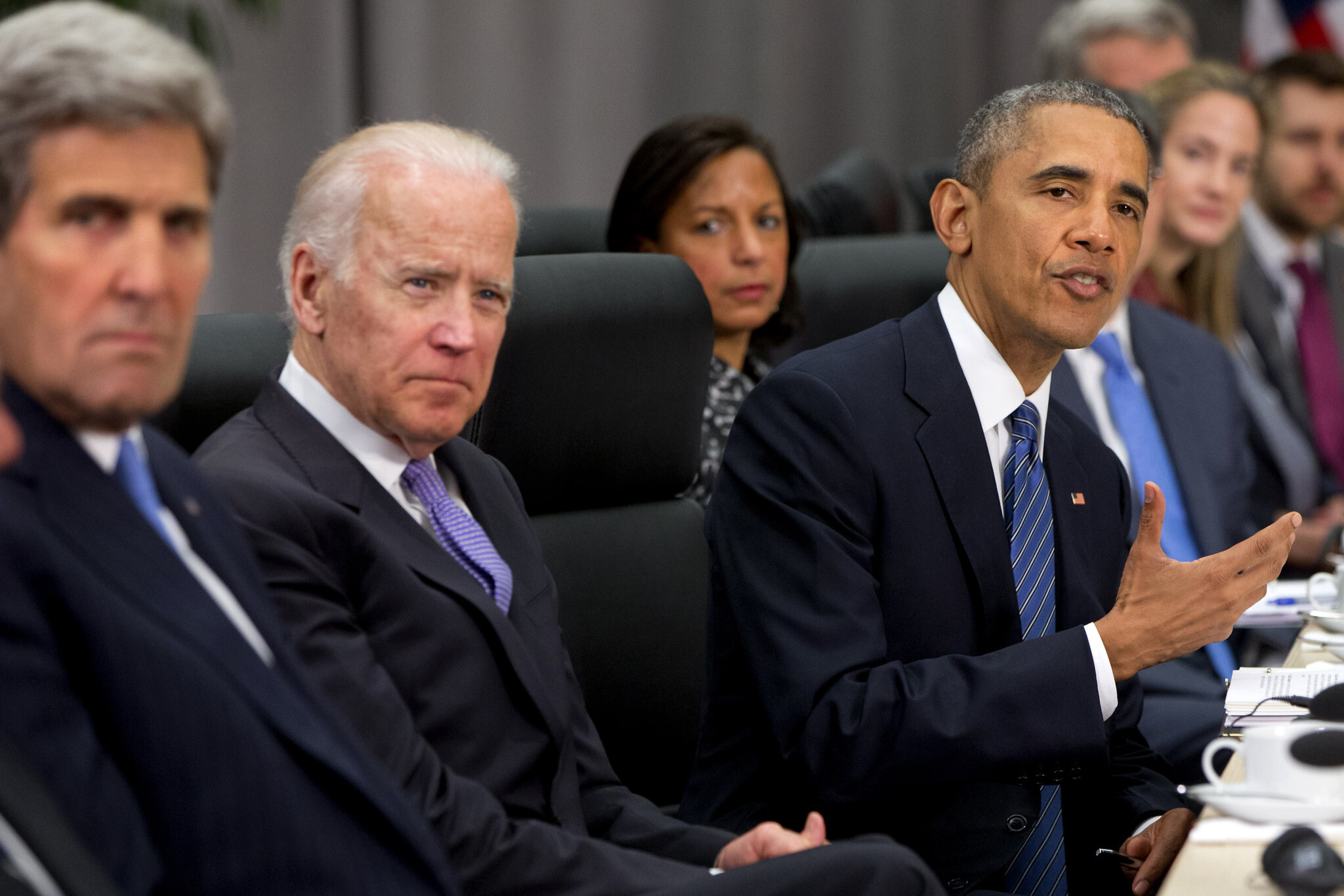
US President Barack Obama, accompanied by, from left, Secretary of State John Kerry, Vice President Joe Biden, and National Security Adviser Susan Rice, speaks during a meeting with Chinese President Xi Jinping at the Nuclear Security Summit in Washington on March 31, 2016. (AP/Jacquelyn Martin)
Prime Minister Benjamin Netanyahu’s closest advisers are reportedly concerned about the foreign policy team that US President-elect Joe Biden is putting together as it begins to look more and more like that of former president Barak Obama, who sparred frequently with the Israeli premier over Iran and the Israeli-Palestinian conflict.
On Tuesday, Politico reported that Wendy Sherman, a chief US negotiator for the 2015 nuclear deal with Iran, will be nominated for the role of deputy US secretary of state. She’ll serve under Biden’s nominee for secretary of state, Tony Blinken, who was deputy secretary of state under Obama.
Biden has also tapped former Obama-era secretary of state John Kerry to serve as a special envoy on climate change and Obama’s national security adviser Susan Rice to server as director of the White House Domestic Policy Council. Jake Sullivan, who was also involved in negotiating the Iran deal vehemently opposed by the Netanyahu government, will serve as Biden’s national security adviser.
The growing list of “Obama people” has members of Netanyahu’s National Security Council grumbling, Axios reported Wednesday.US Secretary of State John Kerry and Under Secretary for Political Affairs Wendy Sherman meet with foreign ministers of Germany, France, China, Britain, Russia and the European Union at a hotel in Vienna, Austria on July 7, 2015. (AFP PHOTO / POOL / CARLOS BARRIA)
Israeli Ambassador to the US Ron Dermer has told interlocutors in Washington that he’s less worried about Kerry and Rice, as they aren’t slated to be involved in forming Middle East policy, according to Axios.
He’s also not as concerned about Blinken and Sullivan, who are seen as having strong pro-Israel credentials, despite having served in the Obama administration. Dermer’s greater concern is Sherman as she is set to assume a role that will likely include a great deal of involvement in crafting policy toward Iran, the report said.
Dermer declined to comment for this story, as did Netanyahu’s office, Axios said.
Dermer and Netanyahu have both repeatedly called Biden’s plan to re-enter the nuclear agreement abandoned by US President Donald Trump a mistake.
Biden and his staff have said he will only re-enter the accord if Iran returns to compliance with it and that he hopes to negotiate a follow-up agreement that will address Iran’s ballistic missile program as well as its regional hegemony.
Tehran, which announced earlier this week that it has ramped up its uranium enrichment to 20% in violation of the deal, has asserted that it will not negotiate a subsequent agreement.
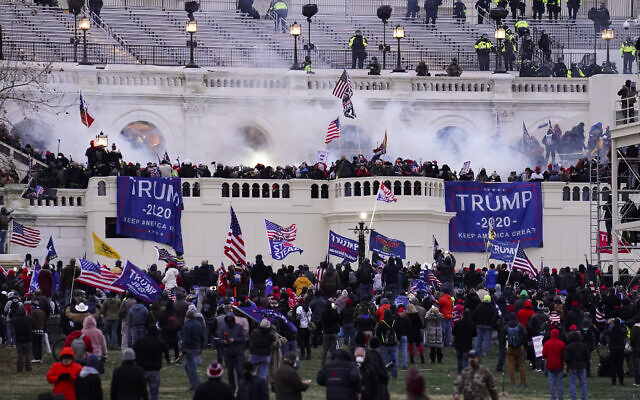
Netanyahu sparred with the Obama administration regularly over the latter’s determination to pursue a diplomatic solution to Iran’s nuclear pursuit as well as a two-state solution to the Israeli-Palestinian conflict based roughly on the pre-1967 borders.Violent protesters, loyal to US President Donald Trump, storm the Capitol, January 6, 2021, in Washington. (AP Photo/John Minchillo)
Netanyahu enjoyed a near complete transformation of those policies when Donald Trump entered the White House in 2017. The Republican president would go on to withdraw from the Iran deal and propose a peace plan that envisions Israel annexing all of its West Bank settlements.
But the premier may be forced to distance himself from Trump against the backdrop of the attempt by the president’s supporters to stampede the Capitol to prevent the certification of his election loss.
Netanyahu condemned the attack on the Capitol as “disgraceful,” but only made mention of Trump in praising him as a “peacemaker” for his administration’s negotiating of the Abraham Accords.
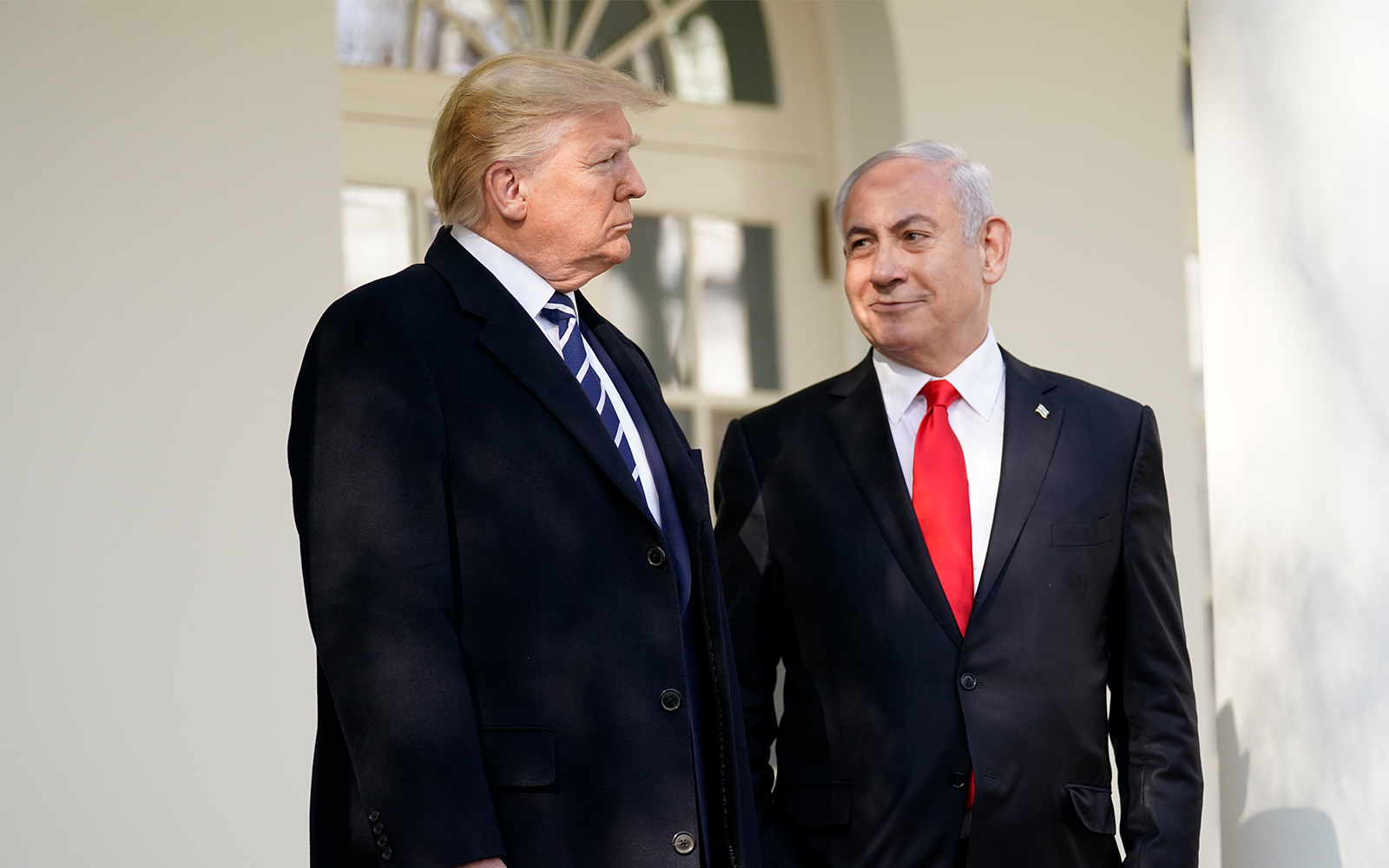
US President Donald Trump, left, and Prime Minister Benjamin Netanyahu walk to a meeting in the Oval Office of the White House, January 27, 2020. (AP Photo/ Evan Vucci)
Prime Minister Benjamin Netanyahu praised US President Donald Trump’s administration for its Middle East policies on Thursday, as the American leader faced widespread criticism at home after hundreds of his supporters stormed the Capitol building the day before.
“I want to thank President Trump and all of you in the administration for all you have done and are doing for peace. You’ve made a real difference, achieving one breakthrough after another, bringing the United Arab Emirates, Bahrain, Morocco and Sudan into the circle of peace. I have no doubt that more Arab and Muslim countries will follow,” Netanyahu said.
In recent months, the Trump administration has brokered normalization agreements between Israel and the UAE, Bahrain and Morocco. Sudan, which recently saw regime change in favor of a government more aligned with the US, has also agreed to normalize ties with Israel, though no agreement between the two countries has been signed.
The prime minister made his remarks alongside US Treasury Secretary Steve Mnuchin, who stopped in Israel on Wednesday and Thursday following a visit to Sudan, where officials agreed to advance their efforts to normalize ties with Israel, and before taking off to Qatar, Kuwait, Saudi Arabia and the United Arab Emirates for meetings.
Netanyahu repeated his opposition to the United States rejoining the Iran nuclear deal, formally known as the Joint Comprehensive Plan of Action, as US President-elect Joe Biden has indicated he plans to do if Iran returns to compliance with the accord.US President Donald Trump, center, with from left, Bahrain Foreign Minister Khalid bin Ahmed Al Khalifa, Israeli Prime Minister Benjamin Netanyahu, and United Arab Emirates Foreign Minister Abdullah bin Zayed al-Nahyan, during the Abraham Accords signing ceremony on the South Lawn of the White House, September 15, 2020, in Washington. (AP Photo/Alex Brandon)
Trump withdrew the US from the agreement in 2018 — at the urging of Netanyahu — reimposing economic sanctions on Iran and prompting Tehran to begin violating the terms of the deal by enriching more uranium and to greater levels. This week, Iran announced it would begin enriching uranium to 20 percent, just a small technical step away from the 90% needed for a nuclear bomb.
Biden has said that if Iran returns to the terms of the agreement, he too would rejoin, removing the crushing economic sanctions that have wreaked havoc on the Iranian economy over the past two years.
Netanyahu, a staunch and vocal opponent of the JCPOA, warned that returning to the agreement would prompt further nuclear proliferation in the region. This claim was based on the criticism that the nuclear agreement grants legitimacy to Iran’s nuclear program, allowing portions of it to operate freely after a certain amount of time, though technically, under the deal, Tehran agrees to never pursue nuclear weapons.
“If we just go back to the JCPOA, what will happen and may already be happening is that many other countries in the Middle East will rush to arm themselves with nuclear weapons. That is a nightmare and that is folly. It should not happen,” Netanyahu said.
The premier thanked Mnuchin for his role in the imposition of economic sanctions on Iran and called for the strategy — known as “maximum pressure” — to continue.Prime Minister Benjamin Netanyahu (R) addressing the media alongside US Treasury Secretary Steven Mnuchin in Jerusalem, January 7, 2021. (GPO)
“I also want to commend the maximum pressure campaign on Iran. Under your leadership, the US Treasury has played a crucial role in applying and enforcing sanctions on the Iranian regime,” Netanyahu said.
“It must be continued to prevent Iran from continuing its campaign of aggression and terror throughout the region and to prevent Iran from rushing to a nuclear arsenal,” he added.
During his remarks, Netanyahu also condemned the assault on the US Capitol building in Washington, DC, by a mob of Trump loyalists who sought to interrupt the certification of Biden’s victory in the November election.
The prime minister called the attack “disgraceful” and said it represented the “opposite of the values we know Americans and Israelis cherish.”Supporters of US President Donald Trump protest inside the US Capitol on January 6, 2021, in Washington, DC. (ROBERTO SCHMIDT / AFP)
Mnuchin also condemned the attack on the Capitol Building and indicated that he would not be resigning from his position in light of the attack on the Capitol, which both Republican and Democratic lawmakers blamed on incitement by the president, as Deputy National Security Adviser Matt Pottinger did Wednesday.
“The violence that occurred last night at the Capitol in Washington, DC, was completely unacceptable. Now is the time for our nation to come together as one and to respect the democratic process in the US,” the treasury secretary said.
“I look forward to getting back to Washington, DC, with our continued work on the transition,” he added.
Mnuchin’s office said that during his visit in Israel, he met with Netanyahu and Finance Minister Israel Katz to discuss the economic opportunities presented by the Abraham Accords and Israel’s improved ties with the Persian Gulf.
His spokesperson said the three also spoke about “national security issues, including cooperative efforts to combat terrorist financing.”
The Islamic Republic just skyrocketed levels of uranium enrichment — all under the watch of the IAEA
Iranian FM Mohammad Javad Zarif (Photo: ATTA KENARE/AFP via Getty Images)
With close to two weeks left in office for President Donald Trump, Iran is establishing facts on the ground to leverage the Biden administration with its announcement that it has begun to enrich uranium to a 20 percent level.
The level represents the “most significant and blatant violation to date” of the nuclear deal, according to former Israeli army intelligence chief Amos Yadlin.
Twenty percent represents “a technical step away from weapons-grade levels of 90 percent,” according to a report by the AP. Astonishingly, the move – which consists of the highest level of enrichment since the nuclear agreement made between Iran and the world powers in 2015 – was made with the tacit approval of inspectors from the International Atomic Energy Agency.
“At Fordo, Iranian nuclear scientists under the watch of International Atomic Energy Agency inspectors loaded centrifuges with over 130 kilograms (285 pounds) of low-enriched uranium to be spun up to 20%, said Kazem Gharibabadi, Iran’s permanent representative to the U.N. atomic agency.” – AP
According to the prestigious Washington think tank, the Institute for Science and International Security, once enough uranium is enriched to the 20 percent level, enriching it further to the 90 percent needed for bomb-grade material would only take six weeks.
The institute estimates, that with this new development at Fordo, it will take Iran only five to six and a half months to produce enough uranium necessary to make a bomb. From that point, it would take another month and a half for Iran to produce a bomb itself.
Some experts believe that Iran already has enough low-level enriched uranium for several nuclear bombs and that the further enrichment necessary to actually produce the bombs would take about three months.
In a clear move to leverage the incoming Biden administration, Iranian Foreign Minister Mohammad Javad Zarif tweeted, “Our measures are fully reversible upon FULL compliance by ALL.
Members of Biden’s incoming administration have indicated that re-entering the 2015 nuclear agreement made under the Obama/Biden administration is “high on his agenda.”
“I believe that in the first months [of Biden’s presidency], we’ll either see him rejoin the deal fully or what I would call ‘JCPOA-minus,’ meaning lifting sanctions in exchange for suspending some of the Iranian nuclear programs [developed] in the past three years,” said Amos Hochstein, who worked at the State Department during the previous administration and oversaw energy sanctions on Iran.
Trump withdrew from the agreement in 2018 and embarked instead on a program of crippling sanctions against Iran. The Trump State Department called Iran’s latest move a “clear attempt to increase its campaign of nuclear extortion.”
Lifting sanctions will give Iran access to the much-needed cash they need to purchase advanced weapons, which recently become legally available to them.
In October, a 13-year UN arms embargo on Iran was lifted as part of the nuclear agreement. This means that Iran – recognized as the largest state sponsor of terrorism – is now allowed to buy weapons from which it was previously restricted, as well as give them to its proxies, including the Lebanese terrorist group Hezbollah and the Houthi rebels in Yemen.
Iran is demanding “full and unconditional implementation of the [nuclear agreement] and compensation for the events of the past,” said a spokesman for the Iranian Foreign Ministry.
Further, the spokesman said, “We will not renegotiate any parts of the [nuclear agreement].”
One of the biggest flaws of the agreement was that it did not address Iran’s ballistic missile program. Ballistic missiles can be fitted with nuclear warheads.
Incoming National Security Advisor Jake Sullivan said in a recent interview on CNN that the U.S. would lift sanctions on Iran in exchange for negotiations on Iran’s ballistic missile program. Sullivan also said in the same interview that the assassination of Iranian terror mastermind Qassem Soleimani did not make America safer or protect U.S. interests.
What are we to make of Biden and members of his administration expressing such attitudes, as well as making such blatant overtures to the Iranian regime? Master negotiators, the Iranians managed to gut the 2015 nuclear agreement of any teeth, including:
Ruling out any inspections of its military sites (necessary for an assessment of possible nuclear dimensions of the existing Iranian nuclear program)
Getting immediate sanctions relief (making “snapback” provisions a moot point after Western nations immediately began investing in Iran)
Retaining centrifuges used for enriching uranium
Continued uranium enrichment
Retention of nuclear sites
In this second round of negotiations, Iran already has the upper hand – simply because the incoming administration has indicated their eagerness to rejoin the agreement. This is especially devastating considering the fact that Trump is leaving Biden with an enormous amount of economic leverage over Iran.
“They [Iran] are in deep, deep trouble, and to simply return to the status quo of the Obama administration, surrender all of that simply to return to a deal that in a space of a very few years is going to run out and allow Iran to surge forward with an industrial-strength nuclear program doesn’t make a lot of sense to me,” said former Vice President Dick Cheney’s national security adviser John Hannah, speaking to FOX Business.
In addition to a severely weakened Iran, Trump has left Biden with a Middle East unified against Iran through the historic Abraham Accords, the peace agreements between Israel and the United Arab Emirates, Bahrain, Morocco and possibly more countries to come in the last days of the Trump administration.
The Trump team has also just negotiated the end of a years-long dispute between the Gulf States and Qatar (who, since the dispute, made overtures to Iran). They also just seized $7 million in Iranian assets after shutting down a money-laundering operation designed to get around American sanctions against the Islamic Republic. The Department of Justice plans to use the money to pay victims of Iranian state-sponsored terrorism.
After the nuclear agreement was made and sanctions were lifted, European companies invested deeply in Iran (apparently with no concern for effectively financing this terrorism). One thing Trump taught us is that America does just fine without playing international politics by European rules.
While Biden has made “restoring” America’s relationship with Europe one of the priorities of his foreign policy, it remains to be seen what the U.S. will get in return – particularly in light of the new trade agreement Europe just made with China. The agreement prioritizes Europe’s ties with the communist regime over those with the U.S.
The new administration would be better off staying the course and not get involved in negotiating with Iran. Historically, such negotiations have not ended well and there is no reason to believe this time will be any different.
Iran is driven by ideology, and no amount of Western largesse will change that.
Iron Dome and Patriot batteries seen in Eilat area in recent days over concerns Iran may seek revenge for killings of Soleimani, Fakhrizadeh with attack on Israel by Houthis
Illustrative. A Patriot missile defense battery sits in the desert in the Ovda air base in southern Israel during the international Blue Flag exercise on November 9, 2017. (Judah Ari Gross/Times of Israel)
The Israeli military has deployed air defense batteries around the southern city of Eilat in recent days amid concerns of an attack from the Iran-backed Houthi militia in Yemen.
The move came around the first anniversary of the United States killing of Qassem Soleimani, the influential head of the Islamic Revolutionary Guard Corps’ expeditionary Quds Force, in an airstrike in Iraq and a month and a half after Mohsen Fakhrizadeh, the head of Iran’s military nuclear program, was killed, allegedly by Israel.
Iran has indicated plans to exact revenge for these two high profile killings. The Israeli military assessed that such retaliation was likely to come from an Iranian proxy, potentially from the Houthis, a Yemeni group that has conducted a number of attacks over the years against Tehran’s other rival in the region, Saudi Arabia.
Last month, IDF Spokesperson Hidai Zilberman told a Saudi news outlet that Israel had information indicating Iran was developing unmanned aerial vehicles and “smart missiles” in Iraq and Yemen, and that the weapons could have the ability to strike Israel.
In light of this threat, Iron Dome and Patriot missile defense batteries have been deployed near Israel’s southern tip of Eilat in recent days. The Iron Dome is generally used against rockets and mortar shells, but can also intercept small drones and cruise missiles. The Patriot system is used primarily to defend against ballistic missiles and larger aircraft like fighter jets and unmanned aerial vehicles.
In recent weeks, the Israeli military has also reportedly sailed a submarine through the area, sending the vessel through the Suez Canal and into the Red Sea. Due to the shallow depth of the canal, submarines can only pass through it above the water, where they can easily be spotted. As such, the move was generally seen as a show of force directed toward Iran.
In his interview last month, Zilberman said Israel was tracking Iranian movements around the region, and that Israeli submarines were quietly “sailing everywhere.”
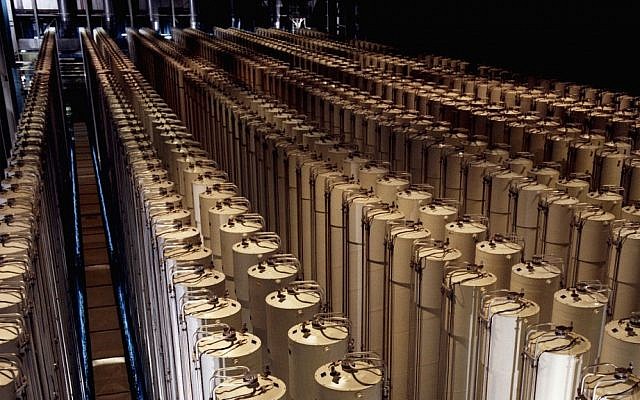
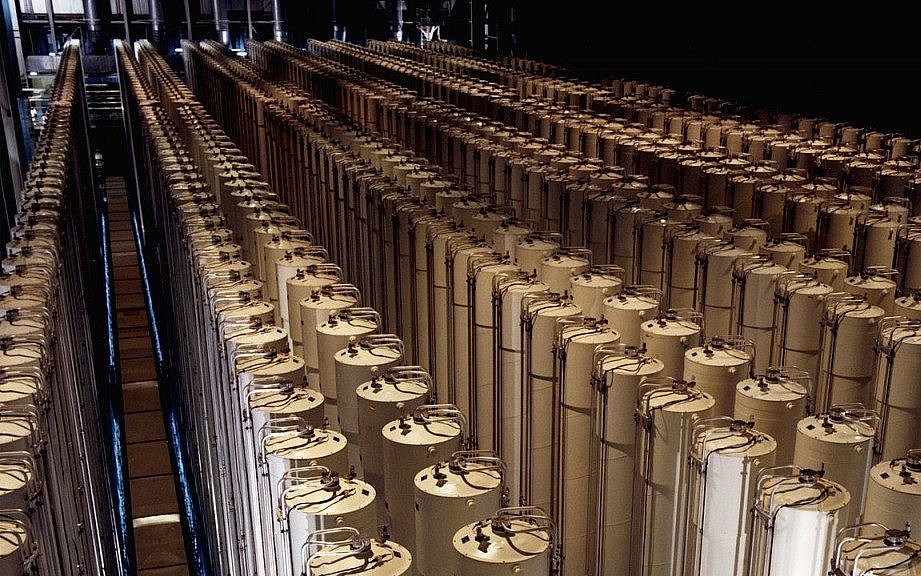
Illustrative. Centrifuges enriching uranium. (Public Domain/US Department of Energy/Wikimedia Commons)
After Iran confirmed that it has stepped up its uranium enrichment in breach of the 2015 nuclear deal, the head of Iran’s atomic agency said Tuesday the Islamic Republic is in the process of installing 1,000 new centrifuges to help increase production.
“One thousand centrifuges are being installed inside the country,” Ali Akbar Salehi said, according to the semi-official Fars News Agency.
“We are currently installing one thousand IR-2m centrifuges, but two cascades are installed and working,” he added.
Salehi also said that Iran had increased its supply of yellowcake, a precursor to enriched uranium, eight-fold in the past two years.
“Until three or four years ago, we used to produce an average of 4 to 5 tons of yellowcake, but for the past two years, we have increased the production of yellowcake to 30 tons,” he said in his reported comments. “This year, the production of yellowcake will be between 35 and 40 tons, which means that we have 8-folded the production of yellowcake.”
Yellowcake is a uranium concentrate in powder form and an early step in uranium processing. It is produced by mining uranium ore from rocks and separating the uranium from the rocks by bathing them in acid. The yellowcake can then be converted, enriched to raise its purity, and then used for weapons or energy production.File: The head of Iran’s Atomic Energy Organization Ali Akbar Salehi delivers his speech at the opening of the general conference of the IAEA in Vienna, Austria, September 16, 2019. (AP Photo/Ronald Zak)
Salehi’s comments came a day after Iran said it had begun enriching uranium to 20 percent purity — far above the level permitted under its 2015 agreement with world powers — in a step the US State Department condemned as “nuclear extortion.” The 2015 deal capped enrichment at 3.75%. The jump from 20% to the 90% required for an atomic bomb is actually rather quick compared to the work needed to move from approximately 4% to 20%.
Increasing enrichment to 20% was the most striking suspension yet of Tehran’s commitments under its landmark deal with six nations, which has been fraying since US President Donald Trump withdrew from it in 2018 and reimposed crippling sanctions.
Responding to the uranium announcement, the US Treasury imposed new sanctions targeting Iran’s steel sector Tuesday, slapping penalties on a dozen Iranian companies, three foreign holding companies of Iranian firms, and one China-based manufacturer that supplies graphite electrodes to the Islamic Republic.
“The Iranian metals sector is an important revenue source for the Iranian regime, generating wealth for its corrupt leaders and financing a range of nefarious activities, including the proliferation of weapons of mass destruction and their means of delivery, support for foreign terrorist groups, and a variety of human rights abuses, at home and abroad,” the US Treasury said in a statement.
“The Trump Administration remains committed to denying revenue flowing to the Iranian regime as it continues to sponsor terrorist groups, support oppressive regimes, and seek weapons of mass destruction,” said Treasury Secretary Steven T. Mnuchin.
The European Union noted Iran’s step “with deep concern” and said it planned to “redouble our efforts to preserve the agreement and return to its full implementation by all parties.”Iranian nuclear scientist Mohsen Fakhrizadeh. (Agencies)
Iran’s conservative-dominated parliament voted in favor of increasing uranium enrichment after the November killing of its top nuclear physicist Mohsen Fakhrizadeh, an assassination Iran blamed on Israel.
Prime Minister Benjamin Netanyahu has charged Iran’s latest nuclear move proves it is seeking to build an atomic bomb — a claim Iran has always strongly denied — and pledged the Jewish state “will not allow” it to do so.
Iran’s Foreign Minister Mohammad Javad Zarif said Tehran took the latest enrichment step “after years of non-compliance” by other parties and that “our measures are fully reversible upon full compliance by all.”
Russia’s foreign ministry said in a statement it “paid tribute to the regular declarations by Iranian leaders of their willingness to return to full respect for the requirements of the agreement”.
It added, however, that “additional efforts and costs will now be required to bring the Fordo site in line with the terms of the agreement.”
Iranians apply pressure by breaking nuclear deal with higher uranium enrichment, but experts say US president is becoming more unpredictable as he rages over election loss
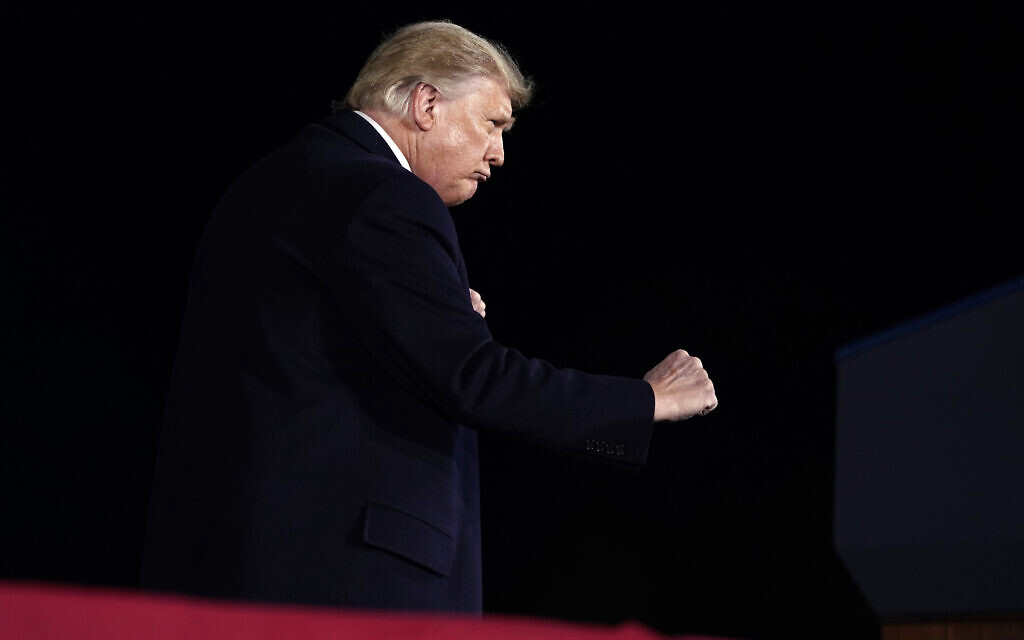
US President Donald Trump dances after speaking during a campaign rally for a Republican senator at Dalton Regional Airport, in Dalton, Georgia, January 4, 2021, (Evan Vucci/AP)
Iran has opened the new year with a gambit to pressure US President-elect Joe Biden, but fears are rising that conflict could erupt instead with Donald Trump, who still commands US military might in his chaotic final stretch.
Iran announced Monday it was stepping up uranium enrichment well beyond the limits in a 2015 nuclear accord negotiated with former president Barack Obama — and indicated it would reverse course if Biden lifts Trump’s crippling sanctions after taking over on January 20.
Tensions have soared since Trump walked out of the accord in 2018, and have escalated further in recent days, with the United States flying B-52 bombers over the Gulf and abruptly reversing a decision to bring home an aircraft carrier.
In an unusual statement that sounded more like the White House than the Pentagon, acting Defense Secretary Christopher Miller said late Sunday he was keeping the USS Nimitz in the Gulf due to Iranian threats against US officials including Trump personally.
“We have a new form of deterrence now — schizophrenic deterrence. We don’t know what we’re doing,” said Vipin Narang, an expert on nuclear strategy at the Massachusetts Institute of Technology.
Instead of looking tough by reversing the Nimitz’s return, “it may send the wrong signal — which is that it’s total chaos in Washington right now and if you’re going to take a shot, maybe this is the time you want to do it.”
Narang said the risk of the United States initiating military action remained low but warned that Trump was becoming more unpredictable as he rages and seeks to overturn his election loss.
“If I were Iran right now, I would actually be thinking that it’s possible that Trump is so unhinged and so angry about the election that he may overreact to any slight provocation,” Narang said.US President-elect Joe Biden waves from the stage as he campaigns for for Georgia Democratic candidates in Atlanta, January 4, 2021. (Carolyn Kaster/AP)
Trump had warned that he would hold Iran accountable for the killings of any Americans after the US embassy in Baghdad was hit a week ago by rockets blamed on Shiite paramilitaries allied with the clerical state.
But Sunday’s anniversary of the US drone attack in Baghdad that killed Iran’s best-known general Qassem Soleimani passed without violence, despite angry demonstrations and Tehran’s calls for vengeance.
Pressure through enrichment
Iran said it would enrich uranium at 20 percent purity, far above the 3.67% allowed under the nuclear accord.
Some experts noted that the step was quickly reversible and that higher enrichment does not in itself bring Iran much closer to building a nuclear bomb, a goal that Tehran denies. Others warn that enrichment at 20% is a short, technical step away from weapons-grade levels of 90%.
Corey Hinderstein, who focused on implementation of the 2015 deal while at the US Energy Department, said that Iran likely wanted to keep the focus squarely on its nuclear program and discourage Biden from broadening diplomacy.
Jake Sullivan, who is set to be Biden’s national security advisor, said in a CNN interview Sunday that the incoming administration eventually wanted to secure limits on Iran’s ballistic missile capabilities.Screen capture from video of nuclear weapons expert Corey Hinderstein. (YouTube)
“I think that Iran in taking this step is both signaling that they are in a position to quickly ramp up their nuclear activities, and I think they believe they’re creating space to limit the negotiation once the new administration comes in,” said Hinderstein, now a vice president at the Nuclear Threat Initiative.
“Unfortunately, we don’t have a very clear understanding of what is driving decision-making for the remainder of the Trump administration. If they so choose, they could see this as a significant escalation.”
Previous standoffs
Despite hawkish threats and the imposition of sweeping sanctions on Iran, Trump had boasted in his unsuccessful campaign of starting no new wars and, in a break with top aides, called off a planned attack on Iran in 2019.
Israel has fewer qualms about the use of force on Iran, which it sees as its main enemy, and was widely suspected in a brazen November attack on Tehran’s outskirts that killed top nuclear scientist Mohsen Fakhrizadeh.
Israeli media have reported that one of its submarines has headed to the Gulf and Defense Minister Benny Gantz recently warned of the possibility of unspecified “events.”
But even Trump’s allies see Iran as looking ahead to Biden.
Jack Keane, a retired general whose Fox News appearances are frequently watched by Trump, said in a segment Monday that the recent deployments showed “the huge capability that the US military has.”
“But I don’t believe the Iranians are going to do anything,” he said.
“They don’t want to do anything to interfere with the potential to have a negotiation with president Biden, who they are hoping will remove the sanctions.”
Defense Minister Benny Gantz visits the Atlit naval base in northern Israel on January 5, 2021. (Screen capture)
Defense Minister Benny Gantz on Tuesday urged greater international efforts to counter Iran, after the Islamic Republic ramped up uranium enrichment to levels that breach curbs on its nuclear program.
“We know that Iran is continuing to ignite the region with instability and chose to raise enrichment to 20 percent. Iran is a global and regional challenge and we too have our eyes open,” Gantz said in a video statement.
He added: “Everyone needs to join together in the fight against Iran, its regional terror activities and the threat of its nuclear armament.”
Gantz spoke as he toured the training base of the navy’s elite Shayetet 13 commando unit in northern Israel.
“Today I’m visiting the navy and its elite units… which operate in every space, close or far, above the water or below it,” he said, praising the “great work” of the soldiers.
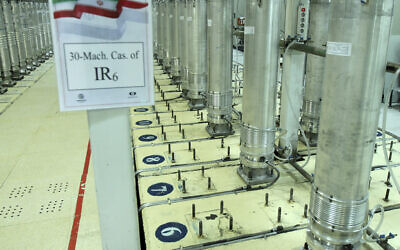
Centrifuge machines in the Natanz uranium enrichment facility in central Iran, November 5, 2019. (Atomic Energy Organization of Iran via AP, File)
Gantz issued a similar appeal on Monday, vowing that Israel would prevent Iran from obtaining nuclear weapons.
“The entire world must step up its pressure, and we must ensure that the defense establishment has the resources needed so that we can be prepared to deal with Iran as necessary on all fronts. We are working with many partners on all fronts and we must continue this trend,” he said.
Prime Minister Benjamin Netanyahu likewise said Israel wouldn’t allow Iran to develop nuclear arms and said its decision to increase uranium enrichment to 20 percent proves Tehran is seeking an atomic bomb.
Earlier Tuesday, Iran confirmed it was enriching uranium to 20% at the underground Fordo facility, well beyond the threshold set by its 2015 nuclear deal with major powers.
The UN’s International Atomic Energy Agency (IAEA) verified the move.A satellite image from September 15, 2017, of the Fordo nuclear facility in Iran. (Google Earth)
It was the most striking violation yet of Iranian commitments under the landmark deal, a process it started in 2019 in response to US President Donald Trump’s dramatic withdrawal from the accord the previous year.
Announcing the move on Monday, government spokesman Ali Rabiei said President Hassan Rouhani had ordered the enrichment “in recent days” in line with a law passed last month by the conservative-dominated parliament.
Foreign Minister Mohammad Javad Zarif tweeted that “we resumed 20% enrichment as legislated by our parliament,” adding that the IAEA had been “duly notified.”
He stressed that Tehran took the step “after years of non-compliance” by other parties and that “our measures are fully reversible upon FULL compliance by ALL.”
The step comes less than three weeks before the end of the presidency of Trump, who has sought to economically punish and diplomatically isolate Iran with a “maximum pressure” campaign, including tough sanctions.
In this April 9, 2018 file photo, released by an official website of the office of the Iranian Presidency, President Hassan Rouhani listens to explanations on new nuclear achievements at a ceremony to mark “National Nuclear Day,” in Tehran, Iran.(Iranian Presidency Office via AP, File)
The outgoing US administration deplored Iran’s plan to step up uranium enrichment, while the European Union said it marked a “considerable departure” from the deal.
Uranium enriched to 20% is far below the 90% needed to construct nuclear bombs, but the jump from 20% to 90% is rather quick compared to the work needed to move from 4% to 20%.
Since the assassination in late November of Iranian nuclear physicist Mohsen Fakhrizadeh, which Iran has blamed on Israel, hardliners in Tehran pledged a response and parliament passed a controversial law calling for the production and storage of “at least 120 kilograms per year of 20% enriched uranium” and to “put an end” to the IAEA inspections intended to check that the country is not developing an atomic bomb.
The Iranian government opposed the initiative, which was also condemned by the other signatories to the accord who called on Tehran not to “compromise the future.”
Quoted by the government’s website, Iranian government spokesman Rabiei said that the administration’s stance toward the law is clear, “but the government considers itself bound to carry out the law.”
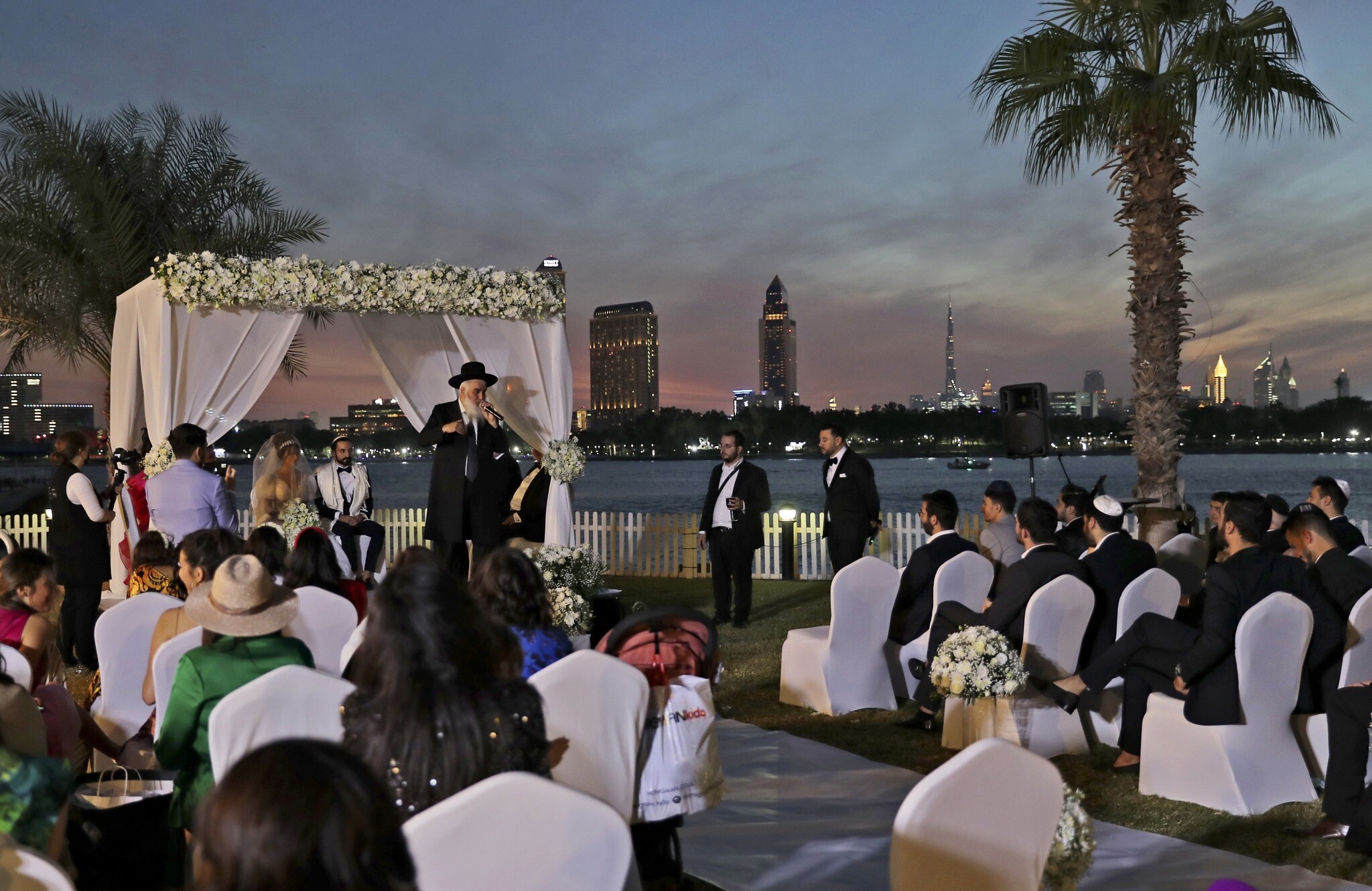
A rabbi officiates under a traditional Jewish wedding canopy during marriage ceremony of the Israeli couple Noemie Azerad, left, seated under the canopy, and Simon David Benhamou, at a hotel in Dubai, United Arab Emirates, December 17, 2020. (Kamran Jebreili/AP)
Amid fears of Iranian revenge attacks on American and Israeli targets for the killing a year ago of top Iranian military commander Qasem Soleimani, authorities in the United Arab Emirates have reportedly arrested a number of Iranians in Dubai and Abu Dhabi in the past few days on suspicion that they planned to carry out terror attacks there.
Israel’s Channel 12 news said Sunday night that the Iranian suspects were nabbed by UAE intelligence apparatuses and are currently being questioned.
The UAE is believed to be sharing the information revealed in the investigation “with friendly states,” the TV report said.
It noted that there are currently thousands of Israeli travelers in the UAE, for both business and pleasure.
The UAE authorities are probing whether they were the intended targets of the Iranian terror cell, the report said.Iraqis drive past a poster depicting late Iranian Revolutionary Guards commander Qasem Soleimani in Iraq’s capital Baghdad, on December 30, 2020, ahead of the first anniversary of his killing in a US drone attack. (Ahmad Al-Rubaye / AFP)
The development comes as Israel braces for an Iranian revenge attack on the first anniversary of the killing of Soleimani in a US drone strike in Baghdad on January 3, 2020. Soleimani was the head of the Quds Force of Iran’s Islamic Revolutionary Guard Corps, which is designated by the US as a terror group.

 A satellite image from September 15, 2017, of the Fordo nuclear facility in Iran. (Google Earth)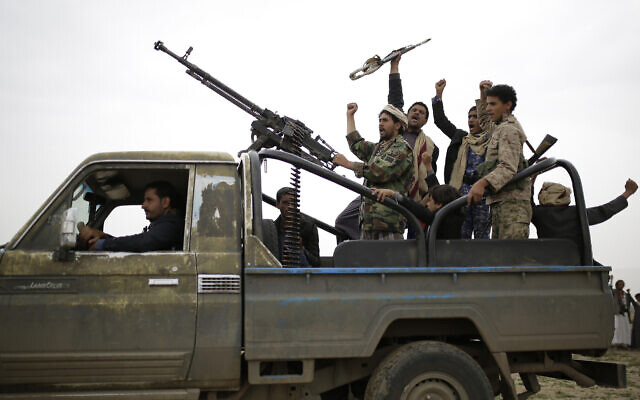
 People run following an explosion at the airport in Aden, Yemen, shortly after a plane carrying the newly formed Cabinet landed on December 30, 2020. (AP Photo)
 Violent protesters, loyal to US President Donald Trump, storm the Capitol, January 6, 2021, in Washington. (AP Photo/John Minchillo)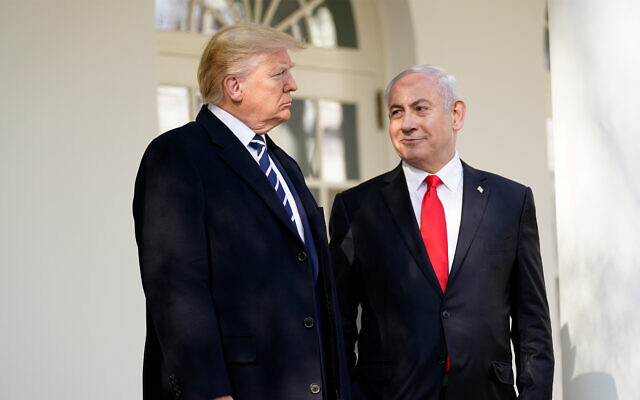
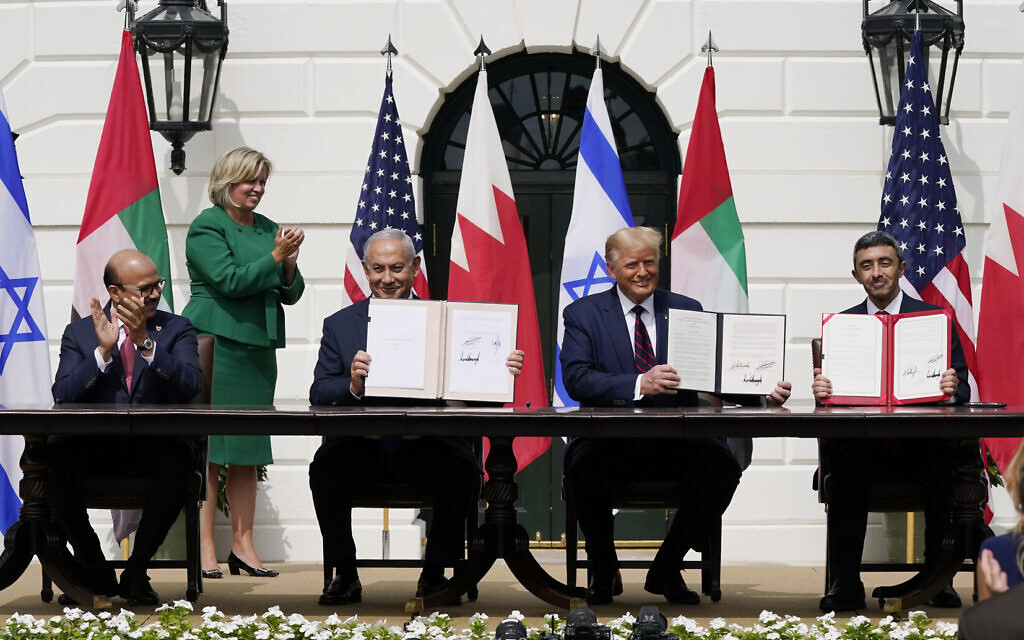 US President Donald Trump, center, with from left, Bahrain Foreign Minister Khalid bin Ahmed Al Khalifa, Israeli Prime Minister Benjamin Netanyahu, and United Arab Emirates Foreign Minister Abdullah bin Zayed al-Nahyan, during the Abraham Accords signing ceremony on the South Lawn of the White House, September 15, 2020, in Washington. (AP Photo/Alex Brandon)
 Prime Minister Benjamin Netanyahu (R) addressing the media alongside US Treasury Secretary Steven Mnuchin in Jerusalem, January 7, 2021. (GPO)
 Supporters of US President Donald Trump protest inside the US Capitol on January 6, 2021, in Washington, DC. (ROBERTO SCHMIDT / AFP)
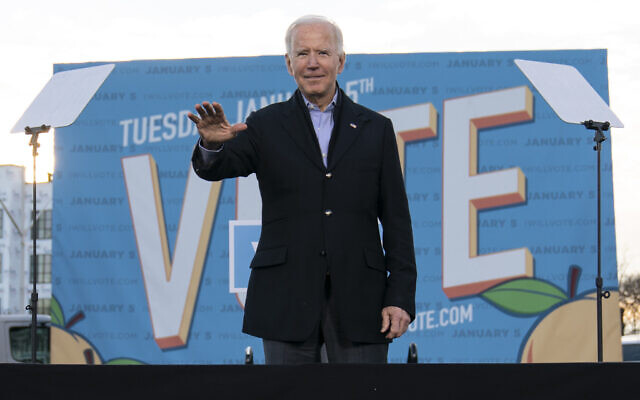 US President-elect Joe Biden waves from the stage as he campaigns for for Georgia Democratic candidates in Atlanta, January 4, 2021. (Carolyn Kaster/AP)
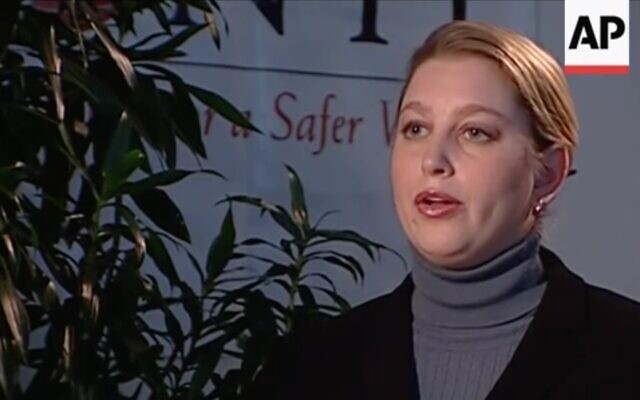 Screen capture from video of nuclear weapons expert Corey Hinderstein. (YouTube)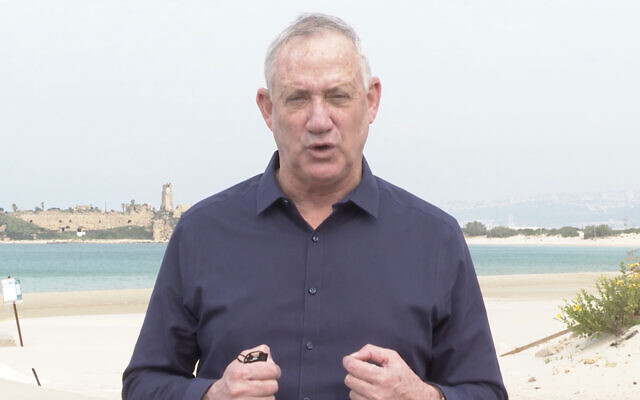






 anneinpt
 artaxes
 danmillerinpanama
 davidking1530
 Peter Hofman
 Joseph Wouk
 Peter
Peter Louisiana Steve
 WarSclerotic


Recent Comments