Author Archive

Israel said readying for signing of ‘spectacularly bad’ Iran deal next week

February 21, 2022

TV network cites Israeli security officials warning that revived agreement won’t take into account the nuclear gains Tehran has made since Trump withdrew from the accord in 2018

By TOI STAFF18 February 2022, 11:23 pm  

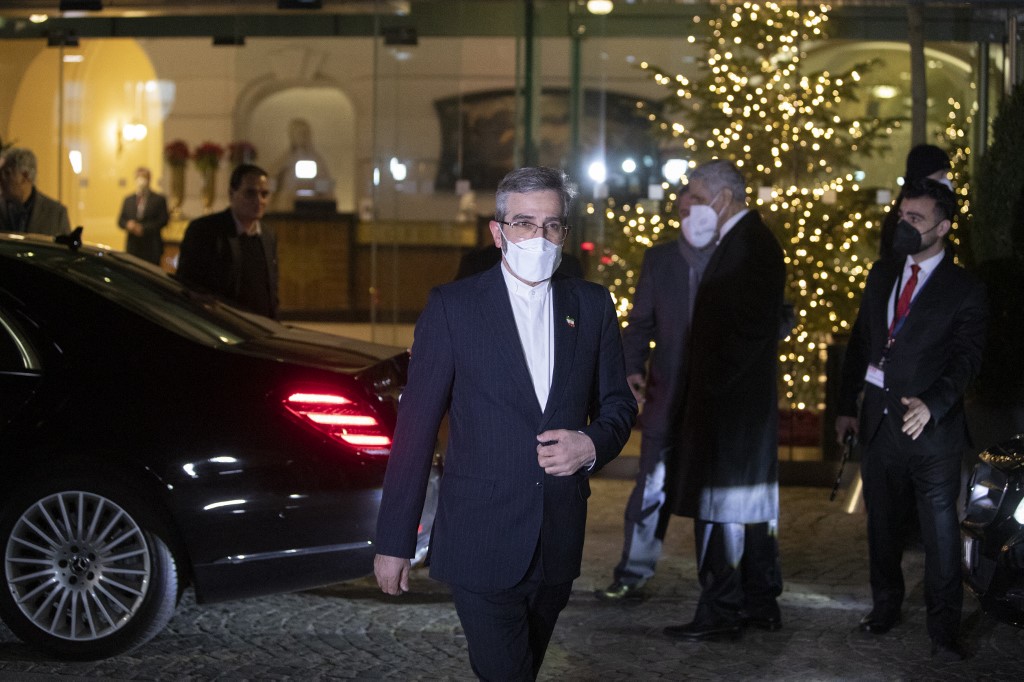
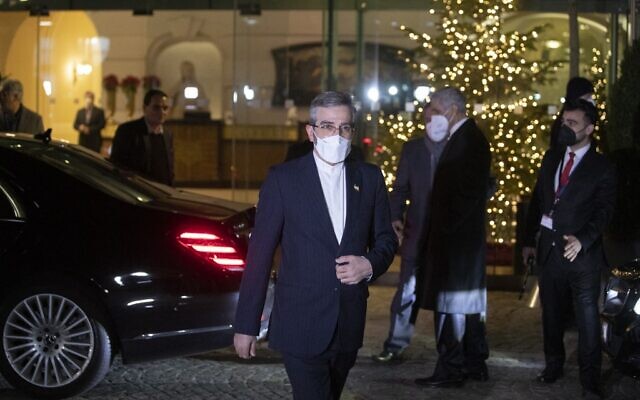
Iran’s chief nuclear negotiator Ali Bagheri Kani leaves the Palais Coburg, venue of the Joint Comprehensive Plan of Action (JCPOA) meeting that aims at reviving the Iran nuclear deal, in Vienna on December 27, 2021. (ALEX HALADA / AFP)

Israel is readying for world powers and Iran to reach an agreement next week to revive the deal aimed at curbing the Islamic Republic’s nuclear program, Israeli television reported Friday, despite Jerusalem’s efforts to lobby against a joint US-Iranian return to the multilateral accord.

Israel opposed the original agreement, formally known as the Joint Comprehensive Plan of Action, when it was signed in 2015, with then prime minister Benjamin Netanyahu arguing that it actually paved the path to an Iranian nuclear arsenal. The Netanyahu government then backed former president Donald Trump’s decision to withdraw the United States from the deal in 2018 and initiate a “maximum pressure” campaign against Iran, which led Tehran to ramp up nuclear work in violation of the JCPOA.

US President Joe Biden is now seeking to revive the accord, conditioning doing so on Iran returning to compliance.

Quoting an unnamed Israeli security official, Channel 13 news reported that while Israel considered the original deal to have been bad, the revived accord taking shape is “spectacularly bad,” as it does not factor in the progress Iran has made since.

Referring to a leaked draft of the imminent accord, the source said Iran will not be required to destroy its advanced centrifuges under the revived agreement. Tehran will have to reduce its uranium enrichment levels, but it has already developed the capability to enrich at high levels. It will also be required to cease producing uranium metal, a crucial component of the bomb-making process. However, the source noted that Iran now has the knowledge to be able to manufacture such materials in the future.

Get The Times of Israel’s Daily Editionby email and never miss our top storiesNewsletter email addressGET IT

By signing up, you agree to the terms

“In essence, it is an agreement that leaves Iran as a nuclear threshold state,” the network said, citing the security source.

Channel 13’s report asserted that Israel would plainly not be able to target Iranian enrichment facilities if and when a revived deal was signed. A key question, though, said its military analyst Alon Ben-David, was whether Israel would have a free hand, as far as the Americans are concerned, to take actions to thwart Iranian progress on weaponization and missile delivery systems for a bomb — areas not covered by the deal.

According to Channel 13, furthermore, the Biden administration has told Israel that Trump enabled Iran to become a “nuclear threshold state” in terms of uranium production and that a failure to revive the old agreement — as Jerusalem is hoping — would leave Tehran weeks away from accumulating enough nuclear material needed for a bomb, rather than months away from the bomb under the terms of the deal.

A diplomat familiar with the talks disputed that assessment, telling The Times of Israel that the deal being negotiated would likely leave Iran between six months to a year away from having enough nuclear material needed for a bomb (weaponization would take another year or two, according to most estimates).
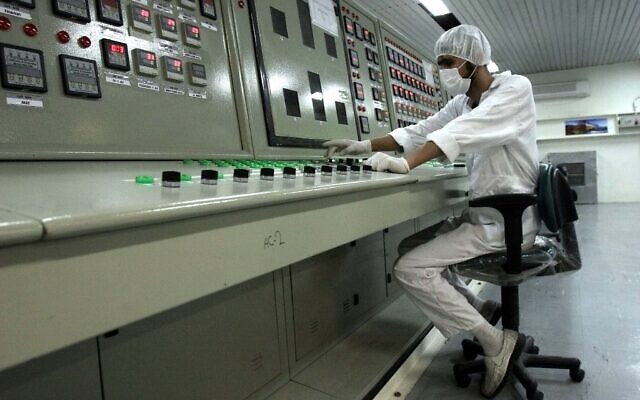
A technician works at the Uranium Conversion Facility just outside the city of Isfahan, Iran, 255 miles (410 kilometers) south of the capital Tehran, Iran, Feb. 3, 2007. (AP Photo/Vahid Salemi, file)

Jerusalem appears to argue that is a price worth paying, rather than granting sanctions relief.

A small ray of hope for Israel is that the sanctions relief being proposed by negotiators in Vienna would only occur gradually and not all at once, the Kan public broadcaster reported.

Negotiators still have a number of issues to settle before a deal can be signed, but Israel believes that will still happen next week, according to Kan.

Accordingly, Jerusalem is preparing a number of actions it plans to take in the coming days, including holding briefings with ambassadors, a possible public address by Prime Minister Naftali Bennett responding to an announcement of a resurrected JCPOA, and private conversations that Defense Minister Benny Gantz and Foreign Ministry Director-General Alon Ushpiz will hold on the sidelines of the Munich Security Conference.

Separately Friday, a senior European Union official told Reuters, “I expect an agreement in the coming week, the coming two weeks or so. I think we have now on the table text that is very, very close to what is going to be the final agreement.”

“Most of the issues are already agreed. But as a principle in this kind of negotiation, nothing is agreed until everything is agreed. So we still have… some questions, some of them rather political and difficult to agree,” the official said.

The United States said Thursday that “substantial progress” during negotiations in Vienna to save the Iran nuclear deal had been made, deeming an agreement possible within days if Iran “shows seriousness” on the matter.

An eighth round of Vienna talks, which involve Iran as well as Britain, China, France, Germany and Russia directly, and the United States indirectly, resumed in late November.
In phone call, Bennett and Biden discuss ‘steps to block Iranian nuclear program’

February 7, 2022

Premier’s office says conversation also addresses US killing of Islamic State leader and Russia-Ukraine conflict; Biden likely to visit later this year

By JACOB MAGID 6 February 2022, 9:50 pm  

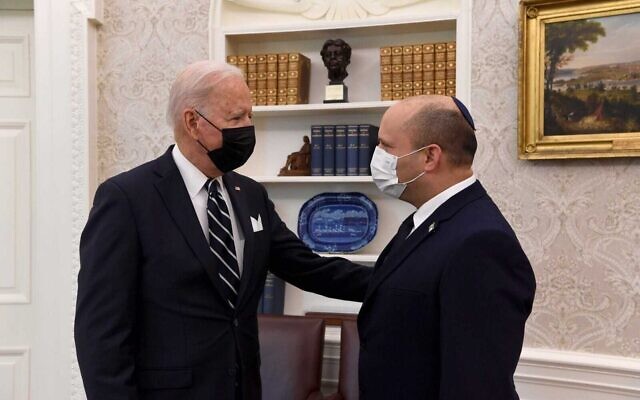
Prime Minister Naftali Bennett, right, speaks as he meets with US President Joe Biden in the Oval Office of the White House, on August 27, 2021, in Washington, DC. (GPO)

Prime Minister Naftali Bennett, right, speaks as he meets with US President Joe Biden in the Oval Office of the White House, on August 27, 2021, in Washington, DC. (GPO)

Prime Minister Naftali Bennett and US President Joe Biden held a rare phone call Sunday evening, discussing the Iranian nuclear threat, the campaign against the Islamic State, the Russian-Ukraine conflict and other security challenges.

It was the third phone call between the leaders since Bennett took office in June 2021. Bennett used to opportunity to again extend an invitation to Biden to visit, and the US leader said he would likely do so later this year. No date has been set.

The prime minister praised Biden for the US operation last week that ended in the death of IS leader Abu Ibrahim al-Hashimi al-Qurayshi. “The world is a safer place thanks to the brave efforts of American forces,” the premier told the president according to the Israeli readout.

According to Hebrew media reports, the US had notified Israel ahead of Thursday’s raid in by US special forces, during which the terror leader blew himself up, killing his wife and children along with himself. Al-Qurayshi once held the “Israel file” in IS, likely putting Israel in a situation to offer intelligence to US counterparts on their target ahead of the mission.

Bennett’s office also said that the two discussed the threats posed by Iran in the region, as well as the “steps to block the Iranian nuclear program.”

Get The Times of Israel’s Daily Editionby email and never miss our top storiesNewsletter email addressGET IT

By signing up, you agree to the terms

On Friday, the Biden administration restored some sanctions relief to Iran’s civilian atomic program, after world powers were believed to have made progress in negotiations in Vienna aimed at reviving the Joint Comprehensive Plan of Action nuclear deal. Washington clarified that the waivers were legally required to allow Iran to make modifications to its nuclear facilities to bring Tehran back into compliance with the JCPOA.

The house in which Islamic State leader Abu Ibrahim al-Hashimi al-Qurayshi died during an overnight raid by US special forces, in the town of Atme in Syria’s northwestern province of Idlib, on February 3, 2022. (Abdulaziz Ketaz/AFP)

Former president Donald Trump withdrew from the deal in 2018 — three years after it was signed — and implemented a “maximum pressure” sanctions campaign against Iran, which responded by increasingly violating the JCPOA and accelerating its effort toward acquiring a nuclear weapon.

Biden came into office pledging to return to the agreement while also negotiating a subsequent “longer and stronger” deal that would seek to curb Iran’s ballistic missile program along with its support for proxy militia groups throughout the region. But talk of the latter agreement has largely faded as the US has been faced with a new Iranian regime led by President Ebrahim Raisi who has shown less interest than his predecessor in reviving the JCPOA, let alone negotiating an additional deal with the US.

The US says that the coming weeks will be critical in determining whether the JCPOA can be salvaged, though the administration has been employing such a vague timeline for at least a month.

At a cabinet meeting earlier Sunday, Bennett implied that Israel could launch a military strike against Iran even if the Islamic Republic and world powers revive their 2015 nuclear deal.

“We are responsible for dealing with the Iranian nuclear program and, of course, we are monitoring the Vienna talks. “Our position is well-known and clear: an agreement – according to the apparent terms – will damage the ability to deal with the nuclear program. Anyone who thinks that an agreement will increase stability is mistaken.

“It will temporarily delay enrichment, but all of us in the region will pay a heavy, disproportionate price for it,” he said.

The Biden administration, by contrast, argues that the JCPOA is better than the current alternative where there are no curbs on Iran’s nuclear activity whatsoever. Jerusalem maintains that Iran will buckle if its feet are held to the fire through sanctions and a credible military threat.

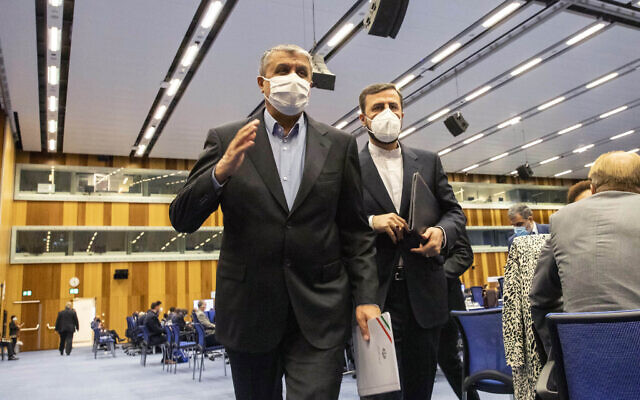
FILE – Mohammad Eslami, new head of Iran’s nuclear agency (AEOI), left, and Iran’s Governor to the International Atomic Energy Agency (IAEA), Kazem Gharib Abadi, leave the International Atomic Energy’s (IAEA) General Conference in Vienna, Austria, September 20, 2021. (AP Photo/Lisa Leutner, File)

Israel fears that reviving the nuclear deal between Iran and world powers may leave Tehran only a few months away from having enough fissile material for an atomic bomb, Israeli television reported Saturday.

The original agreement kept Iran a year from acquiring enough nuclear material to use for a bomb, but that breakout time has shrunk since Trump withdrew from the deal.

Also during the Sunday phone call, Biden and Bennett discussed the ongoing conflict between Russia and Ukraine. Israel sought to avoid taking a stance in favor of either side due to its relatively good relations with both, whereas the US has stepped up its rhetoric against Moscow in recent weeks.

Bennett ended the call by inviting the president and First Lady Jill Biden to Israel. He first extended such an invitation during his visit to the White House last August. Biden told Bennett on Sunday that he looked forward to visiting Israel later this year, according to the US readout.

An Israeli official told the Walla news site that the call lasted about 30 minutes.

The US readout issued later Sunday night was relatively similar to the Israeli one, but did make mention of Biden’s commitment to expanding partnerships in the Middle East “as exemplified by the Abraham Accords, together with Israelis and Palestinians enjoying equal measures of security, freedom, and prosperity.”

Israel said to fear restored Iran deal will leave breakout time of only a few months

February 6, 2022

‘Better to have a distance of a few months and not just weeks,’ US sources quoted as saying; 2015 pact envisioned Tehran would need a year to amass enough material for bomb

By TOI STAFF and AGENCIESToday, 2:09 am  

FILE -- This Oct. 27, 2004 file photo, shows the interior of the Arak heavy water production facility in Arak, 360 kms southwest of Tehran, Iran. (AP Photo/Fars News Agancy, File)

FILE — This Oct. 27, 2004 file photo, shows the interior of the Arak heavy water production facility in Arak, 360 kms southwest of Tehran, Iran. (AP Photo/Fars News Agancy, File)

Israel fears that reviving the nuclear deal between Iran and world powers may leave Tehran only a few months away from having enough fissile material for an atomic bomb, Israeli television reported Saturday.

The Kan public broadcaster did not specify who in Israel was concerned by the possibility that Iran’s so-called breakout time would be significantly shorter under a restored nuclear agreement.

But American sources quoted in the report appeared to acknowledge such a prospect.

“It is better to have a distance of a few months and not just weeks, as would happen if no agreement is signed,” the sources said.

The original deal aimed to keep Iran at least a year away from amassing enough material for a nuclear weapon.

Get The Times of Israel’s Daily Editionby email and never miss our top storiesNewsletter email addressGET IT

By signing up, you agree to the terms

The Kan report came days after US officials told The Wall Street Journal that a revived agreement would leave Iran with a breakout time well below a year, citing the advances in its nuclear program since then-president Donald Trump withdrew the United States from the accord in 2018.

The exact length of the breakout time will depend on the manner in which Iran agrees to return to compliance with the deal, be it by dismantling its stockpiles of enriched uranium and relevant pieces of equipment, destroying them or shipping them abroad.

A technician works at the Uranium Conversion Facility just outside the city of Isfahan, Iran, 255 miles (410 kilometers) south of the capital Tehran, Iran, Feb. 3, 2007. (AP Photo/Vahid Salemi, file)

However, enough nuclear material for a bomb is not the same as having the capabilities to build the core of the weapon and to attach it to the warhead of a missile, which Iran is not believed to possess and would likely take many more months to achieve.

Despite the JCPOA’s more limited impact, US negotiators are still committed to returning to the deal, guided by the belief that some restrictions on Iran’s nuclear program are better than none at all.

On Friday, the Biden administration restored some sanctions relief to Iran’s civilian atomic program as world powers and the Islamic Republic continue talks aimed at salvaging the languishing agreement.

As US negotiators head back to Vienna for what could be a make-or-break session, US Secretary of State Antony Blinken signed several sanctions waivers related to Iran’s civilian nuclear activities. The move reverses the Trump administration’s decision to rescind them.

The waivers are intended to entice Iran to return to compliance with the 2015 deal that it has been publicly violating since former US president Donald Trump withdrew from the agreement in 2018 and re-imposed sanctions. Iran says it is not respecting the terms of the deal because the US pulled out of it first. Iran has demanded the restoration of all sanctions relief it was promised under the deal to return to compliance.

Friday’s move lifts the sanctions threat against foreign countries and companies from Russia, China and Europe that had been cooperating with non-military parts of Iran’s nuclear program under the terms of the 2015 deal, known as the Joint Comprehensive Plan of Action, or JCPOA.

The Trump administration had ended the so-called “civ-nuke” waivers in May 2020 as part of its “maximum pressure” campaign against Iran that began when Trump withdrew the US from the deal in 2018, complaining that it was the worst diplomatic agreement ever negotiated and gave Iran a pathway to developing the bomb.

As a presidential candidate, Joe Biden made a US return to the nuclear deal a priority, and his administration has pursued that goal but there has been little progress toward that end since he took office a year ago. Administration officials said the waivers were being restored to help push the Vienna negotiations forward.

Technicians work at the Iranian Arak heavy water reactor, 150 miles southwest of the capital Tehran, on December 23, 2019. (Atomic Energy Organization of Iran via AP)

The waivers permit foreign countries and companies to work on civilian projects at Iran’s Bushehr nuclear power station, its Arak heavy water plant and the Tehran Research Reactor. Former US secretary of state Mike Pompeo had revoked the waivers in May, 2020, accusing Iran of “nuclear extortion” for continuing and expanding work at the sites.

Iran’s foreign minister on Saturday welcomed the US sanctions relief, but said the move was “insufficient.”

Israeli airstrikes said to hit targets near Damascus

January 31, 2022

Strikes are first since Russia carried out public joint air-defense patrols with Syrian air force; state TV claims some incoming missiles intercepted, but ‘material damage’ caused

By TOI STAFFToday, 5:39 am  

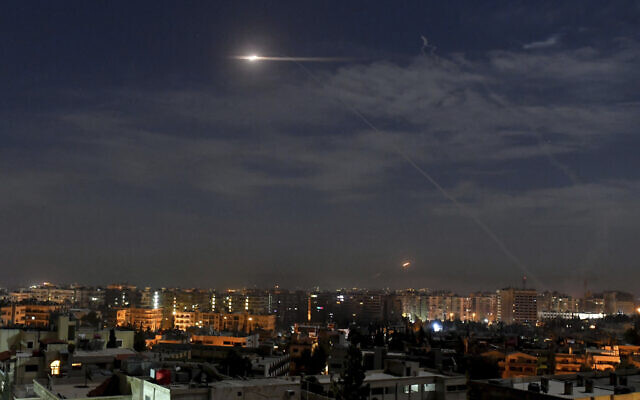
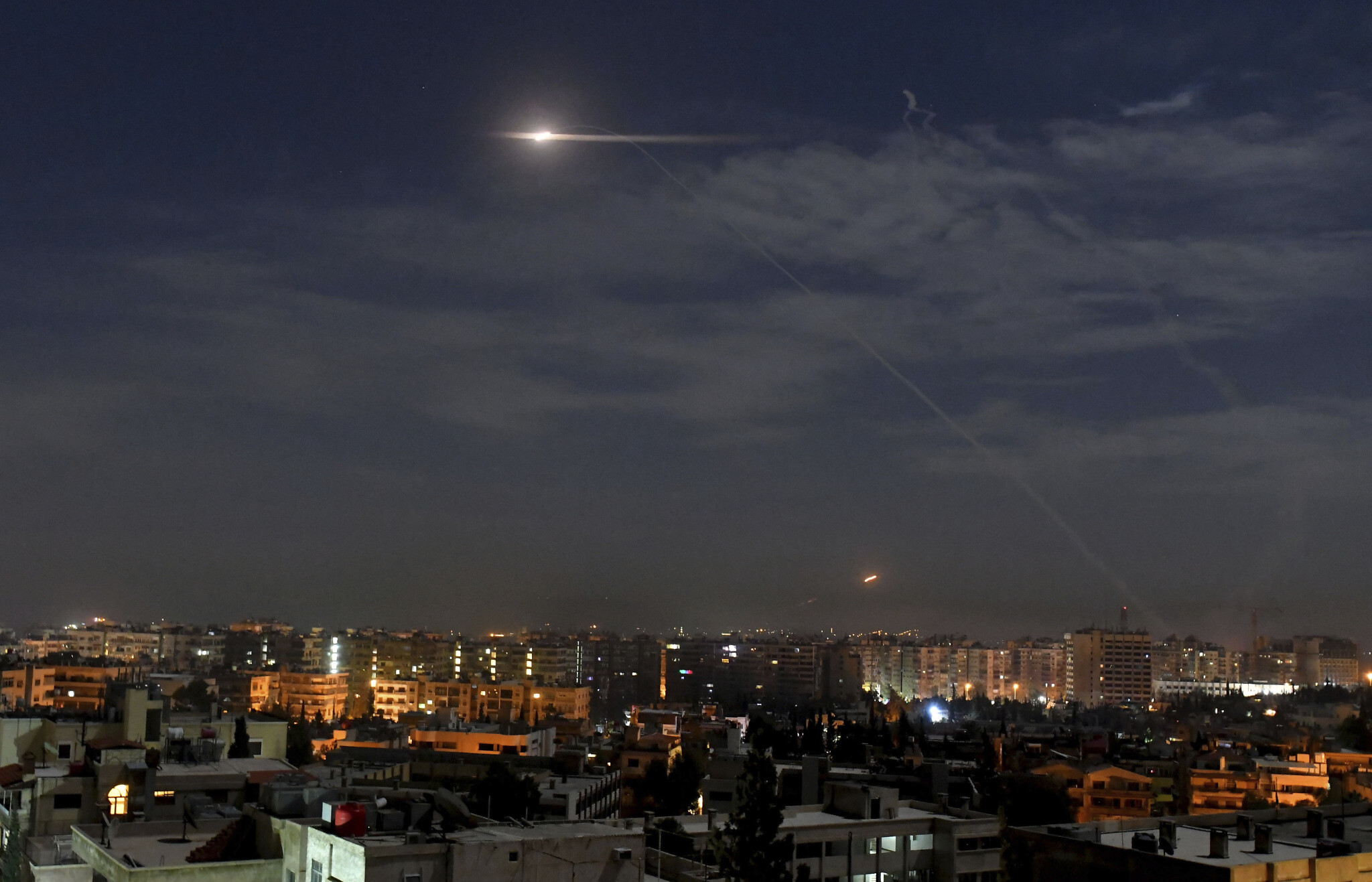
Illustrative: In this photo released by the Syrian official news agency SANA, shows missiles flying into the sky near international airport, in Damascus, Syria, on January 21, 2019. (SANA via AP)

Illustrative: In this photo released by the Syrian official news agency SANA, shows missiles flying into the sky near international airport, in Damascus, Syria, on January 21, 2019. (SANA via AP)

Israeli jets carried out airstrikes against targets near the Syrian capital of Damascus early Monday morning, Syrian state TV reported.

The alleged strikes are the first since Russia announced last week it was carrying out joint military jet patrols with the Syrian air force of the airspace along Syria’s borders, including in the Golan Heights area.

Monday’s TV report said Syria activated its air defenses and intercepted several of the incoming missiles, but noted that the strikes had caused some “material damage.” There were no immediate reports of casualties.

Syria routinely claims to shoot down Israeli missiles. Analysts generally dismiss such claims — heard after nearly every Israeli airstrike — as false, empty boasts.

Reports said the missiles were fired from the direction of neighboring Lebanon. The targets of the strikes were not immediately clear.Get The Times of Israel’s Daily Editionby email and never miss our top storiesNewsletter email addressGET ITBy signing up, you agree to the terms

Israel has staged hundreds of strikes on targets inside government-controlled Syria over the years but rarely acknowledges or discusses specific operations. Many of the strikes in the past targeted the main airport in the capital Damascus, through which Iran is believed to transfer advanced arms to its proxies.

Israel has acknowledged that it targets the bases of Iranian forces and Iran-allied terror groups, particularly along the Golan border, such as Lebanon’s Hezbollah, which has fighters deployed in southern Syria. It says it also attacks arms shipments believed to be bound for those groups.

Hezbollah is fighting on the side of Syrian President Bashar Assad’s forces in the decade-long civil war.

In December, Israel reportedly carried out two high-profile strikes on the Syrian port of Latakia.In this photo released by the Syrian official news agency SANA, flames rise from containers at the scene of missiles attack, at the seaport of the coastal city of Latakia, Syria, early December 28, 2021. (SANA via AP)
Last week Russia carried out a joint air patrol with the Syrian air force along the border with Israel, prompting speculation that Israel would be more hesitant to strike Syria.

Following the patrol, Ynet reported that Israeli military officials were holding talks with Russian army officers to calm tensions.

According to the report, Israeli officials were struggling to understand why Russia, which announced such joint patrols were expected to be a regular occurrence moving forward, had apparently changed its policy toward Israel.

The report claimed, without citing a source, that Israel may limit its air campaign in Syria as a result of Russia’s move, even after discussions end.

US and Iran ‘in ballpark’ of possible nuclear deal, says White House official

January 28, 2022

Still, Brett McGurk also cautions that ‘these talks could collapse very soon’; Bennett uses Holocaust commemoration to slam possible deal

By JACOB MAGID27 January 2022, 9:54 pm  

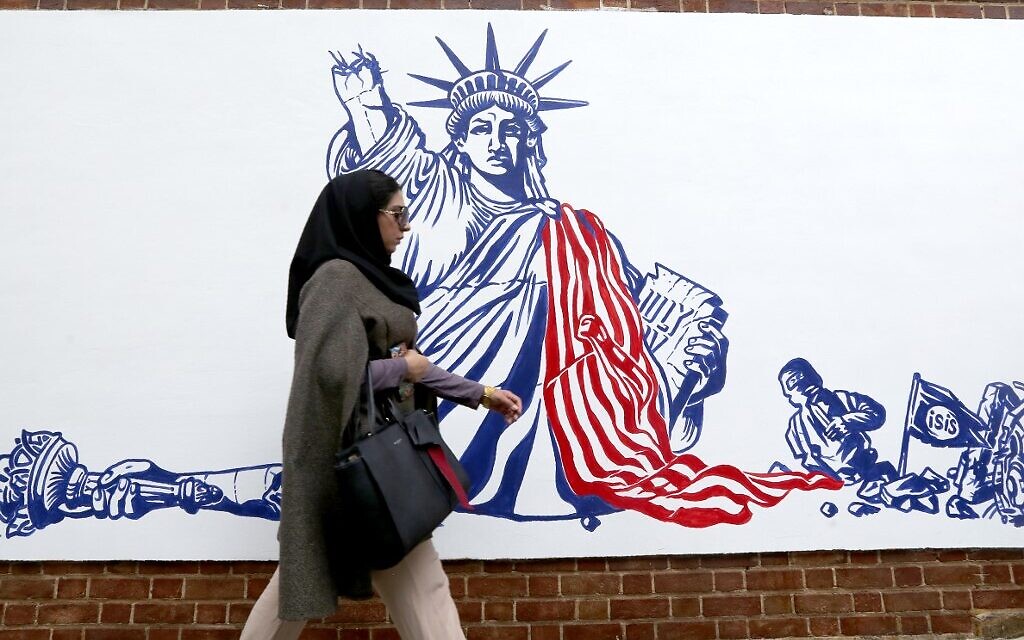
An Iranian woman walks past a new mural painted on the walls of the former US embassy in the capital Tehran, on November 2, 2019. (Atta Kenare/AFP)

An Iranian woman walks past a new mural painted on the walls of the former US embassy in the capital Tehran, on November 2, 2019. (Atta Kenare/AFP)

A senior White House official said Thursday that the United States and Iran are “in the ballpark of a possible [nuclear] deal” in Vienna, while also clarifying that Washington is “very prepared” for the “pretty likely” scenario that there won’t be an agreement.

Iran and world powers are in the midst of an eighth round of negotiations aimed at reviving the tattered 2015 nuclear deal known as the Joint Comprehensive Plan of Action. Former US president Donald Trump withdrew from the deal in 2018, launching a “maximum pressure” sanctions campaign, which Tehran responded to with escalating violations of the multilateral accord.

Trump’s successor, US President Joe Biden, is seeking a joint US-Iran return to compliance with the JCPOA, but has been met by a new, more hardline Iranian president in Ebrahim Raisi, who has demanded the removal of all US sanctions in exchange for the Islamic Republic’s return to the deal.

Asked to comment on the status of negotiations in Vienna during a virtual event hosted by the Carnegie Endowment for International Peace, White House National Security Council coordinator for the Middle East Brett McGurk said, “We’re in the ballpark of a possible deal. But again, I’m not going to put odds on this. There’s [also] a very real chance that these talks could collapse very soon.”

While avoiding taking any sort of definitive stance on where the talks might head, McGurk said they had reached a “culmination point and [that] we’re going to know very soon whether or not it is possible for the Iranians to return to compliance with the nuclear deal on terms that we and the international community can accept.”Get The Times of Israel’s Daily Editionby email and never miss our top storiesNewsletter email addressGET ITBy signing up, you agree to the terms

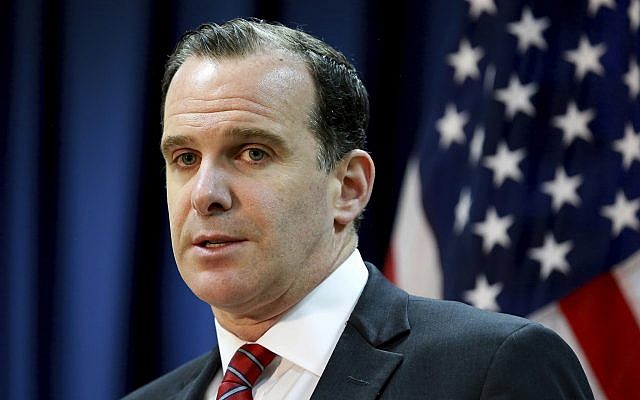
“There’s a chance for a deal, and there’s also a pretty good chance there’s not going to be a deal,” he added. “If there’s no deal, we’re very prepared for that scenario.”Brett McGurk, then-US envoy for the global coalition against Islamic State, at a news conference at the US embassy in Baghdad, Iraq, on June 7, 2017. (Hadi Mizban/AP)
“The prospect of a nuclear-armed Iran is something that would keep anyone up at night, but I can assure you that it’s never going to happen,” McGurk said, adding that a diplomatic path in Vienna is the best way to ensure that.

On Wednesday, the White House said that US National Security Adviser Jake Sullivan told his Israeli counterpart Eyal Hulata that the Biden administration is already “preparing alternative options” to prevent Iran from obtaining a nuclear weapon if Vienna talks fail.

In an effort to defend the Biden administration’s push to return to the JCPOA, McGurk referenced an interview published in Maariv hours earlier in which former IDF chief of staff Gadi Eisenkot called Trump’s withdrawal a “strategic mistake.”

Eisenkot argued that the move, backed by then-prime minister Benjamin Netanyahu, “freed the Iranians from certain shackles [and that] when the Iranians [then] began violating the agreement, they had legitimacy for these violations because of the American withdrawal.”

The Biden administration has been leaning hard on such remarks from current and former Israeli officials as it has doubled down on its blame of the Trump administration for causing the still-unfolding nuclear crisis with Iran.

McGurk was also asked to comment on the recent decision by the US deputy special envoy on Iran to step down from the negotiating team in Vienna along with two others.

Richard Nephew, a longtime State Department official credited with crafting the sanctions that brought Iran to the negotiating table ahead of the 2015 agreement, advocated for a tougher stance against Iran in the Vienna talks than his boss, Rob Malley, and others on the team, the Wall Street Journal reported on Monday. Two other negotiators resigned from the team along with Nephew for the same reasons, according to the paper.Iran’s chief nuclear negotiator Ali Bagheri Kani leaves the Palais Coburg, venue of the Joint Comprehensive Plan of Action (JCPOA) meeting that aims at reviving the Iran nuclear deal, in Vienna, on December 27, 2021. (Alex Halada/AFP)

McGurk avoided criticizing Nephew, calling him an “incredibly talented teammate” and saying that he had gone on to take a different position at the State Department.

He proceeded to offer implicit criticism of those demanding the US take a maximalist approach in the negotiations. He said the Biden administration could have walked out of negotiations when Iran returned to the negotiation table in December for the first time since Raisi’s election, with completely different demands and ones that reneged on previous agreements reached under his predecessor, Hassan Rouhani.

Instead, the US presented a united front with Russia and China against those proposals, McGurk recalled, saying it led the Iranian rial to collapse.

“The Iranians came back a week later with completely different proposals,” he continued. “That in my view is pretty good diplomacy.”

Separately on Thursday, Prime Minister Naftali Bennett appeared to take a cue from his predecessor, Benjamin Netanyahu, using his International Holocaust Remembrance Day speech to invoke the threat posed by Iran.

“When we hear the Iranian regime’s daily calls to annihilate the State of Israel, as we speak they continue talking about murdering and destroying the State of Israel, the Jewish state, and when we see their rapid progression towards nuclear weapons, indifference is silent acceptance,” Bennett said in a video address to diplomats. “A country who talks about annihilating the Jewish state should not be a legitimate partner for anything.”

“Those who continue to try to attack Jews, to murder Jews, must know the Jew is no longer a punching bag. We swing back and we swing back hard,” he added.

Israel successfully tests Arrow 3 anti-ballistic missile system

January 18, 2022


Defense Ministry says radar arrays detected incoming ‘target’ and two Arrow 3 interceptors were fired at it, destroying it; trial follows recent Iranian ballistic missile tests

By JUDAH ARI GROSS and TOI STAFFToday, 6:47 amUpdated at 8:30 am  

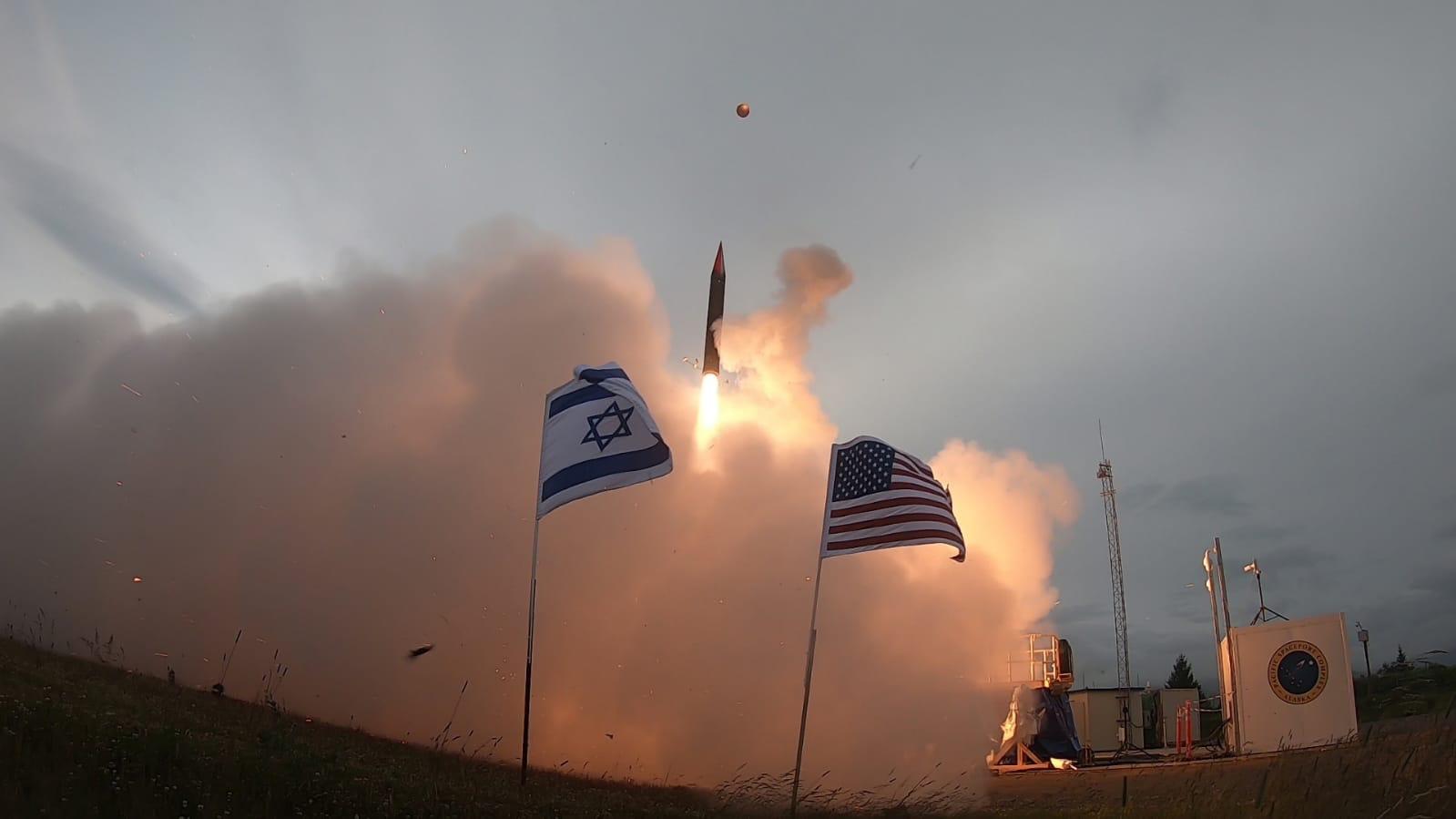
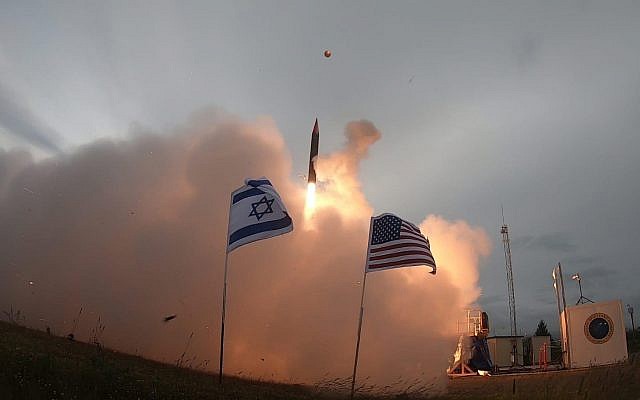
A test launch of the Arrow 3 missile defense system released by the Defense Ministry on July 28, 2019. (Defense Ministry)

A test launch of the Arrow 3 missile defense system released by the Defense Ministry on July 28, 2019. (Defense Ministry)

Israel conducted a successful test of its Arrow 3 anti-ballistic missile system on Tuesday morning, the Defense Ministry said.

According to the ministry, the live-fire test was conducted over central Israel.

“The operational radar arrays of the Arrow system detected the target and sent the data to the fire management system, which analyzed the data and fully plotted the interception. Once the plans were completed, two Arrow 3 interceptors were fired at the target, and they completed their mission successfully,” the Defense Ministry said in a statement.

The Arrow 3 is currently Israel’s most advanced long-range missile defense system, meant to intercept ballistic missiles while they are still outside of the Earth’s atmosphere, taking out projectiles and their nuclear, biological, chemical or conventional warheads closer to their launch sites. It is a joint project by the Defense Ministry’s Missile Defense Organization and the American Missile Defense Agency. Work is underway on the development of a yet more advanced system, the Arrow 4.

It was not immediately clear what was being tested with Tuesday’s Arrow 3 system in the trial, but the head of the Defense Ministry’s Weapons Development and Technology Infrastructure Administration, Danny Gold, described it as “a breakthrough that represents a technological leap forward in the capabilities of the defense establishment to renew and to match the emerging threats regionally and on the future battlefield.”Get The Times of Israel’s Daily Editionby email and never miss our top storiesNewsletter email addressGET ITBy signing up, you agree to the terms

Tuesday’s test followed a number of recent ballistic missile tests by Iran in recent weeks.

In an apparent threat to Iran, Defense Minister Benny Gantz said the test ensured Israel’s ability to take action freely.

“We are preserving Israel’s ability to defend itself against developing threats in the region and allowing Israel offensive freedom of operation against its enemies, from an understanding that the best defense allows for the most effective attack,” he said.

The Arrow 3 was first tested successfully in February 2018, after months of delays and technical problems. It is considered one of the most powerful weapons of its kind in the world and has been in development since 2008.

Complemented by a number of other missile defense systems designed to protect Israel from short-, medium- and long-range attacks, the Arrow 3 represents the highest level of Israel’s multi-tiered missile defense network.

White House focusing blame on ‘reckless’ Trump ahead of Iran nuclear deal decision

January 13, 2022


Plan said made as Biden administration gears up for political fight as US will have to decide whether to re-enter the deal or walk away and apply further pressure on Tehran

By TOI STAFFToday, 3:18 am  

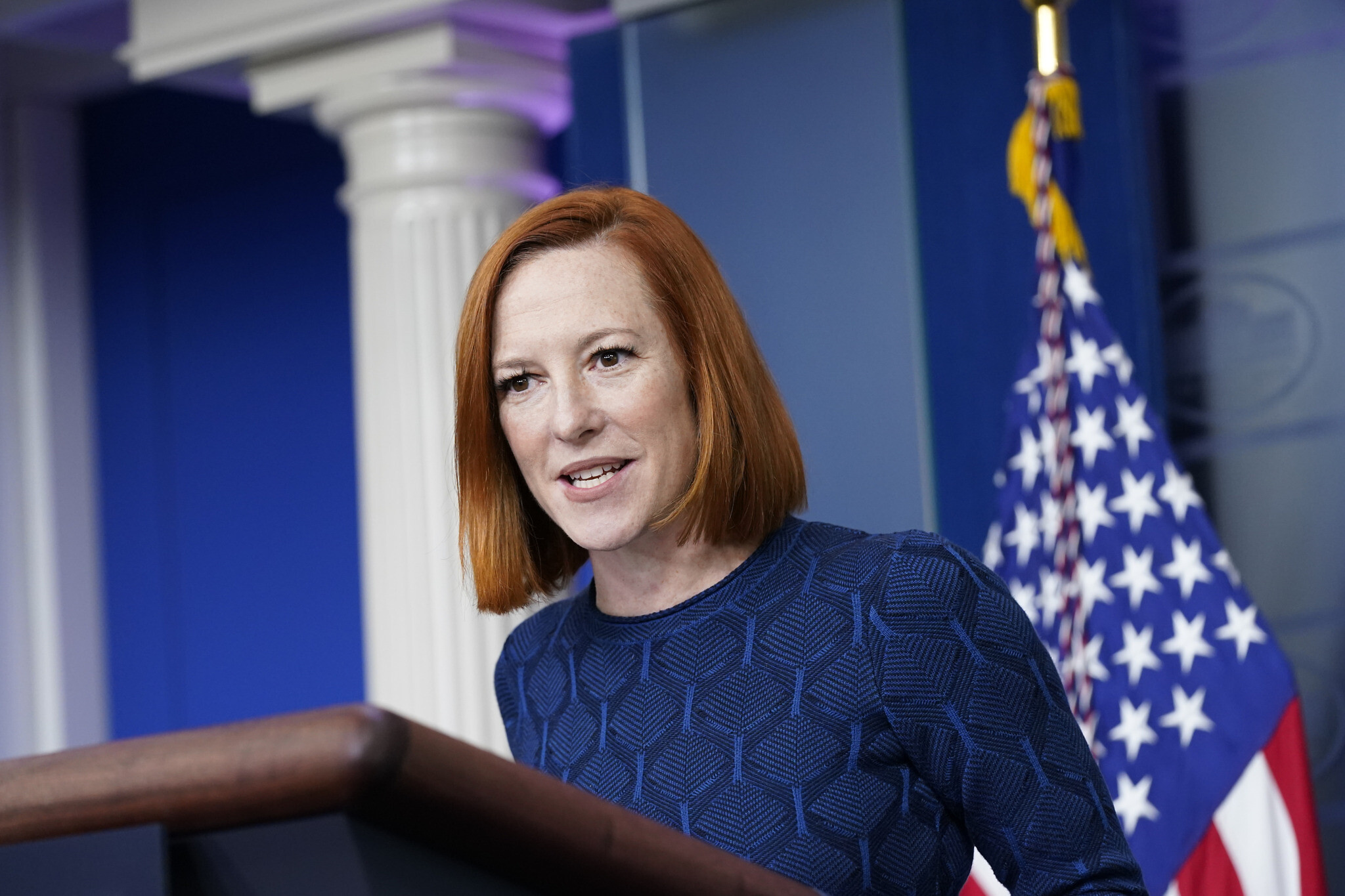
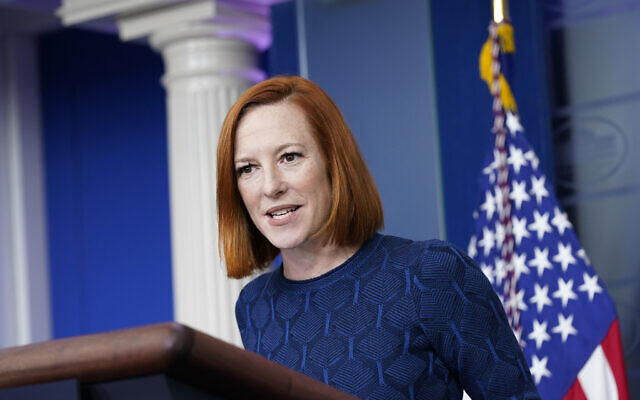
White House press secretary Jen Psaki speaks during a press briefing at the White House, Monday, Jan. 10, 2022, in Washington. (AP Photo/Patrick Semansky)

White House press secretary Jen Psaki speaks during a press briefing at the White House, Monday, Jan. 10, 2022, in Washington. (AP Photo/Patrick Semansky)

The Biden administration is gearing up for the Iran nuclear deal talks to reach an end by stepping up criticism of former president Donald Trump and blaming him for the current situation.

In recent days, both State Department spokesperson Ned Price and White House spokesperson Jen Psaki attacked Trump for pulling the US out of the 2015 deal — agreed by Iran, the US, China, Russia, Britain, France and Germany — that offered Tehran sanctions relief in exchange for curbs on its nuclear program.

Trump unilaterally withdrew the US in 2018 and reimposed biting sanctions, prompting Tehran to begin rolling back on its commitments and stepping up its enrichment activities.

The decision to focus on Trump is a deliberate one as the current talks in Vienna aimed at bringing the sides back into the deal head for a conclusion, the Axios news site reported Wednesday, citing two White House sources, saying they wanted to “focus the fire on Trump.”

On Tuesday, Price answered a question on the Vienna talks with a comment on Trump.Get The Times of Israel’s Daily Editionby email and never miss our top storiesNewsletter email addressGET ITBy signing up, you agree to the terms

“It’s worth spending just a moment on how we got here,” Price said. “It is deeply unfortunate that because of an ill-considered or perhaps unconsidered decision by the previous administration that this administration came into office without these stringent verification and monitoring protocols that were in place.”

Price said the Trump administration promised a better deal “that never came close” and instead “Iran has been able to gallop forward with its nuclear promise.”

Later Wednesday, Psaki said none of Iran’s “increased capabilities or aggressive actions they have taken through proxy wars around the world” would have occurred if Trump had not “recklessly pulled out of the nuclear deal with no thought as to what might come next.”https://platform.twitter.com/embed/Tweet.html?dnt=true&embedId=twitter-widget-0&features=eyJ0ZndfZXhwZXJpbWVudHNfY29va2llX2V4cGlyYXRpb24iOnsiYnVja2V0IjoxMjA5NjAwLCJ2ZXJzaW9uIjpudWxsfSwidGZ3X2hvcml6b25fdHdlZXRfZW1iZWRfOTU1NSI6eyJidWNrZXQiOiJodGUiLCJ2ZXJzaW9uIjpudWxsfSwidGZ3X3NwYWNlX2NhcmQiOnsiYnVja2V0Ijoib2ZmIiwidmVyc2lvbiI6bnVsbH19&frame=false&hideCard=false&hideThread=false&id=1481388478533353481&lang=en&origin=https%3A%2F%2Fwww.timesofisrael.com%2Fwhite-house-focusing-blame-on-reckless-trump-ahead-of-iran-nuclear-deal-decision%2F&sessionId=4d9d91949063474870798c0bc900f55db1148b90&siteScreenName=timesofisrael&theme=light&widgetsVersion=86e9194f%3A1641882287124&width=550px

Speaking at a press briefing Psaki said that as a result of Trump’s actions “Iran’s nuclear program was no longer in a box, no longer had the most robust inspection regime ever negotiated, no longer had the tight restrictions on nuclear activity.”

Axios said the White House was laying the groundwork for the end of talks, when the US would either re-enter the deal or walk away and apply further pressure on Tehran.

“Both scenarios will generate political backlash, particularly from Republicans, but the White House wants to keep Democrats together in part by emphasizing that it was Trump who triggered this crisis and left them with only bad options,” Axios said.

The report said the talks were likely to culminate by the end of January or February.

On Tuesday France’s Foreign Minister Jean-Yves Le Drian said the talks were proceeding so slowly that they are unlikely to lead to any agreement “within a realistic timeframe.”In this image made from April 17, 2021, video released by the Islamic Republic Iran Broadcasting, IRIB, state-run TV, various centrifuge machines line the hall damaged on April 11, 2021, at the Natanz Uranium Enrichment Facility, some 200 miles (322 km) south of the capital Tehran. (IRIB via AP, File)

The discussions taking place in Vienna “are underway but from our point of view they are slow, too slow,” Le Drian told the French parliament.

“There is a vital urgency on this issue because of Iran’s own actions and the trajectory of its nuclear program,” he added

On Monday Iran’s foreign ministry spokesman had said that efforts by “all parties” to revive his country’s 2015 nuclear agreement with world powers had resulted in “good progress” during the Vienna talks.

Negotiations to salvage the nuclear deal resumed in late November after they were suspended in June as Iran elected a new, ultra-conservative government.

“There has been good progress on all four issues of removing sanctions, nuclear issues, verification and obtaining guarantees” during the latest round of talks, Iran’s foreign ministry spokesman Saeed Khatibzadeh told reporters on Monday.

The US has participated only indirectly in the Vienna talks, which seek to bring Washington back inside the accord and to ensure Iran re-adheres to its own commitments.

Le Drian had sounded more positive about the talks on Friday, when he said they were progressing on a “rather positive path” while still emphasizing the urgency of bringing them to a speedy conclusion.

The following day his Iranian counterpart Hossein Amir-Abdollahian said the two sides are nearing a “good agreement” due to France “behaving reasonably” after previously playing “the role of a bad cop”.

Britain, France and Germany said last month that the window for concluding a deal was “weeks, not months”, due to the speed of Iran’s nuclear enrichment.

Agencies contributed to this report

Eyeing Iran, Bennett says military undergoing largest rearmament in years

January 11, 2022


Prime minister tells Knesset’s Foreign Affairs and Defense Committee that Tehran remains country’s most significant foe, Israel fighting Iranian forces constantly

By JUDAH ARI GROSS10 January 2022, 4:29 pm  

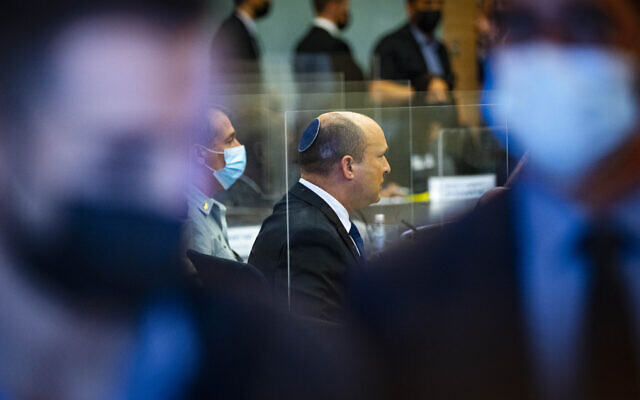
Prime Minister Naftali Bennett attends a Defense and Foreign Affairs Committee meeting at the Knesset in Jerusalem, January 10, 2022. (Olivier Fitoussi/Flash90)

Prime Minister Naftali Bennett attends a Defense and Foreign Affairs Committee meeting at the Knesset in Jerusalem, January 10, 2022. (Olivier Fitoussi/Flash90)

Prime Minister Naftali Bennett told the Knesset on Monday that the country’s military and other security services were undergoing their largest rearming in years.

Bennett’s comments came as the IDF was working intensively to prepare for a potential military strike on Iran’s nuclear facilities, amid growing concerns that ongoing talks between the world powers and Tehran in Vienna about curbing the latter’s nuclear program may result in an agreement that Israel deems unacceptable, or in no agreement whatsoever.

“We are investing in security rearmament of the IDF and the entire defense establishment. I would say this was rearmament that we haven’t seen for years. This rearmament is important to our survival, and I am very glad about it and am determined to see it through quickly,” Bennett said, speaking to the parliament’s powerful Foreign Affairs and Defense Committee.

Bennett’s government increased the 2022 defense budget to nearly NIS 60 billion ($19.2 billion), a large chunk of which was to be earmarked for planning on military engagement with Iran, including billions to upgrade or procure vehicles, ordnance and more.

In a criticism of his predecessor Benjamin Netanyahu, Bennett claimed the military had been in a “tailspin” for years, which “severely damaged Israeli national security, in every dimension.” Bennett was defense minister under Netanyahu in 2019 and 2020.Get The Times of Israel’s Daily Editionby email and never miss our top storiesNewsletter email addressGET ITBy signing up, you agree to the terms

Bennett reiterated that Israel will not be party to a nuclear deal with Iran and will do whatever it deems necessary to ensure the country’s security.

“In terms of the Vienna talks, the nuclear talks — we are indeed concerned. It is important for me to say and to clarify here in a way that can’t be misunderstood: Israel is not part of the agreements, Israel is not bound by what is written in the agreements if they are signed, and Israel will continue to ensure its full freedom of operation in any place and at any time, with no limitations,” Bennett said.

The rest of the premier’s remarks were delivered behind closed doors.

This was Bennett’s first appearance as prime minister before the Foreign Affairs and Defense Committee, a parliamentary body meant to oversee the military, foreign policy and related issues.

In his remarks at the start of the meeting, Bennett told the committee that Iran was “at the top of our list of challenges.”

“Iran is the head of the octopus that sends enemies and proxies and its tentacles at us, on all of our borders. We are dealing — day and light — with Iran and its proxies. We are making a change, moving to a mindset of constant attack and not just constant defense,” he said.

Israel has been engaged in a long-simmering shadow war with Iran for years, mostly through regular airstrikes on Iranian-linked targets in Syria and en route to Syria, as well as occasional attacks — both physical ones and cyber attacks — on Iranian nuclear facilities, according to foreign reports.

Israel has opposed a return to the 2015 deal, instead pushing for negotiators to revamp the accord with stricter restraints on Iran and to address malign activity in the region beyond the nuclear portfolio. Officials have threatened that Israel could take military action to keep Iran from getting a nuclear weapon, even without the support of other nations.

Israel’s leaders split three ways on Iran. Tehran promises “fresh ideas” for Vienna talks – DEBKAfile

January 6, 2022

Israel’s ministers and military chiefs aired three diverse views on how to deal with a nuclear Iran at their latest foreign affairs and security cabinet session:

  1. To go along with the negotiating track being pursued by six world powers and Iran in Vienna. Military Intelligence (Aman) director Maj. Gen. Aharon Haliva argued that even if they decided to renew the bad 2015 nuclear accord, some limits would remain to curtail Iran’s nuclear activity and Israel and the IDF would win time to properly prepare for a crushing blow to Iran’s nuclear program. This view is not accepted by the Chief of Staff and most of the generals, who assert that he IDF is already now adequately prepared for this mission.
  2.  Another proponent of the Vienna track is Foreign Minister Yair Lapid – except that he says he hopes Israel will have some influence on the final text of the renegotiated accord and be able to insert important changes.  By referring to this approach as “trench warfare,” Lapid indicates he has little faith in Israel achieving this goal.
  3. Chief of Staff Lt. Gen. Aviv Kohavi and Mossad chief David Barnea are of one mind on insisting that a deal with Iran would only be acceptable if the 2015 accord was rewritten and substantially improved. Since they realize that this objective is unattainable, they favor following the path of a military strike right away.

Defense Minister Benny Gantz’s voice is missing from the debate. And since Prime Minister Naftali Bennett does not look like coming down in favor of any of the three views, Israel finds itself revisiting the hot, unresolved debate of 2012, which hampered the decision a decade ago on whether or not to attack Iran in order to cut short its drive for a nuclear bomb.

The Biden Administration’s stance is not clear. However, Iran appears to be signaling a readiness for some flexibility with an offer to bring “new ideas” to the table in Vienna. Its delegation chief Bagheri Kani announced at the last session that Iran is backing off its ultimatum for the lifting of all sanctions as a precondition, and ready to embrace a new approach in which “everything has to go in parallel on all the major issues.” None of the powers taking part in the talks is clear about what Tehran is really driving at but are ready to wait and see what new ideas are forthcoming.

The common factor in the current state of play regarding the handling of Iran’s nuclear ambitions is a deep fog of uncertainty surrounding the next steps ahead, whether by the US, Israel or Iran.

With Iran in mind, Israel signs deal with US for heavy choppers, refueling planes

January 1, 2022

Weapons sale to cost $3.1 billion, with the funds coming from military aid Washington provides to Jerusalem

By JUDAH ARI GROSS31 December 2021, 11:06 am  

An undated photograph of a Sikorsky CH-53K King Stallion heavy transport helicopter, which Israel signed an agreement to purchase from the United States on December 30, 2021. (Lockheed Martin)

An undated photograph of a Sikorsky CH-53K King Stallion heavy transport helicopter, which Israel signed an agreement to purchase from the United States on December 30, 2021. (Lockheed Martin)

Israel on Thursday signed a long-awaited agreement to purchase a dozen heavy transport helicopters and two additional refueling planes from the United States, in a weapons deal worth over $3 billion, the Defense Ministry said.

These aircraft, along with a number of additional F-35 fighter jets that Israel plans to purchase from the US, are specifically meant to counter threats posed by Iran, including its nuclear program.

According to the ministry, in addition to the fighter jets, transport helicopters and refueling planes, this includes “advanced aerial munitions, air defense systems, new naval and land-based platforms, and cyber and digital systems.”

The 12 CH-53K Sikorsky CH-53K King Stallion heavy transport helicopters will replace Israel’s aging fleet of CH-53 Sea Stallion helicopters, which have been in use for over half a century and have seen a number of maintenance issues in recent years. The first CH-53K helicopters are scheduled to arrive in Israel in 2026, according to the ministry.

Under the agreement, Israel has the option to purchase six more CH-53K helicopters in the future as well.Get The Times of Israel’s Daily Editionby email and never miss our top storiesNewsletter email addressGET ITBy signing up, you agree to the terms

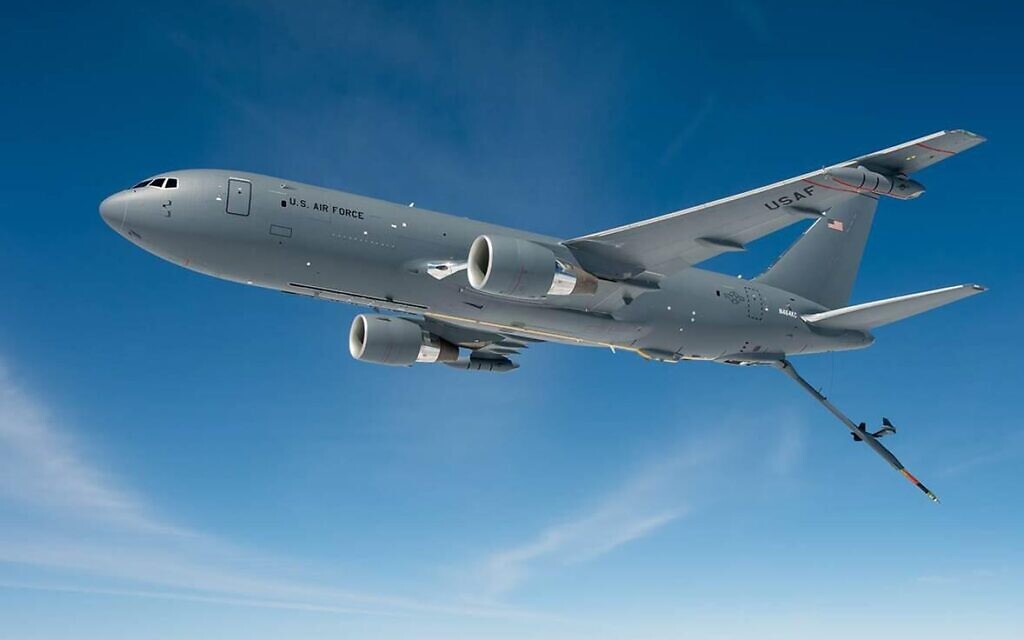
In addition, the delegation of the ministry’s purchasing department signed a deal to buy two more Boeing KC-46 refueling planes, which would be needed in order to conduct strikes against targets in Iran, some 2,000 kilometers (1,200 miles) from Israel and far outside the regular flight range of Israeli jets.An undated photograph of a Boeing KC-46 refueling plane, which Israel signed an agreement to purchase from the United States on December 30, 2021. (Boeing)



Israel has already agreed to purchase two of these refueling planes, which are scheduled to arrive in 2025. Israel has asked that this date be moved up by a year — a move that would require the US to give up its spot in line to receive the planes from Boeing — but Washington has thus far rejected the request.

The helicopter deal will cost Israel roughly $2 billion and the refuelers will cost another $1.1 billion, with the money coming from the $3.8 billion that Israel receives from Washington as part of the 10-year memorandum of understanding between the two countries, the ministry said.

“The purchase of these platforms is part of a wider effort, which is being led by the Defense Ministry with the IDF over the past year and a half to strengthen the capabilities and force build-up of the IDF against current and future threats, mostly those posed by the ‘third-ring,’” the Defense Ministry said.

In Israeli military parlance, the first ring refers to threats directly on the country’s borders, the second ring refers to slightly farther-flung enemies, like those in Iraq or Yemen, and the third ring refers to those yet further away — in practice, it is almost exclusively used in connection with Iran.

Defense Ministry Benny Gantz negotiated the initial approvals for the sales with US officials. The budget was then approved by the ministerial committee for military acquisitions and the Knesset’s joint defense budget committee, Gantz’s office said. This summer, the US State Department also signed off on the sale of the helicopters saying it was “vital to US national interests to assist Israel to develop and maintain a strong and ready self-defense capability.”

The defense minister hailed the purchases, saying in a statement that they were a critical part of the military’s preparedness, particularly against Iran.

“We are continuing to grow stronger, to change, and to adapt the air force to future challenges, those close by and especially those far from Israel’s borders,” he said.