”Palestinian Islamic Jihad is trying to perpetrate a series of attacks on Israel in the next few hours or days”, warned unnamed IDF officers to Israel’s channel 14 television program.
”The objective of the terrorists would be to spoil the important progress that has been made towards an understanding of a ceasefire between Israel and Hamas, through the mediation of Egypt and the UN.” the sources said.
Israeli security officials have detected unusual activity by members of the military wing of Islamic Jihad in various locations along the Israel-Gaza border fence in the past few hours. The attack could include the launching of missiles made in Russia against Israeli targets. Possibly the placing of explosive charges on the border fence in the attempt to break through perpetrate a large scale.
According to reports, Hamas is not involved in these activities. IDF sources say the order to perpetrate the attack was transmitted from the Beirut,office of the leader of the Islamic Jihad, Ziad Nahla, to the military wing of the group in Gaza
It has not been fully clarified why Islamic Jihad is interested in bringing about the collapse of the agreement with Israel, which is being negotiated through the Egyptian intelligence officers. It is possible that this is in the organization’s way of expressing dissatisfaction, or it could be a directive from Iran, which funds the Islamic Jihad, with the aim of destroying the agreement. Military sources have pointed to Islamic Jihad as responsible for the launch of the six rockets fired at Israeli communities near Gaza last Saturday night.
The Islamic Jihad denied the IDF Accusations. “These reports are not true,” the Islamic terrorist group said in a statement.
Negotiations to reach a long term cease fire between Israel and Hamas, are still being conducted by Egyptian General Ahmed Abdel Khalek, and Bugarian UN envoy for the Middle East, Nickolay Mladenov. They met with Hamas leader Ismail Haniyeh at his home in the Shati refugee camp.
Hamas’s negotiator is being led Yahya Sinwar the terrorist group’s leader in Gaza, while on the Israeli negotiator is being led by Meir Ben-Shabat. the head of the National Security Council,
In the framework of the negotiations, Israel has reopened the two border crossings with the Gaza Strip, Erez and Kerem Shalom.
We can’t run an ad in the New York Times but these savages get the cover. Think about that. Qatar is arguably the preeminent sponsor of terror in the world today. It is a benefactor of the genocidal armies of ISIS, al Qaeda, and Boko Haram; it is involved in Taliban narcotics trafficking through a relationship with the Pakistani National Logistics Cell; and profits from operating a virtual slave state. Qatar is involved in terror operations from Nigeria to Gaza to Syria to Iraq. The tiny Persian Gulf nation of Qatar – one of the wealthiest countries in the world on a per capita basis, thanks to enormous oil and natural gas reserves – has become one of the most harmful influences in the Middle East and a key supporter of terrorist groups.“The Qatari government has provided sanctuary to various members of jihadist organizations, namely the Taliban, al-Qaeda, Hamas, and the Muslim Brotherhood, allowing some of them to establish official offices on its territory. More on Qatar here.
The author of this Sunday’s New York Times magazine cover story about the campaign to boycott, divest, and sanction the state of Israel works for an organization whose major donor, Qatar, is also the largest state funder of the terrorist group Hamas. Other significant donors to the author’s organization, the International Crisis Group, are leading supporters of the anti-Semitic boycott movement the author describes in his piece.
The author, Nathan Thrall, is tied to a large network of BDS supporters that are funded into the millions by the Qatari government, which has long been engaged in efforts to spy on the American Jewish community and pro-Israel officials. Qatar’s foreign influence operations in Washington, D.C., have flown mostly under the radar, but are part of a larger proxy battle being waged by wealthy Middle Eastern governments eager to peddle influence in powerful D.C. circles.
Thrall, who the Times presents as a disinterested expert, serves as director of the Arab-Israeli Project at the International Crisis Group, or ICG, a left-leaning advocacy organization that has received around $4 million from the Qatari government in the just the last year. Qatar’s donations represent around 23 percent of ICG’s total budget. Qatar is not mentioned in Thrall’s 11,500-word piece.
ICG also has raised $1 million in the past several years from the Rockefeller Brothers Foundation, a prolific and open funder of the BDS movement in the United States.
Another significant portion of ICG’s funding—more than $5 million in the last three years—comes from the Open Society Foundations, run by liberal billionaire George Soros. Open Society funds dozens of Palestinian organizations that are prominent members of the BDS movement.
ICG’s president is former Obama administration official Robert Malley, another Israel critic who was fired from President Barack Obama’s 2008 presidential election team after he met with the Hamas terror organization. He joined the Obama administration in 2014.
Thrall has been affiliated with ICG during the bulk of his career, which dates to 2010 with bylines at the BBC, the Guardian, the Washington Post, and CNN.
In his writing, Thrall has gone to great lengths to portray Israel as an aggressor in its conflict with Palestinian terrorists.
In a 2011 dispatch in the Times, Thrall argued that Israeli policies are to blame for the violence fostered by Hamas and its terror affiliates. Numerous other reports written over the years demonstrate a clear anti-Israel bias and attempt to portray the conflict as the Jewish state’s fault, not that of the terrorists who attack it.
As Hamas attacked Israel in 2014, Thrall wrote in the Times‘ Review of Books that the terror group “demonstrated that its militancy and its willingness to endure a ferocious Israeli attack could achieve more in weeks than [Palestinian President Mahmoud] Abbas’s talks have achieved in years. During the Gaza war, Israel did not announce a single new settlement in the West Bank.”
In another 2014 report, Thrall wrote that Hamas’s terrorist bombing on Israel are the “direct result of the choice by Israel and the West.”
Thrall has openly expressed support for the BDS movement, which he claimed is the “leading cause for advocates of free speech.” Pro-Israel groups, Thrall has argued, are responsible for what he described as a “decades-long attempt” to “stifle pro-Palestinian speech in the U.S.”
Thrall’s advocacy with the Qatari-funded ICG is raising further questions about influence peddling by terror-tied governments. Critics argue that Thrall and the New York Times should disclose his ties and what appears to be a clear anti-Israel bias.
David Brog, executive director of the Maccabee Task Force and former executive director of the Christians United For Israel, or CUFI told the Free Beacon that the article is clearly framed to portray Israel in an unflattering–and factually inaccurate–manner.
“I didn’t think it was possible, but the New York Times has reached a new low,” Brog said. “This article is an extended, one-sided endorsement of Rep. Ilhan Omar’s assertion that US support for Israel is purchased with Jewish dollars. To Thrall, Israel can do no right and the Palestinians can do no wrong. He condemns Israel’s “occupation” while barely mentioning Israel’s repeated offers to exit the territory — and the serial Palestinian rejections of these offers. He criticizes Israel’s security measures without ever acknowledging the Palestinian terror that necessities them. He can’t even bring himself to admit that the Palestinian Arabs launched the 1948 War in an effort to destroy Israel — he writes that the war “erupted.” The list goes on. I’d expect more balanced and thorough reporting from a high school newspaper.”
Josh Block, a veteran pro-Israel official who serves as the CEO and president of the Israel Project, described the Times‘ failure to disclose Thrall’s biases and ICG’s funding as “horrifying.”
“It is outrageous that any newspaper, let alone one that takes itself so seriously as the NYT would commit what is such an obvious and horrifying violation of basic journalistic ethics and standards by publishing such a misleading article—presented as ‘news’—rife with falsehoods, ad hominem attacks on Jews and even including implying supporters of Israel were responsible for the Tree of Life massacre, all without acknowledging, even hiding the fact, that it is authored by a supporter of the ‘Destroy Israel Movement,’ which calls itself B.D.S., and who is employed and paid by an organization whose primary funders are leading sponsors and funders of the effort to destroy and boycott the Jewish state, starting with Qatar, followed by the Rockefellers and OSI,” Block said. “It boggles the mind. ”
The New York Times did not respond to a request for comment.
In order to actually make Islam the religion of peace, the majority of Muslim people should change in five aspects, Somali-born Dutch-American activist Ayaan Hirsi Ali told Mandiner.
According to Hirsi Ali, Muslims should change their attitude to the Quran and Muhammad instead of taking everything literally; appreciate actual life more than life after death; the sharia and the concept of jihad should be changed and they should change the norm of not reporting radicals to the police.
Speaking to Hir Tv, she warned the Islamisation is an actual threat in Europe, financed by countries like Qatar and Saudi Arabia.
In an interview with daily Magyar Hirlap, Hirsi Ali pointed out that while compromises can be found among the various groups in democracy, it is not possible to reach a compromise with Islamists.
Earlier that day, Bennett, a cabinet member, had written a letter to Attorney-General Avihai Mandelblit calling on him to require Netanyahu to call a meeting.
Naftali Bennett (L) and Benjamin Netanyahu (R). (photo credit: MARC ISRAEL SELLEM/THE JERUSALEM POST)
Prime Minister Benjamin Netanyahu cancelled the first Security Cabinet meeting called since Hamas escalated its attacks on Israel last week, a move that New Right leader Naftali Bennett has said is politically motivated.
The meeting was set for Wednesday and then canceled soon after on Sunday.
According to Bennett, the actions taken so far “have not created the necessary deterrence against Hamas’ actions, which are meant to hurt the security of Israeli citizens.”
He also expressed concern at reports that Israel is negotiating with Hamas.
“It is not reasonable, in my opinion, for the Prime Minister and security establishment to manage such important security events on their own, without the Security Cabinet ministers, who carry the responsibility [for Israel’s response] by law, giving their opinions,” Bennett wrote to Mandelblit.
After the meeting was canceled, Bennett said it was a political move, and that Netanyahu is “holding residents of the South hostage for a political campaign.
“Netanyahu is avoiding calling a cabinet meeting, because he knows that, just like with the operation to destroy Hamas tunnels in Protective Edge, I will oppose a shameful deal with Hamas and will lead a creative initiative to defeat Hamas,” said Bennett, who seeks to be appointed defense minister in the next government.
Spokespeople for the prime minister did not respond to requests for comment.
Education Minister Naftali Bennett and Justice Minister Ayelet Shaked, who chair the New Right party, will vote in the Cabinet against Prime Minister Binyamin Netanyahu’s agreement with Hamas to stop the launching of rockets from Gaza.
“It’s not just the Israelis’ feeling of humiliation,” Bennett said. “[Hamas leader Yahya] Sinwar and [Hamas leader Ismail] Haniyeh are going to victory celebrations without any fear that Israel will eliminate them. That’s not a way to establish deterrence. Shaked and I will vote in the cabinet against signing an agreement of Israel’s surrender to Hamas.”
“After more than 1,000 rockets this year, tens of thousands of incendiary balloons, a million Israelis in bomb shelters, Sinwar should just leave this world instead of prancing around like a proud peacock,” Bennett added.
“Anyone who thinks that he bought us peace is wrong because surrendering to terrorism just whets their appetite for more terrorism. We can expect another wave of terror – a much more violent one.”
Yisrael Beyteinu chairman and former Defense Minister Avigdor Liberman also attacked the Prime Minister: “The situation we have encountered is bankruptcy, both from a moral and security perspective. We see that IDF forces have been deployed – Israel is afraid. The biggest power in the Middle East is afraid of a terrorist organization.”
“The residents of the south of Israel aren’t second class and we can’t abandon them,” Liberman stressed. “Hamas must be subdued with a comprehensive plan like I already proposed in July. In the first stage, I expect the government to announce a halt on the transfer of funds to Hamas. I hope that the state of Israel will stop merely responding to Hamas and begin to initiate.”
A Palestinian woman reacts after inhaling tear gas fired by Israeli forces during a protest marking Land Day and the first anniversary of a surge of border protests, at the Israel-Gaza border fence, in the southern Gaza Strip March 30, 2019. . (photo credit: ASHRAF ABU AMRAH / REUTERS)
Hamas and Islamic Jihad officials said on Saturday that the weekly protests near the Gaza-Israel border will continue despite Egypt’s ongoing efforts to reach ceasefire understandings between the Palestinian factions and Israel.
Palestinian sources claimed that the Egyptian intelligence officials who have been mediating between the Palestinian factions and Israel in the past few days have made progress towards reaching new ceasefire understandings. The Palestinian factions in the Gaza Strip are now waiting for Israel’s final response to their demands, the sources added.
The sources claimed that Israel has accepted most of the Palestinian factions’ demands, including the expansion of the fishing zone, the reopening of the border crossings, the delivery of additional Qatari funds to the Gaza Strip and creating job opportunities for thousands of unemployed Palestinians there.
The Egyptian team, headed by senior General Intelligence Service official Ahmed Abdel Khaleq, met on Thursday and Friday with leaders of Hamas, Islamic Jihad and other Palestinian factions and discussed with them ways of achieving a new truce with Israel.
Khalil al-Haya, member of the Hamas “political bureau,” said that the Egyptian intelligence officials carried “positive responses” from Israel. The Egyptian officials, he said, will return to Israel on Sunday to receive timelines for the implementation of the reported understandings.
Haya said that the weekly protests along the border with Israel, which are called “Great March of Return and Breaking the Siege,” will continue until they achieve their goals. “In the past year, the weekly marches achieved some of their goals,” he added. “They will achieve more goals.”
He was speaking to reporters during a tour of the site of Saturday’s mass protests near the border with Israel on the occasion of the first anniversary of the protests, which coincide with the commemoration of Land Day. The Hamas official said that the Palestinians in the Gaza Strip will continue to put pressure on Israel until it complies with their “legitimate demands.”
Ismail Haniyeh, head of the Hamas “political bureau,” on Friday phoned Qatari Foreign Minister Mohammed bin Abdel Rahman al-Thani and the deputy director of the Egyptian General Intelligence Service, Amro Hanafi, and discussed with them the efforts to reach ceasefire understandings with Israel.
A source close to Hamas said it was unclear at this stage whether Qatar would continue to provide financial aid to the Palestinians in the Gaza Strip. The source was commenting on a report that suggested that Qatar has agreed to send $40 million in cash to the Gaza Strip as part of the reported Egyptian-sponsored ceasefire understandings.
Senior Hamas official Mahmoud Zahar said that the protests will continue until the blockade on the Gaza Strip is removed. “We won’t give up Jerusalem and the Arab Golan Heights,” Zahar said. “We won’t abandon the use of weapons against the occupation.”
Khaled al-Batsh, a senior Islamic Jihad official and head of the committee in charge of the weekly protests near the Gaza-Israel border, said on Saturday that the demonstrations will continue for another year. He said that the Palestinians were determined to thwart US President Donald Trump’s unpublished plan for peace in the Middle East, known as the “deal of the century.”
Speaking to reporters near the border with Israel, al-Batsh said that Saturday’s protests were designed to prepare the Palestinians for a “new phase during which they will continue the struggle to restore their stolen rights and end the siege on the Gaza Strip.”
We have just exposed a number of people that Rashida Tlaib publicly thanks and is friends with, who post explicit pro-terror content and calls to violence such as “kill every zionist”.
Approaching a lull? Not according to newspaper headlines Friday morning which announced tensions, high alert, army deployment and the transfer of IDF forces to the south of Israel.
The Egyptian delegation is negotiating with Hamas to try to restore calm, but it’s not at all certain that the terrorist organization will accept the offer. Instead, we may be dragged into another round of launches, rockets and red alerts less than two weeks before Israeli elections.
“I see the logic of Hamas which says it’s time to set the facts,” Arab affairs commentator Zvi Yehezkeli said on Channel 13 News on Friday. “Imagine yourself facing an enemy that has more military capabilities than you and you only have the patience, the stubbornness and the ability to harass the enemy.”
For those who may have already managed to forget, a summary of recent episodes: Hamas fired a rocket which hit Israel and destroyed a house in the Sharon area and Israel attacked Gaza in return. As far as Israel is concerned, the story is closed. As far as Hamas is concerned – it’s not.
“The profit of Hamas at the moment is related to the improvement of conditions on the day after,” Yehezkeli explained. “They want an agreement and this is what the Egyptian mediator discussed with them Thursday night.”
“The mediator proffered a very generous offer, which includes increasing their fishing area, opening the crossings and bringing in goods that have been banned since Operation Protective Edge – cement, iron and other building materials. However, Hamas is currently refusing the offer.”
“A year after they initiated these protests, Hamas is reaping the benefits. They found something that bothers us and we don’t know what the future holds,” Yehezkeli said.
An agreement or an escalation is currently on the agenda. According to Yehezkeli, if an agreement is reached and the state of Israel pays a little more money to silence Gaza, Hamas will hold quiet demonstrations devoid of violence, and if the negotiations fail, the violent demonstrations on the fence will continue as usual.
“Yahya Sinwar will tell the Gazans to break through the fence and harass the IDF soldiers. Israeli snipers will shoot them, Israel will be humiliated again and on Tuesday we’ll see them reach an agreement until the next missile,” Yehezkeli said.
And the next missile will come – that’s definite – the question is only when.
“There will be a missile,” Yehezkeli said. “I don’t know whether it will before the elections but there will definitely be another missile because they broke the psychological barrier of firing at the center of Israel. But as I said, everything very much depends on an agreement. If there’s no agreement and we continue these tensions, we’ll see a missile heading towards the center of the country.”
And what about the IDF forces deployed in the south of Israel? According to Yehezkeli, they’re there only for the sake of “being seen and feared.”
“I don’t know how quickly the armored forces and the tanks will enter Gaza. I think that they’re currently only there as a threat to Hamas to accept our proposal. It’s a bit embarrassing, but ultimately it can be solved with money. Hamas wanted money and its goal was achieved – it fired at the center, it received money, quiet for quiet. We’ll go to elections and the day after we’ll wake up to the Gaza problem.”
Extortion eventually pays off…
“Of course,” Yehezkeli quickly retorted. “There were no demonstrations on the fence a year ago. Since the demonstrations began, you know how much money and how much attention Hamas has received? How many donations from the world? How much attention from Qatar, the Arab countries and Egypt? Extortion definitely pays off.”
“[Former Hamas leader Sheikh] Ahmed Yassin wrote in the 1980s that in actuality, there are no forces here. Israel is a strong country with nuclear power and planes and Hamas lacks these abilities. How do they have the courage to start up with Israel? Precisely because Israel won’t use its weapons against them.”
“It’s not that they have the courage,” Yehezkeli asserted. “They simply don’t see Israel as strong and this is our weak point. They know that we really won’t shoot at Gaza because we’ll use the ‘tap on the roof’ procedure and we’ll make a thousand calculations before we act. They kill their people which we would never dare to do. They trust that Israel will be responsible and that’s where they get their courage to act.”
“Hamas sees this as a battle of minds between two societies – a Western society that sanctifies time, routine and the value of life with a Middle Eastern society that has all the time in the world, has no weapons and will always harass us until we say ‘enough.’ It’s not a matter of courage, but it’s a matter of two conflicting approaches.”
An agreement or not – one way or another – the next time missiles are fired at the center and Hamas will quickly declare that the missile was launched unintentionally, don’t be so quick to believe it. “Yesterday they admitted that the missile was not a mistake after all,” Yehezkeli concluded.
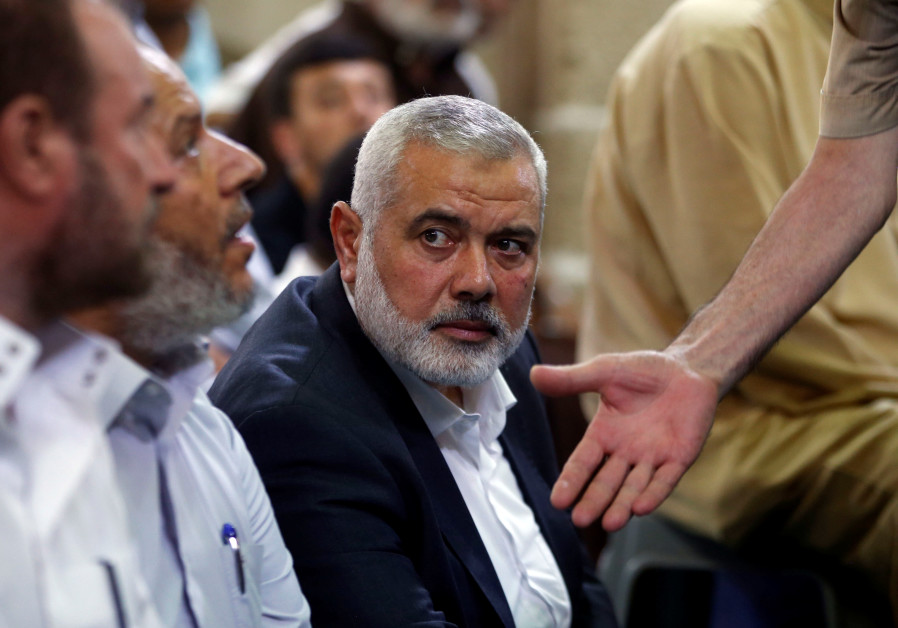
Hamas Chief Ismail Haniyeh looks on as he attends the funeral of Palestinian Hamas militants who were killed in Israeli tank fire, at a mosque in Gaza City July 26, 2018. (photo credit: MOHAMMED SALEM/REUTERS)
Hamas leader Ismail Haniyeh spoke on Friday afternoon regarding the negotiations with Israel mediated by Egypt, explaining that the behavior of Hamas at march of the million will depend on their demands being met.
“We continue our discussions today with our Egyptian brothers and with the participation of the factions,” Haniyeh said. “We are completing our earlier discussions so as to achieve our goal. We stand at a crossroads and a deep examination of Israeli stances, as well as Israel’s response to the needs of our nation.”
Haniyeh explained that based on decisions made at these deliberations, they will “determine the way in which the situation will pan out at the march of the million of Land Day.”
“We are in the final stretch of the road, which will have a serious impact on the decisions of Hamas and the factions and especially on the future,” he stated.
We are working with our Egyptian brothers to find a solution to the humanitarian crisis in Gaza to end the suffering of our people and establish their dignity in their country,” Haniyeh said. “All of this will be achieved by reaching some serious understandings that will be respected by the enemy, understandings which include the need for a ceasefire, the entrance of humanitarian aide and the implementation of projects, the opening of crossings and fishing, employment programs and treatment of electricity problems and more, by way of the removal of the siege over the Gaza Strip.”
Haniyeh said that Hamas continues to “coordinate intensely with our brothers in Qatar.”






 anneinpt
 artaxes
 danmillerinpanama
 davidking1530
 Peter Hofman
 Joseph Wouk
 Peter
Peter Louisiana Steve
 WarSclerotic
Recent Comments