My brother, lets change harts in time .
Perhaps somebody like it .
For me it is modern classic,
My brother, lets change harts in time .
Perhaps somebody like it .
For me it is modern classic,
Apr 20, 2019 12:00 pm By Robert Spencer
This is one statement that Muslim leaders have not infrequently made that Western analysts appear unwilling to hear or incapable of hearing. But Muhanna Hamad Al-Muhanna is not an “extremist.” The Qur’an demonizes the Jews in numerous ways. It depicts the Jews as inveterately evil and bent on destroying the well-being of the Muslims. They are the strongest of all people in enmity toward the Muslims (5:82); they fabricate things and falsely ascribe them to Allah (2:79; 3:75, 3:181); they claim that Allah’s power is limited (5:64); they love to listen to lies (5:41); they disobey Allah and never observe his commands (5:13). They are disputing and quarreling (2:247); hiding the truth and misleading people (3:78); staging rebellion against the prophets and rejecting their guidance (2:55); being hypocritical (2:14, 2:44); giving preference to their own interests over the teachings of Muhammad (2:87); wishing evil for people and trying to mislead them (2:109); feeling pain when others are happy or fortunate (3:120); being arrogant about their being Allah’s beloved people (5:18); devouring people’s wealth by subterfuge (4:161); slandering the true religion and being cursed by Allah (4:46); killing the prophets (2:61); being merciless and heartless (2:74); never keeping their promises or fulfilling their words (2:100); being unrestrained in committing sins (5:79); being cowardly (59:13-14); being miserly (4:53); being transformed into apes and pigs for breaking the Sabbath (2:63-65; 5:59-60; 7:166); and more. They are under Allah’s curse (9:30), and Muslims should wage war against them and subjugate them under Islamic hegemony (9:29).
Find out how and why every attempt at a peace agreement between Israel and the “Palestinians” has failed in my forthcoming book, The Palestinian Delusion: The Catastrophic History of the Middle East Peace Process, which you can preorder here.
Kuwaiti researcher Muhanna Hamad Al-Muhanna repeated the antisemitic blood libel that Jews use human blood, preferably of Christian children, in the making of holiday pastries. He further said that the Jews would destroy the moral values and economy of any country they entered, that they monopolized the slave trade, and that Hitler had decided to get rid of the Jews because they were behind movements fighting the social order and behind pornography. Al-Muhanna warned that anyone who normalizes relations with them is “a Jew like them.” Muhanna posted the video on his Youtube channel, which has over 13,000 subscribers, on February 26, 2019. The 47-minute long video was viewed close to 25,000 times.
Muhanna Hamad Al-Muhanna: One of the most famous religious practices of the Jews is the slaughter of a Christian child on a certain holiday. They take his blood and make it into a pastry, which is eaten on that day. They call it “sacred blood.” It must be an innocent child, who has not been contaminated by the world. When Muhammad Ali Pasha ruled Syria, there was the case of Father Thomas. This is one of the most famous incidents in history. Father Thomas was passing through the Jewish Quarter, when the Jews were having a religious celebration. When that Christian priest was passing there, the Jews kidnapped him and his servant and slaughtered them. They collected their blood in a bowl, and used it to bake pastries for the Jews of Iraq. The Jews of Damascus did this. They were captured, placed on trial in Damascus, and sentenced to death. But Rothschild and Montefiore, the richest people in those days, intervened, and obtained amnesty from Muhammad Ali Pasha. The practice of kidnapping children to make pastries with their blood was immortalized by the late Naguib Al-Kilani, in his well-known book, Blood for the Matzos of Zion. [Former Syrian Defense Minister] Mustafa Tlass conducted similar research. This is a famous [Jewish] religious practice.
[…]
Whenever the Jews enter a country, it is their custom to take over its commerce, and to try to corrupt all the religious and moral ties in that country, so that the Jews become equal to the rest of the people in that country. Let me give you an example. I don’t know if you have noticed, but all the novelists – Shakespeare, Tolstoy, Dostoevsky, what’s his name… Stevenson, Walter Scott… You cannot find a single European novelist who hasn’t attacked the Jews in his books.
[…]
The most famous traders who brought salves from Africa to the Americas… The Portuguese and Spanish Jews had a monopoly on that trade.
[…]
Hitler noticed that the Jews were behind every clandestine movement fighting the social order. He noticed that the Jews were behind the pornographic movies and literature. So he said that if Germany wants to make progress, it must get rid of the Jews or of their control. This brief review of the history of the Jews tells us something very important: that even if Islam permitted the signing of peace agreements with the Jews… Of course, Islam does not allow the signing of peace agreements with the Jews, because the Jews are occupying the land of the Muslims. Those who compare contemporary Jews to the Jews of Medina are fooling people, because in Medina, the Jews were under the rule of the Prophet Muhammad.
[…]
If they were to leave Palestine, perhaps we would be able to normalize relations with them. But they are the enemies of our religion, the enemies of our people. They are our enemies historically and ideologically – our enemies in everything. They are treacherous people. They betrayed the Prophet Muhammad three times. If they weren’t honest with the Prophet Muhammad, how can they be honest with you? In addition, whenever the Jews entered a country, they destroyed its moral values and its economy. These are people who worship money and gold.
[…]
The Jews are usurious by religion and by practice. They amass and monopolize gold.
[…]
Whoever normalizes relations with the Jews is a Jew like them, even if he is not aware of his Jewish character. He is a Jew just like them, even if claims to be Muslim. He has the same nature, the same culture, and the same ideology. Our war with the Jews will continue until Judgment Day – just like the Christians who occupy our countries, plunder our resources, and fight our religion….
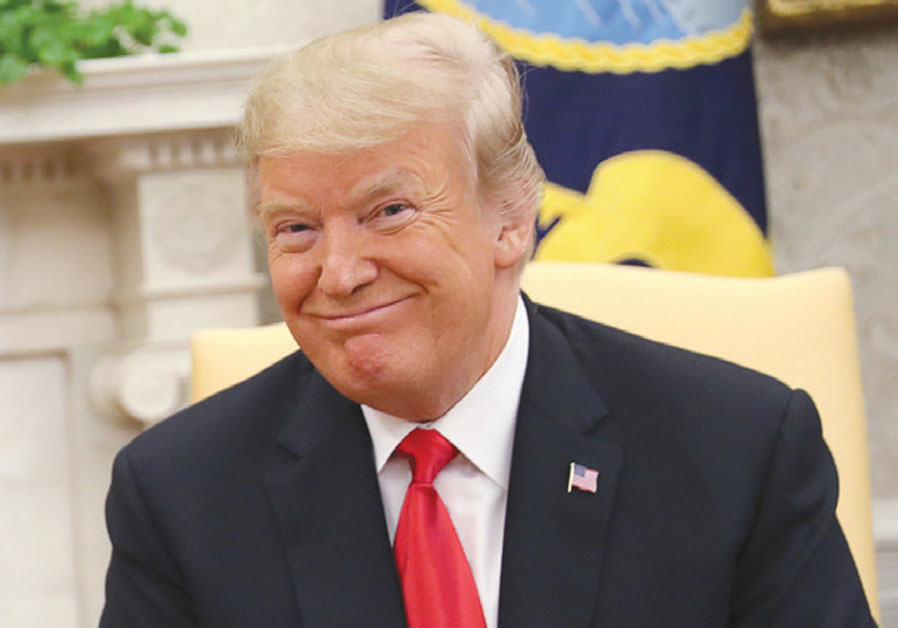
According to an old joke that never wears out its welcome, the theme of all Jewish holidays is: “They tried to kill us, we won, let’s eat.”
On Passover, this humorous description is fine-tuned to include a quip about how the Israelites have been freed from Egyptian bondage only to become enslaved in the kitchen, after spending weeks obsessively scrubbing the house to rid it of any vestige of a breadcrumb or other leavened item.
There is, of course, a serious purpose to Passover and other Jewish holidays: to express gratitude to God for rescuing us – his “Chosen People” – from annihilation at the hands of our endless enemies.
Some of the cynics among us, and there are many, tend to throw in a few digs at the dinner table about how we wouldn’t need so much saving at the last minute if divine intervention had kept us from needing it in the first place. This complaint is best expressed in the common Jewish wisecrack – uttered while looking heavenward – “Hey, could you choose somebody else for a change?”
Comedy aside, it is completely understandable for Jews to feel war-weary, particularly as a people who prefers the pen to the sword. But, being as stupid as we are smart, our response to this form of malaise is to turn our pens on one another and fear the world’s wrath whenever forced to use our swords. No wonder God gets so exasperated.
Luckily, such frustration has not been exhibited by the administration in Washington. Indeed, since assuming office in January 2017 – after being rejected and ridiculed by a majority of Jewish voters – US President Donald Trump proceeded to implement one stunningly pro-Israel policy after another.
This was especially surprising, considering the claim on the part of his detractors that he was actually an isolationist. The slogan “Make America Great Again,” his opponents said, was code for “Keep America out of the World’s Business.”
Equally amazing was his immediate grasp that guaranteeing Israel’s security and well-being is consistent with and a boon to American interests. His predecessor, Barack Obama, certainly didn’t see it that way. Unless maybe he did, in some convoluted fashion. After all, his hostility to Israel stemmed from the same poisonous root as his dim view of the United States. Not that US Jews seemed to notice. Or care.
Which brings us to another joke, this one Israeli, which circulated widely in 2012: “If Obama personally nuked Tel Aviv before the election, the Jewish vote in America would go down to 70%.”
What was not amusing in the least, however, was Obama’s second victory. His abominable treatment of both America and Israel was even worse.
It was thus that conservative Jews (in the political, not religious, sense) cast their ballots for Trump, the “anybody but a Democrat” candidate. One thing that was obvious to these apparently unlikely backers of someone like him was that whatever else the New York real estate mogul-turned-reality TV star turned out to be, it couldn’t be worse for America and Israel than Hillary Clinton and her party of progressives.
Still, it was a gamble. For better or worse, Trump had never been in politics. Opting for a novice to become the leader of the Free World felt a bit risky.
On the other hand, early in his first term, Obama actually told a group of Jewish leaders, “When there is no daylight [between the US and Israel], Israel just sits on the sidelines, and that erodes our credibility with the Arabs.”
He also boasted about “leading from behind,” and announced that the United States was no different from other countries; certainly not superior to them.
At least Trump was vowing to reverse course. He pledged to wrest America from the throes of policies that were turning it into a global laughing stock, and promised to have Israel’s back.
So, in spite of his assertion that he could succeed at brokering a deal between Israel and the Palestinian Authority where all previous US administrations had failed, right-wing Jews voted for him anyway.
It should be noted that this is not why he won the election. Jews may loom large in the eyes of antisemites, but we are a tiny minority everywhere other than in Israel. And even in the Jewish state, we number only a few million.
Clearly, none of this mattered to Trump. He had an agenda and ran with it, naysayers be damned. Or blessed, as Israel would turn out to be with him in the White House.
In December 2017, less than a year into his presidency, Trump announced that his administration was recognizing Jerusalem as the capital of Israel. His UN ambassador at the time, Nikki Haley, then vetoed a Security Council resolution denouncing the move and calling for the recognition to be rescinded.
On May 8, 2018, Trump canceled the Joint Comprehensive Plan of Action, the 2015 nuclear deal with the Iranian regime that never stopped enriching uranium or spinning centrifuges, while testing long-range ballistic missiles and threatening to wipe Israel off the map.
A week later, on May 15, the US Embassy in Jerusalem was officially opened. The same day, the US blocked a UN Security Council statement calling for an independent investigation into the deaths of Palestinians along the Israel-Gaza border, caused during violent weekly protests spurred and funded by Hamas. This is because the Trump administration rightly accepted Israel’s version of events, which was that the killings had been committed in self-defense.
On June 1, the US vetoed a Security Council resolution calling for “international protection” for Palestinian civilians. The Trump administration clearly understood that the only Palestinian “civilians” in danger are those attacking Israelis with knives, Molotov cocktails, rocks and rockets.
On August 31, the Trump administration confirmed that it would cease funding for the United Nations Relief and Works Agency for Palestine Refugees in the Near East (UNRWA) over its anti-Israel activities and perpetuation of a false refugee problem.
On September 10, the Trump administration closed the Palestine Liberation Organization mission in Washington and subsequently revoked the visas of the PLO envoy and his family members, forcing them to leave the US.
On September 17, the Trump administration cut $10 million of funding for bogus “conflict resolution” programs aimed at bringing about reconciliation between Fatah in the West Bank and Hamas in Gaza, and for Jews and Arabs in Israel.
Last month, in mid-March, in its annual global human rights report, the US State Department replaced the word “occupied” with “Israeli-controlled” in its reference to the Golan Heights. The significance of this change in language became apparent on March 25, when Trump signed a presidential proclamation recognizing Israeli sovereignty over the territory. This week, the US administration published an official map reflecting the new reality.
Whether something similar is in the works for Judea and Samaria remains to be seen, but in the same State Department report, the word “occupied” was also removed from references to the West Bank. Nor did the Trump administration express disapproval with Prime Minister Benjamin Netanyahu for promising, during his reelection campaign, to extend Israeli sovereignty to Jewish settlements in that area.
Meanwhile, last week, Trump designated Iran’s Islamic Revolutionary Guard Corps a foreign terrorist organization.
At the Passover Seder this evening, Jews around the world will be singing “Dayenu,” each verse of which recalls an additional act of God’s kindness to the Children of Israel during the Exodus from Egypt. The point is not simply to thank him for these acts, but to acknowledge that every one of them – in and of itself – is so great that it would have sufficed.
It would be both blasphemous and ridiculous to compare Trump’s behavior to God’s. Still, many Israelis have been drawing a bemused Dayenu parallel in relation to the US president’s policies toward the Jewish state.
How could we not?
This is not to say that no cynics lurk among the pro-Trump Israelis. You know, the ones who cannot stop worrying about the contents of his “deal of the century.” These people suspect that the many and varied carrots Trump has provided the Jewish state thus far are probably a precursor to a very large stick.
Waiting for the other shoe to fall is a Jewish affliction, but in this case it is unwarranted, regardless of the details of the peace plan. Nothing that the Trump administration has done to date suggests that Israel will be blamed for the Palestinian intransigence that is certain to continue.
We’re winning. Let’s eat.

Iranian President Hassan Rouhani (up center) attends a military parade during a ceremony marking the country’s annual army day in Tehran, on April 18, 2019. – Iran’s President Hassan Rouhani called on Middle East states on April 18 to “drive back Zionism”, in an Army Day tirade against the Islamic republic’s archfoe Israel. (STRINGER/AFP/Getty Images)
In urging neighbouring countries to “drive back Zionism”, the Islamic republic’s leader said the U.S. and its ally Israel were the root cause of all the troubled region’s problems.
“The region’s nations have lived alongside each other for centuries and never had a problem… If there is a problem, it is caused by others,” he said in the speech broadcast live on state television. “Let us stand together, be together and rid the region of the aggressor’s presence.”
Rouhani assured neighbouring countries that Iran’s armed forces are “never against you or your national interests” but are “standing against the aggressors.”
“The power of our armed forces is the power of the region’s countries, the Islamic world”, he said. “If we have a problem in the region today, its roots are either with Zionism or America’s arrogance.”
Rouhani said Muslim nations must band together and “restore the historical right of the nation of Palestine,” saying that “Zionism … has been committing crimes in the region for the past 70 years”,
“The final victory will surely be with the righteous,” he said.
Stirring exhortations against Israel are standard fare of official speeches in Iran, although some, such as a call by Rouhani’s predecessor Mahmoud Ahmadinejad for Israel to be “wiped off the map”, have triggered international condemnation.
For his part, Rouhani has previously called Israel a “cancerous tumour”, and urged Muslim governments to unite against it and its U.S. ally.
Last month he urged Iranians to put a curse on the U.S., Israel and Saudi Arabia, reiterating his long-standing charge that the U.S. and its allies are solely responsible for the country’s ailing economy.
“Put all your curses on those who created the current situation,” Rouhani said, adding that “the United States, the Zionists” and Saudi Arabia were to blame for the country’s ills. He didn’t say what kind of curses the Iranians should invoke.
The U.S. plan, Rouhani claimed, was to “dominate” the Iranian nation, “something Washington will not achieve.”
Last week, Washington placed Iran’s Islamic Revolutionary Guards on its blacklist of “foreign terrorist organisations,” the first time it had imposed the sanction on a military arm of a foreign government.
“Today, I am formally announcing my Administration’s plan to designate Iran’s Islamic Revolutionary Guard Corps (IRGC), including its Qods Force, as a Foreign Terrorist Organization (FTO) under Section 219 of the Immigration and Nationality Act,” says @POTUS in statement. pic.twitter.com/ovitdZq5Fi
— Steve Herman (@W7VOA) April 8, 2019
AFP contributed to this report

Iran is seeking to shore up its relations with Turkey, after it has conducted high level meetings with Iraq and Syria in recent weeks. Iranian Foreign Minister Mohammad Javad Zarif journeyed to Ankara where he met with Turkey’s foreign minister in a joint press conference. Turkey criticized US sanctions against Iran, even as other Turkish officials are in Washington trying to end a crisis with the US.
Zarif said that the US wants to control relations with other countries, hinting that Turkey must not be influenced by US views. “We will not allow the US to question our business with other countries.” Turkey’s Foreign Minister Mevlut Cavusoglu said that US sanctions against Iran were “wrong.” Turkey has expressed this view before. Turkish Finance Minister Berat Albayrak is in Washington and the Defense Minister of Turkey also recently met his US counterpart.
This is part of the policy Turkey is seeking to conduct, trying to be allies with the US and Russia and also reach out to Iran. After years in which Turkey had many difficulties with its neighbors, including shooting down a Russian plane on the Syrian border and opposing Iran’s role in the Syrian civil war, Ankara is trying to maneuver to be essential to each country so that they need Turkey more than Turkey needs them. Iran wants to play into this puzzle because it needs Turkey as an outlet for its economy and because Turkey is a strong economy, unlike Iraq and other neighbors, which have many more problems.

“There are no partners in Palestine for Trump. There are no Arab partners for Trump and there are no European partners for Trump,” Shtayyeh said during a wide-ranging hour-long interview.
Shtayyeh, a British-educated economist, takes office at a difficult time for the Palestinians, with his government, the Palestinian Authority, mired in a dire financial crisis. The PA administers autonomous zones in the West Bank.
The Trump administration has slashed hundreds of millions of dollars of aid, including all of its support for the UN agency for Palestinian refugees.

Israel has also withheld tens of millions of dollars of tax transfers to punish the Palestinians for their “martyrs’ fund,” a program that provides stipends to the families of Palestinian terrorists imprisoned or killed by Israel.The Israelis say the fund rewards violence, while the Palestinians say the payments are a national duty to families affected by decades of violence. Furious about the withholding, the Palestinians have in turn refused to accept partial tax transfers from Israel.
Without its key sources of revenue, the Palestinian Authority has begun paying only half salaries to tens of thousands of civil servants, reduced services and increased borrowing. In a new report being released Wednesday, the World Bank said the Palestinian deficit will grow from $400 million last year to over $1 billion this year.
“Israel is part of the financial war that has been declared upon us by the United States. The whole system is to try to push us to surrender, and agree to an unacceptable peace proposal,” Shtayyeh said. “This a financial blackmail, which we reject.”
Shtayyeh laid out a number of proposals for weathering the storm. He said he has imposed spending cuts by reducing perks for his cabinet ministers.

He said he would seek to develop the Palestinian agricultural, economic and education sectors and seek ways to reduce the Palestinian economy’s dependence on Israel. For example, he proposed importing fuel from neighboring Jordan, instead of from Israel, and even floating a Palestinian currency. He also said the Palestinians would seek financial backing from Arab and European donors.
Despite the tensions with Israel and the U.S., Shtayyeh said the Palestinians remain committed to the establishment of an independent Palestinian state on areas captured by Israel in the 1967 Six-Day War. That includes establishing a capital in East Jerusalem, which Israel has annexed and claims as part of its eternal capital.
The two-state solution has enjoyed overwhelming international support for the past two decades. But Prime Minister Benjamin Netanyahu and his hard-line political allies reject Palestinian independence.
Netanyahu secured another term in office in elections last week and is expected to form a new coalition with religious and nationalist parties that oppose the two-state solution. On the campaign trail, Netanyahu even raised the possibility of annexing Israeli settlements in the West Bank, a step that may extinguish any remaining hopes for an independent Palestine.
Netanyahu has received a boost from Trump, who has given Netanyahu a number of diplomatic gifts since taking office. Trump has recognized Jerusalem as Israel’s capital and moved the U.S. Embassy to the holy city, slashed aid to the Palestinians and shuttered the Palestinian diplomatic office in Washington.
In a departure from Republican and Democratic predecessors, Trump also has notably refused to endorse the two-state solution. His peace team, led by son-in-law Jared Kushner, has repeatedly pushed back the release of a peace plan it says it is preparing, and it remains unclear if or when it will be released.
Kushner’s team has said little about their proposal. But their limited public statements have indicated it will call for large amounts of economic investment in the Palestinians, but given no sign that it will include their demand for independence.

Shtayyeh said that after all of the U.S. moves in favor of Israel, particularly the recognition of Jerusalem, there is nothing left to negotiate.
He said any proposal that ignores key Palestinian demands will be rejected by the international community. The European Union this week reiterated its call for peace talks aimed at establishing a Palestinian state.
“Where are we going to have the Palestinian state?” he asked. “We are not looking for an entity. We are looking for a sovereign state.”
“Palestinians are not interested in economic peace. We are interested in ending occupation,” he said. “Life cannot be enjoyed under occupation.”
Saudi Arabia is preparing for the launch of the so-called “Arab NATO” — the Middle East Strategic Alliance (MESA) — in an effort to combat Iranian hegomony in the region.
The kingdom on April 8 hosted a meeting with the high-level participation of Saudi Arabia, the United States, the United Arab Emirates, Bahrain, Kuwait, Oman, Qatar and Jordan. According to the Saudi WAS news agency, the meeting was “an important step to launching the alliance, which aims to strengthen the security and stability of the region and the world.”

Sulaiman al-Oqaily, a Saudi political analyst, says there must be one strategy among the Arab nations that form the alliance, as well as a clear target in order for such an endeavor to succeed.
First, al-Oqaily points out that there must be one united Arab bloc that has agreed that the “Arab NATO” would protect the Arab world from all kind of threats and security challenges. “Its members’ motives and determinants have to be the same,” he says.
Al-Oqaily says that the sectarianism with which Iran targets the Middle East is more dangerous than Israel.
“Iran is taking advantage of its culture and religious links to the Arab world to expand there and destroy it,” he says. “Israel can’t violate the Arab society like Iran, but through its intelligence services.”
He also speculates that if Iran weren’t involved in Iraq, the latter would have peace by now.

The US administration has since last year been exploring the creation of a new security body comprising Sunni Middle Eastern countries that would be geared toward countering Shiite Iran’s regional adventurism. Reportedly, MESA member-states would seek deeper cooperation in the realms of missile defense, military training and counter-terrorism, while strengthening broader political and economic ties.
“It would serve as a bulwark against Iranian aggression, terrorism, extremism and will bring stability,” a spokesperson for the White House’s National Security Council asserted in reference to the potential association last year.
“It’s not a new project. However, its implementation is what matters,” says Qassem Qaseer, a Lebanese political analyst. He confirms that the US has been working with Arab states for a while now to form such a body, noting that “the issue remains with the different agendas and political approach of its member of states.”
For example, Qaseer says that the Arab countries don’t agree on more than one critical issue, pointing out that the Arab NATO is still an idea with no structure.
“They aim to pressure Iran on the ground by such initiative, although, they need to make it a reality first,” Qaseer says. It is noteworthy that the Idea of an Arab NATO coalition is one of the results of the Arab-Islamic summit hosted by Riyadh in May 2017.

Over the past year, senior American officials, including President Donald Trump’s adviser Jared Kushner and international negotiator Jason Greenblatt, have conducted shuttle diplomacy among Middle East capitals. Several analysts who spoke to The Media Line confirmed the visits laid the foundation for MESA, although the notion reportedly was first raised by Saudi Arabia.
Regarding Israel, its relations with regional Muslim nations are by most accounts improving, primarily the result of a shared interest in curbing Iran’s potential nuclearization. However, the conflict with the Palestinians remains a major, if not insurmountable, obstacle to the establishment of full diplomatic ties between Israel and more of its neighbors.
Article written by Dima Abumaria. Reproduced with permission of The Media Line
by Soeren Kern
https://www.gatestoneinstitute.org/14053/iran-winning-yemen
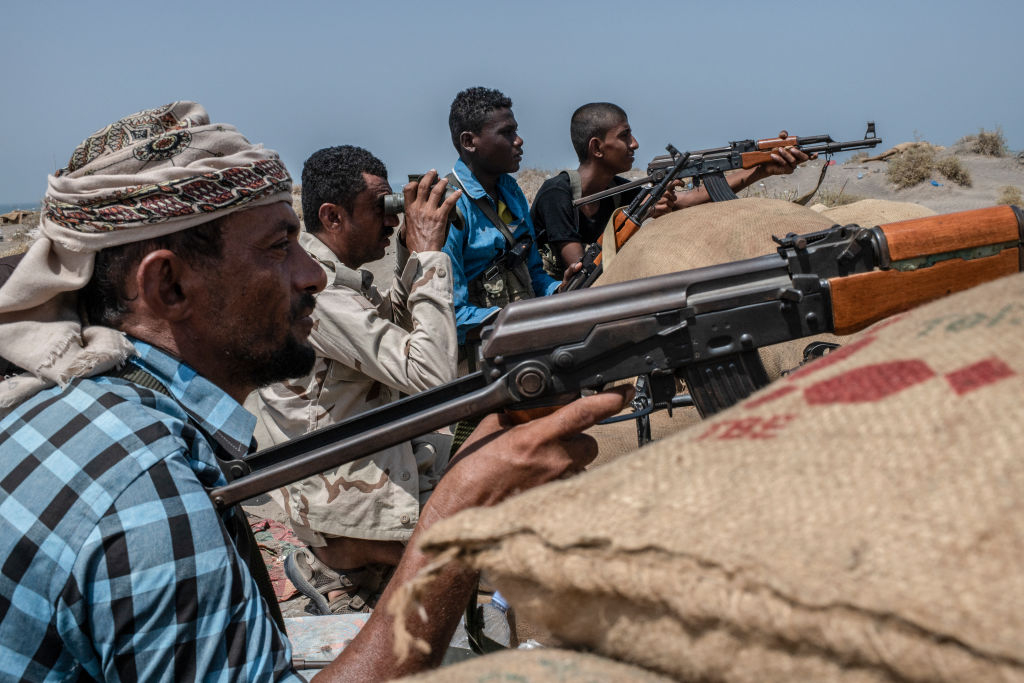 Militiamen aligned with Yemen’s government (supported by the US and Saudi Arabia) look for snipers from Iranian-backed Houthi rebel forces, south of Hodeidah, Yemen on September 21, 2018. According to the United Nations, Iran has been supplying Houthi rebels with weapons for more than a decade. (Photo by Andrew Renneisen/Getty Images) Militiamen aligned with Yemen’s government (supported by the US and Saudi Arabia) look for snipers from Iranian-backed Houthi rebel forces, south of Hodeidah, Yemen on September 21, 2018. According to the United Nations, Iran has been supplying Houthi rebels with weapons for more than a decade. (Photo by Andrew Renneisen/Getty Images) |
A ceasefire deal aimed at ending Yemen’s civil war is collapsing amid disputes between the warring parties over how to implement the agreement. A resumption of hostilities would, according to aid groups, accelerate Yemen’s descent into famine and threaten as many as 15 million people — more than half the population — with starvation.
Yemen’s four-year conflict is generally viewed as a proxy war between Saudi Arabia, which backs the internationally-recognized Yemeni government, and Iran, which backs tribal-based Shiite rebels, known as Houthis.
Iran has long denied accusations that it provides financial and military support to the Houthis, officially known as Ansar Allah (Partisans of Allah). According to the United Nations, however, Tehran has been supplying the rebels with weapons for more than a decade.
Yemen’s civil war has deep roots based on religious, economic and political grievances that go back to September 1962, when a revolution replaced a 1,000-year-old absolute hereditary Shiite monarchy — the Zaidi imamate — with a secular regime, the Republic of Yemen.
The Houthi movement, formed in 1992 as a Zaidi-Shia armed opposition group to fight the pro-American government of then-President Ali Abdullah Saleh, has demanded regional autonomy and a greater share of power in the central government.
The Houthi insurgency began in June 2004, when the group’s leader, Hussein Badreddin al-Houthi, launched an armed rebellion aimed at bringing down the Saleh government. Sectarian violence was inflamed when al-Houthi was killed by Yemeni forces in September 2004.
In November 2011, after more than three decades in power, Saleh signed a deal to transfer power to Yemeni Vice President Abdrabbuh Mansur Hadi. The move, welcomed by many as a turning point in Yemen’s history, failed to quell Houthi protests.
The conflict escalated into a full-blown civil war in September 2014, when the rebels, representing between a quarter and a third of the Yemeni population, staged a coup d’état and seized control of the capital, Sanaa. Hadi, Yemen’s internationally-recognized president, subsequently fled to Saudi Arabia.
In March 2015, Saudi Arabia and a Western-backed coalition of ten Sunni Arab states — alarmed by what they viewed as an attempt by Iran to establish a militarized Shiite state in northern Yemen — began a military intervention against Houthi targets to restore the legitimate government. The Saudi-led coalition, despite having superior air power, quickly got bogged down due to the Houthis’ adeptness at asymmetric warfare. The conflict soon reached a military stalemate that continues to this day.
At least 7,000 Yemeni civilians have died and more than 10,000 have been injured during the last four years of conflict, according to data from the Office of the United Nations High Commissioner for Human Rights (OHCHR). At least three million people have been displaced and around 400,000 children suffer from severe malnutrition. UN Secretary-General António Guterres has described Yemen as the “world’s worst humanitarian crisis.”
Sometimes called the “forgotten war,” the conflict in Yemen received new scrutiny after the October 2018 killing of Saudi dissident Jamal Khashoggi at the kingdom’s consulate in Istanbul. Outrage over the murder increased pressure on Saudi Arabia to seek a truce in Yemen.
In November 2018, the United States announced that it was halting the aerial refueling of aircraft from the Saudi-led coalition engaged in Yemen. A month later, in December 2018, the United States Congress passed a joint resolution calling for the removal of American troops from Yemen.
In March 2019, the U.S. Senate voted to remove U.S. troops from Yemen within 30 days. In April 2019, the U.S. House of Representatives passed a resolution to end American military support for the Saudi-led war in Yemen. The White House has vowed to veto the resolution. It has stated that the resolution raises “serious constitutional concerns” and is based on an “erroneous premise” — presumably meaning that it would not be in the U.S. interest to abandon Yemen to Iran.
In December 2018, the warring parties signed a series of UN-sponsored agreements — known collectively as the Stockholm Agreement — primarily aimed at facilitating the movement of international aid through Yemen’s main Red Sea port of Hodeidah, through which the country receives about 70% of its food imports. The Houthis pledged to withdraw from Hodeidah and Saudi-led coalition forces promised to retreat from the outskirts of the city.
The troop withdrawals in Hodeidah were intended to clear the way for wider negotiations to end the four-year war. The agreement, however, has been criticized for being ambiguous; it does not, for instance, stipulate who should control the port in Hodeidah after the Houthis withdraw.
The Houthis now say that they will not withdraw from the port without guarantees that Saudi-led coalition forces will not seize control. Each side has accused the other of violating the pact. The Yemeni government believes that the Houthis are using the strategic port to smuggle in weapons from Iran to sustain their military efforts.
Saudi Arabia views the Houthis — who adhere to Zaidi Islam, an offshoot of Shiism — as an Iranian proxy that Tehran is using to its project political and military power in the Arabian Peninsula in an apparent quest to become the dominant force in the Middle East.
Saudi leaders have sounded the alarm about the threat posed by the so-called Shia Crescent, an ever-expanding arc of Iranian influence across the Arab world. In Iraq, for example, the government is now dominated by Shiites. In Syria, Iran (and Russia) have prevented Sunni rebels from overthrowing President Bashar al-Assad, whose Alawite sect derives from Shiism. In Lebanon, the Iran-sponsored Shiite terrorist group Hezbollah effectively runs the government.
Now in Yemen, Riyadh seems justifiably to fear that Tehran is seeking to establish a permanent presence on Saudi Arabia’s southern border to encircle the Kingdom — possibly as part of a broader strategy to take control of Saudi oil fields and holy sites, Mecca and Medina — to upend the balance of power in the Middle East.
Iran’s rhetoric has only fueled those concerns. After the Houthi takeover of Saana in September 2014, for example, Iranian Lawmaker Ali Reza Zakani, a trusted adviser to Iran’s Supreme Leader, Ayatollah Ali Khamenei, boasted that Sanaa had become the fourth Arab capital under Iranian control. Sanaa, he said, now joins “three Arab capitals [Beirut, Baghdad and Damascus] which have ended up in the hands of Iran and belong to the Iranian Islamic revolution” and “the greater jihad.” He added:
“The Yemeni revolution will not be confined to Yemen alone. It will extend, following its success, into Saudi territories. The Yemeni-Saudi vast borders will help accelerate its reach into the depths of Saudi land.”
In November 2016, the chief of staff of the Iranian armed forces, General Mohammad Hossein Baqeri, speaking at a gathering of naval commanders, said that Iran would like to set up naval bases in Yemen:
“We need distant bases, and it may become possible one day to have bases on the shores of Yemen or Syria, or bases on islands or floating bases. Is having distant bases less than nuclear technology? I say it is worth dozens of times more.”
Some analysts have argued that while the West’s attention has been focused on Iran’s nuclear program to the exclusion of everything else, it has ignored Tehran’s efforts to solidify its control over the Middle East. Analyst David Daoud observed:
“The West sees nuclear weapons as Iran’s ultimate goal. But the Islamic Republic is not so simple-minded. Nuclear weapons are only one aspect of a multi-faceted strategy aimed at achieving regional hegemony. Particularly since the overthrow of Saddam Hussein’s regime in Iraq, Iran’s expansionist policies have gone into overdrive. By supplying arms and training to various proxies helpful to its interests and using them to carry out terrorist campaigns around the Middle East and beyond, Iran has exponentially increased the region’s instability and then taken advantage of the chaos.”
The head of Iran’s Islamic Revolutionary Guards Corps’ (IRGC) Quds Force, Qasem Soleimani, has hinted that Tehran’s long-term objective is to become a world power by gaining control over the global oil supply. In a February 2014 interview with Fars News, he said:
“The Shia crescent is not political. The Shia crescent is an economic crescent — and the most important economic issue in the world is oil. We know that 70% of global oil reserves are located in Iran, Iraq and Saudi Arabia, where 80% of the oil is located in Shiite areas of the country such as Dammam and Qatif.”
Middle East analyst Raman Ghavami wrote:
“Yemen is not an isolated war but intrinsically linked to Iran’s wider regional strategy. Unless this aspect begins to be highlighted more insistently, it is difficult to see any lasting peace in Yemen — a treaty could be signed, but as Iran faces other problems it could return to destabilizing Yemen because it is a crucial part of Iran’s Shia Crescent into Saudi Arabia.”
The importance of Yemen’s geostrategic location at the entrance to the Red Sea and across from the Horn of Africa was noted by retired IDF Lt.-Col. Michael (Mickey) Segall:
“Iran views Yemen, in general, and the northern Shia sector in particular, as a convenient staging ground for subversive activity against Saudi Arabia, its main religious-political rival in the Middle East, via the Saudis’ ‘backyard.’
“Iran also sees Yemen as an important factor in its policy of establishing a physical Iranian presence, both ground and naval, in the countries and ports of the Red Sea littoral, which control the shipping lanes that lead from the Persian Gulf to the heart of the Middle East and onward to Europe.
“If the Shia rebels gain control of the Bab al-Mandeb Strait, Iran can attain a foothold in this sensitive region giving access to the Red Sea and the Suez Canal, a cause of concern not only for its sworn rivals Saudi Arabia, Egypt and the Gulf states, but also for Israel and European countries along the Mediterranean.”
Analysts are divided on the question of how much influence Iran wields over the Houthis. Some say that the Houthis are fiercely independent and are more an ally to Iran than an actual proxy in the mold of Hezbollah. Iran’s ideological and religious influence on the Houthis, nevertheless, has been documented:
Hussein Badreddin al-Houthi, the founder and chief ideologue of the Houthi movement, lived for a time in Qom, the main city in Iran for Shia religious studies, where he is said to have focused on the works of Ayatollah Ruhollah Khomeini, the leader of the Iranian revolution, who in 1979 transformed Iran into an Islamic theocracy.
Al-Houthi reportedly believed that Yemen should be modeled on the Islamic Republic of Iran. One of his books is called “Iran in the Philosophy of Hussein Houthi.”
The Houthi movement’s anti-American and anti-Semitic slogan — “Allahu Akbar! Death to America! Death to Israel! Curse the Jews! Victory to Islam!” — appears to have been inspired by Khomeini, who had popularized the call for “Death to America” during the Iranian revolution.
Iran has been shipping weapons to the Houthis since at least 2009, according to a 2015 report by a UN Panel of Experts. “Current military Iranian support to Houthis in Yemen is consistent with patterns of arms transfers going back to more than five years to date,” the UN report said.
The UN document, presented to the Security Council’s Iran Sanctions Committee in June 2015, reported that in April 2009, an unnamed Iranian vessel unloaded crates of weapons onto Yemeni boats. The crates were then delivered in batches to the Saada Governate, where the Houthi movement is based.
In October 2009, Yemeni authorities seized an Iranian ship, the Mahan 1, which was believed to be carrying weapons for the Houthis.
In February 2011, Yemen authorities intercepted an Iranian fishing vessel in Yemeni territorial waters. The vessel was carrying “900 Iranian-made anti-tank and anti-helicopter rockets,” apparently intended for Houthi rebels.
In June 2012, an Iranian ship, the Imdad 1, sailed from an Iranian military port in Bandar Abbas to Yemen. The vessel was carrying weapons, which were unloaded into small boats and taken to Ash Shirh, a small port in southern Yemen, and then delivered to Houthis in the Saada Governate.
In January 2013, a joint US-Yemen patrol intercepted an Iranian ship, the Jihan 1, which was carrying 40 tons of weapons, including surface-to-air missiles, destined for Houthi insurgents. A UN Monitoring Report later indicated that some of the cargo may have been bound for al-Shabaab militants in Somalia.
In December 2014, the Reuters news agency confirmed — from Yemeni, Western and Iranian sources — that Iran had been supplying weapons, money and training to the Houthis before and after their takeover of Sanaa. The report said that Houthis were receiving military training in Iran and Lebanon. “We think there is cash, some of which is channeled via Hezbollah and sacks of cash arriving at the airport,” a Western source said. “The numbers of those going for training are enough for us to worry about.”
A senior Iranian official told Reuters that the Quds Force — the external arm of Iran’s Islamic Revolutionary Guard Corps — had a “few hundred” military personnel in Yemen in 2014 to train Houthi fighters. He added:
“Everything is about the balance of power in the region. Iran wants a powerful Shiite presence in the region that is why it has got involved in Yemen as well.”
A Yemeni official had then shown Reuters a breakdown of the cargo of the Jihan 1. It included Katyusha rockets, heat-seeking surface-to-air missiles, Russian-made rocket-propelled grenade launchers, Iranian-made night vision goggles and artillery systems that can track land and navy targets 40 kilometers (25 miles) away. There were also silencers, nearly three tons of RDX explosives, C-4 explosives, ammunition, bullets and electrical transistors. Reuters concluded:
“The assertions are likely to reinforce Saudi, and Western, fears that Iran is exploiting turmoil between Sunni and Shiite Muslims in Iraq, Syria, Lebanon, Bahrain and now Yemen.”
In March 2015, Tehran announced the beginning of an “air bridge” between Iran and Sanaa with a twice-daily shuttle service operated by Mahan Air, an Iranian government-controlled airline used by the IRGC Quds Force to ferry trainers and equipment to warzones. Hundreds of Hezbollah operatives, as well as members of the Iranian military, were said to have been transported from Yemen to Iran and back.
In September 2015, the Australian Navy intercepted a dhow containing anti-tank guided munitions, tripods, launch tubes, launcher assembly units and missile guidance sets. The weapons were reportedly destined for Houthi rebels in Yemen.
In February 2016, Saudi Arabia stopped a ship that was carrying military communications equipment under the guise of carrying medical supplies. The vessel, which was on its way to Houthi rebels in Yemen, began its journey in the southern Iranian port of Bandar Abbas. Also that month, the Australian Navy intercepted a dhow that was carrying 2,000 AK-47s, 100 RPG launchers, and other weapons.
In March 2016, U.S. Navy ships in the Arabian Sea seized an arms shipment from Iran likely bound for Houthi fighters. The weapons seized were hidden on a small dhow and included 1,500 AK-47 rifles, 200 rocket-propelled grenade launchers, and 21 machine guns. Also that month, a French destroyer seized almost 2,000 AK-47s, dozens of Dragunov sniper rifles, nine antitank missiles, and other equipment.
In November 2016, the UK-based think tank Conflict Armament Research (CAR) reported the existence of an arms “pipeline” originating in Iran and extending to Yemen and Somalia:
“CAR’s analysis of the seized materiel, and its investigations into the dhow trade around the Horn of Africa, suggests the existence of a weapon pipeline extending from Iran to Somalia and Yemen, which involves the transfer, by dhow, of significant quantities of Iranian-manufactured weapons and weapons that plausibly derive from Iranian stockpiles.”
In October 2016, Reuters reported that Iran had increased weapons transfers to the Houthis through Oman, which neighbors Yemen.
In March 2017, Reuters noted that Iran had stepped up its support for the Houthis by sending advanced weapons and military advisers to Yemen. A senior Iranian official said that Major General Qasem Soleimani, commander of the Quds Force, met top IRGC officials in Tehran in February 2017 to look at ways to “empower” the Houthis. “At this meeting, they agreed to increase the amount of help, through training, arms and financial support,” the official said. “Yemen is where the real proxy war is going on and winning the battle in Yemen will help define the balance of power in the Middle East.”
Also that month, CAR reported that Iran was supplying the Houthis with “kamikaze” drones to attack Saudi-led coalition missile defense systems:
“The use of these unmanned aerial vehicles (UAVs) illustrates the Houthi and Saleh-aligned forces’ ability to employ low-cost technology against the Coalition’s sophisticated military assets. Their acquisition of Iranian-designed Qasef-1 UAVs supports allegations that Iran continues to bolster the capacity of Houthi and Saleh-aligned forces through the transfer of new technology and advanced weaponry.”
In August 2017, Reuters disclosed that Iran had begun smuggling weapons into Yemen via Kuwait in an effort to evade an international arms embargo on the Houthis. Using this new route, Iranian ships were said to be transferring equipment to smaller vessels in the northern Persian Gulf, where they would face less scrutiny. The transshipments were reportedly taking place in Kuwaiti waters and nearby international shipping lanes. “Parts of missiles, launchers and drugs are smuggled into Yemen via Kuwaiti waters,” a senior Iranian official told Reuters. “The route sometimes is used for transferring cash as well.” The official added that “what is especially smuggled recently, or to be precise in the past six months, are parts of missiles that cannot be produced in Yemen.”
In November 2017, Houthi rebels launched a missile strike at the Saudi capital Riyadh, targeting King Khalid International Airport. The missile used was a Burkan-2, which is based on the Iranian Qiam ballistic missile. The attack demonstrated that the Houthis were capable of reaching deep into Saudi territory.
In March 2018, CAR reported that Iran was supplying the Houthis with sophisticated radio-controlled improvised explosive devices (RCIEDs):
“The specific components of the RCIEDs employed by Houthi forces in Yemen are identical to components in an RCIED seized by Bahraini security forces from Iranian-backed militants and documented by CAR in Bahrain. These components are also identical to those interdicted by Yemeni security forces on board the Jihan 1 cargo vessel, while en route from Iran, in 2013.”
In January 2018, a UN Panel of Experts report on Yemen noted:
“The Panel has identified missile remnants, related military equipment and military unmanned aerial vehicles that are of Iranian origin and were brought into Yemen after the imposition of the targeted arms embargo. As a result, the Panel finds that the Islamic Republic of Iran is in non-compliance with paragraph 14 of resolution 2216 (2015) in that it failed to take the necessary measures to prevent the direct or indirect supply, sale or transfer of Borkan-2H short-range ballistic missiles, field storage tanks for liquid bipropellant oxidizer for missiles and Ababil-T (Qasef-1) unmanned aerial vehicles to the then Houthi-Saleh alliance.”
On March 25, 2018, Saudi air defenses intercepted seven ballistic missiles fired by Houthi rebels at Riyadh, where one man was killed from debris, as well as at the southern cities of Najran, Jizan and Khamis Mushait. Two weeks later, on April 11, 2018, Saudi air defense forces intercepted a ballistic missile over Riyadh. Houthi media outlets said that the missile was targeted at the Saudi defense ministry.
In May 2018, the U.S. Department of the Treasury’s Office of Foreign Assets Control (OFAC) imposed sanctions on five Iranian individuals who “provided ballistic missile-related technical expertise to Yemen’s Houthis, and who transferred weapons not seen in Yemen prior to the current conflict, on behalf of the Islamic Revolutionary Guard Corps-Qods Force (IRGC-QF).”
In July 2018, Houthi leaders reportedly ordered their followers and loyalists in rebel-controlled government institutions, including schools and universities, to organize seminars and events to commemorate the Iranian Revolution. The streets of Sanaa were decorated with posters encouraging the people to repeat Khomeini chants. The rebels also dispatched convoys mounted with loudspeakers to broadcast recordings by Houthi founder, Hussein al-Houthi, and his brother and their current leader, Abdul Malek.
In November 2018, the US special representative for Iran, Brian Hook, provided evidence of Iranian missile proliferation to Yemen. He showed the remains of Sayyad-2C surface-to-air missile intercepted in Yemen by Saudi Arabia. The missile, emblazoned with the words “The Hunter Missile” in Farsi, was evidently intended for the Houthis. Hook said that Iran also is exporting antitank guided missiles: Toophan missiles were seized aboard a dhow ship in the Persian Gulf, and Towsan missiles were found by Saudi Arabia during a raid in Yemen.
In January 2019, Houthi rebels used an Iranian-supplied drone to attack a pro-government military parade at the Al-Anad military base. Yemen’s chief of military intelligence, Major General Mohammad Saleh Tamah, and the Yemeni army’s deputy chief of staff, Major General Saleh Al-Zindani, died of wounds sustained in the attack. The attack proved Iran’s role in arming the rebels with drone and ballistic missile technology.
On January 25, a UN Panel of Experts report on Yemen revealed that fuel was being shipped illegally from Iran to Houthi rebels to finance their war against the Yemeni government. The report also said that the panel “has traced the supply to the Houthis of unmanned aerial vehicles and a mixing machine for rocket fuel and found that individuals and entities of Iranian origin have funded the purchase.”
In February 2019, U.S. Ambassador to Yemen Matthew Tueller accused Iran of “throwing gasoline on the fire” of conflicts across the Middle East:
“We see Iran as one of the major forces that is trying to foster instability. Step back for a moment and look at what we have in Yemen. We have a non-state actor, a militia, that has overthrown the government, and yet it is receiving arms, equipment and a support from a state, Iran.”
In March 2019, Saudi-led coalition forces reported that during the month they had shot down four Iranian-supplied drones.
In addition to direct support from Iran, Houthi rebels are also receiving help from the Iranian proxy, Hezbollah.
In 2014, for instance, several Hezbollah operatives were arrested in Yemen and held on charges of training Houthi rebels. The men were members of Hezbollah’s Unit 3800, an expeditionary militia modelled on the Iranian Quds Force and aimed at spreading Iran’s revolution to other countries.
Earlier, in August 2013, the U.S. Department of the Treasury had sanctioned a former Hezbollah commander, Khalil Harb, for his command of Hezbollah activities in Yemen from 2012 onward. Harb had been found responsible for the movement of “large amounts of currency” to Yemen. Hezbollah also helped the Houthis establish their first satellite television channel, Al Masirah TV, which is based in Beirut’s Hezbollah-controlled southern suburbs.
In May 2015, the Financial Times reported that ties between Hezbollah and the Houthis stretch back over a decade and that hundreds of Lebanese and Iranian advisors have provided training to Houthi fighters in Yemen. “This is not a relationship with one side in control and the other mindlessly following,” a Houthi operative interviewed in Beirut said. “We exchange experience and ideology. We have our own character, our own way of doing things. The goal is not to build a Hezbollah model in Yemen.”
In February 2016, Yemeni President Hadi claimed that he had received a letter from Hezbollah Secretary-General Hassan Nasrallah that read, “Our fighters arrived in Yemen to teach the Yemeni people the essence of governing.”
Also that month, the Saudi Arabia-owned Al Arabiya news network posted a video of what it claimed was a meeting between Hezbollah commander Abu Saleh and Houthi forces in Yemen. The video shows a man in military fatigues addressing a group in Lebanese-accented Arabic about training for “martyrdom” operations inside Saudi Arabia.
In March 2016, an unnamed Hezbollah commander interviewed by the magazine Foreign Affairs about his group’s support for the Houthis remarked: “After we are done with Syria, we will start with Yemen, Hezbollah is already there…. Who do you think fires Tochka missiles into Saudi Arabia? It’s not the Houthis in their sandals, it’s us.”
In June 2018, Saudi-led coalition forces said that they had killed eight Hezbollah fighters in the mountainous Saada region in north-western Yemen. Coalition spokesman Colonel Turki al-Maliki said the Hezbollah fighters were part of a group heading to the Saudi border when they were spotted:
“Terrorist members from Hezbollah and from the Iranian regime are coming to help the rebels launch ballistic missiles and train them in combat. Both Iran and Hezbollah must stop sending military experts to Yemen.”
In August 2018, Hezbollah revealed that its leader, Hassan Nasrallah, had met with a delegation headed by Houthi spokesman Mohamad Abdelsalam to discuss the war in Yemen.
Although questions remain about the degree to which Iran can control or influence Houthi behavior, the ongoing war in Yemen has increased the Houthis dependence on weapons and financial support from Iran, whose position in Yemen is stronger than ever.
Since the October 2018 murder of Saudi dissident Jamal Khashoggi in Istanbul, the tide of world opinion has turned against Saudi Arabia — a turn of events Iran will be sure to exploit. Even if the warring sides eventually reach a peace agreement, Iran’s presence in Yemen is unlikely to diminish anytime soon.
Current affairs analyst Gerald M. Feierstein noted:
“Hard-line elements [in Iran] appear to see the continuation of the conflict [in Yemen] as a relatively low-cost and low-risk means of sustaining political, economic, and military pressure on the Saudis. Saudi Arabia’s intervention has reportedly cost between $5 billion and $6 billion a month, while Iran’s expenditures in Yemen probably total only millions a year.”
Yemeni Foreign Minister Khaled al-Yemany has accused Iran of ordering the Houthis not to implement the Stockholm Agreement, aimed at winding down the conflict, after first directing the Houthis to accept the agreement:
“The Houthis’ intransigence confirms their loyalty to Iran’s negotiating tactics. These usually begin with implicit approval of negotiating solutions, followed by complete retraction in order to force the international community to make more concessions and impose a fait accompli on the Yemeni government and Arab coalition.”
Even without Iranian pressure, as the UN panel of experts has observed, the Houthis have little incentive to cooperate:
“The Houthis believe that they only have to survive and outlast the Saudi Arabia-led coalition in order to ‘win’ the war, which limits their willingness to negotiate. The Saudi Arabia-led coalition, on the other hand, is faced with four broad choices: (a) unilaterally cease hostilities and leave the Houthis in control; (b) mount a massive ground invasion with no guarantee of success and certain casualties; (c) continue to carry out airstrikes and hope for different results [after four years of fighting] …. or (d) attempt to resurrect … an anti-Houthi coalition…. The Panel does not believe that any side is in a position to secure an outright military victory.”
Yemeni President Abdrabbuh Mansur Hadi has said that he will not allow Iran to establish a “Persian” state in Yemen. The UN panel of experts, however, has concluded that Yemen’s ability to remove the Houthis (much less the Iranians) from northern Yemen is limited: “The authority of the legitimate Government of Yemen has now eroded to the point that it is doubtful whether it will ever be able to reunite Yemen as a single country.”
Soeren Kern is a Senior Fellow at the New York-based Gatestone Institute.

Iranian President Hassan Rouhani / Getty Images
BY: Follow @Kredo0
Iranian leaders have authorized and begun spinning a set of advanced nuclear centrifuges to mark the country’s Iran National Nuclear Day, which leaders said is in honor “of all the jihadi efforts of our country’s nuclear industrialists.”
In unveiling a set of IR-6 nuclear centrifuges, which are the key component in enriching uranium to amounts that could be used as fuel for a weapon, Iranian President Hassan Rouhani claimed that Tehran has “acquired missiles and weapons you could not have imagined.”
“Today, and throughout the past year, we have launched 114 new technologies via the Atomic Energy Organization of Iran,” Rouhani was quoted as saying in remarks translated by the Middle East Media Research Institute, or MEMRI. “This is the message to the world: You have not succeeded and you will not succeed in preventing the progress and development of the Iranian people and [their] scientists. If yesterday you feared our IR-1 centrifuges—well, here you go!
As the nuclear centrifuges began to spin, Rouhani reportedly urged those in attendance at the event to “gloriously wave your [Iranian flags]” in “honor of all the jihadi efforts of our country’s nuclear industrialists,” according to MEMRI.
The installation of these centrifuges marks yet another increase in Iran’s nuclear know-how, elements of which remain legal under the landmark nuclear deal that President Donald Trump abandoned last year.
While the United States is no longer party to the deal, it has kept in place certain sanctions waivers that permit Iran to engage in sensitive nuclear research. Congressional Iran hawks in recent weeks have expressed anger over the waivers, which remain in place due to the State Department.
Rouhani, in his remarks, said that U.S. sanctions have not stopped Iran from making strides in the nuclear technology arena.
“If you claim that you can block advanced technology with your sanctions—you are lying and you know it,” he said.
Rouhani went on to claim that Iran is on the cusp installing an even more advanced generation of these nuclear centrifuges, called IR-8.
“Today, we launched a chain of 20 IR-6 centrifuges,” he said. “If you persevere in your injustice and wrongdoing, you will also see a chain of IR-8 centrifuges in the not-so-distant future. You cannot prevent the scientific progress of the Iranian people. If the purpose of your sanctions was to diminish Iran’s military power, know that in the past year—as you are fully aware—we have acquired missiles and weapons that you could not have imagined.”

Prime Minister Benjamin Netanyahu declared himself victorious in the 2019 general election Tuesday night, as updated exit polls and early results showed him with a clear path to forming a new government.
“I am very moved on this night,” he told exuberant supporters. “This is a night of an incredible, incredible victory.”
Though initial exit polls at 10 p.m. had shown Likud and Blue and White either even at 36 seats (Channel 13 and Kan) or with an advantage for Blue and White (37 to 33 on Channel 12), updated results accounting for the final hours of voting on both Channel 12 and 13 showed Likud leading 35 to 34.
And regardless of the horse race between the two major parties, the right-wing bloc was projected to win a majority in the 120-seat Knesset. The results mean Netanyahu will likely sweep back into power for an unprecedented fifth term, despite pending bribery and fraud indictments hanging over him.
As of 3:12 a.m. Wednesday, with over 2.7 million votes counted, Likud was leading Blue and White 27.5 percent (roughly 33 seats) to 26% (31 seats). Shas was running a distant third with 6% (7 seats), followed by UTJ with 5.2% (6 seats) and Yisrael Beytenu with 4.6% (6 seats). The actual number of seats will likely go up once all votes are tallied and votes of parties that did not cross the threshold are redistributed.
Final turnout in the vote was 67.9%, down from 2015’s final turnout of 71.8%.
Depending on the final tally and coalition negotiations, Netanyahu appeared slated to be able to form a coalition with some 63 to 65 seats, while the Blue and White led opposition would have 55 to 57 seats.
Updated Channel 13 exit pollAccounting for voting in the final hours before polls closed35353434887766666655554444000000Series 1
Likely blocs according to Channel 13 projection65655555RightCenter-left + Arab
Netanyahu said the numbers indicated a “fantastic achievement, an enormous achievement, which is almost unfathomable.”
He applauded his supporters for securing his win in the face of a “biased media.”
He called the Likud outcome “almost unprecedented,” saying, “When did we receive so many seats? I don’t even remember.”

If Likud ends up with 33 seats or above, it would be the party’s best showing since 2003, when it won 38 seats under the leadership of Ariel Sharon.
Netanyahu said Israel, under his leadership, was strong, prosperous and “a good place to live.”
Updated Channel 13 exit pollAccounting for voting in the final hours before polls closed35353434887766666655554444000000Series 1
Even as he declared his win, Netanyahu also counseled patience until all the ballots were counted. “A long night, maybe a long day, is still ahead of us and we will wait for the final results,” he said.
Netanyahu said he was in contact with right-wing parties, “our natural partners… Nearly all of them have publicly declared that they will recommend that I form the next government.
“It will be a right-wing government. But I intend to be the prime minister of all of Israel, right and left, Jews and non-Jews alike.”
Hanging over Netanyahu is a likely indictment in three corruption cases, including one charge of bribery. Netanyahu has been rumored to be planning to condition, or tacitly link, entry to the post-election coalition he hopes to form on support for the so-called “French law,” which would shelter him from prosecution as long as he remains in office. Netanyahu has denied seeking such legislation.

Of right-wing parties projected to enter the Knesset, only Yisrael Beytenu and Kulanu said they would wait before deciding on whether to back Netanyahu, though Kulanu leader Moshe Kahlon later indicated he was leaning toward supporting the prime minister.
Earlier Blue and White party leader Benny Gantz had also declared victory, after one major exit poll appeared to show his party in a stronger position.
Gantz said he would be the next prime minister of Israel and would “form a wide coalition that represents the whole of Israel.”
However, those claims seemed increasingly improbable as the night wore on.
Several key party leaders said they would recommend Netanyahu to lead the next government, including the heads of Ultra-Orthodox parties Shas and United Torah Judaism.
Meanwhile, in a surprise turn of events, Naftali Bennett and Ayalet Shaked’s New Right was hovering around the electoral threshold, while Moshe Feiglin’s Zehut party, which had been polling at 6-8 seats prior to the vote, was below the threshold.
Feiglin had been seen as a possible kingmaker, refusing to back Netanyahu despite his hard-right ideology.
Orly Levy-Abekasis’s Gesher party was also not projected to pass, as had been predicted by the polls.
Over 10,000 polling stations closed at 10 p.m. Tuesday, after a heated campaign season reached its climax with a tense election day, in which almost all parties attempted to galvanize their base by claiming they were in dire straits due to low turnout among their voters.
The decision regarding who will be the next prime minister may ultimately lie with President Reuven Rivlin, who will meet with the leaders of all the parties that cleared the electoral threshold, hear who each of them recommends as prime minister, and determine which candidate has the best chance of forming a coalition of at least 61 out of the 120 elected Knesset members.
Israel has never had a single-party government, and the next coalition, like the last one, seems certain to be a product of tense negotiations among about half a dozen parties that may take days or weeks.

By law, the final election results must be published within eight days of the vote, but a spokesman for the Central Elections Committee said the counting would be finished on Thursday afternoon. All the counting is done manually, following the closing of the polling stations.
Buoyed by a tight alliance with US President Donald Trump but clouded by a series of looming corruption indictments, Netanyahu has been seeking a fifth term in office that would make him Israel’s longest-serving leader, surpassing founding father David Ben-Gurion. He has served consecutively for the past 10 years, and was also prime minister from 1996 to 1999.
Netanyahu faced his stiffest challenge in a decade from Gantz, a craggy former military chief making his first foray into politics, who united his fledgling faction with Lapid’s Yesh Atid party and former defense minister Moshe Ya’alon’s Telem party to create Blue and White.

In the campaign’s final days, Netanyahu played to his base and veered to the right, vowing to annex Jewish West Bank settlements if reelected and embarking on a media blitz in which he portrayed himself as the underdog and frantically warned that “the right-wing government is in danger.”
Michael Bachner and Times of Israel staff contributed to this report.




 anneinpt
 artaxes
 danmillerinpanama
 davidking1530
 Peter Hofman
 Joseph Wouk
 Peter
Peter Louisiana Steve
 WarSclerotic
Recent Comments