Author Archive

Germany Agrees with Palestinians: Jerusalem NOT Israel’s Capital

April 25, 2018

Although, according to Germany, every state has the right to choose its own capital, it doesn’t extend the same courtesy to Israel.

By: United with Israel Staff

Apr 25, 2018

https://unitedwithisrael.org/

Germany is refusing to recognize Jerusalem as Israel’s capital. Indeed, while its foreign ministry acknowledged that every country has the right to name its own capital, it said that this is not the case for Israel, insisting that the status of Jerusalem can be settled only through negotiations with the Palestinians.

“As a matter of principle, every state has the right to determine a city in its territory to be its capital,” Niels Annen, a minister of state in Germany’s Foreign Ministry, said in response to a query by a lawmaker from the far-right Alternative for Germany (AfD) party last week, The Times of Israel reported.

“Since the eastern part of Jerusalem that Israel occupied in 1967 contrary to international law is not part of Israel’s sovereign territory, the international community, including Germany, has not recognized this declaration,” he added.

He based his position on the 1980 United Nations Security Council’s (UNSC) Resolution 478, which proclaimed that Israel’s declaration on united Jerusalem being its capital “constitutes a violation of international law,” as well as on clauses for the 1995 Oslo Peace Accords.

“The federal government shares the view that the status of Jerusalem, just like other final status issues, can only be settled through negotiations to be durable and acceptable,” Annen affirmed.

Germany’s Chancellor Angela Merkel similarly stated, in an interview with Israel’s Channel 10, that Berlin will not move its embassy in Israel from Tel Aviv to Jerusalem.

‘Repeating the Arguments of Israel’s Enemies’

Petr Bystron, who submitted the query, responded that “the German government’s answer was almost identical with that of the Palestinian Authority, which has been protesting US President Donald Trump’s decision to move the US Embassy to Jerusalem.”

Since Trump’s announcement in December that the US recognizes Jerusalem as the Israeli capital and will move its embassy there, a number of countries have followed suit.

Bystron said he was “amazed that, even 70 years after the founding of the State of Israel, the German government has no idea what its capital is.” He was especially surprised, he said, that Foreign Minister Heiko Maas, who had just visited Jerusalem and emphasized Germany’s “special responsibility for, and solidarity with, the democratic, Jewish state of Israel,” was unwilling to support Israel’s position.

“Considering the special responsibility the German government keeps emphasizing it has toward Israel, it is strange they keep repeating the arguments of Israel’s enemies,” Bystron said.

Congressmen Call for Disclosure of U.S. Aid to Palestinian Terrorists

April 25, 2018

Letter calls for suspension of aid to the Palestinians

Palestinian president Mahmud Abbas

Palestinian Authority President Mahmoud Abbas / Getty Images

BY:

Members of Congress hope to compel the State Department to disclose the amount of U.S. aid money the Palestinian Authority has given to convicted terrorists and their families, according to a congressional communication viewed by the Free Beacon that calls for a complete freeze in U.S. aid to the Palestinian government.

Reps. David McKinley (R., W.V.) and John Ratcliffe (R., Texas) are circulating a letter to Republican offices urging them to join an effort to compel the State Department to detail the amount of taxpayer money that has been used by the Palestinian government to pay terrorists under a longstanding policy known as “pay to slay.”

Following passage of the Taylor Force Act, which requires the Palestinian government to stop these payments or face a full cutoff in aid, the lawmakers are seeking to immediately freeze U.S. aid to the Palestinians until the State Department explains to lawmakers how it plans to enforce the new law.

The letter follows a recent Free Beacon report disclosing that the Palestinian Authority continues to spend U.S. aid dollars on terrorists. Palestinian officials have also made clear that they have no intention of following the new law and will continue to provide terrorists and their familiar with compensation.

“We urge you to immediately suspend all aid payments to the Palestinian Authority,” the lawmakers write, according to a copy of the letter viewed by the Free Beacon. “Further, we urge you to make the cessation of this abhorrent practice that incentivizes terrorism a pre-condition for any U.S.-brokered peace talks between the sovereign state of Israel and the Palestinian Authority.”

The lawmakers also demand the State Department outline in detail, “how many foreign aid dollars went to the PA that were then used to fund terrorists prior to passage of the Taylor Force Act?”

Lawmakers are additionally requesting information on what measures the administration is “planning to take to enforce the law and suspend aid to the PA, given the above statements and the content of their proposed budget?” according to the letter, which is addressed to secretary of state nominee Mike Pompeo.

The State Department is required to report to Congress this week on its implementation of the Taylor Force Act and explain what efforts it is taking to stop Palestinian payments to terrorists.

Asked about the state of play on Wednesday, a State Department official declined to provide information on the reporting requirement and further information showing the Palestinian government continues to provide salaries to terrorists.

Organizations tracking the Palestinian media recently disclosed that the PA is slated to spend at least eight percent of its 2018 budget on its so-called martyr’s fund. That figure amounts to about $355 million, according to Palestinian Media Watch.

Palestinian President Mahmoud Abbas, in a recent speech, outlined his intention to continue paying terrorists, a point highlighted by the lawmakers in their letter to Pompeo.

“There is something that the Americans are telling us to stop—the salaries of the martyrs and the martyrs’ families,” Abbas was quoted as saying. “Of course we categorically reject this. We will not under any circumstances allow anyone to harm the families of the prisoners, the wounded, and the martyrs. They are our children and they are our families. They honor us, and we will continue to pay them before the living.”

The lawmakers go on to request the Trump administration require the Palestinians to abandon this  practice as a pre-condition for peace talks with Israel.

Other members of Congress are lining up behind the effort as well. 

“Congress took a bipartisan and resolute stance in the budget deal last month: We will not continue to provide aid to the Palestinian Authority if they use those funds to pay terrorists and their families. These evil individuals seek to harm the United States and our ally Israel,” said McKinley. “We call on the State Department to cease aid payments to the Palestinian Authority until it can be confirmed that they have complied with this requirement.”

Iran’s navy commander threatens to sink US ships

April 25, 2018

Admiral Ali Fadavi says Americans will land in a ‘catastrophic situation,’ amid escalating rhetoric over endangered nuclear deal

Today, 9:14 am

https://www.timesofisrael.com/irans-navy-commander-threatens-to-sink-us-ships/

Commander of the Islamic Revolution Guards Corps (IRGC) Navy Rear Admiral Ali Fadavi. (Fars)

A top Iranian general has threatened to sink the United States Navy’s ships, warning that the US would find itself in a “catastrophic situation” amid an ongoing war of words between the countries over the possibility President Donald Trump’s could exit a landmark nuclear deal.

“The actual information that the Americans have about us is much less than what they think they have. When will they figure this out? When it is too late,” the Revolutionary Guard Corps’s navy commander, Admiral Ali Fadavim, told Iranian television on Saturday.

“They will definitely figure it out when their ships are sunk, or when they find themselves in a catastrophic situation,” Fadavi threatened in an interview with IRINN TV, according to a translation by the Middle East Media Research Institute.

Trump is threatening to tear up the 2015 agreement aimed at curbing nuclear efforts unless European capitals agree to supplement it with tougher controls on Tehran’s missile program and future ability to return to nuclear fuel enrichment.

Iran’s President Hassan Rouhani on Tuesday warned the US that it would face serious consequences should it pull out of the deal, which Washington says falls short of preventing Iran from producing atomic weapons.

“I am telling those in the White House that if they do not live up to their commitments, the Iranian government will react firmly,” Rouhani said in a speech broadcast live on state television, according to Reuters.

“If anyone betrays the deal, they should know that they would face severe consequences,” he added.

Iranian Foreign Minister Mohammad Javad Zarif gives a speech during the Munich Security Conference on February 18, 2018 in Munich, southern Germany. (AFP PHOTO / Thomas KIENZLE)

Iran has been upping the rhetoric, with Foreign Minister Mohammad Javad Zarif warning Saturday that Tehran was ready to “vigorously” resume uranium enrichment if the US ditched the accord.

Zarif told reporters in New York that Iran is not seeking to acquire a nuclear bomb, but that its “probable” response to a US withdrawal would be to restart production of enriched uranium – a key bomb-making ingredient.

Other Iranian officials have threatened withdrawal from the Treaty on the Non-Proliferation of Nuclear Weapons.

Trump has set a May 12 deadline for the Europeans to “fix” the agreement, which provided for curbs to Iran’s nuclear program in exchange for relief from financial sanctions.

On Monday Russian Foreign Minister Sergey Lavrov said that he had agreed with his Chinese counterpart that the two countries would “obstruct” any attempt by Trump to “sabotage” the deal.

Iran Threatens to Withdraw from Nuclear Non-Proliferation Treaty

April 25, 2018

by Adelle Nazarian24 Apr 2018

http://www.breitbart.com/national-security/2018/04/24/iran-threatens-withdraw-nuclear-non-proliferation-treaty/

AFP/ASIF HASSAN

A senior Iranian official said on Tuesday that Tehran may withdraw from the nuclear non-proliferation treaty (NPT) if President Donald Trump scraps the Joint Comprehensive Plan of Action (JCPOA), or Iran nuclear deal.

Iran has been party to the NPT since 1970.

“This is one of three options that we are considering,” Ali Shamkhani, the secretary of Iran’s Supreme National Security Council, said about the possibility that Iran will withdraw from the NPT if Trump dismantles the nuclear Iran deal. According to Reuters, Shamkhani made the statement during a news conference broadcast on state television and also stated that the Atomic Energy Organization of Iran was ready for some “surprising actions” if the nuclear deal was scrapped.

Also on Tuesday, Iran’s President Hassan Rouhani reportedly warned Trump that there would be “severe consequences” if he “betrays the deal.”

advertisement

“If anyone betrays the deal, they should know that they would face severe consequences,” Rouhani said in Tabriz. He reportedly added, “Iran is prepared for all possible situations” and said, “I am telling those in the White House that if they do not live up to their commitments … the Iranian government will firmly react.”

Last week, Iran’s Foreign Minister Mohammad Javad Zarif threatened that the United States would face an “unpleasant” response if Washington decides to pull out of the Iran nuclear deal saying, “Definitely, the measure that the Islamic Republic would take and the reaction that the international community would show to the US move would be very unpleasant to the Americans.”

French President Emmanuel Macron arrived in Washington, DC, on Monday in a last-ditch attempt to keep America in the JCPOA.

During his joint press conference with the leader of the free world, Macron said it was time to work on a new Iran deal, saying, “I can say that we have had very frank discussions on that, just the two of us. We, therefore, wish from now on to work on a new deal with Iran.”

During the press conference, Trump warned Iran against restarting its nuclear program. “You’ll find out about that. It won’t be so easy for them to restart. They’re not going to be restarting anything. They restart it, they’re going to have big problems, bigger than they’ve ever had before,” Trump said.

Palestinians Furious US Won’t Call Judea, Samaria ‘Occupied’

April 25, 2018

The State Department ceased using the term “occupied” in references to Judea and Samaria, sparking Palestinian anger. 

Apr 24, 2018

By: United with Israel Staff

https://unitedwithisrael.org

Construction in Efrat, Judea. (Gershon Elinson/Flash90)

The Palestinian Ministry of Foreign Affairs on Monday condemned the US State Department for dropping the term “occupied  territories” when referring to the Judea and Samaria region in its annual human rights report.

The ministry said in a statement that “this act is another one in a long list of US actions and policies targeting Palestine and the Palestinian people”.

“The current administration of US President Donald Trump has abandoned its respect for international law and has actually taken steps that violate this law by implementing illegitimate and illegal positions on Palestine and the Palestinian-Israeli conflict,” the Palestinians charged.

“The American administration is not only biased towards Israel, but fully embraces its illegal policies to a point they have become part of US ideology and policies,” said the Foreign Ministry.

The Palestinians stressed, however, that by dropping the term “occupied territories” from the US State Department report, “it does not in any way mean anything and does not eliminate the concept of occupied territory according to international law and international legality, but it reveals to the world once again the reality of the US positions, especially for those who refuse to see them as they are.”

In it latest annual report on human rights,  the State Department did not use the controversial term “occupied” in references to various territories in and adjacent to Israel.

Israel liberated Judea and Samaria and unified Jerusalem in the 1967 Six Day War. Israel has since annexed those liberated parts of Jerusalem.

While the term “occupied” had been used in such reports since the Carter administration, the 2017 version drops this term, which is generally used pejoratively to criticize Israeli policy following military victories through which the Jewish state acquired control of various territories.

The change comes after US Ambassador to Israel David Friedman advised the department in December to stop using the “misleading” term “occupied” in references to Judea and Samaria.

The term “occupied” is considered by many to be a loaded phrase intended to demonize Israel with regard to its activities in disputed areas.

In response to the State Department’s change in terminology, Israel’s Defense Minister Avigdor Liberman tweeted over the weekend, “the lie of the occupied Palestinian territories begins to be revealed. They say that a lie repeated often enough becomes true, but the truth is forever stronger. The State Department report is proof of that.”

US and France to demand ‘new deal’ from Iran

April 25, 2018

April 24, 2018

World Israel News – Latest News from Israel

The presidents of the US and France announced their commitment to correct flaws in the current nuclear agreement with Iran.

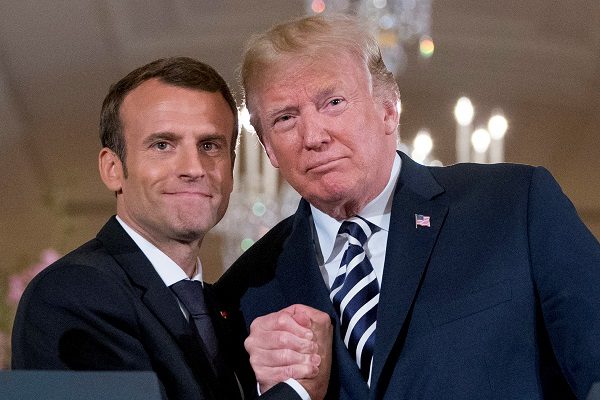
President Donald Trump and French President Emmanuel Macron. (AP Photo/Andrew Harnik

By: World Israel News Staff

At a press conference in Washington with US President Donald Trump by his side, French President Emmanuel Macron issued a joint call for a new direction in the multi-national nuclear agreement with Iran.

After “very frank discussions” between the two leaders, Macron announced that the US and France would “from now on … work on a new deal with Iran,” reported AFP.

“I think we will have a great shot at doing a much bigger, maybe, deal,” declared Trump at the press conference on Tuesday. The president reiterated that the current agreement is “a bad deal, a bad structure.”

According to Macron, the revised agreement would address not only Iran’s nuclear ambitions, but also Tehran’s ballistic missile program, its influence throughout the Middle East, and post-2025 activity.

While Trump has repeatedly threatened to walk away from the 2015 deal, under which Iran enjoyed relief from crippling sanctions and was guaranteed a civilian nuclear program, European powers have urged the US to stay in the deal.

May 12 represents the next deadline for Trump to decide whether to demand changes to the deal by refusing to re-certify it, a step that European powers claim would be a breach of the agreement.

In response to potential challenges from the US, Tehran continues to threaten to accelerate enrichment activities. The Islamic Republic has also become increasingly belligerent in Syria, posing an imminent threat on Israel’s border with its war-torn neighbor.

Trump took the opportunity on Tuesday to respond to Iran’s most recent threats, warning, “They’re not going to be restarting anything. If they restart it, they’re going to have big problems, bigger than they ever had before. And you can mark it down.”


Trump: Denuclearization of North Korea ‘Means They Get Rid of Their Nukes’

April 24, 2018

BY:

Trump: Denuclearization of North Korea ‘Means They Get Rid of Their Nukes’

President Donald Trump said Tuesday he defined denuclearization of North Korea as the rogue country getting rid of all its nuclear weapons.

“Meetings are being set up, and I want to see denuclearization of North Korea. A lot of concessions have already been made,” Trump said at a White House press conference alongside French President Emmanuel Macron.

Trump said he had made no concessions on his side ahead of a planned summit with North Korean dictator Kim Jong Un. North Korea announced last week through state media that it would immediately suspend nuclear and missile tests, as well as abolish a nuclear test site in what it called an effort to bring peace to the peninsula.

Trump tweeted Sunday North Korea had “agreed to denuclearization,” although Kim had not done so as defined by the Trump administration.

Asked how he defines denuclearization, Trump said it meant “they get rid of their nukes.”

“It means they get rid of their nukes. Very simple,” Trump said. “They get rid of their nukes, and nobody else would say it. It would be very easy for me to make a simple deal and claim victory. I don’t want to do that. I want them to get rid of their nukes.”

US admiral outlines new military buildup to counter China

April 24, 2018

The man nominated to run the US Pacific Command spells out his plans to contain Beijing on a number of fronts, from the oceans to space

April 24, 2018 1:43 PM (UTC+8)

http://www.atimes.com/article/us-admiral-outlines-new-military-buildup-to-counter-china/

The USS Carl Vinson aircraft carrier with Japan Maritime Self-Defense Force destroyers conducting an exercise in the Philippine Sea. Photo: US Navy via AFP

The American admiral slated to head the US Pacific Command is planning a buildup of American forces in the region along with closer alliances as part of the Pentagon’s new strategy to counter China.

Admiral Philip Davidson, the nominee for the command job, revealed in little-noticed testimony to a US Senate committee how he will restructure the 375,000 military and civilian personnel, 200 ships and nearly 1,100 aircraft in the region.

If confirmed for the position, a prospect likely in the coming weeks, Davidson said he would “recalibrate” the command in line with the Pentagon’s new national defense strategy.

“This effort entails ensuring the continued combat readiness of assigned forces in the western Pacific; developing an updated footprint that accounts for China’s rapid modernization and pursuing agreements with host nations that allow the United States to project power when necessary,” Davidson stated in written answers to questions posed by the panel.

Davidson did not elaborate on the plans.

But likely improvements in the US military posture are expected to include expanded naval forces with additional submarines and warships, including possibly a second forward-deployed aircraft carrier strike group. New deployments to Asia of advanced warplanes and drone aircraft also are expected, along with regional arms sales to American allies of ships, aircraft, missiles and drones.

Confronting China

“In the future, hypersonic and directed energy weapons, resilient space, cyber and network-capabilities, and well-trained soldiers, sailors, airmen, marines, and coastguardsmen, will be crucial to our ability to fight and win,” he said.

Current forces in the region do not support Pacom’s defense requirements, Davidson noted.

The comments by the admiral reflect the more muscular policies of US President Donald Trump and Defense Secretary Jim Mattis, who have made confronting Chinese aggressiveness in Asia and around the world a strategic priority.

In addition to building up partnerships and alliances in Asia, Davidson stated bluntly he will “collaborate with other elements of the US government and our allies to confront regional competitors.”

Based on China’s development of asymmetric warfare capabilities like anti-satellite weapons, cyber weaponry and high-speed hypersonic missiles, Davidson urged Pacific Command to rapidly field its own advanced war fighting capabilities.

“Pacom is heavily dependent on high-end warfare capabilities, including fifth-generation aircraft; munitions capable of penetrating China’s anti-access/area-denial environment; undersea warfare dominance capabilities; and survivable logistics and mission partner networks,” he said.

“With China, the United States should expand the competitive space by investing in next-generation capabilities, for example, hypersonic technology, while simultaneously recognizing that China is already weaponizing space and cyber.”

Hypersonic missiles are weapons that travel at speeds of more than 7,000 miles per hour and can maneuver, making them difficult systems to counter with increasingly sophisticated air and missile defenses.

The United States is readying forces that would be used to counter what the admiral described as “Chinese malign activities,” ranging from the militarization of built-up islands in the South China Sea to anti-democratic subversion through the Beijing development program called Belt and Road.

Military modernization

“China claims that these reclaimed features and the Belt and Road Initiative will not be used for military means, but their words do not match their actions,” he said. “Our defense strategy provides the necessary guidance that will drive our actions.”

The Belt and Road program is part of Beijing’s bid to “shape a world aligned with its own authoritarian model while undermining international norms such as the free flow of commerce and ideas,” he said. Predatory loans and other actions used in the program are indicators China is using its Belt and Road program to coerce states into greater access and influence for China, he added.

On China’s military buildup, the admiral described it as “the most ambitious military modernization in the world.” And on China’s large force of missiles, Davidson said: “The threat to US forces and bases is substantial and growing.”

Specifically, the new US defense strategy outlines two military components that have not been clearly revealed in public. The concepts are part of Mattis’ military reform efforts that seek to produce more lethal and agile global forces.

American military forces are now structured on a post-Cold War posture when the United States was the dominant military power and the main threats were rogue states.

The first new concept is called “dynamic force employment” that seeks to increase military options for responding to conflict, ranging from major wars to regional actions in Asia and Europe.

Key capabilities

The second concept is called the global operating model that outlines how military forces would be structured and used in both pre-conflict global competition and wartime missions.

Key capabilities include nuclear arms, cyber warfare and space warfare arms, advanced command, control and communications, strategic mobility and forces for countering weapons of mass destruction.

The model calls for utilizing four layers described under the phrase “contact, blunt, surge and homeland.”

One key aspect involves contact with competitors that will seek to better position American military forces to compete more effectively against foreign threats below the level of armed conflict.

This is what military analysts call “gray zone conflicts,” like the covert Russian takeover of Ukraine’s Crimea in 2014, and China’s covert militarization of built-up islands in the South China Sea that started in 2013.

Davidson testified that both concepts will guide forces in dealing with China.

“Due to the distances involved in the Indo-Pacific, we cannot rely solely on surge forces from the Continental United States to deter Chinese aggression or prevent a fait accompli,” the four-star admiral said. “Pacom must maintain a robust blunt layer that effectively deters Chinese aggression in the Indo-Pacific.”

To ensure China will be deterred from expansionism or aggression, whether in the South China Sea, East China Sea or against Taiwan, Davidson vowed to regularly assess the military footprint in Asia.


Carter Center Sued for Providing Support to Terrorists, Defrauding Taxpayers

April 24, 2018

Trump admin says case too expensive to prosecute, seeks dismissal

Former President Jimmy Carter / Getty Images

BY:

Carter Center Sued for Providing Support to Terrorists, Defrauding Taxpayers

The Trump administration is seeking the dismissal of a suit alleging the nonprofit helmed by former president Jimmy Carter has used taxpayer funding to provide material support to international terrorist groups, including Hamas.

The Zionist Advocacy Center, which filed the recently unsealed suit in 2015, alleges the Carter Center received more than $30 million in taxpayer grants while violating federal statutes barring it from using the cash to provide material support to terror groups.

The plaintiffs maintain the Carter Center has violated the law by hosting designated terrorists at is facilities, as well as by providing various forms of assistance to the Palestinian terror group Hamas and other known terror entities, according to recently unsealed court documents.

The Department of Justice surprised pro-Israel insiders recently when it moved to have the case dismissed on the grounds it is too expensive to prosecute, according to court filings the administration had requested remain secret.

A hearing on the dismissal motion will occur on April 25, though legal experts handling the case are hoping to convince the DOJ to reverse its opinion beforehand, according to those familiar with the proceedings.

Evidence presented in the case purports to show the Carter Center accepted millions in government grants while falsely certifying it was not violating prohibitions on providing material support to terror groups, which include a broad range of factors including lodgings, expert advice, and other types of support.

Former President Carter’s ongoing and well-documented interactions with Hamas and Popular Front for the Liberation of Palestine (PFLP) are tantamount to material support for terror groups, the suit alleges citing evidence Carter hosted these officials at his Center’s offices.

This also includes providing services and advice to Hamas and other individuals and organizations designated as terrorists by the U.S. government.

While the Trump administration’s lawyers admit in their motion to dismiss that Carter has in fact met with designated terrorists and terror groups, they are seeking to have the case tossed because it would be too expensive to adjudicate in court.

“Representatives of the Carter Center have engaged in discussions and meetings with members of Hamas and the Popular Front for the Liberation of Palestine,” the government’s motion states.

However, “the primary purposes of these activities were to facilitate dialog between the Palestinian factions and to urge Hamas to recognize Israel’s right to exist, forgo violence, and accept previous peace agreements,” Trump administration lawyers maintain, adding that these activities were not concealed from the public.

Due to the publicly available nature of these interactions, the DOJ maintains the activity should not be classified as material support for terrorists, according to the government’s dismissal motion.

The DOJ did not immediately have comment on the case. A representative for the Carter Center did not respond to multiple Free Beacon requests for comment.

The DOJ maintained in its motion to dismiss the case that the core issue represents “a difference of opinion with the Carter Center about how to resolve conflict in the Middle East” and, for that reason, does not violate laws barring material support to terror groups.

“If the United States were to decline to intervene in the case … the United States, as the real party of interest, likely would be required to devote considerable resources to the litigation,” the DOJ argued.

“The United State has determined that this action should not proceed,” the DOJ wrote.

Yifa Segal, director of the International Legal Forum, a group involved in the case, told the Free Beacon that DOJ’s legal arguments do not hold water.

“According to U.S. law, the provision of expert advice or assistance otherwise known as material support, even if meant to promote peaceful and lawful conduct, can facilitate terrorism,” Segal said.

“The logic is simple. Any service provided to a terror group can help free up other resources within the organization,” Segal explained. “Taking into account that a terror organization, ultimately, aims at executing acts of terror, by freeing resources from other needs, you are very likely to contribute to the organization’s illegal acts of violence, whether you intended to do so or not.”

Services like those provided by the Carter Center can in fact “contribute to the terrorist organization’s own legitimacy,” according to Segal, who said arguments revolving around the Carter Center’s intentions in providing such services are irrelevant to the legality of the case.

“It seems that the DOJ is attempting to bury this case by making technical arguments as to this procedure,” Segal said. “Beyond our professional disagreement regarding these particular claims, the question is this: Even if their arguments are correct, why isn’t the government taking different measures to put a stop to this illegal activity?”

Update: The Department of Justice declined to comment.

Russia: Israel will suffer ‘catastrophic consequences’ if it attacks future S-300 system in Syria

April 24, 2018

A Russian newspaper reported today that Syria will soon receive the advanced S-300 missile system from Moscow free of charge. The military sources who spoke with the newspaper added that Israel will suffer “catastrophic consequences” if it attacks the system.

Becca Noy
http://www.jerusalemonline.com/news/world-news/around-the-globe/russian-officials-caution-israel-ahead-of-s-300-missile-systems-arrival-in-syria-35528
Russian President Vladimir Putin and Assad Photo Credit: Russian Presidential Press and Information Office
Moscow will supply the Syrian government with the advanced S-300 missile system, the Russian Kommersant newspaper reported on Monday, according to Hadashot news. Citing two Russian military sources, the newspaper said that the system, which will be provided to Syrian President Bashar al-Assad for free, will arrive in Syria very soon.

he sources added that the components of the system will be transferred to Syria on transport aircraft and naval ships. The military officials added that if Israel attacks the system in Syria, it will suffer “catastrophic consequences.”

Other sources who spoke with Kommersant said that the system will be set up in several strategic areas, including Damascus. Initially, only Russian officials will be allowed to operate the system. However, Syrian Army officers will eventually learn the technology and be allowed to operate it.

Last week, JOL reported that Russian Foreign Minister Sergey Lavrov said that Moscow may provide Damascus with the missile system in response to the coordinated airstrikes carried out by the US, Britain and France in Syria. Speaking to the BBC, Lavrov said that the attack, which he called an “outrageous act of aggression,” convinced Russia that the Syrian Army needs the system.

“Several years ago, we decided not to supply S-300 systems to Syria at our partners’ request,” he explained. “Now, we will consider options to ensure the Syrian state’s security after this outrageous act of aggression from the United States, France and Great Britain.”

In the past, Israeli officials have expressed concerns about the S-300 system’s possible arrival in Syria, claiming that the system would limit Israel’s freedom of action in the region and threaten the Israeli Air Force’s superiority.