Palestinian Authority President Mahmoud Abbas said Sunday he will continue to pay stipends to Palestinian attackers and their families, in spite of the Israeli parliament’s decision to withhold tax funds collected on the PA’s behalf.
Abbas told a Fatah Central Committee meeting in the West Bank that the Palestinian government would continue to pay its “martyrs and prisoners and wounded people,” as it has since 1965, the Times of Israelreported.
“We will not allow anyone to interfere with the money that Israel is against us paying to the families of martyrs and prisoners,” he said, according to a transcript from a state-run media outlet.
The stipends amount to about $330 million, according to the report, which represents 7 percent of the Palestinian Authority’s $5 billion 2018 budget:
Israel has called on Palestinians for years to halt the stipends, which benefit roughly 35,000 families of Palestinians killed, wounded or jailed in the conflict with Israel, many of them accused of involvement in terror. Israel says the stipends encourage violence.
Among the beneficiaries are families of suicide bombers and others involved in deadly terrorist attacks on Israelis.
The Palestinians contend the number of stipend recipients involved in deadly attacks is a small fraction of those aided by the fund. They say that the tax revenue collected by Israel for them under past peace agreements is their money and that the Palestinian Authority has a responsibility to all of its citizens like any other government.
Israel’s punitive measure against the Palestinians mirrors the passage of the Taylor Force Act in the United States, which President Donald Trump signed into law as part of the $1.3 trillion spending bill passed in March. Force was an American serviceman who was stabbed and killed in March 2016 by a Palestinian while he was in Tel Aviv.
The law ends U.S. funding for the Palestinian Authority until it ceases bounty payments to terrorists and their families, with exceptions for Palestinian water and vaccination programs, eastern Jerusalem hospitals, and assistance to Palestinian security forces
After Israel announces move in response to border violence, Hamas demands international community step in, Islamic Jihad calls move ‘declaration of war,’
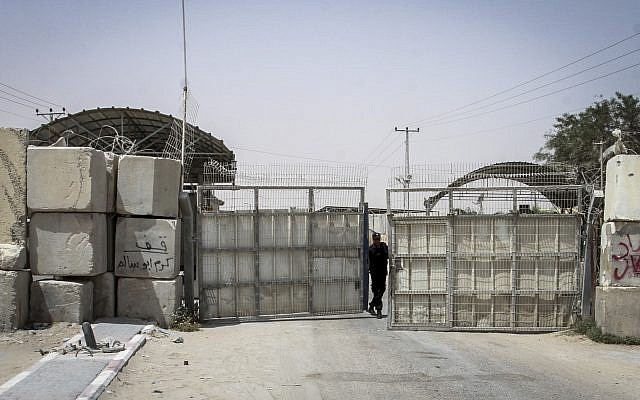
The Kerem Shalom crossing between Israel and the Gaza Strip is seen from the Gaza side of the border on June 7, 2015. (Abed Rahim Khatib/Flash90)
The Hamas terror organization called Israel’s decision to close the Kerem Shalom crossing with Gaza a “crime against humanity” on Monday, hours after Prime Minister Benjamin Netanyahu announced the move to respond to cross border violence.
“Netanyahu’s approval of additional measures to intensify the siege and prevent the entry of materials and goods to Gaza is a new crime against humanity,” Hamas spokesman Fawzi Barhoum said.
Barhoum also accused the international community of being silent on “the crime of the suffocating siege on the Gaza Strip,” and called on it to take “immediate action” to end the blockade of the Strip.
Kerem Shalom, the only cargo crossing between Gaza and Israel, has been subject to a strict blockade by Israel for the past 11 years that is meant to prevent terrorist groups from bringing weapons into the Strip. Egypt also tightly controls the nearby Rafah border crossing into the Sinai.
The Islamic Jihad terror group said the step was a “new declaration of war” and vowed to respond.
“Once again, the government of Zionist terror announces a war on the Palestinian people by intensifying its oppressive siege that has multiplied the suffering of the Palestinian people for more than 11 years,” it said in a statement.
“We are coordinating with the factions and forces to evaluate all developments, including the occupation’s most recent measures, which we are dealing with as a new declaration of war on the Palestinian people,” Islamic Jihad added.
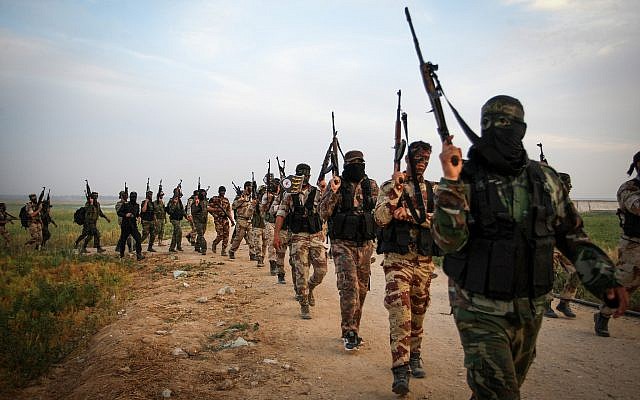
Fighters from the Islamic Jihad terror group march during a military drill near the border with Israel, east of the town of Khan Younis in the southern Gaza Strip, on March 27, 2018. (Abed Rahim Khatib/Flash90)
Earlier, Netanyahu said Israel will be undertaking measures to pressure Hamas, including closing Kerem Shalom, the main commercial passageway between Israel and the coastal enclave.
Defense Minister Avigdor Liberman said he had instructed the military “to take a number of steps” to respond to “Hamas provocations” on the border.
“We are not looking for a confrontation or for a military venture, but in the way Hamas operates, the [situation] deteriorates and [Hamas] is liable to pay the full price, a much heavier price than Operation Protective Edge,” Liberman added, referring to the 2014 war with the terror organization.
Over the past three months, weekly clashes have taken place on the Gaza border, with Israel accusing Hamas of using the demonstrations as cover to carry out attacks and attempt to breach the security fence. The “March of Return” protests have also seen Palestinians fly airborne incendiary devices toward Israeli territory, sparking hundreds of fires in southern Israel and causing millions of shekels in estimated damages.
Immediately after Netanyahu spoke, the Israel Defense Forces confirmed that Kerem Shalom would be closed to all commercial goods into and out of the Gaza Strip.
The army said humanitarian aid, notably food and medicine, would still be allowed into Gaza, but would require special permission from the military liaison to the Palestinians, Maj. Gen. Kamil Abu Rokon.
According to the IDF, the idea of closing Kerem Shalom was proposed by IDF Chief of Staff Gadi Eisenkot and was approved by Netanyahu and Liberman.
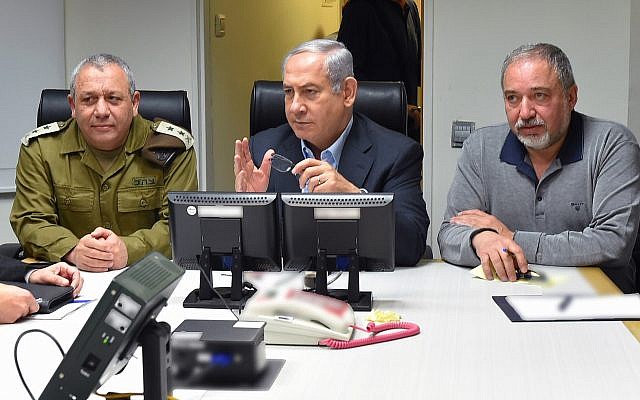
Prime Minister Benjamin Netanyahu, center, is briefed on the escalation on the northern border along with IDF Chief of Staff Gadi Eisenkot, left and Defense Minister Avigdor Liberman, right, on February 10, 2018. (Ariel Hermoni/Defense Ministry)
The military said the closure would continue as long as Palestinians persist in launching incendiary kites and balloons into Israel.
The crossing has been closed a number of times in the past three months, after sustaining damage from fires set by Palestinian protesters.
In addition to closing the crossing, the army said it was prematurely ending the temporary extension to the permitted Gaza fishing zone, which had allowed fisherman to sail up to nine miles from the coast in order to take advantage of the summer fishing season.
Netanyahu’s announcement came after opposition leaders slammed him for what they described as a lackluster response to the border violence and kite fires.
Yesh Atid party leader Yair Lapid told reporters earlier Monday that the prime minister was not doing enough to counter airborne arson attacks.
“For four years, he has done nothing regarding Gaza,” he said. “He knew, we all knew that there would be a new round of violence, but he did nothing. And now the round of violence has come. Our fields are being burned.”
He claimed that Netanyahu is waiting for the Trump administration to present its peace plan and has therefore not acted to stem the arson attacks from Gaza.
Israeli firefighters extinguish a blaze in a field in southern Israel, which was caused by kites flown by Palestinians in the Gaza Strip, on June 20, 2018. (Yonatan Sindel/Flash90)
Zionist Union chairman Avi Gabbay told his faction meeting that in the four years that have passed since the 2014 Gaza war, Netanyahu has “failed to provide security to the people of Israel.”
“It’s clear that Netanyahu is no longer Mr. Security,” he said, referring to a nickname given to the prime minister. “Mr Security would have used the opportunity presented after the war to create a plan, to bring security, to provide us with some forward thinking. Instead: Nothing.”
Raoul Wootliff and Judah Ari Gross contributed to this report.
Photo Credit: The Fisher Institute For Air and Space Strategic Studies
North Korean nuclear warheads
North Korea offered to end its missile sales to Iran and Syria in exchange for a cash payment of $1 billion from Israel back in 1999, according to a report published by The Wall Street Journal, describing information revealed in a new book by a man named Thae Yong Ho, a former North Korean interpreter who defected to South Korea in 2016.
The offer was allegedly made to then-Israeli Ambassador to Sweden Gideon Ben-Ami, by his North Korean counterpart, at a cafe in Stockholm cafe.
Israel reportedly turned down the proposal and instead made a counter offer of food aid in exchange for Pyongyang’s promise to end its missile sales to Israel’s enemies.
North Korea rejected the offer, and has continued to supply nuclear technology, ballistic missiles and other weapons to Iran and Syria ever since.
Ben-Ami confirmed the report, telling Israel’s “Kan” public broadcasting corporation that he and his North Korean counterpart in Sweden, Son Mu Sin, conducted several covert meetings between 1999 and 2002.
Ten North Korean scientists were reportedly killed when Israel destroyed a Syrian nuclear facility that was under construction in September 2007. The plant was reportedly close to completion, and acquiring the ability to produce radioactive materials at the time of the air strike.
European leaders are not only unable to counteract the demographic crisis on the Old Continent, but also lose ground in terms of defense. President Trump’s skepticism and reservation about the military ideas of European bureaucrats Ankara’s increasingly aggressive actions towards Cyprus and Greece, and the rapprochement between Turkey and Russia highlight NATO’s weakness on the eve of its summit in Brussels.
Europe stands no chance if forced to face conflict on three fronts. Two of them are of conventional character: on the eastern flank, where there are continuous tensions with Russia, and in the Balkans near the border with Turkey. The third concerns the Mediterranean area, where young and strong men from Africa and Central Asia cross European borders with the support of a thousand people from the continent’s heartland. Europeans are also militarily involved in Afghanistan, Syria and take part in the growing conflict in Mali.
While Europe is losing its allies, Russia and Turkey are looking for alternative directions of cooperation. Turkey has ceased to be a credible member of NATO, and there are growing fears of the US’s non-engagement in European conflicts. The Gefira team compares the capabilities of the North Atlantic Alliance, without taking into account the American and Turkish armed forces, with those of Moscow and Ankara. The conclusion is clear: the European potential is too weak to deal with any dispute on NATO’s eastern and south-eastern borders.
The comparison shows that European NATO countries spend more than four times on armaments than the Kremlin and Ankara. Despite the fact that the size of the Alliance’s European troops is greater by more than 350,000 people, the advantage of Russian and Turkish ground and air forces is noticeable. NATO’s Navy seems to be stronger, as evidenced by the ratio of nine aircraft carriers to one Russian, but Russia has three times more nuclear submarines. An important element is nuclear equipment: in total, European NATO countries only have 515 nuclear warheads, while Russia has 7,000.
An additional obstacle to the European part of the Alliance is that their troops do not have uniform command. Actions taken by Italy, Poland and Hungary, as well as the euro crisis and migration issues show that Berlin is not able to lead Europe in the face of external threats. France is also trying to take control of European troops, but this has led to the destruction of Libya, while military adventures in Mali are doomed to disaster.
The lack of command procedures without Washington participation is one problem. Logistics is another. Although there are plans to transfer the Alliance forces to the eastern flank, the distance is too large to respond to an unexpected attack. However, given the increasing risk of conflict between Greece and Turkey, NATO countries should reconsider organizational issues that will allow their armies to move more efficiently not only to the east, but also to the south of Europe. Instead of focusing on deterrents, Europe should determine the appropriate logistical procedures that are the basis for a smooth response to an attack on one of the Alliance members.
Although NATO troops are more numerous than Russian and Turkish, even if Article 5 has come into force, no country will sacrifice all of its armed forces. The North Atlantic Treaty gives freedom to members in choosing the means and methods of military defense of a NATO member. Even if each state allocates 10-20% of its soldiers and military equipment (which we consider as a limit anyway), it will not be able to oppose Russian or Turkish troops.
Drawing on the Global Firepower ranking, in the table below, we have compiled the data related to the number of military personnel and items of equipment for three types of armed forces as well as NATO’s and Russia’s budget expenditures.1)Numbers apart, also technological issues are important i.e. a state’s ability to modernize its military equipment. The Turkish and Russian weapons are regularly tested in operations in the Middle East, which makes it possible to improve them. Most European armies use their equipment only on the training ground and during maneuvers.
First border: USA and Europe
Diplomats admit it openly: Transatlantic relations have been deteriorating for years.2)Washington is less willing to finance European defense, which is not to the liking of European decision makers who have become accustomed to the United States’ sponsorship to such an extent that many countries are not increasing defense spending to reach the agreed 2% of GDP in 2024. Washington spends USD 647 billion a year on defense, while the military expenditures of other NATO states amount to USD 268 billion. The American president announces that he he is sick and tired of funding European defense.3)On the other hand, European leaders state that this new American doctrine “has no friends but enemies.”4)The rejection of the climate change conference provisions by the United States as well as Washington’s withdrawal from the nuclear agreement with Iran, resulting in the re-imposition of sanctions on Tehran, is a bone of contention that brought about a rise in oil prices by hitting importers of this raw material, including Europe.
The trade war waged between the EU and the United States negatively affects transatlantic relations as demonstrated by the recent G7 summit. In addition, Washington is skeptical about European defense plans related to the creation of the European Intervention Initiative, stating that they undermine current forms of cooperation.5)The growing tension between Europe and the United States may have its apogee at the July NATO summit, when the United States, in order to show the weakness of European allies, may decide to limit its military presence on the Old Continent, and possibly leave the organization altogether. It is important that a few days after the meeting of the Alliance leaders, a meeting of President Putin and President Trump will take place in Helsinki. It is also worth adding that Ukrainian President Petro Poroshenko (Ukraine is not a NATO memeber) will take part in the July NATO summit in Brussels. spreading the Alliance’s influence to the East may elicit Moscow’s decisive response.
The second border: NATO and Turkey
Europe is openly pointing to Russia as an enemy that could intensify operations in eastern Ukraine or open a new front in the Baltics or Transnistria.6)7)However, while the war with Russia in our view is rather less likely, the second – more realistic – place of conflict is the Balkans and Asia Minor. Ankara raises territorial claims against Nicosia and Athens. It can be exemplified by the border violation of Greek air zone by Turkish fighters,8)or even the Turkish blockade of European ships exploring gas fields in the economic zones of Cyprus.9)The annexation of Cyprus by Turkey and the attack on Greece (which is also a NATO member) would launch Article 5 of the North Atlantic Treaty.
Turkey and the other NATO members have diverging interests. An example of this is the “Olive Branch” launched at the beginning of this year against the US-equipped People’s Protection Units (YPG), which is the largest Kurdish militia in Syria.10)This causes Ankara to be marginalized by the North Atlantic allies, which Gefira’s team had previously signaled.11)In the current situation, Turkey is not an actual member of the Alliance. Erdoğan’s victory and the strengthening of his position under the presidential system will result in Turkey’s greater activity, and the confrontation between Europe and Ankara, whether it concerns Cyprus or the Greek islands in the Aegean Sea, has become very likely.
Europe distances itself from its military allies. Australia, Canada or Japan, potential partners of the Old Continent, do not see any special interest in engaging their own troops in possible disputes in this area. While European policy-makers lose their allies, Moscow and Ankara are trying to create bilateral and multilateral forms of military cooperation. The Old Continent is unable to cope with the escalation of the aforementioned conflicts, without the support of the United States and Turkey. The North Atlantic Pact depleted by two members is losing importance, and the diverging interests of NATO countries deepen existing divisions. Considering the above list of hypothetical events, it should be noted that the Alliance, contrary to the opinion of many analysts and the mainstream media citing them, cannot be perceived as a permanent military arrangement.
Historians have concluded that history is cyclic unless one learns from its mistakes; we will be doomed to endure an endless repetition of the cause and effects of poor management systems. French author Charles Pinot Duclos observed:
“We see on the theater of the world a certain number of scenes which succeed each other in endless repetition: where we see the same faults followed regularly by the same misfortunes, we may reasonably think that if we could have known the first we might have avoided the others. The past should enlighten us on the future.”
The People’s Mujahedeen of Iran, commonly known as the Mujahedeen-e-Khalq or MEK, is a notorious Iranian resistance group; it was once listed as a Foreign Terrorist Organization (FTO) by the United States for its alleged killing of U.S. personnel in Iran during the 1970s, and for its ties to former Iraqi leader Saddam Hussein. This group receives funds from many sources, including Saudi Arabia.
MEK also began a multiyear, multimillion-dollar lobbying campaign to remove itself from the terrorist list, including possible financial rewards to American political figures including Rudy Giuliani, Newt Gingrich, Howard Dean, MG Paul E. Vallely, John Bolton and others.
Recognizing the group’s rejection of violence, the State Department delisted the MEK in late 2012, but voiced ongoing concerns about its alleged mistreatment of its members.
Many of these former high-ranking US officials – who represent the full political spectrum – have been paid tens of thousands of dollars to speak in support of the National Council of Resistance of Iran (NCRI) or MEK. Ironically, these heavyweight politicians never talk about MEK’s violent and anti-American past history, but they refer to them as “freedom fighters” with “values just like us,” as democrats-in-waiting ready to serve as a vanguard of regime change in Iran. Why?
Aside from monetary rewards, some argue that the MEK has provided invaluable information to the US about the Iranian nuclear sites. OK, great! But does this automatically make them freedom fighters, ready to switch places with current mass murderers who have been holding onto power with their fists? Hardly!! Exchanging one Islamist group with another is not a change at all: it’s lunacy!
The amount of the fees being paid to these officials is vague, but judging by the money handed to certain individuals, the total could well be in the millions. For example, the former governor of Pennsylvania, Edward G. Rendell, was allegedly paid $150,000 for seven or eight speeches. Elaine Chao, President Trump’s transportation secretary, received $50,000 in 2015 for a five-minute speech, according to reports. Giuliani, who spoke at a conference in Paris on behalf of Iranian resistance figures alongside 18 other international guests, has been known to charge up to $100,000 for a single appearance, and sometimes demands private jets to charter him to appearances and much more.
MEK Supporters
Generals Tom McInerney and Paul Valley, former CIA officer Clare Lopez, former U.S. ambassador to Saudi Arabia Jim Atkins, Representative Ileana Ros Lehtinen, former Governor of Kansas Sam Brownback, former Congressman Bob Filner, former Congressmen Tom Tancredo, former Senators Jim Talent and Kay Bailey Hutchinson, former Congressman Patrick J. Kennedy, who on this video is confessing to getting paid, scholar Daniel Pipes, John Bolton, the current advisor to President Trump, John Dean, Victoria Toensing of DiGenova & Toensing, retired general Wesley Clark, and even AIPAC have also supported the group. Several of the aforementioned officials have been the recipients of lucrative speaking fees. Saudi Arabia has been on the forefront, supplying the MEK with limitless financial resources in an attempt to topple the Iranian regime.
MEK Opponents
Scholar Michael Ledeen, bestselling author and Iran expert Ken Timmerman, CSP founder and CEO Frank Gaffney, Iranian activist Manda Ervin, and the entire Iranian people.
Perhaps money is the explanation. Otherwise, Giuliani’s relationship with the MEK, a bizarre terrorist organization that has killed Americans, is inexplicable.
“Iranians are both bitter about American pressure and their own government,” said Suzanne Maloney of the Brookings Institution, who added, however, that, “one way or another the regime will try to discredit and taint those who dissent as somehow driven by outside support or orchestration.”
Karim Sadjadpour, an expert on Iran at the Carnegie Endowment for International Peace, said: “They’re widely viewed as a backward and intolerant cult by their opposition peers in Iran,” he said. “After the terrorist label is dropped, Mr. Sadjadpour said, “I don’t think the world really looks that much different. U.S.-Iran relations will remain hostile, and the M.E.K. will remain a fringe cult with very limited appeal among Iranians.”
Like a chameleon, the MEK has adopted a new name to fool gullible and greedy politicians. But a cult can’t change its spots. They can’t even bring themselves to admit their founder (Masoud Rajavi) is dead. For now, they are enjoying support from the usual suspects — the Arab “royal” petro states, some elements in Israel, of American and European politicians who would do anything for a financial reward.
American establishment figures who support the cult of Rajavi will have lot of explaining to do someday. Ignoring the lessons of history will ultimately backfire on them. No wonder why people around the world are suspicious when it comes to American foreign policy.
The MEK is almost universally denounced by Iranians around the world, and still are regarded as a terrorist group. After the MEK aided in the Islamic Revolution in 1979, bloody street battles took place against Iran’s eventual leadership. As a result, the MEK literally waged war against Iranians. The group took refuge in Ashraf, Iraq, where they aided Saddam Hussein in the Iran-Iraq War. Saddam Hussein went on to employ this special brigade in his deadly operations against Kurds and in repressing the Iraqi Shia.
Conclusion
Sel-serving politicians upporting the MEK, this most dangerous terrorist group, is tantamount to betraying the ideals of America — the flag holder of freedom in the world. The motives for the strange bedfellows rallying in support of the MEK are difficult to decipher, given the overwhelming evidence exposing the evils of this gang of Islamist cultists. The politicians supporting this cult better be warned. Whatever their motives, they are repeating President Jimmy Carter’s monumental folly that brought the infamous Ayatollah Khomeini to power and birthed Islamist jihadism of both Shite and Sunni varieties.
This time around, these misguided and/or deluded hired individuals circling Madam Rajavi will most assuredly be disgraced and disappointed. The Iranian people shall, for a certainty, frustrate and defeat the cultist schemers and their cohorts. The Iranian people have suffered for four decades under the yoke of Islamic tyranny and will in no way allow its replacement by a refurbished edition blessed by mercenary politicians.
In this case, history shall not repeat itself. Freedom shall prevail.
This brings the death toll of Christians to more than 6,000 since the start of 2018.
“The Islamists of northern Nigeria seem determined to turn Nigeria into an Islamic Sultanate and replace Liberal Democracy with Sharia as the National Ideology. The object of course, is to supplant the Constitution with Sharia as the source of legislation.” — National Christian Elders Forum, a wing of the Christian Association of Nigeria.
The Nigerian government and the international community, however, have from the start done little to address the situation. This lack of participation is not surprising: they cannot even acknowledge its roots, namely, the intolerant ideology of jihad.
In what the Christian Association of Nigeria is calling a “pure genocide,” 238 more Christians were killed and churches desecrated by Muslims last week in the west African nation. This brings the death toll of Christians to more than 6,000 since the start of 2018.
According to a joint statement by the Christian Association, an umbrella group of various Christian denominations, “There is no doubt that the sole purpose of these attacks is aimed at ethnic cleansing, land grabbing and forceful ejection of the Christian natives from their ancestral land and heritage.”
The statement condemned the recent attacks, “where over 200 persons were brutally killed and our churches destroyed without any intervention from security agencies in spite of several distress calls made to them.”
The statement adds that the majority of those 6,000 Christians massacred this year were “mostly children, women and the aged… What is happening in … Nigeria is pure genocide and must be stopped immediately.”
The details of the murder of these thousands, though seldom reported, are often grisly; many were either hacked to death or beheaded with machetes; others were burned alive (including inside locked churches or homes); and women are often sexually assaulted or raped before being slaughtered.
Both the Nigerian government and the U.S. government have long sought to present this protracted jihad as territorial clashes between the haves (apparently always Christians) and haves-not (apparently always Muslims).
In 2012, for instance, President Bill Clinton said that “inequality” and “poverty” are “what’s fueling all this stuff” (the “stuff” being a reference to the ongoing Muslim slaughter of Christians in Nigeria). Former U.S. Assistant Secretary of State for African Affairs, Johnnie Carson, said after an Easter Day bombing in 2012 of a Nigerian church left 39 worshippers dead, “I want to take this opportunity to stress one key point and that is that religion is not driving extremist violence”. The Obama administration reportedly agreed to spend $600 million in a USAID initiative launched to ascertain the “true causes” of unrest and violence in Nigeria — which naturally lay in the socio-economic, supposedly never the religious, realm.
In its recent statement, however, the Christian Association of Nigeria denied these claims. After saying that those responsible for slaughtering Christians are always allowed to “go scot free” by the Nigerian government—which further portrays the attacks as “farmers/herdsmen clashes”—it inquired:
“How can it be a clash when one group [Muslims] is persistently attacking, killing, maiming, [and] destroying, and the other group [Christians] is persistently being killed, maimed and their places of worship destroyed? How can it be a clash when the herdsmen are hunting farmers in their own villages/communities and farmers are running for their lives?”
On May 2, the National Christian Elders Forum — a wing of the Christian Association, the members of which average the age of 75 and come from Nigeria’s six geopolitical zones — met with the British High Commission in an effort to receive support. (Days before the meeting, around 30 Muslim herdsmen had stormed a church during early morning Mass and murdered nearly 20 parishioners and two clergymen.) The group’s executive summary of issues included:
It is clear to the Christian Elders that JIHAD has been launched in Nigeria by the Islamists of northern Nigeria led by the Fulani ethnic group [the “herdsmen”]. This Jihad is based on the Doctrine of Hate taught in Mosques and Islamic Madrasas in northern Nigeria as well as the supremacist ideology of the Fulani. Using both conventional (violent) Jihad, and stealth (civilization) Jihad, the Islamists of northern Nigeria seem determined to turn Nigeria into an Islamic Sultanate and replace Liberal Democracy with Sharia as the National Ideology. The object of course, is to supplant the Constitution with Sharia as the source of legislation. The current 1999 Constitution is plagued with dual conflicting ideology of Democracy and Sharia. There are certain values which are non-negotiable in a pluralistic society and it seems the advocates of the Caliphate do not respect this. A dual-ideology-driven Nigeria cannot be the Nigeria of our dream. We want a Nigeria, where citizens are treated equally before the law at all levels…. Bearing in mind that Christians constitute over 50% of the Nigerian population, the goal of the Islamists is bound to create serious conflicts which if not checked is capable of escalating into another civil war. Already, the Islamists are murdering Christians with impunity and destroying vulnerable Christian places of worship and communities at an alarming and inhuman rate.
That 6,000 Christians, “mostly children, women and the aged,” have been butchered in just the first six months of this year is a reminder of how violence only escalates when left unchecked. That is the story of the Muslim persecution of Christians in Nigeria.
It took three times as long (a year-and-a-half, between December 2013 to July 2015), for example, for the same Muslim herdsmen to slaughter a total of 1,484 Christians (532 men, 507 women, and 445 children), critically wound 2,388 Christians (1,069 men, 817 women, and 502 children), and burn or destroy 171 churches.
The Nigerian government and the international community, however, have from the start done little to address the situation. This lack of participation is not surprising: they cannot even acknowledge its roots, namely, the intolerant ideology of jihad. As a result, the death toll of Christians has only risen — and will likely continue to grow exponentially — until such time that this reality is not only acknowledged but addressed.
The governor of Nigeria’s Anambra State, Willie Obiano (center), visits a wounded survivor of a deadly attack on St. Philip Catholic Church in Ozubulu, August 11, 2017. (Image source: Channels TV video screenshot)
Syria’s T-4 air base, home to Iranian military personnel, was attacked late Sunday night in a repeat air strike, allegedly by Israeli warplanes, according to a Syrian military source who spoke with Al Masdar News.
The Israeli fighter pilot who reportedly carried out the strike succeeded in hitting the target despite having to dodge several S-200 air defense missiles fired by the Syrian military.
No further details were made available.
The Israel Air Force attacked the T-4 (Tiyas) air base this past April, destroying a military drone center that had sent a military attack drone packed with explosives into Israeli territory. At least seven Iranian Revolutionary Guard Corps soldiers and seven Syrian Arab Army (SAA) soldiers were killed in that attack.
The air strike followed a fierce exchange in which an Israel Air Force F-16 was hit by a Syrian anti-Aircraft S-300 missile and crashed in Israeli territory during a retaliatory attack that followed the entry of the Iranian drone into Israeli airspace. Both the pilot, who was seriously injured, and the navigator ejected and taken to Maimonides Medical Center in Haifa. Both survived and eventually returned to service.
The IAF launched two more waves of attack on Iranian and Syrian anti-aircraft missile sites, in what the commander, Brigadier General Tomer Bar, described as “a complete operational success, including the thwarting of the UAV, attacking the sources of the fire, and in a subsequent response.”
Israel has made it clear that it is determined to continue undermining Iranian efforts to entrench itself militarily in Syria and will do whatever it takes to stop the transfer of game-changing weapons to Hezbollah.
Prime Minister Benjamin Netanyahu will meet this week with Russia’s President Vladimir Putin and on the agenda will be — again — the issue of eliminating Iran’s presence in Syria.
“The IDF is prepared for several scenarios and ready to defend the citizens of the State of Israel and its sovereignty” the IDF Spokesperson’s Unit said.
Antiroket Israel, Iron Dome, meluncurkan amunisi pencegat roket-roket Hamas, 16 November 2012. Photo: Reuters/Amir Cohen
The IDF deployed several Iron Dome batteries in southern Israel Thursday following a situational assessment, the military told The Jerusalem Post.
“The IDF is prepared for several scenarios and ready to defend the citizens of the State of Israel and its sovereignty,” the IDF Spokesperson’s Unit said.
On Thursday, an IDF drone fired “a missile at a motorcycle” east of Deir al-Balah in the central Gaza Strip, official Palestinian news agency Wafa reported, adding that while there were no injuries the motorcycle was destroyed.
The IDF has been carrying out strikes in the Gaza Strip against vehicles used by terrorist cells who launch incendiary aerial devices into Israel. The Hamas terrorist group in turn has launched mortar shells towards southern Israeli communities.
On June 20, Hamas, along with Islamic Jihad, launched a barrage of 45 mortars shortly after IAF jets struck three targets in the Strip in response to incendiary kites and explosive balloons launched towards southern Israel.
Seven of the projectiles were intercepted by the Iron Dome missile defense system and another three fell inside the Strip. Four were found inside communities in the Eshkol Regional Council, causing damage to nearby homes and cars. One landed in the yard of an empty kindergarten.
A week later, at least 13 mortars were fired from the Gaza Strip after the IAF struck a vehicle said to have been heavily involved helping in Palestinians in launching incendiary devices into Israel. Two of the mortar shells were intercepted by the Iron Dome system over the city of Sderot.
Earlier on Thursday, the Defense Ministry announced that it had successfully conducted a planned missile test launch of the Iron Dome system from the Palmachim air base.
According to a statement released by the Ministry of Defense, the series of experiments were led by Rafael, the main contractor of the Iron Dome system, along with Elta and with the participation of the Israel Air Force and Navy.
During the test the various types of targets which simulate the emerging threats developing in the area were launched.
“Homa [missile defense] will continue to develop the Iron Dome system in order to deal with the emerging threats in the arena in order to best protect the State of Israel,” read the statement.
Israel continuously improves the technology behind the country’s anti-missile systems and last year the Defense Ministry carried out a number of experiments using American- made components in the course of the missile interception tests for the first time.
The experiments, which were conducted in the south of the country, focused on the use of the “Tamir” interceptor and it’s ability to intercept a number of targets which were fired simultaneously at different ranges.
The Rafael-built system carries 24 pounds of explosives and can intercept an incoming projectile from four to 70 kilometers away and Israel Aerospace Industries Ltd. which produces the radar system for the Iron Dome system through its ELTA division, has reported sales of it to various armies around the world.
Israel’s air defenses currently include the Iron Dome, designed to shoot down short-range rockets and the Arrow system which intercepts ballistic missiles outside of the Earth’s atmosphere. The David’s Sling missile defense system is designed to intercept tactical ballistic missiles, medium- to long-range rockets, as well as cruise missiles fired at ranges between 40 to 300km.
Iranian military officials are threatening to enact a naval blockade in the Strait of Hormuz, a key shipping lane for oil in the Persian Gulf, if the United States follows through with efforts to block all of Iran’s oil exports under a rash of new economic sanctions on the Islamic Republic, according to regional reports.
Ali Jafari, commander of Iran’s Revolutionary Guard Corps, or IRGC, warned the Trump administration to not “make any stupid move to halt Iran’s oil export,” vowing that if the U.S. administration follows through with this threat, Iranian forces will shut down the Strait of Hormuz for all nations, a move that could cripple the regional flow of crude oil products.
“We stand ready to put in action President Hassan Rouhani’s latest position that if Tehran were not able to export its crude oil through the Strait of Hormuz, no other country would be able to do so,” Jafari was quoted as saying in Iran’s state-controlled press.
The plan to shut down the critical shipping lane is said to be endorsed by Iranian President Hassan Rouhani, who, along with other top Iranian officials, has been working on contingency plans to combat U.S. economic sanctions on Tehran following President Donald Trump’s decision to walk away from the nuclear agreement.
Meanwhile, Iran’s representative to the Organization of Petroleum Exporting Countries, or OPEC, blamed Trump for rising oil prices, claiming that the president’s rhetoric could force oil prices to rise to $100 per barrel.
”It’s beyond comprehension that the European Union, including the British Government are prepared to open up lending again to Iran, especially as we know that their nuclear ambitions are far from over. The Trump Administration will take a very dim view of this.” Yes, that is true. But in Britain they’re too busy readying a snarling Trump blimp to fly over London while the President is visiting to think about trivial matters such as funding Iran’s nuclear program and violent repression of its own people. The European Commission and the Theresa May government in Britain deserve the condemnation of all free people for this, and if the Iranian mullahs succeed in firing off nuclear weapons, the blood will be on their hands.
“‘Beyond comprehension’ that European Commission wants EIB to lend money to US-sanctioned Iran – Nigel Farage,” UKIP Press release, July 4, 2018:
The European Commission has called for the European Investment Bank to fund US-sanctioned Iran and is supported in this by the British Government. Because all international loans are denominated in US dollars, it would mean the EIB could be shut out of the lending market and pushed into default.
The European Parliament today heavily rejected an UKIP objection to a delegated act from the European Commission allowing the EIB to lend money to Iran.
At an EP Budget Committee 28th May 2018, the EIB rep (quotes below) says raising funding on the international market was a life and death issue for the EIB. And if the EIB lent money as the European Commission wants, to Iran, the EIB would be shut out of the dollar market and effectively pushed into default.
The UK representation in Brussels has clarified that the British government has supported the European Commission in calling for the EIB to lend money to Iran.
UKIP MEP Nigel Farage said:
”It’s beyond comprehension that the European Union, including the British Government are prepared to open up lending again to Iran, especially as we know that their nuclear ambitions are far from over.
The Trump Administration will take a very dim view of this.“
Unless objected to by Council or European Parliament, the delegated act proposal will be adopted by Commission on 6th August 2018….
Please take a moment to consider this. Now, more than ever, people are reading Geller Report for news they won’t get anywhere else. But advertising revenues have all but disappeared. Google Adsense is the online advertising monopoly and they have banned us. Social media giants like Facebook and Twitter have blocked and shadow-banned our accounts. But we won’t put up a paywall. Because never has the free world needed independent journalism more.
Everyone who reads our reporting knows the Geller Report covers the news the media won’t. We cannot do our-ground-breaking without your support. We must continue to report on the global jihad and the left’s war on freedom. Our readers’ contributions make that possible.
Geller Report’s independent, investigative journalism takes a lot of time, money and hard work to produce. But we do it because we believe our work is critical in the fight for freedom and because it is your fight, too.
Please contribute to our ground-breaking work here.


 The governor of Nigeria’s Anambra State, Willie Obiano (center), visits a wounded survivor of a deadly attack on St. Philip Catholic Church in Ozubulu, August 11, 2017. (Image source: Channels TV video screenshot)






 anneinpt
 artaxes
 danmillerinpanama
 davidking1530
 Peter Hofman
 Joseph Wouk
 Peter
Peter Louisiana Steve
 WarSclerotic
Recent Comments