Author Archive

Ismail Haniyah: More escalation unless siege on Gaza is lifted

July 15, 2018

Hours after a ceasefire between Hamas and Israel was announced, the leader of Hamas spoke at the funeral of two Palestinians killed in an IDF strike and vowed to continue the ‘resistance’ until the siege on Gaza is lifted; ‘We will not give up on returning to all the land of Palestine’; Meanwhile, IAF aircraft attacks an incendiary balloons unit in the strip.

Yoav Zitun, Elior Levy, Matan Tzuri|Published:  07.15.18 , 13:42

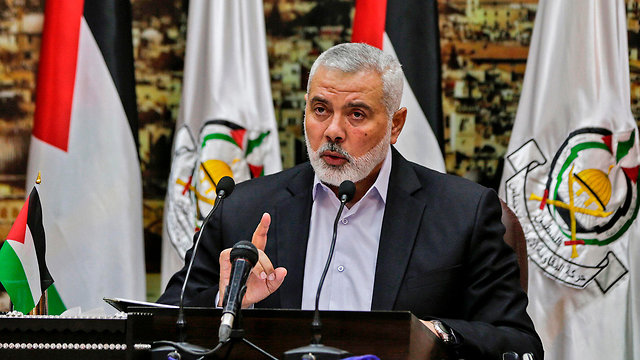
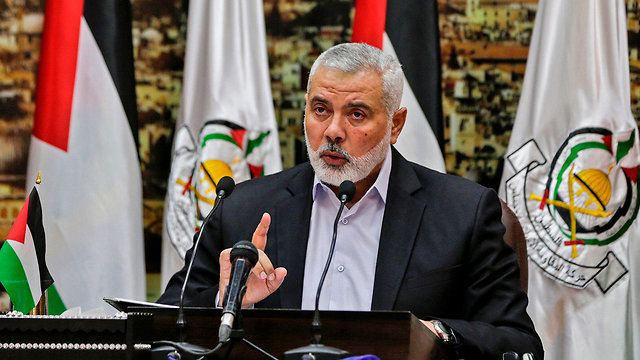
Ismail Haniyah (Photo: AFP)

Hamas leader Ismail Haniyah spoke on Sunday at the funeral of the two teenagers killed in yesterday’s IDF airstrike in Gaza and warned Israel of further escalation unless the siege on the strip is lifted.

“We are on the road to victory, the issue of Palestine, Jerusalem and Gaza is still on the top of our agenda. The solution to the situation in Gaza is to lift the siege. The Palestinian people do not believe in promises about projects. The people want to see real results that will bring an end to this siege.

“The weekly marches will continue until we’ve reached all of our goals, first and foremost: lifting the siege on Gaza. We’ll continue to march until the right of return is realized. We will not give up on returning to all the land of Palestine,” raged Haniyah.

Ismail Haniyah (Photo: AFP)

Ismail Haniyah (Photo: AFP)

Haniyah also said that the factions in the strip are those who had the last world when it came to ending the latest escalation.

“Our enemy, which aspires to impose equations of the rules of confrontation, has encountered resistance. We say to everyone that the marches that have put our issue on the map will only become more intense. The assassinations, carried out by your warplanes, will not happen again. These equations will not work again. Many elements were involved in mediating the ceasefire, but it was the word of the resistance that was the loudest,” he vented. Earlier in the day, several fires have broken out in the Gaza border region due to incendiary balloons being flown from the strip into Israel, only hours after a source told Ynet that the phenomenon of incendiary kites and balloons will stop gradually.

One of the fires ignited a hummus field in the Sdot Negev Regional Council. The fires have been extinguished.

In response the IDF attacked three Hamas units in northern Gaza responsible for launching of the incendiary devices into the Israeli territory.

First published: 07.15.18, 13:42

German intel report: Iran seeks to shatter states’ stability with WMD

July 15, 2018

Iran and North Korea aim to circumvent embargoes

By Benjamin Weinthal
July 15, 2018 15:11
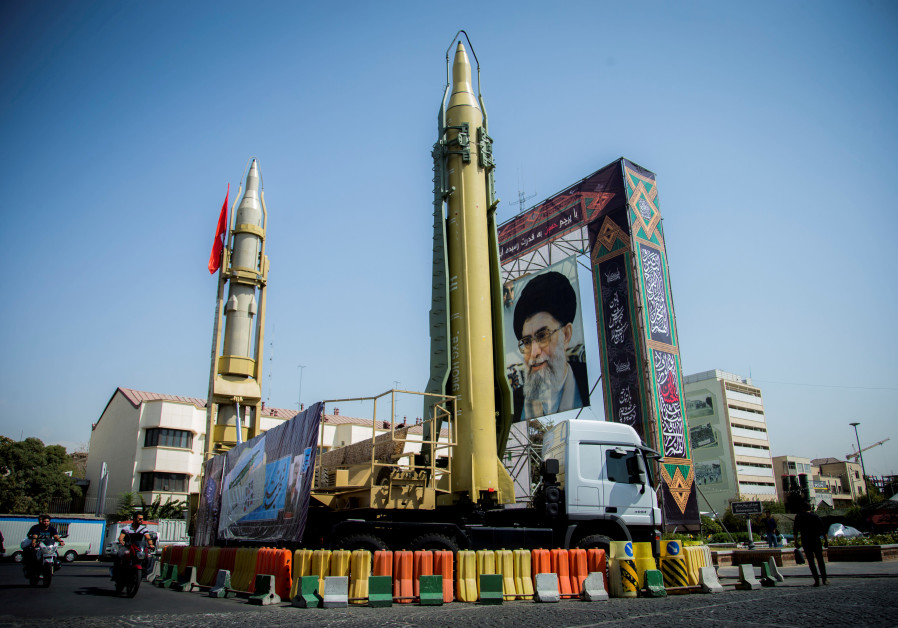
Missiles and a portrait of Iran’s Supreme Leader Ayatollah Ali Khamenei in Baharestan Square in Tehran, Iran. (photo credit: NAZANIN TABATABAEE YAZDI/ TIMA VIA REUTERS)

The German intelligence agency of the state of Hesse published a new document on countering the spread of weapons of mass destruction, singling out the Islamic Republic of Iran as one of two states seeking to obtain the ultimate form of powerful weapons.

The Jerusalem Post reviewed the late June document that states: “Weapons of mass destruction are a continued instrument of power politics that also, in regional and international crises situations, can shatter the entire stability of state structures. States like Iran and North Korea attempt, in the context of proliferation, to acquire and spread such weapons by, for example, disguising the transportation ways through third countries.”

The report said that the goal of the intelligence agencies of Iran and North Korea is “to circumvent control mechanisms in countries that are not especially subject to embargo restrictions.”

According to the Hesse report, proliferation is defined as “the production and spreading of weapons of mass destruction” and “the acquisition of compatible missile carrying systems and technology by states for which these weapons were not previously available.”

The intelligence agency explained that the “goal of counter-intelligence is to prevent” countries like Iran and North Korea, who seek weapons of mass destruction.

The report listed some types of illegal proliferation technology that countries want for the production of weapons of mass destruction. The examples include “equipment for the enrichment of uranium, nuclear reactors in connection with reprocessing plants, bioreactors, drying installation facilities, and the production process for precursor chemical  products.”

As a general rule, the intelligence agency noted, countries do not obtain completed weapons of mass destruction, rather secure “individual components, equipment, technologies and their products.”

German regional domestic intelligence agencies like the Hesse organization are the rough equivalent of the Shin Bet (Israel Security Agency).

The state of Hesse has not yet published its intelligence report covering the year of 2017. Germany’s 16 states each publish intelligence reports covering threats to the constitutional, democratic system. The federal government publishes a nation-wide report that covers more broad terms, such as threats like radical Islam, weapons proliferation and right-wing and left-wing extremism.

The 2017 national report ignored the North Rhine-Westphalia intelligence report that said Iran sought to obtain illicit technology that could be used for military nuclear and ballistic missile programs. In North Rhine-Westphalia, Iran’s regime made “32 procurement attempts… that definitely or with high likelihood were undertaken for the benefit of proliferation programs,” the state’s intelligence agency wrote last year.

German state reports frequently list more concrete data on Iran’s illicit nuclear, missile and espionage activities in the federal republic than the national intelligence report.

Take the examples of the southern German states of Baden-Württemberg and Bavaria:  The Post reported in early June that the intelligence agency of Baden-Württemberg wrote in its report: “Iran continued to undertake, as did Pakistan and Syria, efforts to obtain goods and know-how to be used for the development of weapons of mass destruction and to optimize corresponding missile-delivery systems.”

Bavaria’s intelligence agency noted in its April report: “Iran, North Korea, Syria and Pakistan are making efforts to expand their conventional weapons arsenal through the production of weapons of mass destruction.”

German Chancellor Angela Merkel and Foreign Minister Heiko Maas are both energetic supporters of the 2015 Iran nuclear deal that aims to curb Tehran’s drive to become an atomic weapons power.

Neither Merkel nor Maas has commented on the state intelligence agency reports that documented Iran’s illegal proliferation activities in 2017 in Baden-Württemberg and Bavaria.

Israel has Iran on the brain, and all the kites in Gaza won’t change that

July 15, 2018

Realpolitik dictates that threats from Syria trump Hamas, leaving Israelis and Palestinians on both sides of the border little hope for change beyond the cycles of flareups

Today, 2:28 pm

https://www.timesofisrael.com/israel-has-iran-on-the-brain-and-all-the-kites-in-gaza-wont-change-that/

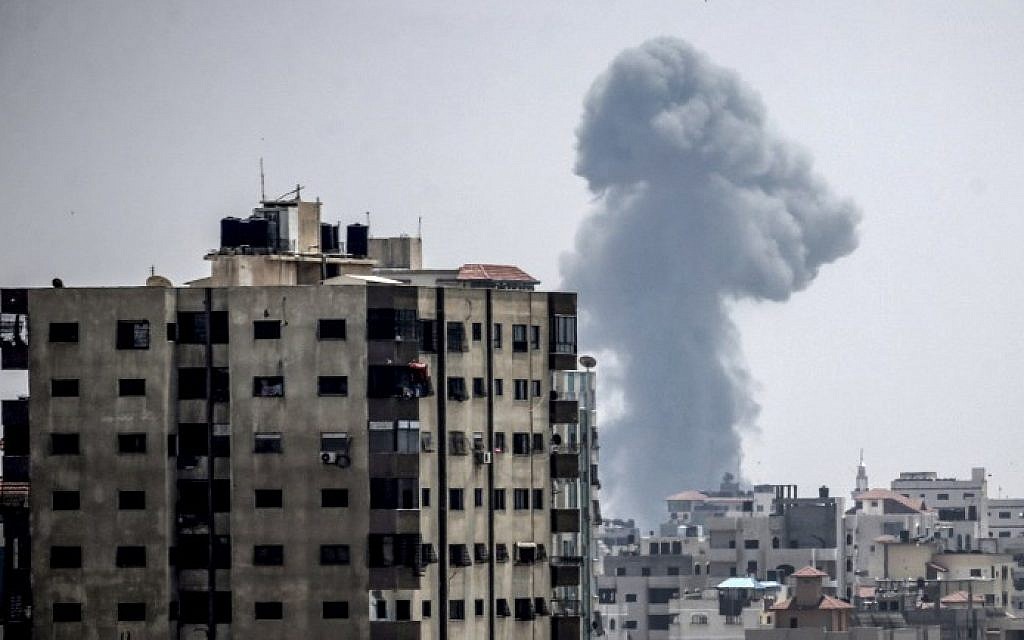
A picture taken on July 14, 2018, shows a smoke plume rising following an Israeli air strike in Gaza City (AFP PHOTO / MAHMUD HAMS)

There’s a popular saying in Arabic that roughly translates to “I came the way I left.” In other words, there was a lot of fuss, but no progress has been made. It’s a sentiment familiar to anyone watching the Gaza border’s seemingly endless cycles of violence.

It is likely too early to summarize what happened in and around Gaza over the last 48 hours, but there is a feeling that the latest bout of violence — the most serious confrontation between Israel and Hamas since the 2014 war — was unnecessary and unproductive, and left the situation in the Palestinian territory unchanged.

Early Sunday, several mortar shells were fired at Gaza-adjacent Israeli communities, apparently remnants of the violence a day earlier. Technically, this latest bout of violence, starting with Israeli airstrikes late Friday night, was a direct response to a violent riot along the Gaza border earlier in the day in which an IDF soldier was injured by a grenade thrown by a Palestinian.

But in practice, the IDF bombardment was an opportunity for Israel to destroy Hamas’s cross border tunnels it has long known about, and an effort to change the status quo with the Strip’s rulers regarding the increasing arson balloon and kite attacks.

There were those in Israel and in the IDF who believed that bombing empty Hamas facilities would cause the organization to panic and order its members to stop flying incendiary devices over the border that have burned thousands of acres of forests and agricultural fields in recent months. In addition, Israel hoped the strikes would appease residents of southern Israel and right-wing politicians who have been demanding a heavier response to the increasing arson attacks.

It’s doubtful the arson kite phenomenon will be stemmed, and thus the demands for action will only intensify.

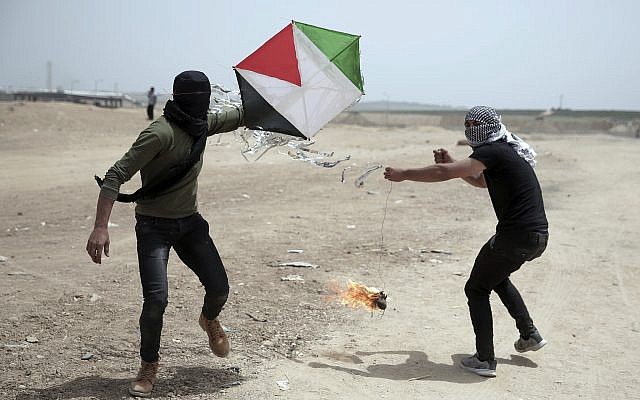
Palestinian protesters fly a kite with a burning rag dangling from its tail to during a protest at the Gaza Strip’s border with Israel, April 20, 2018. (AP Photo/ Khalil Hamra)

Hamas was less than enthusiastic about the Egyptian-brokered ceasefire deal reached on Saturday. When it was informed the deal was going into effect, the terror group launched dozens of rockets at Israeli communities on the other side of the border to register its discontent without completely refusing to accept it.

And again, a few hours into the ceasefire, Hamas sources leaked that Egypt was pressuring the group to stop launching rockets and adhere to the ceasefire.

But it seems that both sides hoped that Egypt could successfully broker a truce to end the violence.

And everyone knows — Israel, Hamas and Egypt — that the next round of fighting is on the horizon, and that the reality in Gaza is unlikely to change significantly in the wake of the weekend violence.

The Israeli politicians who are quick to announce the government must not tolerate the ongoing “kite terrorism” are not telling the public the truth.

Firstly, the kites are not the most urgent security threat facing Israel but more like third or fourth down that list. Gaza has been downgraded, and is now regarded to be a less critical threat to Israel than the one posed by the Iranian military along the northern border in the sunset of the Syrian war.

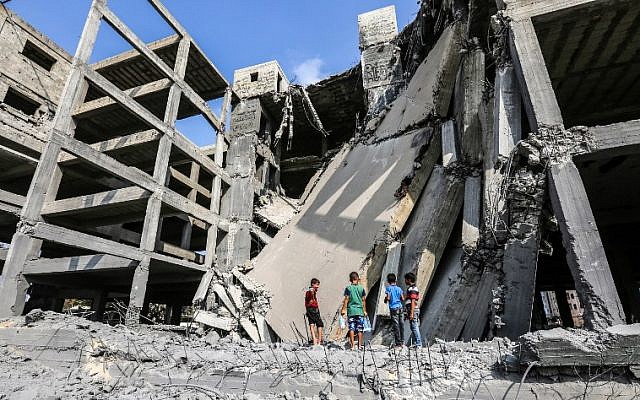
Palestinian boys walk through the wreckage of a building that was damaged by Israeli air strikes in Gaza City on July 15, 2018. (AFP / MAHMUD HAMS)

Israel sees getting dragged into a complicated war in Gaza over incendiary kites as unnecessary for the IDF while a much more critical campaign is being waged in Syria over Iran.

So long as Iran is trying to entrench itself near the Golan border, its doubtful the reality for the Israeli residents living near the Gaza border — where kites are sparking multiple fires every day — will radically change in the near future.

Secondly, Israel — though politicians from Prime Minister Benjamin Netanyahu’s government generally refrain from saying this in public — wants to ensure the survival of Hamas in Gaza. Not out of affection for the organization, but because the alternatives to that terrorist group ruling the Strip is either complete chaos or Israel re-occupying Gaza and ruling over its 2 million residents.

This is the consideration behind Israel’s cautious policy regarding Gaza. A bout of violence, incendiary kites and demonstrations along the border is considered to be “tolerable” and does not warrant an all-out war that could force Israel to deal with far more difficult decisions than it is already facing.


Intelligence Report: Israel needs Trump and Putin in Syria

July 15, 2018

Netanyahu seeks support from Trump and Putin as Israel’s ‘free hand’ in Syria approaches its end.

By Yossi Melman
July 15, 2018 04:20
https://www.jpost.com/Jerusalem-Report/Intelligence-Report-Back-to-the-Future-562417
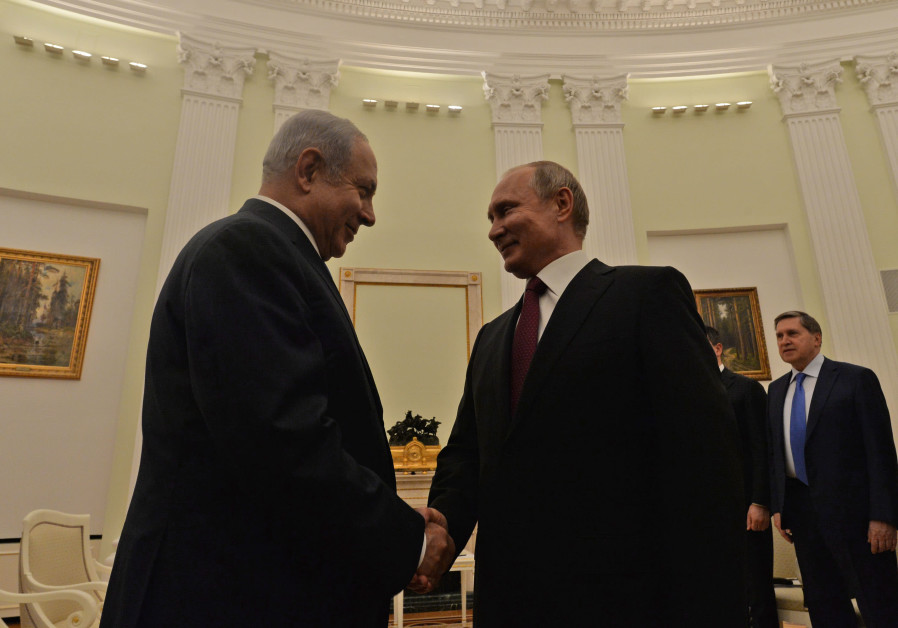
Prime Minister Benjamin Netanyahu shakes hands with Russian President Vladimir Putin . (photo credit: KOBI GIDEON/GPO)

Though he hasn’t been present there, the spirit of Israel’s prime minister hovered all over the summit meeting between the US and Russian presidents in Helsinki in mid-July. Benjamin Netanyahu worked laboriously mobilizing all his influence in Washington to persuade Donald Trump to meet Vladimir Putin.

The two leaders have mysterious relations that are unfolding as a special investigation of former FBI director Robert Muller into alleged Russian meddling in the last US presidential elections is progressing. Trump and Putin were scheduled to discuss international matters from North Korea to the Russian occupation of the Crimean Peninsula in Ukraine to the trade wars declared by Trump and the conflicts in the Middle East.

The Israeli prime minister, however, is mainly interested in two topics: Iran and the civil war in Syria. He needs both leaders to back his policy on these fronts.

On July 11, four days before the summit, Netanyahu was set to meet Putin and sit next to him in his private box at a Moscow soccer stadium watching together one of the two World Cup’s semi-finals.

It will be Netanyahu’s 10th meeting with the Russian leader in the last three years. He has more Putin’s hours than any other leader in the world.

The frequency and urgency of his encounters with Putin are a result of the fact that the Syrian civil war appears to be reaching its end and the army of President Bashar Assad is on its way to regain its position along the Israeli border on the Golan Heights.

Israel’s interests are to allow the Syrian army to return to its posts along the border as mandated by the 1974 agreement on “Disengagement of Forces” between the two sides, which ended the 1973 Yom Kippur War, while preventing any presence of Iranian, Lebanese Hezbollah or Shi’ite militias in undefined areas near the border.

After seven-and-a-half years of violence and bloodshed, including the use of chemical weapons, the death toll among Syrian government forces, opposition forces and civilians is estimated by UN and civil rights groups to be more than 500,000. As of December 2017, approximately 13.1 million people were in need of humanitarian assistance in Syria, with 6.3 million people displaced internally, and an additional 5.4 million registered refugees, making the Syrian situation among the largest humanitarian crises in the world.

Throughout the war years, Israeli policy remained more or less unchanged. Though some of the Israeli intelligence estimates were wrong (“Assad will be toppled within three weeks,” then- defense minister Ehud Barak predicted in 2011), the policy of non-intervention and not taking sides was consistent, with a few minor exceptions.

The Israeli “red lines” set by Netanyahu and the three defense ministers who served under him during this period – Barak, Moshe Ya’alon and Avigdor Liberman – consisted until a year ago of the following.

• To ensure the peace on the Israeli side of the border by responding to any violation of its sovereignty, deliberate or errant, by the Syrian army or rebel groups.

• To provide humanitarian aid to the villages next to the border, thus ensuring their gratitude and minimizing their incentives to act against Israel. So far, Israel has treated in its hospitals 3,500 victims, many of them children and women, and supplied more than a hundred tons of medical aid, food, clothes and tents worth nearly $100 million, which mostly was financed by contributions from evangelical communities in the US.

• According to foreign reports, the “good border” relations also included a supply of light weapons, ammunition and communication gear to the moderate, national-secular rebels groups near the border. In return, according to these reports, Israel, gleaned good intelligence on what was happening in Syria and beyond.

• To secure the safety of the Syrian Druze community (roughly half a million people), in order to calm down Israel’s own small Druze community (about 120,000), whose members serve in the Israeli armed and security forces and are considered loyal citizens of the Jewish state.

• To crush by military force efforts by Iran and Hezbollah to create a terrorist infrastructure on the Syrian side of the Golan Heights.

• To conduct air strikes and demolish transfers from Iran via Syria to Hezbollah of sophisticated weapons.

These goals were more or less achieved by a wise policy of the Israeli military and government by employing the tactics of a tightrope dance that combined determination, sensitivity and caution.

Even the arrival of the thousands of members of the Russian contingency and especially its air force and state-of-the-art anti-aircraft batteries didn’t stop Israel from preserving and enhancing its national interests. This was possible by establishing direct “hotlines” between Hmeimim Air Base in northwestern Latakia, where Russian headquarters is located, and the IDF and Israel Air Force headquarters in Tel Aviv.

The occasional talks between Israel and Russian officers helped “deconflicting” and the prevention of dog fights between Israeli and Russian pilots. On top of that, in his rounds of meetings with Putin, it seems that Netanyahu obtained from the Russia leader the license to almost freely operate in Syria as long as targets were not fully identified with the Assad regime.

But a year or so ago, Israel’s red lines were redefined and extended. While all the above interests are still in place, Israel has added a more important goal: to remove the presence of Iranian, Hezbollah and Shi’ite militias as far as possible from the Israeli border.

Netanyahu and Liberman have stated time and again that Israel would not tolerate any Iranian or pro-Iranian presence in the entire country of Syria. But even the top Israeli political and military echelon know that this is an unachievable goal.

A few weeks ago, Russia announced that its official position is that when the war is over, “all foreign forces” will have to leave Syria. Israel was satisfied and encouraged by this statement.

Nowadays there are Russian, Iranian, Turkish and American troops helping either the Assad regime in its war against the defeated ISIS, or Kurdish rebels (supported by 2,000 American troops) fighting against Turkey and aiming to create an autonomous. In early July, however, Russian Foreign Minister Sergey Lavrov redefined his government’s position by saying that it would be “unrealistic” to ask Iran to leave or withdraw all its forces from Syria.

So far, the IAF struck Hezbollah and Iranian targets in Syria with impunity. Israeli cabinet ministers and high-ranking IDF officers told me they assume that it is still in the Russian interests to weaken Iranian presence in Syria. Nevertheless, they understand that it  will be very difficult to achieve a total withdrawal of the Iranian, Hezbollah and Shi’ite contingents from Syria.

“Our flight policy in Syria” is about to change, they added. Thus, Israel will have to settle for less.

Israel’s real new red lines are now limited but much more important strategically. They aim to push Iranian troops and their allies 50-60 kilometers from the border, and to persuade Putin and via him Syrian President Bashar Assad, to prohibit the deployment of Iranian missiles and air defense systems on Syrian soil. If these goals are reached, Israel will allow and even encourage the return of the Syrian army to its 1974 positions along the border, so long as it respects the buffer zone (up to 10k from the border) and its limitations regarding a no-fly zone and the number and size of tanks and heavy artillery to be deployed in the area.

With the imminent return of Assad’s forces, the United Nations troops known as UNDOF (UN Disengagement Observer Force) will also return. At its peak, the force consisted of 3,000 soldiers from more than dozen nations. But because of the war, UNDOF was reduced to 1,000 troops now led by an Indian general.

Assad is well aware of the destructive power of Israel. He wants to consolidate his rule all over Syria and restore stability. But he is also a weak leader who owes his power to Iran and Russia. Israel can ruin his “party.” Nevertheless Netanyahu can’t solely rely on the logic of Assad, who has to be yet released from the Iranian grip.

Israel needs Putin and Trump, who hasn’t made up yet his mind yet on whether to let the US troops stay or leave, and whether to help Assad and Iran understand the new emerging reality.

As dozens of rockets hit Israel, IDF pounds Gaza in heaviest strikes since 2014

July 14, 2018

Palestinian terror groups fire 60 projectiles at Israel on Saturday afternoon; residents in border communities told to remain close to shelters, public gatherings canceled

https://www.timesofisrael.com/idf-pounds-gaza-in-widest-day-of-strikes-since-2014-war/
A picture taken on July 14, 2018 shows a smoke plume rising following an Israeli air strike in Gaza City (AFP PHOTO / MAHMUD HAMS)

Israeli aircraft on Saturday attacked more than 40 targets in the Gaza Strip in the most extensive daytime assault since 2014’s Operation Protective Edge as Palestinian terror groups fired repeated salvos of rockets and mortars into Israel.

The surge in violence intensified after midnight Friday-Saturday as the Israel Defense Forces hit an attack tunnel and Hamas training bases in Gaza in response to the moderate wounding of an IDF officer by a hand-grenade thrown during a border riot on Friday.

During the night, Palestinians fired more than 30 projectiles into Israel and kept up the attacks on Saturday, firing a further 60 rockets and mortar shells. Residents of Israeli border communities spent the night in bomb shelters and were cautioned to remain close to the shelters during the day.

The IDF said Iron Dome intercepted 16 projectiles that were headed for residential areas in total.

Israel’s political leadership is considering a range of possibilities for trying to halt the rocket fire, including targeted assassinations of Hamas terror chiefs, the use of ground forces, and a ceasefire mediated by Egypt and/or others, but no decision had been made as of Saturday late afternoon, Hadashot TV news reported.

The primary target of the IAF strikes Saturday was the Hamas battalion headquarters in Beit Lahia, in the north of the Strip, the army said.
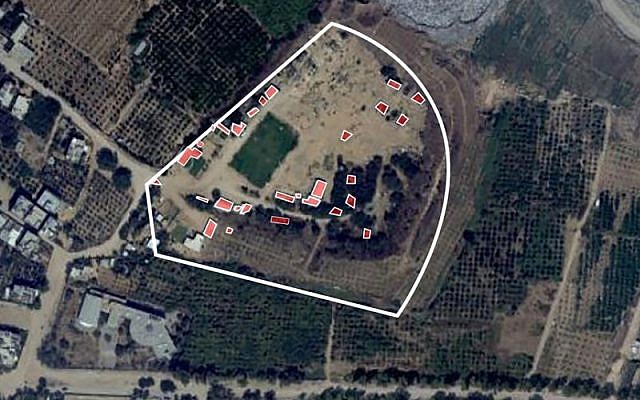
An aerial illustration of the Hamas Battalion headquarters in Beit Lahia. (IDF Spokesperson)

“The focus of the attack is a wide-scale strike of the Hamas Battalion HQ in Beit Lahia, which includes urban warfare training facilities, weapon storage warehouse, training compounds, command centers, offices and more,” the IDF said in a statement.

“In addition, a weapons manufacturing site and storage facilities housing various types of weapons, including Hamas’ naval capabilities, were struck,” it said.

The air force also attacked a Palestinian terrorist cell launching mortars.

The IDF spokesman said the aim of the operation was to “restore a sense of security” and that the military would “respond as necessary” to a wide range of scenarios.

The Hamas-run health ministry said it had not received any reports of injuries in the Israeli strikes.

https://videoidf.azureedge.net/771f7156-c3d9-4e74-8b8e-c16beaced50f.mp4?_=1

According to IDF spokesman Brig. Gen. Ronen Manelis, the operation had three aims: To end the incendiary kites and balloons from Gaza, end the large-scale border protests, and end the rocket and mortar fire.

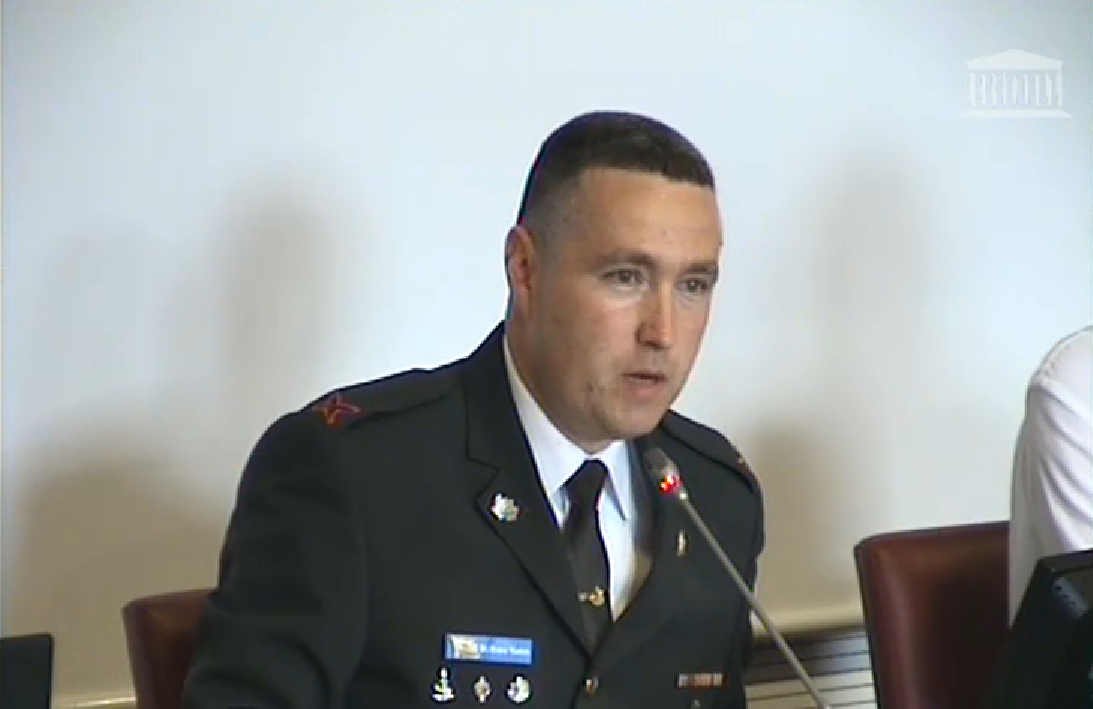
IDF Spokesman Brig. Gen. Ronen Manelis (screen capture of National Assembly footage)

“There are three factors occurring that we view seriously and cannot allow to continue,” he said, adding that this was the largest daytime Israeli strike on Gaza since the 2014 Gaza War.

Media reports said that Egyptian intelligence services had contacted the Hamas leadership in Gaza to try to prevent a further escalation of violence.

In the Saturday afternoon salvo, Palestinians fired more than 60 rockets and mortar shells and sirens wailed frequently in southern Israel. Army Radio reported that at least one projectile was intercepted, with the remainder falling in unpopulated areas.

There were no immediate reports of injuries.

A farm building was lightly damaged in one border community, with no harm to any animals reported.

Local residents, who had earlier been told they could return to their usual routines after an earlier barrage overnight Friday, were instructed to remain close to bomb shelters, and large gatherings of people were to be canceled.

The day of tension and violence came after terrorists fired more than 30 rockets and mortars toward Israel overnight Friday in the wake of IDF strikes on a number of Hamas targets in Gaza in response to violence along the border.

No injuries or damage were reported but warning sirens wailed for much of the night in border communities including the Sdot HaNegev Regional Council area and the town of Sderot.

The army earlier on Saturday said it targeted two Hamas attack tunnels as well as other military compounds in the Strip, including those involved in the spate of incendiary kite and balloon attacks.

Even as the airstrikes were being carried out, the IDF said rockets were fired toward Israel.

According to the IDF, six projectiles were intercepted by the Iron Dome aerial defense system. One rocket landed inside a kibbutz in the Shar HaNegev Regional Council area.

Hamas on Saturday said the barrage of rockets and mortar shells into Israeli territory overnight was fired by the “resistance” to “stop Israeli escalation.”

The spokesman for the terrorist group, Fawzi Barhoum, also said the projectiles were an “immediate response” that was meant to “deliver the message” to Israel.

The army said it held Hamas responsible for all violence emanating from Gaza, which the terror group has ruled since 2007.

“The Hamas terror organization is responsible for the events transpiring in the Gaza Strip and emanating from it and will bear the consequences for its actions against Israeli civilians and Israeli sovereignty,” the army said, adding that “the IDF views Hamas’ terror activity with great severity and is prepared for a wide variety of scenarios.”

The IDF said aircraft had attacked “an offensive terror tunnel in the southern Gaza Strip, in addition to several terror sites in military compounds throughout the Gaza Strip, among them complexes used to prepare arson terror attacks and a Hamas terror organization training facility.”

The IDF published video of its air strikes.

https://videoidf.azureedge.net/6ffa8be2-92bf-4633-a125-b805da677753.mp4?_=2

The latest round of violence has threatened to spark a further conflagration after weeks of tensions along the volatile border.

Israel in recent weeks has repeatedly warned Hamas that while it has no interest in engaging in the kind of conflict that led to the sides fighting three wars over the past decade, it would not tolerate its continued efforts to breach the border fence and its campaign to devastate Israeli border communities with incendiary attacks.

On Friday, thousands of Palestinians gathered near the Gaza border for their near-weekly protest. The army said protesters attacked soldiers with grenades, bombs, Molotov cocktails, and rocks.

A 15-year-old Palestinian who tried to climb over the fence into Israel was shot dead, media reports in Gaza said.

Later the IDF said an Israeli officer was moderately wounded by a grenade thrown at him during the clashes at the border.

On Saturday, the Hamas-run health ministry in Gaza announced that a 19-year-old succumbed to his wounds sustained at the clashes a day earlier.

It was not clear whether the two deaths were tied to the attack that wounded the Israeli officer.

Gaza officials said 220 others were hurt in Friday’s riots. Most were treated at the scene, while several dozen were taken to hospital. The violence was held under the banner of “Identifying with Khan al-Ahmar,” a West Bank Bedouin village whose planned demolition by Israel is being debated at the High Court.

Since March 30, weekly clashes have taken place on the Gaza border, with Israel accusing Hamas of using the demonstrations as cover to carry out attacks and attempt to breach the security fence. The “March of Return” protests have also seen Palestinians fly airborne incendiary devices toward Israeli territory, sparking hundreds of fires in southern Israel and causing millions of shekels in estimated damages.

The Israeli army reportedly notified Hamas in recent days that if the incendiary kite and balloon attacks from the Gaza Strip don’t cease, Israel would respond with major military action.

Palestinians prepare a kite with flammable materials that they will fly into southern Israel from Rafah, in the southern Gaza Strip, on June 22, 2018. (Abed Rahim Khatib/Flash90)

On Monday, Israel announced it was shutting down the Kerem Shalom border crossing — the Strip’s main crossing for commercial goods — in response to the endless stream of incendiary and explosive kites and balloons that have been flown into southern Israel, sparking fires that have burned thousands of acres of land and caused millions of shekels in damages. Humanitarian and essential supplies continue to enter Gaza.

The IDF has sought to avoid an escalation of hostilities on the southern front despite the attacks, but according to the Haaretz daily, the political pressure to act has been building as the economic and psychological harm caused by the fires takes its toll.

On Wednesday, incendiary kites and balloons sparked 19 fires of varying sizes in Israel, according to local government officials. Fifteen of them occurred in the Eshkol region, which abuts the southern Gaza Strip. The other four occurred in the Sha’ar Hanegev region, which lies to the northeast of the coastal enclave.

In response, the Israeli military conducted an airstrike against a group of Palestinians it said was launching incendiary balloons toward Israel from the southern Gaza Strip, east of the city of Rafah. There, too, no injuries were reported.

After shuttering Kerem Shalom, the army said humanitarian aid, notably food and medicine, would still be allowed into Gaza, but would require special permission from the military liaison, Maj. Gen. Kamil Abu Rokon, to the Palestinians.

The military said the closure would continue so long as Palestinians persist in launching incendiary kites and balloons into Israel.

Agencies contributed to this report. 
Congress Demands State Department Release Secret Report Busting Myth of Palestinian Refugees

July 13, 2018

Cruz, congressional insiders pressuring Trump administration to expose long classified report

Palestinian protestors uses slings to throw stones towards Israeli forces during clashes across the border, following a demonstration calling for the right to return

Palestinian protestors uses slings to throw stones towards Israeli forces during clashes across the border, following a demonstration calling for the right to return / Getty Images

BY:

Congress Demands State Department Release Secret Report Busting Myth of Palestinian Refugees

Key lawmakers in Congress are increasing pressure on the Trump administration to release a long classified government report on Palestinian refugees that insiders have described as a potential game changer in how the United States views the refugee issue and allocates millions in taxpayer funding for a major United Nations agency, according to conversations with senior congressional officials working on the matter.

The State Department has, since the Obama administration was in office, been hiding a key report believed to expose the number of Palestinian refugees as far smaller than the U.N. and other have claimed for decades. The public release of this information could alter how the United States provides funding for Palestinian refugees.

The Washington Free Beacon first disclosed the existence of the refugee report in January, when the Trump administration decided to significantly cut funding to the U.N. Relief and Works Agency, or UNRWA, an organization long accused of harboring anti-Israel bias and of aiding Hamas terrorists in the Palestinian territories.

Though the State Department is legally required to publish an unclassified version of the report, it has repeatedly ignored demands by Congress that the report be released.

The State Department, when asked by the Free Beacon, could not provide any information or timeframe on the report’s possible release.

“The State Department is committed to taking all appropriate measures to provide information in response to requests from Congress,” a State Department official said.

Rep. Doug Lamborn (R., Colo.) spearheaded the initial effort to declassify the report. Congress must have a complete picture of the Palestinian refugee situation in order to ensure that U.S. taxpayer funds are not being wasted, he told the Free Beacon in April.

“It is critical that Congress investigates the United Nations Relief and Works Agency (UNRWA), which operates under the United Nations (UN) using a different definition of a refugee for Palestinians than all other UN refugees around the world,” Lamborn said.

Congressional demands that the report be publicly released come at time of mounting criticism for UNRWA, which is facing a severe cash crunch following the Trump administration’s decision to reduce U.S. funding. The tense situation with UNRWA has sparked protests in the Gaza Strip, where UNRWA mainly operates and employs hundreds.


In addition to regional protests over UNRWA’s inability to pay salaries, Turkey was recently appointed at the U.N. to chair the agency’s advisory committee for the next year. This has stoked concerns that UNRWA could take an even more anti-Israel position in the coming months.

Sources with direct knowledge of the report’s contents have told the Free Beacon it puts the number of actual Palestinian refugees at around 20,000, far fewer than the 5.3 million figure routinely pushed by UNRWA and pro-Palestinian advocates who want to see the United States and international partners continue sending millions in aid to the Palestinian government.

Sen. Ted Cruz (R., Texas), one of the main lawmakers pressuring the Trump administration to release the report, told the Free Beacon that efforts to suppress the information on the actual Palestinian refugees is preventing Congress from providing oversight for the U.S. taxpayer.

“UNRWA lashes out against America and engages in anti-Semitic incitement. Hamas terrorists use UNRWA facilities to target Israeli civilians,” Cruz told the Free Beacon. “The American people deserve to see this reported State Department assessment, so Congress and the administration can have a transparent and productive debate about America’s role in the organization.”

Now that Secretary of State Mike Pompeo is running the State Department following the ouster of former head Rex Tillerson, lawmakers and senior congressional officials see a renewed opportunity to ensure the refugee report is released.

They continue to view the classified report’s findings as a critical tipping point in the debate over UNRWA’s funding and core mission, which has found itself subjected to increased scrutiny as a result of what many allege is UNRWA’s anti-Israel bias and close relationship with Palestinian terror groups.

One senior congressional official who has been involved in the UNRWA issue for several years questioned why the Trump administration is continuing to keep the report classified, particularly as the White House amps up efforts to foster peace between the Israelis and Palestinians. The refugee issue has long been a sticking point in peace talks.

“It’s not really a question of what they’re hiding,” said the source, who was not authorized to speak on the record about the situation. “We know what’s in the report because it’s just a matter of mathematics and demographics. The number of refugees was half a million people to begin with, and that was 70 years ago so many of them have passed away, so it can’t be five million now.”

“The question is why the Trump administration is trying to lock in the Obama era policy of never letting this report see the light of day,” the source said.

Update July 13, 3:16 p.m.: This post has been updated with further information.

Florida: Mass Murder Plot Thwarted, CAUGHT Before Blowing Up Building to “Kill All The F***king Jews”

July 13, 2018

By – on

Florida: Mass Murder Plot Thwarted, CAUGHT Before Blowing Up Building to “Kill All The F***king Jews”

This Jew-hater was captured in the act. He was setting up the gas containers, had poured gas down the hallways and elevators and had padlocks to put on the fire hoses to prevent the fire department from using them. But this story will get nary a mention in the elite (antisemitic) left-press. But comment on a hijab and you are worldwide news.

Note the first sentence of this local news report: “A Miami Beach man upset with his Jewish neighbors” as if that is some justification. My colleagues and I are excoriated for opposing jihad terror and sharia savagery but they imply justification becasue he was “upset with his Jewish neighbors.”


If ‘everyone’ has good relations with Russia, Nord Stream may be ‘less of a problem’ – Trump to NATO

July 12, 2018
https://www.rt.com/news/432857-trump-nord-stream-threat/
Sergey Guneev / Sputnik
Donald Trump, who chastised Germany for buying energy from Russia and extending the natural gas pipeline connecting the two countries, indicated he may reconsider his stance if “everybody” has a good relationship with Russia.

US President Donald Trump hinted at the change of heart at a media conference following the NATO summit in Brussels.

“Frankly, maybe everybody is going to have a good relationship with Russia, so there will be a lot less problem with the pipeline. But to me it was a major point of contention. We discussed it at length today. Germany has agreed to do a lot better than they were doing,” he said.

Read more

© Hannibal Hanschke

Trump was referring to what he described as Germany’s pledge to spend more on defense along with other NATO members, which he sees as a major win for his administration.

Speaking to journalists, Trump seemed pleased with himself for attacking Germany on its energy import from Russia during the first day of the summit.

“I brought it up. Nobody brought it up but me,” he said. “Actually, I think the world is talking about it now maybe more than anything else.”

On Wednesday, Trump called Germany a “captive” of Russia for buying Russian natural gas. The remark was rejected by top German officials, including Chancellor Angela Merkel, who said Berlin conducts an independent foreign policy and was not a captive of any country.

READ MORE: Merkel slams Trump’s ‘Russian captive’ comment, defends Berlin’s ‘independent policies’

Germany insists that its trade with Russia is a national issue and not that of NATO or the EU, and its allies in Western Europe seem to agree. French President Emmanuel Macron, who spoke to the media after Trump on Thursday, said he personally didn’t find Trump’s remarks about Germany shocking but believed that countries should “take such decision in a sovereign manner.”

“Mr. Trump shared his point of view. An ally has the right to speak about strategic issues,” Macron said.

Russia and Germany are currently connected directly by the Nord Stream, an underwater pipeline through the Baltic Sea. A second pipeline that would double the capacity of the first one is currently under construction. The US opposes the project, claiming it would give Russia more leverage over Europe. Officials in Germany and Russia say the US is simply trying to wrestle its way into the European energy market and sell its own liquefied natural gas.

Trump’s targeting of Russian-European energy cooperation, and Merkel personally, during a NATO summit is simply a publicity stunt that would have no tangible effect on the energy trade itself, according to Vladislav Belov, the head of the Center for German Studies at the Moscow-based Institute of Europe.

“Trump linked defense spending of the US with German spending on Russian hydrocarbons. Apparently he sees this as a matter of security that Germany spends money on gas and not on defense. It’s a typical Trump dilettante approach,” he told RT.

Belov said there was “zero chance” that Germany would bend to Trump’s pressure on the pipeline project, regardless of how he attacks the German chancellor. “Trump’s hostile rhetoric towards Merkel proves that apparently Obama forgot to hand over the secret dossier with compromising materials against her, which some conspiracy theorists in Russia claim must exist,” he joked.

Ireland passes BDS law against trade with Jewish communities in Judea and Samaria

July 12, 2018

By – on

Ireland passes BDS law against trade with Jewish communities in Judea and Samaria

The Boycott, Divest, Sanction [Israel] movement is this century’s Nazi movement, only on a worldwide scale. Same tactics, same viciousness, same lies, same thuggery — the Germans employed the same tactics. Preceding Kristallnacht, the Nazis held several days calling for Germans to boycott Jewish-owned businesses. This was the direct antecedent to the BDS movement. This is no different.

This century’s Nazi officials are in the Irish parliament.

“Ireland to pass BDS law against Jewish businesses in ‘occupied territories,’” by Batya Jerenberg, World Israel News, July 4, 2018 (thanks to Mark):

An Irish law against importing goods and services from “occupied territories” was carefully worded so that it would apply only to the Jewish state, its sponsor said.

The second-largest party in Ireland’s parliament announced Wednesday that it will support a pro-BDS bill coming to a vote later this month, thus guaranteeing its passage.

Fianna Fáil will join the largest opposition party, Sinn Féin, and others in passing what is officially called the Control of Economic Activity (Occupied Territories) Act of 2018. Although it does not mention Israel, or even “Palestine,” by name, its sponsor, Senator Frances Black (Independent), has openly noted that its wording was carefully formulated so that it would only apply to the Jewish state.

This means that the law, which would affect Judea and Samaria, eastern Jerusalem and the Golan Heights, does not cover areas such as Turkey’s longtime occupation of northern Cyprus or Russia’s more recent occupation of the Crimea.

As reported in JNS, a spokesman for the Irish pro-Israel group Irish4Israel said that the bill “was endorsed by trade unions and others and had the support of many smaller parties. The motivation is a naive hope to show solidarity with the Palestinians” due to “an Irish obsession to identify with the perceived underdog.”

Fianna Fáil’s Niall Collins said that “passing the Occupied Territories Bill has the potential to send a strong message that the issue of illegal settlements is being taken seriously and needs to be addressed.”
‘Closing doors will not facilitate Ireland’s influence’

Israel’s embassy in Ireland blasted the bill in a statement as an “immoral” one that “will not do any good.” Legislation that promotes any kind of boycott, it continued, “should be rejected as it does nothing to achieve peace but rather empowers the Hamas terrorists as well as those Palestinians who refuse to come to the negotiating table.”

In addition, the embassy noted, “Closing doors will not in any way facilitate Ireland’s role and influence.”

An interesting point about the proposed legislation is that it runs counter to the law of the European Union (of which Ireland is a member), which states that all EU countries must have a common trade policy. In explaining why parliament should go ahead with it anyway, Black told Ireland’s TheJournal.ie, “I feel if we wait for the EU to take the lead, we could be waiting forever.”…

“Israel Slams ‘Immoral’ Bill Passed by Ireland’s Senate Outlawing Trade With West Bank Jewish Communities,” Algemeiner, July 11, 2018:

Irish legislation outlawing trade with Israeli settlements could put the Irish operations of US companies like Apple (pictured) at risk from US anti-boycott rules. Photo: Reuters / Michael MacSweeney.

Legislators in Ireland’s Senate passed a bill on Wednesday that will prohibit “the import or sale of goods and services” from Jewish communities in the West Bank, deemed to have been under Israeli “occupation” since the June 1967 Six-Day War.

Passed by a vote of 25-20, the bill drew support from all Ireland’s major political parties, except the governing Fine Gael party.

Before the vote, PLO Executive Committee member Hanan Ashrawi called on “the Irish people in light of our historical relationship to stand up and to reject the importation of any settlement products — because settlements are, after all, a war crime and an ongoing aggression against the Palestinian people and they want you to be complicit in this war crime.”

The Israeli Foreign Ministry summoned Ireland’s ambassador in Tel Aviv, Simon Coveney, to condemn the Senate’s “absurd” initiative. The ministry said the bill “will harm the livelihoods of many Palestinians who work in the Israeli industrial zones affected by the boycott.”

Recently-released Syrian textbooks introduce Russia as a close ally while presenting Iran and Turkey as regional competitors, suggesting that Damascus’…

The bill, which passed its second reading on Tuesday, still has eight more procedural hurdles to jump, including a vote in the Irish Parliament’s House of Representatives, before it can be signed into law by the Irish president.

Commenting on the legislation, Prof. Orde F. Kittrie — who teaches law at Arizona State University and is a senior fellow at the Foundation for Defense of Democracies (FDD) think tank — asserted that if “companies abide by the Irish law, they could violate U.S. law, which prohibits U.S. companies from participating in foreign boycotts that the U.S. government does not endorse.”

“The bill, if enacted, would put at risk Ireland’s economic links to the United States, which are vital to Irish prosperity,” Kittrie noted in an article for Fortune magazine….

Russia moving into Libya

July 12, 2018

– – Wednesday, July 11, 2018

https://www.washingtontimes.com/news/2018/jul/11/russia-moving-into-libya/

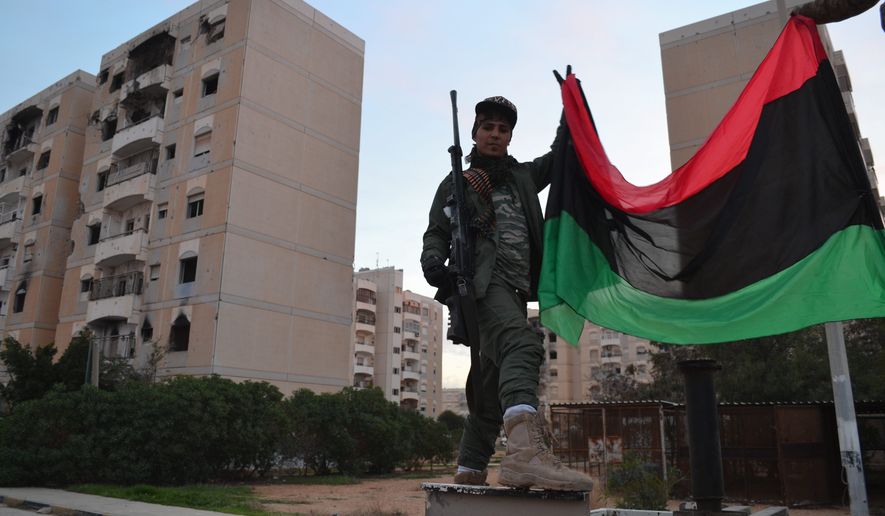
Libyan National Army forces, under the leadership of Maj. Gen. Khalifah Haftar, is pushing for a Russian military presence in eastern Libya. (The Washington Times/File) more >

U.S. intelligence agencies are closely monitoring Russian military activities in Libya for signs that Moscow may soon build a military base in the divided North African state.

Intelligence reports indicate that Russia is planning to expand its Syrian bases at Tartus and Hemeimeem to Libya.

The possible Russian move into Libya represents the most recent failure stemming from the policies of President Obama that backed Islamist rebels who overthrew and killed Libyan strongman Moammar Gadhafi in 2011.

Mr. Obama has said that the failure to prepare for the aftermath of the ouster of Gadhafi was the worst mistake of his presidency. Secretary of State Hillary Clinton also came under fire for failing to provide security for Americans who were attacked and killed in Benghazi after Gadhafi’s fall.

The push for a Russian military presence in Libya is being led by retired Maj. Gen. Khalifah Haftar, whose militia forces, the Libyan National Army, control eastern Libya. Russian private military forces have been operating in eastern Libya since March 2017, including the RSB Group that has deployed several dozen armed mercenaries to join forces with Haftar militias.

News reports from Libya stated recently that the RSB Group mercenaries are engaged in advance work, scouting locations for a Russian military base in Tobruk or Benghazi.

In addition to RSB, the notorious Wagner Group of Russian mercenaries also is operating in eastern Libya, reportedly to service Gen. Haftar’s Russian-supplied weaponry. Wagner mercenaries also are helping set up an intelligence network for the general’s forces.

Libya under Gadhafi supported international terrorism, including the 1988 bombing of Pan Am Flight 103, which killed 259 people over Lockerbie, Scotland. In 2003, after the U.S. invasion of Iraq, however, Gadhafi decided to collaborate with the U.S. and Britain in giving up his nuclear weapons program in exchange for closer trade and diplomatic relations with the West.

The regime came down in 2011 as the result of the Obama administration’s policies that opposed the Gadhafi government and backed Islamist rebels.

The country spiraled into a failed state and since 2014 has been divided between two governing bodies: the Council of Deputies based in Tobruk and the Islamist General National Congress based in Tripoli. Sections of the country, which has large oil reserves, remain under the control of numerous Islamist militias.

The head of the Libyan government in Tobruk, Prime Minister Abdullah Al-Thini, said in an Arabic news interview June 27 that the U.S., Britain and Italy are “enemies of the Libyan people” because they have backed the forces promoting political Islam in Libya. Observers say the United States should back Gen. Haftar in a bid to prevent Russia from taking control over Libya.