Author Archive

Iran, N. Korea Grow Stockpile of Ballistic Missiles Capable of Striking U.S. Troops, Allies, Israel

August 9, 2018

Iran, N. Korea continue to share missile tech, capitalizing on Obama-era sanctions loopholes

Iranian President Hassan Rouhani and North Korean Foreign Minister Ri Yong Ho

Iranian President Hassan Rouhani and North Korean Foreign Minister Ri Yong Ho / Getty Image

BY:

Iran, N. Korea Grow Stockpile of Ballistic Missiles Capable of Striking U.S. Troops, Allies, Israel

Iran and North Korea are growing their stockpile of ballistic missiles, including long-range missiles capable of striking U.S. assets, American allies, and even the continental United States, according to new congressional reports that shine a light on efforts by these rogue nations to advance their military capabilities.

North Korea continues to aid Iran with its advanced ballistic missiles program in defiance of international regulations barring such activity, according to the reports, issued by the Congressional Research Service. This includes an extensive proliferation network and multiple facilities dedicated to constructing short-range, medium-range, and long-range ballistic missiles.

Iran’s missiles, many of which are modeled off North Korean technology, are advanced enough to strike targets throughout the Middle East, including Israel, stoking fears that the next regional war—which many say is imminent—could present Iran an opportunity to show off its newest missile technology.

U.S. officials familiar with the Iranian and North Korean missile programs told the Washington Free Beacon that much of the recent technological progress by these rogue nations is the result of the Obama administration’s efforts to relax international regulations on such activity as part of the landmark nuclear agreement.

In the time since that agreement was reached, Iran has taken significant steps toward building, testing, and improving its ballistic missile technology, including long-range missiles that have been tested under cover of Tehran’s space program.

“The Obama administration gutted the international prohibitions against Iran’s ballistic missile development,” one U.S. official involved in efforts aimed at rolling back Iran told the Free Beacon on background. “Then, when Iran started racing to build a more sophisticated arsenal, they had Samantha Power make some noise at the United Nations before quietly standing aside. That’s how we find ourselves where we are.”

The latest reports on Iranian and North Korean missile technology paint a startling portrait of the sheer power of both countries, which continue to exchange technology on both the missile and nuclear front.

“Iran continues to invest in developing ballistic missiles and in building an extensive network of facilities, although missile inventory information is scarce,” the latest report on Iran states.

“Iran’s short- and medium-range ballistic missile tests indicate that Iran is focused on increasing the accuracy of its missiles,” according to the report, which includes both open source and U.S. intelligence community information.

However, Iran continues to experience delays in its more sophisticated missiles, including its long-range and intercontinental ballistic missile technology, though it continues to test and refine this hardware.

“The majority of Iran’s heavy artillery rockets and ballistic missiles are tactical or short-range (less than 500 kilometers),” according to the report.

The mobile nature of Iran’s shorter-range rockets has allowed it to share this technology with its allies in the region. Shorter-range missiles employed by Iran are more than capable of striking “U.S. and allied bases in the Gulf region if moved from their operating bases, as well as targets throughout Iraq,” the report notes.

After years of testing and refining this technology, “Iran has grown increasingly self-sufficient in producing SRBMs [short-range ballistic missiles], but still probably relies on outside sources, such as North Korea, for some key components and material,” according to the report.

Iran also has developed and produced medium-range ballistic missiles (MRBMs) estimates to reach distances of around 2,000 kilometers or more, “sufficient to strike targets throughout the Middle East.”

“Iran continues to develop, test, and build more capable and increasingly accurate MRBMs,” U.S. intelligence sources have noted. “Iran argues these missiles constitute an important deterrent and retaliatory force against U.S. and other forces in the region in the event of war.”

To support this missile program, Iran has built and underground network of facilities and missile launch sites that are protected by the country’s air defenses and technology such as Russia’s S-300 anti-aircraft missiles, which are currently believed to be operational. This would protect Iran’s missile technology from a preemptive strike.

Support for Iran’s program comes from North Korea and other rogue exporters that have skirted international sanctions and capitalized on the subsequent lifting of these sanctions by the Obama administration.

“Iran relies to some extent on others, particularly North Korea, for certain key missile components and materials in its MRBM program,” the report states. “Export controls and sanctions have made it increasingly difficult, but not impossible, for Iran to acquire the best of such items, causing Iran to try to exploit weaknesses in existing export and nonproliferation regimes, or to try to find foreign sellers willing to circumvent those laws.”

Iran’s Shahbab-3 ballistic missile, for instance, has been imported from North Korea and is based on that country’s own designs.

Tehran’s long-range and intercontinental ballistic missile technology is harder to pin down.

“Some have long believed Iran’s space launch program could mask the development of an intercontinental ballistic missile (ICBM) with ranges in excess of 5,500 km that could threaten targets throughout Europe, and even the United States (at least 10,000 km),” according to the report.

However, it remains unclear just how much progress Tehran has made in developing working technology.

Meanwhile, “North Korea has made rapid advancements in its nuclear weapons and ballistic missile programs,” according to a second congressional report. “North Korea is striving to build a credible regional nuclear war fighting capability that might evade regional ballistic missile defenses.”

As the United States pursues diplomacy with North Korea, there are encouraging signs the country has made moves to dismantle some of this technology, the report notes.

Egypt said to warn Hamas: Israel will renew assassinations if fire persists

August 9, 2018

Terror group’s leaders have reportedly turned off their phones, gone underground over fears of targeted killings by Israeli military

Today, 10:08 pm

https://www.timesofisrael.com/egypt-said-to-warn-hamas-israel-will-renew-assassinations-if-fire-persists/

Hamas chief Ismail Haniyeh (L) and Hamas leader in the Gaza Strip Yahya Sinwar attend a rally marking the 30th anniversary of the terror group’s founding in Gaza City, on December 14, 2017. (AFP Photo/Mohammed Abed)

Egypt has warned Hamas that Israel will seek to assassinate the terror group’s leaders if rocket fire from the Gaza Strip does not cease, according to an Israeli television report on Thursday.

Egyptian intelligence cautioned Hamas that Israel could renew targeted killings if the terror group further exacerbates tensions on the Gaza Strip border, Hadashot television news reported.

Previous media reports in recent months have indicated that Israel conveyed similar threats to Gaza rulers Hamas through Egyptian channels during periods of increased violence on the border.

Separately, Israel Radio on Thursday night quoted Hamas officials as saying political and military leaders from the terrorist group have turned off their cellphones over the last day and went into hiding for fear of being assassinated.

Hamas leaders were also signaling they were not responsible for a rocket attack targeting the southern city of Beersheba earlier on Thursday, Hadashot reported, in an apparent attempt to defuse the tensions.

The reported Egyptian warning to Hamas came amid a major flare-up in tensions on the Gaza border, with over 180 rockets and mortar shells fired at southern Israel since Wednesday night.

The projectiles injured at least seven people and caused damage to homes, businesses, and infrastructure throughout the region, according to the Israel Defense Forces.

In response, the Israeli Air Force struck over 150 Hamas “terror sites” in the Strip, the army said. Palestinian officials said a pregnant woman and her infant daughter were killed in the Israeli strikes, along with one Hamas fighter, who was reportedly in a car used by a rocket-launching Hamas cell that was targeted by an IDF aircraft.

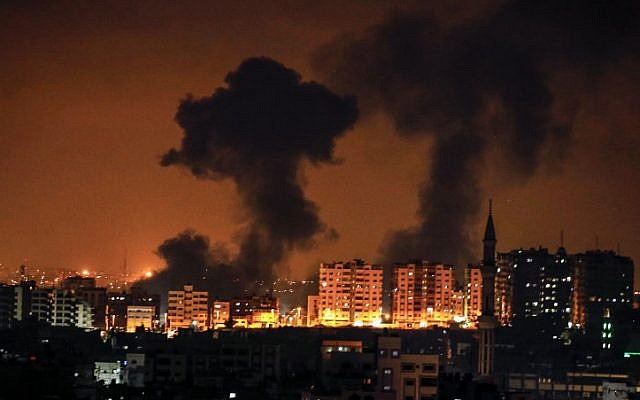
A plume of smoke rises from the remains of a building west of Gaza City that was targeted by the Israeli Air Force in response to a rocket attack that hit southern Israel earlier in the day on August 9, 2018. (AFP Photo/Mahmud Hams)

On Thursday evening, the Israeli Air Force flattened a five-story building in northern Gaza that served as a headquarters for Hamas’ internal security service, the army said.

The IDF said the strike on the building in the northern Gaza Strip, which also served as a cultural center in the coastal enclave, was in response to “rocket fire by the Hamas terror group against the city of Beersheba earlier in the day.”

The military threatened that the attack was “an expression of the IDF’s intelligence and operational capabilities, which will expand and intensify as necessary.”

Eighteen Palestinians were wounded in the Israeli strike, according to the Hamas-run Gaza health ministry. The degree of their injuries was not immediately known.

The attack on the building was one of the IDF’s first strikes on a site deep inside a city in Gaza since the 2014 war. Most of the strikes previously conducted by Israel targeted facilities outside major population centers. In addition, the Rimal neighborhood in which the building was located is one of the more upscale areas of Gaza City.

This decision was seen as an attempt by the military to show Hamas that it was prepared to step up its attacks against the terror group if rocket and mortar fire continued to strike southern Israel from the Gaza Strip.

The site where a mortar shell from the Gaza Strip hit an apartment building and cars in the southern Israeli city of Sderot, on August 9, 2018. (Yonatan Sindel/Flash90)

Minutes after the Israeli strike on the building began, incoming rocket sirens blared in the Eshkol region of southern Israel, sending thousands of residents into bomb shelters, where they had already spent much of the day in light of frequent attacks from the Gaza Strip throughout the previous two days.

A second wave of sirens were triggered shortly after the IDF confirmed that it had conducted the strike at 8:00 p.m. A third round of sirens went off an hour later.

There were no injuries or damage caused by any of those rocket attacks, Israeli officials said.

The renewed rocket attacks came amid a period of heightened tensions along the Gaza border, following months of clashes and exchanges of fire.

Earlier this week, there had been reports of intensive talks between Israel and Hamas for a long-term ceasefire.

Hamas Blackmail, Media Silence

August 9, 2018

‘There is no deterrence. Go to war now’

August 9, 2018

Former IDF chief says terror organizations like Hamas will only be deterred by threats to their existence after 180 rockets fired at Israel.

Shimon Cohen, 09/08/18 18:40
http://www.israelnationalnews.com/News/News.aspx/250303
General Uzi Dayan – Eliran Aharon

Major-General (Res.) Uzi Dayan, former deputy chief of staff, called for the restoration of Israeli deterrence in Gaza through a military operation against Hamas following the launching of 180 rockets and mortars from Gaza overnight.

“I hope there will be an operation in Gaza. This is something that needs to be done because our deterrence has been eroded to a point,” Dayan said in a conversation with Arutz Sheva.

“Even if there is a kind of ceasefire, Hamas will continue to operate below the threshold of response, to send kites and balloons, on the assumption that we will respond only with a small response, and even if it sends eighty rockets to the Gaza vicinity like yesterday, Israel will not launch an operation. This is called the loss of deterrence.

Dayan, the former head of the National Security Council, explained that a future operation that would end without Hamas being neutralized would be considered a loss for Israel. “It is important to respond strongly because Hamas must be deterred and if we want to deter it, it can only be done through a threat to [Hamas’] very existence. We need to decide whether to embark on a war in Gaza and decide whether the goal is to punish or topple Hamas.”

“Anything less than regime change is a victory for Hamas because then Hamas entered the bunkers and even if thousands of people in Gaza are killed, it will not matter to it. It will continue to be in the bunker for a week or two and then it will emerge from the ruins and declare victory. And that’s how it will show in the world that Israel did not succeed in eliminating Hamas. ”

Dayan estimates that without the support of Israeli public opinion, the IDF would not launch an operation against Hamas. “Why do we recoil? Because of the price to Israel. We fear losses. The main problem is Israeli public opinion. Israel is not going to begin a war that would result in casualties unless Israeli public opinion understands that there is no choice but to go to war.”

“Public opinion day is not like that. In the Gaza vicinity they say they hope the quiet will return, they do not support an operation in Gaza,” he said. “The IDF needs to present more aggressive plans that include the destruction of Hamas, whether by eliminating the leadership, no matter whether it is a political leadership or military leadership. or by making it leave the Gaza Strip, just as we removed the PLO from Lebanon.”

“And if we are determined to harm the leadership of Hamas, it means destroying governmental targets and houses belonging to leading families in Hamas. In this situation, some punishment will indeed be achieved, but there will not be such a deterrent that the masses in Gaza will say, ‘If this is the result then we have to stop shooting.’ A terrorist organization is deterred only by a threat to its very existence. This does not mean conquering all of Gaza but it would entail a ground invasion.”

War is on ? live updates.

August 9, 2018

[21:51] Security cabinet instructs IDF to continue acting forcefully in Gaza

Israel’s security cabinet instructed the IDF to continue to act with force after its meeting at the IDF headquarters in Tel Aviv on Thursday evening.

“The cabinet has instructed the IDF to continue to act with force against perpetrators of terror,” a brief cabinet statement said.

[21:12] Sirens sound in Gaza border community

Further rocket sirens sounded in Israeli communities in the Eshkol Regional Council near the Gaza border on Thursday evening.

[18:34] Security Cabinet meeting underway

An emergency meeting of the Security Cabinet, headed by Prime Minister Benjamin Netanyahu, is currently underway at the IDF and Defense Ministry headquarters in Tel Aviv.

[18:28] Sirens sound in Gaza border communities

Rocket sirens were activated in multiple Gaza border communities on Thursday evening.

Sirens were heard in Nir Oz, Nirim, Kissufim and Ein HaShlosha.

[18:00] Reports: Israel carrying out airstrikes in Gaza Strip

Israeli jets have carried out further airstrikes in the Gaza Strip, according to initial Palestinian reports.

Airstrikes have been reported in areas to the west of Gaza City, in the northern Gaza Strip.

https://www.jpost.com/Israel-News/Live-updates-Flareup-in-the-south-564419

Sderot pledges support: ‘Time to enter Gaza’

August 9, 2018

Sderot Mayor calls government to launch military operation, restore regional peace: ‘We must strike terror and bring life back to normal.’

Flash 90- Cowardly archers target children

Sderot Mayor Alon Davidi pledges his city’s support of a post-diplomatic solution to the current aggression from Gaza: “We must return life back on track. The time has come to undertake an operation in Gaza,” Davidi said. “We must deal a blow to terror and return life to normal. For our part, we’ll provide the operating space and the time for the army and policymakers to bring quiet back to our region,” he said.

Alarms were heard this morning across the Gaza area, in Ashkelon, and Netivot. The IDF renewed attacks in Gaza and since morning three emplacements of rocket launchers and mortars were hit.

Nine people are still hospitalized. Since the beginning of the escalation, 26 casualties have been evacuated to hospitals last night and this morning.

Prime Minister Binyamin Netanyahu is holding a security situation assessment with the Defense Minister and top security force echelons in the Kirya in Tel Aviv. At 16:00 the Political-Security Cabinet will convene.

Sderot Mayor Alon Davidi – Flash 90

Egyptian Intelligence: Israel Rejected the Terms of Armistice with Hamas

August 9, 2018

Hamas warns that if the Israeli attacks did not stop in Gaza, the radius of rocket attacks would be widened.

JOL Staff

http://www.jerusalemonline.com/news/politics-and-military/military/egyptian-intelligence-israel-rejected-the-terms-of-armistice-with-hamas-36445

Smoke rises after Israeli warplanes carried out an air strike over residential areas in Gaza City (Flickr)

Palestinian sources, referring to the mediators from the Egyptian Muhabharata, disseminated information that Israel rejected the terms of the cease-fire proposed by him with Gaza.

At the same time, Israel allegedly put forward an ultimatum – if before 16:00 on August 9 rocket attacks from Gaza do not stop, a large-scale military operation against Hamas will begin.

Hamas, meanwhile, warned that if the Israeli attacks did not stop in Gaza, the radius of rocket attacks would be widened.

A correspondent for Arabic affairs of the 10th channel of Israeli TV Zvi Yekhezkeli commented on what was happening:

In the end, there is a “responsible adult” – either Egypt or Israel.

The logic of Hamas is very simple. He needs a limited conflict. In a limited conflict, he will always be the one who will say the last word – and create a “new level of containment.” And what else can they think of us when we began to blow up skyscrapers in Gaza only on the 48th day of Operation “Indestructible Rock”? Our attacks are so stereotyped that it always ends with this kind of “new equation of force.”

Egypt, for its part, is ruthless – unlike us. In Egypt, Hamas is defined as a terrorist organization, in Egypt they can not stand. But if you demolish Hamas, Gaza falls on them – and they absolutely do not need it. All they want is silence in Gaza, so that the situation in Sinai does not heat up.

When a “Cease-Fire” is Not a Cease-Fire

August 9, 2018

An advisory to journalists in the Middle East.

https://www.frontpagemag.com/fpm/236310/when-cease-fire-not-cease-fire-david-bedein

In the current conflagration between Israel and Gaza, news agencies mistakenly report that a “cease fire” is being discussed with Hamas.

In the imagination of the media, such a “cease fire” might result in the kind of armistice that ended hostilities in World War I, on the 11th hour of the 11th day of the eleventh month on Nov. 11 1918, paving the way to the Versailles peace treaty and the genesis of the League of Nations.

However, the three Arabic nuanced terms being discussed with Hamas as a resolution to the current situation have nothing to do with a “cease fire”:

Those terms are Hudna, Tahadia and Hudaybiyyah. All three terms imply continued war, after a respite.

Hudna: a tactical pause intended only for rearmament, a temporary respite in the war between Islamic forces and non-Islamic forces.

The authoritative Islamic Encyclopedia (London, 1922) defines hudna as a “temporary treaty” which can be approved or abrogated by Islamic religious leaders, depending on whether or not it serves the interests of Islam; a hudna cannot last for more than 10 years.

Tahadia: a temporary halt in hostile activity which can be violated at any time.

Hudaybiyyah: An understanding that there will be no fighting for 10 years named for the “treaty of Hudaybiyyah” in 628 AD.

The Islamic Encyclopedia mentions the Hudaybia treaty as an “ultimate hudna.”

The late PLO leader Yasser Arafat often referred to “a hudna” in his speeches when he defined and described the nature of the Oslo Accords.

In the words of the Islamic Encyclopedia, “The Hudaybia treaty, concluded by the Prophet Mohammad with the unbelievers of Mecca in 628, provided a precedent for subsequent treaties which the Prophet’s successors made with non-Muslims.

Mohammad made a hudna with a tribe of Jews back then to give him time to grow his forces, then broke the treaty and wiped them out. Although this treaty was violated within three years from the time that it was concluded, most jurists concur that the maximum period of peace with the enemy should not exceed ten years, since it was originally agreed that the Hudaybia treaty should last ten years.”

Hudna, Tahadia and Hudaybiyyah – the only options on the table with Hamas – do not compare to the “mu’ahada” treaty of peace that Egypt signed with Israel in 1979, or the mu’ahada treaty of peace that Jordan signed with Israel in 1994.

How many people remember that three hudnas already occurred with Gaza?

How many people remember what occurred during those ‘hudnas”’?

Well, the people in Sderot and the Negev region of Israel remember.

Let us refresh our memories.

From November 26, 2006, until May 15, 2007, a Hudna between Hamas and Israel went on for almost six months. One cannot ignore the statement made by Hamas five days before the hudna went into effect: “Hamas’s military wing will stop the rocket fire when residents evacuate the city of Sderot.” (from November 21, 2006)

During that hudna, Gazans launched 315 missiles targeted at Sderot and the western Negev, according to an IDF spokesman.

And there was another hudna with Gaza which lasted until the end of Dedember . 2008, which witnessed 878 attacks fired from Gaza.

And there was a hudna from the end of Operation Cast Lead on January 18, 2009, to the first day of Operation Pillar of Defense on November 12, 2012.

During that period, approximately 2,000 rockets and missiles were fired from Gaza, sending one million Israelis running to shelters

And from the end of operation ‘Pillar of Defense’, through June 30th 2014, 300 aerial attacks were launched from Gaza towards southern Israel- during yet another tenuous Hudna.

What country would tolerate one missile fired into its territory — and agree to a Hudna, Tahadia and Hudaybiyyah that promises yet more aerial attacks?

IDF says war in Gaza approaching, communities near Strip could be evacuated

August 9, 2018

Senior military officials say many troops will be sent to southern front after Palestinian terrorists launch more than 150 rockets, mortar shells overnight

Today, 9:49 am

https://www.timesofisrael.com/idf-says-war-in-gaza-approaching-communities-near-strip-could-be-eva

A picture taken on August 8, 2018 in Gaza City shows smoke plumes rising following an Israeli air strike (AFP PHOTO / MAHMUD HAMS)

A senior army official warned Thursday morning that Israel was nearing a full-blown military confrontation in the Gaza Strip after hundreds of rockets were launched overnight by Palestinian terror groups, adding that the government could begin evacuating communities near the coastal enclave in preparation.

“We have more capabilities in our arsenal,” he threatened, speaking on condition of anonymity. “We are ready to continue attacking, attacking and attacking. Our strikes deeply affect Hamas, it would be better off returning to the understandings reached after Operation Protective Edge [in 2014].”

Authorities said over 150 rockets and mortar shells were launched at Israeli communities since Wednesday evening. The barrages by the Hamas terror group continued throughout the night and into Thursday, seriously injuring a woman when a projectile hit a home in the Eshkol regional council.

According to IDF spokesperson Lt. Col. Jonathan Conricus, at least seven people in total were injured in southern Israel by the Gaza rocket attacks.

In response to the attacks, the Israeli army said it struck over 140 Hamas targets in the Gaza Strip overnight.

The military said its raids targeted training compounds as well as weapons manufacturing facilities and storage warehouses. The air force also targeted sites from which rockets were being launched, including a car that the army said was being used by a cell of terrorists. One Hamas operative was reportedly killed in the airstrike. Unconfirmed reports claimed he was the relative of a senior Hamas commander.

Hamas said a 23-year-old pregnant woman and her infant daughter were killed in an IDF strike. The woman’s husband was reported moderately injured. There was no immediate comment from Israel.

At least six other Palestinians were injured as a result of the IDF strikes, according to the Hamas-run health ministry.

“We are nearing a confrontation in no small steps,” an anonymous IDF senior officer said. “Hamas is making serious mistakes, and we may have to make it clear after four years that this path doesn’t yield any results for it and isn’t worth it.”

The military said a large number of additional forces were being deployed to the Gaza area. However, no additional reservist units were called up, Conricus said.

According to the spokesman, the military was ready to evacuate communities in southern Israel if war breaks out.

“This is something that we are prepared to do, but this is not something that is in process or that we are eager to do,” Conricus said.

The woman who was seriously injured was a 30-year-old foreign worker from Thailand. She suffered injuries to her abdomen and limbs. Another person was lightly injured in the same barrage, and several were treated for shock.

Most of the rockets hit open areas. The Iron Dome defense system — which targets only missiles projected to strike communities — destroyed 25 of the rockets.

Conricus said the system was operating as well as the military had expected, but stressed that it could not provide perfect, “hermetic” protection.

Indeed, several hit homes and factories in Israeli communities, causing damage. One barrage that slammed into the city of Sderot Wednesday evening injured at least three Israelis. Thirteen others were treated for panic attacks, including two pregnant women who went into premature labor.

The current round of violence “is definitely not over,” Conricus said.

“We are in the midst of a new round, the end of which I cannot see yet,” the anonymous official added. “We struck a range of targets, including tunnel shafts and many military compounds belonging to Hamas. What we wanted to destroy was done very well.

“Meanwhile, there are talks on calming the situation down and reaching an agreement. This morning, I understand, Hamas is distancing itself from an agreement, and nearing a conflict in which it will suffer a hard blow. Its two million hostages will be the ones suffering.”

Following the attacks from Gaza, Prime Minister Benjamin Netanyahu and Defense Minister Avigdor Liberman met overnight with senior officers from the IDF and other security services at the military’s headquarters in Tel Aviv, to discuss the situation and decide on a course of action.

The security cabinet was also due to hold a special session on Thursday afternoon regarding the ongoing violence.

Sirens sounded in Israeli communities throughout the night, and thousands of families slept in bomb shelters and protected spaces.

Israel Police officers search for pieces of rockets that were fired from the Gaza Strip and struck the southern Israeli town of Sderot on August 8, 2018. (Israel Police)

Overnight six rockets exploded in Sderot, including two that hit homes and one that hit a factory. Another hit a house in the Hof Asheklon regional council. In all cases the rockets caused damage but no casualties. In addition, a rocket hit a factory in the Sha’ar Hanegev region, breaking through the roof and damaging equipment inside, a spokesperson for the region said. The factory was empty of people at the time of the rocket attack.

Residents of southern Israel were told to remain close to bomb shelters in case of additional rockets or mortar shells from Gaza.

Hamas claimed responsibility for the rocket attacks, saying it was avenging the deaths of two operatives killed in an Israeli strike the day before — a strike that came in response to what the IDF initially identified as a shooting attack on its forces, but which was apparently an internal Hamas exercise.

The United Nations condemned the Hamas rocket fire.

Nikolay Mladenov, United Nations Special Coordinator for the Middle East Peace Process, speaks during a press conference at the UNESCO headquarters in Gaza City, September 25, 2017. (AFP/MOHAMMED ABED)

“I am deeply alarmed by the recent escalation of violence between Gaza and Israel, and particularly by today’s multiple rockets fired towards communities in southern Israel,” UN envoy Nickolay Mladenov said in a statement.

He called on all sides to step “back from the brink” and restore calm.

US Middle East envoy Jason Greenblatt also condemned Hamas in a tweet. “Another night of terror & families huddling in fear as Israel defends itself,” he said.

“This is the Hamas regime’s choice. Hamas is subjecting people to the terrifying conditions of war again.”

The recent rocket fire represented a major uptick in tensions along the border, amid intensive talks between Israel and Hamas for a long-term ceasefire.

Such an agreement is meant to end not only rocket launches and shootings from Gaza but also the regular incendiary kite and balloon attacks from the Palestinian enclave that have burned large swaths of land in southern Israel and caused millions of shekels of damage.

Judah Ari Gross and Adam Rasgon contributed to this report.


Dozens of rockets fired at south; IDF pounds Hamas targets in Gaza

August 9, 2018

Residents of southern Israel told to stay near bomb shelters as military strikes ‘terror targets’ in the Strip, including factory reportedly used to build attack tunnels

8 August 2018, 10:02 pm

https://www.timesofisrael.com/idf-strikes-hamas-posts-in-gaza-as-fresh-rocket-sirens-sound-in-south/

Dozens of rockets and mortar shells were fired at southern Israeli communities from the Gaza Strip on Wednesday night and into Thursday, including one barrage that slammed into the city of Sderot, injuring several Israelis, prompting the Israeli Air Force to bomb at least 12 Hamas positions across the Gaza Strip, the military said.

The air force also targeted one car that the army said was being used by terrorists to launch rockets at southern Israel from the Strip. One Hamas operative was reportedly killed in the airstrike. Unconfirmed reports claimed he was the relative of a senior Hamas commander.

Wave after wave of rocket attacks set off sirens throughout the night in the Hof Ashkelon, Sha’ar Hanegev, Sdot Negev and Eshkol regions outside Gaza, as well as the town of Netivot, sending thousands of Israelis into bomb shelters, where many bedded down with their families.

One rocket — or possibly shrapnel from an Iron Dome interceptor — damaged a home in Sderot late Wednesday night, police said. At least two rockets struck the city earlier in the day, injuring three people. At least eight others were treated for panic attacks, including two pregnant women who went into labor.

A rocket fired from the Gaza Strip that struck a factory in the Sha’ar Hanegev region of southern Israel on August 8, 2018. (Israel Police)

Around 1 a.m. another two rockets exploded in Sderot, one outside a home and another in a factory, causing damage but with no reports of injuries.

In addition, a rocket hit a factory in the Sha’ar Hanegev region, breaking through the roof and damaging equipment inside, a spokesperson for the region said. The factory was empty of people at the time of the rocket attack.

Following the attacks from Gaza, Prime Minister Benjamin Netanyahu and Defense Minister Avigdor Liberman were meeting overnight with senior officers from the IDF and other security services at the military’s headquarters in Tel Aviv, to discuss the situation and decide on a course of action.

According to the military, at least 70 projectiles were fired at southern Israel as of midnight Wednesday, including the eight that were launched at Sderot earlier in the evening.

At least 11 rockets or mortar shells were intercepted by the Iron Dome missile defense system, the army said.

“The majority of the rockets hit open areas,” the IDF said in a statement. Iron Dome does not target rockets projected to strike open areas.

Hamas claimed responsibility for Wednesday’s attacks, saying it was avenging the deaths of two operatives killed in an Israeli strike the day before — a strike that came in response to what the IDF initially identified as a shooting attack on its forces, but which was apparently an internal Hamas exercise.

“In response to Israel aggression, the Palestinian resistance has launched a large number of rockets in recent hours at the enemy,” a statement by the group said. “There was a promise [to respond] and now it has been fulfilled.”

The United Nations condemned the Hamas rocket fire.

Nikolay Mladenov, United Nations Special Coordinator for the Middle East Peace Process, speaks during a press conference at the UNESCO headquarters in Gaza City, September 25, 2017. (AFP/MOHAMMED ABED)

“I am deeply alarmed by the recent escalation of violence between Gaza and Israel, and particularly by today’s multiple rockets fired towards communities in southern Israel,” UN envoy Nickolay Mladenov said in a statement.

He called on all sides to step “back from the brink” and restore calm.

“If the current escalation…is not contained immediately, the situation can rapidly deteriorate with devastating consequences for all people.”

Spokespeople for the southern Israeli regional councils said no rockets or mortar shells appeared to have struck inside any of their communities, besides the one that hit the factory. Several were found in the fields outside their gates.

The Israel Defense Forces said its warplanes conducted airstrikes on 12 “terror targets” in the Gaza Strip in response to the rockets and an earlier shooting attack on a civilian construction vehicle near the border.

An IDF aircraft also targeted a car that the military said was being used by a terror cell launching rockets at Israel. The army later released a video of the airstrike.

One Palestinian man was reportedly killed in the strike, 30-year-old Hamas man Ali al-Ghandour was killed, according to the Hamas-run Gaza health ministry.

According to the military, among the Hamas positions bombed by the fighter jets was a factory where the terror groups constructs the concrete blocks it uses for attack tunnels and a fully operational tunnel opening near the Gaza coast belonging to Hamas’s naval commando unit.

In addition, a number of Hamas facilities used to manufacture and store rockets and other military equipment were hit in the strikes, the IDF said.

According to the army, the concrete factory was originally used as a civilian hotel, but was seized by Hamas during the 2012 Operation Pillar of Defense campaign. A year later it was converted a facility to produce the concrete slabs that line the walls of tunnels, the military said.

An aerial photograph distributed by the Israeli military showing what it says is a Hamas facility used to produce concrete slabs for the group’s attack tunnels, which the IDF bombed on August 8, 2018, in response to rocket attacks from the Strip. (Israel Defense Forces)

In addition to al-Ghandour, at least six other Palestinians were injured in the Gaza Strip as a result of the IDF strikes, according to the Hamas-run health ministry.

The Israeli military said the terror group, with which it was fought three wars in the past decade, would bear the consequences of any further violence from the Gaza Strip.

An aerial photograph distributed by the Israeli military showing what it says is the opening to a tunnel opening along the Gaza coast belonging to the Hamas terror group’s naval commando unit, which the IDF bombed on August 8, 2018, in response to rocket attacks from the Strip. (Israel Defense Forces)

“The IDF sees with severity the terrorist activities of Hamas. The IDF is prepared for a variety of scenarios and is determined to fulfill its mission of defending the citizens of Israel,” the army said in a statement.

Residents of southern Israel were told to remain close to bomb shelters in case of additional rockets or mortar shells from Gaza.

The rocket attacks came amid a period of heightened tensions along the Gaza border, following months of clashes and exchanges of fire. On Tuesday, Hamas vowed to avenge the deaths of two of its members killed by IDF tank fire after the army mistakenly thought a military exercise had been a cross-border attack.

A police sapper searches the yard of a house the southern Israeli town of Sderot that was hit by a rocket attack from the Gaza Strip on August 8, 2018. (Israel Police)

On Wednesday afternoon, the military warned that it was anticipating a revenge attack by Hamas after spotting members of the terror group evacuating posts likely to be targeted by Israel in reprisal raids.

Hours later, shots were fired from the northern Gaza Strip at a number of civilian construction vehicles along the border, damaging one of them, the army said.

Damage to a construction vehicle outside the Gaza Strip, which the military says was caused by gunfire from the Palestinian enclave, on August 8, 2018. (Israel Defense Forces)

In response, an IDF tank shelled a nearby Hamas observation post.

Wednesday’s rocket fire represented a major uptick in tensions along the border, amid intensive talks between Israel and Hamas for a long-term ceasefire.

Such an agreement is meant to end not only rocket launches and shootings from Gaza but also the regular incendiary kite and balloon attacks from the Palestinian enclave that have burned large swaths of land in southern Israel and caused millions of shekels of damage.

Throughout Wednesday, at least 11 fires were sparked in southern Israel by airborne arson devices launched from the Gaza Strip. Israeli firefighters extinguished all of them, according to a spokesperson for Fire and Rescue Services.

Adam Rasgon and Times of Israel staff contributed to this report.