Turkish lawyers are calling for US soldiers at Incirlik Air Base to be arrested, alleging they have ties to the movement behind the 2016 coup attempt. They want the base searched via warrants and flights leaving it to be halted.
As the political row between Ankara and Washington intensifies, the attorneys from the pro-government Association for Social Justice and Aid ask for the “arrest of the commanders of the US Air Force who are the superiors of the soldiers based at Incirlik and took a role in the failed coup attempt on July 15, 2016.”
The details of the demands have been outlined in court documents filed at the chief public prosecutor’s office in Adana, published online by the Stockholm Center for Freedom, a group of exiled Turkish journalists.
The lawyers accuse the US military of attempting to destroy constitutional order through their activities with a movement led by Fethullah Gülen, who Ankara claims was behind the failed coup attempt on July 15, 2016.
“We want to arrest American soldiers for serious ties to FETO (Gülen movement) or in other words global American terror,” Muhammed Gömük, president of TayDer (Social Justice and Aid) told RT, adding that there are 12 “suspicious persons” implicated.
“We believe that all blames are true, absolutely, because we provided very strong evidence.”
Gömük said the investigation could spread to “lots of American officials,” including soldiers, embassy and consulate personnel. He went on to mention John Bass, the former US ambassador, claiming he had been “chatting with the coup team, according to a video record.”
In addition to their detention, the complaint seeks search and seizure warrants for the base, in order to gather evidence. It also seeks the halting of all outbound US flights from the base. Incirlik, an important staging base for combat operations against Islamic State (IS, formerly ISIS), is home to roughly 2,200 Americans, according to RealClear Defense.
When asked by RT what kind of response it expected from Washington, Gömük said its reaction “is not important so much,” as Turkey does not respect the US.
Meanwhile, US European Command spokesman Mark Mackowiak told the Air Force Times that “any reports that US government or military personnel had any previous knowledge or involvement in a Turkey coup attempt are baseless and completely false.”
The petition comes after the US levied economic sanctions on Turkish Interior Minister Suleyman Soylu and Justice Minister Abdulhamit Gul for their roles in the detention of American pastor Andrew Brunson, who has been held since October 2016 on charges of belonging to a terrorist organization – allegations which the US and international human rights organizations say are false.
Tensions between the US and Turkey, both NATO members, have steadily worsened in recent years, partly surrounding Ankara’s crackdown following the failed coup attempt. The situation declined again in October 2017, when Turkey arrested a US consulate worker for alleged ties to Gülen. The two have also recently been at odds over Turkey’s purchase of Russian S-400s, with the US holding back on its delivery of F-35 jets to Turkey over the issue.
The municipality of Malmö uses taxpayers’ money to support “Group 194,” an organization that posts anti-Semitic images on its Facebook page — such as a defamatory cartoon portraying a Jew drinking blood and eating a child.
In Sweden, imported Middle Eastern anti-Semitism is funded by taxpayer money, so when scandals occur, they are often addressed by the same people who have participated in spreading its message.
No effective actions are currently being taken against the spread of anti-Semitism in Sweden.
Just as European anti-Semitism was defeated by rejecting and condemning the ideology after World War II and isolating its proponents, so must Sweden’s “new” anti-Semitism be defeated by isolating its advocates and marginalizing all organizations spreading its ideas. This means that all direct and indirect government funding of these organizations has to end. As long as this does not happen, Jews in Sweden will continue living in fear and insecurity.
As major Swedish cities such as Malmö have become known as places where Jews are threatened, anti-Semitism in Sweden has attracted international attention. Does Sweden, however, really deserve this bad reputation or is there some misunderstanding?
In December 2017, when US President Donald J. Trump recognized Jerusalem as the capital of Israel, demonstrations broke out in Malmö. Protesters, often people with an Arab background, shouted, “We want our freedom back and we’re going to shoot the Jews”, and a chapel at the Jewish cemetery was attacked with firebombs. In Gothenburg, the city’s synagogue was also attacked with firebombs.
The synagogue in Gothenburg, Sweden was firebombed on December 9, 2017. (Image source: Lintoncat/Wikimedia Commons)
The local newspaper in Malmö, Kvällsposten, described how the Jewish congregation in Malmö — not Israelis; Swedish Jews — tries to protect itself:
“At the synagogue in Malmö, the Jewish congregation has set up poles to prevent attacks with vehicles. In addition, the building is protected by a high fence around the building. The area has been guarded for a long time by the police. As soon as the congregation holds a service, the premises are guarded by the police.”
One could fairly say that the Jews in Malmö are under siege. Reports also note that Jews in Malmö cannot wear any Jewish symbols in public without the risk of being attacked.
Only the most brazen and explicit anti-Semitic acts are reported by the Swedish media. Many organizations that spread implicit anti-Semitism receive no attention from either the Swedish media or the so-called “anti-racist” movements. The group Youth Against Settlements (YAS), for example, which has its base in Hebron, visits high schools and holds lectures in Sweden, and is conducting a campaign against the Jewish residents of Hebron. One student described what was said when YAS visited the Glokala Folkhögskolan school in Malmö on February 28, 2018:
“They talked about there being checkpoints everywhere in the country [Israel] and that Arabs are constantly being stopped and beaten down, killed. They also said that the Palestinians lived in concentration camps, kind of like the Second World War. And that Israel sees and hears everything. Like they had cameras everywhere and observed everything. I mean there was a lot of bullshit that they said. Towards the end, everybody was forced to take pictures with their flag. I had to pretend to go to the bathroom to avoid it. Really sick!”
“The most controversial thing that was mentioned was that Jews control the United States and the media.”
These interviews with the students were conducted by a Swedish blogger, Tobias Petersson, who published them on his blog. That public high schools received visits from an organization that demonizes Israel and makes false and outrageous anti-Semitic statements should, at the very least, have been investigated by the media. But the Swedish media ignored the defamation and neither verified nor repudiated the information.
Instead, the two individuals who represented YAS and were touring in Sweden, Zleikha Al Muhtaseb and Anas Amro, were described as “peace activists”. On their Facebook pages, however, knife attacks, martyrdom and intifada are celebrated. YAS also supported the recent riots at the border between Israel and Gaza, despite these riots having led to more Palestinians being killed, worsening the conflict between Israelis and Palestinians, and having been organized by Hamas, an anti-Semitic terrorist organization that outspokenly seeks to destroy Israel.
YAS was invited to hold lectures for public institutions in Sweden; and the foreign minister of Sweden, Margot Wallström, met with YAS when she visited Ramallah in December 2016. As such, YAS became an organization legitimized by the Swedish government. When organizations such as YAS visit Sweden and are received unquestioningly, with open arms, by high schools and other public institutions, this kind of welcome legitimizes the type of anti-Semitism that is presented, no matter how false, as a supposedly reliable view of Israel.
Another organization that clearly has anti-Semitic tendencies and is supported by public institutions in Sweden is Group 194. Its name, which derives from United Nations General Assembly Resolution 194, adopted on December 11, 1948, during the 1948-49 Arab-Israeli War that followed the founding of Israel. Resolution 194 says, among other things:
“…the refugees wishing to return to their homes and live at peace with their neighbours should be permitted to do so at the earliest practicable date, and that compensation should be paid for the property of those choosing not to return and for loss of or damage to property which, under principles of international law or in equity, should be made good by the Governments or authorities responsible…”
The resolution is used by many Palestinians to try to prove international recognition of a “right to return” to what is today the heartland of Israel, to erase Israel, as maps of “Palestine” openly display, and ostensibly to reclaim homes that 70 years later are likely no longer there.
Group 194, a pro-Palestinian political organization, has close ties with the Democratic Front for the Liberation of Palestine (DFLP), a terrorist group that has murdered at least 36 Israeli civilians, and which supports the Assad regime in Syria. That is why it seemed strange when the Labor and Social Services Board of the Municipality of Malmö, on October 27, 2017 granted 132,000 kronor (roughly $15,000) to Group 194 and two other organizations, so they could patrol the suburb of Rosengård at night, supposedly in order to make the area safe. For full disclosure, the author, as a member of this municipal board, and a few of his fellow party colleagues voted against this proposal; the majority of the board, however, supported it. Today, it is a fact that pro-Palestinian organizations are funded by the municipality of Malmö.
Group 194 supports violentextremism. On their Facebook page one can see pictures of minors holding Kalashnikov rifles. There also have been anti-Semitic images on Group 194’s Facebook page, such as a defamatory cartoon portraying a Jew drinking blood and eating a child. Why does the municipality of Malmö support such an organization with taxpayers’ money? The reason is that Malmö and Sweden have serious problems in dealing with imported, Middle Eastern anti-Semitism. When Swedish politicians — because of ignorance or tolerance for intolerant behavior — accept anti-Semitism in an important Swedish city as Malmö, that is an unacceptable problem. It is also unacceptable when a majority of local politicians in Sweden’s third-largest city support taxpayer money going to a pro-Palestinian organization that has made anti-Semitic statements and promoted violence. It reveals that too many Swedish politicians apparently cannot even recognize what anti-Semitism looks like and when and how to take a stand against it. What are Swedish Jews to think?
Group 194 was also given an award by the municipality of Malmö at a gala it organized, and has received contributions from various municipalities in Sweden for several years, including Sundsvall and Landskrona, where the municipality has a close cooperation with Group 194. When Landskrona had its official summer party, one of its organizers was Group 194.
Ship To Gaza is an organization that usually gets a lot of media publicity. When one of its activists, Ferry Saarposhan, stated that Israel’s treatment of Palestinians “is worse than the Holocaust,” the Swedish media stayed silent. The video clip of his statement is posted on the official Facebook page of Ship to Gaza-Sweden, a page that has more than 35,000 “likes”. But no one has yet responded to his slander.
Different factors end up reinforcing each other, as this author has already noted. They create an echo chamber that then leads to a situation where Arab and Muslim anti-Semitism becomes accepted by Swedish authorities. These factors include:
Large-scale immigration from countries where anti-Semitism is normalized.
A strong pro-Palestinian engagement among Swedish politicians that has resulted in a totally inaccurate and surreal debate about the Israel-Palestine conflict, in which Israel is unjustly demonized.
A desire among political parties in Sweden to win the votes of immigrants.
A Swedish multiculturalism that is so uncritical of foreign cultures that it cannot differentiate between culture and racism.
A fear of sounding critical of immigration.
Important Swedish institutions, such as the Church of Sweden, legitimizing anti-Semitism by endorsing the counter-factual Kairos Palestine document.
Today this process has gone so far that many in Sweden seem to have totally internalized this imported, Middle Eastern anti-Semitism and made it an integral part of their ideology.
Today in Sweden, supporting organizations that demonize Israel and spread anti-Semitism is considered completely normal. It is not even the subject of discussion — unless an extreme statement is uttered. Oldoz Javidi, a parliamentary candidate for the feminist party, Feminist Initiative, for instance, said that all Israeli Jews should move to the United States so “the Palestinians can live in peace and rebuild the country that once was theirs”. Only after the Times of Israel and other non-Swedish media outlets wrote articles about this incident did some Swedish mainstream media outlets start writing about the incident and describe the candidate’s statements as anti-Semitic. The criticism from Swedish media outlets forced Javidi to withdraw her candidacy.
When it comes to confronting imported Middle Eastern anti-Semitism, there seems to be simply a fear of conflict, and especially of being called “racist” or “anti-immigrant.” These fears seem to lead at best to a wish to try to paper over problems by holding “dialogues” to find “compromises.”
In August 2017, Bassem Nasr, a representative for the Green Party in Malmö’s municipal council, wrote an op-ed that criticized anti-Semitism within pro-Palestinian organizations. Strangely enough, Nasr was embraced by the Swedish establishment, which often brands anyone who criticizes Arab and Muslim anti-Semitism as racists.
Nasr, however, has a history that the media failed to mention. In 2006, he invited the anti-Semitic terrorist organization Hamas to Malmö. The visit never took place, only because one of the Hamas representatives was denied a visa to enter Europe. Nasr, however, never explained why he invited Hamas representatives in the first place; he never even apologized.
In 2008, Bassem Nasr wrote — incorrectly — in an op-ed:
“The fact is that there is no Israeli prime minister throughout history that has had so little blood on his hands as the Iranian president.”
At the time Nasr made this statement, Mahmoud Ahmadinejad, who denied that the Holocaust ever happened, was president of Iran. The fact that Iran is an Islamist dictatorship and second only to China for most executions in the world — and even executes minors — makes Nasr’s statement even more bizarre.
What seemed to have suited the Swedish establishment was that Nasr had no suggestions on how to counter anti-Semitism in Malmö and Sweden, except that it was “the task of the teachers”. That Nasr had once invited Hamas to Malmö and been active in pro-Palestinian organizations for several years evidently created the feeling of comfortable, non-confrontational “dialogue” that many policy-makers in Sweden seem to imagine can fight anti-Semitism.
One source of Middle Eastern anti-Semitism is the messages that come from Sweden’s mosques. In April 2017, a mosque in the Swedish city of Borås invited a speaker who had been convicted in Germany for calling for the murder of Jews. In July 2017, an imam at a mosque in the Swedish city of Helsingborg said that Jews were the descendants of apes and pigs.
When the government, after several scandals related to extremism in Muslim religious communities, wanted to investigate the criteria for financial support from the state, Ulf Bjereld, who has a history of defending Islamists in different contexts, was appointed to head the investigation. Bjereld is also chairman of the Religious Social Democrats of Sweden. This organization has been criticized several times for excusing and legitimizing anti-Semitism, and is part of the Social Democratic Party — Sweden’s governing party.
Appointing someone such as Bjereld for this investigation shows that the Sweden’s national and local governments are not ready to confront Arab and Muslim anti-Semitism, but would much rather have a nice, quiet “dialogue” about it.
In Sweden, imported Middle Eastern anti-Semitism is funded by taxpayer money, so when scandals occur, they are often addressed by the same people who have participated in spreading its message.
No effective actions are currently being taken against the spread of anti-Semitism in Sweden.
In December 2017, this author submitted a motion to the Malmö municipal council to map and analyze anti-Semitism in the city. It is a measure that would give the politicians a clear picture of why anti-Semitism has increased there, so that corrective measures could be taken. But this proposal is unpopular, because such an analysis of anti-Semitism in Malmö would force the authorities to realize that Arab and Muslim anti-Semitism is a huge problem.
Just as European anti-Semitism was defeated by rejecting and condemning the ideology after World War II and isolating its proponents, so must Sweden’s “new” anti-Semitism be defeated by isolating its advocates and marginalizing all organizations spreading its ideas. This means that all direct and indirect government funding of these organizations has to end. As long as this does not happen, Jews in Sweden will continue living in fear and insecurity.
Palestinian protesters wave their national flag as they gather during a demonstration at the Israel-Gaza border, in Khan Yunis in the southern Gaza Strip on August 10, 2018. (photo credit: SAID KHATIB / AFP)
According to Palestinian reports a paramedic was shot and killed in the chest while providing medical attention to injured rioters east of Rafah in the southern Gaza Strip and another 110 demonstrators were wounded, including one man in critical condition after being shot in the head near Khan Younis.
A journalist was also said to have been wounded by Israeli fire.
Protesters marking the 20th week of the “Return March” demonstrations rioted along five spots along the border throwing rocks at Israeli soldiers and burning tires and launching incendiary kites into Israel from the Strip, causing at least six fires.
The IDF spokesperson stated that 9000 rioters gathered along the Gaza border fence and threw stones, Molotov cocktails and other explosives.
It also reported that an attempt was made to cross the fence, but the suspect immediately backtracked back into the Gaza Strip. In response to a grenade thrown at Israeli forces, an IDF tank attacked a Hamas position in the northern Gaza Strip. No Israeli soldiers were injured.
The deadly riots came after a 12-hour lull of fighting between Israel and Hamas which saw over 200 rockets and mortars fired from the coastal enclave towards southern Israeli communities and over 150 retaliatory strikes by Israeli jets.
While a ceasefire to end the escalation of violence was said to have been agreed upon by the two sides following Egyptian and UN mediation, Hamas vowed that the Return March demonstrations would continue.
“Every time the Israeli killing machine tries to break the strength and will of our people to continue its struggle, every time it will fail,” said a spokesman for the group.
The protests along the border dubbed have been the greatest threats to Israeli security in the region since operation Protective Edge due to the combination of terror tunnels, riots, attempted infiltrations and the use of incendiary items.
At least 160 Palestinians have been killed by Israeli fire since the protests began, one Israeli soldier was killed by a sniper and another officer was moderately wounded after he was shot by a sniper in the Kissufim area in an ambush after troops arrived to disperse a violent demonstration by 20 Palestinian youth close to the border fence.
On Tuesday IDF troops killed two Hamas snipers after the military thought troops came under fire near Beit Lahiya in the northern Gaza Strip. The IDF later acknowledged that the shooting did not target the army’s troops.
Maj.-Gen. Herzi Halevi, the head of the army’s Southern Command, concluded the IDF strike was made in error, as the gunmen, part of Hamas’s naval commando unit, were not shooting – as the army believed in real-time – at a border fence patrol by the Rotem Battalion of the Givati infantry brigade but was part of a drill being observed by senior Hamas leaders.
Following the incident the IDF shut Route 25 and several smaller service roads near the Gaza border in light of threats made by Hamas.
“In light of Hamas statements and the evacuation of Hamas outposts, the Southern Command decided to increase readiness and to close a number of roadways in the Gaza periphery,” read the statement released by the IDF Spokesperson’s Unit.
Despite the military significant barrage of projectiles on Wednesday and Thursday the army lifted all restrictions on Israeli residents in the south except for the closure of the roads along the Gaza border out of fear that Hamas snipers will target passing vehicles.
The first ‘Return Flotilla’ is expected to leave Gaza on Saturday for Israel’s territorial waters in an attempt to break the naval blockade imposed on the Gaza Strip.
The flotilla is organized by an organization called the National Movement to Break the Siege on Gaza, which takes place simultaneously with the Friday demonstrations held along the Gaza Strip border.
The Hamas political bureau, the supreme body of the Hamas leadership, convened last week in the Gaza Strip to decide to continue the return riots on the Gaza border and the “popular struggle” and “unpopular” against Israel.
Various forms of terrorist activity are included under the heading of “Popular Struggle,” including stone-throwing, stabbing, burning, the launching of incendiary kites and balloons, and other forms of violence.
In February 2010 Hamas sent explosive barrels into Israel’s territorial waters. One of the barrels was swept ashore in Palmachim, 8 miles north of the Gaza Strip.
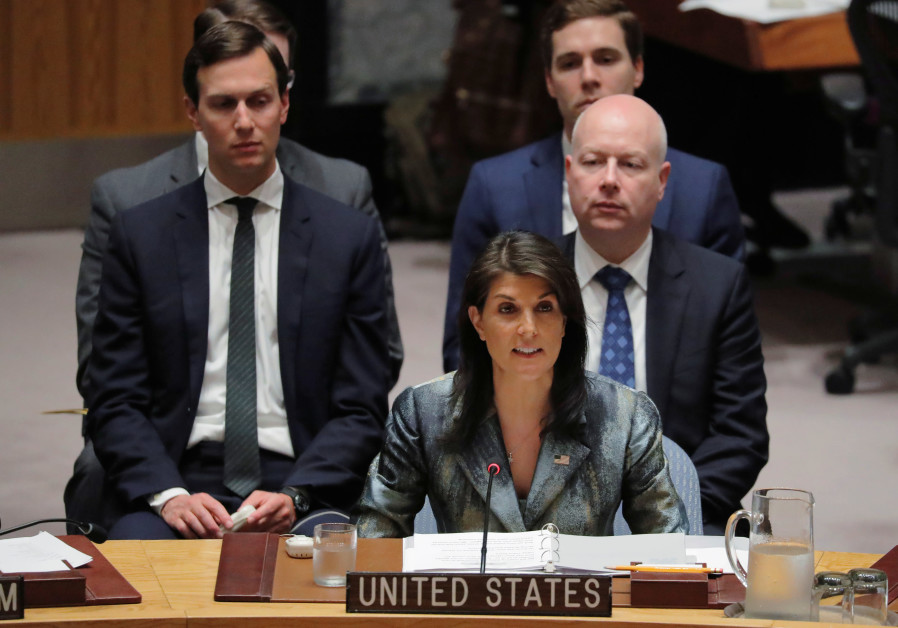
United States Ambassador to the United Nations (UN) Nikki Haley speaks in front of White House senior adviser Jared Kushner during a meeting of the UN Security Council at UN headquarters in New York, U.S., February 20, 2018. . (photo credit: REUTERS)
US President Donald Trump’s plan for Israeli-Palestinian peace may be the most closely guarded policy secret in Washington these days, 18 months in the making and yet still known only to the small handful of men behind it.
Senior administration officials describe the plan as detailed, pragmatic, and essentially complete. All that prevents them from publishing it is their sense that the timing is off.
They are waiting for some ripe moment to present itself – perhaps when the Palestinian leadership decides to give the administration a second chance after writing it off for recognizing Jerusalem as Israel’s capital last year. But such a moment seems unlikely any time soon. The Palestinian Authority, which has not seen the plan, says that Trump’s peace team has given every indication that its contents will reflect bias in favor of Israel by sidestepping explicit references to a two-state solution, dismissing refugee claims, endorsing a permanent Israeli presence in the Jordan Valley, allowing Jewish settlers to remain in the West Bank and remaining silent on the future placement of a sovereign Palestinian capital.
There are reasons to believe they are right. While the White House insists that its recognition of Jerusalem as Israel’s capital does not predetermine sovereignty over the entire city in an eventual peace agreement, it has never explicitly stated, as it did with Israel in December, that Palestinians have a reciprocal right to a capital in the holy city – or to any capital at all.
They have removed all reference to a two-state solution, to Palestinian independence or Palestinian territories from State Department language, dismissing those terms as “meaningless” without yet spelling out alternatives. And they have defunded the UN Relief and Works Agency, characterizing the Palestinian aid organization as a corrupt and inefficient body perpetuating a false narrative on refugees unhelpful to the pursuit of peace.
“The traditional core issues are essential and we focus on them extensively with a strong appreciation of the historic differences between the two sides,” Jared Kushner, the president’s son-in-law and senior adviser leading the peace effort, told the Palestinian Al-Quds newspaper in June. “We are committed to finding a package of solutions that both sides can live with.”
But, he added: “Simply resolving core issues without creating a pathway to a better life will not lead to a durable solution.”
Kushner and Jason Greenblatt, the president’s special representative for international negotiations, have said their plan tackles some of the thorniest issues in the conflict with specificity and ingenuity – a truly novel take on a geopolitical challenge that has, for too long, been mired in stale thinking. But while past efforts have failed, the careful balance American presidents have walked in since 1967 has allowed them to bring both sides around the same table, to the precipice of an agreement multiple times. Trump’s approach thus far has not. The reason the timing has been off may be because the approach is off.
TRUMP’S TEAM says that the PA leadership is prejudging what is in their plan before they see it, and this much is true: Palestinian officials, like the rest of us, have been left to read tea leaves based on the behavior they have seen thus far. If the plan includes revelatory material that defies expectations – as the team claims – then it should not wait for a moment of kindness from the Palestinians to present itself before releasing the plan. That moment will be created by the presentation of the plan.
The peace team seems to be considering this approach, expressing confidence that their work will see the light of day whether or not the Palestinians come around beforehand. They say the plan will include proposals that both parties will love and hate, and lament that they are frequently forced to dismiss rumors on the contents of their plan that scatter news reports.
But in testing whether the time is right for a rollout, the administration may be releasing trial balloons – based both on false as well as genuine tidbits from the plan – to gauge public response, knowing full well it can simply deny whichever ones float too high. Regardless of the strategy, public response has been self-evident as the plan is still under wraps.
Palestinian leaders are skeptical Trump’s team will ever support a policy that disadvantages Prime Minister Benjamin Netanyahu, and at some point, it will have to prove them wrong to earn their trust back. And report in Foreign Policy magazine last week, which quoted Kushner from back in January questioning the role of UNRWA, did them no favors. White House officials said it was a stretch to say they were denying the refugee status of millions of Palestinians simply by challenging UNRWA’s mandate, which treats the descendants of refugees from the 1940s the same as their modern-day ancestors. But Palestinian leaders saw Kushner’s comments in an e-mail calling for the “disruption” of UNRWA as further evidence of his plans to erode Palestinian claims to a homeland there.
There is one new sign the administration is working on a rollout with direction and purpose. The Associated Press reported last week that the peace team had begun staffing up, on-loading officials from the State Department and National Security Council to create working groups on the policy dimensions of the plan, the economic components of the plan and the strategic sale of the plan to the public. The formation of these teams would indicate that a release is not imminent – these staffers still need time to get into place and prepared – but that publication could be ready in the coming months.
“You can’t put something out where everybody says, ah, this is dead on arrival,” a senior administration official told The Jerusalem Post in June. “You can’t do that. And the same exact document that may be dead on arrival on a Monday might not be dead on arrival on a Thursday. That sounds kind of counterintuitive, but that’s the way this works.”
Palestinian protesters at the Israel-Gaza border, in Khan Yunis in the southern Gaza Strip, on August 3, 2018. (AFP/Said Khatib)
The Hamas terrorist group on Friday said the so-called “March of Return” border demonstrations would continue unimpeded later in the day, despite a cessation of hostilities with Israel clinched the night before.
The announcement came after a 12-hour lull in fighting, following two days that saw the heaviest exchange of Palestinian rocket fire and reprisal Israeli airstrikes since the 2014 Gaza war.
For the past four months there have been near-weekly, violent protests along the Israel-Gaza border organized by Gaza’s Hamas rulers.
Hamas spokesman Hazem Qassim tweeted on Friday that demonstrators would continue to “break the siege” on the Gaza Strip.
“Every time the Israeli killing machine attempts to break our people’s will to continue its struggle and marches, it fails to do so,” he wrote. “Today our people will head to the ‘Marches of Return’ to challenge the Israeli war machine.”
“Our Palestinian people has a long-lasting, struggling soul,” the Hamas spokesperson wrote. “It will continue its resistance in all of its forms until it gains its freedom, independence and right to a dignified life.”
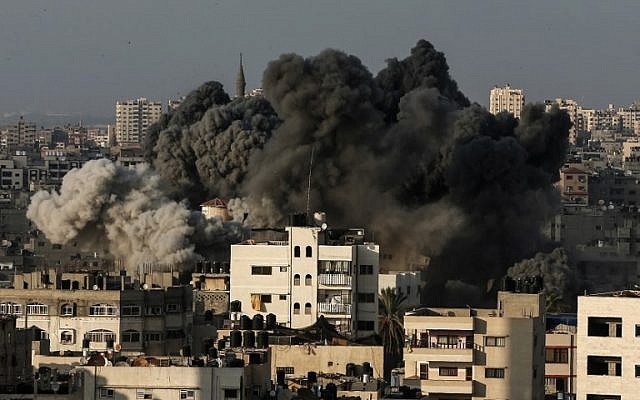
A plume of smoke rises from the remains of a building west of Gaza City that was targeted by the Israeli Air Force in response to a rocket attack that hit southern Israel earlier in the day on August 9, 2018. (Mahmud Hams/AFP)
Over the past four months the “March of Return” protests have led to deadly clashes which saw Israeli security forces facing gunfire, grenades, Molotov cocktails, and efforts — sometimes successful — to damage or cross the border fence.
At least 160 Palestinians have been killed by Israeli fire since the weekly protests began, the Hamas ministry says. Hamas has acknowledged that dozens of those killed were its members.
One Israeli soldier was shot dead by a Palestinian sniper.
In addition to the border clashes, southern Israel has experienced hundreds of fires as a result of incendiary kites and balloons flown over the border from Gaza. Over 7,000 acres of land have been burned, causing millions of shekels in damages, according to Israeli officials.
Council heads and mayors in southern Israel are furious at Prime Minister Binyamin Netanyahu and Defense Minister Avigdor Lieberman for their desire to seek a cease-fire with Hamas instead of launching a military operation to destroy Hamas and restore Israeli deterrence after Hamas launched about 200 rockets against Israel in under two days.
Tamir Idan, head of the Sdot Negev Regional Council, said that “no one has informed us of the cease-fire. There was no hesitation. Hamas determines when fighting will begin, and when it will end.”
“We expect a military operation that will remove Hamas, or a comprehensive and long-term arrangement that will include all kinds of terror,” Idan added.
Sderot Mayor Alon Davidi echoed Idan’s sentiments: “I understand the desire to reach negotiations, but in my opinion the cease-fire is a mistake. We will have to reach an operation, to eradicate this terror. The intermittent war is unhealthy for us and not good for the State of Israel,” Davidi said.
Gadi Yarkoni, head of the Eshkol Regional Council, expressed the hope that any peace agreement with the Gaza Strip would include economic support for the communities surrounding the Gaza Strip. “An ongoing reality of four months of security tension reached an extreme point yesterday. We went through a day of heavy barrage of fire to our communities and canceled educational activities and cultural and community events.”
“In the past few hours there has been quiet and we hope that the latest tension has been ‘the storm before the calm’, after which there will be an arrangement that will ensure long-term calm,” Yarkoni said.
Jewish Home MK Bezalel Smotrich slammed Defense Minister Liberman for failing to take decisive action against Hamas.
“Defense Minister Avigdor Liberman is proving to a ceaseless prattler. He is one of the weakest and strategically ignorant people in the State of Israel, and the one who has the greatest gap between his words and his actions. He cannot to serve as defense minister in the next term,” Smotrich said.
The head of the IDF’s Southern Command Maj. Gen. Herzl Halevi, center-left, speaks with Sderot mayor Alon Davidi, center-right, during a visit to the southern town, which was hit repeatedly with rocket fire from the Gaza Strip on August 9, 2018. (Israel Defense Forces)
Leaders of Israeli cities and towns near the Gaza border on Friday criticized the government over an apparent ceasefire with Hamas and called for a long-term solution, after a two-day bout of violence saw the heaviest exchange of fire between Israel and the Gaza terrorist organization since the 2014 war.
Hours after fighting grounded to a halt, local officials called on the government to secure a permanent end to rocket fire from the Palestinian coastal enclave, whether by military or diplomatic means.
Residents of southern Israel for several months have been rattled by a series of one or two-day rounds of fighting between Hamas and Israel, sending them scrambling to their bomb shelters and raising fears of war. In all cases, violence later subsided under ceasefires negotiated by Egypt and the UN, before resuming weeks later.
Alon Davidi, the mayor of Sderot, which suffered the brunt of the rocket fire from Gaza, said the effective truce was a “mistake” and that the IDF must decisively curb attacks on Israel through military action.
“I understand the desire to enter negotiations, but in my opinion the ceasefire is a mistake,” Davidi said. “We need to a military operation to eradicate this terror. The intermittent war is unhealthy for us and unhealthy for the State of Israel.”
The Hamas terror group said a ceasefire had been reached “on the basis of mutual calm” and went into effect at midnight. It said the deal was mediated by Egypt and other regional players.
Alon Davidi, mayor of the southern Israeli city of Sderot, attends a press conference in Jerusalem, March 27, 2017. (Hadas Parush/Flash90)
Israel denied there was a truce, but a senior Israeli official told Israel Radio that “quiet would be met with quiet.” There were no instances of violence reported along the border overnight.
Gadi Yarkoni, the head of the Eshkol Regional Council adjacent to the Gaza border, said that he hoped the sides would reach a permanent solution.
“This drawn-out reality of four months of security tension reached its climax yesterday,” he said. “We went through a day of heavy firing on our towns, we had to stop educational activities as well as cultural and communal events. In the past few hours there is quiet and we hope that the recent tension was ‘going up for the sake of coming down,’ and afterwards we will have an agreement which will guarantee quiet for the long term.”
He said the uncertainty was taking its toll on the local population.
Gadi Yarkoni (R) of the Eshkol Regional Council (Facebook)
“The events of the past few months and the sharp transitions from calm to emergency have a serious impact on the residents of the Gaza periphery.”
Tamir Idan, head of the Sdot Negev Regional Council in southern Israel, also said the reported ceasefire was a mistake.
“If we are really talking about a ceasefire, which has not yet been officially confirmed, it is in my opinion a serious mistake, creating a framework in which we have a new normality whereby Hamas controls the fire and decides when to end it,” he said, according to a Walla news report.
“We expect sharp, harsh and unequivocal action against Hamas which will end the terror in all its forms immediately, and which will allow the residents of the Gaza periphery to return to normal like all other citizens,” he added.
The leaders of Moshav Netiv Ha’asara, adjacent to the border, said the ceasefire was “simply an embarrassment” and made a mockery of those who lived in the area.
“The place looks like a ghost town this morning,” the council head said. “Because of irresponsible announcements like these most of the families have fled. Only the farmers remain, who cannot leave, and they’ve been told that if they work it will be their responsibility — as if they have any choice — because from their perspective it is do or die.”
On Friday morning, the IDF Home Front Command announced that all security restrictions in southern Israel had been lifted.
The reported ceasefire on Thursday came just an hour after the security cabinet completed a four-hour meeting on Gaza, instructing the military to “continue acting forcefully” against terror groups in the Strip,
IDF spokesman Lt. Col. Jonathan Conricus said Thursday that Gaza terror groups have fired about 150 rockets at Israel in the past 24 hours, while Israel has struck some 140 Hamas targets in Gaza.
He said the rocket that landed in Beersheba — some 40 kilometers (25 miles) from the Gaza border– required a more powerful, longer-range rocket, marking a significant escalation in violence.
A picture taken on August 9, 2018, shows people inspecting the rubble of a building targeted by the Israeli Air Force in response to a rocket attack that hit southern Israel earlier in the day on August 9, 2018. (AFP Photo/Mahmud Hams)
1. Until we meet again: A day of rocket strikes and Israeli reprisal raids ended with a shaky ceasefire, but nobody is convinced the last projectile has been fired and the feeling that war is in the offing is stronger than ever.
If those words look familiar, it’s because I published them on July 15, but it’s just as relevant today, as it may be after the next round of fighting. If Israel and Hamas are stuck in a seemingly endless loop of bad decisions and worse consequences, then the two are currently in the hangover stage after another bender, searching blurry-eyed for their AA sponsor’s phone number, but instead finding a series of texts from their bros inviting them for another night out.
“Until next time,” reads a headline on a Yossi Yehoshua column in Yedioth Ahronoth, which kind of says it all.
As a sign of the frustration felt not only in the border region, at an outdoor performance of Verdi’s Nabucco in Tel Aviv Thursday night attended by tens of thousands, the conductor stopped the show before the famous “Va Pensiero” (The Hebrew slaves’ chorus) to dedicate the song to the residents of the south and demanded that “something must change so kids can sleep at night, on both sides of the border.” It received the largest applause of the night.
2. Keep it copacetic: Calm can be reached either through war or a long-term deal and it seems that while the army and Hamas prefer the latter, others are insistent that girding for battle may be the better choice.
The defense establishment thinks the chances of all-out war have decreased significantly, Haaretz reports.
A Hamas official says that the terror group is not interested in going to battle, but wanted to send a message that it won’t tolerate being attacked, according to Channel 10, citing Asharq al-Awsat.
The rescinding of special instructions keeping southerners close to their bomb shelters is seen by many as a sign that the army believes the ceasefire will remain in place, at least for a few days.
But Israel is clearly girding for the next round and trying to return what little is left of its deterrent capability, as evidenced by the front page of Israel Hayom, seen as a government mouthpiece, vowing with a large headline that “The attacks will continue until the rockets stop.”
3. The last bullet: While a ceasefire after a day of rockets seems de riguer at this point, it’s still a feat to get the sides to stop fighting, writes former national security adviser Yaakov Amidror in Israel Hayom.
“Both sides want to prove that they can keep firing, because a one-sided ceasefire will be seen as weak,” he writes.
“Neither side wants to lose control, nobody wants this to descend into war, but each side is fighting for the right to shoot the last bullet,” Nahum Barnea writes in Yedioth Ahronoth.
4. US pressure: That Egypt puts pressure on Hamas to stop firing rockets is an old story, but Haaretz’s Zvi Bar’el says that the US is also putting pressure on Israel to keep from hitting Gaza too hard.
“Both Washington and Cairo see ending Gaza’s humanitarian crisis as much more important than dealing with the tactical confrontation between Israel and Hamas,” he writes.
Bar’el also notes that both Egypt and Israel (and the US) want to rebuild Gaza with a responsible party in charge, a status they have all granted to Hamas: “In the past, Israel negotiated with Hamas only over prisoner exchanges and ceasefires. Now, it’s holding diplomatic and economic negotiations with Hamas over Gaza’s future. The fact that Israeli and Hamas officials aren’t negotiating directly doesn’t change the fact that talks are taking place.”
5. Aiming at the IDF: Not all Israelis are willing to view Hamas as a partner, even a secret one. Representing those — including many in the government — who want the IDF to go further against the terror group, Israel Hayom’s Amnon Lord issues a scathing attack on the military..
“The army doesn’t want to kill balloon and kite launchers and places itself as judge over someone who has been convicted of murder who says, ‘I was forced to pull the trigger, what can I do.’ But on the other side of the border is the body.”
“That’s how it is in the western Negev. On the Gazan side they are ‘kids’ but on our side is the destruction of thousands of dunams.”
He’s not alone. In the right-wing Israel National News website, columnist Boaz Shapiro also directs fire at the heads of the army — and the government — whom he says “have long shown weakness and inertia which are not understood on any level, and are not transparent.”
“Tell me… do important people not understand what even a child understands,” he writes, directing his message specifically at prime Minister Benjamin Netanyahu, Defense Minister Avigdor Liberman, and army head Gadi Eisenkot.
6. Scaredy rabbit: Channel 20, also on the right, put together a strange gag on Thursday in which anchor Boaz Golan interviewed a bunny (the Hebrew version of a scaredy cat), apparently to show how weak the army and government are.
“Netanyahu is doing great work in many fields, but with anything regarding Gaza, many feel he has failed,” presenter Boaz Golan wrote later.
7. Dome of Arc: If there’s anything the Israeli press does agree on, it’s on the sublimity of this picture of an Iron Dome rocket interceptor, captured by Amir Cohen of Reuters.
Incredible @Reuters photo (Amir Cohen) of Iron Dome interception of Gaza rocket. It’s like that scene in Harry Potter where his wand meets with Voldemort’s. pic.twitter.com/xUSUfXFZH9
The picture, or variations of it, grace the pages and screens of pretty much every media outlet (at least those that subscribe to Reuters).
8. Bogota bummer: Mystery still surrounds Colombia’s decision to recognize Palestine, just as the country seemed to be moving closer to Jerusalem, and came as a surprise to pretty much everybody.
Before the news became public (though after the outgoing government of Juan Manuel Santos signed the official recognition) Tzachi Hanegbi, representing Israel at the inauguration of new president Ivan Duque, wished the outgoing administration luck and happily gave interviews, a sign of how clueless Israel’s government was about the news, ToI’s Raphael Ahren reports.
Mixed messages were coming from Bogota, long considered Israel’s most staunch ally in Latin America, following the move, leaving Israel’s Foreign Ministry nonplussed and unable to answer reporters questions for 16 hours after the move was announced. The only one to make a statement was Israel’s Embassy in Bogota, which issued an angry denunciation, in Spanish.
“The fact that ministry spokesperson Emmanuel Nahshon did not even provide reporters with a Hebrew translation of the Bogota embassy’s angry statement led Israel’s Diplomatic Correspondents’ Association to send him a formal protest letter,” Ahren writes.
A Palestinian source tells ToI that the move was because Santos “agreed that Netanyahu doesn’t do anything to advance peace.”
Amichai Stein, a reporter for Israel’s public broadcaster, writes on Twitter that a Colombian official told him that the new government may yet reverse the cancellation.
#BREAKING: Colombian official tells me: “All options are on the table – including the cancelation of the recognition of the Palestinian state”. Confirms the former & the current FM minister spoke on this issue in the past, but says “They were surprised of the announcment” https://t.co/tAeYh19ppO
9. Just say no: Haaretz Knesset correspondent Chaim Levinson jokes on Twitter that Likud lawmakers are now demanding Colombia stop importing drugs into Israel.
10. Who is Israel: With Sacha Baron Cohen continuing to make headlines each time a new episode of “Who is America” comes out, especially for the exploits of his Israeli macho character Erran Morad, Shmuel Rosner writes in the New York Times that the stereotype might reflect more on Americans than Israelis.
“Israel’s most avid supporters in America might like us more as crude machos than as start-up entrepreneurs. They might even prefer our satirized fossils to our real selves,” he writes.
But Rosner also says that the stereotype isn’t false and there are still many “Morads” roaming about Israel: “Every Israeli who serves in the military knows that we still have Morads. But for every idiotic Morad, we also have two prankish Cohens. That’s why we can afford a laugh.”
Terrorist groups in Hamas-controlled Gaza fired 180 rockets into Israel on Wednesday and Thursday, including a long-range rocket that landed near the southern Israeli town of Beersheba.
The Israel Air Force struck back, flattening a Hamas security headquarters.
The international media went into its usual anti-Israel spin mode, describing the violence as “clashes” instead of what it was: an unprovoked attack on civilians by Hamas, which is using the violence to gain diplomatic leverage and convince the world to send money.
Israeli leaders, and the Israeli public, are beyond frustrated — even though the U.S.-funded Iron Dome system has destroyed many of the rockets. Some are calling for Hamas leaders to be targeted. Many want Hamas itself to be crushed once and for all.
If Israel wants to destroy Hamas, and liberate the Gaza Strip from its iron-fisted Islamist rule — now more than a decade old — there will never be a better time. President Donald Trump is the most pro-Israel leader the United States has ever produced, and his team of Middle East negotiators are so frustrated with Palestinian intransigence that they have called for cutting economic aid to Gaza.
If Israel were to undertake a tough ground assault, with Hamas hiding behind civilians in hospitals and in booby-trapped buildings, it would — finally — have a friend in the White House who would withstand international pressure and allow it to fight until victory.
Moreover, Iran, the patron of regional terror, is in the midst of a crippling economic and political crisis. The Iranian regime, tied down in Syria, struggling with a collapsing currency, and facing mass protests in the streets, would hesitate before helping its proxy terror groups in Gaza. It would also be less likely than in the past to open a northern front by using Hezbollah to attack Israel.
The window of opportunity may not last long. Democrats have a good chance of winning back the U.S. House of Representatives in November. If they do, they will bring a new crop of anti-Israel politicians to Washington, along with a new hostility to Israel. Not one Democrat attended the opening of the new U.S. embassy in Jerusalem earlier this year, and none attended the party at the Israeli embassy in Washington, DC, to mark the occasion. The party rank-and-file are increasingly drawn to Israel-hating leaders.
One such is Alexandria Ocasio-Cortez, who will likely win New York’s 14th congressional district. She recently complained about the “occupation of Palestine” (despite not being able to explain what it was), and sided with Hamas over Israel in border clashes.
Another is Rashida Tlaib, a Palestinian-American who won the Democratic primary in Michigan’s 13th congressional district on Tuesday. She is close to antisemite Linda Sarsour, and backed Palestinian terrorist Rasmea Odea in her bid to avoid deportation.
A House controlled by Nancy Pelosi would make it harder for the Trump administration to support Israel. Republicans could still win, but Israel cannot afford to take that chance. If it wants to “free Palestine” from Hamas, the time may be now — or never.



 The synagogue in Gothenburg, Sweden was firebombed on December 9, 2017. (Image source: Lintoncat/Wikimedia Commons)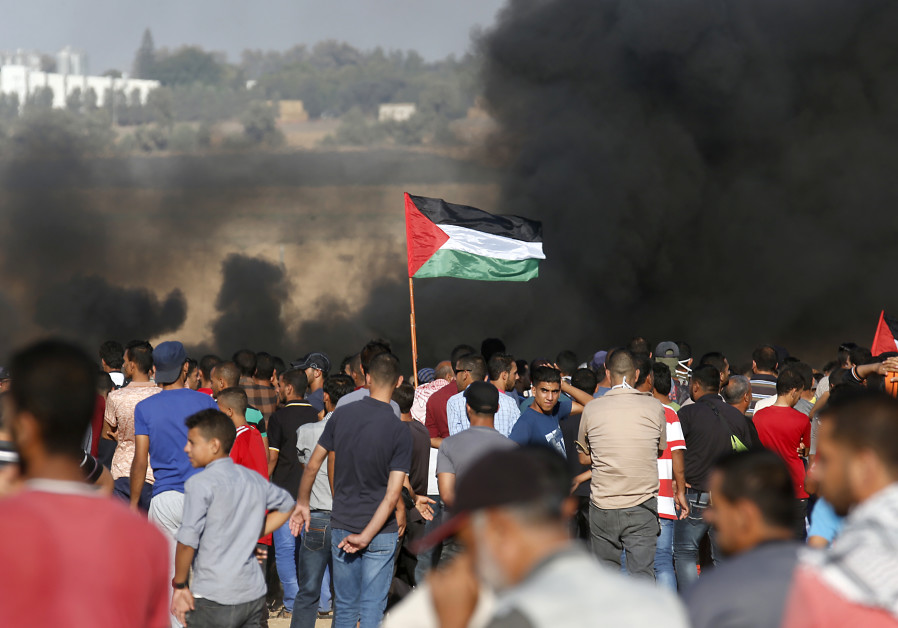











 anneinpt
 artaxes
 danmillerinpanama
 davidking1530
 Peter Hofman
 Joseph Wouk
 Peter
Peter Louisiana Steve
 WarSclerotic
Recent Comments