Author Archive

Trump Admin Permits Iran to Continue Nuclear Work at Secretive Military Sites

November 6, 2018

Concessions to Europe complicate administration’s Iran sanctions rollout

BY:

Trump Admin Permits Iran to Continue Nuclear Work at Secretive Military Sites

The Trump administration has allowed European countries to continue cooperating with Iran’s nuclear activities at a contested, secretive facility where Iran had wanted to make weapons-grade uranium, one of many loopholes in the recently announced sanctions reimposition that Iran hawks have criticized as being too weak.

Iran is being given a pass from the administration to continue nuclear projects at the Arak, Bushehr, and Fordow facilities, all contested sites that have been at the center of Tehran’s secretive nuclear enrichment work in the past.

The decision is part of a package of concessions granted by the Trump administration to Iran and European allies as a bevy of new U.S. sanctions go back into effect. In addition to permitting continued nuclear projects, the administration has walked back its vow to cut Iran’s oil exports to zero and fully disconnect Tehran from the international banking system.

These concessions, first reported last week by the Washington Free Beacon and subsequently confirmed by numerous publications, have riled Iran hawks on Capitol Hill and elsewhere who have long fought to close all existing loopholes in U.S. sanctions.

The State Department on Monday confirmed the Free Beacon‘s reporting, issuing a statement admitting to granting waivers for nuclear projects in Iran.

“We are specifically permitting nonproliferation projects at Arak, Bushehr, and Fordow to continue under the strictest scrutiny to ensure transparency and maintain constraints on Iran,” the administration announced.

“Permitting these specific activities to continue is an interim measure that preserves oversight of Iran’s civil nuclear program,” according to the statement, which has sparked fierce pushback from Iran hawks. “It enables the United States and our partners to reduce the proliferation risks at Arak, maintain safe oversight of operations at Bushehr, limit Iran’s stockpile of enriched uranium, and prevent the regime from reconstituting sites such as Fordow for proliferation-sensitive purposes.”

“This oversight enhances our ability to constrain Iran’s program and keep pressure on the regime while we pursue a new, stronger deal,” the administration maintained, hinting at efforts to preserve the landmark nuclear deal that Trump abandoned in frustration over what he described as glaring loopholes that have empowered Iran’s global terror operations.

While the administration will not consent to Iran undertaking new nuclear activities, it has conceded permission for European allies to continue projects already underway in the country.

“We are not issuing waivers for any new civil nuclear projects,” according to the administration. “We are only permitting the continuation for a temporary period of certain ongoing projects that impede Iran’s ability to reconstitute its weapons program and that lock in the nuclear status quo until we can secure a stronger deal that fully and firmly addresses all of our concerns.”

Advocates of a hardline approach to Iran in Congress say they are not being fooled by the administration’s rhetoric, which has historically been tough but is not being backed up with action.

“It’s not maximum pressure if Iran gets to keep selling oil, gets to keep accessing the global financial system, and—now—gets to keep working on its nuclear program with help from Europe, Russia, and China,” said one senior Republican congressional official.

“The administration is even letting Iran continue working with partners at Fordow, a bunker built into the side of a mountain which even Obama used to say needed to be closed,” the source said. “The policy announced today will lock in the nuclear deal under Trump’s watch.”

Added a second GOP congressional official working on the matter: “The pro-Obama deep state and Tillerson holdovers in Foggy Bottom strike back.”

David Albright, a veteran nuclear expert who runs the Institute for Science and International Security, told the Free Beacon the waiver issued for the contested Fordow nuclear facility is “hard to swallow.”

“It was grouped with the Arak reactor and a nuclear safety center, and hard to separate off,” Albright explained. “Those two provide concrete benefits, namely a reactor no longer able to make much plutonium and less fear that Bushehr, or for that matter the little Tehran Research Reactor, will melt down and spread dangerous radiation throughout the region.”

“Fordow employs centrifuge experts in a non-uranium enrichment process, which is good, but the whole process is quickly reversible,” Albright warned. “Those experts could be rapidly reassigned to work on advanced centrifuges to enrich uranium and Fordow could be restarted to enrich uranium.”

With Fordow continuing its operations, the issue is likely to “complicate, but not unravel future negotiations aimed at ending enrichment in Iran, which appears to be the Trump administration’s goal,” Albright said. “It is justified since Iran has no civil need to enrich uranium. Given its immense cost, and the ability to buy enriched uranium for civil purposes internationally at far less cost, any increase in domestic Iranian enriched uranium production should be viewed as military activity.”

Moreover, if “Iran violates the nuclear limits or refuses IAEA [International Atomic Energy Agency] inspections, then the E3 [in Europe] will have a responsibility to snap back sanctions under the JCPOA,” Albright added. “In anticipation of that possibility, the United States should continue to publicly make clear that it will not allow Iran to acquire nuclear weapons.”

Organizations that have supported the Trump administration’s moves on Iran also have expressed caution with the new concessions, another sign of mounting frustration among those who expected the White House to get tough with Tehran.

“The implementation of a maximum pressure, full economic blockade on Iran is the only way to force the regime to change its malignant behavior,” United Against Nuclear Iran (UANI) Chairman Sen. Joe Lieberman and CEO Amb. Mark Wallace said in a statement. “This campaign should include action by SWIFT to disconnect Iranian banks and no repeat of these oil waivers after 180 days. Anything else will continue allowing the world’s leading state sponsor of terrorism to fund its global terror campaign.”

A mental health Break .

September 30, 2018

My Art, My Life

For more info contact the artist directly or contact me .


IDF attacks Hamas posts in Gaza

September 16, 2018

IDF aircraft and tank attack posts belonging to Hamas as violent riots continue.

Elad Benari, Canada, 14/09/18 20:06 | updated: 20:24
Reuters

IDF aircraft and a tank on Friday attacked two positions belonging to the Hamas terrorist organization along the Gaza border, in response to a number of grenades and explosive devices that were hurled at IDF forces during violent disturbances along the security fence.

In addition, an IDF officer was slightly injured by shrapnel from a pipe bomb that was thrown at the soldiers. The officer was given medical treatment at the scene.

In a statement, the IDF said, “The Hamas terror organization is responsible for all events which take place in Gaza and from it.”

“The IDF will continue to thwart attempts to harm Israeli civilians and IDF troops in order to protect Israel’s borders and civilians.”

The weekly violent “March of the Return” riots continued on Friday, as they have every week since March 30.

On Friday morning, IDF troops neutralized an explosive device located near the Gaza border.

The device was discovered near the border fence separating southern Gaza from Israel. No injuries or damages were reported.

Overnight Thursday, a pipe bomb was thrown at IDF soldiers in the Rafah area in the southern Gaza Strip.

There were no injuries among the soldiers. Fire was opened towards three Palestinian Arab suspects who were identified as they crawled towards the security fence. It is unknown if they were injured by the gunfire.

The incident took place less than a day after IDF troops uncovered an explosive device placed by Gazan terrorists adjacent to the security fence in southern Gaza.

IDF troops disposed of the explosive device and thwarted the attempted attack against IDF soldiers.

No injuries were reported and no damage was caused.

(Arutz Sheva’s North American desk is keeping you updated until the start of Shabbat in New York. The time posted automatically on all Arutz Sheva articles, however, is Israeli time.)

Report: Israel Attacks Damascus International Airport [video]

September 16, 2018

Report: Israel Attacks Damascus International Airport

Missile intercepted by Syrian aerial defense at Damascus International Airport-Photo Credit: SANA / screen capture

Israeli warplanes attacked Damascus International Airport late Saturday night, according to the Syrian Arab News Agency (SANA). Syrian government anti-aircraft defense systems were activated, with a number of anti-aircraft missiles launched in response to the attack, according to SANA.

A spokesperson for the Israel Defense Forces said Israel does not comment on foreign reports.

“Our air defenses responded to an Israeli missile attack on Damascus International Airport and shot down a number of hostile missiles,” said a Syrian Arab Army source quoted by SANA. A statement by the Syrian Arab Army posted to Facebook stated, “We have reports of a large flaming mass being seen after it was shot down, but we cannot yet confirm whether a jet was shot down or not. The above video was taken of a live interception to one of the incoming targets and was provided by a visitor to the Damascus International Fair which is currently [being] held.”

According to international military analyst Eva J. Koulouriotis, there were two separate raids by the Israel Air Force on two Iranian sites near the airport.

“Preliminary information indicates that one of the sites targeted by Israeli warplanes is a warehouse of Iranian weapons that were transferred to Syria a few days ago…,” Koulouriotis wrote at the start of a series of tweets. “Information confirms that the second target is a military cargo plane belonging to the Iranian Revolutionary Guards inside Damascus International Airport which landed hours ago… A source confirmed that the shipment of sophisticated weapons targeted was intended to be transferred and handed over to the Hezbollah Lebanese terrorist militia inside Lebanon,” she tweeted.

Local sources reported the strike was aimed at Iranian military targets near the airport, and said at least four explosions were heard, adding there appeared to be an attack on an underground compound near the airport.

How a Herman Wouk novel shaped the debate over removing an unfit president

September 15, 2018

The 25th Amendment to the US Constitution got a little inspiration from a passionate Jewish lawyer in ‘The Caine Mutiny’

WASHINGTON (JTA) — It’s hard to follow the news these last weeks without running into a reference to the 25th Amendment to the United States Constitution, which provides for the removal from office of a president unfit to serve.

Questions about Donald Trump’s capacity to govern arise in “Fear,” Bob Woodward’s chronicle of the Trump presidency that was released last week. Also last week, an anonymous senior administration official writing in an op-ed in The New York Times described a mercurial and dangerous president and said that whispers of triggering the 25th Amendment suffuse the workings of the administration.

Vice President Mike Pence, who would become president were the amendment triggered, denied that it was under consideration.

Omarosa Manigault Newman, an adviser to Trump who was fired earlier this year and has written her own book about administration dysfunction, claims that other officials tag #TFA in texts to each other about Trump’s mental peregrinations.

What’s less known is that the amendment owes its existence in part to a riveting scene of Jewish angst in a popular novel, play and movie, “The Caine Mutiny.”

This May 15, 2000, file photo, shows author Herman Wouk in Palm Springs, California. (AP Photo/Douglas L. Benc Jr., File)

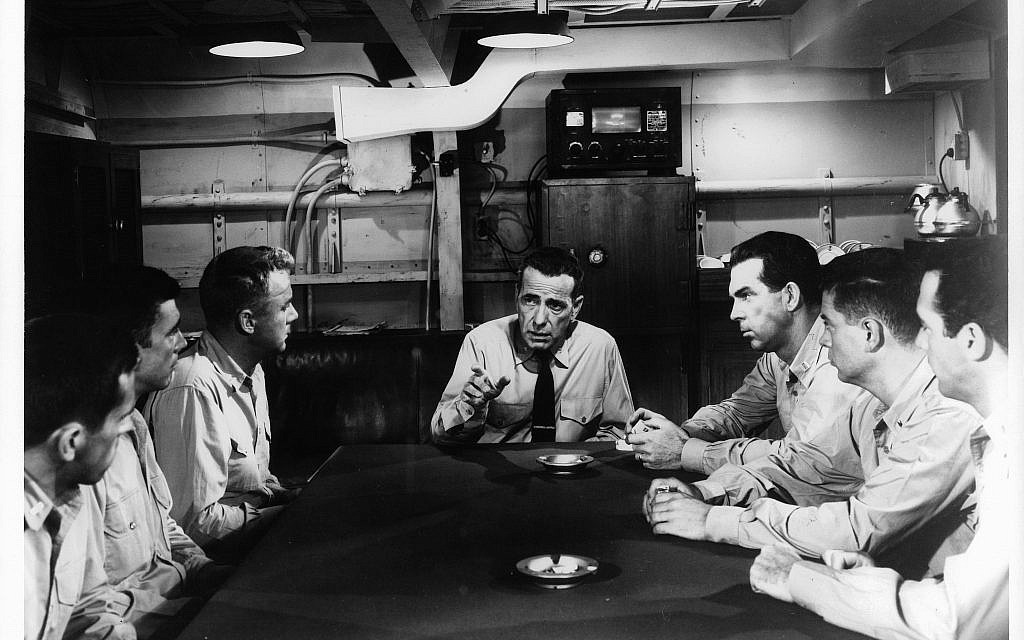
Spoiler alert for the three people in the universe who have not seen an iteration of the “Mutiny” on late night TV, at their high school theater or on “The Simpsons.” Herman Wouk’s 1951 novel is about a group of Navy officers who remove a volatile captain from his command of a minesweeper when he freezes up during a typhoon. The officers are tried for mutiny and acquitted. The Pulitzer Prize-winning book, the subsequent play and the 1954 movie made “Captain Queeg” a byword for erratic leadership.

Humphrey Bogart earned an Oscar nomination for his performance as Queeg, who nervously spins a pair of ball bearings in his hand and obsesses about missing strawberries before breaking down on the witness stand.

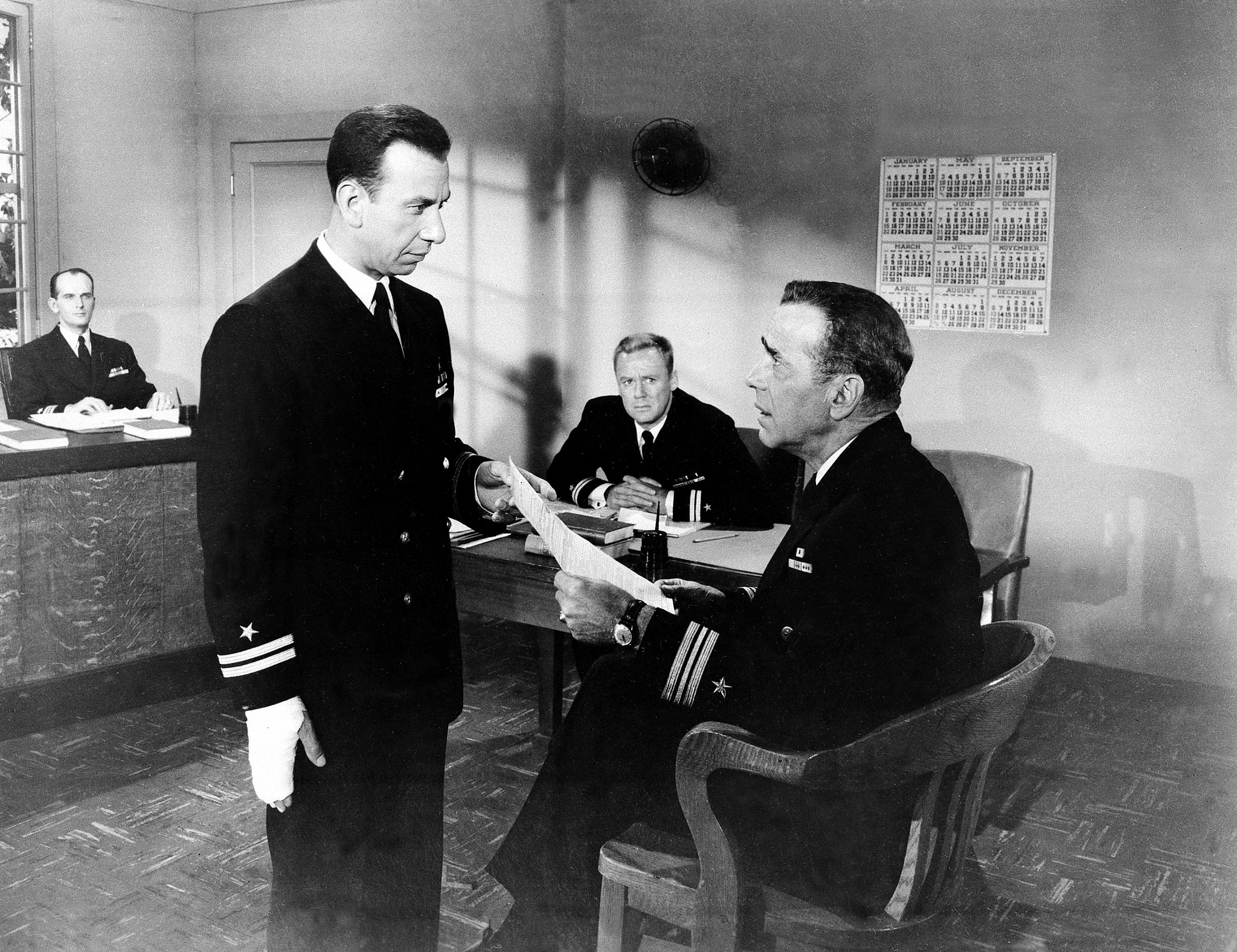
Jose Ferrer, left, portraying Lt. Barney Greenwald, Van Johnson, center, as Lt. Steve Maryk, and Humphrey Bogart, as Captain Philip Francis Queeg, appear in the 1955 Hollywood movie ‘The Caine Mutiny.’ (AP Photo)

Less well remembered is the twist at the end: At a celebration of the mutineering officers’ legal victory, Lt. Barney Greenwald, their defense lawyer, dresses them down for undermining Queeg before the typhoon. Greenwald insists that had the crew given Queeq the loyalty he deserved, he would have had the confidence to take control during the storm.

In the novel and the play, Greenwald’s Jewishness is made explicit.

“Greenwald’s Jewishness is at the moral heart of the piece, drama that rings true every moment,” a New York Times critic said in a positive review of the 1981 revival.

Men like Queeg, Greenwald tells the acquitted officers, protected the country from fascist invasion before the United States entered World War II, while the officers pursued lucrative careers until they were drafted.

The final scene of the film — Hollywood! — denudes Greenwald’s speech of its Jewish content but preserves the power of its message: The men who protected Americans from fascism deserved better consideration.

“The Germans aren’t kidding about the Jews, they’re cooking us down into soap over there,” Greenwald says in the novel. “I just can’t cotton to the idea of my mother melted down into a bar of soap … I owed [Queeg] a favor, don’t you see? He stopped Hermann Goering from washing his fat behind with my mother.”

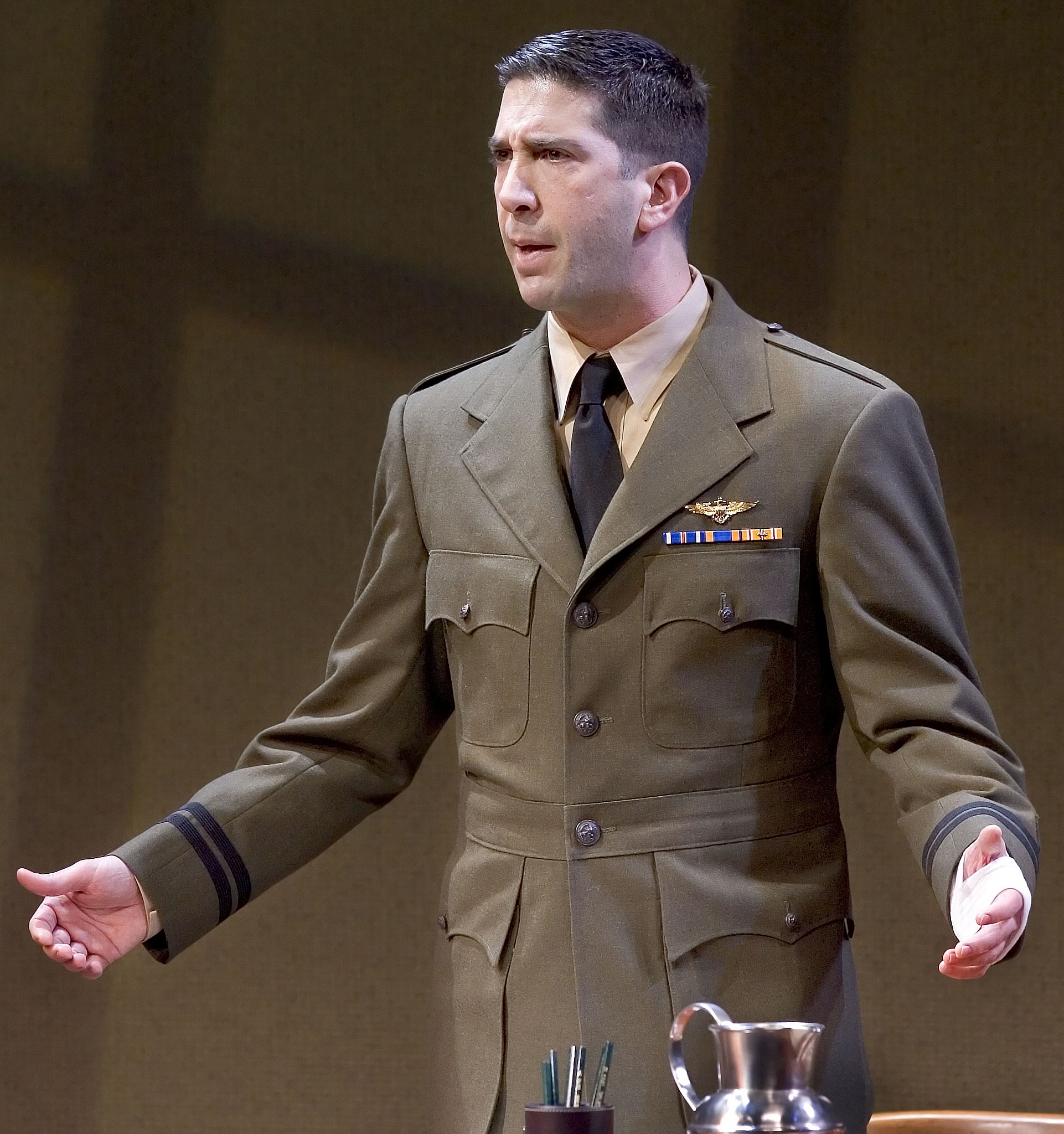
David Schwimmer plays the role of Lieutenant Barney Greenwald, during a revival of Herman Wouk’s 1954 courtroom drama ‘The Caine Mutiny Court-Martial,’ April 13, 2006, at the Schoenfeld Theater in New York. (AP Photo/Stephen Chernin)

The 103-year-old Wouk, who is Jewish, based the novel on his World War II experiences in the Navy. He served aboard two minesweepers, including the USS Zane. In addition to “The Caine Mutiny,” he wrote “The Winds of War,” a popular 1970s novel that made the plight of Europe’s Jews central to its sweeping account of US involvement in World War II. He has also written a primer on Judaism, “This is My God.”

Greenwald’s agonized plea that commanders deserve fuller consideration of their ability to lead before they are removed informed the process that led to the passage of the amendment in 1967, as The Washington Post reported last week.

John Sutherland, a Harvard law professor asked to advise on the issue, told the US House Judiciary Committee in 1956 about how he stayed up all night reading ‘The Caine Mutiny.’”

“Did you finish it in one night?” asked Emmanuel Celler, D-N.Y., the chairman of the committee, who eventually drafted the 25th Amendment with Sen. Birch Bayh, D-Ind.

“I finished it about 2 o’clock in the morning,” Sutherland said. “It is a bully novel.”

Sutherland apologetically added that he did not mean to “depreciate the solemnity” of the hearings by comparing the deliberations of Congress to a popular novel, but Celler, who was Jewish, appreciated the mention of Wouk’s work.

“It is an excellent analogy,” Celler said.

Sutherland likened a vice president who assumes the presidency simply by declaring the president incapable to Napoleon, who crowned himself emperor.

In this file photo taken on June 20, 2018 US Vice President Mike Pence speaks as US President Donald Trump looks on before signing an executive order on immigration in the Oval Office of the White House in Washington, DC. (AFP PHOTO / Mandel Ngan)

“Didn’t he seize the crown and put it on his own head?” he asked before adding that would not be acceptable to Americans.

John Feerick, a revered New York lawyer who helped draft the amendment, told the Post that the film was a “live depiction” of a constitutional crisis. The “Caine” analogy was not new to Feerick: He cited it in a 1965 book on presidential successions.

“A Vice-President would be on precarious ground in a case where a President had become insane, refused to declare himself disabled, or disagreed with the decision of the Vice-President,” he wrote at the time.

In those circumstances, Feerick wrote, a vice president might be “too reluctant to act or, if he did act, he might be labeled a usurper.”

The solution in the amendment is a complicated formula: A vice president must muster a majority of the Cabinet to declare to Congress that the president is no longer fit to govern, whereupon the vice president assumes the presidency. Should the president declare himself fit to govern, he reassumes the presidency, and the vice president and the Cabinet have four days to reassert to Congress that the president is indeed unfit. The vice president then reassumes the presidency for up to 23 days while Congress considers whether the president is fit to govern. Ousting the president requires a two-thirds majority in the Senate and the House of Representatives.

Three weeks and a two-thirds majority to consider whether a commander deserves the humiliation of ouster. Barney Greenwald would approve.

Trump administration adopts new definition of anti-Semitism in schools

September 13, 2018

By – on

Trump administration adopts new definition of anti-Semitism in schools

President Trump is going to change the way the U.S education department investigates anti-Semitism, to include delegitimizing Israel or holding Israel to a double standard that would not be expected from any other democratic nation. This is fabulous news. Anti-Israel and pro-BDS activity is raging on campuses all over the United States. As a result, pro-Israel Jewish students are being terrorized on college campuses.

“Palestinian” and pro-BDS groups criticized the decision harshly, claiming that their free speech rights are being violated. They’re lying. It is the free speech rights of pro-Israel Jews (on college campuses) that have been violated by the supporters of the BDS movement and other radical left-wing groups.

Pro-“Palestinian” groups refuse to allow civilized debate on the Israel-“Palestinian” conflict, because they know they can’t win. Instead, they bully, marginalize, intimidate, humiliate, and assault pro-Israel Jewish students, making it next to impossible for pro-Israel Jews (and non-Jews) to exercise their freedom of speech rights. President Trump’s decision was not only a victory for pro-Israel Jewish students, but also for Americans who care about freedom of speech.

President Trump has quite simply been a godsend for Israel and the Jewish people. President Trump has done more for Israel in less than two years than AIPAC has done in 50. Significantly more. Sadly, President Trump can expect to receive only 25 percent of the Jewish vote in 2020, at best.

“Trump administration adopts new definition of anti-Semitism in schools,” by Michael Stratford, Politico, September 11, 2018:

The Trump administration is changing how the Education Department investigates allegations of discrimination against Jewish students, backing an approach that is favored by pro-Israel groups but that critics worry will stifle free speech and criticism of Israel on campus.

The policy change was outlined in a letter last month by Kenneth Marcus, who leads the department’s Office for Civil Rights, in which he re-opened a 2011 investigation into Rutgers University in connection with alleged discrimination against Jewish students. The letter was obtained by POLITICO.

Marcus wrote in the letter that the Education Department, in its investigations into discrimination, would use the “working definition” of anti-Semitism that is “widely used by governmental agencies” including the State Department.

That definition includes examples in which delegitimizing Israel, or holding it to a double standard not expected of other democratic nations, are deemed anti-Semitic.

That meant the Office for Civil Rights for the first time was using a definition of anti-Semitism that some Jewish activists have long sought as a tool to curb discrimination on campuses. But some civil liberties organizations and advocates for Palestinian rights believe that the definition is so broad that it would label criticism of Israel as anti-Semitic.

Education Department spokeswoman Liz Hill denied that the administration had made a change. “The Department has not adopted a definition of anti-Semitism,” Hill said in an email.

“Secretary DeVos has made clear that OCR will look at the specific facts of each case and make determinations accordingly,” she added. “The facts in the Rutgers case, many of which were disregarded by the previous administration, are troubling.”

Ps: emphasis by PH

I Admit , yes really !

September 11, 2018

The weirdo in me let me do this .

Thanks to yo

To be plugged in or not to be plugged in !

September 10, 2018

US Says Assad Has Approved Gas Attack In Idlib, Setting Stage For Major Military Conflict

September 10, 2018

At this point there’s not even so much as feigning surprise or suspense in the now sadly all-too-familiar Syria script out of Washington.

The Wall Street Journal has just published a bombshell on Sunday evening as Russian and Syrian warplanes continue bombing raids over al-Qaeda held Idlib, citing unnamed US officials who claim President Bashar al-Assad of Syria has approved the use of chlorine gas in an offensive against the country’s last major rebel stronghold.”

And perhaps more alarming is that the report details that Trump is undecided over whether new retaliatory strikes could entail expanding the attack to hit Assad allies Russia and Iran this time around.

That’s right, unnamed US officials are now claiming to be in possession of intelligence which they say shows Assad has already given the order in an absolutely unprecedented level of “pre-crime” telegraphing of events on the battlefield.

And supposedly these officials have even identified the type of chemical weapon to be used: chlorine gas.

The anonymous officials told the WSJ of “new U.S. intelligence” in what appears an eerily familiar repeat of precisely how the 2003 invasion of Iraq was sold to the American public (namely, “anonymous officials” and vague assurances of unseen intelligence)  albeit posturing over Idlib is now unfolding at an intensely more rapid pace:

Fears of a massacre have been fueled by new U.S. intelligence indicating Mr. Assad has cleared the way for the military to use chlorine gas in any offensive, U.S. officials said. It wasn’t clear from the latest intelligence if Mr. Assad also had given the military permission to use sarin gas, the deadly nerve agent used several times in previous regime attacks on rebel-held areas. It is banned under international law.

It appears Washington is now saying an American attack on Syrian government forces and locations is all but inevitable.

And according to the report, President Trump may actually give the order to attack even if there’s no claim of a chemical attack, per the WSJ:

In a recent discussion about Syria, people familiar with the exchange said, President Trump threatened to conduct a massive attack against Mr. Assad if he carries out a massacre in Idlib, the northwestern province that has become the last refuge for more than three million people and as many as 70,000 opposition fighters that the regime considers to be terrorists.

And further:

The Pentagon is crafting military options, but Mr. Trump hasn’t decided what exactly would trigger a military response or whether the U.S. would target Russian or Iranian military forces aiding Mr. Assad in Syria, U.S. officials said.

Crucially, this is the first such indication of the possibility that White House and defense officials are mulling over hitting “Russian or Iranian military forces” in what would be a monumental escalation that would take the world to the brink of World War 3.

The WSJ report cites White House discussions of a third strike — in reference to US attacks on Syria during the last two Aprils after chemical allegations were made against Damascus —  while indicating it would “likely would be more expansive than the first two” and could include targeting Russia and Iran.

The incredibly alarming report continues:

During the debate this year over how to respond to the second attack, Mr. Trump’s national-security team weighed the idea of hitting Russian or Iranian targets in Syria, people familiar with the discussions said. But the Pentagon pushed for a more measured response, U.S. officials said, and the idea was eventually rejected as too risky.

A third U.S. strike likely would be more expansive than the first two, and Mr. Trump would again have to consider whether or not to hit targets like Russian air defenses in an effort to deliver a more punishing blow to Mr. Assad’s military.

Last week the French ambassador, whose country also vowed to strike Syria if what it deems credible chemical allegations emerge, said during a U.N. Security Council meeting on Idlib: “Syria is once again at the edge of an abyss.”

With Russia and Iran now in the West’s cross hairs over Idlib, indeed the entire world is again at the edge of the abyss.

developing…

New Alliance Emerges in Eastern Mediterranean to Reshape Regional Security Landscape

September 10, 2018

Peter KORZUN | 07.09.2018 |

https://www.strategic-culture.org/news/2018/09/07/new-alliance-emerges-in-eastern-mediterranean-reshape-regional-security-landscape.html

The military-political landscape in Europe and the Mediterranean is changing. NATO is not as unified as it once was, and Turkey’s membership has become more of a formality than a real thing. A pro-US group consisting of Great Britain, Poland, and the Baltic States has emerged as part of a North Atlantic Alliance that is divided by differences and the open rift over the 2% financial contribution, a decree that is largely ignored, along with the other divisions that are weakening the bloc. Other groups are arising that also have common security interests. A new pact, an Arab NATO allied with the United States, will soon materialize in the Middle East.  Changes are coming, but they are hard to predict as everything is currently in a state of flux.

“The United States is interested in increasing its use of military bases and ports in Greece,” said General Joseph Dunford, the Chairman of the US Joint Chiefs of Staff (CJCS), on Sept. 4 during his visit to Athens.  “If you look at geography, and you look at current operations in Libya, and you look at current operations in Syria, you look at potential other operations in the eastern Mediterranean, the geography of Greece and the opportunities here are pretty significant,” he added. According to the Military Times, “[N]o specific bases have been identified, but that Supreme Allied Commander Europe Army Gen. Curtis Scaparrotti is evaluating several options for increased US flight training, port calls to do forward-based ship repairs and additional multilateral exercises.” US Commerce Secretary Wilbur Ross came to Greece right after the CJCS’s visit to take part in the annual Thessaloniki International Trade Fair.

Washington’s relations with Ankara continue to deteriorate. The idea of expelling Turkey from NATO is being discussed in the most prestigious American media outlets. The view that Ankara is more of an adversary than an ally is commonly held among American pundits.  General Dunford pointedly did not include Turkey on his itinerary, as top US military officials would normally do in order to maintain balance in their relationship with Athens and Ankara. This is a clear message to Turkey.

It was reported in May that the US military had started to operate MQ-9 aerial vehicles out of Greece’s Larissa military base.  That same month, the USS Harry S. Truman aircraft carrier was one of the American ships making a port call. Greece’s Souda Bay naval base is being used to support US operations in Syria. US Ambassador to Greece Geoffrey Pyatt has often cited the strategic significance of the ports of Alexandroupolis and Thessaloniki.

Washington is interested in helping the Greek military conduct more effective operations in the Aegean and the Mediterranean. Greece is a crucial element in dealing with the challenges of the Eastern Med, the Maghreb, the Balkans, and the Black Sea region.

There can be no doubt that Ankara’s dispute with Cyprus and Israel over drilling rights in the Mediterranean was also on the agenda of the talks during Gen. Dunford’s visit, although no comments were made to the media in regard to this issue. Greece wants to transform Alexandroupoli into a hub for the gas being exported from Israel and Cyprus to Europe. The pipeline’s approximate length is between 1,300 to 2,000 kilometers, and it will begin in Israel and cross through the territories of Cyprus, Crete and Greece to eventually end in Italy. The hub will also have a rail link to Bulgaria. A floating LNG reception, storage, and regasification unit will be part of this project, to make it possible to bring in US LNG supplies.

The planned route of the EastMed pipeline, a project supported by the EU, will bypass Turkey, despite the increased cost. Ankara will hardly sit idly by and watch this turn of events. Turkey claims that part of the exclusive economic zone of Cyprus is under Turkish jurisdiction.  According to Turkey’s President Erdogan, the “Eastern Mediterranean faces a security threat should Cyprus continue its unilateral operations of offshore oil and gas exploration in the region.” The countries involved in the project may need US protection and help in order for this to come to fruition.

For the US, strengthening its relations with Greece means expanding support for the emerging Greece-Israel-Cyprus Eastern Mediterranean Alliance (EMA) that has been driven by the discovery of hydrocarbons in Israeli and Cypriot waters and by opposition to Turkey. As Ambassador Pyatt put it, “Americans are back in a really big way.”

A year ago the US opened its first permanent military base in Israel run by the US military’s European Command (EUCOM). Officially, the primary mission of the air-defense facility located inside the Israeli Air Force’s Mashabim air base, west of the towns of Dimona and Yerucham, is to detect and warn of a possible ballistic missile attack from Iran. This is part of a broader process as a new military alliance with its own infrastructure emerges.

In 2015, Greece and Israel signed a military cooperation agreement. Bilateral and trilateral military drills, such as Nobel Dina, a multinational joint air and sea exercise conducted under the partnership of Greece, Israel, and the United States, have become routine. In March 2014, Israel opened a new military attaché office in Greece to signify this ever-closer relationship.

Israel has a strong defense and military relationship with Cyprus. The three nations are pledging deeper military ties, in keeping with the declaration they issued at the first-ever trilateral defense summit last year.  Both Greece and Cyprus are EU members and Israel needs allies within the bloc. Greece opposed the EU’s decision to label products from Israel’s settlements. In May, the leaders of the three allied Eastern Mediterranean nations paid a joint visit to Washington.

Albania, Greece’s neighbor, has recently offered to establish a US military base on its soil. Albania‘s defense minister, Olta Xhacka, made the proposal in April during her visit to Washington.

Of all the members of the emerging alliance, only Israel is not a NATO member, but it’s an enhanced partner and a member of the Mediterranean Dialogue. What we actually have is a new alliance within the alliance, which was unofficially established to counter Turkey, a full-fledged NATO member.  Under the circumstances, it would only be natural for Ankara to distance itself from NATO to move toward Russia, Iran, China, the SCO, and, perhaps, the Eurasian Union.

The alliance of the US and the three Eastern Mediterranean states has emerged as a political and military “petite entente,” a force to be reckoned with at a time when NATO is facing serious challenges to its unity and the EU’s future is in question.

The two large entities that bring together nations sharing the same “values,” or the desire to counter China or Russia, are giving way to smaller groups of countries pursuing shared regional interests, thus undermining the very concept of what is known as the United West.