Author Archive

Israel airstrike left Syria arms warehouse in ruins, satellite images show

September 21, 2018

Now you see it, now you don’t…

https://www.timesofisrael.com/israel-airstrike-left-syria-arms-warehouse-in-ruins-satellite-images-show/

Syrian soldiers reportedly arrested in connection with downed spy plane; IAF commander to fly to Moscow to present the findings of Israel’s investigation into the incident

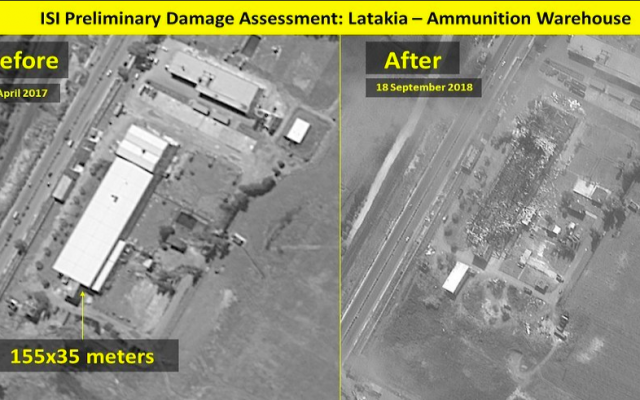
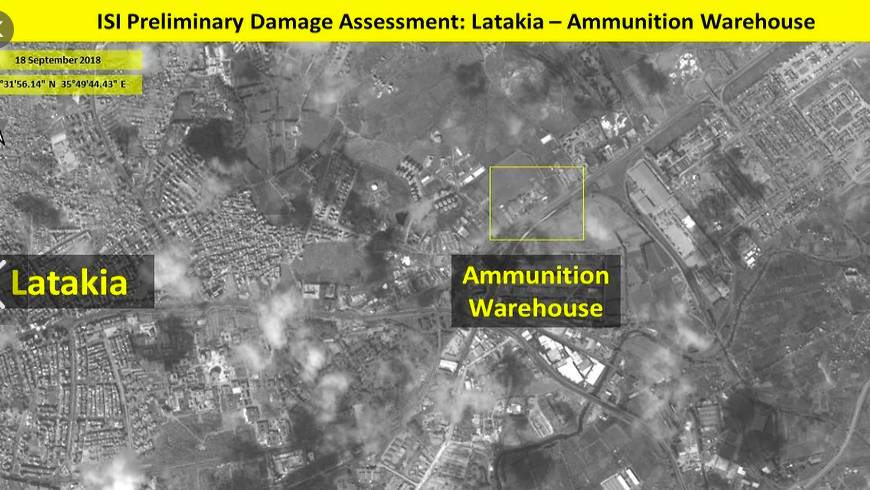
A before and after photo of an ammunition warehouse which was destroyed in an Israeli airstrike on a Syrian base in Latakia, September 18, 2018 (ImageSat International (ISI/Ynet)

A munitions warehouse in a Syrian military facility appears to have been completely obliterated in an Israeli airstrike in the Syrian port city of Latakia late on Monday, satellite images released Wednesday show.

A Russian military reconnaissance plane was shot down by Syria during the Israeli strike, killing all 15 crew members.

On Wednesday Syria released video footage from the site of the attack, reiterating its claim that Israel targeted an aluminium factory, not a weapons warehouse in Monday’s strike, according to the Ynet news site. The veracity of the footage could not be independently verified.

On Monday, Syria accidentally shot down the Russian reconnaissance plane when its air defenses swung into action against the Israeli strike on Latakia. The Russian defense ministry initially blamed Israel, saying the IAF jets used the Russian plane as cover.

However, Russian President Vladimir Putin later told reporters that the downing of the plane by Syrian air defenses was a “chain of tragic accidental circumstances.”


The remains of a Syrian ammunition warehouse which was destroyed in an Israeli airstrike on a base in Latakia, September 18, 2018. (ImageSat International (ISI/Ynet)

On Wednesday, the Russians approved Prime Minister Netanyahu’s proposal to fly air force commander Major General Amiram Norkin to Moscow to present the findings of Israel’s investigation into the incident.

Syrian media and opposition sources reported Wednesday that several Syrian soldiers who were involved in the downing of the Russian spy plane were arrested and interrogated.

The fighters from the air force base in Latakia were reportedly arrested by members of the Russian military police. A Syrian unit was also reported to have taken part in the arrest, according to Hadashot TV.

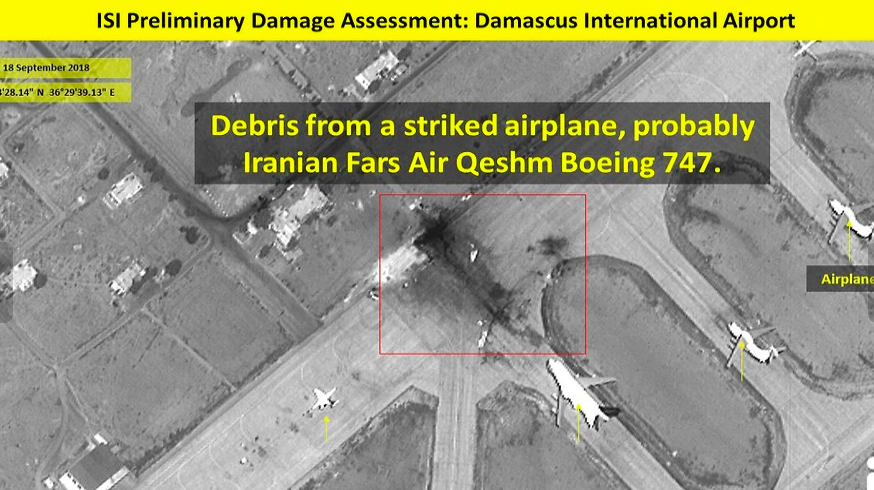
Meanwhile, the remains of another plane, a Boeing 747 aircraft that was destroyed in an earlier alleged Israeli strike at Damascus airport on Saturday, and believed to be in the use of the Iranian Revolutionary Guard, can be seen in separate images provided by ImageSat International (ISI).


The remains of a suspected Iranian aircraft which was hit in an Israeli airstrike, Damascus, September 18, 2018. (ImageSat International (ISI/Ynet)

Prime Minister Benjamin Netanyahu spoke Tuesday with Russian President Vladimir Putin amid the rising tensions between the two countries in the wake of Monday’s airstrike.

In the call, the Israeli leader “noted the importance of the continued security coordination between Israel and Syria that has managed to prevent many casualties on both sides in the last three years,” a statement from Netanyahu’s office said.

The Kremlin said that Putin emphasized that the Israeli attack violated Syria’s sovereignty and also breached the Russian-Israeli agreements on avoiding clashes in Syria. The Russian leader urged Netanyahu “not to allow such situations in the future.”

Israel said its jets had attacked a Syrian military facility that manufactured “accurate and lethal weapons,” which were “about to be transferred, on behalf of Iran, to Hezbollah in Lebanon.”

Netanyahu told Putin that Israel was “determined” to prevent Iranian military entrenchment in Syria, and the attempts by Iran, which calls for the destruction of Israel, to transfer to Hezbollah lethal weaponry to be used against Israel.

Netanyahu also reiterated that Israel would completely share all the information it had on the circumstances of the raid and suggested sending Israel’s air force chief to Moscow to “deliver all the needed information.”

The conversation came on Tuesday evening just before Israel began observing Yom Kippur, the holiest day of the Jewish year.

Earlier Tuesday, Putin confirmed that Israel did not shoot down the plane, rejecting any comparisons with the downing of a Russian jet by Turkey in 2015.

“An Israeli jet did not shoot down our plane,” the Russian leader said.

The Russian defense ministry on Tuesday morning had blamed Israel for the accident and warned of reprisals.

Putin said he had signed off on the defense ministry statement. “No doubt we should seriously look into this,” Putin said, speaking at a news conference after talks with Hungarian Prime Minister Viktor Orban.

Israel said its deputy ambassador in Moscow Keren Cohen-Gat was summoned to the Russian foreign ministry. The Israeli Foreign Ministry said there would be no comment on what was discussed.

Putin also said Moscow would beef up security for Russian military personnel in Syria as a priority response. “These will be the steps that everyone will notice,” he said, without providing further details.

He expressed condolences to the families of the victims, calling the accident a “tragedy for us all.”

The incident was the worst case of friendly fire between the two allies since Russia’s game-changing military intervention in September 2015.

The Russian plane was downed by a Russian-made S-200 air defense supplied to Syria.

The Israeli military on Tuesday acknowledged conducting the airstrike the night before and “expressed sorrow” for the deaths of the 15 Russian airmen.

In a statement, however, the IDF denied all responsibility for the downing of the Russian spy plane, saying that Syria, Iran, and Hezbollah were the ones at fault.

“Israel expresses sorrow for the death of the aircrew members of the Russian plane that was downed tonight due to Syrian anti-aircraft fire,” the IDF said, and noted that the Russian plane that was hit “was not within the area of the operation.”

The Israeli strike was conducted at approximately 10 p.m. by four F-16 fighter jets, according to the Russian military.

Syrian air defenses opened fire at the incoming missiles, at the attacking aircraft and — according to Israel — at nothing in particular. The Russian Il-20 was shot down in the air battle.

“The Syrian anti-air batteries fired indiscriminately and, from what we understand, did not bother to ensure that no Russian planes were in the air,” the army said.

According to the IDF, the target of its Monday night strike was a Syrian military facility that manufactured “accurate and lethal weapons,” which were “about to be transferred, on behalf of Iran, to Hezbollah in Lebanon.”

The target of the Israeli strike was identified by Syria as a subsidiary of its defense ministry, known as the Organization for Technical Industries, which has suspected ties to the country’s chemical weapons and missile programs.

“These weapons were meant to attack Israel, and posed an intolerable threat against it,” the army said.

Though Israeli officials have said, generally, that the military conducts operations inside Syria against Iranian and Hezbollah targets, the IDF rarely acknowledges specific airstrikes, preferring instead to adopt a formal policy of neither confirming nor denying the attacks attributed to it.

The military said its initial investigation found that its strike was completed before the Russian plane entered the area of the operation and that the reconnaissance aircraft was shot down after the Israeli fighter jets had returned to Israeli airspace.

“Israel holds the Assad regime, whose military shot down the Russian plane, fully responsible for this incident. Israel also holds Iran and the Hezbollah terror organization accountable for this unfortunate incident,” the army added.

This appeared to refute the claim made by Moscow that the Israeli pilots used the surveillance plane as cover for their attack.

Russian Defense Minister Sergei Shoigu also accused Israel of failing to inform the Russian military of its plans, which he said would have been in the “spirit” of Israeli-Russian coordination in Syria. The Russian defense ministry said Israel warned them of the impending strike “less than a minute” before it began, which left them insufficient time to clear their personnel from the area.

The Israeli and Russian militaries maintain what they call a “deconfliction mechanism,” which is meant to coordinate their activities in Syria in order to avoid incidents like this one. Until Monday night, these efforts had largely succeeded in preventing direct or indirect clashes since Russia became more deeply involved in the Syrian civil war three years ago.

The Israeli military said it had coordinated with Russia ahead of the attack, though it did not address Moscow’s specific claims about the amount of time between the notification and the airstrike itself.

The IDF also said it would “share all the relevant information with the Russian government to review the incident and to confirm the facts in this inquiry.”


IDF officer who shot down Syrian plane speaks of tension before missile launch

September 18, 2018

Hey Syrians, remember that plane of yours which was shot down a few months ago?

You know, the one that da Jooos shot down?

Well, it was shot down by a woman.

Bet that stings a whole heap, don’t it?

https://www.timesofisrael.com/idf-officer-who-shot-down-syrian-plane-speaks-of-tension-before-missile-launch/

Captain Or Naaman says of the July incident, ‘You take deep breaths and you wait to hear and see that you knocked out the target’

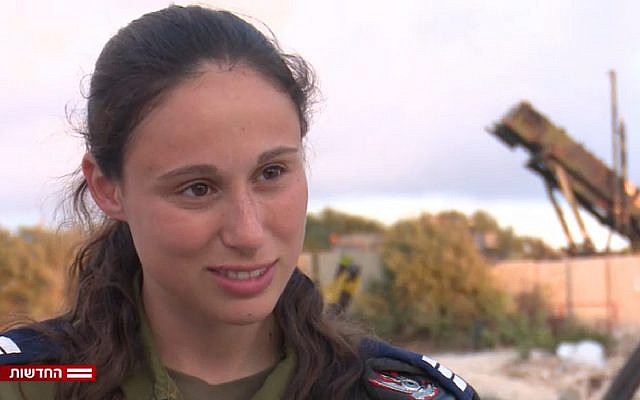
Captain Or Naaman, who commanded the team that shot down a Syrian plane, in an interview broadcast on September 17, 2018. (Screen capture: Hadashot news)

Captain Or Naaman, the IDF officer who commanded the unit that downed a Syrian plane after it entered Israeli airspace in July, described the tension in the control station during the operation, in an interview with Hadashot news shown Monday.

According to the Israeli military, a Syrian Sukhoi fighter jet entered Israeli airspace over the Golan Heights on July 24, traveling approximately two kilometers (one mile) before it was shot down by two Israeli Patriot interceptor missiles.

Naaman commanded the team who fired the missiles, and she said that during the operation the control station remained quiet.

“I can say it is a bit like the paratroopers’ course I did. There is that moment before you jump from the plane — you don’t know what will happen, whether the parachute will open, or if the helmet will fall off, or how you will land on the ground,” she told Hadashot. “This is fairly similar to the process of launching from the control station.”

She also described the palpable tension after the launch.

“You take deep breaths and you wait to hear and see that you knocked out the target,” she said. “When you hear the ‘boom’ outside of the missile, you… that’s… that’s something I never imagined I’d hear.”

The full interview with Naaman will be broadcast on Wednesday night.

The Israel Defense Forces said at the time it had repeatedly warned Syria against flying aircraft close to the border before shooting down the jet.

Syria confirmed that its aircraft had been shot down by Israel and said it crashed in the Yarmouk Basin in southwestern Syria.

One of the pilots, identified as Col. Amran Mara’e, was killed when the plane was shot down, a Syrian military source told the Russian Sputnik news outlet. The fate of the other airman was not immediately known. According to Israeli reports, however, there was only one pilot in the plane.

The plane was involved in Syrian dictator Bashar Assad’s offensive against the rebel-held Daraa and Quneitra provinces, near the Israeli border.

Minutes before the plane was shot down, Syria’s state-run Al-Ikhbariya TV was broadcasting footage from the fence demarcating the UN buffer zone between Syrian and Israeli forces inside the Golan Heights. A UN observer post could be seen just on the other side of the fence.

According to the IDF, the fighter jet took off from the Iran-linked T-4 air force base in central Syria, which Israel has bombed in the past, and traveled “at high speed” toward the Golan Heights.

Israel stressed that it will continue to enforce the 1974 Separation of Forces Agreement, which requires Syria to abide by a demilitarized zone between the two countries

This was the first time that Israel shot down a Syrian fighter jet since 2014, when another Russian-made Sukhoi fighter jet entered Israeli airspace and was targeted with a Patriot missile.

In February of this year, the Syrian military shot down an Israeli F-16 fighter jet as it was taking part in a bombing raid against an Iranian-linked airfield in central Syria after an Iranian drone penetrated Israeli airspace, according to the IDF. The F-16’s pilot and navigator were injured as they bailed out of the aircraft, which crashed to the ground in northern Israel.

Syria mistakenly downs Russian plane as it repels alleged Israeli strike?

September 18, 2018

This relates to the attack mentioned in the previous post…

Woops!

Report: Syria mistakenly downs Russian plane as it repels alleged Israeli strike

https://www.timesofisrael.com/report-syria-mistakenly-downs-russian-plane-as-it-repels-alleged-israeli-strike/

Russia implies France or Israel responsible for missing aircraft; Syria claims 2 killed after Israel fires missiles from Lebanese airspace toward chemical weapons-linked facility

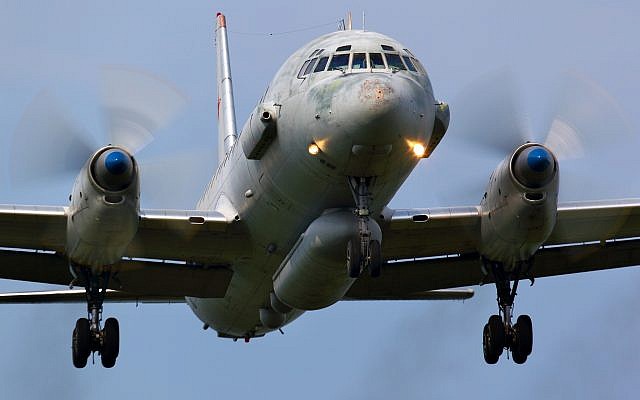
A Russian military Ilyushin IL-20 landing at Kubinka air base on June 3, 2011. (Artyom Anikeev/iStock/Getty Images)

A Russian military plane with 14 servicemen aboard was accidentally shot down by Syrian air defenses as they tried to repel an alleged Israeli strike on Monday, a US official told CNN.

The official added that the plane was downed by a Russian-made missile system which was sold to its Syrian ally. [Hahahahaha! Oh my, the irony!]

Russian state news TASS said the IL-20 disappeared over the Mediterranean on Monday evening was as it returning to Latakia province at the same time as the suspected strike by Israel, and that concurrently France was also firing rockets nearby.

“Connection has been lost with the crew of a Russian Il-20 plane over the Mediterranean Sea 35 kilometers from the Syrian coast as it was returning to the Hmeimim airbase,” the Russian defense ministry said, adding the communications were lost at the time of the suspected Israeli attack.

“At the same time Russian air control radar systems detected rocket launches from the French frigate Auvergne which was located in that region,” Russia’s TASS news agency quoted the defense ministry as saying, according to Reuters.

A rescue operation has been launched.

Israel does not regularly comment on alleged strikes in Syria.

An Israeli military spokeswoman when asked about both the reported Israeli strike and the Russian plane said: “We don’t comment on foreign reports.”

Syrian state media earlier reported that a Syrian facility linked to the country’s chemical weapons program was bombed on Monday night, triggering Syrian air defenses.

The state-run Al-Ikhbariya TV reported loud explosions in the coastal Latakia province, saying they were likely from Israeli strikes targeting a state company for technical industries.

Explosions continued for nearly a half hour, said state-run Al-Ikhbariya TV, which aired footage showing streaks of white light flashing across the sky. An unidentified military official was quoted as saying Syrian air defenses intercepted some missiles heading for the provincial capital of Latakia from the sea.

Al-Ikhbariya said 10 people were injured and two required hospitalization.

A Pentagon spokesman said the United States was not involved and declined to provide further details.

“The missiles were not fired by the US military and we have nothing further at this time,” he said.

A French army spokesman also denied any involvement.

Syrian military sources told SANA that the attack came from the direction of the sea and targeted an Organization for Technological Industries center in Latakia.

The sources also claimed the country’s air defenses shot down a number of incoming missiles. The Syrian army has regularly been accused of exaggerating its interception capabilities.

The attack caused a large explosion and knocked out power to the surrounding area, according to local media.

The Organization for Technological Industries is a subsidiary of the Syrian Ministry of Defense and has been tied to the developments of both missiles and chemical weapons.

The Britain-based Syrian Observatory for Human Rights reported the explosions, saying the target appeared to be an ammunition depot, part of the compound of the organization. The war monitoring group said it was not clear if the depot was for Iranian or Syrian forces.

The strikes followed a similar attack on Damascus International Airport late Saturday, which Syrian state media also blamed on Israel. A military official quoted then on state media said Syrian air defenses intercepted some missiles coming from the sea.

Other attacks were reported on September 4 that targeted sites in the coastal Tartus area and in Hama province. The Observatory said at the time that the attacks were believed aimed at Iranian military posts.

Israel is alleged to have been behind a series of airstrikes mainly targeting Iranian and Hezbollah forces in Syria that have joined the country’s war fighting alongside the government. Israel rarely acknowledges attacks inside Syria, but has said it will use military action to prevent weapons transfers to its enemies.

Earlier this month, an Israeli military official said the Jewish state has struck over 200 Iranian targets in Syria over the past 18 months.

Syria says suspected Israeli strikes hit regime facility

September 18, 2018

It’s never an accident…

https://www.timesofisrael.com/syrian-tv-reports-suspected-israeli-strikes-on-state-company/

Syrian army claims 2 killed after Israel fires missiles from Lebanese airspace toward chemical weapons-linked facility in coastal city of Latakia

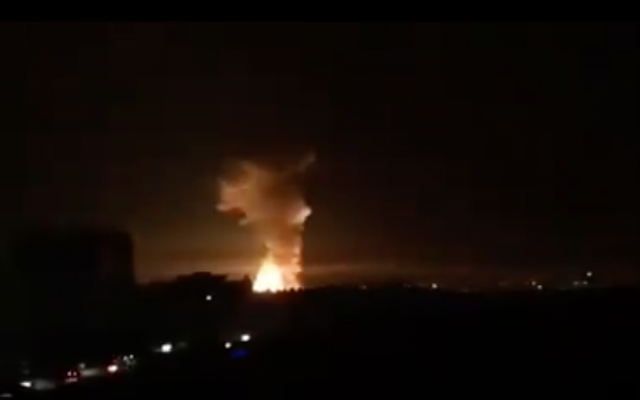
Explosions seen in the Syrian city of Latakia after an attack on a military facility nearby on September 17, 2018. (Screen capture: Twitter)

A Syrian facility linked to the country’s chemical weapons program was bombed on Monday night, triggering Syrian air defenses, state media reported.

The state-run Al-Ikhbariya TV reported loud explosions in the coastal Latakia province, saying they were likely from Israeli strikes targeting a state company for technical industries.

The Syrian army said that Israel fired missiles from Lebanese airspace, adding that two people were killed in the attack and the facility was severely damaged, Hadashot reported early Tuesday.

A spokesperson for the US Department of Defense denied that the American military was behind the attack, telling the Voice of America news outlet, “I can unequivocally say this is not us.”

Syrian military sources told SANA that the attack came from the direction of the sea and targeted an Organization for Technological Industries center in Latakia.

The sources also claimed the country’s air defenses shot down a number of incoming missiles. The Syrian army has regularly been accused of exaggerating its interception capabilities.

The attack caused a large explosion and knocked out power to the surrounding area, according to local media.

The Organization for Technological Industries is a subsidiary of the Syrian Ministry of Defense and has been tied to the developments of both missiles and chemical weapons.

The Britain-based Syrian Observatory for Human Rights reported the explosions, saying the target appeared to be an ammunition depot, part of the compound of the organization. The war monitoring group said it was not clear if the depot was for Iranian or Syrian forces.

The strikes followed a similar attack on Damascus International Airport late Saturday, which Syrian state media also blamed on Israel. A military official quoted then on state media said Syrian air defenses intercepted some missiles coming from the sea.

Other attacks were reported on September 4 that targeted sites in the coastal Tartus area and in Hama province. The Observatory said at the time that the attacks were believed aimed at Iranian military posts.

Israel is alleged to have been behind a series of airstrikes mainly targeting Iranian and Hezbollah forces in Syria that have joined the country’s war fighting alongside the government. Israel rarely acknowledges attacks inside Syria, but has said it will use military action to prevent weapons transfers to its enemies.

Earlier this month, an Israeli military official said the Jewish state has struck over 200 Iranian targets in Syria over the past 18 months.

In tacit threat, Israel releases satellite photos of Syrian presidential palace

September 18, 2018

We know where you live, Bashar…

Just remember that.

https://www.timesofisrael.com/in-tacit-threat-israel-releases-satellite-photos-of-syrian-presidential-palace/

To mark 30 years since its first orbital launch, Defense Ministry publishes images from its newest spy satellite, showing Syrian tanks, an airfield… and Bashar Assad’s home

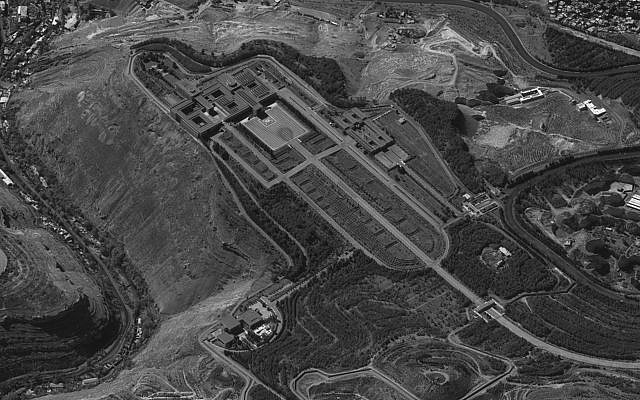
A photograph of Syria's Presidential Palace in Damascus taken by Israel's Ofek 11 spy satellite, which was released by the Defense Ministry on September 17, 2018. (Defense Ministry)
A photograph of Syria’s Presidential Palace in Damascus taken by Israel’s Ofek 11 spy satellite, which was released by the Defense Ministry on September 17, 2018. (Defense Ministry)

Israel on Monday released photographs taken by its newest spy satellite of sites located deep inside Syria, including Syrian dictator Bashar Assad’s palace, in an apparent threat to the regime.

The images, taken by the Ofek 11 spy satellite, were released by the Defense Ministry to mark 30 years since Israel’s first orbital launch on September 19, 1988.

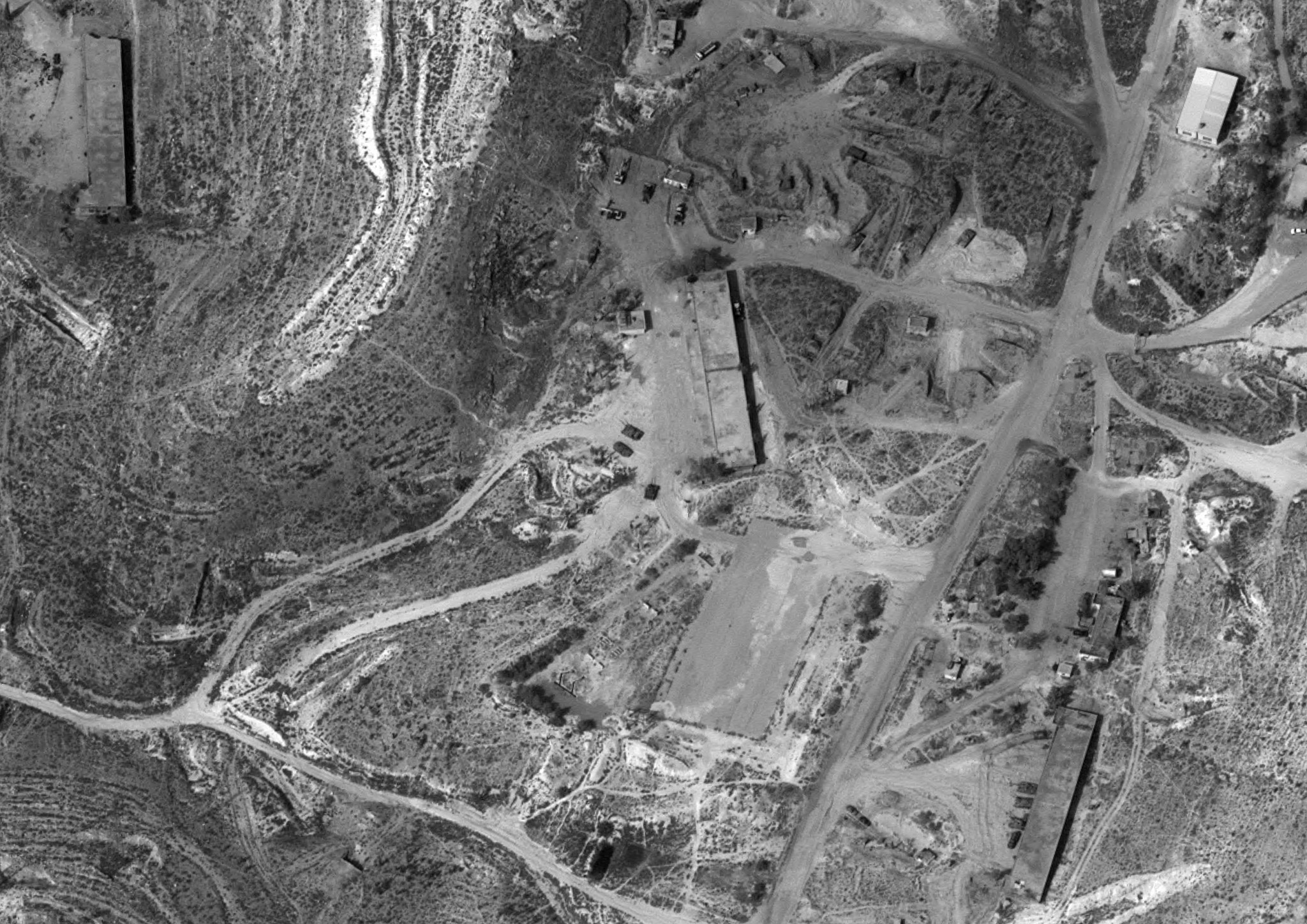
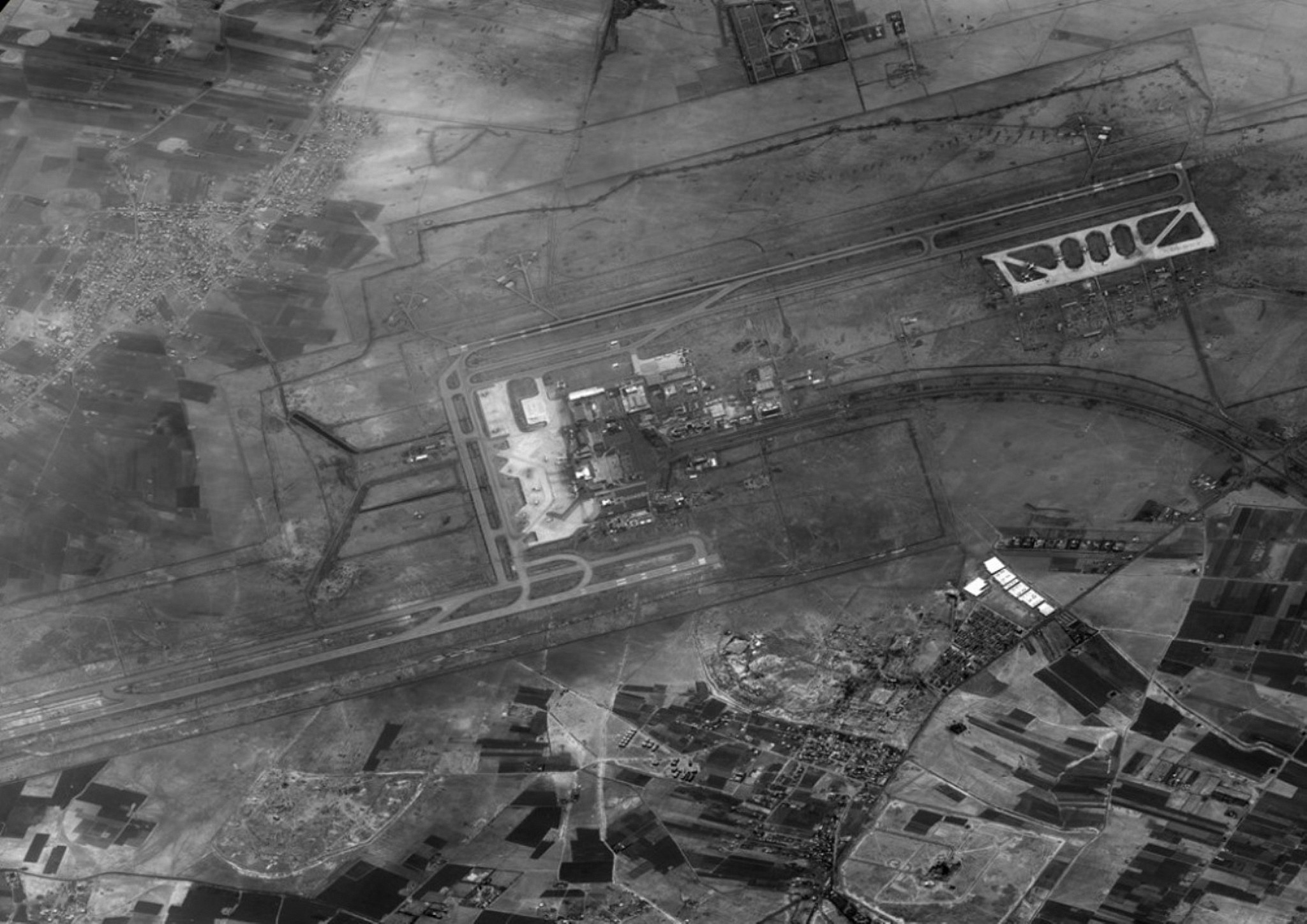
The three photographs released by the ministry showed the Syrian Presidential Palace, also known as the Palace of the People; tanks on a Syrian military base; and the Damascus international airport, which was reportedly targeted by an Israeli missile strike on Saturday night.

The publication of the images could be seen as both a show of strength and a tacit threat to Syria, where Israel has routinely conducted air raids against Iranian targets — over 200 of them since 2017, according to the Israel Defense Forces.


A photograph of a Syrian military base taken by Israel’s Ofek 11 spy satellite, which was released by the Defense Ministry on September 17, 2018. (Defense Ministry)

The Saturday night strike reportedly targeted an Iranian plane at the Damascus international airport that was delivering weapons to pro-regime forces and Islamic Revolutionary Guards Corps units fighting in Syria’s civil war, as well as several weapons storage facilities at the airport itself.

There was no official Israel comment on the reported attack. However, Prime Minister Benjamin Netanyahu on Sunday seemed to acknowledge that the Israeli military was responsible for it.

“Israel is constantly working to prevent our enemies from arming themselves with advanced weaponry,” Netanyahu said at the start of the weekly cabinet meeting at his office in Jerusalem. “Our red lines are as sharp as ever and our determination to enforce them is stronger than ever.”


A photograph of Syria’s international airport in Damascus taken by Israel’s Ofek 11 spy satellite, which was released by the Defense Ministry on September 17, 2018. (Defense Ministry)

The Syrian state news agency, SANA, claimed that Israel had targeted the airport with missiles, activating the country’s air defenses, which shot down a number of the projectiles. The Syrian military has often been accused of exaggerating its successes in intercepting incoming missiles.

On Sunday, the Britain-based Syrian Observatory for Human Rights monitoring group said that the alleged Israeli strike caused “substantial” damage at the airport, but had no immediate information on casualties.

For years, Israel has been concerned that Iran was using opportunities presented by the Syrian civil war to entrench itself militarily in the country in order to further threaten the Jewish state — alongside the threat already posed by terror group Hezbollah in Lebanon.

Earlier this year, Israeli military officials also told Syria publicly that its military, specifically its air defenses, would not be targeted by Israel unless it fired at Israeli aircraft.

The Ofek 11

The Ofek 11 spy satellite was launched on September 13, 2016, using a Shavit rocket, the same basic model that Israel used to launch the first Ofek satellite 30 years before.

Shortly after takeoff, the team operating the satellite discovered it was not functioning properly. Teams of engineers on the ground worked to stabilize the Ofek 11 and get its systems running.

Nine days later, the satellite beamed back its first images, dispelling fears that it was a total operational loss.

“The Ofek 11 satellite will provide operational outputs,” the Defense Ministry said at the time.

The Ofek 11 was an upgrade from the Ofek 10 satellite launched by Israel in April 2014.

The Ofek 11 joined approximately 10 other satellites, including the Ofek 10, Ofek 9, Ofek 7 and Ofek 5, that feed intelligence to Israel’s security forces.

“Israel’s independent capabilities in the field of satellites represents a significant advantage in its efforts to stand up to various security threats. The quality of the images and photographs that are produced by our different satellites is incredible and provide us with valuable intelligence, and prove that the sky is not the limit,” Amnon Harari, the head of the Defense Ministry’s space program, said on Monday.

First Translation of Khameini’s New Book on the Destruction of America, Israel

September 14, 2018

If you happen to be curious about the depths of obsessive, visceral hatred possible in a human being, then look no further than here. 

Khameini’s views on Israel.

Sheer (pun intended) unadulterated poison.
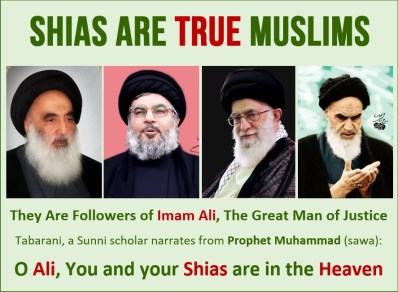
Image result for shia muslims

EXCLUSIVE: First Translation of Khameini’s New Book on the Destruction of America, Israel

What follows is the first significant translation of the newly-released book, ‘Palestine’ by Iran’s Supreme Leader, Ayatollah Khameini. The page numbers below refer to the original PDF in Farsi (available here). This page will be updated as more of the book is available in translation.

As Jonathan Tobin writes at Commentary:

The Khamenei Palestine book is important not in and of itself but because the regime’s obsession with Israel is a key to its foreign policy. Iran constitutes a grave threat to Neighboring Arab countries that are at least as angry about the president’s embrace of Tehran as the Israelis since their nuclear status would undermine their security. But as much as Iran is focused on regional hegemony in which Sunni states would be brought to heel, as Khamenei’s Palestine illustrates, it is the fixation on Israel and Zionism that really animates their expansionism and aid for terror groups.

As Taheri notes in his article on the book, Khamenei distinguishes his idée fixe about destroying Israel from European anti-Semitism. Rather, he insists, that his policy derives from “well established Islamic principles.” Chief among them is the idea that any land that was once ruled by Muslims cannot be conceded to non-believers no matter who lives there now. While the Muslim world seems to understand that they’re not getting Spain back, the territory that constitutes the state of Israel is something else. Its central location in the middle of the Muslim and Arab worlds and the fact that Jews, a despised minority people, now rule it makes its existence particularly objectionable to Islamists like Khamenei.

Khameini: ‘Palestine’ (2015)

Introduction by Dr. Ali Akbar Velayati

The role of Shia Ulama [Islamic leaders] in the complicated issue of Palestine has steadily moved toward reaching its goal. The issue of Palestine has had many extensive, large-scale reflections all around the world. The way Shia Ulamas, [scholars] including Motaharri, dealt with the issue of Palestine was to rely on Allah internally and on Muslims externally, which enabled them to fight against the oppressors with all their might. Having this in mind, it is worth it to know how this class of Muslim scholars approached the issue of Palestine and Zionism.

Mohammd Hasan Ibn Mohammad Ibrahim Gilani, one of these scholars, who in his own time had experienced an issue of occupation, as the Israeli-Palestine issue, emphasizes Jihad as a mandatory Islamic duty on Muslims’ shoulders. He states, “If the people of darkness and blasphemy attack Muslims’ lands and try to establish a non-Islamic political system in that land, jihad becomes a compulsory religious duty for all Muslims who are able to use a weapon. Sheikh Mohammad Reza Hamedani, who lived in 19th century, in his book, Trqib Ul Musliemin Ela Difa Ul Moshrekin [Encouraging Muslims to resist non-Muslims] expressly writes, “ The purpose of jihad is to preserve the seed of Islam and granting Islam prosperity and superiority. Until reaching that goal, the duty of jihad is compulsory.”

By studying the contemporary history of Shia movements, we see how this class of Muslim scholars, even in difficult situations when the foundation of Islamic society was under attack from everywhere, led Muslims in waging jihad. They meticulously analyzed the situation and recognized the colonists’ long-term plan. In various circumstances, these scholars created obstacles in the way of the colonists and prevented them from reaching their ultimate goal. For example, in Iraq, the British Army tried to subjugate Iraqis, suppress their uprisings, and divert Iraqis’ attention from revolting against them. They created an atmosphere of fear among Iraqis, not knowing that the Iraqi Shia Ulama [Muslim religious leaders] would disappoint them. An Iraqi Muslim scholar who lived during World War I recorded his observations of Najaf Shia uprising and its causes. He wrote,

Some people believe that only because of Islam and Islamic honor the crusaders could not dominate Najaf and rule over this city, which is the center of religion and the apple of the eye of Shia Muslims. Islamic honor prevented the crusaders from placing the flag of trinity over monotheism.

Islamic sources and faith enabled the Ulama to fulfill their Islamic duty regarding the issue of Palestine. Examining the movement that Shia religious leaders initiated and comparing it with their current day position toward the issue of Palestine proves that Shia Ulamas are among the most persistent and non-compromising Islamic leaders who have shown resistance to the danger of Zionism. In response to a question from Mohammad Sabri Abedin, Agha Mohammad Hossain aul Kashif al-Quta, who was the highest-ranking Muslim scholar in Najaf, wrote, “The worst type of oppression is forgetting about Islamic duties and disrespecting the Quran by disobeying its commands.”

Regarding selling Palestine land to Jews and its Islamic ruling about these types of transactions, Kashif al Quta states, “Don’t you even realize that selling land to the Jews in general and being involved in the transaction as agents or the like is tantamount to fighting against Allah and his prophet and destroying the religion of Islam? Those who participate in such transaction are out of the religion and consequently infidels. Do not do business with those who are involved in such transactions. Do not marry them. When they die, do not let them to be buried in Muslims’ cemeteries. You should make a list of apostates, mention their names in there, and publicize it.” [Note: Being recognized apostate allows Muslim to kill the person, make his wives and children slave, and appropriate his property.]

The Ulama’s objection to the two-state Solution in the United Nations was the first formal confrontation between the Islamic scholars [Ulama] and the West, which highlighted the role of Iraqi scholars in resisting against the West. Shia leaders like, Hebbat Ul Din Shahrestani, Sayyed Mehdi Sadr, Sayyed Mohammad Mehdi Isfahani, Sheikh Razi Aul Yassin, Yusuf Ata, Habib al Ubaidi, and Ibrahim Ravi, sent a telegraph to both the United Nations and the United Kingdom Department of State, expressing,

Hereby, we the delegates of Islamic legal schools announce our dissatisfaction to the two-state solution, which is aiming to strike at the heart of Arabs and Muslims.

Ayatollah Sayyed Abul Hasan Isfahani, another high-ranking Muslim scholar, wrote a note to the Iranian Embassy in Baghdad asking Iranians to double their efforts in the United Nations for Palestinian rights. Accordingly, Kashi al-Quta wrote a letter to Malik Ghazi, the king of Iraq, encouraging him to adopt the same tactic in the United Nations and support Palestinians. He warned the king and the British officials that the only choice they have is to issue a fatwa for Jihad.

Al-Nahar, a Baghdad newspaper, reported that [in the 1950s] Muslim scholars gathered around Imam Ali’s Shrine in Najaf and discussed the possibility of issuing the fatwa of jihad. Ulama from Syria, Lebanon, Jordan, Egypt, Yemen, Turkey, Afghanistan, and Arab Gulf countries were invited and Kashif al Quta issued the fatwa for jihad. The issued fatwa stated,

O, Muslims, Arabs, brothers, and human beings! A situation in which the beheaded Palestine is trapped, is obvious. As I have said before, the issue of Palestine is not just an Arab-Muslim issue. Every human being has to wage jihad. Hereby I send a public invitation to Arabs and Muslims. Allah is my witness that if I were not old and sick, I would be the first person to make jihad against Israel.

In another fatwa, Kashif al Quta, classified the Islamic world and assigned each one of them to perform their duty of jihad regarding Palestine. The first country he addressed was Jordan. He believed, since the Hashemite family runs Jordan and they are decedents of the prophet, they are the ones who need to initiate jihad. After Jordan, he addressed Hijaz [Saudi Arabia]. He said, “Since Islam shone in that land, Saudis also should be a part of the jihad.” Kashif al Quta also assigned Syria and Egypt for the reason that they are Palestine’s neighbor.

In the 1960s, Imam Khomeini started his transparent and relentless movement, which played a pivotal role in the realm of politics and the establishment of a new wave called “Islamic Awakening.” Islamic awakening in Iran and in the Islamic world aimed to first topple the Pahlavi regime and replace it with an Islamic republic system and second, to wage Jihad in the region against Zionism in an effort to emancipate Palestine. Globally, the movement is going to confront the United States as the symbol of injustice. In one sentence, Imam Khomeini’s purpose of struggle is to emancipate Iran and the Islamic world from the superpowers’ bondage, restore honor to Islam, and establish an Islamic government based on Islamic principles.

With persistence and honesty, Imam Khomeini raised the flag of the emancipation of Quds and Palestine. The chain of resistance against Zionists is currently more evolved. Today, the resistance line starts from Iran and covers Iraq, Syria, Lebanon, Jordan, Gaza, West Bank, Egypt, Libya, Tunisia, Algeria, Sudan, Yemen, Bahrain, Pakistan, and Afghanistan. This new wave of Islamic awakening, which was initiated by Imam Khomeini, is now stronger than ever. Cutting the hand of the United States from Islamic countries, establishing Islamic government and restoring Islamic values, and emancipating the whole of Palestine are our objectives.

Dr. Ali Akbar Velayati

[Biographical Note on Ali Akbar Velayati: Velayati was born in Rostamabad village in Shemiran, Tehran, on 24 June 1945. He was admitted to Tehran University of medical sciences in 1964. Velayati finished his studies in pediatrics and moved to Johns Hopkins University for a fellowship in infectious diseases. Velayati taught at a university and was an active member of the Supreme Council of Cultural Revolution, Expediency Council and Islamic Encyclopedia Foundation. During the rule of Mohammad Reza Shah, Velayati was arrested by the intelligence service when he was only seventeen. After the Islamic Revolution, and under Mousavi, the former Iranian prime minister, Velayati served as the minister of foreign affairs. After Hashemi Rafsanjani became the president of Iran, he retained his position until 1997. Since then he has been an advisor on international affairs to the Supreme Leader of Iran. In November 2006, Argentine Judge Rodolfo Canicoba Corra issued an international arrest warrants for Velayati and six other Iranians and one Lebanese in connection with the AMIA terror attack in Buenos Aires, Argentina, which killed 85 people and seriously injured151. The attack on the Jewish Cultural Center came two years after the 1992 terrorist bombing of the Israeli embassy in Buenos Aires. Velayati has been on the official Wanted list of Interpol since March 2007 charged with “Aggravated Murder and Damages” related to the 1994 AMIA bombing case. The arrest warrant is based on the allegation that senior Iranian officials planned the attack in an August 1993 meeting, including Khamenei, the Supreme Leader, Mohammad Hejazi, Khamanei’s intelligence and security advisor, Rafsanjani, then president, Ali Fallahian, then intelligence minister, and Velayati, then foreign minister.]

Quds Day: The Day of Breaking the Back of Oppressive Americans and its Zionists Servants [p.40]

In 1960s, Ayatollah Ruhollah Khomeini started his transparent and relentless movement, which played a pivotal role in the realm of politics and the establishment of a new wave called, “the Islamic Awakening.” The Islamic Awakening in Iran and in the Islamic world aimed to first topple the Pahlavi regime and replace it with an Islamic Republic system and, second, to wage Jihad in the region against Zionism in an effort to emancipate Palestine. Globally, the movement is going to confront the United States as the symbol of injustice. In one sentence, Imam Khomeini’s purpose of struggle is to emancipate Iran and the Islamic world from the superpowers’ bondage; to restore the honor to Islam; and to establish an Islamic government based on Islamic principles.

With persistence and honesty, Imam Khomeini raised the flag of the emancipation of Quds [Jerusalem] and Palestine. The chain of resistance against Zionists is currently more evolved. Today, the resistance line starts from Iran and covers Iraq, Syria, Lebanon, Jordan, Gaza, West Bank, Egypt, Libya, Tunisia, Algeria, Sudan, Yemen, Bahrein, Pakistan, and Afghanistan. This new wave of Islamic Awakening, which was initiated by Imam Khomeini, is now stronger than ever. Cutting the hand of the United States from Islamic countries, establishing Islamic governments and restoring Islamic values, and emancipating the whole Palestine are our objectives.

For us, [the liberation of Jerusalem] Quds and Palestine are very significant and splendid issues. Today [Quds Day] is when all the oppressed people armed with the spirit of faith and reliance on Allah would break the back of all unjust superpowers, the Imperialism of the United States and its Zionist servants. We should not be satisfied with what we have [the Islamic Revolution] within our borders; we should not think we are done. Until this stinky wound and infected gland called “the Israeli Government” is in the heart of Islamic territories, we cannot feel we have won.

From the beginning of the Islamic Revolution in Iran to the present time, Palestine remains a burning issue for the Muslims of the world. The centrality of Palestine for the leadership of the Islamic Republic of Iran and the Muslim world is undeniable. Even before to the Islamic Revolution, Palestine, the Palestinian people, and the injustice they were experiencing were important issues for Imam Khomeini and the movement he led. We cannot observe and tolerate the existence and presence of the enemy who has occupied the land.

Palestine is the most important issue of the Islamic world. Palestine is the most important issue of the world of Islam. There is not any other international issue in the world of Islam more important than the issue of Palestine. The reason is that the domination of the occupiers of Palestine and Quds is the source other weaknesses and problems in the Islamic world. One might ask about the future of Palestine and Quds. Let me educate you and give you some information: As we broke down and destroyed the robust, undefeatable gates of the imperialist regime of the Shah, we can defeat the legendary power of the superpowers.

Allah’s Promise: Defeating Bani Israel [the Jewish People] Again [p.41]

We should learn from the Quran in which Allah addresses Israel saying:

“O children of Israel! Indeed, you would do mischief in land twice and you will become tyrants and extremely arrogant.” [Surah Al-Isra’ 17:4-8]

Allah’s soldiers will come to punish you for the corruption you did on Earth. Any nation that walks on the path of Allah—with the weapon of truth and justice—Allah will help him. But any nation that makes mischief, oppresses the people, and ignores humanity will be destroyed and perished.

An Infected Cancer Called “Israel,” Cause of Division Among Muslims [p.42]

Imperialists, the enemy of human beings, planted this infected cancer gland within Islamic-Arabic territory. Today this gland has grown and become the cause of division among Muslim governments. You see how the leaders of Islamic countries who call themselves Muslims do not perform their Islamic duty about the issue of Palestine. Why? Because they have been busied with internal problems. Where their problems have come from? From this infected gland named “Israel” that was created by the superpowers.

Defeating Israel by Muslims is Pivotal for Muslims’ Salvation is the World [p.43]

Today, Palestinians have risen up. The Quran in Surah 17:7 has addressed Palestinians saying, “If you do good. You have done this to yourself.” If you do jihad in the cause of Allah, if you obey Allah’s command and fight against the enemy of humanity and the religion of truth, O Palestinian Muslims, you have done a good thing that benefits you. When we create a glorious Islamic power in the region, this power can punch superpowers in the mouth. Then, the Muslim nations will never suffer from hunger, poverty, and oppression.

Supporting Palestinians is an Islamic Duty [p.44]

We, the revolutionary Muslim people of Iran—after successfully getting the attention of the entire world by punching the American imperialists in the mouth—should take another big step: We should teach Arab nations how to fight for Palestine and Palestinians rights sacrificially. As I said before, the issue of Palestine is an Islamic humanitarian issue. It is humanitarian because group of anti-human criminals, who know nothing but hegemony and trespassing, have gathered to plot against other nations and governments. Today, they help our enemies, some of whom share borders with us. Palestine is also an Islamic issue for us: Islam has obligated us to defend other Muslims and their lands; it has obligated us to fight for the rights of oppressed peoples; it has obligated us to answer to our Muslim brothers and sisters call for help with our property and lives.

Muslim Governments Ignore Palestine [p.45]

Palestinians have been calling for help from other Muslims for decades. Which one of these Arab governments has answered the call for help from their Palestinian Muslim brothers? They just used the issue of Palestine for their political advertisements, just to attract their people for political purposes. I address North African and Middle Eastern governments. I address the Gulf States. Which one of you all has done the Islamic duty of helping your Palestinian brothers?

The Possibility of Annihilation of Israel through Nations’ Determination and Resolve [p.46]

Take the issue of Quds and Palestine seriously. Bayt Ul Moqaddas was Muslims’ first Qibla [the direction that should be faced when a Muslim prays]. This [holy place] is under the control of antihuman Zionist occupiers, and needs to be emancipated. The land of Palestine has to be freed and returned to its own people. They might ask, “How would you wipe a country, which is under the protection of the superpowers, off the map?” A resolve that comes from faith eases any difficulty; it makes every miracle possible.

Islamic Revolution: A Role Model for all Islamic Revolutions [p.47]

The Islamic Revolution of Iran would become the mother of all other Islamic revolutions throughout the region. After your triumphant Revolution, the passion for Islamic values is boiling in the region. Today, many movements based on Islamic ideology are seeking freedom. This fire continues to give off flames. You should continue. You should know that those you inspire, other Revolutions, would come to your help whenever you need them. That the Islamic Revolution continues to live disappoints the United States, and has done so thusfar.

Today we face two factors to deal with. One problem is the Imperialism of the United States and its agent and proxy in the region, the Occupier Government of Israel—on which we should put pressure, and seek its destruction. This government is the expression and visualization [the agent and proxy] of the American hegemony. Another factor is the issue of inviting oppressed Arab nations to rise up against their oppressors.

Like Pebbles and Buckets of Water  [p.48]

Today—on behalf of you the people of Tehran who have gathered here in the Day of Quds [Jerusalem Day]—I tell the other nations to learn from our experience. Look at the miracle Allah has done through the Iranian people, and encourage others to move [in this direction]. As our Imam and leader mentioned, there are more than one billion Muslims around the world. This is a huge and marvelous power. If every one of us through a pebble toward Israel, this nation would be buried under a pile of pebbles.

O Muslim nations, [Quds Day] belongs to you as well. We should get ready and arm ourselves with military weapons and equipment. Improve the quality of your weapons. We have the issue of Palestine, the concern of the Imperialism of the United States, and plots and conspiracies. As Imam Khomeini said, “If Muslims were united and each one had poured a bucket of water on Israel, a flood would have taken Israel away. ”

The Importance of Palestine [p.51] [

From a speech given at Imam Khomeini’s Shrine, May 21- 2002.

Palestine is the most important Issue in the Islamic World. No other international issue is more important than Palestine in the World of Islam. The reason is that the occupation of Palestine and Quds, which are parts of the body of Islam, is the source of all the weaknesses and problems in the Islamic World. This painful wound on the body of Islamic society is annoying the heart of the Prophet. The heart and soul of the Prophet in paradise is full of sadness. What is the solution, then? Jihad is the answer.

See how the oppressive countries without any sympathy toward the Islamic nations are smashing [the Palestinians] underfoot. Palestine is, and will continue to be, the most important issue of the Islamic nations. This is not a joke; some occupiers have come to remove others from their homes and country and replace them with those whose hands are soaked to their elbows in blood. Palestine is the worst misery the Islamic nation has ever experienced. Those who claim the importance of human rights should be on the vanguard of this struggle and lead others.

Besides Palestine, Beit Ul Moqadas [Jerusalem] is also important. Today, Zionists wage a spectrum of plots and conspiracies aimed at the destruction of this Holy City. But Muslims never allow Zionists to carry out their plots: this city belongs to all Muslims, and is the capital of Palestine. They will resist. Palestine is an issue for the Islamic world for two reasons: One reason is that Palestine is a part of Islamic territory. All Islamic schools of thoughts agree over this. All Muslim scholars have consensus over this claim that Palestine is a part of Islamic land that has been occupied by our enemies. Everybody is religiously obligated to wage jihad to return this part of Islamic land back.

Another reason is that the establishment of this Jewish government, in other words, Zionist government, in this region was to fulfill the first stage of a bigger plan. Palestine links three continents of Asia, Africa, and Europe. The United Kingdom created this mess to prevent the emergence of another Islamic power like Ottoman Empire. Even though the Americans pushed the British away and inherited its colonialism. Therefore, the liberation of Palestine and destruction of the occupier Zionist regime is an issue that has close relationship with the security and existence of Iran and all other countries in the region. Those Muslim intellectuals who have not become puppets in the hands of the oppressive United States believe that we should fight against Israel and resist American’s hegemony.

The Islamic Republic and the Issue of Palestine [p.63]

Adapted from a seminar given to a group of Palestinian Jihad groups (February 27, 201); a a speech before a group of Ardabili Youth (July 26, 2000); and an address to a group of pilgrims in Mashhad (March 21, 2011).

Palestine is not a strategic but a belief issue. It is about a heart connection. It is a religious issue. For these reasons, there is an agreement between Iranian people and us over the issue of Palestine. The majority of our people care about Palestine and this motivates millions of them to come out for demonstration in the Quds Day regardless of the climate condition. The view, perspective, and analysis of our decisionmaking officials toward Palestine is religious not political, per se. We are asked why we support the people of Bahrein. We support all oppressed who rise up against their oppressors. We have been supporting Palestinians for decades. Which Islamic country has done such thing? Are the Palestinians Shia? No. How many times have our youth rushed to airports to fly to Gaza to fight against Israel? They did it many times. But we stopped them. We told them the roads to Gaza are blocked. Our people care about Palestine regardless of sectarian differences. We care about Egypt and Tunisia as well. Are they Shia? No. Enemies try to misinform others that our support of oppressed people is a sectarian issue.

Supporting Oppressed Nations, Especially Palestine, is a Part of the Islamic System’s General Policies [p.64]

Announcement of the Five Year-Period General Policy by the Supreme Leader (January 10, 2009).

Improving the place, situation, power, and role of the Islamic Republic of Iran at the regional and international level in order to bolster our national security and national interest, and also supporting Muslims and oppressed nations, especially the nation of Palestine, are important parts of our general policies.

Without Destroying Israel, Our Victory is Incomplete [p.65]

A message to the pilgrims on Hajj (June 3, 1989). 

We do not follow the dictated solutions offered by the superpowers regarding the Palestine issue. The only accepted treatment for the wound of Palestine is to cut and remove the cancer gland of the Zionist government, and this is possible. In the process of pilgrimage, Muslims should chant concerted slogans in support of Palestinians. Iranian people should always take side with Palestinian fighters. Without winning the battle of Palestine, our victory is incomplete. Since the first days of his mission and struggle in Iran, our deceased great Imam [Khomeini] gave the first priority to the issue of Palestine. He continued the same mission even after he defeated the Shah and established the Islamic Republic. In his political and spiritual will, Imam Khomeini talked about Palestine to Muslims all around the world and highlighted the religious obligation facet of it.

Universality of Imam Khomeini’s Movement [p.67]

Tehran Friday Prayer at Imam Khomeini’s Shrine (June 3, 2010).

Another facet of the Imam’s movement was its universality. Imam [Khomeini] believed that his mission is universal. It belongs to the Muslims around the globe; even oppressed non-Muslims could use it. Imam did not pay any attention to the critics, who said his statements were, “interfering in other independent countries’ affairs.” Our method of exporting our revolution is different from the colonialists’ method. We do not use colonialism. We are not such people. Our method is to spread the scent of this merciful phenomenon to the world. Therefore, other nations come to recognize their responsibilities. Muslim nations should know their identity, to learn how to find it. One example of this universal view was the Imam’s position regarding Palestine. He directly said, “Israel is a cancer gland.” What do people do with a cancer gland? Aside from cutting and removing it, what other treatments are available? This was his rationale, and he did not care about the criticism. This is not a slogan; it is logic.

The Iranian Revolution Created Hope for Palestinians  [p.67]

Tehran Friday Prayer (February 12, 2004).

This [Iranian] Revolution in the Islamic and Arabic worlds revived hopes. Before we successfully toppled the Shah’s regime, the Islamic world was in a hopeless, passive situation. The Zionists had successfully intimidated the Muslim Nations. No nation could even imagine a feeling of hope. Suddenly, the gates of hope opened and nations woke up. Zionists wrongfully thought that they have swallowed Palestine and everything is in control. You see how the Palestinians are resisting, even under tremendous pressure. This resistance is not only a defeat for Israelites, but also for Americans. All the Zionist superpowers that control the world are defeated, as a poor, unarmed nation has brought them all to their knees.

The spirit of hope also awakened in the Lebanese. In the aftermath of the revolution, Lebanon was a mess. Zionists did whatever they wished to that country. They attacked and killed people. Their warplanes were flying over Lebanon whenever they wanted, as if it was their own territory. Instead of focusing on the [Israeli] enemy, Lebanese groups were fighting against one another. Shaheed Chamran was there at that time. He was reporting whatever he was observing. He reported, “Now, Lebanese are going to become a power. They are striking Zionists unprecedentedly. The Zionists are retreating.”

Our Position [Against Israel & the United States] [p.68]

Speech to the Iranian Military’s Joint Chiefs of Staff (June 30, 1991).

Our position against Israel is, as always: Israel is a malignant cancer gland that needs to be uprooted. In contrast to what shallow people believe, it is not impossible to defeat Israel and the United States. Superpowers have come and gone throughout history. Materialistic powers are neither everlasting nor infinite. Yesterday, there was a power called the Soviet Union. It was one of the superpowers, but it no longer exists. A similar historical contemporary change is still before us.
Artist turns Kassam rockets into flowers and mezuzahs

September 14, 2018

I am proud to say that I own a piece of this artist’s work. 

See pics below.

I am always walking around with a physical reminder of the creativity and life-affirming nature of the Jewish people, and of the destructiveness and death-loving nature of the followers of Mohammed.

img_20180914_1056389731img_20180914_1056581571

Artist turns Kassam rockets into flowers and mezuzahs

https://www.israelnationalnews.com/News/News.aspx/251867

Instead of therapy, Gaza area artist Yaron Bob turns Hamas rockets into mezuzot, flowers, and birds.

Holding aloft a missile fragment, Gaza-area artist Yaron Bob explains to a Kann interviewer that not long ago the projectile had penetrated an Israeli car.

“The incredible Iron Dome is Israel’s missile defense system. When rockets are fired into Israel, the Iron Dome shoots a missile to intercept the rocket, preventing destruction and the murder of innocent lives,” says the description of one item on Bob’s website.

“Bring Israel’s heavenly protection into your home with this limited-edition Mezuzah made from an actual Iron Dome missile!”

“I cut it into rectangles, polish it, and craft the mezuzot. My mezuzot get grabbed up all over the world. They cost between $150-200.”

Asked how much profit he can extract from a single Kassam missile, Bob makes a quick calculation and answers “About $2,000 per Kassam.”

A tour of his storage area reveals a representative variety of the weapons constantly aimed at Israel’s children: “Here are rockets that fell a month ago; this one’s a 120mm, this one’s a Grad. Wanna see a whole Grad?” he asks deferentially, and lifts one from the pile. “Made in China,” he says. “This one here fell in Dimona.”

The interviewer asks Bob,”How do you have all these types?” and Bob retorts, “How do they?”

His website, Rockets into Roses, describes other works of Bob: “Be in awe of this exquisite Menorah with seven branches, designed from actual rockets fired into Israel,” says another item description. “From the Hebrew and English inscriptions of ‘beat their swords into plowshares’ at its base to the intricate detail of each branch and candle-holder, this Menorah is absolutely extraordinary. Display this in your home and be inspired by what it represents – turning terror and darkness into peace and light, in a very literal sense!”

“Beautifully designed Rocket Rose sculpture, this handmade piece is made from Kassam rockets that fell in Israel. It features four beautiful long-stemmed roses coming out of a rocket, symbolizing the idea of growth emerging from destruction.”


Air Force marks planes to commemorate bombing Syria reactor in 2007

September 10, 2018

They must have changed the name of the operation, it was “Operation Orchard” previously I believe.

https://www.timesofisrael.com/air-force-marks-planes-to-commemorate-bombing-syria-reactor-in-2007/

At Hatzerim Air Base ceremony, stickers with the operation’s symbol placed on F-15i and F-16i jets that destroyed facility in Deir el-Zour

Pilots and crews who took part in the 2007 bombing of the Syrian nuclear reactor in Deir a-Zour take part in a ceremony marking the planes that participated in the operation, on September 6, 2018 at the Hatzerim Air Force Base in southern Israel. (IDF Spokesperson's Unit)

The Israeli Air Force marked the 11-year anniversary of its destruction of Bashar Assad’s secret nuclear reactor, in a ceremony that saw special markings placed on the warplanes that took part in the strike.

The strike against the reactor in the Deir el-Zour region of Syria took place on the night between September 5 and 6, 2007, but was only officially acknowledged by Israel earlier this year. The reactor had become operational a short time earlier, leading then-prime minister Ehud Olmert to order its destruction.

Three squadrons took part in the attack, dubbed by the military “Operation Outside the Box”: Squadron 69, known as “Hapatishim,” or “The Hammers” flying F-15i fighters; Squadron 119, “Ha’atalef,” or “The Bat” and Squadron 253, “The Negev,” flying F-16is.

The ceremony at the Hatzerim Air Force Base, west of Beersheba, saw the marking of the planes from squadrons 69 and 253. Squadron 119’s planes will be marked in a separate ceremony on September 14.

Pilots who took part in the operation, technical crews who armed the planes in 2007 and the commander of Squadron 69, Lt. Col. G., placed on the planes stickers bearing the symbol of the operation, the army said in a statement.

The symbol includes a triangle, symbolizing an attack and painted in the colors of the Syrian flag, with a radioactivity symbol at its center, symbolizing the nuclear reactor.

Israel armed Syrian rebels to fight Iranian proxies?

September 10, 2018

Below this article from the JPost I have copied in a link to the source Foreign Policy article.

The picture of the tanks is from the FP article. I wouldn’t mind having a large version of this pic up on my wall at home….

https://www.jpost.com/Arab-Israeli-Conflict/Foreign-report-Israel-aids-rebels-to-fight-Iran-proxy-and-Isis-566713

According to foreign reports, Israel’s aim in providing weapons and cash to rebel groups in Operation Good Neighbor was to keep troops belonging to Hezbollah and Iran away from Israel’s border.

Israeli soldiers near the Syrian border in the Israel-occupied Golan Heights on May 10. (Menahem Kahana/AFP/Getty Images)

Israel reportedly armed and funded at least 12 rebel groups in southern Syria to prevent Iranian-sponsored insurgents affiliated with Islamic State from becoming embedded near the Golan, according to a report in Foreign Policy magazine.

Testimonies from more than 20 commanders in Foreign Policy noted that Israel supplied the weapons and cash to rebel groups throughout “Operation Good Neighbor” – launched in 2016 and shut down in July once the Assad regime regained control of the Syrian side of the Golan Heights – to keep troops belonging to Hezbollah and Iran away from the border of the Israeli-controlled Golan Heights.

On Monday, the IDF maintained its position that the IDF did not interfere in the Syrian Civil War.

In addition to allocating funds for Syrian insurgents to purchase arms on the Syrian black market, Israel reportedly paid $75 monthly per soldier, according to testimonies from journalists and rebel fighters in Syria.

Through Operation Good Neighbor, the Israeli military provided more than 1,524 tons of food, 250 tons of clothes, 947,520 liters of fuel, 21 generators, 24,900 palettes of medical equipment and medicine.

Reports first surfaced of Israel providing arms and cash to rebel groups several years ago. The regime of Bashar Assad claimed Israel was providing arms to terrorist groups, and that its forces regularly seized arms and munitions stamped in Hebrew.

According to The Wall Street Journal, Israel had been arming at least seven different rebel groups in Syria’s Golan Heights, including the Fursan al-Joulan rebel group which had around 400 fighters and was given an estimated $5,000 per month by Israel. “Israel stood by our side in a heroic way,” the group’s spokesperson, Moatasem al-Golani, told the The Wall Street Journal in a January 2017 report. “We wouldn’t have survived without Israel’s assistance.”

Israel has repeatedly warned against Iran’s entrenchment in Syria, has stressed that the country cannot serve as an Iranian forward operating base, and warned against Damascus becoming a way station for arms smuggling to Hezbollah in Lebanon.

While Israel’s military had been carrying out operations against Iranian targets in Syria for several years, its extent only became public after an IAF F-16 was downed by Syrian air defenses in February.

On Monday, the military announced that in the past year and half alone, Israel has carried out 200 strikes against Iranian and Hezbollah targets in Syria.

Last year former Israel Air Force head Maj.-Gen. (res.) Amir Eshel stated that the IAF carried out 100 airs trikes in Syria over the past five years.

The Syrian army, backed by Russian airpower and Iranian Shi’ite militia fighters, has recaptured large swathes of territory formerly held by rebels, and is now believed to have control over 70% of the war-torn country.

While Syrian troops have once again been deployed to the border with Israel, in order to prevent an escalation between the two enemy countries, Russian military police have been deployed along the Golan Heights border along with UN Peacekeepers.

Inside Israel’s Secret Program to Back Syrian Rebels

Inside Israel’s Secret Program to Back Syrian Rebels


U.S. Seizes Thousands of Iranian Weapons From Mystery Ship

September 10, 2018

Article from a few days ago…

U.S. Seizes Thousands of Iranian Weapons From Mystery Ship

September 6, 2018

USS Jason Dunham

U.S. military officials confirmed Thursday the seizure of more than 2,000 Iranian arms stockpiles that had been stashed on a mystery ship floating in international waters near the Gulf of Aden.

The seizure of the ship was first announced last week, but at the time Central Command officials said the origin of the weapons was unclear.

This afternoon, Centcom confirmed the USS Jason Dunham, a guided missile destroyer stationed in waters near the Persian Gulf, had discovered 2,521 AK-47 rifles “that plausibly derive from Iranian stockpiles, according to Conflict Armament.”

The stateless skiff was first discovered floating in the Gulf of Aden on Aug. 28.

“As a part of our counter-trafficking mission, we are actively involved in searching for illegal weapons shipments of all kinds,” Vice Adm. Scott Stearney, commander of U.S. Naval Forces Central Command, U.S. 5th Fleet, and the Combined Maritime Forces, said at the time. “Ensuring the free flow of commerce for legitimate traffic and countering malign actors at sea continue to be paramount to the U.S. Navy and its regional partners and allies.”

The mystery ship “was determined to be stateless following a flag verification boarding, conducted in accordance with international law,” according to U.S. military officials. “The origin and intended destination of the skiff have not yet been determined.”

This is the fourth weapons seizure in the area since 2015.