Author Archive

Claim That Iran Sanctions Are Like a Spigot Doesn’t Hold Water Under Questioning of Treasury Official

February 5, 2014

Claim That Iran Sanctions Are Like a Spigot Doesn’t Hold Water Under Questioning of Treasury Official – PJ Media.

Negotiator grilled on more of what the nuke deal doesn’t address as lawmakers lash out at White House for bullying the legislative branch

February 4, 2014 – 10:27 pm

WASHINGTON — The Treasury Department official in charge of implementing sanctions on rogue regimes was tripped up by the chairman of the Senate Foreign Relations Committee Tuesday when grilled on how quickly sanctions could even be restarted if the Iran nuclear deal falls through.

As expected, Undersecretary of State for Political Affairs Wendy Sherman, who has been leading the U.S. delegation in the Geneva negotiations, pressed the administration line that Congress moving forward on new sanctions would “derail” diplomacy, “alienate us from our allies and risk unraveling the international cohesion that has proven so essential to ensuring that our sanctions have the intended effect.”

“We have made it clear to Iran that if it fails to live up to its commitment, or if we are unable to reach agreement on a comprehensive solution, we would ask Congress to ramp up new sanctions immediately,” Sherman told the morning hearing.

Chairman Robert Menendez (D-N.J.), an author of the Iran sanctions bill that has raised such ire at 1600 Pennsylvania Ave., noted to Treasury Undersecretary for Terrorism and Financial Intelligence David Cohen that “all of the sanctions that I’ve offered with Senator [Mark] Kirk and members have supported, they always have to have at least a 6-month period of time in order to give countries and companies the notice required and the time for you to do the regulations necessary to proceed.”

When asked if that was a fair statement, Cohen stammered, “I — I assume so…”

“Well, you’re enforcing them and you’ve had to pursue them. Have you had less than six months to be able to pursue any of the sanctions that we’ve passed?” Menendez continued.

“Senator, I sitting here right now don’t recall every piece of legislation, whether any of them were immediately effective or there was a phase-in for all of them,” Cohen replied. “We have, of course, implemented the sanctions that Congress passes as promptly as possible.”

Menendez stressed that “the legislation that became law always had a very long lead time, and then after that, you went to work to try to pursue that,” undercutting the administration’s argument that sanctions could turn on and off like a spigot as needed.

“To suggest that we can quickly pass sanctions is to not recognize that when we pass sanctions, there are six months from the date of signing before it ever goes into effect, and then after that there’s a whole period of time for you actually to pursue enforcement,” he said. “…It’s not simply about passing sanctions. It’s about the timeframe necessary to have them be effective and ultimately to take effect. And that is way beyond the window.”

Menendez hadn’t spoken publicly about the Iran sanctions effort since President Obama scolded the bill’s supporters and vowed to veto any such bill in the State of the Union address.

Today, the senator made clear that he’s still in the game.

“Any deal the administration reaches with Iran must be verifiable, effective, and prevent Iran from ever developing even one nuclear weapon,” Menendez said. “In my view, based on the parameters described in the joint plan of action, and Iranian comments in the days that have followed, I am very concerned about Iran’s willingness to reach such an agreement. This is not a nothing ventured, nothing gained enterprise. We have placed our incredibly effective international sanctions regime on the line without clearly defining the parameters of what we expect in a final agreement.”

The chairman brought up a number of telling quotes offered by Iranian official in recent days, including the head of Iran’s nuclear agency, Ali Akbar Salehi, telling Iranian state television “the iceberg of sanctions are melting, while our centrifuges are also still working. This is our greatest achievement.”

“Well, frankly, it is my greatest fear. Salehi may be correct — the iceberg of sanctions may melt before we have an agreement in place. That may, in fact, be the Iranian end game.”

Any acceptable deal “must require Iran to dismantle large portions of its nuclear infrastructure. Any final deal must address Iran’s advanced centrifuge research and development activities that allow it to more quickly and more efficiently enrich uranium. It must eliminate the vast majority of Iran’s 20,000 centrifuges, close the Fordow facility, and stop the heavy water reactor at Arak from ever coming online. And it must address Iran’s weaponization activities at Parchin and possibly elsewhere, something not directly dealt with by the joint plan of action…. A final agreement should move back the timeline for breakout to beyond a year or more, and insist on a long-term, 20-year-plus regime of monitoring and verification.”

“A final agreement that mothballs Iran’s infrastructure, or fundamentally preserves their ability to easily break out, is not a final agreement I can support,” Menendez added.

Ranking Member Bob Corker (R-Tenn.) revived a legislative possibility raised by Menendez at a previous hearing, in which Congress would try to exert a stronger say over the final agreement.

“Maybe what Congress should do is pass a piece of legislation that lays out clearly the only thing we will accept at the end,” Corker said, highlighting the fear of many in Congress that the administration will just forge a series of never-ending rolling agreements.

Sherman claimed that, on the stated desire to keep Iran from obtaining a nuclear weapon, “I am certain that we are closer today to that goal than we were just a few weeks ago.”

“The P5+1′s negotiations with Iran underscores that it is possible not only to make progress on the nuclear issue, but with Iran,” she said. “The coming months will be a test of Iran’s intentions of the possibility of a peaceful resolution to the crisis.”

When Menendez asked for a yes-or-no answer on whether a final agreement would close Fordow, Sherman responded, “In all of these questions today, I’m going to be thoughtful about what I say, Senator, not because I do not want to be direct, but I don’t want to negotiate with Iran in public so that they know what our positions are going to be at the negotiating table. So I will be as forthcoming as I can be.”

She brushed off his question about the number of centrifuges Iran would need to remove and called President Hassan Rouhani’s claim that the agreement won’t call for any destruction of centrifuges “an opening maximalist negotiating position.”

Menendez noted another big flaw in the interim agreement: no access to Parchin, the military complex near Tehran believed to be ground zero for Iran’s nuclear weapons program.

“In the interim, in your joint plan of action, they rejected, during this period of time, access to it,” he said.

Sherman said it hadn’t been rejected, it just needed to be addressed. “I hope and I would urge Iran to address Parchin during these six months while we are negotiating the comprehensive agreement because it will increase the confidence that we will actually get to a final and comprehensive resolution,” she said.

Corker wanted to know why the interim agreement didn’t address delivery mechanisms. “I just don’t understand why an interim deal would not address them stopping the perfecting of those things that allow what they’ve already perfected to be delivered,” he said.

“If we are successful in assuring ourselves and the world community that Iran cannot obtain a nuclear weapon… then them not having a nuclear weapon makes delivery systems almost — not entirely — but almost irrelevant,” Sherman said.

“Why would you negotiate a deal that allows that to continue? I just, I don’t get it. Why would you say that would be a part of the next deal, since they’ve already perfected the first part? It seems to me that being able to deliver it is an important aspect, but apparently not so, in your case,” Corker said.

“Well, Senator, you and I disagree about the conclusion of the joint plan of action,” replied Sherman. “We believe that it has set out a framework for a comprehensive agreement to ensure that Iran does not obtain a nuclear weapon.”

Sen. Jim Risch (R-Idaho) noted that despite the administration’s claim that sanctions relief is limited, “you’ve got business people flooding in there ready to do business, going back to business as usual with the Iranians.”

“The French, the Italians, the Irish, the Canadians, you’ve got political people.… Whose job is it going to be to put the genie back in the bottle when this thing fails?” Risch asked.

“Although we don’t want people to go, because we think it does send the wrong message, if they do go, it puts pressure, perversely, on the Rouhani administration,” Sherman said of the new business traffic. “Because as far as we have seen today, there are not deals getting done, but rather people getting first in line in the hope that, someday, there will be a deal.”

In addition to Obama’s State of the Union warnings, pressure has also been lobbed at Democratic senators by Hillary Clinton as the White House battles the possibility of being embarrassed in front of the Iranian regime.

But the intensive behind-the-scenes effort against the Menendez-Kirk Nuclear Weapon Free Iran Act of 2013, which has 58 co-sponsors, has also gotten to some Republicans.

“I’ve not signed onto the new sanctions bill here. I believe that if diplomacy can work, we ought to allow it to work,” Sen. Jeff Flake (R-Ariz.) said.

“I haven’t appreciated some of the comments from the administration describing those who are in favor of a sanctions bill, implying that they’re warmongering or that they have anything but the best motives. I think that everyone here wants the same thing. And for the administration or others to describe people who have a different view, I think is unfair,” Flake added.

Proponents of sanctions likewise took umbrage at the administration’s attempt to paint pro-sanctions members as hellbent on attacking Iran in lieu of any negotiation process.

“I’ve been disappointed in the rhetoric from the administration about Congress’s involvement,” Corker said. “On one hand, I think that you would readily admit that the position that Congress has taken through the years has helped you be in the place that you are. But somehow, because Congress wants to ensure that we end up with a proper end state, there’s been a lot of unfortunate things that have been said.”

Furthermore, Corker added, the administration seems to be trying to use its battle with Congress as a red herring for the imminent failure of the deal.

“It’s sort of been a place where the administration can say, well, sanctions will end up keeping this deal from happening. Congress can keep saying, oh, we’re trying to do something about it. And I think it avoids the topic of you, candidly, clearly laying out to us what the end state is that you’re trying to negotiate,” he said.

“Maybe the administration can be enlightened to understand the difference between tactics and warmongering and fear-mongering,” Menendez said.

Q&A With Yaakov Amidror, Former Head of the Israeli National Security Council

February 5, 2014

Q&A With Yaakov Amidror, Former Head of the Israeli National Security Council – Tablet Magazine.

(This should be REQUIRED READING for anyone who wants to understand Israel’s security situation.

“The window is not closed. And if there will be a need to make that decision, Israel has many capabilities”
“We will fly wherever is needed, and we have the capacities that are necessary to succeed in our mission.”

– Artaxes)

Netanyahu’s ex-national security adviser says Abbas has a choice between Israeli troops on the Jordan River—or no state at all

By David Samuels|February 5, 2014 12:00 AM

Yaakov Amidror, then national security adviser to the prime minister, center, with, left to right, Tzipi Livni, Prime Minister Benjamin Netanyahu, and Military Secretary Maj. Gen. Eyal Zamir, as Netanyahu meets with U.S. Secretary of State John Kerry (unseen) in Jerusalem on June 29, 2013. (Jacquelyn Martin/AFP/Getty Images)

My first glimpse of Maj. Gen. Yaakov Amidror came at the Herzliya Conference in December 2004, where a parade of notables took turns praising Ariel Sharon’s unilateral disengagement plan as brave, far-sighted, and wise. Amidror, a bearded former senior military intelligence officer, was the skunk at the Israeli security establishment’s annual garden party. Holding a black military beret on his lap, he mocked promises of a peace dividend, and of the moderating influence that an Israeli withdrawal from Gaza would have on Palestinian behavior.

“There won’t be peace,” Amidror predicted, raising his voice to be heard from the back of the crowded room. “The first thing they will do is tear down all the greenhouses that we built there. Then, Hamas will take over in Gaza, and then they will start to fire missiles at us. They will increase the quality and range of their missiles, until they can hit our major cities, just as has happened in Lebanon. When the missiles become unbearable for us, we will be forced to go back into Gaza, except they will be in control of it, not us.” The panelists shook their heads, the way polite and reasonable people do in the presence of a potentially dangerous fanatic. After the panel was over, no one came over to speak to Amidror, preferring the more soothing and cultivated company of Sharon’s lawyer, Dubi Weisglass.

The fact that Amidror’s predictions all came true may not have earned him much credit in polite circles. Then again, when it comes to security questions, politeness may not be much of a virtue. In May 2011, Amidror was chosen by Prime Minister Benjamin Netanyahu to lead Israel’s National Security Council, a job in which he helped oversee efforts to keep Hezbollah from obtaining advanced Russian missile systems, and discussed the progress of the Iranian nuclear program with his American counterpart, Tom Donilon. Amidror’s recent departure from the government, in November 2013, means that his assessments of the current Israeli-Palestinian peace negotiations, and of U.S. negotiations with Iran, as well as of Israel’s relations with China, Russia and Turkey, are worth listening to.

I met Amidror at the Second Avenue Deli in Manhattan, where he ate a bowl of chicken soup and a sandwich; he ordered hard salami on one half of his sandwich, and soft salami on the other half. After he was done eating, we spoke on the record for about 35 minutes.

Do you believe that the current American-sponsored peace talks between Israel and the Palestinians led by Secretary of State John Kerry are serving Israel’s national interest, or not?

That depends on the details of the final proposal. If the Americans succeed in bringing to the agreement all of the elements that are needed—namely, to make sure that there is a secure buffer between the Palestinian state and the Arab world, that there is not going to be a new Gaza in Ramallah, and that Israel will have satisfactory arrangements to deal with emerging terrorist capabilities within the West Bank—if all of these elements will be in the agreement, and will be part of a clear understanding between us and the Palestinians, and are guaranteed by America, and if we will have the opportunity to keep those security arrangements until it will be understood by us, not by anyone else, when it is time to change them, then I think the agreement will be something that Israel can live with. Nothing can be sure, but there would be enough elements that will allow us to deal with problems if they arise in the future.

Can guarantees of the kind you are talking about be made in the absence of Israeli troops in the areas where you believe that Israeli security interests need to be assured?

There is no way to get there without Israeli forces along the Jordan River. There is no question about that. This is the minimum, without which there is no way to have the necessary capabilities in our hands.

I want to be clear that this is also something totally different than what the late Yitzhak Rabin spoke about in 1995, when he spoke about Israeli control of the Jordan Valley, in its broader definition. Here, we are speaking about something much narrower. I am not speaking about the details, but for sure it is something that is much narrower than what was described by Mr. Rabin. We are speaking about Israeli forces along the Jordan River.

So in a broad sense, that means agricultural settlements in the Jordan Valley would no longer have Israeli citizens living in them, as long as there is a ribbon of Israeli troops on the Jordan River, guarding a security envelope that would protect both Israel and a Palestinian state.

What is important for security are the soldiers. The whole issue of settlements is another area in which we have to agree with the Palestinians, with a lot of help from the Americans. But about security, it’s very clear to every professional that without having Israeli troops along the Jordan River, there is no way to defend the State of Israel, and to have the arrangements which are needed in the future, when Israel might face problems from the east, or from within the Palestinian areas.

President Mahmoud Abbas recently said he could imagine arrangements involving Israeli troops on the border lasting for three years. What span of time do you think is reasonable?

I don’t think we should speak about timetables, because we don’t know when the situation will change in a way that will allow us to take the soldiers out. This is something that for sure will take more than three years. But I think it would be wiser, instead of putting a limitation in advance, to have a mechanism that would allow us to test the situation on the ground. And when the time will come that we can say to ourselves, it’s not needed anymore, that relations between the Palestinians and Israel are like relations between France and Germany, we can leave. So time is needed here.

Did you understand President Abbas’ statement about a three-year time-limit as a signal of his willingness to accept the kinds of security arrangements you are talking about?

It means that he does not understand the professional needs in this area of security. And I’m sure that if he will take advice from any outside professional, he will get the same answer.

It’s not a question of time. It’s a question of capabilities, and the determination to use the capabilities. And when the Palestinians will have the capabilities, which they don’t have today, and the determination to use those capabilities, which they also don’t have today, and when both those criteria are met, then, in the future, we might come to a situation in which Israeli troops will not be needed.

What I hear you saying is that these negotiations are not moving anyone closer to an actual agreement. Because there is no way that any version of the current Palestinian leadership is going to agree to allow Israeli troops to remain inside the territory of their state for an open-ended period of time.

Well, I think that would be a huge mistake. Because they will be losing their chance to have a sovereign Palestinian state—with some restrictions, but still, a sovereign Palestinian state. If the fact that Israeli forces stay along the Jordan River is more important to them than their independence, and their ability to control their own lives in a sovereign state, then they are making a huge mistake.

What if John Kerry and some visiting American generals step in to resolve this impasse, as they reportedly have, and say, “Hey, we have a great idea. How about we put NATO troops on the Jordan River, and promise that we will maintain the security of the border with Jordan for as long as we judge that our presence is needed.”

One of the principles that Israel has been very clear about since the founding of the state is that we are not outsourcing our security to anyone. We don’t expect, and we don’t want, others to do the job for us.

By the way, I would also like to say a few words about my own personal experience with international forces, beginning in 1967, in the Six Day War. When I was a paratrooper, we entered Gaza; after some hours of fighting, the United Nations forces were marching out of Gaza. So I learned the principle of international guarantees then, and even more so when I became the intelligence officer for the Northern command, and I saw how UNIFIL was a problem for us, and provides good cover for Hezbollah. And that’s still true today. After the 2006 operation in Lebanon, when the new UNIFIL force was set up, they didn’t provide even one report about one case of Hezbollah bringing munitions, shells and rockets into the South.

So with all due respect to all those who promise us that international forces will do the job for us, there is absolutely no basis to make those promises, based on our experience in the past.

Many people have criticisms of U.N. forces in many parts of the world. But here, we’re not talking about the U.N. We’re talking about the United States of America. Don’t you feel that U.S. security guarantees for Israel would feel much more secure and reliable?

The answer is no.

Why not?

First of all, we don’t want American soldiers to sacrifice their lives for the security of Israel. I think it’s bad for America, it’s bad for Israel, and it’s very, very bad for relations between Israel and America.

Second, we have learned from our experience, without mentioning events in the past, that when something happened, and circumstances became complicated, and it does not fit the interests of those who are giving the orders to the soldiers, they find many reasons and excuses to evacuate the forces. We don’t want to be in this position in the future. And that is why we are very, very determined on this point: Only Israeli forces can make us sure that we will not find ourselves living with another Gaza Strip in Ramallah, which is five miles from the Israeli parliament in the city of Jerusalem. This is so important for us that we are not going to give it away.

Watching the American secretary of state working hard to make peace between Israelis and Palestinians feels like a last, nostalgic reminder of the bygone Middle East of the 1990s, where America seemed to be all-powerful, and Yasser Arafat and Yitzhak Rabin finally shook hands on the White House lawn. What are some of the bigger differences that you see between the American role in the 1990s, and these current negotiations?

I think the big difference is not in Washington. The big difference is in Jerusalem. There is a prime minister who is coming from the right-wing element in Israeli society, who has said clearly, against all odds, and over the strong objections of parts of his own constituency, that he is going for a two-state solution.

Rabin didn’t say it. On the contrary, in 1995, a month before he was assassinated, he said clearly that he did not think that the future should include an independent Palestinian state. Now, you have a prime minister who has said publicly, and formally, in English and in Hebrew, “I am going for a two-state solution.” I think this is the most important difference between now and the past, provided that the Palestinians will be open to the offer, and will be courageous enough to understand that they also have to pay something.

Does America have the same power to influence events in the Middle East that it did 20 years ago, in the so-called heyday of the peace process, or 10 years ago, or even five years ago?

At least from the Israeli point of view, the answer is yes. I don’t think this administration has less influence in Israel than previous administrations. At the end of the day, I don’t think the main change is in Washington. The main change is in Jerusalem, where the prime minister made a historic decision to go for a two-state solution. American influence in Israel didn’t diminish because of all the changes that have been happening in the Middle East.

Israel may be the only country in the Middle East where that statement is true. It certainly isn’t true in Egypt. It isn’t true in Saudi Arabia.

Maybe there are other consequences to the changes you have described. It is not connected to the negotiations between the Palestinians and the Israelis.

Every few months I read in the newspapers that a delegation of high-ranking officers from the People’s Liberation Army of China has come to visit Israel, sometimes staying for as long as a week. I imagine that they hold extensive meetings with their counterparts in the Israel Defense Forces; trade wisdom and knowledge, compare techniques, eat, and place orders for different kinds of materials. How important to Israel is the bilateral relationship with China these days?

If you look at the value of the trade between Israel and China, you will see that it is very low—mainly chemicals from the Dead Sea, and chips from Intel. There is no question that for the Israeli economy, China is a very important target, and we have to find ways to sell more, just as the Americans do, to the Chinese market. According to an agreement we have with the United States of America, Israel does not sell anything related to military to the Chinese—and we do not do it, and will not do it.

With all due respect to our relationship with China, it is not a substitute for our relations with the United States of America. The Chinese know it. The prime minister was very clear about it. Every Israeli official who meets with the Chinese is very clear about it. Israel is eager to sell more, and to have better relations, and to cooperate with China, which is a huge market, and a very big and important state. But if it is related to military matters, we are not in the picture.

Let me bring up another country that also seems to be in the mix in the Middle East lately. Being of Russian descent, it is hard not to feel a touch of improper pride at how Prime Minister Vladimir Putin has brought Russian military power back to the Middle East in a very short period of time—not only by solving the Syrian chemical weapons crisis through his masterful diplomacy, or whatever you might call it, but also by selling billions of dollars worth of Russian weapons to Saudi Arabia and Egypt. As national security advisor, did you see Russian power as a lasting phenomenon in the eastern Mediterranean, and did you feel a need to keep the Russians informed about Israeli thinking, especially when it comes to Syria? Judging by the frequency of Bibi’s trips to Moscow, I’d say the answer is yes.

I think that it would be a huge mistake to ignore the Russians. Israel is a little country in the region, and should have a dialogue with any state that is willing to speak with us, and is not acting directly against our interests. We have a very good dialogue with the Russians. In many cases, we don’t agree, but it is very important that we understand their point of view, and they understand our point of view. And we are very careful to tell them in advance that if they provide the Syrians with weapons systems that will go from Syria into the hands of Hezbollah, then we will do whatever is needed to stop it. We never wanted to surprise the Russians. It was very important that they understand our point of view.

It’s my understanding that despite these interdiction efforts, a significant quantity of more advanced Russian missile systems have made their way into Lebanon.

Some of these systems did make their way into Lebanon, but most of them did not reach Lebanon. And that wasn’t an accident. This is our policy. And the Russians don’t agree with us, but at least they know all the details of our policy.

I think it’s important that in this dialogue with the Russians, we are telling them the truth: They are providing one of the most dangerous enemies of the State of Israel, namely Hezbollah, with capabilities that might endanger Israel’s ability to defend itself, and we will not let it happen. We will not. And we keep our promises, and the Russians know it. At the end of the day, Russia is a sovereign state, and they are making their own decisions. But at the same time, Israel is also a sovereign state, and we are making our own decisions.

Among the groups that the Russian-backed government in Syria is fighting are ISIS and the al-Nusra Front, which proclaim their allegiance to al-Qaida. Have you found areas of cooperation with the Russians and the Assad government when it comes to keeping tabs on jihadist organizations that are getting closer every month to the Israeli border in the Golan?

No. We don’t cooperate with the Assad regime. At the end of the day, on one side you have the combination of Iran, Hezbollah and Assad. And on the other side you have al-Qaida-like organizations. I think that from the Israeli point of view, both sides are bad—very bad. So then you ask yourself a very interesting question: If you have to make a decision between the two, which one is worse? It’s a very, very interesting question, and you can hear many voices in Israel offering opinions.

My personal view, and it’s entirely personal, is that, at the end of the day, Hezbollah, with the backing of Iran, which is a huge and very strong state, is more dangerous than al-Qaida, which, as extremist as they are, lacks the backing of any state. But both are very, very bad.

Do you think it’s likely that we will see Israeli missile strikes on al-Qaida-like concentrations that get too close to Israel’s borders?

I don’t know. But we have a very clear policy: We are not taking part in this war between the four or five sides inside Syria. We defend ourselves. Whenever there is an attack from the Syrian side, we have immediately reacted. And we keep the freedom to deny the ability of Hezbollah to acquire new capabilities from the Syrians which might hurt our ability to defend ourselves. These are the only areas in which we are active relating to Syria.

One of the defining U.S. policy initiatives of the past few years in the Middle East was withdrawing support for Egyptian President Hosni Mubarak, and then throwing that support behind the Muslim Brotherhood-led government of Mohammed Morsi. However, it appears that Morsi chose his defense minister unwisely, and as a result he is now confined in a sound-proof cage inside a courtroom in Cairo. How would you characterize Israel’s relations with the current leader of Egypt, Gen. al-Sisi, who, according to various U.S. government statements, is viewed by America as illegitimate?

First, from our point of view, it is very important that in Egypt there will be a situation of stability, rather than turmoil. It is very important for us that in Cairo there will be someone who understands that the control over Sinai is as important to Egypt as it is to Israel. That all those al-Qaida-like organizations that are now in the Sinai will hurt the ability of the Egyptians to defend themselves in Cairo. They need to understand the dangers for them if Hamas is flourishing and getting stronger in Gaza, because this is the paradise of the extremists, who in the next stage will target the Egyptians themselves.

From all those points of view, we prefer to deal with the generals, although relations did continue with the Muslim Brotherhood as well. But we prefer the generals as partners in dialogue. We have some ideas about how the Egyptians can do better in Sinai, and we have a dialogue with them about it. But at the end of the day we understand that the main issue for the generals is not Israel, but the Muslim Brotherhood—and we understand why.

In the last conversation I had with an informed Egyptian source about these issues, that person told me that the generals see the Hamas state in Gaza as a direct threat to the stability of the Egyptian state, because of its working relationship with the Muslim Brotherhood apparatus in Egypt, and with terrorist organizations in Sinai.

He is right.

In the last six months or so, Israel has been very quiet about Turkey. The prime minister of Turkey, meanwhile, seems to be facing an open split in his own party and in the state apparatus between his followers and the Gulenists, the followers of Fethullah Gülen.

Not because of Israel.

Do you see Gülen and the Gulenists as a force that, within an AKP-type democratic Islamic-oriented context, is likely to be less confrontational and more cooperative with Israel than the Erdogan government?

I don’t know—and I don’t want to say anything about domestic issues in Turkey. I do want to say that it is in the interests of both Turkey and Israel to have better relations. And the way that will happen from Turkey’s side is their issue, and not ours.

Finally, the U.S. and Iran have been negotiating a deal that supposedly will not eliminate, but will at least halt, Iran’s progress towards physical possession of even a single nuclear device. Do you see these negotiations as contributing to the security of the State of Israel, and of the region as a whole?

I would cite Secretary Kerry’s own words, “A bad agreement is worse than not having an agreement.” So, if it will be a good agreement, meaning that the Iranians will not have the ability to achieve military capability, then it will be a good thing for Israel and for the region. If it will be an agreement under which the Iranians can continue to enhance their capabilities, as is true of the current interim agreement, it will be a bad agreement.

Israel will judge the situation not on nice words, and pleasant faces, but on what happens on the ground. Up until now, the Iranians have not stopped their advance towards a bomb. If that will continue be the situation after the next agreement, then that will be a bad agreement.

As the interim agreement negotiations have continued, there has been more and more visible evidence of U.S.-Iranian security cooperation in other spheres, including most recently and visibly in Iraq, where you have the use of Iranian advisors on the ground combined with airlifts of American military equipment to try and beat back the Sunni jihadist groups that re-took control of Fallujah and Ramadi. Do you see evidence of U.S.-Iranian security cooperation, whether formal or informal, in Iraq, Syria, and elsewhere, as worrisome—or is that just a coincidence?

I don’t know. What I know for sure is that the Iranians didn’t change their policy in the Middle East. This current Iranian regime is still deeply involved in the killing in Syria. This current regime is encouraging Hezbollah to send their people to fight against civilians in Syria. The current regime is very much involved in giving the jihadists in the Gaza Strip more capabilities.

I don’t know what will emerge at the end of the process. Up until now, we have not seen a fundamental change in the attitude of this new regime in Iran towards the main issues in the Middle East—namely helping Hezbollah, helping the Assad regime kill civilians, and building the capabilities of terrorists in Gaza. So from our point of view, it’s the same regime, with nicer words.

What do you make of the fact that none of what you point out seems to be inhibiting America from seeing Iran as a security partner in the region?

I don’t believe that in the future there is any common ground between the interests of a great democracy like the United States of America, and the clerics and their messengers in Iran.

But as I told you in the beginning, the United States of America is a sovereign state. And we will make our own decisions about what we see as the interests of the State of Israel, and the threats to our security, and I’m sure that America will make its own decisions, based on their own view of the same issues.

One final question, given the advanced state of U.S. negotiations with Iran, and the open American and European intention to sign some kind of document that will not do many of the things you would want it to do. Is it your opinion that Israel made a mistake by not attacking Iranian nuclear sites when the window was open?

Israel, and the decision-makers in Israel, are not running towards another war. Those who have lived through wars know how dangerous war might be, and that it is wise to take steps to prevent wars, to whatever extent is possible.

At the same time, it is also very clear to me, that if Israeli decision-makers will come to the conclusion that tomorrow will be too late, they will consider whatever means are necessary to stop the Iranians. The window is not closed. And if there will be a need to make that decision, Israel has many capabilities – and it is not a secret that we have continually sharpened our capabilities, until today. The Air Force is exercising constantly. And if there will be a need to make that decision in the future, then we will have the capabilities to carry out our intentions.

You think that having a clear flight path over Saudi Arabia compensates for the hardening and dispersal of Iranian nuclear sites that has taken place over the past year?

We will fly wherever is needed, and we have the capacities that are necessary to succeed in our mission.

***
Head of Iran Nuclear Organization: ‘Entire Nuclear Activity of Iran Is Going On’

February 5, 2014

Head of Iran Nuclear Organization: ‘Entire Nuclear Activity of Iran Is Going On’ – The Weekly Standard.

(This shows how utterly worthless the interrim deal is. The guy tells us exactly how they enrich, produce centrifuges and coninue work at Arrack. All this according to the agreement. – Artaxes)

 
9:18 AM, Feb 5, 2014 • By DANIEL HALPER

The head of an Iranian nuclear organization, Ali Akbar, says the “entire nuclear activity of Iran is going on,” despite the nuclear deal reached with the United States and other Western nations. Akbar made the comments in an interview with PressTV, an Iranian propaganda outfit.

Akbar also says they won’t dismantle Arak reactor, that the American have achieved nothing, and that they’re continuing to build new nuclear sites.

Press TV has conducted an interview with Dr. Ali Akbar Salehi, the Head of the Atomic Energy Organization of Iran in Tehran about the disputed issues surrounding Iran’s peaceful nuclear program.

The following is an approximate transcript of the interview.

Press TV: The United States says that it has managed to dismantle at least parts of Iran’s nuclear program. What do you say to that?

Salehi: At the outset allow me to thank you and it’s my pleasure talking to you.

If you look at the word ‘dismantle’ and you look at it in the dictionary, dismantle means to take apart and try to put it into pieces, equipment. Well, you can come and see whether our nuclear sites, nuclear equipment and nuclear facilities are dismantled or not.

The only thing we have stopped and suspended – and that is voluntarily – is the production of 20 percent enriched uranium and that’s it.

Of course, there is another thing that we have undertaken; we have committed ourselves not to install main equipment, which have been defined as to what those main equipments are in the Arak 40 megawatt heavy water reactor.

The nuclear facilities are functioning; our enrichment is proceeding, it’s doing its work, it’s producing the 5 percent enriched uranium and those centrifuges that stopped producing the 20 percent will be producing 5 percent enriched uranium. In other words our production of 5 percent [uranium] will increase. The entire nuclear activity of Iran is going on.

Centrifuges that were used for the production of 20 percent, they will be used now for producing 5 percent enriched uranium.         

Press TV: Will that create another stumbling block in the way of negotiations?

Salehi: No. This has been agreed already.

Press TV: This has been agreed?

Salehi: Yes, that those centrifuges that stopped producing the 20 percent will be producing 5 percent.

Press TV: What about research and the new-generation centrifuges that Iran has developed – what’s going to happen to them?

Salehi: That’s a good question. In fact, the best part of this joint action plan is the research part. It’s so clear that R&D has no constraint. We are working on our advanced centrifuges. We have a number of advanced centrifuges, which are under the IAEA supervision where they are being tested and uranium gas has been injected into it – of course, not for accumulation, it’s just for testing those centrifuges.

Once you develop a centrifuge you test it first. Once you test the first centrifuge you will have two centrifuges; test them together and then you will have 10, 20; then you can go up to 50 and then 164.

And those centrifuges will have to be working together in a cascade for a while – for probably two years to make sure that those centrifuges that have been developed are performing well enough to then be able to produce them in mass production.

Press TV: Let’s go back to the question of dismantling the nuclear program as the United States is talking about.

Iran has 19,000 centrifuges as far as we have learned – it’s in the news. The Americans are saying that they have managed to put a break or put an end to the operation of half of the centrifuges that Iran has and has had in operation.

These 19,000 centrifuges, my question is, were they operational before the joint action plan – all of them; and now the US has managed to stop half of them?  

Salehi: You see, we have two sites for enrichment, one is at Natanz and the other one is at Fordo.

Out of the 18,000 centrifuges that we have roughly, 9,000 of them are working, are functioning; and the other 9,000 we have voluntarily accepted not to inject gas into them. 

Press TV: You were not injecting gas before the joint action plan so the situation has not changed?

Salehi: Yes. That was a political decision that was made in the previous government and that decision is still upheld.

Press TV: So technically speaking the Americans have not achieved anything in terms of stopping the injection of gas into those centrifuges? 

Salehi: No, except we can say that we have agreed to extend this moratorium on not injecting gas into the centrifuges for another six months. 

Press TV: What about new nuclear plants. Are you planning to build new nuclear power stations in Iran? We know there is one in Bushehr – one is not enough perhaps.

Salehi: Yes. We have one, which is the Bushehr power plant, which is about a 1,000 megawatt nuclear power plant. [So, Iran]… is the only country in West Asia that has a nuclear power plant.

We have a protocol signed between Iran and Russia in 1992 at the time of President Rafsanjani that the Russians according to this protocol had committed themselves upon request from Iran to construct another 4,000 megawatts of nuclear power plants in Iran.

We are trying to bring into implementation this protocol. We are talking to and negotiating with the Russians over this next 4,000 megawatts [powerplant]. Still we have not exhausted the negotiation – we are still negotiating the terms. We hope. We hope that with the next power plant… we will be able to start the work on the next power plant next year. And of course it will take 7-8 years… with the Russians; it will take about 7- 8 years before we can complete this plant.  

Press TV: Do you consider other partners? It’s just Russia?

Salehi: Now we are talking with the Russians very seriously, but we have recently received some proposals from other countries.

Press TV: Can I ask from which countries?

Salehi: No because unless it is finalized I wouldn’t like to mention it.

Press TV: What about the regional countries, if for instance the United Arab Emirates or the Saudis, other regional countries or Persian Gulf States – if they ask you Mr. Salehi do you think you can help us with building our own power plant, would you help them?  

Salehi: We are indigenously working very hard on developing one indigenous power plant, about 360 megawatts. But that takes quite a while and that is our first experience.

But, what we can do if they ask us for assistance, we can be good advisors in many aspects.

Press TV: So, you are ready to help them?

Salehi: Yes we are ready to help them. Even in instalment of equipment we have very good experience.

Press TV: There are those in the West who are saying it was the sanctions that brought Iran to the negotiating table and they are saying that maybe a year ago or two years ago Iran wasn’t ready to engage in serious talks and now Iran is engaged in serious talks.

What do you say to that? 

Salehi: You see, we have always been at the negotiating table. It is the other side who appeared at some times and disappeared at other times. We have never declined negotiating – negotiating with the P5+1.

So, we are continuing along the same track, the same course we had started out long before. So we will keep on negotiating.

We are a nation that has produced civilization. We hope this time that… we have always shown our good intention, but we hope that this time they really come with good intention and good faith.

If they really come in good faith and good intention, this is an opportunity that they can utilize. Otherwise Iran will pursue its natural course, its daily business and yes I wouldn’t deny some problems that have been emanated from sanction, but this does not mean that these sanctions have been crippling for Iran.

Iran is a big country; it is self-sufficient in many respects. It can produce its own food; it can produce most of its needs indigenously, so we have a long breath to continue with this.

So it’s up to the other side to really make the best of this opportunity to come into terms with Iran – and they have tested us many times – and Iran has stood the test of time for three thousand years. In the past 35 years also they have tested us in many ways. I think enough is enough. An advice to them is to really use this opportunity and to come into terms with Iran.

Iran has been the only country until now – among Muslim countries, that has been able to put satellites into orbit three times consecutively with success.

And for your information South Korea started after us and they failed twice. We are the first country and probably until now the only country – that I’m not very sure – but I am certain we are the first country that started animal cloning. And we have started to produce medicine from the milk of these animals.

Which other country out of the Muslim countries and developing countries have had these achievements? Of course, taking into account all of these constraints this is an incredible achievement that the Iranian nation has acquired.

So this nation as I told you it has stood the test of time for three thousand years. We have seen a lot of ups and downs, but we are among very, very few nations of the world that have endured all these ups and downs and have stayed as a nation as yet.          

Press TV: If President Barack Obama is defeated by pro-Israeli lobbies in the Congress – the likes of Bob Menendez and Mark Kirk – and the United States decides to violate the terms of the Geneva deal, how long will it take, technically speaking, for Iran to get back on track?  

Salehi: A few hours.

Press TV: A few hours. Will we do that?

Salehi: Well, if we need to produce 20 percent yes we will do it.

Press TV: Let’s go to the question of the Arak heavy water reactor. A lot of people are questioning why. Why does Iran need plutonium in the first place?

Salehi: You see, we have many types of reactors. It is not only light-water reactor, we have heavy-water reactors, we have gas-cooled reactors. We have many types of reactors as we have many types of cars for example. You can have cars working on batteries, on diesel or on gas or whatever. Each one of them has its own engine, so is the case with reactors. You have different types of reactors.

The heavy-water reactor of Arak is not for the production of plutonium. This is the wrong way to define this reactor. This reactor is a research reactor. It is for the purpose of producing radio-isotopes and making other tests: fuel tests, material tests. So many other tests that you can use this reactor and make those tests; use the neutrons and make many different tests with the neutrons emanated from the core of this reactor.

So, this reactor, it is a heavy reactor, but we have not designed this reactor for the intention of the production of plutonium. This is point one.

Secondly, yes this reactor can be used – or such type of reactors, heavy water reactors – can be used for the production of plutonium.

You also have production of plutonium in light-water reactors. But you see, why don’t they speak about production of plutonium in light-water reactors? In Bushehr, we are producing plutonium in Bushehr. The technical answer is that not all plutonium is good plutonium for weapons. You have, in jargon, ‘weapons-grade plutonium’.

Weapons-grade plutonium is not produced by this reactor. This reactor will produce about 9 kilograms of plutonium, but not weapons-grade plutonium. I want to underline this, not weapons-grade plutonium.

Press TV: If Iran stops producing plutonium will that damage its nuclear program?

Salehi: As I told you this reactor is a research reactor, it’s not for the production of plutonium because if you want to use the plutonium from this reactor you need a reprocessing plant.

We do not have a reprocessing plant. We do not intend – although this is our right and we will not forego our right – but we do not intend to build a reprocessing plant.

So, unless you have a reprocessing plant you can never, never get that plutonium out of the fuel.

Suppose it takes two years before this reactor is completed, it needs another one year for many tests before the rector comes to full operation – that means about three years. Then you will have another one year, the fuel will be in the reactor – so that will be four years.

Once you take out the fuel from the core you will have to… you cannot touch the fuel because it is hot, highly radioactive and very hot, so you will have to keep it in a pool for some years.

It takes six, seven, eight years before we are able – if we intend to use the plutonium – to extract the plutonium. Seven to eight years and plus you need a reprocessing plant, which we don’t have and we don’t intend to construct.       

Press TV: The IAEA knows this doesn’t it?

Salehi: Yes of course. It was myself in 2003 when we presented our report to the IAEA about our peaceful activities we indicated then that Iran is not intending to construct a reprocessing plant.

But of course we do not forego our right for that. This is our right according to the NPT; according to the Statute of the IAEA, but we do not intend to do that because we have no use for that. We don’t want to make MOX (Mixed oxide fuel) fuel, we don’t want to extract the plutonium and the plutonium is a not a weapons-grade plutonium in the first place and we don’t want to extract it even for MOX. So that’s it.  

Press TV: This research reactor you’re talking about, the one in Arak the heavy-water reactor, people are asking if you don’t really need it if it’s not helping with Iran’s nuclear program, why do you need it?

Why do you want this thing, why do you want this whole international, Western dispute over this particular issue?

Salehi: First of all it is a scientific achievement, it is a technological achievement. This is first.

Secondly, it is a research reactor. In other words it is used to do research in areas of science and technology. You can test different materials in this reactor; you can produce radio isotopes for cancer patients; you can test fuels – the future fuels that we would like to use – in Bushehr we can test them there.

We can do scientific research with it or example the measuring of cross section using those neutrons – cross sections for various reactions with different materials.

There is such a wide usage of this reactor that we see no point stopping the work on this reactor.

Yes they say they can give us a light-water reactor in place of a heavy water reactor, but again with a light water reactor you can again produce plutonium, OK to a lesser extent I agree.

Here we can do some design change in other words make some change in the design in order to produce less plutonium in this reactor and in this way allay the worries and mitigate the concerns.

Press TV: Do you think they have genuine concerns when it comes to Iran’s nuclear program? Because you are saying that plutonium is for medical purposes; the enriched uranium is for power plants; and you say that the IAEA knows this – for some weird reason it is not telling the world what the realities on the ground are. 

Salehi: Their concerns from my experience is not genuine.

They are only using this as an excuse to put pressure on Iran, a political pressure.

I give an example: When this whole fabricated fire started in 2002, late 2002 and then we proceeded into 2003, there was an allegation that Iran has enriched uranium to more than 50 percent.

And we insisted that we have not done that and we didn’t have even centrifuges then except one or two imported centrifuges that we were testing. We insisted that this is an imported contamination and they said no.

For three years both sides insisted on their position and finally they succumbed to the fact that yes this is an imported contamination from another country. We have many examples of this sort.  

Press TV: The laptop story

Salehi: The laptop story we have many, many examples of this sort.

So this shows that their concern is not really a viable concern. It’s fabricated concern just to put pressure.

You know… when scientists sit together, experts sit together they know what they’re speaking about, they know what they’re talking about. It is only when it is politicized that we run into all these problems.

This reactor is a reactor for research. The question could be, why did you start both on enrichment and on heavy water? This could be a question, a valid question.   

The answer is… after the war (Iran, Iraq war 1980-1988) we wanted to start the nuclear activities of Iran, which had started by the way in the Shah’s regime upon the recommendations of the Americans SRI, the Stanford Research Institute.

They had compiled about 50 volumes of future studies about economic and social development in Iran. And they had recommended that it would be in the interests of Iran to construct up to 20,000 megawatts of nuclear power plants and that was their recommendation.

How come at that time they insisted on this recommendation and now they are talking differently?

Press TV: Let’s go back to November 24th, 2013 when Iran and the five permanent members of the UN Security Council plus Germany reached the so-called Geneva deal. As a nuclear scientist and MIT Graduate and more importantly as Iran’s nuclear chief, what was your first reaction? 

Saleh: I was happy that both sides reached, I mean, took the first step in a one thousand mile journey. 

Iran: US ‘Wishes Won’t Come True’ at Nuclear Talks

February 5, 2014

Iran: US ‘Wishes Won’t Come True’ at Nuclear Talks – New york Times.

By THE ASSOCIATED PRESS    FEB. 5, 2014, 9:59 A.M. E.S.T.

TEHRAN, Iran — Iran’s foreign minister says Washington’s “wishes are unlikely to come true” at upcoming talks between the Islamic Republic and world powers over its nuclear program.

Mohammad Javad Zarif said at a Wednesday news conference in Tehran that the U.S. wanted Iran to give up major parts of its program, but “those wishes are unlikely to come true and that’s why they are negotiating with the Islamic Republic of Iran to achieve a solution based on realities.”

Iran stopped enrichment of uranium to 20 percent and started neutralizing its stockpile on Jan. 20 in order to fulfil commitments reached under an interim deal in Geneva on Nov. 24. Negotiations over a final comprehensive deal are to start Feb. 18.

Iranian President Hassan Rouhani has been criticized by hard-liners who say he made too many concessions in return for too little.

Experts: Iran Exerting Troubling Influence in Latin America

February 5, 2014

Experts: Iran Exerting Troubling Influence in Latin America – The Washington Free Beacon.

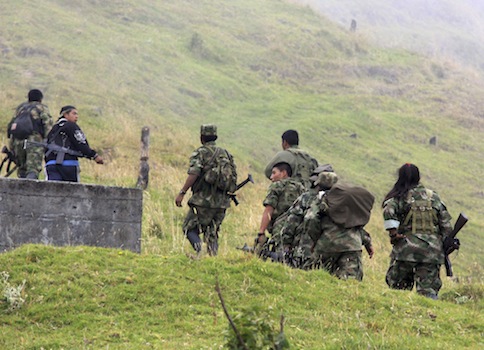
Guerrillas of the Revolutionary Armed Forces of Colombia, FARC linked to Hezbollah

Guerrillas of the Revolutionary Armed Forces of Colombia, FARC / AP

BY:
February 4, 2014 6:00 pm

Iran and its terrorist proxy groups’ influence in Latin America remains a troubling security threat to the region and world, experts said at a congressional hearing on Tuesday.

Hezbollah, a Shiite terrorist group based in Lebanon and sponsored by Iran, has established illicit networks in Latin America in the last few decades to provide millions annually for its global operations, experts on the region told the House Foreign Affairs Subcommittee on Terrorism, Nonproliferation, and Trade.

Those networks involve money laundering, counterfeiting, piracy, and drug trafficking in cooperation with local criminal groups like the Revolutionary Armed Forces of Colombia (FARC).

Celina Realuyo, assistant professor of national security affairs at the National Defense University, said the “convergence” of terror and crime networks in Latin America presents a significant threat to regional and global security.

“These types of illicit actors, terror providers, and criminals, a lot of them are offering and brokering services but may not espouse the ideological fervor that other groups have,” she said. “But they’re offering a lot of special services—a terror pipeline—where you see this very unholy alliance between terror groups and criminal groups who have a win-win.”

The witnesses’ testimony on Tuesday appeared to contradict a State Department report issued last year that downplayed the threat of Iran and Hezbollah in the Western Hemisphere and was sharply criticized by some lawmakers and terrorism experts.

Realuyo said a lot of fundraising for Hezbollah in the region cannot be “separated out” from the illicit operations of local criminal groups.

Douglas Farah, senior associate at the Center for Strategic and International Studies’ Americas Program, added that just because ties between Hezbollah and groups like FARC seem opaque does not mean they are nonexistent.

“It’s hard to get through the policy perception that [they’re] not there,” he said.

Realuyo pointed to three recent cases as evidence of the links between Hezbollah and criminal groups in Latin America.

The first was Operation Titan, a two-year joint U.S.-Colombian investigation in 2008 that revealed a multi-million dollar cocaine trafficking operation stretching from Panama to Hong Kong. Chekry Harb, a Lebanese kingpin in Colombia contributed about 12 percent of the drug trafficking ring’s profits to Hezbollah.

Ayman Joumaa, another Lebanese drug kingpin, allegedly shipped tens of thousands of kilograms of cocaine into the United States from Colombia. The drugs were distributed through Central America to the Zetas cartel in Mexico, operations that enabled Joumaa and his associates to launder more than $850 million through front companies like the Lebanese Canadian Bank (LCB)

Joumaa was indicted in 2011 but remains at large.

The Beirut–based LCB served as a conduit for money laundering and fundraising for Hezbollah and had more than $5 billion in total assets in 2009. It was disbanded after reaching a $102 million settlement with U.S. prosecutors last year.

Fatah noted that Hezbollah operatives have also been indicted for attempting to sell weapons from the terrorist group to FARC.

Latin American countries ultimately act as “safe havens” that help Iran evade international sanctions, Fatah added.

The experts said U.S. officials and lawmakers must remain vigilant in monitoring the terror-crime nexus in Latin America.

While joint U.S. intelligence operations with countries in South America have had some success in combating drug trafficking and violent crime, they said many operations have now moved to Central American countries such as Honduras and El Salvador.

“As Colombia and Peru become much more effective in terms of having real assets and growing economies, Central America has become the new ungoverned territory for these cartels,” Realuyo said.

Off Topic: Is the White House Practicing Photo-Op Diplomacy?

February 5, 2014

Off Topic: Is the White House Practicing Photo-Op Diplomacy? – The Fiscal Times.


iStockphoto
 

The Fiscal Times

February 4, 2014

In his State of the Union address delivered last week, President Obama talked at length about domestic issues–income inequality, health care, jobs and education.  Foreign policy issues, including the continuing war in Afghanistan, the crisis in Syria, and talks over Iran’s nuclear program were given lip service at the end of his speech.

One of the reasons for this is that Americans have grown tired of a decade of endless war—and domestic policy matters much more to voters than foreign policy. But a careful read of Obama’s speech shows that the only firm promise he made was not to send troops into harm’s way.

Related: The Coming Bloodbath in Syria

“As commander in chief, I have used force when needed to protect the American people, and I will never hesitate to do so as long as I hold this office. But I will not send our troops into harm’s way unless it is truly necessary, nor will I allow our sons and daughters to be mired in open-ended conflicts,” Obama said. “We must fight the battles that need to be fought, not those that terrorists prefer from us — large-scale deployments that drain our strength and may ultimately feed extremism.”

This line is indicative of a growing trend within the White House. Obama and his advisers spend a lot of time talking about what they’re not going to do. They rarely talk about what they are going to do, what they hope to achieve by doing it, and the reasons behind the action.

Brian Katulis, a senior fellow for national security at the Center for American Progress, expressed this view in a Washington Post op-ed last week. Katulis argued that Obama’s failure to outline a more cohesive foreign policy “underscores a crisis of purpose about U.S. engagement in the world.”

The president needs to be more specific when addressing foreign policy, Katulis said. Even his promise not to send troops into harm’s way is vague — what constitutes an event that is significant enough to put American in harm’s way?

Related: Why Iran Is Now Obama’s Best Middle East Bet

For instance, Obama threatened military force against Syrian President Bashar Al Assad used chemical weapons, but failed to act when evidence of their use emerged. At the same time, he ordered Navy SEALs into Somalia to fight al Shabaab after an attack on a mall in Kenya – an attack that killed no Americans.

“To advance his national security agenda in the next three years, Obama should offer a more cohesive strategic argument for global engagement, one that more clearly articulates the values informing his policies,” Katulis wrote. “It won’t be sufficient for the administration to state how the president intends to approach particular national security questions: He needs to articulate why they matter and what’s at stake.”

Evidence Abounds

Katulis is traveling in Europe and was not able to comment. But evidence of U.S. disengagement, and our failure to offer specifics on how we intend to execute a foreign policy agenda, is everywhere.

For instance, the entire Middle East is in a period of upheaval that the Obama administration seems powerless to shape. The White House has been unable to stop bloodshed in Syria, and negotiations to end the conflict are floundering. Two Senators now claim that Secretary of State John Kerry said that the United States failed in Syria, a characterization that the White House disputes.

At the same time, Iraq continues to descend into chaos as Washington offers only supplies and weapons while al Qaeda continues to make gains. Turmoil also continues in Egypt, as supporters of the government backed by Washington and deposed last year continue to struggle against the military.

In Afghanistan, the United States has yet to articulate a clear policy on what happens when the majority of troops leave this coming summer. Part of this is the fault of Hamid Karzai, the Afghan president who has refused to make an exit deal. But part of it also comes from internal fights within the administration about the future of the country.

Photo-Op Diplomacy

To be sure, the United States is engaged in some foreign policy matters. Kerry has rebooted peace talks between the Israelis and the Palestinians, and diplomats are currently engaged in trade talks with Asian and European nations. But Robert Zarate, policy director of the Foreign Policy Initiative, said that these are exceptions to the rule.

“The bottom line is that President Obama is pursuing American minimalism,” he said. “He’s replacing policy with process.”

The two biggest examples of this are Iran and Syria, he said. The United States appears to be engaged because it’s participating in the talks. But that’s just process; the American end game, in each case, is unclear.

“The president, to this day…I don’t understand what he’s doing. The president didn’t want to get involved, period. The red line was just a figure of speech. I speculate that he thought that his bluff is enough,” Zarate said.

“I don’t think they think this stuff through a lot,” he added. “It’s photo-op foreign policy, and it’s the same situation with Iran. We’re just negotiating, not trying to force an outcome.”

Iran Nuclear Substance Could Face New U.N. Scrutiny

February 4, 2014

Iran Nuclear Substance Could Face New U.N. Scrutiny – Global Security Newswire.

Feb. 4, 2014

International Atomic Energy Agency Director General Yukiya Amano, left, attends a panel discussion with Iranian Foreign Minister Mohammad Javad Zarif on Saturday at the Munich Security Conference. Amano suggested his agency could further question Iran over past work involving a key nuclear substance.

International Atomic Energy Agency Director General Yukiya Amano, left, attends a panel discussion with Iranian Foreign Minister Mohammad Javad Zarif on Saturday at the Munich Security Conference. Amano suggested his agency could further question Iran over past work involving a key nuclear substance. (Christof Stache/AFP/Getty Images)

Iran could face new international scrutiny over previous activities tied to a potential ingredient for initiating nuclear detonations, Reuters reports.

The International Atomic Energy Agency might discuss Iran’s past work with polonium 210 at a Saturday meeting with Iranian delegates, the news agency reported on Monday, citing recent comments by IAEA Director General Yukiya Amano. The U.N. organization is seeking to shed light on Iran’s atomic ambitions by investigating allegations that the Middle Eastern nation may once have conducted experiments relevant to nuclear-bomb development. Tehran insists its atomic activities are nonmilitary in nature.

“Polonium can be used for civil purposes like nuclear batteries, but can also be used for a neutron source for nuclear weapons. We would like to clarify this issue,” Amano said at the Munich Security Conference this past weekend.

The U.N. agency in 2008 said it was satisfied with prior Iranian disclosures tied to polonium, and the IAEA chief’s reason for calling new attention to the rare substance was uncertain. A number of Iranian researchers in the 1980s had suggested pursuing an investigation on generating the material, but the effort ended prematurely following the departure of a key scientist, according to past disclosures reported by the agency.

The 2008 statement said the agency would also continue its probe on the matter with the intention of verifying its initial conclusions. Mark Hibbs, a nuclear expert with the Carnegie Endowment for International Peace, said Amano’s organization might have obtained new data pertaining to Iran’s work with the substance.

IAEA spokeswoman Gill Tudor, though, said the polonium issue was not new.

“The agency is keeping an eye” on the matter, and its understanding would “benefit from further clarification,” she said.

Meanwhile, Iran has gained access to $550 million in previously restricted funds under a six-month accord with the five permanent U.N. Security Council member nations and Germany, Reuters reported on Monday.

Tehran agreed in November to restrict some of its nuclear activities in exchange for curbs on international economic pressure. The United States and other nations hope the interim arrangement will pave the way for long-term restrictions aimed at preventing any Iranian actions to develop nuclear arms.

Iranian Ballistic Missile Program Can Continue Under Deal

February 4, 2014

Iranian Ballistic Missile Program Can Continue Under Deal – The Washington Free Beacon.

U.S. Negotiator Wendy Sherman: ‘We’ve not shut down’ Iran’s nuke delivery program 

Wendy Sherman / AP

Wendy Sherman / AP

BY:
February 4, 2014 12:47 pm

The U.S.’s top nuclear negotiator admitted on Tuesday that Iran could continue developing ballistic missiles under the recently inked nuclear accord meant to scale back Tehran’s nuclear program.

Under pressure from the Senate Foreign Relations Committee (SFRC), U.S. negotiator Wendy Sherman conceded that the U.S. failed to “shut down” Iran’s ongoing development of ballistic missiles, which have long range capabilities and are the preferred weapon for delivering a nuclear payload.

“It is true that in these first six months we’ve not shut down all of their production of any ballistic missile that could have anything to do with delivery of a nuclear weapon,” Sherman told lawmakers during a hearing on the nuclear deal. “But that is indeed something that has to be addressed as part of a comprehensive agreement.”

This comprehensive agreement will not be agreed upon for at least six months, Sherman admitted, giving Tehran a lengthy window in which to perfect its weapons systems.

Iran plans to launch three new satellites into space in the coming weeks, according to regional reports. The technology used to conduct such a launch is similar to those used for ballistic missiles, leading experts to label Iran’s space program a cover for its ballistic missile work.

The “satellites are ready for launch and it is anticipated that one of them will be sent into orbit by the end of the current Iranian year,” which ends of March 20, the deputy head of Iran’s Space Agency was quoted as saying on Monday by the semi-official Fars News Agency.

Senators on the SFRC criticized Sherman, the State Department’s under secretary of state for political affairs, for inking a deal that they said leaves gaping “loopholes” on which Iran can capitalize.

“Why did you all not in this agreement in any way address the delivery mechanisms, the militarizing of nuclear arms, why was that left off since they [Iran] breached a threshold everyone acknowledges. They can build a bomb. We know that,” said Sen. Bob Corker (R., Tenn.), the committee’s ranking member. “They know that. They have advanced centrifuges. We have a major loophole in the research and development area that everyone acknowledges.”

“We are going to allow them over this next year to continue to perfect the other piece of this, which is the [nuclear] delivery mechanism,” Corker added. “Why did we do that?”

Sen. Marco Rubio (R., Fla.) pointed out that “few countries” in the world possess both the ability to enrich uranium to high levels and an advanced ballistic missile program.

If Iran is awarded right to continue its enrichment, and continue its missile program, all it would have to do is ramp up uranium production “and now they’re a nuclear power,” Rubio warned.

Sherman responded by stating that the ballistic missile program is secondary to its bomb-making capabilities.

“If we can get—and I don’t know whether yet if we will be successful—but if we can get to the verifiable assurance that they cannot obtain a nuclear weapon, if we know they cannot have a nuke weapon, then a delivery mechanism, as important as it is, is less important,” she said.

Sen. James Risch (R., Idaho) said he has been “disgusted” by the interim deal.

“I do not support what has been done,” he told Sherman. “I think this thing’s a disaster. I was stunned when I saw what the agreement was. I’ve been disgusted as we’ve gone forward.”

Sherman promised that Iran’s ballistic missile work would be addressed at a later time in a final agreement.

“We see this as a first step,” she said. “We don’t consider the gaps that exist loopholes because this is not a final agreement. This is a first step.”

Sherman said that the ballistic missile program would be rendered ineffective if the U.S. can successfully convince Iran to give up its nuclear program.

“If we are successful in assuring ourselves and the world community that Iran cannot obtain a nuclear weapon, then them not having a nuclear weapon makes delivery systems almost, not entirely, but almost irrelevant,” she said.

Sherman went on during the hearing to explicitly lay out some of the concessions that the U.S. hopes to win in a final deal.

Iran, she said, does not need to continue its work at the highly fortified Fordow facility. It also has no need for the partially constructed heavy water reactor at Arak.

She also said there is “no doubt” that Iran will have to scale back the number of nuclear centrifuges it is operating.

Kerry tells Iran that existing sanctions will stay in place as nuclear negotiations continue – Washington Post

February 4, 2014

Kerry tells Iran that existing sanctions will stay in place as nuclear negotiations continue – Washington Post.

By , Published: February 2

 Secretary of State John F. Kerry told Iran’s foreign minister Sunday that the United States will continue to enforce existing sanctions on Iran while bargaining over a deal to rein in Iran’s disputed nuclear program.The top U.S. and Iranian diplomats held a rare face-to-face meeting Sunday in Germany, the State Department said. The private meeting furthers a tentative warming between the two nations that began with the election last year of Iranian President Hassan Rouhani.
Kerry’s discussion with Iranian Foreign Minister Mohammad Javad Zarif was their first since the United States and Iran struck a temporary agreement that caps the most worrisome elements of Iran’s nuclear program in exchange for limited easing of global financial restrictions on Iran’s oil business. They also met in September at the United Nations to begin talks that Iran has sought as a way to end crushing economic sanctions.

“Secretary Kerry reiterated the importance of both sides negotiating in good faith and Iran abiding by its commitments” under that initial agreement, a senior State Department official said Sunday. “He also made clear that the United States will continue to enforce existing sanctions.”

The official spoke on the condition of anonymity to describe the closed-door meeting on the sidelines of an international security conference. The meeting lasted slightly longer than an hour, the official said.

The nuclear negotiations with Iran are politically sensitive at home, where many in Congress oppose the Obama administration’s strategy of limited easing of sanctions imposed in protest of a secretive nuclear program that Iran says has no military purpose.

Israeli Prime Minister Benjamin Netanyahu also opposed the interim, six-month deal as a giveaway to Iran. The United States and Israel have accused Iran of trying to build a nuclear weapon.

European Union foreign policy chief Catherine Ashton, who is leading negotiations with Iran on behalf of six world powers, called the one-on-one meeting “incredibly important” to build confidence for the larger negotiations set to begin Feb. 18 in Vienna.

The goal is a comprehensive agreement that ends a 10-year diplomatic impasse and ensures that Iran cannot quickly redirect its advanced nuclear development work to build a bomb. Kerry has repeatedly said negotiations will be extremely difficult.

Kerry and Zarif have portrayed the interim deal reached in November very differently for their respective publics. Kerry stresses that the deal forces Iran to stop uranium enrichment work considered the most likely to lead to a bomb and degrade its existing stocks of the most potent uranium. Zarif stresses the economic benefit to Iran and what he calls a recognition of Iran’s right to a continued homegrown uranium enrichment program.

Zarif said in an interview Saturday that Iran was not prepared to give up research on centrifuges used to purify uranium as part of a final nuclear deal.

“We are ready because we believe it is in our interests and we have no other intention. So theoretically it shouldn’t be that difficult,” Zarif told Reuters and International Media Associates, a television production company.

In Iran, Mehdi Karroubi, the 76-year-old former speaker of Iran’s parliament, was released from custody. The move is the first sign that Karroubi and former prime minister Mir Hossein Mousavi may be exonerated for leading the 2009 “Green Movement.”

Both men were accused of inciting massive street protests after the disputed reelection of President Mahmoud Ahmadinejad in 2009. Since the election of Rouhani as Iran’s president in June, there have been growing calls from reformists for the release of Mousavi and Karroubi.

Karroubi has been held under arrest in a heavily guarded state-controlled residence since 2011.

But in an interview Sunday with the official Iranian Student News Agency, Karroubi’s son, Hossein Karroubi, said that though his father returned home Saturday night, the elder Karroubi’s fate is still unclear.

“The groundwork for this transfer was done 10 days ago, and now he is living on the second floor and the security team are in a separate suite on the first floor. The security situation has not changed, just the location,” Hossein Karroubi said.

Jason Rezaian in Tehran contributed to this report.

Key senator: Sanctions after Iran talks fail might be too late

February 4, 2014

Key senator: Sanctions after Iran talks fail might be too late – The Jerusalem Post.

Pushback against White House during Senate hearing on Iran as senators say Tehran still conducting nuclear research during negotiations; chief negotiator Sherman says coming months will be test for the Islamic Republic

By MICHAEL WILNER
02/04/2014 19:00

US Congress
US Congress Photo: REUTERS

WASHINGTON — In a Senate hearing on negotiations with Iran on Tuesday, Foreign Relations Committee chairman Robert Menendez challenged US President Barack Obama on the weight of his vow to seek new sanctions against Iran should talks over its nuclear program fail.

Questioning Wendy Sherman, the chief US negotiator with Iran, Menendez (D-NJ) noted that Iran’s continued nuclear-related research and development would shorten the window of time required by the Islamic Republic to produce a nuclear weapon— even as negotiations take place.

“In reality, the only effect we have is over time,” Menendez said. “To enforce sanctions then would be far beyond the scope or the window.”

“It’s not simply about passing sanctions,” Menendez added. “It’s about the timeframe necessary to have them be effective.”

In his fifth State of the Union address, the president said he would be the first man in Washington to call for new sanctions if Iran fails to agree to a comprehensive nuclear accord satisfactory to the US and its allies.

In the same speech, he promised to veto any new sanctions legislation that might compromise the diplomatic process. Menendez introduced just such a bill in December that he described as an “insurance policy” for Congress. That bill has earned 59 cosponsors across party lines.

Midway through the hearing, Menendez pushed back against the Obama administration for referring to his strategy as tantamount to a “march to war,” a phrase stated multiple times by Jay Carney, the White House press secretary, after the bill’s rollout.

“I don’t believe any of you, any senator, any member of the House are warmongers. I don’t believe anyone prefers war,” Sherman agreed. “Tactical considerations may lead us to that choice. But that is an issue of tactics, not an issue of intent.”

Sherman conditioned her testimony by noting that she would not negotiate with Iran in public. But she noted that Iran’s scientists “cannot unlearn what they know” about nuclear weaponry, and that the US delegation was focused instead on preventing Iran from being physically able to build such a weapon.

“The coming months will be a test of Iran’s intentions,” she said.

Sherman defended a short-term nuclear agreement reached in Geneva in November between Iran and world powers, a negotiation she led personally.

“This is not perfect,” she said, referring to the six-month pause known formally as the Joint Plan of Action. “But we agreed on a six-month program that freezes where they are, and rolls back their program in significant ways.” The US would be willing to tolerate a “small, limited enrichment program,” Sherman added— a position vehemently opposed by Prime Minister Benyamin Netanyahu.

Menendez asked the lead diplomat to comment on recent statements by Iranian leaders, including Iranian President Hassan Rouhani and Iranian Foreign Minister Mohammad Javad Zarif, that the Islamic Republic would never dismantle its expansive centrifuge program.

“It is their maximalist negotiating position,” Sherman said, chalking up the comments to political talk for domestic consumption. “I wouldn’t expect any less.”

Also testifying was David Cohen, under secretary for terror and financial intelligence at the Treasury Department, who repeated the administration’s assertions that most sanctions against Iran would be vigorously enforced.

But Senator Jeanne Shaheen (D-NH) asked Cohen whether European allies would comply just as well, noting that “expansive EU trade delegations” were preparing to travel to Tehran to explore newfound business opportunities.

“If these talks turn into deals that violate the elaborate sanctions we have in place, then we’ll take action,” Cohen said, repeating that Iran “is not open for business.”

Ranking member of the committee, Senator Bob Corker (R-TN), said he was concerned that the interim agreement would gel into a new status quo.

“Somehow, because Congress wants to ensure that we end up with a proper end state, there’s been a lot of unfortunate things that have been said,” Corker said, calling for continued pressure from his colleagues.

Corker is a strong supporter of Menendez’s sanctions bill, the Nuclear Weapon Free Iran Act of 2013, which would trigger new sanctions tools against Iran if a deal is not reached in one year.

In his opening remarks, Menendez tacitly ceded that Iran is already a nuclear-threshold state.

“If all we achieve is the essence of an early-warning system in Iran’s future break-out ability, and the sanctions regime has collapsed, and the only options for this or any future President is to accept a nuclear-armed Iran or a military option, in my view,” Menendez said, “that is not in the national security interests of the United States.”

“I know that is not anyone’s goal or plan, but I also think we need to guard against wanting a deal so much that we concede more than we gain,” he added.


